OUR VISIT IN TEHUAN-TEPEC
Reading edition
DEAR COUSINS:
MEXICO, who is our near neighbor—she lives just across the Rio Grande River from us,—has always before this time sent a good representation to Madame World’s fairs.
But this year she could not arrange to leave home, and some of her children were much disappointed, just as one would naturally expect, when they had their minds all made up to come. We can quite understand it.
So one little village said, “Oh, Mother Mexico, please let us go to our Cousin America’s party?”
Mothers always enjoy making their children happy, we are glad to have observed, so Senora Mexico told the little village if it would be good and keep its face and hands clean, and not ask for more than one helping of cake and ice-cream that it might go to the party. So it came, and one evening we went up to call. It lives on a very noisy street called “The Zone,” but after we were inside the gates we did not even hear the noise.
It is quite the quaintest little village we have ever been in. They have a dear little theatre, not a movie, but a real play theatre, which pleased us because we like regular plays much better than pictures. It seems more like really doing things, and we miss the voices so much in a movie.
They gave a play for us, in their own language, and it was very funny. We did not, of course, understand the words, but they laughed so much at it that we knew.
After the play we went to supper, which was cooked on a ’dobe stove, and served in a real kitchen in a real hacienda.
There is a real river of real water running through the village, and on it is a tiny barge full of green vegetables, showing how the gardener takes his produce to market. There were two big catfish in the river. We stood on the puente, which is Mexican for “bridge,” and watched the good ship Anita as it steamed into the harbor. We feared the catfish would capsize it.
Some of the people of the village have brought along their work, and we were much interested in the basket-making, and the weaving of the brilliant colored serapes, which the people wear instead of coats.
A Mexican grandmother gave us each a dear little vase of red pottery, and a feather picture of a blue jay. We hoped the picture was not made of a real blue jay’s feathers, because we are fond of him.
We found the village interesting. They bade us adios, and asked us to come again. Thank you, Mexico, we shall.
Your loving cousins, JANE AND ELLEN.
DEAR COUSINS:
WE DO not know where we have been more beautifully entertained than we were in Japan. A lovely little Japanese maiden with an embroidered robe told us a good many interesting things. One of them was about “Boy Day.”
It seems that in Japan all the boys have one birthday, that is, May fifth is set aside for a universal boys’ birthday. They have then a celebration, all over the nation, and it is what with us would be a bank holiday like Thanksgiving, or Decoration Day.
The carp is chosen for the emblem, because he is the Samurai, or warrior fish, because he is so full of courage, and figures of him are made of crepe and floated from bamboo poles, along with their flag.
On that day the boys are instructed in the standards of manhood as they are expected to live, and shown their ancestors’ great deeds as recorded in the family records.
We think we should not exactly care about a wholesale birthday, but the maiden said that the girls also have one, which is March third. A doll made like the small girl child is presented to her, and she is supposed to keep it until she grows up, so that her children may have it. Japanese people care a very great deal about their ancestors, and we suppose they feel about them as we do about our great-grandfathers who fought with George Washington.
We had Ceremonial Tea, in a lovely tea-garden, which was very beautiful, but of course we are not allowed to drink tea, but the cakes were interesting, and father said that budding authoresses should always absorb local color.
We think that we did that because we studied the flowers and shrubs very intently, and while father talked with the artist who was making lovely postal cards by painting scenes from the gardens we went out and traced to its source the laughing brook which was rushing through the grounds. It did not spoil it a bit for us to discover that the brook came from a water pipe sunk in the ground, because we understand of course that the gardens did not grow there of their own accord.
The Japanese people love beauty and always
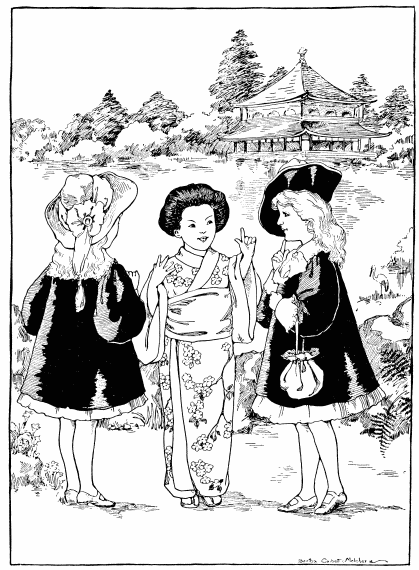
A lovely little Japanese maiden with an embroidered robe told us a good many interesting things.
create it wherever they may be living, and their gardens at the Fair are very wonderful. They have a dwarf evergreen tree which is said to be over one thousand years old. It is about as large as our Christmas tree is when we have a large one for both families.
In Japan, the silk culture occupies an important place. We saw some exhibits of it, and it seems to us that if we did not care so much about our native land that we might like to go and raise silkworms in Japan.
Your loving cousins, JANE AND ELLEN.
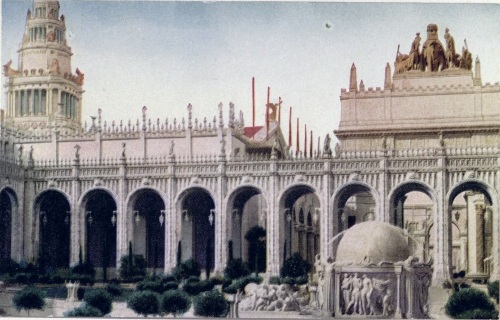
Section Court of the Ages, showing Tower of Jewels and Arch of the Rising Sun in distance. The Fountain of Earth in the foreground.