"CAN I BECOME A GRAND OPERA SINGER?"
Reading edition
THE average teacher, in fact, most teachers, will say, "Yes, if you study," but this is not true, as you have only about one chance in a thousand. Have you any idea of the requirements necessary in order to become a "star" of the Metropolitan Opera Company?
You must have a fine voice, a "big" voice, a voice of great power and endurance, fine enunciation, clear and correct pronunciation, knowledge of the modern languages, have at least twenty-five operas committed to memory, fine dramatic ability, good physique, size, personality and "pull." And you must also be on the other side of the ocean to accept the engagement; and then, your acceptance by a director to "star" is about as difficult as an audience with a king.
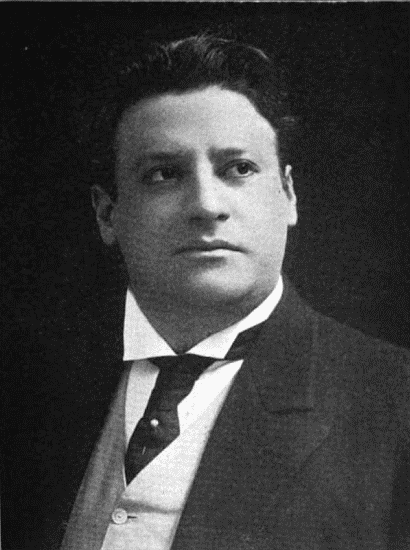
ALBERT MILDENBERG
The well known composer who has enaugerated a plan to establish Municipal Grand Opera in New York City. Mr. Mildenberg's experience as conductor in the Municipal Opera Houses in France and Italy has fitted him well for this laudable undertaking which will pave the way for the training and placing of many talented pupils in this country, who have heretofore been compelled to go abroad in order to secure positions on the Grand Opera Stage.
There is no reason why a person with voice and talent who has to make his own living, could not do so after several years of study. I have over one hundred pupils who are making a good living by singing, and as many more holding church positions paying them enough to enable them to continue their studies.
Show me a pupil who has to make his own living, and who has studied with one teacher for eight or nine years and is not making his living by singing, and you are showing me one who never will.
There is, of course, no end to the study of voice culture. I have studied more or less for over twenty years and am still studying, but if you have to make your own living, secure whatever position may be open to you. The church or concert position is equally valuable as the opera.
In Europe, where you hear grand opera all the year around, it becomes a second nature, but here in our western cities, until recently, grand opera was almost unknown; two or three performances a year was about all we could hope for. This was not enough to thoroughly acquaint the people with the operas, and not enough to create a demand.
In a western city of 200,000 inhabitants where five years ago it was impossible to draw an audience of a hundred persons unless heralded by spectacular advertising, I had the pleasure of witnessing this year "Standing Room Only" during the performance of the dear old operas, Il Trovatore, Faust and Carmen. The operas that the people have become acquainted with through the phonographs, the orchestras and the grand opera study clubs, organized by the more up-to-date teachers. Mr. Albert Mildenberg is taking up a most commendable work, that of establishing the municipal grand opera in New York City; he will eventually succeed, and, with Herr Andreas Dippel organizing permanent grand opera in the larger cities west of New York, it will not be long before the grand opera positions will be plentiful. Within the next year, through the efforts of Victor Maurel, the grand opera sung in English will also gain ground, and divide honors with the French, German and Italian, giving those who have not studied the foreign languages, but who are otherwise prepared, a chance for positions on the grand opera stage.
Some cranks insist that the days of the old Italian opera, with its arias and glorious coloratura work, are passing in order to give place for the new music drama. This is not correct, and will not be possible as long as there are excellent singers who can sing these operas. We have room for both the grand opera and the music drama.
To be an "artist" is the aim the student has in view, and "study" is the means to that end.