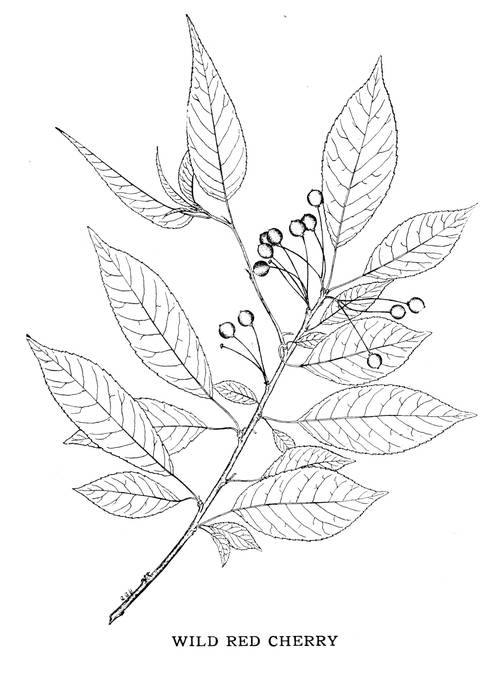
CHOKE CHERRY
Reading edition
Prunus virginiana, L.
Form.—Height 15-30 feet, diameter 6-12 inches; trunk usually short with a rounded crown.
Leaves.—Alternate, simple, 2-4 inches long, oval, oblong, or obovate, abruptly pointed, very sharply serrate, with slender teeth, glabrous, dull dark green above, paler beneath.
Flowers.—May-June; perfect; about ½ inch broad, white, arranged in a drooping, many-flowered raceme 3-6 inches long.
Fruit.—Ripens in late summer; a globular, dark crimson drupe, borne on short pedicels in drooping clusters, astringent.
Bark.—Smooth, dark gray, somewhat roughened on old trunks by shallow fissures. Inner bark has a disagreeable odor.
Wood.—Heavy, hard, close-grained, light-brown; sapwood light colored.
Range.—Newfoundland to Manitoba, south to Georgia and Texas.
Distribution in West Virginia.—Rare in most sections. Scattered trees grow at high elevations along the Alleghanies. Most common and of largest size on the borders of swamps from Cranesville, Preston County, southward to Canaan Valley, Tucker County.
Habitat.—Prefers damp soils of swamp borders, streams and thickets.
Notes.—The Choke Cherry is in no sense a timber tree but is attractive when growing wild or planted.