APPENDIX I (continued 2)
Reading edition
Old traders I met with in the early sixties informed me that during one of these wars, between the years 1820 and 1830, the king Pepple, then reigning in Bonny succeeded in capturing the king of Calabar of that time (the grandfather of the last king Amachree), and to celebrate his victory and royal capture, made a great feast to which he invited all the European slave traders then in his country. The feast was a right royal one, the king had a special dish prepared for himself which was nothing less than the heart of his royal captive, torn from his scarcely lifeless body.
The New Calabar people, though said to be descended from the Old Calabar race, have not retained any of the characteristics of the latter, neither in their language nor dress, nor have they retained the elaborate form of secret society or native freemasonry peculiar to the Efik[86] race called Egbo.
Their religion is the same animistic form of Ju-Juism and belief in the oracle they call Long Ju-Ju situated in the vicinity of Bende in the hinterland of Opobo, common to all the inhabitants of the Delta; besides the latter, they are believers in the power of a Ju-Ju in some mystic grove in the Oru country. The peculiar test at this latter place is said to have been established by some ancient dame having uttered some fearful curse or wish at the spot where the ordeal is administered. The descriptions of this are rather vague, as no one who has undergone it has ever been known to return, that is, if he has really seen the oracle work, for if it works it is a sign of his guilt and drowns him; if he is innocent it does not work, so on his return he is not in a position to describe it. But the proprietors of this interesting Ju-Ju have for very many years found that a nigger fetches a better price alive than when turned into butcher’s meat; they have therefore been in the habit of selling the guilty victim into slavery in as far distant a country as possible; but occasionally one of these men have drifted down to the coast again, but dare not return to his own country as no one would believe he was anything else but a spirit. One of these “spirits” I had the pleasure to interview on one occasion, and he told me that the only ones who were actually drowned were the old or unsaleable men; when two men went to this Ju-Ju or ordeal well, to decide some vital question between them, the party taking best would want to see his dead or drowned opponent; for this purpose the Ju-Ju priests always kept a few of the old and decrepit votaries on hand to be drowned as required, but the opponent was never allowed to stand by and see the oracle work, but was taken up to the well and allowed to see a dead body lying at the bottom, and after he had glanced in and satisfied himself there was a drowned person there, he would be hurried away by the Ju-Ju priests and their assistants. That these priests had the supernatural power to make the water rise up in the well, this “spirit” thoroughly believed, and when I offered the suggestion of an underground water supply brought from some higher elevation, he scouted the idea and gave me his private opinion thus: “White man he no be fit savey all dem debly ting Ju-Ju priest fit to do; he fit to change man him face so him own mudder no fit savey him; he fit make dem tree he live for water side, bob him head down and drink water all same man; he fit make himself alsame bird and fly away; you fit to look him lib for one place and you keep you eye for him, he gone, you no fit see him when he go.”
Which little speech turned into ordinary English meant to say that white people could not understand the devilish tricks the Ju-Ju priests were able to do, they could so disguise a person that his own mother would not recognise him, this without the assistance of any make-up but simply from their devilish science; that they could cause a tree on the banks of a river to bend its stem and imbibe water through its topmost branches; that they could change themselves into birds and fly away; and lastly, that they could make themselves invisible before your eyes and so suddenly that you could not tell when they had done so.
I asked him why the Ju-Ju man had not altered him, so that when he sold him it would be impossible for any one who had known him in his own country ever to recognise him if they saw him in another. His reply was: “Ju-Ju man savey them man what believe in Ju-Ju no will believe me dem time I go tell dem I be dem Osūkū of Young Town come back from Long Ju-Ju. He savey all man go run away from me in my own country.” “Well,” I said, “how about the people amongst whom you now are? they believe in very nearly the same Ju-Jus that your own people do, what do they say about you?” “Oh! they say I be silly fellow and no savey I done die one time, and been born again in some other country.” I then asked him how they accounted for his knowing about the people who were still alive in his own country and to be able to talk about matters which had taken place there within the previous five or six years. Then I got the word the inquirer in this part of the world generally gets when he wishes to dive into the inner circles of native occultism, viz., “Anemia,” which means “I don’t know.”
The chiefs in New Calabar in the days of the last king’s father were an extremely fine body of men, both physically and commercially; the latter quality they owed to the strong hand the king kept over them, and the excellent law he inaugurated when he became the king with regard to trade, viz., that no New Calabar chief or other native was allowed to take any goods on credit from the Europeans. His power was absolute, and considering that he inherited his father’s place at a time when the country was in the throes of war with Bonny—his father being the king captured by the king of Bonny mentioned previously—the success of his rule was wonderful, for he pulled his country together and carried on the war with such ability that Bonny ultimately was glad to come to terms; a peace was agreed upon which lasted many years, until the old king of Bonny died, and his son wishing to emulate his father re-opened hostilities, but with such ill-success and loss to his country that it eventually led to his being deposed and exiled from his country for some years.
The New Calabar people are and have been always great believers in Ju-Juism, the head Ju-Ju priest being styled the Ju-Ju king and ranking higher than the king in any matters relating to purely native affairs.
The shark is their principal animal deity, to which they were in the habit of sacrificing a light-coloured child every seven years. This used to be openly and ostentatiously performed by a procession of a half-dozen large canoes being formed up at the town of New Calabar, each canoe being manned by forty to fifty paddlers; in the midships of each canoe a deck some ten feet long would be placed on which the Ju-Ju priests and a number of the younger chiefs and the grown-up sons of the chief men would huddle together and keep up a continuous howling and dancing, accompanied with the waving of their hands and handkerchiefs, until they arrived down near the mouth of the river. When the water began to be so rough that the singers and dancers could not keep their feet, it was a sign the offering must be cast into the sea; the Ju-Ju men and their assistants all supplicating their friend the shark to intercede with the Spirit of the Water to keep open the entrance to their river and cause plenty of ships to come to their river to trade.
Their Ju-Ju house in their original town was a much larger and more pretentious edifice than that of Bonny, garnished with human and goats’ skulls in a somewhat similar manner, unlike the Bonny Ju-Ju house in the fact that it was roofed over, the eaves of which were brought down almost to the ground, thus excluding the light and prying eyes at the same time; at either side of the main entrance, extending some few feet from the eaves, was a miscellaneous collection of iron three-legged pots, various plates, bowls and dishes of Staffordshire make, all of which had some flower pattern on them, hence were Ju-Ju and not available for use or trade—the old-fashioned lustre jug, being also Ju-Ju, was only to be seen in the Ju-Ju house, though a great favourite in Bonny and Brass as a trade article—at this time all printed goods or cloth with a flower or leaf pattern on them were Ju-Ju. Any goods of these kinds falling into the hands of a true believer had to be presented to the Ju-Ju house. As traders took good care not to import any such goods, people often wondered where all these things came from. Had they arrived shortly after a vessel bound to some other port had had the misfortune to be wrecked off New Calabar, they would have solved the problem at once, for anything picked up from a wreck which is Ju-Ju has to be carried off at once to the Ju-Ju house. I remember on one occasion visiting this Ju-Ju house just after a large ship called the Clan Gregor bound into Bonny had been wrecked off New Calabar, and found the Ju-Ju house decked both inside and out with yards of coloured cottons from roof to floor; but the Ju-Ju priests did not get all their rights, for some tricky natives on salving a bale of goods would carefully slit the bale just sufficiently to see what were the goods inside, and should they be Ju-Ju would not open them, but take them to their particular friend amongst the European traders, and get him to send them away to some other river for sale on joint account.
Every eighth day is called Calabar Sunday, the day following being formerly the market day or principal receiving day for the white traders of the native produce, which consisted principally, and still does, of palm oil. The native Sunday was passed in olden days by the chief in receiving visits from the white men and jamming[87] with them for any produce he had the intention of selling the following day, or clearing up any little Ju-Ju matters that he had been putting off for the want of a slack day, not because it was his Sunday, but because that was a day on which by custom he could not visit the ships. I remember it was on paying a visit to old King Amachree, the father of the late king of the same name, I saw for the first time a native sacrifice. I was then little more than a boy as a matter of fact, I was under seventeen years of age, but filling a man’s place in New Calabar who had been invalided home. The old king had taken me under his special protection and gave me much good advice and counsel, which was of great use to me in my novel position. My employers ought to have been very thankful to him, for though I was the youngest trader in the river by some twelve years, I held my own with them and got a larger share of the produce of the river than my predecessor had done, all owing to the old brick of a king, who would come and see how I was doing on the big trade days, and if he thought I was not doing as well as my neighbours he would send off a message to a small creek close to the shipping, where the natives used to wait with their oil until it was jammed for, id est, agreed for, and order three or four canoes of oil to be sent off to me, though I had not seen its owner to agree with him as to what he was to get for it. I held this appointment for a little over six months, when, my senior having returned, I had to go back to my duties in Bonny under the chief agent of the firm, a Captain Peter Thompson, one of the kindest-hearted skippers that ever entered Bonny river. In those days we all had some nickname that we were known by amongst the natives, and another amongst the white men. Amongst the former he was called Calla Thompson, because he was short, in contradistinction to another Thompson who was tall, called Opo Thompson; but his name amongst the white men was Panter Thompson, owing to his inability to pronounce the “th” in panther during a discussion as to whether we had tigers or only panthers on the West Coast of Africa. Poor Panter, after a most successful voyage of a little over two years, was preparing to return home, and had only a few more weeks to remain in Bonny, when in stepping into his boat his foot slipped and he fell into the river at a point known to be infested with sharks. A brother skipper jumped into the boat, and actually clutched him by his cap at the same moment poor Panter said “I am gone, Ned!” no doubt feeling himself being drawn down by some hungry shark.
His son now commands one of the finest steamers of the African Steamship Company, and seems to have inherited in a marked degree all the good qualities of his father; so, travellers to West Africa, if you want a comfortable ship and a thorough good fellow to travel with, take your passage in the ship commanded by Captain Willie Thompson, R.N.R.
But this is digressing. I must get back to New Calabar and tell you what I saw at my introduction to Ju-Juism under the auspices of dear old King Amachree. The occasion was the swearing Ju-Ju with some people in the interior, with whom they had only lately opened up commercial relations, and they wanted them to swear they would trade with no other people but them. The deputation, who represented the market people, looked as wild a lot as one could wish to see, and, as far as I could make out, the ceremony I was watching was a kind of preliminary canter to a more impressive, and most likely more diabolical one to be carried out at some future date in the stranger folks’ country. On this occasion the officiating Ju-Ju priest did not seem to address any of his words to the strangers, who looked on with a certain amount of fear depicted in their countenance.
The Ju-Ju priest was clothed (?) in a superb dark-coloured and greasy-looking rag about his loins, barely sufficient to satisfy the easiest going of European Lord Chamberlains; but from the expressive grunts of satisfaction which greeted his appearance in the Ju-Ju house, I was led to suppose his dress was quite correct and proper for the occasion. His head was shaved on the right side, and all down his right side and leg he had been dusted over with some greyish-white native chalk. He said a few words in an undertone to one of his assistants, who went out of sight for a moment or so and quickly returned with a very fine almost milk-white goat, the poor beast seeming to anticipate its fate from its fearfully loud bleating. The Ju-Ju priest seized the poor beast by its muzzle with his left hand, and dexterously tossing its body under his left arm, forced its head back towards his left shoulder until the neck of the beast formed an arc, his assistant handing him at this moment a very sharp white-handled spear-pointed knife, which he drew across the animal’s throat, almost severing its head from its body. Quick as lightning he dropped on one knee and held the bleeding animal over a receptacle, having the appearance of a large soup plate, fashioned in the clay of the ground immediately in front of the altar arrangement. In the centre of this plate was a hole down which the quickly coagulating blood slowly trickled; after the interval of what appeared to me minutes, but was in fact most likely less than a minute, the Ju-Ju man laid the lifeless body of the goat down with its neck over the opening in the plate, leaving it there to drain. At the moment of the sacrifice various gongs and old ship bells were struck by young men stationed near them for that purpose—a wrecked ship’s bell being generally presented to the Ju-Ju house, though not as in the case of Ju-Ju goods by law prescribed. New Calabar people had been fairly well observant of this custom, and the wrecks numerous, judging from the number of ships’ bells in the Ju-Ju house. At every movement of the Ju-Ju priest the king and chief would grunt out a noise very much resembling that auld Scotch word “ahum.”
The Ju-Ju house had amongst its possessions several ill-shapen wooden idols, and scattered about the affair that represented an altar were various small idols looking very much like children’s dolls; also several large elephant’s tusks, and two or three very well carved ones, with the usual procession of coated and naked figures winding round them.
The present king of New Calabar[88] is a son of my old friend King Amachree, and is called King Amachree also, but has shown little of the ability of his late father, being completely led by the nose by his brother George Amachree, who practically rules both king and people.
The former is a small, quiet, and rather amiable man, but of a vacillating and unreliable character; his brother and prime minister is, on the contrary, a tall and very fine specimen of the negro race, endowed by nature with a very suave and not unmusical voice, a very able speaker, clear and logical reasoner, but of a very grasping nature—an excellent and successful trader and exceedingly nice man to deal with, as long as he has got things moving the way that suits him and his policy; but when thwarted in his designs, trading or political, he becomes a difficult customer to deal with, and a very unpleasant and objectionable type of negro “big man.” Nevertheless, had he had the fortune to have been born in a civilised Africa, I feel confident his natural abilities, assisted by education, would have made him a man of eminence in whatever country his lot might have been cast.
Most of the New Calabar chiefs bear a very favourable repute amongst the white traders, and compare very favourably intellectually with the neighbouring chiefs of the Niger Delta.
Another chief of no mean capacity is Bob Manuel, of Abonema, exceedingly neat, almost a dandy in appearance, a very shrewd trader, clear and concise in his speech, honourable in all his dealings, of a very reserved temperament; but a charming man to talk with, once started on any topic that interests him or his visitor.
Owing to some peculiarities in their dress, the New Calabar chiefs are very different to the chiefs in other parts of the Delta. They never appear outside of their houses unless robed in long shirts (made of real india madras of bold check patterns, in which no other colour but red, blue and white is ever allowed to be used) reaching down to their heels; under this they wear a singlet and a flowing loin cloth of the same material as their shirts. Of late years, during the rainy season, some of them have added elastic-side boots and white socks, but the most curious part of their get-up is their head-gear, for since about 1866 they have taken to wearing wigs. These are only worn on high days and holidays and at special functions, but the effect sometimes is so utterly ridiculous as to be more than strangers can look at without laughing. Imagine an immensely stout and somewhat podgy negro with elastic-side boots, white stockings, long shirt, several strings of coral hung round his neck and hanging in festoons down as far as where his waistcoat would end, did he wear one, a Charles II. light flaxen wig, the latter topped up by an ordinary stove-pipe black silk hat!
This fashion of wearing wigs, I am afraid, was unconsciously inaugurated by me, having taken with me in 1865 to New Calabar some wigs that I had used in some private theatricals in England. A chief named Tom Fouché saw them, and was enchanted with a nigger’s trick wig, the top of which could be raised by pulling a hidden silk cord, and eventually he became the proud possessor of my stock, and produced a great sensation the first public festival he appeared at. Previous to this I never saw a wig in New Calabar; as a matter of fact, they have no excuse for them, a bald-headed native being an almost unheard-of curiosity, and grey or white heads are very scarce. Alas! like all pioneers, I did not reap the reward I should have done, as I left the New Calabar river before the fashion had caught on, and Messrs. Thomas Harrison and Co., of Liverpool, became the principal purveyors of wigs to the Court of New Calabar.
These people are remarkable for the bold stand they have made against the persecution of their neighbours almost from the day their founder planted his foot on the New Calabar soil, or mud rather, I should say; besides their wars with the Bonny men, they were often attacked by the Brass men, allies of Bonny. With the Okrika men they were almost constantly at war. This latter was a kind of guerilla warfare carried on in the creeks, and consisted in seizing any unprotected small canoe with its crew of two or three men or women and cargo, the latter generally being yams or Indian corn, the custom being on both sides to eat these prisoners.
The Church Missionary Society established a mission here in 1875, but during the war of 1879 and 1880 the missionary had to leave. Their success had not been brilliant up to this date, owing, no doubt, in some measure, to the immense power wielded by the Ju-Ju priests in New Calabar.
It was not until 1887-8 that the missionaries were able to again commence their labours amongst these people, and then not in the principal town. Archdeacon Crowther, however, succeeded about this time in getting a plot of ground in Bob Manuel’s town, Abonema, for the purpose of building a mission station. As to the success of this last effort I can’t speak from personal observation, as I left this river shortly afterwards myself; in fact, it was on my last visit to Abonema that I conveyed in my steamer, the Quorra, the missionary and his wife to their new home from Brass. They were a young couple of very well educated and most intelligent Sierra Leone natives.
BONNY AND THE PEPPLE FAMILY
This river was the most important slave market in the Delta, as a matter of fact surpassing in numbers of slaves exported any other single slave-dealing station on the West or South-West Coast of Africa.
According to Mr. Clarkson, the historian of the abolition of the slave-trade, this river and Old Calabar exported more slaves than all the other slave-dealing centres on the West and South-West Coasts of Africa combined.
It is a well-known fact that for about two hundred years the average annual output of slaves through the Bonny River was about 16,000 (this included the shipments from New Calabar), totalling up to the immense number of 3,200,000 souls taken out of this part of Africa during two centuries.
The above figures do not represent the total depletion this part of Africa suffered during this time. To the above immense number of slaves exported must be added the number of lives lost in the raids made on the Ibo villages for the purpose of capturing the people to sell as slaves; we must also add the number that died on their way down from the interior to the coast, and to these again must be added the slaves refused by the European trader by reason of any defect, malformation, or incipient signs of disease. The fate of these poor souls was sad; but perhaps many of their brethren envied them their quick release from the cares of this world. The native slave-dealer was too practical a man to burden himself with mouths to fill that he could not immediately turn into cloth, rum, gunpowder or coral, so oftener than otherwise he would simply tell his own niggers to drop their canoe astern of the slave ship, cut the rejected slaves heads off, and cast their bodies into the river to feed the sharks, this often taking place within sight of the European slaver.
A very moderate allowance for loss of life between the interior and the slave-ship from the above-mentioned causes would be at the least 40 per cent.; thus totalling the immense number of 4,480,000 souls sent out of this one district in about two centuries. The greater number of these were Ibos, a slave much sought after in the olden days by planters in the West Indies and the Southern States of America.
I have mentioned these latter facts here to point out to my readers that the so-called benevolent domestic slavery as practised on the coast of Western Africa and tolerated in Her Britannic Majesty’s West African Colonies, must, as a natural consequence, lead to a deplorable loss of life, though not in so wholesale a manner as the export of slaves led to in former days.
The Bonny people claim to be descended from the Ibo tribe, but I should be inclined to think that their proper description to-day would be a mixture of Ibos, Kwos, Billa, and sundry infusions of blood from inter-marriage with the female slaves brought down by the slave-dealers from places lying beyond and at the back of the Ibo people.
Whatever their origin may have been, a commercial spirit is, and has been since their first intercourse with Europeans, a very highly developed trait in their character. As I have already shown, they were the greatest slave traders in Western Africa, and when that, for them, lucrative trade was finally put a stop to by the treaty signed on the 21st of November, 1848, between Her Britannic Majesty’s Consul and King Pepple, whereby King Pepple was to receive an annual present of $2,000 for six years—[previous to this, one, if not two treaties had been signed by King Pepple, with Her Britannic Majesty’s representatives, with the same object; but the greed of gain had been too much for his dusky Majesty, combined with the continued presence on the coast of the Spanish slave-dealers; one of the latter being established at Brass as late as 1844]—they then turned their whole attention to the legitimate trade of palm oil, and soon became the largest exporters of that article on the West Coast of Africa. Their trade in this article had not been inconsiderable since 1825, at which date the Liverpool merchants had seriously turned their attention to legitimate trade.
In 1837-38, the export of palm oil was already about 14,200 tons, all carried in sailing vessels principally owned in Liverpool, and mostly by firms that had been in the slave trade.
Like the natives of Brass, many of these people have embraced the Christian faith, the Church Missionary Society having placed one of their stations here in 1866, some two years earlier than the Brass Mission was commenced.
Their endeavours have certainly met with considerable success in prevailing upon a large number of the natives to give up many of their Ju-Ju practices; amongst others, the worship of the iguana, an immense lizard, which from time immemorial had been the Bonny man’s titular guardian angel. They not only got them to give up worshipping this saurian, but also, to mark a new departure in their religious ideas, the missionaries prevailed upon the people to organise a general iguana hunt; so, following the old saying of “the better the day, the better the deed,” one Easter Sunday, about the year 1883 or 1884, or about twenty-two years after the establishment of the mission, the bells of the mission church rang out the signal for the wholesale slaughter of these reptiles. To such an extent and with such good will did the people work that day, that by evening time not one was left alive in the town. That day it was everybody’s job to kill these reptiles, but it was nobody’s job to clear away the dead bodies, there being no County Council in Bonny to see to the scavenger work after this animal St. Bartholomew; the consequence was the stench was so great from the decaying bodies that every European predicted a general sickness would be the natural outcome of it all; but no such unlucky event happened, and the natives did not seem to notice the extra strong perfume very much—one of them observing, to a growl about it by a white man, that “it be all same them trade beef you sell we people for chop.”
The Bonny men until late years were steeped in all the most vile practices of Ju-Juism—sacrificing human beings to their various Ju-Jus, and eating all their prisoners captured in war, certain of their Ju-Ju practices demanding an annual human sacrifice. If at this time they happened to be at peace with their neighbours, and consequently without any prisoner to be sacrificed, the Ju-Ju men would disguise themselves in some fantastic dress (some Europeans have said they disguise themselves as leopards; I have never seen this disguise used, and doubt it very much), and prowl about the town and its byeways, seizing for their purpose in preference some stray stranger that might be staying in the town; failing a stranger, some noted bad character belonging to the town in whose fate no one would be greatly interested would be seized upon. To say these practices are completely stamped out would be, perhaps, not quite the truth; but that they are being stamped out I feel convinced, and considering what believers in Ju-Ju these people have been, I think I may say fairly quick.
The common sense of the people is assisting very much, and the women are showing themselves capable of something better than what their former state condemned them to. The final decision to slaughter the iguana some years ago was brought about by them in a great measure on solid common sense grounds, for had not the iguana been their mortal enemy for years by eating their fowls and chickens before their eyes, thus destroying about the only means a woman of the lower class, or one who had ceased to please her lord and master, had of making a little pin money.
The Ju-Ju house of Bonny, once the great show place of the town, has now completely disappeared and its hideous contents are scattered; strange to say, I saw, only a few weeks ago, in the house of a lady in London, one of the sacrificial pots of native earthenware that had done duty for many generations in the Bonny Ju-Ju House.
A description of this Ju-Ju house may be interesting to some of my readers. It was an oblong building of about forty feet long by thirty broad, surrounded by mud walls about eight or ten feet high; one portion over where the altar stood had had sticks arranged, as if the intention had been at some time to roof it over; at the end behind the altar the wall had been built in a semicircle; the altar looked very much like an ordinary kitchen plate rack with the edges of the plate shelves picked out with goat skulls. There were three rows of these, and on the three plate shelves a row of grinning human skulls; under the bottom shelf, and between it and the top of what would be in a kitchen the dresser, were eight uprights garnished with rows of goats’ skulls, the two middle uprights being supplied with a double row; below the top of the dresser, which was garnished with a board painted blue and white, was arranged a kind of drapery of filaments of palm fronds, drawn asunder from the centre, exposing a round hole with a raised rim of clay surrounding it, ostensibly to receive the blood of the victims and libations of palm wine.
To one side, and near the altar, was a kind of roughly made table fixed on four straight legs; upon this was displayed a number of human bones and several skulls; leaning against this table was a frame looking very like a chicken walk on to the table; this also was garnished with horizontal rows of human skulls—here and there were to be seen human skulls lying about; outside the Ju-Ju house, upon a kind of trellis work, were a number of shrivelled portions of human flesh.
Whilst writing about the wholesale slaughter of iguanas I forgot to mention that this was not the first time an animal that was Ju-Ju and held in high veneration had had a general battue arranged for it. The monkey used to hold a place in Bonny equal with the iguana, but for some reason or another it fell from its high estate, and was as ruthlessly slaughtered by its quondam worshippers.
Other Ju-Jus were the shark and the Spirit of the Water, or supposed guardian angel of the Bar. The bull was at one time worshipped, but not of late years; but still fresh beef was Ju-Ju, and twenty years ago no Bonny gentleman would touch it.
Like fresh beef, milk of cows or goats was never used by natives, neither were eggs eaten by Bonny men or any of the neighbouring coast tribes.
Native houses in Bonny are very little different to the general run of native houses along this coast, as far as the external appearance goes; but inside they are perfect Hampton Court mazes to the uninitiated. A noticeable peculiarity is that the entrance door and all the other doorways in a native house have a fixed barrier about eighteen inches high between each room from whence start the doorways proper. This forms a very favourite seat of the master of the house or his wife, but one must never step over them while any one is sitting on them; a man stepping over one while a man is sitting there means “poison for eye,” as the natives express it, which means to say your action will cause them sickness. A man doing the same when a female is sitting in this position has a much more significant meaning, and for a slave would entail a good flogging.
No community of natives demonstrates the peculiar workings of domestic slavery so well as these people, for in no other place on the coast can any one find so many instances of the rapid rise of a bought slave from the lowest rung of the slave ladder to the topmost.
The bought slave was quite a different class to the son of a slave born in Bonny of slave parents; for outside the direct descendants of the Pepple family, the freemen of Bonny could be counted on one hand; therefore, a slave born in Bonny was looked upon as being almost equal with a freeman. These were called Bonny free; and the Bonny free, though they boast of their birth, can’t boast of the most brains, for the most intelligent men of these people—especially during the last fifty years—have been bought slaves, with few exceptions.
In 1837, the then reigning King Pepple had to get Captain Craigie of H.M. Navy to assist him in asserting his rights, a slave of his having usurped his place. A few years after, in 1854, this same King Pepple was deposed by his chiefs for making continuous war on New Calabar, and thus draining the wealth of the country, as well as for his cruelties to his own people; they, at the same time, found out another charge against him that he was an usurper, as there was a young man named Dapho Pepple, a son of his elder brother, who was entitled to the throne, and, with the assistance of the late Consul Beecroft, the change was made and the fighting King Pepple was taken away to Fernando Po, and eventually found his way to England in 1857; there he resided four years, was carefully looked after by the temperance party, and eventually became a convert to Christianity. Several sets of verses were strung together for and about him by the goody goody papers of the time. He made strong appeals to the British public for £20,000 to establish a mission in his country; but in this matter I am afraid he was not successful, as the mission was never started by him, and on his arrival home in Bonny River, in August, 1861, there was a dearth of current coin in the royal pockets.
The following is King Pepple’s address in verse, which, he asserted, he spoke when seeking funds to establish a mission in his country. He only asked for a modest £20,000. I never heard what he got, but one thing I do know, whatever he did get, he never expended a shilling of it for the purpose it was given him:—
Beloved bretheren, Young and old, I come to day to ask for gold To help the missionary Coons Who brave Bonny’s hot simoons. Tooralooral! Rich and poor, A pewter plate is at the door! Now why must each of you decide Your heart and purse to open wide? It is because the imbued sin That e’en now lurks each heart within Tooralooral! with all its might Is prompting you to close them tight. And then it must not be forgot That Hell is wide and awful hot, And gibbering fiends around us grin With joy to see us tumble in. Tooralooral! don’t forget The Devil he may have you yet. But would you from destruction turn, Nor ’mid sulphurous vapours burn, But each become a blessed spirit, And kingdom come with joy inherit. Tooralooral! tip us a bob, To help us on our holy job. Remember, friends, we are but dust, And die in course of time we must. To show the seeds have taken root By yielding up the proper fruit, Tooralooral! are you willing To subscribe another shilling? If you will help to save the nigger Your crown of glory shall be bigger, More white your robes, your sandals smarter, When we shall meet above herear’ter Tooralooral! Psalms and Hymns, Cherubs sweet and Seraphims. Fields of glory, floods of light, Sweet effulgence, Angels bright, Sounds symphoneous, jewels rare, Sheets of gold and perfumed air. Tooralooral! fellow men, Hallelujah! and Amen.
By what specious reasoning he succeeded in prevailing upon the authorities at the Foreign Office to countenance his return to Bonny, or what he described as his dominions, I know not. The fact, however, is on record that he did get this permission, and that he found some good friends in London to assist him with sufficient cash to pay £900 down on account of the charter of the Bewley, a small vessel of only about 180 tons register, which was to carry him and his consort, the Queen Eleanor, better known in Bonny as Allaputa, and their royal suite, which consisted of nine English men and two English women; amongst the former he had nominated the following officials, viz., premier, secretary, an assistant secretary, three clerks, and one doctor, a farmer, and a valet for himself. Mrs. Wood, the gardener’s wife, was to be schoolmistress, and the other English woman was to act as a maid of honour to the Queen Eleanor. All these people had agreements for salaries varying from £60 to £600 per annum, some of them with an allowance of £15 for uniform; several of the agreements contained a clause that stipulated that the king was to supply them with suitable apartments in the royal palace. On arriving in the Bonny river, these poor people had a rude awakening, for they found that the king was not wanted by his people, had no royal palace, and no revenues. However, they did not immediately quit the service of the dusky monarch, but held on in the hope of getting sufficient arrears of pay out of him to pay their passages home; they had some reason for their action, for the old king still had a strong party friendly to him in the town. The king funked landing amongst his late subjects, and he remained on board the Bewley, until the 15th of October, landing at last with many misgivings. Strange to relate, the same day the walls of the Bonny Ju-Ju house crumbled to bits, caused, no doubt, by the heavy rains, but the king looked upon it as an omen boding no good to him.
When the king landed, the captain of the Bewley gave the European suite notice that he could not supply them with food any longer, as the king was not able to pay him what he owed the ship.
These poor people now found themselves in a sad plight, but the Liverpool supercargoes in the river gave them quarters in their different sailing vessels and hulks. Those who wished to try their luck in some other place on the coast had their passages paid by the supercargoes of the river; Miss Mary, the queen’s maid of honour, was about the first to be sent home, the gardener and his wife left in November, and by the end of December the last of the king’s white suite left the river. None were ever paid their arrears of wages, the king being with difficulty made to find £10 towards the passage money of the doctor. Strange to relate, though these eleven white people could not be said to have passed their time in Bonny river under the best conditions for health, being cooped up on board a vessel of only 180 tons register, yet only one of them died, that one being the king’s valet. All had remained more than two months in the river, some four months, at a time, when, according to some authorities, the coast climate is most to be dreaded.
King Pepple never regained his ancient sway over the Bonny people, and after lingering in very indifferent health a few years, during which time he was every now and again springing some new intrigue on his people, he passed away at Ju-Ju Town, where he had been living almost ever since his return to his native land, for his health’s sake, he asserted, but rumour had it that he felt himself safer away from the vicinity of his more powerful chiefs.
After his death, the affairs of Bonny went back into the hands of the four regents, as they had been since the death of King Dapho up to the time of King Pepple’s return in 1861, and in a great measure remained during the few years Pepple lived.
These regents had originally been appointed by the late Acting Consul Lynslager on the 1st of September, 1855, and were the heads of the following houses:—
Name of House. Native Name of Chief in Possession in 1855. Name of chief in Possession in 1869.
Annie Pepple Elolly Pepple Ja Ja.
Captain Hart Apho Dappa Still alive.
Adda Allison Generally called Addah. " "
Manilla Pepple Erinashaboo Warrabo.
Oko Jumbo Jim Banago } Advisers to the regents, both wealthy men. Still alive. Squeeze Banago.
The above lists show in a very marked manner the favourable side of domestic slavery; every one of the above chiefs were bought slaves or the sons of bought slaves, and in that case would be Bonny free. Ja Ja was bought by Adda Allison, and by him presented to Elolly Pepple, the name Ja Ja signifying a present in some native language in the hinterland of Bonny. Oko Jumbo was a slave bought by Manilla Pepple. Captain Hart was a slave bought from the Okrika people, and had been head slave of the late King Dapho. The others I am not sure about, but Squeeze Banago and Warrabo may have been Bonny free, though I have my doubts, but in no case from 1855 up to this date, 1869, had a son inherited from his father. I don’t wish to be understood never did; because cases have occurred, and did occur during this time, where the son followed the father, but in these six principal Houses the chief was not the son of the former head of the House. A House, in native parlance, meant a number of petty chiefs congregated together for mutual protection, owning allegiance generally to the richest and most intelligent one amongst them, whom they called their father, and the Europeans called a chief. A House could be formed as Oko Jumbo formed his. He, as I have said above, was a bought slave, yet, by his superior intelligence and industry, he amassed, in early life, great wealth, was able to buy numerous slaves, some of whom showed similar aptitude to himself, to whom he showed the same encouragement that his master had shown him, and allowed them to trade on their own account. These men in their turn bought slaves, and allowed them similar privileges. This kind of evolution went on with uninterrupted success until Oko Jumbo, after twenty years’ trading, found himself at the head of five or six hundred slaves; for, according to country law, all the slaves bought by his favoured slaves (now become petty chiefs or head boys) belonged to him as he belonged to Manilla Pepple; but owing to his accumulated riches and numerous followers he was beginning to take rank as a chief and head of a House. One must not think that the assistance given by an owner of slaves to here and there one, as described above, is all pure philanthropy; it is nothing of the kind, for for every hundred pounds worth of trade the slave does on his own account nowadays means £25 into the coffers of his master. In the early sixties this profit was not so great, but it represented in those days a ten to fifteen per cent. commission to the head of the House.
There were five kinds of commission paid by the European traders to the heads of Houses. There were Ex Bar, Custom Bar, Work Bar, Gentlemen’s Dash and Boys’ Dash, and as a slave who had been allowed to trade by his master rose in the social scale he marked the different stages he passed through by being allowed gradually to claim these various commissions on his own oil from the Europeans; thus at first he would get only the boys’ dash, = 1 pes of small Manchester cloth, value about 2s., and a fisherman’s red cap, worth about 3d. The latter was supposed to go to his pull-away boys to buy palm wine. The second stage in his progress would be marked by his being allowed to take the gentlemen’s dash, consisting of two pes of cloth, value 2s. 6d. each. The third he would be allowed to receive a portion of the work bar on his oil, sometimes only a third, gradually increasing until he would be allowed to claim the whole work bar. On arriving at this latter stage he would be expected to provide a war canoe and men and arms for the same, ready at any moment to turn out and fight for the general good of the country or to take part in any quarrel between his master and any other chief in Bonny, or to attend his master with it when he wished to visit any small country and make a little naval demonstration if these people had been a little slack in paying their debts. In course of time, this man, having supplied a war canoe, would aspire to being recognised as a chief, and thus be entitled to wear an eagle’s feather in his hat. To arrive at this stage he would have to make some payments to the principal Ju-Ju men of the town, and if he never had been at war, and thus missed the opportunity of cutting an enemy’s head off, he must purchase a slave for this purpose and cut the poor creature’s head off in cold blood in the Ju-Ju house. This function was rigorously insisted upon by the Ju-Ju men, and under no circumstances would they allow a man to become a chief who had not cut a man’s head off, either in war or in cold blood. After this ceremony, the new-made chief would be duly introduced, at a public meeting, to all the other chiefs, and the next day several brother chiefs would accompany him round to the various trading ships in the port, to intimate to the Europeans that he was a full chief, and entitled to receive all the work bar, ex bar, gentlemen’s dash and boys’ dash that a chief was entitled to. I have previously mentioned custom bar; this originally was paid only to the king, and consisted of one iron bar upon every puncheon of oil bought by the European trader; in early days the king used to put a boy on board each ship to collect this toll, but in course of time found that he was more sure to be honestly dealt with if he left the white man to pay him occasionally what was due to him, than to receive it daily through his bar-boy. On the deposition of King Pepple, the custom bar was collected by the four regents, whose descendants demanded it as a right, even after the return of the king, and continued to get it, until a few years ago, when all these bars were abolished in Bonny by mutual consent, and in their place was paid “topping,” varying from time to time, according to the saneness of the white traders, from twenty to thirty per cent. on the price of the oil, gentlemen’s and boys’ dash still being continued.
Referring back to the head-cutting ceremony, I must here mention a curious fact, when one remembers the savage state of these people, that I have known many Bonny men who were in a position to be made chiefs, and had conformed to all the preliminary forms, but who shirked the head cutting in cold blood, preferring thus to continue head boys only, until forced by the chiefs (generally instigated by the Ju-Ju men) to complete the ceremony. One in particular, named Jungo, I remember, who at the time of the civil war in Bonny in 1869 had been for some time eligible to become a chief, yet shirked the head cutting; he was amongst those who followed Ja Ja in his retreat to the Ekomtoro, afterwards called the Opobo; it was not until some years after arriving in the Opobo that some Ju-Ju priest remembered that Jungo had not distinguished himself during the war, and that he had yet to perform his head cutting. Poor Jungo was one of the mildest natured black men I have ever known, and tried all kinds of schemes to get out of the ordeal, even offering to give up some of his acquired rights, but public opinion and the Ju-Ju priests were too much for him, and the slave to be sacrificed was bought, and the ceremony carried out by Jungo; but he was such a poor performer that he unintentionally caused considerably more pain to his victim than necessary, for Jungo tried to do the terrible deed by striking with his face turned the other way, the victim absolutely cursing him for his bungling. This latter episode may, perhaps, be put down as a traveller’s yarn, but it is not at all to be wondered at, when it is known that these poor wretches are made drunk previous to being decapitated.
Having described how a slave might become a chief, I will now describe how one became the head of a House or chief, and afterwards made himself a king, and one of the most powerful in this part of Africa.
When Elolly Pepple died (some say he was poisoned), shortly after the return of King Pepple in 1861, the Annie Pepple House was for some time left without a head. The various chiefs held repeated meetings, and the generally coveted honour did not seem to tempt any of them; by right of seniority a chief named Uranta (about the freest man in the House, some asserted he was absolutely free), was offered the place, but he, for private reasons of his own, refused. After Uranta there were Annie Stuart, Black Foobra and Warrasoo, all men of some considerable riches and consideration, but they also shirked the responsibility, for Elolly had been a very big trader, and owed the white men, it was said, at the time of his death, a thousand or fifteen hundred puncheons of oil, equivalent to between ten and fifteen thousand pounds sterling, and none of the foremost men of the house dare tackle the settlement of such a large debit account, fearing that the late chief had not left sufficient behind him to settle up with, without supplementing it with their own savings, which might end in bankruptcy for them, and their final downfall from the headship. At this time there was in the House a young man who had not very long been made a chief, though he had, for a considerable number of years, been a very good trader, and was much respected by the white traders for his honesty and the dependence they could place in him to strictly adhere to any promise he made in trade matters. This young chief was Ja Ja, and though he was one of the youngest chiefs in the house, he was unanimously elected to fill the office. He, however, did not immediately accept, though his being unanimously elected amounted almost to his being forced to accept.
He first visited seriatim each white trader, counted book (as they call going through the accounts of a House), and found that though there was a very large debit against the late chief, there was also a large credit, as a set off, in the way of sub-chief’s work bars and the late Elolly’s own work bars. At the same time, he arranged with each supercargo the order in which he would pay them off, commencing with those who were nearing the end of their voyage, and getting a promise from each that if he settled according to promise they would get their successor to give him an equal amount of credit that they themselves had given the late Elolly. A few days after, at a public meeting of the chiefs of the Annie Pepple House, he intimated his readiness to accept the headship of the House, distinctly informing them that, as they had elected him themselves, they must assist him in upholding his authority over them as a body, which would be no easy task for him when there were so many older and richer chiefs in the House who were more entitled than he was to the post. The older chiefs, only too delighted to have found in Ja Ja some one to take the responsibility of the late chief’s debts and the troubles of chieftainship off their shoulders, were prepared, and did solemnly swear, to assist him with their moral support, taking care not to pledge themselves to assist him in any of the financial affairs of the House.
Ja Ja had not been many months head of the Annie Pepple House before he began to show the old chiefs what kind of metal he was made of; for during the first twelve months he had selected from amongst the late Elolly’s slaves no less than eighteen or twenty young men, who had already amassed a little wealth, and whom he thought capable of being trusted to trade on their own account, bought canoes for them, took them to the European traders, got them to advance each of these young men from five to ten puncheons worth of goods, he himself standing guarantee for them. This operation had the effect of making Ja Ja immediately popular amongst all classes of the slaves of the late chief. At the same time, the slaves of the old chief of the House began to see that there was a man at the head of the House who would set a good example to their immediate masters. Some of these young men are now wealthy chiefs in Opobo, and as evidence that they had been well chosen, Ja Ja was never called upon to fulfil his guarantee.
Two years after Ja Ja was placed at the head of the House the late Elolly’s debts were all cleared off, no white trader having been detained beyond the date Ja Ja had promised the late chief’s debts should be paid by. In consideration for the prompt manner in which Ja Ja had paid up, he received from each supercargo whom the late chief had dealt with a present varying from five to ten per cent. on the amount paid.
From this date Ja Ja never looked back, becoming the most popular chief in Bonny amongst the white men, and the idol of his own people, but looked upon with jealousy by the Manilla Pepple House, to which belonged the successful slave, Oko Jumbo, who was now, both in riches and power, the equal of Ja Ja, though never his equal in popularity amongst the Europeans. Though there was a king in Bonny, and Warribo was the head of the Manilla House, id est, the king’s House, Oko Jumbo and Ja Ja were looked upon by every one as being the rulers of Bonny. The demon of jealousy was at work, and in the private councils of the Manilla House it was decided that Ja Ja must be pulled down, but the only means of doing it was a civil war. The risks of this Oko Jumbo, Warribo and the king did not care to face, as though the Oko Jumbo party was most numerous, each side was equally supplied with big guns and rifles up to a short time before the end of 1868, when two European traders, on their way home, picked up a number of old 32 lb. carronades at Sierra Leone, and shipped the same down to Oko Jumbo. This sudden accession of war material, of course, put him in a position to provoke Ja Ja, and he cast about for a causus belli, but Ja Ja was an astute diplomatist, and managed to steer clear of all his opponent’s pitfalls. A very small matter is often seized upon by natives as a means to provoke a war, and in this case the cause of quarrel was found in “that a woman of the Annie Pepple House had drawn water from some pond belonging to the Manilla Pepple House.” This was thought quite sufficient. A most insulting message was sent to Ja Ja, intimating that the time had come when nothing but a fight could settle their differences. His reply was characteristic of the man; he reminded them that he had no wish to fight, was not prepared, and, furthermore, that neither he, nor they, had paid their debts to the Europeans. The latter part of the message was too much for an irascible, one-eyed old fighting chief named Jack Wilson Pepple, so off he marched to his own house, and fired the first round shot into the Annie Pepple part of the town, and civil war was commenced. It was a bit overdue, the last having taken place in 1855. As a rule, they come round about every ten years, like the epidemics of malignant bilious fever of the coast.
The Annie Pepple House was not slow to reply, but Ja Ja knew he was over-matched, both in guns and numbers of fighting men, so he only kept up a semblance of a fight sufficiently long to allow him to make a retreat to a small town called Tombo, in the next creek to the Bonny creek, only about three miles from Bonny by water, less by land.
From here he was in a better position to parley with his opponents, and make terms if possible, but he soon saw that no arrangement less than the complete humiliation of himself and people was going to satisfy his enemies, for besides the jealousy of Oko Jumbo, the young King George Pepple, son of the gentleman who had been to England and brought out the European suite, had not forgotten that the Annie Pepple house, represented by the late Elolly, had been the chief opponents of his late father when he returned to Bonny in 1861 after his exile.
This young man had been educated in England, and I must say did credit to whoever had had charge of his education. He both spoke and wrote English correctly, and had his father been able to hand over to him the kingship as he had received it in 1837, he might have blossomed into a model king in West Africa; but, alas! the only thing he inherited from his father beyond the kingship was debt—king only in name, receiving only so much of his dues as the principal chiefs liked to allow him, not having the means of being a large trader, looked upon with scant favour by the Europeans, and owing to his English education lacking the rude ability of such men as Oko Jumbo and Ja Ja to make a position for himself, he became but a puppet in the hands of his principal chiefs; a fate, I am afraid, which has generally befallen the native of these parts who has attempted to retain any of the teachings of Christianity on his return amongst his pagan brethren.
Few people can understand the reason of this. It is simply another proof of the wonderful power of Ju-Ju amongst these people, for it is to that occult influence that I trace the general ill-success of the educated native of the Delta in his own country,—unless he returns to all the pagan gods of his forefathers, and until he does so many channels of prosperity are completely closed to him.
I am afraid I have wandered a little from my subject, but in doing so I hope I have made some things clear that otherwise might have appeared a little mixed from an European point of view, so will now return to Ja Ja.
From Tombo Town Ja Ja communicated with the Bonny Court of Equity, and a truce was arranged, native meetings followed, and after several weeks of palavering, no better terms were offered Ja Ja than had before been offered to him. The white men interested themselves in the matter, and held meetings innumerable, until at last they were as divided as the natives. With the exception of one or two at the outside, they understood so little of the occult workings of native squabbles that they could do little to smooth matters over. In the meantime, Ja Ja had been studying a masterly plan of retreat from Tombo Town to a river called the Ekomtoro, also called the Rio Condé in ancient maps.
Once in this river, by fortifying two or three points he would be able to completely turn the tables on his enemies by barring their way to the Eboe markets, but to get there he would have to pass one, if not two, fortified points held by the Manilla Pepple people. Besides this, what would his position be when there, if he could not get any white men there to trade with? Luckily for him, there dropped from the clouds the very man he wanted. This was a trader named Charley, who had been in the Bonny River some years before, and was now established at Brass on his own account. At an interview with Ja Ja, that did not last half an hour, the whole plan of campaign was arranged. Charley returned to Brass and confided the scheme to his friend, Archie McEachan, who decided to join him. Thus Ja Ja had the certainty of support in his new home if he could only get there, and get there he did.
Being shortly after joined by these two white traders trade was opened in the Ekomtoro, and on Christmas Day, 1870, Ekomtoro was named the Ŏpŏbō River, after Ŏpŏbō, the founder of the town of “Grand Bonny,” as Bonny men delight to call their mud and thatch capital.
The name of Ŏpŏbō was chosen by Ja Ja himself. To students of the peculiar relationship existing between a bought slave and his master, the latter looked up to and called father by his slave, this choice of the name of a man who had been a great man in his father’s house, id est, his master’s, demonstrates in a striking manner the veneration a bought slave, under the system of domestic slavery in these parts, in many cases displays, equalling in every respect that of the free-born direct descendant.
The tables were now turned with a vengeance, and Ja Ja remained the master of the position, and for several years kept the Bonny men out of the Eboe and Qua markets; eventually agreeing to have the differences between himself and the Manilla Pepple people settled by the arbitration of the New Calabar and the Okrika chiefs with Commodore Commerell and Mr. Charles Livingstone, Her Britannic Majesty’s Consul for the Bights of Benin and Biafra, as referees.
Evidently the arbitrators considered that Ja Ja was in no way to blame for the civil war that had taken place in Bonny, for in the division of the markets that had been common property when Ja Ja and his people had formed an integral part of the Bonny nation, the greater part was given to Ja Ja and his right to remain where he had established himself fully recognised.
Immediately on this settlement being come to, Her Britannic Majesty’s Consul entered into a commercial treaty with Ja Ja recognising him as King of Opobo. This treaty was signed January 4th, 1873, the deed of arbitration having been signed the day previous.
In giving my readers the history of this man up to this point, I have always had in my mind the question of domestic slavery, being anxious to give its most favourable side as fair an exposition as its unfavourable.
I have in previous pages mentioned some of the latter, but those remarks only dealt with the early stages of the slave’s condition after capture in the interior and his risks of arriving alive at his destination. I have now to deal with him as a chattel of one of the petty chiefs, chiefs or kings of Western Africa, admitting that his chances of improving his condition are manifold, his life until he gets his foot on the first rung of the ladder of advancement is terrible; he never knows from one moment to another when he may be re-sold, he is badly fed, in fact, some masters never feed their slaves at all when they are not actually employed pulling a canoe or doing other labour such as making farm, cutting sticks for house-building, &c. Failing these employments, the slave has all his time to himself. His chances of putting this time to any profit are very few in the Oil Rivers; and should he by chance get some employment from a white man, his owner takes good care to receive his pay, the only thing the slave getting out of it being three full meals a day for a few days, making the starvation fare he is accustomed to the harder to bear afterwards. Were it not for their adopted mother, id est, the woman they are given to on being bought, their state would be absolutely unbearable in times of forced idleness; but these women almost invariably have considerable affection for their numerous adopted children, and though their means may be very limited, they generally manage to supply them with at least one meal a day in return for the many little services they perform for them, such as fetching water, carrying firewood in from the bush, selling their few fowls and eggs to the white men, and doing any other little matter of trade for them.
Even those slaves who have been lucky enough to fall into the hands of a master who sees that they at least do not starve, have along with their less lucky brethren to put up with the ungovernable fits of temper which some of these black slave owners display at times, in many cases inflicting the most terrible punishment for trivial offences, as often as not only on suspicion that the slave was guilty. Amongst the numerous punishments I have known inflicted are the following.
Ear cutting in its various stages, from clipping to total dismemberment; crucifixion round a large cask; extraction of teeth; suspension by the thumbs; Chilli peppers pounded and stuffed up the nostrils, and forced into the eyes and ears; fastening the victim to a post driven into the beach at low water and leaving him there to be drowned with the rising tide, or to be eaten by the sharks or crocodiles piecemeal; heavily ironed and chained to a post in their master’s compound, without any covering over their heads, kept in this state for weeks, with so little food allowed them that cases have been known where the irons have dropped off them, but they, poor wretches, were too weak to escape, as they had been reduced to living skeletons; impaling on stakes; forcing a long steel ram rod through the body until it appeared through the top of the skull. The above are a few of the punishments that even to this day are practised, not only in the Niger Delta, but in the outlying districts of the West African colonies. It is very rare that the Government officials get to know anything about them; and when they do, it is difficult to procure a conviction owing to the fear natives have to come forward and act as witnesses.
Besides the punishments enumerated above, there are many others, some of which are too horrible to be described here.
One often hears people who know a little about West Africa talk about native law, but they forget to mention, if they happen to know it, that in a powerful chief’s house there is only one exponent of the law, and that is the chief; for him native law only begins to have effect when it is a matter between himself and some other chief, or a combination of chiefs, whose power is equal or superior to his own.
As an instance of the form which native justice (?) sometimes takes, I will relate what took place some years ago in one of the oil rivers. An old and very powerful chief had a young wife of whom he was immoderately jealous. Amongst his favourite attendants was a young male slave, a mere boy, to whom he had given many tokens of his favour; but the demon of jealousy whispered to him that his young slave boy was looked upon with too much favour by his young wife—herself little more than a child. That a slave of his should dare to cast his eyes on his wife was more than this terrible old chief could stand, so he decided to put an end at once to the love dreams of his slave, and at the same time point out to any other enterprising slave of his how dangerous it was to aspire to the forbidden favours of a chief’s wife. So he ordered his young wife to cook him a specially good palm oil chop, a native dish of great repute, for his breakfast the following morning. The next morning when he sat down to his breakfast his favourite slave was behind his chair in attendance; his young wife was present to see her lord and master was properly served—the wives do not sit at table with their husbands—when suddenly the chief turned in his chair and ordered his young slave to sit at table with him. Naturally the slave hesitated to accept such an unheard-of honour as to sit at table with his master; quickly scenting something terrible was going to befall him, he attempted to leave the apartment, but other slaves quickly barred his way, and he was brought back trembling with fright, the beads of perspiration rolling down his face and body in little rivulets, and placed in a chair opposite his master, who, all this time had not displayed any signs of anger; gradually the boy began to regain somewhat his scattered senses. Finding his master displayed no signs of anger, he began to do as he was ordered, the chief at the same time plied him with repeated doses of spirits, till at last the boy began to chatter, and attacked the food with a will. At length, having eaten and drunk till he could scarcely stand, his master asked him had he enjoyed his young mistress’s cooking. On his replying yes, the chief called for a revolver, and telling him it was the last thing he ever would enjoy of his young mistress, he emptied the six chambers of the revolver into the poor lad’s head; then having ordered his body to be thrown into the river, went on with the usual occupations of the day, never having once mentioned the reason of his act to his people nor explaining his meaning to his young wife.
To the native mind the chief’s actions spoke as plainly as possible; but not having spoken, his wife’s family could not, had they wished, have made a palaver about his wife’s good fame; for though the chief was originally a bought slave or nigger himself, his young wife was country free, her family being sufficiently powerful to have made things uncomfortable for him if he had accused her without proof of guilt. Had she been a slave, the chances are she would have been slaughtered.
I do not wish to convey to my readers the idea that all chiefs in the Niger Delta are cruel monsters, but they all have power of life and death over their slaves; the mildest of them occasionally may find themselves so placed that they are compelled in conformity with some Ju-Ju right to sacrifice a slave or two. The ordinary punishments for theft and insubordination practised amongst these people are often terribly cruel and unnecessarily severe.
Of course the Government of the Niger Coast Protectorate is steadily breaking down these savage customs, wherever and whenever they hear of them being practised within their jurisdiction; but the formation of the country, the dense forests, and the superstition of the people, all assist in keeping most cases from coming to their knowledge.
Before taking leave of the Bonny people, I must not omit to mention that the custom of destroying twin children and children who had the misfortune to be born with teeth was, and is, a custom still observed amongst them. Another custom prevalent amongst these people, and common more or less to all other natives in the Delta, was the destroying of any woman if she became the mother of more than four children.
ANDONI RIVER AND ITS INHABITANTS.
This river lies a few miles to the east of Bonny River. The inhabitants of the lower part of the river are called Andoni men, and during the slave-dealing days these people were as well known to Europeans as the Bonny men, but, owing in a great measure to the much deeper water at the entrance to Bonny River than was to be found on the Andoni bar, the former river offering thus more facilities for deep-draughted ships, the traders gradually deserted the Andoni altogether, though these people were, I believe, the original owners of the land now claimed by the Bonny people as forming the Bonny kingdom. The Andoni men, being deserted by the European traders, gradually became a race of fishermen and small farmers. The Bonny men, having become the dominant race, and not allowing the Andonis any intercourse with the white traders in their river, the Andoni men protested against this treatment, and waged war against the Bonny men on many occasions in the early part of this century. The last war between these two peoples continued for some years; the Bonny men not always getting the best of these encounters, were very glad to come to terms with them in 1846, a treaty being then signed between the two tribes, wherein the Andoni men were secured equal rights with the Bonny men, but the commercial enterprise of these people seems to have died out. Yet the King of Doni Town, as their principal town is called in old maps, was reported by traders, who visited him in 1699, as being a man of some intelligence, speaking the Portuguese language fluently, and having some knowledge of the Roman Catholic faith, yet still adhering to all the customs of Ju-Juism, furthermore describing the people as being such implicit believers in their Ju-Ju that they would kill any one who touched any of the idols in their Ju-Ju house.
This may have been true at the time, but about five and twenty years ago I visited the town of Doni, as also their Ju-Ju house, and handled some of their idols, and they showed no irritation at my so doing. I had, of course, asked permission to do so of the Ju-Ju man who was showing me round. I have no doubt they would resent any one interfering with them without their permission. When I visited these people they gave me the idea that they had never seen a white man, or had any communication with him, for I vainly searched for any evidence that the white man had ever been established in their river. From all I was able to gather of their manners and customs I found that they differed little from any of their neighbours, though they are always described by interested parties as being inveterate cannibals and dangerous people for strangers to visit.
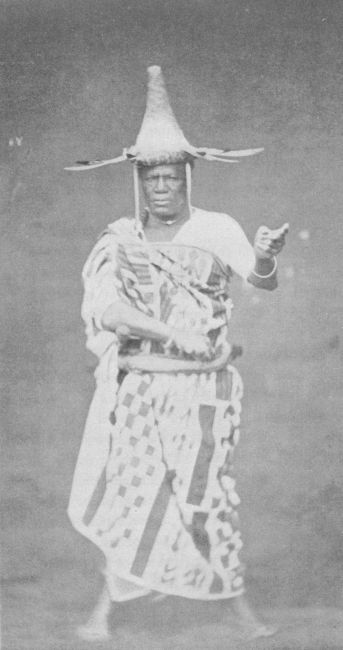
ToList Ja Ja Making Ju Ju [To face page 540
OPOBO RIVER.
After leaving Andoni, and continuing down the coast some ten or fifteen miles, the Opobo discharges itself into the sea. This river, marked in ancient maps as the Rio Condé and Ekomtoro, is the most direct way to the Ibo palm-oil-producing country.
This river was well known to the Portuguese and Spanish slave traders, but as Bonny became the great centre for the slave trade, this river was completely deserted and forgotten to such an extent that, though an opening in the coast line was shown on the English charts where this river was supposed to be, it was never thought worth the trouble of naming, and remained quite unknown to the English traders until it came suddenly into repute, owing to Ja Ja establishing himself here in 1870.
The people here are the Bonny men and their descendants who followed Ja Ja’s fortunes, therefore their manners and customs are identical with those of Bonny.
The physical appearance of these people is somewhat better than that of the Bonny men, owing, I think, to the position of their town, which is built on a better soil, and raised a few feet higher than that of Bonny from the level of the river, also their uninterrupted successful trade since their arrival in this country has doubtless not a little contributed to their improved condition, while, on the other hand, the Bonny men suffered severely during the years from 1869 to 1873, owing to Ja Ja barring their way to the markets, and they seem never to have recovered themselves.
Trading stations of the white men are at the mouth of the river and at Eguanga, the latter a station a few miles above Opobo town.
Opobo became, under King Ja Ja’s firm rule, one of the largest exporting centres of palm oil in the Delta, and for years King Ja Ja enjoyed a not undeserved popularity amongst the white traders who visited his river, but a time came when the price of palm oil fell to such a low figure in England that the European firms established in Opobo could not make both ends meet, so they intimated to King Ja Ja that they were going to reduce the price paid in the river, to which he replied by shipping large quantities of his oil to England, allowing his people only to sell a portion of their produce to the white men. The latter now formulated a scheme amongst themselves to divide equally whatever produce came into the river, and thus do away with competition amongst themselves. Ja Ja found that sending his oil to England was not quite so lucrative as he could wish, owing to the length of time it took to get his returns back, namely, about three months at the earliest, whilst by selling in the river he could turn over his money three or four times during that period. He therefore tried several means to break the white men’s combination, at last hitting upon the bright idea of offering the whole of the river’s trade to one English house. The mere fact of his being able to make this offer shows the absolute power to which he had arrived amongst his own people. His bait took with one of the European traders; the latter could not resist the golden vision of the yellow grease thus displayed before him by the astute Ja Ja, who metaphorically dangled before his eyes hundreds of canoes laden with the coveted palm oil. A bargain was struck, and one fine morning the other white traders in the river woke up to the fact that their combination was at an end, for on taking their morning spy round the river through their binoculars (no palm oil trader that respects himself being without a pair of these and a tripod telescope, for more minute observation of his opponents’ doings) they saw a fleet of over a hundred canoes round the renegade’s wharf, and for nearly two years this trader scooped all the trade. The fat was fairly in the fire now, and the other white traders sent a notice to Ja Ja that they intended to go to his markets. Ja Ja replied that he held a treaty, signed in 1873, by Mr. Consul Charles Livingstone, Her Britannic Majesty’s Consul, that empowered him to stop any white traders from establishing factories anywhere above Hippopotamus Creek, and under which he was empowered to stop and hold any vessel for a fine of one hundred puncheons of oil. In June, 1885, the traders applied to Mr. Consul White, who informed King Ja Ja that the Protectorate treaty meant freedom of navigation and trade.
So the traders finding their occupation gone, decided amongst themselves to take a trip to Ja Ja’s markets, the only sensible thing they had done since the trouble commenced. This was a step in the right direction, namely, by attempting to break down the curse of Western Africa id est, the power of the middle-man.
The names of the four traders who first attempted to trade in the Ibo markets of King Ja Ja deserve to be recorded, for their action was not without great risk to themselves. They were:
Mr. S. B. Hall Mr. Thomas Wright Mr. Richard Foster } English
Mr. A. E. Brunschweiler—Swiss.
To these must be added the name of Mr. F. D. Mitchell, who, though not in the first trip to the markets, joined in the subsequent attempt to establish business amongst the interior tribes. Their reception at the markets was not altogether a success, owing to the reception committee, or whatever represented it in those parts, being packed with either Ja Ja’s own people or Ibos favourable to him.
This good beginning was continued under great difficulties by these first traders with little profit or success for about two years, owing to the great power of Ja Ja amongst the interior tribes and the pressure he was able to bring to bear on the Ibo and Kwo natives.
In the meantime, clouds had been gathering round the head of King Ja Ja. His wonderful success since 1870 had gradually obscured his former keen perception of how far his rights as a petty African king would be recognised by the English Government under the new order of things just being inaugurated in the Oil Rivers; honestly believing that in signing the Protectorate treaty of December 19th, 1884, with the sixth clause crossed out, he had retained the right given him by the commercial treaty of 1873 to keep white men from proceeding to his markets, he got himself entangled in a number of disputes which culminated in his being taken out of the Opobo River in September, 1887, by Her Britannic Majesty’s Consul, Mr. H. H. Johnston, C.B., now Sir Harry Johnston, and conveyed to Accra, where he was tried before Admiral Sir Hunt Grubbe, who condemned him to five years’ deportation to the West Indies, making him an allowance of about £800 per annum and returning a fine of thirty puncheons of palm oil, value about £450 in those days, which the late Consul Hewett had imposed upon him, a fine that the Admiral did not think the Consul was warranted in having imposed.
Poor Ja Ja did not live to return to his country and his people whom he loved so well, and whose condition he had done so much to improve, though at times his rule often became despotic. One trait of his character may interest the public just now, as the Liquor Question in West Africa is so much en evidence, and that is, that he was a strict teetotaler himself and inculcated the same principles in all his chiefs. In his eighteen years’ rule as a king in Opobo he reduced two of his chiefs for drunkenness—one he sent to live in exile in a small fishing village for the rest of his life, the other, who had aggravated his offence by assaulting a white trader, he had deprived of all outward signs of a chief and put in a canoe to paddle as a pull-away boy within an hour of his committing the offence.
During the Ashantee campaign of 1873 Sir Garnet Wolseley sent Captain Nicol to the Oil Rivers to raise a contingent of friendly natives; on his arrival in Bonny he was not immediately successful, so continued on to Opobo, where he was the guest of the writer. Upon Captain Nicol explaining his errand, Ja Ja furnished him with over sixty of his war-boys, most of whom had seen considerable fighting in the late war between Bonny and Opobo. The news reaching Bonny of what Ja Ja had done, put the Bonny men upon their mettle, and when Captain Nicol reached Bonny on his way back to Ashantee, he found a further contingent waiting for him from the Bonny chiefs.
This combined contingent did good work against the Ashantees, being favourably mentioned in despatches. Poor Captain Nicol, who raised them, and commanded them in most of their engagements with the enemy, was, I regret to say, killed whilst gallantly leading them on in one of the final rushes just before Coomassie was taken.
In recognition of the above services of his men, Her Most Gracious Majesty Queen Victoria presented King Ja Ja with a sword of honour, the King of Bonny receiving one at the same time.
Shipwrecked people were always sure of kindly treatment if they fell into the hands of Ja Ja’s subjects, for he had given strict orders to his people dwelling on the sea-shore to assist vessels in distress and convey any one cast on shore to the European factories, warning them at the same time on no account to touch any of their property. He was also the first king in the Delta to restrain his people from plundering a wrecked ship, though the custom had been from time immemorial that a vessel wrecked upon their shores belonged to them by rights as being a gift from their Ju-Ju—an idea held by savage people in many other parts of the world.
It seems a pity that a man who had so many good qualities should have ended as he did. He was a man who, properly handled, could have been made of much use in the opening up of his country. Unfortunately, the late Consul Hewett was prejudiced against Ja Ja from his first interview with him, finding in this nigger king a man of superior natural abilities to his own.
Had the late Mr. Consul Hewett had the fiftieth part of the ability in dealing with the natives his sub and successor, Mr. H. H. Johnston, showed, there would never have been any necessity to deport Ja Ja. Unfortunately, between Ja Ja’s stubbornness and the late Consul Hewett’s bungling, matters had come to such a pass that some decisive measures were actually necessary to uphold the dignity of the Consular Office.
When Mr. H. H. Johnston succeeded the late Mr. Consul Hewett, the Opobo palaver was in about as muddled a state as it was possible for it to have got into. Matters had been in an unsatisfactory state for some years between King Ja Ja and the late Consul. Ja Ja had over-stepped the bounds of propriety in more ways than one. He tried the same tactics with Mr. Johnston, who to look at, is the mildest-looking little man you can imagine, and therefore did not fill the native’s eye as a ruler of men; but Mr. Johnston very soon let Ja Ja and the natives generally see he was made of different stuff to his predecessor, and the first attempts on Ja Ja’s part not to act up to the lines he laid down for him settled his fate. Mr. Johnston offered him the choice of delivering himself up quietly as a prisoner or being treated as an enemy of the Queen, his town destroyed and himself eventually captured and exiled for ever. He elected to give himself up, was taken to Accra and there tried and condemned after a fair hearing. I was present myself at the trial, and old friend as I was to him, I don’t think the verdict would have been otherwise had I been in the judge’s place, though there were many extenuating circumstances in his case, all of which were fully considered by Admiral Hunt Grubbe in his final sentence.
I feel confident that had Mr. Consul Johnston had the management of affairs in the Opobo a few years earlier, Ja Ja would never have been deported, and instead of having to censure him, he would have handled him in such a manner as to make use of his influence in furthering British interests. I do not think I can describe the late King Ja Ja better than Mr. Consul Johnston did in a letter he addressed to Lord Salisbury under date of September 24th, 1887, wherein he writes as follows:—“Ja Ja’s chief friends and supporters for years past have been the naval officers on the coast. His generous hospitality, his frank, engaging manner, his naïf discourse, and amusing crudities of diction have gained the ready sympathy of these gentlemen; no doubt Ja Ja is no common man, though he is in origin a runaway slave,[89] he was cut out by nature for a king, and he has the instinct of rule, though it not unfrequently degenerates into cruel tyranny.
“His demeanour is marked by quiet dignity, and his appearance and conversation are impressive.
“Nevertheless, I know Ja Ja to be a deliberate liar,[90] who exhibits little shame or confusion when his falsehoods are exposed. He is a bitter and unscrupulous enemy[91] of all who attempt to dispute his trade monopolies, and the five British firms whose trade he has almost ruined during the past two years.”
A complaint often made against the Government by merchants established on the West Coast of Africa is want of official protection and assistance; in many cases in the past this has been the case; but they certainly could not make this complaint during the few months that Mr. Consul Johnston was at the head of the Consular service in the Oil Rivers. I will here give a summary of what exertions were made by the Government to assist the merchants in their praiseworthy attempts to get behind the middlemen in this one river, where Ja Ja was always given the credit of being the head and front of the obstruction, nothing ever being said about the king and chiefs of Bonny, who were equally interested with Ja Ja in keeping the white men out of the markets, their principal markets being on the River Opobo.
Owing to the energetic representations of Mr. Consul H. H. Johnston, the British Government placed at his disposal for the settlement of the market question and the Ja Ja palaver the following Government vessels, viz., the Watchful, the Goshawk, the Alecto, the Acorn, the Royalist, and the Raleigh, the latter bringing Admiral Sir Hunt Grubbe up from the Cape of Good Hope for the trial of King Ja Ja.
Result: Within a very short time after the deportation of Ja Ja, all the firms who had been so anxious to establish in the interior markets and thus get behind the middlemen (without doubt the curse of the Oil Rivers and every part of Africa where they are tolerated) gave up trading at the interior markets that had caused the Government so much trouble to open for them, and made an agreement with the middlemen, represented in this case by the Bonny men and Opobo men, that they would not attempt to trade any more in the interior markets if the middlemen would promise to trade with no European firm that attempted to trade in the interior markets. On the writer’s last visit to the Opobo in 1896 there was only one firm trading in the interior markets, and that firm was not one of those that were in the river at the time of the clamour for the removal of Ja Ja and the opening of the interior in 1887.