WITH TWELVE ILLUSTRATIONS (continued 2)
R. Nisbet (Robert Nisbet) Bain translation
Thus they lived till the girl had grown up.
It was found that, in the summer time, when the fishermen went out to the Vær to fetch away the dried fish, that the young fellows began underbidding each other, so as to be selected for that special errand.
Some gave up their share of profits, and others their wages; and there was a general complaint in all the villages round about that on such occasions no end of betrothals were broken off.
But the cause of it all was the girl out yonder with the odd eyes.
For all her rough and ready ways, she had something about her, said those she chatted with, that there was no resisting. She turned the heads of all the young fellows; it seemed as if they couldn't live without her.
The first winter a lad wooed her who had both house and warehouse of his own.
"If you come again in the summer time, and give me the right gold ring I will be wedded by, something may come of it," said she.
And, sure enough, in the summer time the lad was there again.
He had a lot of fish to fetch away, and she might have had a gold ring as heavy and as bonnie as heart could wish for.
"The ring I must have lies beneath the wreckage, in the iron chest, over at the island yonder," said she; "that is, if you love me enough to dare fetch it."
But then the lad grew pale.
He saw the sea-bore rise and fall out there like a white wall of foam on the bright warm summer day, and on the island sat the cormorants sleeping in the sunshine.
"Dearly do I love thee," said he, "but such a quest as that would mean my burial, not my bridal."
The same instant the thirteenth cormorant rose from his stone in the misty foam, and flew right over the island.
Next winter the steersman of a yacht came a wooing. For two years he had gone about and hugged his misery for her sake, and he got the same answer.
"If you come again in the summer time, and give me the right gold ring I will be wedded with, something may come of it."
Out to the Vær he came again on Midsummer Day.
But when he heard where the gold ring lay, he sat and wept the whole day till evening, when the sun began to dance north-westward into the sea.
Then the thirteenth cormorant arose, and flew right over the island.
There was nasty weather during the third winter.
There were manifold wrecks, and on the keel of a boat, which came driving ashore, hung an exhausted young lad by his knife-belt.
But they couldn't get the life back into him, roll and rub him about in the boat-house as they might.
Then the girl came in.
"'Tis my bridegroom!" said she.
And she laid him in her bosom, and sat with him the whole night through, and put warmth into his heart.
And when the morning came, his heart beat.
"Methought I lay betwixt the wings of a cormorant, and leaned my head against its downy breast," said he.
The lad was ruddy and handsome, with curly hair, and he couldn't take his eyes away from the girl.
He took work upon the Vær.
But off he must needs be gadding and chatting with her, be it never so early and never so late.
So it fared with him as it had fared with the others.
It seemed to him that he could not live without her, and on the day when he was bound to depart, he wooed her.
"Thee I will not fool," said she. "Thou hast lain on my breast, and I would give my life to save thee from sorrow. Thou shalt have me if thou wilt place the betrothal ring upon my finger; but longer than the day lasts thou canst not keep me. And now I will wait, and long after thee with a horrible longing, till the summer comes."
On Midsummer Day the youth came thither in his boat all alone.
Then she told him of the ring that he must fetch for her from among the skerries.
"If thou hast taken me off the keel of a boat, thou mayest cast me forth yonder again," said the lad. "Live without thee I cannot."
But as he laid hold of the oars in order to row out, she stepped into the boat with him and sat in the stern. Wondrous fair was she!
It was beautiful summer weather, and there was a swell upon the sea: wave followed upon wave in long bright rollers.
The lad sat there, lost in the sight of her, and he rowed and rowed till the insucking breakers roared and thundered among the skerries; the ground-swell was strong, and the frothing foam spurted up as high as towers.
"If thy life is dear to thee, turn back now," said she.
"Thou art dearer to me than life itself," he made answer.
But just as it seemed to the lad as if the prow were going under, and the jaws of death were gaping wide before him, it grew all at once as still as a calm, and the boat could run ashore as if there was never a billow there.
On the island lay a rusty old ship's anchor half out of the sea.
"In the iron chest which lies beneath the anchor is my dowry," said she; "carry it up into thy boat, and put the ring that thou seest on my finger. With this thou dost make me thy bride. So now I am thine till the sun dances north-westwards into the sea."
It was a gold ring with a red stone in it, and he put it on her finger and kissed her.
In a cleft on the skerry was a patch of green grass. There they sat them down, and they were ministered to in wondrous wise, how he knew not nor cared to know, so great was his joy.
"Midsummer Day is beauteous," said she, "and I am young and thou art my bridegroom. And now we'll to our bridal bed."
So bonnie was she that he could not contain himself for love.
But when night drew nigh, and the sun began to dance out into the sea, she kissed him and shed tears.
"Beauteous is the summer day," said she, "and still more beauteous is the summer evening; but now the dusk cometh."
And all at once it seemed to him as if she were becoming older and older and fading right away.
When the sun went below the sea-margin there lay before him on the skerry some mouldering linen rags and nought else.
Calm was the sea, and in the clear Midsummer night there flew twelve cormorants out over the sea.

[1] A fishing-station, where fishermen assemble periodically.
ISAAC AND THE PARSON OF BRÖNÖ
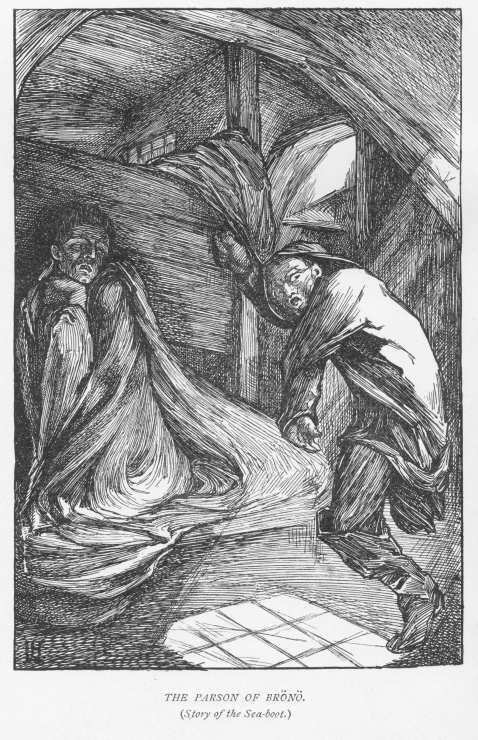
ISAAC AND THE PARSON OF BRÖNÖ
In Helgeland there was once a fisherman called Isaac. One day when he was out halibut fishing he felt something heavy on the lines. He drew up, and, lo! there was a sea-boot.
"That was a rum 'un! " said he, and he sat there a long time looking at it.
It looked just as if it might be the boot of his brother who had gone down in the great storm last winter on his way home from fishing.
There was still something inside the boot too, but he durst not look to see what it was, nor did he exactly know what to do with the sea-boot either.
He didn't want to take it home and frighten his mother, nor did he quite fancy chucking it back into the sea again; so he made up his mind to go to the parson of Brönö, and beg him to bury it in a Christian way.
"But I can't bury a sea-boot," quoth the parson.
The fellow scratched his head. "Na, na!" said he.
Then he wanted to know how much there ought to be of a human body before it could have the benefit of Christian burial.
"That I cannot exactly tell you," said the parson; "a tooth, or a finger, or hair clippings is not enough to read the burial service over. Anyhow, there ought to be so much remaining that one can see that a soul has been in it. But to read Holy Scripture over a toe or two in a sea-boot! Oh, no! that would never do!"
But Isaac watched his opportunity, and managed to get the sea-boot into the churchyard on the sly, all the same.
And home he went.
It seemed to him that he had done the best he could. It was better, after all, that something of his brother should lie so near God's house than that he should have heaved the boot back into the black sea again.
But, towards autumn, it so happened that, as he lay out among the skerries on the look-out for seals, and the ebb-tide drove masses of tangled seaweed towards him, he fished up a knife-belt and an empty sheath with his oar-blade.
He recognised them at once as his brother's.
The tarred wire covering of the sheath had been loosened and bleached by the sea; and he remembered quite well how, when his brother had sat and cobbled away at this sheath, he had chatted and argued with him about the leather for his belt which he had taken from an old horse which they had lately killed.
They had bought the buckle together over at the storekeeper's on the Saturday, and mother had sold bilberries, and capercailzies, and three pounds of wool. They had got a little tipsy, and had had such fun with the old fishwife at the headland, who had used a bast-mat for a sail.
So he took the belt away with him, and said nothing about it. It was no good giving pain to no purpose, thought he.
But the longer the winter lasted the more he bothered himself with odd notions about what the parson had said. And he knew not what he should do in case he came upon something else, such as another boot, or something that a squid, or a fish, or a crab, or a Greenland shark might have bitten off. He began to be really afraid of rowing out in the sea there among the skerries.
And yet, for all that, it was as though he were constantly being drawn thither by the hope of finding, perhaps, so much of the remains as might show the parson where the soul had been, and so move him to give them a Christian burial.
He took to walking about all by himself in a brown study.
And then, too, he had such nasty dreams.
His door flew open in the middle of the night and let in a cold sea-blast, and it seemed to him as if his brother were limping about the room, and yelling that he must have his foot again, the Draugs were pulling and twisting him about so.
For hours and hours he stood over his work without laying a hand to it, and blankly staring at the fifth wall1.
At last he felt as if he were really going out of his wits, because of the great responsibility he had taken upon himself by burying the foot in the churchyard.
He didn't want to pitch it into the sea again, but it couldn't lie in the churchyard either.
It was borne in upon him so clearly that his brother could not be among the blessed, and he kept going about and thinking of all that might be lying and drifting and floating about among the skerries.
So he took it upon himself to dredge there, and lay out by the sea-shore with ropes and dredging gear. But all that he dredged up was sea-wrack, and weeds, and star-fish, and like rubbish.
One evening as he sat out there by the rocks trying his luck at fishing, and the line with the stone and all the hooks upon it shot down over the boat's side, the last of the hooks caught in one of his eyes, and right to the bottom went the eye.
There was no use dredging for that, and he could see to row home very well without it.
In the night he lay with a bandage over his eye, wakeful for pain, and he thought and thought till things looked as black as they could be to him. Was there ever any one in the world in such a hobble as he?
All at once such an odd thing happened.
He thought he was looking about him, deep down in the sea, and he saw the fishes flitting and snapping about among the sea-wrack and seaweeds round about the fishing line. They bit at the bait, and wriggled and tried to slip off, first a cod, and then a ling, and then a dog-fish. Last of all, a haddock came and stood still there, and chewed the water a little as if it were tasting before swallowing it.
And he saw there what he couldn't take his eyes off. It looked like the back of a man in leather clothes, with one sleeve caught beneath the grapnel of a Femböring.2
Then a heavy white halibut came up and gulped down the hook, and it became pitch dark.
"You must let the big halibut slip off again when you pull up to-morrow," something said, "the hook tears my mouth so. 'Tis of no use searching except in the evening, when the tide in the sound is on the ebb."
Next day he went off, and took a piece of a tombstone from the churchyard to dredge the bottom with; and in the evening, when the tide had turned, he lay out in the sound again and searched.
Immediately he hauled up the grapnel of a Femböring, the hooks of which were clinging to a leather fisherman's jacket, with the remains of an arm in it.
The fishes had got as much as they could of it out of the leather jacket.
Off to the parson he rowed straightway.
"What! read the service over a washed-out old leather jacket!" cried the parson of Brönö.
"I'll throw the sea-boot into the bargain," answered Isaac.
"Waifs and strays and sea salvage should be advertised in the church porch," thundered the parson.
Then Isaac looked straight into the parson's face.
"The sea-boot has been heavy enough on my conscience," said he; "and I'm sure I don't want to be saddled with the leather jacket as well."
"I tell you I don't mean to cast consecrated earth to the winds," said the parson; he was getting wroth.
Isaac scratched his head again. "Na, na!" said he.
And with that he had to be content and go home.
But Isaac had neither rest nor repose, there lay such a grievous load upon him.
In the night time he again saw the big white halibut. It was going round and round so slowly and sadly in the selfsame circle at the bottom of the sea. It was just as if some invisible sort of netting was all round it, and the whole time it was striving to slip through the meshes.
Isaac lay there, and gazed and gazed till his blind eye ached again.
No sooner was he out dredging next day, and had let down the ropes, than an ugly heavy squid came up, and spouted up a black jet right in front of him.
But one evening he let the boat drive, as the current chose to take it, outside the skerries, but within the islands. At last it stopped at a certain spot, as if it were moored fast, and there it grew wondrously still; there was not a bird in the air or a sign of life in the sea.
All at once up came a big bubble right in front of the jib, and as it burst he heard a deep heavy sigh.
But Isaac had his own opinion about what he had seen.
"And the parson of Brönö shall see to the funeral too, or I'll know the reason why," said he.
From henceforth it was bruited abroad that he had second sight, and saw many things about him which were hid from other folks.
He could tell exactly where the fish were to be found thick together by the sea-banks, and where they were not; and whenever they asked him about such things, he would say--
"If I don't know it, my brother does."
Now one day it chanced that the parson of Brönö had to go out along the coast on a pious errand, and Isaac was one of them who had to row him thither.
Off they went with a rattling good breeze.
The parson got quickly there, and was not very long about his business, for next day he had to hold divine service in his own parish church.
"The firth seems to me a bit roughish," said he, "and 'tis getting towards evening; but as we have come hither, I should think we could get back again also."
They had not got very far on their homeward journey when the rising gale began to whistle and whine, so that they had to take in four clews3.
And away they went, with the sea-scud and the snow-flakes flying about their ears, while the waxing rollers rose big as houses.
The parson of Brönö had never been out in such weather before. They sailed right into the rollers, and they sailed out again.
Soon it became black night.
The sea shone like mountain snow-fields, and the showers of snow and spray rather waxed than waned.
Isaac had just taken in the fifth clew also when one of the planks amidships gave way, so that the sea foamed in, and the parson of Brönö and the crew leaped upon the upper deck, and bawled out that the boat was going down.
"I don't think she'll founder this voyage," said Isaac; and he remained sitting where he was at the rudder.
But as the moon peeped forth from behind a hail-shower, they saw that a strange foremastman was standing in the scuppers, and baling the water out of the boat as fast as it poured in.
"I didn't know that I had hired that fellow yonder," said the parson of Brönö; "he seems to me to be baling with a sea-boot; and it also seems to me as if he had neither breeches nor skin upon his legs, and the upper part of him is neither more nor less than an empty fluttering leather jacket."
"Parson has seen him before, I think," said Isaac.
Then the parson of Brönö grew angry.
"By virtue of my sacred office," said he, "I adjure him to depart from amidships."
"Na, na!" answered Isaac; "and can parson also answer for the plank that has burst?"
Then the parson bethought him of the evil case he was in.
"The man seems to me mortally strong, and we have great need of him," said he; "nor is it any great sin, methinks, to help a servant of God's over the sea. But I should like to know what he wants in return."
The billows burst, and the blast howled around him.
"Only some two or three shovels of earth on a rotten sea-boot and a mouldy skin-jacket," said Isaac.
"If you're able to gad about again here below, I suppose there's nothing against your being able to enter into bliss again, for all that I know," bawled the parson of Brönö; "and you shall have your shovelfuls of earth into the bargain."
Just as he said this, the water within the skerries all at once became quite smooth, and the parson's boat drove high and dry upon the sandbank, so that the mast cracked.
[1] I.e., at nothing--a house having usually only four walls.
[2] See "The Fisherman and the Draug."
[3] See "The Fisherman and the Draug."
THE WIND-GNOME
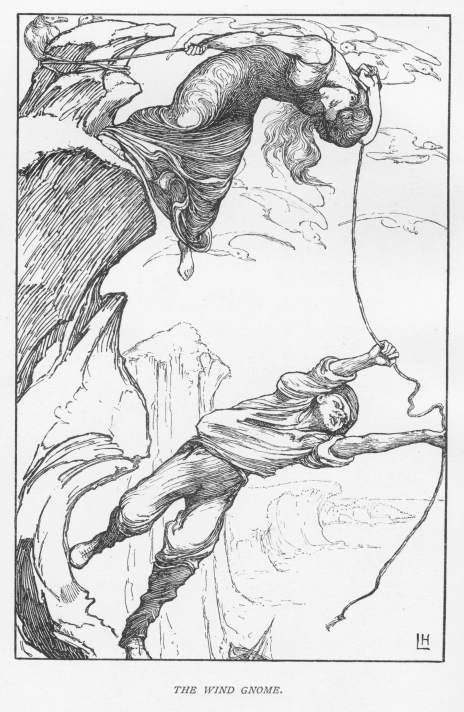
THE WIND-GNOME
There was once a skipper of Dyrevig called Bardun. He was so headstrong that there was no doing anything with him. Whatever he set his mind upon, that should be done, he said, and done it always was.
If he promised to be at a dance, the girls could safely rely upon his being there, though it blew a tempest and rained cats and dogs.
He would come scudding along on a Færing1 to his father's house through storm and stress. Row upon row of girls would be waiting for him there, and he spanked the floor with every one of them in turn, and left their gallants to cool their heels as best they might.
Cock-of-the-walk he always must be.
He would go shark-fishing too, and would venture with his fishing gaff into seas where only large vessels were wont to go.
If there was anything nobody else dared do, Bardun was the man to do it. And, absurd and desperate as the venture might be, he always succeeded, so that folks were always talking about him.
Now, right out at sea, beyond the skerries, lay a large rock, the lair of wild-fowl, whither the merchant who owned it came every year to bring away rich loads of eider-down. A long way down the side of this lofty rock was a cleft. Nobody could tell how far into the rock it went, and so inaccessible was it there that its owner had said that whoever liked might come and take eider-down from thence. It became quite a proverb to say, when anything couldn't be done, that it was just as impossible as taking eider-down from Dyrevig rock.
But Bardun passed by the rock, and peeped up at the cleft, and saw all the hosts of the fowls of the air lighting upon it so many times that he felt he needs must try his hand at it.
He lost no time about it, and the sun was shining brightly as he set out.
He took with him a long piece of rope, which he cast two or three times round a rocky crag, and lowered himself down till he was right opposite the cleft. There he hung and swung over it backwards and forwards till he had got a firm footing, and then he set about collecting eider-down and stuffing his sacks with it.
He went searching about for it so far into the rocky chasm that he saw no more than a gleam of sunlight outside the opening, and he couldn't take a hundreth part of the eider-down that was there.
It was quite late in the evening before he gave up trying to gather it all. But when he came out again, the stone which he had placed on the top of the rope and tied it to was gone. And now the rope hung loosely there, and dangled over the side of the rock. The wind blew it in and out and hither and thither. The currents of air sported madly with it, so that it always kept sheer away from the rock and far out over the abyss.
There he stood then, and tried again and again to clutch hold of it till the sun lay right down in the sea.
When it began to dawn again, and the morning breeze rose up from the sea, he all at once heard something right over his head say--
"It blows away, it blows away!"
He looked up, and there he saw a big woman holding the rope away from the cliff side.
Every time he made a grip at it she wrenched and twisted it right away over the rocky wall, and there was a laughing and a grinning all down the mountain side--
"It blows away, it blows away!"
And, again and again, the rope drove in and out and hither and thither.
"You had better take a spring at once, and not wait till you're tired," thought he.
It was a pretty long leap to take, but he went back a sufficient distance, and then out he sprang.
Bardun was not the man to fall short of anything. He caught the rope and held it tight.
And, oddly enough, it seemed now to run up the cliff-side of its own accord, just as if some one were hoisting it.
But in front of the rocky crag to which he had fastened the rope, he heard a soughing and a sighing, and something said, "I am the daughter of the Wind-Gnome, and now thou hast dominion over me! When the blast blows and whines about thee 'tis I who long for thee. And here thou hast a rudder which will give thee luck and a fair wind whithersoever thou farest. He who is with thee shall thrive, and he who is against thee shall suffer shipwreck and be lost. For 'tis I who am in the windy gusts."
Then all at once everything was quite still; but down on the sea below there swept a heavy squall.
There stood Bardun with the rudder in his hand, and he understood that it was not a thing to be lightly cast away.
Homeward he steered with a racing breeze behind him, and he had not sailed far before he met a galeas which gave him the Bergen price for his eider-down.
But Bardun was not content with only going thither once. He went just the same as before, and he returned from the Dyrevig rock with a pile of sacks of eider-down on his boat right up to the mast.
He bought houses and ships; mightier and mightier he grew.
And it was not long before he owned whole fishing-grounds, both northwards and southwards.
Those who submitted to him, and did as he would have them do, increased and prospered, and saw good days; but all who stood in his way were wrecked on the sea and perished, for the Wind-Gnome was on his side.
So things quickly went from good to better with him. What was to him a fair wind was the ruin of all those who were in any way opposed to him. At last he became so rich and mighty that he owned every blessed trading-place and fishing-station in all Finmark, and sent vessels even as far as Spitzbergen.
Nobody durst sell fish up north without his leave, and his sloops sailed over to Bergen eighteen at a time.
He ruled and gave judgment as it seemed best to him.
But the magistrates thought that such authority was too much for one man to have, and they began to make inquiries, and receive complaints of how he domineered the people.
Next, the magistrates sent him a warning.
"But the right to rule lies in my rudder," thought Bardun to himself.
Then the magistrates summoned him before the tribunal.
Bardun simply whistled contemptuously.
At last matters came to such a pitch that the magistrates sailed forth to seize him in the midst of a howling tempest, and down they went in the Finmark seas.
Then Bardun was made chief magistrate, till such time as the king should send up another.
But the new man who came had not been very long in office there before it seemed to him as if it was not he but Bardun who held sway.
So the same thing happened over again.
Bardun was summoned in vain before the courts, and the magistrates came forth to seize him and perished at sea.
But when the next governor was sent up to Finmark, it was only the keel of the king's ship that came drifting in from the sea. At last nobody would venture thither to certain ruin, and Bardun was left alone, and ruled over all. Then so mighty was he in all Finmark that he reigned there like the king himself.
Now he had but one child, and that a daughter.
Boel was her name, and she shot up so handsome and comely that her beauty shone like the sun. No bridegroom was good enough for her, unless, perhaps, it were the king's son.
Wooers came from afar, and came in vain. She was to have a dower, they said, such as no girl in the North had ever had before.
One year quite a young officer came up thither with a letter from the king. His garments were stiff with gold, and shone and sparkled wherever he went. Bardun received him well, and helped him to carry out the king's commands.
But since the day when he himself was young, and got the answer, "Yes!" from his bride, he had never been so happy as when Boel came to him one day and said that the young officer had wooed her, and she would throw herself into the sea straightway if she couldn't have him.
In this way, he argued, his race would always sit in the seat of authority, and hold sway when he was gone.
While the officer, in the course of the summer, was out on circuit, Bardun set a hundred men to work to build a house for them.
It was to shine like a castle, and be bright with high halls and large reception-rooms, and windows in long rooms; and furs and cloth of gold and bright tiles were fetched from the far South.
And in the autumn there was such a wedding that the whole land heard and talked about it.
But it was not long before Bardun began to find that to be a fact which was already a rumour, to wit, that the man who had got his daughter would fain have his own way also.
He laid down the law, and gave judgment like Bardun himself; and he over-ruled Bardun, not once nor twice.
Then Bardun went to Boel, and bade her take her husband to task, and look sharp about it. He had never yet seen the man, said he, who couldn't be set right by his bride in the days when they did nothing but eat honey together.
But Boel said that she had wedded a man who, to her mind, was no less a man than her own father; and it was his office, besides, to uphold the law and jurisdiction of the king.
Young folks are easy to talk over, thought Bardun. One can do anything with them when one only makes them fancy they are having their own way. And it is wonderful how far one can get if one only bides one's time, and makes the best of things. Whatever was out of gear he could very easily put right again, when once he got a firm grip of the reins.
So he praised everything his son-in-law did, and talked big about him, so that there was really no end to it. He was glad, he said, that such a wise and stately ruler was there, ready to stand in his shoes against the day when he should grow old.
And so he made himself small, and his voice quivered when he spoke, as if he were really a sick and broken-down man.
But it didn't escape Boel how he slammed to the doors, and struck the stones with his stick till the sparks flew.
Next time the court met, Bardun was taxed to a full tenth of the value of all his property, according to the king's law and justice.
Then only did he begin to foresee that it might fare with the magistrates now as it had done formerly.
But all women like pomp and show, thought he, and Boel was in this respect no different to other people. And she was no daughter of his either, if she couldn't keep the upper hand of her husband.
So he bought her gold and jewels, and other costly things. One day he came with a bracelet, and another day with a chain; and now it was a belt, and now a gold embroidered shoe. And every time he told her that he brought her these gifts, because she was his dearest jewel. He knew of nothing in the world that was too precious for her.
Then, in his most pleasant, most courtly style, he just hinted that she might see to it, and talk her husband over to other ways.
But it booted him even less than before.
And so things went on till autumn. The king's law was first, and his will was only second.
Then he began to dread what would be the end of it all. His eyes sparkled so fiercely that none dare come near him. But at night he would pace up and down, and shriek and bellow at his daughter, and give her all sorts of vile names.
Now one day he came in to Boel with a heavy gold crown full of the most precious stones. She should be the Queen of Finmark and Spitzbergen, said he, if her husband would do according to his will.
Then she looked him stiffly in the face, and said she would never seduce her husband into breaking the king's law.
He grew as pale as the wall behind him, and cast the gold crown on the floor, so that there was a perfect shower of precious stones about them.
She must know, said he, that her father and none other was king here. And now the young officer should find out how it fared with them who sat in his seat.
Then Boel washed her hands of her father altogether, but she advised her husband to depart forthwith.
And on the third day she had packed up all her bridal finery, and departed in the vessel with the young officer.
Then Bardun smote his head against the wall, and that night he laughed, so that it was heard far away, but he wept for his daughter.
And now there arose such a storm that the sea was white for a whole week. And it was not long before the tidings came that the ship that Boel and her husband had sailed by had gone down, and the splinters lay and floated among the skerries.
Then Bardun took the rudder he had got from the Wind-Gnome, and stuck it into the stern of the largest yacht he had. He was God himself now, said he, and could always get a fair wind to steer by, and could rule where he would in the wide world. And southwards he sailed with a rattling breeze, and the billows rolled after him like mounds and hillocks.
Heavier and heavier grew the sea, till it rolled like white mountains as high as the rocky walls of Lofoten.
It couldn't well be less when he was to rule the whole world, cried he. And so he set his rudder dead southwards.
He never diminished his sail one bit, and worse and worse grew the storm, and higher and higher rose the sea.
For now he was steering right into the sun.
[1] A small two-oared boat.
THE HULDREFISH
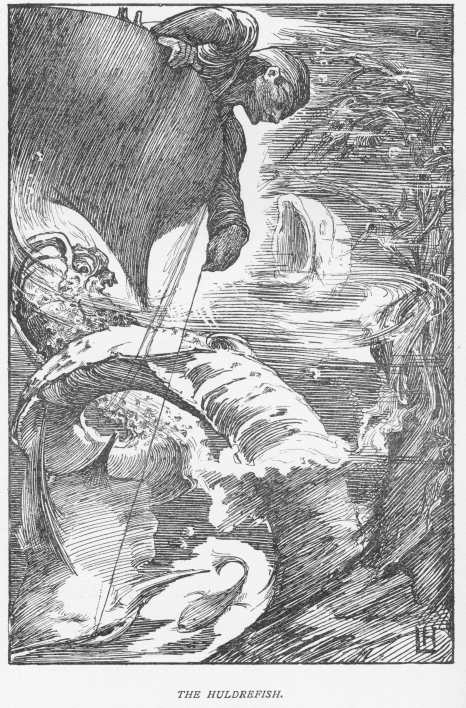
THE HULDREFISH1
It was such an odd trout that Nona hauled in at the end of his fishing-line. Large and fat, red spotted and shiny, it sprawled and squirmed, with its dirty yellow belly above the water, to wriggle off the hook. And when he got it into the boat, and took it off the hook, he saw that it had only two small slits where the eyes should have been.
It must be a huldrefish, thought one of the boatmen, for rumour had it that that lake was one of those which had a double bottom.
But Nona didn't trouble his head very much about what sort of a fish it was, so long as it was a big one. He was ravenously hungry, and bawled to them to row as rapidly as possible ashore so as to get it cooked.
He had been sitting the whole afternoon with empty lines out in the mountain lake there; but as for the trout, it was only an hour ago since it had been steering its way through the water with its rudder of a tail, and allowed itself to be fooled by a hook, and already it lay cooked red there on the dish.
But now Nona recollected about the strange eyes, and felt for them, and pricked away at its head with his fork. There was nothing but slits outside, and yet there was a sort of hard eyeball inside. The head was strangely shaped, and looked very peculiar in many respects.
He was vexed that he had not examined it more closely before it was cooked; it was not so easy now to make out what it really was. It had tasted first-rate, however, and that was something.
But at night there was, as it were, a gleam of bright water before his eyes, and he lay half asleep, thinking of the odd fish he had pulled up.
He was in his boat again, he thought, and it seemed to him as if his hands felt the fish wriggling and sprawling for its life, and shooting its snout backwards and forwards to get off the hook.
All at once it grew so heavy and strong that it drew the boat after it by the line.
It went along at a frightful speed, while the lake gradually diminished, as it were, and dried up.
There was an irresistible sucking of the water in the direction the fish went, which was towards a hole at the bottom of the lake like a funnel, and right into this hole went the boat.
It glided for a long time in a sort of twilight along a subterranean river, which dashed and splashed about him. The air that met him was, at first, chilly and cellar-like; gradually, however, it grew milder and milder, and warmer and warmer.
The stream now flowed along calmly and quietly, and broadened out continually till it fell into a large lake.
Beyond the borders of this lake, but only half visible in the gloom, stretched swamps and morasses, where he heard sounds as of huge beasts wading and trampling. Serpent like they rose and writhed with a crashing and splashing and snorting amidst the tepid mud and mire.
By the phosphorescent gleams he saw various fishes close to his boat, but all of them lacked eyes.
And he caught glimpses of the outlines of gigantic sea-serpents stretching far away into the darkness. He now understood that it was from down here that they pop up their heads off the coast in the dog days when the sea is warm.
The lindworm, with its flat head and duck's beak, darted after fish, and crept up to the surface of the earth through the slimy ways of mire and marsh.
Through the warm and choking gloom there came, from time to time, a cooling chilling blast from the cold curves and winds of the slimy and slippery greenish lichworm,2 which bores its way through the earth and eats away the coffins that are rotting in the churchyards.
Horrible shapeless monsters, with streaming manes, such as are said to sometimes appear in mountain tarns, writhed and wallowed and seized their prey in the fens and marshes.
And he caught glimpses of all sorts of humanlike creatures, such as fishermen and sailors meet and marvel at on the sea, and landsmen see outside the elfin mounds.
And, besides, that there was a soft whizzing and an endless hovering and swarming of beings, whose shapes were nevertheless invisible to the eye of man.
Then the boat glided into miry pulpy water, where her course tended downwards, and where the earth-vault above darkened as it sank lower and lower.
All at once a blinding strip of light shot down from a bright blue slit high, high, above him.
A stuffy vapour stood round about him. The water was as yellow and turbid as that which comes out of steam boilers.
And he called to mind the peculiar tepid undrinkable water which bubbles up by the side of artesian wells. It was quite hot. Up there they were boring down to a world of warm watercourses and liquid strata beneath the earth's crust.
Heat as from an oven rose up from the huge abysses and dizzying clefts, whilst mighty steaming waterfalls roared and shook the ground.
All at once he felt as if his body were breaking loose, freeing itself, and rising in the air. He had a feeling of infinite lightness, of a wondrous capability for floating in higher atmospheres and recovering equilibrium.
And, before he knew how it was, he found himself up on the earth again.
[1] Hulder, huldre, a name for anything elfin or gnomish. Compare Icel. Hulda, a hiding, covering. It implies the invisibility of the elfin race.
[2] Ligorm, serpent that eats the dead. If we have Lichfield and lichgate, we may have lichworm too.
FINN BLOOD
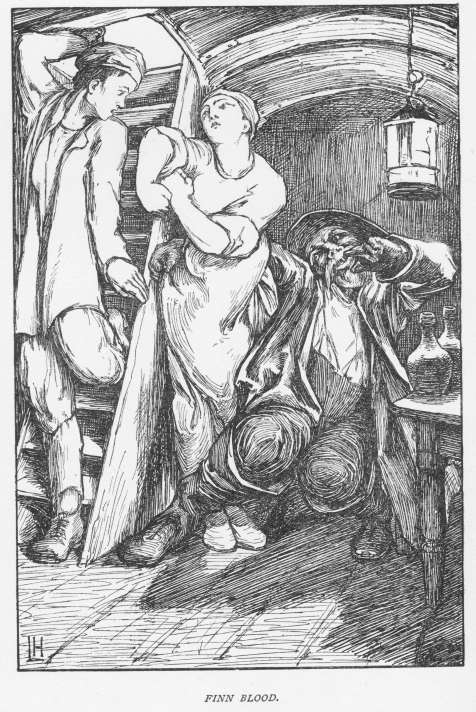
FINN BLOOD
In Svartfjord, north of Senje, dwelt a lad called Eilert. His neighbours were seafaring Finns, and among their children was a pale little girl, remarkable for her long black hair and her large eyes. They dwelt behind the crag on the other side of the promontory, and fished for a livelihood, as also did Eilert's parents; wherefore there was no particular goodwill between the families, for the nearest fishing ground was but a small one, and each would have liked to have rowed there alone.
Nevertheless, though his parents didn't like it at all, and even forbade it, Eilert used to sneak regularly down to the Finns. There they had always strange tales to tell, and he heard wondrous things about the recesses of the mountains, where the original home of the Finns was, and where, in the olden time, dwelt the Finn Kings, who were masters among the magicians. There, too, he heard tell of all that was beneath the sea, where the Mermen and the Draugs hold sway. The latter are gloomy evil powers, and many a time his blood stood still in his veins as he sat and listened. They told him that the Draug usually showed himself on the strand in the moonlight on those spots which were covered with sea-wrack; that he had a bunch of seaweed instead of a head, but shaped so peculiarly that whoever came across him absolutely couldn't help gazing into his pale and horrible face. They themselves had seen him many a time, and once they had driven him, thwart by thwart, out of the boat where he had sat one morning, and turned the oars upside down. When Eilert hastened homewards in the darkness round the headland, along the strand, over heaps of seaweed, he dare scarcely look around him, and many a time the sweat absolutely streamed from his forehead.
In proportion as hostility increased among the old people, they had a good deal of fault to find with one another, and Eilert heard no end of evil things spoken about the Finns at home. Now it was this, and now it was that. They didn't even row like honest folk, for, after the Finnish fashion, they took high and swift strokes, as if they were womenkind, and they all talked together, and made a noise while they rowed, instead of being "silent in the boat." But what impressed Eilert most of all was the fact that, in the Finnwoman's family, they practised sorcery and idolatry, or so folks said. He also heard tell of something beyond all question, and that was the shame of having Finn blood in one's veins, which also was the reason why the Finns were not as good as other honest folk, so that the magistrates gave them their own distinct burial-ground in the churchyard, and their own separate "Finn-pens" in church. Eilert had seen this with his own eyes in the church at Berg.
All this made him very angry, for he could not help liking the Finn folks down yonder, and especially little Zilla. They two were always together: she knew such a lot about the Merman. Henceforth his conscience always plagued him when he played with her; and whenever she stared at him with her large black eyes while she told him tales, he used to begin to feel a little bit afraid, for at such times he reflected that she and her people belonged to the Damned, and that was why they knew so much about such things. But, on the other hand, the thought of it made him so bitterly angry, especially on her account. She, too, was frequently taken aback by his odd behaviour towards her, which she couldn't understand at all; and then, as was her wont, she would begin laughing at and teasing him by making him run after her, while she went and hid herself.
One day he found her sitting on a boulder by the sea-shore. She had in her lap an eider duck which had been shot, and could only have died quite recently, for it was still warm, and she wept bitterly over it. It was, she sobbed, the same bird which made its nest every year beneath the shelter of their outhouse--she knew it quite well, and she showed him a red-coloured feather in its white breast. It had been struck dead by a single shot, and only a single red drop had come out of it; it had tried to reach its nest, but had died on its way on the strand. She wept as if her heart would break, and dried her face with her hair in impetuous Finnish fashion. Eilert laughed at her as boys will, but he overdid it, and was very pale the whole time. He dared not tell her that that very day he had taken a random shot with his father's gun from behind the headland at a bird a long way off which was swimming ashore.
One autumn Eilert's father was downright desperate. Day after day on the fishing grounds his lines caught next to nothing, while he was forced to look on and see the Finn pull up one rich catch after another. He was sure, too, that he had noticed malicious gestures over in the Finn's boat. After that his whole house nourished a double bitterness against them; and when they talked it over in the evening, it was agreed, as a thing beyond all question, that Finnish sorcery had something to do with it. Against this there was only one remedy, and that was to rub corpse-mould on the lines; but one must beware of doing so, lest one should thereby offend the dead, and expose oneself to their vengeance, while the sea-folk would gain power over one at the same time.
Eilert bothered his head a good deal over all this; it almost seemed to him as if he had had a share in the deed, because he was on such a good footing with the Finn folks.
On the following Sunday both he and the Finn folks were at Berg church, and he secretly abstracted a handful of mould from one of the Finn graves, and put it in his pocket. The same evening, when they came home, he strewed the mould over his father's lines unobserved. And, oddly enough, the very next time his father cast his lines, as many fish were caught as in the good old times. But after this Eilert's anxiety became indescribable. He was especially cautions while they were working of an evening round the fireside, and it was dark in the distant corners of the room. He sat there with a piece of steel in his pocket. To beg "forgiveness" of the dead is the only helpful means against the consequences of such deeds as his, otherwise one will be dragged off at night, by an invisible hand, to the churchyard, though one were lashed fast to the bed by a ship's hawser.
When Eilert, on the following "Preaching Sunday," went to church, he took very good care to go to the grave, and beg forgiveness of the dead.
As Eilert grew older, he got to understand that the Finn folks must, after all, be pretty much the same sort of people as his own folks at home; but, on the other hand, another thought was now uppermost in his mind, the thought, namely, that the Finns must be of an inferior stock, with a taint of disgrace about them. Nevertheless, he could not very well do without Zilla's society, and they were very much together as before, especially at the time of their confirmation.
But when Eilert became a man, and mixed more with the people of the parish, he began to fancy that this old companionship lowered him somewhat in the eyes of his neighbours. There was nobody who did not believe as a matter of course that there was something shameful about Finn blood, and he, therefore, always tried to avoid her in company.
The girl understood it all well enough, for latterly she took care to keep out of his way. Nevertheless, one day she came, as had been her wont from childhood, down to their house, and begged for leave to go in their boat when they rowed to church next day. There were lots of strangers present from the village, and so Eilert, lest folks should think that he and she were engaged, answered mockingly, so that every one could hear him, "that church-cleansing was perhaps a very good thing for Finnish sorcery," but she must find some one else to ferry her across.
After that she never spoke to him at all, but Eilert was anything but happy in consequence.
Now it happened one winter that Eilert was out all alone fishing for Greenland shark. A shark suddenly bit. The boat was small, and the fish was very big; but Eilert would not give in, and the end of the business was that his boat capsized.
All night long he lay on the top of it in the mist and a cruel sea. As now he sat there almost fainting for drowsiness, and dimly conscious that the end was not far off, and the sooner it came the better, he suddenly saw a man in seaman's clothes sitting astride the other end of the boat's bottom, and glaring savagely at him with a pair of dull reddish eyes. He was so heavy that the boat's bottom began to slowly sink down at end where he sat. Then he suddenly vanished, but it seemed to Eilert as if the sea-fog lifted a bit; the sea had all at once grown quite calm (at least, there was now only a gentle swell); and right in front of him lay a little low grey island, towards which the boat was slowly drifting.
The skerry was wet, as if the sea had only recently been flowing over it, and on it he saw a pale girl with such lovely eyes. She wore a green kirtle, and round her body a broad silver girdle with figures upon it, such as the Finns use. Her bodice was of tar-brown skin, and beneath her stay-laces, which seemed to be of green sea-grass, was a foam-white chemise, like the feathery breast of a sea-bird.
When the boat came drifting on to the island, she came down to him and said, as if she knew him quite well, "So you're come at last, Eilert; I've been waiting for you so long!"
It seemed to Eilert as if an icy cold shudder ran through his body when he took the hand which helped him ashore; but it was only for the moment, and he forgot it instantly.
In the midst of the island there was an opening with a brazen flight of steps leading down to a splendid cabin. Whilst he stood there thinking things over a bit, he saw two heavy dog-fish swimming close by--they were, at least, twelve to fourteen ells long.
As they descended, the dog-fish sank down too, each on one side of the brazen steps. Oddly enough, it looked as if the island was transparent. When the girl perceived that he was frightened, she told him that they were only two of her father's bodyguard, and shortly afterwards they disappeared. She then said that she wanted to take him to her father, who was waiting for them. She added that, if he didn't find the old gentleman precisely as handsome as he might expect, he had, nevertheless, no need to be frightened, nor was he to be astonished too much at what he saw.
He now perceived that he was under water, but, for all that, there was no sign of moisture. He was on a white sandy bottom, covered with chalk-white, red, blue, and silvery-bright shells. He saw meadows of sea-grass, mountains thick with woods of bushy seaweed and sea-wrack, and the fishes darted about on every side just as the birds swarm about the rocks that sea-fowl haunt.
As they two were thus walking along together she explained many things to him. High up he saw something which looked like a black cloud with a white lining, and beneath it moved backwards and forwards a shape resembling one of the dog-fish.
"What you see there is a vessel," said she; "there's nasty weather up there now, and beneath the boat goes he who was sitting along with you on the bottom of the boat just now. If it is wrecked, it will belong to us, and then you will not be able to speak to father to-day." As she said this there was a wild rapacious gleam in her eyes, but it was gone again immediately.
And, in point of fact, it was no easy matter to make out the meaning of her eyes. As a rule, they were unfathomably dark with the lustre of a night-billow through which the sea-fire sparkles; but, occasionally, when she laughed, they took a bright sea-green glitter, as when the sun shines deep down into the sea.
Now and again they passed by a boat or a vessel half buried in the sand, out and in of the cabin doors and windows of which fishes swam to and fro. Close by the wrecks wandered human shapes which seemed to consist of nothing but blue smoke. His conductress explained to him that these were the spirits of drowned men who had not had Christian burial--one must beware of them, for dead ones of this sort are malignant. They always know when one of their own race is about to be wrecked, and at such times they howl the death-warning of the Draug through the wintry nights.
Then they went further on their way right across a deep dark valley. In the rocky walls above him he saw a row of four-cornered white doors, from which a sort of glimmer, as from the northern lights, shot downwards through the darkness. This valley stretched in a north-eastwardly direction right under Finmark, she said, and inside the white doors dwelt the old Finn Kings who had perished on the sea. Then she went and opened the nearest of these doors--here, down in the salt ocean, was the last of the kings, who had capsized in the very breeze that he himself had conjured forth, but could not afterwards quell. There, on a block of stone, sat a wrinkled yellow Finn with running eyes and a polished dark-red crown. His large head rocked backwards and forwards on his withered neck, as if it were in the swirl of an ocean current. Beside him, on the same block, sat a still more shrivelled and yellow little woman, who also had a crown on, and her garments were covered with all sorts of coloured stones; she was stirring up a brew with a stick. If she only had fire beneath it, the girl told Eilert, she and her husband would very soon have dominion again over the salt sea, for the thing she was stirring about was magic stuff.
In the middle of a plain, which opened right before them at a turn of the road, stood a few houses together like a little town, and, a little further on, Eilert saw a church turned upside down, looking, with its long pointed tower, as if it were mirrored in the water. The girl explained to him that her father dwelt in these houses, and the church was one of the seven that stood in his realm, which extended all over Helgoland and Finmark. No service was held in them yet, but it would be held when the drowned bishop, who sat outside in a brown study, could only hit upon the name of the Lord that was to be served, and then all the Draugs would go to church. The bishop, she said, had been sitting and pondering the matter over these eight hundred years, so he would no doubt very soon get to the bottom of it. A hundred years ago the bishop had advised them to send up one of the Draugs to Rödö church to find out all about it; but every time the word he wanted was mentioned he couldn't catch the sound of it. In the mountain "Kunnan" King Olaf had hung a church-bell of pure gold, and it is guarded by the first priest who ever came to Nordland, who stands there in a white chasuble.
On the day the priest rings the bell, Kunnan will become a big stone church, to which all Nordland, both above and below the sea, will resort. But time flies, and therefore all who come down here below are asked by the bishop if they can tell him that name.
At this Eilert felt very queer indeed, and he felt queerer still when he began reflecting and found, to his horror, that he also had forgotten that name.
While he stood there in thought, the girl looked at him so anxiously. It was almost as if she wanted to help him to find it and couldn't, and with that she all at once grew deadly pale.
The Draug's house, to which they now came, was built of boat's keels and large pieces of wreckage, in the interstices of which grew all sorts of sea-grass and slimy green stuff. Three monstrously heavy green posts, covered with shell-fish, formed the entrance, and the door consisted of planks which had sunk to the bottom and were full of clincher-nails. In the middle of it, like a knocker, was a heavy rusty iron mooring-ring, with the worn-away stump of a ship's hawser hanging to it. When they came up to it, a large black arm stretched out and opened the door.
They were now in a vaulted chamber, with fine shell-sand on the floor. In the corners lay all sorts of ropes, yarn, and boating-gear, and among them casks and barrels and various ship's inventories. On a heap of yarn, covered by an old red-patched sail, Eilert saw the Draug, a broad-shouldered, strongly built fellow, with a glazed hat shoved back on to the top of his head, with dark-red tangled hair and beard, small tearful dog-fish eyes, and a broad mouth, round which there lay for the moment a good-natured seaman's grin. The shape of his head reminded one somewhat of the big sort of seal which is called Klakkekal--his skin about the neck looked dark and shaggy, and the tops of his fingers grew together. He sat there with turned-down sea-boots on, and his thick grey woollen stockings reached right up to his thigh. He wore besides, plain freize clothes with bright glass buttons on his waistcoat. His spacious skin jacket was open, and round his neck he had a cheap red woollen scarf.
When Eilert came up, he made as if he would rise, and said good naturedly, "Good day, Eilert--you've certainly had a hard time of it to-day! Now you can sit down, if you like, and take a little grub. You want it, I'm sure;" and with that he squirted out a jet of tobacco juice like the spouting of a whale. With one foot, which for that special purpose all at once grew extraordinarily long, he fished out of a corner, in true Nordland style, the skull of a whale to serve as a chair for Eilert, and shoved forward with his hand a long ship's drawer full of first-rate fare. There was boiled groats with sirup, cured fish, oatcakes with butter, a large stack of flatcakes, and a multitude of the best hotel dishes besides.
The Merman bade him fall to and eat his fill, and ordered his daughter to bring out the last keg of Thronhjem aqua vitæ. "Of that sort the last is always the best," said he. When she came with it, Eilert thought he knew it again: it was his father's, and he himself, only a couple of days before, had bought the brandy from the wholesale dealer at Kvæford; but he didn't say anything about that now. The quid of tobacco, too, which the Draug turned somewhat impatiently in his mouth before he drank, also seemed to him wonderfully like the lead on his own line. At first it seemed to him as if he didn't quite know how to manage with the keg--his mouth was so sore; but afterwards things went along smoothly enough.
So they sat for some time pretty silently, and drank glass after glass, till Eilert began to think that they had had quite enough. So, when it came to his turn again, he said no, he would rather not; whereupon the Merman put the keg to his own mouth and drained it to the very dregs. Then he stretched his long arm up to the shelf, and took down another. He was now in a better humour, and began to talk of all sorts of things. But every time he laughed, Eilert felt queer, for the Draug's mouth gaped ominously wide, and showed a greenish pointed row of teeth, with a long interval between each tooth, so that they resembled a row of boat stakes.
The Merman drained keg after keg, and with every keg he grew more communicative. With an air as if he were thinking in his own mind of something very funny, he looked at Eilert for a while and blinked his eyes. Eilert didn't like his expression at all, for it seemed to him to say: "Now, my lad, whom I have fished up so nicely, look out for a change!" But instead of that he said, "You had a rough time of it last night, Eilert, my boy, but it wouldn't have gone so hard with you if you hadn't streaked the lines with corpse-mould, and refused to take my daughter to church"--here he suddenly broke off, as if he had said too much, and to prevent himself from completing the sentence, he put the brandy-keg to his mouth once more. But the same instant Eilert caught his glance, and it was so full of deadly hatred that it sent a shiver right down his back.
When, after a long, long draught, he again took the keg from his mouth, the Merman was again in a good humour, and told tale after tale. He stretched himself more and more heavily out on the sail, and laughed and grinned complacently at his own narrations, the humour of which was always a wreck or a drowning. From time to time Eilert felt the breath of his laughter, and it was like a cold blast. If folks would only give up their boats, he said, he had no very great desire for the crews. It was driftwood and ship-timber that he was after, and he really couldn't get on without them. When his stock ran out, boat or ship he must have, and surely nobody could blame him for it either.
With that he put the keg down empty, and became somewhat more gloomy again. He began to talk about what bad times they were for him and her. It was not as it used to be, he said. He stared blankly before him for a time, as if buried in deep thought. Then he stretched himself out backwards at full length, with feet extending right across the floor, and gasped so dreadfully that his upper and lower jaws resembled two boats' keels facing each other. Then he dozed right off with his neck turned towards the sail.
Then the girl again stood by Eilert's side, and bade him follow her.
They now went the same way back, and again ascended up to the skerry. Then she confided to him that the reason why her father had been so bitter against him was because he had mocked her with the taunt about church-cleansing when she had wanted to go to church--the name the folks down below wanted to know might, the Merman thought, be treasured up in Eilert's memory; but during their conversation on their way down to her father, she had perceived that he also had forgotten it. And now he must look to his life.
It would be a good deal later on in the day before the old fellow would begin inquiring about him. Till then he, Eilert, must sleep so as to have sufficient strength for his flight--she would watch over him.
The girl flung her long dark hair about him like a curtain, and it seemed to him that he knew those eyes so well. He felt as if his cheek were resting against the breast of a white sea-bird, it was so warm and sleep-giving--a single reddish feather in the middle of it recalled a dark memory. Gradually he sank off into a doze, and heard her singing a lullaby, which reminded him of the swell of the billows when it ripples up and down along the beach on a fine sunny day. It was all about how they had once been playmates together, and how later on he would have nothing to say to her. Of all she sang, however, he could only recollect the last words, which were these--
"Oh, thousands of times have we played on the shore, And caught little fishes--dost mind it no more? We raced with the surf as it rolled at our feet, And the lurking old Merman we always did cheat.
"Yes, much shalt thou think of at my lullaby, Whilst the billows do rock and the breezes do sigh. Who sits now and weeps o'er thy cheeks? It is she Who gave thee her soul, and whose soul lived in thee.
"But once as an eider-duck homeward I came Thou didst lie 'neath a rock, with thy rifle didst aim; In my breast thou didst strike me; the blood thou dost see Is the mark that I bear, oh! beloved one, of thee."
Then it seemed to Eilert as if she sat and wept over him, and that, from time to time, a drop like a splash of sea-water fell upon his cheek. He felt now that he loved her so dearly.
The next moment he again became uneasy. He fancied that right up to the skerry came a whale, which said that he, Eilert, must now make haste; and when he stood on its back he stuck the shaft of an oar down its nostril, to prevent it from shooting beneath the sea again. He perceived that in this way the whale could be steered accordingly as he turned the oar to the right or left; and now they coasted the whole land of Finmark at such a rate that the huge mountain islands shot by them like little rocks. Behind him he saw the Draug in his half-boat, and he was going so swiftly that the foam stood mid-mast high. Shortly afterwards he was again lying on the skerry, and the lass smiled so blithely; she bent over him and said, "It is I, Eilert."
With that he awoke, and saw that the sunbeams were running over the wet skerry, and the Mermaid was still sitting by his side. But presently the whole thing changed before his eyes. It was the sun shining through the window-panes, on a bed in the Finn's hut, and by his side sat the Finn girl supporting his back, for they thought he was about to die. He had lain there delirious for six weeks, ever since the Finn had rescued him after capsizing, and this was his first moment of consciousness.
After that it seemed to him that he had never heard anything so absurd and presumptuous as the twaddle that would fix a stigma of shame or contempt on Finn blood, and the same spring he and the Finn girl Zilla were betrothed, and in the autumn they were married.
There were Finns in the bridal procession, and perhaps many said a little more about that than they need have done; but every one at the wedding agreed that the fiddler, who was also a Finn, was the best fiddler in the whole parish, and the bride the prettiest girl.
THE HOMESTEAD WESTWARD IN THE BLUE MOUNTAINS
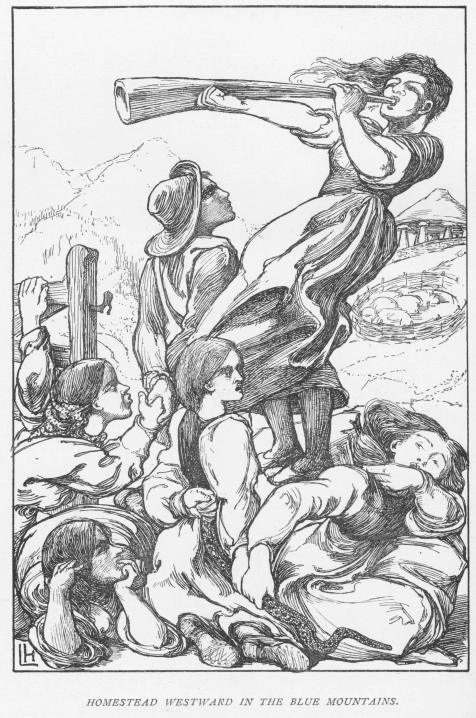
THE HOMESTEAD WESTWARD IN THE BLUE MOUNTAINS
There was once a farmer's son who was off to Moen for the annual manoeuvres. He was to be the drummer, and his way lay right across the mountains. There he could practise his drumming at his ease, and beat his tattoos again and again without making folks laugh, or having a parcel of small boys dangling about him like so many midges.
Every time he passed a mountain homestead he beat his rat-tat-tat to bring the girls out, and they stood and hung about and gaped after him at all the farmhouses.
It was in the midst of the hottest summer weather. He had been practising his drumming from early in the morning, till he had grown quite sick and tired of it. And now he was toiling up a steep cliff, and had slung his drum over his shoulder, and stuck his drumsticks in his bandoleer.
The sun baked and broiled upon the hills; but in the clefts there was a coolness as of a rushing roaring waterfall. The little knolls swarmed with bilberries the whole way along, and he felt he must stoop down and pluck whole handfuls at a time, so that it took a long time to get to the top.
Then he came to a hilly slope where the ferns stood high, and there were lots of birch bushes. It was so nice and shady there, he thought, and so he couldn't for the life of him help taking a rest.
His drum he took off, his jacket he put beneath his head, and his cap over his face, and off he went to sleep.
But as he lay dozing there, he dreamt that some one was tickling him under the nose with a straw so that he could get no peace; and the instant he awoke, he fancied he heard laughing and giggling.
The sun had by this time begun to cast oblique shadows, and far down below, towards the valleys, lay the warm steaming vapours, creeping upwards in long drawn-out gossamer bands and ribands of mist.
As he reached behind him for his jacket, he saw a snake, which lay and looked at him with such shrewd quick eyes. But when he threw a stone at it, it caught its tail in its mouth, and trundled away like a wheel.
Again there was a giggling and a sniggering among the bushes.
And now he heard it among some birch trees which stood in such a wonderful sunlight, for they were filled with the rain and fine drizzle of a waterfall. The water-drops glistened and sparkled so that he really couldn't see the trees properly.
But it was as though something were moving about in them, and he could have sworn that he had caught a glimpse of a fine bright slim damsel, who was laughing and making fun of him. She peeped at him from beneath her hand, because of the sun, and her sleeves were tucked up.
A little while afterwards a dark-blue blouse appeared above the brushwood.
He was after it in an instant.
He ran and ran till he had half a mind to give up, but then a frock and a bare shoulder gleamed betwixt an opening in the leaves.
And off again he pelted as hard as he could, till he began to think that it must have all been imagination.
Then he saw her right in a corner of the green bushes. Her hair had been torn out of its plaits from the speed with which she had flown through the bushes. She stood still, and looked back as if she were terribly frightened.
But the lad thought to himself that if she had run away with his drumsticks, she should pay for it.
And off they ran again, she in front, and he behind.
Now and again she turned round and laughed and gibed, and gave a toss and a twist, so that it looked as if her long wavy hair were writhing and wriggling and twisting like a serpent's tail.
At last she turned round on the top of the hill, laughed, and held out his drumsticks towards him.
But now he was determined to catch her. He was so near that he made grab after grab at her; but just as he was about to lay hold of her hard by a fence, she was over it, while he tumbled after her into the enclosure of a homestead.
Then she cried and shouted up to the house, "Randi, and Brandi, and Gyri, and Gunna!"
And four girls came rushing down over the sward.
But the last of them, who had a fine ruddy complexion and heavy golden-red hair, stood and greeted him so graciously with her downcast eyes, as if she was quite distressed that they should play such wanton pranks with a strange young man.
She stood there abashed and uncertain, poor thing! just like a child, who knows not whether it should say something or not; but all the while she sidled up nearer and nearer to him. Then, when she was so close to him that her hair almost touched him, she opened her blue eyes wide, and looked straight at him.
But she had a frightfully sharp look in those eyes of hers.
"Rather come with me, and thou shalt have dancing--or art thou tired, my lad?" cried a girl with blue-black hair, and a wild dark fire in her eyes. She tripped up and down, and clapped her hands. She had white teeth and hot breath, and would have dragged him off with her.
"Tie thyself up behind first, black Gyri!" giggled the others.
And immediately she let the lad go, and wobbled and twisted, and went backwards so oddly.
He couldn't help staring after the black lassie, who stood and writhed and twisted so uncomfortably, as if she were concealing something behind her, and had, all at once, become so meek.
But the fine bright girl with the slim slender waist, who had rushed on before him, and who seemed to him the loveliest of them all, began to laugh at him again and tease him.
Run as he might, he shouldn't catch her, she jibed and jeered; never should he find his drumsticks again, she said.
But then her mood shifted right round, and she flung herself down headlong, and began to cry. She had followed his drumming the whole day, she said, and never had she heard any fellow who could beat rat-tat-tat so well; nor had she ever seen a lad who was so handsome while he was asleep. "I kissed thee then," said she, and smiled up at him so sorrowfully.
"Beware of the serpent's tongue, lest it bite thee, swain! Tis worst of all when it licks thee first," whispered the bashful one with the golden-red hair. She would fain have stolen between them so softly.
And all at once the swain recollected the snake, which was as slender, and supple, and quick, and sparkling as the girl who lay there on the hill-side, and wept and made fun at the same time and looked oddly alert and wary.
But a stooping, somewhat clumsy little thing now stuck her head quickly in between, and smiled shamefacedly at him, as if she knew and could tell him so much. Her eyes sparkled a long way inwards, and across her face there passed a sort of pale golden gleam, as when the last sunbeam slowly draws away from the grassy mountain slope.
"At my place," said she, "thou shalt hear such Langelejk1 as none else has ever heard. I will play for thee, and thou shalt listen to things unknown to others. Thou shalt hear all that sings, and laughs, and cries in the roots of trees, and in the mountains, and in all things that grow, so that thou wilt never trouble thy head about anything else in the world."
Then there was a scornful laugh; and up on a rock he saw a tall strongly built girl, with a gold band in her hair and a huge wand in her hand.
She lifted a long wooden trumpet with such splendid powerful arms, threw back her neck with such a proud and resolute air, and stood firm and fast as a rock while she blew.
And it sounded far and wide through the summer evening, and rang back again across the hills.
But she, the prettiest and daintiest of them all, who had cast herself on the ground, stuck her fingers in her ears, and mimicked her and laughed and jeered.
Then she glanced up at him with her blue eyes peeping through her ashen-yellow hair, and whispered---
"If thou dost want me, swain, thou must pick me up."
"She has a strong firm grip for a gentle maiden," thought he to himself, as he raised her from the ground.
"But thou must catch me first," cried she.
And right towards the house they ran--she first, and he after her.
Suddenly she stopped short, and putting both arms akimbo, looked straight into his eyes: "Dost like me?" she asked.
The swain couldn't say no to that. He had now got hold of her, and would have put his arm round her.
"'Tis for thee to have a word in the matter, father," she shouted all at once in the direction of the house; "this swain here would fain wed me."
And she drew him hastily towards the hut door.
There sat a little grey-clad old fellow, with a cap like a milk-can on his head, staring at the livestock on the mountain-side. He had a large silver jug in front of him.
"'Tis the homestead westward in the Blue Mountains that he's after, I know," said the old man, nodding his head, with a sly look in his eyes.
"Haw, haw! That's what they're after, is it?" thought the swain. But aloud he said, "'Tis a great offer, I know; but methinks 'tis a little hasty too. Down our way 'tis the custom to send two go-betweens first of all to arrange matters properly."
"Thou didst send two before thee, and here they be," quoth she smartly, and produced his drumsticks.
"And 'tis usual with us, moreover, to have a look over the property first; though the lass herself have wit enough and to spare," added he.
Then she all at once grew so small, and there was a nasty green glitter in her eyes---
"Hast thou not run after me the livelong day, and wooed me right down in the enclosure there, so that my father both heard and saw it all?" cried she.
"Pretty lasses are wont to hold back a bit," said the swain, in a wheedling sort of way. He perceived that he must be a little subtle here; it was not all love in this wooing.
Then she seemed to bend her body backwards into a complete curve, and shot forward her head and neck, and her eyes sparkled.
But the old fellow lifted his stick from his knee, and she stood there again as blithe and sportive as ever.
She stretched herself out tall and stiff, with her hands in her silver girdle; and she looked right into his eyes and laughed, and asked him if he was one of those fellows who were afraid of the girls. If he wanted her he might perchance be run off his legs again, said she.
Then she began tripping up and down, and curtseying and making fun of him again.
But all at once he saw on the sward behind her what looked like the shadow of something that whisked and frisked and writhed round and round, and twisted in and out according as she practised her wheedling ways upon him.
"That is a very curious long sort of riband," thought the drummer to himself in his amazement. They were in a great hurry, too, to get him under the yoke, he thought; but they should find that a soldier on his way to the manoeuvres is not to be betrothed and married offhand.
So he told them bluntly that he had come hither for his drumsticks, and not to woo maidens, and he would thank them to let him have his property.
"But have a look about you a bit first, young man," said the old fellow, and he pointed with his stick.
And all at once the drummer saw large dun cows grazing all along the mountain pastures, and the cow-bells rang out their merry peals. Buckets and vats of the brightest copper shone all about, and never had he seen such shapely and nicely dressed milkmaids. There must needs be great wealth here.
"Perchance thou dost think 'tis but a beggarly inheritance I have here in the Blue Mountains," said she, and sitting down on a haycock, she began chatting with him. "But we've four such sætar2 as this, and what I inherit from my mother is twelve times as large."
But the drummer had seen what he had seen. They were rather too anxious to settle the property upon him, thought he. So he declared that in so serious a matter he must crave a little time for consideration.
Then the lass began to cry and take on, and asked him if he meant to befool a poor innocent, ignorant, young thing, and pursue her and drive her out of her very wits. She had put all her hope and trust in him, she said, and with that she fell a-howling.
She sat there quite inconsolable, and rocked herself to and fro with all her hair over her eyes, till at last the drummer began to feel quite sorry for her and almost angry with himself. She was certainly most simple-minded and confiding.
All at once she twisted round and threw herself petulantly down from the haycock. Her eyes spied all about, and seemed quite tiny and piercing as she looked up at him, and laughed and jested.
He started back. It was exactly as if he again saw the snake beneath the birch tree down there when it trundled away.
And now he wanted to be off as quickly as possible; he cared no longer about being civil.
Then she reared up with a hissing sound. She quite forgot herself, and a long tail hung down and whisked about from behind her kirtle.
He shouldn't escape her in that way, she shrieked. He should first of all have a taste of public penance and public opinion from parish to parish. And then she called her father.
Then the drummer felt a grip on his jacket, and he was lifted right off his legs.
He was chucked into an empty cow-house, and the door was shut behind him.
There he stood and had nothing to look at but an old billy-goat through a crack in the door, who had odd, yellow eyes, and was very much like the old fellow, and a sunbeam through a little hole, which sunbeam crept higher and higher up the blank stable wall till late in the evening, when it went out altogether.
But towards night a voice outside said softly, "Swain! swain!" and in the moonlight he saw a shadow cross the little hole.
"Hist! hist! the old man is sleeping at the other side of the wall," it sounded.
He knew by the voice that it was she, the golden-red one, who had behaved so prettily and been so bashful the moment he had come upon the scene.
"Thou need'st but say that thou dost know that serpent-eye has had a lover before, or they wouldn't be in such a hurry to get her off their hands with a dowry. Thou must know that the homestead westwards in the Blue Mountains is mine. And answer the old man that it was me, Brandi, that thou didst run after all the time. Hist! hist! here comes the old man," she whispered, and whisked away.
But a shadow again fell across the little hole in the moonlight, and the duck-necked one stuck her head in and peeped at him.
"Swain, swain, art thou awake?"
"That serpent-eye will make thee the laughingstock of the neighbourhood. She's spiteful, and she stings. But the homestead westward in the Blue Mountains is mine, and when I play there the gates beneath the high mountains fly open, and through them lies the road to the nameless powers of nature. Do but say that 'twas me, Randi, thou wert running after, because she plays so prettily on the Langelijk.--"Hist, hist! the old man is stirring about by the wall!"--she beckoned to him and was gone.
A little afterwards nearly every bit of the hole was darkened, and he recognised the Black one by her voice.
"Swain, swain!" she hissed.
"I had to bind up my kirtle to-day behind," said she, "so we couldn't go dancing the Halling-fling3 together on the green sward. But the homestead in the Blue Mountains is my lawful property, and tell the old man that it was madcap Gyri thou wast running after to-day, because thou art so madly fond of dancing jigs and hallings."
Then she clapped her hands aloud, and straightway was full of fear lest she should have awakened the old man.
And she was gone.
But the lad sat inside there, and thought it all over, and looked up at the thin pale summer moon, and he thought that never in his whole life had he been in such evil case.
From time to time he heard something moving, scraping, and snorting against the wall outside. It was the old fellow who lay there and kept watch over him.
"Thou, swain, thou," said another voice at the peep-hole.
It was she who had planted herself so firmly on the rock with such sturdy hips and such a masterful voice.
"For these three hundred years have I been blowing the langelur4 here in the summer evenings far and wide, but never has it drawn any one westward hither into the Blue Mountains. And let me tell thee that we are all homeless and houseless, and all thou seest here is but glitter and glamour. Many a man has been befooled hither time out of mind. But I won't have the other lasses married before me. And rather than that any one of them should get thee, I'll free thee from the mountains. Mark me, now! When the sun is hot and high the old man will get frightened and crawl into his corner. Then look to thyself. Shove hard against the door of the hayloft, and hasten to get thee over the fence, and thou wilt be rid of us."
The drummer was not slow to follow this counsel. He crept out the moment the sun began to burn, and cleared the fence with one good bound.
In less than no time he was down in the valley again.
And far, far away towards sunrise in the mountains, he heard the sound of her langelur.
He threw his drum across his shoulder, and hied him off to the manoeuvres at Moen.
But never would he play rat-tat-tat and beat the tattoo before the lasses again, lest he should find himself westwards in the Blue Mountains before he was well aware of it.
[1] A long slow dance, and the music to it.
[2] A Sæter (Swed. säter) is a remote pasturage with huts upon it, where the cows are tended and dairy produce prepared for market and home use during the summer.
[3] A country dance of a boisterous jig-like sort.
[4] A long wooden trumpet.
"IT'S ME."
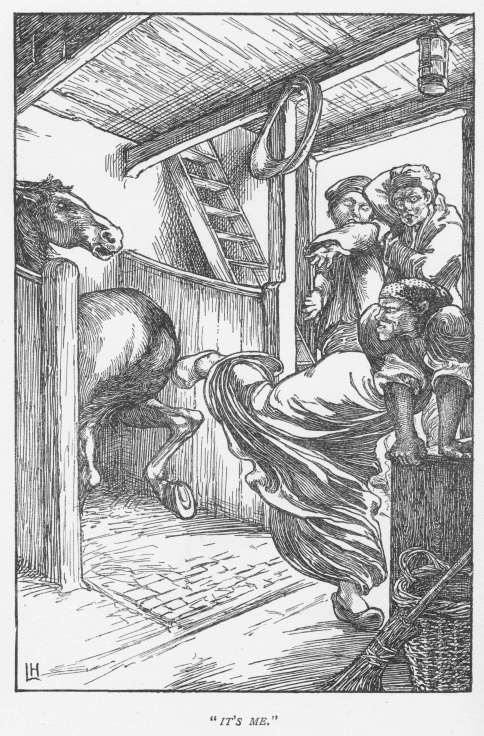
"IT'S ME"
They had chatted so long about the lasses down in the valley; and what a fine time they had of it there, that Gygra's1 daughter grew sick and tired of it all, and began to heave rocks against the mountain side. She was bent upon taking service in the valley below, said she.
"Then go down to the ground gnome first, and grind thy nose down, and tidy thyself up a bit, and stick a comb in thy hair instead of an iron rake," said the dwellers in the mountains.
So Gygra's daughter tramped along in the middle of the river, till the foss steamed and the storm whirled round about her. Down she went to the ground gnome, and was scoured and scrubbed and combed out finely.
One evening a large-limbed coarse-grained wench stepped into the general-dealer's kitchen, and asked if she could be taken into service.
"You must be cook, then," said Madame2. It seemed to her that the wench was one who would stir the porridge finely, and would make no bones about a little extra wood-chopping and tub-washing. So they took her on.
She was a roughish colt, and her ways were roughish too. The first time she carried in a load of wood, she shoved so violently against the kitchen door that she burst its hinges. And however many times the carpenter might mend the door, it always remained hingeless, for she burst it open with her foot every time she brought in wood.
When she washed up, too, heaps and heaps of pots and pans were piled up higgledy-piggledy from meal to meal, so that the kitchen shelves and tables could hold no more, and bustle about as she might, they never seemed to grow less.
Nor had her mistress a much better opinion of her scouring.
When Toad, for so they called her, set to work with the sand-brush, and scrubbed with all her might, the wooden, tin, and pewter vessels would no doubt have looked downright bonny if they hadn't broken to bits beneath her hands. And when her mistress tried to show her how it ought to be done, she only gasped and gaped.
Such sets of cracked cups, and such rows of chipped and handleless jugs and dishes, had never before been seen in that kitchen.
And then, too, she ate as much as all the other servants put together.
So her mistress complained to her master, and said that the sooner they were well quit of her the better.
Out into the kitchen went the general dealer straightway. He was quite red in the face, and flung open the kitchen-door till it creaked again. He would let her know, he said, that she was not there to only stand with her back to the fire and warm her dirty self.
Now when he saw the lazy sluttish beast lounging over the kitchen bench and doing nothing but gape through the window-panes at his boats, which lay down by the bridge laden with train-oil, he was downright furious. "Pack yourself off this instant!" said he.
But Toad showed her teeth, and grinned and blinked up at him, and said that as master himself had come into the kitchen, he should see that she did not eat his bread for nothing.
Then she slouched down to the boats, and snorted back at him with her arm before her face. Before any one could guess what she was after, she had one of the heavy hogsheads of train-oil on her back.
And back she came through the kitchen door, all smirking and smiling, and begged father to be so good as to tell her where she was to put it.
He simply stood and gaped at her. Such a thing he had never seen before.
And hogshead after hogshead she carried from the boat right up into the shop.
The general dealer laughed till he quite gasped for breath, and slapped his thighs so far as his big belly would let him reach them.
Nor was he sparing of compliments.
And into the dwelling-room he rushed almost as quickly as he had rushed out of it.
"Mother has no idea what a capital wench she has got," said he.
But, ever after that, she put her hand to nothing, nay, not so much as to drive a wooden peg into the wall, and if some one else hadn't warmed up a thing or two now and then, there would have been very little to eat in the house. It was as much as they could do to get her away from the fireside at meal times.
When her mistress complained about it, her master said that she oughtn't to expect too much. The lass surely required a little rest now and again, after carrying such drayman's loads as she did.
But Toad always had an ogle and a grin ready at such times as the general dealer came through the door from the shop. Then she grew quick and lively enough, and went on all sorts of errands, whether it was with the bucket to the spring or to the storehouse for bread. And when she saw that her mistress was out of the way, she took it upon herself to do exactly as she liked, both in this and in that.
No sooner was the pot hung on the pot-hook, than she would slip away with a big saucer and fetch sirup from the shop. And she would flounce down before the porridge dish and gobble to her heart's content. If any of her fellow-servants claimed an equal share, she would simply answer, "It's me!"
They dared not rebel. Since the day she had taken up the hogsheads of train-oil, they knew that she had master on her side.
But her mistress was not slow to mark the diminishing both of the sirup-pot and the powdered sugar, and she perceived also in which direction the gingerbreads and all the butter and bacon went. For out the wench would come, munching rye cakes and licking the sirup from her fingers.
And she grew as round and thick and fat as if she would burst.
When her mistress took away and kept the key, Toad would poke her head into the parlour door, and ogle and writhe at the general dealer, and ask if there was anything to carry up to the store-room. And then he would go to the window and watch her as she lifted and carried kegs of fish and casks of sugar and sacks of meal.