PART I.
Reading edition
POPULAR WEATHER PROGNOSTICS.
By the Hon. Ralph Abercromby, F. M. S., and William Marriott, F. M. S., reprinted from the “Quarterly Journal of the Meteorological Society,” published in London.
The attempt to foretell the weather is not of recent date; the ancients carefully studied the sky and clouds, and endeavored to predict the kind of weather that was likely to ensue; and a number of the popular prognostics of the weather of his time are recorded by Aristotle in his work on meteors. In later times our forefathers studied the weather, and as they had no instruments to guide them they observed natural objects and noticed the appearances of the sky and clouds, and also the movements of animals, birds, plants, &c. Shepherds and sailors especially being exposed to all kinds of weather, would naturally be on the lookout for any signs of a coming change, and after a time would begin to associate certain appearances with certain kinds of weather. A good deal of weather wisdom of the above character has been thrown into proverbs, trite sayings, and popular verse; and we propose in the present paper to examine and explain some of these by the aid of the most recent discoveries of meteorological science. A great advance has been made in meteorology during the last twenty years, owing to the introduction of daily synoptic charts of the distribution of atmospheric pressure, temperature, wind, rain, &c. From these it is evident that there is a distinct relation existing between the distribution of pressure and the direction and force of the wind, and the temperature and weather generally. A glance at a number of the charts shows that there is nearly always present either an area of low pressure, called a cyclone, usually having an approximately circular form, and, as a rule, moving in an easterly or northeasterly direction; or an area of high pressure, called an anticyclone, also nearly circular in form, but almost stationary in position. The wind in all cases also blows in a direction nearly parallel with the isobars, having the region of lowest pressure on the left hand. This has given rise to the simple law propounded by Dr. Buy’s Ballot, for the northern hemisphere, viz: “Stand with your back to the wind, and the barometer will be lower on your left hand than on your right.” In cyclones the wind circulates in the opposite way to which the hands of a watch move, but exhibits usually a little in-draught; while in anticyclones the wind circulates in the same way as the hands of a watch, but exhibits usually a little outward motion. The intensity of the wind in all cases depends upon the closeness of the isobars; for the closer the isobars the greater is the difference in pressure in a given distance, and consequently the stronger the wind. Nearly all of our weather is of the cyclonic or anticyclonic type, and is entirely dependent upon the form and distribution of the isobars. It is, therefore, by the aid of isobaric charts that we shall attempt to explain popular prognostics, and to associate them with certain kinds of weather. The method of research actually adopted has been for many years past to 10take notes of any good observation of any prognostic and put them in a portfolio, with the nearest synoptic chart available, or preferably with the nearest, both before and after. When a sufficient number had been collected they were analyzed, and the remarkable result has been arrived at that the greater number of prognostics are simply descriptive of the weather and appearance of the sky, in the different portions of the various shapes of isobars seen on synoptic charts, and that they indicate foul or fair weather just as they precede the shifting areas of rain or blue sky which are mapped out by the isobaric lines. These charts not only show the success of the prognostics, but also explain wherein they sometimes fail, by tracing the changes of each particular condition of the weather. Hitherto the only prognostics which have been accounted for have been those due to excessive damp, but by means of isobaric charts many others can be readily explained. It must not be supposed that the modern methods diminish the value of prognostics, for even in forecasting weather from synoptic charts they are of great value, and are always exceedingly useful to solitary observers who have only a single barometer to depend upon besides these prognostics, as, for instance, on board ship.
We hope that the present paper will create an interest on the part of many in this subject, and show that it is within their power to assist in advancing the science of meteorology, so that it may not remain any longer in the unsatisfactory state set forth in the following old Bedfordshire lines:
“Well, Duncombe, how will be the weather?”
“Sir, it looks cloudy altogether,
And coming across our Houghton Green,
I stopped and talked with old Frank Beane.
While we stood there, sir, old Jan Swain
Went by and said he knowed ’twould rain;
The next that came was Master Hunt,
And he declared he knew it wouldn’t.
And then I met with Farmer Blow,
He plainly said he didn’t know,
So, sir, when doctors disagree,
Who’s to decide it, you or me?”
CYCLONE PROGNOSTICS.
We shall first take a typical well formed cyclone. In the accompanying diagram (Fig. 1) the broad features of the relation of cloud and rain to a cyclone centre are shown, the full line indicating the path of the depression, and the dotted line at right angles to it is the trough or locus of the lowest reading of the barometer.
11
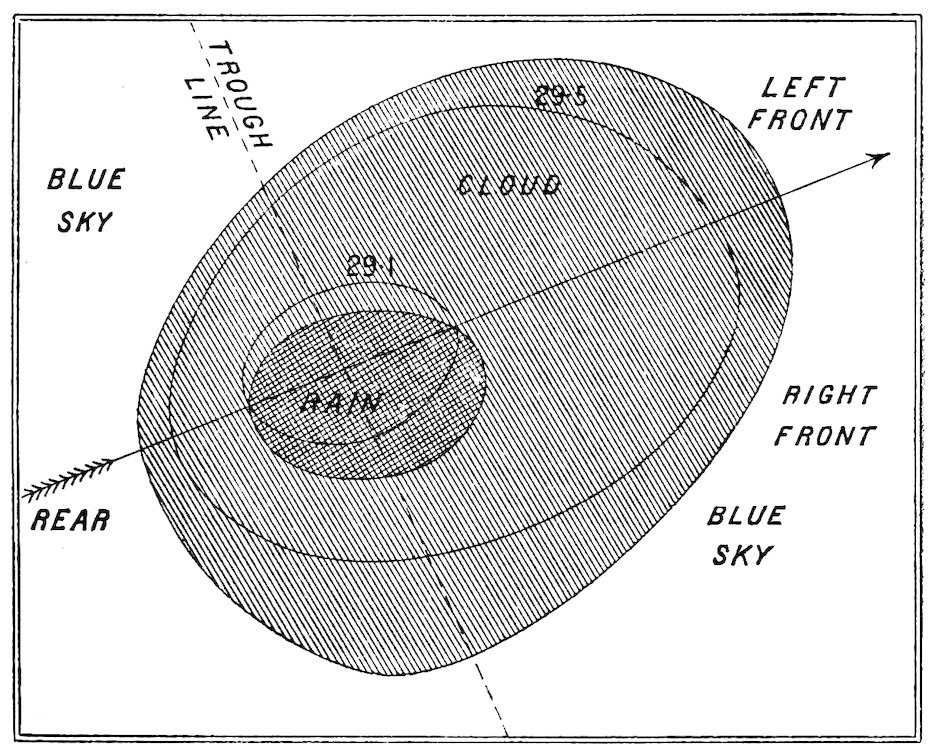
Fig. 1.—Weather in a Cyclone, November 14, 1875.
In the extreme front of the depression there is a blue sky, then, as the barometer begins to fall, and sometimes even before that takes place, a bank of cirro-stratus, preceded by a halo-bearing sky, makes its appearance, which gradually becomes lower and denser, and forms an overcast, dirty sky. In the whole front of the depression the temperature rises, and the atmosphere feels muggy and close. In the right-hand front the clouds assume the cumulo-stratus type, with driving rain later on. In the left-hand front the air is cooler, but still oppressive, with an easterly wind and overcast sky, succeeded by drizzling rain or ill-defined showers. When the trough of the depression has passed the barometer begins to rise, the wind changes and becomes squally, with showers of rain; the air grows cooler, and the clouds break and ultimately clear away.
Now, with regard to the prognostics with reference to Fig. 2, where 12the characteristic weather in the different portions of a depression are given in a diagrammatic form, it will be seen that the first indication of a coming change is the appearance of a halo round the sun or moon in the cirro-stratus clouds. Hence,
When round the moon there is a brugh,
The weather will be cold and rough.
The moon with a circle brings water in her beak.
Halos predict a storm (rain and wind or snow and wind) at no great distance, and the open side of the halo tells the quarter from which it may be expected.
Mock suns predict a more or less certain change of weather.
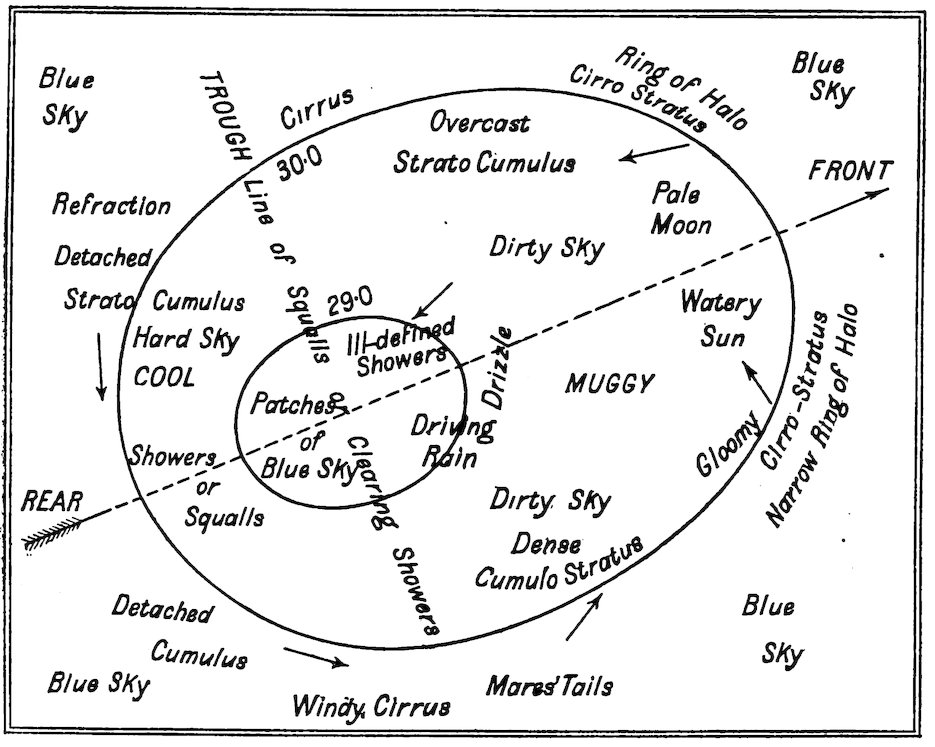
Fig. 2.—Cyclone Prognostics.
With regard to the open side of the halo indicating the quarter from which the storm may be expected, it does not appear that this can be much used as a prognostic. It, however, most probably originated in the fact that halos are often seen in the southwest or west, when the sun or moon is rather low, the lower portion of the halo being cut off by clouds banking up in that direction, and that our storms generally come from those quarters. As a specimen of the value of prognostics we give some details of halos. When rain does not fall within thirty-six hours, any subsequent rain probably belongs to a new depression.
During the six years ending June, 1882, one hundred and fifty-five solar halos and sixty-one lunar halos were observed in the neighborhood of London, and they occurred with the following winds:
13
N. NE. E. SE. S. SW. W. NW. Total.
Solar halos 9 7 17 8 22 28 59 5 155
Lunar halos 4 3 8 3 8 11 21 3 61
WITH SOLAR HALOS.
Rain fell on same day 3 1 10 4 15 12 36 0 81
Rain fell on first day 1 2 1 2 2 10 12 1 31
Rain fell on second day 0 0 1 0 2 1 4 2 10
Rain fell on third day 3 1 0 0 0 1 1 1 7
No rain 2 3 5 2 3 4 6 1 26
WITH LUNAR HALOS.
Rain fell on first day 1 1 3 3 3 9 13 1 34
Rain fell on second day 0 1 0 0 1 1 3 0 6
Rain fell on third day 1 1 2 0 3 1 0 1 9
Rain fell on fourth day 0 0 0 0 0 0 3 1 4
No rain 2 0 3 0 1 0 2 0 8
After the halo comes the pale or watery sun and moon.
When the sun appears of a light, pale color or goes down in a bank of clouds, it indicates the approach or continuance of bad weather.
If the sun goes pale to bed,
’Twill rain to-morrow, it is said.
A red sun has water in his eye.
When the moon has a white look or when her outline is not very clear, rain or snow is looked for.
From the extreme damp in this part of the depression, while the sky generally is pretty clear, cloud forms round and “caps” the tops of hills, a circumstance that has given rise to numerous local sayings:
When the clouds are upon the hills,
They’ll come down by the mills.
When Cheviot ye see put on his cap,
Of rain ye’ll have a wee bit drap.
If Riving Pike do wear a hood,
Be sure the day will ne’er be good.
When Bredon Hill puts on his hat
Ye man of the vale beware of that.
From the same excessive damp the following may be explained:
When the walls are more than usually damp rain is expected.
Doors and windows are hard to shut in damp weather.
The sailor notes the tightening of the cordage on his ship as a sign of coming rain.
A lump of hemp acts as a good hygrometer, and prognosticates rain when it is damp.
When walls built of stones which have been quarried below high water mark become damp, wet weather is at hand.
Also, owing to excessive moisture, clouds appear soft and lowering, and reflect the glare of iron-works and the lights of large towns:
The glare of the distant Ayrshire iron-works being seen at night from Cumbræ or Rothsay, rain is expected next day.
In Kinkardine of Monteith (Perthshire) and in all that district the reflections from the clouds of the furnaces of the Devon and Carrow works (to the east) foretell rain next day.
Also:
When the flames of candles flare and snap or burn with an unsteady or dim light, rain, and frequently wind also, are found to follow.
14This is especially applicable to oil-lamps or tallow candles.
As the depression approaches and the atmosphere becomes gloomy, close, and muggy, some people are troubled with rheumatic pains and neuralgia, old wounds, and corns are painful, animals and birds are restless, and drains and ditches give out an offensive smell:
When rheumatic people complain of more than ordinary pains in the joints, it will rain.
If corns, wounds, and sores itch or ache more than usual, rain is to fall shortly.
A coming storm your shooting corns presage,
And aches will throb, your hollow tooth will rage.
When animals seek sheltered places instead of spreading over their usual range, an unfavorable change is probable.
Hark! I hear the asses bray,
We shall have some rain to-day.
If oxen turn up their nostrils and sniff the air, or if they lick their fore feet, or lie on their right side, it will rain.
Goats leave the high grounds and seek shelter before a storm.
Hogs crying and running unquietly up and down with hay or litter in their mouths, foreshow a storm to be near at hand.
When birds of long flight—rooks, swallows, or others—hang about home and fly up and down, or low, rain or wind may be expected.
This tumbling of rooks is amongst the best known signs of rain in places where those birds are found.
When the peacock loudly bawls,
Soon we’ll have both rain and squalls.
If toads come out of their holes in great numbers, rain will soon fall.
If glow-worms shine much, it will rain.
When gnats bite keenly, and when flies keep near the ground, we look for wind and rain.
When spider webs are seen floating about in the air, farmers regard it as a sign of coming rain.
When many bees enter the hive and none leave it, rain is near.
Also, from cloud and gloom, plants shut up their petals early:
The Convolvulus arvensis (small bind-weed), Anagallis arvensis (scarlet pimpernel), and Calendula pluvialis shut up their flowers before approaching rain. (The pimpernel has been called the poor man’s weather-glass.)
Dr. Jenner’s well-known lines are very good, as they contain references to most of the natural prognostics. (See page 110, General Prognostics.)
It will be seen, however, later on, that the sayings about the rainbow, distant hills, and whirling dust, though good prognostics, do not belong to a depression.
As the depression centre approaches still nearer, rain sets in and continues till the barometer turns to rise. The passage of the trough is often associated with a squall or heavy shower, commonly known as “a clearing shower.” Immediately the air becomes cooler and loses the former muggy sensation, and soon small patches of blue sky appear.
When as much blue sky is seen as will make a Dutchman a jacket (or a sailor breeches) the weather may be expected to clear up.
A small cloudless place in the northeast horizon is regarded both by seamen and landsmen as a certain precursor of fine weather or a clearing up.
The steady rain breaks up into showers or cold squalls, which are followed by hard detached cumulus or strato-cumulus till the sky becomes blue again:
15When after a shower, the cirro-strati open up at the zenith, leaving broken or ragged edges pointing upwards, and settle down gloomily and compactly on the horizon, wind will follow, and will last for some time.
This is a description of a clearing up before the windy portion of a depression has passed.
In the south of the depression near the outskirts, windy cirrus and “mare’s tails” are observed, which indicate wind rather than rain, as they are south of the rainy portion.
The cloud called goat’s hair or the gray mare’s tails forebodes wind.
If clouds look as if scratched by a hen
Get ready to reef your topsails then.
Mackerel sky and mare’s tails,
Make lofty ships carry low sails.
The shift of the wind is different in the right-hand portion of the depression to what it is in the left-hand portion. In the former, on its first approach, the wind backs to south and falls very light to an almost ominous calm. The first puffs or “paws” of wind give rise to a noise in tree tops without much wind, and little eddies of dust, or to a whistling of the wind indoors, which are all well-known signs of rain. Then, as the depression passes along, the wind gradually veers to southwest and west, with increasing strength. Hence,
When the wind veers against the sun,
Trust it not, for back ’twill run.
When the wind is in the south
It is in the rain’s mouth.
In the left-hand side of the depression the wind will back right round from south through east to north and northwest. In the rear of the depression on the left-hand side the wind blows from the northeast and then north, when the clouds begin to break and the weather to clear. When the depression has nearly passed away the wind in the rear draws round to the northwest, and gradually abates, and the weather becomes fine. Hence the saying:
Do business with men when the wind is in the northwest.
This bringing the finest weather is said to improve men’s tempers, as opposed to the neuralgic and rheumatic sensations felt in front of a depression.
WEDGE-SHAPED ISOBAR PROGNOSTICS.
Though the bulk of British weather is made up of cyclones and anticyclones, there are two other distributions of pressure marked out by wedge-shaped isobars and straight isobars respectively, which have never before been described, but which are associated with many well-known sayings. The chief interest in these prognostics consists in the contrasts which they present to cyclone prognostics, as in many cases they are associated with fine or dry weather, as opposed to the damp of an approaching depression. We shall first describe the prognostics which characterize the wedge-shaped area of high pressure that is frequently formed between a retreating and an advancing depression, as it is by far the most common.
All these prognostics owe their value to the fact that as the new depression comes on, rain may be expected. By reference to Fig. 3 it will be seen that in the rear of the retreating depression the weather is beautifully fine, of the sort of which we should say that it was “too fine to last,” or, if it lasted a whole day, we should call it a “pet day.”
16
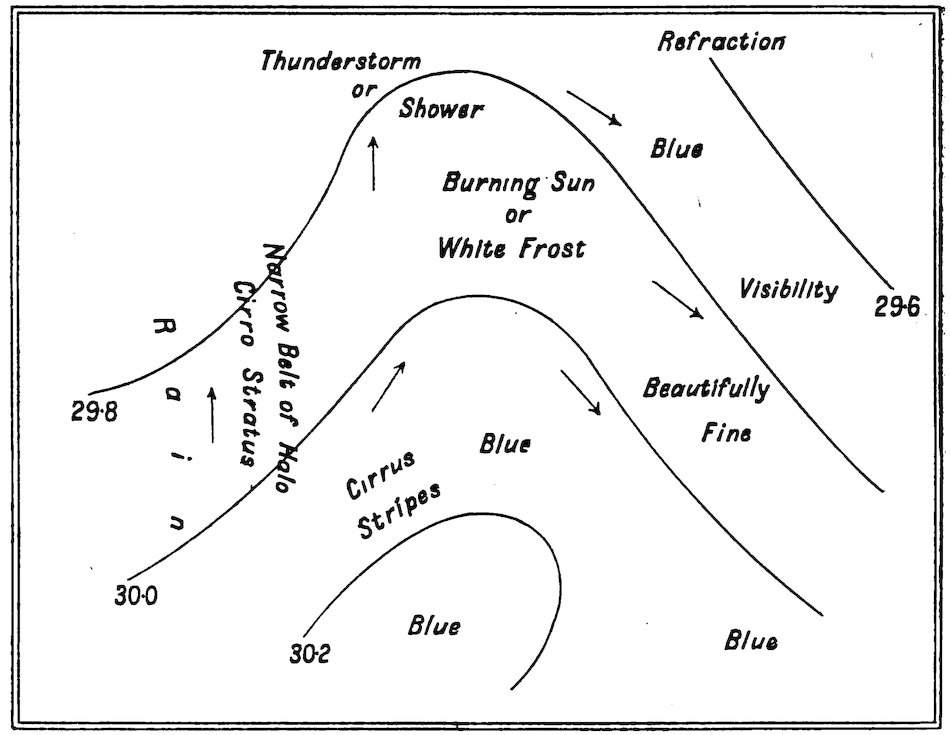
Fig. 3.—Wedge-sharped Isobars.
An unseasonably fine day in spring is called a pet day in Scotland. The fate of pets they say awaits it, and they look for bad weather on the morrow.
During the day the sun is burning hot:
When the sun burns more than usual, rain may be expected.
During the night white frost is formed, owing to calm radiation:
A white frost never lasts more than three days; a long frost is a black frost.
Frost suddenly following heavy rain seldom lasts long.
As the day advances after a white frost, the air becomes dull from the influence of the on-coming depression; whence the saying—
When the frost gets into the air it will rain.
During the very fine weather, on the east side of a wedge-shaped area there is often great visibility with a cloudless sky:
The further the sight the nearer the rain.
When the Isle of Wight is seen from Brighton or Worthing, rain may be expected.
When to the people about Arbrouth the Bell-Rock light is particularly brilliant, rain is expected.
About Cape Wrath and along that part of the coast when the Orkney Islands are distinctly seen, a storm or a continuation of bad weather is prognosticated.
When from Ardersier and the adjoining parish on the southeast side of the Moray Firth the distant Ross-shire hills are distinctly seen in the morning rain is expected that day.
To the people in Eaglesham, in Renfrewshire, when the Kilpatrick hills appear near a change to wet is looked for; but when they appear remote, dry weather will continue.
If the old moon embraces the new moon, stormy weather is foreboded.
17Great confidence is placed in this old prognostic:
I saw the new moon late yestreen
Wi’ the old moon in her arm,
And if we gang to sea, master,
I fear we’ll come to harm.
The reason of “visibility” is uncertain; the old idea that it is due to excess of vapor is certainly erroneous. The dry and wet bulb hygrometer always indicates a considerable amount of dryness when it is remarked, and Mr. Cruickshank has shown by long observation at Aberdeen that visibility is greatest at the driest season of the year.
At the extreme northwest edge of a depression there is often unusual “refraction,” a well-known sign of rain. This seems to be due to the cold air in the rear of a depression being much below the temperature of the sea. If so, it is a sign of rain, for the reason that one depression is usually followed soon by another, which also explains the saying—
A norwester is not long in debt to a souwester.
Refraction and visibility combined also explain the following curious local prognostic:
When Ailsa Craig is distinctly seen, and seems near at hand, the people of Cumbræ look for change. When the weather is going to be finer it lies flat; but when rain is coming it assumes the form of a mushroom.
Ailsa Craig is an isolated rock standing in the Firth of Clyde, about thirty miles from Cumbræ. It has a conical top, with precipitous sides, so that in ordinary weather only the top is seen lying flat on the horizon; but sometimes in the rear of a depression it appears lifted by refraction, and the light encroaches at the edges, as is often seen with projecting promontories, giving the whole a fanciful resemblance to a mushroom. The prognostic is mistrusted by the inhabitants during frost, and we have proved it by our own observation. On the west side of the wedge-shaped area, as the new depression comes on, the blue sky gradually assumes a dirty appearance, accompanied by a halo, and gathers into cloud, and later on rain begins to fall; while in the southern portion the rain is often preceded by strips of cirrus, either lying in the direction of the wind, or sometimes at right angles to it:
Cirrus at right angles to the wind is a sign of rain.
STRAIGHT ISOBAR PROGNOSTICS.
Now we come to the consideration of some very interesting rain prognostics associated with straight isobars. While those in a depression are preceded by an almost ominous calm, and a dirty, murky sky, these are associated with a hard sky and blustery wind, of which it would be ordinarily remarked “that the wind keeps down the rain,” or “that when the wind falls it will rain.” While also the prognostics which precede cyclone rain hold good for the reason that they are seen in front of the rainy portion, those associated with straight isobars hold good because, though there is little rain actually with them, the area which they cover to-day will probably be covered by a depression to-morrow—the conditions being favorable for the passage of depressions.
On turning to Fig. 4 it will be seen that while the pressure is high to the south, it is generally low to the north, without any definite cyclonic system, and that the isobars run straight nearly east and west.
18
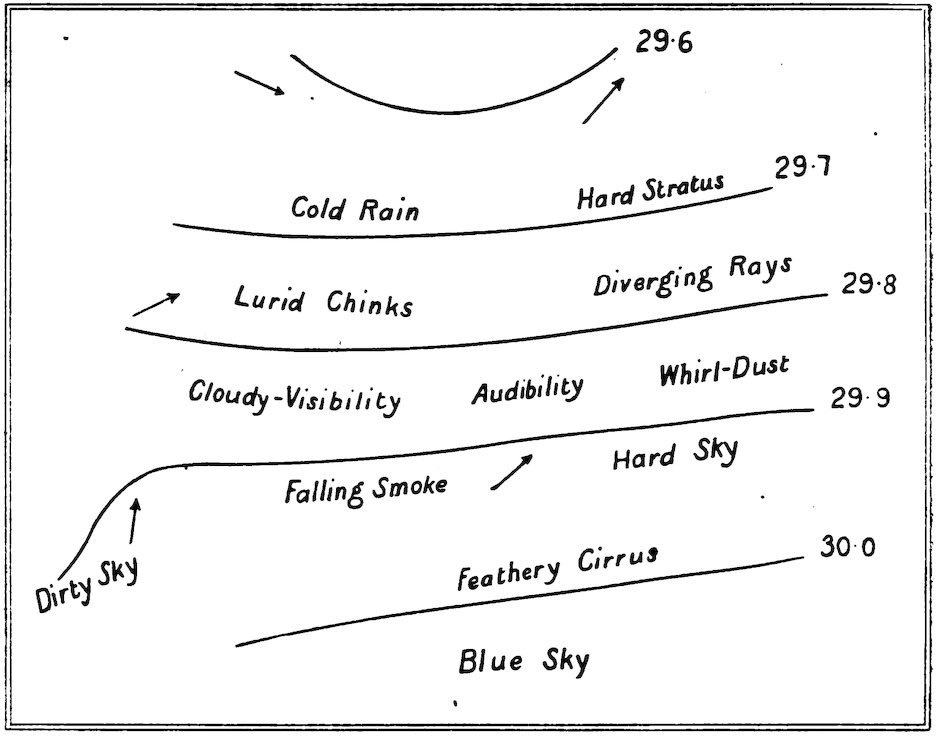
Fig. 4.—Straight Isobar Prognostics.
Near the high pressure the sky is blue, then as we approach the low pressure feathery cirrus, or some form of windy sky, makes its appearance, while a blustery wind whirls the dust, or blows the soot down; and animals turn their tails to the wind to avoid its force on their faces:
When chimneys smoke and soot falls, bad weather is at hand. The whistling of the wind heard within doors denotes rain.
When sheep, cattle, or horses turn their backs to the wind, it is a sign of rain.
Getting still nearer the low pressure, the sky is found to be gathering into hard stratus, at first with chinks between its masses, through which divergent rays stream down under the sun, which is spoken of as “the sun drawing water.” Sometimes, especially in winter, these rays are lurid, and are referred to in the following prognostic:
Along the north shore of the Solway, from Dumfries to Gretna, a lurid appearance in the eastern or southeastern horizon, called from its direction “a Carlisle sky,” is thought a sure sign of coming rain. They describe it as lurid and yet yellowish, and the common saying is:
The Carle sky
Keeps not the head dry.
At the same time there is often great “visibility” with a hard overcast sky, and moderately dry air, in which the stratus seems to play the part of a sunshade, for as soon as the sun comes out the clearness of distant objects diminishes. This visibility must not be confounded with the visibility already described with a cloudless sky, which occurs with wedge-shaped isobars. Simultaneously we often find “audibility.”
If the noise of a steamer or railway train is heard at a great distance, rain is predicted.
This distinctness of distant sounds must be carefully distinguished from sounds which are not usually heard, being brought up by the wind 19coming from a rainy quarter. For instance, the whistle of a railway train to the south of a house will not be usually heard with the normal southwest wind of this country; but when the wind backs in front of a depression to the south, then it will be heard, and although this will be a good prognostic, still it is not true audibility.
When people of Monzie (Perthshire) hear the sound of the waterfalls of Shaggie, or the roar of the distant Turret clearly and loudly, a storm is expected; but if the sound seems to recede from the ear till it is lost in the distance, and if the weather be thick a change to fair may be looked for speedily.
In Fortingall (Perthshire) if, in calm weather, the sound of the rapids on the Lyon is distinctly heard, and if the sound descends with the stream, rainy weather is at hand; but if the sound goes up the stream and dies away in the distance, it is an omen of continued dry weather, or a clearing up if previously thick.
The course of Turret and Lyon is from west to east.
True “audibility” is best described by the saying:
A good hearing day is a sign of wet.
Much sound in the air is a sign of rain.
This last exactly conveys the kind of sound referred to. The reason why audibility is produced is unknown, but the old idea that it is due to excessive moisture in the air is certainly erroneous; in several instances we have observed that the upper current of the wind appeared to be moving much faster than the lower, and perhaps that may have something to do with it. When the gradients are very steep, a little rain sometimes falls with straight isobars, generally in light showers, with a hard sky.
Though as a matter of convenience we have described the sequence of weather as we proceed from high to the low pressure, it must be clearly understood that it does not represent the sequence of weather to a single observer, but rather what the weather will be simultaneously in different parts of the country; for instance, that if there are cirrus clouds in London there may perhaps be a lurid sky in Edinburgh. The prognostic value of all is due to the fact that a depression will soon form which will probably extend over the whole country.
ANTICYCLONE PROGNOSTICS.
Having spoken of cyclones, we shall now direct our attention to anticyclones. In the daily weather charts we sometimes see but two or three isobars, and these are a considerable distance apart, and extend over a large area. The pressure is highest in the centre, and gradually diminishes outwards. The air is calm and cold in the central area, but on the outskirts the wind blows in the direction of the hands of a watch. These are the special features of an anticyclone. The weather in an anticyclone is almost the opposite of that in a depression; that in the latter being wet and unsettled, while that in the former is usually settled and fine, with more or less haze in the air. Another great difference is that while depressions are generally rapid in their movements, anticyclones are nearly stationary; and it is for this reason that they are associated with “settled” fine weather. In the area of high pressure the characteristic features are largely modified by what is termed “radiation” weather, as determined by diurnal and seasonal variations; and as the pressure is nearly stationary, these diurnal and seasonal variations are the chief features of anticyclonic weather.
We shall now give the prognostics due to the variations in some detail, Fig. 5. The sky being generally clear and the air calm, the temperature is high in the day and low at night. In summer brilliant sun 20shine prevails during the day, and at night there is heavy dew, and in low-lying places mist.
Heavy dews in hot weather indicate a continuance of fair weather, and no dew after a hot day foretells rain.
If mist rises in low ground and soon vanish, expect fair weather.
Thin, white, fleecy, broken mists, slowly ascending the sides of a mountain whose top is uncovered, predicts a fair day.
When the mist creeps up the hill,
Fisher out and try your skill.
When in the morning the dew is heavy and remains long on the grass, when the fog in the valleys is slowly dissipated and lingers on the hill-side, when the clouds seem to be taking a higher place, and when a few loose cirro-strati float gently along, serene weather may confidently be expected for the greater part of that day.
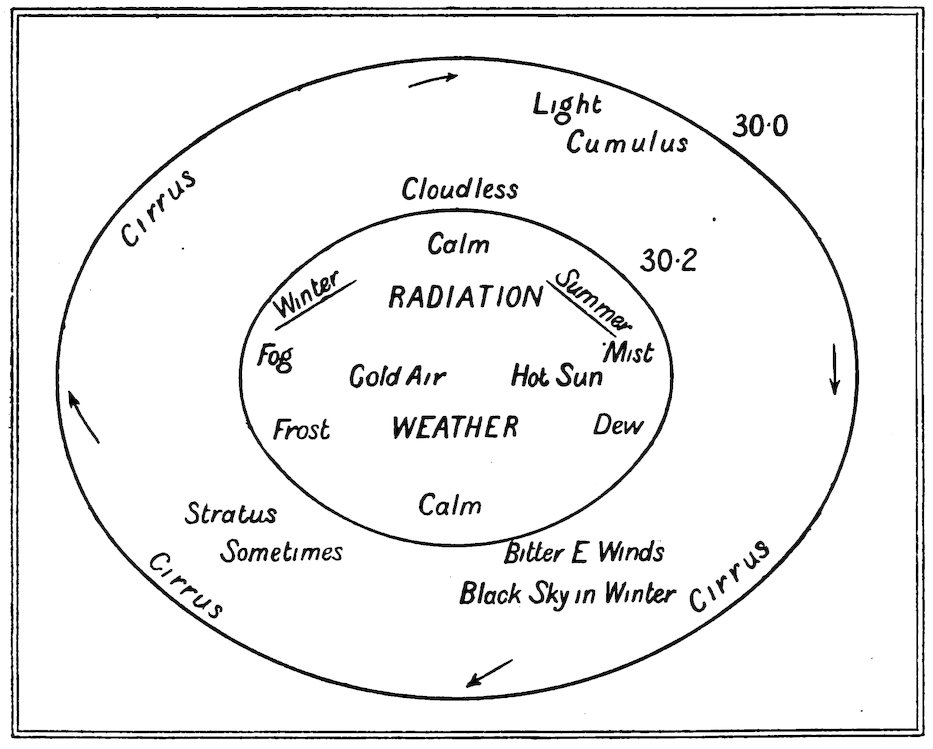
Fig. 5.—Anticyclone Prognostics.
These all refer to night radiation, mist being dispersed by the sun’s rays. Fine, light, genial weather raises the spirits and exerts an enlivening influence not only on human beings but also on animals, birds, insects, &c. Hence the saying:
If larks fly high and sing long, expect fine weather.
When sea birds fly out early and far to seaward, moderate winds and fair weather may be expected.
If rooks go far abroad it will be fine.
Cranes soaring aloft and quietly in the air foreshow fair weather.
If kites fly high, fine weather is at hand.
Wild geese, wild geese, ganging out to sea,
Good weather it will be.
When owls whoop much at night, expect fair weather.
Bats, or flying mice, coming out of their holes quickly after sunset and sporting in the open air premonstrates fair and calm weather.
21Chickweed expands its leaves boldly and fully when fine weather is to follow.
In winter frost is generally prevalent in the central area of an anticyclone, accompanied frequently by fog, which is most dense in the neighborhood of large towns. This is all due to the radiation of calm weather.
White mist in winter indicates frost.
In the evenings of autumn and spring vapor arising from a river is regarded as a sure indication of coming frost.
This comes from the air being colder than the water.
When fires burn faster than usual, and with a blue flame, frosty weather may be expected.
This is caused by reduced temperature of the outer air making a better draught in the chimney.
In winter when the sound of the breakers on shore is unusually distinct, frost is indicated.
These last two prognostics are explained by the fact that the atmosphere is very dense and still in an anticyclone.
In those places where fog does not form the sky will often be clear at night, whence—
Clear moon,
Frost soon.
In winter when the moon’s horns are sharp and well defined, frost is expected.
The wind in an anticyclone system blows in the direction of motion of the hands of a watch, but slightly outwards, and as the anticyclone is nearly always stationary, the wind blows from the same quarter for several days together.
When the wind turns from northeast to east and continues two days without rain, and does not turn south the third day, nor rain the third day, it is likely to continue northeast for eight or nine days, all fair, and then come to the south again.
If the wind is northeast three days without rain,
Eight days will pass before south wind again.
The wind is usually very light in force.
It is said to be a sign of continued good weather when the wind so changes during the day as to follow the sun.
If wind follows sun’s course, expect fair weather.
This “veering with the sun,” as it is called, is the ordinary diurnal variation of the wind, which in this country is very obvious with the shallow gradients of an anticyclone. At sea-side places in summer very often “the wind is in by day and out by night,” which is the equivalent of the land and sea breezes of the tropics. Like two preceding prognostics, it is only in anticyclones that local currents of air, probably due to unequal heating of sea and land, can override the general circulation of the atmosphere in this country.
Sometimes in winter, on the southern side of the anticyclone, bitter east winds, with a black-looking sky, will prevail for several days together, when it may be truly said:
When the wind is in the east
’Tis neither good for man nor beast.
Sometimes also the sky in this region will be covered with a uniform stratus cloud, which is not of any great thickness, and when breaks occur, the sun is seen to be shining brightly above.
On the northeast side of the anticyclone in summer, light, cumulus 22clouds frequently form in the morning, gradually increase till after the maximum temperature has passed, and then decrease and disappear towards evening.
If woollen fleeces spread the heavenly way,
Be sure no rain disturbs the summer day.
When the cumulus clouds are smaller at sunset than they were at noon, expect fair weather.
Clouds small and round like a dapple gray with a north wind, fair weather for two or three days.
The cirrus cloud is usually seen on the outskirts of an anticyclone, if in the front it gradually disappears, but if in the rear it is a sign that there will be a change in the weather, hence:
If cirrus clouds dissolve and appear to vanish, it is an indication of fine weather.
If cirrus clouds form in fine weather with a falling barometer, it is almost sure to rain.
When, after a clear frost, long streaks of cirrus are seen with their ends bending towards each other as they recede from the zenith, and when they point to the northeast, a thaw and a southwest wind may be expected.
Both these latter prognostics refer to a depression coming in and “breaking up the weather” and the anticyclone.
CONCLUSION.
We have endeavored in this paper to deal with such prognostics as can be readily classified, but besides these there are many more, what may be termed unclassified prognostics. Our object has been to show the relation between certain prognostics and certain forms of isobars, and by this means to assign them their proper value. It cannot be doubted that if careful attention were given to the observation of the aspect of the sky, the different forms of cloud and local signs, these would prove, even in conjunction with a single barometer reading, of great assistance in predicting the weather. Of course those persons who live in the neighborhood of large towns labor under a great disadvantage, as the sky has nearly always a dirty appearance, and is frequently obscured by smoke. For this reason London is about the worst place to reside in for studying the weather.
We have only been able to give the rudiments of the new method of considering prognostics, for the method is capable of great extension, and we hope that we may succeed in interesting some of the Fellows sufficiently to induce them to observe prognostics in conjunction with the daily weather charts.
In conclusion, we would venture to express our opinion that the observation of local signs of weather ought to form a most important element in all arrangements for telegraphic reporting for the purpose of forecasts, and that the duty should be impressed upon the observers of reporting at once important changes in the local and general signs of the weather. Great attention should also be paid to the observation of the forms and motion of clouds, and as considerable lack of knowledge prevails, even on the part of good observers, regarding the different forms and modifications of clouds, we are glad to see that the meteorological office has already commenced systematic observations of cirrus clouds. Telegraphic observers should be specially instructed in cloud observations and prognostics by some one thoroughly well versed in the subject, so that there may be strict uniformity among all the observers, but we admit that the proposal presents serious difficulties in the way of realization.
23Theoretically, when the isobars are well defined we ought to be able to write down the prognostics which might be visible, but practically we cannot do so. Besides, there are sometimes cases of isobars which have no well-defined shape, but with which thunder-storms or heavy showers often occur. These, as is well known, do not affect the barometer, but are abundantly forewarned by the commonest prognostics, and as the rainfall is usually heavy in them the failure of the forecast which omits to notice them is very conspicuous.
The scope of this paper precludes us from entering into the complicated question of the non-cyclonic rainfalls in this country. It will be enough to state that the prognostics which precede them are rather those associated with broken weather, such as bright sunrises or heavy clouds banking up without the barometer falling, than the muggy, dirty weather of a cyclone front. The warning they give is also much shorter, rarely more than three or four hours, if so long.
The result of this paper may be summarized as follows:
The authors explain over one hundred prognostics by showing that they make their appearance in definite positions relative to the areas of high and low atmospheric pressure shown in synoptic charts. The method adopted not only explains many that have not hitherto been accounted for, but enables the failure as well as the success of any prognostic to be traced by following the history of the weather of the day on a synoptic chart. The forms discussed are cyclones, anticyclones, wedge-shaped and straight isobars. The details of weather in the last two are now described for the first time. They also point out that prognostics will never be superseded for use at sea and other solitary situations, and that prognostics can be usefully combined with charts in synoptic forecasting, especially in certain classes of showers and thunder-storms which do not affect the readings of the barometer.[1]
DISCUSSION.
Dr. Tripe said that some of the Fellows might think the paper hardly suitable for reading at a meeting or printing in the journal of a scientific society, but many of them took an interest in such papers, because they were comparatively simple. In reference to the table of solar and lunar halos in connection with rainfall, it appeared that rain was pretty sure to fall within three days after the occurrence of a lunar halo, and to the extent of 80 per cent., as regards solar halos, on the first or second day.[2] He considered visibility was a good prognostic, and afforded a more certain indication of the speedy occurrence of rain than even mare’s tails. What caused visibility was unknown to him. The prediction of rain from damp walls depended chiefly on 24the previous weather; a sudden change from cold to warm would have the effect of making walls condense the moisture contained in the air without approaching rain. The falling of soot down a chimney was, he thought, hardly a good prognostic; it was caused to a great extent by the direction and force of the wind, and also the angle at which the wind struck the chimney-pot. He considered the paper a good one, and a step in the right direction.
Dr. Marces said, with regard to visibility being a sign of rain, he had himself observed on the borders of the Lake of Geneva, that if the mountains on the opposite side of the lake could be seen very distinctly on a cloudy day, rain was likely to fall within a short period. On such occasions the coast appeared much nearer than usual. The late Professor de la Rive, of Geneva, ascribed this phenomenon to the atmospheric dust being hygrometric and becoming transparent in damp weather from the moisture it absorbed.
Mr. Stanley remarked that solar and lunar halos depended upon the moisture in the air, and that a sign of rain could be better assured by reference to the hygrometers. He thought that fine weather in front of a cyclone was due to increase of pressure, and therefore of temperature, caused by the onward march of the cyclone. This increase of temperature was known to render sound more audible, and by making the air clearer distant objects became more visible. It was known that condensed vapors disappeared under a slight increase of pressure, just as, conversely, under the ordinary air-pump, vapors appeared on a diminution of pressure. He considered that the fall of rain in the centre of a cyclone was caused by the increase of pressure due to the tangential action of the air in the cyclone. The straight isobars described in the paper, were, he thought, in segments of a very large cyclone, which was general in all large displacements of air.
Captain Toynbee thought that the great clearness of the air experienced when isobars took the wedge-shaped form, was due to the fact that such isobars represented a ridge of high barometrical pressure, which lay between two cyclonic systems, and that the high pressure of the ridge was maintained by air which had previously risen in front of the advancing cyclonic system, when it had lost most of its moisture, and now came down as a dry, pure, clear, northwesterly wind. Hence the clearness of the air was, where wedge-shaped isobars were being experienced, a sign of rain, because it indicated the fact that a cyclonic system would soon advance over the same position. This explanation was based upon the Rev. W. Clement Ley’s theory of the motion of air in cyclonic systems.
Mr. Scott thought that it might have been desirable to give the authorities or sources from which some of the principal sayings had been derived, in order to show which were general and which were of more local import. Reference had also been made to the prevalence of bad smells with a falling barometer, and to the fact that rheumatic affections and neuralgia were felt especially at such a time; but no attempt had been made to explain the connection of those phenomena. It was a well-known fact that a sudden reduction of pressure, such as that experienced by divers when they returned to the surface of the water, produced neuralgic affections. The authors had described straight line isobars and their accompanying prognostics, but only for west winds, for pressure lowest in the north. He should be glad to see the list of prognostics extended so as to include those for straight isobars with east winds when the pressure was lowest in the south. With regard to refraction being a prognostic of rain, in some cases it was a prognostic 25of easterly winds, and was recognized as such in the west of Cornwall. In the past summer he had himself verified this latter statement on several occasions at Scilly and the Land’s End. The authors, he thought, spoke a little too strongly when they said the barometer gave no sign of thunder-storms. The type of isobar which accompanied these was well known; it exhibited small undulations or incipient bights representing imperfectly formed secondary depressions. At the same time he must say that no one yet, in Europe at least, had been able to forecast correctly the amount of rain for a given day in a given place. The probability of some rain could be recognized, but no attempt could be made to estimate its amount. This was apparently owing to ignorance of the conditions of the upper atmosphere.
Mr. Dyason expressed an opinion that the formulaters of weather prognostics in the past must have been color-blind, an affliction from which he was not sure that the authors of the paper were exempt. “Where are the scarlet, orange, green or gold harmonious, and the general glow?” He had endeavored in a series of sketches of skies and clouds to portray the colors as they presented themselves to his mind. In relation to visibility he referred to the Lakes of Geneva and Lucerne, quoting the lines used in the locality of Mont P
Si Pilate a un chapeau, le temps se mettra au beau;
A-t-il un collier, on peut la montée risquer;
Mais s’il porte son épée, il y aura une ondée.
Mr. Dyason exhibited a sketch of the Matterhorn taken south of Zermatt during intense visibility. He did not admit “that London was a bad place for skies;” those he now exhibited were sketched in a northwestern suburb of the metropolis.
Professor Archibald considered that some of the prognostics mentioned in the paper required more explanation. For instance, it was stated that candles burned with an unsteady light in damp weather, but no reason was given why they should do so. One very good prognostic in use in Scotland appeared to have been omitted, namely: “The northwest wind is a gentleman, and goes to bed.” He would also like to know why fires burned with a blue flame in frosty weather. He considered that visibility was often a local phenomenon connected with temperature. He had noticed intense visibility and a fog in juxtaposition on that very day, when travelling from Tunbridge Wells to London.
Mr. Symons pointed out that although it might be useful to trace the origin of some of the weather proverbs, it would be extremely difficult and perhaps impossible, as some of them were ancient. With regard to the connection between lunar halos and rainfall, he thought that it would be curious, considering the large number of wet days in this country, rain falling on an average every other day, if some of them did not happen to follow lunar halos. Respecting doors and windows sticking in damp weather, this was rather the result of existing damp than a forecast of more damp to come; for if existing damp foretold coming damp it was not easy to see how dry weather could ever occur. With regard to visibility, he was glad the authors had referred to Mr. Cruickshank’s observations at Aberdeen, extending over twenty-one years, and Mr. Symons thought that much might be learned from a thorough discussion of similar observations.
Mr. Wilson directed attention to Professor Tyndall’s theory, that audibility was due to the homogeneity of the atmosphere.
Mr. C. Harding thought that the paper would be useful to an isolated observer, whose forecast was dependent upon his own observation. It 26appeared to him that in classifying the prognostics, the authors of the paper had rather begged the question—given a certain occurrence which was admittedly a prognostic of bad weather; this seems to have been consequently classed as belonging to the front half of a cyclonic disturbance. He suggested that with each occurrence of the prognostic in question it would be better to note the existing conditions of atmospheric distribution, and, finally, to classify by actual observation. He stated that the form of isobars described by the authors as wedge-shaped had been referred to many years ago in various publications, by Captain Toynbee, as a “ridge” of pressure. Some distinction should have been made between the weather of anticyclone in summer and in winter, as it differed materially. Audibility had been referred to as a sign of bad weather; he might say that it was notorious in ballooning that for a given distance sounds could be heard more distinctly than on the earth, and in a recent ascent he had noticed that the shrill voices of children were much more audible than the voices of grown persons.
Mr. Abercromby, replying, said that Doctor Tripe’s analysis of halos was interesting, but that if rain did not fall within twenty-four hours after a halo, any rain after that would not be due to the cyclone which produced the halo, but to a new one. Damp walls were certainly due to excess of vapor, not to rapid changes of temperature. Soot was doubtless blown down by wind, but when used as a prognostic it rather referred to soot falling out of doors, and was to be attributed to excessive damp. Halos were unquestionably due to the presence of a thin film of ice-formed cloud, and not merely to the amount of moisture in the air. This ice film was only formed in front of cyclones or thunder-storms, and for that reason was a sign of rain. With regard to visibility alluded to by several speakers, he could not admit that it was due to excessive moisture, for the hygrometer showed that it was not so. He agreed with Captain Toynbee, so far as believing that there was a descending current of dry, clear air with a northwest wind on the front side of a “wedge,” but he doubted if that was the whole explanation. In the centre of anticyclones there was also a descending current of dry air, but no “visibility.” The diagram of straight isobars was given for westerly winds, as that type was by far the commonest. Like every other shape of isobars, the details varied with the type of weather in which they occurred. In an elementary paper it was considered inexpedient to go into so much detail. In the case mentioned by Mr. Scott, isobars trending east and west, but sloping towards the south, the same broad features as given in the diagram would be reproduced, but with a harder sky and an east or northeast wind. The prognostics would, however, be much more likely to fail, for cyclones in the northerly or easterly types, to which such isobars would belong, did not follow with the same regularity as in the westerly type. The refraction, which was a prognostic of east winds on the southwest of an anticyclone, was very different from the refraction on the northwest edge of a cyclone, which portended a fresh storm. The chief difference was the haziness of the horizon in the former case as compared with its visibility in the latter. The latter kind was hardly known on the south coast of England. He strongly suspected that the condition common to both kinds was a relatively cool air over a comparatively warm sea. The type of isobar which exhibited incipient “bights” or imperfect secondaries, was doubtless that most frequently associated with thunder-storms, but the kind of thunder-storms alluded to in the paper as showing no trace on the isobars undoubtedly occurred. Any reference to cloud or sky colors was intentionally omitted in this paper, as also to prognostics relating to diurnal winds. Candles burned 27badly before rain, probably owing to a stagnant, damp air. Blue flame was owing to the formation of carbonic oxide when a fire burned very red on a frosty night. Doors and windows sticking in damp weather indicated rain because damp preceded the rain area of a cyclone.
The idea suggested by Mr. C. Harding, that because certain prognostics were known to be associated with bad weather, therefore they were classed as belonging to the front of a cyclone, was entirely erroneous, and exactly opposite to what had been done. The method Mr. Abercromby had adopted for the last twelve years had been, when he observed a good example of any prognostic, to make a note and put it by with the nearest synoptic chart for the day, or often with both the preceding and succeeding charts. When a sufficient number had been collected, the charts were examined, and the necessary deductions drawn from them. Thus the charts were classified according to the prognostics associated with them. The results of all these researches had been embodied in the paper, and the important fact deduced was that every portion of every shape of isobars had a characteristic weather and appearance. The general fact of a “wedge” being associated with fine weather had been noticed many years ago by Captain Toynbee, but the details of weather in different portions, and their relations to prognostics, had a considerable amount of novelty.
Mr. Marriott said that it would be impossible to give the authorities or sources from which all the sayings in the paper had been derived, but the foot-note on page 23 contained a list of the works from which the quotations had been made. The authors on the present occasion had only dealt with certain classified prognostics; and this would explain why many others had not been noticed. They hoped, however, to deal with these in a future paper.
29
POPULAR WEATHER PROVERBS AND PROGNOSTICS.
PROVERBS RELATING TO ANIMALS.
Ass.
An old adage says:
When the ass begins to bray,
Be sure we shall have rain that day.
Beaver.
In early and long winters, the beaver cuts his winter supply of wood and prepares his house one month earlier than in mild, late winters.
Bears.
When bears lay up food in the fall, it indicates a cold winter.
If the tracks of bear are seen after the first fall of snow, an open, mild winter may be expected.
Bears and coons are always restless before rain.
The bear comes out on the 2d of February, and if he sees his shadow, he returns for six weeks.
Expect rain when dogs eat grass.
Buck’s Horn.
If dry be the buck’s horn
On Holyroad morn,
’Tis worth a vest of gold;
But if wet it be seen
Ere Holyroad e’en,
Bad harvest is foretold.
Bull.
If the bull leads the van in going to pasture, rain must be expected; but if he is careless and allows the cows to precede him, the weather will be uncertain.
Cats.
When cats sneeze it is a sign of rain.
The cardinal point to which a cat turns and washes her face after a rain shows the direction from which the wind will blow.
If the cat is basking in the sun of February, it must go again to the stove in March. (German.)
When cats are snoring foul weather follows.
When cats are washing themselves fair weather follows.
Cats with their tails up and hair apparently electrified indicate approaching wind.
It is a sign of rain if the cat washes her head behind her ear. (Old lady on Cape Cod.)
30Cats clean table-legs, tree-trunks, &c., before storms.
When a cat scratches itself, or scratches on a log or tree, it indicates approaching rain.
If sparks are seen when stroking a cat’s back, expect a change of weather soon.
When a cat washes her face with her back to the fire expect a thaw in winter.
When cats lie on their head with mouth turned up expect a storm.
Cats purr and wash; dogs eat grass; sheep eagerly eat and turn in the direction of the wind-point; oxen sniff the air, and swine are restless before rain.
Cats have the reputation of being weather-wise, an old notion which has given rise to a most extensive folk-lore. It is almost universally believed that good weather may be expected when the cat washes herself, but bad when she licks her coat against the grain, or washes her face over her ears, or sits with her tail to the fire. As, too, the cat is supposed not only to have a knowledge of the state of the weather, but a certain share in the arrangement of it, it is considered by sailors to be most unwise to provoke a cat. Hence they do not much like to see a cat on board at all, and when one happens to be more frisky than usual they have a popular saying that the cat has a gale of wind in her tail. A charm often resorted to for raising a storm is to throw a cat overboard; but, according to an Hungarian proverb, as a cat does not die in water its paws disturb the surface; hence the flaws on the surface of the water are named by sailors “cat’s-paws.” In the same way also a large flurry on the water is a “cat’s-skin;” and in some parts of England a popular name for the stormy northwest wind is the “cat’s-nose.”
Chipmunk.
In cold and early winters the chipmunk is very abundant on the south shore of Lake Superior, and are always housed for the winter in October. In short and mild winters they are seen until the 1st of December.
Cattle.
When a storm threatens, if cattle go under trees, it will be a shower; if they continue to feed, it will probably be a continuous rain. (New England.)
When cows fail their milk, expect stormy and cold weather.
When cows bellow in the evening, expect snow that night.
In Texas, when cattle hasten to timber, expect a “norther.”
When a cow stops and shakes her foot, it indicates that there is bad weather behind her.
When cows refuse to go to pasture in the morning, it will rain before night.
When cattle collect near the barn long before night and remain near the barn till late in the morning, expect a severe winter.
Expect rain when cattle low and gaze at the sky.
31Cattle are also said to foreshow rain when they lick their forefeet, or lie on the right side, or scratch themselves more than they usually do against posts or other objects.
When cattle go out to pasture and lie down early in the day, it indicates early rain.
Deer.
When deer are in gray coat in October, expect a severe winter.
Dogs.
Dogs digging or making deep holes in the ground are said to indicate rain thereby.
If a dog howls when some one leaves the house it indicates rain.
When a dog or cat eats grass in the morning it will certainly rain before night.
When dogs eat grass rain follows.
Dogs refusing meat is an indication of rain.
Donkey.
When the donkey blows his horn
’Tis time to house your hay and corn.
Domestic Animals.
Domestic animals stand with their heads from the coming storm.
Flying squirrels.
When the flying squirrels sing in midwinter, it indicates an early spring.
Foxes.
Foxes barking at night indicates storm.
Ground-squirrel.
When the ground-squirrel is seen in winter, it is a sign that snow is about over.
Ground-hog.
If on Candlemas day (2d February) it is bright and clear, the ground-hog will stay in its den, thus indicating that more snow and cold are to come; but if it snows or rain he will creep out, as the winter has ended. (German.)
Goat.
The goat will utter her peculiar cry before rain.
Hares.
Hares take to the open country before a snow-storm.
Hogs.
Hogs pick and store straws, leaves, &c., before cold weather.
Hogs rubbing themselves in winter indicates an approaching thaw.
32Horse-hair.
If the hair of a horse grows long early, expect an early winter.
The hair of a horse appears rough just before rain.
Horses and cattle.
When horses and cattle stretch out their necks and sniff the air it will rain.
Horses, as well as some other domestic animals, foretell the coming of rain, by starting more than ordinary, and appearing in other respect restless and uneasy on the road.
Horses and mules very lively without apparent cause indicate cold.
When horses assemble in the corner of a field, with heads to leeward, expect rain.
Kine, when they assemble at one end of a field with their tails to windward, often indicate rain or wind. During the dead calm before a storm we may often see them extending their nostrils, with the head upwards, snuffing the air; this prognostic has been noticed of old by Virgil, and after him by Lord Bacon and others.
Mole.
If the mole dig his hole two feet and a half deep, expect a very severe winter; if two feet deep, not so severe; if one foot deep, a mild winter.
When the moles throw up the earth, rain follows soon.
Musk-rat.
The musk-rats build their houses twenty inches higher and very much warmer in early and long winters than in short ones.
Noise.
Animals making unusual noise indicates change of weather.
Oxen and Sheep.
When oxen or sheep collect together as if they were seeking shelter, a storm may be expected. (Apache Indians.)
Pigs.
Pigs uneasy, grunting, and huddling together, indicate cold.
When pigs busy themselves gathering leaves and straw to make a bed (in fall), expect a cold winter.
When in winter pigs rub against the side of their pen, it is a sure sign of a thaw.
If the forward end of a pig’s melt is thicker than the other end, the first part of winter will be the colder. If the latter end is thicker, the last part of winter will be the colder.
When pigs go about with sticks in their mouths, expect a “norther” in Texas.
33Prairie Dogs.
Prairie dogs bank up their holes with grass and dirt before a storm; if they are playful, it is a sign of fair weather.
Partridges.
Partridges drum only in fall when a mild and open winter follows.
Rabbits.
In cold, long winters rabbits are fat in October and November; in mild and pleasant winters they are poor in those months.
Rabbits seek the woods before a severe storm.
Rats and Mice.
Much noise made by rats and mice indicates rain.
Swine.
If swine be restless and grunt loudly, if they squeal and jerk up their ears, there will be much wind. Whence the proverb, “Pigs can see the wind.”
Swine make lairs on south side of shelter before cold weather.
Squirrels, etc.
When squirrels and small animals lay away a larger supply of food than usual, it indicates that a long and severe winter will follow.
When squirrels lay in a winter supply of nuts, expect a cold winter.
When he eats them on the tree,
Weather as warm as warm can be.
When squirrels are scarce in the autumn, it indicates a cold winter.
Sheep.
If sheep ascend hills and scatter, expect clear weather.
Sheep bleat and seek shelter before snow.
You may shear your sheep
When the elder blossoms peep.
Sand Mole.
The sand mole makes a mournful noise just before frost.
Spaniels.
When the spaniel sleeps it indicates rain.
Wolves.
Wolves always howl more before a storm; deer and elk come down from the mountains at least two days before a storm.
If the wolves howl and foxes bark during the winter, expect cold weather.
34If wolves howl in the evening, expect a “norther.” (Texas.)
Mammals as Weather Prophets.
Dr. C. C. Abbott showed that the autumnal habits of certain animals that are popularly supposed to be indicative of the character of the coming winter could not be depended upon, although by the majority of people living in the country they were considered as sure indications of what the winter would prove to be. Dr. Abbott had kept a careful record, extending over twenty years, regarding the building of winter houses by musk-rats, the storing of nuts by squirrels, and other habits of these mammals, and had found that the habits referred to, or their omission in certain autumns, bore no relation to the character of the coming winter. (Trenton Nat. Hist. Soc., meeting February 13, 1883.)
PROVERBS RELATING TO BIRDS.
Birds of Passage.
When birds of passage arrive early in their southern passage, severe weather may be looked for soon.
When birds cease to sing, rain and thunder will probably occur.
If birds in general pick their feathers, wash themselves, and fly to their nests, expect rain.
A dry summer will follow when birds build their nests in exposed places.
Birds flying in groups during rain or wind indicate hail.
Birds and fowl oiling feathers indicate rain.
Birds singing during rain indicate fair weather.
If birds in the autumn grow tame,
The winter will be too cold for game.
Bats.
Bats flying late in the evening indicate fair weather.
Bats who speak flying tell of rain to-morrow.
If bats flutter and beetles fly about, there will be a fine morrow.
Blackbirds.
Blackbirds’ notes are very shrill in advance of rain.
Blackbirds flying south in autumn indicate an approaching cold winter.
Blackbirds bring healthy weather.
Blackbirds flocking in the fall indicate a spell of cold weather.
Buzzards.
A solitary turkey-buzzard at a great altitude indicates rain.
Buzzards flying high indicate fair weather.
35Bluebirds.
When bluebirds twitter and sing, they call to each other of rain.
Chickens.
Chickens, when they pick up small stones and pebbles and are more noisy than usual, afford, according to Aratus, a sign of rain. Other authors prognosticate the coming of rain from the habit fowls have of rubbing in the dust and clapping their wings.
When chickens crow before sundown, it is a sign of rain next day.
Chickens are said to be very noisy just before rain and cocks to crow at unusual hours.
If chickens go out in the rain, it will rain all day.
When chickens come down from roost at night, rain will soon follow.
During rain if chickens pay no attention to it, you may expect a continued rain; if they run to shelter, it won’t last long.
When chickens light on fences during rain to plume themselves, it will soon clear.
Chimney Swallows.
When chimney swallows circle and call, they speak of rain. (Zuñi Indians.)
Cocks.
Cocks are said to clap their wings in an unusual manner before rain, and hens to rub in the dust and seem very uneasy.
If the cock moult before the hen,
We shall have weather thick and thin;
But if the hen moult before the cock,
We shall have weather hard as a block.
If the cock crows more than usual or earlier, expect rain.
Cormorants.
When cormorants fly from the sea and sea fowls seek their prey in pools or ponds, expect wind.
Cranes.
If cranes appear early in the autumn, expect a severe winter.
There will be no rain the day the crane flies down the creek.
When cranes make a great noise or scream, expect rain.
Cranes follow the last frost.
If cranes come early in autumn, expect a severe winter.
If cranes place their bills under their wings, expect rain.
When the cranes early (in October) fly southward, it indicates a cold winter.
Crows.
One crow flying alone is a sign of foul weather; but if crows fly in pairs, expect fine weather.
If crows fly south, a severe winter may be expected; if they fly north, the reverse.
36If the crows make much noise and fly round and round, expect rain.
Cuckoo.
If the cuckoo is heard long after St. John’s day, it means harsh times. (German.)
When the cuckoo comes to the bare shorn,
Sell your cow and buy your corn;
But when he comes to the full bit,
Sell your corn and buy your sheep.
In April he opens his bill;
In May he sings all day;
In June he alters his tune;
Come August, go he must.
Cuckoos hallooing in low lands indicate rain; on high lands indicate fair weather.
Dove.
Don’t plant your corn when the turtle-dove cries.
Domestic Fowl.
Domestic fowls dress their feathers when the storm is about to cease.
Domestic fowls look toward the sky before rain.
Domestic fowls stand on one leg before cold weather.
When fowls collect together and pick or straighten their feathers, expect a change of weather.
When fowls roost in day-time expect rain.
February Birds.
If birds caught in February are fat and sleek, it is a sign of more cold weather.
Finch.
When the finch chirps, rain follows.
Geese.
Wild geese fly high in pleasant weather and low in bad weather.
The whiteness of a goose’s breast-bone indicates the amount of snow during winter.
If the November goose bone be thick,
So will the winter weather be;
If the November goose bone be thin,
So will the winter weather be.
A very heavy plumage of geese in fall indicates an approaching cold winter.
Everything is lovely, and the goose hawks high (not hangs high, as is usually stated). Geese flying high is a sign of fair weather.
If the breast-bone of a goose is red, or has many red spots, expect a cold and stormy winter; but if only a few spots are visible, the winter will be mild.
37When you see geese in water washing themselves, expect rain.
Geese wash and sparrows fly in flocks before rain.
When geese fly at ten o’clock, or in the first part of the night, it is a sign of cold weather.
If domestic geese walk east and fly west, expect cold weather.
When geese and ducks go into the water and flap their wings, throwing the water over their backs, rain is approaching.
When geese or ducks stand on one leg, expect cold weather.
To read the winter of any year take the breast-bone of a goose hatched during the preceding spring. The bone is translucent and it will be found to be colored and spotted. The dark color and heavy spots indicate cold. If the spots are of light shade and transparent, wet weather, rain, or snow may be looked for.
Grouse.
When grouse drum at night, Indians predict a deep fall of snow.
Gulls.
Gulls will soar to lofty heights, and circling round utter shrill cries before a storm.
Hawk.
When men-of-war-hawks fly high, it is a sign of a clear sky; When they fly low, prepare for a blow.
Hedge Sparrow.
If the hedge sparrow is heard before the grape-vine is putting forth its buds, it is said that a good crop is in store.
Heron.
When heron fly up and down as in doubt where to rest, expect rain.
Hen.
When the hen crows, expect a storm within and without.
Jackdaws.
These birds frequent the flocks of rooks, and with them go out to feed, as if they were aware of the superior sagacity of the rook in finding out the most productive pasture, and had learned to avail themselves of it. Starlings sometimes do the same. Sometimes before the change of weather the daws make a great noise in the chimneys wherein they build, and the sound coming down the flue is distinctly heard in the chamber.
Jackdaws are unusually clamorous before rain.
Kites.
Kites flying unusually high are said to indicate fair weather.
Larks.
Larks, when they sing long and fly high, forebode fine weather.
As long as the lark is heard before Candlemas day (in Europe), that long will it be silent afterward on account of cold yet to come. (German.)
38Loon.
Hunters say that the direction in which the loon flies in the morning will be the direction of the wind next day.
Larks.
Field larks, congregating in flocks, indicate severe cold.
Magpies.
Magpies, flying three or four together and uttering harsh cries, predict windy weather.
Missel Thrush.
Missel thrush have been observed to sing particularly loud just before a storm.
Martins.
When martins appear, winter has broken.
No killing frost after martins.
Martins fly low before and during rainy weather.
Migratory.
Migratory birds fly south from cold and north from warm weather. When a severe cyclone is near, they become puzzled and fly in circles, dart in the air and can be easily decoyed. (Observer on North Carolina coast.)
Owls.
Owls hooting indicate rain.
If owls scream in foul weather, it will change to fair.
If owls hoot at night, expect fair weather.
The various omens which vulgar credulity has attached to the hooting and screaming of this bird deserve particular attention. When an owl hoots or screeches, sitting on the top of a house or by the side of a window, it is said to foretell death. The fact seems to be this: The owl, as Virgil justly observes, is more noisy at the change of weather, and as it often happens that patients with lingering diseases die at the change of weather so the owl seems, by a mistaken association of ideas, to forebode the calamity. Both the screech owl and the howlet seem to be alluded to among the harmful fowls in Spencer’s Fairy Queen.
Screech Owl.
A screeching owl indicates cold or storm.
Parrots.
Parrots whistling indicate rain.
It is said that parrots and canaries dress their feathers and are wakeful the evening before a storm.
Peacocks.
When the peacock’s distant voice you hear,
Are you in want of rain? Rejoice, ’tis almost here.
When the peacock loudly bawls
Soon we’ll have both rain and squalls.
If the peacock cries when he goes to roost, and, indeed, much at any time, it is a sign of rain.
39When peacocks and guinea fowls scream and turkeys gobble, expect rain.
The squalling of the peacock by night often foretells a rainy day.
Peafowl utter loud cries before a storm, and select a low perch.
Petrels.
Petrels gathering under the stern of a ship indicate bad weather.
The stormy petrel is found to be a sure token of stormy weather. When these birds gather in numbers under the wake of a ship, the sailors are sure of an impending tempest.
Pintado.
Before rain the pintados, or guinea fowls called comebacks, squall more than usual.
Pigeons.
Pigeons return home unusually early before rain.
It is a sign of rain when pigeons return slowly to the dovehouses before the usual time of day.
Prairie Chickens.
Prairie chickens coming into the creeks and timber indicate cold weather.
When the prairie chicken sits on the ground with all its feathers ruffled, expect cold weather.
Quail.
When quails are heard in the evening, fair weather is indicated for next day.
Quails are more abundant during an easterly wind.
Red Breasts.
Red breasts grow bolder and perch against the window in advance of unusually severe weather.
Robins.
First robins indicate the approach of spring.
Long and loud singing of robins in the morning denote rain.
Robins will perch on the topmost branches of trees and whistle when a storm is approaching.
Rooks.
If rooks fly irregularly and high, and seem to fall, expect rain.
Rooks dart and swoop through the air, sparrows group together and keep up a discordant chirping before rain.
Rooster.
A crowing rooster during rain indicates fair weather.
When the roosters go crowing to bed they will rise with watery head.
If a rooster crows on the ground, it is a sign of rain; if he crows on the fence, it is a sign of fair weather.
40Sea Birds.
If sea birds fly towards land and land birds toward the sea, expect wind without rain.
Sea-gulls.
If sea-gulls fly inland, expect storm.
When sea-gulls fly to land, a storm is at hand.
Snow-birds.
When snow-birds gather in flocks and light on fences and hedges, expect rain.
Storks.
If storks and cranes fly high and steady, expect fair weather.
Summer Birds.
When summer birds take their flight, the summer goes with them.
Swallow.
When swallows in evenings fly high and chirp, fair weather follows; when low, rain follows.
When the swallow’s nest is high
The summer is very dry;
When the swallow buildeth low
You can safely reap and sow.
When the swallows fly low, or when the geese fly, expect storm or cold.
Swallows skimming along the ground indicate rain.
Swallows flying low indicate rain.
Circling swallows indicate rain.
Swan.
The swan builds its nest high before high waters, but low when there will not be unusual rains.
Thrush.
When the thrush sings at sunset a fair day will follow.
Turkeys.
Turkeys perched on trees and refusing to descend indicates snow.
Water turkeys flying against the wind indicate falling weather.
Vultures.
Vultures are considered as evil omens, in consequence, probably, of their following armies for the sake of carcasses of the slain, whereon they feed. When they scent carrion at a great distance, they indicate that state of the atmosphere which is favorable to the perception of smells, which often forebodes rain.
Water Fowl.
If water fowl scream more than usual and plunge into water, expect rain.
If water fowl make more noise than usual, also if robins approach nearer houses than usual, expect frost soon.
Wild Ducks.
Wild ducks scattered around the lakes near Lake Superior form 41in large flocks and go south one month earlier in cold or early winters than in mild or pleasant winters.
Wild Geese.
Wild geese flying over in great numbers indicates approaching storm.
Wild geese, wild geese, going to the sea,
Good weather it will be;
Wild geese, wild geese, going to the hill,
The weather it will spill.
Wild geese moving south indicates approaching cold weather, moving north, indicates that most of winter is over.
When wild geese fly to the southeast in the fall, in Kansas, expect a blizzard.
Wild geese flying directly south and very high indicates a very cold winter. When flying low and remaining along the river they indicate a warm winter in Idaho. For spring, just the reverse when flying north. (Old settler.)
Wild geese flying past large bodies of water indicates change of weather; going south cold, going north warm.
Woodcock.
An early appearance of woodcock indicates the approach of a severe winter.
Woodpecker.
When the woodpecker leaves, expect a hard winter.
When woodpeckers peck low on the trees, expect warm weather.
The ivory-billed woodpecker commencing at the bottom end of a tree and going to the top, removing all the outer bark, indicates a hard winter with deep snow.
Wrens.
When wrens are seen in winter, expect snow.
PROVERBS RELATING TO CLOUDS.
STORM-PRESAGING CLOUDS.
[From the New York Herald.]
An English meteorologist, the Hon. F. A. R. Russell, who for many years has been a cloud observer, has recently given his conclusions as to the predictive value of the upper clouds. As a celebrated example of the clews given by cirrus clouds to coming weather he mentions that the Rev. Mr. Ley, on a fine day, noticing certain indications of the upper clouds in London, telegraphed from the strand to the meteorological office ordering warnings of a heavy thunder-storm for four o’clock that afternoon, which at the preannounced hour came crashing over the metropolis. Mr. Russell’s researches lead him to the conviction that the cirrus cloud is often a more timely monitor of approaching storms than the barometer, and that the “bar or ribbed cirrus,” though somewhat 42uncommon, is “at least equal in value to the falling barometer as a danger signal.” He finds also that “detached patches of cirrus, like little masses of wool or knotted feathers, in a clear sky and of unusual figure, moving at more than the average rate, precede disturbances of great magnitude.”
From Aristotle’s time the value of cloud signs in storm and rain prognostications has been recognized, but their interpretation has only recently become possible, since the movement of storm centres over wide areas has been systematically traced. The irregular motions of the high clouds, perhaps more than their forms (presenting the appearance of having been divided and torn by uprushing currents), indicate dangerous cyclones. If the equatorial air current in which cyclones are borne along is undisturbed by a cyclonic vortex, the clouds floating in its higher strata would sail on it at a uniform rate. But if we suppose that a storm is moving in the great current, the ascending air in the storm’s centre is ceaselessly invading the cloud stratum above. It is this uprushing air which divides the clouds. But as the interchange between the surface and upper air in the cyclone centre tends to retard the swift upper current which transports the cirriform clouds, the motion of these clouds, both over the storm centre and far out in front of it, must often be retarded. The very rapidly moving cirrus clouds which Mr. Russell says precede great disturbances must precede them at great distances from their centres—a fact which enhances their predictive value and shows the importance of observing them systematically. The terrible loss of life and property in the British gale of October 14, 1881, this writer thinks might have been less had the cloud portents been duly watched and heeded, as the cirrus indications of the day previous gave sufficient warning of the coming storm.
Anvil Clouds.
Anvil-shaped clouds are very likely to be followed by a gale of wind.
Appearances.
Soft-looking delicate clouds foretell fine weather with weak, moderate, or light breezes. Hard edged, oily appearing clouds, wind. A dark, gloomy, blue sky indicates wind; a bright, blue sky clear fine weather. Generally the softer the clouds the less wind. Small inky clouds foretell rain.
Assemblage of Clouds.
If an assemblage of small clouds spread out or become thicker and darker, expect rain.
Against the Wind.
If you see a cloud rise against the wind, when that cloud comes up to you the wind will blow the same way that the cloud came, and the same rule holds good of a clear place when all the sky is equally thick except one clear edge. (Shepherd.)
Bull’s Eye.
A small, fast-growing, black cloud in violent motion seen in the tropics, is called the Bull’s Eye, and precedes the most terrible hurricanes.
Black Clouds.
Black clouds in the north in winter indicate approaching snow.
43Black Scuds.
Small black scuds (clouds), drifting from southwest, is a sign of rain.
Bright—Dark.
If clouds be bright,
’Twill clear to-night;
If clouds be dark,
’Twill rain, do you hark?
Blue Sky.
Enough blue sky in the northwest to make a Scotchman a jacket is a sign of approaching clear weather.
Cirro-Cumuli.
When cirro-cumuli appear in winter expect warm and wet weather. When cirri threads are brushed back from a southerly direction expect rain and wind.
Cirri and Cumulus.
When cirri merge into cerro-stratus, and when cumulus increase towards evening and become lower clouds, expect wet weather.
Cumulus Clouds.
If a fair day, with cumulus clouds, expect rain before night.
Curdly Sky.
A curdly sky will not leave the earth long dry.
A curdly sky will not be twenty-four hours dry.
Cross-Wind Clouds.
If you see clouds going cross wind, there is a storm in the air.
Clouds—Wind.
Clouds flying against the wind indicate unsettled weather.
Dusky Clouds.
Dusky or tarnish-silver colored clouds indicate hail.
Disperse.
When clouds, after a rain, disperse during the night, the weather will not remain clear.
Dark Sky.
If the sky becomes darker without much rain and divides into two layers of clouds, expect sudden gusts of wind.
Dark clouds in the west at sunrise indicate rain on that day.
Equinox.
If it blows in the day it generally hushes toward evening.
The vernal equinoctial gales are stronger than the autumnal.
East Wind.
If rain falls during an east wind, it will continue a full day.
East Clouds.
Clouds in the east, obscuring the sun, indicate fair weather.
44Evening and Morning.
Evening red and morning gray will set the traveller on his way. But evening gray and morning red will bring down rain upon his head.
Fair.
If the sky beyond the clouds is blue,
Be glad, there is a picnic for you.
When there is enough clear sky to patch a Dutchman’s breeches, expect fair weather.
Fleecy Clouds.
If, in winter, the clouds appear fleecy, with a very blue sky, expect cold rain or snow.
If there be a fleecy sky, unless driving northwest, expect rain.
When the clouds are formed like fleeces, but dense in the middle and bright toward the edge, with the sky bright, they are signs of a frost, with hail, snow, or rain.
If the woolly fleeces strew the heavenly way,
Be sure no rain disturb the summer day.
Fine Weather.
If clouds at the same height drive up with the wind, and gradually become thinner and descend, expect fine weather.
Gusts.
If there be a cloudy sky and dark clouds driving fast under higher clouds, expect violent gusts of wind.
General Cloudiness.
When a general cloudiness covers the sky and small, black fragments of clouds fly underneath, they indicate rain, and probably it will be lasting.
Hen Scarts.
Hen scarts and filly tails
Make lofty ships wear low sails.
High, Dark Clouds.
If high, dark clouds are seen, in spring, winter, or fall, expect cold weather.
Heavy Sky.
If the sky after fine weather becomes heavy with small clouds, expect rain.
High Clouds.
If clouds form high in air in their white trains like locks of wool, they portend wind and probably rain.
Hues.
Clouds being soft, undefined, and feathery, will be fair. Generally, any deep, unusual hue of clouds indicate rain and wind, while the more quiet and moderate tints indicate fair weather.
Heavy Rains.
If clouds float at different heights and rates, but generally in opposite directions, expect heavy rains.
Horizontal Clouds.
Narrow, horizontal red clouds after sunset in the west indicate rain before thirty-six hours.
45Hills.
When clouds are on the hills
They’ll come down by the mills.
Isolated Clouds.
When on clear days isolated clouds drive over the zenith from the rain-wind side (see table I, part II) storm and rain follow within twenty-four hours.
June.
It never clouds up in a June night for a rain.
Lookout Mountain.
When Lookout Mountain has its cap on, it will rain in six hours.
Low Clouds.
Clouds floating low enough to cast shadows on the ground are usually followed by rain.
Mackerel Sky.
Mackerel sky, mackerel sky,
Never long wet, never long dry.
Mackerel Clouds.
The mackerel clouds always indicate storm if they first appear about 15° north of west. (Kansas.)
Mackerel scales and mare’s tails
Make lofty ships carry low sails.
Mackerel clouds in sky,
Expect more wet than dry.
Mountain Clouds.
When the clouds hang on the mountain side after a rain and the sun shines on the top of the mountain, the storm is over. When gray clouds are seen for several days on the tops of high mountains, in the fall, they indicate an early winter. (Apache Indians.)
Mackerel Scales.
Mackerel scales,
Furl your sails.
A mackerel sky,
Not twenty-four hours dry.
Northwest Clouds.
If a layer of thin clouds drive up from the northwest, and under other clouds moving more to the south, expect fine weather.
Opening.
If clouds open and close, rain will continue.
Red Sky.
When it is evening, ye say it will be fair weather, for the sky is red; and in the morning it will be foul weather to-day, for the sky is red and lowering. (Matthew xvi, 2, 3.)
When clouds are gathered toward the sun at setting, with a rosy hue, they foretell rain.
If there be red clouds in the west at sunset it will be fair; if the clouds have a tint of purple it will be very fine, or if red bordered with black in the southeast.
46Rounded Clouds.
A cloud with rounded top and flattened base carries rainfall on its face.
Red clouds at sunrise indicate storm.
Red clouds at sunrise indicate rain on the following day.
Storm.
Behold there ariseth a little cloud out of the sea like a man’s hand.
Prepare thy chariot and get thee down that the rain stops thee not. And it came to pass in the mean while, that the heaven was black with clouds and wind and there was great rain. (Kings xviii, 44, 45.)
Stratus.
Stratus or fall cloud is a fog or mist, so called from being strewed along the ground, and from its consisting of particular kinds of clouds, which fall at night-time to the ground. A stratus in the morning, in autumn, often ushers in some of the finest days we enjoy.
Sunday Sunset.
If Sunday sunset is obscured, expect rain before Wednesday.
Salt Lake Valley.
A horizontal streak or band of clouds immediately in front of the mountains on the east side of Salt Lake valley is an indication of rain within one or two days. When black clouds cover the western horizon, rain will follow soon, and extend to the eastward over the valley. (Observer at Salt Lake.)
Storm.
If clouds look like they had been scratched by a hen,
Get ready to reef your topsails then.
If the clouds be of different heights, the sky being grayish or dirty blue, with hardly any wind stirring, the wind, however, changing from west to south, or sometimes to southeast, without perceptibly increasing in force, expect storm.
South Clouds.
If clouds appear suddenly in the south, expect rain.
Sunrise.
If clouds fly to the west at sunrise, expect fine weather.
If at sunrise many clouds are seen in the west, and disappear, expect fine weather for a short time.
Strips of Clouds.
If long strips of clouds drive at a slow rate high in the air, and gradually become larger, the sky having been previously clear, expect rain.
Streamers.
When streamers point upward, the clouds are falling and rain is at hand. When streamers point downward, the clouds are ascending and drought is at hand.
47Salmon Clouds.
A long strip of clouds called a Salmon, or Noah’s Ark, stretching east and west, is a sign of stormy weather, but when it extends north and south, it is a sign of dry weather.
North and south the sign of drought,
East and west the sign of blast.
Tints.
Light, delicate, quiet tints or colors, with soft, undefined forms of clouds indicate and accompany fair weather; but unusual or gaudy hues, with hard definitely outlined clouds, foretell rain, and probably stormy weather.
Thin Light Clouds.
If there be a light-blue sky with thin, light, flying clouds, whilst the wind goes to the south, without much increase in force, or a dirty blue sky when no clouds are to be seen, expect storm.
Tails or Feathers.
If there be long points, tails, or feathers hanging from thunder or rain clouds, five or six or more degrees above the horizon, with little wind in summer, thunder may be expected, but storm will be of short duration.
Two Currents.
Two currents of clouds indicate approaching rain, and in summer thunder.
Thunder.
Against much rain the clouds grow rapidly larger, especially before thunder.
Terraces of Clouds.
When the clouds rise in terraces of white, soon will the country of the corn priests be pierced with the arrows of rain. (Zuñi Indians.)
Variety.
The different kinds of clouds indicate rain.
West Clouds.
When ye see a cloud rise out of the west, straightway ye say there cometh a shower, and so it is. (Luke xii, 54.)
Brassy-colored clouds in the west at sunset indicate wind.
White Clouds.
If on a fair day in winter a white bank of clouds arise in the south, expect snow.
If small white clouds are seen to collect together, their edges appearing rough, expect wind.
48Wind.
If the wind blow between north and east or east, with clouds for some days, and if clouds be then seen driving from the south high up, rain will follow plentifully, sometimes forty-eight hours after; if after the rain the wind goes to the south or southwest, better weather will follow.
Yellow Sky.
A light yellow sky at sunset presages wind.
A pale yellow sky at sunset presages rain.
PROVERBS RELATING TO DEW.
Absence of Dew.
The absence of dew for three days indicates rain.
If nights three dewless there be,
’Twill rain, you’re sure to see.
Easter.
The number of dews before Easter will indicate the number of hoar frosts to occur after Easter, and the number of dews to occur in August.
Heavy Dew.
If there is a heavy dew and it soon dries, expect fine weather; if it remains long on the grass, expect rain in twenty-four hours.
Heavy dew indicates fair weather.
Clouds without dew indicate rain.
If there is a heavy dew it indicates fair weather; no dew indicates rain.
Haying Season.
In haying season, when there is no dew, it indicates rain.
Much dew after a fair day indicates another fair day. A calm and fair day followed by absence of dew indicates rain.
Midnight.
With dew before midnight,
The next day will sure be bright.
Plentiful Dew.
If the dew lies on the grass plentifully after a fair day, it indicates that the following day will be fair. If there is no dew and no wind after a fair day, rain will follow.
Southerly Winds.
A heavy dew in the middle latitudes is said to indicate southerly winds.
A heavy dew with a south to east wind, fair—with a northwest wind, rain. (New England.)
Summer Dew.
During summer a heavy dew is sometimes followed by a southerly wind in the afternoon.
Wet Feet.
If your feet you wet with the dew in the morning, you may keep them dry for the rest of the day.
49
PROVERBS RELATING TO FISH.
General.
When fish bite readily and swim near the surface, rain may be expected.
Fish become inactive just before thunder showers, silent, and won’t bite.
Fish bite the least
With wind in the east.
Fishes in general, both in salt and fresh waters, are observed to sport most and bite more eagerly against rain than at any other time.
Black-fish.
Black-fish in schools indicate an approaching gale.
Blue-fish, pike, etc.
Blue-fish, pike, and other fish jump with head towards the point where a storm is frowning.
The approach of blue-fish to the Middle Atlantic coast is a true indication of a shift of wind to the north within twenty-four or thirty-six hours. The observer furnishing the above states that he has not known this saying to have failed once in the past twenty-five years, and assigns as a reason that in autumn all fish go south, and the blue-fish, it appears, is able to anticipate this change and approaches the coast, where it may strike the feed-fish on their way south.
Clam-Beds.
Air-bubbles over the clam-beds indicate rain.
Porpoises in harbor indicate coming storm.
Cat-fish.
Fish swim up stream, and cat-fish jump out of water before rain.
If the skin on the belly of the cat-fish is unusually thick, it indicates a cold winter; if not, a mild winter will follow. (Negro.)
Cockles.
Cockles and most shell fish are observed against a tempest to have gravel sticking hard unto their shells, as a providence of nature to stay or poise themselves, and to help to weigh them down, if raised from the bottom by surges.
Cod-fish.
The cod is said to take in ballast before a storm. It is said by Sergeant McGillivry, Signal Corps, U. S. A., that there is one instance of this saying well authenticated, as follows: A number of cod were taken twelve hours before a severe gale, and it was found that each had swallowed a number of small stones, some of the stones weighing three or four ounces.
Crabs and Lobsters.
The appearance of crabs and lobsters indicates that spring has come, and that there will be no more freezing weather. Lake Ontario black bass leave shoal water before a thunder-storm. This has been observed twenty-four hours before storm.
50Cuttles.
Cuttles, with their many legs, swimming on the top of the water and striving to be above the waves, presage a storm.
Cuttle-fish.
Cuttle-fish swimming on the surface of water indicate the approach of storm.
Dolphins.
Dolphins, as well as porpoises, when they come about a ship, and sport and gambol on the surface of the water, betoken a storm; hence they are regarded as unlucky omens by sailors.