Front matter
Reading edition
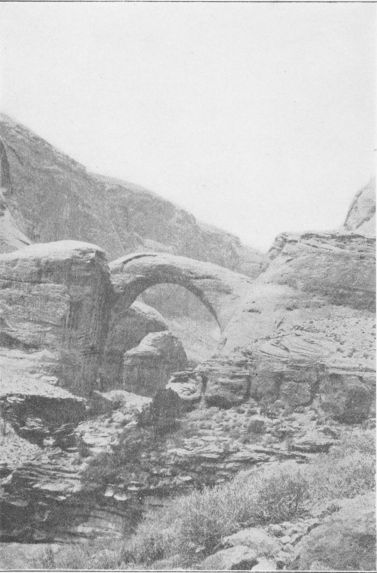
From the National Geographic Magazine, copyright 1911 The great Rainbow natural bridge of southern Utah LINK TO IMAGE
REDWAY'S GEOGRAPHICAL READERS WEALTH OF THE WORLD'S WASTE PLACES AND OCEANIA BY JEWETT C. GILSON FORMER SUPERINTENDENT OF SCHOOLS, OAKLAND, CALIFORNIA ILLUSTRATED CHARLES SCRIBNER'S SONS NEW YORK :::::::::::::::::: 1913
Copyright, 1913, by JEWETT C. GILSON
PREFACE
Although the term "Waste Places" carries an implied meaning of "worthless," yet, interpreted in the light of Nature's methods, each region described, useless as it may apparently seem, possesses a definite relation to the rest of the world, and therefore to the well-being of man. The Sahara is the track of the winds whose moisture fertilizes the flood-plains of the Nile. The Himalaya Mountains condense the rain that gives life to India. From the inhospitable polar regions come the winds and currents that temper the heat of the tropics.
Nature has secreted many of her most useful treasures in most forbidding places. The nitrates which fertilize so much of Europe are drawn from the fiercest of South American deserts, and the gold which measures American commerce is mined in the arctic wilds of Alaska or in the almost inaccessible scarps of the western highlands. The description of these regions and the portrayal of their relation to the rest of the world is the purpose of Part I of this book.
Part II of the book deals with Oceania—more especially with our island possessions in the Pacific Ocean. It presents the salient features of the ocean grand division in the light of most recent knowledge.
The author wishes to give credit to Mr. Jacques W. Redway, F.R.G.S., for suggesting the subject of Part I and for the inspiration he received from the distinguished geographer in developing the subject.
J. C. G.
Oakland, California, December 25, 1912.
CONTENTS
PART I WEALTH OF THE WORLD'S WASTE PLACES
PAGE
Introduction 1
CHAPTER
I. The Wealth of the Arid Southwest 4
II. The Grand Canyon of the Colorado 27
III. Yellowstone Park 35
IV. Two Prehistoric Cemeteries—Giant Reptiles and Giant Trees 51
V. Death Valley 58
VI. The Mineral Wealth of the Andes 67
VII. The Czar's Greater Domain 82
VIII. The Mystic Highlands of Asia 97
IX. The Primal Home of the Saracen 105
X. The Sahara 115
XI. Polar Regions—the Conquest of the Arctic 128
XII. Polar Regions—Antarctica 147
XIII. Iceland, the Maid of the North 160
XIV. Greenland 170
XV. Where the Two Great Oceans Meet 175
XVI. Reclaimable Swamp Regions 183
XVII. Strange Rock Formations—Natural Bridges 190
XVIII. Strange Rock Formations—Table Mountain of California 195
XIX. Strange Rock Formations—Gibraltar 199
XX. The Baku Oil Fields 206
XXI. The South African Diamond Fields 211
PART II OCEANIA
XXII. The Islands of the Pacific 226
XXIII. Australia 233
XXIV. The Great Barrier Reef 244
XXV. The Gold Fields of Australia 250
XXVI. Tasmania 258
XXVII. New Zealand 262
XXVIII. Samoa and Fiji 270
XXIX. The Hawaiian Islands 277
XXX. Guam 285
XXXI. The Philippine Islands 289
XXXII. The Dutch East Indies—Java 301
XXXIII. The Dutch East Indies—Sumatra and Celebes 311
XXXIV. Borneo and Papua 319