Random Comment
Reading edition
Sir Walter Scott used to say that he had never met any man from whom he could not learn something. No matter how ignorant the humblest citizen may appear to be, the chances are that he knows a few things which you do not know; and if you will “draw him out” you will add to your knowledge.
The Virginia negro who happened to pass along the road while the Chief Justice of the Supreme Court of the United States was puzzling his brains over the problem of mending his broken sulky-shaft, knew exactly the one thing which John Marshall did not know.
The great lawyer was at his wit’s end, helpless and wretched. How could he mend that broken shaft and continue his journey? He did not know and he turned to the negro for instruction.
With an air of superiority which was not offensive at that particular time, the negro drew his pocket-knife, stepped into the bushes, cut a sapling, whittled a brace and spliced the broken shaft.
When the Chief Justice expressed his wonder, admiration and pleasure, the negro calmly accepted the tribute to his talent and walked off, remarking,
“Some folks has got sense and some ain’t got none.”
That little story is a hundred years old, but it’s a right good little story. A school-teacher, whom I loved very dearly, told it to me when I was a kid. He was the only man I ever knew who had it in him to be a great man, and who refused to strive for great things because, as he said, “It isn’t worth the trouble.”
He was naturally as great an orator as Blaine or Ben Hill. He was far and away a loftier type than Bryan, for he had those three essentials which Bryan lacks—humor, pathos and self-forgetful intensity of feeling. But after one of his magnificent displays of oratory he would sink back into jolly indolence, and pursue the even tenor of his way, teaching school. “It is not worth while. Let the other fellows toil and struggle for fame and for office, I don’t care. They are not worth the price.”
Few knew what was in this obscure teacher, but those few knew him to be a giant.
Once, at our College Commencement, the speaker who had been invited to make the regular address was the crack orator of the state. He was considered a marvel of eloquence. Well, he came and he delivered his message; and it was all very chaste and elegant and superb. Indeed, a fine speech.
He sat down amid loud applause. Everybody satisfied. Then the obscure genius to whom I have referred rose to talk. By some chance the faculty had given him a place on the program.
I looked at my old school-teacher as he waddled quietly to the front. I saw that his face was pale and his eyes blazing with fire. I felt that the presence and the speech of the celebrated orator had aroused the indolent giant. I knew he would carry that crowd by storm—would rise, rise into the very azure of eloquence and hover above us like an eagle in the air.
And he did.
Men and women, boys and girls, laughed and cheered and cried, and hung breathless on his every word, as no crowd ever does unless a born orator gets hold of them. Actually I got to feeling sorry for the celebrity who had made the set speech. He sat there looking like a cheap piece of neglected toy-work of last Christmas.
The faces of the leading people after my old teacher had sat down, were a study. The expression seemed to say, “Who would have thought it was in him!”
I don’t think he ever made another speech.
The brilliant eyes will blaze no more. The merry smile faded long ago. The great head, that was fit to bear a crown, lies low for all the years to come.
He left no lasting memorial of his genius. Only, as through a glass darkly, you may see him, in a book called “Bethany,” written by one in whom he, the unambitious, kindled the spark of an ambition which will never die.
There being no smokers in the “smoker,” I went in there to stretch out. The Florida East Coastline train was working its way down the peninsula, and was doing it very leisurely.
Into the “smoker” came a young fellow with whom I opened conversation. It turned out that he had been pretty much all over Europe. He had toured Germany several times. On the Sir Walter Scott principle, I sought knowledge from him, and he told me several interesting things.
One evening he had been at Heidelberg when the soldiers mounted guard. This being a regular function many civilians had assembled to see it.
An officer was putting the men through some of their exercises, when, at the order to “ground arms,” one of the privates let his gun down too slow.
The officer flew into a rage, rushed up to the soldier, slapped his jaws, kicked him repeatedly on the shins, struck him with the flat of his sword, and spat time and again in the man’s face!
Of course the officer was cursing the private for every vile thing he could lay his tongue to, all the while.
Said my informant, “He not only spat in the man’s face once, but he did it four or five times.”
I asked, “Was there no murmur of disgust or indignation in the crowd of citizens who were looking on?”
“None whatever,” he said. “The people took the occurrence as a matter of course. It happens so often.”
Then the young man rose up in the smoker, and showed me how the private had stood in his place, rigid, staring straight ahead, not daring to change his position or expression while enduring the kicks and spits of the officer. Not a word of protest or complaint did he venture to utter.
That’s Militarism, gone crazy.
Not long ago one of our high-priced city preachers declared publicly that we Americans needed an Emperor to head our army.
Do you recall a story which went the rounds of the newspapers a few years ago? In substance it hinted that William Hohenzollern, Emperor of Germany, had compelled one of his young officers to kill himself.
My traveller related to me the particulars as he had learned them in Germany.
The Emperor was holding a banquet, a revel, on board his yacht, the Hohenzollern: wine had been drunk freely; loose talk was going on. The Emperor made some insulting reference to the mother of a lieutenant who was seated near him.
Upon the impulse of the moment, the brave boy did a most natural thing—he slapped the brutal defamer of his mother in the mouth.
Consternation paralyzed the Emperor and all his guests.
The lieutenant left the yacht; no one tried to stop him. Going ashore, he made ready to quit the world; and next morning he rode his bicycle deliberately off a precipice and fell headlong to his voluntary death.
And the high-priced, city preacher declared that we needed an Emperor!
Frederick the Great was really a great man.
Riding along the streets of Berlin one day, he saw a crowd looking up at a placard on a wall, Reining his horse, the old King inquired, “What is it?”
He was told that the placard contained a lot of violent abuse of himself.
“Hang it lower, so that the people can read it better,” ordered the King, and he rode on.
The pompous despot who now sits upon the throne of Frederick the Great puts girls and old women, as well as boys and men, in jail if they dare to say, or to write, anything disrespectful of him.
Is democracy gaining ground anywhere? Are not those historic allies, the Church and the State, encroaching steadily upon the masses? Are not the High Priest and the War Lord constantly putting a greater distance between themselves and the Common People?
Does not the individual citizen have less power and recognition now than at any other time since the founding of our Government?
Poor General Wheeler! After all his efforts to please Northern sentiment, they would not permit him to be buried with the Confederate flag in his coffin!
The Nation is a mighty good paper, but it ought not to class General N. B. Forrest as “a scout” and “guerrilla.”
General Forrest was named by General Lee, during the last year of the war, as the best soldier that the Civil War had developed.
Forrest was greater than his commanding general at Fort Donelson, at Murfreesborough, and at Chickamauga. He finally swore that he would not obey any more fool orders from blundering superiors, and he struck out for himself. During the short time that he held independent command his achievements, considering his resources, rivalled those of Stonewall Jackson in the Valley Campaign.
Nor should The Nation be too hard upon the West Point officers who followed their native states out of the Union. Justice to those officers requires one to remember that they were taught at West Point that the States had the right to secede from the Union.
If The Nation will consult the text-book from which Generals Lee, Johnston, Beauregard and Wheeler were instructed in Constitutional Law, it will discover that these young officers simply put in practice that which their teachers had taught them to be their right.
The book to which I refer is Rawle’s work upon Constitutional Law.
After General Wheeler had tried so hard to win the heart of the North, don’t you think they might have allowed the Confederate flag to rest upon his folded hands?
That was the flag which he had followed in the storm of actual war. The Cuban business was nothing. It was child’s play, and pitiful child’s play at that. But the Civil War was real, was colossal, rent a continent asunder, and shook the world. It was the Confederate flag which had led Wheeler to his fame. His youth, his first and best, had been given to that; of all the banners on earth none could have been dearer, holier to him than that.
To look upon it was to bring back the years and the deeds which had brought him glory. It associated itself with the heroes who had listened to his battle-cry, and who had sanctified their sacrifice to duty with their blood. It spoke to him of the hopes and the griefs and the despair of his home, the South; it recalled the enthusiasm and the heartbreak; the splendid devotion of noble women, and the resignation of conquered men.
Surely, surely the Confederate flag must have been the dearest emblem of Duty and Sacrifice to General Joe Wheeler.
Don’t you think that Charity might have softened the heart of the North to the old warrior who was dead, and that they might have let him rest under the “Conquered Banner?”
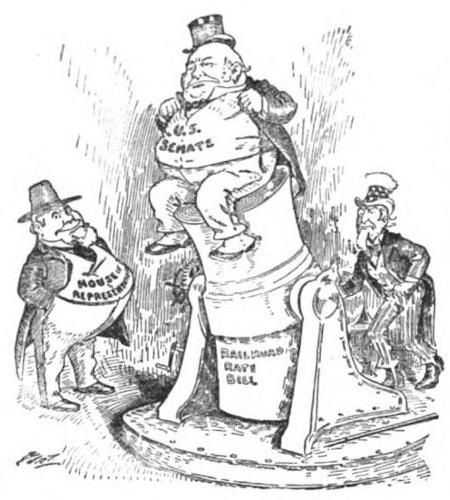
The House: I give you warning, old man; it’s loaded!
Bart, in Minneapolis Journal
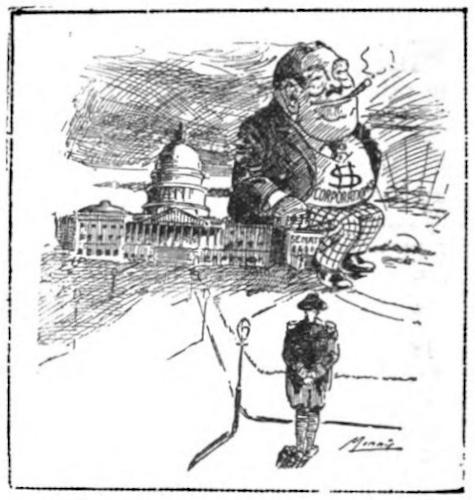
If George Washington Came to the Capital Today
Morris, in Spokane Spokesman-Review
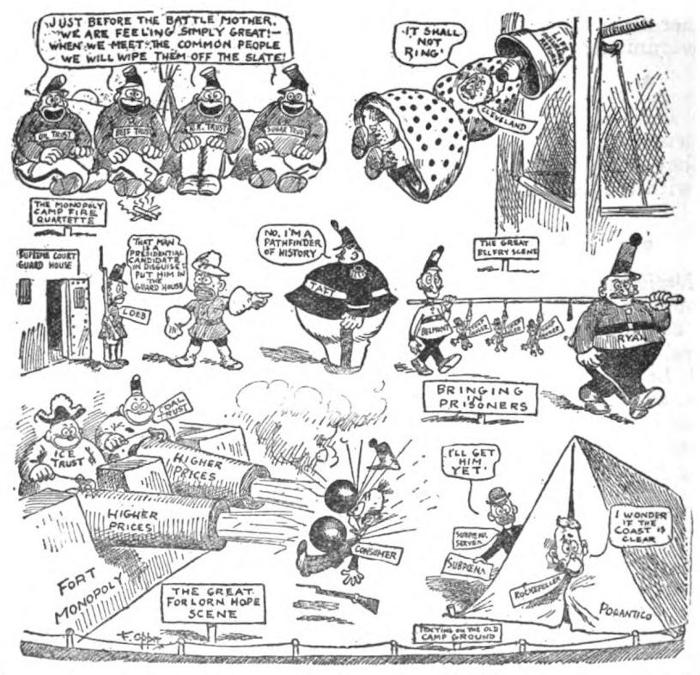
The Stirring War Drama Entitled: “Chased By the Enemy; or, Curfew Shall Not Ring This Evening”
Opper, in N. Y. American