Front matter
Reading edition
E-text prepared by Graeme Mackreth and the Online Distributed Proofreading Team (http://www.pgdp.net) from page images generously made available by Internet Archive (https://archive.org)
Note: Images of the original pages are available through Internet Archive. See https://archive.org/details/warwickkingmaker00oman
English Men of Action
WARWICK THE KINGMAKER

COPYRIGHT
First Edition 1891. Reprinted 1893, 1899, 1905 (Prize Library Edition) 1903, 1909, 1916
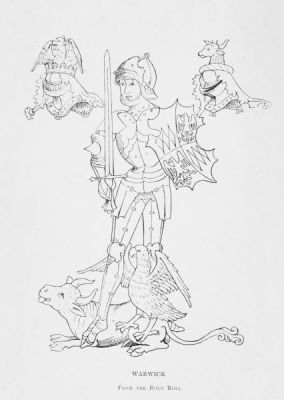
WARWICK From the Rous Roll
WARWICK
THE KINGMAKER
BY
CHARLES W. OMAN
MACMILLAN AND CO., LIMITED ST. MARTIN'S STREET, LONDON 1916
CONTENTS
CHAPTER I
The Days of the Kingmaker 1
CHAPTER II
The House of Neville 12
CHAPTER III
Richard of Salisbury 19
CHAPTER IV
The Kingmaker's Youth 29
CHAPTER V
The Cause of York 38
CHAPTER VI
The Beginning of the Civil War: St. Albans 47
CHAPTER VII
Warwick Captain of Calais and Admiral 60
CHAPTER VIII
Warwick in Exile 79
CHAPTER IX
Victory and Disaster—Northampton and St. Albans 93
CHAPTER X
Towton Field 107
CHAPTER XI
The Triumph of King Edward 128
CHAPTER XII
The Pacification of the North 137
CHAPTER XIII
The Quarrel of Warwick and King Edward 159
CHAPTER XIV
Playing with Treason 175
CHAPTER XV
Warwick for King Henry 193
CHAPTER XVI
The Return of King Edward 208
CHAPTER XVII
Barnet 228
CHAPTER I
THE DAYS OF THE KINGMAKER
Of all the great men of action who since the Conquest have guided the course of English policy, it is probable that none is less known to the reader of history than Richard Neville Earl of Warwick and Salisbury. The only man of anything approaching his eminence who has been treated with an equal neglect is Thomas Cromwell, and of late years the great minister of Henry the Eighth is beginning to receive some of the attention that is his due. But for the Kingmaker, the man who for ten years was the first subject of the English Crown, and whose figure looms out with a vague grandeur even through the misty annals of the Wars of the Roses, no writer has spared a monograph. Every one, it is true, knows his name, but his personal identity is quite ungrasped. Nine persons out of ten if asked to sketch his character would find, to their own surprise, that they were falling back for their information to Lord Lytton's Last of the Barons or Shakespeare's Henry the Sixth.
An attempt, therefore, even an inadequate attempt, to trace out with accuracy his career and his habits of mind from the original authorities cannot fail to be of some use to the general reader as well as to the student of history. The result will perhaps appear meagre to those who are accustomed to the biographies of the men of later centuries. We are curiously ignorant of many of the facts that should aid us to build up a picture of the man. No trustworthy representation of his bodily form exists. The day of portraits was not yet come; his monument in Bisham Abbey has long been swept away; no writer has even deigned to describe his personal appearance—we know not if he was dark or fair, stout or slim. At most we may gather from the vague phrases of the chroniclers, and from his quaint armed figure in the Rous Roll, that he was of great stature and breadth of limb. But perhaps the good Rous was thinking of his fame rather than his body, when he sketched the Earl in that quaint pictorial pedigree over-topping all his race save his cousin and king and enemy, Edward the Fourth.
But Warwick has only shared the fate of all his contemporaries. The men of the fifteenth century are far less well known to us than are their grandfathers or their grandsons. In the fourteenth century the chroniclers were still working on their old scale; in the sixteenth the literary spirit had descended on the whole nation, and great men and small were writing hard at history as at every other branch of knowledge. But in the days of Lancaster and York the old fountains had run dry, and the new flood of the Renaissance had not risen. The materials for reconstructing history are both scanty and hard to handle. We dare not swallow Hall and Hollingshead whole, as was the custom for two hundred years, or take their annals, coloured from end to end with Tudor sympathies, as good authority for the doings of the previous century. Yet when we have put aside their fascinating, if somewhat untrustworthy, volumes, we find ourselves wandering in a very dreary waste of fragments and scraps of history, strung together on the meagre thread of two or three dry and jejune compilations of annals. To have to take William of Worcester or good Abbot Whethamsted as the groundwork of a continuous account of the times is absolutely maddening. Hence it comes to pass that Warwick has failed to receive his dues.
Of all the men of Warwick's century there are only two whose characters we seem thoroughly to grasp—the best and the worst products of the age—Henry the Fifth and Richard the Third. The achievements of the one stirred even the feeble writers of that day into a fulness of detail in which they indulge for no other hero; the other served as the text for so many invectives under the Tudors that we imagine that we see a real man in the gloomy portrait that is set up before us. Yet we may fairly ask whether our impression is not drawn, either at first or at second hand, almost entirely from Sir Thomas More's famous biography of the usurper, a work whose literary merits have caused it to be received as the only serious source for Richard's history. If we had not that work, Richard of Gloucester would seem a vaguely-defined monster of iniquity, as great a puzzle to the student of history as are the other shadowy forms which move on through those evil times to fall, one after the other, into the bloody grave which was the common lot of all.
In spite, however, of the dearth of good chronicles, and of the absolute non-existence of any contemporary writers of literary merit, there are authorities enough of one sort and another to make it both possible and profitable to build up a detailed picture of Warwick and his times. First and foremost, of course, come the invaluable Paston Letters, covering the whole period, and often supplying the vivid touches of detail in which the more formal documents are so lamentably deficient. If but half a dozen families, as constant in letter-writing as John and Margery Paston, had transmitted their correspondence to posterity, there would be little need to grumble at our lack of information. Other letters too exist, scattered in collections, such as the interesting scrawl from Warwick himself, in his dire extremity before Barnet fight, to Henry Vernon, which was turned up a year ago among the lumber at Belvoir Castle. Much can be gathered from rolls and inquests—for example, the all-important information as to centres and sources of local power can be traced out with perfect accuracy from the columns of the Escheats Roll, where each peer or knight's lands are carefully set forth at the moment of his decease. Joining one authority to another, we may fairly build up the England of the fifteenth century before our eyes with some approach to completeness.
The whole picture of the times is very depressing on the moral if not on the material side. There are few more pitiful episodes in history than the whole tale of the reign of Henry the Sixth, the most unselfish and well-intentioned king that ever sat upon the English throne—a man of whom not even his enemies and oppressors could find an evil word to say; the troubles came, as they confessed, "all because of his false lords, and never of him." We feel that there must have been something wrong with the heart of a nation that could see unmoved the meek and holy King torn from wife and child, sent to wander in disguise up and down the kingdom for which he had done his poor best, and finally doomed to pine for five years a prisoner in the fortress where he had so long held his royal Court. Nor is our first impression concerning the demoralisation of England wrong. Every line that we read bears home to us more and more the fact that the nation had fallen on evil times. First and foremost among the causes of its moral deterioration was the wretched French War, a war begun in the pure spirit of greed and ambition,—there was not even the poor excuse that had existed in the time of Edward the Third—carried on by the aid of hordes of debauched foreign mercenaries (after Henry the Fifth's death the native English seldom formed more than a third of any host that took the field in France), and persisted in long after it had become hopeless, partly from misplaced national pride, partly because of the personal interests of the ruling classes. Thirty-five years of a war that was as unjust as it was unfortunate had both soured and demoralised the nation. England was full of disbanded soldiers of fortune; of knights who had lost the ill-gotten lands across the Channel, where they had maintained a precarious lordship in the days of better fortune; of castellans and governors whose occupation was gone; of hangers-on of all sorts who had once maintained themselves on the spoils of Normandy and Guienne. Year after year men and money had been lavished on the war to no effect; and when the final catastrophe came, and the fights of Formigny and Chatillon ended the chapter of our disasters, the nation began to cast about for a scapegoat on whom to lay the burden of its failures. The real blame lay on the nation itself, not on any individual; and the real fault that had been committed was not the mismanagement of an enterprise which presented any hopes of success, but a wrong-headed persistence in an attempt to conquer a country which was too strong to be held down. However, the majority of the English people chose to assume firstly that the war with France might have been conducted to a prosperous issue, and secondly that certain particular persons were responsible for its having come to the opposite conclusion. At first the unfortunate Suffolk and Somerset had the responsibility laid upon them. A little later the outcry became more bold and fixed upon the Lancastrian dynasty itself as being to blame not only for disaster abroad, but for the "want of governance" at home. If King Henry had understood the charge, and possessed the wit to answer it, he might fairly have replied that his subjects must fit the burden upon their own backs, not upon his. The war had been weakly conducted, it was true; but weakly because the men and money for it were grudged. The England that could put one hundred thousand men into the field in a civil broil at Towton sent four thousand to fight the decisive battle at Formigny that settled our fate in Normandy. At home the bulwarks of social order seemed crumbling away. Private wars, riot, open highway robbery, murder, abduction, armed resistance to the law, prevailed on a scale that had been unknown since the troublous times of Edward the Second—we might almost say since the evil days of Stephen. But it was not the Crown alone that should have been blamed for the state of the realm. The nation had chosen to impose over-stringent constitutional checks on the kingly power before it was ripe for self-government, and the Lancastrian house sat on the throne because it had agreed to submit to those checks. If the result of the experiment was disastrous, both parties to the contract had to bear their share of the responsibility. But a nation seldom allows that it has been wrong; and Henry of Windsor had to serve as scapegoat for all the misfortunes of the realm, because Henry of Bolingbroke had committed his descendants to the unhappy compact.
Want of a strong central government was undoubtedly the complaint under which England was labouring in the middle of the fifteenth century, and all the grievances against which outcry was made were but symptoms of one latent disease.
Ever since the death of Henry the Fifth the internal government of the country had been steadily going from bad to worse. The mischief had begun in the young King's earliest years. The Council of Regency that ruled in his name had from the first proved unable to make its authority felt as a single individual ruler might have done. With the burden of the interminable French War weighing upon their backs, and the divisions caused by the quarrels of Beaufort and Gloucester dividing them into factions, the councillors had not enough attention to spare for home government. As early as 1428 we find them, when confronted by the outbreak of a private war in the north, endeavouring to patch up the quarrel by arbitration, instead of punishing the offenders on each side. Accounts of riotous assemblages in all parts of the country, of armed violence at parliamentary elections, of party fights in London at Parliament time—like that which won for the meeting of 1426 the name of the Parliament of Bats (bludgeons)—grow more and more common. We even find treasonable insurrection appearing in the strange obscure rising of the political Lollards under Jack Sharp in 1431, an incident which shows how England was on the verge of bloodshed twenty years before the final outbreak of civil war was to take place.
But all these public troubles would have been of comparatively small importance if the heart of the nation had been sound. The phenomenon which makes the time so depressing is the terrible decay in private morals since the previous century. A steady deterioration is going on through the whole period, till at its end we find hardly a single individual in whom it is possible to interest ourselves, save an occasional Colet or Caxton, who belongs in spirit, if not date, to the oncoming renascence of the next century. There is no class or caste in England which comes well out of the scrutiny. The Church, which had served as the conscience of the nation in better times, had become dead to spiritual things; it no longer produced either men of saintly life or learned theologians or patriotic statesmen. In its corporate capacity it had grown inertly orthodox. Destitute of any pretence of spiritual energy, yet showing a spirit of persecution such as it had never displayed in earlier centuries, its sole activity consisted in hunting to the stake the few men who displayed any symptoms of thinking for themselves in matters of religion. So great was the deadness of the Church that it was possible to fall into trouble, like Bishop Pecock, not for defending Lollardry, but for showing too much originality in attacking it. Individually the leading churchmen of the day were politicians and nothing more, nor were they as a rule politicians of the better sort; for one like Beaufort, who was at any rate consistent and steadfast, there are many Bourchiers and George Nevilles and Beauchamps, who merely sailed with the wind and intrigued for their own fortunes or those of their families.
Of the English baronage of the fifteenth century we shall have so much to say in future chapters that we need not here enlarge on its characteristics. Grown too few and too powerful, divided into a few rival groups, whose political attitude was settled by a consideration of family grudges and interests rather than by any grounds of principle, or patriotism, or loyalty, they were as unlike their ancestors of the days of John or Edward the First as their ecclesiastical contemporaries were unlike Langton or even Winchelsey. The baronage of England had often been unruly, but it had never before developed the two vices which distinguished it in the times of the Two Roses—a taste for indiscriminate bloodshed and a turn for rapid political apostasy. To put prisoners to death by torture as did Tiptoft Earl of Worcester, to desert to the enemy in the midst of battle like Lord Grey de Ruthyn at Northampton, or Stanley at Bosworth, had never before been the custom of England. It is impossible not to recognise in such traits the results of the French War. Twenty years spent in contact with French factions, and in command of the godless mercenaries who formed the bulk of the English armies, had taught our nobles lessons of cruelty and faithlessness such as they had not before imbibed. Their demoralisation had been displayed in France long ere the outbreak of civil war caused it to manifest itself at home.
But if the Church was effete and the baronage demoralised, it might have been thought that England should have found salvation in the soundheartedness of her gentry and her burgesses. Unfortunately such was not to be the case. Both of these classes were growing in strength and importance during the century, but when the times of trouble came they gave no signs of aspiring to direct the destinies of the nation. The House of Commons which should, as representing those classes, have gone on developing its privileges, was, on the contrary, thrice as important in the reign of Henry the Fourth as in that of Edward the Fourth. The knights and squires showed on a smaller scale all of the vices of the nobility. Instead of holding together and maintaining a united loyalty to the Crown, they bound themselves by solemn sealed bonds and the reception of "liveries" each to the baron whom he preferred. This fatal system, by which the smaller landholder agreed on behalf of himself and his tenants to follow his greater neighbour in peace and war, had ruined the military system of England, and was quite as dangerous as the ancient feudalism. The salutary old usage, by which all freemen who were not tenants of a lord served under the sheriff in war, and not under the banner of any of the baronage, had long been forgotten. Now, if all the gentry of a county were bound by these voluntary indentures to serve some great lord, there was no national force in that county on which the Crown could count, for the yeoman followed the knight as the knight followed the baron. If the gentry constituted themselves the voluntary followers of the baronage, and aided their employers to keep England unhappy, the class of citizens and burgesses took a very different line of conduct. If not actively mischievous, they were sordidly inert. They refused to entangle themselves in politics at all. They submitted impassively to each ruler in turn, when they had ascertained that their own persons and property were not endangered by so doing. A town, it has been remarked, seldom or never stood a siege during the Wars of the Roses, for no town ever refused to open its gates to any commander with an adequate force who asked for entrance. If we find a few exceptions to the rule, we almost always learn that entrance was denied not by the citizens, but by some garrison of the opposite side which was already within the walls. Loyalty seems to have been as wanting among the citizens as among the barons of England. If they generally showed some slight preference for York rather than for Lancaster, it was not on any moral or sentimental ground, but because the house of Lancaster was known by experience to be weak in enforcing "good governance," and the house of York was pledged to restore the strength of the Crown and to secure better times for trade than its rival.
Warwick was a strong man, born at the commencement of Henry the Sixth's unhappy minority, whose coming of age coincided with the outburst of national rage caused by the end of the disastrous French War, whose birth placed him at the head of one of the great factions in the nobility, whose strength of body and mind enabled him to turn that headship to full account. How he dealt with the problems which inevitable necessity laid before him we shall endeavour to relate.
CHAPTER II
THE HOUSE OF NEVILLE
Of all the great houses of mediæval England, the Nevilles of Raby were incontestably the toughest and the most prolific. From the reign of John to the reign of Elizabeth their heritage never once passed into the female line, and in all the fourteen generations which lived and died between 1210 and 1600 there was only one occasion on which the succession passed from uncle to nephew, and not from father to son or grandson. The vitality of the Neville tribe was sufficient to bear them through repeated marriages with those only daughters and heiresses whose wedlock so often forebodes the extinction of an ancient house. Of four successive heads of the family between 1250 and 1350, all married ladies who were the last representatives of old baronial houses; but the Nevilles only grew more numerous, and spread into more and more branches, extending their possessions farther and farther from their original seat on the Durham moors till all the counties of the north were full of their manors.
The original source of the family was a certain Robert Fitz-Maldred, lord of Raby, who, in the reign of John, married Isabella de Neville, heiress of his neighbour Geoffrey de Neville of Brancepeth. Robert's son Geoffrey, who united the Teesdale lands of his father with his mother's heritage hard by the gates of Durham, took the name of Neville, and that of Fitz-Maldred was never again heard in the family. The lords of Raby did not at first distinguish themselves in any way above the rest of the barons of the North Country. We find them from time to time going forth to the King's Scotch or French wars, serving in Simon de Montfort's rebel army, wrangling with their feudal superior the Bishop of Durham, slaying an occasional sheriff, and founding an occasional chantry, and otherwise conducting themselves after the manner of their kind. It was one of the house who led the English van against the Scots at the great victory of 1346, and erected the graceful monument which gave to the battlefield the name of Neville's Cross.
Only two characteristics marked these Nevilles of the thirteenth and fourteenth centuries; the largeness of their families—three successive lords of Raby boasted respectively of ten, eleven, and nine children—and their never-ending success in laying field by field and manor by manor. Robert Neville, who in the time of Henry the Third married Ida Mitford, added to his Durham lands his wife's broad Northumbrian barony in the valley of the Wansbeck. His son of the same name made Neville one of the greatest names in Yorkshire, when he wedded Mary of Middleham, and became in her right lord of Middleham Castle and all the manors dependent on it, reaching for a dozen miles along the Ure and running up to the farthest bounds of the forest of Coverdale. Robert the younger's heir, Ralph, emulated the good fortune of his father and grandfather by securing as his wife Euphemia, heiress of Clavering, who brought him not only the half-hundred of Clavering in Essex, but the less remote and more valuable lands of Warkworth on the Northumbrian coast. Ralph's son John, though he married as his first wife a younger daughter of the house of Percy, secured as his second Elizabeth Latimer, heiress of an old baronial house whose domains lay scattered about Bucks and Bedfordshire.
Four generations of wealthy marriages had made the Nevilles the greatest lords in all the North Country. Even their neighbours, the Percies of Northumberland, were not so strong. The "saltire argent on the field gules," and the dun bull, the two Neville badges, were borne by hosts of retainers. Three hundred men-at-arms, of whom fourteen were knights and three hundred archers, followed the lord of Raby even when he went so far afield as Brittany. For home service against the Scots he could muster thrice as many. More than seventy manors were in his hands, some spread far and wide in Essex, Norfolk, Bedfordshire, and Buckinghamshire, but the great bulk of them lying massed in North Yorkshire and South Durham, around Raby and Middleham, the two strong castles which were the centres of his influence. Hence it was not surprising that King Richard the Second, when he lavished titles and honours broadcast on the nobility after his surprising coup d'état of 1397, should have singled out the head of the Nevilles for conciliation and preferment. Accordingly, Ralph Neville, then in the thirty-fourth year of his age, was raised to the dignity of an earl. Curiously enough, he could not be given the designation of either of the counties where the bulk of his broad lands lay. The earldom of Durham was, now as always, in the hands of its bishop, comes palatinus of the county since the days of William the Conqueror. The titles of York and of Richmondshire, wherein lay the other great stretch of Neville land, were vested in members of the royal house. The Percies had twenty years before received the title of Northumberland, the third county where the Nevilles held considerable property. Hence Ralph of Raby had to be put off with the title of Westmoreland, though in that county he seems, curiously enough, not to have held a single manor. The gift of the earldom was accompanied with the more tangible present of the royal honour of Penrith.
All these favours, however, did not buy the loyalty of Ralph Neville. He was married to one of John of Gaunt's daughters by Katherine Swinford, and was at heart a strong partisan of the house of Lancaster. Accordingly, when Henry of Bolingbroke landed at Ravenspur in July 1399, Westmoreland was one of the first to join him; he rode with him to Flint, saw the surrender of King Richard, and bore the royal sceptre at the usurper's coronation at Westminster. Henry rewarded his services by making him Earl Marshal in place of the exiled Duke of Norfolk.
Earl Ralph went on in a prosperous career, aided King Henry against the rising of the Percies in 1403, and committed himself more firmly than ever to the cause of the house of Lancaster by putting down the insurrection which Scrope, Mowbray, and the aged Northumberland had raised in 1405. Twice he served King Henry as ambassador to treat with the Scots, and twice the custody of the Border was committed to him as warden. When Bolingbroke died, and Henry of Monmouth succeeded him, Earl Ralph was no less firm and faithful. At the famous Parliament of Leicester in 1414, when the glorious but fatal war with France was resolved upon, he was one of the few who withstood the arguments of Archbishop Chicheley and the appeals of the Duke of Exeter and gave their voices against the expedition. He besought the King that, if he must needs make war, he should attack Scotland rather than France, the English title to that crown being as good, the enterprise more hopeful, and the result more likely to bring permanent profit, while—quoting an old popular rhyme—he ended by saying that
He that wolde France win, must with Scotland first begin.
But all men cried "War! War! France! France!" The ambitious young King had his will; and the next spring there sailed from Southampton the first of those many gallant hosts of Englishmen who were to win so many fruitless battles to their country's final loss, and leave their bones behind to moulder in French soil, in the trenches of Harfleur and Orleans or on the fields of Beaugé and Patay.
Every reader of Shakespeare has met Earl Ralph in the English camp on the eve of the battle of Agincourt, remembers his downhearted wish for a few thousands of the "gentlemen of England now abed," and can repeat by heart the young King's stirring reply to his uncle's forebodings. But, in fact, Earl Ralph was not at Agincourt, nor did he even cross the sea. He had been left behind with Lord Scrope and the Baron of Greystock to keep the Scottish March, and was far away at Carlisle when Henry's little band of English were waiting for the dawn on that eventful St. Crispin's day. Unless tradition errs, it was really Walter of Hungerford who made the speech that drew down his master's chiding.
Ralph was now growing an old man as the men of the fifteenth century reckoned old age; and while the brilliant campaigns of Henry the Fifth were in progress abode at home, busied with statecraft rather than with war. But his sons, and they were a numerous tribe, were one after another sent across the seas to join their royal cousin. John, the heir of Westmoreland, was serving all through the campaigns of 1417-18, and was made governor of Verneuil and other places in its neighbourhood, after having held the trenches opposite the Porte de Normandie during the long siege of Rouen, and assisted also at the leaguer of Caen. Ralph, Richard, William, and George are found following in their elder brother's footsteps as each of them arrived at the years of manhood, and all earned their knighthood by services done in France.
Meanwhile Earl Ralph, after surviving his royal nephew some three years, and serving for a few months as one of the Privy Council that governed in the name of the infant Henry the Sixth, died on October 21st, 1425, at the age of sixty-two, and was buried in the beautiful collegiate church which he had founded at Staindrop, hard by the gates of his ancestral castle of Raby. There his monument still remains, escaped by good fortune from the vandalism of Edwardian and Cromwellian Protestants. He lies in full armour, wearing the peaked basinet that was customary in his younger days, though it had gone out of fashion ere his death. His regular features have little trace of real portraiture, and show no signs of his advancing years, so that we may conclude that the sculptor had never been acquainted with the man he was representing. Only the short twisted moustache, curling over the mail of the Earl's camail, has something of individuality, and must have corresponded to the life; for by 1425 all the men of the younger generation were close shaven, like King Henry the Fifth. On Earl Ralph's right hand, as befitted a princess of the blood royal, lies his second wife Joan of Beaufort; on his left Margaret Stafford, the bride of his youth and the mother of his heir.
CHAPTER III
RICHARD OF SALISBURY
Earl Ralph, surpassing all his keen and prolific ancestors not only in the success with which he pushed his fortunes, but in the enormous family which he reared, had become the father of no less than twenty-three children by his two wives. Nine were the offspring of Margaret of Stafford, fourteen of Joan of Beaufort. John, the heir of Westmoreland, had died a few years before his father, and the earldom passed to his son, Ralph the second, now a lad of about eighteen. But the greater number of the other twenty-two children still survived, and their fortunes influenced the after history both of the house of Neville and the kingdom of England to such an extent that they need careful statement.
The old Earl had turned all his energies into negotiating the marriages of his children, and partly by the favour of the two Henries, partly by judicious buying up of wardships in accordance with the practice of the fifteenth century, partly by playing on the desire of his neighbours to be allied to the greatest house of the North Country, he had succeeded in establishing a compact family group, which was already by 1425 one of the factors to be reckoned with in English politics. The most important of these connections by far was the wedding of his youngest daughter Cecily to Richard Duke of York—a marriage brought about by royal favour shortly before the Earl's death, while both the contracting parties were mere children; the Duke some eleven years old, the little bride about nine.[1] By this union Ralph of Westmoreland was destined to become the ancestor of a score of kings and queens of England. It bound the house of Neville to the Yorkist cause, and led away the children of Ralph from that loyalty to Lancaster which had been the cause of their father's greatness. But at the time when the marriage was brought about no one could well have foreseen the Wars of the Roses, and we may acquit the Earl of any design greater than that of increasing the prosperity of his house by another marriage with a younger branch of the royal stock. His own union with Joan of Beaufort had served him so well, that he could desire nothing better for the next generation. The elder brothers and sisters of Cecily of York, if their alliances were less exalted than hers, were yet wedded, almost without exception, to the most important members of the baronage.
Of the elder family, the offspring of Earl Ralph by Margaret of Stafford, the second son Ralph Neville of Biwell married the co-heiress of Ferrers. One sister died young, another became a nun, but four of the remaining five were married to the heirs of the houses of Mauley, Dacre, Scrope of Bolton, and Kyme. The younger family, the children of Joan of Beaufort, made even more fortunate marriages. Of the daughters, the youngest, as we have stated above, wedded Richard of York. Her elder sisters were united respectively to John Mowbray Duke of Norfolk, Humphrey Stafford Duke of Buckingham, and Henry Percy Earl of Northumberland—the grandson of Earl Ralph's old enemy and the son of Hotspur. Of the six sons of Joan of Beaufort, Richard the eldest married Alice Montacute, heiress of the earldom of Salisbury, and became by her the father of the Kingmaker; with him we shall have much to do. William, the second son, won the heiress of Fauconbridge. George, the third son, was made the heir of his half-uncle John Lord Latimer, and by special grant succeeded to his uncle's barony. Robert entered the Church, and by judicious family backing became Bishop of Salisbury before he had reached his twenty-fifth year, only to be transplanted ten years later to Durham, the most powerful of the English bishoprics, whose palatine rights he could thus turn to the use of his numerous kindred. Finally, Edward, the youngest brother, secured Elizabeth Beauchamp, heiress of Abergavenny.
The numbers of the English baronage had been rapidly decreasing since the reign of the third Edward, and in the early years of Henry the Sixth the total number of peers summoned to a Parliament never exceeded thirty-five. Among this small muster could be counted one grandson, three sons, and five sons-in-law of Earl Ralph.[2] A little later, one son and one grandson more were added to the peers of the Neville kindred, and it seemed probable that by the marriages of the next generation half the English House of Lords would be found to descend from the prolific stock of Raby.
In the first twenty years of the reign of Henry of Windsor, while the young King's personal weakness was not yet known, while his uncle of Bedford and his great-uncle of Winchester stood beside the throne, and while the war in France—though the balance had long turned against England—was still far from its disastrous end, the confederacies of the great baronial houses were of comparatively little importance. The fatal question of the succession to the Crown was still asleep, for the young King was only just nearing manhood, and might, for all that men knew, be the parent of as many war-like sons as his grandfather. It was not till Henry's nine years of barren wedlock, from 1445 to 1454, set the minds of his nobles running on the problem of the succession, that the peace of England was really endangered.
Richard Neville, the eldest of the sons of Earl Ralph's second marriage, was born in 1399. He was too young to follow King Henry to the siege of Harfleur and the fight of Agincourt, but a few years later he accompanied his half-brother John, the heir of Westmoreland, to the wars of France. It was not in France, however, that the years of his early manhood were to be spent, but on the Scotch Border in the company of his father. When he came of age and was knighted in 1420 he was made the colleague of the old Earl in the wardenship of the Western Marches. This office he retained for several years, and was in consequence much mixed up with Scotch affairs, twice acting as commissioner to treat with the Regent of Scotland, and escorting James the First to the border of his kingdom when the English Council released him from his long captivity. We hear of him occasionally at Court, as when, for example, he acted as carver at the Coronation Banquet of the newly-wed Queen Catherine, a ceremony which, according to Monstrelet, "was performed with such splendid magnificence that the like had never been seen since the time of that noble knight Arthur, King of the English and Bretons."
Richard had reached the age of twenty-six when, in 1425, he married Alice, the only child of Thomas Montacute Earl of Salisbury, who had just reached her eighteenth year. The Montacutes were not among the wealthiest of the English earls—for his faithful adherence to Richard the Second the last head of the house had lost his life and his estates; and although his son had been restored in blood, and had received back many of the Montacute lands, yet the list of his manors in the Escheats Roll reads poorly enough beside those of the Earls of Norfolk and Devon, March and Arundell. Earl Thomas, in spite of his father's fate, had consented to serve the house of Lancaster.
In 1425, as we have already mentioned, the old Earl, Ralph of Westmoreland, died. In his will, which has been preserved, we find that he left his son Richard little enough—"two chargers, twelve dishes, and a great ewer and basin of silver, a bed of Arras, with red, white, and green hangings, and four untrained horses, the best that should be found in his stable." Evidently he thought that he need do nothing for this son on whom the earldom of Salisbury was bound to devolve. It was only to Ralph and Edward, the two among his surviving sons who had not yet inherited land from their wives, that the old Earl demised the baronies of Biwell and Winlayton, two of his outlying estates.
But in another respect the will of Earl Ralph was destined to prove a source of many heart-burnings in the house of Neville, and fated to break up the strict family alliance which made its strength. While he left the Durham lands of Neville, round his ancestral castle of Raby, to his grandson and heir, Ralph the second, he made over the larger part of his Yorkshire possessions not to the young Earl, but as jointure to his widow, Joan of Beaufort, the mother of Richard and the other thirteen children of his second family. The Countess, once mistress of Sherif Hoton Castle and the other North-Riding lands of Neville, had no thought of letting them pass away from her own sons to the descendants of her husband's first wife. They were destined to be diverted from the elder to the younger family. Here lay the source of many future troubles, but while the young Earl Ralph was still a minor the matter did not come to a head.
Three years after he lost his father, Richard Neville heard of the death of his father-in-law. The Earl of Salisbury had been appointed by John of Bedford Captain-General of all the English forces in France, and gathering together ten thousand men, all that the Regent could spare, had marched to the fatal siege of Orleans. There in the early days of the leaguer, six months before Joan the Maid came to the rescue of the garrison, he had met his death. As he watched the walls from the tower on the bridge over the Loire, a stone shot had torn away half his face; he died in a few days, exhorting his officers with his last breath to persevere in the attack.
Thus Richard Neville became by the death of his father-in-law Earl of Salisbury and master of the lands of Montacute. They lay, for the most part, on the borders of Wiltshire and Hampshire, between Ringwood and Amesbury, in the valleys of the Bourn and Avon. The castles of Christchurch and Trowbridge were the most important part of the heritage from the military point of view. Some scattered manors in Berkshire, Dorset, and Somerset served to swell its value. Richard, now become a considerable South Country baron, at once did homage for his wife's lands, and was summoned as Earl of Salisbury to the next Parliament, that of 1429. At the same meeting at which he took his seat his nephew, Ralph the younger of Westmoreland, also appeared for the first time, having now passed his minority and entered into possession of such of the Neville lands as had not been left to his step-mother.
It was beyond doubt the alienation of these lands which led to the estrangement between the younger and the elder Nevilles which we soon after find taking visible form in troubles in the North. Ralph, marrying a sister of Henry Earl of Northumberland, became the firm friend and ally of that house of Percy which his grandfather had done so much to humble. Richard kept up the old feud, and was always found on the opposite side from his nephew. Presently (the exact year of the commencement of the quarrel is uncertain, but it was at its height in 1435) we find them at actual blows in a manner which brings out the fact that the "good and strong governance," which Parliament after Parliament sighed for in the reign of Henry the Sixth, had already become a hopeless dream. Plaints come down from the North to the Lord Chancellor that "owing to the grievous differences which have arisen between Ralph Earl of Westmoreland, and his brothers John and Thomas on the one hand, and Joan Dowager-Countess of Westmoreland and her son Richard Earl of Salisbury, on the other hand, have of late assembled, by manner of war and insurrection, great routs and companies upon the field, which have done all manner of great offences as well in slaughter and destruction of the King's lieges as otherwise, which things are greatly against the estate and weal and peace of this Royaume of England."
Of the details of this local war in Yorkshire we know nothing. Some sort of accommodation was patched up, by three arbitrators named by the Privy Council, for the moment between uncle and nephew; but the grudge rankled, and if ever England should be rent by civil war, it took no prophet to foretell that the two Neville earls would be found in opposite camps.
The old Countess Joan of Westmoreland died in 1440, and left, as was natural, Middleham, Sherif Hoton, and all the other lands of her jointure to her eldest son. Richard of Salisbury thus became a much greater landholder in the North than he already was in the South. His Hampshire and Wiltshire fiefs are for the future the less important centre of his strength. Sherif Hoton becomes his favourite residence, and it is always as a power in Yorkshire, not in Wessex, that he is mentioned by the chroniclers of the day.
Neither of the Neville earls took any prominent part in the never-ending French War. Ralph of Westmoreland seems to have been wanting both in the appetite for war and the keen eye for the main chance which had hitherto distinguished the lords of Raby. It was his younger brother John who was the fighting man of the older branch of Neville. Earl Richard, on the other hand, was energetic enough, but seems to have preferred to push his fortunes at home, rather than to risk his reputation in the unlucky wars where Somerset and Suffolk and so many more earned ill-fame and unpopularity. We hear of him most often on the Scottish Border, where he seems to have succeeded to the commanding position that had once been held by his father. He was Captain of Berwick, and served as Warden both of the Eastern and Western Marches, till at the end of 1435 he was sent as ambassador extraordinary to Edinburgh. James the First, with whom he had to settle some matters of Border feud, was his own connection, for Salisbury's mother was aunt of Joan Beaufort, the young Queen of Scots. After quitting King James, only a few months before his cruel murder at Perth, Earl Richard went on an embassy of far greater importance, being sent to France, along with his young brother-in-law the Duke of York, to endeavour to patch up some agreement that might end the series of disasters which had commenced with the death of the Duke of Bedford in the previous year. His mission failed, as indeed all missions were bound to do that made after the treaty of Arras the same demands which the French had refused before it. Nevertheless, on his return, in 1437, Salisbury was made a member of the Privy Council, and took his seat in the body which ever since 1422 had been directing the fortunes of England.
This appointment fixed Salisbury in London for the greater part of the next ten years. We find from the records of the Privy Council that he was almost as regular an attendant at its meetings as was Cardinal Beaufort himself, the practical Prime Minister of the realm. His signature appears at the foot of countless documents, and his activity and appetite for business seem to have been most exemplary. So far as we can judge of his action, he appears to have sided with the great Cardinal, and not with the Opposition which centred round Humphrey Duke of Gloucester; but factions had not fully developed themselves as yet in the Council, and the definite parties which existed a few years later were only just beginning to sketch themselves out.
FOOTNOTES
CHAPTER IV
THE KINGMAKER'S YOUTH
Richard, the second child but eldest son of Richard Neville of Salisbury and Alice Montacute, was born on November 22nd, 1428, just nineteen days after his grandfather had fallen at the siege of Orleans. We know absolutely nothing of his childhood—not even the place of his birth is recorded. We must suppose, but cannot prove, that his earliest days were passed on his mother's lands in Wessex, in moving about between Amesbury, Christchurch, and Ringwood as his parents' household made its periodical peregrinations from manor to manor according to the universal practice of the time. As a boy he must have visited his paternal grandmother, Joan of Beaufort, on her Yorkshire estates, when his father was fixed in the North as Warden of the Scotch Border. There probably he may have imbibed some of the old lady's dislike for her step-sons of the elder branch of the Nevilles, with whom she and his father were now at open variance. A little later he must have spent much time in London, when his father became a member of the Council of Regency, lodged at the "Tenement called the Harbour in the Ward of Dowgate," which his father and grandmother had received by will from his grandfather when the larger London house of the family, "Neville's Inn in Silver Street," passed with the Westmoreland earldom to the elder branch.
The fortunes of the house of Neville, as we have told them hitherto, have consisted of one interminable story of fortunate marriages. The reader must now be asked to concentrate his attention on another group of these alliances, a group which settled the whole history of the Kingmaker, and gave him the title of the earldom by which he is always named.
The Beauchamps of Warwick held one of the oldest English earldoms; they represented in direct descent the Henry of Newburgh to whom William Rufus had granted the county in 1190.[3] Richard Beauchamp, the head of the family at this time, was perhaps the worthiest and the most esteemed of the English nobles of his day. The "gracious Warwick," the "father of courtesy" as the Emperor Sigismund called him, had been through all the wars of Henry the Fifth, and won therein a name only second to that of the King himself. He had seen many cities and men in every land that lay between England and Palestine, and left everywhere behind him a good report. His virtues and accomplishments had caused him to be singled out as tutor and governor to the young King, Henry the Sixth; no better model, as all agreed, could be found for the ruler of England to copy. Nor did Warwick belie his task; he made Henry upright, learned, painstaking, conscientious to a fault. If he could but have made him as strong in body and spirit as he was morally, he would have given England the best king that ever she possessed.
Richard Beauchamp had married Isabel, heiress of Despenser, and widow of Richard, Lord of Abergavenny. Their family consisted of a son, Henry, a boy of ten, and a daughter, Anne, three years younger. In addition, the Countess of Warwick had an only daughter by her first husband, who was heiress of Abergavenny. Beauchamp and Richard Neville of Salisbury were the best of friends, and had determined to seal their friendship by intermarriage between their families. The alliance was destined to be complicated; each earl married his heir to his friend's daughter. The boy Henry, heir of Warwick, was affianced to Cecily Neville, Salisbury's six-year-old daughter; the boy Richard, heir of Salisbury, to Anne Beauchamp, daughter of Warwick. Nor was this all; the family relations were complicated by the marriage of Warwick's step-daughter Elizabeth, the heiress of Abergavenny, to Edward Neville the younger brother of Salisbury.
The boy Richard Neville received a competent dowry with his wife, but nothing more was expected to follow from the marriage. Fate, however, decreed otherwise.
The old Earl of Warwick died in 1439, full of years and honours. To him succeeded his son Henry, the husband of Cecily Neville, now sixteen years of age, and "a seemly lord of person." He had been brought up with the young King, a lad of his own years, and was Henry of Lancaster's bosom friend. When the King came of age he heaped on the young Beauchamp every honour that his affection could devise. Not only was he made Knight of the Garter and a Privy Councillor before he was nineteen, but he was created Duke of Warwick, and invested by the King's own hands with the lordship of the Isle of Wight. If Henry Beauchamp had lived, it would have been he, and not Suffolk and Somerset, who in a few years would have ruled England. But his career was broken in its earliest promise. Ere he had finished his twenty-third year Henry Beauchamp was cut off from the land of the living, and his lands and duchy devolved on his only child, a little girl but four years of age. Her wardship fell to William de la Pole Earl of Suffolk, already the declared adversary of Salisbury and the Neville family.
By the wholly unexpected death of Henry Beauchamp only this one frail life lay between the lad Richard Neville—he was sixteen when his brother-in-law died—and the earldom of Warwick. Nor was that life to continue long. The child Anne Beauchamp survived for three years more, and then died, aged seven, on June 23rd, 1449. She was buried by her grandam Constance, daughter of Edmund Duke of York, before the high altar of Reading Abbey.
The heiress of Warwick was now the elder Anne, Richard Neville's young wife,[4] and in her right Richard received the Beauchamp lands from the unwilling hands of the little countess's guardian, Suffolk. The patent which created him Earl of Warwick, and joined his wife in the grant, was dated July 23rd, 1449.
Thus, in the year in which he reached his twenty-first birthday, the future Kingmaker became "Earl of Warwick, Newburgh, and Aumarle, Premier Earl of England, Baron of Elmley and Hanslape, and Lord of Glamorgan and Morgannoc." He was now a much more important personage than his own father, for the Beauchamp and Despenser manors in the West Midlands and the Welsh Marches were broader by far than the Montacute lands in Wessex, or the Neville holding round Middleham.
A short survey of the items of the Beauchamp heritage is necessary to show how wide-spread was the power which was now placed in the hands of the young Richard Neville. Perhaps the most compact block of his new possessions was the old Despenser holding in South Wales and Herefordshire, which included the castles of Cardiff, Neath, Caerphilly, Llantrussant, Seyntweonard, Ewyas Lacy, Castle-Dinas, Snodhill, Whitchurch, and Maud's Castle. Caerphilly alone was a stronghold fit to resist ten thousand men, with its tremendous rings of concentric fortification; and the massive Norman masonry of Cardiff was still ready for good service. Between Neath and Ewyas Lacy lay no less than fifty manors of the Despenser heritage. In Gloucestershire was another group of estates which the Beauchamps had got from the Despensers—of which the chief were the wide and populous manors of Tewkesbury, Sodbury, Fairford, Whittington, Chedworth, Wickwar, and Lydney. In Worcestershire there was a compact block of land along the Severn and on both its banks; the largest manors included in it were Upton-on-Severn, Hanley Castle, and Bewdley, but there were twenty-four more estates of less importance, together with the Castle of Elmley, which had given the Beauchamps a baron's title. In Warwickshire, beside the fair town and castle which went with the earldom, there were not any very broad tracts of land—only nine manors in all, but one of these was the wealthy manor of Tamworth. Going farther south in the Midlands we find in Oxfordshire five manors and the forest of Wychwood reckoned to the Beauchamps, and in Buckinghamshire the baronial seat of Hanslape and seven manors more. Nor was it only in central England that Richard Neville could count his estates; there were scattered holdings accruing to him in Kent, Hampshire, Sussex, Essex, Hertfordshire, Suffolk, Norfolk, Berkshire, Wiltshire, Somerset, Devon, Cornwall, Northampton, Stafford, Cambridge, Rutland, and Nottingham, amounting in all to forty-eight manors. Even in the distant North one isolated possession fell to him—the castle of Barnard's-Castle on the Tees. If in addition to the manors we began to count up the scattered knights' fees, the advowsons of churches, the chantries, the patronage of abbeys, and the tenements in towns, which formed part of the Beauchamp heritage, we should never be done; but these are all written in the Escheats Roll, whence the antiquary may excavate them at his will.
The year 1449, in which Richard Neville attained his majority and gathered in his wife's heritage, was the turning-point in the reign of Henry the Sixth. No more critical time could have been found in the whole century in which to place power and influence in the hands of a young, able, and ambitious man. For it was in 1449 that the doom of the house of Lancaster was settled by the final collapse of the English domination in France. In March came the fatal attack on Fougères which reopened the war, an attack of which it is hard to say whether it was more foolish or wicked. In August, September, and October occurred with bewildering rapidity the fall of the great towns of eastern and central Normandy, ending with the capitulation of Rouen after a siege of only nineteen days.
It was this unparalleled series of disasters which made the existing Lancastrian rule unbearable to the English nation. Suffolk, the minister whose policy had led up to the disaster, and Somerset, the governor whose avarice had depleted the Norman garrisons, and whose rashness and ill faith had precipitated the outbreak of hostilities, were henceforth pursued by the bitter hatred of the majority of Englishmen. When it was found that King Henry identified their cause with his own, he himself—against whom no one had previously breathed a word—found for the first time that the current of public opinion was setting against him.
It was now that the final scission of the two parties that were afterwards to be known as Yorkist and Lancastrian took place. Every man of note in England had now to make his choice whether his personal loyalty to the King should lead him into acquiescing in the continuance in office of the ministers whom Henry openly favoured, or whether he would set himself in opposition to the Court faction, even though he was thereby led into opposition to the King.
From the first moment there was no doubt which of the two courses would be adopted by the two Neville earls of the younger branch. Warwick, now as always, acted in strict union with his father, and Salisbury had never been a friend of Suffolk. Moreover, they were both concerned in behalf of their relative the Duke of York, who by Somerset's contrivance had been sent into a kind of honorary exile in Ireland. When the crisis should come, it was already pretty certain that Salisbury and Warwick would be found on the side of York, and not on that of Suffolk and Somerset. But as yet, though men were growing excited and preparing for evil times, no one foresaw the exact shape which the troubles were to take. One thing only was certain, that Suffolk and Somerset were growing so hateful to the nation that an explosion against them would soon take place, and that when the explosion came there would be a large party among the leading men of England who would rejoice in its effects.
The most ominous sign of the times was that the great barons on both sides were already quietly arming, seeing to the numbers of their retainers, and concluding agreements to take their neighbours into their livery if the worst should come to the worst.
Nothing can be a more typical sign of the times than the treaty which Salisbury entered into with a Westmoreland knight, whose lands lay not far from his great holding in the North-Riding, as early as September 1449, the very month when Somerset was losing Normandy.
"This indenture made between Richard Earl of Salisbury, on the one part, and Walter Strykelande knight, on the other, beareth witness that the said Walter is retained and withholded with the said Earl for the term of his life, against all folk, saving his allegiance to the King. And the said Walter shall be well and conveniently horsed, armed, and arrayed, and always ready to bide come and go with to and for the said Earl, at all times and places, as well in time of peace as time of war, at the wages of the same Earl." Walter's following was worth having, being "servants, tenants, and inhabitants within the county of Westmoreland; bowmen with horse and harness, sixty-nine; billmen horsed and harnessed, seventy-four; bowmen without horses, seventy-one; billmen without horses, seventy-six"—in fact a little army of two hundred and ninety men. The existence of a few such treaties as this between Salisbury and his northern neighbours shows clearly enough how the Neville power was built up, and how formidable to the public peace it might become. If once such treaties were in existence, how long would it be before the single clause "saving his allegiance" would begin to drop into oblivion?
FOOTNOTES
CHAPTER V
THE CAUSE OF YORK
If 1449, the year of Warwick's accession to his wife's heritage, was a time of trouble for England, the year which immediately followed was far worse. The loss of the Norman fortresses was followed in a few months by the sporadic outbreaks of popular rage which might have been expected—outbreaks directed against all who could in any way be connected with the evil governance of the realm. Bishop Moleyns, the Keeper of the Privy Seal, was murdered by a mob of mutinous sailors at Portsmouth in January. But this blow was only a premonitory symptom of the storm which was brewing against Suffolk, the head of the Government. Four months later—the fatal battle of Formigny had been fought meanwhile, and the last English foothold in Northern France lost—he was driven from power by an irresistible demonstration of wrath, in which the whole nation, from the House of Lords to the London mob, took its part. Protected from legal punishment by the King's pardon, Suffolk fled over-sea; but some London ships waylaid him in the Straits of Dover, and he was seized and put to death after a mock trial by the captain of the Nicholas of the Tower. So well hated was he that his tragic end was received with exultation instead of remorse, and the political ballad-mongers of the day wrote many an insulting rhyme over his headless corpse.
Instead of mending matters, Suffolk's death was only the signal for worse troubles. Two months after his death came the great rebellion of the Kentishmen under Cade, accompanied by various other outbreaks in the southern counties. The insurgents were inspired by the same impulse which had slain Suffolk; they were set on making an end of all who had been responsible for the late disaster abroad and misgovernment at home. In London, Lord Say the Treasurer was caught and slain; in Wiltshire, Bishop Ayscough was beheaded by a mob of his own tenantry. But the rising, being but a sudden ebullition of rage with no plan or programme of reform, and being headed not by any respectable leader but merely by the disreputable adventurer Cade, died down of its own accord, without leaving any permanent effect on the governance of the realm. To make its power felt, the national discontent had to look for a responsible leader and a definite programme.
Both the Court party and the people knew where that leader might be found. Richard Duke of York, the heir-apparent to the childless King, lay across the sea in Ireland. He was an able soldier, much tried in the French wars, a firm and successful administrator—he had even succeeded in winning popularity in Ireland—and a man of blameless character, who had completely won the nation's confidence. Moreover, he was a man with a grievance; though the first prince of the blood, he was deliberately excluded from all place in the King's councils or share in the administration of the realm. While in the midst of a successful campaign in France he had been superseded by the unlucky Somerset, and sent off to Ireland, apparently in the idea that like most other rulers of that distressful country he would wreck his reputation there. But he had been fortunate, and only increased his fame by the administration of the island. Already the Court party were murmuring against him once more, and the people believed that some other exile would ere long be found for him. As the ballad-monger sang—
The falcon flies and has no rest Till he wot where he may build his nest.
Cade's rebels had used the Duke's name largely in their proclamations, but there seems no real ground for supposing that they had held any communication with him. The only evidence against him was that all discontented parties and persons spoke of him as the man that should right them some day. Nevertheless threats were made that he should be indicted for high treason, and action against him was apparently imminent. Then at last York took the initiative. He threw up the government of Ireland, crossed over to Wales, and came up to London with a considerable body of his tenants from the Marches at his back. There he claimed and obtained an interview with the King, in which he declared his loyalty, and received Henry's assurance that no harm was intended against him. This done, he retired to his estates on the Welsh border. But he had now definitely put himself at the head of the opposition to the Court party, whom he had bitterly rated in his remonstrance to the King.
The discontent of England had found its mouthpiece and its leader in this resolute prince, "a man of low stature, with a short square face, and somewhat stout of body," like his uncle Edmund of York, who had fallen at Agincourt rather stifled in his armour than slain by his wounds.
Our whole view of the conduct of Warwick in the ten years between 1450 and 1460 must be determined by our decision as to the designs and conduct of his uncle of York during that period. If we conclude that the Duke was aiming at the crown from the first, then we cannot but believe that his brother-in-law Salisbury and his nephew Warwick must have known or guessed his wishes, and on them must rest almost as great a share of blame for the outbreak of the Civil War as lies on the head of York himself. For the gain of their family we must believe that they sacrificed the peace of their country. This view has been commonly adopted by historians; it was set forth in every Lancastrian manifesto of the time; it was repeated by the historians who wrote under the Tudors, and it still prevails.
Another view, however, was taken by the majority of the English people in York's own day. Wherever in England public spirit ran strong, wherever wealth had accumulated and civilisation had advanced, a sympathy for the Yorkist party manifested itself. Kent, London, and East Anglia were always strongly on the Duke's side. But if York had been an ambitious schemer, deliberately upsetting the peace of the realm for his own ends, we should not expect to find his supporters among those parts of the nation to whom peace and good governance were above all things profitable.
A glance through the pages of the chroniclers who were contemporary with the war, Harding, Gregory, William of Worcester, Whethamsted, the anonymous English chronicler in the Camden Series, shows that to the majority of the English people York passed not as a disturber of the peace, but as a wronged and injured man, goaded into resistance by the machinations of the Court party. In one aspect he was regarded as a great lord of the royal blood excluded from his rightful place at the Council board, and even kept out of the country by his enemies who had the King's ear. In another he was regarded as the leader and mouthpiece of the Opposition of the day, of the old and popular war-party which inherited the traditions of Henry the Fifth and Humphrey of Gloucester—a party, indeed, whose views (as we have said elsewhere) were unwise and even immoral, but one which might reasonably ask to be taken into consideration by those who managed the affairs of the realm. In these days of ours when Ministries prove incapable and grow discredited the Opposition has its turn at the helm in the natural course of things. In the fifteenth century the old methods which had served Simon de Montfort, and the Lords Ordainers of 1322, were still the only ones which could be used against ministers who were out of sympathy with the nation. York was doing at St. Albans much what Earl Simon had done at Lewes.
This too must be said, that if disaster without and disorder within are to be held sufficient to discredit any rule, there had never been a time since the evil days of Bannockburn when England had more right to be discontented with her rulers. Moreover, there was no chance that things would grow better; as long as the Queen and her friends ruled the King, so long would things continue as they were. Men thought at one moment that with the removal of Suffolk the evil times would come to an end. But when an outburst of popular fury swept Suffolk to his end—and be it remembered that there is no evidence to connect York with Suffolk's tragic death—the ascendency of Somerset proved as disastrous and as hopeless as that of his predecessor. And when Somerset fell at St. Albans men hoped once more that matters would right themselves; but the less-known ministers who soon succeeded to the helm—Beaumont and the Earl of Wiltshire—proved quite as unprofitable servants to the nation. As long as the Queen was at the King's side to choose his councillors for him, so long would the discontent of England continue to increase. Margaret's misfortunes make us loath to speak evil of her, but in fairness to the Yorkists it must be remembered that she was the most detestable politician that England had known. It is usual to call the dislike of the nation for her a stupid prejudice against a foreigner; but there was surely some reason for hating the woman who sold Berwick to the Scots and Calais to the French, who reintroduced the hateful practice of sweeping attainders in the Parliament of 1459, who succeeded in turning loyalty into a party-cry by making the King a party-leader. Well might she confess to a foreign friend on one occasion "that if the great lords of her own party knew what she was doing, they would themselves be the first to rise and put her to death," for she it was who committed that foulest treason of all—which consists in sending secretly to tell a foreign enemy where to strike, in order that by his blow a party-end may be served. In 1457, when the realm was for a moment at peace, she deliberately incited the French admirals to make their great descent on the Kentish coast which ended in the fearful sack of Sandwich, merely because she knew that such a disaster would be counted against her political enemies the Yorkists. There is nothing to be compared to it in English history except the conduct of the arch-traitor Marlborough in 1694 over the affair of Brest.
The English hatred of Queen Margaret was no prejudice, but a wholesome instinct which led the English nation to recognise its enemy. She made herself a party-leader, and as a party-leader she had to be treated. York's ten years' strife with her must be regarded not so much as the rebellion of a subject against his sovereign, but as the struggle of one party-leader against another with the primitive weapons which alone were possible in the constitutional crises of that day. But even if we grant that York had his excuses, and that his general attitude does not stand self-condemned at the first glance, it remains to be seen how far his programme was justifiable, and how far he honestly endeavoured to carry it out to the best of his abilities. That he was an able, self-confident, ambitious man, with the fixed idea that he was the victim of the intrigues of the Court party, and that but for those intrigues he would be able to assume the position in the King's Council to which his birth entitled him, we know well. That when the King remained childless for nine years after his marriage, York could not help dwelling on the near prospect of his accession to the throne, was matter of notoriety. When that prospect was suddenly taken from him by the unexpected birth of an heir to the crown, York's spirits were deeply dashed, and his friends murmured in secret about changelings and bastards. But his own attitude and language were still everything that could be required by the most exacting critic; he shared in the rejoicings at the birth of Prince Edward, and joined the Commission which was appointed to confer on the infant the title of Prince of Wales. All his speeches and manifestoes for the next six years were full even to satiety of professions of loyalty to the King, and no claims on his own part were ever made for anything more than that right of access to the King's ear to which he was obviously entitled. The Yorkist declarations are always statements of grievance and demands for reform, set forth on public grounds; they show no traces of dynastic claims. The actions of the party, too, are quite in keeping with their declarations. That they would take the King into their own hands, and not leave him in those of the Somersets or Wiltshire or Beaumont, they had always stated, and they attempted no more when they had the chance. The best criterion of York's honesty is his conduct after the first battle of St. Albans, when the fortune of war had placed the King's person in his power. He then proceeded to give Henry new ministers, but did absolutely nothing more. No word about the succession was breathed, nor was it even attempted to punish those who had previously ruled the kingdom so ill. With a wise moderation all the blame was heaped on Somerset—and Somerset was dead, and could suffer no harm whatever might be laid to his charge.
It may then fairly be argued that Warwick and all those who followed Richard of York in peace and war down to the year 1460 had an honest programme, and could in all sincerity trust their leader, when he assured them that his ends were national and not personal,—the reform of the governance of England, not the establishment of the house of York on the throne. We shall see that when, after enduring and inflicting many evils, York did at last lay claim to the throne, his own party, headed by Warwick, firmly withstood him and compelled him, in adherence to his and their original pledges, to leave King Henry his throne and content himself with the prospect of an ultimate succession.
This being so, it is only just to Warwick and the other Yorkist leaders to give them the benefit of the doubt wherever their conduct admits of an honourable explanation, and not to judge their earlier assertions or claims or complaints in the light of later events. On these lines we shall proceed to describe the young Earl's actions down to the final outbreak of war in 1459.
CHAPTER VI
THE BEGINNING OF THE CIVIL WAR: ST ALBANS
From the moment when York returned from Ireland without the King's permission, and commenced to expostulate with his royal kinsman against the doings of Somerset and the rest of the Court party, the progress of events was sure and steady. Nothing save some extraordinary chance could have warded off the inevitable Civil War. That it did not break out sooner was only due to the fact that York was as cautious as he was determined, and was content to wait for the crown which the King's sickly constitution and long-barren wedlock promised him. Moreover, the Court party themselves had no desire to push matters to extremities against the man who was in all probability to become their king at no very distant date. For more than four years the struggle between York and Somerset proceeded before swords were actually drawn; they fought by manifestoes and proclamations, by Acts of Parliament, by armed demonstrations, but neither would actually strike the first blow.
The final crisis was brought about by the juxtaposition of two events of very different character. In August 1453 the King fell into a melancholy madness, exactly similar to that which had afflicted his unfortunate grandfather Charles the Sixth of France. He sat for days without moving or speaking; whatever was said to him he cast down his eyes and answered nought. The King's insanity was a deadly blow to Somerset, for he was helpless without the royal name to back him. York, on the other hand, with the general consent of the nation, assumed the direction of affairs, and became the King's lieutenant. He was afterwards made Protector of the Realm. This promised a final termination to the civil troubles of the realm.
But a few months after the King had become deranged, the whole face of affairs was changed by the birth of an heir to the crown. The Queen was delivered of a son on October 13th. This unexpected event—for the royal pair had been childless for nine years—was of fatal import to York. It took away the safety that had proceeded from the fact that his enemies believed that he was one day to reign over them, and it made York himself desperate. He came to the conclusion that he must be either regent or nothing; to save his head he must resort to desperate measures, and no more shrink from arms.
It is at this moment that Warwick begins to come to the front. In the earlier phases of York's struggle with Somerset he and his father had avoided committing themselves unreservedly to their kinsman's party; when he made his armed demonstration in 1452 they had not appeared at his side, but had negotiated in his favour with the King. In the Parliament of January 1454 they took part more decidedly in his favour. Mischief was brewing and every peer came up to London with hundreds of retainers in his train. It was then noticed that Warwick "with a goodly fellowship at his back" rode up in company with his uncle of York, and that Salisbury with sevenscore men-at-arms joined him in London.
York's preponderance in the councils of the realm was at once followed by the promotion of his Neville kinsmen. In December Warwick, now aged twenty-five, was made a member of the Privy Council. In April, after York had been made Protector, Salisbury was made Chancellor of the Realm; it was forty-four years since a layman had held the post.
The King was insane for sixteen months, and for that time York governed the realm with discretion and success. His conduct with regard to the question of the succession was scrupulously correct. The infant Prince Edward was acknowledged heir to the throne, and York, Warwick, and Salisbury were all members of the Commission which in April invested him with the title of Prince of Wales. The Court party were treated with leniency; only Somerset, against whom the popular outcry was as loud as ever (he had nearly been torn to pieces by a London mob in 1453), was committed to custody in the Tower, where he lay all the time of the King's madness. The country seemed satisfied and the prospect was fair.
To the Nevilles these two last years of promotion and success had only been clouded by a fierce quarrel with the house of Percy. In 1453 Salisbury had been celebrating the marriage of his fourth son, Thomas, to a niece of Lord Cromwell at Tattershall in Yorkshire. As he left the feast his retainers fell into an affray with some followers of Thomas Percy Lord Egremont, a younger son of the Earl of Northumberland. Out of this small spark sprung a sudden outbreak of private war all over the counties of York and Northumberland, in which the Nevilles were headed by John, Salisbury's second son, and the Percies by Egremont. The trouble lasted more than a year, and was only ended by York going in person, after he had been made Protector, to pacify the combatants. In this he succeeded, but the Percies maintained that they had been wronged, and were ever afterwards strong supporters of Somerset and the Queen.
In December 1454 King Henry came to his senses, and York resigned the protectorate. The King's recovery was in every way unfortunate; the moment that he was himself again he fell back into the hands of the Court party. His first act was to release Somerset from the Tower, and declare him a true and faithful subject. His next was to dismiss York and Salisbury from all their offices, and with them several other high functionaries who were enemies of Somerset, including Tiptoft Earl of Worcester, the Lord Treasurer. The disgraced peers retired to their estates—York to Sendal, Salisbury to Middleham.
But worse was to come. In May a Council, to which were summoned neither York, Salisbury, Warwick, nor any other of the old councillors who were their friends, met at Westminster. This body summoned a Parliament to meet at Leicester, "for the purpose of providing for the safety of the King's person against his enemies." Who would be declared the enemies York and Salisbury could guess without difficulty; and what would be done with these enemies they knew well enough. Imprisonment would be the least evil to be feared at the hands of Somerset.
The fatal moment had come. York was desperate, and resolved to anticipate the vengeance of his adversaries. The moment that the news came, he called out his Yorkshire retainers, and sent to ask the aid of his friends all over England. Salisbury joined him at once with the Neville tenants from his North-Riding estates, and without a moment's delay York and his brother-in-law marched on London. Warwick fell in with them on the way, but no other friend came to their aid, though the Duke of Norfolk was getting together a considerable force on their behalf in East Anglia.
York's little army marched down the Ermine Street; on May 20th he lay at Royston in Cambridgeshire. Beside the two Nevilles he had only one other peer in his company, Lord Clinton, and the knights present were merely the personal followers of York and Salisbury. Except a few of Warwick's Midland tenants, the whole army was composed of the Yorkshire retainers of York and Salisbury, and the chroniclers speak of the whole army as the Northern Men. More troops could have been had by waiting, but the Duke knew that if he delayed, the enemy would also gain time to muster in strength. At present the lords of the King's Council were quite unprepared for war, and the rapid march of York's little army had not allowed them time for preparation.
On the 21st the Duke felt his way southward along the line of the Ermine Street, and lay at Ware. There he and the two Earls indited a laborious apology for their arrival in arms to "their most redoubted sovereign Lord the King." They were "coming in grace, as true and humble liegemen, to declare and show at large their loyalty," and sought instant admission to the royal presence that they might convince him of the "sinister, malicious, and fraudulent reports of their enemies."
Somerset read clearly enough the meaning of York's march on London, and even before the Duke's manifesto was received, had stirred up the King to have recourse to arms. Many of the great lords of the King's party were in London, but they were surprised by the sudden approach of the enemy, and had brought few followers with them. Thus it came to pass that although the King marched out of Westminster on the 21st with many of the greatest lords of England at his back, he had less than three thousand combatants in his host. With him went forth his half-brother Jasper of Pembroke, the Dukes of Somerset and Buckingham, the Earls of Northumberland, Devon, Stafford, Wiltshire, and Dorset, and Lords Clifford, Dudley, Berners, and Roos, nearly a quarter of the scanty peerage of England. York's manifesto reached the King as he marched through Kilburn, but Somerset sent it back without allowing it to reach the royal hands. That night the army turned off the Roman road to shelter themselves in the houses of Watford; but next morning very early all were afoot again, and long before seven o'clock King Henry and his host reached St. Albans. The royal banner was pitched in St. Peter's Street, at the northern end of the straggling little town, the outlets of the streets were barricaded, and then the troops dispersed to water their horses and prepare breakfast. An hour later York and his forces appeared, advancing cautiously from the east along the Hertford Road. Hearing of the King's march on Watford, the Duke had left the direct line of advance on London, and set out to seek his enemies. When St. Albans was found to be strongly held, York, Salisbury, and Warwick drew up their four thousand men in battle array, in a field called Keyfield to the east of the town, and paused before attacking. They were hardly arrived before the Duke of Buckingham was seen emerging with a herald from the barricade which closed the eastern outlet of the town. This elderly nobleman was Salisbury's brother-in-law and Warwick's uncle; he was sure of a fair hearing from the insurgents, for he had never been identified with the party of Suffolk and Somerset, and was in arms out of pure loyalty to the King. Arrived in the presence of the rebel leaders, Humphrey of Buckingham demanded the cause of their coming and the nature of their intentions. The Duke of York replied by charging his master's envoy with a message for the royal ears, which began with all manner of earnest protestations of loyalty, proceeded with a vague declaration that the intent of his coming in arms was righteous and true, and ended with a peremptory demand that it would please the King "to deliver up such persons as he might accuse, to be dealt with like as they have deserved." Buckingham brought the message back and repeated it to the King, as he sat in the house of Westley, the Hundredman of the town of St. Albans, whither he had retired after his arrival. When the Duke's demand was made known, for once in his life the saintly King burst out into a fit of passion. "Now I shall know," he cried, "what traitors are so bold as to raise a host against me in my own land. And by the faith that I owe to St. Edward and the Crown of England, I will destroy them every mother's son, to have example to all traitors who make such rising of people against their King and Governour. And for a conclusion, say that rather than they shall have any lord here with me at this time, I will this day for his sake and in this quarrel stand myself to live or die."
When this answer came to the Duke of York he made no immediate attack on the town, but turned to harangue his troops. He told them that the King refused all reformation or reparation, that the fate of England lay in their hands, and that at the worst an honourable death in the field was better than the shame of a traitor's end, which awaited them if they lost the day. Then he launched the whole body in three divisions against the barricades which obstructed the northern, southern, and eastern exits of the town.
The hour was half-past eleven o'clock, for the interchange of messages between the King and York had consumed four hours of the morning. The royal troops, seeing Buckingham coming and going between the two armies, had believed that an agreement would be patched up without fighting. Many had left their posts, and some had disarmed themselves. When the Duke's men were seen in motion every man ran to arms, and the bells of the abbey and the churches ringing the alarm set monks and townsmen to prayers, in good hope that the shield of their warrior-patron would be stretched over them to ward off the plundering bands from the North, the
Gens Boreæ, gens perfidiæ, gens prona rapinæ,
whose advent always sent Abbot Whethamsted into an ecstasy of bad Latin verses.
The first rush of the Yorkists was beaten off at all the three points which they attacked. Lord Clifford on the London Road "kept the barriers so strongly that the Duke might not in any wise, for all the power he had, break into the streets." Warwick too, who led the left division of the Yorkist host, was repulsed in his attack on the southern exit of the town. But the Earl's quick military eye, now for the first time exercised, had marked that the Lancastrians, though strong enough to hold the barricades, had not enough men to defend the long straggling line of houses which formed the southern extension of the town. Gathering together his repulsed retainers, he broke into the gardens which lay behind the houses of Holywell Street, and bursting open the back-doors of several dwellings, ran out into the main thoroughfare of the town, "between the sign of the Chequers and the sign of the Key, blowing up his trumpets and shouting with a great voice, A Warwick! A Warwick!"—a cry destined to strike terror into Lancastrian ears on many a future battlefield. Warwick's sudden irruption took the defenders of the barricades in the rear, but they faced about and stood to it manfully in the streets. The Lancastrian line was broken, and the Yorkist centre, where Sir Robert Ogle led on the Duke's own followers from the Northern Marches, now burst into the market-place in the centre of the town to aid Warwick.
For one wild half-hour the arrows flew like sleet up and down St. Peter's Street, and the knights fought hand to hand in the narrow roadway. But the Lancastrians were overmatched. The King received an arrow in the neck, and was led bleeding into the house of a tanner. Somerset, the cause of the battle, was stricken dead on the doorstep of an inn named the Castle. Sir Philip Wentworth, the King's standard-bearer, threw down his banner and fled away. James of Ormond the Irish Earl of Wiltshire, and Thorpe the Speaker of the House of Commons, followed him. But the other leaders of the King's army were less fortunate. The Earl of Northumberland and Lord Clifford were slain. The Earl of Dorset was desperately wounded, and left for dead in the street. The Duke of Buckingham, with an arrow sticking in his face, took sanctuary in the abbey. The Earls of Stafford and Devon, both wounded, and Lord Dudley, yielded themselves prisoners. Only sixscore men had been slain in the King's army, but the larger part were persons of mark, for, as was often the case in that century, the lightly-equipped archers and billmen could fling down their arms and get away with ease, while the knights and nobles, fighting on foot in their cumbrous armour, could not make speed to fly when the day was lost. So it came to pass that of the one hundred and twenty Lancastrians who fell, only forty-eight were common men, the rest were nobles, knights, and squires, or officers of the King's household. On the next day the victors marched on London, vainly hoping, perhaps, that with the death of Somerset and the capture of the King the days of the weak government of Lancaster were over.
The Duke and his followers thought, as yet, of nothing more than a change of ministry. Their conduct shows that they had nothing more in hand than the replacing of the Court party in the great offices of State by persons who should be more in touch with their own views and the will of the nation. The Chancellorship was left in the hands of Archbishop Bourchier, whom the Yorkists felt that they could trust; but the Earl of Wiltshire was replaced as Treasurer by Lord Bourchier, the Archbishop's brother. The Duke of York became Constable; Warwick superseded the dead Somerset as Captain of Calais; Salisbury was made Steward of the Duchy of Lancaster. A little later Warwick's younger brother George Neville was given the wealthy bishopric of Exeter, though he had only just reached his twenty-sixth year. A Parliament summoned in July ratified these appointments, and chose as its Speaker Sir John Wenlock, of whom we shall frequently hear again as one of Warwick's firmest friends and adherents. A strongly-worded oath of allegiance to King Henry was taken by the Duke of York, and all the House of Lords with him, and the new ministry started on its career with favourable prospects. The only trouble for the moment came from an ill-judged attempt in Parliament to fix the responsibility for the "Ill Day of St. Albans" on definite persons. Warwick named Lord Cromwell as one of those most to blame, and when Cromwell gave an angry reply, there sprang up such an altercation between them that men feared a breach of the peace. That night Cromwell borrowed the Earl of Shrewsbury's men-at-arms to guard his house; but Warwick had cooled down and no more came of the quarrel, for the Parliament very wisely concluded to lay all the responsibility for the Civil War on Somerset, who was dead and could not reply.
York's authority in the kingdom was made more secure for the moment when King Henry fell once again into one of his fits of melancholy madness in October. The Parliament reassembled and appointed the Duke Regent, but on February 25th Henry came to his senses, and at once relieved York of his office. There followed a time of unrest and rumours of war, but for some months longer the Duke succeeded in maintaining his place at the helm. But trouble was always impending. Warwick, whose trained and paid soldiery in the garrison of Calais were the only permanent military force belonging to the Crown, had to come over on several occasions to back his uncle. At one time we hear that York feared to be waylaid on his way to Parliament, and got Warwick with three hundred men "all in jacks or brigandines" to escort him thither, "saying that if he had not come so strong he would have been distressed, but no man knew by whom, for men think verily that there is no man able to undertake any such enterprise."
York was not wrong, however, in thinking that there were those who were ready to risk much to get him out of power. Since Somerset was dead, the leadership of the Court party had fallen into very firm and determined hands, those of Margaret of Anjou, and the Queen had resolved to exercise the unbounded influence that she enjoyed over her husband to make him evict his Yorkist ministers the moment that it seemed safe so to do. For her resolve she had this much excuse, that the new government was at first no more fortunate than the old in enforcing order in the kingdom, for into the period of York's ascendency fell the worst private war that had been seen for a generation. Courtney Earl of Devon and Lord Bonville fell to blows in the West, and fought a battle outside Exeter with four thousand men a side; the Earl won, and signalised his victory by ransacking the cathedral and carrying off several of the canons as prisoners. Yet he was not brought to justice for this abominable sacrilege, even though he was of the party which was opposed to York. But Margaret was not entitled to blame York for the state of the kingdom, for we find that she deliberately went to work to give the Duke trouble, by stirring up foreign enemies against England. A Scotch raid in the summer of 1456 was more than suspected to be due to her intrigues; and it is certain that while the Duke was officially taking the Scots to task in the King's name, the King was disavowing York's war-like despatches in private letters to James the Second. When we know that a year later Margaret was not above setting on the French to ravage the Kentish sea-ports for her own private purposes, we can understand a little of the hatred with which she was followed by the Commons of the south-eastern counties.