Chapter X · I Visit Miss Bloemfontein
Reading edition
And I also here discuss that irreconcilable maiden, Lord Stanley, and our own behaviour.
We published in the next issue, No. II, of March 26th, a letter by "Miss Uitlander" (pronounced in that country "Aitlander"). It was as genuine a production of the young womanhood of the town as that of "Miss Bloemfontein" had been, and it would have been wholly to our liking had it been as exceptional and bold a bit of work as the other, for it was, naturally, very pro-English. Suffice it to say that it answered and contradicted the Boer sentiments with vigour.
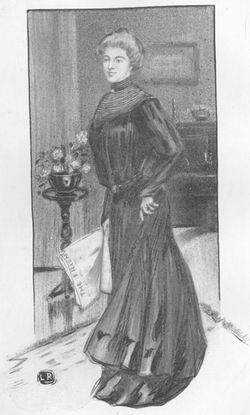
Miss Bloemfontein. (A Portrayal of a Type, by Lester Ralph.)
This reminded us that we were to enjoy no more communications from the sprightly and talented Miss Bloemfontein. Most gallantly we had resolved to allow her the last word and there end the correspondence; but she had remained silent, leaving us with that "last word" which we, like simpletons, had never doubted that she would claim as hers by right of her womanhood. She was laughing at the predicament in which she had abandoned us, for she was wide awake at all points.
She had done me the honour to ask me to call upon her and—in this the laugh was on my side—then had repented of it. She repented because, in my reply to her communication, I had addressed her as "sweetheart" and had called her "dear." It had happened that when she wrote to the paper she let a few close friends into the secret, and these, when they read my lover's terms addressed to her, made haste to twit her upon the publicity of these verbal caresses, so that from rose-and-pearl she became peony red and hot of cheeks, and not nearly as desirous of seeing me as before my second letter saw the light.
However, I went to her home and found it very prettily appointed and comfortable, with an admiring family gathered around their girlish idol who had been to London, and who sang sweetly, played the piano deftly, and seemed to have read at least a little upon many subjects. She was, I should say, seventeen or eighteen, a pure blonde, still very girlish both in face and figure. I spent a pleasant hour in her company, and an English officer who called there at the same time endeavoured to persuade her to make up a party for afternoon tea at his regimental camp near the town. But her mother had announced that she could not bear to walk in the streets and see the British soldiers disfiguring the once hallowed scenery of the place, so it was perhaps, no wonder that Miss Bloemfontein declined to take afternoon tea with those enemies.
"I will not do anything to encourage or recognise their presence," she said.
"When your mother is not looking, I am going to whisper something to you," I remarked. "Now is my time. It is this: You are a little fraud; you are no Boer at all."
I intended to continue by explaining that a girl so clever and well read, and who lived amid such refined surroundings, could not possibly sympathise with the rude and ignorant people of the veldt. But she suspected that I meant something different.
"You mean because I am a Jewess," she said.
And then came the most comical closing of this very peculiar episode. She, who elected herself to be the champion of the Boers, was a Jewess, and I, who wooed her supposed sisterhood as an English adorer, am an American.
Ah, well, little Miss Bloemfontein, I was at least genuine in standing up for liberty, justice, and the highest principles of good government. They are the prizes that are guarded by my flag as well as by the one which floats over your town. And if you were as earnest in your sympathy for the Boers it was either because you had been deceived by them as to the causes of the war and the issues at stake, or else it was because your loyalty to the friends of a lifetime outweighed all else. May we not, then, part here with mutual esteem and respect?
In this number we published two contributions by Mr. Kipling, a second one of the "Fables for the Staff" and some "Kopje-book Maxims." All of us tried to assist at the framing of these maxims, but, though we suggested two or three (Mr. Landon being the most fertile at the time) Mr. Kipling shaped them all in his own way and with a readiness and ease which excelled any work of composition that I have ever seen done by any writer in all my experience. It was said of him three or four years ago that he was then writing too much, but it will always seem to us that his difficulty must be in restraining himself, and in publishing only the best that wells from his mind.
Another peculiarity that we noticed was that he would, by preference, carry forward two or three manuscripts at once and would write, now at one, and presently at another. The "Kopje-book maxims" reveal this breadth and variety of his mental processes to whoever is able to understand the fine shadings of the meanings of them all, and to those who can comprehend the fact that they were literally "dashed off" hot, like sparks under a smith's hammer. If these mere playthings of his pen, done as part of our merry and careless morning's work, were forced to stand as specimen products of the methods of this master writer, an injustice to him would follow. The point is that his methods are the same, and his mind works with similar freedom and celerity, at all times, and at whatever he does; at least so far as we were able to judge. But what he wrote for The Friend was finished and published on the instant without the after-polishing and refinement of the flawless work which has made him world-famous.
In this same number we printed an interesting forecast of the future of the Free State by Mr. Fred J. Engelbach. An officer sent us a jocular account of the amazingly plucky work being done by the Ordnance Survey—and particularly of one feat by Major Jackson, R.E. We also published, from my pen, a short warning to the soldiers not to drink the water out of certain wells which had for years been known to contain the germs of enteric. I learned the fact during my visit to my "sweetheart," Miss Bloemfontein, and as I look back, now, upon that paragraph I almost shudder to think how little we dreamed that in a few weeks 7,000 men of our force would be down with that dread disease.
I have referred to the fact that Lord Stanley came every day at noon to overlook what we had done. I would ask for nothing more amusing than to have heard his gossip at the Residency upon the manner in which he found The Friend to be conducted and produced. The truth was that we had finished everything for the day, except the interminable proof-reading, by the time he reached what the country editor grandiloquently refers to as "our sanctum sanctorum." In consequence he always caught us just as we were looking up from our desks and taking a deep breath of relief.
We who have been bred in this profession may not realise just what applause is to an actor, or what there may be to a mariner in the movement and breath of the ocean; but we fully realise that journalism is perhaps the only calling that men find as full of fun as it is of hard work. The company of bright minds, certain to be sanguine and optimistic, the excitement produced by unexpected news, the rush to prepare it most attractively and against time, the thousand unpublishable conceits and views and arguments that leap to the mind and are discussed in council, the freaks and blunders of the reporters and contributors—all these elements are in the cup of joy that a journalist drinks off every day.
Therefore when Lord Stanley came he was certain to find us merry and voluble and prankish. He may have imagined that we must perforce be grave—we to whom was given the high and almost religious right to speak for an empire and an army, and to conduct a British organ in so delicate a situation as was ours among the Boers—neither offending them nor giving them a chance to find a flaw in the practice of our principles. Grave enough was that part of our work which we meant to be so.
Serious in its strain upon us and important in its effort to rest and inform and recreate the soldiers, was most of what we did. But it is a habit of the journalist's mind and a result of his work that he shall be or become a philosopher, viewing the world as it is, no matter how differently he may present it to a duller and more conservative public.
Therefore Lord Stanley found us declaiming soldier poetry, writing nonsense verses, drawing caricatures of one another, telling stories, behaving like men without a care on their minds. We realised that he must be shocked at us—and we voted that he behaved very well under the circumstances. He usually came in with a quick step and an air of business. We delayed him with chaff which he seemed always at a loss to understand at first. He got at our bundles of proof-sheets and he applied himself to them most gravely. By and by he began to catch the contagion of our spirits, his eye wandered from the sheets, he wavered—he began to join in our talk. "Is there anything else—or anything you are in doubt about?" he would ask. He believed us when we answered him, for he knew that we understood what not to publish. In that mutual trust and confidence there grew up a relation between us and himself which was dearly prized by us, and which we hope he esteemed as highly.
Once he told us that there had been complaint of a mock-speech by the German Emperor which some one had written among a lot of pretended cablegrams avowedly fanciful. Once he declined to publish a mild attack of mine upon Mr. Winston S. Churchill for finding fault with our army chaplains. At another time, upon the ground of prudence, he threw out an article upon our treasonous colonists which we copied from an Afrikander exchange. Apart from these slight exercises of his power he passed all our work, though it was as big in bulk as the "Newcomes" and "Vanity Fair" rolled together—300,000 words—ten columns a day for nearly thirty days!
I have called the censor's office a "hole in a wall," but our sanctum was not half as neat or presentable. Whoever has carried the collecting mania into the study of country newspaper offices has noticed how one never differs from another. The greasy smell of printer's ink, the distempered walls stuck over here and there with placards and the imprint of inky fingers, the gaping fireplace, the bare, littered floor, the table all cut on top and chipped at the edges, the bottomless chairs with varying degrees of further dismemberment, the "clank—clank" of the press in the next room—these are the proofs positive of genuine country newspaper offices the world around—from Simla to Bismarck, Dakota, and back again. And the office of The Friend was like all the rest.
THE FRIEND. (Edited by the War Correspondents with Lord Roberts' Force.)
BLOEMFONTEIN, MONDAY, MARCH 26, 1900.
FABLES FOR THE STAFF.[5] The Elephant and the Lark's Nest. BY RUDYARD KIPLING.
II.
A discriminating Boer, having laid a Nestfull of valuable and informing Eggs, fled across the Horizon under pressure of necessity, leaving his Nest in a secluded Spot, where it was discovered by a Disinterested Observer who reported the same to an Intelligence Officer. The Latter arriving at his Leisure with a great Pomposity said: "See me hatch!" and sitting down without reserve converted the entire Output into an unnecessary Omelette.
After the Mess was removed, the Disinterested Observer observed: "Had you approached this matter in another spirit you might have obtained Valuable Information."
"That," replied the Intelligence Officer, "shows your narrow-minded Prejudice. Besides I am morally certain that those Eggs come out of a Mare's Nest."
"It is now too late to inquire," said the Disinterested Observer, "and that is a pity."
"But am I not an Intelligence Officer?" said the Intelligence Officer.
"Of that there can be no two opinions," said the Disinterested Observer. Whereupon he was sent down.
Moral. Do not teach the Intelligence to suck Eggs.