PART II WAR LETTERS
Reading edition
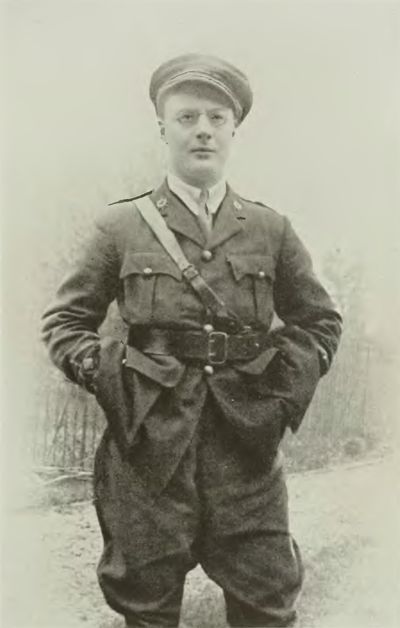
Paul as a Subaltern in the A.S.C. (From a Photograph by his Brother)
AT A HOME PORT
From April 15, 1915, to July 26 in the same year Second Lieutenant H. P. M. Jones was employed at a home port which was, and is, one of the principal centres of supply for the British Expeditionary Force. He was glad of the opportunity of obtaining an insight into the methods of supplying the British Army in the field, and was impressed with the thoroughness, efficiency, and businesslike promptitude of the Army Service Corps. He took the earliest chance of quitting this routine work and applying for service abroad.
May 15th, 1915.
You London folk seem to have been having high times with the enemy aliens. It is quite startling and quite pleasant to see English people roused to do things at last. I see from the photos in the papers that the rioting was done for a great part by men of fighting age who ought to be in the Army. It stands to reason that it is always the dregs of the population who show their patriotism by this sort of behaviour. Still, it is refreshing to see someone taking some sort of action. Everybody here is cursing the Government for its remissness with regard to Germans and Austrians resident in this country. There are exceptions, such as Germans who have absorbed the British spirit, but, generally speaking, Germans, even if naturalised, must retain their patriotic feelings towards their Fatherland, and the patriotic German is, of course, England's enemy. Therefore he will try his best to do us all the harm he can.
Personally I think we ought to take stern action in regard to the internment of all Germans in this country. My argument is not based on trivial ideas of retaliation or punishment, but it is based on facts such as the following: (a) I am a Britisher, Britain is fighting; so I fight for Britain and wish to see her everywhere victorious: (b) In Nature the strongest survive and the weaker go to the wall, and in this war Britain must prove herself either the stronger or the weaker: (c) Our policy must be guided by the idea of proving ourselves the stronger in deeds, not words—not by talk of justice or right, because invariable universal abstract standards of justice and right never existed, and never will exist, in this world. The ideal never was anything but a dream—that is why the poet can never be a politician, and vice versa. We must not let sentimental considerations stand between us and victory. Sounds just like a German talking, doesn't it? Yes, I do agree with the German point of view—except as regards frightfulness, which is really folly and does not achieve its end—but I transfer the point of view to England. Why should England allow any rival to stand in her way? In any case, are we not the world's greatest political people and the best colonisers? Leave the realms of Art to the other nations if you like—England never will be artistic, I fear—but Art is not politics. Politics—I mean primarily foreign policy—signifies the adaptation of a nation to environment of time, place and circumstance, and it is that which is the ruling fact of life.
I am now quite converted to the doctrine of facts. Though passionately idealistic in many respects, I realise that the Facts of life are in cruel but deadly opposition to the Ideals of life, and that while the Ideal remains a dream the cruel Fact remains the reality.
This pseudo-philosophy arises from my having read Arnold Bennett's article in to-day's Daily News, and also from a perusal of Hudson's "Herbert Spencer." Bennett is just an idealist, but in dealing with those cruel realities of which I have spoken, he seems to me a child. Any attempt to dissociate the acts of the German Government from the views of the German people—in other words to assume that a great part of the latter want peace—is absurd. Look at France in 1870. When the Second Empire was overthrown and the Third Republic set up in its place, did the Republicans seek peace? No, they proceeded to prosecute the war to the utmost and tried to drive the invader off the soil of France. And even if in this war a succession of defeats should overthrow the German Kaiser and his Government, do you think the Germans would submit forthwith, and throw themselves on the mercy of the Allies? No, they will fight to the last man, woman and child to prevent the Rhine being crossed. So we should realise that, for our own safety's sake, we must reduce the German military forces to a position of helplessness—in fact, utterly destroy them, if we are to have any settlement. It is Germany or ourselves; and till one or the other is up or down, the war will go on.
To crush the Germans we must put every ounce into the struggle. Are we doing so? I cannot think it when I see Parliament taking such a disgraceful line on the question of drink. Small wonder that Lloyd George exclaims, "What an ignoble spectacle the House of Commons presents now!" I had thought the British Parliament to be a great and potent institution. Now I think it is a convocation of old apple women. What we want is a Cromwell or a Napoleon to knock together the heads of political parties and declare, "No more drink." What will history say when it is recorded that in the midst of this great struggle the British people refused to give up the drink that was poisoning their lives and hindering the work of the nation, and that the influence of a few brewers and capitalists was sufficient to prevent any serious reform being passed in that House which is supposed to be the people's representative?
As for the recent anti-German riots, they seem to me to have been organised by those slack loafing elements of the population who lounge about refusing to enlist. Still, I suppose this is a necessary product of our type of national civilisation. Yet that system—the English or insular, I call it—has done, as it will do, marvels. So perhaps all is for the best, but I am grieved beyond measure at the collapse of L. G.'s scheme for drastic treatment of the drink evil. He at least is a man.
Do you realise what a fine part amateur sportsmen are playing in this war? I really doubt if there will be many great athletes left if things go on as they are doing. On the same day I read that Poulton-Palmer and R. A. Lloyd are gone. Only last year, I remember seeing those two as Captains of England and Ireland respectively, shaking hands with each other and with the King at the great Rugby Football match at Twickenham. I see news is to hand also of the death in action of A. F. Wilding, a great athlete who neither drank nor smoked. So in three days we have lost the most brilliant and versatile centre three-quarter in Poulton, the cleverest drop-kick in the world in Lloyd, and the world's champion tennis-player in Wilding!
June 6th, 1915.
Lloyd George in his two last speeches has said more than anyone else during the war. He is an extraordinary man, and at his greatest when rallying the workers. I see that the Tory Press is enthusiastic about him, and also about Winston Churchill's speech of yesterday. L. G.'s remark that "conscription is not undemocratic" has set a new train of thought stirring in this country. Up to now, in the view of the average Englishman, democracy and conscription had been set at opposite poles. Personally I am not exactly a democrat, an aristocrat, a monarchist, a socialist, or a constitutionalist, but a sort of combination of them all, and a firm believer in the Will to Power and in the Strong Man. But the point is that England certainly inclines to democracy—meaning by democracy laissez-faire. Hence what is needed in a crisis like this is to bring into operation a system which, while partaking of a democratic nature, and so not being repugnant to the national type (as developed by geography, circumstance and history) may yet bring into play the advantages of military training and national organisation. If you can persuade the stolid Englishman to adopt a sort of semi-voluntary military system, which is voluntary or appears so to him, yet puts him under discipline, well then you have an ideal system for England to win this war by. Of course, there is an alternative scheme, namely, for some man of outstanding personality to come along and say, "Look here, I am master, and by my force of character I will compel you to bow to a system which I know to be good for you and which will in the end benefit you." Lloyd George might be even such a man—a Cæsar, a Charlemagne, a Cromwell, or a Napoleon.
But I confess that this amazing English race is hard to bend, even when a man of outstanding personality arises. Did not Oliver himself—a superman if ever there was one—fail in his efforts to make better those whom he ruled? Still, as Goethe says, "Personality makes the man," and perhaps even in England a great man might force our stubborn nation to his will. But I confess I doubt it. Besides, I fear the system would break down as soon as the immediate need for it had vanished. We must have regard to the evolution of our type of race-species when trying to frame measures for its advance to victory over another type of race-species, for the simple reason that, if we do not, the system we are trying to set up will remain in the air, and never come to anything until the people have become sufficiently educated in our way of thinking to accept such a scheme. It seems to me that you could never make a British Army on a German model, or a German Army on a British model, because of the difference between the types of the two nations—the only exception being where you have a superman with a wonderful mind and personality to plan the pattern and enforce its adoption.
Our problem in England is to organise the very individualistic British race without letting them imagine that they are being organised. This sounds like the problem about the irresistible force up against the insurmountable obstacle. But seriously if you have followed my train of thought you will agree with me that what is wanted is to frame a system of military service and national organisation which yet conforms to the national predilection in favour of laissez-faire. This would not be so difficult if there were two or three centuries to do it in; the difficulty is that we must do it at once. Perhaps it is impossible; perhaps the influence of our insular environment will be too strong ever to allow a general military system to grow up here—I don't know, but I hope not. Anyway, it is Lloyd George to whom we look to turn the wheels, because he has personality and that almost uncanny Celtic gift of seeing into the future.
Is it not clear that the Germans have developed to the full a system of organisation in harmony with their national character? Geography has rendered necessary to them a certain type of national policy, and I consider their methods were the only possible ones for them, though they badly needed a clever diplomatist to deceive Europe in these latter years. Now Bismarck, if he had lived until to-day, would probably have secured for Germany a leading place, not by directly fighting England—who is, of course, the natural rival of Germany—the old story of the first and the second boy in the class—but by embroiling her at some suitable moment with other Powers. Then, when all would have been weakened by the war, Germany would step in and take the spoils. Fortunately for us the Prussian is a thoroughly bad diplomatist; and he has preferred open force to policy. Last year the Germans really played their cards astoundingly badly. Did we? Well, in one sense, yes, in that we failed to have a force ready to give the Germans a swift blow as soon as they ventured on an invasion of Belgium. On the other hand, no, because Edward Grey, acting openly, and in accordance with British traditions, yet succeeded by some extraordinary means in duping our enemies and making them rush into a war never expecting that we would participate in it. By accident Grey blundered into a marvellous stroke of diplomacy. Of course, we know that all his actions were governed by an honest desire to preserve peace, but the facts show that he really deceived the Germans more than Machiavelli would have done. (The Prussian, in the average, is very prone to misunderstand his enemy.) The Germans thought we would not come in; we did come in, just when they were not expecting it; in effect, that was a master-stroke. Where we failed was that we were not ourselves ready with an adequate force. Though we strangled German commerce at sea and helped to save France, we were deficient in many elements of an army, and are still woefully so. That is the natural result of insularity.
Now if through the folly of Ministers we lose this great chance of settling with our rival, we shall be cutting our own throats. You see, I have led you, by a devious path, back to the old problem—the necessity for organising England to win this war and to establish her national type as supreme. We must take any and every step necessary to set this great nation of ours even higher than it stands now. Some nation must be political leader of the international polity; why not England, whose extraordinary colonising and governing ability is so well known? I am tired to death of talk about "crushing militarism" and of wild dreams of "a union of small States." If you want to see the latter process in operation, look at the normal state of the Balkans! States may have all the "rights" in the world, but if they are not strong enough in a political and military sense, they will never be able to maintain them. Since England—great and wise nation that she is!—has the sense to use her power benignantly, what harm would there be if she were to assert it over weaker national organisms, as man has done over the beasts? This would certainly not be possible without repeated wars. Subject nations may be treated as easily and as freely as you like when under our sway, but they must be conquered first, and we must keep our power over them even though it is hidden.
But I am dreaming myself now, for there is nothing eternal in Nature except conflict and change; and as our Empire grew, so, I fear, it must some day decay. Evolution is no respecter of persons. Anyway it is our duty to postpone that day of decline as long as we can. In my view England's claims are above all others. Our Allies are just so much use to us as we can make of them. They, too, have their national ambitions and interests, and, of course, if these clashed with ours, they would go off on their own. I blame them not at all. It is as well, however, to be prepared for contingencies. For example, four or five sparrows will combine to attack a larger bird which has a piece of bread. As soon as they get the bread the sparrows themselves begin to squabble for its possession; and perhaps two or three will set on the one that has hold of it and force him to give it up. Such is Nature—a theatre of vast, unceasing conflict. Men and nations all come under the great immutable law.
July 19th, 1915.
This coal strike in South Wales is a baffling business. As usual, English lack of system is to blame. The Government ought to have taken over all the mines, as they did the railways, right at the start of the war. But laissez-faire said "No." Now see the result. Undoubtedly men, employers and Government are all to blame—the Government for not organising the system and failing to stop the increased profits of the owners due to the rise in prices; the owners for taking those profits and making all sorts of unkept promises during the past year about meeting the men to discuss what should be done with war profits; and the men because they are imperilling the whole fate of the Navy for the sake of a few more pence a day, and for failing to show that generosity of spirit which they ought to exhibit in a national crisis like this. What gives the lie to those critics who denounce the unpatriotic conduct of the miners is the astounding proportion of recruits from the affected areas, and the fact that thousands of strikers have sons, brothers and other relatives in the trenches. The whole thing is almost a judgment on English haphazard methods, though I know those methods are only the product of our insular position. After all, we fought Napoleon with almost a revolution going on in Ireland. And do you remember the Six Acts? So history repeats itself.
The Germans are still astounding the world. This move on Russia will, I think, be ranked by military historians in the future as one of the most immense things in the story of the war—a parallel, but on a far larger scale, with the French and our own advance from the Marne to the Aisne. Unfortunately, I am afraid the Germans will be more successful than we were on that occasion—for we only drove them back 20 or 30 miles, but the Germans now seem to be menacing two great cities, half a dozen first-class fortresses, and four vital railway lines. There is no doubt that they, at least, are not playing at war. And to think that it should be Wales that may be half-crippling the Navy when we are matched with such a foe! If the Navy fails, then Heaven help us! I don't think we can lose even now, but I doubt now if Germany can lose. It may be 1793-1815 over again!
Don't imagine that economics end war. Nations can easily do without trade if they will. To win a war, in ninety-nine cases out of a hundred, you have to beat the enemy's forces decisively in the field and put large bodies of his troops permanently out of action, or capture important tracts of territory such as corn land or mining districts, without which he cannot wage the war. Nothing has done us more harm than all this talk about "attrition." People say, "Oh, it's all right, we can strangle Germany by means of our Navy, and only time is wanted." As a matter of fact, Germany is so well prepared by environment, history, and her own endeavours for such a war that were Berlin itself in our hands, I would not like to say we should have won. Berlin has in the past been entered by the enemy, and yet the Germans have defeated their foes. Look at Frederick the Great—he won his wars with half his own country in the enemy's hands. Make no mistake, we shall have to cut the German Army to pieces if we are to win. And we shall not succeed, at least not for any practical purpose, unless we put every man into his right place to win the war. We want the shell-makers at home, the soldiers in the field, the mere politician on the scrap-heap, and capable men at the head of affairs. There must be no more of this muddling War Office policy, no more of this defective control of vital industries and these scandalous deficiencies in equipment.[Back to Contents]
WITH THE 9th CAVALRY BRIGADE
On July 27, 1915, Paul Jones left Waterloo Station for service abroad. Shortly after his arrival in France he was ordered to proceed to the Headquarters of the 9th Cavalry Brigade (1st Cavalry Division), having been appointed Requisitioning Officer to the Brigade. His thorough knowledge of French was the determining factor in securing him this appointment, a very responsible one for a youth of 19.
August 5th, 1915.
At length a chance to write a letter home. I seem to have been travelling for weeks, and I had no time for anything but hasty postcards. My address may not convey much geographically, but I will take the risk of saying that I am very far up country, and—which of course pleases me immensely—not many miles from the real Front. My work involves a great deal of French conversation and much riding and motoring. I am, in fact, a Requisitioning Officer, a title which almost explains itself.
The journey up from the base seemed absolutely endless, but was never lacking in interest, so much was there to see. The glorious spirits of our men would be a lesson to the Jeremiahs at home. Never had I expected, never could I believe possible, that such a wonderfully jovial spirit could prevail among men going to certain danger and hardship and possible death. I saw a lot of Welshmen on the way, and wherever one met them they were singing in those gloriously rich Welsh voices.
How kind-hearted our soldiers are I realised on my journey up. Frequently alongside the railway line were groups of French kiddies shouting, "Souvenirs!" "Souvenirs!" In response our fellows were chucking out to them from the train all sorts of things, bully beef, bread, biscuits, etc., and laughing and chatting at the windows. What a diversity of tongues and accents among our soldiers! Cockney, Lancashire, Scotch, Welsh and West Country were easily recognisable. For cheerfulness and kindness you will never match the British Tommy.
I don't see so very much difference between the new and the old France, except for the greater number of uniforms; the same gay old café-life goes on as always.
Only four out of the fifteen A.S.C. officers who left London on Monday last came up-country, and I was one of the four. Eureka! also Banzai! There ought to be a chance of some excitement, anyhow. I am in glorious health and spirits and feel very pleased with life. Isn't it fine that my desire to be really close to the thick of things should be so fully gratified? Tell Hal I had two delightful swims at the base.
August 9th, 1915.
My mare is temporarily hors de combat with a cut on the hock. This is a nuisance, as I have now to rely on the hospitality of other officers in lending me either their horses or their motor-cars, or, alternatively, go about on a push-bike when I have to travel far afield, which happens almost daily. Before the week is out I am expecting to go right up into the firing-line. One is astounded at the off-hand manner in which officers who have been in the trenches take the most hair-raising adventures. An artillery officer was telling us to-day with the utmost sang-froid of the difficulty he and his comrades had in eating their dinner when poison-gas was blowing about. The gas made their eyes water to such a degree that everybody at the mess seemed to be weeping bitterly. He also told us that for a long time they had had no need of réveillé, as the Boches had a habit of dropping a Jack Johnson near by every morning at 6.15 punctually. In the short time I have been out here I have been struck with the glorious English coolness and the steadfast refusal to get flurried that marks all our tribe.
In our relations with the inhabitants of the countryside we show consideration and strict honesty. Every bit of damage done is compensated, every blade of grass is paid for, although necessarily we have first to investigate the validity of claims for damage. The whole thing is very characteristic of British integrity. I am going very strong and gradually getting the hang of my work, which is decidedly interesting.
We had a remarkable concert the other night. The whole thing—stage, paints, wigs, orchestra, curtains, scenery, everything—was got up by the 1st Cavalry Division Supply Column, and most of the performers were A.S.C. men. The most popular vocalist turned up on his own, however, viz. Captain the Maclean, of Lochbuie (of the 19th Hussars), who is quite an artist in his way. This gay, debonair Scotsman is simply worshipped by the men. One of the latter (himself holding the D.C.M. and the French Médaille Militaire for conspicuous bravery at Landrecies) told me Maclean was the bravest man he had ever seen; he is always at the head of a rush whether on horseback or on foot, and invariably goes into action with a hunting-crop.
A French Territorial Infantry Regiment marched into the town yesterday. They all wore the new grey uniform that is superseding the red trousers and blue tunics of the old days. Quite an interesting spectacle! But for sheer beauty you should see our cavalry on the move. A wonderful sight, I assure you, even without all the gay accoutrements of the Military Tournament. In fact, to my mind, the field-dress makes the affair even more impressive. The horses are simply beauties, and every one of them is in perfect condition.
I have met an old Bedfordian among the cavalry. We have had many a chat comparing notes as to the past, especially in regard to the fierce-fought struggles of old between Bedford and the Blue-and-Blacks. We hope to get some sort of Rugger up when the winter comes, though of course a very great proportion of the cavalry officers are men from Eton, Harrow, Winchester and other schools where, I regret to say, the game of games is not played! They will have to be taught.
August 13th, 1915.
A lot of cavalry men are up trench-digging and I have had my first experience of being up really close to the firing-line. It doesn't take one long to get from here to the thick of things, and we were soon apprised of the fact by heavy and ponderous crashes. Just above us a British aeroplane was winging its flight towards the German lines. Presently one saw small flashes of flame in the air all around it, followed by curious little puffs of smoke; then came the sound of exploding shells; you know that light travels faster than sound. The Boches were potting at the 'plane. However, the British airman was easily able to clear away. After this, a Taube came in our direction and our artillery was having pots at it. Pursued by two British 'planes the Taube turned tail and skedaddled, passing exactly over our car. I wonder it didn't buzz a bomb at us, for the road was crowded with cars, lorries, waggons, and columns of marching soldiers. But it didn't, and went off as fast as it could lick.
We soon reached a village which, during the previous day, had been subjected to a mild bombardment. The results even of a few shells were staggering. A large number of the houses and the village church were shattered into atoms; nothing left but heaps of bricks, with here and there a wall standing amid the débris. To me it was a remarkable spectacle, though my companions assured me that this village was in a positively palatial condition compared to other places farther up. Just as we reached the troops we were destined for, an appalling crash rent the air, and went echoing away like a peal of thunder. It was the British heavy artillery at work, though we couldn't see any batteries. Meanwhile the Boches were aiming at our aeroplanes which were flying above us continually. Amid all this our fellows were quite unmoved, and an exciting game of Soccer was in progress, every successful effort being cheered to the echo by the soldier spectators. And that, mind, though only last night the Boches put twenty-eight of our men out of action not far from this very spot, landing three shells on top of them at midnight, killing one and wounding twenty-seven others, not to mention several horses.
Our route now lay along a road roughly parallel to the firing-lines, and only a few miles behind them. We passed several camps, where all sorts of regiments were quartered. Then we came to quite a big town, which was packed with lorries and field ambulances, and with columns of British soldiers, always cheerful, though in many cases much fatigued. Finally we came back to our quarters. To me the whole experience was most interesting and exciting, and I am eagerly looking forward to a repetition of it. Next time I shall go right up to the real centre of things. It is great to be so near the scrapping, and I only hope a chance of real fighting does come my way. Anyhow, I am ready to do my duty, whatever it may be.
Well, the Germans have got that Petrograd-Warsaw railway. Apparently some people anticipate an advance on Petrograd itself. The war is assuming a phase very like that of the Napoleonic struggles. I hope 1812 repeats itself, but candidly I don't think that the Boches will put their heads into the lion's mouth by risking an advance into Russia with winter coming on.
To his Brother
August 18th, 1915.
I am very busy, but my work is becoming more and more interesting, and I am about in the open air almost all the time. To-day I have had a twenty-mile horse-ride. My little mare ran like clockwork. She is a gem of a horse. I am hoping also to get some motor driving. There is no speed limit here. Talk about express trains! No; Rugby football is not much appreciated by the 9th Brigade. Cavalry officers swear by polo. To see them play a polo match is a sheer delight, for they are the best horsemen in the world.
Many men of our Cavalry Division are at present employed in making a reserve line of trenches some distance behind the real article. Our own brigade is digging vigorously in the grounds of a fine old château. The Supply Officer and I, as his understudy, go up continually in a car conveying special supplies and to do various other duties. The château grounds are well within enemy gun range, and most of the neighbouring buildings have been blown to atoms. Yesterday the first news that greeted us from the trench-diggers was that they had been bombarded that morning by gas shells, among other pleasant surprises. While we were pursuing our duties I heard a boom, followed by a long, sighing screech, then a violent crash about fifty yards off. It was a German shell. Another and yet another followed. Suddenly an R.A.M.C. man came running up to fetch a stretcher—someone had been knocked out. As the nearest man at hand I joined him in carrying the stretcher, and we doubled our fastest for the trees where the first shot had pitched. We found that an R.A.M.C. man had been struck above the ankle by a piece of shrapnel. The wound was small, but deep and ugly, and the leg was broken. The poor chap was in terrible pain. We conveyed him as carefully as we could to the field ambulance. There had been other casualties hereabouts in the morning.
More and more shells, and then a lull. After this exhibition of afternoon hate, we took tea with some officers of the 15th Hussars in a tent in the château grounds. It was a delicious meal, and was not interrupted, though enemy shells from time to time shot over our heads and exploded some distance away in the woods behind. The ineffectiveness of the enemy shelling was greeted every time there was an explosion by cat-calls, shouts and whistling on the part of our imperturbable soldiers. Then the enemy diverted his guns to a village through which our return road ran. On our approaching this place we found our way barred by military policemen, who informed us the traffic was temporarily held up, and that we would have to seek our destination by another and a more devious route. Looking back, one is amused at the nonchalance of this tea in the open with the Hussar officers, while German missiles were shooting over our heads and crashing to earth a couple of hundred yards away. Had the enemy shortened the range we should all have gone up among the little birds.
Did you see that splendid joke in Punch—an old man talking to a very badly wounded Irish soldier swathed in bandages from head to foot? The former says, "This is a terrible war, isn't it, my man?" Pat replies, "Yes, sorr, it is that; a rale tirrible war. But faith! 'tis better than no war at all." Capital, and so deliciously Irish!
August 23rd, 1915.
Excessively busy days these—out sometimes from nine in the morning till about ten at night, often missing meals perforce. A few days back I was in the city whose name practically sums up the character of British fighting—Ypres. Never have I seen such a picture of desolation. Not a house standing; only skeletons of buildings, shattered walls, and gaping window openings, from which all vestige of glass has long since disappeared. The Church and the Cloth Hall are simply piles of débris. To walk along the streets is like a kind of nightmare, even when the Boches are not indulging in a spell of hate against the place. Talk of Pompeii—why, this puts it quite among the "also-rans." What a pathetic spectacle to see a whole city in ruins! Stupefaction and sadness at the wholesale destruction is my impression of this melancholy ruin of an historic town.
Having seen my rations delivered to our regiments, I and my companions (two Hussar officers) visited a battery of 5-inch howitzers at work not far off, through the medium of a friendly Artillery officer. Their headquarters have been amazingly lucky in not being hit up to date. They told us that there was going to be great "strafing" that night, that the Boches were very good gunners, but that they and the French sometimes became quarrelsome and loosed off at each other like fury for a short time, both sides doing very little real damage. As we were chatting a long whistle-blast betokened the presence of a Taube, and our companions quickly dragged us out of sight into a dug-out, lest the enemy airman should spot men about and send back the range. You must understand that the guns are so concealed that it is almost impossible to see them even when you know where they are located. After the aerial visitor cleared off, we had a great tea, with all the ground about us shaking to the reverberation of the battery discharges. Presently a long-drawn-out screech in the distance, and a fearful crash in the middle distance. "That's Percy again!" said the Artillery officer. We found that "Percy" is the name for a German 17-incher, which frequently drops shells ten miles behind our lines. The smallest crater made by his shells would accommodate a locomotive engine with ease. "Percy" is no doubt "some gun," as the Yankees would say. It was a curious sensation to walk about the fields with shells from both sides flying over one's head. Some gas shells had been discharged that day, and the air in places was quite heavy with the odour of them—not unpleasant to smell, but most mephitic, and apt to make your eyes water.
Whom do you think I met on the main road up to-day? None other than Reggie Lloyd, who was one of my best pals at Dulwich. Our car was moving very fast and overtook his. I stopped and jumped out, and we exchanged a firm handshake and a few words before we had to be moving on again "in the cause of duty." He is a second lieutenant in the R.E., and looked thundering fit. To-day I saw him again. On this occasion he was moving about fifty miles an hour on a motor-bike, and we only had time for a hand-wave as we passed. What a thrill to meet an old pal like that out here in the fire zone!
August 28th, 1915.
To go up the road from here to the firing-line is a great experience. You see, as you pass along, all the multifarious items of army organisation—long lines of lorries, horsed-wagons, limbers, guns, columns of marching men, motor-cars by the score, French soldiers, British soldiers, aeroplanes spinning merrily overhead—truly a wonderful spectacle. You have no conception of the abominable state of the main roads out here. The pavé road, peculiar to these parts, is always a bone-shaker at the best of times, but now, after the passage of so much heavy traffic, it is simply appalling. A curious feature is the extraordinary straightness of the main roads, down which you can literally see for miles. The by-roads, on the other hand, seem to abound in right-angled turns, and it is not an easy matter to drive a car along at any considerable rate of speed.
My knowledge of French has come in very useful indeed, but for these outlying country districts a knowledge of Flemish would be even more valuable. Many persons about here speak not one word of French, and Flemish is almost always used by the people en famille. It is a kind of mixture of low German and middle English. I can usually get at people's meanings, and even make them understand mine, by a jargon embracing sometimes words from Chaucer and sometimes a little German. Listening to the language when spoken one is reminded of rather nasal Welsh. There is a distinct resemblance between the general sound of Welsh and Flemish in conversation.
These parts constitute one of the most Catholic districts in Europe; the people are quite as devout as those of the south of Ireland. Wherever you go on the roads you are confronted with shrines—little structures with an altar, holy images, etc., that can be seen through a glass window barred across with slender pieces of iron. Above the door is an admonition urging the passer-by to stop and say an "Ave" or a "Pater." All the dedications to saints and the Virgin are in Latin. For example, this is a very common heading for a shrine, "Ave, Maria, gratiæ plena." I have also seen shrines dedicated to some of those old chaps that Dad is so interested in—Antony of Padua, Francis of Assisi, etc. All over the place you meet, stuck in boxes with glass fronts and mounted on poles, tiny waxen images of various saints, or Christ on the Cross, the Virgin Mary, etc., etc. When a native comes to one of these shrines or images, he pulls off his hat, crosses himself, repeats a prayer, and passes on, probably confident that his sins are forgiven. Everybody goes to Mass at the church of his commune at seven o'clock each morning, and often in the evening as well—on Sunday about three times. Church spires are about the only landmarks in this very flat and rather uninteresting country. The towers vary between the square and the spire. The church itself is always large and quite imposing. You don't see churches of anything like the same size in English villages of corresponding population. A common sight as you ride along these roads is to see the curé, dressed in a long black surtout and a huge wide-brimmed hat just like "Don Bartola," the music-master in the opera of Il Barbiere de Siviglia. The curé gravely salutes you as you pass by, "Bon jour, mon ami!"
I am billeted with very decent folk, extremely devout Catholics. The old man is the secretary to the Mayor. He spends his spare time learning English, and can read an English newspaper quite well. My room is of the kind I like—plain, with two huge windows opening like folding-doors, and only a tiny carpet to attract the dust; the rest clean, bare boards. In the room are two waxen images, one of the Virgin and Child, and one of Christ carrying a child in His arms; also a waxen model in a case of glass of the Virgin and Child, besides no fewer than three crucifixes. This is only characteristic of the whole village: every room I've seen hereabouts seems crowded with images. There are lots of these images, chipped and smashed, lying about the streets of Ypres. I suppose where you are at present [Scotland] everybody is a Presbyterian and very much against all ritual. There is at least this resemblance between Scot and Flemish: they both call the church "kirk" or "kerque." It is rather amusing to think that, according to the ideas of some English Churchmen, both Scottish Presbyterian and Flemish Catholic are lost for ever; while the Baptist of Llanelly is equally convinced that all three of them are; and each imagines the other to be hopelessly wrong. The war has this advantage: that it cuts athwart of all such ridiculous distinctions—for have we not among the Allies English Churchmen and Nonconformists, Catholics, Mohammedans, Hindus and secular Frenchmen, all fighting on the one side against another side which includes Catholics, Protestants and Mohammedans? I say what matter what a man believes if he does his duty?
The last two or three days I have spent in more or less local work, meaning by that districts within about ten miles of headquarters. I have been in the saddle all day, from 9 A.M. to 7 P.M., the only interval being for lunch. Riding is glorious sport. I don't think I shall ever be able to live without a horse in the future. I have been using here one of my own mares, and a fine charger belonging to a 9th Lancer employed at H.Q. (you remember it was this regiment that made the famous charge at Le Cateau back in October). It is a glorious steed this, full of "devil," and a bit bad-tempered. My own big mare is a rather quiet horse, very good at trotting long distances; my other one is smaller but more fiery. I prefer to ride whenever possible a horse that really takes some managing.
September 8th, 1915.
I am glad you are invigorated and pleased with your trip to the land of Burns and Harry Lauder. The Scottish Highlands are the exact opposite of these flat plains. Never in my life have I seen a district so absolutely level as this. There are but three hills in these parts, and these are the only landmarks for miles and miles. Otherwise every road is like every other, every field and every clump of trees the same. The roads are all either dead straight or, in the case of side roads, full of right-angle bends. There is nothing of that sinuous curving which characterises English country roads. As you get nearer the firing-line the roads become worse owing to the passage of Army traffic, till finally they end up in mere broad tracks full of holes and humps. When the weather is bad the mud is appalling—even the Dulwich footer-ground variety comes a bad second—added to which there is, in the case of main roads, the nuisance of a most unlevel pavé, which, it is true, keeps free from mud, but to travel along which in a motor-car is torture. The way the Army lorries go bumping along—many of them old motor-buses with the top parts discarded—is stupendous. It is a strange sight occasionally to see approaching you a real motor-bus, painted grey and full of Tommies. I almost stopped one the other day, near the fire zone, and asked to be taken to Oxford Circus; it all seemed so familiar.
The news from Russia isn't very inspiriting. It looks as if Riga and Rovno will follow in the wake of Warsaw and Novo-Georgievsk. Not that the mere capture of a town means anything in itself, but the Boches must be getting a store of ammunition and guns through their successes. Still, it might be that 1812 would repeat itself, though I fear the Germans have studied history too well to fall into the pit that destroyed Napoleon. Nous verrons.
I went down the other day to an advanced Field Supply Depôt. I often think of the steady flow of goods across the Channel from the home port where I began my Army experience, and the vastness of the silent work behind the scenes that is needed to keep the Army going. You would be amazed to find how little is known even in the A.S.C. itself of that which I have been privileged to see. It has a spice of romance about it, this moving of vast stores from England to the trenches. Out here one gets fresh bread and meat regularly. There are also ample supplies of preserved meat. As for "bully" beef, it is rare good stuff, and I am by no means averse from the hard Army biscuit.
It is the chief part of my duties to make local purchases or requisitions of goods as they are needed. Local resources are always used to the utmost, though G.H.Q. is careful to insist on all goods being duly paid for, or an official requisition-note being handed to the seller. You will realise that in this sort of work I get a lot of practice in French. The French spoken in these parts is very thick, quite different from the metallic French of Paris.
I am told that when we are moving in the field, cavalry go twice as fast as any other branch of the Service. When we begin to move, my job will be really most exciting and interesting, as I shall have to be right on ahead with a store of supplies, bought, requisitioned, or obtained somehow, to keep things going till the ordinary service of lorries and horsed wagons adapts itself to the new conditions. Whatever happens I hope to see some sport.
I get on excellently with the cavalry officers. They have a bright charm of their own and are absolutely fearless. Most of them are descendants of the old English and Scottish chivalry. They are intensely Conservative in opinion, not over intellectual, but men with fine traditions and noble instincts. They have a passion for horses and all things equine.
September 16th, 1915.
So you have had an experience of the Zepps. I am glad London bore it philosophically. I never imagined that it would be possible seriously to perturb the people of England by this species of frightfulness. As Dad puts it, "Curiosity quite mastered every sense of fear," but if the Zepps. are to continue paying visits to our suburb, you may have to evacuate 198 and dig yourselves in in the garden with communicating trenches leading from your dug-outs to Croxted Road and Herne Hill.
It is splendid how our fellows keep rolling up to fight, for, believe me, the war is no joke out here. Very few people who have been out think it's all a death-or-glory sort of business. On the contrary, it is a steady and persistent strain, a strain under which the strongest nerves are apt to give way after a time—I am talking, of course, of the trenches. When the cavalry go into action as cavalry, they are bound to suffer fearfully, being so exposed, but there's no doubt that they will do their job, and put a still greater number of the Boches out of action. This is a war in which there is nothing picturesque or romantic. It takes all the cheerfulness of the British Tommy to overmaster the grinding strain of trench warfare, though as man is by nature a fighter, he presently begins to throw off the trammels of civilisation and live à la naturelle. The British soldier has done marvels in this war. Nothing but his irrepressible spirits and lion-hearted courage would have held up this great host of Boches armed with new and strange implements of war and with every weapon known to science.
September 18th, 1915.
In an interval of relaxation, our division gave a Horse Show to-day. To these cavalrymen, horses are as meat and drink, almost the one topic of their conversation, at once their delight and their business. A lot of notabilities from various places in France came up to see the Show. It was the most magnificent display of horseflesh I have ever seen. It was held in a large open field. The programme included competitions for officers' and troopers' horses (light and heavy), driving for the limbers of the regiment, work by machine-gun sections, races, jumping, turn-out of A.S.C. wagons, and what-not. A wonderful display was that of the officers' chargers, in which the long line of competitors rode, trotted and galloped past the General who was judging. Some of the men's horses were also very good, and really ran the officers' chargers close for merit. The first three prize-winners would be worth a clear £450 apiece. To describe the efficiency of the wagon-driving, the smartness of their turn-out, the quickness and neatness of all their manœuvres, is beyond me. There was no lance or sword play. The whole business had been arranged to see that everything was as efficient as possible, and to promote a spirit of healthy rivalry among the different regiments. It was an extraordinary spectacle, not fifteen miles from the firing-line, with the big guns booming in one's ears the whole time—very characteristic of the Englishman's love of sport and its value to the nation. This is one of the things that the Boches never can, or will be able to, understand. They cannot realise how these "mad English" can forget the War when in the middle of it, and when any minute their "sport" might be interrupted by a "Jack Johnson." I was with our Brigade Veterinary Officer, who, of course, is an equine expert. It was a treat to hear him telling off the points of the magnificent chargers passing in front of us, pawing the ground and snorting, full of dash and fire. To me the whole affair had a profound interest. I have never enjoyed myself more, and really its psychological significance was immense.
On the morning of 25th September, 1915, the 1st and 4th Corps of the British Army delivered an attack on the enemy line between La Bassée Canal on the north and a point opposite the village of Grenay on the south. There were subsidiary simultaneous attacks east of Ypres by the 5th Corps, and north of the La Bassée Canal by the 3rd and the Indian Corps. Our main attack was made in co-operation with the French offensive on our right. The British Cavalry Corps was posted in the neighbourhood of St. Pol and Bailleul-les-Pernes, in readiness to co-operate with the French Cavalry in pushing home any success which might be attained by the combined offensive.
September 23rd, 1915.
I am about to leave on an official mission, the nature of which I cannot disclose to you for the time being. My kit has had to be sent away, and I am only equipped with things I can carry about me or in my saddle-wallets on the horses. Revolver, haversack, official books, map-case and respirator are slung about my body. It is fine to be independent of trunks. Last night I bivouacked in a field, and one day I was quartered in a mining village which before the war must have been a busy place. It reminded me very much of the outskirts of Llanelly. I am feeling better in health and spirits than ever before.
An article by a Liberal M.P. that appeared recently in the Daily Chronicle annoyed me very much. Previously I had imagined the writer to be rather a sportsman and a game fighter; but his insulting references in this article to the "good fellows" in the trenches, who are "excellent in their time and place," etc., simply set my teeth on edge. I know full well that the type of thing that he calls "a voice from the trenches" is only an exploitation of sensational newspapers, as Tommy never by any chance in my experience of him talks of subjects like conscription. But the sheer cruelty of this M.P.'s patronising talk of the men who are dying by thousands to keep him and his kind safe at home absolutely surpasses everything. The suggestion that the man at the Front knows less of how to run wars than M.P.s who have, in all probability, never seen a drop of blood shed or a gun fired in anger in their lives, is, on the face of it, ludicrous. We have heard a lot about the Army not interfering in politics. Well and good; but let the politicians cease to meddle with military affairs, unless, of course, it is manifest that the most sacred civil rights of the people are being sacrificed to a caucus of officers, like those who tried to hold up the Home Rule Bill.
To-day a big detachment of German prisoners was brought into the village. They were well dressed and equipped, and in reasonably good spirits.
October 3rd, 1915.
Life continues to use me well, though in the last week or two I have been all-ends up with work. I have usually managed to keep fairly dry, but the weather is awful, and despite mackintoshes and greatcoats galore, I have been absolutely soaked on more than one occasion, especially one night about four days back, when I had to sleep in the open on a heath in pouring rain, and with a bitter wind blowing. However, one thinks but little of that sort of thing when campaigning, and I have never been better in health.
I wish I could describe to you some of the scenes I witnessed during the past week, above all, on that never-to-be-forgotten day before the great attack was made. We found ourselves moving along the same road as the Guards—Grenadiers, Scots, and Welsh—who were going up to the attack (the Welsh Guards had never been in action before, having only recently been constituted, but I hear they did great things). Never had I seen such a sight as that evening before the attack. On one side of the road our cavalry, on the other the Guardsmen, all moving forward to the accompaniment of the sound of guns booming sullenly ahead. We halted for a time beside a detachment of Life Guards, among whom I recognised an old Alleynian named Kemp, whom I had not seen since last October. We had a few minutes' pleasant conversation before passing on with our respective columns.
A day or two ago I was to have gone right up to the battlefield with supplies, but a sudden change in orders made it impossible. However, a number of our lot were up there. They tell me it was a fearful scene—the ground littered with corpses, and all the débris of a battlefield scattered around. I was bitterly disappointed at not getting right up, but duty is duty, and I had orders to do other things. We all hope that the day of the great move forward has now begun to dawn, but there's no doubt it will be a devil of a job, as the Boches are fighting like hell to regain the lost ground. All yesterday, last night and this morning the guns have been rumbling away with more than usual vigour.
October 6th, 1915.
The general impression here now is that the advance is proving a very tough proposition. The casualty list is of colossal dimensions. All the signs point to a long war.
A French interpreter is attached to each battalion of British infantry, or regiment of cavalry, with a liaison officer, or interpreter officer, attached to each brigade in addition. Personally, I have never found any need for an interpreter's services. I am able to make almost any of my requirements comprehensible to the inhabitants, and I think I may describe myself as being really fluent in French by this time. It is perfectly amazing how few of our people can talk any other language than their own.
That was a piquant incident at the College as described by Hal. A little dash of unconventionality like that is wanted in Dulwich and in all Public Schools. They, like other national institutions, are terribly prone to get into a groove. Though that groove be a good one, yet an occasional lift out of it can do no harm. But there's no doubt about it that, conservative though they may be, our Public Schools have done marvellously in this war. The system has proved its value ten thousand times over, and never so much as on these gory plains of Flanders and the hilly crags of Gallipoli. Of late the officer casualties have been fearful, and most of them these days seem to be killed, not wounded.
So Bulgaria seems determined to come in against us. If this means that Roumania and Greece join us, I don't see why the Germans should be so keen on enlisting the Bulgars on their side. Funny, isn't it, how all Europe is falling into the whirlpool of war? Every one of the little States finds that the war is a chance for it to get something out of someone else—hence its decision to join in. I hope our Government won't go sending big forces out to Albania or Salonika, or such places, unless and until they are sure it would be to England's benefit. For the life of me, I can't see why we should carry these footling little nations on our shoulders. All they do is to turn on you as soon as your back is turned, as vide the Bulgars themselves. The end of it all is that everyone is scrapping against someone else for some selfish aim, and the main object and high ideals for which we entered the war are wholly forgotten.
I cannot describe to you the muddy conditions out here. Mud lies inches thick on the roads, and is kept damp and slimy by the continual passage of limbers, horses, guns, wagons and lorries—the final result being a veritable swamp. The other day a man of the 19th Hussars was watering two horses when he got himself and the two animals hopelessly bogged beside the pond in a swamp which he mistook for dry ground. Eventually we tugged him and the two horses out with ropes. They were all soaked with slime and mud from head to foot. As for the infantrymen, when they come out of the trenches, they are caked in mud all over. In these parts mud is the great feature of the war.
October 11th, 1915.
I continue to be very busy. You must understand that it is my job to supplement the ordinary supplies that come up on the Supply Column from the railway with supplies obtained locally. These latter are frequently as essential as the former. Especially is this the case with cavalry, who are naturally apt, when moving, to get separated from their supplies, owing to the rapidity of their progress. Then comes the Requisitioning Officer's real task. That is not to say that this is the only case in which he has to work. On the contrary, the work is absolutely continuous. The men always want all sorts of things that the Supply Column does not provide, and it is up to me to get those things, and what is more, in most cases, to transport them also. I am in charge of a number of wagons, limbers, etc., to carry out this latter job, and I am responsible for the care and transport of the ordinary supplies for our Brigade Headquarters after they leave the Supply Column. I have also to do the following jobs: (1) Distribute pay to the large number of A.S.C. men attached to Headquarters; (2) when we are in billets, to see to the billeting arrangements for the brigade, and adjust the relations between the troops and whatever inhabitants there may be.
You must not imagine that there are no inhabitants in these districts. On the contrary, it is my experience that people cling to their homes and lead their ordinary lives right up into the fire zone. Our authorities take the greatest care not to offend the inhabitants. Let me give you an illustration. Recently we were at a small village, now quite blown to atoms, and considered a hot spot even out here, and which really has no inhabitants. Well, on the occasion of entrenching operations our chaps found it necessary to take some doors from ruined houses. They wanted the timber for planks for trench supports and dug-outs. Though all the inhabitants had fled or been killed long before, and the village was little better than a dust-heap, yet a solemn and portentous court of inquiry was held on those doors: were we justified in taking them, and should payment be made for them to the old inhabitants or their representatives? Eventually it was decided that, as the doors were taken to help to make trenches, they might be considered as destroyed by a fait de guerre, which, I believe, corresponds to an "act of God" in the civil courts, and payment ought not therefore to be made for the doors. It was, however, pointed out that if the said doors had been used to make a road, not a trench, they would not be faits de guerre, and in such case payment would have had to be made to the Mayor of the destroyed commune!
"Business as usual" is the motto they try to live up to throughout these parts, and every effort is made to persuade people that the war is only a sort of accident. Money remains money, and there are people selling and buying right up to places where many lives are lost every day. The position is really almost that described in a Bystander cartoon, depicting a peasant standing above a line of our trenches amid a hell of shot and bursting shrapnel, and saying, "Messieurs, I am desolated to trouble you, but I must request you to fight in my other field, as I plough this one to-day." By the way, The Bystander has succeeded, as no other paper save perhaps Punch has done, in catching the atmosphere that exists out here.
I assure you that just behind the firing-line people are minting money out of our occupation. Not only do they get paid regularly if British troops are billeted on them, but they can name their own prices for milk, beer, eggs, etc., and all those other things that Tommy is anxious for, and for which he can afford to pay. He is, I think, paid three times as much as either the French or the Boche soldiers. True, I have met some pitiful cases of refugeeism, but to a very large number of people in Northern France the war is nothing but somewhat of a nuisance. Of course, where they do feel it is in their own terrible casualty lists. I have known family after family in the little villages who have lost one or two sons. In many communes one finds that the Mayor has been killed while serving at the front, and a deputy acts in his stead. The Mayor of the place where we are now stationed has three sons fighting, one at Verdun. I had an agreeable chat a few days back with the local schoolmaster, who was home on short leave from the trenches.
It is curious that only The Bystander and Punch should have succeeded in catching the atmosphere of "Somewhere in France." Many of the war correspondents, brilliantly though they write, have missed it altogether. John Buchan is not so bad, when he writes soberly, but he will let his imagination run away with him. Talking of writers, what a delightful thing was that article of Zangwill's in the Daily Chronicle on "The Perils of Walking in War-time"! Its brilliant satire, firm grasp of facts, lively humour and racy style quite took my fancy.
I have had some interesting chats with some of the old soldiers in our division about Mons, the Marne and the Aisne, and all "those brave days of old." One chap, now acting as a clerk at Headquarters, wears the ribbons of the D.C.M. and French Médaille Militaire for swimming a river (on the retreat from Mons) amid a tempest of shot and shell, and giving warning to a party of our people on the other side who were in the greatest danger of being surrounded—and quite oblivious of the fact—by the Boches who had forced the passage of a bridge some way off. This brave fellow led his menaced comrades to another bridge, and so enabled them all to get clear.
The Supply Officer of one of our brigades is F. P. Knox, a Dulwich man, who captained the old school at cricket back in 1895 or so and I believe led Oxford to victory after that. His brother you may know—N. A. Knox, the famous fast bowler.
October 15th, 1915.
The Balkan business is a startling knockout for those enthusiasts who see in the development of small States salvation for the world! If people would only accept the fact that this is a material world they would not be surprised at the situation. Myself, I consider that our diplomacy has failed, probably because it did not offer tempting enough bribes to Bulgaria and Greece. No matter; what is the fate of a few tuppenny-ha'penny Balkan States, who have never done a thing worth doing, beside that of the British Empire! Why should we always play the philanthropic idiot towards all these wretched little nations? As if any of them—or anyone else, for that matter, in international politics—knows the meaning of the word gratitude! However righteous our policy may have been, it doesn't seem to have worked in South-East Europe, and the Boches appear to have got home first there. I don't think it is so much a triumph for their diplomacy as a judgment on the blundering stupidity of ours. But when all's said and done, the alliance or hostility of a few Bulgars, Greeks or Roumanians doesn't count for so much, anyhow. "Come the three corners of the world in arms, and we shall shock them. Naught shall make us rue, if England to herself do rest but true."
Yesterday I played Soccer for Headquarters against the 15th Hussars. We beat them 2 to 1. However, I can't work up any enthusiasm for Soccer. Oh! for a real game of Rugger. Still, the Tommies—the English ones, at least—think Soccer the only game, so one must cut one's cloth to one's opportunities. It is something to get a game of any sort out here. Is the October number of The Alleynian out yet? I hope they keep their war list up to date. Our Roll of Honour is as good as anybody's, and should be carefully attended to.
October 20th, 1915.
Whom do you think I met the other day leading a column of motor lorries up to our brigade H.Q.? No less a person than G. P. S. Clark, the centre three-quarter who scored that wonderful try against Haileybury in my first year in the team—running and feinting his way through right from his own line. He is a motor expert, and has been gazetted to the M.T. branch of the A.S.C.
Is there any chance of my getting the post of A.D.C. to a Welsh brigadier? If the Welsh division is due out presently it would be rather a good job. But if it involved my coming back to England for any length of time I wouldn't take it. I am perfectly satisfied with my present work, but still would very much like to become a real combatant. Against the defect of short sight I can put the following points:
(a) Three months of Active Service, almost invariably in the neighbourhood of the firing-line; on several occasions right up in it.
(b) I have always been attached to the Headquarters of a Cavalry Brigade, have been in the closest contact with the Brigade Staff, and have taken my orders from the Staff Captain direct—a very large proportion of those orders about real Staff work.
(c) I have now a real linguistic fluency in French; pretty useful German also.
(d) I have been acting under the supervision of a Supply Officer, whose work I do when he is away, and I know the system of transport and supply backwards.
(e) I have a thorough knowledge of how to make up supplies by requisition and purchase on the countryside.
(f) On the march I move at the head of the limbers which form the Cavalry Divisional train, and am second in command of them all, so I know something about that branch of work, too.
(g) I am quite a useful horseman.
You may say on reading the above list of virtues that a glass case is the right place for me, but I know to the full that if one wants one of these "knutty" jobs one has to represent oneself as a sort of little tin god. Now don't imagine that I am dissatisfied with my present job. I am more than pleased with it; still I am very keen to become a fighting soldier.
October 25th, 1915.
My present quarters are in a mill. I have a fine large room, also first-rate stabling for my horses. Brigade Headquarters are in one of those magnificent châteaux that are dotted over this part of France. A gorgeous place it must have been in time of peace, and so it is now except that it is beginning to show signs of war-wear and constant use.
I am very bucked with life. All that we would like now would be a stupendous advance. This nibbling policy is all very well, but it doesn't suit cavalry.
My horses have just been clipped. It is the customary thing at this time of year, as horses' coats get very thick, and in consequence they sweat heavily when on the march. The effect of clipping is curious in the extreme, as the animal no longer appears of its original colour, but of the colour of its skin, i.e., mouse-grey. My mare was originally chestnut; now she is a dark grey. Horses are much happier with their thick coats off. The hair will have grown again in a couple of weeks, but it won't be thick for some time. My mare is a grand horse for steady, continuous work, also quite a good galloper. I had a gallop for two furlongs or so the other day with the Staff Captain and the A.D.C., each mounted on a crack cavalry charger. My mare came in with the first of them, and had more left in her at the end than either of the others.
There is no greater mistake than to suppose that the function of the horse has vanished in modern war. On the contrary, even in the transport, horses are quite as much used as motors. Horse transport is not confined to roads, and can pass much more easily than motor vehicles over rough ground. When you get up near the front, where the roads are badly cut up, horse transport is not only desirable but essential. Of course, the motor is absolutely invaluable for speedy transport. But on the whole one can say that, except for motor-buses, which sometimes take the men right up close to the trenches, and except for the ammunition park—a collection of powerful and very speedy lorries loaded up with munitions, which has always to be in readiness to dash up to the front in view of an emergency—except in these cases, it is safe to say that motor transport ends some miles from the actual fighting-line, and all the remaining transport is horsed. True, motor-cars containing Generals on inspection, Supply officers, etc., go all over the place, often right up behind the firing-line. Also there are the motor machine-gun cars, and the armoured cars, which are fighting units proper. But don't for goodness' sake imagine that the horse is done with in modern war because of the advent of the motor.
What the motor has done is to alter the whole face of things because of the extraordinary rapidity with which it enables you to fling troops or supplies up to the Front or transport them from point to point. But for the effective use of motor vehicles you need pretty good roads. You will remember how in the earlier months of the War, ourselves, the Germans and the French effected big troop movements simply by motor transport. You will recall the occasion on which the French flung a force across the suburbs of Paris and attacked the Boches on the right, thus beginning the movement known as the Battle of the Marne. Then there was the occasion when Hindenburg attacked the Russians in October, 1914, feinting at their left and striking at their right at Tannenberg with a force of armoured cars, cavalry, and infantry conveyed in motors. Neither of these movements could have been achieved before the advent of motor transport. As this war progresses, the need for really capable and cool-headed motor drivers will steadily increase. But it will be none the less invaluable to know how to manage a horse—whether to ride it, drive a wagon, or ride-and-drive in a limber. One of our limber horses is a grey captured from the Germans last year. He is a very good worker and doesn't seem to mind being a prisoner in the least.
I must tell you of a funny incident. That night when we were sleeping on the heath, which I referred to in a previous letter (p. 149), our Medical Officer was awakened at 2 A.M. by a frantic signaller, that is, one of the R.E. motor-cycle dispatch riders. It was pouring rain at the time and bitterly cold. The signaller solemnly handed the M.O. an envelope marked "Urgent and Special." The M.O. opened it, his mind full of visions of men mortally stricken awaiting immediate attention and of other tragic things. Judge his astonishment when he found inside the following note from his O.C.: "Kindly render your monthly inoculation return to Headquarters before the end of the week." What the M.O. said is unprintable, as this return had already been sent in, and, in any case, is just a formality of no importance to anybody.
My affection for the British soldier deepens the more I know of him. To a student of human nature it is an everlasting joy to get Tommy to tell you his experiences in his own inimitable language, interspersed with all sorts of gory adjectives. It is so different from and better than the sort of thing you read in the Society papers. Human nature as it really is comes out strongly in these splendid men at the Front. A talk with Tommy is of intense interest to a chap as keen as I am on psychology.
November 5th, 1915.
Still much occupied; out almost all day and every day, either on horseback or in a motor. Much interest has been displayed in these parts in the visit of the King. I have passed the château where he is staying almost every day this past week.
The district where we are now quartered is filled with refugees, among them some orphans from Loos. Some people about here have been terribly hit by the war, but some are reaping enormous profits out of it. Such is the caprice of fortune. All over this neighbourhood you see the names of Life Guards, Royal Horse Guards, Grenadiers, etc., carved on doors and panels. We are close to a large town which is an important point in the scheme of things.
Events seem to be taking a remarkable turn. Who, at the start of the war, would have thought that we would have been able to land a military force in the Balkan Peninsula? It is really a remarkable position all round. Asquith's speech was frank if nothing else. There appears to have been discord in the Cabinet, so now we are about to have something like a "Committee of Public Safety." Marvellous race, the English! Lord Derby seems to be an outstanding personality just now. Have you noticed how each month of the war is marked by some new phase of public opinion? Optimism, pessimism, spies, Zeppelins, economy, pink forms, voluntaryism, conscription, munitions—each of these has been for a time the centre of public interest, and each has swiftly fallen from its pedestal to be replaced by some other phase. Curiously enough, the talk at home has not been influenced in any direct way by the real progress of the war, but by the effect on the popular imagination of trivial incidents, magnified out of all proportion by sensational journals. The war goes on, nevertheless, showing that the great British spirit is something far too strong and deep to be really influenced by the caprices of public opinion.
It is amusing to see how the views of certain newspapers vary from month to month, and even more diverting to observe how all the amateur strategists claim that they had really predicted every phase of the military operations. Believe me, however, the war has been and is quite different from any ideas entertained in regard to it in the early weeks and months. It is a blend of grotesque incongruities that would be humorous were not one side of them so tragic and terrible. No one here seems to know anything definite about what is going on. One has considerable local knowledge but very little general information. Probably the latter is impossible to get in this sort of mix-up—the scale on which the war is being waged is so vast.
You will see roughly from Sir John French's latest dispatch the part played by the cavalry in the advance of 25th September-5th October. You will not, of course, be able to glean much of what actually happened, but I can tell you we had a most interesting time.
How tiresome is the tosh written in the papers and spoken in Parliament about the war! One wonders if it would not be a good plan to shut up Parliament for a time, though I suppose it is a good thing to have a place where men can vent their foolish thoughts. But I am thoroughly weary of "Statements by the Prime Minister" which state nothing, and of mere denunciations by Sir Arthur Markham and Sir Edward Carson; also of the shrieking of the Yellow Press, the wishy-washiness of the Liberal Press and the Spectator, the impenetrable Conservatism of the Morning Post, and the noisy sensationalism of the Bottomley—Austin Harrison crew. Thank goodness the strong broad stream of British spirit runs deeper and is much purer than would appear from this froth and scum on the surface.
Recently it has been a period of Catholic festivals about here. Some days there have been processions and bell-ringing from morn to eve. The other day was the Fête des Morts, and lately there was the French All Saints' Day. It is a singular sensation to hear the chime of church bells blending with the thudding of the guns.
November 18th, 1915.
Yesterday I rode twenty-five miles. A delightful experience it was, too;—in crisp winter weather and with the surrounding country covered with snow. It has become very cold of late, but I am fond of cold weather, especially when it keeps dry. Assigned some special work by the Staff Captain, I had permission to move when and how I liked, instead of accompanying the Column as I usually do. The result was that I was able to join up with the Veterinary section attached to the brigade. We moved at our own pace, resting our horses where we wanted to and giving them a good drink and feed en route, instead of jogging on monotonously with the Column. Our horses were thoroughly fit and full of life when we reached our destination, and good for another twenty-five miles if necessary. You would not believe how much horses benefit from care and attention as to food and rest. The time you lose in watering, resting and feeding, you can always more than make up through the consequent freshness of your animals. Obviously, when speed is absolutely vital, you can't choose your time to rest the horses. For example: on those never-to-be-forgotten days, 23-26 September last, we used to move at a rapid trot for hours on end—for the expectation then was that the Boche line might be broken. This latest "trek" had not the urgency or the wild excitement of that, and we were able to take our own time.
I had a ripping game of Rugger a few days back, playing for the 19th Hussars against the Bedford Yeomanry. The latter, who included some old Bedford School boys, beat us, though only by one point. I played forward in the first half of the game, and scrum-half in the second. It was a treat to handle a Rugby ball again!
Things are becoming rather mixed in English politics, what with Asquith's contradictory statements about conscription, Carson resigning and Winston flinging up politics for the Army. His resignation is creditable to Winston, and at a moment like this he would naturally want to do his bit at the Front. Everybody in the cavalry that I have spoken to considers him a good sportsman. Myself, I regard Churchill as a man with a real touch of genius.
The Haldane controversy seems to have started afresh. How terrible is the ingratitude of the masses! If Haldane had done no more than create the Territorials and the Officers' Training Corps he would have had an everlasting claim to fame; but when one considers also his creation of the General Staff, and his arrangements for mobilising, equipping, transporting and supplying the B.E.F.—well, one begins to realise that the man is a Colossus. And yet the wretched Jingoes continue to bespatter him with mud, and I suppose the nation in the mass regards him as a species of highly-educated spy! But perhaps the majority of the people have never heard of him—Charlie Chaplin is a far more living personality to most of them, I make no doubt.
I referred in a recent letter (p. 162), to the fluctuating phases of opinion in England in regard to the war. A new phase would appear now to have arisen and taken the place of the Lord Derby boom. This new phase is one of criticism of past military and naval operations—Neuve Chapelle, Loos, Suvla Bay, the Narrows, Antwerp, etc. etc., all of which are being discussed with equal zest and ignorance. Mark my words, there will soon be a new phase or an old one will recur.
To his Brother.
November 23rd, 1915.
I am so sorry Dulwich got done down by Bedford. Of all our matches, that is the one we are most keen on winning. Still, we can't expect to win always, and we have not lost to Bedford for three years till now. I had perhaps the unique experience of being in a team which never lost a Bedford match. In 1912-13, when I got my colours, we drew 28 points all; in 1913-14 we won, 16 to 15; and last year, 32 to 16. Well, I would have given anything for the School to have got home a fourth time against old Bedford, but it was not to be.
The sudden drop in temperature during the last fortnight has affected most people here. I have escaped without any sort of cold, though nine-tenths of the officers and men have been down with chills.
My mare has developed a devil of a temper of late, and bites and kicks like anything—a sign of exuberant vigour. Fortunately she gets on well with my other horse, and they don't "strafe" each other in the stable. To get horses in the same stable on good terms with each other is largely a question of feeding them at the same time. My second horse, which my servant rides when we are on the move, is a jolly little chestnut, very strong and hardy, with a magnificent long tail. I ride him and the mare on alternate days. Horses are ridiculous creatures. They will eat all sorts of things, even wood, mud, and pieces of coal, as if from sheer cussedness. It can't be because they are hungry, as they get plenty to eat in the way of oats, hay, dry clover, etc. Sometimes, as if from devilment, they will roll in the mud a few minutes after they have been nicely groomed. Some of our regiments have a lot of mules, which are given to fearful brayings—a sound which is a cross between a horse's whinny, a donkey's hee-haw and an elephant's trumpeting. Mules bite and kick each other continually, but they will do any amount of work when so inclined.
November 29th, 1915.
I see that the Welshmen are coming out. May they strafe the Boches to the wide! I hope the Cymry will prove themselves worthy successors to Owain Glyndwr and all the other grand old chiefs who have given us such a name in arms. Times have changed, and to-day, instead of smiting your foe with a club or a sword, you "strafe" him with gas-shells and machine-guns. The old way was the best, but the natural instinct of all things animate to fight remains, as it always will remain.
We have received some of The Times' broad-sheets. I don't exactly know whether they are good or not. It is undoubtedly a benefit to have "bits" from great writers to skim over when you haven't the time, or the inclination, to wade through a volume. On the other hand, it is intensely aggravating to experience the feeling of incompleteness that naturally results from having your reading suddenly cut off.
December 3rd, 1915.
The other day I was ordered to visit a certain battery in the firing-line. No one had a ghost of an idea as to their present location, but I discovered where their supplies were being drawn from—a spot two miles from the line, which was being "strafed" daily. Off I went to this place in my car, but nobody there knew a thing about the people I wanted, so I had to go up to the railway station and crave the loan of a telephone. After a great deal of bother I got on to some genial soul who knew where the Brigade Headquarters were of the lot I was after. He told me where they had gone to, but whether they were still there or not he didn't know. Anyhow, it was a clue. So, like Pillingshot (in P. G.'s story), I worked on it.
After consulting my maps, and chatting with dozens of military police, interpreters, etc., I took my car forward by a certain road. By this time it was pitch dark, except for star shells and gun flashes. The road was crammed with traffic. We took a wrong turning, and eventually found ourselves on an apology for a road that ended in a swamp full of shell-holes, and had to retrace our steps gingerly. After blundering about in the dark for some time we struck the village we were looking for, a hopeless sort of place crammed with Scotsmen, all exceedingly grimy, but gay and cheerful. In one house the men were waltzing to the strains of a mouth-organ, though the boom of the guns was shaking the house every second or so.
Having reached the Headquarters I was in quest of, I ascertained from them that the battery with which I had business to do was now at a spot two miles away down a main road which was the scene of such desperate fighting not long back. The O.C. strongly advised me not to take the car down there, as if I did "it was likely that the car would stop some pieces of metal." There was nothing for it but to walk down the road leading to the recently captured village. It was very dark, but star-shells, with their weird green light, would illuminate the countryside every five minutes or so. In the darkness one could vaguely discern the shape of the first-line transport wagons taking up rations to the trenches, and small columns of silently marching men, and now and then a motor lorry belonging to some ammunition park. Presently, after what seemed an interminable walk, I found the battery, who themselves had only just arrived, and executed my job in a half-ruined house. To get back to my car I borrowed a horse and rode part of the way with a number of led horses, which, having brought up the guns, were going back to the wagon line.
On getting to my car I decided that my best road to return would be to go straight along into a certain large town, instead of the route we'd come by. As we spun along a voice from the darkness hailed us: "Have you room for an officer?" We at once pulled up and told him to jump in. Poor devil! he was almost in a state of collapse and talked wildly. He had been six months in the trenches, and had just come out of them in a half-hysterical state. I had to speak to him pretty firmly before he could pull himself together. We took him to his destination, and he was most grateful for the lift.
It was an uncanny experience, this wandering about in the darkness in desolate regions a few hundred yards from the trenches. In this grim struggle there is none of the glory and pomp of war as exhibited in the days of old, when rival armies met amid the blare of trumpets and the waving of standards. The pageantry of war is gone. We have now war in all its fierceness, grime and cold-bloodedness without any picturesque glamour or romance. Can you wonder that in such conditions civilised human nature out here swiftly changes and is replaced by elemental savagery?
In December, 1915, Paul Jones had short leave, and spent six days at home. He took advantage of the opportunity to have a game of football on the familiar arena in Dulwich, playing for the Old Alleynians against the College 1st XV.
December 21st, 1915.
All well after a pleasant crossing. The blundering authorities kept us and three other leave trains six hours in —— station, no one being allowed to leave the platform! We eventually reached —— at 7 P.M. The two first men I met on the boat were old Dulwich boys, W. J. Barnard and Bobby Dicke. Barnard is a field-gunner, and Dicke is in the 1st Royal Fusiliers. I also met another O.A., named Corsan, who is captain in Barnard's battery. How well I remember ragging with him in choir practices! We had a thrilling chat over old times. Both Barnard and Corsan went through the Battle of Loos. On reaching France we found there was no means of getting to our respective destinations until next morning, so we all dined together with a couple of other subs., one in the K.R.R.s, a mere boy in appearance but a veteran in experience. How delightful to meet old pals, and what splendid fellows these old public-school men are!
Everything is very festive about here just now. Officers and men are making ready to pass Christmas in the old-fashioned way.
December 28th, 1915.
We had a very jolly Christmas. The revellings have, in fact, only just begun to subside. Our Brigade Major spent his Christmas in the trenches along with his brother, a V.C. In that part of the line there was a truce for a quarter of an hour on Christmas Day, and a number of Englishmen and Germans jumped out and started talking together. A German gave one of our men a Christmas tree about two feet high as a souvenir. It is of the usual variety, covered with tinsel and adorned with glass balls.
January 4th, 1916.
Here was a man who threw up all to take up soldiering, not because he had the military instinct, but from sheer patriotism and sense of duty. It was just like him—at school he would always put himself out to play in a game if a team was a man short. He was always called "Nighty" by the boys. Can you wonder, with the example of such a man before me, that I should be longing to get into the Infantry? Heavens! A man would not be a man who did not feel as I feel about this matter.
Well, Sir John Simon has resigned. Rather a pity that such a career should be cut short. Still, at best he was a mere politician, and to tell you the truth I don't like politicians much. All the same, I do think Simon did some valuable work as Home Secretary, and earlier as Attorney-General.
For once the British Government appears to have acted with vigour—I mean by occupying Salonika and telling the Greeks politely to "hop it." Result, the Greeks have hopped it. How much more simple and effective this than to jaw about "the rights of neutrals," the "sanctity of small nations," etc., etc.! No! take a strong line in this world, and you're more likely to get what you want than by cajolery.
January 26th, 1916.
One day last week I mounted my horse at 2.15 P.M. and rode in a south-easterly direction. For the first couple of miles things were as usual—crowds of soldiers about, of course, and lots of transport on the move. One village I found populated half by civilians and half by troops. Thereafter the country becomes barer and grimmer, and the fields for the most part are uncultivated—in itself a remarkable thing in France. The next village I came to bore signs of having been shelled, but was still habitable. Originally it must have been quite a pleasant little place. Not many of the native inhabitants remained, and the houses for the most part were filled with Scotsmen and sappers.
Passing on, with the roar of the guns getting more and more distinct, we come to a place that leaves no manner of doubt that there is a war on. There are graves by the roadside, and shell-holes. Lines of trenches and coils of barbed wire arrest your attention. Now there comes into view the battered remnant of what was once a busy mining village. The great slag-heap towers up on our right hand, its sides scarred and smashed by shell-fire. Not a house is left standing. There are only shattered walls and heaps of bricks. Over all hangs that curious odour one gets at the Front—a sort of combined smell of burning and decay. A grotesque effect is produced by a signboard hanging outside a ruined tenement and bearing the words: "Delattre, Débitant," or, in other words, "Delattre's Inn." On the right a gunner is standing on what was once a house roof, hacking away at the beams with a pickaxe; he is getting firewood, no doubt. Solemnly a general service wagon rolls by, carrying a load of fuel, and a limber crashes past at a trot. A little single-line railway from the colliery crosses the road, and even now there are standing on it two or three trucks, strange to say quite intact. The machinery at the pit-head is all smashed, bent and broken. You are impressed with the strange, eerie silence, when suddenly there is an earth-shaking crash. One of our heavies has been fired. You hear the shell whirring away on its journey of destruction, and finally a faint, far-distant crash, perhaps marking the end of a dozen men, five or ten miles off.