W.H.G. Kingston (continued 2)
Reading edition
Mr Marlow at length paid his long promised visit. Lucy eagerly inquired if he had seen Waihoura.
“I spent a couple of days at Ihaka’s pah on my way here,” he replied, “and I am sorry to say that your young friend appears very unhappy. Her father seems resolved that she shall marry Hemipo, notwithstanding that he is a heathen, as he has passed his word to that effect. I pointed out to him the misery he would cause her; and though he loves his child, yet I could not shake him. He replied, that a chief’s word must not be broken, and that perhaps Waihoura’s marriage may be the means of converting her husband. I fear that she would have little influence over him, as even among his own people he is looked upon as a fierce and vindictive savage.”
“Poor Waihoura!” sighed Lucy. “Do you think her father would allow her to pay us another visit? I should be so glad to send and invite her.”
“I am afraid not,” answered Mr Marlow. “Ihaka himself, though nominally a Christian, is very lukewarm; and though he was glad to have his daughter restored to health, he does not value the advantage she would derive from intercourse with civilised people. However, you can make the attempt, and I will write a letter, which you can send by one of his people who accompanied me here.”
The letter was written, and forthwith despatched. In return Ihaka sent an invitation to the pakeha maiden and her friends to visit him and his daughter at his pah. Mr Marlow advised Lucy to accept it.
“The chief’s pride possibly prevents him from allowing his daughter to visit you again, until, according to his notions, he has repaid you for the hospitality you have shown her,” he observed. “You may feel perfectly secure in going there; and, at all events, you will find the visit interesting, as you will have an opportunity of seeing more of the native customs and way of living than you otherwise could.”
Mr Pemberton, after some hesitation, agreed to the proposal, and Valentine undertook to escort his sister. Harry said he should like to go; “but then about the sheep—I cannot leave them for so long,” he said. James Greening offered to look after his flock during his absence. A lady, Miss Osburn, a very nice girl, who was calling on Lucy, expressed a strong wish to accompany her.
“I think that I am bound to go with you, as I have advised the expedition, and feel myself answerable for your safe conduct,” said Mr Marlow. “I may also prove useful as an interpreter, and should be glad of an opportunity of again speaking to Ihaka and his people.”
A message was accordingly sent to the chief, announcing the intention of Lucy and her friends to pay a visit to his pah.
The road, though somewhat rough, was considered practicable for the waggon, which was accordingly got ready. They were to start at daybreak, and as the pah was about twelve miles off, it was not expected that they would reach it till late in the afternoon. Two natives had been sent by Ihaka to act as guides, and as they selected the most level route, the journey was performed without accident.
About the time expected they came in sight of a rocky hill rising out of the plain, with a stream running at its base. On the summit appeared a line of palisades, surmounted by strange looking figures, mounted on poles, while in front was a gateway, above which was a larger figure, with a hideous countenance, curiously carved and painted. The natives pointed, with evident pride, at the abode of their chief.
As the path to it was far too steep to allow of the waggon going up it, Lucy and her friend got out to ascend on foot. As they did so, the chief and a number of his people emerged from the gateway, and came down to meet them. The usual salutations were offered, and the chief, knowing the customs of his guests, did not offer to rub noses. Lucy inquired anxiously for Waihoura. She was, according to etiquette, remaining within to receive her visitors.
After passing through a gateway, they found a second line of stockades, within which was a wide place occupied by numerous small wahrés, while at the further end stood two of somewhat larger size, ornamented with numerous highly carved wooden figures. On one side was a building, raised on carved posts, with a high-pitched roof—it was still more highly ornamented than the others, in grotesque patterns, among which the human face predominated. This latter was the chief’s store-house, and it was considerably larger and handsomer than his own abode. The dwelling-houses were of an oblong shape, about sixteen feet long and eight wide, with low walls, but high sloping roofs; the doors were so low that it was necessary to stoop when entering. The roofs were thatched with rampo, a plant which grows in the marshes; and the walls were of the same material, thickly matted together, so as to keep out both rain and wind.
As the party advanced, Waihoura appeared from her wahré, and throwing her arms on Lucy’s neck, began to weep as if her heart would break. She then conducted her friends into the interior, while the chief took charge of Mr Marlow, Valentine, and Harry.
Waihoura’s abode was clean and neat, the ground on each side covered thickly with fern, on the top of which mats were placed to serve as couches. Here the Maori girl begged her guests to be seated, and having recovered her composure, she thanked Lucy warmly for coming, and made inquiries about her friends at Riverside. She smiled and laughed, and became so animated, that she scarcely appeared like the same person she had been a few minutes before. She became very grave, however, when Lucy asked if her father still insisted on her marrying Hemipo.
“He does,” she answered, in a sad tone. “But I may yet escape, and I will, if I can, at all risks.”
She pressed her lips together, and looked so firm, that Lucy hoped that she would succeed in carrying out her resolution.
Their conversation was interrupted by a summons to a feast, which the chief had prepared, to do honour to his guests. In the centre of the pah a scaffold was erected, with bars across it, on which were hung up various fish, pieces of pork, and wild-fowl, while on the top were baskets full of sweet and ordinary potatoes, and a variety of other vegetables; and a number of women were employed in cooking, in ovens formed in the ground. These ovens were mere holes filled with hot stones, on the top of which the provisions were placed, and then covered up with leaves and earth.
In deference to the customs of their white friends, the natives had prepared seats for them, composed of fern and mats, in the shade of the chief’s wahré, while they themselves sat round, at a respectful distance, on the ground, in the hot sun.
When all were arranged, the chief, wrapped in his cloak, walked into the centre, and marching backwards and forwards, addressed the party, now turning to his guests, now to his countrymen, the rapidity of his movements increasing, till he appeared to have worked himself into a perfect fury. Waihoura, who sat by Lucy’s side, begged her and her friend not to be alarmed, he was merely acting according to custom. Suddenly he stopped, and wrapping his cloak around him, sat down on the ground.
Mr Marlow considered this a good opportunity of speaking to the people, and rising, he walked into their midst. His address, however, was very different to that of the chief’s. He reminded them that God, who rules the world, had given them all the food he saw there collected; that He desires to do good to the bodies of men, and to enable them to live in happiness and plenty; but that He loves their souls still more, and that He who had provided them with the food was ready to bestow on them spiritual blessings, to feed their souls as well as their bodies: that their bodies must perish, but that their souls must live for ever—He had sent the missionaries to them with His message of love, and He grieved that they were often more ready to accept only the food for their bodies, and to reject that which He offers for their souls. Much more he spoke to the same effect, and explained all that God, their Father had done for them when they were banished for their sins, to enable them again to become His dear children. Earthly fathers, he continued, are too often ready to sacrifice their children for their own advantage, regardless of their happiness here and of their eternal welfare. Ihaka winced when he heard these remarks, and fixed his eyes on the speaker, but said nothing. Other chiefs, who had come as guests, also spoke. Lucy was glad to find that Hemipo was not among them.
The feast then commenced, the provisions were handed round in neat clean baskets to each guest. Ihaka had provided plates and knives and forks for his English friends, who were surprised to find the perfect way in which the fish and meat, as well as the vegetables, were cooked.
After the feast, the young people hurried out of the pah towards a post stuck in the ground, on one side of a bank, with ropes hanging from the top; each one seized a rope, and began running round and round, now up, now down the bank, till their feet were lifted off the ground, much in the way English boys amuse themselves in a gymnasium. In another place a target was set up, at which the elder boys and young men threw their spears, composed of fern stems, with great dexterity. Several kites, formed of the flat leaves of a kind of sedge, were also brought out and set flying, with songs and shouts, which increased as the kite ascended higher and higher. A number of the young men exhibited feats of dancing, which were not, however, especially graceful, nor interesting to their guests. When the sun set the party returned to the pah. Mr Marlow, accompanied by Val, went about among the people, addressing them individually, and affording instruction to those who had expressed an anxiety about their souls.
Ihaka had provided a new wahré for his visitors, while Waihoura accommodated Lucy and Miss Osburn in her hut.
Lucy had hoped to persuade Ihaka to allow his daughter to return with her, but he made various excuses, and Waihoura expressed her fears that she was not allowed to go on account of Hemipo, who objected to her associating with her English friends.
Next morning the party set out on their return, leaving Waihoura evidently very miserable, and anxious about the future. They had got a short distance from the pah, when a chief with several attendants passed them, and Lucy felt sure, from the glimpse she got of his features, that he was Hemipo, especially as he did not stop, and only offered them a distant salutation. Mr Marlow again expressed his regret that he had been unable to move Ihaka. “Still, I believe, that he is pricked in his conscience, and he would be glad of an opportunity of being released from his promise,” he remarked. “The chief considers himself, however, in honour bound to perform it, though he is well aware that it must lead to his daughter’s unhappiness. I do not, however, suppose that he is biased by any fears of the consequences were he to break off the marriage, though probably if he did so Hemipo would attack the fort, and attempt to carry off his bride by force.”
When the party got back to Riverside, their friends were very eager to hear an account of their visit, and several regretted that they had not accompanied them.
“Who would have thought, Miss Lucy, when we first came here, that you would ever have slept inside one of those savage’s huts!” exclaimed Mrs Greening. “My notion was, that they would as likely as not eat anybody up who got into their clutches; but I really begin to think that they are a very decent, good sort of people, only I do wish the gentlemen would not make such ugly marks on their faces—it does not improve them, and I should like to tell them so.”
Chapter Seven.
The Beginning of Trouble.
Prosperous condition of the settlement—Mr Pemberton and his sons go out shooting.—Waihoura is observed flying from Hemipo, who fires and wounds her.—Rescued by Mr Pemberton and taken to Riverside.—Val goes for Dr Fraser.—On their return, Rahana, a native chief, saves their lives.—Ihaka arrives with his followers to defend the farm, as also do Rahana’s, but no enemy appears, and they, with Waihoura, return to Ihaka’s pah.
The little settlement went on prosperously, the flocks and herds increased, and more land was brought under cultivation; the orchards were producing fruit, and the kitchen gardens an abundance of vegetables.
There had been outbreaks of the natives in the northern part of the island, but those in their immediate neighbourhood were supposed to be peaceably disposed, and friendly towards the English.
Lucy had been for some time expecting to hear from Waihoura, and she feared, from the last account she had received from her, that the marriage the poor girl so much dreaded with Hemipo, might soon take place.
“I am afraid it can’t be helped,” observed Mrs Greening, who was trying to console her. “After all, he is her own countryman, and maybe she will improve him when they marry.”
“Oh, but I mourn for her because he is a heathen, and a cruel bad man,” said Lucy, “and I am sure she is worthy of a better fate.”
Mr Pemberton and Valentine had shortly after this gone out with their guns to shoot some wild-fowl which had visited the banks of the river. The young Pembertons and Greenings had built a boat, and as the birds appeared more numerous on the opposite side, Harry, who met them, offered to paddle them across. While Harry remained in the canoe, they proceeded up a small stream which ran into the main river. They were approaching the border of the forest. Although the foliage, entwined by creepers, was so dense towards the upper part of the trees that the rays of the sun were unable to penetrate through it, the lower part was open and free from underwood, thus enabling them to pass among the trees without difficulty, and to see for a considerable distance into its depths.
“We shall find no birds there,” observed Val. “Had we not better turn back and continue along the bank of the main stream?”
They were just about to do as Val proposed, when they caught sight of a figure running at full speed through the forest towards them.
“It is a woman, I believe,” exclaimed Val. “Yes, and there is a man following her. She is endeavouring to escape from him. She is crying out, and making signs for us to come to her assistance. She is Waihoura!”
As he spoke, the savage stopped, then levelled his rifle and fired. Waihoura shrieked out, and running a few paces further towards them, fell.
“I must punish the villain,” exclaimed Val, dashing forward.
“Stay, my boy,” said Mr Pemberton, “he deserves punishment, but not at our hands,—let us try and assist the poor girl.”
They hurried to where Waihoura lay. The bullet had wounded her in the shoulder. Meantime the savage had retreated, and when they looked round for him, he was nowhere to be seen.
“We must take the poor girl to the house and endeavour to obtain surgical assistance for her,” said Mr Pemberton.
They lifted her up and bore her along towards the river. Valentine shouted for Harry, who quickly came up with the canoe.
Waihoura was too much agitated to speak, or to tell them by whom she had been wounded. Still her countenance exhibited an expression rather of satisfaction than of alarm. Harry having secured the canoe, ran on before his father and brother to prepare Lucy for the arrival of her friend. Waihoura was carried into the house, and placed on the bed she had formerly occupied, while Harry ran on to get Mrs Greening to assist in taking care of her.
Left with Lucy and Betsy, Waihoura soon recovered her composure.
“I have escaped from him,” she said, in her broken English. “I have done what I long intended. Hemipo came for me to my father’s pah, and I was delivered in due form to him, and so my father’s honour was satisfied. I went quietly for some distance, as if I was no longer unwilling to accompany him, and then, watching my opportunity, I ran off, hoping to make my escape without being discovered. He saw me, however, and followed, though I was already a long way off. I hoped to reach the river and swim across to you, when he was nearly overtaking me. Just then, as he caught sight of your father and brother, in his rage and disappointment he fired at me, and would have killed me had they not come up to prevent him.”
Such was the meaning of the account Waihoura gave Lucy, as she and Betsy were endeavouring to staunch the blood which continued to flow from the wound. As soon as Mrs Greening arrived, she advised Val to set off and obtain Dr Fraser’s assistance.
“We may be able to stop the blood, but the hurt is a bad one, and if the bullet is still in the wound, will need a surgeon to take it out,” she observed.
Valentine required no second bidding. Harry, indeed, had already got a horse ready. He galloped away, taking the shortest cut across the country to the fort. Valentine had to spend some time in searching for Dr Fraser, who had gone off to a distance, and when he returned he had a patient to whom it was absolutely necessary he should attend.
“I’ll not be a moment longer than I can help,” exclaimed the doctor. “I felt great interest in that pretty little native girl. There’s one comfort, that the natives seldom suffer from fever through injuries. You ride back and say I am coming.”
“I would rather wait for you,” answered Valentine. Though he was sorely annoyed at the delay, it enabled him to give his horse a feed, and to rest the animal, so that there was not so much time lost as he supposed.
At length the doctor was ready, and they set off to take the way by which Valentine had come. They had gone rather more than half the distance, and were approaching a defile between two high hills, covered thickly with trees, and wild rugged rocks on either side. They were just about to enter it when a Maori, who, by the way he was dressed, appeared to be a chief, was seen hurrying down the side of the hill towards them, and beckoning to them to stop.
“He wishes to speak to us,” said Valentine, “shall we wait for him?”
“I hope that his intentions are friendly,” observed the doctor. “These fellows have been playing some treacherous tricks to the settlers in the north, and it is as well to be prepared.”
“His manner does not appear to be hostile,” observed Valentine. “I will ride forward to speak to him.”
Valentine had not gone many paces before he met the native, who hurriedly addressed him in broken English.
“Go back and take another path,” he exclaimed. “If you go forward you will be killed, there’s a bad chief, with several men, lying in wait to shoot you. I have only just discovered their intentions, and hurried forward to give you warning.”
“Can you tell us who the chief is?” asked Valentine, not feeling very willing to believe the stranger’s statement.
“His name does not matter,” answered the young stranger. “He supposes me to be his friend, and begged me to assist him, so that I do not wish further to betray him, but I could not allow you to suffer.”
“There may be some truth in what the young man says, and we should be unwise not to take his advice,” observed the doctor.
Valentine warmly thanked the stranger, who offered to lead them by a path he was acquainted with, which would enable them to escape the ambush and reach the river side with little loss of time. He accordingly led them back for some distance, and then striking off to the right over the hills, conducted them through another valley, which in time took them out on to the open plain.
“You are safe now,” he said. “Ride on as fast as you can, so that your enemy may not overtake you.”
“I should like to know who you are, that we may thank you properly for the benefit you have done us,” said Valentine, “and I am sure Ihaka’s daughter, on whose account Dr Fraser is going to our settlement, will desire to express her gratitude. She is sorely wounded, and I fear in much danger.”
“Wounded and in danger,” exclaimed the young stranger. “How has she received an injury?”
“She was basely shot at by a Maori,” answered Val.
“The chief told me that it was your sister who was ill, and that you having grossly insulted him, he was determined to revenge himself on you.” He stopped for a few moments as if for consideration. “I will accompany you,” he said. “If I go back I shall not be able to resist accusing him of his treachery, and bloodshed may be the consequence.”
“Come along then, my friend,” said the doctor, “you are fleet of foot, and will keep up with our horses.”
The stranger, a fine young man, one of the handsomest natives Valentine had as yet seen—his face being, moreover, undisfigured by tattoo marks,—on this ran forward, and showed by the pace he moved at, that he was not likely to detain them.
It was dark when they reached Riverside, but Lucy had heard the sound of their horses’ feet, and came out to meet them.
“I am so thankful you have come, doctor,” she exclaimed. “Waihoura is, I fear, suffering much pain, and we have been able to do little to relieve her.”
The doctor hurried into the house. His report was more favourable than Lucy had expected. He quickly extracted the bullet, and promised, with the good constitution the young girl evidently possessed, that she would soon recover.
Valentine invited the young stranger to remain, and he evidently showed no desire to take his departure.
“I wish to stay for your sakes as well as my own,” he said, “and I would advise you to keep a vigilant watch round the house during the night. The man who has committed so foul a deed as to shoot Ihaka’s daughter, must from henceforth be Rahana’s foe, and I now confess that it was Hemipo who intended to waylay and murder you. I am myself a Rangatira, chief of a numerous tribe. My father ever lived on friendly terms with the English, and seeing the folly of war, wished also to be at peace with his neighbours, and I have desired to follow his example. Among our nearest neighbours was Hemipo, who, though one I could never regard with esteem, has always appeared anxious to retain my friendship. Hitherto I have, therefore, frequently associated with him, but from henceforth he must be to me as a stranger. He is capable, I am convinced, of any treachery, and when he finds that you have escaped him on this occasion, will seek another opportunity of revenging himself.”
This was said partly in English and partly in Maori.
Mr Pemberton, following the advice he received, sent to farmer Greening and several other neighbours, asking their assistance in guarding Waihoura, thinking it possible that Hemipo might attack the place and attempt to carry her off. Among others who came up was Mr Spears, with a cartouche-box hanging by a belt to his waist, and a musket in his hand.
“Neighbours should help each other, Mr Pemberton,” he said as he made his appearance, “and so I have locked up the shop, and shall be happy to stand sentry during the night at any post you may assign me. Place me inside the house or outside, or in a cow-shed, it’s all the same to me. I’ll shoot the first man I see coming up the hill.”
Valentine suggested that Mr Spears was as likely to shoot a friend as a foe, and therefore placed him, with a companion, in one of the sheds, strictly enjoining him not to fire unless he received an order to do so.
From the precautions taken by Mr Pemberton, it was not likely that Hemipo would succeed even should he venture on an attack, especially as every one in the settlement was on the alert.
The night passed off quietly, and in the morning Dr Fraser gave a favourable report of Waihoura. A messenger was then despatched to Ihaka, to inform him of what had occurred. He arrived before sunset with several of his followers, well-armed, and at once requested to have an interview with his daughter. On coming out of her room he met Mr Pemberton, and warmly thanked him for having again preserved her life.
“From henceforth she is free to choose whom she will for a husband,” he observed. “I gave her, as I was bound to do by my promise, to Hemipo; but she escaped from him, and as he has proved himself unworthy of her, though war between us be the result, I will not again deliver her to him.”
Lucy, who overheard this, was greatly relieved. Not knowing the customs of the Maoris, she was afraid that the chief might still consider himself bound to restore Waihoura to her intended husband.
“I must go at once and tell her,” she said. “I am sure that this will greatly assist her recovery.”
“She knows it. I have already promised her,” said Ihaka. “And I will remain here and defend her and you, my friends, from Hemipo,—though boastful as he is, I do not believe that he will venture to attack a pakeha settlement.”
Rahana, who had hitherto remained at a distance, now came forward, and the two chiefs greeted each other according to their national custom, by rubbing their noses together for a minute or more. They then sat down, and the young chief gave Ihaka an account of the part he had taken in the affair.
“We have ever been friends,” answered Ihaka, “and this will cement our friendship closer than ever.”
They sat for some time talking over the matter, and Rahana agreed to send for a band of his people to assist in protecting their friends, and afterwards to escort Waihoura to her home.
Till this time, the only natives who frequented the settlement were the labourers employed on the farm, but now a number of warriors might be seen, with rifles in their hands, some seated on the hillside, others stalking about among the cottages. They all, however, behaved with the greatest propriety, declining even to receive provisions from the inhabitants, both Ihaka’s and Rahana’s people having brought an abundant supply. Though scouts were sent out in every direction, nothing was heard of Hemipo, and it was supposed that he had returned to his own village—either being afraid of meeting those he had injured, or to hatch some plan of revenge.
Dr Fraser, who had gone home when he considered Waihoura out of danger, returned, at the end of a fortnight, and pronounced her sufficiently recovered to undertake the journey home, to which Ihaka was anxious to convey her, as she would be there safer from any design Hemipo might entertain, than in the unprotected cottage at Riverside. Lucy, although she would gladly have had her remain longer, felt that this was the case. The Maori girl warmly embraced her before taking her seat on the covered litter constructed for her conveyance, and willingly gave a promise to return to Riverside as soon as her father considered it safe for her to do so. The young chief had constituted himself her chief attendant, and when they set out placed himself by her side, which he showed no intention of quitting. It appeared that they had hitherto been strangers to each other, but Lucy, having observed the admiration with which he had regarded Waihoura the first time they met, pleased with his manners, could not help hoping that he might become a Christian, and a successful suitor of her friend. She watched the party as they took their way along the road, till they were lost to sight among the trees; and from the judicious precautions they took of throwing out scouts, she trusted that they would, escape being surprised even should Hemipo be on the watch for them, and would reach their destination in safety.
As soon as they were gone the settlement returned to its usual quiet state.
After the character they had heard of Hemipo, Mr Pemberton considered it prudent to keep a watch at night, and to advise the Greenings, as well as his own sons, to carry arms in their hands, and never to go singly to a distance from the house.
Day after day passed by, till at length they began to feel that such precautions were unnecessary, and by degrees they abandoned the habit, only occasionally taking their guns when they went out to shoot birds, or when the traces of a wild pig, which happened to stray from the mountains, were discovered in the neighbourhood. Few countries in the world are so destitute of game or animals of any description, or of noxious reptiles, as New Zealand; the only reptile, indeed, being a harmless lizard, while the only wild beasts are the descendants of pigs originally introduced by Europeans, which having escaped from their owners to the forests where they roam at large.
Unhappily, although many of the natives lived on the most friendly terms with the English, and had made considerable advancement in civilisation, a large number still, at that period, retained much of their former savage character, and, instigated perhaps by evilly-disposed persons, from time to time rose in aims against the English, and though inferior in numbers to the settlers, were enabled, in their mountain fastnesses, to resist the attacks of well-trained troops sent against them. They sometimes descended on the unprepared settlements, murdered the inhabitants, and committed many fearful atrocities. Of late years, however, finding resistance vain, they have submitted to the English Government, and as they possess equal rights and privileges with the settlers, and are treated in every respect as British subjects, it may be hoped that they will become, ere long, thoroughly civilised and contented with their lot, so infinitely superior to that of their former savage state. At the time, however, that the occurrences which have been described took place, although cannibalism and their more barbarous customs were almost abandoned, still a number of the tribes were hostile to the English, and also carried on a fierce warfare among themselves. Our friends at Riverside were destined shortly to feel the ill effects of this state of things.
Chapter Eight.
Carried Off.
Disturbance among the natives.—Volunteers from the settlement.—Mr Pemberton and Val called away.—The settlers, to their dismay, discover that the young Pembertons have been carried off.
Lucy had made tea, and her father and brother, who had come in from their work, had just taken their seats, when Mr Spears, announced by Betsy, popped his head in at the door.
“Beg pardon, Mr Pemberton, for intruding, but I thought you would like to have this letter at once,” he said, handing an official-looking envelope. “I have sent several others of similar appearance to a number of gentlemen in our neighbourhood, and I suspect they mean something.”
Lucy observed that her father’s countenance assumed a grave expression as he read the document; after requesting the bearer to sit down and take a cup of tea.
“More disturbances among the natives?” asked Mr Spears. “I hope, though, that they will keep quiet in these parts.”
“Yes, I am sorry to say that they have risen in much greater numbers than heretofore, and matters look very serious,” answered Mr Pemberton. “The Governor has requested me to assist in organising a body of volunteers to co-operate with the loyal natives in this district, and to keep in check any of the Maoris who may be inclined to rebel, while the troops are engaged with the main body of the insurgents. I am afraid this will compel me to be absent from home for some time.”
“May I go with you?” exclaimed Harry. “I should so like to have some soldiering.”
“No, you must stay at home to take care of Lucy and the farm,” answered Mr Pemberton. “Val, you are named, and though I would rather have left you in charge, we must obey the calls of public duty. Farmer Greening will assist Harry; Paul and James will probably accompany me.”
“Put my name down as a volunteer,” exclaimed Mr Spears. “I’ll have my musket and cartouche-box ready in a trice. I shall be proud to go out and fight my country’s battles.”
“Take my advice, Mr Spears, and stay at home to look after your shop and the settlement—some must remain behind to guard it,” said Mr Pemberton.
“I am ready for the field, or for garrison duty,” answered the little man, rising, and drawing himself up. “I must go back with the news to the village; the people are suspecting that there is something in the wind.”
Mr Pemberton and Valentine soon made the necessary preparations for their departure, and early the next morning, in company with several other settlers, set out on their expedition. As the natives in their immediate neighbourhood had always appeared very friendly, they had no anxiety about the safety of Riverside.
Time passed on; news reached the settlement that the volunteers had on several occasions been engaged, and that the insurgents still made head against them. Lucy could not help feeling anxious at the prolonged absence of her father and brother; but as they wrote word that they were well, she kept up her spirits, hoping that the natives would soon be convinced of the uselessness and folly of their rebellion, and that peace would be established. She also received visits from Mary Osburn and other friends, and Mrs Greening never failed to look in on her two or three times in the day, while her husband kept his eye on the farm, and assisted Harry in managing affairs. Lucy had hoped that by this time it would be safe for Waihoura to pay her a visit, and she had sent a message inviting her to come to Riverside. In reply, Waihoura expressed her thanks for the invitation, but stated that as her father was absent with many of his people, taking a part in the war, she could not venture to quit home. She also mentioned that Hemipo was supposed to have joined the rebels, as he had not for some time been seen in the neighbourhood.
A short time after this, as Harry was standing on the bank of the river, near which his sheep were feeding, he observed a small canoe gliding down the stream. A single native was in it, who, as soon as he saw him, paddled up to where he stood. The stranger leaped on shore, and asked Harry, in Maori, pointing to the hill, whether he did not belong to that place. As Harry understood very little Maori, he could but imperfectly comprehend what the man, who appeared to be delivering a message, was saying. The stranger, perceiving this, tried to help his meaning by dumb show, and Harry heard him repeat the name of Hemipo several times. The man placed himself on the ground, and shut his eyes, as if he was asleep, then he jumped up, and, moving away, ran up to the spot, and pretended to be lifting up a person whom he carried to the canoe. He did this several times then he flourished his arms as if engaged with a foe, leaping fiercely about from side to side, and then jumped into his canoe and began to shove it off, as if he was going to paddle up the stream. He returned, however, again coming up to Harry, and, with an inquiring look, seemed to ask whether he was understood? Harry asked him to repeat what he had said, and at length made out, as he thought, that the stranger wished to warn him that the settlement would be attacked at night, while the inhabitants were asleep, by Hemipo, whose object was to carry them off as prisoners, but when this was likely to take place he could not discover. The stranger, who was evidently in a great hurry to be off again, seemed satisfied that he was understood, and, getting into his canoe, paddled rapidly up the river.
“I wish that I understood the Maori better,” thought Harry, “I should not then be in doubt about the matter; however, it will be as well to be prepared. We will fortify our house, and keep a bright look out, and I’ll tell the other people to be on the watch.”
He soon after met Toby, and telling him to look to the sheep, hurried homewards. Lucy listened calmly to his account.
“There is, I fear, no doubt that some harm is intended us,” she observed. “But we must pray that it may be averted, and do what we can to guard against it. I think our six native labourers are faithful, and we must place three of them in the house, and send the other three out as scouts to give us notice of the approach of an enemy. I propose also that we have a large pile of firewood made above the house, that, as soon as danger threatens it may be lighted as a signal to our friends in the neighbourhood. You must tell them of our intention, and ask them to come to our assistance as soon as they see the fire blazing up.”
“You ought to have been a man, and you would have made a first-rate soldier,” exclaimed Harry, delighted at Lucy’s idea. “It is the wisest thing that could be done; I’ll tell everybody you thought of it, and I am sure they will be ready to help us.”
“But perhaps they will think that the whole place is to be attacked, and if so, the men will not be willing to leave their own homes and families,” observed Lucy.
“Oh, but I am sure the Maori intended to warn us especially, for he pointed to our hill while he was speaking,” said Harry. “Then he mentioned Hemipo, who probably has a spite against us for rescuing Waihoura from him. However, there’s no time to be lost. I’ll tell the men to cut the wood for the bonfire, and go on to let Mr Osburn and our other friends know about the matter.”
Having charged Lucy and Betsy to close the doors and windows, and not to go out of the house, he went to tell the other people. The farmer was out, but he told Mrs Greening what he had heard.
“Oh, it would be terrible if any harm was to happen to Miss Lucy, and the Squire and Master Val away,” exclaimed the good woman; “I’d sooner our place were all burned down than that—I’ll go round to her and persuade her to come here—then, if the savages go to your house they will not find her, and if they come here, the farmer and Tobias, I’ll warrant, will fight for her as long as they have got a bullet or a charge of powder remaining.”
Harry warmly thanked Mrs Greening for her generous intentions, though he doubted very much whether Lucy would consent to leave the house. He then hurried on to the village.
Mr Spears, at whose house he first called, was thrown into a great state of agitation on hearing of his apprehensions.
“I’ll go round and tell all the other people, and we will see what can be done,” he exclaimed, getting down his musket. “We will fight bravely for our homes and hearths; but dear me, I wish all the people who are away would come back. These savages are terrible fellows, and if they were to come suddenly upon us at night, as you fancy they will, we may find ourselves in a very unpleasant predicament.”
While Mr Spears went off in one direction, Harry continued on to the house of their friend Mr Osburn, which was at no great distance. He, though expressing a hope that the stranger had been amusing himself at Harry’s expense, undertook to collect the rest of the neighbours, and to make preparations to go to his assistance should the signal-fire give them notice that the house had been attacked.
“I would offer at once to go up and assist in guarding you,” he said. “But I am afraid that our other friends will not be willing to leave their own cottages undefended; indeed, I think we shall more effectually assist you by following the plan you propose. Still, I would advise you not to be over anxious about the matter, though you will do wisely to take the precautions you propose.”
Harry, feeling somewhat proud of himself, and tolerably well satisfied with the arrangements he had made, returned home. He found the farmer and Mr Greening at the house. They had in vain attempted to persuade Lucy to pass the night at their house—she would not leave Harry, who said that, as he had charge of the place, nothing would induce him to desert his post, and they hoped, with the precautions taken, they might escape the threatened danger.
“Depend upon it, if the savages really come and find us prepared they will not venture to attack the house,” said Harry.
“Well, well, I like your spirit, Master Harry,” said the farmer. “I’ll be on the watch, and if I hear the sound of a musket I shall know what it means, and will be quickly round with my four natives.”
At length the farmer and Mrs Greening took their departure. Harry had spoken to the native servants, who seemed fully to understand what was expected of them, and promised to be vigilant. Betsy had undertaken to keep a lantern burning, and to run out at the back-door at the first signal of danger, and light the bonfire. Harry tried to persuade Lucy to go to bed.
“Of course I shall sit up myself and keep watch for anything that happens,” he said; “and if you fall asleep, Lucy, I’ll awaken you if necessary.”
After commending themselves to the care of God, and reading together, as usual, a chapter in the Bible, the two young people sat down with their books before them to wait the issue of events, Harry, however, every now and then got up and ran to the door to listen, fancying he heard some sounds in the distance. Hour after hour passed by, and neither foe nor friend appeared. The night seemed very long, but at length the morning light streamed through the openings above the shutters. Harry opened the door, the air was pure and fresh, and the scene before him appeared so calm and peaceful, that he felt much inclined to laugh at his own fears. The native servants, who had been on the watch, came in also, and declared that they had seen no one, nor heard the slightest sound during the night to alarm them. In a short time farmer Greening arrived, and expressed his satisfaction at finding that they had had no cause for alarm.
“Perhaps after all, Master Harry, the man was only passing a joke on you, though it was as well to be on the safe side, and to be prepared.”
Lucy had several visitors during the day, who appeared much inclined to consider they had been unnecessarily alarmed.
“We may or may not have been,” observed Harry, “but I intend to keep the same look out tonight as before.”
The second night passed over like the former, and Harry himself now owned that unless the stranger purposely intended to deceive him, he must have misunderstood his meaning.
The evening came on, the cows had been milked, the pigs and poultry fed, and other duties attended to. They were in their sitting-room reading, when Betsy came in and announced Mr Spears.
“I hope I don’t intrude, Miss Lucy,” he said, putting his head in at the doorway in his usual half-hesitating manner, “but I could not shut up my house for the night without coming to inquire how you are getting on. Well, Master Harry, the Maoris who were to attack us have turned out to be phantoms after all, pleasanter foes to fight with than real savages. However, you behaved very well, my young friend, and I hope you will get a quiet night’s rest, and sleep free from alarm.”
“Thank you for your kind wishes,” answered Lucy, “but still I hope that you and our other friends will be on the watch, for I cannot feel altogether secure till our father and brother return.”
“Never fear, Miss Lucy, we will be ready if your phantom foes come. Pardon me, Master Harry, for calling them phantom foes, but such they are, I suspect. Ah! ah! ah!” and Mr Spears laughed at his own conceit. As Lucy did not wish to encourage the little man, she did not invite him to sit down, and, somewhat to her relief, he soon went away.
Mr Spears had reached home, and was shutting up his cottage, when, looking towards the hill, he saw the beacon fire blazing up. He rushed back for his musket, and began to load it in great haste; but in vain he pulled the trigger, it would not go off—no wonder, for he had forgotten to put on a cap. Not discovering this, having knocked at the doors of his immediate neighbours, and told them that the settlement was attacked, he ran as fast as his legs could carry him to Mr Osburn. Though that gentleman turned out immediately, it was sometime before he could collect the rest of the inhabitants, when some with firearms, and others with pitchforks, or any weapons they could lay hands on, rushed up the hill towards Mr Pemberton’s farm. They were joined on the way by farmer Greening and Tobias. All round the house seemed quiet, and not a sign of a Maori could be discovered.
“There’s been some trick played,” said farmer Greening, “for all my servants went off this evening, and I should not be surprised that Mr Pemberton’s have done the same; but I hope Master Harry has kept the door shut, and not let the enemy inside.”
As may be supposed, on reaching the house, their consternation and grief was very great when they discovered that the inmates had gone; and from the overturned chairs, and the back and front doors being open, their alarm for the safety of their young friends was greatly increased.
“The savages have undoubtedly come and carried them off, but we may yet be in time to overtake them, if we can ascertain in what direction they have gone,” said Mr Osburn.
“See, the orchard gate is open,” said farmer Greening. “They must have gone this way, by the path which leads to the river.” They went on a little farther, when Tobias picked up a handkerchief.
“That must be Miss Lucy’s,” he exclaimed, “and probably dropped on purpose,” observed Mr Osburn.
On reaching the river, no signs, however, of the savages nor their captives were to be seen; and though they hurried along the bank for some distance, they were at length compelled to return, in a state of increased anxiety for their young friends, to the settlement.
Chapter Nine.
The Rescue.
Lucy and Harry carried off by Hemipo, who takes them to his pah.—Lucy explains the truth to a native girl who attends her.—Waihoura appears, and assists them to escape.—Encounter Hemipo, who is conquered by Rahana.—Hemipo allowed to go free.—Happy return to Riverside with Waihoura and her party.—Great rejoicings.—Hemipo becomes a Christian.—Waihoura marries Rahana, and the settlement flourishes.
Lucy and Harry were spending their evening, as was their usual custom, Harry reading aloud while his sister sat by his side working.
Mr Spears had not long gone away, when a slight knock was heard at the door.
“I do believe it must be that Mr Spears come back again,” observed Betsy, getting up to open it. As she did so, what was her horror to see the figure of a tall Maori warrior, his face painted red, with his merai or axe in his hand.
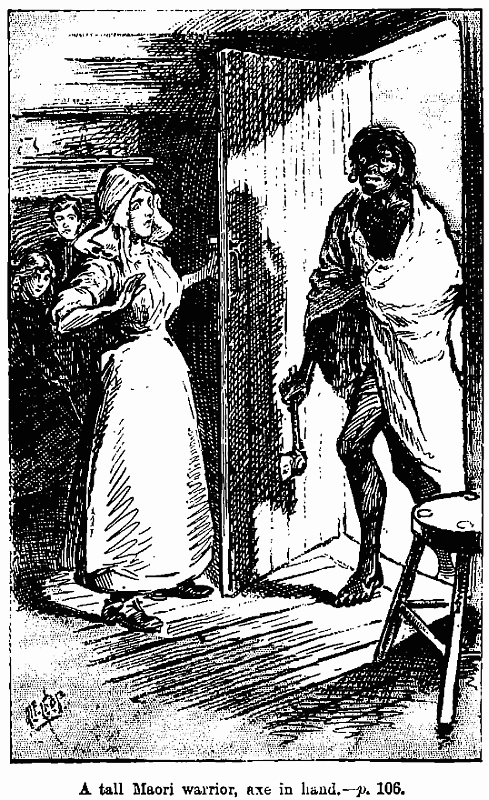
“Run, Miss Lucy! run, Master Harry, and hide yourselves!” she exclaimed, attempting to push back the door. Her efforts were vain, the savage dashed it open and stalked in, followed by a dozen or more Maoris.
“Light the bonfire!” exclaimed Lucy,—and Betsy, springing by her, made her escape at the back-door. Harry tried to drag off Lucy in the same direction, but they were both instantly seized by the Maoris, two of whom sprang after Betsy. Scarcely a word was spoken by any of the natives, and Lucy had been too much agitated and alarmed to shriek out. The leader, in whom, by his sinister features and fierce looks, Lucy recognised Hemipo, had raised his weapon as if to strike Harry, but he restrained himself on finding that there was no opposition. He and one of his companions now bound Harry’s arms, making signs to him that if he made any noise his brains would be dashed out. Two others then lifted up Lucy, and taking a cloak which hung on the wall, threw it round her. Plunder did not appear to be their object; for, although numerous articles were lying about which would have been of value to them, none were taken. The savages now lifted up Lucy and Harry in their arms and carried them out of the house. Harry looked round, hoping to see some of the native servants. No one appeared.
“I hope, at all events, that Betsy may have set light to the signal-fire, that if we are carried away our friends will come in pursuit of us,” he said to himself.
Great was his disappointment when directly afterwards he saw Betsy brought along in the arms of two of the savages.
“I have done it though, Master Harry,” she exclaimed, loud enough for him to hear. “I had just time to throw the candle in among the sticks and paper before they caught me,—I do not think they saw what I had been about, or they would have stopped and put it out.”
A savage growl, and the hand of one of her captors placed over her mouth, prevented Betsy from saying any more.
The whole party now moved down the hill at a rapid rate towards the river. On reaching the bank the young captives were placed on board a canoe, several of which were collected at the spot. Harry felt a little relieved when his arms were unbound, and he was allowed to sit at his ease beside Lucy. The savages evidently supposed that he would not attempt to leap out and swim on shore.
The flotilla shoved off. The night was very dark, but the Maoris, well acquainted with the river, navigated dexterously amid the rocks and occasional rapids in their course. Now and then the water could be seen bubbling up on either side, and sometimes leaping over the gunwale, and once or twice so much came in that Harry feared the canoe would be swamped.
“If we are upset, stick to me, Lucy,” he whispered. “I’ll swim with you to the shore, and we will then run off and try and make our escape.” Lucy felt confident of her young brother’s courage, but feared that there was little prospect of his succeeding in the attempt. Poor Betsy shrieked out with alarm. A threatening sound from the man who steered the canoe warned her to keep silence.
There had been for sometime a strong wind, it now increased, and blowing directly against them, greatly impeded the progress of the canoes. Still the Maoris persevered. At length a loud clap of thunder burst from the sky. It was succeeded by several terrific peals, while vivid flashes of forked lightning darting forth showed that they were passing between high rugged cliffs which rose on either side of the stream, overhung with trees, amid which the wind roared and whistled as they waved to and fro above their heads, threatening every instant, torn up by the roots, to fall over and crush them. The thunder rattled louder than ever, reverberating among the cliffs. Just then a flash, brighter than its predecessors, which came hissing along close to the canoe, showed Harry the savage features of Hemipo, who was sitting in the stern steering. Still the canoe went on, indeed, as far as Harry could see there was no place on either side where they could have landed, and he earnestly prayed that, should any accident happen, it might be further on, where there would be a hope of reaching the shore. Lucy sat with her hands clasped in his, and her calmness and self-possession gave him courage.
“Oh, what a dear brave little sister mine is,” he thought to himself. “I would willingly give up my life to save her’s. I wonder what these savages will do with us. They surely cannot be so barbarous as to intend to kill her,—they may knock me on the head very likely, and I only wonder they did not do so at first, it would have been more like their usual custom.”
The rain was now falling in torrents. Harry drew the cloaks which had been thrown over Lucy and Betsy closer round them. He was himself quickly wet through, but for that he cared little.
Though it was evident that the paddlers were straining every nerve to urge the canoe onwards, he could judge by the appearance of the cliffs that they were making but slow progress, sometimes, indeed, they were almost brought to a standstill, then again they would redouble their efforts, and the wind lulling for a short time, they would stem the rapid current and get into calmer water. It was difficult to judge, under the circumstances, how time went by, but it seemed to Harry that the whole night was thus spent. Still the darkness continued, and hour after hour passed.
At length the banks came more clearly into view, and he could distinguish the other canoes in company. Suddenly the cliffs on either side ceased, and he found that they had entered a lake. Covered, however, as it was with foaming waves stirred up by the storm, it seemed scarcely possible for the canoes to make their way across it. After they had in vain attempted to do so, and several of them had been nearly swamped, Harry perceived that they were steering towards the shore. They made their way up a small inlet, where, sheltered from the gale, the canoes at length floated quietly, and their crews set to work to bail them out. This being done, Harry observed that they were examining their muskets, and fresh priming them, lest they should have become damp with the rain. He hoped from this that they had not yet reached Hemipo’s district, and were still in that of some friendly tribe. Meantime a man was sent on shore, who ran to the summit of a neighbouring height, where Harry saw him looking round, as if to ascertain whether any one was approaching.
On his return, after he had given his report, Hemipo landed, and with scant ceremony dragged his prisoners out of the canoe, and signed to them that they were to accompany him. Eight of the savages immediately landed and closed round them. Having issued orders to the remainder, he led the way towards the entrance of a valley which extended up from the water. Lucy and Betsy could with difficulty walk after having been so long cramped up in the canoe. Harry begged his sister to lean on him, that he might help her along, and poor Betsy did her best to keep up with them, for the savages showed no inclination to slacken their pace. Every now and then, indeed, one of them gave her a rough push to make her move faster. Harry felt very indignant, but knew that it would be useless to expostulate, and dreaded lest Lucy might be treated in the same way. The valley through which they were proceeding he found ran parallel with the lake, and concluded, as was the case, that it would at length conduct them to an upper part of the stream, which, had it not been for the storm, Hemipo intended to have reached in the canoes. The chief stalked on ahead, every now and then turning round to order his followers to move faster. The valley, as they proceeded, narrowed considerably; the sides, composed of wild rugged rocks with overhanging trees crowning their summits, rising precipitously on either hand. Harry observed that the chief, as they advanced, looked cautiously ahead, as if he thought it possible that an enemy might appear to intercept him. Suddenly he stopped altogether, and addressed a few words to his followers, while he pointed up the valley. What he said Harry could not understand, but several of the savages directly afterwards drew their merais from their belts, and cast fierce looks at their captives, which too clearly indicated their cruel designs.
“Oh, our dear father, my poor brother,” murmured Lucy, as her eye glanced at the savages’ weapons, and she clung closer to Harry, thinking of those she loved more than of herself. “Yet they cannot be so cruel.”
“Are they going to kill us?” cried Betsy. “Dear, dear Miss Lucy,” and she stretched out her arms as if to protect her young mistress.
After waiting a short time Hemipo ordered two of his men to go ahead, apparently to ascertain if the road was clear. They seemed satisfied that such was the case, for at a sign from them he and the rest proceeded as before. Harry, as they advanced, could not help looking up frequently at the cliffs on either side, and more than once he fancied he saw some person moving among the rocks as if observing them, while at the same time endeavouring to remain concealed. If such was the case, the person managed to escape the keen eyes of the Maoris, for Hemipo went on, evidently not supposing that he was watched. At length they emerged from the defile, and proceeding over a more open, though still a hilly and picturesque country, till they again came in sight of the river. By this time Lucy and Betsy were nearly dropping with fatigue, and even Harry, though accustomed to exercise, felt very tired, but the savages still urged them on, regardless of their weary legs. Harry felt very indignant, but Lucy entreated him not to show his resentment.
At last a hill, round the base of which the river made its way, rose directly before them, with a stockade on its summit, similar to that surrounding Ihaka’s village. Hemipo led the way towards it, and ascended a narrow path, at the top of which appeared a gateway, with a huge hideous figure above it. As he approached a number of women and children and old men issued forth eyeing his captives with no pleasant looks. Scarcely a word, however, was exchanged between the inhabitants and him till they entered the pah, when the whole party seated themselves on the ground, each of them singling out one of the new comers, and began rubbing their noses together, howling and weeping, while the tears, in copious torrents, flowed down their brown cheeks. Under other circumstances, Harry, who with his sister and Betsy, were left standing alone, would have felt inclined to laugh heartily at the odd scene, but matters were too serious to allow him to do so now.
After the savages had rubbed their noses, howled, and shed a sufficiency of tears to satisfy their feelings, they got up with dry eyes and unconcerned looks, as if nothing of the sort had occurred. They then came round their captives, who were allowed to stand unmolested, while Hemipo was apparently giving an account of his adventures. Lucy and Betsy trembled as they saw the fierce glances cast at them during the chief’s address; their lives seemed to hang on a thread, for any moment his auditors, whom he appeared to be working into a fury, might rush forward and cut them down with the merais, which, ever and anon, they clutched as if eager to use them. At length he ceased, when another orator got up, and appeared to be endeavouring to calm the angry feelings of the assembly. Others spoke in the same strain, and at last the orator, who had opposed Hemipo, having gained his object, so it seemed, came up to the captives and signed to them to accompany him. Leading them to a large wahré on one side of the pah, he told them to enter. Lucy, overcome with fatigue, sank on a heap of fern, which covered part of the floor.
“Cheer up,” said Harry, “they do not intend to kill us, and I hope that chief, who looks more good-natured than Hemipo, will think of bringing us some food. I’ll let him know that we want it.” Harry went back to the door at which the chief was still standing, and made signs that they were very hungry. The chief evidently understood him, and in a short time a girl appeared with a basket of sweet potatoes, some baked fish, and a bowl of water. Lucy thanked her warmly in Maori, saying that she might some day have the opportunity of rewarding her, adding—
“Our people will be grateful for any kindness shown us, and though we have been most cruelly carried away from our home, yet they will not revenge themselves on the innocent.” The girl, whom Lucy supposed from her appearance to be a slave, looked very much surprised.
“Our religion teaches us that we should forgive our enemies, and do good to those who injure us, and therefore still more should we be grateful to all who do us good,” she continued. “Do you understand that?” The girl shook her head, and made signs to Lucy and her companions to eat while the food was hot; they needed, indeed, no second bidding, the girl standing by while they discussed the meal.
Lucy feeling the importance of gaining the good-will of any person in the village, again spoke to the girl, much to the same effect as before. The latter evidently understood her, and made a sign that if discovered in helping them to escape she would be killed. Lucy’s words had, however, it seemed, made an impression on her mind, for when she stooped down to take up the basket and bowl, she whispered that she would do what she could to be of use to them.
They were now left alone. Harry entreated his companions to go to sleep, declaring that he was able to sit up and keep watch; and in spite of their anxiety, they were so weary, that in a few minutes their eyes closed, and they happily forgot all that had occurred. Harry kept awake as well as he could, and every now and then he observed women and children, and sometimes men, peering at them through the open door of the hut. Discovering, however, a chick mat spread on a framework leaning against the side of the hut, he conjectured that it was intended to use as a door, and, accordingly, placing it across the entrance, shut out the intruders. Having now nothing to distract his attention, he very soon dropped off to sleep. It was dark when he awoke, and as there were no sounds in the village he concluded that it was night, and he hoped that they might therefore be allowed to rest in quiet. He went to the door of the hut and looked out. No one was stirring, the storm had ceased, and the stars were shining brightly overhead. He again carefully closed the entrance, securing it with some poles, so that it could not be opened from the outside, and throwing himself on the fern at Lucy’s feet, was soon fast asleep.
He was awakened by hearing some one attempting to open the door—the daylight was streaming in through the crevices—on pulling it aside the slave girl, who had brought their supper, appeared with a basket of food and a bowl of water, as before. The light awoke Lucy and Betsy, who seemed refreshed by their slumbers, though their faces were still pale and anxious. The girl pointed to the food and bade them eat, but seemed unwilling to stay.
“Let us say our prayers, Harry, as we should do at home, before breakfast,” said Lucy, “though we have not a Bible to read.”
They knelt down, and Lucy offered up a prayer of thanksgiving to God for having preserved them, and for further protection, while the Maori girl stood by wondering what they were about. She then hurried away, as they supposed, from having received orders not to remain with them. They were left alone all the morning, and at noon the girl brought them a further supply of food.
“This looks as if the Maoris did not intend to do us any harm, perhaps they expect to get a ransom for us,” observed Harry.
“I trust so,” said Lucy, “and I am sure our friends would pay it should our father and Val be still absent from home; but, perhaps, Hemipo has some other object in carrying us off.”
“What can that be?” asked Harry. “The idea came into my mind, and I fear it is too likely that he has done so, in order to get Waihoura into his power. If she believes that our lives are in danger, she will, I am sure, be ready to do anything to save them,” answered Lucy.
“How should she know that we have been carried away,” asked Harry.
“She will suspect something when our labourers suddenly return to her village, and will send to ascertain what has occurred,” observed Lucy.
“If it was not for your sake, Lucy, I would run every risk rather than let the poor girl fall into the power of the savage,” exclaimed Harry. “I hope that our father and Val, and the volunteers, will find out where we have been carried to, and will come to attack the pah and rescue us.”
“That would cause great loss of life, and, perhaps, seal our fate,” answered Lucy. “I have been praying, and He who does not allow a sparrow to fall to the ground without knowing it, will arrange matters for the best. The knowledge that He does take care of us should give us confidence and hope.”
“I am sure you are right,” observed Harry, after a few minutes reflection. “Still we cannot help talking of what we wish.”
In the afternoon, Harry going to the door of the hut, heard voices as if in loud discussion at a distance, and observing no one about, he crept on among the huts till he came in sight of a number of people seated on the ground, apparently holding a debate, for one after the other got up and addressed the rest. Keeping himself concealed behind the hut, he watched them for some time, at length he saw Hemipo and a body of armed men issue out by the gate. He crept back to the hut with this information. As far as he could ascertain, only the old men, and women, and children, were left in the pah.
Late in the evening the slave girl again visited them, and, as she appeared less anxious than before to hurry away, Lucy spoke to her. At last she answered—
“What Manima can do she will do for the pakehas, but they must wait—perhaps something will happen.” She said this in a very low voice, and taking up the basket and bowl, hurried away. Harry found that no one interfered with him as he walked about outside the hut; but he did not like to go far from Lucy and Betsy, and darkness coming on, he returned. After he had closed the door, they offered up their prayers as usual, and lying down, soon fell asleep.
Lucy was awakened by feeling a hand pressed on her shoulder. She was inclined to cry out, when she heard a low voice saying in Maori—
“Don’t be afraid, call your brother and Betsy.” Lucy, to her astonishment, recognised the voice of Waihoura, and without waiting to ask questions, awakened Harry and Betsy. A few words served to explain what she had heard, and they at once got up and followed Waihoura out of the hut. She led the way among the wahrés the inmates of which, they knew from the sounds which issued forth, were fast asleep. They soon reached the inner end of the pah, behind the public store-house, the largest building in the village, when Waihoura pointed to an opening in the stockade. It was so narrow that only slight people could have passed through it. Waihoura, taking Lucy’s hand, led her through it, but Betsy almost stuck as she made the attempt. With some assistance from Harry, she however succeeded in getting on the other side, when he following, found that they were standing on the top of a cliff. Waihoura again taking Lucy’s hand, showed them a narrow and zigzag path which led down it. They followed her, as she cautiously descended towards the river, which Harry saw flowing below them.
On reaching the edge of the water Waihoura stepped into a canoe, which had hitherto been hidden by a rock. The rest of the party entering it, two men who were sitting with their paddles ready, immediately urged the canoe out into the stream, down which they impelled it with rapid strokes, while Waihoura, taking another paddle, guided its course. Not a word was spoken, for all seemed to know exactly what was to be done. They had entirely lost sight of the hills on which the pah stood, before Waihoura uttered a word. She then, in a whisper, addressed Lucy, who was sitting close to her, apparently considering, even then, that great caution was necessary. They were passing between high cliffs, amid which the slightest sound, Harry rightly guessed, might be carried, and heard by any one posted on them. The paddlers redoubled their efforts, till at length they got into a broader part of the river. Lucy then, in a low voice, told Harry that Waihoura had heard of their capture from the labourers, who had returned home, and had immediately formed a plan for their rescue. She had friends in Hemipo’s pah, for all were not as bad as he was, and among them was Manima, who belonged to a friendly tribe, and had been carried off some time before by Hemipo, with others, as a slave. She had herself, with a party of her people, immediately set out, and knowing the route they would have to take, had remained in ambush with the intention of rescuing them; but fearing that Hemipo would put them to death should he find himself attacked, she resolved to employ stratagem to set them at liberty. She had at once sent a message to Manima, and on finding that Hemipo had set out on another expedition, she had herself that very night entered the pah in disguise, and arranged the plan which had thus far been carried out.
“She tells us,” added Lucy, “that her only fear arises from the possibility of meeting Hemipo, who has gone down the river in his war canoes, though for what object she could not ascertain. She advises us to keep very silent, as should he be anywhere near, he is certain to have scouts on the watch, though we may hope to escape them in the darkness of night.”
“As I said of you, Lucy, she would make a first-rate General,” observed Harry, “and I hope for her sake, as well as ours, that she will prove herself a successful leader.”
Scarcely had Harry spoken when a loud voice hailed them from the shore, and a bullet whistled close to them.
“Don’t cry out,” whispered Waihoura. “The man will take some time to load again, and we may get beyond his reach.” Her hopes were, however, vain, for directly afterwards several canoes darted from behind some rocks, and surrounding them, their canoe was towed to the shore.
“They are Hemipo’s people,” said Waihoura. “But keep silence, he is not among them, and they will merely keep us prisoners till he comes, and something may happen in the meantime.”
The country was tolerably level beyond the bank where the canoes lay. There was sufficient light from the stars to enable Harry to see for some distance inland, and he recognised the spot as the same place at which they had been taken on shore on their way up the river. After waiting a considerable time, he observed a party of men moving along from the direction of the valley, and coming towards the canoes. He was afraid that they were Hemipo and his band.
“How will the savage treat us, and those who have been trying to aid our escape?” he thought. Just then he caught sight of another and very much larger party coming from nearly the opposite direction. The first stopped and seemed trying to hide themselves behind some rocks and bushes, but the others had seen them, and uttering loud cries, rushed forward, then came the flashes and rattle of musketry, with reiterated cries for a few minutes, when the smaller party giving way, attempted to fly, but were quickly surrounded. The people in the canoes, on seeing this, shoved off from the bank, and endeavoured to drag Waihoura’s canoe with them. The crew resisted; a blow on his head, however, struck down one of the men, and it appeared too probable that their enemies would succeed in their object.
They had got out into the middle of the stream, when several more canoes were seen rounding a point below them. Waihoura uttered a loud cry, and the canoes came rapidly paddling towards them. Their captors, on seeing this, allowed her to go free, and began making their way as fast as they could up the river.
“Who are you?” asked Waihoura, as the strangers’ canoes approached.
“We are Rahana’s people, and he ordered us to come here to stop Hemipo from descending the river, while he proceeded on by land,” was the answer.
“Then it is Rahana who has gained the victory,” exclaimed Waihoura, and, escorted by her friends, she guided her canoe towards the shore, Harry taking the paddle of the poor man who had been struck down. They quickly landed, when a messenger despatched to Rahana brought him to where Waihoura and her English companions were seated on some rocks by the bank of the river. He spoke earnestly for a few minutes to Waihoura. Lucy, from what he said, learned that she had sent to ask his assistance, and that ascertaining the proceedings of Hemipo, he had set out with all his followers to meet him and compel him to restore the prisoners he had carried off.
“He and many of his people are now in my hands, for before they could escape we surrounded them and captured them all,” he said, addressing Lucy and Harry. “They deserve death,—do you wish that we should kill them, or give them into the hands of your countrymen?”
“Oh no, no, spare their lives,” exclaimed Lucy. “We should do good to our enemies, and we would far rather let them go free. We are thankful to have been rescued from their power, but more than that we do not desire.”
“That is a strange thing the pakeha girl says,” remarked Rahana to Waihoura. “Is it according to the religion you desire to teach me?”
“Oh yes, yes,” exclaimed Waihoura. “I know that Lucy is right. She has told me that He who came to die and be punished that men might enjoy happiness hereafter, blessed His enemies, and did good to those who injured Him.”
“Then they shall live,” said Rahana. “I will set Hemipo free, and tell him that it is by the wish of the pakehas, and that he must henceforth be their friend and ally, and abandoning the cruel customs of our people, learn the good religion, which has made them act thus towards him.”
Lucy and Harry knowing the alarm their disappearance must have caused to Mrs Greening and their other friends, were anxious to return home immediately. Waihoura offered to accompany them, and begged Rahana that he would allow one of his canoes to convey them down the river.
“I will myself take charge of them, and I shall be proud to deliver them in safety to their friends,” he answered. “I will, however, first obey their wish, and set Hemipo and his followers free, after I have deprived them of their arms, which belong to my warriors.”
While the canoes were getting ready for the voyage down the river, fires were lighted, and fish and other provisions were cooked, some of which were presented to Waihoura and her friends, greatly to Harry’s satisfaction, who declared that he had seldom felt so hungry in his life; though Lucy and Betsy, still scarcely recovered from their agitation, partook of the repast but sparingly. Meantime Rahana had gone back to where he had left his warriors and their prisoners. He shortly returned, accompanied by another person. As they approached the spot where Waihoura and her friends sat, the light of the fire showed that Rahana’s companion was Hemipo. He looked greatly crestfallen, but recovering himself, he addressed Waihoura. Neither Lucy nor Harry could clearly understand him; but they gathered from what he said that he desired to express his gratitude for having his life spared, and sorrow for his conduct towards her, as also for having carried off her friends, and that if they would send a missionary to him he would gladly listen to his instruction. It evidently cost him much to speak as he did. She was glad when the interview was over, and Rahana told him that he might now depart in peace.
Waihoura and her friends were now conducted to the largest canoe, in which Rahana also took his seat. They had not proceeded far down the river when day broke, and the neighbouring woods burst forth with a chorus of joyful song, the sky overhead was blue and pure, the waters bright and clear, and the grass and shrubs, which grew on the banks, sparkled with bright dewdrops.
“See, see,” exclaimed Harry. “There’s a whole fleet of boats coming up the river.” Rahana, on observing them, went ahead of his flotilla with a flag waving at the bow of his canoe.
“There is our father, there is Val,” exclaimed Harry. The canoe was soon alongside one of the largest boats. A few words explained all that had occurred. Mr Pemberton and his companions had returned home the day after his children and servant had been carried off, when an expedition had immediately been organised to sail up the river and attack Hemipo’s pah, it being at once suspected that he had committed the outrage.
As there was now no necessity to proceed further, the boats’ bows were turned down the stream, Harry, with his sister and Betsy, having gone on board Mr Pemberton’s. Accompanied by the canoes, a strong current being in their favour, they soon reached “Riverside,” where the safe return of the young people caused almost as much satisfaction as the news which had just before arrived of the termination of the war.
Waihoura soon afterwards became the wife of Rahana, who built a house after the English model, on some land which he owned in the neighbourhood near the river, and receiving instruction from their friends, both became true and earnest Christians. They had the satisfaction also of hearing that Hemipo, who had gladly received Mr Marlow and other missionaries, had, with all his people, become Christians, and he showed by his changed life and peaceable conduct, that he was one in reality as well as in name.
“Riverside” continued to increase and prosper, and protected by the friendly natives who surrounded it, escaped the disasters from which many other places in subsequent years suffered. Honest Mr Spears must not be forgotten. Though still showing a readiness to help everybody, having learned the necessity of attending to his own affairs, he became one of the leading tradesmen in the place. Both Mr Pemberton and farmer Greening had, in course of time, the satisfaction of seeing their children married, and settled happily around them.
The End.
|
Chapter 1
| |
Chapter 2
| |
Chapter 3
| |
Chapter 4
| |
Chapter 5
| |
Chapter 6
| |
Chapter 7
| |
Chapter 8
| |
Chapter 9
|