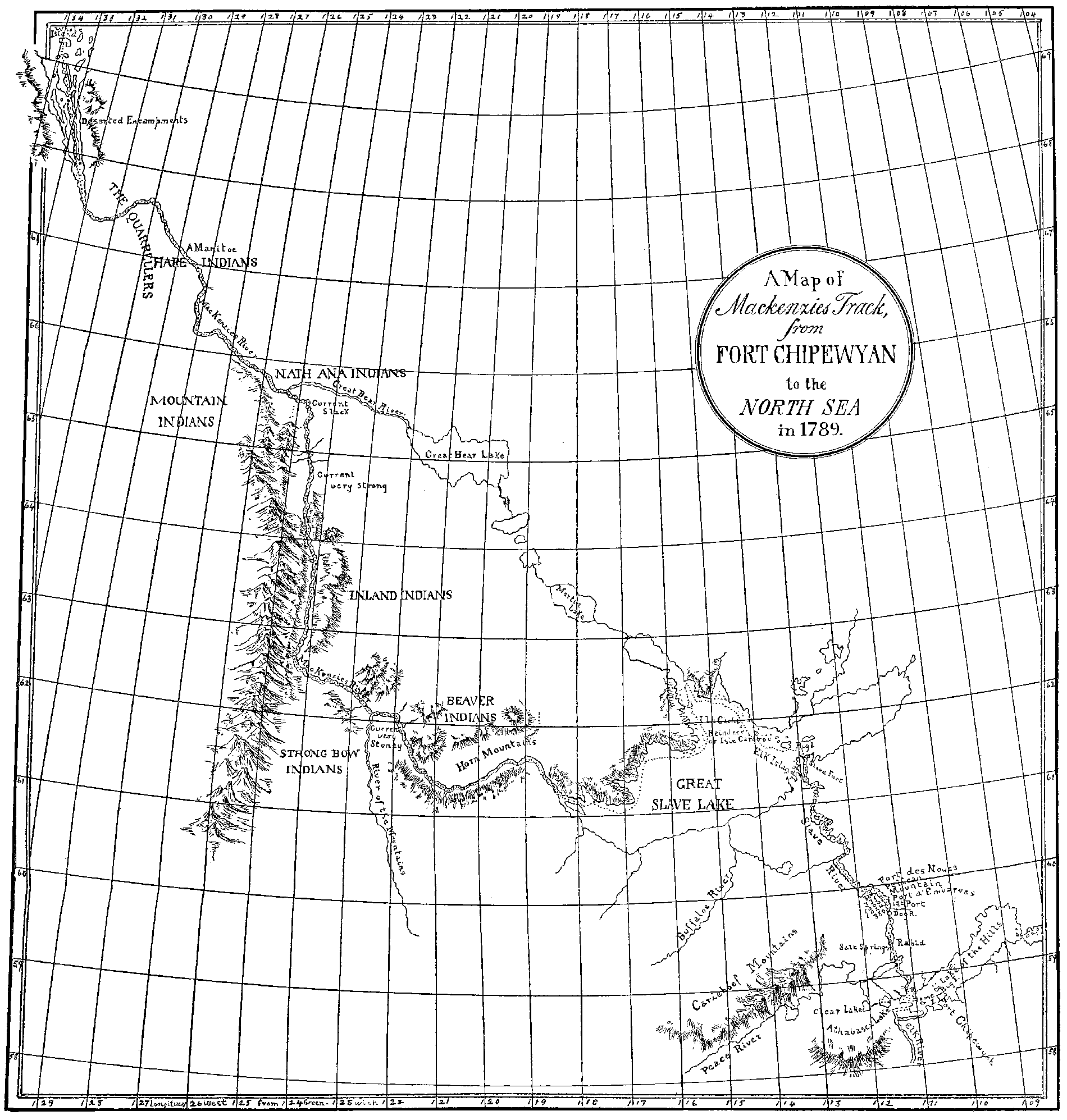
TO THE FROZEN and PACIFIC OCEANS IN 1789 and 1793 (continued 3)
Reading edition
Many and various are the motives which induce a savage to engage in war. To prove his courage, or to revenge the death of his relations, or some of his tribe, by the massacre of an enemy. If the tribe feel themselves called upon to go to war, the elders convene the people, in order to know the general opinion. If it be for war, the chief publishes his intention to smoke in the sacred stem at a certain period, to which solemnity, meditation and fasting are required as preparatory ceremonials. When the people are thus assembled, and the meeting sanctified by the custom of smoking, the chief enlarges on the causes which have called them together, and the necessity of the measures proposed on the occasion. He then invites those who are willing to follow him, to smoke out of the sacred stem, which is considered as the token of enrolment; and if it should be the general opinion that assistance is necessary, others are invited, with great formality, to join them. Every individual who attends these meetings, brings something with him as a token of his warlike intention, or as an object of sacrifice, which, when the assembly dissolves, is suspended from poles near the place of council.
They have frequent feasts, and particular circumstances never fail to produce them, such as a tedious illness, long fasting, etc. On these occasions it is usual for the person who means to give the entertainment, to announce his design, on a certain day, of opening the medicine-bag, and smoking out of his sacred stem. This declaration is considered as a sacred vow that cannot be broken. There are also stated periods, such as the spring and autumn, when they engage in very long and solemn ceremonies. On these occasions dogs are offered as sacrifices, and those which are very fat, and milk-white, are preferred. They also make large offerings of their property, whatever it may be. The scene of these ceremonies is in an open inclosure on the bank of a river or lake, and in the most conspicuous situation, in order that such as are passing along or travelling, may be induced to make their offerings. There is also a particular custom among them, that, on these occasions, if any of the tribe, or even a stranger, should be passing by, and be in real want of any thing that is displayed as an offering, he has a right to take it, so that he replaces it with some article he can spare, though it be of far inferior value; but to take or touch any thing wantonly is considered as a sacrilegious act, and highly insulting to the great Master of Life, to use their own expression, who is the sacred object of their devotion.
The scene of private sacrifice is the lodge of the person who performs it, which is prepared for that purpose, by removing every thing out of it, and spreading green branches in every part. The fire and ashes are also taken away. A new hearth is made of fresh, earth, and another fire is lighted. The owner of the dwelling remains alone in it; and he begins the ceremony by spreading a piece of new cloth, or a well-dressed moose-skin neatly painted, on which he opens his medicine-bag and exposes its contents, consisting of various articles. The principal of them is a kind of household god, which is a small carved image about eight inches long. Its first covering is of down, over which a piece of birch-bark is closely tied, and the whole is enveloped in several folds of red and blue cloth. This little figure is an object of the most pious regard. The next article is his war-cap, which is decorated with the feathers and plumes of scarce birds, beavers, and eagle's claws, etc. There is also suspended from it a quill or feather for every enemy whom the owner of it has slain in battle. The remaining contents of the bag are, a piece of Brazil tobacco, several roots and simples, which are in great estimation for their medicinal qualities, and a pipe. These articles being all exposed, and the stem resting upon two forks, as it must not touch the ground, the master of the lodge sends for the person he most esteems, who sits down opposite to him; the pipe is then filled and fixed to the stem. A pair of wooden pincers is provided to put the fire in the pipe, and a double-pointed pin, to empty it of the remnant of tobacco which is not consumed. This arrangement being made, the men assemble, and sometimes the women are allowed to be humble spectators, while the most religious awe and solemnity pervades the whole. The Michiniwais, or Assistant, takes up the pipe, lights it, and presents it to the officiating person, who receives it standing and holds it between both his hands. He then turns himself to the East, and draws a few whiffs, which he blows to that point. The same ceremony he observes to the other three quarters, with his eyes directed upwards during the whole of it. He holds the stem about the middle between the three first fingers of both hands, and raising them upon a line with his forehead, he swings it three times round from the East, with the sun, when, after pointing and balancing it in various directions, he reposes it on the forks: he then makes a speech to explain the design of their being called together, which concludes with an acknowledgment for past mercies, and a prayer for the continuance of them, from the Master of Life. He then sits down, and the whole company declare their approbation and thanks by uttering the word ho! with an emphatic prolongation of the last letter. The Michiniwais then takes up the pipe and holds it to the mouth of the officiating person, who, after smoking three whiffs out of it, utters a short prayer, and then goes round with it, taking his course from East to West, to every person present, who individually says something to him on the occasion; and thus the pipe is generally smoked out; when, after turning it three or four times round his head, he drops it downwards, and replaces it in its original situation. He then returns the company thanks for their attendance, and wishes them, as well as the whole tribe, health and long life.
These smoking rites precede every matter of great importance with more or less ceremony, but always with equal solemnity. The utility of them will appear from the following relation.
If a chief is anxious to know the disposition of his people towards him, or if he wishes to settle any difference between them, he announces his intention of opening his medicine-bag and smoking in his sacred stem; and no man who entertains a grudge against any of the party thus assembled can smoke with the sacred stem; as that ceremony dissipates all differences, and is never violated.
No one can avoid attending on these occasions; but a person may attend and be excused from assisting at the ceremonies, by acknowledging that he has not undergone the necessary purification. The having cohabited with his wife, or any other woman, within twenty-four hours preceding the ceremony, renders him unclean, and, consequently, disqualifies him from performing any part of it. If a contract is entered into and solemnised by the ceremony of smoking, it never fails of being faithfully fulfilled. If a person, previous to his going a journey, leaves the sacred stem as a pledge of his return, no consideration whatever will prevent him from executing his engagement.[3]
The chief, when he proposes to make a feast, sends quills, or small pieces of wood, as tokens of invitation to such as he wishes to partake of it. At the appointed time the guests arrive, each bringing a dish or platter, and a knife, and take their seats on each side of the chief, who receives them sitting, according to their respective ages. The pipe is then lighted, and he makes an equal division of every thing that is provided. While the company are enjoying their meal, the chief sings, and accompanies his song with the tambourine, or shishiquoi, or rattle. The guest who has first eaten his portion is considered as the most distinguished person. If there should be any who cannot finish the whole of their mess, they endeavour to prevail on some of their friends to eat it for them, who are rewarded for their assistance with ammunition and tobacco. It is proper also to remark, that at these feasts a small quantity of meat or drink is sacrificed, before they begin to eat, by throwing it into the fire, or on the earth.
These feasts differ according to circumstances; sometimes each man's allowance is no more than he can despatch in a couple of hours. At other times the quantity is sufficient to supply each of them with food for a week, though it must be devoured in a day. On these occasions it is very difficult to procure substitutes, and the whole must be eaten whatever time it may require. At some of these entertainments there is a more rational arrangement, when the guests are allowed to carry home with them the superfluous part of their portions. Great care is always taken that the bones may be burned, as it would be considered a profanation were the dogs permitted to touch them.
The public feasts are conducted in the same manner, but with some additional ceremony. Several chiefs officiate at them, and procure the necessary provisions, as well as prepare a proper place of reception for the numerous company. Here the guests discourse upon public topics, repeat the heroic deeds of their forefathers, and excite the rising generation to follow their example. The entertainments on these occasions consist of dried meats, as it would not be practicable to dress a sufficient quantity of fresh meat for such a large assembly; though the women and children are excluded.
Similar feasts used to be made at funerals, and annually, in honour of the dead; but they have been, for some time, growing into disuse, and I never had an opportunity of being present at any of them.
The women, who are forbidden to enter the places sacred to these festivals, dance and sing around them, and sometimes beat time to the music within them; which forms an agreeable contrast.
With respect to their divisions of time, they compute the length of their journeys by the number of nights passed in performing them; and they divide the year by the succession of moons. In this calculation, however, they are not altogether correct, as they cannot account for the odd days.
The names which they give to the names are descriptive of the several seasons.
May Atheiky o Pishim Frog Moon.
June Oppinu o Pishim The Moon in which birds begin to lay their eggs.
July Aupascen o Pishim The Moon when birds cast their feathers.
August Aupahou o Pishim The Moon when the young birds begin to fly.
September Waskiscon o Pishim The Moon when the moose deer cast their horns.
October Wisac o Pishim The Rutting-Moon.
November Thithigon Pewai o Pishim Hoar-Frost Moon.
Kuskatinsyoui o Pishim Ice Moon.
December Pawatchicananasis o Pishim Whirlwind-Moon.
January Kushapawasticanum o Pishim Extreme cold Moon.
February Kichi Pishim Big Moon; some say, Old Moon.
March Mickysue Pishim Eagle Moon.
April Niscaw o Pishim Goose Moon.
These people know the medicinal virtues of many herbs and simples, and apply the roots of plants and the bark of trees with success. But the conjurers, who monopolize the medical science, find it necessary to blend mystery with their art, and do not communicate their knowledge. Their materia medica they administer in the form of purges and clysters, but the remedies and surgical operations are supposed to derive much of their effect from magic and incantation. When a blister rises in the foot from the frost, the chafing of the shoe, etc., they immediately open it, and apply the heated blade of a knife to the part, which, painful as it may be, is found to be efficacious. A sharp flint serves them as a lancet for letting blood, as well as for scarification in bruises and swellings. For sprains, the dung of an animal just killed is considered as the best remedy. They are very fond of European medicines, though they are ignorant of their application: and those articles form an inconsiderable part of the European traffic with them.
Among their various superstitions, they believe that the vapour which is seen to hover over moist and swampy places, is the spirit of some person lately dead. They also fancy another spirit which appears, in the shape of a man, upon the trees near the lodge of a person deceased, whose property has not been interred with them. He is represented as bearing a gun in his hand, and it is believed that he does not return to his rest, till the property that has been withheld from the grave has been sacrificed to it.
EXAMPLES OF THE KNISTENEAUX AND ALGONQUIN TONGUES.
Knisteneaux. Algonquin.
Good Spirit Ki jai Manitou Ki jai Manitou.
Evil Spirit Matchi manitou Matchi-manitou.
Man Ethini Inini
Woman Esquois Ich-quois.
Male Nap hew Aquoisi.
Female Non-gense Non-gense.
Infant A' wash ish Abi nont-chen.
Head Us ti quoin O'chiti-goine.
Forehead Es caatick O catick.
Hair Wes ty-ky Winessis.
Eyes Es kis och Oskingick.
Nose Oskiwin O'chengewane.
Nostrils Oo tith ee go mowNi-de-ni-guom.
Mouth O toune O tonne.
My teeth Wip pit tah Nibit.
Tongue Otaithani O-tai-na-ni.
Beard Michitoune Omichitonn.
Brain With i tip Aba-e winikan.
Ears O tow ee gie O-ta wagane.
Neck O qui ow O'quoi gan.
Throat O koot tas gy Nigon dagane.
Arms O nisk O nic.
Fingers Che chee Ni nid gines.
Nails Wos kos sia Os-kenge.
Side O's spig gy Opikegan.
My back No pis quan Ni-pi quoini.
My belly Nattay Ni my sat.
Thighs O povam Obouame.
My knees No che quoin noh Ni gui tick.
Legs Nos Ni gatte.
Heart Ok thea Othai.
My father Noo ta wie Nossai.
My mother Nigah wei Nigah.
My boy (son) Negousis Nigouisses.
My girl (daughter) Netanis Nidaniss.
My brother, elder Ni stess Nis-a-yen.
My sister, elder Ne miss Nimisain.
My grandfather Ne moo shum Ni-mi-chomiss.
My grandmother N'o kum No-co-miss.
My uncle N' o'ka miss Ni ni michomen.
My nephew Ne too sim Ne do jim.
My niece Ne too sim esquois Ni-do-jim equois
My mother-in-law Nisigouse Ni sigousiss.
My brother-in-law Nistah Nitah.
My companion Ne wechi wagan Ni-wit-chi-wagan.
My husband Ni nap pem Ni na bem.
Blood Mith coo Misquoi.
Old Man Shi nap Aki win se.
I am angry Ne kis si wash en Nis Katissiwine.
I fear Ne goos tow Nisest guse.
Joy Ne hea tha tom Mamond gikisi.
Hearing Pethom Oda wagan.
Track Mis conna Pemi ka wois.
Chief, great ruler Haukimah Kitchi onodis.
Thief Kismouthesk Ke moutiske.
Excrement Meyee Moui.
Buffalo Moustouche Pichike.
Ferret Sigous Shingouss.
Polecat Shicak Shi kak.
Elk Moustouche Michai woi.
Rein deer Attick Atick.
Fellow deer Attick Wa wasquesh.
Beaver Amisk Amic.
Wolverine Qui qua katch Quin quoagki.
Squirrel Ennequachas Otchi ta mou.
Minx Sa quasue Shaugouch.
Otter Nekick Ni guick.
Wolf Mayegan Maygan.
Hare Wapouce Wapouce.
Marten Wappistan Wabichinse.
Moose Mouswah Monse.
Bear Masqua Macqua.
Fisher Wijask Od-jisck.
Lynx Picheu Pechou.
Porcupine Cau quah Kack.
Fox Mikasew Wagouche.
Musk Rat Wajask Wa-jack.
Mouse Abicushiss Wai wa be gou noge.
Cow Buffalo Noshi Moustouche Nochena pichik.
Meat-flesh Wias Wi-ass.
Dog Atim Ani-mouse.
Eagle Makusue Me-guissis.
Duck Sy Sip Shi-sip.
Crow, Corbeau Ca Cawkeu Ka Kak.
Swan Wapiseu Wa-pe-sy.
Turkey Mee sei thew Mississay.
Pheasants Okes kew Ajack.
Bird Pethesew Pi-na-sy.
Outard Niscag Nic kack.
White Goose Wey Wois Woi wois.
Grey Goose Pestasish Pos ta kisk.
Partridge Pithew Pen ainse.
Water Hen Chiquibish Che qui bis.
Dove Omi Mee O mi-mis.
Eggs We Wah Wa Weni.
Pike or Jack Kenonge Kenonge.
Carp Na may bin Na me bine.
Sturgeon Na May Na Maiu.
White fish Aticaming Aticaming.
Pickerel Oc-chaw Oh-ga.
Fish (in general) Kenonge Ki-cons.
Spawn Waquon Wa quock.
Fins Chi chi kan O nidj-igan.
Trout Nay gouse Na Men Gouse.
Craw Fish A shag gee A cha kens chacque.
Frog Atahick O ma ka ki.
Wasp Ah moo A mon.
Turtle Mikinack Mi-ki-nack.
Snake Kinibick Ki nai bick.
Awl Oscajick Ma-gose.
Needle Saboinigan Sha-bo nigan.
Fire steel Appet Scoutecgan
Fire wood Mich-tah Missane.
Cradle Teckinigan Tickina-gan.
Dagger Ta Comagau Na-ba-ke-gou-man.
Arrow Augusk or Atouche Mettic ka nouins.
Fish Hook Quosquipichican Maneton Miquiscan.
Ax Shegaygan Wagagvette.
Ear-bob Chi-kisebisoun Na be chi be soun
Comb Sicahoun Pin ack wan.
Net Athabe Assap.
Tree Mistick Miti-coum.
Wood Mistick Mitic.
Paddle Aboi Aboui.
Canoe Chiman S-chiman.
Birch Rind Wasquoi Wig nass.
Bark Wasquoi On-na-guege.
Touch Wood Pousagan Sa-ga-tagan.
Leaf Nepeshah Ni-biche.
Grass Masquosi Masquosi.
Raspberries Misqui-meinac Misqui meinac.
Strawberries O'-tai-e minac O'-tai-e minac.
Ashes Pecouch Pengoui.
Fire Scou tay Scou tay.
Grapes Shomenac Shomenac.
Fog Pakishihow A Winni.
Mud Asus ki A Shiski.
Currant Kisijiwin Ki si chi woin.
Road Mescanah Mickanan.
Winter Pipoun Pipone.
Island Ministick Miniss.
Lake Sagayigan Sagayigan.
Sun Pisim Kijis.
Moon Tibisca pesim (the night Sun)Dibic Kijis
Day Kigigah Kigi gatte.
Night Tabisca Dibic kawte.
Snow Counah So qui po.
Rain Kimiwoin Ki mi woini
Drift Pewan Pi-woine.
Hail Shes eagan Me qua mensan.
Ice Mesquaming Me quam.
Frost Aquatin Gas-ga-tin.
Mist Picasyow An-quo-et.
Water Nepec Nipei.
World Messeasky (all the earth)Missi achki.
Mountain Wachee Watchive.
Sea Kitchi kitchi gaming Kitchi kitchi gaming.
Morning Kequishepe Ki-ki-jep.
Mid-day Abetah quisheik Na ock quoi.
Portage Unygam Ouni-gam.
Spring Menouscaming Mino ka ming.
River Sipee Sipi.
Rapid Bawastick Ba wetick.
Rivulet Sepeesis Sipi wes chin.
Sand Thocaw Ne gawe.
Earth Askee Ach ki.
Star Attack Anang.
Thunder Pithuseu Ni mi ki.
Wind Thoutin No tine.
Calm Athawostin A-no-a-tine.
Heat Quishipoi Aboyce.
Evening Ta kashike O'n-a-guche.
North Kywoitin Ke woitinak.
South Sawena woon Sha-wa-na-wang.
East Coshawcastak Wa-ba-no-no-tine.
West Paquisimow Panguis-chi-mo.
Tomorrow Wabank Wa-bang.
Bone Oskann Oc-kann.
Broth Michim waboi Thaboub.
Feast Ma qua see Wi con qui wine.
Grease or oil Pimis Pimi-tais.
Marrow fat Oscan pimis Oska-pimitais.
Sinew Asstis Attiss.
Lodge Wig-waum Wi-gui-wam.
Bed Ne pa win Ne pai wine.
Within Pendog ke Pendig.
Door Squandam Scouandam.
Dish Othagan O' na gann.
Fort Wasgaigan Wa-kuigan.
Sledge Tabanask Otabanac.
Cincture Poquoatehoun Ketche pisou,
Cap Astotin Pe matinang.
Socks Ashican A chi-gan.
Shirt Papackeweyan Pa pa ki weyan.
Coat Papise-co-wagan Papise-co-wa-gan
Blanket Wape weyang Wape weyan.
Cloth Maneto weguin Maneto weguin.
Thread Assabab Assabab.
Garters Chi ki-bisoon Ni gaske-tase besoun.
Mittens Astissack Medjica wine.
Shoes Maskisin Makisin.
Smoking bag Kusquepetagan Kasquepetagan.
Portage sling Apisan Apican,
Strait on Goi ask Goi-ack.
Medicine Mas ki kee Macki-ki.
Red Mes coh Mes-cowa.
Blue Kasqutch (same as black)O-jawes-cowa.
White Wabisca Wabisca.
Yellow Saw waw O-jawa.
Green Chibatiquare O'jawes-cowa.
Brown O'jawes-cowa.
Grey, etc. O'jawes-cowa.
Ugly Mache na gouseu Mous-counu-gouse.
Handsome Catawassiseu Nam bissa.
Beautiful Kissi Sawenogan Quoi Natch.
Deaf Nima petom Ka ki be chai.
Good-natured Mithi washin Onichishin.
Pregnant Paawie And-jioko.
Fat Outhineu Oui-ni-noe.
Big Mushikitee Messha.
Small or little Abisasheu Agu-chin.
Short Chemasish Tackosi.
Skin Wian Wian.
Long Kinwain Kiniwa.
Strong Mascawa |Mache-cawa. |Mas-cawise.
Coward Sagatahaw Cha-goutai-ye.
Weak Nitha missew Cha-gousi.
Lean Mahta waw Ka wa ca tosa.
Brave Nima Gustaw Son qui taige.
Young man Osquineguish Oskinigui.
Cold Kissin Kissinan.
Hot Kichatai Kicha tai.
Spring Minouscaming Minokaming.
Summer Nibin Nibiqui.
Fall Tagowagonk Tagowag.
One Peyac Pecheik.
Two Nisheu Nige.
Three Nishtou Nis-wois.
Four Neway Ne-au.
Five Ni-annan Na-nan.
Six Negoutawoesic Ni gouta was-wois.
Seven Nish woisic Nigi-was-wois.
Eight Jannanew She was wois.
Nine Shack Shang was wois.
Ten Mitatat Mit-asswois.
Eleven Peyac osap Mitasswois, hachi pecheik.
Twelve Nisheu osap Mitasswois, hachi, nige.
Thirteen Nichtou osap Mitasswois, hachi, niswois.
Fourteen Neway osap Mitasswois, hachi, ne-au.
Fifteen Niannan osap Mitasswois, hachi, nanan.
Sixteen Nigoutawoesic osap Mitasswois, hachi, negoutawaswois.
Seventeen Nish woesic osap Mitasswois, hachi, nigi was-wois.
Eighteen Jannenew osap Mitasgwois, hachi, shiwasswois.
Nineteen Shack osap Mitasswois, hachi, shang as wois.
Twenty Nisheu mitenah Nigeta-nan.
Twenty-one Nishew mitenah peyac osapNigeta nan, hachi, pechic.
Twenty-two, etc. Nisheu mitenah nishew osap
Thirty Nishtou mitenah Niswois mitanan.
Forty Neway mitenah Neau mitanan.
Fifty Niannan mitenah Nanan mitanen.
Sixty Negoutawoisic mitenahNigouta was wois mitanan.
Seventy Nishwoisic mitenah Nigi was wois mitanan.
Eighty Jannaeu mitenah She was wois mitanan.
Ninety Shack mitenah Shang was wois mitanan.
Hundred Mitana mitenan Ningoutwack.
Two hundred Neshew mitena a mitenahNige wack.
One thousand Mitenah mitena mitenah Kitchi-wack.
First Nican Nitam.
Last Squayatch Shaquoiyanke.
More Minah Awa-chi min.
Better Athiwack mithawashin A wachimin o nichi shen.
Best Atniwack mithawashin Kitchi o nichi shin.
I. or me Nitha Nin.
You, or thou Kitha Kin.
They, or them Withawaw Win na wa.
We Nithawaw Nina wa.
My, or mine Nitayen Nida yam.
Your's Kitayan Kitayem.
Who Auoni.
Whom Awoine Kegoi nin.
What Wa
His, or her's Otayan Otayim mis.
All Kakithau Kakenan.
Some, or some few Pey peyac Pe-pichic.
The same Tabescoutch Mi ta yoche.
All the world Missi acki wanque Mishiwai asky.
All the men Kakithaw Ethi nyock Missi Inini wock.
More Mina Mine wa.
Now and then Nannigoutengue.
Sometimes I as-cow-puco
Seldom Wica-ac-ko.
Arrive Ta couchin Ta-gouchin.
Beat Otamaha Packit-ais.
To burn Mistascasoo Icha-quiso.
To sing Nagamoun Nagam.
To cut Kisquishan Qui qui jan.
To hide Catann Caso tawe.
To cover Acquahoun A co na oune.
To believe Taboitam Tai boitam.
To sleep Nepan Ni pann.
To dispute Ke ko mitowock Ki quaidiwine.
To dance Nemaytow Nimic.
To give Mith Mih.
To do Ogitann O-gitoune.
To eat Wissinee Wissiniwin.
To die Nepew Ni po wen.
To forget Winnekiskisew Woi ni mi kaw.
To speak Athimetakcouse Aninntagousse.
To cry (tears) Mantow Ma wi.
To laugh Papew Pa-pe
To set down Nematappe Na matape win.
To walk Pimoutais Pemoussai.
To fall Packisin Panguishin.
To work Ah tus kew Anokeh.
To kill Nipahaw Nishi-woes.
To sell Attawoin Ata wois.
To live Pimatise Pematis.
To see Wabam Wab.
To come Astamoteh Pitta-si-mouss.
Enough Egothigog Mi mi nic.
Cry (tears) Manteau Ambai ma wita.
It hails Shisiagan Sai saigaun.
There is There is some Aya waAya wan
It rains Quimiwoin Qui mi woin.
After to-morrowAwis wabank Awas webang.
To-day Anoutch Non gum.
Thereaway Netoi Awoite.
Much Michett Ni bi wa.
Presently Pichisqua Pitchinac.
Make, heart Quithipeh Wai we be.
This morning Shebas Shai bas.
This night Tibiscag De bi cong.
Above Espiming O kitchiai.
Below Tabassish Ana mai.
Truly Taboiy Ne de wache
Already Sashay Sha shaye.
Yet more Minah Mina wa.
Yesterday Tacoushick Pitchinago.
Far Wathow Wassa.
Near Quishiwoac Paishou.
Never Nima wecatch Ka wi ka.
No Nima Ke wine.
Yes Ah In.
By-and-bye Pa-nima Pa-nima.
Always Ka-ki-kee Ka qui nick
Make haste Quethepeh Niguim.
It's long since Mewaisha Mon wisha.
SOME ACCOUNT OF THE CHEPEWYAN INDIANS.
They are a numerous people, who consider the country between the parallels of latitude 60. and 65. North, and longitude 100. to 110. West, as their lands or home. They speak a copious language, which is very difficult to be attained, and furnishes dialects to the various emigrant tribes which inhabit the following immense track of country, whose boundary I shall describe.[1] It begins at Churchill, and runs along the line of separation between them and the Knisteneaux, up the Missinipi to the Isle a la Crosse, passing on through the Buffalo Lake, River Lake, and Portage la Loche: from thence it proceeds by the Elk River to the Lake of the Hills, and goes directly West to the Peace River; and up that river to its source and tributary waters; from whence it proceeds to the waters of the river Columbia; and follows that river to latitude 52. 24. North, and longitude 122. 54. West, where the Chepewyans have the Atnah or Chin Nation for their neighbours. It then takes a line due West to the seacoast, within which, the country is possessed by a people who speak their language[2] and are consequently descended from them: there can be no doubt, therefore, of their progress being to the Eastward. A tribe of them is even known at the upper establishments on the Saskatchiwine; and I do not pretend to ascertain how far they may follow the Rocky Mountains to the East.
It is not possible to form any just estimate of their numbers, but it is apparent, nevertheless, that they are by no means proportionate to the vast extent of their territories, which may, in some degree, be attributed to the ravages of the small-pox, which are, more or less, evident throughout this part of the continent.
The notion which these people entertain of the creation, is of a very singular nature. They believe that, at the first, the globe was one vast and entire ocean, inhabited by no living creature, except a mighty bird, whose eyes were fire, whose glances were lightning, and the clapping of whose wings were thunder. On his descent to the ocean, and touching it, the earth instantly arose, and remained on the surface of the waters. This omnipotent bird then called forth all the variety of animals from the earth, except the Chepewyans, who were produced from a dog; and this circumstance occasions their aversion to the flesh of that animal, as well as the people who eat it. This extraordinary tradition proceeds to relate, that the great bird, having finished his work, made an arrow, which was to be preserved with great care, and to remain untouched; but that the Chepewyans were so devoid of understanding, as to carry it away; and the sacrilege so enraged the great bird, that he has never since appeared.
They have also a tradition amongst them, that they originally came from another country, inhabited by very wicked people, and had traversed a great lake, which was narrow, shallow, and full of islands, where they had suffered great misery, it being always winter, with ice and deep snow. At the Copper-Mine River, where they made the first land, the ground was covered with copper, over which a body of earth had since been collected, to the depth of a man's height. They believe, also, that in ancient times their ancestors lived till their feet were worn out with walking, and their throats with eating. They describe a deluge, when the waters spread over the whole earth, except the highest mountains, on the tops of which they preserved themselves.
They believe, that immediately after their death, they pass into another world, where they arrive at a large river, on which they embark in a stone canoe, and that a gentle current bears them on to an extensive lake, in the centre of which is a most beautiful island; and that, in the view of this delightful abode, they receive that judgment for their conduct during life, which terminates their final state and unalterable allotment. If their good actions are declared to predominate, they are landed upon the island, where there is to be no end to-their happiness; which, however, according to their notions, consists in an eternal enjoyment of sensual pleasure, and carnal gratification. But if their bad actions weigh down the balance, the stone canoe sinks at once, and leaves them up to their chins in the water, to behold and regret the reward enjoyed by the good, and eternally struggling, but with unavailing endeavours, to reach the blissful island, from which they are excluded for ever.
They have some faint notions of the transmigration of the soul; so that if a child be born with teeth, they instantly imagine, from its premature appearance, that it bears a resemblance to some person who had lived to an advanced period, and that he has assumed a renovated life, with these extraordinary tokens of maturity.
The Chepewyans are sober, timorous, and vagrant, with a selfish disposition that has sometimes created suspicions of their integrity. Their stature has nothing remarkable in it; but though they are seldom corpulent, they are sometimes robust. Their complexion is swarthy; their features coarse, and their hair lank, but always of a dingy black; nor have they universally the piercing eye, which generally animates the Indian countenance. The women have a more agreeable aspect than the men, but their gait is awkward, which proceeds from their being accustomed, nine months in the year, to travel on snow-shoes and drag sledges of a weight from two to four hundred pounds. They are very submissive to their husbands, who have, however, their fits of jealousy; and, for very trifling causes, treat them with such cruelty as sometimes to occasion their death. They are frequently objects of traffic; and the father possesses the right of disposing of his daughter. [3] The men in general extract their beards, though some of them are seen to prefer a bushy black beard, to a smooth chin. They cut their hair in various forms, or leave it in a long, natural flow, according as their caprice or fancy suggests. The women always wear it in great length, and some of them are very attentive to its arrangement. If they at any time appear despoiled of their tresses, it is to be esteemed a proof of the husband's jealousy, and is considered as a severer punishment than manual correction. Both sexes have blue or black bars, or from one to four straight lines on their cheeks or forehead, to distinguish the tribe to which they belong. These marks are either tattooed, or made by drawing a thread, dipped in the necessary colour, beneath the skin.
There are no people more attentive to the comforts of their dress, or less anxious respecting its exterior appearance. In the winter it is composed of the skins of deer, and their fawns, and dressed as fine as any chamois leather, in the hair. In the summer their apparel is the same, except that it is prepared without the hair. Their shoes and leggins are sewed together, the latter reaching upwards to the middle, and being supported by a belt, under which a small piece of leather is drawn to cover the private parts, the ends of which fall down both before and behind. In the shoes they put the hair of the moose or reindeer with additional pieces of leather as socks. The shirt or coat, when girted round the waist, reaches to the middle of the thigh, and the mittens are sewed to the sleeves, or are suspended by strings from the shoulders. A ruff or tippet surrounds the neck, and the skin of the head of the deer forms a curious kind of cap. A robe, made of several deer or fawn skins sewed together, covers the whole. This dress is worn single or double, but always in the winter, with the hair within and without. Thus arrayed a Chepewyan will lay himself down on the ice in the middle of a lake, and repose in comfort; though he will sometimes find a difficulty in the morning to disencumber himself from the snow drifted on him during the night. If in his passage he should be in want of provision, he cuts a hole in the ice, when he seldom fails of taking some trout or pike, whose eyes he instantly scoops out, and eats as a great delicacy; but if they should not be sufficient to satisfy his appetite, he will, in this necessity make his meal of the fish in its raw state; but, those whom I saw, preferred to dress their victuals when circumstances admitted the necessary preparation. When they are in that part of their country which does not produce a sufficient quantity of wood for fuel, they are reduced to the same exigency, though they generally dry their meat in the sun.[4]
The dress of the women differs from that of the men. Their leggins are tied below the knee; and their coat or shift is wide, hanging down to the ankle, and is tucked up at pleasure by means of a belt, which is fastened round the waist. Those who have children have these garments made very full about the shoulders, as when they are travelling they carry their infants upon their backs, next their skin, in which situation they are perfectly comfortable and in a position convenient to be suckled. Nor do they discontinue to give their milk to them till they have another child. Childbirth is not the object of that tender care and serious attention among the savages as it is among civilized people. At this period no part of their usual occupation is omitted, and this continual and regular exercise must contribute to the welfare of the mother, both in the progress of parturition and in the moment of delivery. The women have a singular custom of cutting off a small piece of the navel string of the new-born children, and hang it about their necks: they are also curious in the covering they make for it, which they decorate with porcupine's quills and beads.
Though the women are as much in the power of the men, as other articles of their property, they are always consulted, and possess a very considerable influence in the traffic with Europeans, and other important concerns.
Plurality of wives is common among them, and the ceremony of marriage is of a very simple nature. The girls are betrothed at a very early period to those whom the parents think the best able to support them: nor is the inclination of the women considered. Whenever a separation takes place, which sometimes happens, it depends entirely on the will and pleasure of the husband. In common with the other Indians of this country, they have a custom respecting the periodical state of a woman, which is rigorously observed: at that time she must seclude herself from society. They are not even allowed in that situation to keep the same path as the men, when travelling: and it is considered a great breach of decency for a woman so circumstanced to touch any utensils of manly occupation. Such a circumstance is supposed to defile them, so that their subsequent use would be followed by certain mischief or misfortune. There are particular skins which the women never touch, as of the bear and wolf; and those animals the men are seldom known to kill.
They are not remarkable for their activity as hunters, which is owing to the ease with which they snare deer and spear fish: and these occupations are not beyond the strength of their old men, women, and boys: so that they participate in those laborious occupations, which among their neighbours are confined to the women. They make war on the Esquimaux, who cannot resist their superior numbers, and put them to death, as it is a principle with them never to make prisoners. At the same time they tamely submit to the Knisteneaux, who are not so numerous as themselves, when they treat them as enemies.
They do not affect that cold reserve at meeting, either among themselves or strangers, which is common with the Knisteneaux, but communicate mutually, and at once, all the information of which they are possessed. Nor are they roused like them from an apparent torpor to a state of great activity. They are consequently more uniform in this respect, though they are of a very persevering disposition when their interest is concerned.
As these people are not addicted to spirituous liquors, they have a regular and uninterrupted use of their understanding, which is always directed to the advancement of their own interest; and this disposition, as may be readily imagined, sometimes occasions them to be charged with fraudulent habits. They will submit with patience to the severest treatment, when they are conscious that they deserve it, but will never forget or forgive any wanton or unnecessary rigour. A moderate conduct I never found to fail, nor do I hesitate to represent them, altogether, as the most peaceable tribe of Indians known in North America.
There are conjurers and high-priests, but I was not present at any of their ceremonies; though they certainly operate in an extraordinary manner on the imaginations of the people in the cure of disorders. Their principal maladies are, rheumatic pains, the flux and consumption. The venereal complaint is very common; but though its progress is slow, it gradually undermines the constitution, and brings on premature decay. They have recourse to superstition for their cure, and charms are their only remedies, except the bark of the willow, which being burned and reduced to powder, is strewed upon green wounds and ulcers, and places contrived for promoting perspiration. Of the use of simples and plants they have no knowledge; nor can it be expected, as their country does not produce them.
Though they have enjoyed so long an intercourse with Europeans, their country is so barren, as not to be capable of producing the ordinary necessaries naturally introduced by such a communication and they continue, in a great measure, their own inconvenient and awkward modes of taking their game and preparing it when taken. Sometimes they drive the deer into the small lakes, where they spear them, or force them into inclosures, where the bow and arrow are employed against them. These animals are also taken in snares made of skin. In the former instance the game is divided among those who have been engaged in the pursuit of it. In the latter it is considered as private property; nevertheless, any unsuccessful hunter passing by, may take a deer so caught, leaving the head, skin, and saddle for the owner. Thus, though they have no regular government, as every man is lord in his own family, they are influenced, more or less, by certain principles which condone to their general benefit.
In their quarrels with each other, they very rarely proceed to a greater degree of violence than is occasioned by blows, wrestling, and pulling of the hair, while their abusive language consists in applying the name of the most offensive animal to the object of their displeasure, and adding the term ugly, and chiay, or still-born.[5]
Their arms and domestic apparatus, in addition to the articles procured from Europeans, are spears, bows, and arrows, fishing nets, and lines made of green deer-skin thongs. They have also nets for taking the beaver as he endeavours to escape from his lodge when it is broken open. It is set in a particular manner for the purpose, and a man is employed to watch the moment when he enters the snare, or he would soon cut his way through it. He is then thrown upon the ice where he remains as if he had no life in him.
The snow-shoes are of a very superior workmanship. The inner part of their frame is straight, the outer one is curved, and it is pointed at both ends, with that in front turned up. They are also laced with great neatness with thongs made of deer-skin. The sledges are formed of thin slips of board turned up also in front, and are highly polished with crooked knives, in order to slide along with facility. Close-grained wood is, on that account, the best; but theirs are made of the red or swamp spruce-fir tree.
The country, which these people claim as their land, has a very small quantity of earth, and produces little or no wood or herbage. Its chief vegetable substance is the moss, on which the deer feed; and a kind of rock moss, which, in times of scarcity, preserves the lives of the natives. When boiled in water, it dissolves into a clammy, glutinous substance, that affords a very sufficient nourishment. But, notwithstanding the barren state of their country, with proper care and economy, these people might live in great comfort, for the lakes abound in fish, and the hills are covered with deer. Though, of all the Indian people of this continent they are considered as the most provident, they suffer severely at certain seasons, and particularly in the dead of winter, when they are under the necessity of retiring to their scanty, stinted woods. To the Westward of them the musk-ox may be found, but they have no dependence on it as an article of sustenance. There are also large hares, a few white wolves, peculiar to their country, and several kinds of foxes, with white and grey partridges, etc. The beaver and moose-deer they do not find till they come within 60 degrees North latitude; and the buffalo is still further South. That animal is known to frequent an higher latitude to the Westward of their country. These people bring pieces of beautiful variegated marble, which are found on the surface of the earth. It is easily worked, bears a fine polish, and hardens with time; it endures heat, and is manufactured into pipes or calumets, as they are very fond of smoking tobacco; a luxury which the Europeans communicated to them.
Their amusements or recreations are but few. Their music is so inharmonious, and their dancing so awkward, that they might be supposed to be ashamed of both, as they very seldom practise either. They also shoot at marks, and play at the games common among them; but in fact they prefer sleeping to either; and the greater part of their time is passed in procuring food, and resting from the toil necessary to obtain it. They are also of a querulous disposition, and are continually making complaints; which they express by a constant repetition of the word eduiy, "it is hard," in a whining and plaintive tone of voice.
They are superstitious in the extreme, and almost every action of their lives, however trivial, is more or less influenced by some whimsical notion. I never observed that they had any particular form of religious worship; but as they believe in a good and evil spirit, and a state of future rewards and punishments, they cannot be devoid of religious impressions. At the same time they manifest a decided unwillingness to make any communications on the subject.
The Chepewyans have been accused of abandoning their aged and infirm people to perish, and of not burying their dead; but these are melancholy necessities, which proceed from their wandering way of life. They are by no means universal, for it is within my knowledge, that a man, rendered helpless by the palsy, was carried about for many years, with the greatest tenderness and attention, till he died a natural death. That they should not bury their dead in their own country, cannot be imputed to them as a custom arising from a savage insensibility, as they inhabit such high latitudes that the ground never thaws; but it is well known, that when they are in the woods, they cover their dead with trees. Besides, they manifest no common respect to the memory of their departed friends, by a long period of mourning, cutting off their hair, and never making use of the property of the deceased. Nay, they frequently destroy or sacrifice their own, as a token of regret and sorrow.
If there be any people who, from the barren state of their country, might be supposed to be cannibals by nature, these people, from the difficulty they, at times, experience in procuring food, might be liable to that imputation. But, in all my knowledge of them, I never was acquainted with one instance of that disposition; nor among all the natives which I met with in a route of five thousand miles, did I see or hear of an example of cannibalism, but such as arose from that irresistible necessity, which has been known to impel even the most civilized people to eat each other.
EXAMPLES OF THE CHEPEWYAN TONGUE
Man Dinnie.
Woman Chequois.
Young man Quelaquis.
Young woman Quelaquis chequoi.
My son Zi azay.
My daughter Zi lengai.
My husband Zi dinnie.
My wife Zi zayunai.
My brother Zi raing.
My father Zi tah.
My mother Zi nah.
My grandfather Zi unai.
Me, or my See.
I Ne.
You Nun.
They Be.
Head Edthie.
Hand Law.
Leg Edthen.
Foot Cuh.
Eyes Nackhay.
Teeth Goo.
Side Kac-hey.
Belly Bitt.
Tongue Edthu.
Hair Thiegah.
Back Losseh.
Blood Dell.
The Knee Cha-gutt.
Clothes or Blanket Etlunay.
Coat Eeh.
Leggin Thell.
Shoes Kinchee.
Robe or Blanket Thuth.
Sleeves Bah.
Mittens Geese.
Cap Sah.
Swan Kagouce.
Duck Keth.
Goose Gah.
White partridge Cass bah.
Grey partridge Deyee.
Buffalo Giddy.
Moose deer Dinyai.
Rein deer Edthun.
Beaver Zah.
Bear Zass.
Otter Gaby-ai.
Martin Thah.
Wolverine Naguiyai.
Wolf Yess (Nouhoay).
Fox Naguethey.
Hare Cah.
Dog Sliengh.
Beaver-skin Zah thah.
Otter skin Naby-ai thith.
Moose-skin Deny-ai thith.
Fat Icah.
Grease Thless.
Meet Bid.
Pike Uldiah.
White-fish Slouey.
Trout Slouey zinai.
Pickerel G'Gah.
Fish-hook Ge-eth.
Fish-line Clulez.
One Slachy.
Two Naghur.
Three Tagh-y.
Four Dengk-y.
Five Sasoulachee.
Six Alki tar-hy-y.
Seven
Eight Alki deing-hy.
Nine Cakina hanoth-na.
Ten Ca noth na.
Twenty Na ghur cha noth na.
Fire Coun.
Water Toue.
Wood Dethkin.
Ice Thun.
Snow Yath.
Rain Thinnelsee.
Lake Touey.
River Tesse.
Mountain Zeth.
Stone Thaih.
Berries Gui-eh.
Hot Edowh.
Cold Edzah.
Island Nouey.
Gun Telkithy,
Powder Telkithy counna.
Knife Bess.
Axe Thynle.
Sun
Moon Sah.
Red Deli couse.
Black Dell zin.
Trade, or barter Na-houn-ny.
Good Leyzong.
Not good Leyzong houlley.
Stinking Geddey.
Bad, ugly Slieney.
Long since Galladinna.
Now, today Ganneh.
Tomorrow Gambeh.
By-and-bye, or presently Garehoulleh.
House, or lodge Cooen.
Canoe Shaluzee.
Door The o ball.
Leather-lodge N'abalay.
Chief Buchahudry.
Mine Zidzy.
His Bedzy.
Yours Nuntzy.
Large Unshaw.
Small, or little Chautah,
I love you Ba eioinichdinh.
I hate you Bucnoinichadinh hillay.
I am to be pitied Est-chounest-hinay.
My relation Sy lod, innay.
Give me water Too hanniltu.
Give me meat Beds-hanniltu.
Give me fish Sloeeh anneltu.
Give me meat to eat Bid Barheether.
Give me water to drink To Barhithen.
It is far off Netha uzany,
Is it not far Nilduay uzany.
It is near Nitha-hillai.
How many Nilduay.
What call you him, or that Etlaneldey.
Come here Etla houllia
Pain, or suffering Yeu dessay.
It's hard I-yah.
You lie Untzee.
What then Eldaw-gueh.