Part 4 — CHAPTER XXVIII.
Reading edition
Caracalla—The Agoumenos—Curious Cross—The Nuts of Caracalla—Singular Mode of preparing a Dinner Table—Departure from Mount Athos—Packing of the MSS.—Difficulties of the Way—Voyage to the Dardanelles—Apprehended Attack from Pirates—Return to Constantinople.
It took me three hours to reach Caracalla, where the agoumenos and Father Joasaph received me with all the hospitable kindness of old friends, and at once installed me in my old room, which looked into the court, and was very cool and quiet. Here I reposed in peace during the hotter hours of the day; and here I received the news that the captain of the vessel which I had hired had left me in the lurch and gone out to sea, having, I suppose, made some better bargain. This caused me some tribulation; but there was nothing to be done but to get another vessel; so I sent back to Xeropotamo, which appeared to be the most frequented part of the coast, to see whether there was any craft there which could be hired.
I employed the next day in wandering about with the agoumenos and Father Joasaph in all the holes and corners of the monastery; the agoumenos telling me interminable legends of the saints, and asking Father Joasaph if they were not true. I looked over the library, where I found an uncial Evangelistarium; a manuscript of Demosthenes on paper, but of some antiquity; a manuscript of Justin (Ιουστινου) in Greek; and several other manuscripts,—all of which the agoumenos agreed to let me have.
One of the monks had a curiously carved cross set in silver, which he wished to sell; but I told the agoumenos that it was not sufficiently ancient: I added, however, that if I could meet with any ancient cross or shrine or reliquary, I should be delighted to purchase such a thing, and that I would give a good price for it. In the afternoon it struck him suddenly that as he did not care for antiquities, perhaps we might come to an arrangement; and the end of the affair was that he gave me one of the ancient crosses which I had seen when I was there before, and put the one the monk had to sell in its place; certain pieces of gold which I produced rendering this transaction satisfactory to all parties. This most curious and beautiful piece of jewellery has been since engraved, and forms the subject of the third plate in Shaw's 'Dresses and Decorations of the Middle Ages,' London, 1843. It had been presented to the monastery by the Emperor John, whom, from what I was told by the agoumenos, I take to have been John Zimisces. It is one of the most ancient as well as one of the finest relics of its kind now existing in England.
On the evening of the second day my man returned from Xeropotamo with the information that he had found a small Greek brig, and had engaged to give the patron or captain eleven hundred piastres for our passage thence to the Dardanelles the next day, if I could manage to be ready in so short a time. As fortunately I had purchased all the manuscripts which I wished to possess, there was nothing to detain me on Mount Athos; for I had now visited every monastery excepting that of St. Anne, which indeed is not a monastery like the rest, but a mere collection of hermitages or cells at the extreme point of the peninsula, immediately under the great peak of the mountain. I was told that there was nothing there worth seeing; but still I am sorry that I did not make a pilgrimage to so original a community, who it appears live on roots and herbs, and are the most strict of all the ascetics in this strange monastic region.
All of a sudden, as we were walking quietly together, the agoumenos asked me if I knew what was the price of nuts at Constantinople.
"Nuts?" said I.
"Yes, nuts," said he; "hazel-nuts: nuts are excellent things. Have they a good supply of nuts at Constantinople?"
"Well," said I, "I don't know; but I dare say they have. But why, my Lord, do you ask? Why do you wish to know the price of hazel-nuts at Constantinople?"
"Oh!" said the agoumenos, "they do not eat half nuts enough at Stamboul. Nuts are excellent things. They should be eaten more than they are. People say that nuts are unwholesome; but it is a great mistake." And so saying, he introduced me into a set of upper rooms that I had not previously entered, the entire floors of which were covered two feet deep with nuts. I never saw one-hundredth part so many before. The good agoumenos, it seems, had been speculating in hazel-nuts; and a vessel was to come to the little tower of the scaricatojo down below to be freighted with them: they were to produce a prodigious profit, and defray the expense of finishing the new buildings of Caracalla.
"Take some," said he; "don't be afraid; there are plenty. Take some, and taste them, and then you can tell your friends at Constantinople what a peculiar flavour you found in the famous nuts of Athos; and in all Athos every one knows that there are no nuts like those of Caracalla!"
They were capital nuts; but as it was before dinner, and I was ravenously hungry, and my lord the agoumenos had not brought a bottle of sherry in his pocket, I did not particularly relish them. But there had been great talking during the morning between the agoumenos and Pater Joasaph about a famous large fish which was to be cooked for dinner; and, as the important hour was approaching, we adjourned to my sitting room. Father Joasaph was already there, having washed his hands and seated himself on the divan, in order to regulate the proceedings of the lay brother who acted as butler. The preparations for the banquet were made. The lay brother first brought in the table-cloth, which he spread upon the ground in one corner of the room; then he turned the table upside down upon the table-cloth, with its legs in the air: next he brought two immense flagons, one of wine, the other of water; these were made of copper tinned, and were each a foot and a half high; he set them down on the carpet a little way from the table-cloth; and round the table he placed three cushions for the agoumenos, Pater Joasaph, and me; and then he went away to bring the dinner. He soon reappeared, bringing in, with the assistance of another stout catechumen, the whole of the dinner on a large circular tray of well-polished brass called a sinni. This was so formed as to fix on the sticking-up legs of the subverted table, and, with the aid of Pater Joasaph, it was soon all tight and straight. In a great centre-dish there appeared the big fish in a sea of sauce surrounded by a mountainous shore of rice. Round this luxurious centre stood a circle of smaller dishes, olives, caviare, salad (no eggs, because there were no hens), papas yaknesi, and several sweet things. Two cats followed the dinner into the room, and sat down demurely side by side. The fish looked excellent, and had a most savoury smell. I had washed my hands, and was preparing to sit down, when the Father Abbot, who was not thinking of the dinner, took this inopportune moment to begin one of his interminable stories.
"We have before spoken," he said, "of the many kings, princes, and patriarchs who have given up the world and ended their days here in peace. One of the most important epochs in the history of Mount Athos occurred about the year 1336, when a Calabrian monk, a man of great learning though of mean appearance, whose name was Barlaam, arrived on a pilgrimage to venerate the sacred relics of our famous sanctuaries. He found here many holy men, who, having retired entirely from the world, by communing with themselves in the privacy of their own cells, had arrived at that state of calm beatitude and heavenly contemplation, that the eternal light of Mount Tabor was revealed to them."
"Mount Tabor?" said I.
"Yes," said the agoumenos, "the light which had been seen during the time of the Transfiguration by the apostles, and which had always existed there, was seen by those who, after years of solitude and penance and maceration of the flesh, had arrived at that state of abstraction from all earthly things that in their bodies they saw the divine light. They in those good times would sit alone in their chambers with their eyes cast down upon the region of their navel; this was painful at first, both from the fixedness of the attitude required, with the head bent down upon the breast, and from the workings of the mind, which seemed to wander in the regions of darkness and space. At last, when they had persevered in fasting day and night with no change of thought or attitude for many hours, they began to feel a wonderful satisfaction; a ray of joy ineffable would seem to illuminate the brain; and no sooner had the soul discovered the place of the heart than it was involved in a mystic and ethereal light."[18]
"Ah," said I, "really!"
"Now this Barlaam, being a carnal and worldly-minded man, took upon himself to doubt the efficacy of this bodily and mental discipline; it is said that he even ventured to ridicule the venerable fathers who gave themselves up so entirely to the contemplation of the light of Mount Tabor. Not only did he question the merits of these ascetic acts, but, being learned in books, and being endowed with great powers of eloquence and persuasion, he infused doubts into the minds of others of the monks and anchorites of Mount Athos. Arguments were used on both sides; conversations arose upon these subjects; arguments grew into disputations, conversations into controversies, till at last, from the most peaceful and regular of communities, the peninsula of the holy mountain became from one end to the other a theatre of discord, doubt, and difference; the flames of contention were lit up; every thing was unsettled; men knew not what to think; till at last, with general consent, the unhappy intruder was dismissed from all the monasteries; and, flying from the storm of angry words which he had raised on all sides around him, he departed from Mount Athos and retired to the city of Constantinople. There his specious manners, his knowledge of the language of the Latins, and the dissensions he had created in the church, brought him into notice at court; and now not only were the monks of Mount Athos and Olympus divided against each other, but the city was split into parties of theological disputants; clamour and acrimony raged on every side. The Emperor Andronicus, willing to remove the cause of so much contention, and being at the same time surrounded with difficulties on all sides (for the unbelieving Turks, commanded by the fierce Orchan, had with their unnumbered tribes overrun Bithynia and many of the provinces of the Christian emperor), he graciously condescended to give his imperial mandate that the monk Barlaam should [here the two cats became vociferous in their impatience for the fish] be sent on an embassy to the Pope of Rome; he was empowered to enter into negotiations for the settlement of all religious differences between the Eastern and Western churches, on condition that the Latin princes should assist the emperor to drive the Turks back into the confines of Asia. The Emperor Andronicus died from a fever brought on by excitement in defending the cause of the ascetic quietists before a council in his palace. John Paleologus was set aside; and John Cantacuzene, in a desperate endeavour to please all parties, gave his daughter Theodora to Orchan the Emperor of the Osmanlis; and at his coronation the purple buskin of his right leg was fastened on by the Greeks, and that of his left leg by the Latins. Notwithstanding these concessions, the embassy of Barlaam, the most important with which any diplomatic agent was ever trusted, failed altogether from the troubles of the times. The Emperor John Cantacuzene, who celebrated his own acts in an edict beginning with the words 'by my sublime and almost incredible virtue,' gave up the reins of power, and taking the name of Josaph, became a monk of one of the monasteries of the holy mountain, which was then known by the name of the monastery of Mangane, while the monk Barlaam was created Bishop of Gerace, in Italy."
By the time the good abbot had come to the conclusion of his history, the fish was cold and the dinner spoilt; but I thought his account of the extraordinary notions which the monks of those dark ages had formed of the duties of Christianity so curious, that it almost compensated for the calamity of losing the only good dinner which I had seen on Mount Athos.
What a difference it would have made in the affairs of Europe if the embassy of Barlaam had succeeded! The Turks would not have been now in possession of Constantinople; and many points of difference having been mutually conceded by the two great divisions of the church, perhaps the Reformation never would have taken place. The narration of these events was the more interesting to me, as I had it from the lips of a monk who to all intents and purposes was living in the darkness of remote antiquity. His ample robes, his long beard, and the Byzantine architecture of the ancient room in which we sat, impressed his words upon my remembrance; and as I looked upon the eager countenance of the abbot, whose thoughts still were fixed upon the world from which he had retired, while he discoursed of the troubles and discords which had invaded the peaceful glades and quiet solitudes of the holy mountain, I felt that there was no place left on this side of the grave where the wicked cease from troubling or where the weary are at rest. No places, however, that I have seen equal the beauty of the scenery and the calm retired look of the small farmhouses, if they may so be called, which I met with in my rides on the declivities of Mount Athos. These buildings are usually situated on the sides of hills opening on the land which the monastic labourers cultivate; they consist of a small square tower, usually appended to which are one or two little stone cottages, and an ancient chapel, from which the tinkling of the bar which calls the monks to prayer may be heard many times a day echoing softly through the lovely glades of the primæval forest. The ground is covered in some places with anemones and cyclamen; waterfalls are met with at the head of half the valleys, pouring their refreshing waters over marble rocks. If the great mountain itself, which towers up so grandly above the enchanting scenery below, had been carved into the form of a statue of Alexander the Great, according to the project of Lysippus, though a wonderful effort of human labour, it could hardly have added to the beauty of the scene, which is so much increased by the appearance of the monasteries, whose lofty towers and rounded domes appear almost like the palaces we read of in a fairy tale.
The next morning, at an early hour, mules were waiting in the court to carry me across the hills to the harbour below the monastery of Xeropotamo, where the Greek brig was lying which was to convey me and my treasures from these peaceful shores. Emptying out my girdle, I calculated how much, or rather how little money would suffice to pay the expenses of my voyage to the Asiatic castle of the Dardanelles, feeling assured that from thence I could get credit for a passage in the magnificent steamer The Stamboul, which ran between Smyrna and Constantinople. With the reservation of this sum, I gave the agoumenos all my remaining gold, and in return he provided me with an old wooden chest, in which I stowed away several goodly folios; for the saddle-bags, although distended to their utmost limits, did not suffice to carry all the great manuscripts and ponderous volumes that were now added to my store. Turning out the corn from the nosebags of the mules, I put one or two smaller books in each; and, after all, an extra mule was sent for to convey the surplus tomes over the rough and craggy ridge which we were to pass in our journey to the other sea. Although the stories of the agoumenos were too windy and too long, I was sorry to part from him, and I took an affectionate leave also of Pater Joasaph and the two cats. Unfortunately, in the hurry of departure, I left on the divan the MS. of Justin, which I had been trying to decipher, and forgot it when I came away. It was a small thick octavo, on charta bombycina, and was probably kicked into the nearest corner as soon as I evacuated the monastery.
Our ride was a very rough one. We had first to ascend the hill, in some places through deep ravines, and in others through most glorious forests of gigantic trees, mostly planes, with a thick underwood of those aromatic flowering evergreens which so beautifully clothe the hills of Greece and this part of Turkey.
When we had crossed the upper ridge of rock, leaving the peak of Athos towering to the sky on our left, we had to descend the dry bed of a torrent so full of great stones and fallen rocks, that it appeared impossible for anything but a goat to travel on such a road. I got off my mule, and began jumping from one rock to another on the edge of the precipice; but the sun was so powerful, that in a short time I was completely exhausted; and on looking at the mules, I saw that one after another they jumped down so unerringly over chasms and broken rocks, alighting so precisely in the exact place where there was standing-room for their feet, that, after a little consideration, I remounted my mule; and keeping my seat, without holding the bridle, we hopped and skipped from rock to rock down this extraordinary track, until in due time we arrived safely at the sea-shore, close to the mouth of the little river of Xeropotamo. My manuscripts and myself were soon embarked, and with a favouring breeze we stood out into the Gulf of Monte Santo, and had leisure to survey the scenery of this superb peninsula as we glided round the lofty marble rocks and noble forests which formed the background to the strange and picturesque Byzantine monasteries with every one of which we had become acquainted.
Being a little nervous on account of the pirates, of whom I had heard many stories during my sojourn on Mount Athos, I questioned the master of the vessel on this subject. "Oh," said he, "the sea is now very quiet; there have been no pirates about the coast for the last fortnight." This assurance hardly satisfied me. How terrible it would be to see these precious volumes thrown into the sea, like my unhappy precursor's MS. of Homer! It was frightful to think of! We were three days at sea, there being at this fine season very little wind. Once we thought we were chased by a wicked-looking cutter with a large white mainsail, which kept to windward of us; but in the end, after some hours of deadly tribulation, during which I hid the manuscripts as well as I could under all kinds of rubbish in the hold, we descried the stars and stripes of America upon her ensign; so then I pulled all the old books out again. This cutter was, I suppose, a tender to some American man-of-war. On the evening of the third day we found ourselves safe under the guns of Roumeli Calessi, the European castle of the Dardanelles; and, after a good deal of tedious tacking, we got across to the Asiatic castle of Coom Calessi, where I landed with all my treasures. Before long, the Smyrna steamer, The Stamboul, hove in sight, and I took my passage in her to Constantinople.
THE END.
London: Printed by W. Clowes and Son, Stamford Street.
INTERIOR OF THE ABYSSINIAN LIBRARY, IN THE MONASTERY OF SOURIANI ON THE NATRON LAKES.
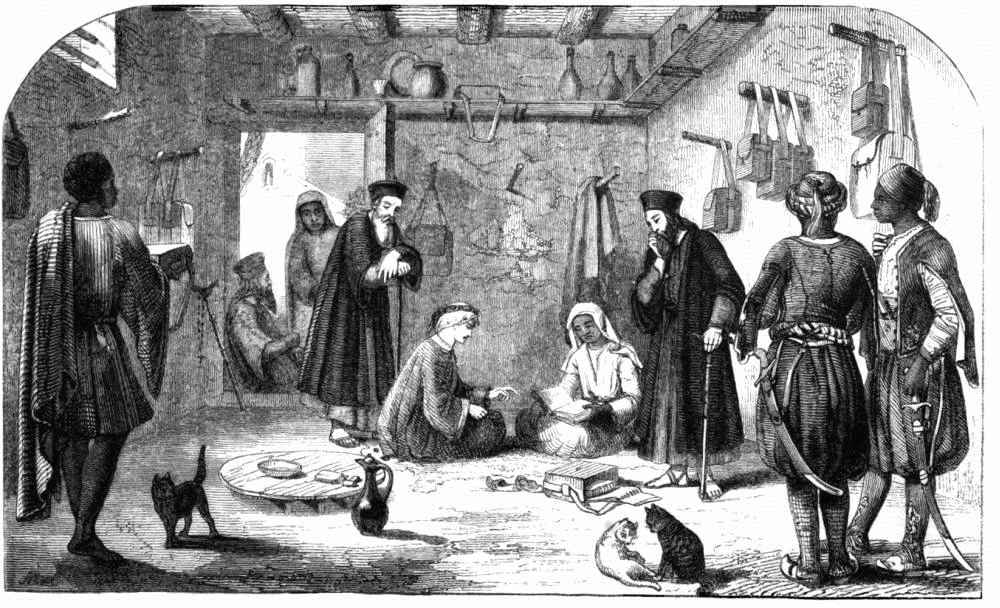
Abyssinian monk clothed in leather. The dining table. The blind abbot leaning over the Author. Abyssinian monk. Coptic monk. The books hanging from wooden pegs let into the wall. The Author's Egyptian servants.
Plan of the church, the convent of the Pulley.
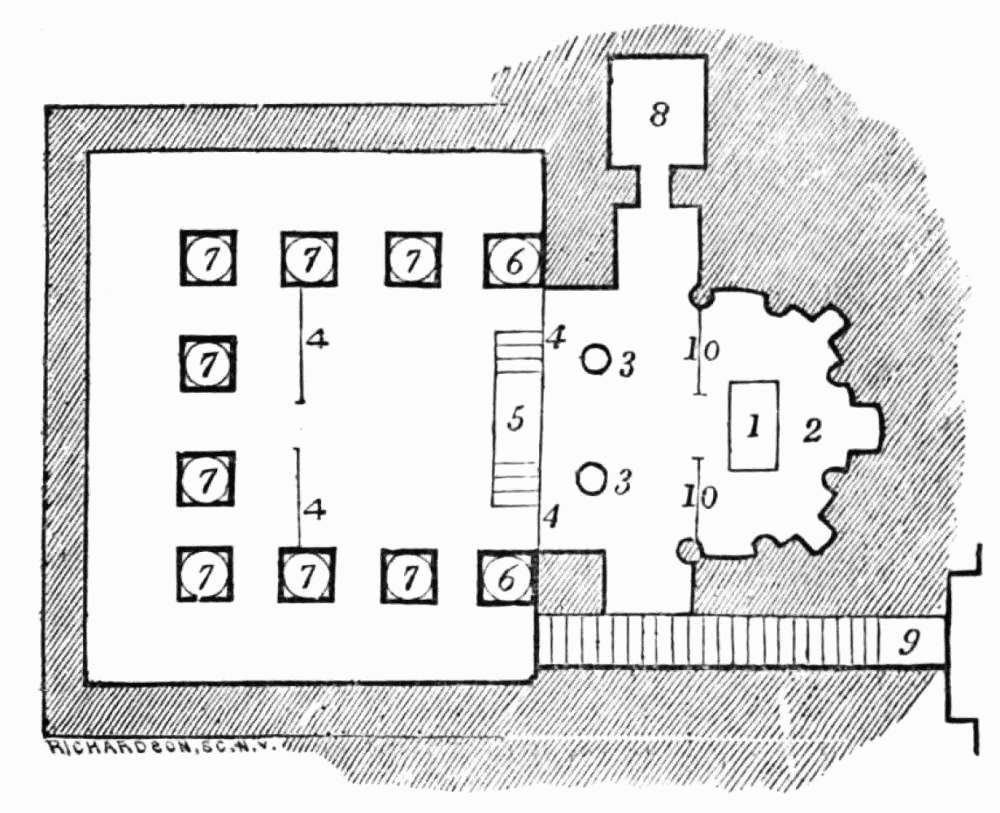
1. Altar.6. Two three-quarter columns.
2. Apsis, apparently cut out of the rock.7. Eight columns.
3. Two Corinthian columns.8. Dark room cut out of the rock (there is another corresponding to it under the steps).
4. Wooden partitions of lattice-work, about 10 ft. high. 9. Steps leading down into the church.
5. Steps leading up to the sanctuary. 10. Screen before the Altar.
Plan of the church of the The Holy Sepulchre.
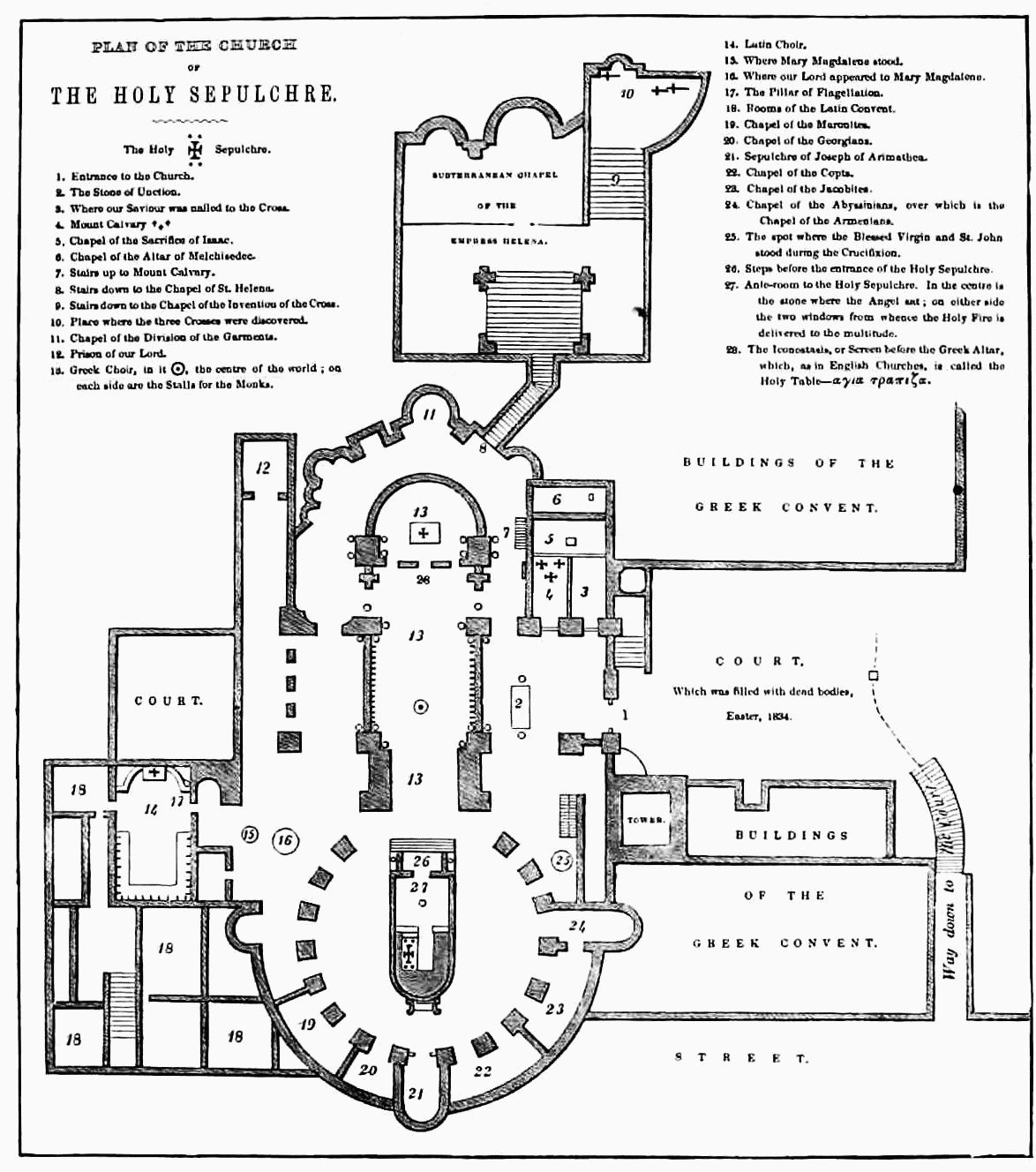
The Holy Sepulchre.

1.Entrance to the Church.15.Where Mary Magdalene stood.
2.The Stone of Unction.16.Where our Lord appeared to Mary Magdalene.
3.Where our Saviour was nailed to the Cross.17.The Pillar of Flagellation.
4.Mount Calvary 18.Rooms of the Latin Convent.

5.Chapel of the Sacrifice of Isaac.19.Chapel of the Maronites.
6.Chapel of the Altar of Melchisedec.20.Chapel of the Georgians.
7.Stairs up to Mount Calvary.21.Sepulchre of Joseph of Arimathea.
8.Stairs down to the Chapel of St. Helena.22.Chapel of the Copts.
9.Stairs down to the Chapel of the Invention of the Cross.23.Chapel of the Jacobites.
10.Place where the three Crosses were discovered.24.Chapel of the Abyssinians, over which is the Chapel of the Armenians.
11.Chapel of the Division of the Garments. 25.The spot where the Blessed Virgin and St. John stood during the Crucifixion.
12.Prison of our Lord.26.Steps before the entrance of the Holy Sepulchre.
13.Greek Choir, in it , the center of the world; on each side are the Stalls for the Monks.27.Ante-room to the Holy Sepulchre. In the center is the stone where the Angel sat; on either side the two windows from whence the Holy Fire is delivered to the multitude.

14.Latin Choir.28.The Iconostasis, or Screen before the Greek Altar, which, as in English Churches, is called the Holy Table—ικονοsτασις.