Chapter IX · THE FIELD OF THE BATTLE OF STOKE. [177a]
Reading edition
CHAPTER IX. THE FIELD OF THE BATTLE OF STOKE. [177a]
“Have we so soon forgot those days of ruin, When York and Lancaster drew forth the battles, When, like a matron butchered by her sons, And cast beside some common way, a spectacle Of horror and affright to passers by, Our groaning country bled at ev’ry vein?”
Rowe’s Jane Shore, act iii.
Before commencing a description of the Field of the Battle of Stoke (in Nottinghamshire), it may be advisable to mention concisely the nature of a very formidable insurrection, which was suppressed by that battle.
John de la Pole, Earl of Lincoln, [177b] a man of talents, courage, and enterprise, was a nephew of Edward IV. and of Richard the Third, and also of Margaret, [177c] the widow of Charles the Bold, or the Rash, Duke of Burgundy. Margaret was an uncompromising and implacable enemy of Henry VII., [178a] and in 1487, a formidable conspiracy was set on foot, by her and the Earl of Lincoln, of which the object was to raise an insurrection in England against Henry. It was given out that Edward Earl of Warwick, son of George Duke of Clarence, and nephew of Edward IV., had effected his escape, notwithstanding the vigilance of Henry VII., and had gone abroad; and Lambert Simnel, [178b] the son of a joiner, named Thomas Simnel, of Oxford, [178c] was tutored by Richard Simons, a priest of that city, to personate the young prince.
Margaret furnished the Earl of Lincoln with 2000 Germans, veteran troops, commanded by Martin Swartz, an officer of talents and experience. With these forces, and with Lambert accompanying him, the earl landed in Ireland, and Lambert was soon afterwards crowned as King, in the Cathedral at Dublin.
They remained some short time in Ireland, where the earl raised a body of Irish forces, and provided transports; and having at length sailed from Dublin, the Earl landed with his army, on the 4th of June, [178c] near Pile of Foudrey, at Furness, in Lancashire, where Sir Thomas Broughton, who had become a party to the conspiracy, had considerable possessions; and the spot near the village of Broughton, where, according to tradition, they encamped after landing, is even now called Swart Moor, after the commander of the German troops. The insurgents were there joined by Sir Thomas Broughton, and others, with additional forces.
Lord Lovel [178d] was also a principal mover of the insurrection; and we are informed by Dugdale, that he accompanied the Earl of Lincoln from Flanders to Ireland, and afterwards came over with him and the rest of the insurgents into England. Whether that was the case, or whether Lord Lovel joined the earl at the same time that Sir Thomas Broughton did, or afterwards, during the march of the insurgents, does not seem quite certain. Writers have differed upon that point; and the act of attainder [179a] against Lord Lovel, does not throw any light upon it. It is, however, certain, that he joined the insurgents before the battle of Stoke.
The Earl of Lincoln marched with his forces from Furness into Yorkshire; and on arriving at Masham, he sent to the mayor of York, and requested to be admitted into the city, in order to victual the army. [179b] This having been refused, it made a great and serious change, in the earl’s plans and prospects; and it is not improbable, that it determined him at all hazards, promptly to seek and fight the King. He then marched from Yorkshire into Nottinghamshire; but the exact line of march is not known; it may, however, be fairly concluded, that he took the route by Mansfield. He proceeded to Southwell, and continued his march in the direction of the Trent; and he appears to have crossed that river at Fiskerton, which in the summer time is shallow, and easily fordable by men and horses. As Newark was preoccupied by the King’s army, Fiskerton was the only safe place near Southwell, where the earl’s forces could pass the Trent. After crossing the river, they took up a position on the elevated ground to the southward of, and overlooking, the little village of East Stoke, in Nottinghamshire.
In the mean time, the King, apprised of the landing of the insurgents in Lancashire, assembled a considerable army under the command of his uncle, Jasper Duke of Bedford (formerly Earl of Pembroke [180a]) and John Earl of Oxford; [180b] and with these he marched from Kenilworth, through Coventry, Leicester, Loughborough, and Nottingham. The valuable services rendered to Henry by Thomas, first Earl of Derby (when Lord Stanley [180c]), at the battle of Bosworth, were too important, and too recent, to be forgotten; and the King was, of course, happy to call for, and avail himself of, his influence on this occasion. On Corpus Christi Day, the King was joined at Nottingham by Lord Strange, son of the Earl of Derby, with a great body of troops, principally consisting of the followers and tenants of the earl. He was also joined there by the Earl of Shrewsbury, [180d] and by several knights and gentlemen, with additional forces.
The King marched to the village of Ratcliffe, where he passed the night. From Ratcliffe, he proceeded to Newark, which he succeeded in occupying before the Earl of Lincoln’s forces could arrive there. [180e] From Newark, the King advanced with his army, and took up his position on the road leading to East Stoke, and about three miles on the southward side of Newark.
These introductory observations may possibly cause the positions, which will now be described, of the hostile armies, to be the more readily understood.
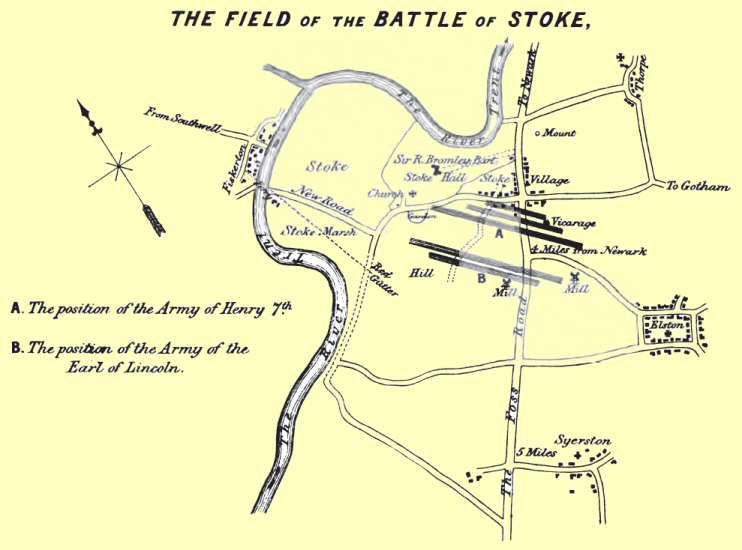
In approaching the village of East Stoke, by the foss-way leading from the southward towards Newark, the road gradually ascends, until the traveller attains an eminence or hill, distant little more than half a mile from the village, commanding an extensive view of Newark and the neighbouring country. Upon its highest elevation, to the left or west of the foss-road, is a windmill, in Stoke Fields; and to the right or south-east, is another mill, in Elston Fields; but both are in the parish of Stoke: this eminence decreases in height towards the latter mill, but extends past the former, towards the north-west, and it ends in a steep cliff, the foot of which is separated from the river Trent and Fiskerton Ferry, by Stoke Marsh. The marsh is of narrow width, and the distance is not much more than a quarter of a mile from the ferry to the foot of the hill.
That part of the hill upon which the mill in Stoke Fields is erected, was, at the time when I visited the field of battle, and probably still is, called the Rampire, a name sufficiently significant, and the inhabitants of its vicinity are in the habit of pointing it out, as the place where the Earl of Lincoln’s forces were encamped. It is by far the strongest military position within some miles of the village, and tallies exactly with the accounts in the old historical works. This being premised, the earl’s centre would naturally be at the place where the mill is now erected; his right wing would extend a little way across the foss-road, in the direction of the other mill standing in Elston Fields; and his left wing would occupy the strong position on the summit of the eminence. [181] The hill rapidly decreases in height, and slopes down towards Stoke village and the vicarage-house, which stands in Elston Fields, although in Stoke parish, close to the village, and about fifty or sixty yards to the right or east of the foss-road. It was down this slope that the earl’s troops descended to attack the forces of Henry VII., at the battle of Stoke.
In proceeding to describe the situation of Henry’s camp, and to compare the two positions with the accounts given by the old historians, it is proper to mention, that after passing the village of Stoke, and at less than half a mile on the foss-road, towards Newark, and between three and four miles from the latter town, the road gradually rises until the traveller arrives at the toll-bar, which is on slightly elevated ground. [182a]
From the accounts given by the old historical writers of the movements of Henry VII., [182b] there is great reason to suppose, that at that place, or very near to it, his forces were encamped previously to the battle of Stoke; and as the country, between Newark and Stoke, is nearly level, with the exception of the elevated ground just before mentioned, it was the only place, three miles from Newark, where eligible rising ground could be found, to encamp upon, between that town and Stoke village; and it tallies in its distance from Newark, and its contiguity to the village of Stoke, with the accounts given by the old historians.
The two positions above described, correspond in a remarkable manner, with the accounts of the old annalists and chroniclers. Polydore Virgil, after describing the Earl of Lincoln’s putting to sea with his forces from Dublin to England, says, that “haud procul Lancastrio in terram descendunt, freti opibus Thomæ Brogtoni, qui princeps erat conjurationis socius.” He then mentions the course pursued by Henry, and states, that “Comes Lincolniesis interea Eboracensem agrum ingressus cùm sociis, lento incedebat gradu, ac sine ullo maleficio incolarum, quippe qui sperabat aliquem populi concursum ad se fieri,” and, after mentioning the earl’s reasons for venturing upon a battle, he proceeds as follows: “ex agro Eboracensi Neuuarcum versus iter facere cœpit, ut ibi auctis copiis, in regem, quem venire obviam, & vix bidui abesse intellexerat, recta via contenderet. Cæterū priusquam ille eò perveniret, Henricus cui nulla hora operis comitis erat ignota, sub vesperū illius diei, qui ante prælii diem illuxit, celerius opinione eorum, obviam venientibus factus, Neuuarcum accessit, parumque illic moratus, tria millia passuum progressus est, ibique positis castris pernoctavit. Comes verò cognito regis adventu nihil territus incœptum iter continuat, eodemque die pervenit ad viculum proximum adversariorum castris, quem vocāt Stochum, eôqûe loci castra facit. Postero die rex ex omnibus copiis triplici instructa acie, Stochum proficiscitur, ac prope castra comitis consistit, atque facit æquo in loco pugnandi potestatem. Potestate facta, comes copias educit, signoque suis dato, in certamen descēdit.”
As Polydore Virgil wrote in the reign of King Henry VIII., numbers of persons present at the battle, must have been living, from whom he probably obtained information.
Hall also wrote in the reign of King Henry VIII., and died soon after the accession of King Edward VI. In his Chronicles, the mentions, that the Earl of Lincoln and his troops landed “at the Pyle of Fowdrey, within lytle of Lancastre;” that he marched into Yorkshire, and afterwards “directed his waye from Yorke to Newarke-upo’-Trent, to thentent that there he (as he trusted) augme’tyng hys co’paigny might set upon the Kyng, who’ he knew to be but II daies jorney from him. Albeit, before he came there, Kyng Henry was in his bosome, and knewe every houre what the erle did, came the night before that he fought, to Newarke, and there approched nere hys enemyes soner then they loked for him, and there tariyng a lytle, went III myles further and pitched his feelde, and lodged there that night. The Erle of Lyncolne certefyed of his commyng was nothynge afearde, but kepte styll on hys jorney, and, at a lytle village called Stoke, nygh to the Kyng and hys army, planted hys campe. The next daye followynge the Kynge devyded hys whole nombre into three battailes, and after in good arraye approched nigh to the toune of Stoke, where was an equall and playne place for bothe parties to arreigne the battaile. When the place was apoynted and ordeined to trye the bittermost by stroke of battaile, the erle set furth his army, and, gevyng a token to his compaignye, set upon his adversaries with a manly courage, desirynge his souldyours that daye to remembre his honoure and their awne lyves.”
Holinshed’s account, in his Chronicles, written in the reign of Elizabeth, is nearly in the same words.
Lord Chancellor Bacon (Viscount St. Alban’s), in his Life of King Henry VII., as given in Kennet’s Lives, says, that the Earl of Lincoln “march’d towards Newark, thinking to have surprised the town. But the King was somewhat before this time come to Nottingham,” and, a battle being resolved upon in his council, “march’d speedily, so as he put himself between the enemies’ camp and Newark, being loth their army should get the commodity of that town. The earl, nothing dismay’d, came forwards that day unto a little village call’d Stoke, and there encamp’d that night upon the brow or hanging of a hill. The King, the next day, presented him battel upon the plain, the fields being open and champion. The earl courageously came down, and joyned battel with him.”
In Stow’s Annals, it is stated, that “the Earl of Lincolne, being entered into Yorkeshire, directed his way to Newark-upon-Trent, and, at a little village called Stoke, three or four miles from Newarke, nigh to the King and his army, planted his campe. The next day following, the King divided his number into three battells, and after approched nigh the towne of Stoke, where both the armies joined and fought egerly.”
Speed says, that “the King dislodgeth with his army, and passeth thorow Newarke, leaving it behind him about three miles.” Also, “the next day, both the armies are brought forth to fight neere to a little village called Stoke.” He also adverts to the earl’s having marshalled his men “upon the brow or hanging of an hill,” before the battle.
Sir Richard Baker, in his Chronicles, mentions the earl’s “taking his way from York to Newark-upon-Trent. King Henry, understanding which way he took, came the night before the battel to Newark, and, going three miles further, near to a village called Stoke, there waited the approach of the Earl of Lincoln.”
Upon inquiry, I learnt, that human bones, coins, and other relics indicative of a battle, have been frequently dug up in the fields, on the south side of the village, which are exactly where, from the above accounts, it is to be presumed, the earl’s centre was engaged, after descending from his strong post, and which lie at the foot of the eminence, above described; and also on the south side of and within the garden of Sir Robert Bromley, Bart., which would be the position of the earl’s left wing when fighting. They have also been found in digging the foundations of some walls near the vicarage, in Elston Fields, where the King’s left wing would be engaged.
In August 1825, Sir Robert Bromley kindly accompanied me over part of the field of battle, and pointed out a place in his garden, where the remains of many of the slain were found. They were interred in long trenches; but very few indications of armour or weapons were discovered; however, the labourers found two spurs: one of which they purloined, the other Sir Robert Bromley obtained. He kindly allowed me to inspect it. It is of silver on the outside, and of steel within, and is of considerable beauty and elegance of workmanship. It is of very small size, and remarkable for the appropriate nature of its ornaments—roses boldly embossed on its surface. It bears a strong resemblance to the one dug up on Bosworth Field, of which an engraving is given in Hutton’s Bosworth Field.
Those who wish for an account of the march and movements of Henry previously to the battle, will find it in the journal said to have been kept by the herald, [185a] who accompanied his army. Henry’s proclamation, [185b] for enforcing discipline and order on the march, is curious, and gives us some idea of the insubordination of an English army, at that period.
The principal commanders in Henry’s army, were, Jasper Duke of Bedford, [186a] John Earl of Oxford, [186b] George Earl of Shrewsbury; [186c] Richard Neville, Lord Latimer, [186d] Edward Lord Hastings; [186e] George Lord Strange, son of Thomas Earl of Derby; [186f] Sir John Cheney, and Sir Edward Fielding. [186g] Thomas Brandon, brother of Sir William Brandon [186h] (who was the standard-bearer of Henry, and was slain at the battle of Bosworth), had the honour of bearing Henry’s shield at the battle of Stoke. [186i]
The Earl of Lincoln and his forces being posted upon the hill, Henry, on the 16th of June, 1487, [186j] drew up his army in three lines, in the open space to the southward or south-east of Stoke, and offered the earl battle, which the latter, notwithstanding the disparity of their forces, courageously accepted.
The act of attainder [187a] passed against the earl and his adherents, furnishes some evidence of guns having been used by the earl’s forces; as the act states them to have been armed with “swerdys, speris, marespikes, bowes, gonnes, harneys, brigandines, hawberkes, and many other weapyns and harneys.” If, as that act seems to state, the earl had artillery with his army, which were used at the battle, they would naturally be placed, on the slope of the hill before described, and would be fired from thence upon the royal army drawn up on the lower ground.
The earl descended the hill, with his troops in good order, and attacked the royalists with great intrepidity, in hopes, that, by breaking their first line, the fugitives from it, would fall back upon those in the rear, and throw them into confusion; but, after bravely fighting for three hours, during which, the half-naked Irish, undisciplined, and only armed with darts and skins, obstinately maintained their ground, although Henry’s archers kept constantly thinning their ranks, and the English and Germans fought with the utmost valour, they were totally routed, with great slaughter. The Earl of Lincoln, Lord Kildare (or, as several authors call him, Lord Thomas Gerardine or Fitzgerald), Sir Thomas Broughton; Martin Swartz, the commander of the foreign auxiliaries; and most of the other leaders of the earl’s party, died sword in hand. [187b] The impostor, Lambert Simnel, and the priest his tutor, were taken prisoners, [187c] and Lord Lovel was never afterwards heard of; it has been said, that in endeavouring to escape by crossing the Trent, he was drowned in the river. Some writers state, that he was slain in the battle; but in the account given in the before-mentioned journal, he is said to have been “put to flight” [escaped]. [188a] Whether he perished in crossing the Trent, fell in the battle, or fled, and contrived to secrete himself, so as to elude discovery, will probably never be satisfactorily ascertained. [188b] He had been a steadfast supporter of King Richard III., at whose coronation, he had the honour of carrying one of the pointed swords on the King’s left hand; [188c] and was made Lord Chamberlain, and he had also fought for him at Bosworth Field. [188d] His enmity to Henry VII. induced him to join the insurrection of Sir Humphrey Stafford, and his brother, Thomas Stafford, in 1486, and take up arms in Yorkshire, whilst they prepared to attack Worcester; but, his troops dispersing, he was obliged to fly to Furness, in Lancashire, where Sir Thomas Broughton received and afforded him an asylum, and from thence he proceeded into Flanders, to Margaret Duchess of Burgundy. [188e]
Many of the Earl of Lincoln’s forces were destroyed in their flight from the field, and in attempting to escape over the Trent, by Fiskerton Ferry. A ravine or gully, which descends from the high ground on the south-west side of the cliff, is now pointed out, as being the place through which the fugitives endeavoured to pass, in order to get to the ferry, and which, tradition says, ran with blood, and where a great slaughter was inflicted upon them. It is from that circumstance, called Red Gutter; and human bones, and other indicia of slaughter, have been dug up in it. It is rather difficult of access at present, from being covered with a plantation of trees; but there is still a path through it, and it opens upon Stoke Marsh, about thirty or forty yards to the southward of the modern road leading over the marsh, to the ferry; towards which the fugitives would naturally endeavour to pass through this ravine, as the steepness of the cliff would render it difficult, in most places, to descend in any other direction; and the contiguity of the right wing of the royal army would prevent a retreat over the flat ground by the high road past the church to the ferry. The Trent, in the summer time, and the battle was fought in the month of June, is fordable for horses and men, and, as far as I could judge by the eye, it is thereabouts one hundred and sixty or one hundred and eighty yards wide; and if the wreck of the defeated army could have gained the opposite bank, it would have furnished some chance of escape, in comparative safety.
That the hill in Stoke Fields above described, is that on which the Earl of Lincoln was encamped, seems to be satisfactorily proved, independently of tradition, from the circumstance, that when he entered Nottinghamshire from Yorkshire, and marched towards Newark-on-Trent, as stated in Leland’s Collectanea, [189] “Enemyes and rebelles drew towards Newarke warde, passing by Southwelle and the Furside of Trente,” he found the castle and town of Newark preoccupied by his enemy, in which Hall, Holinshed, Polydore Virgil, Bacon, Speed, and Baker, all agree, and he could not well get to Stoke, without passing through, or close to, Southwell, and then crossing the Trent: and the ford and ferry nearest to Southwell, and to those parts of the country through which he is said to have marched, is Fiskerton; which is close under the hill. Besides which, the hill is by far the strongest military position in that part of the country: in fact, the cliff occupied, as before observed, by his left wing, was almost inassailable; and the parts of the hill where his centre and right were posted, must have been exceedingly difficult of approach by hostile forces, because they would labour under the disadvantage of having to ascend an eminence, probably strengthened by artificial defences and by the natural obstacles of brushwood and other inconveniences incident to uncultivated ground. It is the only elevated ground near Stoke, of sufficient elevation to warrant the word “descends,” used by Polydore Virgil, “Comes copias educit, signoque suis dato in certamen descendit;” and, after a very careful survey of the country for miles round Stoke, no other eminence presents itself worthy of Bacon’s appellation, “the brow or hanging of a hill,” or to which his words “came down” can apply, “the earl courageously came down and joyned battel with him.”
The bones, coins, and other relics, which have been dug up, show that the conflict took place at the spot before mentioned, near the village, and close to, and in the garden of Sir Robert Bromley, Bart., in Stoke Fields, and also upon a small portion of Elston Fields. [190]
A great part of the church has evidently been rebuilt, and, except a Gothic arch communicating from the tower to the body of the church, it has not many claims to antiquity. A few brick and slated cottages have of late years been built amongst the others, in the village; but its appearance conveys to the spectator, the idea of its having undergone little change for centuries past.
The places where the human bones, &c. &c. have been dug up, show that the village of Stoke, previous to the battle, was occupied by part of Henry’s forces, because, as it was the Earl of Lincoln who commenced the attack, it is obvious, that, if the village had been occupied by his troops, the battle would have been fought on the north or the north-east side, and not to the southward of the village; besides which, that idea receives corroboration from the expression of Polydore Virgil, in reference to Henry’s movements:—“Stochum proficiscitur, ac prope castra comitis consistit.” [191a] Henry could not have drawn his forces out of the village, and approached the camp of the earl, if the former had not preoccupied the village.
This memorable battle was the last that was fought between the adherents to the rival Houses of York and Lancaster (that in 1485, called Bosworth Field, being often erroneously so considered), in which one of the House of York attempted, by arms, to obtain the crown; and it firmly secured the House of Tudor upon the throne of England. The victory was, however, purchased by a lamentable destruction of human life: about 4000 of the insurgents, and half of the van of the royal forces, are said to have perished there; probably a total loss of from 5000 to 6000 lives.
What consequences would have ensued to England, if the earl had been victorious, though it may be amusing to speculate upon them, it is, of course, impossible to form a reasonable conjecture. He had claims to the crown, according to the laws and constitution, in due course, after the daughters of King Edward the Fourth (supposing the attainders [191b] of George Duke of Clarence, and Sir Thomas Saint Ledger, to be valid, and to exclude their issue), from his being the eldest son of John de la Pole, Duke of Suffolk, and of Elizabeth, [191c] second sister of King Edward IV. and Richard III., and daughter of Richard Duke of York. He is described as one who possessed talents and courage; and he was encouraged by the known intentions of his uncle, King Richard III., who had declared him successor to the crown, [192a] in case that monarch should die without issue; and at his coronation the earl had the honour of carrying the ball and cross, whilst the sceptre was confided to his father, the Duke of Suffolk. [192b]
It is very clear, that the earl was not at the battle of Bosworth, fighting on the side of his uncle, not only from the total silence of historians, [192c] but from the fact, that his name does not appear in the list of noblemen, knights, and gentlemen, who were attainted, [192d] when Henry VII. called a Parliament, for taking a part in that battle; and also from the fact of his being one of the nobles allowed to attend a council of Henry VII. [192e] He appears not to have acted with sincerity, when he could so far demean himself, as to bring the impostor, Lambert Simnel, forward as a stalking-horse; and, in the words of Bacon, “neither did the earl refrain the business, for that he knew the pretended Plantagenet to be but an idol. But contrariwise, he was more glad it should be the false Plantagenet than the true; because, the false being sure to fall away of himself, and the true to be made sure of by the King, it might open and pave a fair and prepared way to his own title.” He must have been aware of the imposture, and appears to have been actively concerned in the insurrection, with the intention of benefiting himself, and the hope of successfully advancing his own claims to the crown.
It is a remarkable circumstance, that, at the time of the Earl of Lincoln’s death, his grandmother, Cecily Duchess of York, was still living; a woman who was doomed to witness, in her own family, more appalling and extraordinary calamities and vicissitudes, than are to be found in the history of any individual allied to any of the other royal families of Europe; I might, perhaps, even be allowed to go further, and to state, in the known history of any other human being.
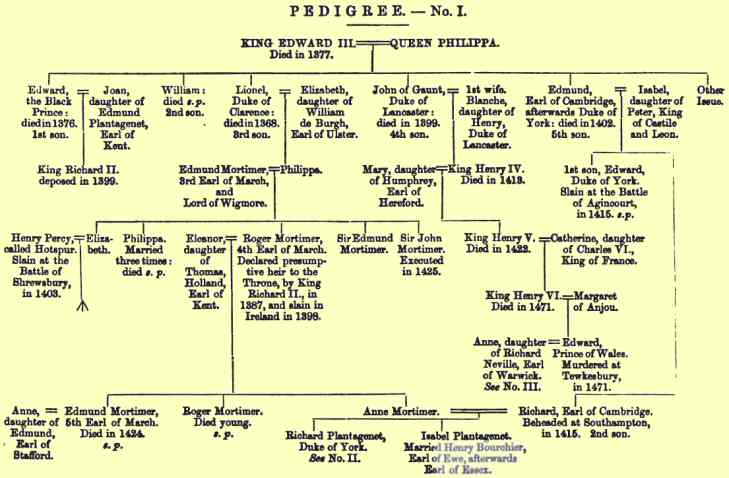
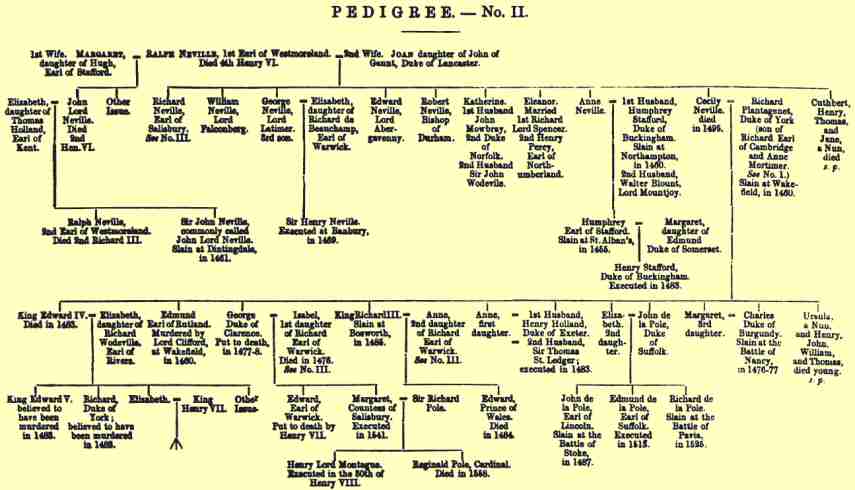
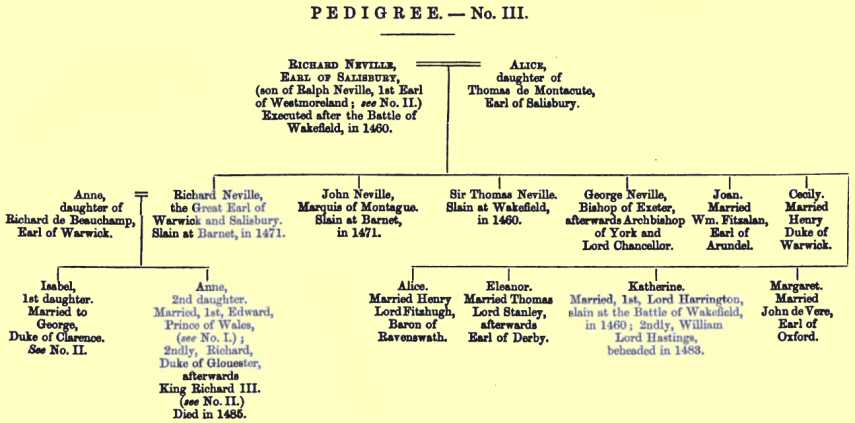
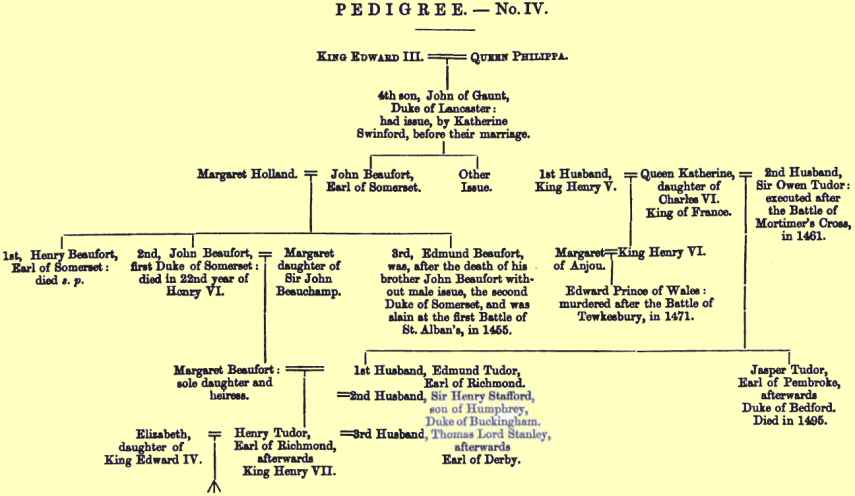
Her nephew, Humphrey Earl of Stafford, was slain at the first battle of St. Alban’s, in 1455; his father, Humphrey Stafford, Duke of Buckingham, who married her sister, Anne Neville, perished at the battle of Northampton in 1460; her husband, Richard Plantagenet, Duke of York, when the crown of England was almost within his grasp, and her nephew, Sir Thomas Neville, son of her brother, Richard Neville, Earl of Salisbury, and her husband’s nephew, Sir Edward Bourchier, son of Henry Earl of Ewe, afterwards Earl of Essex, by Isabel his wife, were slain in 1460, at the battle of Wakefield; her brother, the Earl of Salisbury, was taken prisoner there, and put to death; her second son, Edmund Earl of Rutland, although a mere child, was, at the same time, murdered after the battle, by John Lord Clifford; her half-nephew, Sir John Neville, commonly called John Lord Neville, [193a] brother to Ralph Neville, second Earl of Westmoreland, perished in 1461, in the action of Dintingdale, prior to the battle of Towton; her nephew, Sir Henry Neville (son of her brother, George Neville, Lord Latimer), was made prisoner, and put to death after the battle of Banbury, in 1469; [193b] her two nephews, Richard Neville, the great Earl of Warwick, the “proud setter-up and puller-down of kings,” and John Neville, Marquis of Montague, and her husband’s nephew, Humphrey Bourchier, Lord Cromwell, the son of Henry Earl of Ewe and Essex, by Isabel his wife, were slain at the battle of Barnet, in 1471; Edward Prince of Wales, who married her great-niece, Anne Neville, the daughter of her nephew, the great Earl of Warwick, was barbarously murdered, after the battle of Tewkesbury, in the same year; her son George Duke of Clarence, was put to death in the Tower of London, in 1477–8, his wife Isabel, who was her great-niece, having previously died, as was suspected, by poison; her son-in-law, Charles Duke of Burgundy, called Charles the Bold, or Charles the Rash, who married Margaret, her third daughter, after having by his folly and rashness, impaired his power, and placed his dominions in a state of great peril, was slain at the battle of Nancy, in 1476–7; her eldest son, King Edward IV., abandoned a warlike and active life for pleasure and excesses, which cut him off in the prime of manhood, in 1483; the first husband of her niece, Katherine Neville, William Bonvile, Lord Harrington, [194a] was slain at the battle of Wakefield, in 1460, and the second husband of her niece, William Lord Hastings, was beheaded, without even the form of a trial, in 1483; her youngest niece, Margaret Neville, married John de Vere, Earl of Oxford, [194b] who, during many years of his life, was a fugitive or prisoner, whilst she suffered from great poverty, and her son by the Earl of Oxford, died in confinement, in the Tower of London, during her husband’s exile; her son-in-law, Henry Holland, Duke of Exeter, who married her daughter Anne, was attainted for his support of the House of Lancaster, lived for some time in exile, and was in such poverty, as to be obliged to beg his bread, and in 1473, his corpse was found stripped naked, on the seashore, near Dover; her two grandsons, King Edward V. and Richard Duke of York, are believed to have been murdered [195a] in the Tower of London, in 1483; her son-in-law, Sir Thomas St. Ledger, who married Anne, widow of Henry Holland, Duke of Exeter, was executed in 1483, at Exeter, and attainted for treason, in joining the unsuccessful rebellion of Henry Stafford, Duke of Buckingham; and the latter, who was her great-nephew, being the grandson of her sister, Anne Neville, being deserted by his forces, and betrayed, was, about the same time, taken prisoner and beheaded; her grandson, Edward Prince of Wales, son of King Richard III. and of her great niece, Queen Anne, through whom she naturally expected the honour of being the ancestress of a line of English Monarchs, died in 1484; and the childless Queen, his mother, a few months afterwards, followed him to the tomb; her youngest son, King Richard III., was slain at the battle of Bosworth, in 1485; and her grandson, John de la Pole, Earl of Lincoln, perished in 1487, at the battle of Stoke. [196a]
She died in 1495; [196b] after three princes descended from her, had succeeded to the crown of England, without taking into the account her grand-daughter, Elizabeth, Queen of Henry VII., and more than one had been murdered; and, by her death, was saved the additional affliction of the loss of her grandson, Edward Plantagenet, Earl of Warwick, the last male of the House of Plantagenet, who was tyrannically and wickedly put to death, in 1499, by Henry VII.
On a reference to the following Pedigrees, although they only give some portions of the descents and alliances of the illustrious Houses of Plantagenet and Neville, the reader will observe the degree of consanguinity or connection in which each of the before-mentioned distinguished but unfortunate personages stood, with reference to Cecily Duchess of York. It would be foreign to the object of this work, and would be an undertaking of great labour and difficulty, to give on a more extensive scale, the pedigrees of either of those Houses.
After perusing such a list of frightful calamities, occurring in the lifetime of a single individual, to the members of her own family, the reader may rejoice in living in a civilized age, under the mild and gentle sway of a Sovereign of the House of Brunswick, and may well exclaim of the Duchess of York, in the language of Voltaire, whilst narrating the misfortunes of the Royal House of Stuart:—“Il n’y a pas d’exemple sur la terre d’une suite de calamités, aussi singulières et aussi horribles, que celles qui avaient affligé toute sa maison.”
“Que les hommes privés, qui se plaignent de leur petites infortunes, jettent les yeux sur ce prince, et sur ses ancêtres.” [197]