Radio Vision
Reading edition
The machines here shown are the laboratory models used in the development of Radio Vision and Radio Movies for the reception in the home of broadcast studio performances, i. e., dancing girls, public speakers, pantomime, marionettes, motion pictures; and, by remote control, outdoor events, sports, etc.
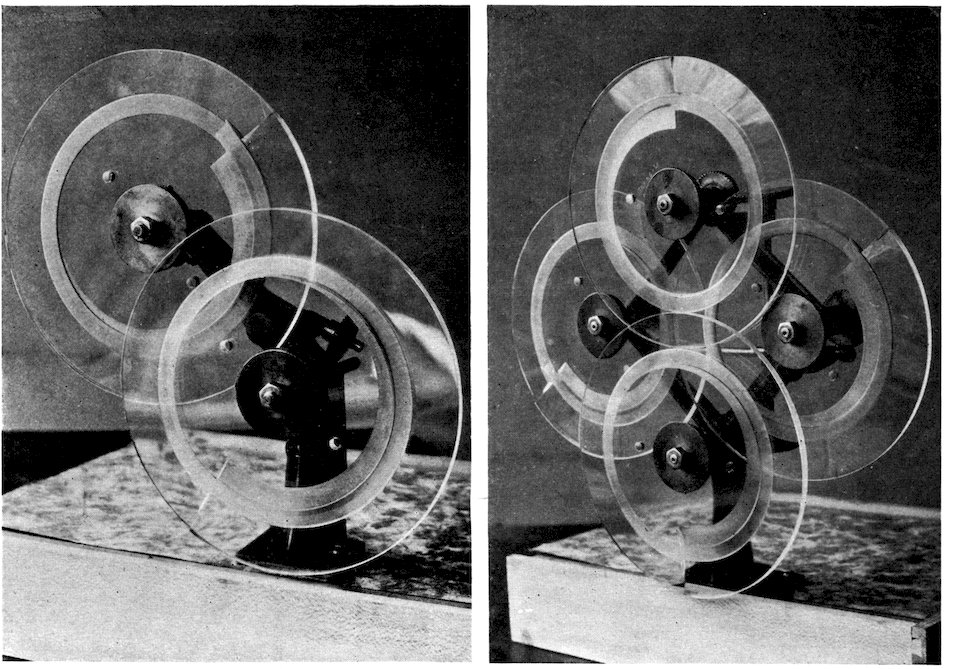
The lower illustration shows a 10″ disc rotating in front of a prismatic ring, synchronized by a variable speed of the motor. The light is in the round box at the top of the standard behind the lens carrier, and shines through lenses and prism (onto a picture screen) as they pass, the light fluctuating in value with the incoming radio signals to make up a complete picture every one-sixteenth of a second.
The upper illustrated mechanism differs from the lower one in that it has a second overlapping prism for optical correction.
The casing enclosing the mechanism is not very large, and contains, besides the radio vision mechanism, the radio receiving set, and a loudspeaker, so that an entire opera in both action and music may be received.
110
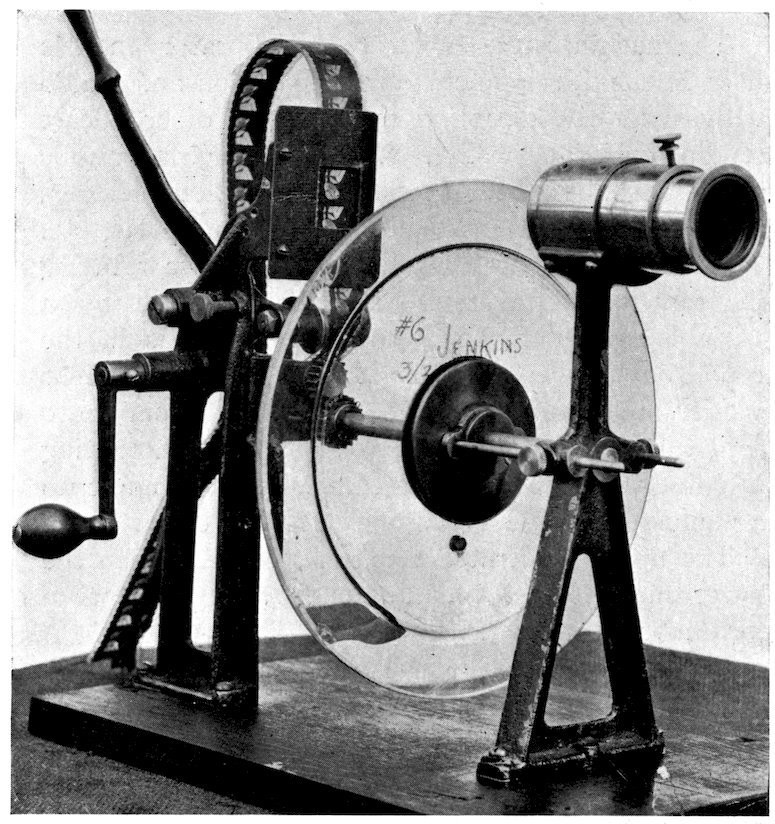
The prismatic ring can be rotated to follow any moving object; e.g., a motion picture film; or if fitted with a high-reading automobile speedometer the speed of an airplane or dirigible can be read directly off a dial by the navigating officer.
111
112
113
114
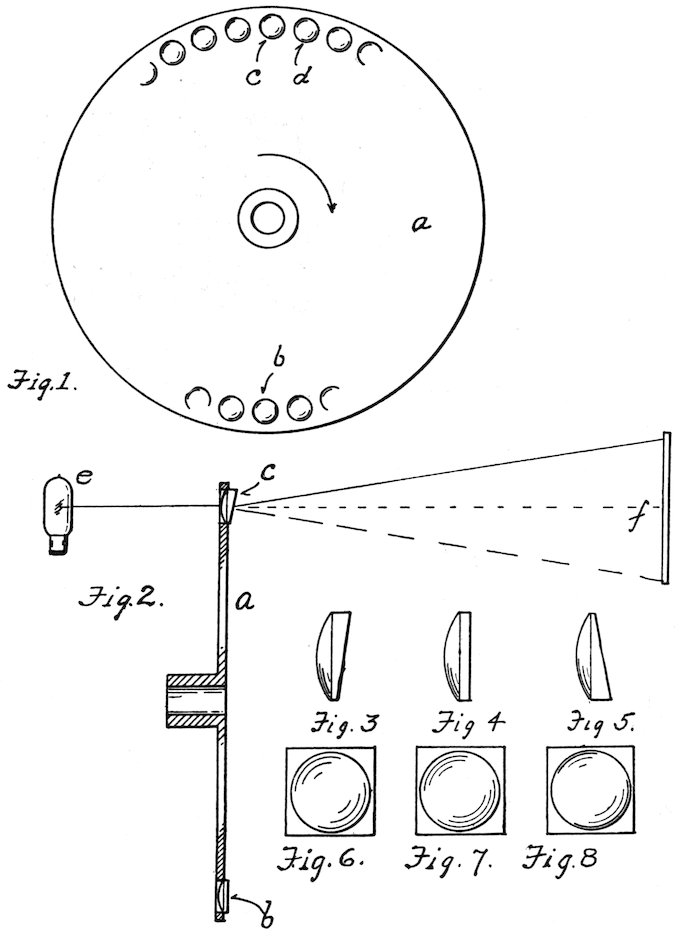
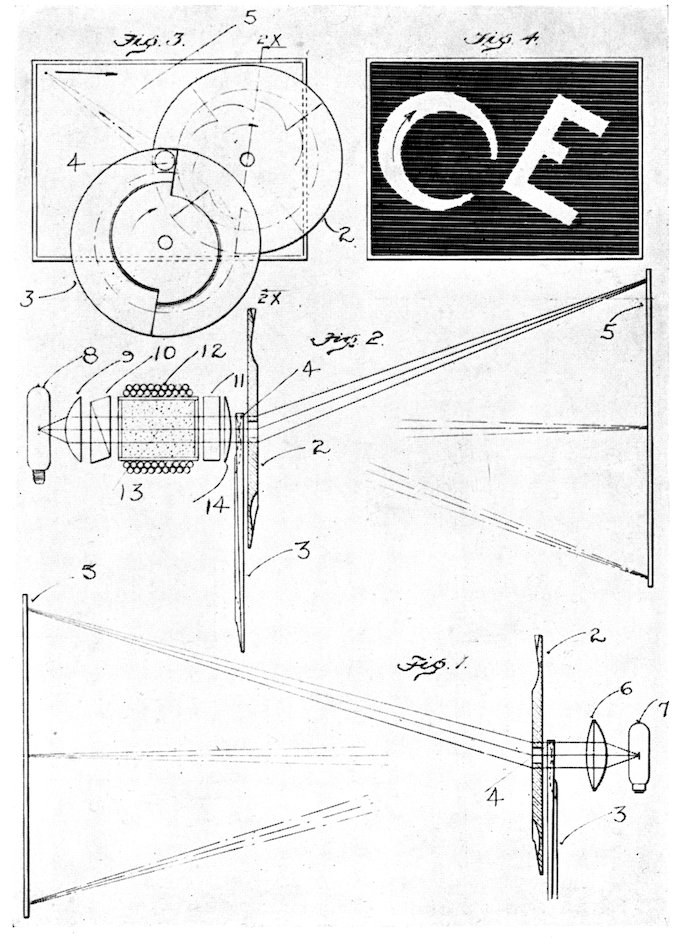
The rotation of the disc A carrying lenses b, c, d, etc., sweeps the image of the light source C across the screen F in a horizontal direction, while line displacement in a vertical direction is effected by reason of the changing angle of successive prism elements.
115
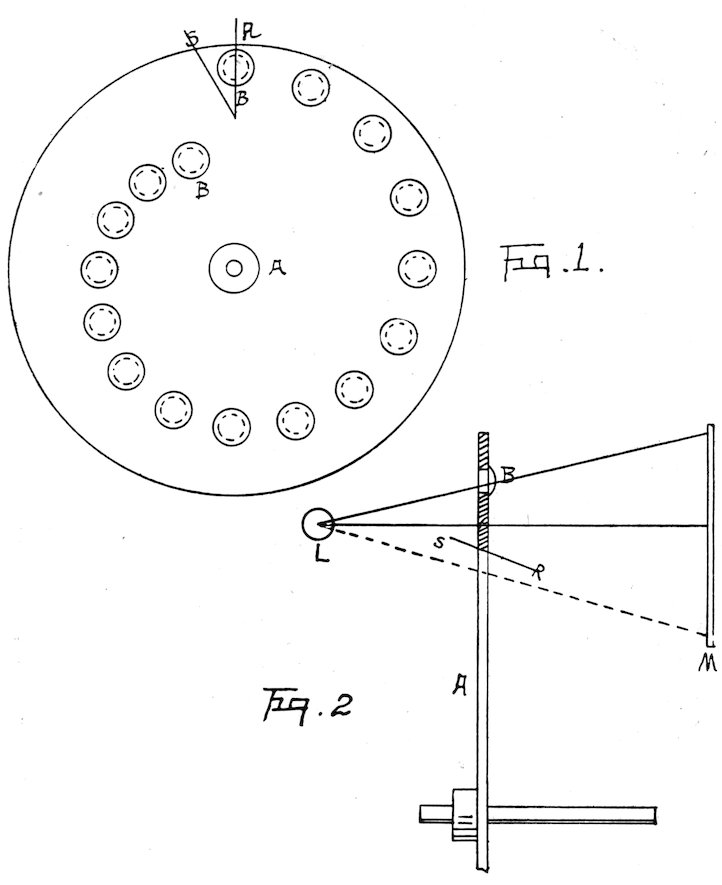
The rotation of the disc A carrying lenses arranged in a spiral causes the light L to sweep across the screen M. A revolution every sixteenth second gives a motion picture screen effect.
116
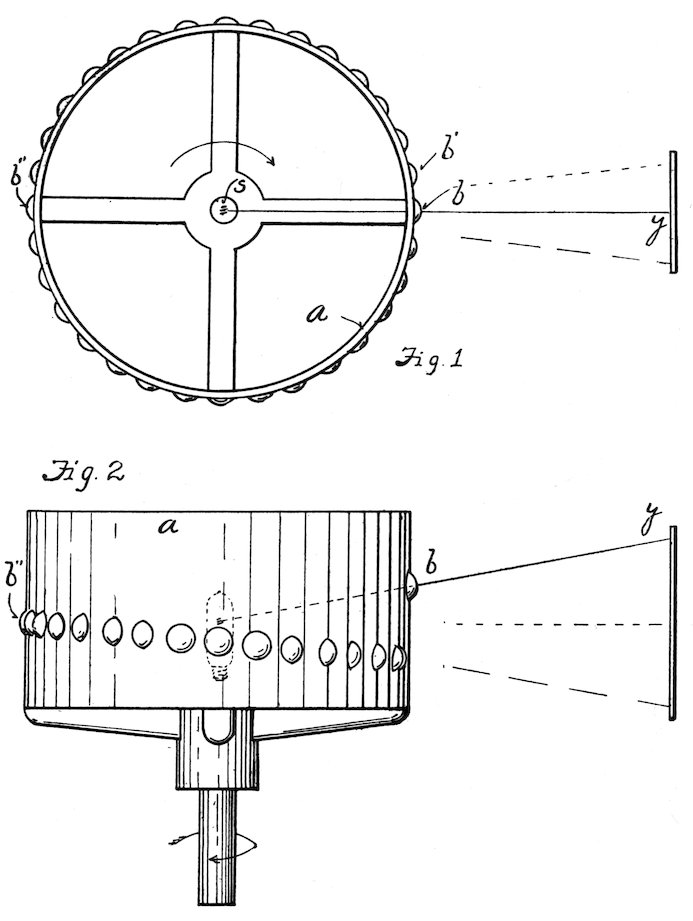
Radio Motion Picture Mechanism The rotation of the drum A carrying the lenses b, b′, b″, etc., causes the image of the light source S to sweep across the screen Y in two directions. A complete rotation every sixteenth of a second is motion picture speed.
117
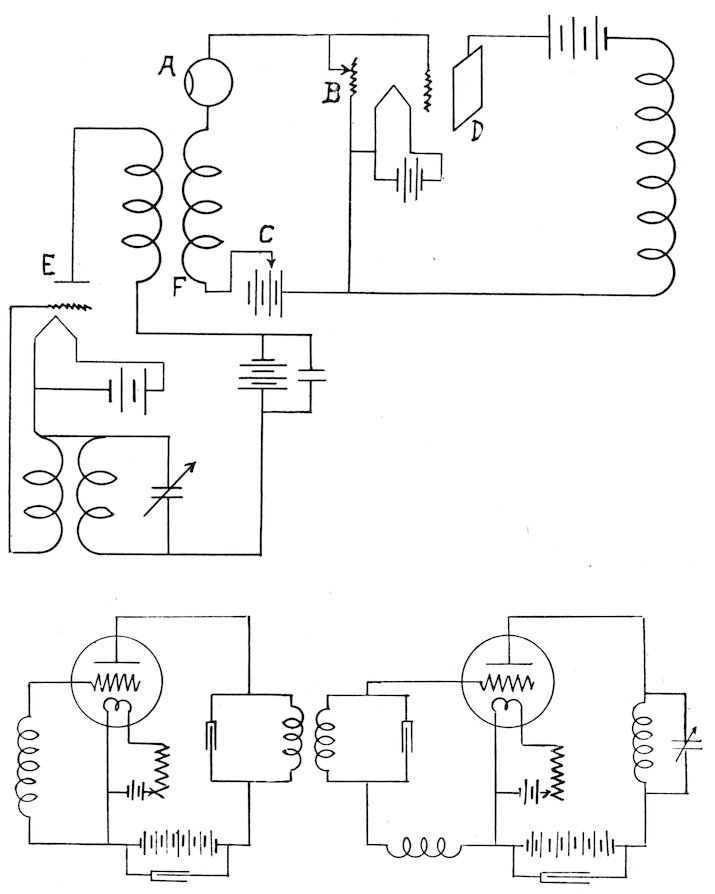
Radio Vision hook-up circuits. A is the light cell. The upper circuit puts a “chopper” frequency onto the radio carrier wave by the inductive coupling. The lower diagram shows an intermediate frequency oscillator to be controlled by a light cell (not shown), the intermediate being put on the carrier wave.
118