Wilcomb E. Washburn Research Associate, Institute of Early American History and Culture and Instructor in History, College of William and Mary (continued 2)
Reading edition
The usual grievances of the settlers against the Indians were not the violent murders and massacres so often associated in the public mind with Indian-white relations, but minor irritations concerning property and animals. The settlers let their hogs run wild. The hogs would get into the Indians' corn. The Indians would kill the hogs. The settlers would demand satisfaction. Many acts of the Assembly testify to the fact that shooting of wild hogs was one of the most frequent points of dispute not only between the English and the Indians but among the English themselves. It was one reason why early Assemblies provided strict rules for erecting adequate fences around cultivated fields and establishing lines of responsibility for damage caused by straying cattle or hogs. On the frontier, however, such refinements of civilization as fences were long in coming. What was more natural than that the same conflicts which arose among the English in the early years of settlement should arise between the English and the Indians on the frontier. The tragedy was that English-Indian conflicts were not normally settled in the courts as were conflicts between Englishmen. The courts did deal with Indian-white conflicts to a certain extent, but, as noted before, the local justices were often the very persons the Indians accused of oppressing them. Sometimes the Indians were able to bring their complaints before the General Court in Jamestown. But often the dispute was settled in the wilderness in the traditional frontier way: by violence. Since the settlers had weapons of violence superior to those possessed by the Indians, it was not very frequently that the Indians won their "case."
In the Assemblies of these years there is occasional mention of the splitting of counties in two parts, or of the formation of new parishes. Usually these divisions were made along rivers or streams. Such legislation suggests that settlement was spreading back from the water routes into the land area between streams. The early counties were normally set up to embrace the area on both sides of watercourses, even broad rivers like the James and York. The rivers were, in the early period of settlement, bonds that linked the settlers on either side to each other. It was natural that rivers should be the principal thoroughfares of the country. But as settlement spread into the interior, up the tributary streams that issued into the larger rivers, the natural social unit that developed was that of communities on the same side of the river. Hence the gradual conversion of rivers into political boundaries.
The Assembly of March 1655, for the first time in Virginia's history, restricted the voting privilege to "housekeepers whether freeholders, leaseholders, or otherwise tenants." Freemen who could not qualify as householders, even though they may have been grown sons living in their father's house, could not vote. It is significant that this first restriction on the right to vote in Virginia came not under a royal governor, but under so-called "Parliamentary" rule. So unpopular was this enactment that it was amended by an act of the Assembly of March 1656 on the grounds that "we conceive it something hard and unagreeable to reason that any persons shall pay equall taxes and yet have no votes in elections." Freemen were again allowed to vote provided that they did not do so "in a tumultuous way."
The Assembly of March 1656 passed an act which attempted to solve the Indian problem in a way that had never been tried before but has been frequently tried since. The plan was to encourage the growth of an acquisitive spirit among the Indians to serve as a counterweight to the acquisitive spirit of the English. The preamble to the act asserted that the danger of war from the Indians stemmed from two causes: "our extreame pressures on them and theire wanting of something to hazard and loose beside their lives." Therefore the Assembly enacted that for every eight wolves' heads brought in by the Indians, the King or great man of the Indians should have a cow delivered to him at the public charge. "This will be a step to civilizing them and to making them Christians," the act went on; "besides it will certainly make the comanding Indians watch over their own men that they do us no injuries, knowing that by theire default they may be in danger of losing their estates." The Assembly also attempted to make the lands possessed by the Indians under the seal of the colony inalienable to the English. Otherwise, constant pressure on the Indians by the settlers would force them over and over again to dispose of their lands.
Many people fail to realize that the Indians of Virginia lived in well-defined towns or settlements. It was, indeed, the Indians who lived an "urban" life in the seventeenth century while the English settlers were usually scattered about the countryside. The conventional picture of the Indian roaming the forests, living solely by hunting and fishing, is mistaken. The Indian did hunt and fish, as many of us do today. But his support came in large measure from the corn and vegetables growing in the fields which adjoined every Indian town. The Indians had a close-knit and harmonious community life. They were only indirectly touched by the white man's money economy and were usually content to raise only what food they needed for their own consumption. They were not infected with the restless, individualistic spirit of the white settler who constantly worked to accumulate a monetary surplus from the returns on his single cash crop, tobacco.
Like later attempts to destroy the group-centered society of the Indians in favor of a self-centered society, this attempt of 1656 was not completely successful.
Indian Troubles, 1656-1658
Early in 1656 word was received that six or seven hundred strange Indians from the mountains had come down and seated themselves near the falls of the James. The March Assembly, considering how much blood it had cost to "expell and extirpate those perfidious and treacherous Indians which were there formerly," and considering how the area lay within the limits "which in a just warr were formerly conquered by us," ordered the two upper counties under Col. Edward Hill to send 100 men to remove the intruders peacefully, making war only in self-defense. Messages were sent to obtain the aid of the Pamunkeys, Chickahominies, and other neighboring Indians. Tottopottomoy, the King of the Pamunkeys, joined Hill with 100 of his warriors, although only the summer before his brother had been murdered by an Englishman.
The western Indians had apparently come down to treat with the English about trade, bringing with them many beaver skins to begin the commerce. Col. Hill, however, despite the Assembly's command to avoid the use of force, perfidiously had five of the kings who came to parley with him put to death. "This unparalleled hellish treachery and anti-christian perfidy more to be detested than any heathenish inhumanity," a contemporary wrote, "cannot but stink most abominably in the nosetrils of as many Indians, as shall be infested with the least scent of it, even to their perpetual abhorring and abandoning of the very sight and name of an English man, till some new generation of a better extract shall be transplanted among them!" In the fight that ensued Tottopottomoy lost his life fighting bravely for the English. Despite his fidelity, neither he nor his tribe was honorably treated by the English, the very land he owned being extorted from him and his successors.
Hill himself was found guilty by the unanimous vote of the Burgesses and Council of "crimes and weaknesses" in his conduct of the campaign. He was ordered suspended from all offices, military and civil, and made liable for the charge of procuring a peace with the Indians with whom he had so treacherously dealt.
The disgraceful episode of Hill's campaign may have caused some soul-searching in the Assembly that met following the event, for, in addition to censuring Hill, it repealed an act which had made it lawful to kill an Indian committing a trespass. It pointed out that since the oath of the person killing the Indian was considered sufficient evidence to prove the alleged trespass, killing Indians, "though never so innocent," had come to be of "small account" with the settlers. Since the colony would probably be involved in endless wars and might "expect a success answerable to the injustice of our beginning if no act be made for the future to prevent this wanton and unnecessary shedding of blood," the Assembly attempted to provide some protection for the Indians.
That expansion into the Indians' territory continued is shown by the authorization given by this same Assembly of December 1656 to form the county of Rappahannock on both sides of the Rappahannock River above Lancaster County. Confirmation of the movement towards the frontier is shown in the report to the same Assembly by the sheriffs of Isle of Wight County and Elizabeth City County, both at the mouth of the James River, that their counties were overrated in the tax lists of "tithable" persons by thirty-eight and thirty-two persons respectively. The Assembly ordered that their tax allotments should be reduced accordingly and laid upon Lancaster County "where they are increased since the last year's list 152 persons." An act of the Assembly of March 1658 similarly took note of the numbers of inhabitants who had "deserted their plantations and receded into the bay of Chisapeake" without having satisfied their creditors. It prescribed penalties for removing without notice.
Bills guaranteeing the Indians their lands, justice, and personal freedom continued to pass. The acts freely admitted that previous guarantees to this effect had been ineffective and that "manie English doe still intrench upon the said Indians' land," which the Assembly conceived to be "contrary to justice, and the true intent of the English plantation in this country." Nevertheless attempts to legislate justice for the Indians continued. It could not be done. The power of the Assembly's acts was not equal to the power of the frontiersmen's muskets. However, the acts of the Assembly were not without effect, and in many cases served their purpose. One of the most notable acts of this Assembly provided that no grants of land should be made to any Englishman in the future until the Indians had first been guaranteed fifty acres for each bowman. The good intent of this act seems to have been a direct consequence of the practice that had arisen in the preceding years of granting patents to Englishmen for land occupied by the Indians. It was an attempt to make sure that the Indians would not be wholly dispossessed to satisfy the land hunger of the English.
National Portrait Gallery, London
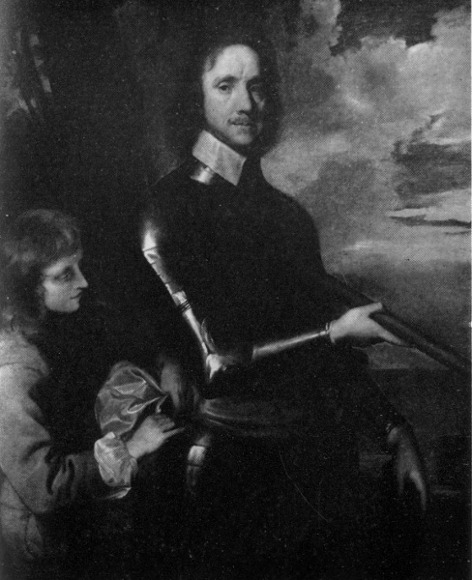
OLIVER CROMWELL Painting by Robert Walker
Parliamentary Governors, 1652-1659
Early writers on Virginia history tended to overemphasize how completely affairs in Virginia during the Commonwealth and Protectorate periods were in the hands of the House of Burgesses. Still, the House did assume to itself many of the powers of government in the period and asserted its ultimate authority in all other matters. It took this position out of necessity, and always with the proviso that, should instructions come from the supreme power in England, it would obey them.
The first Governor under the Commonwealth, Richard Bennett, was appointed by an act of Assembly on April 30, 1652, his term to last for one year or until the following meeting of the Assembly, with the further proviso that the appointment should be in effect "untill the further pleasures of the states be knowne." Bennett, a planter of Nansemond County, was a Puritan in his religious outlook and was one of those who had invited New England to send ministers to Virginia in the early 1640's. When Parliament decided to conquer the colony in 1651 it appointed him one of the commissioners for the enterprise. It is probable that the secret instructions issued to Bennett by the Parliamentary authorities required him to come to some agreement with the Burgesses on who should be Governor until a more formal commission for the office should issue from the supreme power in England. However, as the years passed, and as instructions from England failed to deal with Virginia's problems, the House of Burgesses asserted its prerogative more and more.
On March 31, 1655, Edward Digges was elected Governor by the Assembly to replace Bennett. Digges was the son of Sir Dudley Digges, Master of the Rolls under Charles I. He came to Virginia sometime before 1650 and bought a plantation on the York River, subsequently known as "Bellfield." The plantation become famous for the quality of the tobacco grown there, and was also the scene of Digges's efforts at silk production, in the culture of which he employed three Armenians. When Digges decided to return to England in 1656, Samuel Mathews was elected to succeed him. There is some confusion as to whether Governor Mathews was the man who so bedeviled Sir John Harvey in the 1630's, or his son of the same name.
When Mathews and the Council attempted to dissolve the Assembly on April 1, 1658, the Burgesses answered that the Governor's action was illegal, and that they would remain and complete their work. Mathews refused to concede their point formally, though he declared his willingness to allow them to continue in fact while the dispute was submitted to the Lord Protector in England. The Burgesses declared his answer unsatisfactory. They demanded a specific acknowledgment that the House remained undissolved. Mathews and the Council finally agreed to revoke the declaration of dissolution, but still insisted on referring the dispute to the Lord Protector. The House rejected this answer as well, asserting that the present power of Virginia resided in the Burgesses, who were not dissolvable by any power extant in Virginia but themselves. They directed the High Sheriff of James City County not to execute any warrant but from the Speaker of the House. In addition, they ordered Col. William Claiborne, the Secretary of the Council, to surrender the records of the country into the hands of John Smith, the Speaker of the Assembly, on the basis of the Burgesses' declaration to hold "supreame power of this country."
That the House of Burgesses did not mean its actions to be in defiance of the power that existed in England, however, is shown by its agreement to proclaim Richard, son of Oliver Cromwell, Lord Protector when the Governor sent down, at the March 1659 session, an official letter from His Highness' Council requiring that it be done. Immediately after agreeing to proclaim Richard, the Burgesses decided to address the new Lord Protector for confirmation of the privilege granted to the Assembly, perhaps under the terms of Bennett's secret instructions, to elect its own officers. Although the Speaker of the House assured the Burgesses that the Governor was willing to join them in such a request, some of the Burgesses expressed a desire to hear the assurance from the Governor's own lips. Accordingly, he was sent for and, to the satisfaction of the Burgesses, "acknowledged the supream power of electing officers to be by the present lawes resident in the Grand Assembly." He promised to join them in requesting confirmation of these privileges from His Highness.
The Assembly, at this same session, passed an act electing Mathews Governor again for two years "and then the Grand Assembly to elect a Governour as they shall think fitt." The act was to be in force "until his Highness pleasure be further signified." William Claiborne was appointed Secretary of State on his acknowledgment that he received the place from the Assembly, and with the proviso that he should continue Secretary until the next Assembly or until the Lord Protector's pleasure should be further signified to the colony.
The Assembly of 1659 marks the high water point of local government in Virginia. Not only were the Burgesses supreme in matters of general legislation, compelling the Governor and Secretary to bow to their sovereign power, but in their home counties affairs were conducted much as the local justices saw fit. The Assembly of 1659 even authorized free trade with the Indians by anyone in any goods—even guns and ammunition. Never before had regulation on a point of such vital interest to the security of the colony been so utterly abandoned.
Recall of Sir William Berkeley by the Assembly, 1659-1660
Soon after the Assembly of March 1659 ended, Richard Cromwell resigned the reins of government in England. The English nation was again plunged into turmoil. Letters arriving in Virginia spoke of the people divided "some for one Government some for another." The prospect of London "burned into Ashes and the streets running with blood" was held a likely outcome of the divisions.
In the midst of this troublous situation, Governor Mathews died. The next Assembly met in March 1660. In a move that has astonished historians since that time it asked Sir William Berkeley, the royal Governor whom its former leaders had deposed, to govern Virginia again. No royal banners were unfurled; Charles II was not proclaimed King. The House of Burgesses, holding the supreme power in the colony, merely offered the governorship to the man who had been universally admired for his justice, humanity, and willingness to sacrifice his own interest to that of the colony.
Berkeley had been unwilling to disavow his loyalty to the Crown in 1652 and he was not prepared to do so now. He replied to the Burgesses' invitation by saying that he would not dare to offend the King by accepting a commission to govern from any power in England opposed to him. He urged them to choose instead a more vigorous man from amongst their own number. But he did offer to accept the governorship directly from the House of Burgesses if the Council would concur with the Burgesses in offering it to him. He promised that if thereafter any supreme power in England succeeded in re-establishing its authority in Virginia he would immediately lay down his commission and "will live most submissively obedient to any power God shall set over me, as the experience of eight yeares have shewed I have done." He would not refuse their call, he wrote, if they accepted his conditions, for "I should be worthily thought hospitall mad, if I would not change povertie for wealth,—contempt for honor."
The Council on March 21, 1660, unanimously concurred in the Burgesses' choice of Berkeley as Governor, and the King's loyal servant was thereupon installed in the office.
Some historians have seen the election of Berkeley as the signal for a royalist purge of the Parliamentary influences that were thought to have existed in the colony since 1652. A study of the membership of the House of Burgesses, Council, and county courts, however, shows a continuity of membership which extends from before the Parliamentary seizure of the colony until after the restoration of King Charles II. The evidence suggests that there was no violent division between royalists and Parliamentarians in Virginia. The people were Virginians first and royalists or Parliamentarians second. The solidarity of their political interests was a harbinger of the American independence that was slowly to mature in the next century.
On May 29, 1660, the birthday of Charles II, that monarch returned to London and was restored to the throne of England. Word of the restoration was received in Virginia in the fall, and Berkeley ordered the sheriffs and chief officers of all counties to proclaim Charles II King of England, and to cause all writs and warrants from that time on to issue in His Majesty's name. The Assembly of March 1661, taking into consideration the fact that the colony, by submitting to the "execrable power" of the Parliamentary forces, had thereby become guilty of the crimes of that power, enacted that January 30, the day Charles I was beheaded, should "be annually solemnized with fasting and prayers that our sorrowes may expiate our crime and our teares wash away our guilt." Another act declared May 29, the day of Charles II's birth and restoration, a holy day to be annually celebrated "in testimony of our thankfulnesse and joy."
Thus ended the brief period in which Virginia's government was turned upside down and permanent alteration caused in her relations with England. Although the King once more became the symbol of the unity of the colony and the mother country, the royal prerogative would never again be blindly accepted by the people of either place. Larger developments in the economic, social, and intellectual spheres were bringing to an end the era of all-powerful Kings. Power had descended to the lower ranks of society, and that power was beginning to be brought into play.
This larger shift of power has been chronicled in the story of Virginia from 1625 to 1660. It is the story of a small community of Englishmen transplanted to American shores, living for a time subject to traditional English restraints, then, in a period of rapid expansion, losing their cohesiveness and their values under the impact of the American experience and their own natures. Their political expression soon passed from a passive to an active mode. The law became something they made, not something someone else applied to them. Land was similarly not something bestowed on them by generous parents, but something one took from Nature, or Nature's surrogate, the Indian. Labor was no longer a privilege allowed the individual by the community, but a precious gift contributed by the individual to the community. In sum, the ordinary people who had removed themselves to the New World soon discovered that they were no longer humble servants of great lords, but were themselves lords of the American earth. If they had the power why not exercise it? The process by which the rulers of the people were forced to become the "servants" of their "subjects" thereupon began. The culmination of this rearrangement of the political atoms of society was the War for Independence of 1776. Whether the swing from authority to liberty was for good or for evil is not for the historian to say.