Part 2 — XXIII (continued 2)
Reading edition
Notwithstanding such instructive object-lessons as these, with which all parts of China must to a greater or less extent abound, many of those who think that they can afford to do so continue to repeat the experiment, although the adage says: “If your wife is against it, do not take a concubine.” If this advice were to be adopted, it is not improbable that the practice of concubinage in China would become practically extinct.
A traveller through China often notices in the villages along his route that in the early morning most of the men seem to be assembled by the roadside, each one squatting in front of his own door, all busily engaged in shovelling in their food with chopsticks (appropriately called “nimble-sons”), chatting meantime during the brief intervals with the neighbour nearest. That the entire family should sit down to a table, eating together and waiting for one another, after the manner of the inhabitants of Western lands, is an idea so foreign to the ordinary Chinese mind as to be almost incomprehensible.
This Chinese (and Oriental) habit is at once typical and suggestive. It marks a wholly different conception of the family, and of the position of woman therein, from that to which we are accustomed. It indicates the view that while man is yang, the male, ruling, and chief element in the universe, woman is yin, “dull, female, inferior.” The conception of woman as man’s companion is in China almost totally lacking, for woman is not the companion of man, and with society on its present terms she never can be. A new bride introduced into a family has visible relations with no one less than with her “husband.” He would be ashamed to be seen talking with her, and in general they seem in that line to have very little to be ashamed of. In those unique instances in which the young couple have the good sense to get acquainted with each other, and present the appearance of actually exchanging ideas, this circumstance is the joke of the whole family circle, and an insoluble enigma to all its members. We have heard of cases in which members of a family where there was a newly married couple, kept a string in which was tied a knot, every time that they were heard to speak to one another. This cord would be subsequently exhibited to them in ridicule of their intimacy!
A Chinese bride has no rational prospect of happiness in her new home, though she may be well dressed, well fed, and perhaps not abused. She must expect chronic repression through the long years during which she is for a time in fact, and in theory always, a “child.” Such rigorous discipline may be necessary to fit her for the duties of her position, when she shall have become herself a mother-in-law, and at the head of a company of daughters-in-law, but it is a hard necessity. That there are sometimes genuine attachments between mothers-in-law and daughters-in-law it would be a mistake to deny, for in such rare cases human nature shows its power of rising superior to the conventional trammels in which it finds itself by iron customs bound.
To defend herself against the fearful odds which are often pitted against her, a Chinese wife has but two resources. One of them is her mother’s family, which, as we have seen, has no real power, and is too often to be compared to the stern light of a ship, of no service for protection in advance, and only throwing a lurid glare on the course which has been passed over, but which cannot be retraced.
The other means of defence which a Chinese wife has at her command is—herself. If she is gifted with a fluent tongue, especially if it is backed by some of that hard common sense which so many Chinese exhibit, it must be a very peculiar household in which she does not hold her own. Real ability will assert itself, and such light as a Chinese woman possesses will assuredly permeate every corner of the domestic bushel under which it is of necessity hidden. If a Chinese wife has a violent temper, if she is able at a moment’s notice to raise a tornado about next to nothing, and to keep it for an indefinite period blowing at the rate of a hundred miles an hour, the position of such a woman is almost certainly secure. The most termagant of mothers-in-law hesitates to attack a daughter-in-law who has no fear of men or of demons, and who is fully equal to any emergency. A Chinese woman in a fury is a spectacle by no means uncommon. But during the time of the most violent paroxysms of fury, Vesuvius itself is not more unmanageable by man.
If a Chinese husband happens to be a person of a quiet habit, with no taste for tumults, he may possibly find himself yoked to a Xantippe who never for an instant relaxes the reins of her dominion. In such cases the prudent man will be glad to purchase “peace at any price,” and whatever the theory may be, the woman rules. Such instances are by no means infrequent. This is witnessed as well by what one sees and hears in Chinese society as well as by the many sayings which refer to the “man-who-fears-what-is-inside,” that is, the “hen-pecked man.” Although it is an accepted adage that
“A genuine cat will slay a mouse, A genuine man will rule his house,”
yet there are numerous references to the punishment of “kneeling-by-the-bedside-holding-a-lamp-on-the-head,” which is the penalty exacted by the regnant wife from her disobedient husband.
If a Chinese woman has the heaven-bestowed gift of being obstreperous to such a degree that, as the sayings go, “people do not know east from west”; that “men are worn out and horses exhausted”; that “the mountains tremble and the earth shakes,” this is unquestionably her surest life-preserver. It is analagous to the South American toucan, which is said to frighten away enemies by the mere exhibition of itself, they not caring to wait for further and detailed proofs of its capacities of execution. But if such an endowment has been denied her, her next best resource is to pursue a course exactly the opposite, in all circumstances and under all provocations holding her tongue. To most Chinese women, this seems to be a feat as difficult as aërial navigation, but now and then an isolated case shows that the difficult is not always the impossible.
The present position of woman in China is a heritage of the remote past, as is illustrated by the most ancient Chinese literature, an example of which heads the present chapter. The instructions and the prohibitions in the Book of Rites, one of the oldest and most venerated classical works, embody fundamental principles which have always governed the Chinese in their treatment of women. The essence of the Chinese classical teaching on this subject is, that woman is as inferior to man as the earth is inferior to heaven; and that she can never attain to full equality with man.
According to Chinese philosophy death and evil have their origin in the Yin, or female principle of Chinese dualism, while life and prosperity come from the subjection of it to the Yang, or male principle; hence it is regarded as a law of nature to keep woman completely under the power of man, and to allow her no will of her own. The result of this theory and the corresponding practice is that the ideal for women is not development and cultivation, but submission. Women can have no happiness of their own, but must live and work for men, the only practical escape from this degradation being found in becoming the mother of a son. Woman is bound by the same laws of existence in the other world. She belongs to the same husband, and is dependent for her happiness on the sacrifices offered by her descendants.[5]
It is occasionally objected that to attribute the evils attending the lot of woman in China to the moral system which has molded and preserved that empire, is as inaccurate as it would be to hold Christianity responsible for all the moral evils found in Christian lands. Between the two cases there is, however, this fundamental difference. Every moral evil has from the beginning been antagonized by Christianity. Those evils that still flourish do so in spite of it, and against its unceasing efforts and incessant protest. Christianity acting upon the relatively lofty conception of woman, held by the Teutonic races, has gradually brought about that elevation of the sex which we now witness in full development. The theory of Confucianism, on the other hand, is both erroneous and defective. It is therefore no exaggeration to charge a large part of the evils from which Chinese women suffer to this efficient cause. It is moreover highly important to remember that neither for evils arising from wrong moral teaching nor for others, has Chinese ethics ever furnished either preventive or remedy.
We must, therefore, regard the position of women in China, as the ultimate outcome and a most characteristic fruitage of Confucianism. In our view it has been a bitter fruit, and in recapitulation we would lay emphasis upon seven deadly sins in the relation of that system to woman.
I. Viewed from a purely Chinese point of view there is no inherent objection to the education of Chinese women. In one of the huge Chinese encyclopedias, out of 1,628 books, 376 are devoted to famous women, and of these four chapters treat of female knowledge, and seven others of the literary productions of women, works which have been numerous and influential. But as compared with the inconceivable numbers of Chinese women in the past, these exceptional cases are but isolated twinkles in vast interstellar spaces of dense darkness. Yet in view of the coming regeneration of China, their value as historical precedents to antiquity loving Chinese is beyond estimation.[6]
Rare and unimportant exceptions aside, Chinese women are provided with no education. Their minds are left in a state of nature, until millions of them are led to suppose that they have no minds at all, an opinion which their fathers, husbands and brothers often do much to confirm, and upon which they then habitually act.
II. The sale of wives and daughters. This comes about so naturally, and it might almost be said so inevitably, when certain conditions prevail, that it is taken by the Chinese as a matter of course. Except in years of famine it appears in some parts of the empire to be rare, but in other parts it is the constant and the normal state of things for daughters to be as really sold as are horses and cattle.
There are sections of northern China in which it is not uncommon for a man who has contracted debts which he cannot otherwise pay, to part with a daughter as a last resort. But there are other districts where the practice cannot be exceptional, as is evident from the great number of girls who, one is told, have been procured from this region. If the Chinese themselves are questioned about the matter, the fact is always admitted, the custom is reprobated, but the universally conclusive inquiry is propounded: “What help is there for it?” In the present condition of the empire this interrogatory is unanswerable.
III. Too early and too universal marriages. A considerable part of the unhappiness caused by Chinese marriages may fairly be charged to the immaturity of the victims. To treat children as if they were adults, while at the same time treating them as children who require the same watch and ward as other children, does not appear to be a rational procedure, nor can it be claimed that it is justified by its results. That a new pair constitute a distinct entity to be dealt with independently, is a proposition which Confucianism treats with scorn, if indeed it ever entertains such a conception at all. The compulsory marriage of all girls forces all Chinese society into cast-iron grooves, and leaves no room for exceptional individual development. It throws suspicion around every isolated struggle against this galling bondage, and makes the unmarried woman seem a personified violation of the decrees of heaven and of the laws of man.
IV. Infanticide of female infants. This is a direct, if not a legitimate result of the tenet that male children are absolutely indispensable, applied in a social system where dire poverty is the rule, and where an additional mouth frequently means impending starvation. In a chapter in her “Pagoda Shadows,” on “The Extent of a Great Crime,” Miss Fielde combines a great variety of testimony taken from several different provinces, in the following paragraph. “I find that 160 Chinese women, all over fifty years of age, had borne 631 sons, and 538 daughters. Of the sons, 366, or nearly sixty per cent., had lived more than ten years; while of the daughters only 205, or thirty-eight per cent., had lived ten years. The 160 women, according to their own statements, had destroyed 158 of their daughters; but none had ever destroyed a boy. As only four women had reared more than three girls, the probability is that the number of infanticides confessed to is considerably below the truth. I have occasionally been told by a woman that she had forgotten just how many girls she had had, more than she wanted. The greatest number of infanticides owned to by any one woman is eleven.”
Infanticide will never cease in China, until the notion that the dead are dependent for their happiness upon sacrifices offered to them by the living shall have been totally overthrown.
V. Secondary wives. Concubinage is the natural result of the Confucian theory of ancestral worship. The misery which it has caused and still causes in China is beyond comprehension. Nothing can uproot it but a decay of faith in the assumption underlying all forms of worship of the dead.
VI. Suicides of wives and daughters. The preceding causes, operating singly and in combination, are wholly sufficient to account for the number of suicides among Chinese women. The wonder rather is that there are not more. But whoever undertakes to collect facts on this subject for any given district will not improbably be greatly surprised at the extraordinary prevalence of this practice. It is even adopted by children, and for causes relatively trifling. At times it appears to spread, like the smallpox, and the thirst for suicide becomes virtually an epidemic. As already mentioned, according to the native newspapers, there are parts of China in which young girls band themselves into a secret league to commit suicide within a certain time after they have been betrothed or married. The wretchedness of the lives to which they are condemned is thoroughly appreciated in advance, and fate is thus effectually checkmated. It would be wrong to overstate the evils suffered by woman in China, evils which have indeed many alleviations, and which are not to be compared to those of her sisters in India or in Turkey. But after all abatements have been made, it remains true that the death-roll of suicides is the most convincing proof of the woes endured by Chinese women.
VII. Overpopulation. The whole Chinese race is and always has been given up with a single devotion to the task of raising up a posterity, to do for the fathers what the fathers have done for the grandfathers. In this particular line, they have realized Wesley’s conception of the ideal church in its line, where, as he remarked, the members are “All at it, and always at it.” War, famine, pestilence sweep off millions of the population, but a few decades of peace seem to repair the ravages of the past, which are lost to sight, like battlefields covered with wide areas of waving grain.
However much we may admire the recuperative power of the Chinese people as a whole and individually, it is difficult not to feel righteous indignation toward a system which violates those beneficent laws of nature which would mercifully put an end to many branches of families when such branches are unfitted to survive. It is impossible to contemplate with equanimity the deliberate, persistent, and uniform propagation of poverty, vice, disease and crime, which ought rather to be surrounded with every restriction to prevent its multiplication, and to see this propagation of evil and misery done, too, with an air of virtue, as if this were of itself a kind of religion, often indeed the only form of religion in which the Chinese take any vital interest.
It is this system which loads down the rising generation with the responsibility for feeding and clothing tens of thousands of human beings who ought never to have been born, and whose existence can never be other than a burden to themselves, a period of incessant struggle without respite and without hope.
To the intelligent foreigner, the most prominent fact in China is the poverty of its people. There are too many villages to the square mile, too many families to the village, too many “mouths” to the family. Wherever one goes, it is the same weary tale with interminable reiteration. Poverty, poverty, poverty, always and evermore poverty. The empire is broad, its unoccupied regions are extensive, and its undeveloped resources undoubtedly vast. But in what way can these resources be so developed as to benefit the great mass of the Chinese people? By none, with which we are acquainted, or of which we can conceive, without a radical disturbance of the existing conditions. The seething mass of over-population must be drawn off to the regions where it is needed, and then only will there be room for the relief of those who remain.
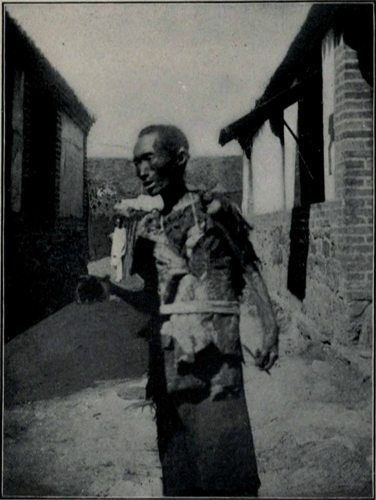
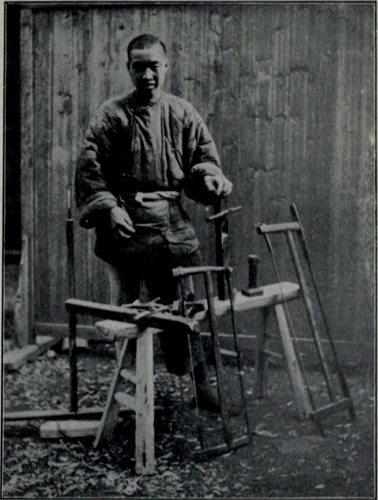
One of China’s Parasites—a Beggar. One of her Sources of Strength—a Carpenter.
It is impossible to do anything for people who are wedged together after the manner of matches in a box. Imagine a surgeon making the attempt to set the broken leg of a man in an omnibus in motion, which at the time contained twenty other people, most of whom also had broken legs which likewise require setting! The first thing to do would be to get them all unloaded, and to put them where they could be properly treated, with room for the treatment, and space for breathing. It is, we repeat, not easy to perceive how even the most advanced political economy can do anything of permanent benefit for the great mass of the Chinese without a redistribution of the surplus population. But at this point practical Confucianism intervenes, and having induced the begetting of this swarm of human beings, it declares that they must not abandon the graves of their ancestors, who require their sacrifices, but must in the same spot continue to propagate their posterity to continue the interminable process.
The world is still large, and it has, and for ages will doubtless continue to have, ample room for all the additional millions which its existing millions can produce. The world was never so much in need of the Chinese as to-day, and never, on the other hand, were the Chinese more in need of the world. But if China is to hold its own, much more if it is to advance as other nations have advanced and do advance, it must be done under the lead of new forces. Confucianism has been a mighty power to build up, and to conserve. But Confucianism with its great merits has committed many “Deadly Sins,” and of those sins it must ultimately suffer the penalty. Confucianism as a developing force is a force, which is spent. Sooner or later it must give way to something stronger, wiser, and better.