Part 2 — CHAPTER VI 1562-1595 FRANCIS DRAKE IN CALIFORNIA
Reading edition
How the Sea Rover was attacked and ruined as a Boy on the Spanish Main off Mexico—His Revenge in sacking Spanish Treasure Houses and crossing Panama—The Richest Man in England, he sails to the Forbidden Sea, scuttles all the Spanish Ports up the West Coast of South America and takes Possession of New Albion (California) for England
If a region were discovered where gold was valued less than cartloads of clay, and ropes of pearls could be obtained in barter for strings of glass beads, the modern mind would have some idea of the frenzy that prevailed in Spain after the discovery of America by Columbus. Native temples were found in Chile, in Peru, in Central America, in Mexico, where gold literally lined the walls, silver paved the floors, and handfuls of pearls were as thoughtlessly thrown in the laps of the conquerors as shells might be tossed at a modern clam-bake.
Within half a century from the time Spain first learned of America, Cortés not only penetrated Mexico, but sent his corsairs up the west coast of the {134} continent. Pizarro conquered Peru. Spanish ships plied a trade rich beyond dreams of avarice between the gold realms of Peru and the spice islands of the Philippines. The chivalry of the Spanish nobility suddenly became a chivalry of the high seas. Religious zeal burned to a flame against those gold-lined pagan temples. It was easy to believe that the transfer of wedges of pure gold from heathen hands to Spain was a veritable despoiling of the devil's treasure boxes, glorious in the sight of God. The trackless sea became the path to fortune. Balboa had deeper motives than loyalty, when, in 1513, on his march across Panama and discovery of the Pacific, he rushed mid-deep into the water, shouting out in swelling words that he took possession of earth, air, and water for Spain "for all time, past, present, or to come, without contradiction, … north and south, with all the seas from the Pole Arctic to the Pole Antarctic, … both now, and as long as the world endures, until the final day of judgment." [1]
Shorn of noise, the motive was simply to shut out the rest of the world from Spain's treasure box. The Monroe Doctrine was not yet born. The whole Pacific was to be a closed sea! To be sure, Vasco da Gama had found the way round the Cape of Good Hope to the Indian Ocean; and Magellan soon after passed through the strait of his name below South America {135} right into the Pacific Ocean; but round the world by the Indian Ocean was a far cry for tiny craft of a few hundred tons; and the Straits of Magellan were so storm-bound, it soon became a common saying that they were a closed door. Spain sent her sailors across Panama to build ships for the Pacific. The sea that bore her treasure craft—millions upon millions of pounds sterling in pure gold, silver, emeralds, pearls—was as closed to the rest of the world as if walled round with only one chain-gate; and that at Panama, where Spain kept the key.
That is, the sea was shut till Drake came coursing round the world; and his coming was so utterly impossible to the Spanish mind that half the treasure ships scuttled by the English pirate mistook him for a visiting Spaniard till the rallying cry, "God and Saint George!" wakened them from their dream.
It was by accident the English first found themselves in the waters of the Spanish Main. John Hawkins had been cruising the West Indies exchanging slaves for gold, when an ominous stillness fell on the sea. The palm trees took on the hard glister of metal leaves. The sunless sky turned yellow, the sea to brass; and before the six English ships could find shelter, a hurricane broke that flailed the fleet under sails torn to tatters clear across the Gulf of Mexico to Vera Cruz, the stronghold of Spanish power.
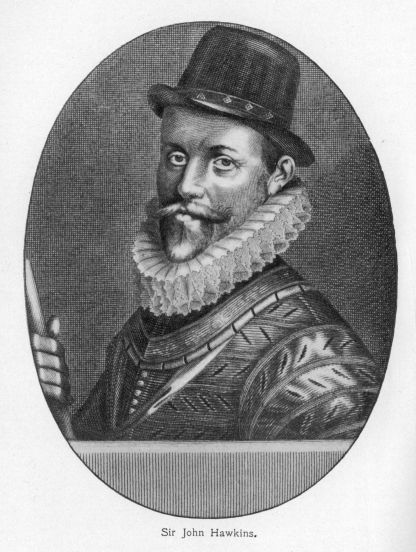
[Illustration: Sir John Hawkins.]
But Hawkins feared neither man nor devil. He {136} reefed his storm-torn sails, had the stoppers pulled out of his cannon in readiness, his gunners alert, ran up the English ensign, and boldly towed his fleet into port directly under Spanish guns. Sending a messenger ashore, he explained that he was sorry to intrude on forbidden waters, but that he needed to careen his ships for the repair of leakages, and now asked permission from the viceroy to refit. Perhaps, in his heart, the English adventurer wasn't sorry to get an inner glimpse of Mexico's defences. As he waited for permission, there sailed into the harbor the Spanish fleet itself, twelve merchantmen rigged as frigates, loaded with treasure to the value of one million eight hundred thousand pounds. The viceroy of Mexico, Don Martin Henriquez himself, commanded the fleet. English and Spanish ships dipped colors to each other as courteous hidalgoes might have doffed hats; and the guns roared each other salutes, that set the seas churning. Master John Hawkins quaffed mug after mug of foaming beer with a boisterous boast that if the Spaniards thought to frighten him with a waste of powder and smoke, he could play the same game, and "singe the don's beard."
Came a messenger, then, clad in mail to his teeth, very pompous, very gracious, very profuse of welcome, with a guarantee in writing from the viceroy of security for Hawkins while dismantling the English ships. In order to avoid clashes among the common soldiers, the fortified island was assigned for the English to {137} disembark. It was the 12th of August, 1568. Darkness fell with the warm velvet caress of a tropic sea. Half the crew had landed, half the cannon been trundled ashore for the vessels to be beached next day, when Hawkins noticed torches—a thousand torches—glistening above the mailed armor of a thousand Spanish soldiers marching down from the fort and being swiftly transferred to the frigates. A blare of Spanish trumpets blew to arms! The waters were suddenly alight with the flare of five fire-rafts drifting straight where the disarmed English fleet lay moored. Hawkins had just called his page to hand round mugs of beer, when a cannon-shot splintering through the mast arms overhead ripped the tankard out of his hand.[2]
"God and Saint George," thundered the enraged Englishman, "down with the traitorous devils!"
No time to save sailors ashore! The blazing rafts had already bumped keels with the moored fleet. No chance to raise anchors! The Spanish frigates were already abreast in a life-and-death grapple, soldiers boarding the English decks, sabring the crews, hurling hand grenades down the hatches to blow up the powder magazines. Hawkins roared "to cut the cables." It was a hand-to-hand slaughter on decks slippery with blood. No light but the musketry fire and glare of burning masts! The little English company were fighting like a wild beast trapped, when with a {138} thunderclap that tore bottom out of hull—Hawkins's ship flew into mid-air, a flaring, fiery wreck—then sank in the heaving trough of the sea, carrying down five hundred Spaniards to a watery grave. Cutlass in hand, head over heels went Hawkins into the sea. The hell of smoke, of flaming mast poles, of blazing musketry, of churning waters—hid him. Then a rope's end flung out by some friend gave handhold. He was up the sides of a ship, that had cut hawsers and off before the fire-rafts came! Sails were hoisted to the seaward breeze. In the carnage of fire and blood, the Spaniards did not see the two smallest English vessels scudding before the wind as if fiend-chased. Every light on the decks was put out. Then the dark of the tropic night hid them. Without food, without arms, with scarcely a remnant of their crews—the two ships drifted to sea.
Not a man of the sailors ashore escaped. All were butchered, or taken prisoners for a fate worse than butchery—to be torn apart in the market-place of Vera Cruz, baited in the streets to the yells of on-lookers, hung by the arms to out-of-doors scaffolding to die by inches, or be torn by vultures. The two ships at sea were in terrible plight. North, west, south was the Spanish foe. Food there was none. The crews ate the dogs, monkeys, parrots on board. Then they set traps for the rats of the hold. The starving seamen begged to be marooned. They would risk Spanish cruelty to escape starvation. Hawkins landed {139} three-quarters of the remnant crews either in Yucatan or Florida. Then he crept lamely back to England, where he moored in January, 1569.
Of the six splendid ships that had spread their sails from Plymouth, only the Minion and Judith came back; and those two had been under command of a thick-set, stocky, red-haired English boy about twenty-four years of age—Francis Drake of Devon, one of twelve sons of a poor clergyman, who eked out a living by reading prayers for the Queen's Navy Sundays, playing sailor week days. Francis, the eldest son, was born in the hull of an old vessel where the family had taken refuge in time of religious persecution. In spite of his humble origin, Sir Francis Russell had stood his godfather at baptism. The Earl of Bedford had been his patron. John Hawkins, a relative, supplied money for his education. Apprenticed before the mast from his twelfth year, Drake became purser to Biscay at eighteen; and so faithfully had he worked his way, when the master of the sloop died, it was bequeathed to young Drake. Emulous of becoming a great sailor like Hawkins, Drake sold the sloop and invested everything he owned in Hawkins's venture to the West Indies. He was ruined to his last penny by Spanish treachery. It was almost a religion for England to hate Spain at that time. Drake hated tenfold more now. Spain had taught the world to keep off her treasure box. Would Drake accept the lesson, or challenge it?
{140} Men who master destiny rise, like the Phenix, from the ashes of their own ruin. In the language of the street, when they fall—these men of destiny—they make a point of falling upstairs. Amid the ruin of massacre in Mexico, Drake brought away one fact—memory of Spanish gold to the value of one million eight hundred thousand pounds. Where did it come from? Was the secret of that gold the true reason for Spain's resentment against all intruders? Drake had coasted Florida and the West Indies. He knew they yielded no such harvest. Then it must come from one of three other regions—South America, Central America, Mexico.
For two years Drake prospected for the sources of that golden wealth. In the Dragon and Swan, he cruised the Spanish Main during 1570. In 1571 he was out again in the Swan. By 1572 he knew the secret of that gold—gold in ship-loads, in caravans of one thousand mules, in masses that filled from cellar to attic of the King's Treasure House, where tribute of one-fifth was collected for royalty. It came from the subjugated Kingdom of Peru, by boat up the Pacific to the Port of Panama, by pack-train across the isthmus—mountainous, rugged, forests of mangroves tangled with vines, bogs that were bottomless—to Nombre de Dios, the Spanish fort on the Atlantic side, which had become the storehouse of all New Spain. Drake took counsel of no one.
Next year he was back on the Spanish Main, in the {141} Pacha, forty-seven men; his brother John commanding the Swan with twenty-six of a crew, only one man older than fifty, the rest mere boys with hate in their hearts for Spanish blood, love in their hearts for Spanish gold. Touching at a hidden cove for provisions left the year before, Drake found this warning from a former comrade, stuck to the bark of a tree by a hunting knife:—
"Captain Drake—if you do fortune into this port, haste away; for the Spaniards have betrayed this place, and taken all away that you left here—your loving friend—John Garret."
Heeding the warning, Drake hastened away to the Isle of Pinos, off the isthmus, left the ships at a concealed cove here, armed fifty-three of his boldest fellows with muskets, crossbows, pikes, and spontoons. Then he called for drummers and trumpeters, and rowed in a small boat for Nombre de Dios, the treasure house of New Spain. The small boat kept on the offing till dark, then sent ashore for some Indians—half-breeds whom Spanish cruelty had driven to revolt. This increased Drake's force to one hundred and fifty men. Silently, just as the moon emerged from clouds lighting up harbor and town, the long-boat glided into Nombre de Dios. A high platform, mounted with brass cannon, fronted the water. Behind were thirty houses, thatch-roofed, whitewashed, palisaded, surrounded by courtyards with an almost European pomp. The King's Treasure House stood at one end of the market. Near it was a chapel with high wooden steeple.
{142} A Spanish ship lay furled in port. From this glided out a punt poled like mad by a Spaniard racing to reach the platform first. Drake got athwart the fellow's path, knocked him over, gagged his yells, and was up the platform before the sleepy gunner on guard was well awake. The sentry only paused to make sure that the men scrambling up the fort were not ghosts. Then he tore at the top of his speed for the alarm-bell of the chapel and, clapping down the hatch door of the steeple stairs in the faces of the pursuing Englishmen, rang the bells like a demon possessed.
Leaving twelve men to hold the platform as a retreat, Drake sent sixteen to attack the King's Treasure just at the moment he himself, with his hundred men, should succeed in drawing the entire Spanish garrison to a sham battle on the market-place. The cannon on the platform were spiked and overturned. Drums beating, trumpets blowing, torches aflare, the English freebooter marched straight to the market. Up at the Treasure House, John Drake and Oxenham had burst open the doors of the store-room just as the saddled mules came galloping to carry the booty beyond danger. A lighted candle on the cellar stair showed silver piled bar on bar to the value of one million pounds. Down on the market, the English trumpeter lay dead. Drake had fallen from a sword slash and, snatched up by comrades, the wound stanched by a scarf, was carried back to the boat, where the raiders made good their escape, richer by a million pounds with the loss of only one man.
{143} Drake cruised the Spanish Main for six more months. From the Indians he learned that the mule trains with the yearly output of Peruvian gold would leave the Pacific in midwinter to cross overland to Nombre de Dios. No use trying to raid the fort again! Spain would not be caught napping a second time. But Pedro, a Panama Indian, had volunteered to guide a small band of lightly equipped English inland behind Nombre de Dios, to the halfway house where the gold caravans stopped. The audacity of the project is unparalleled. Eighteen boys led by a man not yet in his thirtieth year accompanied by Indians were to invade a tangled thicket of hostile country, cut off from retreat, the forts of the enemy—the cruelest enemy in Christendom—on each side, no provisions but what each carried in his haversack!
Led by the Indian Pedro, the freebooters struck across country, picked up the trail behind Nombre de Dios, marched by night, hid by day, Indian scouts sending back word when a Spaniard was seen, the English scudding to ambush in the tangled woods. Twelve days and nights they marched. At ten in the morning of February 11, they were on the Great Divide. Pedro led Drake to the top of the hill. Up the trunk of an enormous tree, the Indians had cut steps to a kind of bower, or lookout. Up clambered Francis Drake. Then he looked westward.
Mountains, hills, forested valleys, rolled from his feet westward. Beyond—what? The shining {144} expanse of the fabled South Sea! The Pacific silver in the morning light! A New World of Waters, where the sun's track seemed to pave a new path, a path of gold, to the mystic Orient! Never before had English eyes seen these waters! Never yet English prow cut these waves! Where did they lead—the endlessly rolling billows? For Drake, they seemed to lead to a New World of Dreams—dreams of gold, of glory, of immortal fame. He came down from the lookout so overcome with a great inspiration that he could not speak. Then, as with Balboa, the fire of a splendid enthusiasm lighted up the mean purposes of the adventurer to a higher manhood. Before his followers, he fell on his knees and prayed Almighty God to grant him the supreme honor of sailing an English ship on that sea!
That night the Indian came back with word that the mule train laden with gold was close on the trail. Drake scattered his men on each side of the road flat on their faces in high grass. Wealth was almost in their grasp. Hope beat riotous in the young bloods. No sound but the whir of wings as great tropic insects flitted through the dark with flashes of fire; or the clank of a soldier unstrapping haversack to steel courage by a drink of grog! An hour passed! Two hours before the eager ears pressed to earth detected a padded hoof-beat over grass. Then a bell tinkled, as the leader of the pack came in sight. Drunk with the glory of the day, or too much grog, some fool sailor leaped in {145} mid-air with an exultant yell! In a second the mule train had stampeded.
By the time Drake came to the halfway house,[3] the gold was hidden in the woods, and the Spaniards fleeing for their lives; though an old chronicle declares "the general" went from house to house assuring the Spanish ladies they were safe. The Spaniards of Tierra Firme were simply paralyzed with fright at the apparition of pirates in the centre of the kingdom. Then scouts brought word of double danger: on the Atlantic side, Spanish frigates were searching for Drake's ships; from the Pacific, two hundred horsemen were advancing in hot pursuit. Between the two—was he trapped?—Not he! Overland went a scout to the ships—Drake's own gold toothpick as token—bidding them keep offshore; he would find means to come out to them. Then he retreated over the trail at lightning pace, sleeping only in ambush, eating in snatches, coming out on the coast far distant from Nombre de Dios and Spanish frigates. Binding driftwood into a raft, Drake hoisted sail of flour sacks. Saying good-by to the Indian, the freebooter noticed Pedro's eyes wander to the gold-embossed Turkish cimeter in his own hand, and at once presented scabbard and blade to the astonished savage. In gratitude the Indian tossed three wedges of gold to the raft now sheering out with the tide to sea. These Drake gave {146} to his men. Six hours the raft was drifting to the sails on the offing, and such seas were slopping across the water-logged driftwood, the men were to their waists in water when the sail-boats came to the rescue.
On Sunday morning, August 9, 1573, the ships were once more in Plymouth. Whispers ran through the assembled congregations of the churches that Drake, the bold sea-rover, was entering port loaded with foreign treasure; and out rushed every man, woman, and child, leaving the scandalized preachers thundering to empty pews.
Drake was now one of the richest men in England. At his own cost he equipped three frigates for service under Essex in Ireland, and through the young Earl was introduced to the circle of Elizabeth's advisers. To the Queen he told his plans for sailing an English ship on the South Sea. To her, no doubt, he related the tales of Spanish gold freighting that sea, closed to the rest of the world. Good reason for England—Spain's enemy—to prove that the ocean, like air, was free to all nations! The Pope's Bull dividing off the southern hemisphere between Portugal and Spain mattered little to a nation belligerently Protestant, and less to a seaman whose dauntless daring had raised him from a wharf-rat to Queen's adviser. Elizabeth could not yet wound Spain openly; but she received Drake in audience, and presented him a magnificent sword with the words—"Who striketh thee, Drake, striketh us!"
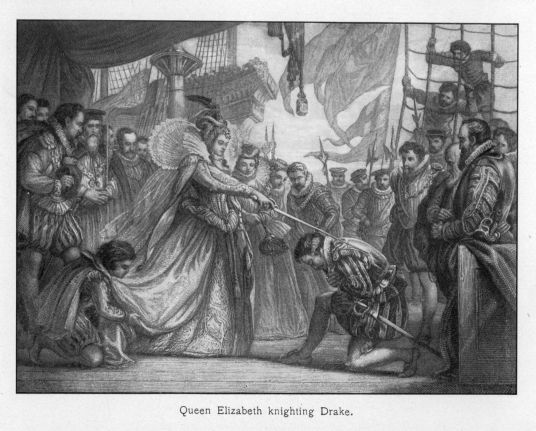
[Illustration: Queen Elizabeth knighting Drake.]
{147} Five ships, this time, he led out from Plymouth in November of 1577. Gales drove him back. It was December before his fleet was at sea—the Pelican of one hundred tons and twenty or thirty cannon under Drake, Thomas Doughty, a courtier second to Drake, the Elizabeth of eighty tons, the Swan, Christopher, and Marygold no larger than fishing schooners; manned in all by one hundred and sixty sailors, mostly boys.
Outward bound for trade in Egypt, the world was told, but as merchantmen, the ships were regally equipped—Drake in velvets and gold braid, served by ten young gentlemen of noble birth, who never sat or covered in his presence without permission; service of gold plate at the mess table, where Drake dined alone like a king to the music of viols and harps; military drill at every port, and provisions enough aboard to go round the world, not just to Egypt.
January saw the fleet far enough from Egypt, at the islands off the west coast of Africa, where three vessels were scuttled, the crews all put ashore but one Portuguese pilot carried along to Brazil as guide. Thomas Doughty now fell in disfavor by openly acting as equal in command with Drake. Not in Egypt, but at Port St. Julian—a southern harbor of South America—anchored Drake's fleet. The scaffold where Magellan had executed mutineers half a century before still stood in the sands.
The Christopher had already been sent adrift as useless. The Swan was now broken up as unseaworthy, {148} leaving only the Pelican, the Elizabeth, and the Marygold. One thing more remained to be done—the greatest blot across the glory of Drake. Doughty was defiant, a party growing in his favor. When sent as prisoner to the Marygold, he had angered every man of the crew by high-handed authority. Drake dared not go on to unknown, hostile seas with a mutiny, or the chance of a mutiny brewing. Whether justly or unjustly, Doughty was tried at Port St. Julian under the shadow of Magellan's old scaffold, for disrespect to his commander and mutiny; and was pronounced guilty by a jury of twelve. A council of forty voted his death. The witnesses had contradicted themselves as if in terror of Drake's displeasure; and some plainly pleaded that the jealous crew of the Marygold were doing an innocent gentleman to death. The one thing Drake would not do, was carry the trouble maker along on the voyage. Like dominant spirits world over, he did not permit a life more or less to obstruct his purpose. He granted Doughty a choice of fates—to be marooned in Patagonia, or suffer death on the spot. Protesting his innocence, Doughty spurned the least favor from his rival. He refused the choice.
Solemnly the two, accuser and accused, took Holy Communion together. Solemnly each called on God as witness to the truth. A day each spent in prayer, these pirate fellows, who mixed their religion with their robbery, perhaps using piety as sugar-coating for their ill-deeds. Then they dined together in the {149} commander's tent,—Fletcher, the horrified chaplain, looking on,—drank hilariously to each other's healths, to each other's voyage whatever the end might be, looked each in the eye of the other without quailing, talking nonchalantly, never flinching courage nor balking at the grim shadow of their own stubborn temper. Doughty then rose to his feet, drank his last bumper, thanked Drake graciously for former kindness, walked calmly out to the old scaffold, laid his head on the block, and suffered death. Horror fell on the crew. Even Drake was shaken from his wonted calm; for he sat apart, his velvet cloak thrown back, slapping his crossed knees, and railing at the defenders of the dead man.[4] To rouse the men, he had solemn service held for the crew, and for the first time revealed to them his project for the voyage on the Pacific. After painting the glories of a campaign against Spanish ports of the South Seas, he wound up an inspiriting address with the rousing assurance that after this voyage, "the worst boy aboard would never nede to goe agayne to sea, but be able to lyve in England like a right good gentleman." Fletcher, the chaplain, who secretly advocated the dead man's cause, was tied to a mast pole in bilboes, with the inscription hung to his neck—"Falsest knave that liveth."
On August 17 they departed from "the port {150} accursed," for the Straits of Magellan, that were to lead to Spanish wealth on the Pacific.[5]
The superstitious crews' fears of disaster for the death of Doughty seemed to become very real in the terrific tempests that assailed the three ships as they entered the straits. Gales lashed the cross tides to a height of thirty feet, threatening to swamp the little craft. Mountains emerged shadowy through the mists on the south. Roiling waters met the prows from end to end of the straits. Topsails were dipped, psalms of thanks chanted, and prayers held as the ships came out on the west side into the Pacific on the 6th of September. In honor of the first English vessel to enter this ocean, Drake renamed his ship "Golden Hind." {151} The gales continued so furiously, Drake jocosely called the sea, Mare Furiosum, instead of Pacific. The first week of October storms compelled the vessels to anchor. In the raging darkness that night, the explosive rip of a snapping hawser was heard behind the stern of the Golden Hind. Fearful cries rose from the waves for help. The dark form of a phantom ship lurched past in the running seas—the Marygold adrift, loose from her anchor, driving to the open storm; fearful judgment—as the listeners thought—for the crew's false testimony against Doughty; for, as one old record states, "they could by no means help {152} spooming along before the sea;" and the Marygold was never more seen.
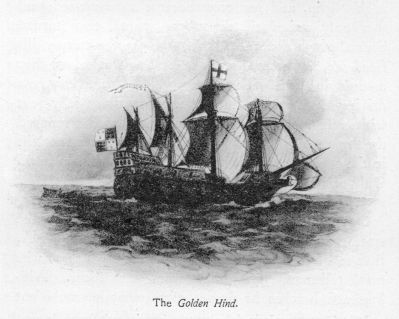
[Illustration: The Golden Hind.]
Meanwhile like disaster had befallen the Golden Hind, the cable snapping weak as thread against the drive of tide and wind. Only the Elizabeth kept her anchor grip, and her crew became so panic-stricken, they only waited till the storm abated, then turned back through the straits, swift heels to the stormy, ill-fated sea, and steered straight for England, where they moored in June. Towed by the Golden Hind, now driving southward before the tempest, was a jolly-boat with eight men. The mountain seas finally wrenched the tow-rope from the big ship, and the men were adrift in the open boat. Their fortunes are a story in itself. Only one of the eight survived to reach England after nine years' wandering in Brazil.[6]
Onward, sails furled, bare poles straining to the storm, drifted Drake in the Golden Hind. Luck, that so often favors daring, or the courage, that is its own talisman, kept him from the rocks. With battened hatches he drove before what he could not {153} stem, southward and south, clear down where Atlantic and Pacific met at Cape Horn, now for the first time seen by navigator. Here at last, on October 30, came a lull. Drake landed, and took possession of this earth's end for the Queen. Then he headed his prow northward for the forbidden waters of the Pacific bordering New Spain. Not a Spaniard was seen up to the Bay of San Filipe off Chile, where by the end of November Drake came on an Indian fisherman. Thinking the ship Spanish, the fellow offered to pilot her back eighteen miles to the harbor of Valparaiso.
Spanish vessels lay rocking to the tide as Drake glided into the port. So utterly impossible was it deemed for any foreign ship to enter the Pacific, that the Spanish commander of the fleet at anchor dipped colors in salute to the pirate heretic, thinking him a messenger from Spain, and beat him a rattling welcome on the drum as the Golden Hind knocked keels with the Spanish bark. Drake, doubtless, smiled as he returned the salute by a wave of his plumed hat. The Spaniards actually had wine jars out to drown the newcomers ashore, when a quick clamping of iron hooks locked the Spanish vessel in death grapple to the Golden Hind. An English sailor leaped over decks to the Spanish galleon with a yell of "Downe, Spanish dogges!" The crew of sixty English pirates had swarmed across the vessel like hornets before the poor hidalgo knew what had happened. Head over heels, down the hatchway, reeled the astonished dons. Drake clapped down {154} hatches, and had the Spaniards trapped while his men went ashore to sack the town. One Spaniard had succeeded in swimming across to warn the port.[7] When Drake landed, the entire population had fled to the hills. Rich plunder in wedges of pure gold, and gems, was carried off from the fort. Not a drop of blood was shed. Crews of the scuttled vessels were set ashore, the dismantled ships sent drifting to open sea. The whole fiasco was conducted as harmlessly as a melodrama, with a moral thrown in; for were not these zealous Protestants despoiling these zealous Catholics, whose zeal, in turn, had led them to despoil the Indian? There was a moral; but it wore a coat of many colors.
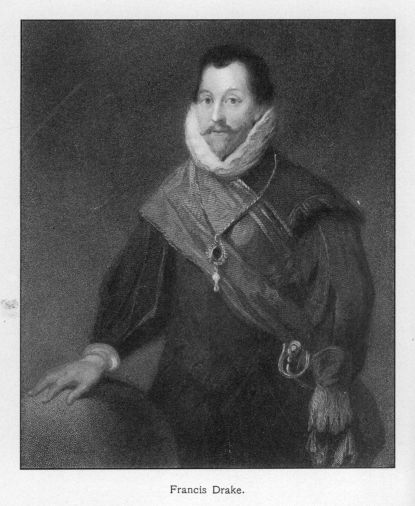
[Illustration: Francis Drake.]
The Indian was rewarded, and a Greek pilot forced on board to steer to Lima, the great treasury of Peruvian gold. Giving up all hope of the other English vessels joining him, Drake had paused at Coquimbo to put together a small sloop, when down swooped five hundred Spanish soldiers. In the wild scramble for the Golden Hind, one sailor was left behind. He was torn to pieces by the Spaniards before the eyes of Drake's crew. Northling again sailed Drake, piloted inshore by the Greek to Tarapaca, where Spanish treasure was sent out over the hills to await the call of ship; and sure enough, sound asleep in the sunlight, fatigued from his trip lay a Spanish carrier, {155} thirteen bars of silver piled beside him on the sand. When that carrier wakened, the ship had called! Farther on the English moored and went inland to see if more treasure might be coming over the hills. Along the sheep trails came a lad whistling as he drove eight Peruvian sheep laden with black leather sacks full of gold.
Drake's men were intoxicated with their success. It was impossible to attack Panama with only the Golden Hind; but what if the Golden Hind could catch the Glory of the South Seas—the splendid Spanish galleon that yearly carried Peruvian gold up to Panama? Drake gained first news of the treasure ship being afloat while he was rifling three barks at Aricara below Lima; but he knew coureurs were already speeding overland to warn the capital against the Golden Hind. Drake pressed sail to outstrip the land messenger, and glided into Callao, the port of Lima, before the thirty ships lying dismantled had the slightest inkling of his presence.
Viceroy Don Francisco de Toledo of Lima thought the overland coureur mad. A pirate heretic in the South Seas! Preposterous! Some Spanish rascal had turned pirate; so the governor gathered up two thousand soldiers to march with all speed for Callao, with hot wrath and swift punishment for the culprit. Drake had already sacked Callao, but he had missed the treasure ship. She had just left for Panama. The Golden Hind was lying outside the port becalmed {156} when Don Toledo came pouring his two thousand soldiers down to the wharves. The Spaniards dashed to embark on the rifled ships with a wild halloo! He was becalmed, the blackguard pirate,—whoever he was,—they would tow out! Divine Providence had surely given him into their hands; but just as they began rowing might and main, a fresh wind ruffled the water. The Golden Hind spread her wings to the wind and was off like a bird! Drake knew no ship afloat could outsail his swift little craft; and the Spaniards had embarked in such haste, they had come without provisions. Famine turned the pursuers back near the equator, the disgusted viceroy hastening to equip frigates that would catch the English pirate when famine must compel him to head southward.
Drake slackened sail to capture another gold cargo. The crew of this caravel were so grateful to be put ashore instead of having their throats cut, that they revealed to Drake the stimulating fact that the Glory of the South Seas, the treasure ship, was only two days ahead laden with golden wealth untold.
It was now a wild race for gold—for gold enough to enrich every man of the crew; for treasure that might buy up half a dozen European kingdoms and leave the buyer rich; for gold in huge slabs the shape of the legendary wedges long ago given the rulers of the Incas by the descendants of the gods; gold to be had for the taking by the striking of one sure blow at England's enemy! Drake called on the crew to acquit {157} themselves like men. The sailors answered with a shout. Every inch of sail was spread. Old muskets and cutlasses were scoured till they shone like the sun. Men scrambled up the mast poles to gaze seaward for sight of sail to the fore. Every nerve was braced. They were now across the equator. A few hundred miles more, and the Glory of the South Seas would lie safe inside the strong harbor of Panama. Drake ordered the thirty cannon ready for action, and in a loud voice offered the present of his own golden chain to the man who should first descry the sails of the Spanish treasure. For once his luck failed him. The wind suddenly fell. Before Drake needed to issue the order, his "brave boys" were over decks and out in the small boats rowing for dear life, towing the Golden Hind. Day or night from February twenty-fourth, they did not slack, scarcely pausing to eat or sleep. Not to lose the tremendous prize by seeing the Glory of the South Seas sail into Panama Bay at the last lap of the desperate race, had these bold pirates ploughed a furrow round the world, daring death or devil!
At three in the afternoon of March the 1st, John Drake, the commander's brother, shouted out from the mast top where he clung, "Sail ho!" and the blood of every Englishman aboard jumped to the words! At six in the evening, just off Cape Francisco, they were so close to the Glory of the South Seas, they could see that she was compelled to sail slowly, owing to the weight of her cargo. So unaware of danger was {158} the captain that he thought Drake some messenger sent by the viceroy, and instead of getting arms in readiness and pressing sail, he lowered canvas, came to anchor, and waited![8] Drake's announcement was a roaring cannonade that blew the mast poles off the Spanish ship, crippling her like a bird with wings broken. For the rest, the scene was what has been enacted wherever pirates have played their game—a furious fusillade from the cannon mouths belching from decks and port-holes, the unscathed ship riding down on the staggering victim like a beast on its prey, the clapping of the grappling hooks that bound the captive to the sides of her victor, the rush over decks, the flash of naked sword, the decks swimming in blood, and the quick surrender. The booty from this treasure ship was roughly estimated at twenty-six tons of pure silver, thirteen chests of gold plate, eighty pounds of pure gold, and precious jewels—emeralds and pearls—to the value in modern money of seven hundred and twenty thousand dollars.
Drake realized now that he dared not return to England by the Straits of Magellan. All the Spanish frigates of the Pacific were on the watch. The Golden Hind was so heavily freighted with treasure, it was actually necessary to lighten ballast by throwing spices and silks overboard. One can guess that the orchestra played a stirring refrain off Cape Francisco that night. The Northeast Passage from Asia to Europe was {159} still a myth of the geographers. Drake's friend, Frobisher, had thought he found it on the Atlantic side. After taking counsel with his ten chosen advisers, Drake decided to give the Spanish frigates the slip by returning through the mythical Northeast Passage. Stop was made at Guatalco, off the west coast of New Spain, for repairs. Here, the poor Portuguese pilot brought all the way from the islands off the west coast of Africa, was put ashore.[9] He was tortured by the Spaniards for piloting Drake to the South Seas. In the course of rifling port and ship at Guatalco, charts to the Philippines and Indian Ocean were found; so that even if the voyage to England by the Northeast Passage proved impossible, the Golden Hind could follow these charts home round the world by the Indian Ocean and Good Hope up Africa.
It was needless for Drake to sack more Spanish floats. He had all the plunder he could carry. From the charts he learned that the Spaniards always struck north for favorable winds. Heading north, month after month, the Golden Hind sailed for the shore that should have led northeast, and that puzzled the mariners by sheering west and yet west; fourteen hundred leagues she sailed along a leafy wilderness of tangled trees and ropy mosses, beauty and decay, the froth of the beach combers aripple on the very roots of the {160} trees; dolphins coursing round the hull like greyhounds; flying fish with mica for wings flitting over the decks; forests of seaweed warning out to deeper water. Then, a sudden cold fell, cold and fogs that chilled the mariners of tropic seas to the bone. The veering coast pushed them out farther westward, far north of what the Spanish charts showed. Instead of flying fish now, were whales, whales in schools of thousands that gambolled round the Golden Hind. As the north winds—"frozen nimphes," the record calls them—blew down the cold Arctic fogs, Drake's men thought they were certainly nearing the Arctic regions. Where were they? Plainly lost, lost somewhere along what are now known as Mendocino, and Blanco, and Flattery. In a word, perhaps up as far as Oregon, and Washington. One record says they went to latitude 43. Another record, purporting to be more correct, says 48. The Spaniards had been north as far as California, but beyond this, however far he may have gone, Drake was a discoverer in the true sense of the word. Mountains covered with snow they saw, and white cliffs, and low shelving shores, which is more descriptive of Oregon and Washington than California; but only the sudden transition from tropic heat to chilling northern fogs can explain the crew's exaggerated idea of cold along the Pacific coast. Land was sighted at 42, north of Mendocino, and an effort made to anchor farther north; but contrary winds and a rock bottom gave insecure mooring. {161} This was not surprising, as it was on this coast that Cook and Vancouver failed to find good harborage. The coast still seemed to trend westward, dispelling hopes of a Northeast Passage, and if the world could have accepted Drake's conclusions on the matter, a deal of expenditure in human life and effort might have been saved.
Two centuries before the deaths of Bering and Cook, trying to find that Passage, Drake's chronicler wrote: "The cause of this extreme cold we conceive to be the large spreading of the Asian and American continent, if they be not fully joined, yet seem they to come very neere, from whose high and snow-covered mountains, the north and north-west winds send abroad their frozen nimphes to the infecting of the whole air—hence comes it that in the middest of their summer, the snow hardly departeth from these hills at all; hence come those thicke mists and most stinking fogges, … for these reasons we coniecture that either there is no passage at all through these Northerne coasts, which is most likely, or if there be, that it is unnavigable.… Adde there unto, that though we searched the coast diligently even unto the 48 degree, yet found we not the land to trend in any place towards the East, but rather running continually North-west, as if it went directly to meet with Asia.… of which we infallibly concluded rather than coniectured, that there was none."
Giving up all idea of a Northeast Passage, Drake turned south, and on June 17 anchored in a bay now {162} thoroughly identified as Drake's Bay, north of San Francisco.
The next morning, while the English were yet on the Golden Hind, came an Indian in a canoe, shouting out oration of welcome, blowing feather down on the air as a sign of dovelike peace, and finally after three times essaying courage, coming near enough the English to toss a rush basket full of tobacco into the ship. In vain Drake threw out presents to allure the Indian on board. The terrified fellow scampered ashore, refusing everything but a gorgeous hat, that floated out on the water. For years the legend of Drake's ship was handed down as a tradition among the Indians of this bay.[10]
By the 21st tents were erected, and a rude fortification of stone thrown round in protection where the precious cargo of gold could be stored while the ship was to be careened and scraped. At the foot of the hill, the poor Indians gathered and gazed spellbound at the sight of this great winged bird of the ocean, sending thirty cannon trundling ashore, and herself beginning to rise up from the tide on piles and scaffolding. As Drake sent the assembled tribe presents, the Indians laid down their bows and spears. So marvellously did the wonders of the white men grow—sticks that emitted puffs of fire (muskets), a ship so large it could have carried their tribe, clothing in velvet and gold braid gorgeous as the plumage of a {163} bird, cutlasses of steel—that by the 23d great assemblages of Indians were on their knees at the foot of the hill, offering sacrifices to the wonderful beings in the fort. Whatever the English pirate's faults, he deserves credit for treating the Indians with an honor that puts later navigators to shame. When he saw them gashing bodies in sacrifice, his superstition took fire with fear of Divine displeasure for the sacrilege; and the man who did not scruple to treat black slaves picked up among the Spaniards baser than he would have treated dogs, now fell "to prayers," as the old chronicle says, reading the Bible aloud, and setting his crew to singing psalms, and pointing to the sky, at which the Indians grunted approvals of "ho—ho!"
Three days later came coureurs from the "King of the Indians"—the chief—bidding the strangers prepare for the great sachem's visit. The coureurs advanced gyrating and singing; so that the English saw in this strange people nomads like the races of Scripture, whose ceremony was one of song and dance. The warriors preceding the chief carried what the English thought "a sceptre," but what we moderns would call a peace-pipe. The chains in their hands were probably strings of bears' claws, or something like wampum; the "crowns of feathers," plumed head-dresses; the gifts in the rush baskets borne by the women to the rear, maize and tobacco.
Drake drew his soldiers up in line, and with trumpets sounding and armor at gleam marched out to {164} welcome the Indian chief. Then the whole company of savages broke out in singing and dancing. Drake was signalled to sit down in the centre. Barely had he obeyed when to the shouting and dancing of the multitude, "a chain" was thrown over his neck, "a crown" placed on his head, and "the sceptre" put in his hand. According to Indian custom, Drake was welcomed by the ceremony of adoption in the tribe, "the sceptre" being a peace-pipe; "the crown," an Indian warrior's head-dress. Far otherwise the ceremony appeared to the romantic treasure hunters. "In the name and to the use of Her Most Excellent Majesty," records the chaplain, "he (Drake) tooke the sceptre, crowne, and dignity of the sayd countrie into his hand;" though, added the pious chaplain of pirates, when he witnessed the Indians bringing the sick to be healed by the master pirate's touch,—"we groane in spirit to see the power of Sathan so farre prevails."
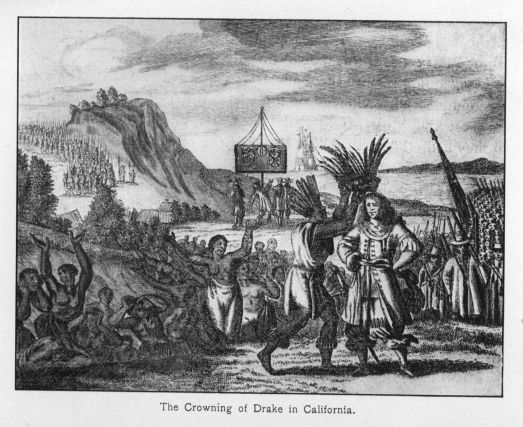
[Illustration: The Crowning of Drake in California.]
To avert disaster for the sacrilege of the sacred touch of healing, Drake added to his prayers strong lotions and good ginger plasters. Sometime in the next five weeks, Drake travelled inland with the Indians, and because of patriotism to his native land and the resemblance of the white sand cliffs to that land, called the region "New Albion." "New Albion" would be an offset to "New Spain." Drake saw himself a second Cortés, and nailed to a tree a brass plate on which was graven the Queen's name, the year, the free surrender of the country to the {165} Queen, and Drake's own name; for, says the chaplain, quite ignorant of Spanish voyages, "the Spaniards never had any dealing, or so much as set a foot in this country, the utmost of their discoveries reaching only many degrees Southward of this place."
Drake's misunderstanding of the Indian ceremony would be comical if it were not that later historians have solemnly argued whether an act of possession by a pirate should hold good in international law.
On the 23d of July the English pirate bade farewell to the Indians. As he looked back from the sea, they were running along the hilltops burning more of the fires which he thought were sacrifices.
Following the chart taken from the Spanish ship, Drake steered for the Philippines, thence southward through the East Indies to the Indian Ocean, and past Good Hope, back to Plymouth, where he came to anchor on September 26, 1580. Bells were set ringing. Post went spurring to London with word that Drake, the corsair, who had turned the Spanish world upside down, had come home. For a week the little world of England gave itself up to feasting. Ballads rang with the fame of Drake. His name was on every tongue. One of his first acts was to visit his old parents. Then he took the Golden Hind round the Channel to be dry-docked in Deptford.
For the once, the tactful Queen was in a quandary. Complaints were pouring in from Spain. The {166} Spanish ambassador was furious, and presented bills of sequestration against Drake, but as the amount sequestered, pending investigation, was only fifty-six thousand pounds, one may suspect that Elizabeth let Drake protect in his own way what he had taken in his own way. For six months, while the world resounded with his fame, the court withheld approval. Jealous courtiers "deemed Drake the master thief of the unknown world," till Elizabeth cut the Gordian knot by one of her defiant strokes. On April 4 she went in state to dine on the Golden Hind, to the music of those stringed instruments that had harped away Drake's fear of death or devil as he ploughed an English keel round the world. After the dinner, she bade him fall to his knees and with a light touch of the sword gave him the title that was seal of the court's approval. The Golden Hind was kept as a public relic till it fell to pieces on the Thames, and the wood was made into a memorial chair for Oxford.
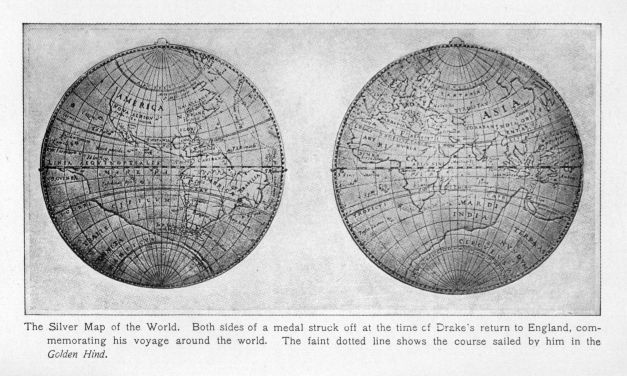
[Illustration: The Silver Map of the World. Both sides of a medal struck off at the time of Drake's return to England, commemorating his voyage around the world. The faint dotted line shows the course sailed by him in the Golden Hind.]
After all the perils Drake saw in the subsequent war—Cadiz and the Armada—it seems strange that he should return to the scene of his past exploits to die. He was with Hawkins in the campaign of 1595 against Spain in the New World. Things had not gone well. He had not approved of Hawkins's plans of attack, and the venture was being bungled. Sick of the equatorial fever, or of chagrin from failure, Drake died off Porto Bello in the fifty-first year of his age. His body {167} was placed in a leaden coffin, and solemnly committed to that sea where he had won his first glory.[11]
{172}