Front matter
Reading edition
This text uses UTF-8 (unicode) file encoding. If the apostrophes and quotation marks in this paragraph appear as garbage, you may have an incompatible browser or unavailable fonts. First, make sure that your browser’s “character set” or “file encoding” is set to Unicode (UTF-8). You may also need to change the default font.
All Plates except the Frontispiece were originally printed on right-hand pages. Some have been shifted slightly to fall between poems. The List of Illustrations shows their original location (facing page). Spacing of contractions such as I ’ve follows the original.
Contents Index of First Lines List of Illustrations Introduction Victorian Songs

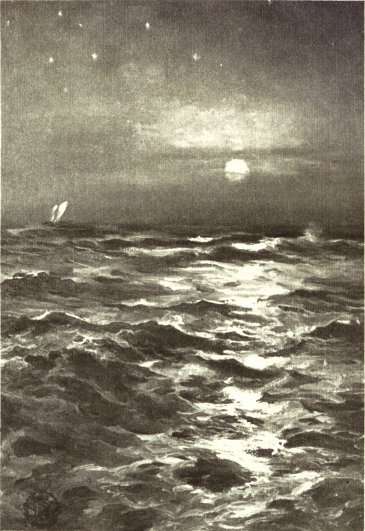
“‘Let some one sing to vs, lightlier move The minvtes fledged with mvsic’.”
TENNYSON

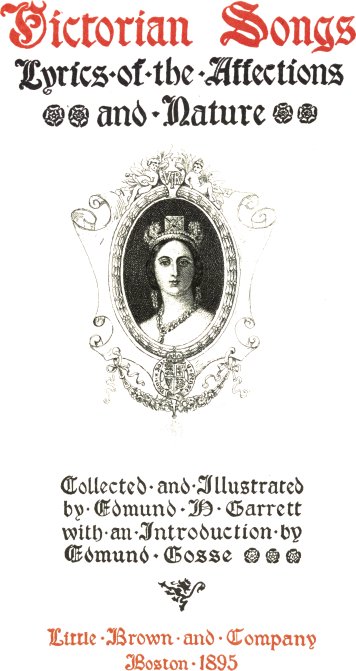
— Title Page Text —
Copyright, 1895. By Edmund H. Garrett.
University Press: John Wilson and Son, Cambridge, U.S.A.
Some editions of the book have a two-page Editor’s Note before the Contents, acknowledging the “publishers and authors who have given permission for the use of many of the songs included in this volume”. It has been omitted from this e-text.
Where are the songs I used to know? Christina Rossetti.
AÏDÉ, HAMILTON (1830). page
Remember or Forget 3
Oh, Let Me Dream 6
Love, the Pilgrim 7
ALLINGHAM, WILLIAM (1824-1889).
Lovely Mary Donnelly 9
Song 13
Serenade 14
Across the Sea 16
ARNOLD, SIR EDWIN (1832).
Serenade 18
A Love Song of Henri Quatre 20
No and Yes 22
At Altenahr 23
Marit 24
AUSTIN, ALFRED (1835).
A Night in June 26
BEDDOES, THOMAS LOVELL (1803-1849).
Dream-Pedlary 30
Song from the Ship 33
Song 34
Song 35
Song, by Two Voices 36
Song 38
BENNETT, WILLIAM COX (1820).
Cradle Song 39
My Roses blossom the Whole Year Round 41
Cradle Song 42
BOURDILLON, F. W. (1852).
Love’s Meinie 43
The Night has a Thousand Eyes 44
A Lost Voice 45
BUCHANAN, ROBERT (1841).
Serenade 46
Song 48
COLLINS, MORTIMER (1827-1876).
To F. C. 49
A Game of Chess 50
Multum in Parvo 52
Violets at Home 53
My Thrush 54
Too Late 56
A Silly Song 58
DARLEY, GEORGE (1795-1846).
May Day 60
I ’ve been Roaming 62
Sylvia’s Song 63
Serenade 64
DE TABLEY, LORD (1835).
A Winter Sketch 66
The Second Madrigal 69
DE VERE, AUBREY (1788-1846).
Song 70
Song 72
Song 74
DICKENS, CHARLES (1812-1870).
The Ivy Green 75
DOBSON, AUSTIN (1840).
The Ladies of St. James’s 77
The Milkmaid 81
DOMETT, ALFRED (1811-1887).
A Glee for Winter 84
A Kiss 86
DUFFERIN, LADY (1807-1867).
Song 88
Lament of the Irish Emigrant 90
FIELD, MICHAEL.
Winds To-day are Large and Free 94
Let us Wreathe the Mighty Cup 96
Where Winds abound 97
A Song 98
Song 99
GOSSE, EDMUND (1849).
Song for the Lute 101
HOOD, THOMAS (1798-1845).
Ballad 102
Song 104
I Remember, I Remember 106
Ballad 108
Song 110
HOUGHTON, LORD (RICHARD MONCKTON MILNES) (1809-1885).
The Brookside 111
The Venetian Serenade 113
From Love and Nature 115
INGELOW, JEAN (1830).
The Long White Seam 116
Love 118
Sweet is Childhood 120
KINGSLEY, CHARLES (1819-1875).
Airly Beacon 121
The Sands of Dee 122
Three Fishers went Sailing 124
A Farewell 126
LANDOR, WALTER SAVAGE (1775-1864).
Rose Aylmer 127
Rubies 128
The Fault is not Mine 129
Under the Lindens 130
131
Ianthe 132
One Lovely Name 133
Forsaken 133
LOCKER-LAMPSON, FREDERICK (1821-1895).
A Garden Lyric 134
The Cuckoo 137
Gertrude’s Necklace 139
LOVER, SAMUEL (1797-1868).
The Angel’s Whisper 141
What will you do, Love? 143
MACKAY, CHARLES (1814-1889).
I Love my Love 145
O Ye Tears! 147
MAHONEY, FRANCIS (1805-1866).
The Bells of Shandon 149
MASSEY, GERALD (1828).
Song 153
O’SHAUGHNESSY, ARTHUR (1844-1881).
A Love Symphony 156
I made Another Garden 158
PROCTER, ADELAIDE ANNE (1825-1864).
The Lost Chord 160
Sent to Heaven 162
PROCTER, B. W. (BARRY CORNWALL) (1787-1874).
The Poet’s Song to his Wife 165
A Petition to Time 167
A Bacchanalian Song 168
170
The Sea-King 172
A Serenade 174
King Death 176
Sit Down, Sad Soul 178
A Drinking Song 180
Peace! What do Tears Avail? 182
The Sea 184
ROSSETTI, CHRISTINA G. (1830-1895).
Song 186
Song 188
Song 189
Three Seasons 190
ROSSETTI, DANTE GABRIEL (1828-1882).
A Little While 191
Sudden Light 193
Three Shadows 194
SCOTT, WILLIAM BELL (1812-1890).
Parting and Meeting Again 196
SKIPSEY, JOSEPH (1832).
A Merry Bee 198
The Songstress 199
The Violet and the Rose 200
STERRY, J. ASHBY.
Regrets 201
Daisy’s Dimples 203
A Lover’s Lullaby 204
A Match 205
Rondel 208
Song 209
TENNYSON, ALFRED (1809-1892).
The Bugle Song 210
Break, Break, Break 212
Tears, Idle Tears 213
Sweet and Low 215
Turn, Fortune, Turn thy Wheel 216
Vivien’s Song 217
THACKERAY, WILLIAM MAKEPEACE (1811-1863).
At the Church Gate 218
The Mahogany Tree 220
THORNBURY, GEORGE WALTER (1828-1876).
Dayrise and Sunset 223
The Three Troopers 225
The Cuckoo 228

Listen—Songs thou ’lt hear Through the wide world ringing. Barry Cornwall.
page
A baby was sleeping Samuel Lover 141
“A cup for hope!” she said Christina G. Rossetti 190
A golden bee a-cometh Joseph Skipsey 198
A little shadow makes the sunrise sad Mortimer Collins 52
A little while a little love Dante Gabriel Rossetti 191
A thousand voices fill my ears F. W. Bourdillon 45
Across the grass I see her pass Austin Dobson 81
Ah, what avails the sceptered race! Walter Savage Landor 127
Airly Beacon, Airly Beacon Charles Kingsley 121
All glorious as the Rainbow’s birth Gerald Massey 153
All through the sultry hours of June Mortimer Collins 54
Along the garden ways just now Arthur O’Shaughnessy 156
Although I enter not William Makepeace Thackeray 218
As Gertrude skipt from babe to girl Frederick Locker-Lampson 139
As I came round the harbor buoy Jean Ingelow 116
Awake!—The starry midnight Hour B. W. Procter (Barry Cornwall) 174
Awake thee, my Lady-love! George Darley 64
Back flies my soul to other years Joseph Skipsey 199
Break, break, break Alfred Tennyson 212
Came, on a Sabbath noon, my sweet Thomas Ashe 23
Christmas is here William Makepeace Thackeray 220
Come, rosy Day! Sir Edwin Arnold 20
Come sing, Come sing, of the great Sea-King B. W. Procter (Barry Cornwall) 172
Could ye come back to me, Douglas, Douglas Dinah Maria Mulock Craik 56
Drink, and fill the night with mirth! B. W. Procter (Barry Cornwall) 180
Every day a Pilgrim, blindfold Hamilton Aïdé 7
Fast falls the snow, O lady mine Mortimer Collins 49
First the fine, faint, dreamy motion Norman Gale 98
Hence, rude Winter! crabbed old fellow Alfred Domett 84
How many Summers, love B. W. Procter (Barry Cornwall) 165
How many times do I love thee, dear? Thomas Lovell Beddoes 38
I bring a garland for your head Edmund Gosse 101
I had a Message to send her Adelaide Anne Procter 162
I have been here before Dante Gabriel Rossetti 193
I leaned out of window, I smelt the white clover Jean Ingelow 118
I looked and saw your eyes Dante Gabriel Rossetti 194
I made another garden, yea Arthur O’Shaughnessy 158
I remember, I remember Thomas Hood 106
I sat beside the streamlet Hamilton Aïdé 3
I wandered by the brook-side Lord Houghton 111
I walked in the lonesome evening William Allingham 16
If I could choose my paradise Thomas Ashe 22
If love were what the rose is Algernon Charles Swinburne 205
If there were dreams to sell Thomas Lovell Beddoes 30
I ’m sitting on the stile, Mary Lady Dufferin 90
In Clementina’s artless mien Walter Savage Landor 131
In Love, if Love be Love, if Love be ours Alfred Tennyson 217
Into the Devil tavern George Walter Thornbury 225
It was not in the winter Thomas Hood 102
I ’ve been roaming! I ’ve been roaming! George Darley 62
King Death was a rare old fellow! B. W. Procter (Barry Cornwall) 176
Kissing her hair I sat against her feet. Algernon Charles Swinburne 208
Lady! in this night of June Alfred Austin 26
Last time I parted from my Dear William Bell Scott 196
Let us wreathe the mighty cup Michael Field 96
Little dimples so sweet and soft J. Ashby Sterry 203
Lullaby! O lullaby! William Cox Bennett 42
Lute! breathe thy lowest in my Lady’s ear Sir Edwin Arnold 18
Mirror your sweet eyes in mine, love J. Ashby Sterry 204
Mother, I can not mind my wheel Walter Savage Landor 133
My fairest child, I have no song to give you Charles Kingsley 126
My goblet’s golden lips are dry Thomas Lovell Beddoes 34
My love, on a fair May morning Thomas Ashe 24
My roses blossom the whole year round William Cox Bennett 41
O for the look of those pure gray eyes J. Ashby Sterry 201
O happy buds of violet! Mortimer Collins 53
“O Heart, my heart!” she said, and heard Dinah Maria Mulock Craik 58
O lady, leave thy silken thread Thomas Hood 104
O lips that mine have grown into Algernon Charles Swinburne 209
O Love is like the roses Robert Buchanan 48
O May, thou art a merry time George Darley 60
O roses for the flush of youth Christina G. Rossetti 188
O spirit of the Summertime! William Allingham 13
O ye tears! O ye tears! that have long refused to flow Charles Mackay 147
Often I have heard it said Walter Savage Landor 128
Oh, a dainty plant is the Ivy green Charles Dickens 75
Oh, hearing sleep, and sleeping hear William Allingham 14
Oh! let me dream of happy days gone by Hamilton Aïdé 6
Oh, lovely Mary Donnelly, my joy, my only best! William Allingham 9
“Oh, Mary, go and call the cattle home” Charles Kingsley 122
One lovely name adorns my song Walter Savage Landor 133
Peace! what can tears avail? B. W. Procter (Barry Cornwall) 182
Seated one day at the Organ Adelaide Anne Procter 160
Seek not the tree of silkiest bark Aubrey de Vere 72
She was not fair, nor full of grace B. W. Procter (Barry Cornwall) 170
She ’s up and gone, the graceless Girl Thomas Hood 108
Sing!—Who sings B. W. Procter (Barry Cornwall) 168
Sit down, sad soul, and count B. W. Procter (Barry Cornwall) 178
Sleep sweet, belovëd one, sleep sweet! Robert Buchanan 46
Sleep! the bird is in its nest William Cox Bennett 39
Softly, O midnight Hours! Audrey de Vere 70
Strew not earth with empty stars Thomas Lovell Beddoes 35
Sweet and low, sweet and low Alfred Tennyson 215
Sweet is childhood—childhood ’s over Jean Ingelow 120
Sweet mouth! O let me take Alfred Domett 86
Tears, idle tears, I know not what they mean Alfred Tennyson 213
Terrace and lawn are white with frost Mortimer Collins 50
Thank Heaven, Ianthe, once again Walter Savage Landor 132
The fault is not mine if I love you too much Walter Savage Landor 129
The ladies of St. James’s Austin Dobson 77
The night has a thousand eyes F. W. Bourdillon 44
The Sea! the Sea! the open Sea! B. W. Procter (Barry Cornwall) 184
The splendour falls on castle walls Alfred Tennyson 210
The stars are with the voyager Thomas Hood 110
The streams that wind amid the hills George Darley 63
The Sun came through the frosty mist Lord Houghton 115
The Violet invited my kiss Joseph Skipsey 200
There is no summer ere the swallows come. F. W. Bourdillon 43
Three fishers went sailing away to the West Charles Kingsley 124
To sea, to sea! the calm is o’er Thomas Lovell Beddoes 33
Touch us gently, Time! B. W. Procter (Barry Cornwall) 167
Turn, Fortune, turn thy wheel and lower the proud! Alfred Tennyson 216
Two doves upon the selfsame branch Christina G. Rossetti 189
Under the lindens lately sat Walter Savage Landor 130
Wait but a little while Norman Gale 99
We have loiter’d and laugh’d in the flowery croft Frederick Locker-Lampson 134
We heard it calling, clear and low Frederick Locker-Lampson 137
What is the meaning of the song Charles Mackay 145
“What will you do, love, when I am going” Samuel Lover 143
When a warm and scented steam George Walter Thornbury 228
When along the light ripple the far serenade Lord Houghton 113
When another’s voice thou hearest Lady Dufferin 88
When I am dead, my dearest Christina G. Rossetti 186
When I was young, I said to Sorrow Aubrey de Vere 74
When Spring casts all her swallows forth George Walter Thornbury 223
When the snow begins to feather Lord de Tabley 66
Where winds abound Michael Field 97
Who is the baby, that doth lie Thomas Lovell Beddoes 36
Winds to-day are large and free Michael Field 94
With deep affection Francis Mahoney 149
Woo thy lass while May is here Lord de Tabley 69
Their songs wake singing echoes in my land. Christina Rossetti.
Sweet and low, sweet and low Frontispiece
“Oh! let me dream of happy days gone by” 6
Across the Sea 16
“My love on a fair May morning” 24
Song in the Garden 38
The night has a thousand eyes 44
50
“I ’ve been roaming, I ’ve been roaming” 62
“A maid I know,—and March winds blow” 82
“That bright May morning long ago” 90
“I remember, I remember” 106
I wandered by the brook-side 112
“Three fishers went sailing away to the West” 124
Ianthe 132
Gertrude’s Necklace 140
“She turned back at the last to wait” 158
King Death 176
“I looked and saw your eyes” 194
Break, Break, Break 212
“When Spring casts all her swallows forth” 224
The writer of prose, by intelligence taught, Says the thing that will please, in the way that he ought. Frederick Locker-Lampson.
No species of poetry is more ancient than the lyrical, and yet none shows so little sign of having outlived the requirements of human passion. The world may grow tired of epics and of tragedies, but each generation, as it sees the hawthorns blossom and the freshness of girlhood expand,
This divorce between poetry and music has been more frankly accepted in the present century than ever before, and is nowadays scarcely opposed in serious criticism. If music were a necessary ornament of lyrical verse, the latter would nowadays scarcely exist; but we hear less and less of the poets devotion (save in a purely conventional sense) to the lute and the pipe. What we call the Victorian lyric is absolutely independent of any such aid. It may be that certain songs of Tennyson and Christina Rossetti have been with great popularity “set,” as it is called, “to music.” So far as the latter is in itself successful, it stultifies the former; and we admit at last that the idea of one art aiding another in this
The age which has been the first to accept this condition, then, should be rich in frankly lyrical poetry; and this we find to be the case with the Victorian period. At no time has a greater mass of this species of verse been produced, not even in the combined Elizabethan and Jacobean age. But when we come to consider the quality of this later harvest of song, we observe in it a far less homogeneous character. We can take a piece of verse, and decide at sight that it must be Elizabethan, or of the age of the Pléiade in France, or of a particular period in Italy. Even an ode of our own eighteenth century is hardly to be confounded with a fragment from any other school. The great Georgian age introduced a wide variety into English poetry; and yet we have but to examine the
It is perhaps too early to decide that this will never be the case with the Victorian lyrics. While we live in an age we see the distinction of its parts, rather than their co-relation. It is said that the Japanese Government once sent over a Commission to report upon the art of Europe; and that, having visited the exhibitions of London, Paris, Florence, and Berlin, the Commissioners confessed that the works of the European painters all looked so exactly alike that it was difficult to distinguish one from another. The Japanese eye, trained in absolutely opposed conventions, could not tell the difference between a Watts and a Fortuny, a Théodore Rousseau
We use the word “Victorian” in literature to distinguish what was written after the decline of that age of which Walter Scott, Coleridge, and Wordsworth were the survivors. It is well to recollect, however, that Tennyson, who is the Victorian writer par excellence, had published the most individual and characteristic of his lyrics long before the Queen ascended the throne, and that Elizabeth Barrett, Henry Taylor, William Barnes, and others were by this date of mature age. It is difficult to remind ourselves, who have lived in the radiance of that august figure, that some of the most beautiful of Tennyson’s
“Quoth tongue of neither maid nor wife To heart of neither wife nor maid, Lead we not here a jolly life Betwixt the shine and shade? “Quoth heart of neither maid nor wife To tongue of neither wife nor maid, Thou wagg’st, but I am worn with strife, And feel like flowers that fade.”
That is a masterpiece, but so is this:—
“Nay, but you who do not love her, Is she not pure gold, my mistress? Holds earth aught—speak truth—above her? Aught like this tress, see, and this tress, And this last fairest tress of all, —So fair, see, ere I let it fall? “Because, you spend your lives in praisings, To praise, you search the wide world over: Then why not witness, calmly gazing, If earth holds aught—speak truth—above her? Above this tress, and this I touch, But cannot praise, I love so much!”
And so is this:—
“Under the wide and starry sky, Dig the grave and let me lie. Glad did I live and gladly die, And I laid me down with a will. “This be the verse yon grave for me: Here he lies where he longed to be; Home is the sailor, home from sea, And the hunter home from the hill.”
But who would believe that the writers of these were contemporaries?
If we examine more closely the forms which lyric poetry has taken since 1830, we shall find that certain influences at work in the minds of our leading writers have led to the widest divergence in the character of lyrical verse. It will be well, perhaps, to consider in turn the leading classes of that work. It was not to be expected that in an age of such complexity and self-consciousness as ours, the pure song, the simple trill of bird-like melody, should often or prominently be heard. As civilization spreads, it ceases to be possible, or at least it becomes less and less usual, that simple emotion should express itself with absolute naïveté. Perhaps Burns was the latest poet in these islands whose passion warbled forth in perfectly artless strains; and he had the advantage of using a dialect still unsubdued and
This beautiful direct simplicity, however, was not infrequently secured by Tennyson, and scarcely less often by Christina Rossetti, both of whom have left behind them jets of pure emotional melody which compare to advantage with the most perfect specimens of Greek and Elizabethan song. Tennyson did not very often essay this class of writing, but when he did, he rarely failed; his songs combine, with extreme naturalness and something of a familiar sweetness, a felicity of workmanship hardly to be excelled. In her best songs, Miss Rossetti is scarcely, if at all, his inferior; but her judgment was far less sure, and she was more ready to look with complacency on her failures. The songs of Mr. Aubrey de
The richer and more elaborate forms of lyric, on the contrary, have exactly suited this curious and learned age of ours. The species of verse which, originally Italian or French, have now so abundantly and so admirably been practised in England that we can no longer think of them as exotic, having found so many exponents in the Victorian period that they are pre-eminently characteristic of it. “Scorn not the Sonnet,” said Wordsworth to his contemporaries; but the lesson has not been needed in the second half of the century. The sonnet is the most solid and unsingable of the sections of lyrical poetry; it is difficult to think of it as chanted to a musical accompaniment. It is used with great distinction by writers to whom skill in the lighter divisions
With the sonnet might be mentioned the lighter forms of elaborate exotic verse; but to these a word shall be given later on. More closely allied to the sonnet are those rich and somewhat fantastic stanza-measures in which Rossetti delighted. Those in which Keats and the Italians have each their part have been greatly used by the Victorian poets. They lend themselves to a melancholy magnificence, to pomp of movement and gorgeousness of color; the very sight of them gives the page the look of an ancient blazoned window. Poems of this class are “The Stream’s Secret” and the choruses in “Love is enough.” They satisfy the appetite of our time for subtle and
From this highly elaborated and extended species of lyric the transition is easy to the Ode. In the Victorian age, the ode, in its full Pindaric sense, has not been very frequently used. We have specimens by Mr. Swinburne in which the Dorian laws are closely adhered to. But the ode, in a more or less irregular form, whether pæan or threnody, has been the instrument of several of our leading lyrists. The genius of Mr. Swinburne, even to a greater degree than that of Shelley, is essentially dithyrambic, and is never happier than when it spreads its wings as wide as those of the wild swan, and soars upon the very breast of tempest. In these flights Mr. Swinburne attains to a volume of sonorous melody such as no other poet, perhaps, of the world
“Darkness to daylight shall lift up thy pæan, Hill to hill thunder, vale cry back to vale, With wind-notes as of eagles Æschylean, And Sappho singing in the nightingale.”
Nothing could mark more picturesquely the wide diversity permitted in Victorian lyric than to turn from the sonorous and tumultuous odes of Mr. Swinburne to those of Mr. Patmore, in which stateliness of contemplation and a peculiar austerity of tenderness find their expression in odes of iambic cadence, the melody of which depends, not in their headlong torrent of sound, but in the cunning variation of catalectic pause. A similar form has been adopted by Lord De Tabley for many of his gorgeous studies of antique myth, and by Tennyson for his “Death of the Duke of Wellington.” It is an error to call these iambic odes “irregular,” although they do not follow the classic rules with strophe, antistrophe, and epode. The enchanting “I have led her home,” in
A branch of lyrical poetry which has been very widely cultivated in the Victorian age is the philosophical, or gnomic, in which a serious chain of thought, often illustrated by complex and various imagery, is held in a casket of melodious verse, elaborately rhymed. Matthew Arnold was a master of this kind of poetry, which takes its form, through Wordsworth, from the solemn and so-called “metaphysical” writers of the seventeenth century. We class this interesting and abundant section of verse with the lyrical, because we know not by what other name to describe it; yet it has obviously as little as possible of the singing ecstasy about it. It neither pours its heart out in a rapture, nor wails forth its despair. It has as little of the nightingale’s rich melancholy as of the lark’s delirium. It hardly sings, but, with infinite decorum and sobriety, speaks its melodious message to mankind. This sort of philosophical poetry is really critical; its function is to analyze and describe; and it approaches,
Almost a creation, or at least a complete conquest, of the Victorian age is the humorous lyric in its more delicate developments. If the past can point to Prior and to Praed, we can boast, in their various departments, of Calverly, of Locker-Lampson, of Mr. Andrew Lang, of Mr. W. S. Gilbert. The comic muse, indeed, has marvellously extended her blandishments during the last two generations, and has discovered methods of trivial elegance which were quite unknown to our forefathers. Here must certainly be said a word in favor of those French forms of verse, all essentially lyrical, such as the ballad, the rondel, the triolet, which have been used so abundantly as to become quite a
Those who write hastily of Victorian lyrical poetry are apt to find fault with its lack of spontaneity. It is true that we cannot pretend to discover on a greensward so often crossed and re-crossed as the poetic language of England many morning dewdrops still glistening on the grasses. We have to pay the penalty of our experience in a certain lack of innocence. The artless graces of a child seem mincing affectations in a grown-up woman. But the poetry of this age has amply made up for any lack of innocence by its sumptuous fulness, its variety, its magnificent accomplishment, its felicitous response to a multitude of moods and apprehensions.
“I have loved flowers that fade, Within whose magic tents Rich hues have marriage made With sweet immemorial scents: A joy of love at sight,— A honeymoon delight, That ages in an hour:— My song be like a flower. “I have loved airs that die Before their charm is writ Upon the liquid sky Trembling to welcome it. Notes that with pulse of fire Proclaim the spirit’s desire, Then die, and are nowhere:— My song be like an air.”
Edmund Gosse.

“Short swallow-flights of song”
TENNYSON