Captain Marryat (continued 6)
Reading edition
“Your last observation is correct; or rather it is not, for the marriage will never take place.”
“Mais, que voulez-vous Mademoiselle?” cried Monsieur Gironac, “must we send for the angel Gabriel for you?”
“No,” replied I, “he is not a marrying man any more than I am a marrying woman. Is it not sufficient that I admit your Count to be very agreeable?—that won’t content you. You want me to marry a man whom I have seen for one half hour. Are you reasonable, Monsieur Gironac?”
“He has rank, wealth, good looks, talent, and polished manners; and you admit that you do not dislike him; what would you have more?”
“He is not in love with me, and I am not in love with him.”
“Mademoiselle Valerie de Chatenoeuf, you are une enfant. I will no longer trouble myself with looking out for a husband for you. You shall die a sour old maid,” and Monsieur Gironac left the room, pretending to be in a passion.
A few days after the meeting with Count de Chavannes, Lionel made his appearance. My heart beat quick as I welcomed him.
“He is here,” said he, anticipating my question, “but I called just to know when we should come, and whether I was to say any thing to him before he came.”
“No, no, tell him nothing—bring him here directly—how long will it be before you return?”
“Not half an hour; I am at my old lodgings in Suffolk Street, so good-bye for the present,” and Lionel walked away again.
Monsieur and Madame Gironac were both out, and would not return for an hour or two. I thought the half hour would never pass, but it did at last, and they knocked at the door. Lionel entered, followed by my brother Auguste. I was surprised at his having grown so tall and handsome.
“Madame Gironac is not at home, mademoiselle,” said Lionel.
“No, Monsieur Lionel.”
“Allow me to present to you Monsieur Auguste de Chatenoeuf, a lieutenant in the service of his Majesty the King of the French.”
Auguste bowed, and, as I returned the salute, looked earnestly at me and started.
“Excuse me, mademoiselle,” said he, coming up to me, and speaking in a tremulous voice, “but—yes, you must be Valerie.”
“Yes, dear Auguste,” cried I, opening my arms.
He rushed to me and covered me with kisses, and then staggering to a chair, sat down and wept. So did I, and so did Lionel, for sympathy and company.
“Why did you conceal this from me, Lionel?” said he after a time; “see how you have unmanned me.”
“I only obeyed orders, Auguste,” replied Lionel; “but, now that I have executed my commission, I will leave you together, for you must have much to say to each other. I will join you at dinner-time.”
Lionel went out and left us together; we renewed our embraces, and after we were more composed, entered into explanations. I told him my history in as few words as possible, promising to enter into details afterwards, and then I inquired about the family. Auguste replied, “I will begin from the time of your disappearance. No one certainly had any suspicion of Madame d’Albret having spirited you away; indeed, she was, as you know, constantly at the barracks till my father left, and expressed her conviction that you had destroyed yourself. The outcry against your mother was universal; she dared not show herself, and your father was in a state to excite compassion. Four or five times a day did he take his melancholy walk down to the Morgue to ascertain if your body was found. He became so melancholy, morose, and irritable, that people were afraid lest he would destroy himself. He never went home to your mother but there was a scene of reproaches on his part, and defence on hers, that was a scandal to the barracks. All her power over him ceased from that time, and has ceased for ever since, and perhaps you know that he has retired.”
“How should I know, Auguste?”
“Yes; he could not bear to look the other officers in the face; he told me that he considered himself, from his weakness and folly, to have been the murderer of his child, that he felt himself despicable, and could not longer remain with the regiment. As soon as the regiment arrived at Lyons, he sent in his retirement, and has ever since been living at Pau, in the south of France, upon his half-pay and the other property which he possesses.”
“My poor father!” exclaimed I, bursting into tears.
“As for me, you know that I obtained leave to quit the regiment, and have ever since been in the 51st of the line. I have obtained my grade of lieutenant. I have seen my father but once since I parted with him at Paris. He is much altered, and his hair is grey.”
“Is he comfortable where he is, Auguste?”
“Yes, Valerie; I think that he did wisely, for it was ruinous travelling about with so many children. He is comfortable, and, I believe, as happy as he can be. Oh, if he did but know that you were alive, it would add ten years to his life.”
“He shall know it, my dear Auguste,” exclaimed I, as the tears coursed down my cheeks. “I feel now that I was very selfish in consenting to Madame d’Albret’s proposal, but I was hardly in my senses at the time.”
“I cannot wonder at your taking the step, nor can I blame you. Your life was one of torture, and it was torture to others to see what you underwent.”
“I pity my father, for weak as he was, the punishment has been too severe.”
“But you will make him happy now, and he will rejoice in his old days.”
“And now, Auguste, tell me about Nicolas—he never liked me, but I forgive him—how is he?”
“He is, I believe, well; but he has left his home.”
“Left home!”
“You know how kind your mother was to him—I may say, how she doted upon him. Well, one day he announced his intention of going to Italy, with a friend he had picked up, who belonged to Naples. His mother was frantic at the idea, but he actually laughed at her, and behaved in a very unfeeling manner. Your mother was cut to the heart, and has never got over it; but, Valerie, the children who are spoiled by indulgence, always turn out the most ungrateful.”
“Have you heard of him since?”
“Yes; he wrote to me, telling me that he was leading an orchestra in some small town, and advancing rapidly—you know his talent for music—but not one line has he ever written to his mother.”
“Ah, me!” sighed I, “and that is all the return she has for her indulgence to him. Now tell me about Clara.”
“She is well married, and lives at Tours: her husband is an employé, but I don’t exactly know what.”
“And Sophie and Elisée?”
“Are both well, and promise to grow up fine girls, but not so handsome as you are, Valerie. It was the wonderful improvement in your person that made me doubt for a moment when I first saw you.”
“And dear little Pierre, that I used to pinch that I might get out of the house, poor fellow?”
“Is a fine boy, and makes his father very melancholy, and his mother very angry, by talking about you.”
“And now, Auguste, one more question. On what terms are my father and mother, and how does she conduct herself?”
“My father treats her with ceremony and politeness, but not with affection. She has tried every means to resume her empire over him, but finds it impossible, and she has now turned dévote. They sleep in separate rooms, and he is very harsh and severe to her at times, when the fit comes on him. Indeed, Valerie, if you sought revenge, which I know you do not do, you have had sufficient, for her brow is wrinkled with care and mortification.”
“But do you think she is sorry for what she has done?”
“I regret to say I do not. I think she is sorry for the consequences, but that her animosity against you would be greater than ever if she knew that you were alive, and if you were again in her power she would wreak double vengeance. Many things have occurred to confirm me in this belief. You have overthrown her power, which she never will forgive; and, as for her religion, I have no faith in that.”
“It is then as I feared, Auguste; and if I make known my existence to my father, it must be concealed from my mother.”
“I agree with you that it will be best; for there is no saying to what point the vengeance of an unnatural mother may be carried. But let us quit this subject, for the present at least, and now tell me more about yourself.”
“I will—but there is Lionel’s knock: so I must defer it till another opportunity. Dear Auguste, give me one more kiss, while we are alone.”
Chapter Twelve.
In a few minutes after Lionel’s return, which he had considerably postponed, until Monsieur Gironac’s dinner hour had all but arrived, my good host first, and then kind, merry little madame, made their appearance, and a little while was consumed in introductions, exclamations, admirations, and congratulations, all tinctured not a little by that national vivacity, which other folks are in the habit of calling extravagance, and which, as my readers well know already, the good Gironacs had by no means got rid of, even in the course of a long séjour in the matter-of-fact metropolis of England.
Fortunately, my friends were for the most part, au fait to the leading circumstances of my life, so that little explanation was needed.
And more fortunately yet, like tide and time, dinner waits for no man; nor have I ever observed, in all my adventurous life, that the sympathy of the most sentimental, the grief of the most woe-begone, or the joy of the happiest, ever induces them to neglect the summons of the dinner-bell, and the calls of the responsive appetite.
In the midst of the delight of madame, at having at last to receive the brother of cette chère Valerie, and that brother, too, si bel homme et brave officier, et d’une ressemblance si parfaite à la charmante soeur, dinner was luckily announced; and the torrent-tide of madame’s hospitality was cut short, by her husband’s declaration that we were all, like himself, dying of hunger; and that not a word more must be spoken, touching sympathies or sentiments, until we had partaken of something nutritious de quoi soutenir l’épuisement des emotions si déchirantes.
Madame laughed, declared that he was un barbare, un malheureux sans grandeur de l’âme, and taking possession of Auguste, led him away into the dining-room: where, though she told me afterwards that she was au comble de désespoir at having to sit us down to so everyday a meal, we found an excellent dinner, and spent a very pleasant hour, until coffee was served; when, with it, not a little to my surprise, nor very much to my delight, Monsieur de Chavannes made his appearance.
There was a quizzical look on Monsieur Gironac’s face, and a roguish twinkle in his eye, which led me to believe that what was really a matter of surprise to me, was none to my worthy host; for the Count de Chavannes had never visited the house before, in the evening; nor, from what I had understood, was he on terms of particular intimacy with the Gironacs.
I was foolish enough to be, at first, a little put out at this; and, having manifested some slight embarrassment on his first entrance, which I learned afterwards, did not escape his eye, though he was far too well-bred to show it, I made the matter worse by calling my pride to my aid, incited thereto by Madame Gironac’s glance and smile at my blushing confusion, and certainly in no respect contributed to the gaiety of the evening. Nothing, however, I must admit, could have been more gentlemanly or in better taste, than the whole demeanour of Monsieur de Chavannes, and I could not help feeling this, and comparing it mentally with the inferior bearing of others I had seen, even in the midst of my fit of hauteur and frigidity.
He neither immediately withdrew himself on learning that my brother, whom I had not seen for many years, had but just arrived as any half-bred person would have done under the like circumstances, with an awkward apology for his presence, tending only to make every one else more awkward yet; nor made set speeches, nor foolish compliments, on a subject too important for such trifling.
He did not trouble me with any attentions, which he perceived would be at that moment distasteful, but exhibited the most marked desire to cultivate the acquaintance of Auguste, to whom he showed a degree of deference, though himself somewhat the senior, as to a military man, that flattered his esprit de corps, mingled with a sort of frank cordiality, which except from countryman to countryman in a foreign land, would perhaps have been a little overdone: but, under the actual circumstances, it could not have been improved.
For the short time he remained, he conversed well, and wittily; yet with a strain of fancy and feeling, blended with his wit, which rendered it singularly original and attractive; and perfectly succeeded, though I know not whether he intended it or not, in directing the attention of the company from my altered and somewhat unamiable mood.
Among other things I remember, that in the course of conversation, while tendering some civilities to Auguste, the use of his riding horses, his cabriolet, or his services in showing him some of the lions of London, he observed that Monsieur de Chatenoeuf must not consider such an offer impertinent on his part, since he believed, if our genealogy were properly traced, some sort of cousinship could be established; as more than one of the De Chavannes had intermarried in old times with the Chatenoeufs of Gascony, when both the families, like their native provinces, had been acting in alliance with the English Plantagenets, against the French kings of the house of Valois.
A few words were said, in connexion with this, touching the singularity of the fact, that it would seem as if England had something to do with the associations of the two families; but I do not think the remark was made by De Chavannes, and whatever it was, it was not sufficiently pointed to be in any way offensive or annoying.
On the whole, hurt as I was in some sort by the idea which had taken hold of me, that the Gironacs, through a false and indelicate idea of advancing my welfare, were endeavouring to promote a liking between myself and the Count, I cannot deny, that the evening on the whole, was a pleasant one, and that, if at first it had been my impression that De Chavannes was agreeable, entertaining, and well-bred, I was now prepared to admit he had excellent taste, and delicate feelings into the bargain.
Still I felt that I did not like him, or perhaps I should rather say his attentions—though in fact he had paid me none—and was rather relieved when he made his bow and retired.
Shortly afterwards, Auguste observed that I seemed dull and tired, and Madame Gironac followed suit by saying that it was no wonder if the excitement and interest created by the unexpected arrival of so dear a brother had proved too much for my nerves.
Thereupon, after promising to return early in the morning, so that we might have a long talk about the past, and a long consultation about the future, Lionel and Auguste bade us good-night also; but not before Lionel had said to me as he was taking leave, “I think, Mademoiselle, that it will be no more than proper, that I should drive down to Kew, to-morrow morning, and wait upon Judge Selwyn, who has always been so kind to me—have you any message for him?”
“Oh! yes. I beg you will tell him that Auguste has come, and that I request he will let me know when we may wait on him?—”
“And the answer will be, Mademoiselle, his waiting upon you. Is that what you desire?—”
“I only desire what I state—to know when and how we may see him, for I know very little of Auguste’s heart, if he does not wish to return thanks to one who, except our dear friends here, has been poor Valerie’s surest confidant and protector. But you will find the Judge’s family increased since you saw him. His son has persuaded my pretty little friend, Caroline Stanhope, to become his wife, and she is living with the Judge’s family at present.”
Lionel expressed his surprise and pleasure at the news, but I thought at the moment that the pleasure was not real, though I have since had reason to believe that the gravity which came over his face as he spoke, was the gravity of thought, rather than that, as I fancied at the time, of disappointment.
Nothing more passed worthy of record, and, after shaking hands with Lionel, and kissing my long-lost brother, I was left alone with the Gironacs, half expectant of a playful scolding.
“Well, Mademoiselle Valerie de Chatenoeuf,” began Monsieur, as soon as the gentlemen had left us, “is it because you have found out that you have got a handsome brother, that you are determined to drive all other handsome young men au désespoir?—or is it that you wish to break the heart especially of this pauvre Monsieur de Chavannes, that you have treated us all with an air si hautaine, si hautaine, that if you had been the Queen of France, it could not have been colder?”
“I told you once before, Monsieur Gironac,” I replied, “that your Count de Chavannes does not care a straw how I treat him, or with what air. And if he did, I do not.—He is simply a civil, agreeable gentleman, who looks upon me as he would upon any other young lady, whom he is glad to talk to when she is in the humour to talk; and whom, when she is not, he leaves to herself, as all well-bred men do. But, I repeat, I do not care enough about him, to think for one moment, whether he is hautaine or not. And he feels just the same about me, I am certain.”
“What brings him here then, eh?—where he never came before to-night? not for the beaux yeux of Madame, I believe,” with a quizzical bow to his wife, “or for the grand esprit of myself. I have an eye, I tell you, as well as other people, and I can see one petit peu.”
“I have no doubt you can, Monsieur,” I answered, rather pettishly; “for I suppose you asked him yourself; and, if you did so on my account, I must beg you will omit that proof of kindness in future, for I do not wish to see him.”
“Oh! Monsieur Gironac, for shame, you have made her very angry with your ridiculous badinage—you have made her angry, really, and I do not wonder. Who ever heard of teasing a young lady about a gentleman she has never seen, only three times, and who has never declared any preference?”
“Madame,” replied her husband, in great wrath, either real or simulated, “vous êtes une ingrate,—une,—une—words fail me, to express what I think of your enormous and unkind ingratitude. I am homme incompris, and Mademoiselle here—Mademoiselle is either une enfant, or she does not know her own mind. Shall I give the Comte Chavannes his congé, or shall I not? I shall not,—for if she be une enfant, it is fit her friends look after her; if she does not know her own mind, it is good she have some one who do!—voilà tout. Here is why I shall not go congédier monsieur le Comte. Why rather I shall request him to dine with me to-morrow, the next day, the day after. If he do not, I swear by my honour, foi de Gironac, I will dine at home again never more.”
I could not help laughing at this tirade of the kind-hearted little man, on the strength of which he patted me on the head, and said I was bonne enfant, if I were not si diablement entêtée, and bade me go to bed, and sleep myself into a better humour; a piece of advice which appeared to me so judicious, that I proceeded at once to obey it, and bidding them both a kind good-night, betook myself to my own room to ponder rather than to sleep. And, in truth, I felt that I had need of reflection, for with the return of Auguste, a tide of feelings, which had long lain dormant rather than dead within me had almost overwhelmed me; and the hardness which had its origin in the bitterness of conscious dependence, and which had gained strength from the pride of self-acquired independence, began to thaw in my heart, and to give way to milder and gentler feelings.
The thoughts of home, the desire for my country, the love for my father who, though weak and almost imbecile, had ever been kind to me in person, the craving affection for my brothers and my sisters, nay! something approaching to pity or regret for the mother who had proved herself but a step-mother towards me, all revived in increased and re-invigorated force.
By-and-bye, too, I began to feel that I should be very wretched after the parting with my beloved brother at the end of so brief a renewal of love and intimacy; to be aware of what I had scarcely felt before in the self-confidence of the position I had won—that it is a sad and lonely thing to be a sojourner in a foreign land, with no natural friends, no kind kindred on whom to rely in case of sickness or misfortune;—and, to consider, how dark and grave a thing must be solitary old age, and perhaps a solitary death-bed, far from the home of one’s youth, the friends of one’s childhood.
Then there arose another thought connected with the preceding, by that extraordinary and inexplicable chain, which seems to run through the whole mind of man, linking together things apparently as far asunder as the poles, which have, however, in reality, a kindred origin. That thought was, wherefore should my life be solitary? Why should I stand apart and alone from my race, relying on myself only, and depriving myself, for the sake of a perhaps imaginary independence, of all the endearments of social life, all the sweet ties of family?
Perhaps, the very presence of my brother had opened my eyes to the truth, that there is no such thing in the world as real independence. To realise that possession, most coveted, and most unattainable, one must be a Robinson Crusoe, alone on his desert island,—a sort of independence which no one, I should think, would practically desire to enjoy.
Before sleep came, I believe that I began to muse about Monsieur de Chavannes; but it was only to think that I did not care in the least about him, nor he about me; and that, so far as he was concerned, I had seen no cause to change my decided resolution that I would never marry. All this was, perhaps, in reality, the best of proofs that I did already care something about him, and was very likely before long to care something more; for some one has said, and he, by the way, no ordinary judge of human nature, that if he desired to win a woman’s fancy or affection, his first step would be to make her think about him—even if it were to hate him! anything before the absence of all thought, the blank void of real absolute indifference.
Indeed, I believe it is nearly true, that a woman rarely begins to think often of a man, even if it be as she fancies in dislike, but when, however she may deceive herself, she is on the verge of loving him.
Was such the case with me?
At least, if it were so, I was then so far from knowing it, that I did not even ask myself the question. But I remember that when I fell asleep, I dreamed that I was standing at the altar with the Count de Chavannes, when a band of all those who had ever wronged me, my mother, Madame d’Albret, Madame Bathurst, the Stanhopes, Lady M—, rushed between us, and tore us forcibly asunder,—and I wept so loud that my sorrow awoke me, and it was some time before I was sure it was a dream.
Early the next morning, Auguste came again to see me; and as Monsieur Gironac was abroad, giving lessons on the flute and guitar, while madame either was, or pretended to be, excessively busy with her wax-flowers, we had the whole day to ourselves until luncheon time, and we profited by it so well, that before we were interrupted, we had little to learn on either side concerning the passages of our lives, and the adventures, which both we and all our families had gone through. And if I had been a little inclined to be proud of myself before, and to give their full value to my energy and decision of character, I certainly now stood in no small danger of being spoiled by Auguste’s praises.
For now half crying at my trials and troubles,—now laughing at Lady R—’s absurdities,—now bursting into vehement invective against my enemies,—he insisted that I was a perfect heroine—the bravest and most accomplished of women, as well as the dearest of sisters.
But when I had finished my own story, which I did not begin until I had extracted from him every particle of information about my family—
“Well, my little Valerie,” he said caressingly, as he put his arm about my waist, “you have told me everything—all your little sorrows, and trials, and troubles—all your little pleasures and successes—all your little schemings and manoeuvrings in the love-affairs of other people—and all about the great little fortune which you have accumulated—quite a millionaire, upon my word, with your twenty-five hundred livres de rente—but not one word have you told me about your own little affaires de coeur. I am afraid, little sister mine, you are either a very great hypocrite, or very cold-hearted, which is it, dearest Valerie?”
“Very cold-hearted, I believe, brother. At least I certainly have no affaires de coeur to relate. I cannot pretend to say whether it is my fault or that of other people, but certainly no one ever fell in love with me, if it were not that odious Monsieur G—; and most certainly I have never fallen in love with any one at all.”
Auguste gazed earnestly in my face for a moment, as if he would have read my heart, but I met his eyes with mine quite steadily and calmly, till at length I burst into a merry laugh, which I could not restrain.
“Quite true, little sister?” he said, at last, after my manner had in some sort convinced him.
“Quite true, Auguste, upon my honour,” I replied.
“Well, Valerie, I suppose I must believe that earnest face, and that honest little laugh of yours.”
“You may just as well do so, indeed,” I replied; “for no one was ever in love with me, I assure you. And I do not think,” I added, with a touch of the old pride, “that a de Chatenoeuf is likely to give away a heart that is not desired.”
“It is all very strange,” he added. “And this Monsieur Lionel Dempster?”
“Is a little older than poor Pierre, whom I used to pinch when I wanted to get out of my mother’s reach, and regards me very much as he would a much elder sister—almost, indeed, as a mother.”
“A mother, indeed, Valerie!”
“He once told me something of the kind! He is a very fine young man, certainly, full of talent and spirit, and will make you a very good and agreeable friend—but he is no husband for me, I assure you! He would do much better for Sophie, or Elisée, if he ever should see and like either of them.”
“Always busy for others, Valerie! And for yourself—when will you think for yourself?”
“I think I have thought, and done, too, for myself, pretty well. You forget my twenty-five hundred livres de rente.”
“But twenty-five hundred livres de rente are not a husband, Valerie.”
“I am not so sure about that. I daresay they would buy one at a pinch,” I replied, laughing; “at least, in our poor country, where everyone you meet in society is not a millionaire, like those cold islanders.”
“I think you have grown almost as cold yourself, little sister, and as calculating.”
“To be sure I have,” I made answer; “and to punish me, Monsieur Gironac swears that I shall die a sour old maid.”
“And what do you say?”
“An old maid very likely; but not a sour one, at all events. But, hark! there is a carriage at the door—let me see who it is.”
And I jumped up, and running to the window, saw the Selwyn liveries, and Lionel, en cavalier, beside the carriage-window.
In a moment, the steps were let down; and Caroline speedily made her appearance, commissioned, as she said, by her mother-in-law, to take immediate possession both of myself and Auguste, and to bring us down straightway to Kew. Her husband, she said, would certainly have called on Monsieur de Chatenoeuf, and the Judge also, but that the courts being all in session, they were both so completely occupied, that, except after dinner, they had not an hour of the twenty-four disengaged.
She was commanded, moreover, she added, to invite Monsieur and Madame Gironac to dine at Kew on the following day. Me, moreover, and Auguste she was to carry down forthwith in the carriage.
“So now,” she said, “get you gone, Valerie, and pack up as quickly as possible all that you require to make yourself beautiful for a week, at least.”
“And what do you say to all this, messieurs?” said I, laughingly, to my brother and Lionel; “for there is much more necessity to consult you lords of the creation, as you call yourselves, who are in reality vainer by half, and care five times as much about your toilettes as we much calumniated women—what do you say about this summary packing up and taking flight—can it be accomplished?”
“It is accomplished,” replied Lionel; “in so far at least that I have promised on my own part, and for Monsieur Auguste de Chatenoeuf in the bargain, to overlook the preparation of his kit as well as my own, and to bring them down in a cabriolet, while you and your brother are rolling smoothly along in the Judge’s venerable coach.”
“All that is arranged, then,” said I, “and I will not detain you above ten minutes, during which time, I will send Madame Gironac to amuse you, and you can deliver your own message to her.”
And then, without waiting for any answer, I hurried upstairs to make my travelling toilette, and to put up things for a week’s visit to my good friends.
In the meantime, Madame Gironac, who had always been a great favourite of Caroline’s, had taken my place; and by the merriment which I could hear going on, I could not doubt that, on the whole, the party had been a gainer by the exchange.
Before I was quite ready to make my reappearance, there came a smart double knock at the door; and then, after a minute or two, I could distinguish a gentleman’s footstep ascending the staircase to the dining-room.
My own room looked towards the back of the house, so that I had no means of seeing for myself who the new comer was; and I did not choose to ask any questions of the servant girl, who was bustling in and out of the door with trunks and travelling-cases innumerable.
So I finished my toilette with a heart that beat, I must confess, a little faster than usual, though I should certainly have been puzzled to explain why; put on my hat and shawl, perhaps a little coquettishly, and went down stairs, half impatient, half embarrassed, yet fully persuaded in my own mind that I had not the least expectation of seeing anybody in particular.
I found all the company assembled round the luncheon-table when I entered, and busily engaged with the cotelettes a la Maintenon and green peas. Among those present was Monsieur le Comte de Chavannes, whom I certainly did not expect to see.
He rose immediately from the table as I entered, and advanced a step or two to meet me, with a graceful inclination, and a few well-chosen words, to the intent that he had called in order to invite Monsieur de Chatenoeuf to go out and take a promenade à cheval with him, in order to see the parks and the beauty of London.
All this was said with the utmost frankness, and in the most unaffected manner in the world; and assuredly there was nothing either in the words, or in the manner in which they were uttered, which should have thrown me into a confusion of blushes, and rendered me for a moment almost incapable of answering him.
It must be remembered, however, that I had been rallied very much concerning him of late by Monsieur Gironac, and I could scarcely avoid perceiving that this exceeding assiduity in doing the honours to Auguste could not but be attributed to some more potent cause than mere civility to a fellow-countryman.
My confusion produced, for a second or two, a slight similar embarrassment in the Count, and the blood mounted highly to his forehead. Our eyes met, too, at the same instant; and though the encounter was but momentary, from that time a sort of secret consciousness was established between us.
This scene passed in less time than it takes to describe it; and, becoming aware that every one’s eyes were upon us, I rallied instinctively, replied by a few civil words of thanks, and took a place at the table, which had been left vacant for me, between my brother and Lionel Dempster. This little interruption at an end, the conversation returned to the course it had taken before I came in, and there was a good deal of very agreeable talk; as is sure to be the case whenever four or five pleasant and clever people are thrown together under circumstances which create a sudden and unexpected familiarity, each person desirous of amusing and rendering himself pleasant to his companions of an hour; but not so anxious to make an impression, as to become stiff, stilted, or affected.
Lionel, as I have said long ago, was remarkably witty and clever by nature, and had profited greatly by his opportunities in France; so much so, that I have rarely seen a young man of his age at all comparable to him. The Count was likewise a person of superior abilities and breeding, with a touch of English seriousness and soundness engrafted on the stock of French vivacity; and my brother Auguste was a young, ardent soldier, full of gay youth, high hopes, and brilliant aspirations, all kindled up by the excitement of thus visiting a foreign country, and finding himself in the company of a long-lost and much-beloved sister.
Caroline Selwyn was quick, bright, and lively; Madame Gironac was a perfect mine of life and vivacity; and I, desirous of atoning for my folly of the past evening, did my best to be agreeable.
I suppose I was not wholly unsuccessful, and every time I raised my eyes, I was sure to find those of Monsieur de Chavannes riveted on my face with a deep, earnest gaze, which, though it was instantly averted even before our glances met, showed that he was in some sort interested either in myself, or in my words.
Before luncheon was finished, Monsieur Gironac made his entrée, and it was finally arranged that he and Madame should join us at Kew on the following evening; and, before we set off, Caroline expressed a hope to the Count de Chavannes that he would call upon his friend, Monsieur de Chatenoeuf, while he was staying at the Judge’s, explaining that it was impossible for Mr Selwyn or the Judge to wait on him for some days, until the courts had done sitting, when she assured him that they would do so without fail.
He promised immediately, without a moment’s hesitation, that he would do so; and I believe a riding party was made up on the spot between himself, Lionel, and Auguste, for the second or third day.
As soon as everything was settled, Caroline hurried us away, saying that her mother-in-law would think she had run off; and a short, agreeable drive carried us down to the Judge’s pleasant villa, where I was received almost as one of the family; and Auguste, rather as an old friend, than as a stranger and a foreigner.
The time passed away pleasantly, for it was the height of the loveliest spring weather; the situation of the villa on the banks of the Thames was in itself charming; and for once the English month of May was what its poets have described it—that is to say, what it is once in every hundred years.
Every one wished to please and to be pleased, and the Selwyns were of that very rare class of people, whom you like the more, the more you see of them—the very reverse of the world, in general—nothing could be more delightful than the week which we passed there.
From the Judge I had no concealments; and regarding him almost in the light of a second father, while Auguste was prepared to love him for his love to me, we had many long conversations and consultations concerning my affairs, and the propriety of disclosing my existence to my father.
This I was resolved upon, and both the Judge and Auguste approving, it was decided that it should be done.
The only question then, which remained to be disposed of, was how far my disclosures should be carried, and whether it would be practicable, and if practicable, safe, that I should return to France at present, or indeed at all, while in my present condition.
Auguste gave me his opinion, as he had done repeatedly, that my mother never had laid aside, and never would lay aside, her rancour towards me; and that she would grasp at the first opportunity of taking any vengeance upon me, which my presence should afford her.
He did not believe, he said, that my father would be able long to preserve from her the secret of my being alive, and of my having raised myself to a condition of comparative affluence; nor did he feel by any means assured that, while labouring under the revulsion of feelings which the happy tidings would work upon his mind, my mother would not recover her ascendancy over him.
Beyond this, he could say nothing; for as a young Frenchman, and more especially a young French soldier, he knew even less about the laws of France, and the rights of parents over children, than did Judge Selwyn; only, like the Judge, he was inclined to the opinion that I had better not trust myself within the limits of any jurisdiction which might be called upon to hand me over to the parental authority, until such time as I should be completely my own mistress as regarded them, which probably could only be effected by ceasing to be my own mistress as regarded some one else.
“For be assured, Valerie,” he added, “that the possession of your person for the purpose of annoying you, and avenging herself on you for all the sufferings she has undergone in consequence of your supposed suicide, will become the darling object of her life, so sure as she learns that you are in the land of the living; and the fact of your having secured to yourself a little fortune will not act as a check upon her inclinations.”
I sighed deeply; for, although I felt and knew the truth of all he said, and expected that he would say it, his words seemed to extinguish the last spark of hope in my heart; and it is a bitter and painful thing in any case for a daughter to feel that she shall in all probability never again be permitted to see the authors of her life, or the companions and scenes of her childhood; but it is doubly so when she feels it to be the fault of the wickedness or weakness of those whom she would fain love and esteem, but cannot.
The good Judge marked my emotion, and, laying his hand kindly on my shoulder, said, “You must not give way, my dear girl; you have done all that is right and true and honest; and the course which you have taken has been forced upon you. To yield now, and return home to be tortured and despoiled of the little all, which your own good sense and your own good conduct have procured you—for, apart from good sense and good conduct, there is no such thing in the world as good fortune—would not only be positive insanity, but positive ingratitude to the Giver of all good. My advice to you, therefore, is to remain altogether passive, to pursue the career which you have chosen, and, without yourself taking any steps to disclose your present situation, to authorise your brother fully to reveal to your father so much of it, as shall appear necessary and desirable to him when on the spot. I should not recommend that your place of residence, or exact circumstances should be communicated even to him, at least for the present; and should he desire to write to you, the letters should pass through your brother’s hands, and be forwarded under cover to me, which will prevent the gaining of intelligence through the post-office. The rest we must leave to the effects of time, and of that Providence, which has been displayed so singularly in your behalf already, and which never deserts those who believe humbly, and endeavour sincerely to deserve Divine favour. So this,” he added with a smile, “is the end and sum total of an old lawyer’s counsel, and an old man’s sermon. And now, think over what I have said between you; for I believe you will find it the best course, although it may now hardly suit your excited feelings, and, in the meantime, let us go on the lawn and join the ladies, who seem to have got some new metal of attraction.”
“Indeed, Judge,” I replied, “I am quite convinced of the wisdom of what you propose, and I thank you sincerely for your advice as for all your other goodness towards me. No father could be kinder to an only daughter, than you have been to me; and God will bless you for it; but, to say the truth, I do feel very sad and downcast just at this moment, and am not equal to the joining that gay party. I will go up to my own room,” I added, “for a little while, and come down again so soon as I can conquer this foolish weakness.”
“Do not call it foolish, Valerie,” returned the old man with a benignant smile. “Nothing that is natural can be foolish—least of all, anything of natural and kindly feeling. But do not yield to it—do not yield to it. The feelings are good slaves, but wretchedly poor masters. Do as you will, my dear child, but come to us again as soon as you can. In the meantime, Monsieur de Chatenoeuf, let us go and see who are these new comers.”
And with these words, he turned away, leaning familiarly upon my brother’s arm, and left me to collect myself, and recover from the perturbation of my feelings as well and as soon as I could; which was not perhaps the more quickly that I had easily recognised in the new arrival, the person of the Count de Chavannes.
I have entered perhaps more fully into the detail of my sentiments at this period of my life, for two reasons—one, because of an eventful life, this was upon the whole the most eventful moment—the other, that having hitherto recorded facts and actions rather than feelings or principles, I am conscious that I have represented myself as a somewhat harder and more worldly person, than I feel myself in truth to be.
But the hardness and the worldliness were produced, if they existed at all, by the hardness of the circumstances into which I was thrown, and the worldliness of the persons with whom I was brought into contact.
Adversity had hardened my character, and perhaps in some sort my heart also. At least, it had aroused my pride to the utmost, had set me as it were upon the defensive, and led me to regard every stranger with suspicion, and to look in him for a future enemy.
Good fortune had, however, altered all this. All who had been my enemies, who had injured, or misrepresented me, were disarmed, or subdued, or repentant; I had forgiven all the world—was at peace with all the world. I had achieved what to me was a little competence; I was loved and esteemed by those whom I could in return love and esteem, and of whose regard I could be honestly proud. I had recovered my brother—I still hoped to be reconciled to my parents—and—and—why should I conceal it—I was beginning to think it by far less improbable that I should one day marry—in a word, I was beginning to like, if not yet to love.
All these things had been by degrees effecting a change in my thoughts and feelings. I had been gradually thawing, and was now completely melted, so that I felt the necessity of being alone—of giving way—of weeping.
I went to my own chamber, threw myself on my bed, and wept long, and freely.
But these were not tears of agony such as I shed when I first learned Madame d’Albret’s cruel conduct towards me—nor tears of injured pride such as Madame Bathurst had forced from me, by her effort to humiliate me in my own eyes—nor yet tears of wrathful indignation, such as burst from me when I detected Lady M—, in her base endeavour to destroy my character.
These were tears of affection, of softness, almost of joy. They flowed noiselessly and gently, and they relieved me, for my heart was very full; and, when I was relieved, I bathed my face, and arranged my hair, and descended the staircase almost merrily to join the merry company in the garden.
I found on my joining them, that the Count de Chavannes had already completely gained the good graces, not only of Caroline and her young sisters-in-law, but of Mr Selwyn and the Judge also.
He had come down to Kew with the particular purpose of engaging my brother and Lionel to accompany him, on the next day but one, to Wormwood Scrubs, where there was to be a grand review, in honour of some foreign prince or other, of two or three regiments of light cavalry, with horse-artillery and rockets. It was to conclude with a sham fight, and which he thought would interest Auguste as a military man, and especially one who had commenced his service in the hussars, though he had been subsequently transferred into the line.
This plan had been discussed and talked over, until the ladies, having expressed a laughing desire to see the spectacle, it was decided that Caroline, the two Miss Selwyns and myself, escorted by Lionel, in the rumble, should go down to the review in the Judge’s carriage, Auguste and the Count accompanying us en cavalier, and that after the order of the day should be concluded, the whole party, including the Count, should return to dinner at Kew.
On the day following, as I did not think it either wise or correct to neglect my pupils, my chapel, or Mrs Bradshaw’s school, although I had sent satisfactory reasons for taking one week’s leave of absence, we were all to return to town; I to good Monsieur Gironac’s, Auguste and Lionel to the lodgings of the latter in Suffolk Street.
Monsieur de Chavannes did not stay long after I made my appearance, not wishing either to be, or to appear, de trop on a first visit; nor had he any opportunity of addressing more than a few common-place observations to me, had he desired to do so. Still I observed the same peculiarity in his manner towards me, as distinct as possible from the sort of proud humility, half badinage, half earnest, which he put on in talking with other ladies.
To me he observed a tone of serious softness, with something of earnest deference to everything that fell from my lips, however light or casual, for which he seemed to watch with the utmost eagerness.
He never joked with me, though he was doing so continually with the others; not that he was in the least degree grave or formal, much less stiff or affected; but rather that he seemed desirous of proving to me that he was not a mere butterfly of society, but had deeper ideas, and higher aspirations, than the every day world around us.
When he was going away, he for the first time put out his hand to me à l’anglaise, and as I shook hands with him, our eyes met once more, and I believe I again blushed a little; for though he dropped his gaze instantly, and bowed low, taking off his hat, he pressed my fingers very gently, ere he let them fall, and then turning to take his leave of the Judge and Mr Selwyn, who had just joined us, mounted his horse—a very fine hunter, by the way, which he sat admirably—again bowed low, and cantered off, followed by his groom, as well mounted as himself.
He was not well out of sight, before, as usual, he became the topic of general discussion.
“What a charming person,” said Caroline. “So full of spirit and vivacity, and yet so evidently a man of mind and good feeling. Where did you pick him up, Valerie?”
“He is an old friend, I told you, of Monsieur Gironac’s, and was calling there by accident when he met Auguste, and since that he has been exceedingly kind and civil to him. That is the whole I know about him.”
“Well, he is very handsome,” said Caroline; “don’t you think so, Valerie?”
“Yes,” I answered, quite composedly, “very handsome, a little effeminate-looking, perhaps.”
“Oh! no, not in the least,” said Caroline; “or if he is, so quick and clever and spirited-looking that it quite takes all that away.”
“Caroline,” said Selwyn, laughing, “you have no right to have eyes to see, or ears to hear, or mind to comprehend beauty, or wit, or any other good quality, in any one save me, your lord and master.”
“You, you monster!” she replied, laughing gaily, “I never thought you one bit handsome, or witty, or dreamed that you had one good quality. I only married you, you know as well as I do, to get away from school, and from the atrocious tyranny of my music-mistress there. You need not look fie! at me, Valerie, for I’m too big to be put in the corner, now, and he won’t let you whip me.”
“I think he ought to whip you, himself, baby,” replied the Judge, who had grown very fond of her; and, in truth, she was a very loveable little person in her way, and made her husband a very happy man.
“Now, Judge Selwyn,” interposed I, “do you remember a conversation we once had together, in which you endeavoured to force me to believe that men in general, and you in particular, were not tyrants to your wives and families, and now do I hear you giving your son such advice as that? Alas! what can make women so insane?”
“Don’t you know? Can’t you guess? Mademoiselle Valerie?” asked the old Judge, smiling slily, and with the least possible wink of his eye, when some of the others were looking at us, and then he added in a lower voice, “perhaps it will be your turn soon. I think you will soon be able to go to France without much fear of your mother’s persecution. Come,” he continued, offering me his arm, as the others had now moved a little way apart, “come and take a turn with me in the cedar-walk till dinner’s ready; I want to talk to you, for who knows when one will get another opportunity.”
I took his arm without reply, though my heart beat very fast, and I felt uncomfortable, knowing as I did perfectly well beforehand what he was going to say to me.
We turned into the cedar-walk, which was a long shadowy aisle, or bower, overhung with magnificent cedars of Lebanon, running parallel with the banks of the noble river, and so still and secluded that no more proper place could be found for a private consultation.
“Well,” said the old man, speaking gently, but not looking at me, perhaps for fear of embarrassing me by his eye, “you know I am in some sort, not only your legal adviser, but your self-constituted guardian, and father confessor—so now, without farther preamble, who is he, Valerie?”
“I will not affect to misunderstand you, Judge, though, upon my word, you are entirely mistaken in your conjecture.”
“Upon your word! entirely mistaken! I think, not—I am sure, not.”
“You are, indeed. I have not seen him above four times, nor spoken fifty words to him.”
“Never mind, never mind—who is he?”
“An acquaintance of Monsieur Gironac’s, Monsieur le Comte de Chavannes. His father emigrated hither during the revolution, engaged in commerce, and made a fortune of some 40,000 pounds. At the restoration, the old Count returned to France, and was made by Louis XVIII a Colonel of the Legion of Honour, and died shortly afterwards. There is an estate, I believe, in Brittany, but Monsieur de Chavannes, who was at school here, and has passed all his younger days in this country, is more an Englishman than a Frenchman, and only visits France at rare intervals. That is all I know about him, and that only by accident, Monsieur Gironac having told me, in his lively way, what I should not have dreamed of inquiring.”
“Very proper, indeed—and very good so far, but one would like to know something definite about a man before taking him for one’s husband.”
“I should think so, indeed, Judge; but as I am not going to take him for my husband, I am quite contented with knowing what I do know of him.”
“And what do you know?—of yourself,—I speak of your own knowledge? No hearsay evidence in the case.”
“Nothing more than that he is lively and agreeable, that he has very good manners, and seems very good-natured—I might say, he has been very good-natured to Auguste, poor fellow.”
“Poor fellow! Yes,” answered the Judge. “But men are very apt to be good-natured to poor fellows, who have got nice sisters, with whom they are in love.”
“I dare say, Judge. But to reply in your own phraseology—that is no case in point; for granting that Auguste’s sister is nice, which I will not be so modest as to gainsay, Monsieur de Chavannes is not the least in love with her.”
“Perhaps, not.”
“Certainly, not.”
“Well, be it so? What else do you know about him?”
“Nothing, Judge Selwyn.”
“Nothing of his character, his principles, his morals, or his habits?”
“Really, Judge, one would think, to hear you, that I was going to hire a footman—which I am much too poor to do—and that Monsieur de Chavannes had applied for the place. What on earth have I to do with the young gentleman’s character or principles? I know that he is very gentlemanlike, and is neither a coxcomb nor a pedant, which is refreshing in these days.”
“And, as Caroline says, very handsome, eh?”
“Yes, I think he is handsome,” I replied. “But that has nothing to do with it.”
“Not much, truly,” said the Judge drily. “And this is all you know?”
“Or desire to know. It seems to me quite enough to know of an acquaintance of a few days’ standing.”
“Well—well,” he answered, shaking his head a little.
“Well. He is all that you say. A very fine young man, he seems. I like him. Well, I will make inquiries.”
“Not on my account, I intreat, Judge Selwyn,”—said I, interrupting him eagerly.
“Mademoiselle Valerie de Chatenoeuf,” he said drily, though half in jest, “my head is an old one, yours a very young one. I know young folks are apt to think old heads good for nothing.”
“I do not, I am sure,” interrupted I, again. “I do not, indeed.”
“Nor I, Valerie,”—he answered, interrupting me in his turn, with a good-natured smile. “So you shall let me have my way in this matter. But, to relieve you, my dear, permit me to observe that I have two daughters of my own, and one young son, besides Charles, who is old enough to take care of himself; and, though I am very glad to ask a young man to dine in my house who has, as you observe, very good manners, and is neither a fool nor a coxcomb, I am not at all willing that he should become what you call an habitué, until I know something of his character and principles. And now, as the dressing-bell has rung these ten minutes, and it will take you at least half-an-hour to beautify your little person, I advise you to make the most of your time. And by all means, Valerie, stick to your resolution—never marry, my dear, never marry; for all men are tyrants.”
One might be very sure that I profited by this dismissal, and ran across the lawn as fast as I could, glad to escape the far-sighted experience of the shrewd old lawyer.
“He has seen it, then,” I thought to myself. “He has observed it even in this little space; even in this one interview, and he has read it, even as I read it. I wonder if he has read my heart, too. No, no,” I continued, communing with myself, “that he cannot have done, for I know not yet myself how to interpret it.”
Little thought I then, that whenever our feelings are deeply interested, or when strong passions are at work, even in embryo, we are for the most part the last persons who discover the secrets which are transparent enough, Heaven knows, to all persons but ourselves.
I do not know, nor did I inquire whether the Judge pursued his inquiries concerning the Count as he had promised to do; much less did I learn what was their result. But I do know that the following morning the young gentleman called again at the gate with a led horse for my brother; but did not ask if we were at home, merely sending his compliments to the ladies, and requesting Monsieur de Chatenoeuf to accompany him for a ride.
Lionel was absent in the city on business; so that Auguste and the Count rode out alone, and did not return until it was growing dark, when there was scarcely time to dress for dinner, the latter again sending in an apology for detaining my brother so long, and retiring without getting off his horse.
This gave me, I confess, more pleasure than it would have done to see him, though that would have given me pleasure, too; for I saw in it a proof of something more than mere tact, of mental delicacy, I mean; and an anxiety not to obtrude either upon the hospitality of the Selwyns, or upon my feelings.
Auguste, on his return, was in amazing spirits, and did nothing all dinner-time, but expatiate upon the companionable and amiable qualities of de Chavannes, whom he already liked, he said, more than any person he had ever seen for so short a time—so clever, so high-spirited, so gallant. Everything, in a word, that a man could desire for a friend, or a lady for a lover.
“Heyday!” said the Judge, laughing at this tirade. “This fine Count with his black moustaches seems to have made one conquest mighty quickly. I hope it will not run in the company, or we shall have more elopements,”—with a sly glance at Caroline. “Mademoiselle Valerie here,” he continued, “is a terrible person for promoting elopements, too. But we must have none from my house.”
We continued to be very gay all dinner-time. After dinner we had some music, and the Judge was just pressing me to sing, when Lionel’s servant came into the room, having hurried down from London, in pursuit of his master, in consequence of the sudden arrival of a large package of letters from Paris, endorsed “immediate, and to be delivered with all speed.”
This incident broke up the party for the moment; and indeed threw a chill over us all for the whole evening, when it appeared that the principal letter was one to my brother from the Commandant of Paris, of which city his regiment formed a part of the garrison, reluctantly revoking his leave of absence, in consequence of some expected émeute, and intimating that his presence would be expected at head-quarters on or before the third day of June; an order which it was, of course, impossible to think of neglecting or disobeying, while it would leave him at the furthest but a single week to give to us in London.
It was a bitter disappointment to be separated after so brief a communion, but we consoled ourselves by the recollection that the Straits of Dover are not the Pacific Ocean, and that Paris and London are not a thousand leagues asunder.
Chapter Thirteen.
There never was a finer morning in the world than that appointed for the review. It was just the end of May, and all the scenery, even in the very suburbs of the great city, was brilliant with all the characteristic beauty of an English landscape.
The fine horse-chestnut trees and the thick hawthorn hedges were all in full bloom, and the air was perfectly scented with perfumes from the innumerable nursery grounds which hedge in that side of London with a belt of flowers.
The parks, and the suburban roads were crowded with neatly-dressed, modest-looking nurses and nursery-maids, leading whole troops of rosy-cheeked, brown-curled, merry boys and girls to enjoy the fresh morning air; and Auguste was never tired, as we drove along, of admiring everything that met his eyes in quick succession.
The trees, the flowery hedges, the gay parterres, the glimpses of the noble Thames white with the sails of innumerable craft, the beautiful villas with their small highly cultivated pleasure-grounds, the pretty nursery-maids, and happy English children, all came in for a share of his rapturous admiration; and so vivacious and original were his comments on all that he saw, that he in some sort communicated the infection of his merry humour to us also, and we were all as gay and joyous as the season and the scene.
When we came to the ground destined for the review, my brother was silent, and I saw his cheek turn pale for a moment; but his eye brightened and flashed as it ran over the splendid lines of the cavalry, which, at the moment we came upon the ground, were parading past the royal personage in honour of whom the review was given, and who was on horseback, by the side of a somewhat slender elderly gentleman, dressed in the uniform of a field-marshal, whose eagle eye and aquiline nose announced him, at a glance, the vainqueur du vainqueur de la terre.
“Magnifique, mais c’est vraiment magnifique,” muttered my brother to himself, as the superb life-guards swept along with their polished steel helmets and breast-plates glittering like silver in the sunshine, and their plumes and guidons flashing and twinkling in the breeze. “Dieu de dieu! qu’ils sont géants les cavaliers, qu’ils sont colossaux les chevaux. Et les allures si lestes, si gracieuses, comme s’ils n’étaient que des juments. Mais c’est un spectacle magnifique!”
A moment afterwards, a regiment of lancers passed at a trot, with their pennons fluttering in the breeze, and their lance-heads glimmering like stars above the clouds of dust which rose from under their horses’ hoofs; and these were followed by several squadrons of hussars, with their crimson trousers and their gaily furred pelisses, and then troop after troop of horse-artillery clattering along, the high-bred horses whirling the heavy guns and caissons behind them as if they had been mere playthings.
It certainly was a beautiful and brilliant pageant, and the splendid military music of the cavalry-bands, the clash and clang of the silver cymbals, the ringing roll of the kettle-drums, and the symphonious cadences of the cornets, horns, and trumpets at the same time, delighted and excited me to the utmost.
But, I confess, that to me the calm old veteran, sitting unmoved amidst all that pomp and clangour, and evidently marking only every smallest minutiae of the men, the accoutrements, the movements, was a more interesting, a more moving sight, than all the pageantry of uniform, than all the thrill of music.
I thought how he had sat as cool and impassive under the iron hail of battle, with thousands and thousands of the best and bravest falling around him, the fate of nations hanging on a balanced scale in those fights of giants—I thought how he, alone of men, had faced undaunted and self-confident, that greater than Hannibal, or Alexander, that world-conqueror Napoleon—I thought how he had quelled the might of my own gallant land, and my blood seemed to thrill coldly in my veins, as it will at the recital of great deeds and noble daring—and I knew not altogether whether it was the shudder of dislike, or the thrill of admiration that so shook me.
Had he looked proud, or self-elate, or triumphant, I felt that I could have hated him; but so impassive, and withal now so frail and feeble, yet with an eye so calmly firm, an expression of rectitude so conscious, I could not but perceive that if an enemy of my belle France was before me, it was an enemy who had been made such by duty, not by choice—an enemy who had done nought in hatred, all in honour.
I acknowledged to myself that I was in the presence of the greatest living man; and though I could neither love nor worship, I felt subdued and awed into a sort of breathless horror, as one might fancy humanity to be in the presence of some superior intelligence, some being of another world.
The girls observed my riveted and almost fascinated eye, as it dwelt on that mighty soldier, and began to whisper to one another with a sort of very natural pride at the evident interest which we took in their favourite hero.
Their tittering attracted my brother’s attention, and following their eyes he was not long in discovering what it was that had excited their mirth, and he looked at me for a moment with something like a frown on his forehead. But it cleared away in a moment, and he smiled at his own vehemence, perhaps injustice.
At that moment, the different regiments began wheeling to and fro in long lines, and open columns of troops, and performing an infinity of manoeuvres, which, though I of course did not in the least degree comprehend them, were very fine and beautiful to look at, from the rapidity of the movements, the high spirit of the horses, and the gleam and glitter of the arms, half seen among the dust-clouds. My brother, however, began, as I could see, to be vehemently excited, and his constant comments and exclamations of surprise and admiration, bore testimony to the correctness with which every movement was executed.
Then came the roar of the artillery, as the guns retreated before the charging horse, and even I could comprehend and appreciate the marvellous celerity with which flash followed flash, and roar echoed roar, from the same piece, so speedily that it was scarcely possible to comprehend how the gun should have been loaded and re-loaded while the horses were at full gallop.
By this time all the gentlemen had become so much interested and excited by the scene, that, Lionel having got upon his horse which had been led down to the ground by his servant, they asked our permission to leave us for a short time, and ride nearer to the spot where the artillery were manoeuvring.
As we had several servants about us in the first place, and as in the second there is not the slightest danger of ladies being treated with incivility by an English crowd, unless through their own fault or indiscretion, of course no objection was made, and our cavaliers galloped away, promising to return within a quarter of an hour.
Scarcely were they out of sight, before I observed a tall, handsome, soldierly man, though in plain clothes, ride past the carriage on a very fine horse, followed by a groom in a plain dark frock, with a cockade in his hat.
It seemed to me on the instant that I had seen his face somewhere before, and that I ought to know him; for the features all seemed familiar, although had it been to save my life, I could not have said where I had met him.
I was torturing my memory on this head in vain—for he was evidently an Englishman, and I had no acquaintance with any English officer—when he rode past a second time, and seemed to be engaged in endeavouring to decipher the arms on our carriage, and his object appeared to be the discovery of who I was; at least, I could not but observe that he looked at me from time to time with a furtive glance from under the brim of his hat, as if he, too, fancied that he knew or remembered me. The same thing happened yet a third time; and then he called his servant to his side, and I saw the man ride up a second afterwards to Judge Selwyn’s footman, who was standing at a few yards’ distance from the carriage, and ask him some question, which he answered by a word or two, when the groom rode away.
The gentleman, on receiving the reply, nodded his head quietly, as if he would have said, “I thought so,” and then he looked at me steadily till he caught my eye, when he raised his hat, made a half military bow, and trotted slowly away.
Caroline’s quick eye caught this action in an instant, and, turning to me suddenly, she cried quickly—
“Ah! Valerie, who is that? that handsome man who bowed to you?—Where have I seen him before?”
“The very question which I was asking myself, Caroline. I am quite sure that I have seen his face, and yet I cannot remember where. It is very strange.”
“Very!” replied a strange, sneering voice, close to my ear, with a slightly foreign accent. “Can you say where you have seen mine, Ingrate?”
I turned my head as quick as lightning; for in answering Caroline, who sat on the side of the carriage next to the military spectacle, I had leaned a little inward; and there, with his effeminate features actually livid with rage, and writhing with impotent malignity, stood Monsieur G—, the infamous divorced husband of Madame d’Albret, and the first cause of almost all my misfortunes.
I looked at him steadily, and replied with bitter but calm contempt—
“Perfectly well, Monsieur G—. And very little did I suppose that I should ever see it again. I imagined, sir, that you were in your proper place,—the galleys!”
It was wrong, doubtless, in me so to answer him—unfeminine, perhaps, and too provocative of insult; but the blood of my race is hot, and vehement to repel insult; and when I thought of the sufferings I had endured, the trials I had encountered, and the contumely which I had borne on account of that man, my every vein seemed to overflow with passion.
“Ha!” he replied, grinding his teeth with rage, and becoming crimson from the rush of blood to his head, while he grasped my wrist hard with his hand, and shook it furiously. “Ha! to the galleys yourself—Chienne! Ingrate! Perfide! Traitresse! c’est aux galères que j’ai cru te rencontrer—ou plutot à la—”
What further atrocity the ruffian was about to utter, I know not, for while his odious voice was yet hissing in my ear these atrocious epithets, before the footman who was standing, as I have said, a few yards off at the other side of the carriage, had time to interfere, I heard the sound of a horse at full gallop, and, the next instant, he was dragged forcibly away, and I saw him quivering in the furious grasp of the Count de Chavannes, who had, it seems, been returning to join us, when the assault was committed.
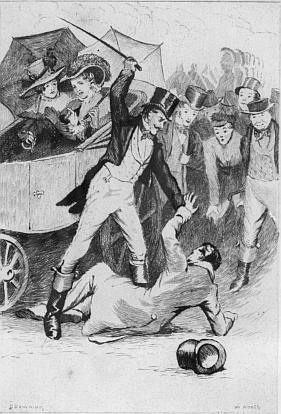
To gallop to my side, to spring to the ground, to collar the ruffian, drag him from the carriage, and lash him with his whole strength with a rough jockey whip till he fairly screamed for mercy, were but the work of a moment.
And I could not but marvel afterwards to think how much power and nervous energy his indignant spirit had lent to his slight frame and slender limbs; for in size, he was by no means superior to G—, whom he nevertheless handled almost as if he had been a child of five years old.
Want of breath at last, rather than want of will, compelled him to pause in his exercise; and then turning towards us with an air as composed and smiling as if he had been merely dancing a quadrille, he took off his hat, saying:—
“I must implore your pardon, ladies, yours more especially, Mademoiselle Valerie, for enacting such a scene in your presence. Mais c’était plus fort que moi!” he added, laughing. “I could not contain myself at seeing a lady so infamously insulted.”
Caroline and the Misses Selwyn were so much frightened by the whole fracas, that they were really unable to answer, and I was for the moment so much taken by surprise, that I could not find words to reply. At this moment, covered with dust and blood, for the whip had cut his face in several places, without his hat, and with all his gay attire besmeared and rent, G— again came up towards the carriage.
He was very pale, nay white, even to the lips—but it was evidently not with terror but with rage, as his first words testified—
“Monsieur le Comte de Chavannes,” he said, slowly, “car je vous connais, et vous me connaîtrez aussi, je vous le jure; vous m’avez frappé, vous me rendrez satisfaction, n’est-ce pas?”
“Oh! no, no,” I exclaimed, before he could answer, clasping my hands eagerly together, “oh, no, no! not on my account, I implore you, Monsieur le Comte—no life on my account—above all, not yours!”
He thanked me by one expressive glance, which spoke volumes to my heart, and perhaps read volumes in return, in my pale face and trembling lips, then turned with a calm smile to his late antagonist, and answered him in English. “I do not know in the least, sir, who you are, and I do not suppose that I ever shall know. I chastised you, five minutes since, for insulting this lady most grossly—”
“Lady!” interrupted the ruffian, with a sneer. “Lady. Lady of plea—”
But the Count went on without pausing or seeming to hear him—“which I should have done at all events, whether I had known you or not, and which I shall most assuredly do again, should you think fit to proceed further with your infamies. As for satisfaction, if I should be called upon in a proper way, I shall not refuse it to any person worthy to meet me.”
“Which this person is not, sir,” interposed yet a third voice; and, looking up, I recognised the officer who had bowed to me: “which this person is not, I assure you, and my word is wont to be sufficient in such cases—Lieutenant-Colonel Jervis,”—he added, with a half bow to me,—“late of His Majesty’s — Light Dragoons. This person is the notorious Monsieur G—, who was detected cheating at écarté at the ‘Travellers,’ was a defaulter on the St Leger in the St Patrick’s year, has been warned off every race-course in England, by the Jockey Club, besides being horsewhipped by half the Legs in England. He can get no gentleman to bring you a message, sir; and if he could, you must not meet him.”
Gnashing his teeth with impotent rage, the detected impostor slunk away, while the Count, bowing to Colonel Jervis, replied quietly—
“I thank you very much, Colonel. I am Monsieur de Chavannes; and I have no doubt what you say is perfectly correct. No one but a low ruffian could have behaved as this fellow did. It was, I assure you, no small offence which caused me to strike a blow in the presence of ladies.”
“I saw it, Monsieur le Comte,” answered Jervis, “I saw it from a distance, and was coming up as fast as I could make my horse gallop, when you anticipated me. Then, seeing that I was not wanted, I stood looking on with intense satisfaction; for, upon my word! I never saw a thing better done in my life. No offence, Count, but by the way you use your hands, I think you ought to have been an Englishman rather than a Frenchman, which I suppose from your name—for you have no French accent—you are.”
“I was at school in England, Colonel,” answered the Count, laughing, “and so learned the use of my hands.”
“That accounts for it—that accounts for it—for on my life, I never saw a fellow more handsomely horsewhipped—and I have seen a good many, too. Did you, Mademoiselle Valerie de Chatenoeuf; for I believe it is you whom I have the honour of addressing?”
“I have been less fortunate than you, Colonel Jervis, for I never saw any one horsewhipped before, and sincerely hope I shall never see another.”
“Don’t say that, my dear lady, don’t say that. I am sure it is a very pretty sight, when it is well and soundly done. Besides it seems ungrateful to the Count.”
“I would not be ungrateful for the world,” I replied; “and I am sure the Count needs no assurance of that fact. I am for ever obliged by his prompt defence of me—but it is nothing more than I should have expected from him.”
“What, that he would fight for you, Valerie?” whispered Caroline, maliciously, in a tone which, perhaps, she did not intend to be overheard; but, if such was her meaning, she missed it, for all present heard her distinctly.
I replied, however, very coolly—
“Yes, Caroline, that he would fight for me, or you, or any lady who was aggrieved or insulted in his presence.”
“Mille graces for your good opinions!” said de Chavannes, with a bow, and a glance that was far more eloquent than words.
“A truce to compliments, if you will not think me impertinent, Count,” said the Colonel; “but I wish to ask this fair lady, if she will pardon me one question; had you ever a friend called—”
“Adèle Chabot!” I interrupted him; “and I shall be most enchanted to hear of her, or better still to see her, as Mrs Jervis.”
“You have anticipated me; that is what I was about to say. We arrived in town last night; and she commissioned me at once to make out your whereabouts for her. The Gironacs told me that you were staying at Kew—”
“Yes, at Judge Selwyn’s. By the way,” I added, a little mischievously, I confess, “allow me to make known to one another, Mrs Charles Selwyn, once Caroline Stanhope, and Colonel Jervis.”
Jervis bowed low, but his cheek and brow burned a little, and he looked sharply at me out of the corner of his eye; but I preserved such a demure face, that he did not quite know whether I was au fait or not.
Caroline, to do her justice, behaved exceedingly well. Her character, indeed, which had been quite unformed before her marriage, had gained solidity, and her mind, judgment as well as tone, since her introduction to a family so superior as that of the Selwyns. And she now neither blushed nor tittered, nor, indeed, showed any signs of consciousness, although she gave me a sly pinch, while she was inquiring in her sweetest voice and serenest manner after Adèle, whom she said she had always loved very much, and longed to see her sincerely in her new station, which she was so admirably qualified to fill. “I hear she was vastly admired in Paris, Colonel; and no wonder, for I really think she was the very prettiest creature I ever saw in my life. You are a fortunate man, Colonel Jervis.”
“I am, indeed,” said he, laughing. “Adèle is a very good little creature, and the people were so good-natured as to be very civil to her in Paris, especially your friend Madame d’Albret, Mademoiselle de Chatenoeuf. Nothing could exceed her attentions to us. We are very much indebted to you for her acquaintance. By the way, Adèle has no end of letters, and presents of all sorts for you from her. When can you come and see Adèle?”
“Where are you staying, Colonel Jervis?”
“At Thomas’s Hotel, in Berkeley Square, at present, until we can find a furnished house for the season. In August we are going down to a little cottage of mine, in the Highlands. And I believe Adèle has some plan for inducing you to come down and bear her company, while I am slaughtering grouse and black cock.”
“Thanks, Colonel, both to you and Adèle. But I do not know how that will be. August is two whole months distant yet, and one never knows what may happen in the course of two months. Do you know I was half thinking of paying a visit to France myself, when my brother who is on a visit to me now, returns to join his regiment.”
“Were you, indeed?” asked de Chavannes, more earnestly than the subject seemed to warrant. “I had not heard of that scheme before. Is it likely to be carried into effect, Mademoiselle?”
“I hardly know. As yet it is little more than a distant dream.”
“But you have not yet answered my question, Mademoiselle de Chatenoeuf,” said the Colonel. “You have not yet told me when you will come and see Adèle.”
“Oh! pardon me, Colonel. I return to town to-morrow, and I will not lose a moment. Suppose I say at one o’clock to-morrow, or two will be better. Caroline, the Judge was so good as to say that he would let his carriage take me home; I dare say it can drop me at Thomas’s, can it not?”
“Certainly, not, Valerie! There, don’t stare now, or look indignant or surprised. It served you perfectly right; what did you expect me to say? Or why do you ask such silly questions? Of course, it can take you wherever you please, precisely as if it were your own.”
“Then at two o’clock, I will be at Thomas’s to-morrow, Colonel; in the meantime, pray give Adèle my best love.”
“I will, indeed. And now I will intrude upon you no longer, ladies,” he added, raising his hat. “In fact, I owe you many apologies for the liberty I have taken in introducing myself. I hope you will believe I would not have done so under any other circumstances.”
We bowed, and, without any further remarks, he put spurs to his horse and cantered away.
“A very gentlemanly person,” said Caroline, “I think Adèle has done very well for herself.”
“You had better not let Mr Charles Selwyn hear you say so, under all circumstances, or I think that very likely the whipping we were talking about in fun yesterday, will become real cara mia!”
“Nonsense! for shame, you mischievous thing!” said Caroline, blushing a little, but not painfully.
“Who is this Colonel Jervis?” asked the Count de Chavannes. “I was a little puzzled, or rather not a little: for at first none of you seemed to know him; and, after a little while, you all appeared to know him quite well. Pray explain the mystery.”
“He is a very gentlemanly person, Count, as Mrs Selwyn justly observes, and, as you can perceive, a very handsome man. Further than that, he was Colonel of one of his Majesty’s crack regiments, as they call them, and is now on half-pay. He is, moreover, a man of high fashion, and of the first standing in society. And, last of all, which is the secret of the whole, he is the husband of a very charming little Frenchwoman, a particular friend of Caroline’s and mine, one of the prettiest and nicest persons on earth, with whom he ran away some six months since, fancying her to be—”
“Valerie!” exclaimed Caroline, blushing fiery red.
“Caroline!” replied I, quietly.
“What were you going to say?”
“Fancying her to be a very great heiress,” I continued; “but finding her to be a far better thing, a delightful, beautiful, and excellent wife.”
“Happy man!” said de Chavannes, with a half sigh.
“Why do you say so, Count?”
“To have married one for whom you vouch so strongly. Is that any common fortune?”
“It is rather common, Count, just of late I mean,” said Caroline, laughing. “You do not know that among Valerie’s other accomplishments she is the greatest little match-maker in existence. She marries off all her friends as fast—oh! you cannot think how fast.”
“I hope, I mean to say I think,” he corrected himself, not without some little confusion, “that she is not quite so bad as you make her out. She has not yet made any match for herself, I believe. No, no. I don’t believe she is quite so bad.”
“I would not be too sure, Count, were I you,” she answered, desirous of paying me off a little for some of the badinage with which I had treated her. “These ladies, with so many strings to their bow—”
It was now my time to exclaim “Caroline!” and I did so not without giving some little emphasis of severity to my tone, for I really thought she was going beyond the limits of propriety, if not of persiflage; and I will do her the justice to say that she felt it herself, for she blushed very much as I spoke, and was at once silent.
The awkwardness of this pause was fortunately broken by the return of Auguste and Lionel at a sharp canter; for the review was now entirely at an end, and they had now for the first moment remembered that, having promised to return in a quarter of an hour, they had suffered two hours or more to elapse, and that we were probably all alone.
Caroline immediately began to rally Lionel and Auguste; the former, with whom she was very intimate, pretty severely, for their want of gallantry in leaving us all alone and unprotected in such a crowd.
“Not the least danger—not the least!” replied Lionel hastily. “Had we not known that, we should have returned long ago.”
“In proof of which no danger, we have been all frightened nearly to death; Mademoiselle Valerie de Chatenoeuf has been grievously affronted, and I am not sure but she would have been beaten by a French Chevalier d’Industrie, had it not been for the gallantry of the Count de Chavannes.”
And thereupon out came the whole history of Monsieur G—, his horse-whipping, the opportune appearance of Colonel Jervis, and all the curious circumstances of the scene.
I never in my life saw anyone so fearfully excited as Auguste. He turned white as ashes, even to his very lips, while his eyes literally flashed fire, and his frame shivered as if he had been in an ague fit. “Il me le paiera!” he muttered between his hard-set teeth. “Il me le paiera, le scélérat! Ma pauvre soeur—ma pauvre petite Valerie!”
And then he shook the hand of Chavannes with the heartiest and warmest emotion. “I shall never forget this,” he said, in a thick, low voice; “never, never! From this time forth, de Chavannes, we are friends for ever. But I shall never, never, be able to repay you.”
“Nonsense, mon cher, nonsense,” replied Chavannes. “I did nothing—positively nothing at all. I should not have been a man, had I done otherwise.”
This had, however, no effect at all in stopping Auguste’s exclamations and professions of eternal gratitude; nor did he cease until Monsieur de Chavannes said quietly, “Well, well, if you will have it so, say no more about it; and one day or other I will ask a favour of you, which, if granted, will leave me your debtor.”
“If granted!—it is granted,” exclaimed Auguste, impetuously. “What is it?—name it—I say it is granted.”
“Don’t be rash, mon cher,” replied the Count, laughing; “it is no slight boon which I shall ask.”
“Do not be foolish, Auguste,” I interposed; “you are letting your feelings get the better of you, strangely; and, Caroline, if you do not tell the people to drive home, you will keep the Judge waiting dinner—a proceeding to which you know he is by no means partial.”
“You are right, as usual, Valerie; always thoughtful for other people. So we will go home.”
But, just as we were on the point of starting, the groom with the cockade, whom we had seen following Colonel Jervis, trotted up, and, touching his hat, asked, “I beg your pardon, gentlemen, but is any one of you the Count de Chavannes?”
“I am,” replied the Count; “what do you want with me, sir?”
“From Colonel Jervis, sir,” replied the man, handing him a visiting card. “The Colonel’s compliments, Count, and he begs you will do him the favour, in case you hear anything more from that fellow, as you horsewhipped, Count, to let him know at Thomas’s at once, for you must not treat him as a gentleman, no how, the Colonel says; and if so be he gives you any trouble, the Colonel can get his flint fixed—the Colonel can!”
“Thank you, my man,” replied the Count; “give my compliments to your master, and I am much obliged for his interest. I shall do myself the honour of waiting on the Colonel to-morrow. Be so good as to tell him so.”
“I will, sir,” said the man; and rode away without another word.
“You see, Monsieur de Chatenoeuf, you must not dream of noticing the fellow as a gentleman,” said the Count.
“Impossible!” Lionel chimed in, almost in the same breath; and all the ladies followed suit with their absolute “Impossible!”
A rapid drive brought us to the Judge’s house at Kew, where we found dinner nearly ready, though not waiting: and the events of the day were the topic, and the Count the hero of the evening.
The next morning, we returned to town—Auguste and myself, I mean; Monsieur de Chavannes having driven up from Kew in his own cabriolet after dinner.
I called, according to my promise, and found Adèle alone, and delighted to see me, and in the highest possible spirits. She was the happiest of women, she said; and Colonel Jervis was everything that she could wish—the kindest, most affectionate of husbands; and all that she now desired, as she declared, was to see me established suitably.
“You had better let matters take their course, Adèle,” I answered. “Though not much of a fatalist, I believe that when a person’s time is to come, it comes. It avails nothing to hurry—nothing to endeavour to retard it. I shall fare, I doubt not, as my friends before me, dear Adèle; and, if I can consult as well for myself as I seem to have done for my friends, I shall do very well. Caroline, by the way, is quite as happy as you declare yourself to be, and I doubt not are; for I like your Colonel amazingly.”
“I am delighted to hear it. He also is charmed with you. But who is the Count de Chavannes, of whom he is so full just now? He says he is the only Frenchman he ever saw worthy to be an Englishman—which, though we may not exactly regard it as a compliment, he considers the greatest thing he can say in any one’s favour. Who is this Count de Chavannes, Valerie?”
I told her, in reply, all that I knew, and that you know, gentle reader, about the Count de Chavannes.
“Et puis?—Et puis?” asked Adèle, laughing.
“Et puis, nothing at all,” I answered.
“No secrets among friends, Valerie,” said Adèle, looking me earnestly in the face; “I had none with you, and you helped me with your advice. Be as frank, at least, with me, if you love me.”
“I do love you dearly, Adèle; and I have no secrets. There is nothing concerning which to have a secret.”
“Nothing?—not this gay and gallant Count?”
“Not even he.”
“And you are not about to become Madame la Comtesse?”
“I am not, indeed.”
“Indeed—in very deed?”
“In very—very deed.”
“Well, I do not understand it. By what Jervis told me, I presumed it was a settled thing.”
“The Colonel was mistaken. There is nothing settled or unsettled.”
“And do you, really, not like him?”
“I really do like him, Adèle, as a very pleasant companion for an hour or two, and as a very perfect gentleman.”
“Yes, he told me all that. But, if you like him so well, why not like him better? Why not love him?”
“I will be plain and true with you, Adèle. I do not choose to consider at all, whether I could or could not, love him. He has never asked me, has never spoken of love to me; and putting it out of the question that it is unmaidenly to love unasked, I am sure it is unwise.”