RUSTIC CHIVALRY.
Nathan Haskell Dole translation
(Cavalleria Rusticana.)
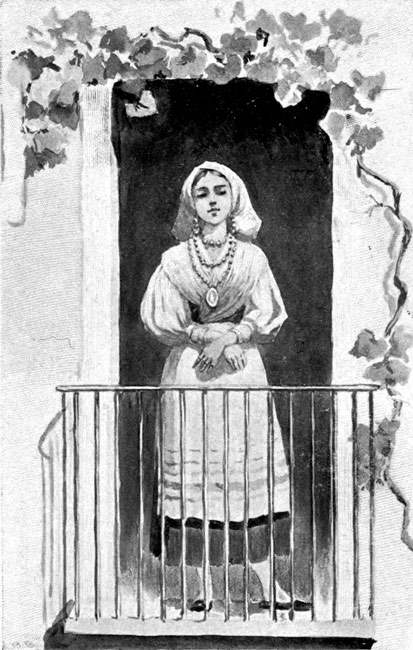
"LOLA USED TO GO OUT ON THE BALCONY WITH HER HANDS CROSSED."
RUSTIC CHIVALRY. (Cavalleria Rusticana.)
Turiddu Macca, gnà Nunzia's son, after returning from the army, used every Sunday to strut like a peacock through the square in his bersegliere uniform and red cap, looking like the fortune-teller as he sets up his stand with his cage of canaries. The girls on their way to Mass gave stolen glances at him from behind their mantellinas, and the urchins buzzed round him like flies.
He had brought back with him, also, a pipe with the king on horseback carved so naturally that it seemed actually alive, and he scratched his matches on the seat of his trousers, lifting his leg as if he were going to give a kick.
But in spite of all this, Lola, the daughter of massaro Angelo, had not shown herself either at Mass or on the balcony, for the reason that she was going to wed a man from Licodia, a carter who had four Sortino mules in his stable.
At first, when Turiddu heard about it, santo diavolone! he threatened to disembowel him, threatened to kill him—that fellow from Licodia! But he did nothing of the sort; he contented himself with going under the fair one's window, and singing all the spiteful songs he knew.
"Has gnà Nunzia's Turiddu nothing else to do," asked the neighbors, "except spending his nights singing like a lone sparrow?"
At length, he met Lola on her way back from the pilgrimage to the Madonna del Pericolo, and when she saw him, she turned neither red nor white, just as if it were none of her affair at all.
"Oh, compare Turiddu, I was told that you returned the first of the month."
"But I have been told of something quite different!" replied the other. "Is it true that you are to marry compare Alfio, the carter?"
"Such is God's will," replied Lola, drawing the two ends of her handkerchief under her chin.
"God's will in your case is done with a snap and a spring; to suit yourself! And it was God's will, was it, that I should return from so far to find this fine state of things, gnà Lola!"
The poor fellow still tried to bluster, but his voice grew hoarse, and he followed the girl, tossing his head so that the tassel of his cap swung from side to side on his shoulders. To tell the truth, she felt really sorry to see him wearing such a long face, but she had not the heart to deceive him with fine speeches.
"Listen, compare Turiddu," she said to him at last, "Let me join my friends. What would be said in town if I were seen with you?"
"You are right," replied Turiddu, "Now that you are going to marry compare Alfio, who has four mules in his stable, it is best not to let people's tongues wag about you. But my mother, poor soul, was obliged to sell our bay mule, and that little plot of vineyard on the highway while I was off in the army. The time 'when Berta spun,' is over and gone, and you no longer think of the time when we used to talk together from the window looking into the yard, and you gave me that handkerchief before I went away, and God knows how many tears I shed into it at going so far that even the name of our place is lost! So good-by, gnà Lola,—Let's pretend it's rained and cleared off, and our friendship is ended."[12]
Gnà Lola married the carter, and on Sundays used to go out on the balcony with her hands crossed on her stomach, to show off all the heavy gold rings that her husband gave to her. Turiddu kept up his habit of going back and forth through the street with his pipe in his mouth, his hands in his pockets, and an air of unconcern, and ogling the girls; but it gnawed his heart that Lola's husband had so much money, and that she pretended not to see him when he passed.
"I'll get even with her, under her very eyes; the vile beast," he muttered.
Opposite compare Alfio lived massaro Cola, the vinedresser, who was as rich as a pig, and had one daughter at home. Turiddu said and did all he could to become massaro Cola's workman, and he began to frequent the house, and make sweet speeches to the girl.
"Why don't you go and say sweet things to gnà Lola?" asked Santa.
"Gnà Lola is a fine lady. Gnà Lola has married a crowned king now!"
"I don't deserve crowned kings!"
"You are worth a hundred Lolas, and I know some one who wouldn't look at la gnà Lola or her saint when you are by, for gnà Lola isn't worthy to wear your shoes, no, she isn't!"
"The fox when he couldn't get at the grapes said, 'How beautiful you are, racinedda mia,' my little grape!"
"Ohè! hands off, compare Turiddu!"
"Are you afraid that I will eat you?"
"I'm not afraid of you or of your God."
"Eh! your mother was from Licodia, we all know that! You have quarrelsome blood. Uh! How I could eat you with my eyes!"
"Eat me then with your eyes, for we should not have a crumb left, but meantime help me up with this bundle."
"I would lift up the whole house for you, yes, I would!"
She, so as not to blush, threw at him a stick of wood which was within reach, and by a miracle didn't hit him.
"Let's have done, for chattering never picked grapes."
"If I were rich I should try to get a wife like you, gnà Santa."
"I shall never marry a crowned king like gnà Lola, but I have my dowry as well as she, whenever the Lord shall send me anyone."
"We know you are rich, we know it."
"If you know it, say no more, for father is coming, and I shouldn't like to have him find me in the court-yard."
The old father began to turn up his nose, but the girl pretended not to notice it, because the tassel of the bersegliere's cap had set her heart to fluttering, and was constantly dancing before her eyes. When the babbo put Turiddu out of the house, his daughter opened the window for him, and stood chatting with him all the evening long, so that the whole neighborhood talked of nothing else.
"I'm madly in love with you," said Turiddu, "and I am losing my sleep and my appetite."
"How absurd!"
"I wish I were Victor Emmanuel's son, so as to marry you."
"How absurd!"
"By the Madonna, I would eat you like bread!"
"How absurd!"
"Ah! on my honor!"
"Ah! mamma mia!"
Lola, who was listening every evening, hidden behind the vase of basil, and turning red and white, one day called Turiddu:—
"And so, compare Turiddu, old friends don't speak to each other any more?"
"Ma!" sighed the young man, "blessed is he who can speak to you."
"If you have any desire to speak to me, you know where I live," replied Lola.
Turiddu went to see her so frequently that Santa noticed it, and shut the window in his face. The neighbors looked at him with a smile or with a shake of the head when the bersegliere passed. Lola's husband was making a round of the fairs with his mules.
"Sunday I am going to confession, for last night I dreamed of black grapes," said Lola.
"Put it off, put it off" begged Turiddu.
"No, Easter is coming, and my husband will want to know why I haven't been to confession."
"Ah," murmured massaro Cola's Santa, as she was waiting on her knees before the confessional for her turn, while Lola was making a clean breast of her sins. "On my soul, I will not send you to Rome for your punishment!"
Compare Alfio came home with his mules; he was loaded with money, and he brought to his wife for a present, a handsome new dress for the holidays.
"You are right to bring her gifts," said his neighbor Santa, "because while you are away your wife adorns your house for you."
Compare Alfio was one of those carters who wear their hats over one ear, and when he heard his wife spoken of in such a way he changed color as if he had been knifed.
"Santo diavolone!" he exclaimed, "if you haven't seen aright, I will not leave you eyes to weep with, you or your whole family."
"I am not used to weeping!" replied Santa, "I did not weep even when I saw with these eyes gnà Nunzia's Turiddu going into your wife's house at night!"
"It is well," replied compare Alfio, "many thanks!"
Turiddu, now that the cat was at home, no longer went out on the street by day, and he whiled away the tedium at the inn with his friends; and on Easter eve they had on the table a dish of sausages.
When compare Alfio came in, Turiddu realized, merely by the way in which he fixed his eyes on him, that he had come to settle that affair, and he laid his fork on the plate.
"Have you any commands for me, compare Alfio?" he asked.
"No favors to ask, compare Turiddu; it's some time since I have seen you, and I wanted to speak concerning something you know about."
Turiddu at first had offered him a glass, but compare Alfio refused it with a wave of his hand. Then Turiddu got up and said to him,—
"Here I am, compare Alfio."
The carter threw his arms around his neck.
"If to-morrow morning you will come to the prickly pears of la Canziria, we can talk that matter over, compare."
"Wait for me on the street at daybreak, and we will go together."
With these words they exchanged the kiss of defiance. Turiddu bit the carter's ear, and thus made the solemn oath not to fail him.
The friends had silently left the sausages, and accompanied Turiddu to his home. Gnà Nunzia, poor creature, waited for him till late every evening.
"Mamma," said Turiddu, "do you remember when I went as a soldier, that you thought I should never come back any more? Give me a good kiss as you did then, for to-morrow morning I am going far away."
Before daybreak he got his spring-knife, which he had hidden under the hay, when he had gone to serve his time in the army, and started for the prickly-pear trees of la Canziria.
"Oh, Gesummaria! where are you going in such haste!" cried Lola in great apprehension, while her husband was getting ready to go out.
"I am not going far," replied compare Alfio. "But it would be better for you if I never came back."
Lola in her nightdress was praying at the foot of the bed, and pressing to her lips the rosary which Fra Bernardino had brought to her from the Holy places, and reciting all the Ave Marias that she could say.
"Compare Alfio," began Turiddu, after he had gone a little distance by the side of his companion, who walked in silence with his cap down over his eyes, "as God is true I know that I have done wrong, and I should let myself be killed. But before I came out, I saw my old mother, who got up to see me off, under the pretence of tending the hens. Her heart had a presentiment, and as the Lord is true, I will kill you like a dog, so that my poor old mother may not weep."
"All right," replied compare Alfio, stripping off his waistcoat. "Then we will both of us hit hard."
Both of them were skilful fencers. Turiddu was first struck, and was quick enough to receive it in the arm. When he returned it, he returned it well, and wounded the other in the groin.
"Ah, compare Turiddu! so you really intend to kill me, do you?"
"Yes, I gave you fair warning; since I saw my old mother in the hen-yard, it seems to me I have her all the time before my eyes."
"Keep them well open, those eyes of yours," cried compare Alfio, "for I am going to give you back good measure."
As he stood on guard, all doubled up, so as to keep his left hand on his wound, which pained him, and almost trailing his elbow on the ground, he swiftly picked up a handful of dust, and flung it into his adversary's eyes.
"Ah!" screamed Turiddu, blinded, "I am dead."
He tried to save himself, by making desperate leaps backwards, but compare Alfio overtook him with another thrust in the stomach, and a third in the throat.
"And that makes three! that is for the house which you have adorned for me! Now your mother will let the hens alone."
Turiddu staggered a short distance among the prickly pears, and then fell like a stone. The blood foaming, gurgled in his throat, and he could not even cry, "Ah! mamma mia!"
LA LUPA.
She was tall and lean; but she had a firm, full bust, and yet she was no longer young; her complexion was brunette, but pallid as if she had always suffered from malaria, and this pallor set forth two big eyes and fresh rosy lips that seemed to eat you.
In the village she was called la Lupa—the She-Wolf—because she was never satisfied. Women made the sign of the cross when they saw her pass, always alone like a big ugly hound, with the vagabond and suspicious gait of a famished wolf; she would bewitch their sons and their husbands in the twinkling of an eye with her red lips and she made them fall in love with her merely by looking at them out of those big Satanic eyes of hers, even if they were before Santa Agrippina's altar.
Fortunately la Lupa never came to church at Easter or at Christmas, nor to hear Mass or to make confession. Padre Angiolino of Santa Maria di Gesù, a true servant of God, had lost his soul on her account.
Maricchia,—poor girl, pretty and clever she was,—secretly wept because she was la Lupa's daughter, and no one had offered to marry her though she had nice clothes in her bureau, and her own little piece of land in the sun, like every other girl of the village.
One time la Lupa fell in love with a handsome youth who had just served out his time in the army, and had come home and was helping to reap the notary's harvest with her; for surely it means to be in love when she felt the flesh burn under the fustian shift, and on looking at him to experience the thirst that one has in hot June days down in the low-lands.
But he went on with his work, undisturbed, with his nose on his sheaves, and he said to her, "Oh, what's the matter, gnà Pina?"
In the immense fields where the only sound was the rustle of the grasshoppers flying up, while the sun was pouring down his hottest beams perpendicularly, la Lupa was heaping up sheaf on sheaf, and pile on pile, without ever showing any signs of fatigue, without one moment straightening herself up, without once touching her lips to the water jug, so as to stick close to Nanni's heels as he reaped and reaped; and now and again he would ask,—
"What do you want, gnà Pina?"
One evening she told him, it was while the men were sleeping in the threshing-floor, weary of the long day's work and the dogs were howling through the vast black campagna,—
"I want you! you are as handsome as the sun and as sweet as honey; I want you!"
"But I want your daughter—I want the young calf," said Nanni, laughing at his own joke.
La Lupa thrust her hands into the masses of her hair, scratching her temples, without saying a word, and went off and was not seen again in the harvest field. But the following October she saw Nanni again at the time when they were pressing the oil, because he worked near her house, and the rattle of the press kept her awake all night.
"Take a bag of olives," she said to her daughter, "and come with me."
Nanni was shoveling the olives into the hopper and shouting "Ohi" to the mule to keep it going.
"Do you want my daughter Maricchia?" demanded gnà Pina.
"What dowry will you give with your daughter Maricchia?" replied Nanni.
"She has her father's things, and besides I will give her my house; it will be enough for me if you'll let me have a corner in the kitchen to spread out a mattress in."
"If that is so, we can talk about it at Christmas," said Nanni. Nanni was all grease and dirt from the olives put to fermenting, and Maricchia would not have him on any account; but her mother grabbed her by the hair as they stood in front of the hearth and hissed through her set teeth,—
"If you don't take him, I'll kill you."
La Lupa looked ill, and the people remarked: "When the devil was old the devil a monk would be." She no longer went wandering about; she stood no more at her doorway looking out with those eyes as of one possessed.
Her son-in-law, when she fixed those eyes on his face, always began to laugh, and would pull out his cloth talisman, with its effigy of the Madonna, to cross himself with.
Maricchia stayed at home to nurse her children, and her mother went out to work in the fields with the men, just like a man,—to weed, to dig, to guide the animals, to dress the vines, whether it were during the Greek-Levant winds[13] of January, or during the August sirocco, when mules let their heads droop, and men sleep prone on their bellies under the shadow of the North wall.
In that time between vespers and nones, when, according to the saying, no good woman is seen going about, gnà Pina was the only living creature to be seen wandering across the campagna, over the fiery hot stones of the narrow streets, among the parched stubble of the wide, wide fields that stretched away into the burning haze toward cloudy Etna, where the sky hangs heavy on the horizon.
"Wake up!" said la Lupa to Nanni, who was asleep in the ditch next the dusty harvest-field, with his head on his arms. "Wake up, for I've brought you some wine to cool your throat."
Nanni opened his eyes, half awake, and saw her sitting up straight and pale before him, with her swelling breast, and her eyes as black as coal, and drew back waving his arms,—
"No! a good woman does not go about between vespers and nones," groaned Nanni, thrusting his face in amongst the dried weeds of the ditch as far as he could, and putting his fingers into his hair. "Go away! Get you gone! And don't you come to the threshing-floor any more."
She turned and went away,—la Lupa,—knotting up her splendid tresses again, looking down steadily as she made her way among the hot stubble, with her eyes black as coal.
But she did go back to the threshing-floor, and Nanni no longer reproached her; and when she failed to come, in that hour between vespers and nones, he went, and with perspiration on his brow, waited for her at the top of the white deserted footpath, but afterwards he would thrust his hands through his hair, and every time he would say, "Go away! Go away! Don't come to the threshing-floor again."
Maricchia wept night and day, and she looked into her mother's face with eyes blazing with tears and jealousy, like a lupachiotta, a young wolf herself, every time that she saw her coming back from the fields, silent and pale.
"Vile! scellerata!" she would say, "Vile mamma."
"Hold your tongue!"
"Thief! thief!"
"Hold your tongue!"
"I'll go to the brigadiere!"[14]
And she actually went with her infants in her arms, without a sign of fear, and without shedding a tear, like a crazy woman, because now she passionately loved that husband whom she had been forced to marry, greasy and dirty as he was from the olives set to fermenting.
The brigadiere summoned Nanni, and threatened him with the galleys and the gallows. Nanni began to weep, and pull his hair; he denied nothing, did not try to justify himself.
"The temptation was too much," said he, "'twas the temptation of hell." He flung himself at the brigadiere's feet, begging him to send him to the galleys.
"For mercy's sake, Signor brigadiere, take me out of this hell! Have me shot! Send me to prison! Don't let me see her ever again! never again!"
"No," replied la Lupa, to the brigadiere's question. "I kept a corner of the kitchen to sleep in when I gave him my house as my daughter's dowry. The house is mine. I do not intend to go away."
Shortly after, Nanni was kicked in the chest by a mule, and was like to die; but the priest refused to bring him the Holy Unction unless la Lupa was out of the house.
La Lupa went away, and her son-in-law was then permitted to pass away like a good Christian; he confessed and partook of the Sacrament with such signs of penitence and contrition that all the neighbors and inquisitive visitors wept as they surrounded the dying man's bed.
And it would have been better for him if he had died then and there, before the devil had a chance to return to tempt him, and take possession of him, mind and body, when he got well again.
"Let me be!" he said to la Lupa; "for mercy's sake, leave me in peace! I have seen death with my own eyes! Poor Maricchia is in despair. Now the whole region knows about it! If I don't see you, it's better for you and better for me."
And he would rather have put his eyes out, than see la Lupa's, for when hers were fastened on him, they made him lose soul and body. He did not know what to do to overcome the enchantment. He paid for Masses to be sung for the souls in Purgatory, and he went for aid to the priest and the brigadiere. At Easter he went to confession, and as a penance, publicly stood on the flint stones of the holy ground in front of the church, putting out six handbreadths of tongue, and then, when la Lupa returned to tempt him,—
"See here," said he, "don't you come on the threshing-floor again, because if you do come to seek me again, as sure as God exists, I'll kill you."
"All right, kill me!" replied la Lupa. "It makes no difference to me; but I can not live without you."
When he saw her afar off coming through the green corn field, he left off pruning the vines, and went and got his axe from the elm.
La Lupa saw him coming to meet her, with his face pale and his eyes rolling wildly, with the axe shining in the sun; but she did not hesitate an instant, did not look away. She went straight forward with her hands full of bunches of red poppies, and devouring him with those black eyes of hers.
"Ah! a curse on your soul!" stammered Nanni.