Chapter IV
Reading edition
It is always delightful to wake up in a new bedroom. The fresh wall-paper, the strange pictures, the positions of doors and windows, imperfectly grasped the night before, are revealed with all the charm of surprise when we open our eyes the next morning.
It was about eight o'clock when Fanfreluche awoke, stretched himself deliciously in his great plumed four-post bed, murmured "What a pretty room!" and freshened the frilled silk pillows behind him. Through the slim parting of the long flowered window curtains, he caught a peep of the sun-lit lawns outside, the silver fountains, the bright flowers, the gardeners at work, and beneath the shady trees some early breakfasters, dressed for a day's hunting in the distant wooded valleys.
"How sweet it all is," exclaimed the Abbé, yawning with infinite content. Then he lay back in his bed, stared at the curious patterned canopy above him and nursed his waking thoughts.
He thought or the "Romaunt de la Rose," beautiful, but all too brief.
Of the Claude in Lady Delaware's collection.[1]
Of a wonderful pair of blonde trousers he would get Madame Belleville to make for him.
Of a mysterious park full of faint echoes and romantic sounds.
Of a great stagnant lake that must have held the subtlest frogs that ever were, and was surrounded with dark unreflected trees, and sleeping fleurs de luce.
Of Saint Rose, the well-known Peruvian virgin; how she vowed herself to perpetual virginity when she was four years old[2]; how she was beloved by Mary, who from the pale fresco in the Church of Saint Dominic, would stretch out her arms to embrace her; how she built a little oratory at the end of the garden and prayed and sang hymns in it till all the beetles, spiders, snails and creeping things came round to listen; how she promised to marry Ferdinand de Flores, and on the bridal morning perfumed herself and painted her lips, and put on her wedding frock, and decked her hair with roses, and went up to a little hill not far without the walls of Lima; how she knelt there some moments calling tenderly upon Our Lady's name, and how Saint Mary descended and kissed Rose upon the forehead and carried her up swiftly into heaven.
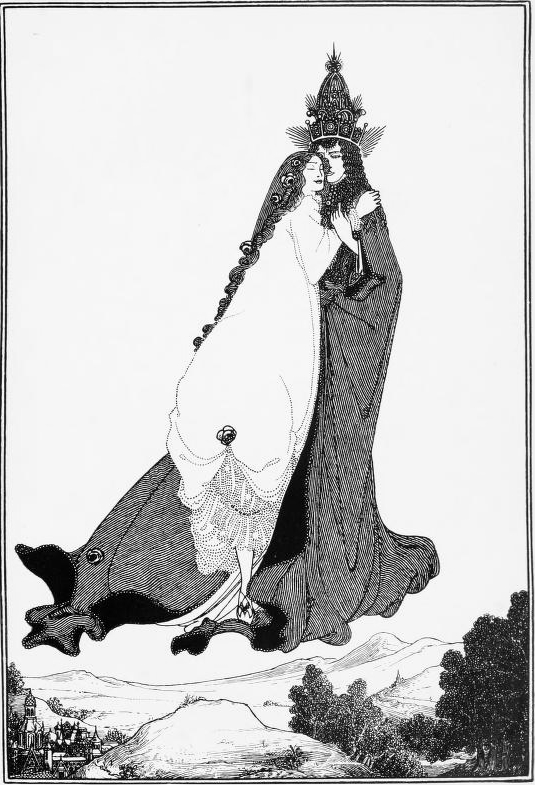
St. Rose of Lima
He thought of the splendid opening of Racine's "Britannicus."
Of a strange pamphlet he had found in Helen's library, called "A Plea for the Domestication of the Unicorn."
Of the "Bacchanals of Sporion."[3]
Of Morales' Madonnas with their high egg-shaped creamy foreheads and well-crimped silken hair.
Of Rossini's "Stabat Mater" (that delightful démodé piece of decadence, with a quality in its music like the bloom upon wax fruit).
Of love, and of a hundred other things.
Then his half-closed eyes wandered among the prints that hung upon the rose-striped walls. Within the delicate curved frames lived the corrupt and gracious creatures of Dorat and his school, slender children in masque and domino smiling horribly, exquisite letchers leaning over the shoulders of smooth doll-like girls and doing nothing in particular, terrible little Pierrots posing as lady lovers and pointing at something outside the picture, and unearthly fops and huge bird-like women mingling in some rococo room, lighted mysteriously by the flicker of a dying fire that throws great shadows upon wall and ceiling.
Fanfreluche had taken some books to bed with him. One was the witty, extravagant, "Tuesday and Josephine," another was the score of "The Rheingold." Making a pulpit of his knees he propped up the opera before him and turned over the pages with a loving hand, and found it delicious to attack Wagner's brilliant comedy with the cool head of the morning.[4] Once more he was ravished with the beauty and wit of the opening scene; the mystery of its prelude that seems to come up from the very mud of the Rhine, and to be as ancient, the abominable primitive wantonness of the music that follows the talk and movements of the Rhine-maidens, the black, hateful sounds of Alberic's love-making, and the flowing melody of the river of legends.
But it was the third tableau that he applauded most that morning, the scene where Loge, like some flamboyant primeval Scapin, practises his cunning upon Alberic. The feverish insistent ringing of the hammers at the forge, the dry staccato restlessness of Mime, the ceaseless coming and going of the troup of Niblungs, drawn hither and thither like a flock of terror-stricken and infernal sheep, Alberic's savage activity and metamorphoses, and Loge's rapid, flaming tongue-like movements, make the tableau the least reposeful, most troubled and confusing thing in the whole range of opera. How the Abbé rejoiced in the extravagant monstrous poetry, the heated melodrama, and splendid agitation of it all!
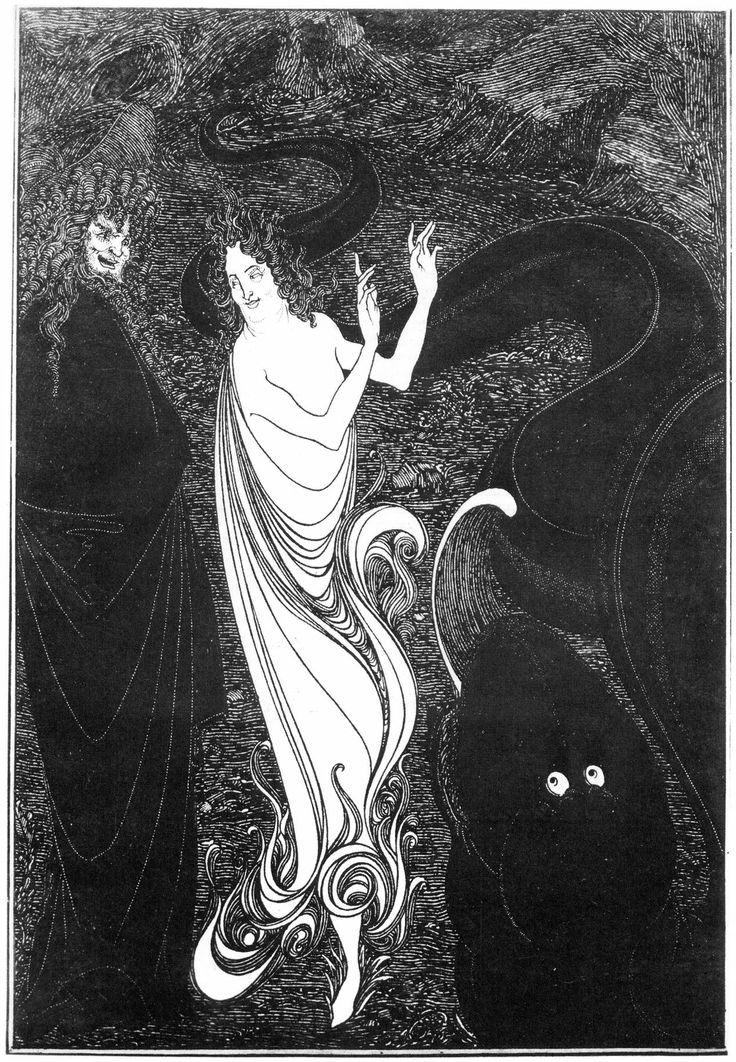
For the Third Tableau of "Das Rheingold"
At eleven o'clock Fanfreluche got up and slipped off his dainty night-dress.
His bathroom was the largest and perhaps the most beautiful apartment in his splendid suite. The well-known engraving by Lorette that forms the frontispiece to Millevoye's "Architecture du XVIIIme siècle" will give you a better idea than any words of mine of the construction and decoration of the room. Only in Lorette's engraving the bath sunk into the middle of the floor is a little too small.
Fanfreluche stood for a moment like Narcissus gazing at his reflection in the still scented water, and then just ruffling its smooth surface with one foot, stepped elegantly into the cool basin and swam round it twice very gracefully. However, it is not so much at the very bath itself as in the drying and delicious frictions that a bather finds his chiefest joys, and Helen had appointed her most tried attendants to wait upon Fanfreluche. He was more than satisfied with their attention, that aroused feelings within him almost amounting to gratitude, and when the rites were ended any touch of home-sickness he might have felt was utterly dispelled. After he had rested a little, and sipped his chocolate, he wandered into the dressing-room, where, under the direction of the superb Dancourt, his toilet was completed.
As pleased as Lord Foppington with his appearance, the Abbé tripped off to bid good-morning to Helen. He found her in a sweet white muslin frock, wandering upon the lawn, and plucking flowers to deck her breakfast table. He kissed her lightly upon the neck.
"I'm just going to feed Adolphe," she said, pointing to a little reticule of buns that hung from her arm. Adolphe was her pet unicorn. "He is such a dear," she continued; "milk white all over, excepting his nose, mouth, and nostrils. This way." The unicorn had a very pretty palace of its own made of green foliage and golden bars, a fitting home for such a delicate and dainty beast. Ah, it was a splendid thing to watch the white creature roaming in its artful cage, proud and beautiful, knowing no mate, and coming to no hand except the queen's itself. As Fanfreluche and Helen approached, Adolphe began prancing and curvetting, pawing the soft turf with his ivory hoofs and flaunting his tail like a gonfalon. Helen raised the latch and entered.
"You mustn't come in with me, Adolphe is so jealous," she said, turning to the Abbé, who was following her, "but you can stand outside and look on; Adolphe likes an audience." Then in her delicious fingers she broke the spicy buns and with affectionate niceness breakfasted her snowy pet. When the last crumbs had been scattered, Helen brushed her hands together and pretended to leave the cage without taking any further notice of Adolphe. Adolphe snorted.
AUBREY BEARDSLEY.
THE THREE MUSICIANS
Along the path that skirts the wood, The three musicians wend their way, Pleased with their thoughts, each other's mood, Franz Himmel's latest roundelay, The morning's work, a new-found theme, their breakfast and the summer day. One's a soprano, lightly frocked In cool, white muslin that just shows Her brown silk stockings gaily clocked, Plump arms and elbows tipped with rose, And frills of petticoats and things, and outlines as the warm wind blows. Beside her a slim, gracious boy Hastens to mend her tresses' fall, And dies her favour to enjoy, And dies for réclame and recall At Paris and St. Petersburg, Vienna and St. James's Hall. The third's a Polish Pianist With big engagements everywhere, A light heart and an iron wrist, And shocks and shoals of yellow hair, And fingers that can trill on sixths and fill beginners with despair. The three musicians stroll along And pluck the ears of ripened corn, Break into odds and ends of song, And mock the woods with Siegfried's horn, And fill the air with Gluck, and fill the tweeded tourist's soul with scorn. The Polish genius lags behind, And, with some poppies in his hand, Picks out the strings and wood and wind Of an imaginary band, Enchanted that for once his men obey his beat and understand.
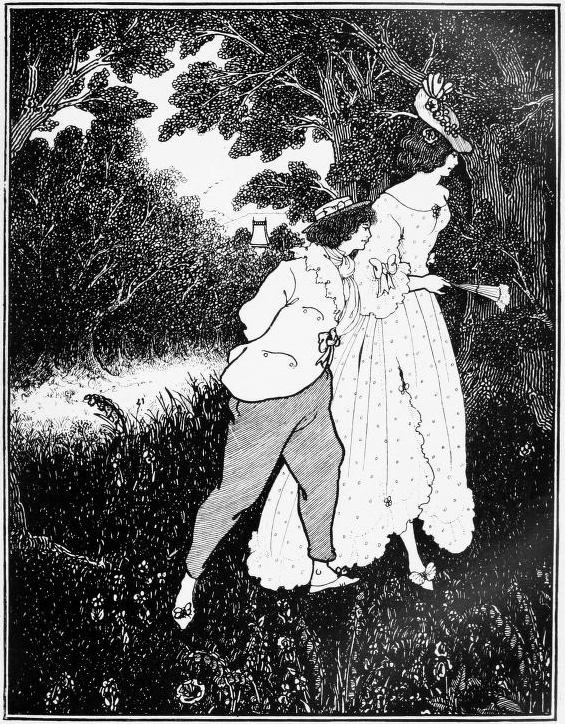
The Three Musicians
The charming cantatrice reclines And rests a moment where she sees Her château's roof that hotly shines Amid the dusky summer trees, And fans herself, half shuts her eyes, and smoothes the frock about her knees. The gracious boy is at her feet, And weighs his courage with his chance; His fears soon melt in noonday heat. The tourist gives a furious glance, Red as his guide-book grows, moves on, and offers up a prayer for France.
AUBREY BEARDSLEY
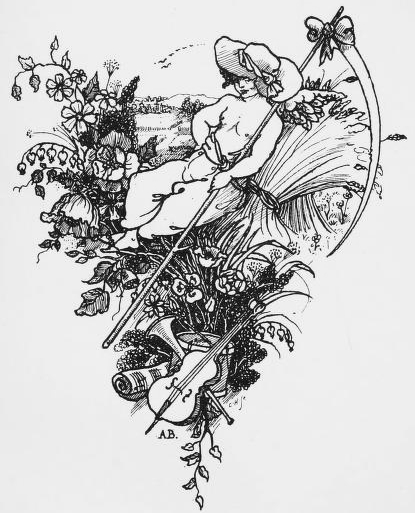
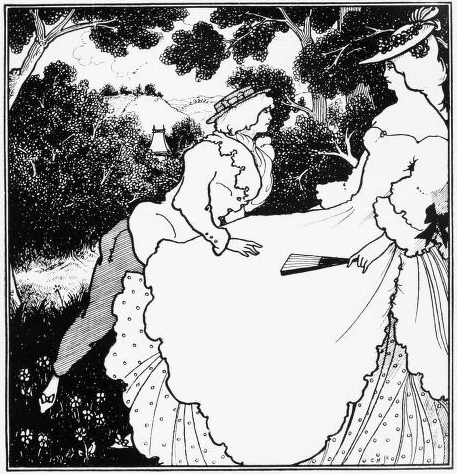
The Three Musicians
THE BALLAD OF A BARBER
Here is the tale of Carrousel, The barber of Meridian Street. He cut, and coiffed, and shaved so well, That all the world was at his feet. The King, the Queen, and all the Court, To no one else would trust their hair, And reigning belles of every sort Owed their successes to his care. With carriage and with cabriolet Daily Meridian Street was blocked, Like bees about a bright bouquet The beaux about his doorway flocked. Such was his art he could with ease Curl wit into the dullest face; Or to a goddess of old Greece Add a new wonder and a grace. All powders, paints, and subtle dyes, And costliest scents that men distil, And rare pomades, forgot their price And marvelled at his splendid skill. The curling irons in his hand Almost grew quick enough to speak, The razor was a magic wand That understood the softest cheek. Yet with no pride his heart was moved; He was so modest in his ways! His daily task was all he loved, And now and then a little praise. An equal care he would bestow On problems simple or complex; And nobody had seen him show A preference for either sex. How came it then one summer day, Coiffing the daughter of the King, He lengthened out the least delay And loitered in his hairdressing? The Princess was a pretty child, Thirteen years old, or thereabout. She was as joyous and as wild As spring flowers when the sun is out.
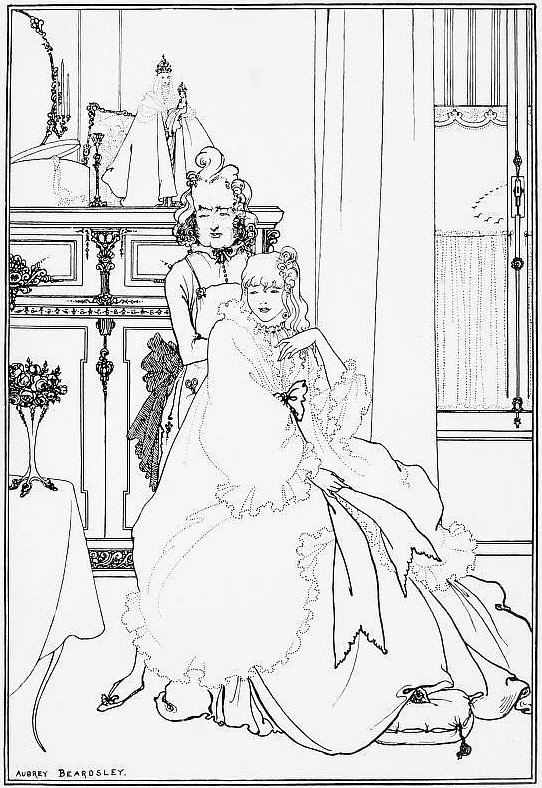
"The Coiffing"
Her gold hair fell down to her feet And hung about her pretty eyes; She was as lyrical and sweet As one of Schubert's melodies. Three times the barber curled a lock, And thrice he straightened it again; And twice the irons scorched her frock, And twice he stumbled in her train. His fingers lost their cunning quite, His ivory combs obeyed no more; Something or other dimmed his sight, And moved mysteriously the floor. He leant upon the toilet table, His fingers fumbled in his breast; He felt as foolish as a fable, And feeble as a pointless jest. He snatched a bottle of Cologne, And broke the neck between his hands; He felt as if he was alone, And mighty as a king's commands. The Princess gave a little scream, Carrousel's cut was sharp and deep; He left her softly as a dream That leaves a sleeper to his sleep. He left the room on pointed feet; Smiling that things had gone so well. They hanged him in Meridian Street. You pray in vain for Carrousel. AUBREY BEARDSLEY.
CATULLUS
CARMEN CI
By ways remote and distant waters sped, Brother, to thy sad grave-side am I come, That I may give the last gifts to the dead, And vainly parley with thine ashes dumb: Since she who now bestows and now denies Hath ta'en thee, hapless brother, from mine eyes. But lo! these gifts, the heirlooms of past years, Are made sad things to grace thy coffin shell, Take them, all drenched with a brother's tears, And, brother, for all time, hail and farewell! AUBREY BEARDSLEY.
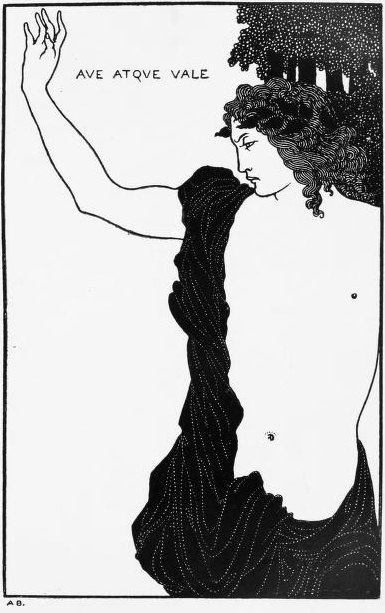
"Ave atque Vale"
TABLE TALK OF AUBREY BEARDSLEY
GEORGE SAND, ETC.
After all the Muses are women, and you must be a man to possess them—properly.
MENDELSSOHN
Mendelssohn has no gift for construction. He has only a feeling for continuity.
THE BROMPTON ORATORY
The only place in London where one can forget that it is Sunday.
WEBER
Weber's pianoforte pieces remind me of the beautiful glass chandeliers at the Brighton Pavilion.
SHAKESPEARE
When an Englishman has professed his belief in the supremacy of Shakespeare amongst all poets, he feels himself excused from the general study of literature. He also feels himself excused from the particular study of Shakespeare.
ROSSINI'S "STABAT MATER"
The dolorous Mother should be sung by a virgin of Morales, one of the Spanish painter's unhealthy and hardly deiparous creatures, with high, egg-shaped, creamy forehead and well-crimped silken hair.
ALEXANDER POPE
Pope has more virulence and less vehemence than any of the great satirists. His character of Sporus is the perfection of satirical writing. The very sound of words scarify before the sense strikes.
IMPRESSIONISTS
How few of our young English impressionists knew the difference between a palette and a picture! However, I believe that Walter Sickert did—sly dog!
TURNER
Turner is only a rhetorician in paint.
ENGLISH LITERATURE
What a stay-at-home literature is the English! It would be easy to name fifty lesser French writers whose names and works are familiar all over the world. It would be difficult to name four of our greatest whose writings are read to any extent outside England.
THE WOODS OF AUFFRAY
In the distance, through the trees, gleamed a still argent lake, a reticent water that must have held the subtlest fish that ever were. Around its marge the trees and flags and fleurs-de-luce were unbreakably asleep.
I fell into a strange mood as I looked at the lake, for it seemed to me that the thing would speak, reveal some curious secret, say some beautiful word, if I should dare to wrinkle its pale face with a pebble.
Then the lake took fantastic shapes, grew to twenty times its size, or shrank into a miniature of itself, without ever losing its unruffled calm and deathly reserve. When the waters increased I was very frightened, for I thought how huge the frogs must have become, I thought of their big eyes and monstrous wet feet; but when the water lessened I laughed to myself, for I thought how tiny the frogs must have grown, I thought of their legs that must look thinner than spiders', and of their dwindled croaking that never could be heard.
Perhaps the lake was only painted after all; I had seen things like it at the theatre. Anyhow it was a wonderful lake, a beautiful lake.
TWO LETTERS OF AUBREY BEARDSLEY
Beardsley unfortunately wrote but few letters. The following is characteristic of the humorous courtesy with which he received criticism:
To the Editor of the Pall Mall Budget.
"SIR,—So much exception has been taken, both by the Press and by private persons, to my title-page of 'The Yellow Book,'[1] that I must plead for space in your valuable paper to enlighten those who profess to find my picture unintelligible. It represents a lady playing the piano in the middle of a field. Unpardonable affectation! cry the critics. But let us listen to Bomvet.
"Christopher Willibald Ritter von Glück, in order to warm his imagination and to transport himself to Aulis or Sparta, was accustomed to place himself in the middle of a field. In this situation, with his piano before him, and a bottle of champagne on each side, he wrote in the open air his two "Iphigenias," his "Orpheus," and some other works.' I tremble to think what critics would say had I introduced those bottles of champagne. And yet we do not call Gluck a decadent.
"Yours obediently
"AUBREY BEARDSLEY.
"THE BODLEY HEAD,
"VIGO STREET, W.
"April 27."
The Daily Chronicle on the occasion of the publication of "Plays" by John Davidson, in criticising Beardsley's frontispiece,[2] deplored the introduction of "two well-known faces of the day." In the following day's issue Beardsley wittily excused himself in the following letter to the editor:
"AN ERROR OF TASTE"
"SIR,—In your review of Mr. Davidson's plays, I find myself convicted of an error of taste, for having introduced portraits into my frontispiece to that book. I cannot help feeling that your reviewer is unduly severe. One of the gentlemen who forms part of my decoration is surely beautiful enough to stand the test even of portraiture, the other owes me half a crown.
"I am, yours truly,
"AUBREY BEARDSLEY.
"114 CAMBRIDGE STREET, S.W.
"March 1, 1894."
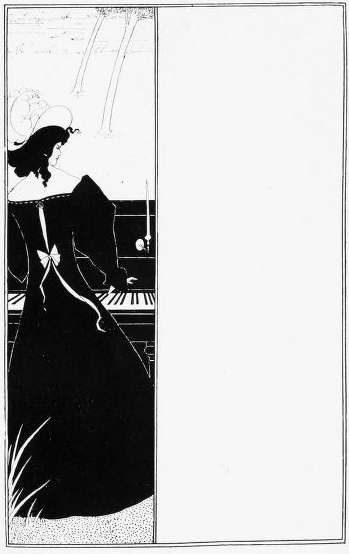
Design for Title-Page of "The Yellow Book" Volume I
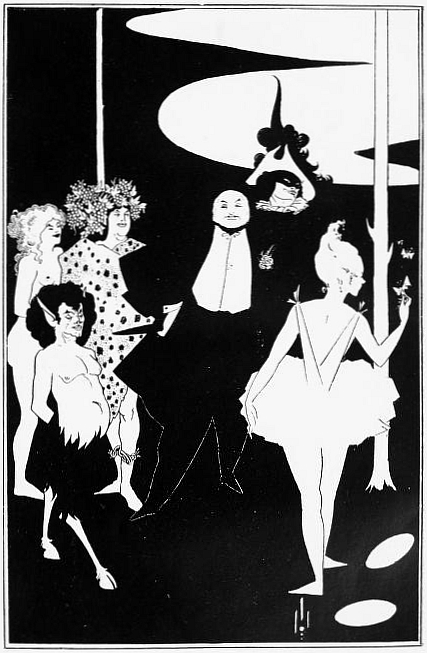
Frontispiece to "Plays" by John Davidson
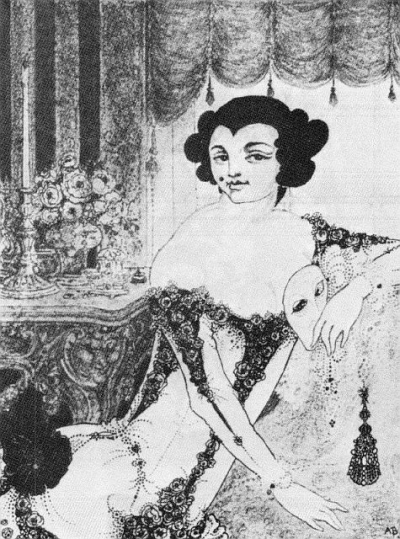
"Arbuscula" — From "A History of Dancing," by Gaston Vuillier. Reproduced by permission of Mr. William Heinemann.
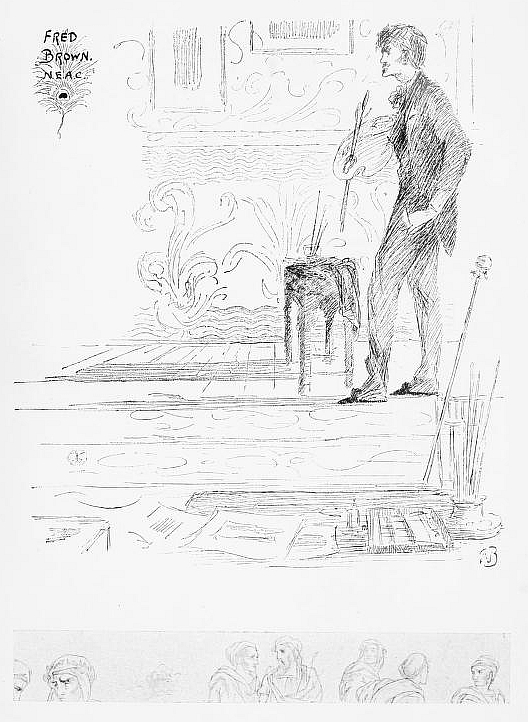
Portrait And other Sketches Hitherto Unpublished —Reproduced by permission of Miss Nellie Syrett.
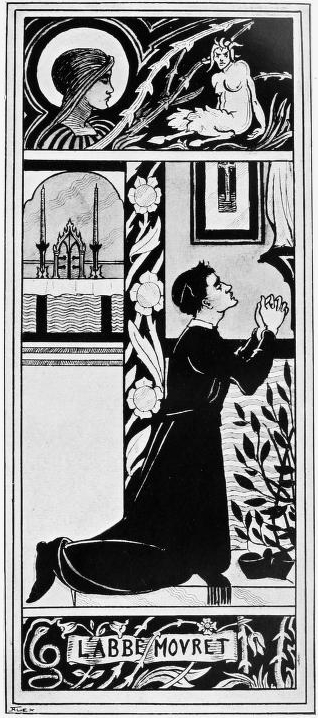
Design for Frontispiece to Zola's "L'Abbé Mouret" Hitherto Unpublished
LIST OF VOLUMES ILLUSTRATED BY AUBREY BEARDSLEY
THE EARLY WORK OF AUBREY BEARDSLEY
WITH AN INTRODUCTION BY H. C. MARILLIER
Price 42s. net (originally published at 31s. 6d. net)
Also an Edition printed upon Japanese Vellum, limited to one hundred and twenty copies for England and America. Price 84;. net (originally published at 63s. net). Now out of print.
This handsome volume was published soon after Beardsley's death. It contains most of his work up to the time of his ceasing to be associated with the art editorship of "The Yellow Book," and includes the remarkable designs illustrating "Salomé," a volume long since out of print. These are considered by the critics as among the best and most individual work he did. There are in all upwards of 180 reproductions, in addition to two characteristic photographs of Beardsley, taken by Mr. Frederick H. Evans.
THE LATER WORK OF AUBREY BEARDSLEY
Demy 4to. Price 42s. net
Also a Limited Edition of one hundred and twenty copies for England and America, printed on Japanese Vellum. 1055. net (originally published at 84s net.)
This collection was not published until nearly three years after Beardsley's death, and contains most of the designs not included in "The Early Work." The two volumes thus form an almost complete record of his artistic production. In all there are upwards of 170 reproductions, including three in colour and eleven in photogravure.
In the Japanese Vellum edition several illustrations are reproduced in photogravure, instead of half-tone as in the ordinary edition, whilst the frontispiece is hand-coloured.
A SECOND BOOK OF FIFTY DRAWINGS BY AUBREY BEARDSLEY
Crown 4to. Price 10s. 6d. net
This Edition is limited to one thousand copies of the ordinary issue, and fifty copies printed on Japanese Vellum (exhausted on publication).
The First Book of Fifty Drawings, which preceded this volume, is now selling at a greatly enhanced price. The present volume is remarkable as containing several reproductions from very early sketches, as well as many executed in the artist's most individual style, among which is a photogravure of "Mademoiselle de Maupin," one design in colour, and three photogravures which show how strong, at one time, was the Burne-Jones influence upon Beardsley.
THE RAPE OF THE LOCK BY ALEXANDER POPE
With Nine Full-page Illustrations by AUBREY BEARDSLEY Crown 4to. Price 10s. 6d. net
Very few copies remain of this volume, which was originally published at 7s. 6d. net. The Japanese Vellum Edition is exhausted.
Perhaps, with the exception of the series of drawings illustrating "Salomé," no designs are more characteristic, more strikingly original, than those contained in "The Rape of the Lock." The edition is now rapidly nearing exhaustion and the publisher has decided not to re-issue it in the original form. This work with the original illustrations is included as Vol. IX. of "The Flowers of Parnassus." Demy 16mo (5 ¾ x 4 ½ inches). Bound in Cloth, Price 1s. net. Bound in Leather, Price is. 6d. net.
VOLPONE: OR THE FOX BY BEN IONSON
A NEW EDITION, WITH A CRITICAL ESSAY ON THE AUTHOR BY VINCENT O'SULLIVAN And Illustrations by AUBREY BEARDSLEY
Together with an Eulogy of the Artist by ROBERT ROSS Demy 4to. Price 10s. 6d. net (originally published at 7s. 6d. net)
Mr. Robert Ross in his eulogy considers 1896 as Beardsley's annus mirabilis, and remarks that it would be impossible to believe he could have surpassed the work of that year but for the illustrations to "Volpone." They characterise in a very marked manner the singular genius both in creative faculty and draughtsmanship of the artist.
THE PIERROT OF THE MINUTE
A DRAMATIC PHANTASY IN ONE ACT BY ERNEST DOWSON
With Illustrations and a Cover-Design by AUBREY BEARDSLEY Crown 4to. Price 10s. 6d. net (originally published at 7s. 6d. net)
Limited to three hundred copies of the ordinary issue (of which very few remain)
A peculiar and pathetic interest attaches itself to this volume on account of the sad, even tragic end of Ernest Dowson. The obituary notices following his death were to many the first intimation of his existence, but to those who knew him there was little room for doubt that he possessed a genius which was as remarkable as it was ill-starred.
PLAYS
BY JOHN DAVIDSON
With Frontispiece and Cover-Design by AUBREY BEARDSLEY Small 4to. Price 7s. 6d. net
The Edition is limited to five hundred copies
This volume has a special interest, as Beardsley was induced by the Daily Chronicle's criticism of his illustration to "Scaramouch in Naxos" to write the letter mentioned in this volume.
THE YELLOW BOOK
AN ILLUSTRATED QUARTERLY LITERARY EDITOR—HENRY HARLAND
ART EDITOR (Vols. I. to IV.)—AUBREY BEARDSLEY
It was in his capacity as art-editor of "The Yellow Book" that Beardsley made his first claim to public notice. The earlier volumes contain twenty designs from his pencil, in addition to a number of others from the best known black and white artists of the day. Volume I. is now out of print, but the publisher has been fortunate in securing several second-hand copies which he supplies only with sets.
THE SAVOY
AN ILLUSTRATED QUARTERLY LITERARY EDITOR—ARTHUR SYMONS ART EDITOR—AUBREY BEARDSLEY
Crown 4to. Price 21s. net a Set
Vol. I. 274 pp. 43 Illus.—Vol. II. 286 pp. 29 Illus. —Vol. III. 280 pp. 30 Illus.
After ceasing to hold the post of art-editor of "The Yellow Book," Beardsley became associated in a similar capacity with "The Savoy," at the same time contributing the lion's share of the illustrations. In the three volumes that appeared he had to his credit forty-nine designs, in addition to a poem and a story entitled "Under the Hill." In addition to Beardsley's own work, "The Savoy" contains many notable contributions both literary and artistic.
POSTERS IN MINIATURE
Over 250 reproductions, including several designs by AUBREY BEARDSLEY, of French, English, and American Posters, with an Introduction by EDWARD PEN FIELD. Large Crown 8vo. Price 5s. net.