UNDER ONE SCEPTRE (continued 2)
Reading edition
"Thou hiddest what in the wall?"
"A key," mumbled Roger.
"A pea!" repeated the Friar, misunderstanding him, and not having much care to investigate. "No need to confess such like small matter, my son. Didst thou name sauce Madame to Master Wynkfeld?"
"Oh yes, Father, twice over!" answered Roger eagerly.
"Good lad. Now keep thee to thy confession."
Which Roger diligently did for the rest of the time, and then, absolved and "clean shriven," ran back to Lawrence in the highest glee.
"Now, Lolly, my sins be all clean gone. Go thou to shrift, and get rid of thine; and then, as soon as ever we can, we'll have yon big book."
It was about a week later that the desired opportunity at last occurred. The Earl had carried away Sir Gerard—for what purpose Roger neither knew nor cared—and he and Lawrence had been bidden to play in the press-chamber, and be good boys till they were called to supper. No sooner were they safely shut in than Roger indulged in a gleeful chuckle.
"Look, Lolly!" said he, holding up the key. "I heard my Lord say to my Lady that he should not be home ere supper-time, and I thought we might have luck, so I ran and fetched the key. Now for it! Set me that settle under the press."
"But your Lordship cannot climb up yonder!" responded Lawrence, as he obeyed.
"I can do what I will!" said Roger stubbornly. "Nay, but look how the press boweth outward! How shall you pass the same?"
The press, which was itself of wood, was built into the wall, in such a manner that the upper half projected further than the lower.
"Dost think a wooden press shall master me? I'll show him I'm his master!"
Roger sprang upon the settle, set one foot upon a carved boss, and climbed up with sufficient agility till he was stopped by the projection. No efforts could get him any higher. He returned to the settle, looking considerably discomfited.
"I'll have it yet!" said he. "See, Lolly—if I could catch yonder great brass rod that sticketh out, I am sicker[#] I could climb up by that I shall jump for it."
[#] Certain.
"Eh, good lack! do not so, my Lord! you shall hurt yourself greatly, if you have not a care."
"Thou go whistle for a fair wind! Here goes!" And little Roger, gathering all his forces, gave a wild upward leap from the settle, intent on catching the brass rod which was part of the ornamentation of the press, and was not very firmly fixed. To Lawrence's surprise, he caught it; but the next moment the end of the rod came out in his hand, and the natural result followed. Down came the rod, and down came Roger, overturning the settle, and bringing his head into violent contact with the floor. There he lay stunned, with Lawrence looking at him in a terrible fright.
"Gramercy, what a to-do is here!" said the voice of Master Salveyn at the door. "Were ye not bidden be good lads til!—— Mercy, Saint Mary! my Lord bleeds! How happened this?"
Lawrence tremblingly replied that he had been climbing, and had fallen. His own nerves had received a much worse shock than those of Salveyn.
"Good lack, will lads ever be out of mischief?" demanded that gentleman. "Shut them up in a chamber where you should think none ill could hap them short of earth-moving,[#] and ere you shall well have turned your back, they shall be killing either themselves or one another! Run thou to call Mistress Grenestede, while I bear my young Lord to his chamber."
[#] Earthquake.
Lawrence rushed off for the middle-aged and useful person in question, the children's nurse, governess, prescriber, chemist, confectioner, and general factotum: and in a few minutes Roger was laid in bed, and Mistress Grenestede was bathing his injured head with warm water. She improved the occasion by giving a lecture to Lawrence—who did not need it—on imprudence and rashness. But when time went on, and her little patient did not return to consciousness, Mistress Grenestede began to look uneasy. A whispered consultation with Salveyn resulted in the sending of a varlet on some errand. Another half-hour elapsed without change, and then Lawrence, standing beside his master's bed, half hidden by the curtain, heard somebody say, "He is come." A step forward to enable him to see who it was, and a smothered exclamation of pleasure broke from him. Master Salveyn was ushering in a priest in long black robe—all physicians were priests at that date—and though the new-comer failed to recognise Lawrence, the boy knew him.
"Father Robesart! God be thanked!"
The priest heard him, and turned towards him.
"Who art thou, my son?"
Lawrence's delight overcame his shyness.
"Father Robesart, wit you not me? I am Lawrence, son of Nicholas, tanner, in the huts at Usk, that went away these two years gone. I bade you farewell in the church aisle, and you blessed me, and told me I should pass word to you never to go any whither that I had not first asked our Lord to be with me."
"Good, my son. I remember thee now, and will have more talk with thee anon. Now let me look on the sick child. Is it my little Lord of March?"
"That is he, good Father."
"How gat he this hurt?"
Mistress Grenestede and Master Salveyn knew so little about it that Lawrence was called forward to say what he knew. His instinct told him that it would be best to confess the whole truth to Father Robesart, which he did, thereby calling up a look on the face of his old friend which was a mixture of amusement and pity.
"Poor child!" he said softly, when Lawrence's story was told,—rather astonishing Mistress Grenestede, that one of the first nobles in England should be thought or called a poor child.
"Please it you, Father, did my Lord a wrong thing herein?" asked Lawrence, timidly.
"I fear he did, my son."
Mr. Robesart said no more, but proceeded to his professional duties. When he had finished his examination of the patient, and had given his instructions to Mistress Grenestede—which involved some learned references to the occultation of certain beneficent planets by malevolent ones, and hints that the herbs prescribed were to be gathered with reference to the position of the sun with respect to the Zodiac—he called Lawrence out into the ante-chamber.
CHAPTER V.
A CHANGE IN ROGER'S DESTINY.
"We shall be together, my Lord and I,
While the crowds around us come and go;
When false hearts wander, and true hearts die,
My Friend will still be mine own, I know."
—SARAH DOUDNEY.
On the wide cushioned seat in the window, Mr. Robesart sat down, and Lawrence placed himself in front, waiting to be questioned. He had to wait in silence for a few moments, while the priest seemed lost in thought; then he turned back to the child.
"Now, my son, I would have some talk with thee. I am faint to find thou hast thought on my words at parting. Hast thou done them, Lawrence Madison?"
"Mean you, Father, if I have asked at our Lord that He would go with me whithersoever I went?"
"That mean I, my son."
"Aye, nearly alway, Father," said Lawrence, lifting a pair of honest eyes to his friend's face, and adding more shyly, "I forgat sometimes."
"Good lad! Take thou God's blessing and mine"—and Mr. Robesart laid his hand on the boy's head. "Hath He been with thee, Lawrence?"
Lawrence looked up in some surprise. Mr. Robesart's question suggested two entirely new ideas: that prayers might have some result attached to them, and that the presence of God was something which he could know and feel. Hitherto he had always looked upon praying as something which had to be done—a good work, and the saying of good words—but a work which had no possible connection with any source or consequence. As a child once said, Lawrence "had plenty of think in him," but he sadly wanted teaching how to put his thoughts to practical purpose. The thoughts now came so fast that the words were slow. Mr. Robesart was wise, and waited for them. How many priceless opportunities have been thrown away, through not waiting quite long enough at such moments! For one temptation to be silent when we ought to speak, are there not a score to speak when we ought to be silent?
"Father! How can I know?" came at last.
"If He never went with thee, thou canst not know," was the pithy answer. "That which one hath not, how can he lose or miss?"
Lawrence was silent, playing with one of the bright buttons of his tunic in a style which indicated that his thoughts were not on the button.
"There is one manner, my son," then continued the priest, "wherein God goeth with all men—in His providence as their Creator and Preserver. Were He not ever with thee after this fashion, thou wouldst not live a moment. But it is after another manner that he goeth with His beloved—as their Father and Friend. Is He that to thee?"
"There be different sorts of fathers," said Lawrence, meditatively.
"Aye. Alas for the human fathers that do misturn[#] the heavenly Father! It is only the good, true, and loving, my child, that be in their lesser way like God."
[#] Pervert, misrepresent.
"Like my sometime Lord was to him?" said Lawrence, with brightening eyes, and a nod towards the door of the inner chamber.
Mr. Robesart smiled a little sadly. "Aye, Lawrence. Take thou for example the best and truest thou hast known, but remember that he must needs fall far behind."
Lawrence went back to the button, uttering his thoughts in a low voice, as if he spoke to it rather than to the priest.
"He alway loved to have my little Lord at his knee," he reflected in this manner. "And he used to lift him up, and kiss him. And if he were in any trouble, my Lord would stay and hear him, even were it to his own travail. And had he been hither this morrow, I reckon it should have gone nigh to break his heart to see him thus.—Father Robesart! Doth God Almighty care for any man like that?"
"He cares like that for thee, Lawrence Madison."
Mr. Robesart paused an instant, and Lawrence thought the sentence was finished. But it was not, for one word followed it. "If——"
"If what?" said the boy quickly.
"If thou wilt have it so."
"If I will have it! Father Robesart, never nobody loved me! Never, in all my life!"
"Then see thou reject not the love which passeth all loves."
"What am I to do?"
"What doth any with love? Take it—enjoy it—return it—do thy little best for Him that giveth it."
"But serve him, how?" It sounded to Lawrence like telling a serf child lying in the mire to rise and offer the golden cup to a king. Would the great nobles around the throne ever permit him to approach it? A dim idea pervaded his brain that Father Robesart, as a priest, could give him a passport through the ranks of the angels. But the answer brought him back to earth again.
"My son, thou servest God when thou servest any whom God loveth."
"Doth God love my Lord? I suppose He will, being thus noble."
"'Not many noble are called,'" said Mr. Robesart, speaking rather to himself than to Lawrence. "Yet 'I will be a God to thee, and to thy seed after thee.' Aye, little Lawrence, I cannot doubt it. God teach thee, poor child, better than I can! Remember, my son, that thou servest not God in following thy little Lord into sin and mischief. Thou wilt serve God by keeping him out thereof."
"My Lord bade me so keep him—my Lord of March, I would say, not he of Arundel. I misdoubt if he care."
"Poor children!" repeated the priest sorrowfully. "Tell me, Lawrence, what would thy little Lord with the Bible?"
"Was it wrong to get that, Father?"
"Assuredly it was wrong to steal the key."
"O Father, we never stole it! We only took it when Sir Gerard left it behind him."
Mr. Robesart smiled and shook his head. "Ye stole it, my son. What is it but stealing to take a thing which he that ought[#] it would not yield unto you? But what wanted my Lord with the book?"
[#] Owned.
"Please, Father, he desired much to read the same, and my old Lady his grandmother had bidden him so to do. And he heard—leastwise I heard, and he asked at me—my Lord of Arundel once to say that he would not have him lay finger thereon; so he was set on it."
Another very pitying smile parted the lips of Mr. Robesart. "I marvel whether the bidding or the forbidding were the more tempting bait! Poor little child!"
"Please, Father——"
"Speak thy will, my son."
"Will my Lord get well again?"
"I trust, if it be our Lord's pleasure, he shall do well, my son."
"Oh, I am so glad!" And Lawrence's sparkling eyes by no means belied his words.
"Dost thou love thy little Lord, Lawrence?"
"Aye, Father—so much! Please, there never was any body else but him and Beattie." Lawrence was very near adding, "and you." A feeling of reverence restrained him, but he might have done it safely.
"Who is Beattie?"
"Blumond's Beattie—at the fishmonger's at Usk."
"Oh! I know. A good child."
"May I love Beattie, please, Father?"
"Thou mayest love who so thou wilt, and as much as ever thou wilt, so long as thou lovest our Lord first and most."
"Whoever I will?"
"Certainly. Who dost thou think too great to be loved?"
"Not great, exactly; but—Father Robesart, might I love you? I never thought I dare, before."
Mr. Robesart was more touched than he thought it well to let Lawrence see. But he did what nobody had ever done to the boy in all his life—he stooped and kissed him. It was an affirmative of the strongest type, and Lawrence felt it so.
Roger's recovery was more rapid than any one about him had anticipated. His body seemed as active and as easily impressed as his mind, as much subject to ups and downs, and generally either on the top of the mount, or in the bottom of the valley: the transition was quick from one to the other, and he was never in either position for long.
Three years more passed uneventfully, until Roger and Lawrence were boys of twelve years old. Both had developed their respective characters. Roger was beginning to see that the lesson-books which he had in old days unreasonably detested, were machines for imparting knowledge and power. If he were only a little older, his own master, and out in the world, what could he not do! The change in his case was more or less radical, for he was learning to govern himself. He had drawn no closer to the Arundel family. He disliked them every one—from the Earl to his youngest child: but most especially he disliked Alice, his betrothed. When he grew to manhood he would pay the fine, and rid himself of that galling bond. He did not care for girls: he wanted to feel free.
The change which had taken place in Lawrence Madison was only in the direction of growth. The fetters of service and etiquette pressed lightly upon him, for he loved his young Lord more than he had ever loved his own brothers; and love makes fetters sit easily. Lawrence did not care for power, as Roger did: but for knowledge his thirst was insatiable. And above all he longed for the knowledge of God—for the realisation of that Presence of which the priest had spoken to him. Like a flower shooting in the spring-time, he kept his face ever towards the light, hoping to reach it some day. Sir Gerard said he was not like a boy. Master Salveyn opined that the lad had a bee in his hood. Mistress Grenestede shook her head with an assumption of superior wisdom, and murmured that such lads as Lawrence Madison died early.
Outside, matters went quietly enough so far as the boys were concerned, till on the third of April, 1383, shortly after the birth of her daughter Margaret, the Countess of Arundel died. Little care as she had taken of them, yet the children felt a blank when she was gone.
Not many weeks after the death of the Countess, when the early roses were just beginning to bud, Mistress Grenestede came into the room where the children were studying under Sir Gerard, in a state of some excitement.
"Give you good den,[#] Sir Gerard! Here is somewhat befallen one of your chicks, for sure!"
[#] Day.
"Take me with you,[#] good Mistress?"
[#] Explain yourself.
"Why, 'tis him," said the ungrammatical lady, nodding towards Roger. "Who but my Lady Princess hath sent for to have him to come and speak with her?"
At this date, there was in the kingdom but one Princess. The daughters of the monarch did not bear that title until the accession of the House of Stuart. "My Lady Princess," therefore, meant Joan of Kent, widow of the Black Prince, and mother of King Richard. She had been in her early youth a very giddy girl, and had sobered down in later life, under the instrumentality of Wycliffe, into the chief nursing mother of the Lollard Church. Her influence with her royal son was powerful, and she was one of the three practical rulers of England at this juncture. For the Princess to send for Roger might therefore mean something of greater import than a mere impulse of kindliness from a lady to a child.
"Is that sooth?"[#] demanded Sir Gerard, almost as excited as Mistress Grenestede.
[#] Truth.
"True as truth, I do ensure you. What shall hap of it, think you?"
"Dear heart, who wist? Shall it be now?"
"Nay, time enough. To-morrow. My Lord bade me don him in his best array, and at eight o' the clock Sir Lewis Clifford shall come for him."
"Who for?" demanded Roger, quite as ungrammatically, and looking up with an eager expression in his eyes.
"Lo' you now, if he be not a-hearkening!—Why, for you, fair Lord. At eight o' the clock to-morrow."
"Who cometh for me?"
"Sir Lewis de Clifford, Knight of the Body to my Lady Princess. Now hark you, sweet Lord; I trust you shall be of gentle conditions—not too masterful, nor yet abashed,[#] but with good manners. 'Tis a great thing for a young gentleman like you to be sent for to my Lady the Princess."
[#] Frightened, nervous.
"She's only a woman!" said Roger, trying to hit the inkstand with a paper pellet. "Why did the King not send for me himself?"
"Good lack, sweet Lord, but you must never be thus masterful! The King, quotha!"
"The King doth what he will," said Sir Gerard, reprovingly.
"I would, if I were king," responded Roger, aiming another pellet at the inkstand.
"Love us, all the saints!" ejaculated Mistress Grenestede.
"The cockerel crows well, trow?" said Sir Gerard with a laugh. "Look you, good Mistress, he hath the Blood in him. 'Tis no wonder. But have a care, my good Lord, that you use not over much homeliness[#] toward my Lady Princess."
[#] Do not be too familiar.
"What would she with me?"
"Nay, who wist? Carry yourself well and seemly, and you shall see."
"Shall Lolly go with me?"
Mistress Grenestede was about to exclaim, "Nay, for sure!" but she stopped and looked at Sir Gerard.
"His Lordship were better have an elder serving-man," answered the tutor.
"If Lolly must not go, I won't be good!"
"Heard any ever the like!"
"Then my Lord must needs send word by Sir Lewis that your Lordship is so naughty a lad, you be not fit to go speak with my Lady's Grace?"
Sir Gerard calculated rightly that this consideration would have some weight. Roger was sensitive to the opinions of other people, and particularly of those much above him in rank.
"I don't see why Lolly could not go!" said he with a pout.
"We shall see," said the tutor. "Perchance, if your Lordship order yourself after his will, my Lord may give leave that you shall choose whom you list."
The Earl, on being appealed to, carelessly replied that Roger might take the man in the moon, if he wished it, provided he were fittingly attired. Roger, who had got over his pet—indeed, his pets were less frequent than they used to be—submitted with nothing more than a little impatience to the tedious ceremony of his own arraying. Mistress Grenestede was very particular, for she desired Roger to make a good impression on the Princess, upon whom she looked with very different eyes from his. When the young Earl's attiring was over, he found himself in a long robe of apple-green satin, edged with cloth of gold, ruby-coloured hose, over which the garter was clasped, and a cap adorned with a very full, long plume of white feathers. His shoes were slate-coloured, with a red diamond pattern. Gold buttons ran all down his sleeves: a rich golden girdle, set with gems, clasped his waist; a golden collar, with diamonds and rubies, was round his neck; and, in compliment to the Princess, her badge of the white hart gorged and couchant was suspended at his breast from a rich gold chain. Thus splendidly arrayed, Roger marched into the hall, where three persons awaited him, clad in his own livery, blue and gold, guarded with white. These were two squires and Lawrence. With considerable impatience the young Earl sat on the form awaiting Sir Lewis Clifford, who was punctual to his time, though Roger could hardly believe it. The party then mounted their horses, and rode away to Kennington Palace, where the Princess was at that time.
Kennington Palace was then in a neighbourhood at least as rural as Hampton Court is now. Sir Lewis led his youthful charge, followed by the attendants, into a pleasant chamber hung with yellow say and panelled with cedar. Here were two ladies and a gentleman—the former seated at work, the latter standing in the window. Sir Lewis, leading Roger up to one of the ladies, dropped on one knee to say—
"Here is the young Lord of March, to wait on my Lady's Grace."
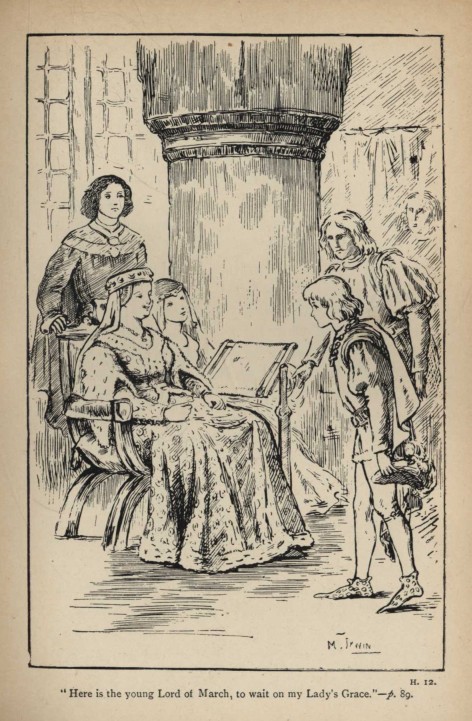
"Here is the young Lord of March, to wait on my Lady's Grace."
With some curiosity Roger looked up, and saw a short, smiling, exceedingly fat woman, clad in a crimson damask dress embroidered with rings of gold. Threads of silver were mingled with her golden hair, and the remains of what had been extreme beauty could be traced in her countenance.
"Come hither, little Cousin," said the Princess affably, smiling all over her plump face. "Of a truth, I am right glad to see thee. I can go visit none now, for I am so fat I may scarce mount mine horse. Didst ever behold a woman fatter than I?"
Roger's head squire, who had been spending considerable pains in coaching him for this interview, was horrified to hear him reply with charming candour—
"No, Dame; that did I never."
"Why, thou sayest well!" laughed the Princess, evidently not in the least offended. "Alway speak truth, fair Cousin."
"So do I," answered Roger rather proudly. "My Lady my grandmother told me ever so to do; and she learned me two sayings by the which I should rule me, and I so will. Under your pleasure, Dame," he added in an instant, with a sudden recollection of the squire's instructions and those of Sir Gerard.
"Come, tell me what they were!" responded the Princess, coaxingly. "Thou lovest my Lady thy grandmother, that can I see."
"Well, I did, middling, Dame," said Roger, coolly. "Howbeit she were only a woman."
The squire was ready to sink into the earth, till he was relieved by the Princess leaning back in her gilded chair with a burst of the heartiest laughter.
"Gramercy, little Cousin, but thou art right covenable![#] I see, we shall be good friends. But I desire thy two sayings. Tell me the same."
[#] Agreeable, amusing.
Roger repeated them rather proudly.
"'Fais ce que doy, advienne que pourra:' 'Un and Dieu, un Roy, servir je doy.'"
"And dost mean to rule thee by them?" asked the Princess, still smiling.
"That do I, Dame. I will serve God and the King to my power, but none other."
"He will do, trow?" said the Princess, looking up at somebody whom Roger had not previously noticed. His eyes followed hers, and he saw standing on her right hand a young man of eighteen, clad in a tunic of black baldekyn, figured with red balls and purplish-gray flowers. Above it was a white tippet; the sleeves were red, with gold cuffs; and he wore yellow shoes with a red pattern.[#] He was of short stature and slight figure: his complexion was of feminine fairness, his hair flaxen tinged with gold, his eyes blue and dove-like. So great was his soft and pathetic beauty, that artists selected his face as the model for "that Face which now outshines the cherubim."
[#] This is King Richard's costume in the Golden Book of St. Albans.
Something in the face won Roger's heart. What it was he did not know himself. It was, in truth, a vague remembrance of that fair young mother who had passed away from him so early, and a likeness to whom he detected without recognising it, in the face before him. An affectionate smile from the royal cousin completed his conquest of the heart of Roger Mortimer.
"He will do, in very truth," said the King, answering his mother first: then he turned to Roger. "Be right welcome, fair Cousin: I trust to see more of you in time coming."
"Sir," asked Roger, looking up, "be you Lord Richard the King?"
"Even so, fair Cousin. What can I do to pleasure you?"
Natures like those of Roger Mortimer are always capable of intense hero-worship. And Roger had found his hero. He dropped on one knee without any prompting.
"Then, Sire, I will live and die with you!"
The King unfastened from his chain of rubies a golden broom-pod wrought with green enamel. It was one of his own badges.
"Then shalt thou be mine own man, by thy covenant," said he, smiling, and attaching the badge to Roger's gold chain: "and thereto is my token."
"Why, well said!" interpolated the Princess, who seemed unable to keep silence long. "Come hither, little Cousin—here, set a stool for my Lord of March,—and tell me how it liketh thee to dwell with my Lord of Arundel."
"Not in no wise, Dame," answered Roger, boldly.
"Not in no wise, quotha! Why what ails thee at him?"
"I love him not, Dame, nor he me."
"Dear heart, here is a pity! But thou lovest my Lady Alice, trow?—though she be but a woman." The Princess's fat shoulders shook with laughter.
"Our young cousin's chivalry is scarce fledged, methinks," said the King.
"If you will learn me, Sire, I will do your bidding," said Roger, who did not know what bashfulness was. "My Lady Alice, said your Grace? Good lack, but I cannot abear her!"
"Cannot bear her, quotha! Nay, now, she is to be thy wife!"
"My Lord the King's command except, that shall she never!" said Roger sturdily.
"See you, fair Son?" was the Princess's comment, with a glance at the King. "And wouldst thou be much aggrieved, little Cousin, if thou wert to depart thence, and to dwell in another household, where thou shouldst have jolly lads and lasses to pleasure and couldst see the King thy cousin well-nigh thee, every day?"
Roger's eyes shone with delight.
"Please it you, Dame, that should like me right well. Howbeit, I hope there should be more lads than lasses."
The Princess indulged in another hilarious convulsion.
"Thy time will come, lad!" said she, when she was able to speak. "Till it do, thou canst lake thee with Tom, which is scarce the younger of thee.—It shall do right well, fair Son: and I pray you heartily to set the matter in train."
"Aye, methinks it were well done," answered the King.
But neither of them explained what was to be done, though Roger's curiosity was intense. Manifestly, he was to be taken from the Earl of Arundel, and given in wardship to some other nobleman. That was a delightful prospect. If he could only be rid of Alice as well, Roger thought he would be in Paradise. And the King had offered him a favour. Roger turned boldly to His Majesty.
"Sire, your Grace said you would pleasure me. Pray you, have me rid of yon Alice. I love no maids, and her least of all."
Once more the Princess burst out laughing. The King looked quietly amused.
"Is that the dearest wish of your heart, fair Cousin?"
"It is so, at this present, my Liege."
"He shall have a dearer anon, or I am no prophetess," exclaimed the convulsed Princess.
"Maybe," said the King. "Well, fair Cousin, we will pleasure you in this matter,—the rather seeing"—and he turned to his mother with a smile—"that it shall pleasure your Grace as well."
At this moment a slight noise outside preceded a scratching at the door, a lifting of the arras, and the announcement of—"My Lady's Grace of Lancaster."
The royal hosts took leave of their little guest rather hastily, yet very kindly, and thus dismissed, Roger was reconducted to Bermondsey House by Sir Lewis Clifford.
There was a good deal to talk over when Roger and Lawrence were safely tucked up in their respective beds.
"I say, Loll!" came from the big blue bed, "this is jolly!"
"I am glad your Lordship is well content therewith," was the response in the quieter voice from the pallet.
"I am so fain to get rid of yon Alice!" said unchivalrous Roger. "And I am right fain, too, to be out of this dull house. Who is Tom, I marvel, that she said I could lake me withal? Metrusteth he is a lad of some mettle, and not a dull lump of stuff like yon Jack Arundel. I would, though, he had been something elder than me in the stead of younger. I love not laking with children."
Master Roger was beginning to consider himself above the degradation of childhood. Lawrence contented himself with replying that he trusted his Lordship might find matters as should be to his satisfaction.
"Where shall it be, Loll, thinkest? I would it might be in the Palace! Aye, and said she not that I should see the King my cousin well-nigh every morrow? I would like that best of all. I could die for him, Lolly!—and shall some day, I cast no doubt."
Lawrence's reply was merely a respectful intimation that he was listening. He was quite as ready as Roger to die for one whom he might love, but not by any means so ready to talk about it.
"O Lolly, I could jump up to the moon, 'tis so jolly!" and Roger executed a pas seul outside his bedclothes. "But I say!—I hope they shall 'noy me with no more maids! Why can folk not leave a man be, I would fain wit?" demanded his Lordship, loftily, lying down again, and drawing the satin coverlet over him, by no means tidily. "I would in very sooth I were but a bit bigger! Howbeit, I reckon we shall grow. And then, Loll, thou shalt be mine own especial knight, and shalt bear mine arms, and fight right behind me."
"I thank your good Lordship," said Lawrence dutifully, though the prospect of fighting, whether before or behind his master, was not particularly enlivening to his mind. Could Lawrence have chosen his lot, there would have been no fighting in it.
"I reckon we shall see," went on Roger, not quite in so lively a tone. "But it shall be right jolly—any how. And I do not—I should not——"
Roger was asleep.
CHAPTER VI.
FAIR AND FICKLE.
"Wel were hym that wyste
To whom he mytte tryste;
Beter were hym that knewe
The falsè fro the trewe."
—OLD POEM OF FIFTEENTH CENTURY.
The hidden intentions of the Princess were very soon revealed. Roger and his suite were transferred from Bermondsey House to Woking Manor, the seat of Thomas, Earl of Kent, the eldest son of the Princess, and half-brother of the King. The Countess of Kent was a sister of the Earl of Arundel, but of a quieter and less decided character than most of her family. Her children, in whom Roger felt more interest than in herself, were six in number, exclusive of two boys who had died in the cradle. They were Alianora, aged fourteen; Thomas, aged twelve; Anne, aged six; Edmund, aged three; Joan, aged two; and Margaret, an infant. The eldest boy was of course the Tom to whom the Princess had alluded. He was present when Roger was introduced to the Countess, and Roger was gratified to discover that Tom, though by a few months the younger, was taller than himself. All the Holands of Kent were tall, fully developed, of very fair complexion, and exceedingly handsome. But Roger's eyes had not reached beyond Tom, when they lighted on some one else who was entering the room, and from that moment he had eyes for no other.
If it be true, as it has been said, that the metaphorical gentleman termed Cupid usually takes the severest vengeance on those who despise his power, he must have been in that mind with regard to Roger Mortimer. One instantaneous glance proved sufficient to awaken in the bosom of Roger, who hated and despised all girls, a fervent boyish passion which reached down to his heart's core, and never left him until his life's end.
The girl of whom the sight proved thus potent was the Lady Alianora de Holand, eldest daughter of the Earl and Countess of Kent. Though only fourteen, she was so tall and stately that she had a grown-up aspect. She stood, when Roger saw her, just in the doorway, her arms full of flowers which she had been gathering in the garden, and her abundant fair hair falling about her like a golden glory. Her little brother Edmund had pulled it down in play; and had she known of the existence of visitors in the hall, the Lady Alianora, who was quite old enough to be particular about her personal appearance, would never have presented herself before them in this dishevelled guise. She stopped, blushed, and hastily dropping her flowers on the nearest form, fled to her chamber to make herself presentable,—leaving on Roger's mind an impression of angelic loveliness.
No such impression was conveyed to Lawrence Madison. Roger, who was in an exalted mood which disposed him, knight-errant-like, to insist upon all beholders' instantaneous acknowledgment of the pre-eminence of the lady of his heart, was quite put out by the cool, indifferent tone in which Lawrence assented to his rapturous comments on the beauty of the Lady Alianora. Accustomed as he was to sudden changes in his impulsive master, yet this one took Lawrence by surprise. He had not expected Roger to alter in that direction. Love, to him, was not a blow to be struck all at once, but a plant to ripen by degrees. The sudden and absorbing passion which had taken possession of Roger's heart by assault, was not merely unexpected to Lawrence; it was incomprehensible.
The transfer of Roger from the care of the Earl of Arundel to that of the Earl of Kent was marked by one peculiarity very unusual at the time. It was purely a personal transfer, and did not include any change with regard to the administration of the estates, which were still left in the hands of Arundel, except that the Earls of Warwick and Northumberland were joined with him in the guardianship. The care of the heir and of the estate so generally went together as to rouse the suspicion in this case that the severance was a fresh clever move on the part of the Princess. To leave the estate in the enemy's hands might be intended as a hidden purchase of his acquiesence in the transfer of the boy. It was a sacrifice of the casket to secure the safety of the gem. Perhaps the Princess was also sagacious enough to divine that—as it turned out—there would be no sacrifice in the matter. Arundel proved in this case an honourable man, and administered the estates well, resigning them without difficulty into Roger's hands when he was called upon to do so.
Between Roger and Thomas, eternal friendship was sworn without delay. Their characters were somewhat alike, save that Roger was slightly the more impulsive, and considerably the more self-willed. The younger children were in Roger's eyes quite beneath his contempt.
There was one point of the matter in respect to which Lawrence was by no means indifferent. The style in which the Lady Alianora behaved to her youthful admirer enraged him beyond words. The beautiful girl was a born coquette. And she treated Roger to every variety of behaviour suggested by that despicable type of character. One day she would lift him up to the heights of ecstacy with her notice and favour, and on the next would plunge him into the lowest depths of despair. It appeared to delight her to play with his feelings like a cat with a mouse. That she had any of her own Lawrence could not discover. But as time went on, and they grew older, and the sentimental adoration of the boy, instead of fading away, blossomed into the solid and enduring love of the man, the sensation of aversion on Lawrence's part became stronger than ever. He would never have used Roger as she did, had he been in her place.
Roger appeared not to perceive this blemish in his chosen idol. All that she chose to do was perfection in his eyes.
It may perhaps strike the reader as hardly possible that a boy of Roger's age could have entertained such feelings. But we have abundant evidence that our fathers, five hundred years ago, grew up much earlier than we do—probably in part from the shorter average duration of human life, and in part from the forcing nature of the life they led. A boy of twelve, in 1385, had attained a period of life equivalent to that of a youth of at least sixteen in the present day.
If it could have been whispered to Roger Mortimer that he was flinging away his true and faithful heart upon a worthless weed, while there were modest violets to be found under the leaves—that he was bartering his priceless diamonds for glass beads which were not worth the picking up—well, he would not have believed it. But in truth he had met with the evil angel of his life, and he was yielding unto her fair false hands the perfect trust and the passionate devotion which were only due to God. Would he ever awake from the dream? and if he did, would it be while there was yet time left to repair his blunder, or only when it was too late, and there remained but a long weary stretch of the wilderness before the end should come?
Ah, the Good Shepherd goes after His lost sheep, until He find them. But they are apt to lead Him up arid steeps and into sunless gulfs, through thorns which tear their feet as well as His, and into dry places where no water is beside the stream which flows from the smitten Rock.
Reserve and reticence were not in the nature of Roger Mortimer. The Princess very soon perceived, with equal amusement and delight, the fulfilment of her prophecy; and urged upon her royal son the desirability of at once betrothing Roger and Alianora. The King, however, preferred a little delay. There was time enough, he said: both were yet very young; matters might alter before they were old enough to be married. So the formal ceremony, though fully intended, was deferred, leaving an element of uncertainty which added to Roger's intermittent misery.
The autumn which followed the spring of Roger's transference to Woking witnessed some most painful events. The second son of the Princess, Sir John de Holand, entering into a squabble between his attendants out of which he had far better have kept himself, killed Sir Ralph Stafford, the favourite squire of the young Queen. He was condemned to die, and the Princess in an agony of grief, sent Sir Lewis Clifford to the King at York, earnestly beseeching for mercy to his brother. She was refused, and it was the first refusal which her royal son had ever given to an intercession of hers. As the event proved, he was ready enough to grant it as man, but he could not feel it his duty as King. The Princess laid it so to heart that her heart broke. A fortnight after the return of Sir Lewis from his fruitless errand, she lay dead at Wallingford Castle.
In the first impulse of his anguish and remorse, King Richard granted a full pardon to his brother, on condition of his making a pilgrimage to Syria. He was a man of the deepest affections, and next to his wife, his mother had been nearest to his heart. Perhaps it was the remembrance of this one rejected appeal and the agony of its result, which made Richard in after years so perpetual a pardoner of the transgressions of those whom he loved.
Another result of these sorrowful circumstances was to cause the King to carry into immediate action various intentions which he knew had been his mother's wish. And in pursuance of one of these, on a morning in October, he sent for the Earl of March.
The royal officers conducted Roger, somewhat to his surprise, to the King's private closet, and motioned to his suite to remain in the ante-chamber. He was to pass in alone.
Roger found, however, that the interview was not to be tête-à-tête. Seated in a curule chair by the side of His Majesty was the uncle of both, Thomas, Duke of Gloucester, the most astute man in England, and the evil angel of the King. Roger made his reverences to his royal kinsman, and was directed to seat himself on a velvet settle which faced them. A slight motion from the young King appeared to be a preconcerted signal at which Gloucester took up the word.
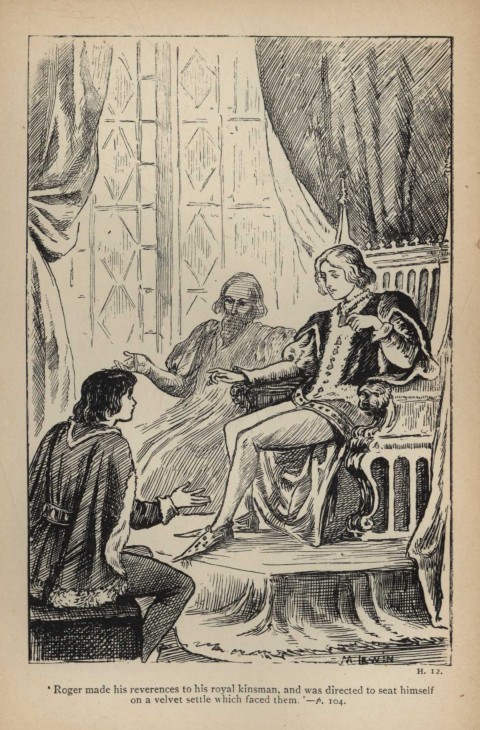
'Roger made his reverences to his royal kinsman, and was directed to seat himself on a velvet settle which faced them.'
"Methinks, fair Cousin," said he, addressing Roger, "that you be not now to learn that your mother, the Lady Philippa of March, was daughter and heir unto my fair brother of Clarence, whom God assoil?"
Roger intimated that this was no news to him.
"And you may lightly guess, moreover, that, my said brother standing next in age to my most honoured Lord the Prince, whom likewise may God pardon, had the said Prince deceased unhappily without issue him outliving, my said brother your grand-sire should have stood next to be king."
Roger bowed his head. He began to wonder what was coming. Was evil about to befall him for the crime of being a great-grandson of King Edward?
"Bear with me, then, my fair Cousin, while I recount unto you the causes of that which I am about to lay before you under command of my Liege here present."
One of the secrets of Gloucester's popularity was his exquisite veneer. Very few persons realised how thin the coating was, or what was the material which lay beneath. Least likely to discover it of all was the young King, in whose single-eyed nature suspicion had no place, and whose warm heart was ready to take in every creature who professed a shred of devotion to himself.
"Maybe, being as you are but right youthful, fair Cousin," pursued Gloucester, "you shall have need to be told in words that after the old custom of England it was not used that, the King's son dying afore his father, his childre should be held to fill his place. This ancient custom, howbeit, was changed by my redoubted Lord and father King Edward, of set purpose that the King our Liege who here sitteth should succeed him on the throne. In case, therefore, that our said Liege should leave no issue—which God defend!—he must needs appoint him a successor after his pleasure. Now my said Liege, accounting it ill (as in very sooth it should be) that men's minds should be unsettled touching so weighty a matter, and knowing moreover that life standeth alway at the pleasure of God, and that men may not dwell on middle earth no longer than it listeth Him—" there was a vast reservoir of piety in Gloucester, but it went no lower than his tongue—"it hath pleased my Liege to make choice of him that shall succeed him, if in evil case he should chance to decease without child. To make an end, fair Cousin, without further words, you are he whom my Lord hath chosen to sit on the throne when the pleasure of God shall be fulfilled in him."
Roger sat dumfoundered. The last conclusion he had expected was the one that had come upon him. Among all the suppositions as to the chosen heir which had been coursing through his thoughts while his uncle spoke, the faintest idea that it might be himself had never occurred to his mind.
He did not know that it had been in existence, nearly as long as he had, in the three governing minds of England, of which one had just passed away. It was the only point of all their opinions in which the Princess and the Dukes of Lancaster and Gloucester were agreed. The private reasons of each were utterly diverse from those of the other two. The Princess wished to secure two points—the happiness of her son, and the welfare of the Lollard Church of which she was the nursing mother. To this end the heir must entertain a personal affection for His Majesty which would prevent him from coveting his position, and must be brought up in an atmosphere which would dispose him toward the Lollard doctrines. The Duke of Lancaster's object was the welfare of England; added to which he did not want to reign himself, and Roger or his brother were the only persons who could reasonably be placed before him. The Duke of Gloucester's object was almost the opposite of the last. He did wish to reign, but he cared more for the reality of power than for the semblance, and knowing that equity would be outraged by his being preferred to his elder brothers, he desired such a monarch as he would easily be able to influence. This he fancied he saw in Roger,—warm-hearted, impulsive, readily swayed, and not too suspicious of ulterior motives.
The only person, at that day, who had ever been able to read the true character of Gloucester was the dead Princess. She must have been a very clever woman. Her feminine instinct penetrated all the joints of his closely-riveted armour, and without his being in the least aware of it, "to her he had shown his naked heart." Somebody who could be trusted must be put in his way; and she read Roger also more accurately than he had done. Through all the outward impulsiveness she discerned the heart's fidelity—through all the thorny surroundings of temptation the ever straightforward aim at the one goal of right. Perhaps her cleverest move of all was just that which looked on the surface the least likely to forward her intentions. She had removed him from the noxious atmosphere of Bermondsey House, and had placed him in a family which was not marked by Lollard proclivities—a family of which, in that respect, even the anti-Lollard Gloucester could feel no suspicion. But she saw that Roger was more easily led than driven: that his intensely Lollard uncle, John de Montacute, "the most pestilent of all that sect," was likely to have far more influence with him as an occasional and interesting visitor, than as the man who decided his fate and sat in judgment on all his little peccadilloes; beside which, had he been consigned to the care of a distinctly Lollard family, Gloucester would have been certain to scheme for his removal. He would probably be content to leave him at Woking, where Lollardism was something quite outside the family notions—a matter which they left to the priesthood, whose business they considered it to be. His suspicions of any sinister design on the part of the Princess would scarcely be aroused by her very natural wish that her youngest son's chosen heir should be in the care of her eldest son.
Roger, of course, had not the slightest conception of all these wheels within wheels which he now saw to his amazement were bearing him forward to the throne. The result was to him the only thing apparent, and that left him in a state of speechless astonishment. The only two clear ideas in his confused head, beyond surprise, were deep devotion to the royal cousin who had marked him by such signal favour, and a rapturous throb of his heart at the thought that now, at least, Alianora was safely assured to him. He knew that a prospective crown would weigh heavily with her, no less than with her parents: and as for him who wore it, and who certainly would weigh less, Roger's loyal heart was content to accept the very crumbs of affection from the hand which he loved, rather than a plentiful board spread by any other.
The King's voice broke Roger's astounded silence.
"Methinks we have somewhat taken you by surprise, fair Cousin," said he, with that exquisitely sweet smile which Richard knew how to give.
"In very deed, my gracious Lord, but you so have!" was the answer. "Mefeareth, my Liege, that your bestowal upon me is far over my dementing."
"Strive then to deserve the same, fair Cousin," said Gloucester didactically. "In all things submit you obeissantly to my Lord his pleasure."
A speech which meant much more than it said, since Gloucester aimed at governing Roger through the King. Like other astute persons, the former scarcely comprehended a mind which had but one aim, and assuredly never intended to strengthen Roger's personal love for his royal cousin. His real intention was to attract it to himself. But Roger's powers of discrimination were greater than those of King Richard, and he had an uneasy sense of some ulterior meaning on the part of his uncle, which cooled his demeanour and lessened his words. He had no intention of confiding his heart's secrets to that over-clever relative.
"I am at ease thereanent," said the King, answering Roger with another smile. "And now, Cousin, God give you good day, for methinks you have food enough for thought."
Roger could not have told whether he returned to Woking through smiling valleys or barren mountains. The family of the Earl of Kent, the elder branches of which had been admitted into the secret, were amused to see how silent and meditative their young ward became after the proclamation of his future brilliant destiny. Roger was growing up fast—faster in mind than in body. Very grave and thoughtful grew the young heir. The radiant crown which hung before him, though in a probably distant future, seemed to have descended upon his head not as an ornament, but as a weight. The Earl of Kent was much surprised at it. The side of Roger's character which was outwardly exhibited—the lighter and more childish side of it—was the only one which he had yet seen. But the depths were there, and they had been stirred at last.
They were stirred in more ways than one. The prospective crown which had struck Roger into gravity, struck the Lady Alianora into a flutter. To her it was merely the most becoming decoration which could rest upon her head. The thought of any duty or responsibility in connection with it was entirely foreign to her mind. But it became desirable to cultivate Roger, and to let him see unmistakably that he was established in her good graces. To lose him now was not to be thought of for a moment. But had the King changed his mind, and transferred his favours to any other person, what the Lady Alianora called her heart would have followed in their wake. The dog-like fidelity which characterised Lawrence Madison, and to which it would have been of no moment whether his master sat upon a throne or a dunghill, was simply inconceivable to her.
It was Sunday evening, and the churches were slowly emptying of the worshippers at vespers. Lawrence was making his way out at the western door, when looking up he encountered a pair of bright eyes attentively regarding him. They belonged to a girl of about his own age, who wore a dress of blue camlet, and was evidently in the middle class of life. She was very pretty, but apparently very shy. Her eyes dropped the instant they encountered his, but kept returning to his face as if she found something attractive in it. Behind her came an older woman whom Lawrence felt certain, as soon as he glanced at her, that he had met somewhere before. As soon as they were clear of the sacred edifice, Lawrence saw the girl turn round to the woman behind her, and address her in an earnest whisper. The woman replied aloud.
"Nay, child: it were not like, methinks."
"But it might be! Will you not ask, Mistress Wenteline?"
The name solved Lawrence's difficulty in a moment. In another instant he had pressed through the crowd, and was by the side of his old friend.
"Mistress Wenteline! Come you from Ludlow—from Usk? Know you not Lawrence Madison?"
"Well, of a surety, but it is!" cried Guenllian, heartily enough. "Lad, how camest thou hither? The maid said it were like thee, but I never thought—Is my Lord hereaway? My Lord of Arundel hath no place in this vicinage, trow?"
"My Lord is not now in ward to him, good Mistress; but unto my Lord of Kent, that dwelleth at the Manor here."
"Now God be thanked therefor!" said Guenllian warmly.
Lawrence turned to the girl. "Methinks I should know you likewise: and in truth, you be like some one that I have known, but I cannot give you a name."
The bright eyes laughed, but their owner seemed too shy to speak. Guenllian looked at both with an amused expression.
"Nay, twain friends so dear as you were of old should not have forgot each other," said she. "Lolly, dost not know thine old playfellow? 'Tis Blumond's Beattie."
"Beattie!" broke from Lawrence with more warmth than usual. But as soon as the greeting was over, both relapsed into extreme shyness.
"And pray you, Mistress Wenteline, how came you hither?"
"Marry, lad, we be tarrying a two-three days, under the King's gracious leave, at his manor of Byfleet, and as Tuesday we journey onward to London town. Beattie and I, we thought we would come to Church something a longer walk, and two of my Lord's squires be with us"—Guenllian paused and looked about for them—"I marvel whither they be gone in this crowd. Beattie, canst see any whither Master Orewell or Master Chauntemarle?"
Beattie thought she saw Master Chauntemarle's cap over yonder: but Lawrence interposed with a question which he was burning to ask.
"But, Mistress Wenteline, how came you hither?"
"Why, look you, we be now of the following of the Lady de Percy, and the Lord of these squires and of us is my Lord of Northumberland."
"And the Lady de Percy is at Byfleet? Me reckoneth my Lord were right fain to see his sister."
"Aye, and the Lady Elizabeth was ever his favourite. But, Lolly, I would fain see my dear child. He is at the Manor here, trow?"
"If it like you to bide for compline, Mistress, you shall then see him with no further travail; or if you will come up to the Manor, I rest well assured that Mistress Dayrell, which keepeth house, shall make you right welcome."
"Beattie, run thou to Master Orewell, which I see searching us o'er by yon yew-tree, and do him to wit of this. Say we will return with Lawrence to the Manor, and ask at him if he or Master Chauntemarle list to come with us. If not, then will we leave our returning as it shall please God."
Beatrice obeyed, and in a minute returned with Master Orewell, who intimated that his pleasure would be to accompany the ladies, but Master Chauntemarle preferred to return to Byfleet. Guenllian accordingly sent through the latter her excuses to Lady Northumberland, and the party set out for the Manor.
Lawrence left his friends in charge of Mistress Dayrell, who was well pleased with the prospect of a gossip, and dashed up the stairs, three at a time, in search of his young master. Roger was playing hand-tennis with the other young people—an occupation the suitability of which to Sunday evening it never occurred to him or any one else to doubt. The moment that he heard who was below, he flung down his battledore, and rushed down the stairs as quickly as Lawrence had come up them.
Guenllian had not realised the change that years could make until Roger stood before her. She had been unconsciously expecting to see the child of nine, and when the handsome boy of thirteen, who looked older than he was, came into the room and welcomed her, she could scarcely believe his identity. But the warmth and brightness were those of the old Roger, and they comforted Guenllian after all her fears and heart-sinkings lest he should be changed and spoiled at Bermondsey House.
"Mine own dear child!" she said lovingly. "Verily, I ask your Lordship's pardon; but you shall seem always my child to me, even when you be a man grown."
Roger had arrived at the age when a boy is rather ashamed of being kissed, and feels it a humiliation. But like a true gentleman as he was in nature as well as name, he put his own feelings aside, and permitted his old nurse to pet him to her heart's content.
"And now, mine heart, give me leave to ask you," inquired Guenllian, in whose diction the new deference was somewhat at variance with the old familiar love, "if you be welsome and happy hereaway?"
"Very, very happy," said Roger's eyes no less than his voice. The Lady Alianora had been unusually complaisant for the past week.
"And how did your Lordship like at Arundel Castle?"
"Very ill, Wenteline. I am rejoiced to be away thence."
Guenllian was privately rejoiced to hear it.
"Metrusteth Lawrence continueth a good lad?"
"Much better than Roger," said the owner of the latter name, with a bright laugh. "He alway were so."
"And your Lordship, as I do hear, is in right high favour with the King?"
Roger smiled and blushed slightly. His honours were still fresh upon him.
"Aye, Wenteline, I have been denounced[#] heir of England."
[#] Announced, proclaimed.
"But to think of it!" exclaimed she. "Well, my dear child, God give thee His grace! Thou shalt make but an ill King without it."
Guenllian thought that Roger's eyes responded, but his voice was silent.
CHAPTER VII.
ROGER HAS HIS WISH.
"Whatever fades, but fading pleasure brings."
—SIR PHILIP SIDNEY.
The paths that had joined for a moment parted again, and Guenllian and Beatrice passed out of the sight of Roger and Lawrence. The life which they led at Woking was very quiet—so quiet that Roger at least began to feel restless, and to complain to Lawrence, that every thing stagnated around him. But before six months were over, the second political convulsion of the century had begun. Gloucester only awaited the removal of his brother Lancaster, who was the barricade against his ambitious designs, to draw the bow which he was holding ready.
The Duke of Lancaster sailed from Plymouth on the ninth of July. By Michaelmas, Gloucester was in London, gathering his conspirators around him. The one with whom he first took counsel was his nephew, Edward, afterwards Earl of Rutland, eldest son of the Duke of York. This man seems to have delighted in dissimulation and treachery, not as means to an end, but for their own sakes. He cared not whom he joined, so long as he could afterwards betray them; and he was ready to agree to anything, if it only involved a plot. Love, kinship, gratitude, even interest, were no barriers in his way. This man had been one of the dearest friends of the young King—the friendship being on the King's side, and only the outward profession of it on Rutland's: but no sooner did Gloucester lay his plans before Rutland, than the latter sacrificed his friend to the pleasure of a conspiracy.
There were four of the Privy Councillors of whom Gloucester had resolved to get rid. These were the Archbishop of York, the Duke of Ireland, the Earl of Suffolk, and Sir Simon Burley. The first and last were professed Lollards: the second, and perhaps the third, almost certainly held those doctrines, though less openly than the other two. There is an old proverb that "If you want to hang a dog, it is easy enough to find a rope:" and the conspirators found no difficulty in fixing on charges calculated to render the four councillors impopular. The Archbishop, who was a Neville of Raby, and the Duke, who was ninth Earl of Oxford, could not be accused of humble origin; but the Earl of Suffolk was open to this impeachment, and they made the most of it, by contemptuously addressing him as "Michael," even in full Parliament. Sir Simon Burley had been the King's tutor, and an old friend of the Black Prince, who had great confidence in him; it might have been supposed difficult to find the rope in his case. But who ever knew a Romish priest short of an excuse to disparage the character of a heretic, by whatever name he might be called? Behind the conspirators himself unseen, but quietly pulling the strings which moved all these puppets at his pleasure, stood Sir Thomas de Arundel, Bishop of Ely, and brother of the Earl, who was at once the instigator, the assistant, and the absolver of them all.
The Earl of Arundel had been induced by his brother to unite with the conspirators, who were also joined by Thomas Beauchamp, Earl of Warwick, a weak man who was as much a dupe as a criminal. It was not till a later period that they were joined by the cautious Henry of Bolingbroke, Earl of Derby, and by another who ought for very shame to have held aloof,—the King's favoured friend and trusted councillor, Thomas Mowbray, Earl of Norfolk. William Courtenay, Archbishop of Canterbury, was also ready to help them, on account of his personal dislike to his brother Archbishop, who had recently received a lucrative appointment whereon Courtenay had set covetous eyes.
Of course the real causes of hatred were not paraded before that innocent, deceivable creature, the public. The true reasons for hating the four obnoxious councillors were that they had the ear of the King, while he declined to be governed by the five conspirators and their priestly guides, who were accordingly much scandalised at his allowing himself to be governed by any one—themselves of course excepted. This is the usual secret of complaints that a man is governed. Put the complainer in the place of the governor, and the complaint will not be heard again.
The ostensible reasons were plausible. The Archbishop of York, said the conspirators, was covetous and arrogant, and took liberties with the King: which of course meant that equal liberties were not allowed to themselves, the Archbishop being in reality one of the gentlest and most unworldly of men. The Duke of Ireland was "a puppy;" he made the King do whatever he liked, and bestow on him lands, titles, and offices (instead of on the conspirators). The Earl of Suffolk was a mere nobody, the scum of the earth, yet he took upon himself to dictate to the King and to oppose the nobles. Sir Simon Burley had proposed, under colour of an expected invasion of the French, to remove the shrine of St. Thomas from Canterbury Cathedral to Dover Castle, on the pretence that Canterbury was not so strong as Dover: of course he could only mean to pocket the rich offerings, and make his own profit out of the guardianship of the shrine. All of them were accused of defalcations of the Crown revenues.
There was a further charge against Ireland, which has been ever since received as historical fact, though it was not substantiated by a single document, nor by any thing but the bare word of the conspirators, and some inferences from circumstantial evidence, which might or might not be true. The Duke had always lived unhappily with his Duchess, who was a cousin of the King. The differences between them were partly ecclesiastical, he siding with the Antipope Urban, she with Pope Clement. There is also reason to suspect that her temper was somewhat less than angelic. The chroniclers tell us that Ireland fell violently in love with a German lady in the Queen's suite, whose name was Lancerona or Lancecrona (a suspiciously manufactured epithet): that the Queen wrote a letter to Pope Urban entreating that he might receive a divorce; that Urban thereupon divorced Ireland and Philippa, and that the Duke married his German love: that his mother was extremely indignant, and took Philippa to live with her; that the Sire de Coucy, father of the Duchess, and the King of France, almost took up arms against England in consequence of these wicked proceedings. The real truth of the matter is that no evidence whatever exists to support these alleged facts. We have evidence that Gloucester and others took pains to spread them as a rumour, but none to show that they were true. Not only is the Queen's letter not forthcoming, but there is no document to show that a divorce ever took place![#] There is no evidence—except the ipse dixit of Gloucester and his partisans—that Ireland ever contracted a second marriage; while the facts that after his banishment he was invited to visit the French Court, that his wife bore the title of Duchess of Ireland to the day of her death, which followed his, and that his mother ran great personal risk in warmly espousing his cause and that of King Richard when both were at the lowest ebb, do not took favourable to the representations of Gloucester. It may be added that this Lancecrona, who is stated to have been a lady in waiting and a laundress—two utterly incompatible positions, even more so at that time than now—does not appear at all as one of the royal suite in any mention of them contained in the state papers, and there is cause for suspicion which almost reaches certainty, that she never existed beyond the inner consciousness of my Lord Duke of Gloucester.
[#] Carter, one of the most accurate of our historians, records his opinion that "there is no reason to think that a divorce was ever granted, nor even solicited, between Ireland and Philippa." (ii. 581.)
These tales, true or false, were assiduously spread among the populace, and Gloucester very secretly, but very diligently, advised them to refuse any further payment of taxes. The King, said he, would have plenty of money at his command, if the wicked councillors were only forced to disgorge their ill-gotten booty. Yet with all their cleverness, Gloucester and his allies could not succeed in accusing Suffolk of any greater covetousness than "taking from the King a thousand marks a year since he was made an Earl"—which was the ordinary grant from the Crown to every earl in England.
That the animosity of these plotters was really and originally religious is shown in the fact that when the whole power in the kingdom fell into their hands, they weeded the state offices and the royal household of all the Lollards, and let others alone. They descended even to squires and ladies—so long as they were Lollards. The Lady de Poynings, a princess's daughter, was not too high for them to aim at; nor was John Calverley, the Queen's squire, too low to feel their vengeance. Sir Bernard Brocas, the Queen's Chamberlain, and the Lady Molyneux, wife of Sir Thomas, were also swept out of her household. Neither prayers nor tears availed to soften them. For four hours the Queen herself, "Cæsar's daughter," knelt to the Earl of Arundel, imploring him to spare Calverley, whom they had condemned to death. It was all in vain. Arundel savagely told her to pray for herself. She had cause enough. Sir Bernard Brocas was also put to death: the ladies were dropped into obscurity, where they were wise enough to remain.
The long and sad story of this persecution—it deserves no other name—belongs to general history: but the end is soon told. Ireland, Suffolk, and Archbishop Neville fled abroad, and died there. Burley meant to have preceded them in this step, but was unfortunately dissuaded by Ireland, at that time unable to conceive the possibility of the conspirators presuming to put any man to death. He generously offered him forty thousand marks to refund in respect of the defalcations of which Burley, "that gentle, gallant, and prudent knight," had been falsely accused. But the Lords Appellants, as it pleased the conspirators to term themselves, wanted blood, not bribes: nor did it suit them to accept as a gift what they meant to take with a high hand. They got the King out of the way, and instantly seized on his old tutor, whom he was unable to deliver from their malicious hands. Burley died on Tower Hill. The other less obnoxious councillors were got rid of, mostly by death without the pretence of a trial: and then my Lords Appellants, having reduced their Sovereign to the status of their slave, courteously, and in subservient language requested him to come home, to obey their orders, and as the first, to deliver into their hands all the state records and twenty thousand pounds.
Ten years later, when the slave had resumed the status of the Sovereign, after a trial on which Lancaster sat as judge, the Earl of Arundel was beheaded in Cheapside. And modern writers regard Richard as a tyrant, and Arundel as a murdered patriot! There is one Book written by truer pens than theirs, wherein other appellations are probably attached to the names.
Perhaps few households in high positions throughout England were less disturbed by the political earthquake than that at Woking Manor. The Earl of Kent, with whomsoever he might side in his heart, practically held aloof from the entire struggle; and the Countess Alesia, though she was sister alike of the Earl of Arundel and the Bishop of Ely, who with Gloucester formed the soul of the conspiracy, appears herself to have entertained no political bias, and to have followed her husband along the quiet bye-path into which he thought it prudent to turn until the storm blew over. Rumours, however, were not slow in reaching them: and no one was more eager to hear all the news than Roger. It need hardly be said that he was a vehement partisan of his royal cousin, and hotly indignant against the Lords Appellants. The suspicions which he had entertained already concerning the fidelity of his uncle of Gloucester were now confirmed to the full, and beyond it.
Those who, being conscious of Lollardism, or knowing themselves suspected of it, felt danger threatening them, got out of the way, or in some other manner prepared for the inevitable as best they could. The prominent Lollard, Sir John Montacute, Roger's great-uncle, made his will, and then waited the event. The young Lord Le Despenser, a boy of Roger's age, was sent off by his friends to sea, being sagaciously placed under the nominal care of the Earl of Arundel.
Having finished their work, the Lords Appellants now thought it time to distribute their rewards. The heaviest prize fell to Gloucester's share, for he granted himself—of course in the King's name—all the lands of the Duke of Ireland, about the second man in England as to wealth, and the smaller property of the Earl of Suffolk. He also appropriated to himself the office of Justice of Chester, which the conspirators had showed such indignation that Ireland should possess. To Arundel was granted the marriage of the young Lord Poynings. To Edward of York was given the earldom of Rutland, with lands in the county, and a hundred marks in money. The Bishop of Ely received the archbishopric of York. Derby was more easily satisfied: he coveted only the breastplate of Sir John Beauchamp, one of the murdered Lollards. He was, in truth, not anxious to show too distinctly his status as one of the conspirators. The Archbishop of Canterbury was made happy by a proclamation that "whosoever should be found to possess any books, pamphlets, or handbills, of Master John Wycliffe and others, deceased, in English or in Latin, should be arrested and put under penalty by the Council." Norfolk and Warwick it was not thought necessary to notice in the general distribution: but, perhaps to blind the eyes of the public, perhaps to keep the King content in the menial position which they had assigned to him, that suppressed gentleman was allowed to make a few insignificant grants to his own friends. He was graciously permitted to restore a single manor to Lady Poynings, their own inheritances to Emma Tresilian, and Idonia Brembre, and her wardrobe to Joan Salesbury, widows of his murdered councillors.[#] He was also allowed to grant to his younger brother the castles of Berkhamsted and Tintagel, and to the elder the constableship of the Tower, and the marriage of Roger, Earl of March.
[#] The widows of Tresilian and Brembre, the two members of the attainted group who alone were not Lollards, received by far the best treatment of any.
"'Tis an ill wind blows nobody good," said Mistress Grenestede when this last piece of news was published.
"Ah, my dear master! is it good it has blown you?" was the silent response of Lawrence Madison in his inmost heart.
Whatever were Lawrence's doubts, none oppressed Roger. He arrayed himself for his bridal without a shadow of apprehension of any sort.
The King, the Queen, the royal Dukes and Duchesses, and half the nobility, were bidden to the marriage of the heir of England, which took place early in March, in the Royal chapel of the Tower.[#] The bridegroom was dressed in blue golden baldekyn, one of the richest silk stuffs then manufactured, the cost of which when plain was about seven guineas: but this was richly wrought with fleurs-de-lis in gold embroidery, which had cost three pounds more. White frills of costly lace encircled his neck and wrists, and closer sleeves of crimson velvet protruded from the wider sleeves of the blue gown. His boots were of crimson velvet, buttoned with pearls. In his hand was a hat of black velvet, over which swept a full plume of white ostrich feathers. From a chain of massy gold about his neck depended the White Hart, in enamel and gold, which was at once the badge of the King and that of the bride.
[#] The place is not on record; February or March, 1389, is the probable date.
The Lady Alianora, who was given away by her royal uncle,—an uncle only about five years older than his niece—was arrayed with the utmost care and costliness that her wardrobe could afford. She appeared in a long robe of crimson velvet, embroidered with golden flowers in an elaborate rambling pattern, and over it a cote-hardie, or close jacket without sleeves, of the choicest miniver, cut low in the neck, as a bridal dress then usually was: cuffs of gold filagree finished the sleeve at the wrist, and a girdle formed of ten golden clasps fitted round the hips. Down the front of the cote-hardie ran a row of gleaming jewels—sapphires, rubies, diamonds, and emeralds—which flashed and sparkled with every motion of the wearer. A golden fillet adorned her head, set with similar gems; and from under it flowed the golden glory of her magnificent hair, which streamed almost to the ground. This last item was an essential part of the bride's costume at this date. Beneath the crimson velvet robe, when she lifted it out of her way, could be seen glimpses of a rich skirt of gold-coloured satin, and black velvet shoes studded with gold. The bride wore no gloves: they were not usual except on some ceremonial occasions, and then only for royal persons, or for the bird to perch upon in hawking. The wedding-ring was set with a ruby.
Around the principal actors stood a crowd of the English nobility, and on its outskirts a motley assemblage of officials then deemed necessary—seneschals, heralds, minstrels, trumpeters, and many others.
When the priest reached the words "With all my worldly goods I thee endow," it was incumbent upon the bridegroom to put a sum of money on the book, in gold and silver, which became the private possession of the bride. Roger laid down the princely sum of three marks, which Alianora swept composedly into her pocket. Pockets were comparative novelties, having only existed for about forty years; and ladies, like gentlemen, had one on each side. Enormous bags they were, within which, had it so pleased her, the bride could easily have disposed of her fillet or her cote-hardie.
Immediately after the ceremony followed the mass,—a low mass, at which the wedded pair alone communicated with the priest. The bride was then led between two married nobles to the banquet-hall, where the wedding-feast was spread, and the bridegroom followed, led in like manner. Precedence even before royalty was given to them for that day. They sat together in the place of honour, the middle of the table on the daïs, the King being on the right hand of the bride, and the Queen on the left of the bridegroom. Such plate as was included in the bridal gifts—and plate was more frequently given than anything else—was used at the feast. Stately gold and silver hanaps, or cups about the size of a chalice, in all manner of diverse forms dictated by fashion or fancy—swans, eagles, dragons, roses,—gold and silver ewers, often matching the hanaps; dishes, plates, porringers, cups, saucers, salt-cellars, spoons—all these had been poured before the feet of Alianora, and all figured at her bridal festival.
This was above all others the era of elaborate cookery, and of marvellous and unintelligible names bestowed upon it. The guests were offered Bouce Jane and Bardolf—both being of the nature of a fricasee; Daryalys and Mon Amy, which may be classed under the head of custards; Aqua Patys, which was garlic broth, and Raynecles, which somewhat resembled croquets. It is, however, very difficult to compare these dishes with our own, since the former were far more elaborate, and generally involved most extraordinary mixtures of incongruous ingredients. There were also oxen, pigs, and sheep, roasted whole; pies of all descriptions, made of flesh, fowl, and fruit; smaller beasts and birds of every kind, many of which are now deemed inedible, such as hedgehogs, squirrels, swans, and herons; and lastly, two regal dishes at the top and bottom of the high table, the boar's head and the peacock in his pride—namely, with the tail fully spread. In the midst of the table, at every course, stood a different "subtlety"—now a castle of silvered cardboard, attacked by painted wooden knights; now a bronze mill turning its wheel through a stream of Gascon wine; now a lady standing on a mossy bank, with her cavalier kneeling at her feet, while his squire held his horse, ready for departure, behind them; finally, a King seated on his throne, with his Court standing around. This table ornament might or might not be of edible materials; it was more frequently the latter.
After this splendid feast, and when the basin of rose-water had been carried round, the hall was cleared for dancing, commenced by a minuet in which the wedded pair were partners. How gentlemen contrived to dance with those long gowns, like dressing-gowns, flapping about their feet, may be left to themselves to explain. They must have been more awkward to manage than a woman's dress, being open in front, and therefore much more likely to entangle the legs. Swords were another difficulty; and to fall over the sword in dancing was not an unknown calamity. The simple expedient of laying it aside for the occasion appears not to have occurred to the wearers, and would, perhaps, have been thought unknightly behaviour.
The bride, who of course was the observed of all observers, conducted herself through the whole ceremony in a composed and self-possessed manner, which the elder ladies thought extremely edifying, and pointed out to their giddy or excitable daughters as a model of proper behaviour.
To women of Alianora's type, the matrimonial ceremony is the great event of life—the ceremony, rather than the fact. And she was perfectly satisfied, for she had obtained all she wanted. She had longed for a gown of blue cloth of gold, and she possessed it, and many equally expensive and handsome. She was now a matron, which meant that she was emancipated from parental control, could go where she liked, and do what she pleased. Before her hung the glittering prospect of a queenly crown, with the adornment of a rich coronet while she waited for it. There was only one element in her jewelled world with which she would have been quite ready to dispense, if she could have had the other items without it, which was unhappily impossible. And that was—Roger.
"Happy is the bride the sun shines on!" said Mistress Grenestede, who dealt largely in proverbs, "Look you, we could not have had a better day, might we have ordered the same our own selves: nay, nor a jollier wedding. What think you, Master Madison? Forsooth, methinks you be somewhat unjocund. You grudge not your Lord a fair and princely bride, trow?"
"I grudge my Lord nothing that shall be for his good, nor for his pleasure," was Lawrence's grave answer. "He above wist that."
"Then, prithee, why be you not better accommodated?"[#]
[#] More at ease.
"By reason, Mistress, that I much question the good: and I do yet more doubt the pleasure."
"Nay, now, heard you ever the like?" demanded Mistress Grenestede of any body who chose to answer, as Lawrence walked quietly away. "Yon lad is either to presume more than him ought,[#] or elsewise can he see further into a millstone than other folk."
[#] More suspicious than he should be.
Lawrence was not so far off that he failed to hear her, and he stopped for a moment to reply.
"Any man may see through a millstone, Mistress mine, if he will but set his eye on line with the hole."
About the close of 1393, the King resolved to make Roger Viceroy of Ireland. He was now twenty years of age—equivalent to twenty-five in the present day—and His Majesty thought it desirable that he should try his hand at that government of which so much might eventually be thrust upon him. He had been married for four years, and most people would have thought him fully competent to take care, not only of himself, but of Ireland. But his wise friend and father-in-law, Kent, who seems to have been much attached to him, was not easy to let him go alone. He resolved to accompany him in person: not only this, but he prepared a petition to the King in Council, in Roger's name, containing the following large stipulations, before Roger should take the lieutenancy upon him.
First, he requested that notwithstanding his nonage, full livery should be granted to the Earl of March of all his estates, in England, Wales, or Ireland; and of all "lordships, castles, manors, towns, lands, tenements, rents, services, franchises, fees, and advowsons, with all other appurtenances and commodities, whether existing in fee, or hereafter to return to the said heritage by reversion or remainder, or by any other way whatever. Item, all the revenues and profits of all the lordships and lands, with all their appurtenances and commodities whatever, belonging to our Lord the King in all the land of Ireland during the nonage of the said Roger. Item, two thousand marks in money to be paid in hand. Item, that he have ... full power to charge his said heritage" for one year, in order to provide money for the voyage. Item, that Roger should not be obliged to take the said lieutenancy upon him, before attaining his majority. Item, that the Earl of Kent should accompany him, with sufficient attendance, specially indicating the Lord Lovel, Sir John Stanley, Sir John Sandes, and Sir Ralph Cheyne. Lastly, that this should be done within a year from the nativity of St. John next ensuing, whereupon Roger would assume the duties of Viceroy. These demands were very large; but that they were perfectly reasonable is shown by the fact that not only did the King assent to them, but that Arundel and his co-trustees gave a ready and formal consent. The entire estates of March, therefore, were at once resigned into Roger's keeping, though he was yet some months short of his full age. Arundel and his colleagues had done their duty well by Roger in this matter. The possessions handed over to him were in the best possible condition. He "found all his castles and houses in good repair, amply stored with rich furniture, his lands stocked with cattle, and forty thousand marks in the treasury."
The King intended to have set out for Ireland about the end of April. But before he was able to leave Shene, where he was then residing, the saddest loss of all his sad life fell upon him. The "black death," that dreadful plague which had scourged England in 1340 and in 1369, returned to ravage it in 1394. One of its first victims, about the 20th or 25th of April, was the beloved Lollard Queen.
This is not the date usually given for her death but it is nearer the truth than the accepted one. Froissart, who states that she died at Whitsuntide (which that year was June 7), and who has been followed by all other writers, contradicts himself by saying that the King's journey was deferred for two months in consequence of the Queen's death, and that he set out about the 24th of June. In this case, she died about the 24th of April: a date shown to be near the truth by an entry on the Issue Roll, recording payment for the carriage of the waxen image to be borne on the coffin at her burial, on the third of June. There must therefore have been time, before this, to manufacture the wax statue, which assuredly never was commenced while the Queen was alive; nor only this, but to convey it by water from London to Richmond, which the entry informs us had been done.
It was not until after the tenth of August that Roger set forth on his journey to Ireland. His retinue consisted of (his own) March Herald, two knights banneret, eight other knights, a hundred men-at-arms, 200 horsed archers, and 400 foot archers. With him, inseparable as his shadow, went Lawrence Madison.
CHAPTER VIII.
MISCALCULATION.
"Keep them thy gifts for them that value gold
Above their souls' redemption and hearts' love!
What! shall I stain mine honour, lose my God,
Do violence to mine heart, at such a price?
This very bait the Devil fished withal
For Christ our Master, urging Him to buy
What was His own an hour too soon, and pay
For the hour's tinsel glory, hope and peace.
Go, buy the traitors that will sell their souls!
From thy perfidious hand I draw mine own,
Clean of its lucre and its perfidy."
An account of the state of affairs in Ireland, when Roger sailed from Holyhead to Dublin—the fact which is supposed to underlie the enigmatical assertion of the worthy Canon of Chimay, Sir John Froissart, that the Lords sent to govern Ireland embarked from Lolighet, and landed at Dimelin—would if in detail require a volume to itself, and would be a mere list of names and battles, diversified by occasional murders. A short epitome of the facts is however requisite, in order to make clear much that follows. There were three parties at this time in Ireland, whom the English styled the Wild Irish, or Irishry; the Rebellious Irish; and the English. The first were the unsubdued natives, who had retired to the mountains, bogs, and forests; the second, who dwelt in the territory known as the English pale, between the Irishry and the sea, were the descendants of mixed marriages between the English and Irish; they partially adopted the customs of both countries, and were subject to the English or not as they found it convenient: more frequently they did not find it so. Among these we find reckoned "the Butyllers, Powers, Gerardyns [Fitzgeralds], Bermynghams, Daltons, Barettes, and Dillons." The last class, the English proper, consisted of "a confused medley of soldiers, merchants, men of needy or desperate fortunes, and those whom the English government had invested with authority: they occupied the principal towns and cities and small tracts around them, chiefly in Leinster, and on the eastern and southern coasts." The "rebellious English" were also termed English by birth, while to the "obedient English" was restricted the title of English by blood.
Since the death of Roger's father, Earl Edmund of March, matters had gradually been going from bad to worse, until now the state of things was little removed from anarchy. "Sometimes the septs were destroying each other; at other times they were making inroads upon the English pale, or joining with the great settlers in their mutual ravages." The most unmanageable of all the Irish chieftains at this period was Arthur MacMorogh, of Leinster, who with the Earl of Desmond wasted the whole south of the country at intervals. Lesser troublers to the English, but still sufficiently vexatious, were the O'Brien in the east, and the O'Neile in Ulster. The chief helper of the government was the Earl of Ormonde, head of the great family of Boteler. Connaught was almost entirely given up to the "wild Irish."
The appearance and tactics of King Richard restored order, and four Kings of the "wild Irish" submitted themselves to him, rather "through love and good-humour than by battle or force," and mainly through the persuasions of the Earl of Ormonde. The four were, O'Neile, King of Meath; Brian, King of Thomond; "Contruo, King of Chenour," which may mean the O'Conor; and Arthur MacMorogh himself, King of Leinster, who claimed to be the Ardriagh, or Lord Paramount over the whole island. At Dublin, on the 25th of March, 1395, these four chieftains were knighted by the King in St. Patrick's Cathedral, after mass, having "watched" the previous night in the church. It may be well to note in passing that Froissart gravely informs us that St. John the Baptist was the founder of the Cathedral. To instruct these four potentates in English customs in general, and in the ceremonies of the forthcoming solemnity in particular, the King appointed a tutor in the person of an English squire of uncertain name, called in different MSS. of Froissart and by other writers, Henry Castide, Cristeed, Cristall, and Cristelle. This man had long been a captive among the "wild Irish," and had married an Irish damsel. His first care was to improve the chieftains' table manners, which in his eyes were those of savages: the next, to induce them to lay aside their Irish cloaks, and attire themselves in silken robes trimmed with fur; the third, to make them use saddles and stirrups, both which they were very unwilling to do. They appear, however, on this occasion, to have been in a most amiable and accommodating temper. What they least liked they submitted to cheerfully, on being assured that it was the King's wish that while they were his guests they should conform to English customs. On one point, however, they showed that they intended to listen to no instruction. When the squire tried to investigate their religious faith, "they seemed so displeased that he was forced to silence."
"We believe in God, Three in One," said the Irish Kings: "thus far there is no difference between our creed and yours."
Their teacher would not quit the subject until he had ascertained one point which was in his eyes of primary importance. To what Pope did they profess obedience? Was their pontiff the successor of St. Peter who reigned at Rome, or the wicked schismatic who had set himself up at Avignon? In fear and trembling he put the question. He might have been easy; for the fierce struggle between Pope and Anti-pope had not penetrated the bogs of the Emerald Isle. The Irish Kings at once answered that their Pope was at Rome.
He then asked if they would like to be made knights. They replied that they were knights already, for every Irish prince was made a knight by his royal father when he was seven years of age. The squire responded rather contemptuously that the King of England would not be satisfied with that kind of childish knighthood, but would create them knights in church with solemn ceremonies.
Shortly before this solemnity, the Earl of Ormonde paid a visit to his royal protegés. He inquired if they were satisfied with Castide—a question which they answered like gentlemen.
"Perfectly. He has prudently and wisely taught us the manners and usages of his country, for which we ought to be obliged, and do thank him."
The Earl then gave them a full explanation of the honour about to be done them, and the ceremonies which would attend it, laying stress on the great value which they ought to set upon it. The four Kings seem to have behaved admirably. They allowed themselves to be richly dressed, of course in the English manner: and let us hope that it did not include cracowes, those ridiculous boots which tapered to a point, and preceded their wearer by several inches,—for these must have been woful inflictions upon an Irish chieftain, accustomed either to wear no boots at all, or to tie on simply "the dun deer's hide." They dined at King Richard's table, where, said Master Castide, "they were much stared at by the Lords and those present—not indeed without reason; for they were strange figures, and differently countenanced to the English or other nations. We are naturally inclined to gaze at anything strange," naïvely added the squire, "and it was certainly, Sir John, at that time, a great novelty to see four Irish Kings."