UNDER ENGLAND’S FLAG (continued 4)
Reading edition
He describes to the wondering circle a terrible machine, in which I recognise the wheel car! Then have we, is it true, an invention for carrying musketry to the distance of round shot? It was incredible. Describe shrapnel shells. A little black fellow starts up and swears it is no new invention. He is scouted and silenced. Take my leave.
January 6, Friday.—Start for Villarviejo. Freezes hard, and the ground is a sheet of ice. As the sun gets up, however, it thaws.
Pass numerous villages, and at three leagues encounter the first Portilia, where the road goes over a high mountain, which is sometimes impassable, and at this time bad and dangerous, not so much on account of the quantity of snow, but because the road, undermined by the run of waters in a thaw, becomes like the worst of rabbit warrens. And besides this, the beaten path is so narrow that two mules meeting could not keep it, and the one that leaves it flounders half buried in the snow. Pass the other Portilia, not in so bad a state, at six leagues, and reach Villarviejo, on the other side, at seven leagues. The general and busy run of waters, as if to their appointed stations, calls forcibly to my mind the description given by Milton of the assemblage of waters at the great command to let dry land appear.
Scenery wild and very high.
Get put up at the curé’s house, which stinks excessively.
While cooking in the kitchen the whole family assembled round the fire, pop on their knees as the curé rises, and say the Rosary aloud. “Santa Maria! Madre de Dios!” is chimed out at the beginning of almost every prayer.
Foster and I sleep in the same room with the curé, who blows like a whale.
January 7.—Start for Monterey. Excessive, heavy, and continued rain. Overtake Colonel Peacock, in charge of £130,000, about four leagues from Verin, which is at bottom, while Monterey is at top, almost adjoining. Converse a good deal with him. Arrive at Verin completely drenched.
These two days’ journeys, though each called seven leagues, are at the lowest calculation eight.
About a league from Verin we are on a hill commanding a complete view of it and the Valdi mountains, most beautiful and romantic, a fine winding stream with green meads, and in the midst villages, woods, groves, pastures, houses, gardens—the garden of Eden.
Find Mr. Murray at Verin. Consult. He has learned that the army was at Lugo on the 5th, on which same day the English entered Orense. It is therefore doubtful whether or no the English will be found there when we arrive, the distance being ten leagues.
Get billets on an apothecary and go to bed. Much disturbed. Knocked up. Sick and ill, and what rest soever my illness allowed was snatched away by voracious and innumerable jumpers that bit me in all directions, and where they did not bite they ran and hopped about my feverish body.
January 8, Sunday.
Because I dare not touch them for my life, Enticing grapes and honey were produced, And when my parched palate prompts my hand, My qualmish stomach sends its veto up. Baboon-faced John projects my certain cure, And gives me burnt bread sopped in scalding wine. I go to the Corregidor, and there Find Murray’s information is confirmed. I write to Colonel Peacock, and resolve To take the shortest road to Vigo Bay, Passing the Minho, by a ferry boat.... Engage a mounted guide, and disfatigue Our weary bodies with two hours’ repose. Then, rising in the dark of night, we go And wonder how the practised guide can find The labyrinthine way, how he can tell The rocks and waters manifold (from snow Just thawed, and pushing for the lowest place) With such sure step to evitate at night.
At last a little village we descry, and thunder at a cottage door, but, alas! the inhabitants of this cottage persist in a death-like silence and a dread repose. Thus we remain, we know not where, in a very cold night. At length the guide goes to another house by himself, and gets a Galician with straw torches, which are very pretty and convenient.
The road is very dreary and unpleasant, and still three leagues to Villadita. On arriving we get a woman to show us the way to the Corregidor’s. It was three o’clock in the morning. Corregidor looks out of his window and says with a loud voice, “Alguacil.”24 The old Alguacil leads to one and another, but we make him give us a smart-looking house with windows to it. The mistress makes a rail, but first the maid comes to the balcony and says, “Good morning, gentlemen.” “A curse, you ugly witch,” says Bernardo, “is this a time for the compliments of the morning?” When we get into this house it is so mouldy, forlorn, and faded fine that, late as it is, we try another, where we find a man in bed in every nook and corner. Get very comfortably lodged, and find that we are only nine leagues from Vigo.
January 9, Monday.—Get a most excellent breakfast, and, notwithstanding my increasing malady, I venture to swallow a quart of rich new milk, which I have not tasted for a long time.
The people come and bother and say, “Behold here are two dear Englishmen that don’t know what good news we have for them. The English, pursued by the French, have headed round at Betanzos and driven the French before them sixteen leagues, and orders are come to halt the troops at Orense that were going to Vigo.”
Although I did not think this account entitled to credit, coming from the Spaniards, who give and take lies with greater assurance and credulity than any other people, I thought that I might so far trust it as to the intelligence which respected Orense, only two and a half leagues distant; and they said the ferry across the Minho was not always passable.
Not feeling safe in the hands of the precarious, headlong Spaniards, I was rather anxious to get to a British column, as the circumstances of the evacuation would not be much longer in spreading, and who could tell the impression it might create.
[A break occurs here in the Journal, but we know that Captain Boothby was now on his way to join Sir John Moore at Corunna via Vigo Bay, and the next tidings we hear from him occur in the letters to his father and brother after the battle of Corunna.]
* * * * *
On Board the “Barfleur,” Jan. 18, 1809.
My ever dearest Father—I am very anxious that you should have a line from me as soon as you will hear of the action of the 16th, the result of which, had it not deprived us of Sir John Moore, would have been everything that could be wished. He was killed by a cannon shot early in the action, which tore away his shoulder. He, however, lived till nine o’clock, being perfectly collected, sensible, and great to the last.
The French in attacking us had at last complied with his most earnest wishes, and the battle had the effect which he foresaw, that of ensuring to us an unmolested and complete embarkation, which took place the night of the action and yesterday, the French contenting themselves with throwing a few shot among the shipping, which, operating on the fears of the masters, caused two or three transports to be lost. Otherwise it had the beneficial effect of getting the fleet under way most expeditiously.
The action was very obstinate and warm, and lasted three hours. It is the first I have been in. Our loss in killed and wounded, particularly in officers, has been very severe, considering the number of troops exposed to fire, which was not more than half the army.
I have no more time, as the bag is closed. God bless you,
Charles.
* * * * *
At Sea, 1809.
My dear B.—As my daily adventures just now would be rather disagreeable than interesting, I shall give you some account of the latter operations in Spain. As much as I can vouch for will be included in a relation of my own movements.
When the army arrived at Astorga, Sir John Moore sent me to La Puebla, the capital of Sanabria, a mountainous district in the kingdom of Leon bordering on Portugal. The place is in the direct but worst road from Benavente to Orense, and as it had been determined that a column should take a better though longer road to Vigo, the object of my mission chiefly was to give immediate intelligence to Sir John Moore should the enemy show any disposition (by taking the shorter route from Benavente or elsewhere to Orense) to cut off the retreat of the column marching on Vigo.
I was apprised of the time when our army would reach the different stages of its retreat, that I might judge where to rejoin it, having executed the service for which I was detached. Being satisfied on this head, I set out for Orense, making long journeys and sometimes travelling by night, the roads very bad and mountainous, rendered almost impassable by snow, but the scenery in many parts extremely beautiful and romantic, particularly in the neighbourhood of Monterey, an old mountain castle of, I believe, no military importance.
From the intelligence I procured at Verin, immediately below it, I thought it better to avoid Orense and proceed to Vigo by the shortest road, crossing the river Minho (over which there is a bridge at Orense) by a ferry.
The Minho at this place is a very rapid, turbid stream, carrying down with great velocity huge timbers and fragments torn by the waters from the mountain sides, or hurled from their tops by the fury of the winter blasts. The scenery is extremely rich and beautiful, having an inexpressible charm viewed from the stupendous heights, immediately impending the river, over which the road winds.
The rugged steepness of the roads greatly lengthens the leagues, and the journeys, which one laid down from the experience of other parts of Spain, are obliged to be most teasingly divided in Galicia, particularly irksome to me on account of the uncertainty there was of the light in which our retreat would be viewed by the barbarous, arrogant, and ignorant, though not ungenerous, Spaniards, for few of the most enlightened would be capable of exculpating me in any cause of anger they might imagine against my country. Having performed a hundred miles of this journey, I unexpectedly fell in with the column that marched upon Vigo, and having communicated with General Alton, I was confirmed in my determination to proceed to Vigo, as all communication between him and the main body of the army had for some time ceased. As it appeared that the enemy had not got scent of this small column, and there was not the smallest probability of anything interesting taking place at the embarkation at Vigo, it became a very earnest object with me to reach Corunna, where it did not seem likely that affairs would have so insipid a complexion. I was therefore very well pleased to find that my friend Burgoyne had been sent to Vigo, and was to wait there until the embarkation was effected. At this time it was pretty confidently believed at headquarters that I had fallen into the hands of the enemy. This left me fully at liberty to proceed with the transports to Corunna, and Sir Samuel Hood, whom I had formerly known in the Baltic, was so kind as to offer me a passage in the Barfleur. It would be needless to describe the anxiety I felt respecting what might be the state of affairs at Corunna, where I was sensible that the army must have been some days. I supposed and hoped that some natural advantages would enable them to repel for so long a time the forces of France, but this might not be the case, and when we arrived that beautiful army might be no more. I got into the harbour in the Minerva frigate on the evening of the 14th January. I went immediately to Sir John Moore, who received me most kindly, and notwithstanding the cruel anxiety he must have suffered, still supported that most engaging exterior so endearing to his friends and so prepossessing to strangers on whom he did not think proper to frown. I then sought out my friends and brother officers, and was greeted by them as one risen from the dead. I, too, felt inexpressible pleasure at getting again amongst my companions, and in feeling satisfied by the tranquillity at Corunna that things were not going on badly; to find my friend Lefebure, too, one of the party, and almost reestablished in health (for owing to excessive anxiety and fatigue in his attendance on the army of Blake, he was attacked and nearly carried to the grave by a fever) gave me the highest pleasure.
He spread a mattress for me on the floor, and I slept as undisturbed as if the French had not passed the Pyrenees. I found that the whole effective forces of the British occupied a position about three miles from the walls of Corunna, which they had held since the 12th, and where they had hutted themselves. This position in a military point of view was very bad, for it was immediately opposed to one of greatly superior strength and elevation, which ground the British, being the defensive and smaller force, could not possess, their object being to contract the front presented to the enemy, who had the power to attack with unlimited numbers. They were therefore obliged to relinquish the commanding ground to the enemy, and to make up by their superior firmness and courage the great defects of their position.
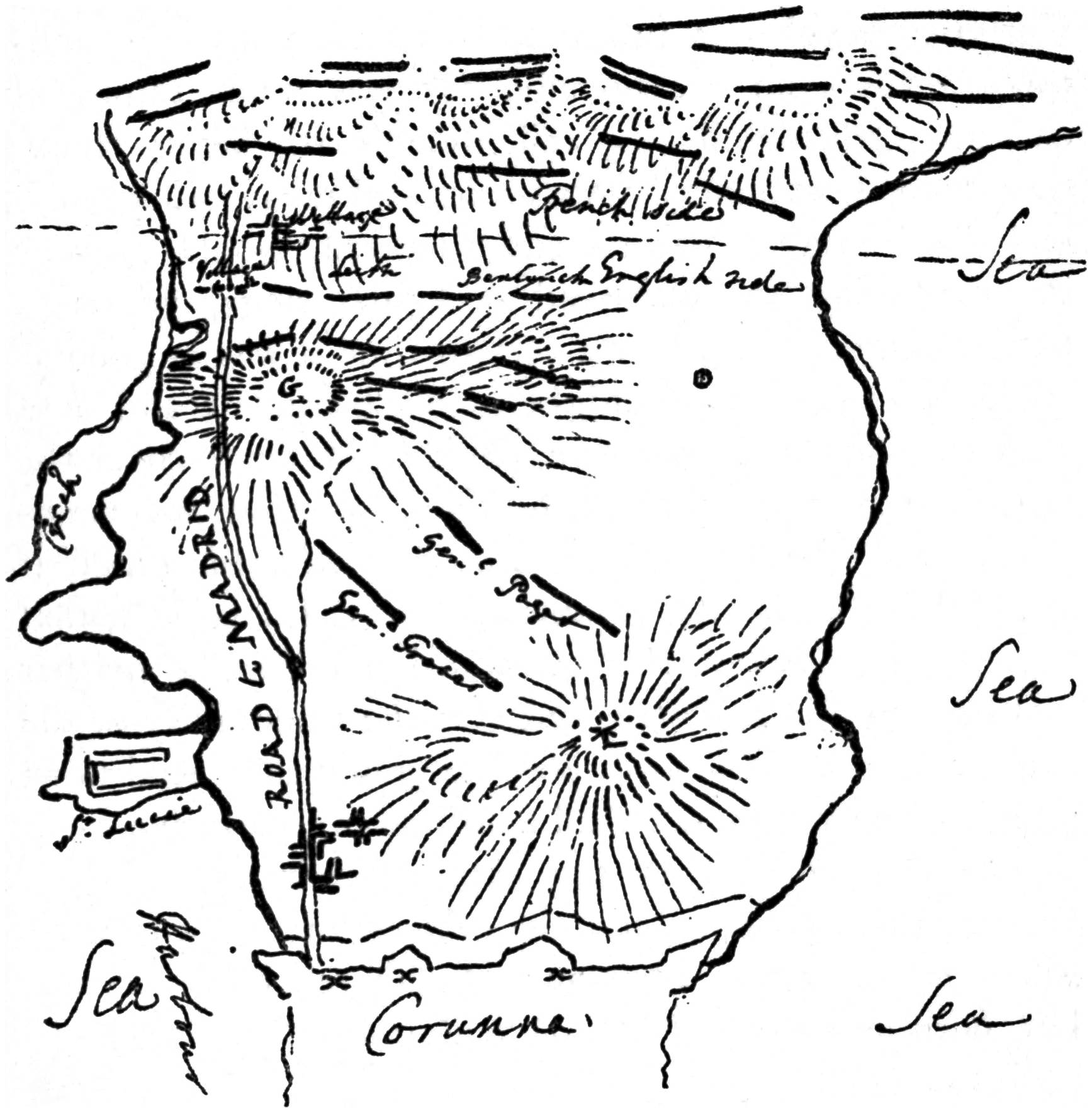
I know not if you understand plan drawing well enough to be assisted by a small hasty outline. The position of the British was bad because commanded by that of the enemy, but more especially because the right was liable to be turned—ⴲ. The hill itself, G, was very well against assault, because the side was very much intersected by steep banks and fences which, defended by our troops, could not be carried. The sketch I have given you is on the first impression of memory, and without the wish to be accurate, just to help you by a spilt-port-wine drawing to the sort of thing. The fortification of Corunna (xxx) was infinitely better than any entrenchment thrown up occasionally. It was much improved and strengthened by us, and though its being fatally commanded, without bomb proof, and many other faults and disadvantages, natural and incurred, would prevent its pretending to withstand a regular siege, yet as a barrier against assault for a certain time it was as good as could be; 1500 men might stand behind it and defy 20,000. Nothing, therefore, could be better to cover the tail of an embarkation. The outer position was maintained that the fleet might not be molested, which it might have been, for instance, from St. Lucia, etc., that the first business of the embarkation might be neither looked into nor molested, and that the tranquillity of the town might be as long as possible preserved. And now, after this explanation, I shall continue my narrative.
On the morning of the 15th, after breakfast, upon hearing some popping and that the enemy were making some demonstration, I borrowed Lefebure’s horse (having left both my own at Vigo) and rode to the English position.
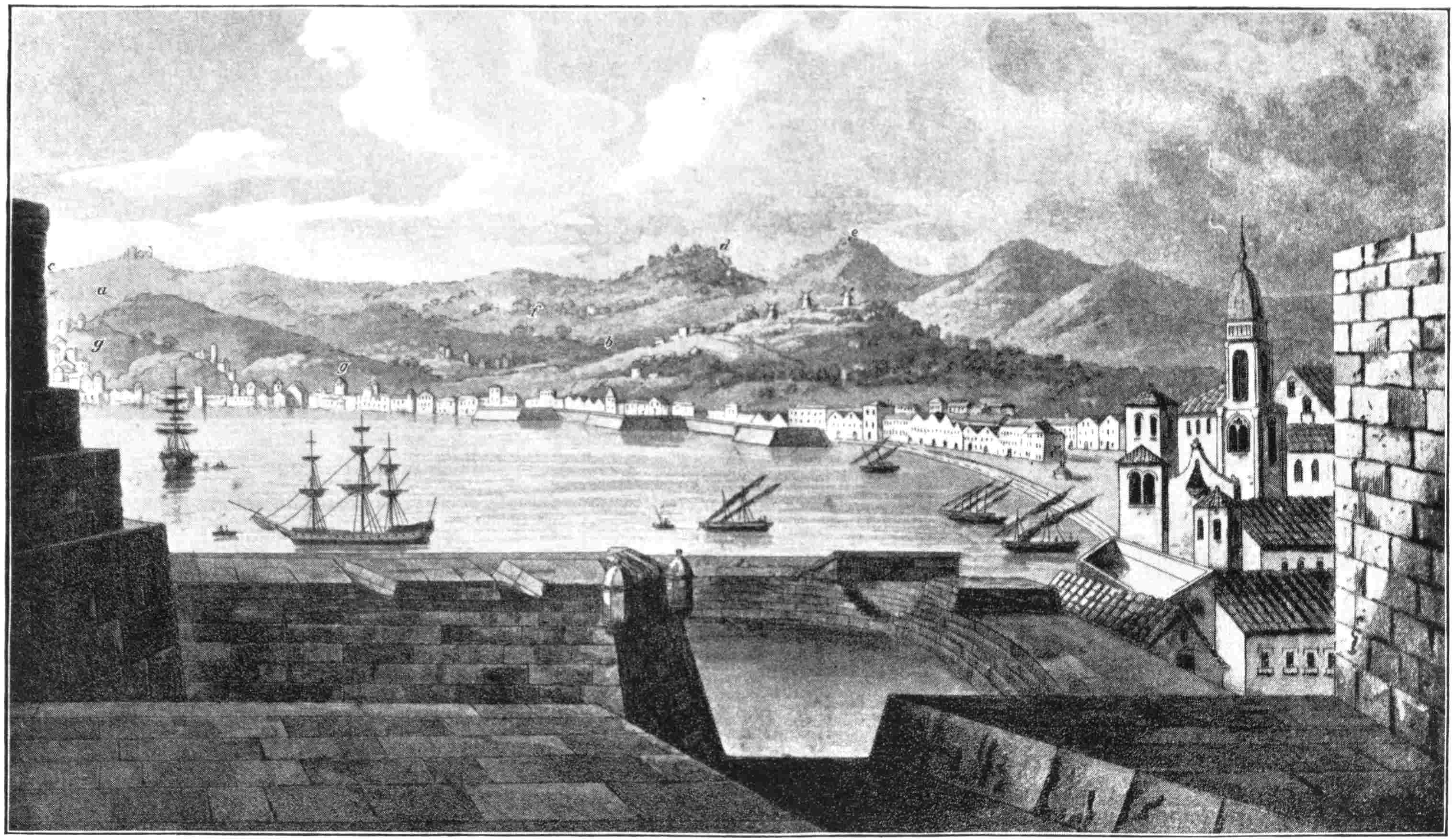
View of the British and French Positions before Corunna, taken from the Citadel.
a b British Line. c d French Line. e Magazine blown up 14th Jan. 1809. f The village of Elvina. g g Heights occupied by the French on the morning of 17th Jan.
From an illustration in “Campaign of Lt.-Gen. Sir John Moore, K.B.” (1809).
The enemy were thrusting out their sharpshooters in all directions, a species of warfare or battle which they understand the best. Ours, however, were not backward, and gave them at least shot for shot. A distant cannonade was soon after commenced on both sides, the French firing at our groups of officers, and indeed at individuals, for I was honoured twice in this way, and my friend Lefebure’s horse had a narrow escape. They then made a parade of their force and several movements on their heights as if they meant something, but merely meaning, I fancy, to know if we still held our ground and with what force. Sir John Moore was out all day, and I followed in his suite over our whole position. He spoke to all officers as he went along, giving cautions, orders, and instructions, and looked wistfully at the enemy, apparently wishing with painful eagerness for a battle. Those who suppose these wishes were excited by any thought of his own fame, do not know Sir John Moore. He wrote to Sir S. Hood that he was anxious for an engagement, because he thought it would be the only means of securing an unmolested embarkation. The sharpshooting and cannonading continued throughout the day, but the number of killed and wounded on our side was inconsiderable, and probably was no greater on that of the enemy.
On the morning of the 16th no skirmishing was heard from the outposts, and everything wore the face of an understanding on the part of the enemy that it was now their business to fight us. As long as we remained embattled upon our position we thought it was not their business, and feared they waited a more favourable opportunity, which must soon be afforded them. For Sir John Moore was determined, much as he wished to give them a check, not to wait any longer, for every day, while it added to their strength, brought with it the chance of a foul wind, which could not be too much dreaded if it lasted long enough to drive us into the town, and to give time to the French to establish batteries on the margin of the harbour for the destruction of the fleet.
At one o’clock I was charged with the erection of a battery in the town and some other works on the ramparts. At about three o’clock we heard the firing begin, sharpshooting first, and then more general, and so much cannonade as convinced me it must be more serious than on the preceding day. Nothing I could say or do could prevail upon the soldiers to lay aside the air of the last extremity of fatigue which they had assumed. The shovel of earth approached the top of the bank as leisurely as the finger of a clock marches round the dial. I was therefore a good deal struck with admiration at their behaviour when at four o’clock an order came for them to join their regiments, which were marching to the field. They threw down their tools, jumped to their arms, hallooed and frisked as boys do when loosed from school, these poor, tattered, half-dead-looking devils. I was no less pleased to be left at liberty. An Engineer has no appropriate place or defined duty in an open battle, but he is always acceptable in the field if mounted, because he is generally a good sensible smart fellow that looks about him, and is trustworthy in the communication and explanations of orders.
What we generally do, therefore, is to offer our several services as aides-de-camp to the several generals whom we may pitch upon or fall in with; and had I been mounted I should have gone straight to General Moore upon finding myself at liberty. But now a horse was my first object. The firing rather increased than slackened. I had never been present at a general action, and I wished painfully for a horse. Thinks I, “I’ll walk towards the scene of things, and I may meet a horse that has lost his master.” I went a little way and overtook a gunner with a saddle on his back.
“What are you going to do with that?” said I.
“I am taking it to St. Lucia,” said he.
“What for?”
“It is there that all the artillery horses are.”
“Oh, ho!” A thought struck me, and I followed him. When I arrived I went straight to an officer of gunner drivers and explained to him my situation. The obliging fellow instantly ordered a horse to be saddled, to my great delight. I asked him, “What news from the field?” “General Baird is killed,” said he. I galloped off, and on my way up I overtook an artillery officer, who told me General Moore was dangerously wounded. I know not how it was, but I certainly galloped on with much less count of personal danger. The enemy had so placed two guns that the overshots invariably came whizzing down the road. As they passed one another I leaned on one side, and thought each destined for my head.
The object of my search now was General Hope. I spied a clump of officers standing just behind the two lines engaged. From the situation they had taken up I thought this group most likely to be General Hope and his suite, so I hastened to it, and was not disappointed. He was looking very attentively at the two uninterrupted lines of fire though he said hardly anything, just sent an order in a quiet way now and then, and whenever the fire immediately before him seemed to slacken, he appeared instinctively to potter down to some place where hotter firing was. I was very glad to find myself so little disturbed by the whizzing of balls. The fire was very hot, and several men and horses of our group were struck, but I was thinking more of the novel sight before me, and glorying in the brave obstinacy of our people, who after so furious and long-continued and unabated an attack still refused to yield one inch to the column after column, relieving each other, that assailed them.
When first indeed I reached General Hope’s party, I looked up at a clear part of the sky and silently begged of God that should a ball this day despatch me, He would forgive me my sins and take me to heaven, and after that I felt finely settled and elevated and indifferent to the event, while the cheering and volleying of our soldiers warmed my heart.
As it was growing dusk a roar of musketry was volleyed on the left, followed by a roar of huzzas quite as loud. General Hope asked, “What’s that?” “The 59th coming up fresh, sir.”
Colonel Graham came up and told him (the firing had almost ceased) that the enemy still possessed a village which was thought too near to us, and asked if it should be taken. General Hope desired that some companies of the 15th might take it, and soon after an officer came up and announced the capture. The firing had totally ceased. General Hope rode round the position, and then went to Corunna to make such arrangements as might be required. We got to the town about eight o’clock. I rode to Sir John Moore’s quarters, and going upstairs met Colonel Graham. He told me Sir John was lying on his mattress dying, that he heard him groan. Perhaps had I gone in, pressed his hand, and got a kind word from him, it would have been a source of pleasure to me now, but then I had no stomach for it. His shoulder and part of his left side were carried away by cannon shot. His great good spirit left his body at nine o’clock.
General Hope’s letter25 is as accurate and chastely true as it is simple, elevated, and beautiful; so great a degree of accuracy one would scarcely have expected, or thought compatible with the elegance of the language, the smoothness and entireness of the narrative. I advise you, if you have forgotten it, or did not know that it was something more than a beautiful piece of writing, to read it again.
Our obstinate battle, the coming in of our wounded, and the melancholy death of our chief had a very great effect upon the feelings of the people of Corunna. “This is for us! this is for us! Poor English, they bleed for us!”
This sort of thing soon worked itself into a transport of generous enthusiasm, which was both beneficial and satisfactory to us.
At about four o’clock on the morning of the 17th, when my companions and I got up, we found that nearly all the army was embarked. The wind was beginning to blow very hard, which made the embarkation very difficult, but, thank God, it blew the right way. On the 16th Sir John Moore had desired Fletcher, chief engineer, to name the number of men he thought necessary to occupy the town line, and to furnish a minute distribution of them upon the different works.
This Fletcher did, and I went round with him and General Beresford (who was entrusted with the forlorn hope), that Fletcher might explain the distribution to him.
Had the French not been so severely cowed and beaten as they were, and had come on to the attack at dawn, Beresford with 1500 men would have held that line while the embarkation was completing, and probably at night have withdrawn to the citadel, protecting that and his own embarkation with a small portion of his force. Then these last would have rushed to the boats in waiting, jumped in, and trusted to the gates and ditches to keep out the enemy until they had shoved off from the shore.
But the impressive lesson the French had received rendered these operations unnecessary; and had not General Hope determined by doing things with the leisure he could command, to do them completely, the whole fleet might have been out at sea on the 17th before a Frenchman had ventured to show his nose.
But it was resolved to embark the sick and wounded, to bury General Moore, and therefore to keep the 1500 men upon the line until evening.
I went with Squire (a friend of mine in the Engineers) walking about the line, and at about seven o’clock we fell in with General Hope, and accompanied him all over the peninsula behind the walls of Corunna. He spoke with much satisfaction of the result of the battle. The troops, he said, had been withdrawn without the knowledge or suspicion of the enemy, deceived by their remaining fires.
At about ten o’clock, I think, a few Frenchmen appeared slinking into the houses near the walls of Corunna, and the Spaniards, acting up to the magnitude of their hatred to every Frenchman, banged at each individual with a 32-pounder. They were sharpshooting this way all day long, though at first we could not conceive the cause of such a heavy cannonade.
General Hope asked us to breakfast with him. “Squire, Boothby, will you come and have some chocolate?” were not unacceptable words. I have loved and admired this quiet, modest, superior being ever since I have known him.
I believe the Spaniards were entirely aware of our determination to embark, yet their enthusiastic blaze in the good cause continued to increase. “They would die in the ruins of their walls.” It even pervaded the women, who all day long were seen with cartridges and wads upon their heads for the service of the batteries.
They were jealous of our interference on the walls, which they wished to defend themselves, so that orders were given to our people not to appear on the walls, the portion destined for their defence being posted behind the ramparts, which were covered with all sorts and both sexes of Spaniards.
Everybody commanded, everybody fired, everybody hallooed, everybody ordered silence, everybody forbade the fire, everybody thought musketry best, and everybody cannon. In short, you have no notion of the loud misrule which prevailed.
However gratifying to us the display of such a spirit might be, or however beneficial to cover and complete our retreat, I believe a scrupulous care was had neither to promote nor increase it.
It was a spontaneous burst, coming up itself, and impossible to be checked—so much unexpected by us that arrangements were made for the last party to spike all the guns in the place. And while we could not but admire the honesty of their zeal, we lamented that it might increase the calamities of the capture, but this, I am happy to find, has not been the case.
It is said that the Governor candidly acknowledged that he should not attempt to stand a siege in so defective a place, but promised that as long as his walls gave protection to an Englishman or an English ship, he would never surrender.
The ground now in possession of the French would enable them to cannonade the shipping which still remained in the harbour as thick as a wood, although for the most part filled with troops.
The General had urged this point with Sir S. Hood, who urged it strongly to the Admiral, De Courcy. It is said that the transports did get the order to proceed to sea the moment they had received their complement of troops.
If so, they, with a degree of idiotic disobedience not unusual nor incompatible with the character of masters of transports, took no heed.
Certain it is that we in the town were rather longing to see a French battery open upon them, which we thought would make them get under way with a signal and beneficial expedition.
But the fact was that we did not despise them half enough, nor know of what extreme cowardice and rascality they were capable.
General Hope determined to be the last man on shore, and desired to have some Engineers remain with him, in which number I was. But at about two o’clock, when the General found that no preparations were making against our line, and that the enemy contented himself with preparing a battery on the top of the height overlooking the shipping, he expressed a wish that we all should embark, as at dusk the boats would be so much occupied that we might find it difficult to get off.
We therefore proceeded together in search of a bit of victuals into the inner town, induced the people to unlock a high tavern, and sat down to a plate of cabbage soup.
It was while thus employed that the French battery opened upon the shipping. It consisted of two field-pieces, which the fears of the French had situated in such a manner as to be as little hurtful as possible.
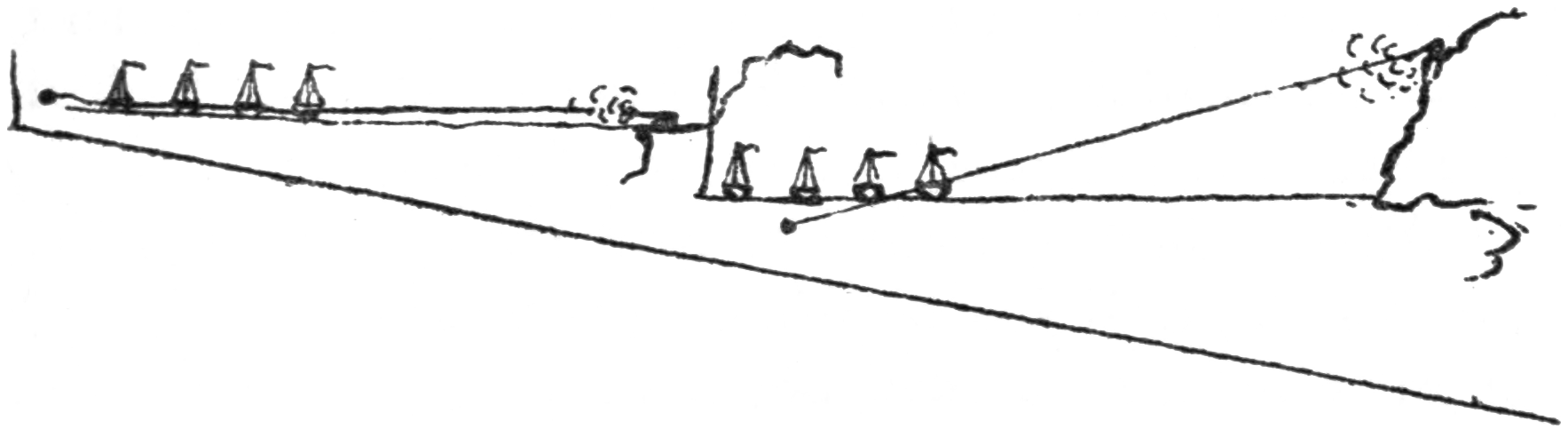
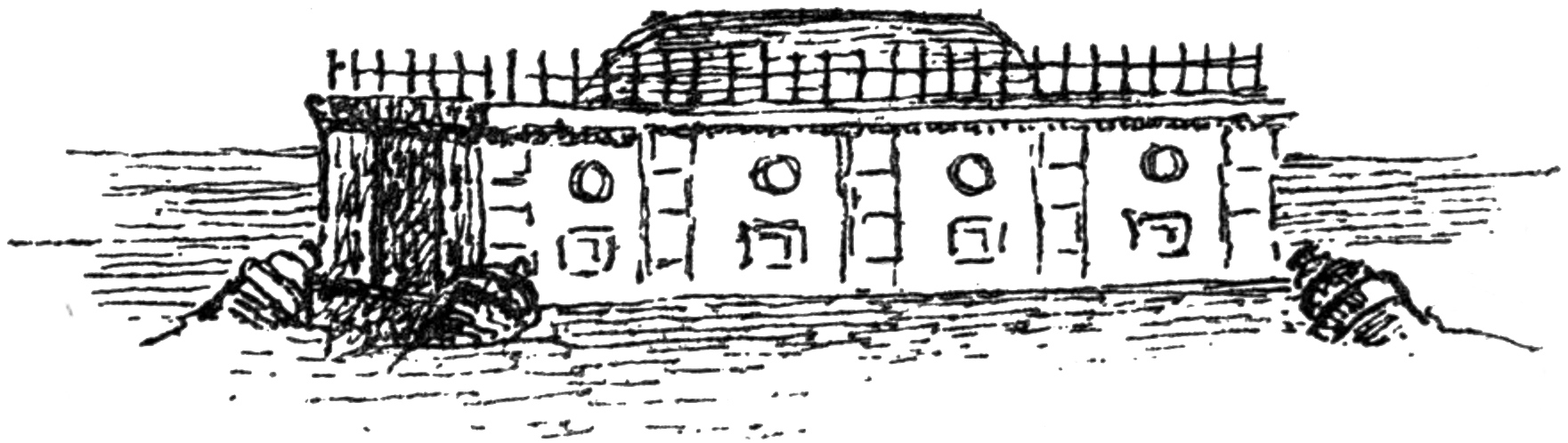
Instead of going to the top of the hill, had they ventured down to an old stone fort (which we had abandoned) with their guns à fleur d’eau, they would probably have hulled some ship or other every shot, but their plunging fire could only touch one spot, and if that spot were not a ship, the ball went innocuously to the bottom.
But the end which the caution of the enemy would not permit him to attain was effectually given to him by the cowardice of the masters of the transports. The wind was blowing very strong, and the first shot from the enemy was the signal for them to cut their cables. Thus, being all adrift at once, it is only wonderful that more did not strike upon the leeward rocks. Seven, I believe, struck, three were got off, and four, after being cleared, were burnt by us, and beautifully lighted the last of the embarkation. The transports that were got off had been previously abandoned by the masters.
A midshipman of the Barfleur told me that on going alongside of a transport on the rocks, the master threw his trunk into the boat, jumped in after it, and then, before a single soldier was out, he cried, “Shove off, or she’ll bilge.” He was knocked backwards by a sailor.
We got on board a man-of-war’s boat, which put me on board the Barfleur to get something I had left there. I was invited to go home in her, which I gladly accepted.
The embarkation being completed, General Beresford came on board at two o’clock in the morning, and when the fleet was collected it sailed for Old England....
After taking the trouble to write this very long letter, my dear B., shall you be able to get through it? I beg at any rate that you will not destroy it, as it completes my Spanish Journal, and I have no copy of this or any other narrative of that period of my proceedings.—Your most affectionate brother,
Charles.
Johannes Moore
Exercitûs Britannici dux præbio occisus
CORUNNA, 1808
On the Burial of Sir John Moore
Not a drum was heard, not a funeral note, As his corse to the rampart we hurried; Not a soldier discharged his farewell shot O’er the grave where our hero was buried. We buried him darkly at dead of the night, The sods with our bayonets turning, By the struggling moonbeams’ misty light And the lantern dimly burning. No useless coffin enclosed his breast, Nor in sheet nor in shroud we bound him, But he lay like a warrior taking his rest, With his martial cloak around him. Few and short were the prayers we said, And we spoke not a word of sorrow, But we steadfastly gazed on the face of the dead, And we bitterly thought of the morrow.
Plymouth Dock, January 28, 1809.
Ever dearest Father—You will not be very sorry to hear of my arrival in England in good health, but, on the other hand, I have not a penny that I know of, nor a shirt nearer than Lisbon.
I shall come up to London without delay, find out where you are, and endeavour to spend some time amongst you, to lay down my head, and settle my affairs.
The man I looked up to as a god, and held in the most cordial respect and affection, after devoting his life to the service of his country, is praised by some and blamed by others.
I know the latter to be the ignorant, but consequently the most talkative, and your catchpenny Generals come forward and tell you how they could have done better. All this makes me sick, and cools my military ardour. For can the utmost blindness of self-love make me think I can ever equal the virtues or military worth of Moore! And yet, as the result of his laborious services, a doubt comes in every man’s mind whether he would now take upon himself that General’s reputation. When dying, though perfectly sensible, he had great difficulty at last to articulate. He said gently, however, that he had endeavoured to serve his country diligently and conscientiously, and he hoped it would be satisfied with what he had done. His latest anxiety seemed to be for victory. “Are they beat? Are they beat?” he repeatedly asked. He wished to send some message to General Hope, who had succeeded him in the command. “Hope, Hope,” he said at intervals, but could not articulate more. His last words were, “Tell my mother.” He could no longer speak, and expired. Was not this the death of a hero and a good man? God bless you.—Your Charles.
The loss of men and money in Spain, I think, are amply compensated for by the acquisition of military fame, but the loss of Sir John Moore at such a time admits of no consolation.
Bath, January 28, 1809.
Dearest Mother—The press on the road, the waters, etc., have made me travel slower, but I set off for London to-morrow, whence you shall hear from me.
We are three Engineers here together, one of whom is my friend Lefebure, the pleasantest and right-thinkingest man in the world. The people here show distinction to our rusty habits, particularly the fair sex, who advance to converse with us, to the astonishment of the well-dressed beaux.
I hope soon to embrace you and my Louisa, and all of you. God bless you, dear people.
Charles.
On returning home after the glorious battle of Corunna, which terminated Moore’s celebrated retreat and his life together, I conceived a thorough dislike and hatred of the military service. My patron was dead, and as a reward for services which I thought inestimable, his memory was reviled by his ungrateful countrymen, and tarnished by crafty, self-interested politicians, who, willing to wound, but yet afraid to strike, took the most impalpable means of offending his sacred memory.
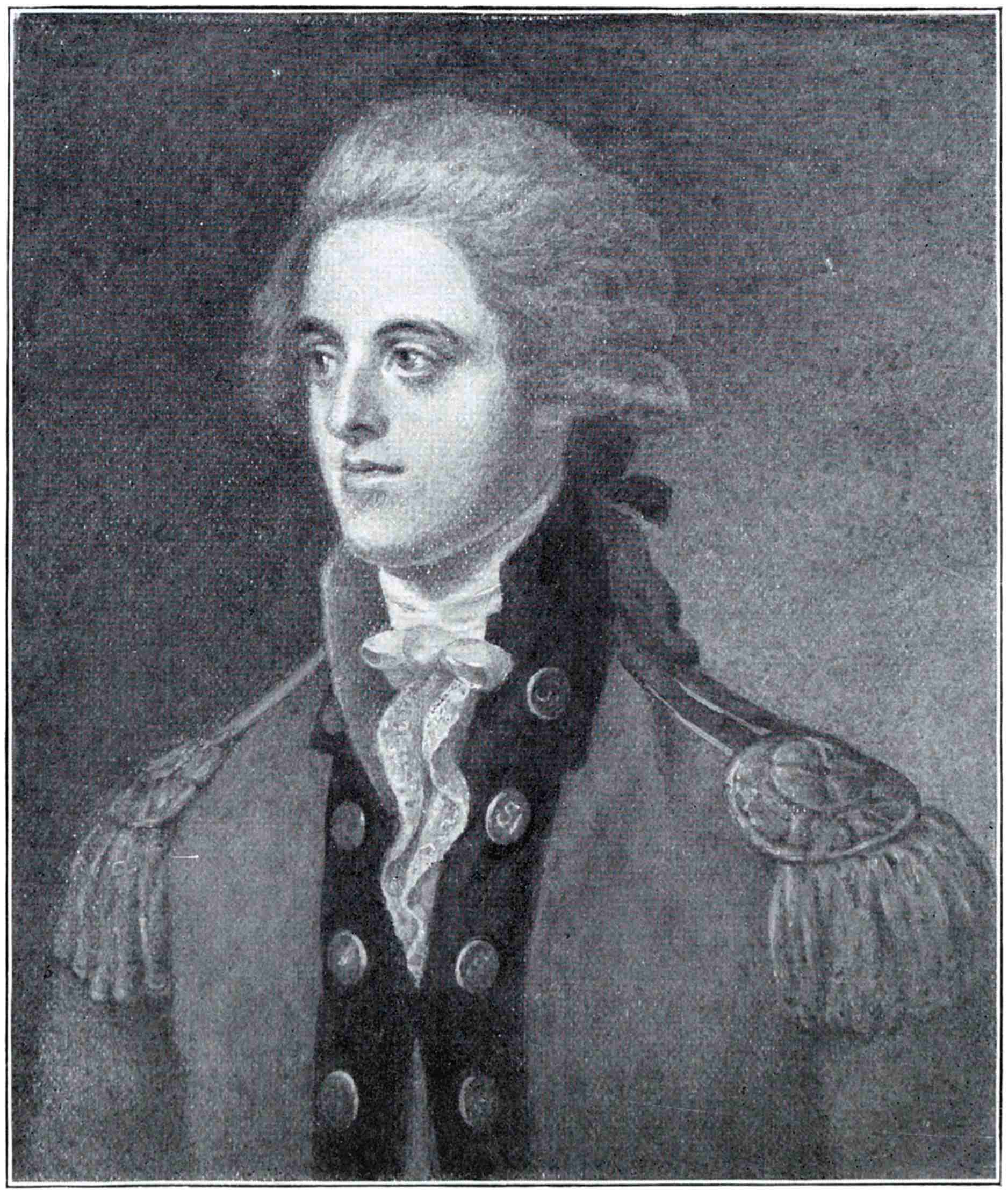
Major Boothby, 51st Regiment.
Afterwards Sir William Boothby, Bart.
Father of Captain Charles Boothby, R.E.
All this increased the disgust which the sight of military operations in a devoted country had excited in my mind.
Bilious with these thoughts, I took the sweet medicine of family endearments.
I did not expect a speedy summons to the wars, for the only theatre which seemed to offer us a part in the drama was just closed, and I therefore promised myself some months of sweet repose and enjoyment, as a change rendered most delightful by those fatigues and dangers which entitled me to welcome it without blushing.
The pictures which had been given me of my family’s distress between the beginning of those horrid accounts from Spain, and the hearing from me after the battle of Corunna made me shudder at the thought of renewing such frightful anxiety; for while delighting in my father’s affection for his children, I was always frightened at it. The violent expression of grief or the admission of immensurate apprehension in a female are less impressive because more consonant to her softer character; but when the safety of his children was concerned, my father lost this distinction. The masculine firmness and well-tempered equality of his mind no longer served him, and he, my mother, and my sister, equally giving way to their fears for me, vainly looked to each other for support. And what a task for my brother ... to be obliged to laugh at their fears while smothering his own!
Early in the month of March the whole village circle dined at my father’s house—Milnes, Lumley, Cleavers, etc.; happiness prevailed, and I was glad. After dinner my brother, opening the post-bag, drew out a large Government letter for me. My father’s eyes followed it across the table with infinite disquiet,26 my mother’s with dismay, and Louisa paled a little. Under such eyes it was necessary to command my own countenance.
I told my father calmly that it was an order for foreign service.
Nothing could represent such an order to them in a flattering point of view. All their fears, all their anxieties were to be renewed, and perhaps in the end not to be so happily relieved. I therefore made no comments, but professed that the future now opened to me was flattering to my prospects, and I further added that I considered active service in Europe as a safeguard from the more distant and unhealthy colonies.
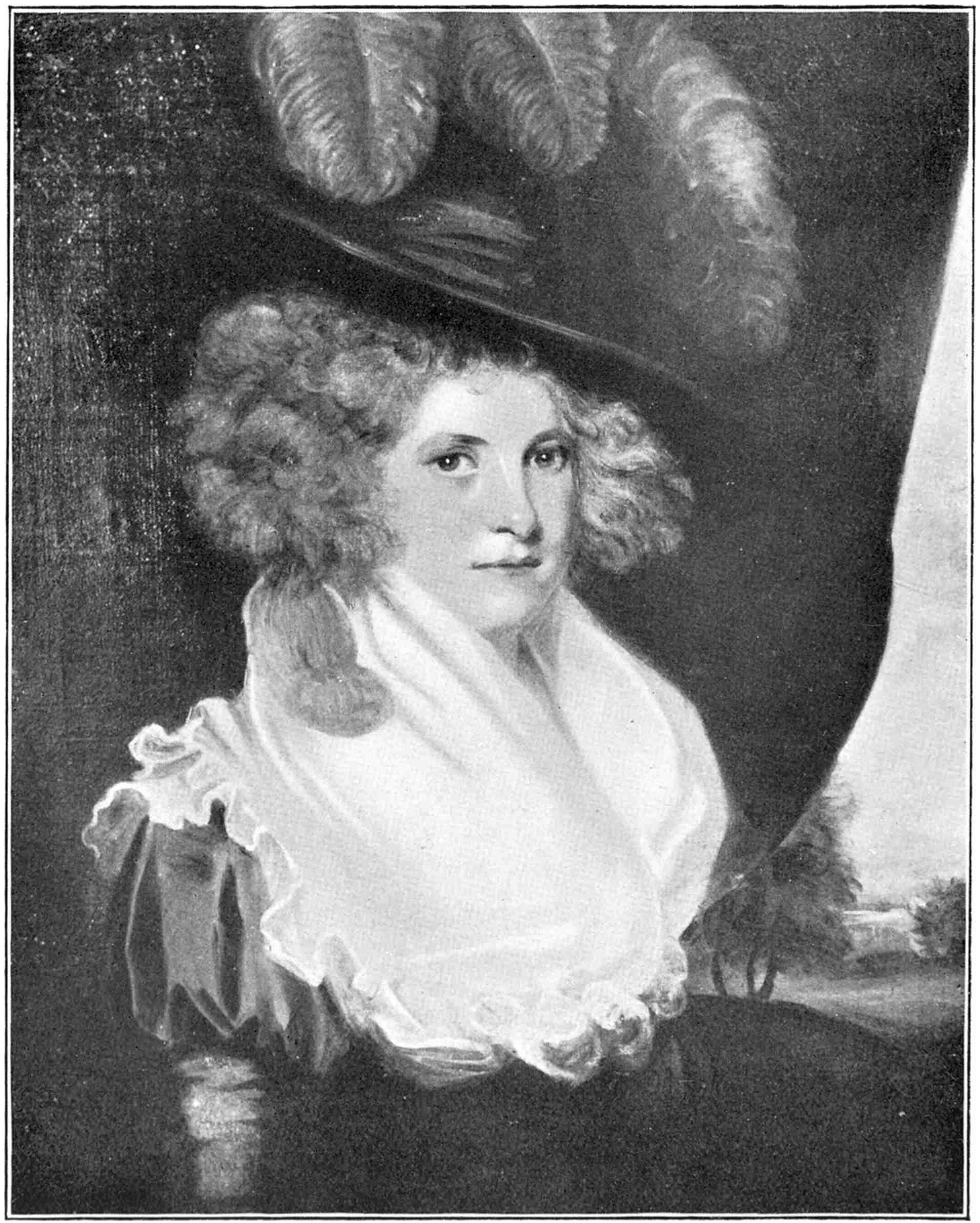
John Hoppner.
Rafela, Wife of Sir William Boothby, Bart.
Mother of Captain Charles Boothby, R.E.
But in fact I was but ill satisfied with the summons, for the Austrian war was but vaguely rumoured, and nothing but the éclat and spunk of some dashing and prompt expedition could make going abroad agreeable to me. My own regrets, however, I was once again obliged to smother, and my own tastes to kick downstairs that I might communicate some degree of consistency and firmness to my aching family, and in this task my brother was my second self.
The next day the whole party met again at the Lumleys’. It will appear strange when I say that we were in better spirits than I wished, for in spite of all I could say, they would not abandon the hope that some event or other would put off the expedition.
As the post time drew near, my father grew grave, and I could see he dreaded a final summons; and even as he dreaded, a large Government letter, like the one before, was put into my hand. I dare not look at my father. My mother, to be out of the way, ran upstairs.
When I had glanced over it, with what alacrity did I put into my father’s hand what I knew would quiet his old heart and illumine his benignant features. It was a simple counter order.
My mother and sister were not long before dancing with joy. It was an harmonious uproar, very delightful to see, and I joined in it with all my heart; to rejoice when they were rejoicing was too natural to my heart to be restrained.
The next day my brother and myself went to spend a night at Welbeck. On returning, the little party met us at the end of the village; they walked slow, and were sorrowful.
The counter order was annulled, and the order for foreign service in force.
For all that the world holds I would not retrace the bitterness of separation.
My brother drove me to Newark, but I was glad to get rid of him, glad when I had escaped my whole kindred, and was left at liberty to weep without adding to their tears.
To have the business of leave-taking over cheered my spirits. I once more felt free, and turned my thoughts upon my companions, those dear companions with whom for years I had been traversing the seas and the lands of Europe.
The passage to Lisbon was boisterous and disagreeable. We set sail on the 17th March 1809, sprang a leak, were run aboard of in the night, and expected to go down, and, in short, were forced to acknowledge that a transport is full of horror.
We landed at Lisbon on the 2nd April, and found it generally expected that Sir John Craddock would re-embark his army in a very few days. The force under his command was said to amount to 17,000, and Marshal Beresford with his Portuguese was called 25,000.
On the other hand, Soult had taken possession of Oporto with 13,000, or, according to some, 17,000. Victor was menacing the Alemtejo with 40,000, and another movable corps of 10,000 had shown itself in the neighbourhood of Ciudad Rodrigo.
Taking this rumoured state of things for granted, the re-embarkation of the army (to a man that knew the nature of Iberian troops) seemed at the first glance to be the most salutary measure that could be adopted.
Lisbon, 2nd April 1809.
My dearest Lou—After a disagreeable voyage we arrived in the Tagus to-day at two o’clock. I do not intend this for a letter, but to take the first opportunity to tell you of my safe arrival.
The French have taken Oporto, and we are supposed to be in force on the frontier.
I would make a bet that I see you again before the expiration of the summer, for they dare not stay to come in contact with the French army, at least I think so.
Nothing ever was more dead than this town. Oh, intolerably dead! No news here.
I shall write longer by the next opportunity.
With every best spring of the heart to you all,
Charles.
Lisbon and the Tagus
To one who enters the Tagus in a fine season there is something inexpressibly captivating wherever he turns his eyes.
The magnificent rock or mountain, forming a gigantic portal to the mouth of the river, is remarkable for the richness and variety of colour, the grandeur of its size, and the wildness and taste of its form.
From this feature, towards Lisbon, towns, orange groves, forts, and palaces make every yard a picture, and as he approaches Lisbon the size and style of the buildings advance; the great convents, dazzling white, the activity of the great road, the grinning batteries, the fury of the bar, the whirling of the current, the antique richness and eminent shape of the Tower of Belim, and then the splendid burst of the city, with her thronged quays and mounting palaces, will long prevent the visitor from perceiving that the southern bank of the river has nothing but loftiness to recommend it.
A traveller who has seen Messina from the Straits immediately knows what is wanting to Lisbon, viewed from the Tagus.
Messina presents to his view all that can be beautiful in a superb city, embosomed in all that is luxuriant and romantic in Nature.
At the foot of her fair hills she occupies, with a splendid and uniform length of architecture, the margin of the sea, and is even better seen through the light fretwork of masts and rigging, upon which sailors of all nations and in all costumes busily twine their pliant forms, adding to her inanimate beauties an interesting display of wealth and commerce. The city is backed by hills, clothed with the most various and luxuriant vegetation; some are crowned by forts and covered with the brightest verdure, which Flora has enamelled with a lavish hand; others hang umbrageous woods or many-coloured thickets over their wild precipices. Upon the slopes of these hills, rising above each other in theatric pride and architectural magnificence, grand slashes of palace, convent, and church are nested in this beautiful bed of vegetable profusion.
On the other hand, the Italian mountains, which may be called the other bank of this azure river, display every imaginable charm to snatch his eyes from a successful rival. “Beautiful! thrice beautiful! incomparable Messina!” he exclaims. “Never did mine eyes behold, nor my imagination form, a scene whose laughing charms surpassed, or even equalled, thine.”
After this he looks upon Lisbon, towering upon her hills, a vast mass of splendid structures. All is building; a house-seller’s shop, a proud and pompous city stretching her sceptre over the red waves of the hasty Tagus.
“Queen of the river with the golden waves,” says the courteous traveller, “thy magnificent appearance excites my admiration. Permit me to tread upon thy spacious marts, to enter thy palaces, to contemplate and wonder at thy riches.”
He pushes for the shore, where disappointment awaits him, conducts him over all parts of the city, serves him at dinner and prepares his bed, reconducts him to his ship, and with him ascends the side, from whence he will no longer delight in those beauties which he knows to be deceptive.
The streets of Lisbon are generally good, and many of them fine; there are no mean houses, and the greater part are handsome and uniform in height and size. There are but few squares, and those are not remarkable.
The quays are very fine, and some noble streets give upon them through magnificent gates, particularly the Rua Aurta, or Street of the Jewellers and Gold-workers. This street, quite straight, broad, and handsomely built, begins at the principal square and issues through a superb gate upon the quay, where a colossal equestrian statue gives it an imposing termination.
But the shops of this street, though abounding in precious stones and precious metal, are extremely mean and exactly alike, each containing a little working equipage for the jeweller (at which he sits), and the window displays a few clumsy glazed boxes, in which his precious commodities are stored.
But as these shops, though mean, are the best, the buyer, being pressed for the want of a commodity, is obliged to hunt for it. The art of alluring money from the pocket of the passenger by a rich and astonishing display of merchandise which he does not want, carried to its height in London, seems in Lisbon to be totally unknown.
The private houses are, some of them, superbly built and richly furnished, but scarcely any of them are commodious, and there is nothing that can be called the environs of a capital.
A public garden, which, though sheltered and well kept, is small, formal, and uninteresting; and one theatre, which, though formerly supplied with the first Italian performers, would not be admired at a provincial town in England. The equipages, although of course diminished in number, absolutely surprise by their barbarity; a clumsy little body, seated upon two huge leathern straps, enormous wheels, and two noble mules, is the only thing to be seen in the shape of a carriage; and from the melancholy relics of the Court, which I had an opportunity of observing, I should doubt if it ever exhibited any elegance or splendour.
The streets are not only (even in this burning weather) covered with dry filth and squalid rags, but are lined with naked beggars and disgusting cripples, who bare and often augment their deformities and afflictions to arouse the dormant compassion of the rich.
But however laughable, it is really dreadful to walk in these streets by night, for your foot slides about in soft things, and the whizzing over head and the splash! splash! splash! that assails your ears make you expect to be covered with refuse every moment, for the city is not lighted at all—a circumstance which must have been formerly as favourable to assassination as it is now to these nightly discharges.
If in the night it is to the last degree shocking to walk the streets of Lisbon, it is not very agreeable during the day. The inequality of the ground fatigues, the importunity of the beggars plagues, and the filth of the streets offends you, while nothing remarkable to the right or left diverts the peevishness of disgust or rewards the diligence of curiosity. There are no hotels, nor inns, at least that can serve a decent man.
I cannot leave Lisbon without noticing the Aqueduct, which is one of the most stupendous and striking structures I ever beheld. It stretches right across a deep valley, and without attempting to recollect its dimensions or to speak accurately on the subject, the impression it has left with me is that a First-rate, with royals and studding-sails set, could pass through the principal arch without touching in any part. To stand under this arch is almost stupefying, and the gigantic size of the whole is well illustrated by some houses close to it.
Residence in Lisbon
April 1809.—As my stay is remembered with indifference, it was not marked by any high degree of satisfaction. Although I did not pretend to form a deliberate opinion upon the affairs of the Peninsula, yet my involuntary belief was that there would be no campaign.
I considered Sir John Moore’s retreat as a lesson likely to teach caution to the British Government, and that they would not now venture to stake the flower of her army on the fate of Spain against the wishes of the nation, seeing that they could hardly answer for having done so when the popular voice was loud in their favour. I thought that unless the Spaniards themselves demonstrated that, in a military light, they could balance their enemies, and were capable in the line of operations of supporting their character as the main army, (which hitherto they had plainly shown they could not do), any further assistance of British troops would be firmly withheld.
The character of the Commander-in-Chief at that time confirmed me in this opinion respecting the intentions of the Government. Because he was not a man of known military talents, and it was likely enough that, since the employment of General Whitelock, Sir Henry Dalrymple, and Sir Harry Burrard, the favourite principle with our latter statesmen—“that experience and reputation are not required in a fully instructed General”—had been abandoned.
As I considered the kingdom of Portugal incapable of defence, except by an army nearly equal to the offensive one, so I felt assured that when the crisis of its fate arrived, a British army that sought to protect it would “stand alone.”
I was led to believe that so soon as a very superior French army should have leisure to move against Portugal, the British army would withdraw and resign her to a fate which it could not control.
As these ideas, however erroneous and indiscreet, possessed my mind, in spite of the warlike breathings of some that I conversed with, I could not help considering my return to England as neither improbable nor very remote, and instead, therefore, of bracing myself for the field, I considered how I might render the time I passed at Lisbon as agreeable as might be, in which pursuit I expected much assistance from some letters of recommendation of which I was the bearer.
The letters on which I most depended were given me by a dear friend and relation to an Englishman of the first rank and consequence in Lisbon, who was invested with a delegated power, and supreme in his particular department, and as this personage had his family at Lisbon, an introduction to him had a very promising aspect.
My other letter, given me by a military acquaintance, was to an Austrian Chevalier, also a person of consequence in Lisbon, residing there with his family.
I could not in reason expect any great things from being the bearer of a letter from a person with whom I had no particular intimacy, and of which I was not the particular object, but only mentioned as being so good as to take charge of the letter. I carried both on the same day.
The Austrian Chevalier was laid up with the gout. I left the letter and a card.
The Englishman was also laid up with the gout. I left a letter for himself and another for his lady, and with each a card, and having thus arranged my lines I returned.
The next morning I received a note from the Austrian, contrived with the most engaging and elegant politeness, the substance of which was, that the Chevalier, sensible of the honour I had done him in bringing him a letter from his friend and mine, trusted that I would dispense with the ceremony of visiting, in favour of an invalid, and allow him and his family to make an acquaintance from which they promised themselves great pleasure, and that, when he had made my acquaintance, he trusted he should be able to persuade me to give him the pleasure of my company as much as I could, and to be a frequent inmate in his house.
It was not long before I made a second visit, and though the Chevalier was still in bed, yet his daughters were so good as to receive me, and that in so agreeable and sincere a manner, accompanied by such an honest invitation from their father, that, very much pleased, I was resolved it should not be my fault if I did not reap the full advantages of such engaging conduct.
My story with respect to the Englishman is sooner told. The fate of my letters to him will perhaps never be known, as he took not the slightest notice of them or their carrier.
I was billeted in the house of an obliging Italian in the best street, where the Commander-in-Chief, the Engineer mess, and everything that it was desirable to be near to, were situated.
The mess was very bad, but the mates (as is almost always the case in the corps to which I have the pleasure to belong) were very good and entertaining. Burgos, Mortimer, and myself formed an indissoluble trio, from which union I cannot express the pride and pleasure I have derived for several years, and which I hope will last me through life.
Besides Burgos and Mortimer were several interesting characters which I shall have occasion to notice as I go along, and among others was little Archer, a friend of my boyhood; Captain Notpat, whom I scarcely knew; and Captain Packman, convivial, festive, and good-natured to a great degree, and several younger men. Our Chief, a man of indisputable worth and bland manners, used also to honour us with his society.
I had not dined here many days before my little friend Archer took me into his room and desired me to carry his defiance to Captain Notpat, who had offended him beyond reparation.
Before I inquired into particulars I reviled my little friend for being too warlike in this particular, as it was not the first nor the second time that I had known him in similar circumstances. He defended himself as well as he could, declared himself averse to duelling, and said he should be very glad if the Captain would act so as to let the affair end peaceably.
Upon this I declared myself very ready to act in quality of mediator if the affair would admit of adjustment, and he would promise to be ruled by my advice, but, at the same time, I declared my unvarying resolution not to interfere if matters took a hostile turn.
Fully master then of my friend’s story, and armed with full powers to treat, I knocked at the Captain’s door. He was not gone to bed, and seemed preparing for a field-day.
He received me involuntarily as his adversary’s second, and ceremoniously begged me to be seated.
My friend, I found, had stated the matter very fairly. The Captain had been provoked at table rather by a teasing manner than any tangible offence, and in revenge he had told my friend in broad terms that he asserted an untruth, and that he might consider the accusation in any light he pleased. Now, though the Captain is a man whose good qualities do sink his imperfections into insignificance, yet had he some certain simplicity or want of usage of the world unfitting his situation and line of life, and this laid him a little open to quizzing, a game at which my friend was not unskilled and much too apt; but fighting is not the way to oppose quizzing, and it appeared to me that in justice and fairness the Captain stood as the unprovoked assailant.
I represented with what force I could the melancholy consequences which might ensue, and which he must be sensible would be laid at his door. “You acknowledge,” said I, “that you gave an insult which you knew could not be passed over, but which you were determined should stop the provoking manner which my friend had for some time pointed at you? Is this the only way in which you can oppose the flippancy of a boy? You have given him an insult which obliges him to call you out, for unless you do away the insult, I will never advise him not to do what I would do myself; and have you turned over in your mind what may be the state of things to-morrow evening? The best that can happen to you, according to my opinion of your feelings, is to receive your adversary’s bullet; and in that case have you reflected upon what grounds you think yourself entitled to close the days of your parents in misery, and to cast a lasting grief upon all your relations? Perhaps to-morrow evening that youth against whom you have no enmity, with whom you have lived in friendship, and whom you know to be worthy, will be stretched in the ghastliness of a violent death, and weltering in the blood which you have lightly shed. What will be your feelings on looking at such a spectacle, the entire work of your own hands? It will not be his fault, for if he submits to an insult he will be despised, and he had better die; but by sending me to you he has opened the door to atonement, and I expect the proof of your courage and magnanimity will be to make it with candour, than which nothing is more noble or more suitable to the character of a gentleman and a man of honour.”
The Captain did my address the honour to open his eyes, and saw that it would be infinitely better to avoid an action. He wrote a candid note, to which my friend returned a friendly answer.
I was thanked by both parties, and retired at 2 o’clock A.M., extremely satisfied with myself to have gained so important and very difficult a victory, for my dispute with the Captain was much longer than boots it to set down.
* * * * *
On the 4th April a fleet of transports, having on board six regiments under the orders of General Hill, entered the Tagus, which force was landed on the 5th, and incorporated with the army of Portugal, and on the 6th the regiments of which it was composed marched by different routes to join the respective brigades to which Sir J. Craddock’s arrangements attached them.
The arrival of this force, and still more the rumoured appointment of Sir A. Wellesley to the command in Portugal, turned the train of my ideas; and soon after there followed the general cry of “Forward,” and an intimation to us that we had better mount ourselves as fast as possible.
Whether this bold determination were caused by the Austrian War (which was no longer uncertain), and extended to the liberation of Spain, or whether it were supposed that Soult had put himself into a cul-de-sac, and the campaign had no further object than to destroy him, I could not judge, because I was ignorant of the amount of the French force actually in Spain, and also ignorant of the nature and extent of the Spanish forces, with which in that country we must of necessity co-operate.
It was, however, pretty certain that knocks were toward, and so it behoved to provide myself with a thick doublet.
The rest of my residence in Lisbon, but a few days, was fully taken up in buying horses and in making travelling arrangements. I was so lucky as to get a wee mulette worth her weight in gold, and I called her Sukey.
When the French entered Oporto by storm, the most important capture they made was two British officers of engineers, Captain Goldfinch and Lieutenant Thompson (a boy). Now Captain Goldfinch left at Lisbon in charge of Captain Packman a fine red-brown stallion, a horse fiery in his gait, gentle in his curvets, soft in his manage, swift in his courses, and no mauler of leather. Thirty pounds was the price that had been paid for him, at which sum he was offered to me, upon condition that in case of the owner’s return it should be at his option to reclaim him. I snatched at this offer, for the horse if sold outright would have fetched half as much more. So far, so well, my charger and my baggager were excellent. I now only wanted a second charger, and the devil and Burgos advised me to buy an English mare that was worn to the bones, but might be got into condition and be worth double what was asked.
This was downright gambling, and I lost, as will appear in the sequel.
In the arrangements made by the chief engineer, Burgos and myself were attached to the right column, consisting of a brigade of Guards under General Harry Campbell, and a brigade of Infantry under General A. Campbell, who in the absence of General Sherbrooke commanded the column.
Now General Sherbrooke and General H. Campbell were Nottinghamshire friends, and therefore the Guards were likely to be forward; this, added to the society of Burgos as a campaigning chum, was the very arrangement for which I was disposed to intrigue. It had, however, taken place in consequence of changes in the distribution of the army, for Burgos had gone to another division under a former plan two days ago, but was now to receive orders to join me as soon as possible. Captain Notpat received sudden orders to go to Abrantes in pursuance of an application from the Marshal Beresford. Captain Packman was to move with the Chief, as well as my friend Mortimer, which, with a few others, formed the party du génie moving with headquarters.
Now my servant’s name was Louis, and he was an Italian. Louis, when I picked him up, looked like a very decayed gentleman, his clothes having the cut gentle, but the thread bare, the assortment incongruous, and the articles ill-adapted to his shape. His Hessian boots came above his knees, and were partly obscured by the eaves of his nankeen pantaloons, that had been washed so often as would perhaps have made a Blackamoor white. The warp and the woof of a blue spotted waistcoat were disunited in the pockets and buttons, and his coat was made for a much larger man. His hat was broken in that part of the brim which meets the hand in salutations. His hair was sandy, lanky, long, and dishevelled. On a dirty shirt was displayed a large brooch, the gage d’amour of some sentimental lass, for he had that sleek, effeminate, sodden, yet bearded visage often thought handsome in pictures by means of regular features, and known to be taking in reality among some of the opposite sex. He was about thirty, had a sepulchral voice, and seemed to have destroyed his constitution; yet was he a wit and an accomplished beau in his own circle, and very probably styled “the charming Louis.”
He got me my milk and eggs of a morning very carefully, but I saw that he was no Bernardo. When I consulted Louis on the line of march, he informed me with much respect that he was unable to walk from infirmity, and seeing me embarrassed about my mare’s sore back, he was so active and obliging as to seek out one who was willing to make a swap with me.
The beast offered in exchange was so rippish that I rejected him, and endeavoured to patch the matter by hiring a beast for Louis the next day, which was to be his care, and so all things were arranged for my departure.
I had taken leave of the Austrian Chevalier, and performed all due and accustomed rights, nor had I any regret at the thoughts of quitting this celebrated city. I write letters home.
Lisbon, Sunday, April 9.
My dearest Mamsey—We have a report here that Sir Arthur Wellesley is at hand. I have no expectation of any actual service against the French, for their force in this part of the world is so superior to ours (and will, I am convinced, continue so) that I have no doubt of our quitting the country as soon as they turn their attention to us.
But if unexpectedly they should, mistaking our force, or too confident, advance towards us with an equal front, we shall drub them well.
When I come to you again, which I guess will be before winter, I shall stay a long, long time. I have been obliged to lay out an immense sum on horses, which are immoderately dear.
I have managed so, however, as that I shall not lose much, in case of being obliged to leave them behind. Ask Louisa if she would like the prettiest little mulette that ever was?
You must not expect long letters, for I am very busy. And when one’s mind is called aside by fifty things at once, one cannot write a gossipy letter.
I have sent B. twenty pages about Spain, and he will send it to you, if you desire. It will complete my journal.
I wrote to General Stewart as soon as I got here, and have a very kind communicative letter from him in return. He is at no great distance, and I think we may meet ere long.
General Sherbrooke, too, I have seen, who appears remarkably well.
I expect to quit Lisbon in a day or two.
Give my immense love to dear old Dad, etc., etc.——Yours, my dearest Mamsey,
Charles.
Departure from Lisbon
April 16, 1809.—About the middle of the month of April I left the capital of Portugal. I was to bear-lead a party of artificers and some mules laden with intrenching tools, and among other désagréments Mr. Louis came to me already thoroughly exhausted, and could not for love nor money procure a beast.
“Then walk,” said I.
“Pardon me,” said he, “’tis wholly out of my power.”
“Then stay behind,” returned I, chafed at his little control over difficulties.
“’Tis what I shall be reduced to,” answered he, with a fallen air, “if my master cannot mount me.”
“My good fellow,” then said I in another tone, “bring me the villain who offered me that misery in exchange for the mare.”
He immediately went off, and soon returned.
I was busied with other matters. I was predetermined on the exchange, which was instantly concluded, and gave the order for the march.
My charger bounded under me with a most curveted agility, which, added to a very martial neigh, would have made me as proud as Marshal Ney27 himself had it not been that the spectacle of my other nag much dashed and diluted the spirit of my exultation. As for Louis he will certainly go to the devil, for there was not somehow room enough on his back whereon to strap my writing-case, for though it was made on purpose for a man’s back, Louis had hung it round his neck, and resembled a Jack that had stolen the locket of a giantess. This embarrassed and bruised his arms, which were both employed to tug at the first bridle he had ever laid hands upon, so that the jade, finding no encouragement to violate her own inclination, would go head foremost into a doorway, the upper part of which she found open, and being buffeted away by the indignant housewife, she would swiftly wheel round, to the infinite terror of Louis, and do the same thing by some other door on the opposite side of the street.
Waiting as I was, to see what sort of a figure my valet cut as he went along, and being confounded at the melancholy state of things—my writing-case banging his breast, and the studied awkwardness which he added to the villainy of the beast—I felt there was but one way to save myself from committing some egregious extravagance. So after assailing him with a deal of bad language and worse Italian, I galloped away, and giving a charge respecting the Italian to my good tall sergeant, resolved never to bestow on him another thought, and, very happy to have escaped, I walked my horse along the banks of the Tagus, giving full range to that cheery meditation inspired by youth and fine weather.
Country between Lisbon, Villa Franca, and the Tagus
April 1809.—None of the roads leading into the town of Lisbon announce one’s approach to a great capital. They are universally paved, the sides of the road overhung with vines and trees, with awkward country houses, and now and then a tasteless palace.
The road from Cintra to Lisbon by Ociras is the best furnished, and more diversified by the contrivances of wealth than any by which I have approached that metropolis.
By the right bank of the Tagus to Santarem nothing is at all interesting until Sacavem. The banks of the Tagus are very tame here as to scenery, and at Sacavem, or a little above it, fenny islands of considerable breadth divide the river into two main streams, which begin about thirteen leagues from the mouth of the Tagus, and end about seven leagues.
I have never had any opportunity of examining the localities of this part of the river, but its banks are not formidable.
But to return to my ride on the road to Villa Franca, at which place I arrived in the afternoon.
The Juez de Fuéro happened to be reviewing his lands bordering the Tagus, and was up to his ears in vegetation. I sent to him, but in vain. He walked from one field to another very composedly, discussing the produce with some other land-learned man, and as my patience began to exhaust, Colonel Perponcher arrived on a very fine black horse.
The Colonel is a Dutchman who had long served the British, and when I first knew him commanded in the island of Gozo, in which were no other troops than a battalion of Dillon’s, which (when we met at Villa Franca) was still in the Mediterranean, whither he intended to proceed to resume the command.
“Well,” said I, “how do you get on, Colonel, with your brigade?”
“Wat brigaade? Wo tol you I av a brigaade?”
“I was told that you were appointed to the command of two battalions of Portuguese.”
“Well, if I was? You call two battalions brigaade? Pretty brigaade! Ha! ha! ha!”
“Why, some of our Brigadiers have no more than two regiments under them. What do you call a brigade?”
“Ah, that is de very thing, by——, with you. A General is nothing, because you av General for all the two regiments. Why, in the Austrian service! Ha! ha! Brigaade! You call that a brigaade?”
It was only now and then that the Colonel committed a little agreeable foreignness in speaking English; and as I knew him to be a gentlemanlike, well-informed man, and believed him to be an officer of great merit, I was not discouraged by his crustiness, the cause of which I determined to find out; and therefore letting the matter drop, I told him that if, as I supposed, he wanted the Juez de Fuéro, he must go to the river for him, as I had endeavoured to fish him out in vain.
“What,” said I, turning to his servant, “why don’t Sr. Juez come? Is he a Frenchman?”
Here Colonel Perponcher interrupted me with some warmth, and advised me to be more prudent. “These sort of things,” said he wisely, “won’t do with them, for —— sake take care; you don’t know what you may do.”
I could no longer forbear laughing at the subtlety of his ill-humour, which vented itself in this manner under the appearance of sagesse, for he had too much discrimination not to perceive that my question was calculated to spur the judge to show by his alacrity in assisting Englishmen that he was not a Frenchman, the very name of which was plague, pestilence, and famine to a Portuguese. The Colonel, seeing that I really could not help laughing, began to smile himself, and proposed that we should lodge together, to which I readily assented. The Juez, having returned up to the breech in wholesome soil, gave us the billet we desired. On leaving him I observed that my charger was dead lame.
The death of a first cousin would in numerous instances be less distressing than the lameness of one’s best horse at the moment that his services are indispensable. We were conducted to a large house with fine stables, the groom of which knew perfectly well what ailed my horse, recommended fomentation of hot wine mixed with hog’s lard, honey, and cow dung, and assured me it would be of no consequence.
I eagerly believed what he said, because if I had not I should have been unhappy all the evening, and if the fellow lied, to-morrow morning would be time enough to grieve. “Sufficient for the day is the evil thereof.” Our host was a wealthy Portuguese, and had some guests of his own nation already in his house, an elderly man with his son, a youth of sixteen, very tall, good-looking, and intelligent, also, what is extremely rare for a Portuguese, speaking French very well.
The master of the house offered us some biscuit and wine, which we declined. He then asked what we would take. “Some dinner,” we replied. “Aye,” said he, “but that can’t be ready till night. Won’t you take something first—a bit of water melon or some oranges?”
The idea of fooling away a lusty appetite upon marshmallows was equally repugnant to the habits of us both, and so we determined to wait, although I was perfectly up to the management of our host, which was by pulling his own ten o’clock supper a little way back towards nine, and giving our five o’clock dinner a most unfeeling stretch towards the same point to make both ends meet and unite in one meal. As I had been in this predicament some fifty or sixty times before, I summoned my patience and a natural capability I have for fasting, while the Colonel saw it grow dark with a mixture of surprise, hunger, and impatience. Poor Louis, who really believed that it was impossible for him to walk six tedious leagues, or twenty-four miles, arrived completely done, for he had not only surpassed his imagined powers, but had been obliged to bear his part in dragging and heaving that wretched animal that was to have carried him. I found I had been taken in, and determined to make the best of it, and with actual labour the beast was pushed into the stable, where it fell to at the manger with a beastly voracity.
One cause I found of Colonel Perponcher’s chagrin was the absence of snuff, and this I was fortunately able to supply, having a large box of Prince’s Mixture in my pocket.
We sat together some time talking of the Mediterranean, and of his brother, whom I had met at Gothenburg, and at last he discovered the main cause of his vexation and return to Lisbon nearly as follows:—“You must understand that in volunteering my services with the Portuguese army, and in determining to meet the very numerous and noisome vexations to which the situation exposed me (implicating my character with the conduct of raw recruits of strange nations and striving to reclaim and organise a mutinous rabble), it is natural to suppose that however well I might wish the righteous cause in which we are assisting these swarths, yet that I should look also for some personal advantage as the attendant of success.” And it was, I suppose, “just this personal advantage” which now seemed more than ever doubtful as time went on.
May 14, 1809.—I heard this morning that Sir Arthur Wellesley has had an action with the enemy.
I was differently and very disagreeably employed, as I went up to Lamego with a British brigade, which was to countenance Beresford and his myrmidons. The enemy came before Lamego, intending, I suppose, to sack and destroy, but finding troops there, they retired. The country is exceedingly strong, and I hoped they would not defend it. It was not my wish to see the Portuguese in action. Let who will take the credit of serving with them, I will not. Accordingly I was very glad to find that the enemy had no intention to dispute the country, either having heard that Soult had been beat, or intending to reinforce him.
Having passed the Douro without halting at Lamego, we stopped at Peizo, and marched the next morning to Amarante.
When about two leagues from our destination it began to rain heavily as if to prepare us for the gloomy, wretched scene that awaited us.
We were thoroughly wet through (I having no baggage) when the beauteous Amarante burst upon our view, the fine-looking houses promising a comfortable rest. What was our aggravated disgust at finding that everything was sacked, burnt, and murdered, not a single house but was completely reduced to its shell wall. Here the venerable master of a mansion lay stretched on his back amid the black ruins of his peaceful habitation, and a ghastly wound disfigured his neck.... It was a horrid spectacle!! But I will not go on with the picture, it exceeds description, and swells one’s hatred to these ruthless and wanton destroyers.
This place, garrisoned by Portuguese troops under Sylvesan, resisted for two days the French under Loison, (the plague of Portugal), and so this inhuman monster thus revenged himself.
Abrantes, June 18, 1809.
My Louisa—I heard that there had been blows, and wrote to tell you I was out of harm’s way.
Nothing can be finer than the passage of the Douro, which in his despatches Sir A. Wellesley makes too little of; in short, it is plain he cannot write, for he did the same at Vimiera. However, he is dashing and able, and if a fair game lies before him, he will not, I hope, be able to cover the fame of his victories by clumsy relations....
Captain Goldfinch of the Engineers, with a fine little Scotch boy (a lieutenant), fell with Oporto into the hands of the French, and made their escape in the late bustle. The respect (they say) which all French who were at Corunna bear to the memory of Moore, and to the English in general, is quite gratifying.
They recite a dispute between a French officer and several others, the former maintaining that the English were victorious, the others, not.
Our advocate read General Hope’s letter,28 asking at every sentence, “N’est-il pas vrai? N’est-il pas bien dit?” etc., etc., and when he came to the simile of General Wolfe’s death he made a very elegant admiration of it.
I was attached to the brigade of General Tilson, who is my friend, and it was with the Portuguese army. We went to Chaves, and penetrated into Galicia. I took the place of an officer who fell ill, otherwise I belong to the brigade of Guards under Harry Campbell, whom I like greatly.
In addition to my mortification at being out of the way, the first notification I had of General Paget’s arrival was accompanied by the news of his having lost a limb, my sorrow for which wholly defeated any attempt to rejoice at our successes. People who did not know him talked a vast deal about the manner in which he bore his sufferings. I say nothing of it, because I know him to be perfect, and know upon what he leans.... It is a comfort to learn that the loss is not likely to affect his constitution, as he is said to recover wonderfully fast.
Devil a bit of nobleness have I about me, my dear Lou. I cannot bear this infernal war, that has killed Moore and maimed Paget, disputing about a country that—— But I won’t talk politics. If Austria, though beaten and overrun, can entertain Buonaparte for a season, perhaps Wellesley may do something for the Spaniards.
The French fight us very ill, whether from a want of hatred or courage. If what had happened to Soult had happened to an English general, he would have been disgraced for ever, for he was shamefully surprised.
But England, although she has every right to expect worse generals than France, is much more rigid with them in articles of skill and judgment; for if she can by any means attribute a disaster to the error of a general, she is not only savage but sanguinary. And this makes very good generals and very brave men so vastly afraid of responsibility, that when they assume command they appear cowardly and indecisive....
Don’t let there be a shade of melancholy in your letters; it disquiets me vastly. Why should you be melancholy? God is very good to us, and we must not pine if we are not always all together as if in heaven. Therefore write very comically about friends and home....
Eternal blessings crown my darling Lou, and guardian angels hover over her.
Charles.
* * * * *
Coria, July 8, 1809.
It is quite a relief, dearest Lou, to be transferred from the filthy styes of the Portuguese to the clean houses of the Spaniards. And as I am shaking off the dust contracted in Portugal, so I am scraping my tongue of those odious inarticulate sounds which compose their language, and gargling vinegar that my throat may be capable of touching with the true Castilian burr the energetic language of Spain.
Alas! I have lost one of my first comforts, a new blue, patent, silver-mounted, morocco writing-case; all my letter-paper, pens, ink, letters, secrets, verses, etc., etc.; also dear Lady N——’s series of useless boxes—all lost by the rascal Pedro, Bernardo’s opposite in everything. The devil take it, though I have lost it a week ago, I cannot recover my temper.
Hitherto I pass my time very pleasantly. I have got a fine young engineer to take care of, whom I row, all the time that he does not sleep, about his vanity; not but that I acknowledge myself to be as vain as he, but that I defy him to have found it out, unless I had told him of it. He is coming into very fine order.
Poor Harry Campbell has been some time unwell, but I hope he is now throwing it off.
General Sherbrooke, to whose division I belong, makes it very pleasant to me. I dine with him mostly, and like him vastly. I think of him very highly as a general. He thinks of Sir John Moore just as I do.
To-morrow we go to Plaçentia, which is much larger than this very pretty town.
Here there is an old castle and walls inhabited by cranes, which interest me very much, perching on the house-tops and church steeples, and cowering over the town.
That fellow there, I at first thought was standing upon the stalk of a weather-cock, but I found by a spy-glass that they were his own long legs, with his great feet happy upon the stone ball.
The air seems fresher here than in Portugal. Sweet F. E. wrote me such a dear note in Mamsey’s letter. I wonder how she could contrive to make it so pleasant and yet so proper. For me, I could do no such thing. Were I to write to her warm, kind, affectionate words, my heart would dictate fluently enough, but I am sure they would not pass the school of decorum.
The mistress would say, “You must scratch out there ‘dearest F.’ Lop away this ‘love’ and that ‘love’”; and so word by word I should see my poor letter robbed of all its graces, looking like a tobacconist’s with “Humble servant to command” at the bottom.
What if I should not fill this sheet! It is very big, and I have to give my letter to General Sherbrooke in a quarter of an hour, and you see I write very close.
My poor chum has just lost a horse, which, though I put on outward signs of condolence, I am not sorry for. As to being bridled, he never could think of such a thing. He would always go when he liked it, and where also. He would look very stupid, to entice the unwary behind him; and then, with both feet and all his might, lunge out, as much as to say, “D—— thee, I have thee now.” In the same manner he would most innocently pretend to come and rub his head upon you in a dawdling, sleepy sort of way, and then get your leg or arm in his jaws and try as hard as he could to crack it. For these and many other pretty accomplishments
His master loved him dearly, And mourns him now sincerely, While I say, “Poor thing” merely, But feel at heart quite cheerly. We’ll go as fast, or nearly, Without, as with him, clearly.
Now to take my leave, and remain, as ever, your
Charles.
* * * * *
Castel Branco, July 1809.
I received dear Mamsey’s letter, by which my mind was relieved respecting her anxiety.
The moment I heard there was fighting I wrote, but feared you would not get my letter in time enough to be spared that cruel suspense.
It will at least be some time before you need begin to think of being anxious again.
The French, it is understood, are retiring very fast, and will probably not dispute anything south of the Ebro. A long march is before us ... we only know as far as Placentia. I miss my poor Bernardo very much, and would give anything to meet with him again, which I think I may do, if we go towards Madrid.
This fine battle of the Danube has cheered us again, perhaps ere you receive this you will know how fallaciously; but I will hope that you are in possession of recent victories for which we are yet to Huzza!29