Volume 4 — CHAPTER X The New Warfare of Position
Reading edition
Sectors of Major EUSAK Units—Statement by General Van Fleet—Hill 854 Secured by 3/1—Helicopter Troop Lift to Hill 884—Helicopter Operation BLACKBIRD—“To Organize, Construct, and Defend”—Marine Operations of November 1951—The Second Marine Christmas in Korea
Two and a half weeks of hard fighting had taken place along the X Corps front when General James A. Van Fleet paid a visit on 16 September 1951. The commanding general of EUSAK wished to inspect the operations and determine the morale of the 1st Marine Division and 2d Infantry Division, both of which had suffered heavy casualties. He found the morale of these X Corps units good and had no adverse criticisms of their operations. While on this tour of inspection, however, he issued the following three directives to X Corps:
(1) That replacements would be integrated into units only when the battalion or larger-sized unit to which they were assigned was in reserve;
(2) that certain ‘choke points’ [General Van Fleet pointed out the locations on the map] be interdicted to prevent enemy reinforcements or withdrawals through these points;
(3) that the Corps Commander firm up his line by 20 September and to plan no further offensives after that date, as it was unprofitable to continue the bitter operation.294
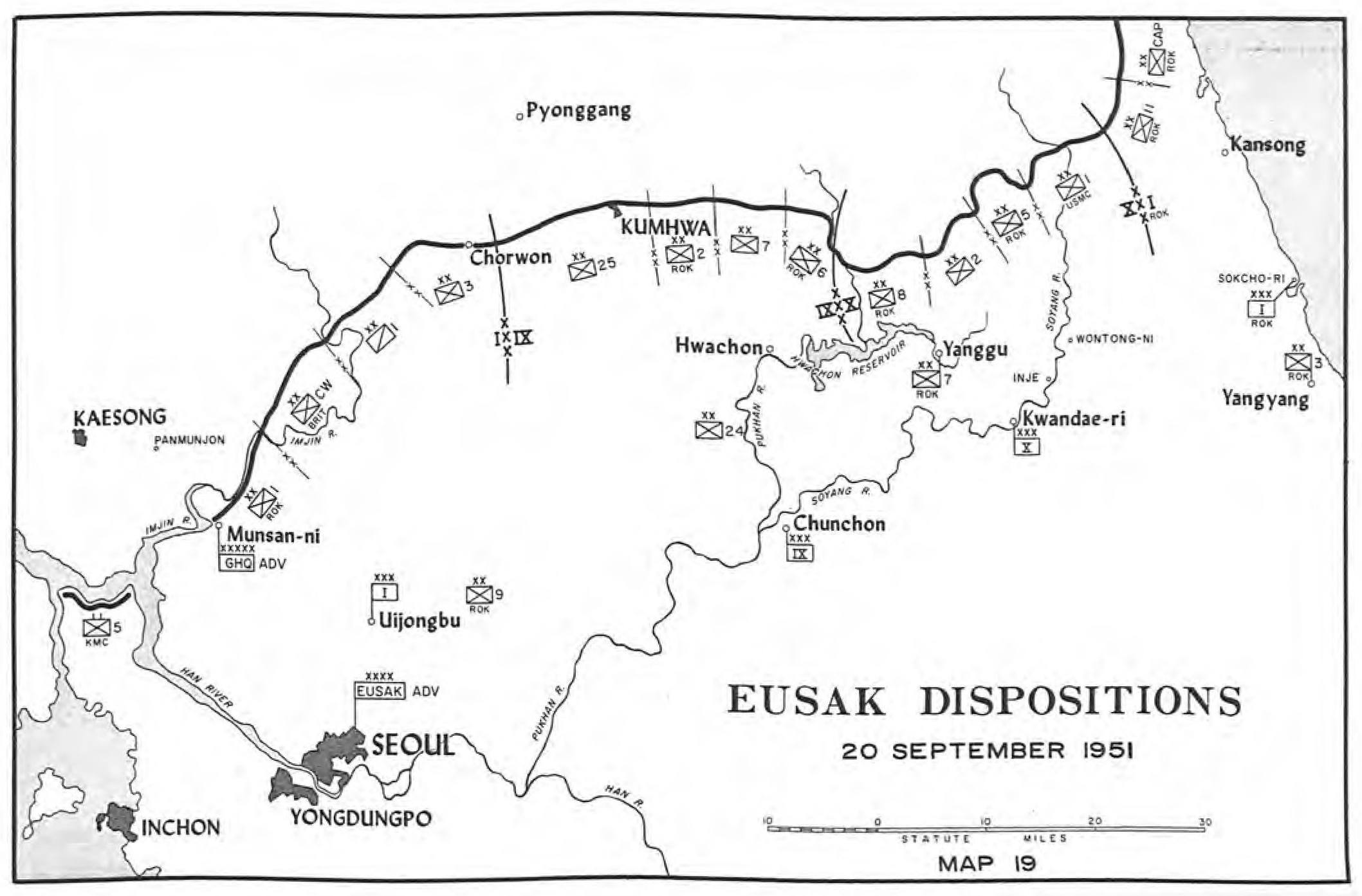
EUSAK DISPOSITIONS
20 SEPTEMBER 1951
MAP 19
Italics have been added to emphasize the importance of 20 September 1951 as the turning point when a warfare of position replaced a warfare of movement throughout the remaining 22 months of the conflict in Korea. There are few dates as important in the entire history of the war.
General Van Fleet reiterated his instructions on the 18th in a confirming directive to the effect that X Corps continue making limited attacks “until 20 September, after which ... units were to firm up the existing line and to patrol vigorously forward of it.”295
Sectors of Major EUSAK Units
At this turning point the Eighth Army had 14 divisions from four corps committed along a 125-mile front across the peninsula. These units were distributed (Map 19) as follows:
U.S. I CORPS
ROK 1st Division holding the left anchor in the Munsan-ni area and controlling the 5th KMC Battalion on the Kimpo Peninsula;
British 1st Commonwealth Division across the river Imjin to the northeast;
U.S. 1st Cavalry Division (Greek and Thai Battalions attached) still farther to the northeast in the Yonchon area;
U.S. 3rd Infantry Division (Belgian Battalion and Philippine 20th BCT attached) having the responsibility for the vital Chorwon area;
U.S. IX CORPS
U.S. 25th Infantry Division (Turkish Brigade attached) defending the area west of Kumhwa;
ROK 2d Division holding a sector east of Kumhwa;
U.S. 7th Infantry Division (Ethiopian Battalion attached) on the right;
ROK 6th Division with a narrow sector as far east as the Pukhan River, the Corps boundary;
U.S. 24th Infantry Division (Colombian Battalion attached) in Corps reserve south of Hwachon;
U.S. X CORPS
ROK 8th Division on the left flank;
U.S. 2d Infantry Division (French and Netherlands Battalions attached) in left-central portion of Corps front;
ROK 5th Division occupying a narrow sector to the east;
U.S. 1st Marine Division holding eastern portion of the Corps sector;
ROK I CORPS
ROK 11th Division responsible for left of the Corps front;
ROK Capitol Division holding the line eastward to the Sea of Japan;
ROK 3d Division in reserve at Yangyang for a period of training.296
Some rather complicated juggling of units took place on the X Corps front, giving the effect of a game of musical chairs in the tactical sphere. From 18 to 21 September the 1st Marine Division extended its line eastward to relieve the 8th ROK Division on the extreme right of the Corps area. That Division in turn relieved the 5th ROK Division on the extreme left, whereupon the latter leapfrogged the 2d Infantry Division to occupy a new sector on the left of the Marines.
Statement by General Van Fleet
“Theirs not to reason why” could never have been written about American fighting men. From 1775 to the present day, they have always taken a keen interest in the high-level strategic and tactical decisions governing their operations. This applies with particular force to the Marines, who have seldom had a voice in the shaping of operations above the division level.
As if in direct reply to unspoken questions, the commanding general of the Eighth Army made a statement on 30 September explaining the purpose of his strategy. “My basic mission during the past four months,” he said, “has been to destroy the enemy, so that the men of Eighth Army will not be destroyed.... Each loaded enemy weapon was a definite threat to the Eighth Army. It was imperative that we knock out as many of those weapons as we could find....”
“In prodding the enemy in the deep belly of the peninsula,” continued General Van Fleet, “we have taken many casualties.... It was mandatory that we control the high ground features, so that we could look down the throat of the enemy and thereby better perform our task of destruction.... In seizing these hills we lost men, but in losing a comparative few we saved other thousands.”
Estimated casualties, inflicted on the enemy by UN ground forces alone from 25 May to 25 September, were announced as 188,237 by the EUSAK commander. “As we open our autumn campaign,” he added, “the enemy potential along the front line has been sharply reduced by our hill-hopping tactics. The Communist forces in Korea are not liquidated but they are badly crippled.”297
Even so, EUSAK G-2 summaries credited the enemy on 1 October 1951 with more than 600,000 troops at the front, or in reserve and available as immediate reinforcements. Six CCF armies and one NKPA corps were capable of reinforcing the units on the MLR or participating in an offensive. The enemy also had an estimated 7,000 men in guerrilla forces behind the UN lines.298
The maximum strength of UN forces in Korea during October was 607,300. This total included 236,871 U.S. Army troops, 21,020 Fifth Air Force personnel, 30,913 U.S. Marines (including 5,386 officers and men of the 1st Marine Aircraft Wing), 286,000 men in ROK units, and 32,172 Allied troops.299
Although it might appear that the opposing forces were about equal, it must be remembered that well over one-fourth of the UN troops were engaged in administrative or maintenance duties behind the front. Thus the Communists had a numerical advantage of at least four to three on the firing line. This was not at all unusual, since they had enjoyed a preponderance in manpower from the beginning.
Hill 854 Secured by 3/1
In accordance with EUSAK instructions, X Corps OI-235 directed the 1st Marine Division to organize and construct defensive positions after relieving the 8th ROK Division on the right and taking over its sector. On the Corps boundary, elements of the 11th ROK Division, I ROK Corps, were to be relieved on Hill 884 (Map 20). This meant the addition of some 9,000 yards to the Marine front, making a total of about 22,800 yards or more than 13 miles.
First Marine Division OpnO 27-51, issued on 18 September, relayed the X Corps directions. It also called for such offensive action as might be necessary to complete the securing of Hill 854, in the sector of the 8th ROK Division, if not in friendly hands at the time of the relief.300
That the enemy had put up a desperate fight to hold this position is indicated by the EUSAK report for 15–16 September: “The ROK 8th Division, employing all three regiments, attacked against heavy and stubborn resistance to wrest Hill 854 from the three battalions of North Koreans who held the position. The ROK 21st Regiment forced one of these battalions to withdraw and occupied a part of the hill, but at the close of the day were engaged in heavy hand-to-hand fighting to retain the position.”301
On 20 September, after three weeks of continual combat, the major units of the 1st Marine Division were disposed from left to right (Map 20) as follows:
1st KMC Regiment (Colonel Kim Dae Shik, commanding; Colonel Walter N. Flournoy, senior adviser) occupying the HAYS line on the left flank and patrolling vigorously to the north;
5th Marines (Colonel Richard G. Weede) holding a wide sector in the center, with Hill 812 as the principal terrain feature;
1st Marines (Colonel Thomas A. Wornham) in process of extending eastward to the Corps boundary just beyond Hill 884;
7th Marines (Lieutenant Colonel John J. Wermuth) in Division reserve at Wontong-ni.302
Division OpnO 27-51 designated the 1st Marines to relieve the ROKs on Hill 854 and complete the seizure of that terrain feature, if necessary. As a preliminary, the 1st Battalion of the 5th Marines (Lieutenant Colonel William P. Alston) took over the front of the 1st Marines on the HAYS line. This enabled 1/1 and 3/1 to enlarge the Division sector by side-slipping to the east while Lieutenant Colonel Franklin B. Nihart’s 2/1 went into immediate reserve just behind the main line of resistance.303
The 1st Battalion of the 1st Marines (Lieutenant Colonel John E. Gorman) relieved two battalions of the 10th ROK Regiment in the Hill 854 area. No opposition from the enemy was encountered, but the Marines suffered 11 casualties from mines as a consequence of incorrect charts supplied by the ROKs.
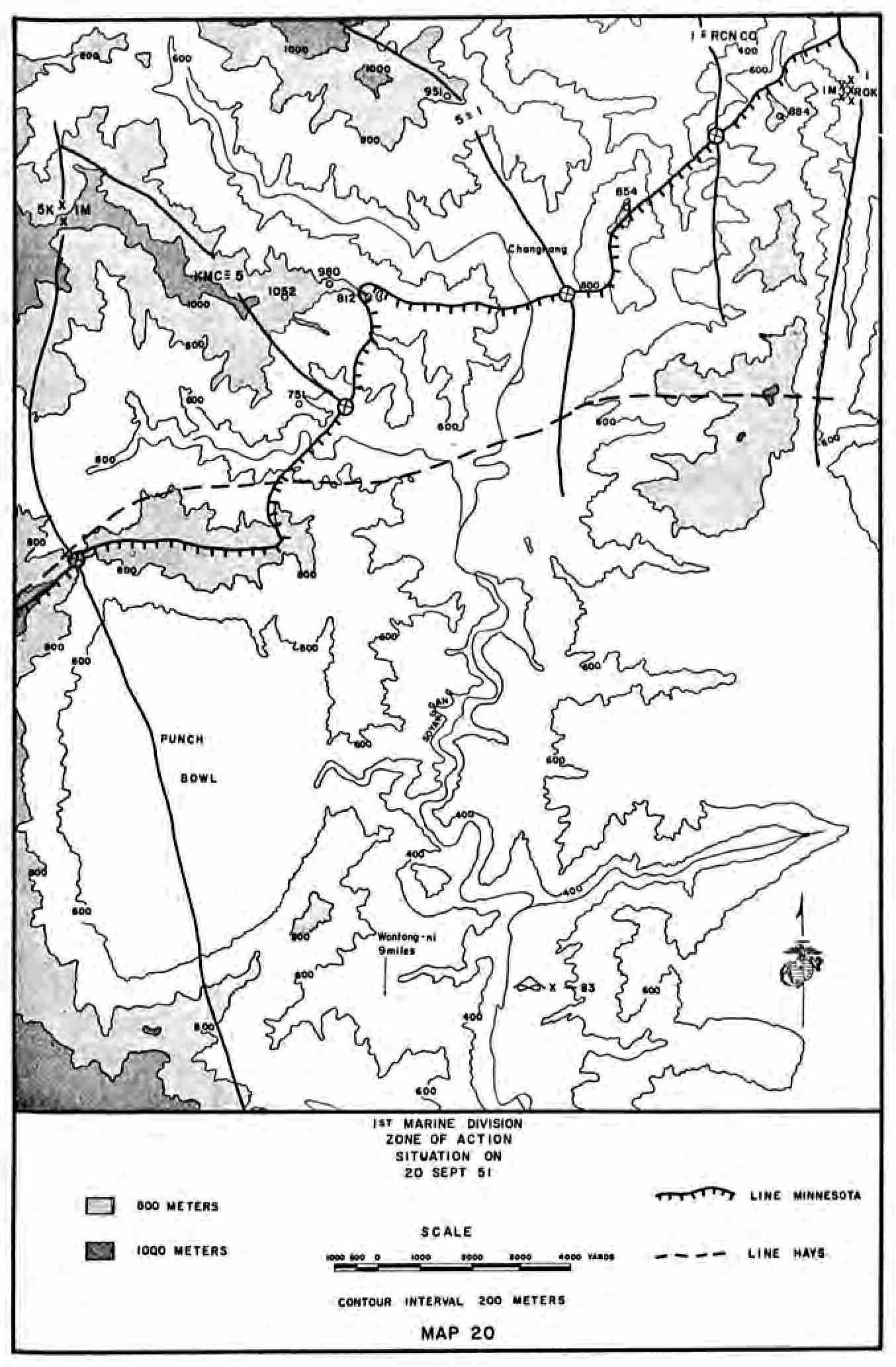
1ST MARINE DIVISION ZONE OF ACTION SITUATION ON 20 SEPT 51
MAP 20
By this time it had become an open question whether “friendly” mines did more harm to friend or foe. Certain it was, at any rate, that the prevailing system—or lack of system—resulted in Marine casualties during nearly every offensive operation in zones where the action shifted back and forth.
Lieutenant Colonel Foster C. La Hue’s 3/1 relieved two battalions of the 21st ROK Regiment. Although the ROKs had fought their way to the summit of Hill 854, the ridgeline to the southwest remained in the enemy’s hands. An attack by 3/1 was planned for 1530 on 20 September, supported by artillery and an air strike. Delays in the arrival of the planes caused a postponement until 1720. How Company jumped off and had advanced 50 yards when a man was killed and another wounded by mines. The attack was called off at dusk so that the ROKs could remove the explosives they had planted.
Air support was requested for 0700 on the morning of the 21st, but it was 1040 before four Air Force F-51s arrived for a strike directed by an observation plane of VMO-6 and a forward air controller. At 1220, following a 10-minute artillery preparation, How Company spearpointed a battalion attack which met stiff resistance. Another air strike was requested but did not materialize. The assault continued with mortar and artillery support until 1745, when How Company reported the ridge line secured.
Casualties of 3/1 for the two days were nine KIA and 55 WIA. Enemy losses totaled 159 counted and 150 estimated KIA, 225 estimated WIA, and 29 prisoners.304
“A large number of mines and booby traps were discovered within the battalion sector,” the 3/1 report for the 23d concluded, “most of these being U.S. types which were placed by ROK troops, with only a few enemy mines scattered in the central portion of the sector.”305
Helicopter Troop Lift to Hill 884
Division OpnO 27-51, it may be recalled, had directed the Marines to extend the X Corps boundary eastward by taking over the sector of the 11th Regiment, I ROK Corps. Even under ordinary circumstances this would have meant an exhausting 15-hour march for the relieving troops merely to climb Hill 884 (Map 20), The position was accessible only on foot, and supplies had to be brought on the backs of cargadores.
Because of the isolation of this wildly mountainous area, a reconnaissance was deemed essential. Major General Gerald C. Thomas, commanding general of the 1st Marine Division, assigned that mission to the Division Reconnaissance Company after deciding on a troop lift by helicopter.
He was aware, of course, that no such operation had ever been undertaken during the brief history of rotary-wing aircraft. Large-scale helicopter troop lifts were still at the theoretical stage.
Lieutenant Colonel George W. Herring, commanding officer of HMR-101, had but 48 hours for preparation. He and his executive officer, Lieutenant Colonel William P. Mitchell, worked out a tactical and loading plan with the commanding officer of Recon Company, Major Ephraim Kirby-Smith, and the acting Division Embarkation Officer, First Lieutenant Richard C. Higgs.306
An air reconnaissance of Hill 884 disclosed only two acceptable locations for landing sites, both approximately 50 feet square with a sheer drop on two sides. About 100 yards apart and some 300 feet below the topographical crest, each could be cleared sufficiently for the landing of a single aircraft.
Major Kirby-Smith decided on the order in which troops of his company and attached units would be landed. The assignment and loading tables were completed on 20 September in time for a rehearsal. All participants were instructed as to their team numbers and embarkation points.
H-Hour of Operation SUMMIT (Map 21) was set for 1000 on 21 September. The plan called for a preliminary landing of a Recon Company rifle squad to provide security. Next, a landing point team from the 1st Shore Party Battalion (Lieutenant Colonel Harry W. Edwards) had the mission of clearing the two sites. These two groups were to disembark from hovering helicopters by means of knotted 30-foot ropes. Strong winds at the 2,900-foot altitude made landing quite hazardous.
The execution was delayed half an hour by the ground fog so prevalent at this time of year. As soon as the two landing sites were cleared (about 40 minutes), word was transmitted by radio for the loading to begin at Field X-83 (Map 21), about 14 miles southwest of Hill 884 by the defiladed route of flight.
Control over the landings and takeoffs on the two Hill 884 sites was exercised by a hovering helicopter. Aircraft landed at 30-second intervals, each carrying five fully equipped men who disembarked in average time of 20 seconds. Two radio nets maintained communications between the landing sites and orbiting aircraft. Voice contact could not be established between the landing point team and X-83, however, and it became necessary for a helicopter to return within sight of the field to restore communications for incoming aircraft.
A total of 224 men, including a heavy machine gun platoon from 2/7, was lifted in flight time of 31.2 hours and over-all time of four hours. In addition, 17,772 pounds of cargo were landed.
Operation SUMMIT ended with the laying of two telephone lines between Recon Company on Hill 884 and the CP of the 1st Marines, about eight miles to the rear. Fifteen minutes were required for dropping each line. The ROKs, following their relief, proceeded on foot to their own Corps area.
From a tactical viewpoint, the importance of Hill 884 lay in its domination of enemy-held terrain. The difficulty of reaching the remote position had been overcome by the helicopter, and Operation SUMMIT was recorded in front page headlines by Stateside newspapers.
Congratulations poured in from all sides. Lieutenant General Lemuel C. Shepherd, Jr., commanding general of FMFPac, complimented HMR-161 on “a bright new chapter in the employment of helicopters by Marines.” Major General Clovis E. Byers, commanding X Corps, praised the “organic and attached units of the 1st Marine Division that participated in the first relief of units on the battle position. Your imaginative experiment with this kind of transport is certain to be of lasting value to all the services.”307
Nobody was more enthusiastic than General Thomas. “Operation SUMMIT, the first helicopter-borne landing of a combat unit in history, was an outstanding success,” said his message. “To all who took part, well done!”
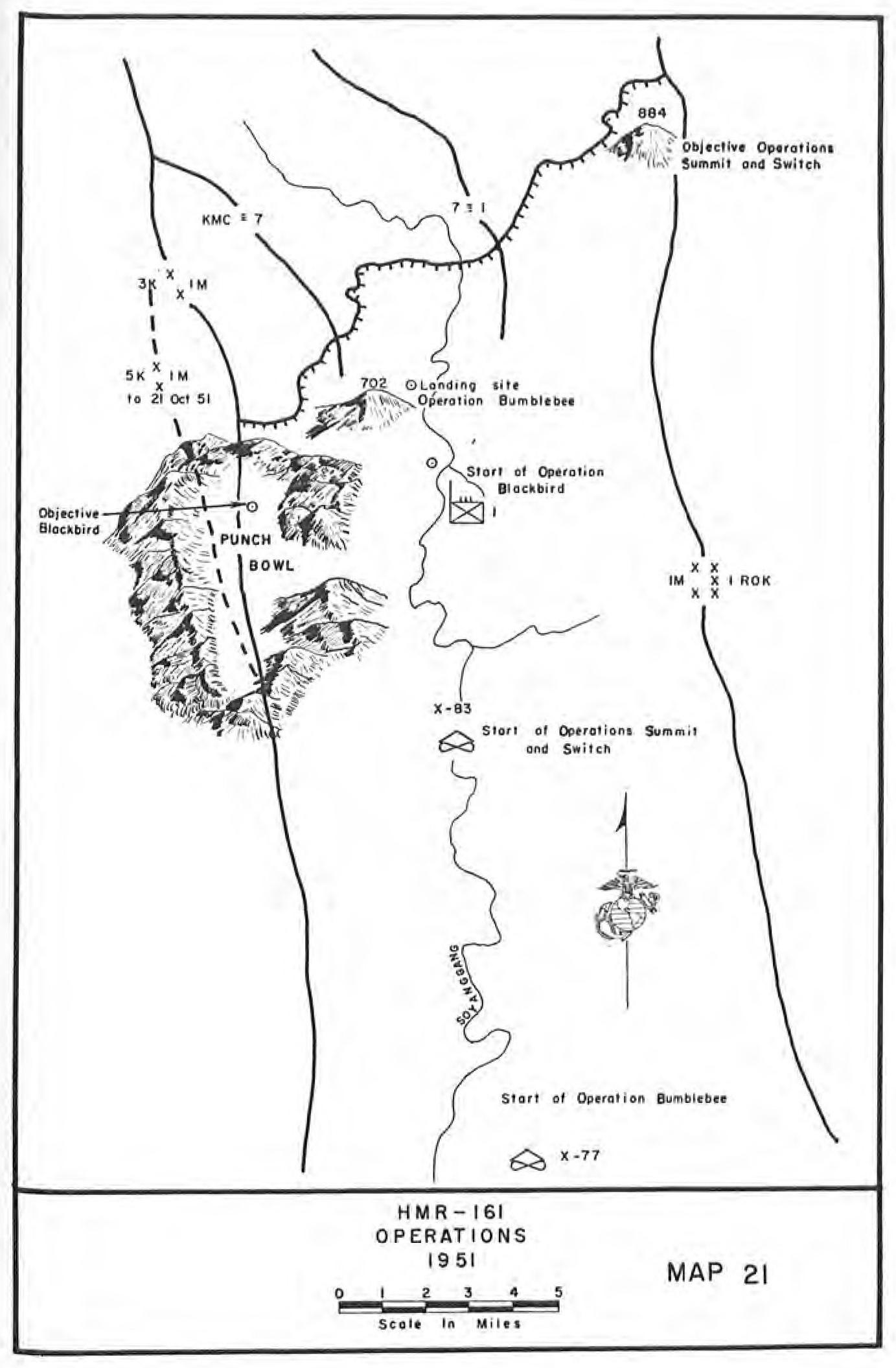
HMR-161 OPERATIONS 1951
MAP 21
Helicopter Operation BLACKBIRD
It is not surprising, considering their training, that the Marines found it a difficult transition from offensive to defensive operations after 20 September. As evidence that patrols were conducted with customary aggressiveness, Marine casualties (including the 1st KMC Regiment) for the last 10 days of the month were 59 KIA, 1 MIA, and 331 WIA. Enemy losses for the same period were 505 counted KIA, and 237 prisoners.
1st Marine Division casualties of 2,416 (including 594 reported by the KMCs) for September as a whole were the most severe suffered during any month of the war so far with the exception of December 1950 and June 1951. NKPA losses of the month were 2,799 counted KIA and 557 prisoners.308
On the 23d the 1st Marines extended to the eastern boundary of X Corps and relieved the Division Reconnaissance Company on Hill 884. That same day the enemy was treated to a novelty when 100 well aimed 16-inch projectiles, fired from a range of 40,000 yards, roared in like meteors on his positions in the area of Hill 951 (Map 20). Naval gunfire from the USS New Jersey was being conducted by Marine spotters in forward OPs, who reported good coverage for the 2,000-pound rounds. Ammunition dumps and artillery pieces were destroyed while NKPA troops in the open suffered heavy personnel casualties, according to observers.
Several more bombardments were contributed by the New Jersey at the request of 1/1 and 3/1 during the balance of the month. Marine and attached Army artillery also gave excellent support with fire so accurate as to break up enemy counterattacks before they could be launched. Ammunition restrictions hampered the efforts of the 11th Marines (Colonel Custis Burton, Jr.) but the cannoneers never failed to respond to an emergency. The 90mm rifles of the 1st Tank Battalion (Lieutenant Colonel Holly H. Evans) continued to show good results with direct observed fire on enemy bunkers. Air support in September, concluded the Division report, was “generally inadequate and unsatisfactory.”309
By the last week of September the Division right (east) flank was well protected, considering the rugged terrain. Not as much could be said for the other flank, northwest of the Punchbowl, where the sector of the Marines joined that of the 5th ROK Division. Since the Division sector was divided by high, roadless mountains, there was no rapid way of moving reserves other than by helicopter. In short, the 1st Marine Division was hard pressed to man a 22,800-yard MLR while keeping in reserve enough troops to help defend this sensitive area in an emergency.
Plans were completed by General Thomas and the Division staff for the rapid displacement of a company from 2/1, the reserve battalion of the 1st Marines, to meet any such threat. Since a surprise attack was most likely to occur at night, it was decided that a helicopter lift of an element of the Division reserve should be made in the darkness of 27 September after a detailed daytime rehearsal.310
In contrast to former Marine helicopters, which had no night-flying aids, the HRS-1 was equipped with few attitude of flight instruments. They were primitive compared to the sophisticated instrumentation of fixed-wing planes, and Lieutenant Colonel Herring sent his pilots on preliminary night indoctrination flights to memorize terrain features.
The route, five air miles in length, amounted to a round trip of 13 miles because of the detours necessary for purposes of concealment. The aircraft were to take off from a dry river bed southeast of Hill 702 (Map 21) and land near the northwestern rim of the Punchbowl, where the troops would march a mile to their final assembly area.
The infantry unit selected for Operation BLACKBIRD was Easy Company of 2/1, commanded by Second Lieutenant William K. Rockey. Lieutenant Colonel Nihart and Major Carl E. Walker, the battalion commander and his executive officer, supervised the daylight rehearsal on the morning of the 27th. Six helicopters lifted 200 men in the overall time of two hours and 10 minutes to a landing site of 50 by 100 feet cleared by a team of the 1st Shore Party Battalion. The troops were proceeding on foot to their assembly area when an antipersonnel mine wounded a man. Nihart called a halt immediately and investigation revealed that the area was filled with mines. Plans were changed to abandon the march, although the landing site remained the same.
Operation BLACKBIRD got under way at 1930 on 27 September. The night was dark when the first HRS-1 took off with five combat-equipped men. Three-minute intervals were required between aircraft operating on a shuttle system, so as to avoid the danger of collisions. Different altitudes were assigned to outgoing and incoming helicopters which used running lights only two minutes before entering or leaving the debarkation zone.
A total of 223 troops were landed in over-all time of two hours and 20 minutes instead of the nine hours a movement by foot would have required. Nevertheless, some of the results were not reassuring. Rotor wash blew out many of the flare pots lighting the embarkation area, and the battery-powered beach lanterns on the landing site proved inadequate. Pilots were temporarily blinded by the glare on windshields; and artillery flashes bothered them while making their way through three mountain passes. Fortunately, good radio communications aided pilots who had trouble in locating the landing site in spite of night rehearsals.
Operation BLACKBIRD remained the only night helicopter troop lift during the war in Korea. “Present equipment,” said the Marine report, “indicates that under present conditions in Korea these night lifts should be limited to movements within friendly territory.”311
“To Organize, Construct and Defend”
“The Division continued to organize, construct and defend positions along a 13½-mile front; patrol forward of the MLR and screen rear areas; and maintain one U.S. Marine regiment which could not be committed without authority from X Corps in a reserve area 17 miles behind the lines.”
The above quotation, from the opening paragraph of the report of the 1st Marine Division for October 1951, sums up in a nutshell the new trend of operations since 20 September. It is significant that for the first time in 1951 the Division Historical Diary departs from a daily account of events and divides the month into two equal parts for a chronicle of operations. Not enough had happened to justify a day-by-day summary.
This does not mean that the Marines neglected any opportunity to do the enemy hurt. It means only that the opportunities of defensive warfare were limited as compared to the preceding six months of offensive operations. That the Marines made the best of such opportunities is shown by the fact that the ratio of enemy to friendly casualties increased from the 4-to-1 of September to the 20-to-1 of October, even though the totals of the former month were larger.312
As a result of his new defensive policies, the enemy often avoided a fight. Day after day passed during the first two weeks of October without far-ranging Marine patrols being able to make contact.
Line MINNESOTA, the new MLR (Map 20), ran roughly parallel to the hays line but included advanced positions taken in the September offensive. During the first 10 days of October the 2d Battalion of the 1st Marines continued to be the Division forward reserve in readiness for a quick shift to any threatened point in the MLR, and the Division Reconnaissance Company had the mission of maintaining daily contact with the 11th ROK Division on the Marines’ right flank.
It might seem that the 7th Marines, 17 miles to the rear at Wontong-ni, would be entirely becalmed. Yet this regiment saw as much action on some days as any of the three regiments ranging forward of the MLR. The explanation was that the rear area was infested with elusive North Korean guerrillas who kept the 7th Marines patrols busy.
Early in October the question arose as to how quickly a reserve battalion could be shifted from one point to another. By this time a company-size helicopter lift had become commonplace, having been successfully completed twice by HMR-161 since Operation SUMMIT. It remained to be seen whether a battalion could be transported with comparable celerity, and, on 9 October, Division issued an order warning of 3/7’s move.
The 7th Marines was due to exchange places with the 5th Marines on the 11th after relieving that regiment in the center of the Division front. While 1/7 and 2/7 completed a conventional relief of their opposite numbers, 3/7 was selected for a helicopter lift. Lieutenant Colonel Edwards, the new commanding officer, had recently commanded the Shore Party Battalion and helped to train its landing site and loading point teams. He took part in the planning along with Colonel Krulak, Lieutenant Colonels Herring and Mitchell, and the new commanding officer of the Shore Party Battalion, Lieutenant Colonel George G. Pafford.
Planning went on as if for an amphibious operation. Assignment and loading tables were worked out, and each Marine of the six-man embarkation teams had his designated place in the helicopter. On 10 October all officers and men of 3/7 attended a familiarization class at which trial teams were loaded.
Operation BUMBLEBEE began at 1000 on the 11th. Field X-77 (Map 21) had been selected as the loading zone because of its proximity to the assembly area of the 7th Marines. The landing site was just behind the 5th Marines MLR, northeast of Hill 702. A flight path of 15 miles took advantage of the concealment afforded by valleys and defiladed areas.
The two dispatchers in the loading zone were provided with a checkoff flight list containing the names of every team of 3/7. In order to avoid delays, replacements could be summoned from a casual pool to fill understrength teams to plane capacity. Average time for loading was 20 seconds.
Ten to 12 minutes were required for the flight. As the helicopters landed at intervals of a minute, a team could exit and allow the craft to be airborne in an average time of 17 seconds. “Time was saved,” according to one Marine report, “when the Shore Party personnel, after opening the door, vigorously assisted the passengers by grasping their arms and starting them away from the craft. The last man out checked to see if any gear had been forgotten. Guides furnished by the battalion directed the passengers toward their respective company assembly areas, thus keeping the landing areas clear at all times.”313
Twelve helicopters were employed in 156 flights. The flight time was 65.9 hours and over-all time five hours and 50 minutes. A total weight of 229,920 pounds included 958 combat-equipped troops averaging 240 pounds.
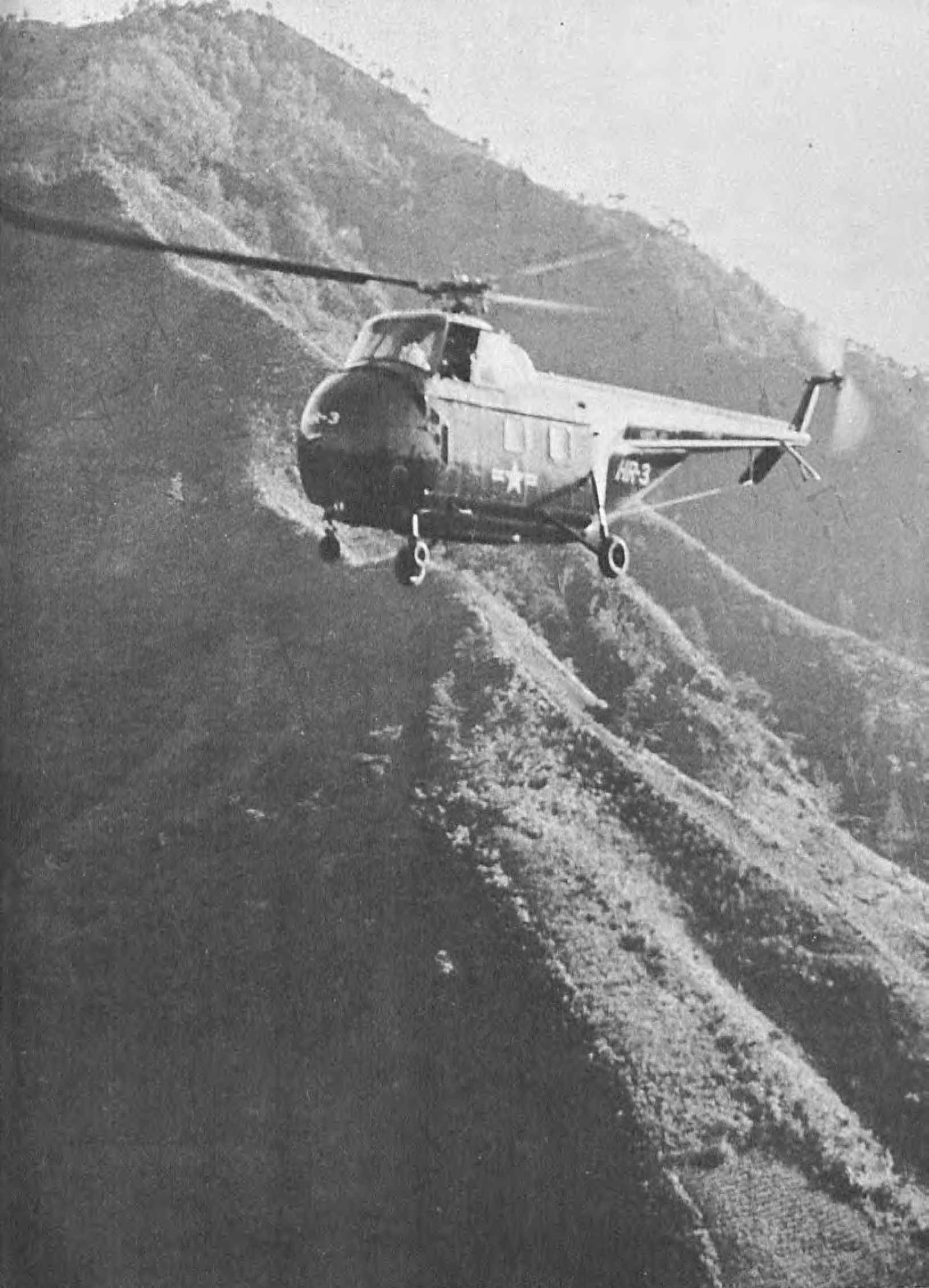
DD MC A 132540
Helicopter In The Hills—A large Sikorsky helicopter hovers over the mountainous terrain of Korea. This type of aircraft has been extensively used for many types of transport missions.
DD MC A 131324
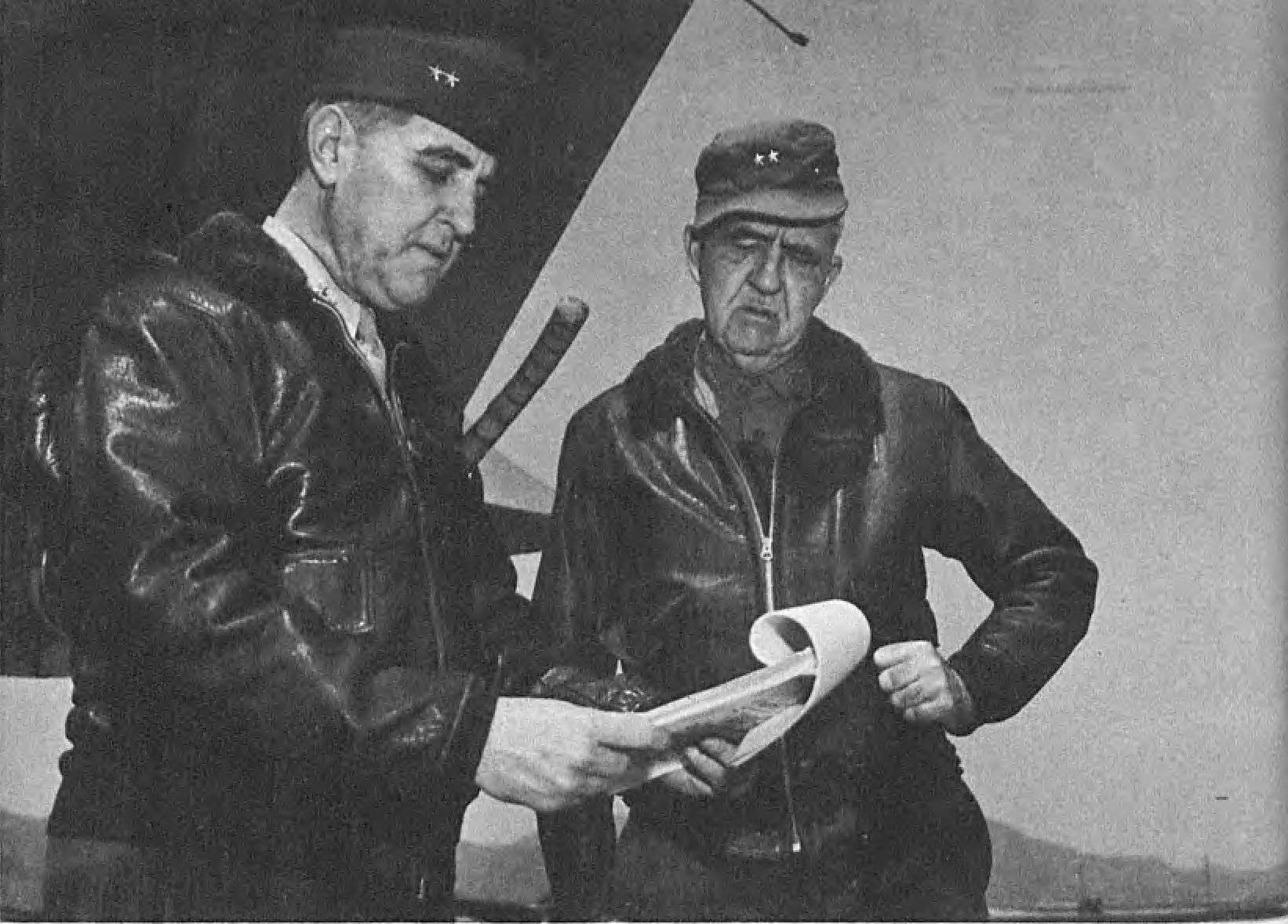
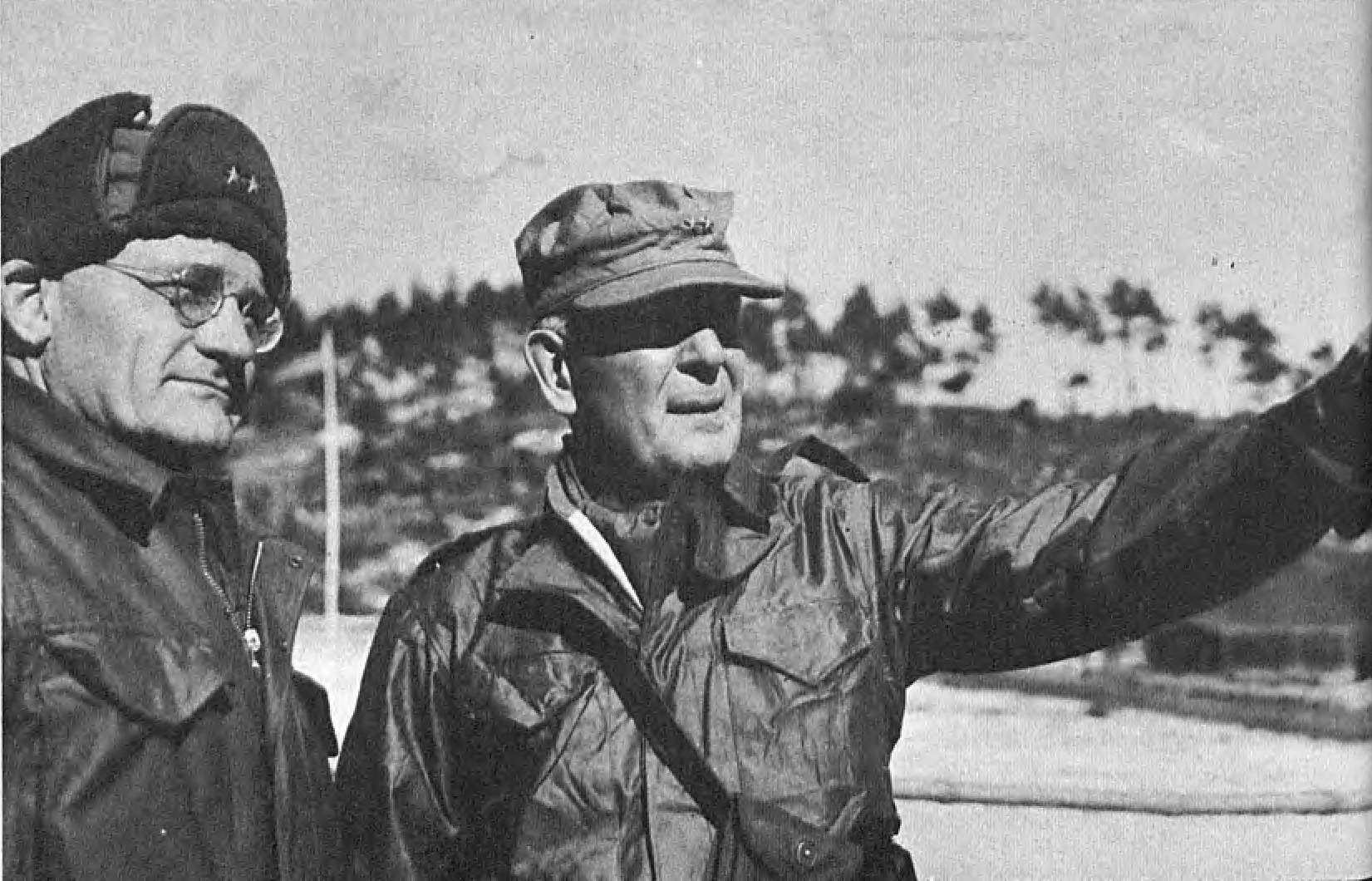
Generals Confer—Above, MajGen Gerald C. Thomas (left) and MajGen Field Harris discuss the situation in April, 1952. Below, MajGen John T. Selden (right) briefs Army MajGen R. D. Palmer.
DD MC A 159084
DD MC A 8410
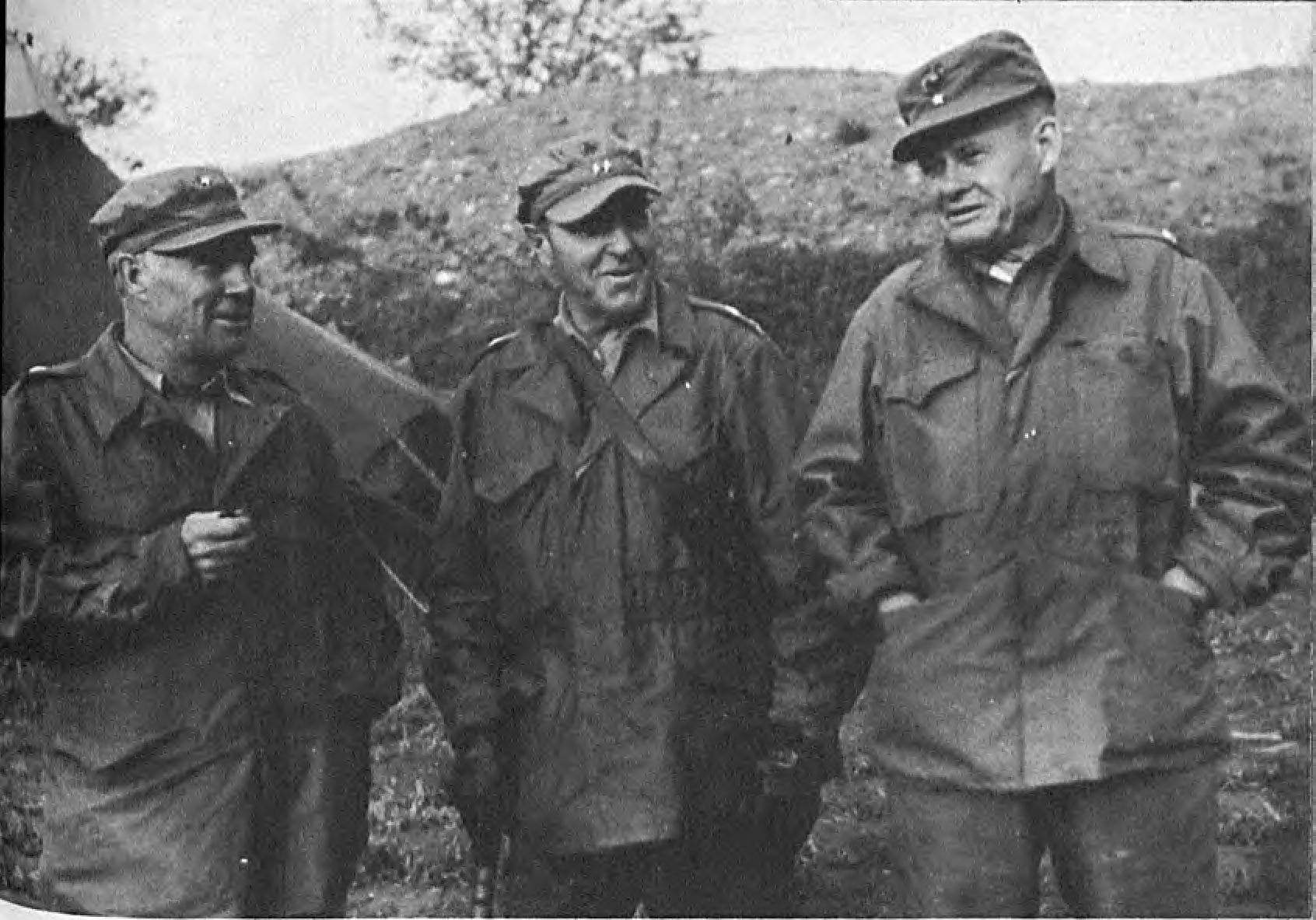
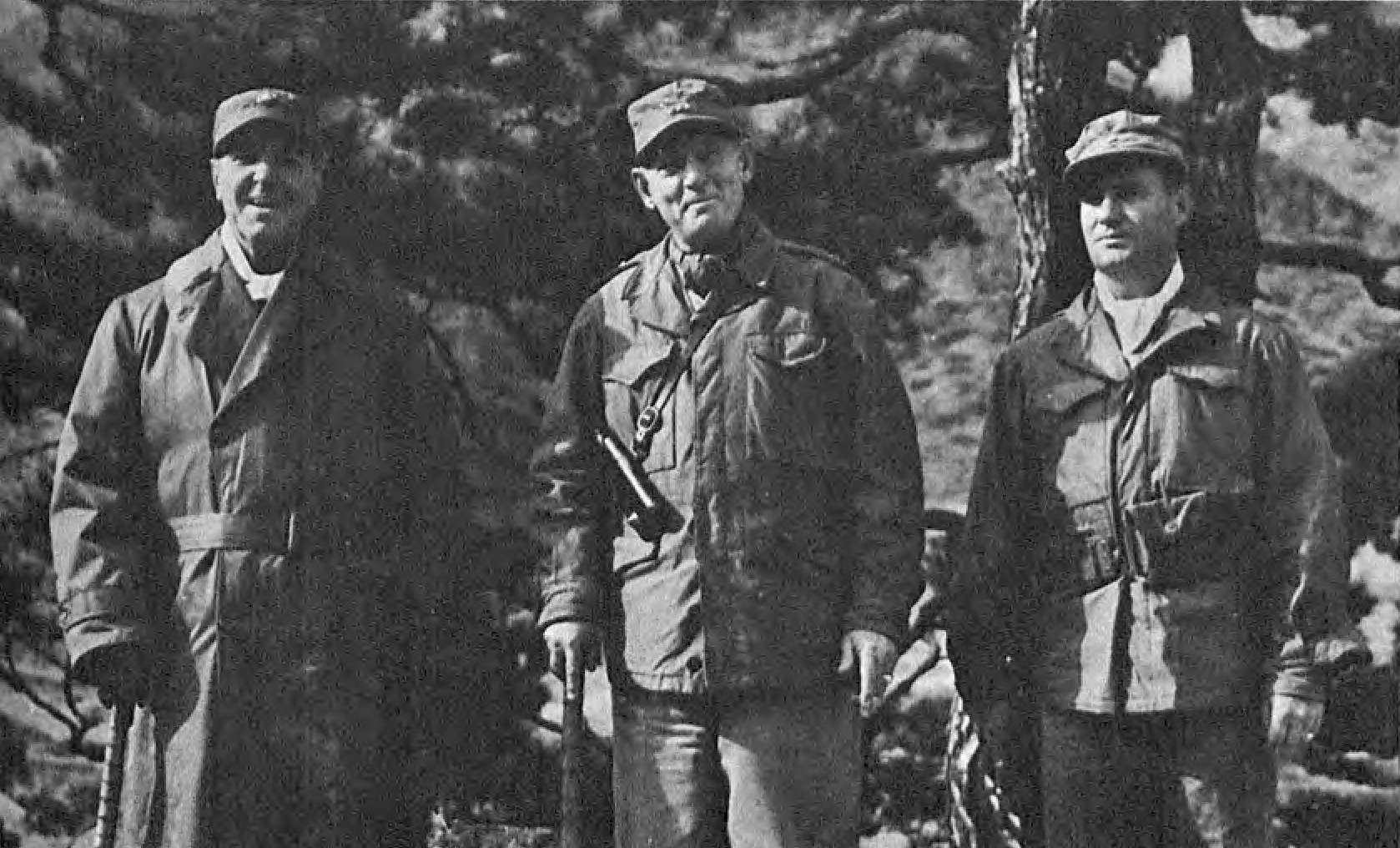
On The Planning Level—Above, BrigGen Whaling, MajGen Thomas, and BrigGen Puller enjoy a bit of humor, while, below, MajGen Thomas, LtGen Shephard, and Col Wade pose for the photographer.
DD MC A 157916
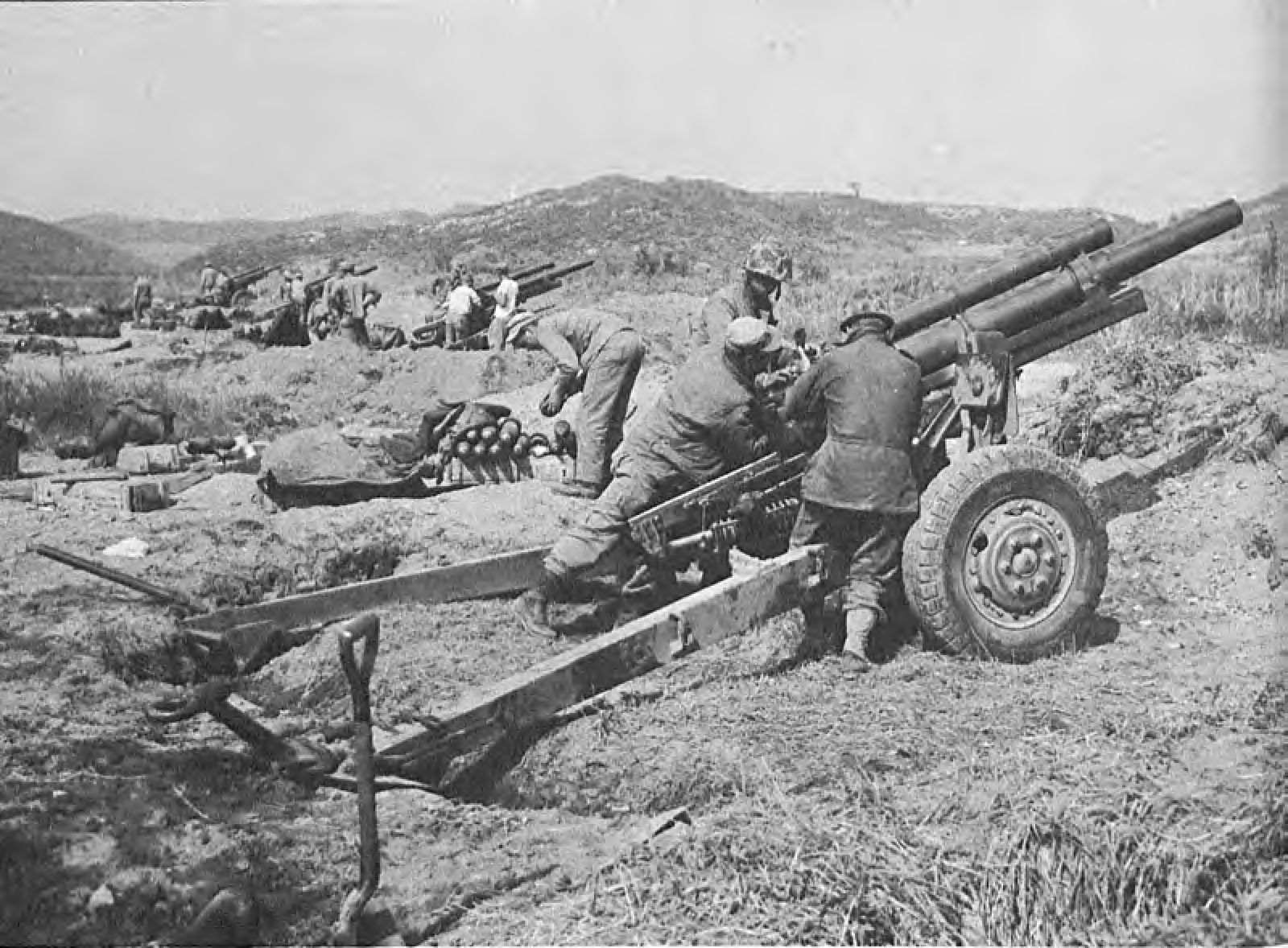
DD MC A 161585
Ready For Action—Above, a Marine 105mm howitzer battery preparing to fire a mission. Below, exterior and interior views of a heavy and light machine gun emplacement.
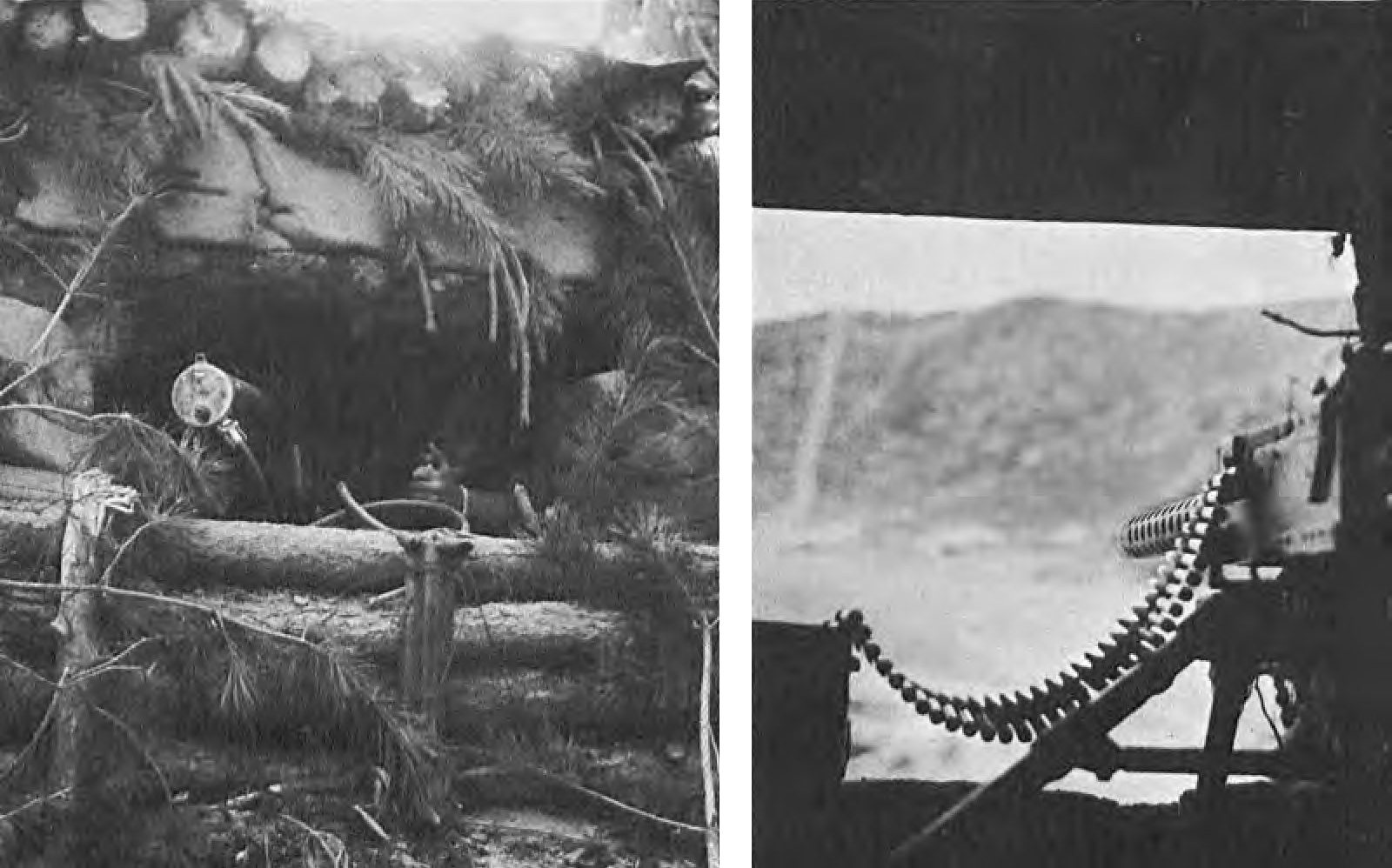
DD MC A 155525 DD MC A 169584
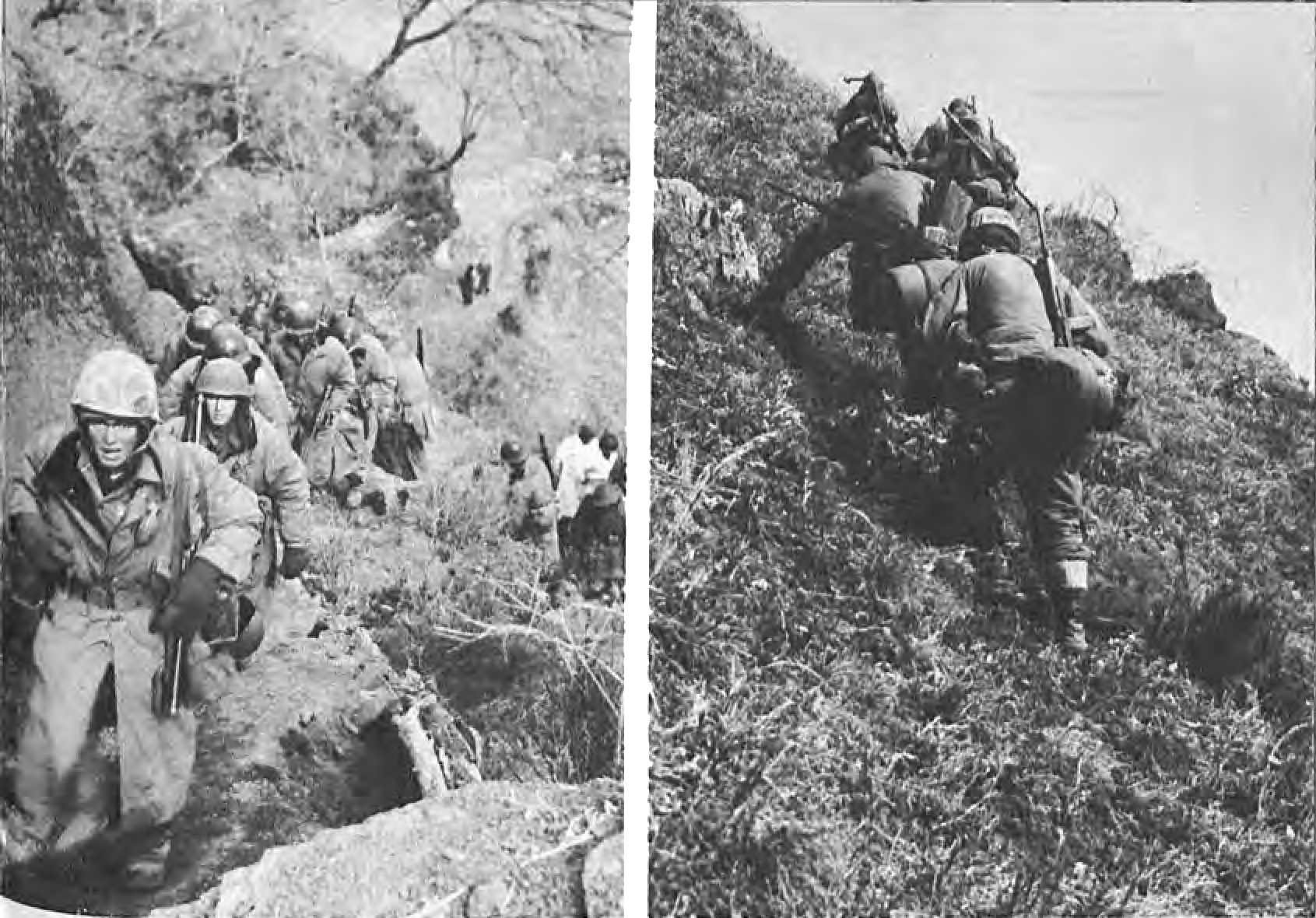
DD MC A 6953 DD MC A 6754
Going Up—Above, left and right, Marines move into position on one of the many Korean hills. Below, a section of the MLR in March, 1952.
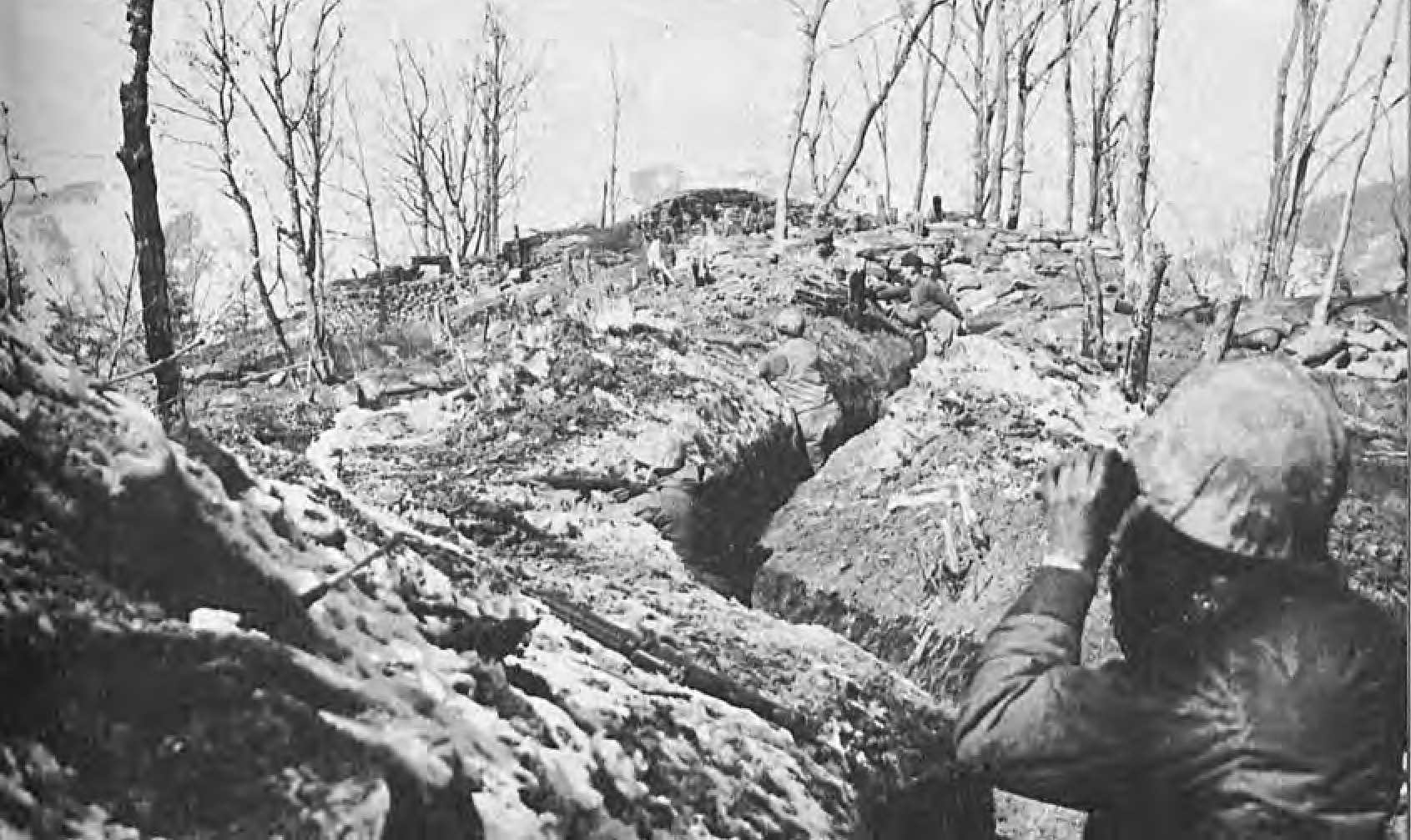
DD MC A 160250
DD MC A 159304
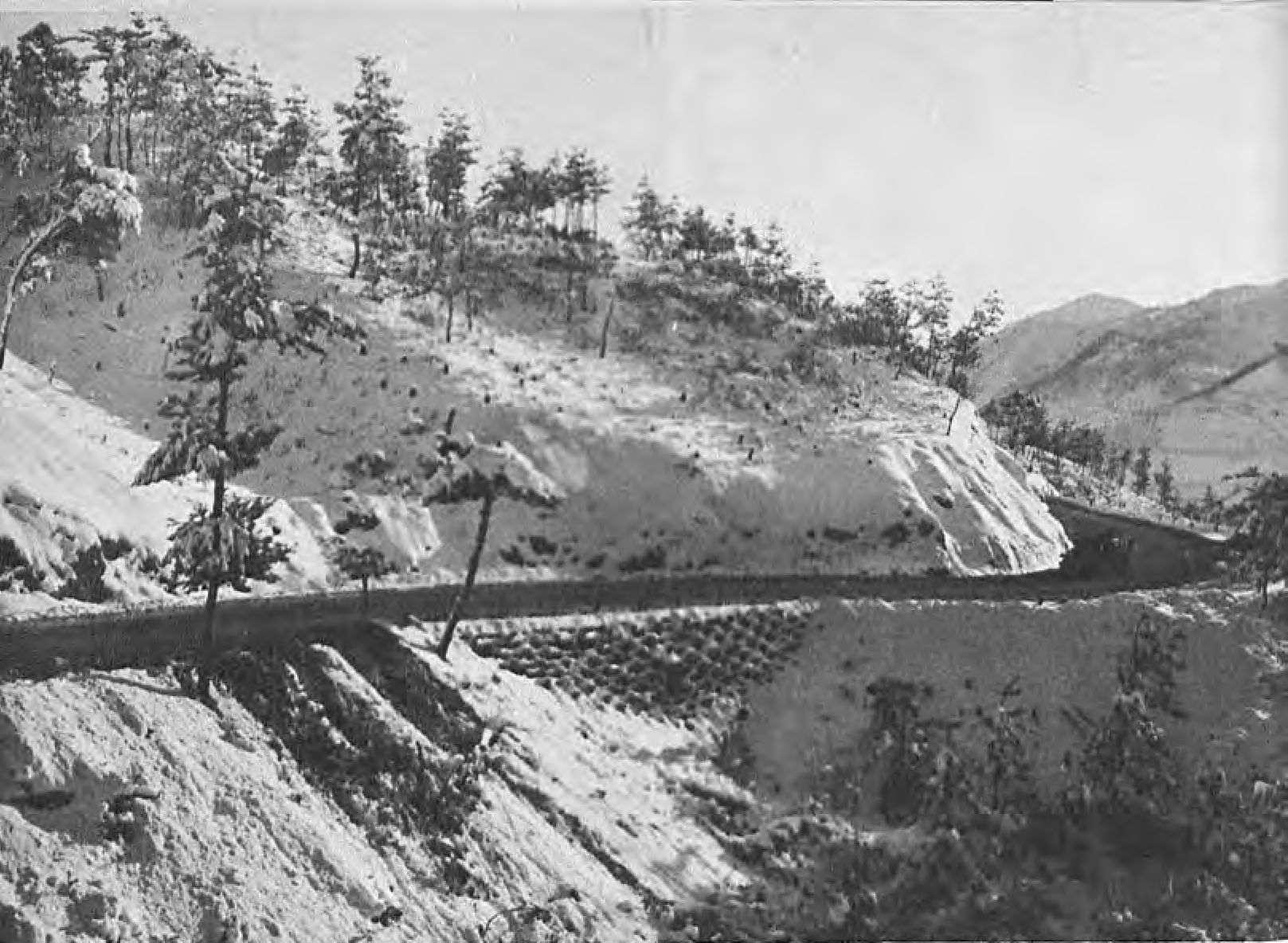
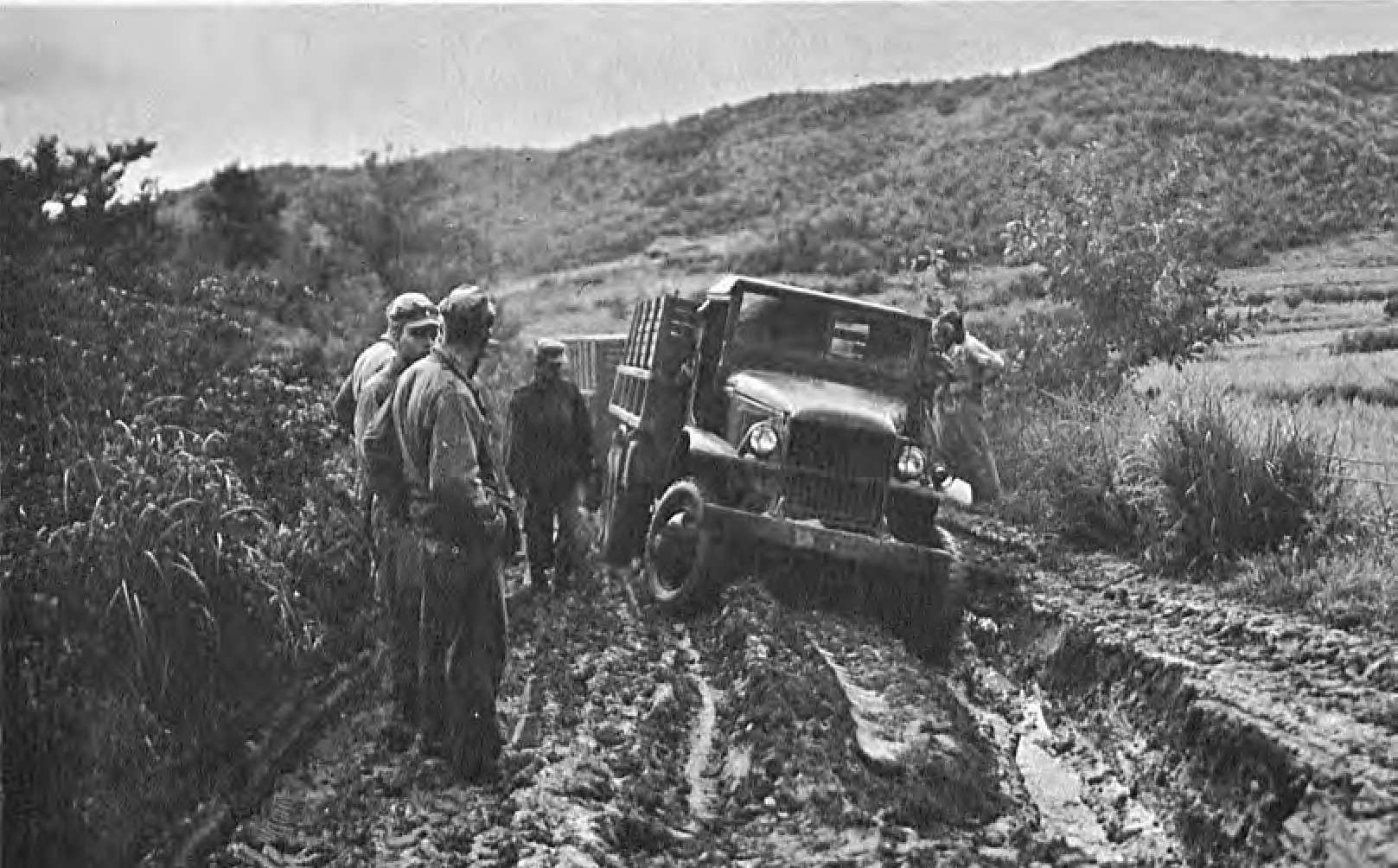
The Lifeline—Above, a view of the MSR of the 1st Marine Division during January, 1952. Below, during the rainy season it is difficult to move supplies over the poor roads.
DD MC A 164552
DD MC A 162316
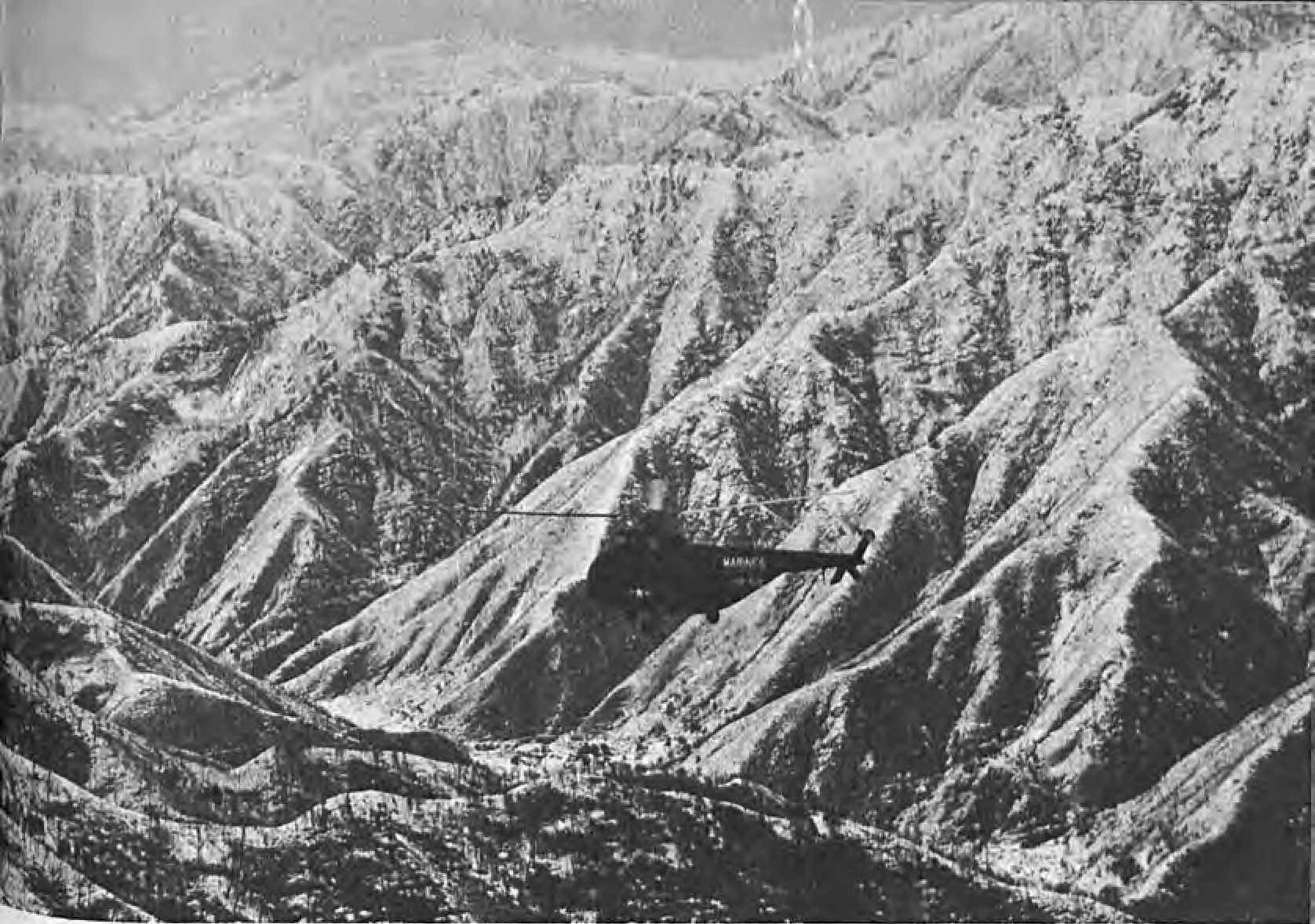
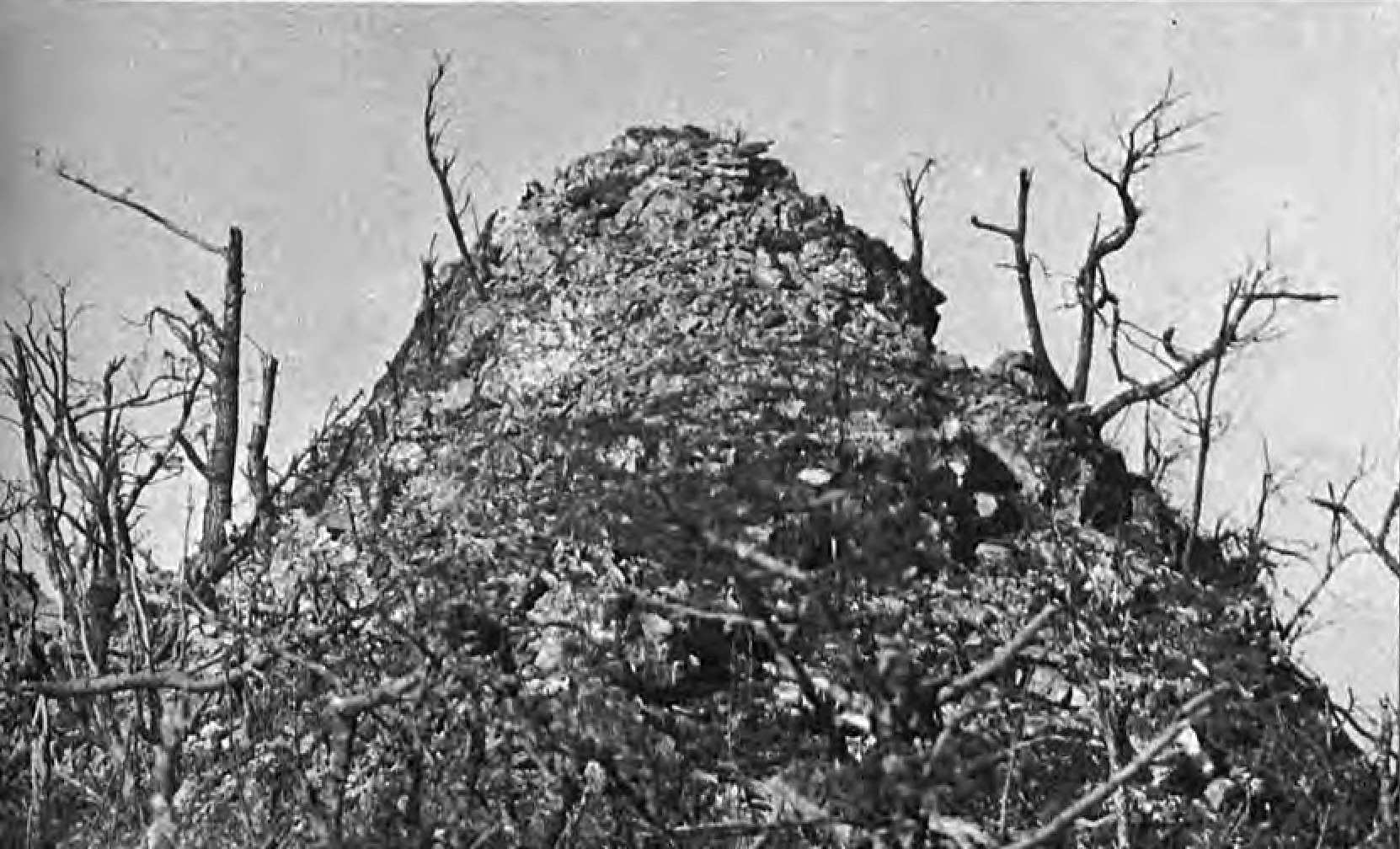
Terrain Features—Above, a Marine helicopter flies behind ice-covered slopes to avoid enemy fire. Below, an enemy stronghold nicknamed “Luke The Gook’s Castle.”
DD MC A 160572
USN 439970 USN 441346
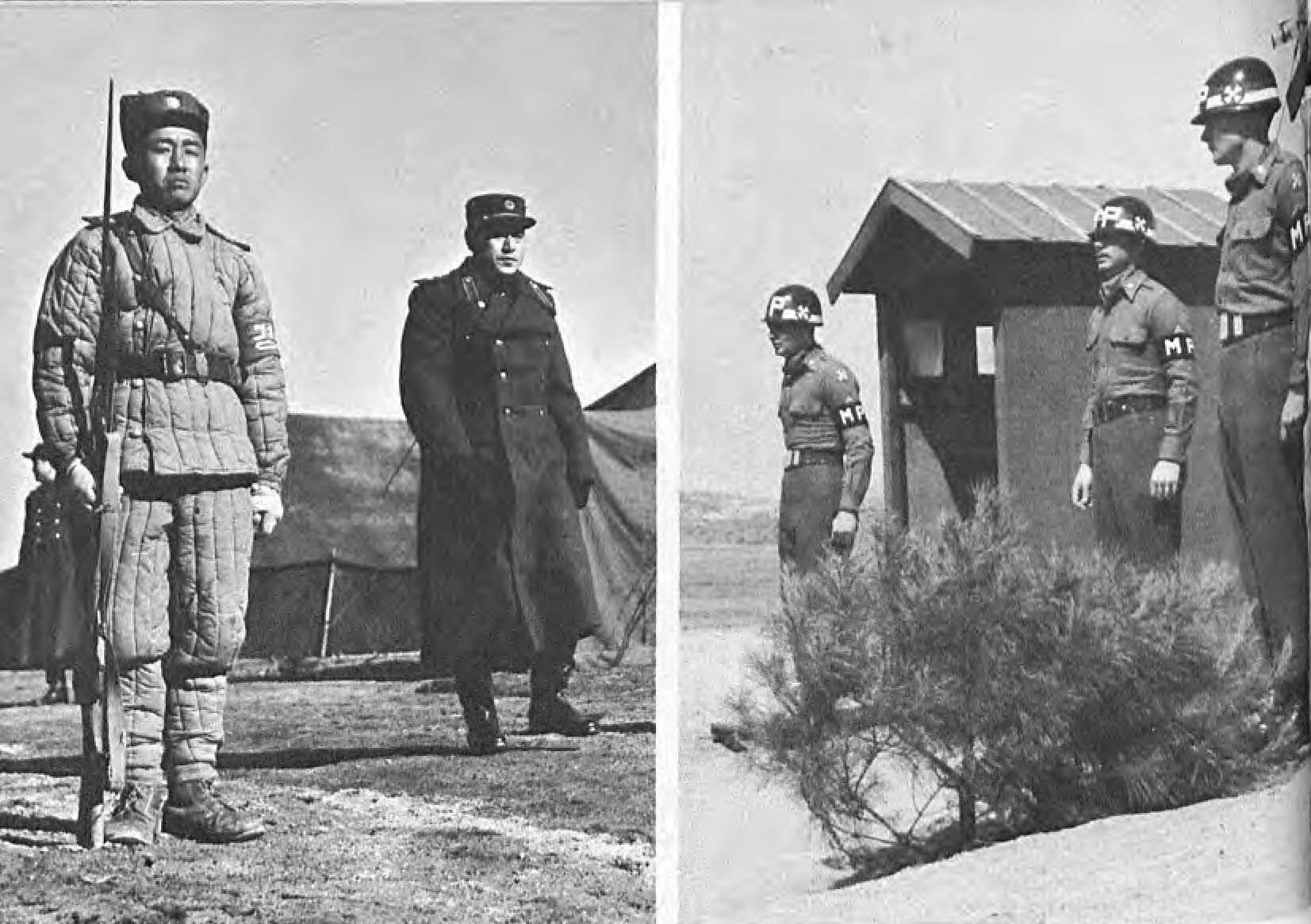
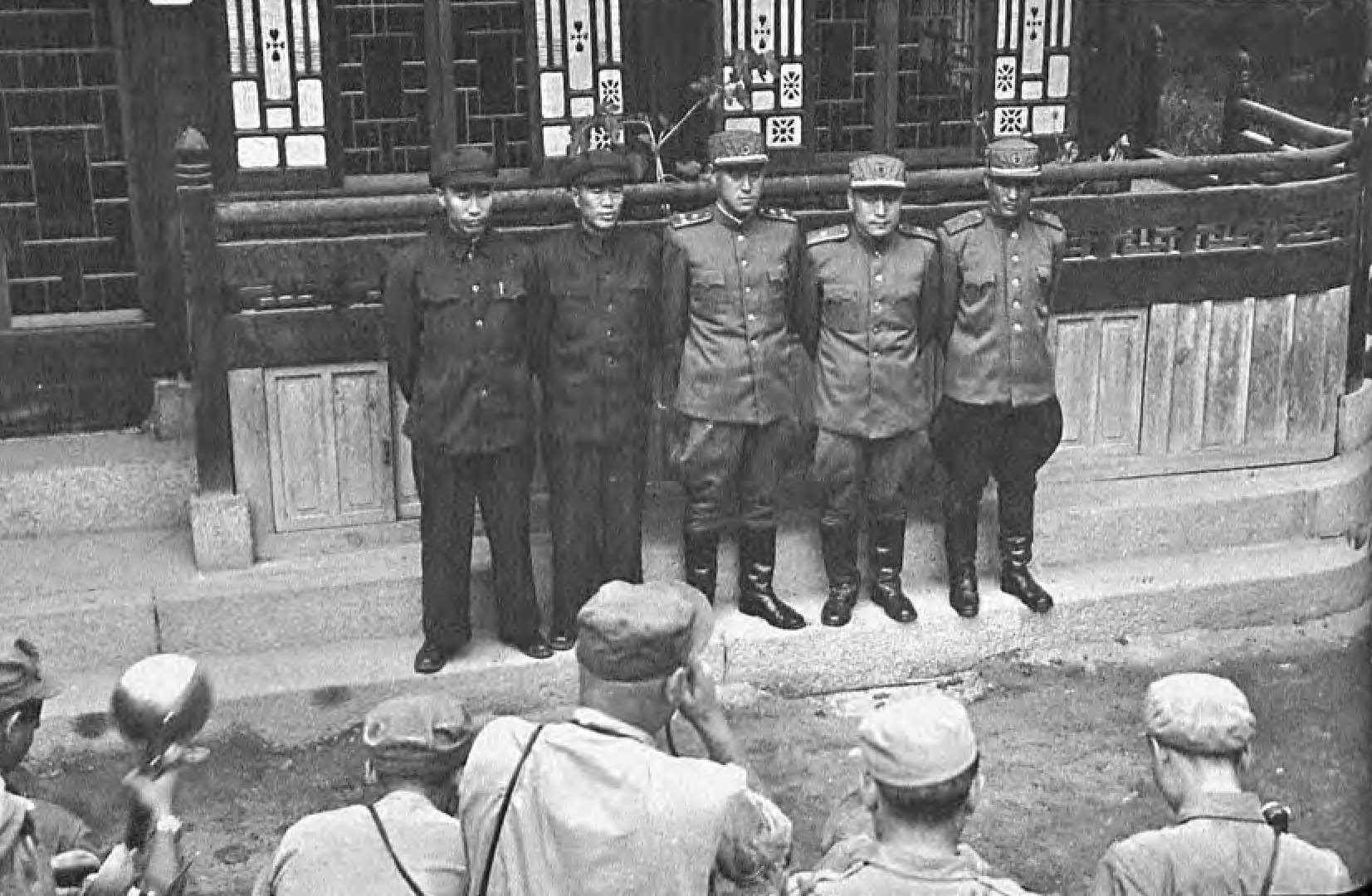
Panmunjom “Talkathon”—Above (left) Gen Nam Il starts for the truce talks. Above (right) United Nations’ sentries. Below, the Chinese and North Korean Communist negotiators.
USN 431929
USN 432414
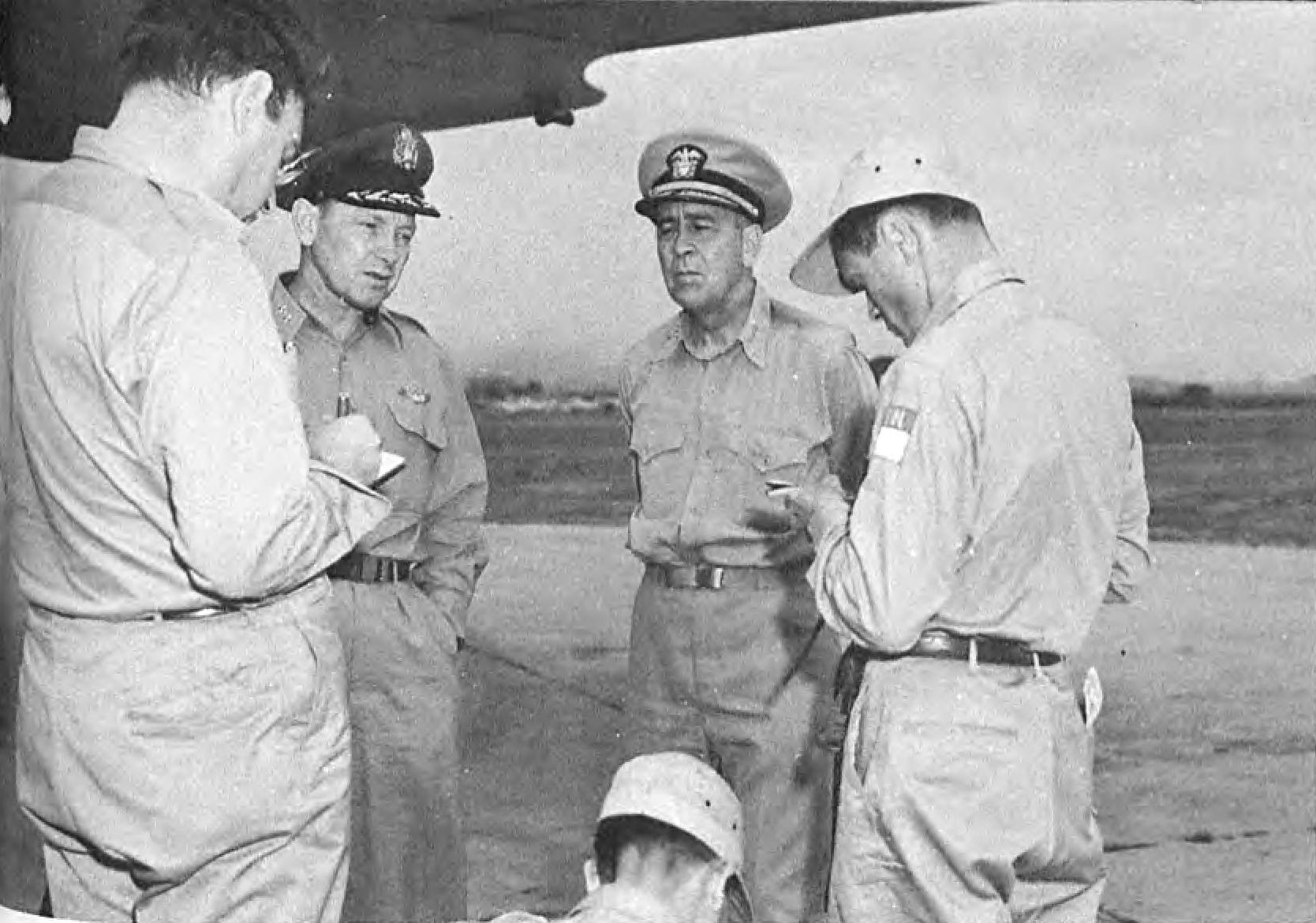
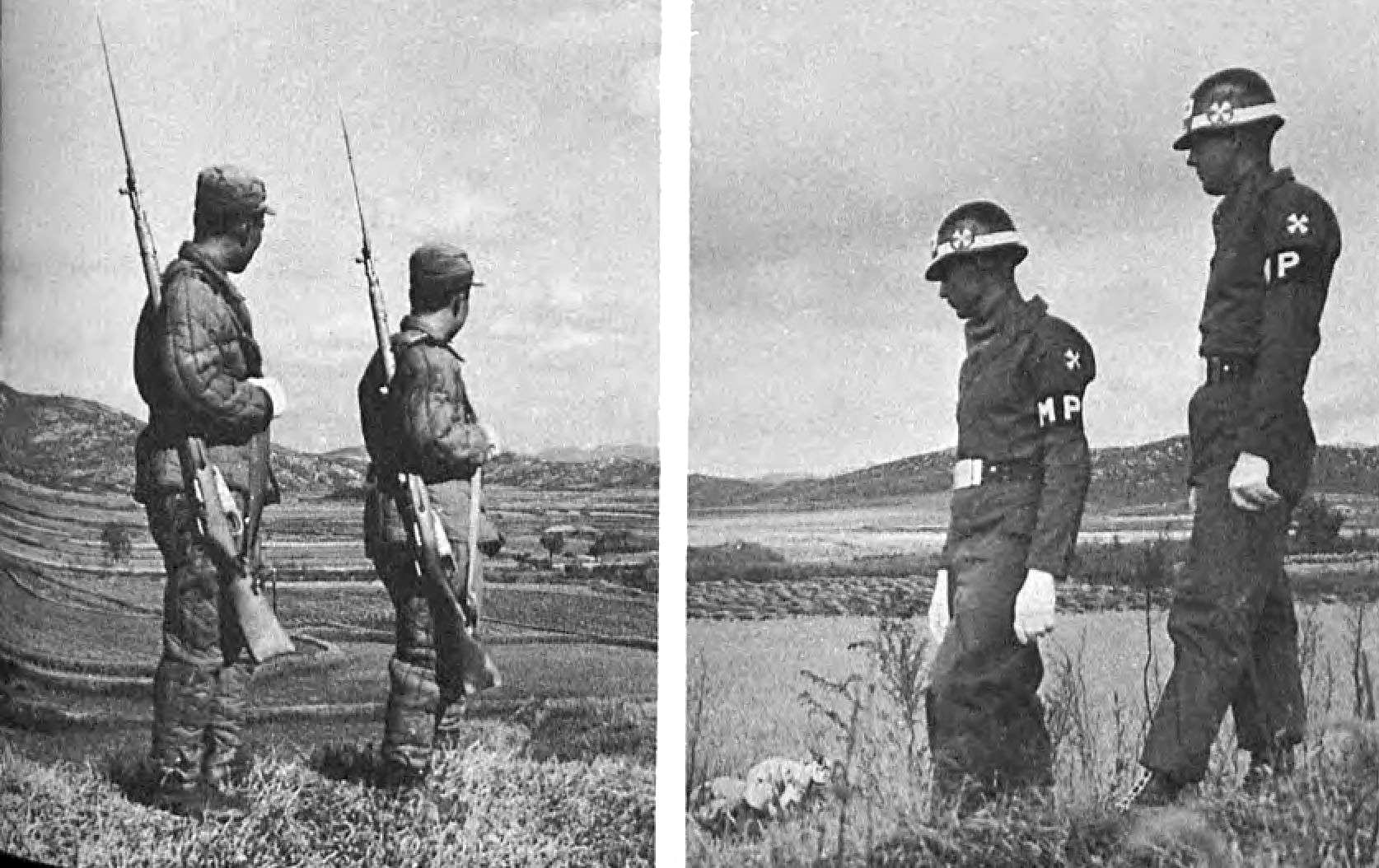
Watchful Waiting—Above, MajGen L. C. Cragie and VAdm C. T. Joy talk to correspondents at Panmunjom. Below, Communist and UN sentries walk posts around the peace talk site.
USN 935646 USN 435646
DD MC A 163575 DD MC A 164145
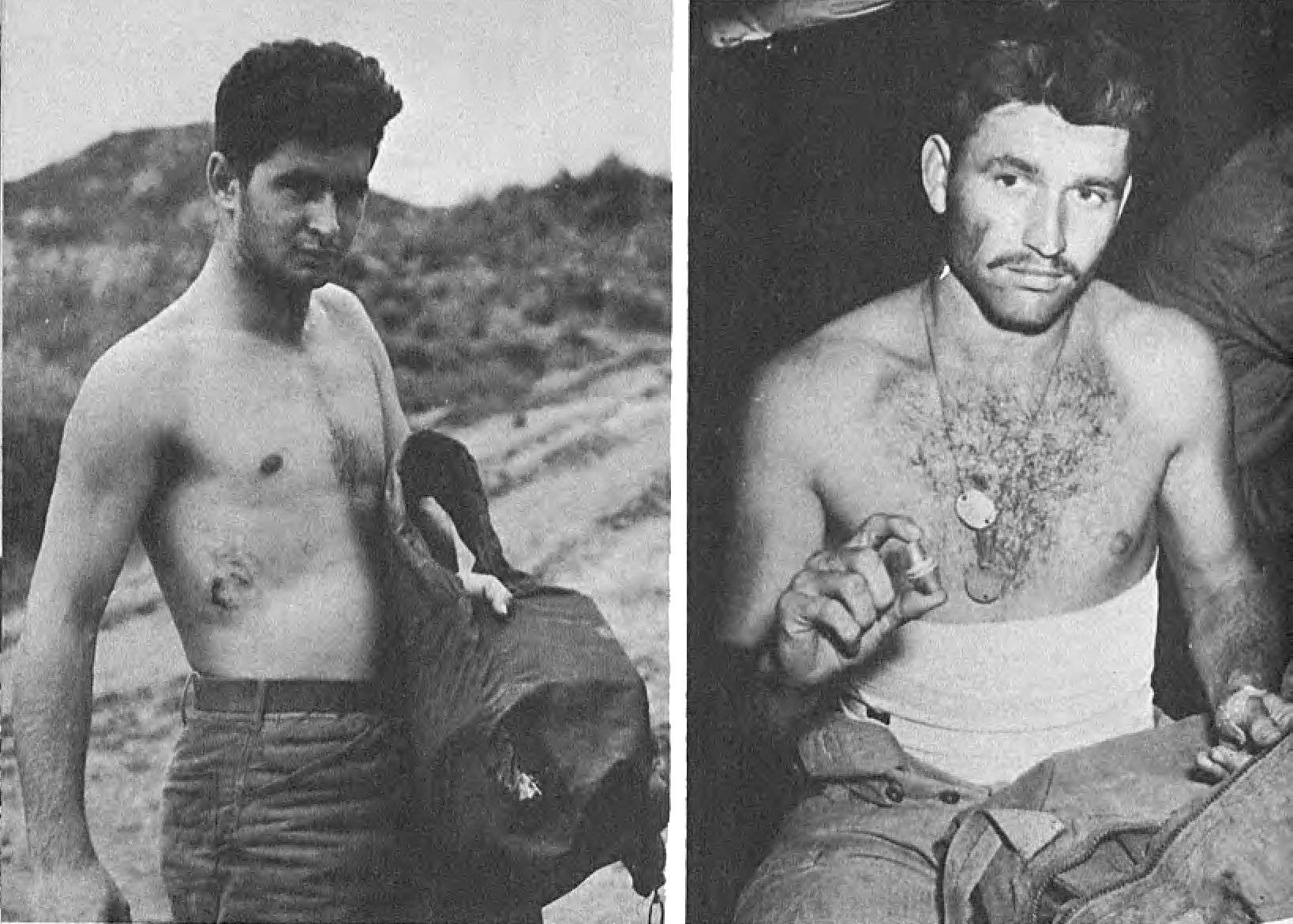
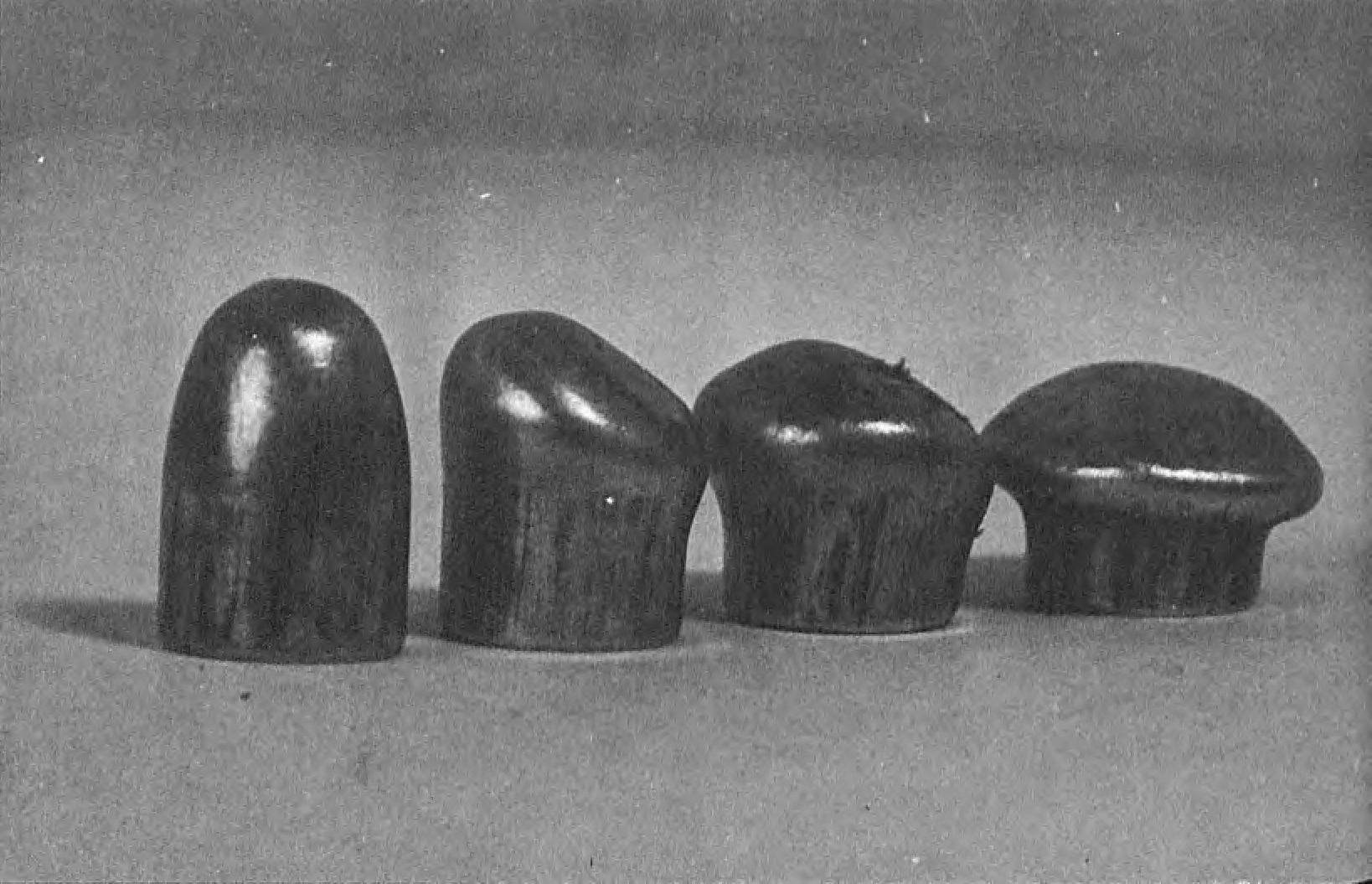
Lifesaver—Above, bruised Marines show the armored vests that saved their lives. Below, a .45 caliber bullet test-fired into cotton contrasted with three removed from an armored vest.
DD MC A 46216
DD MC A 168081
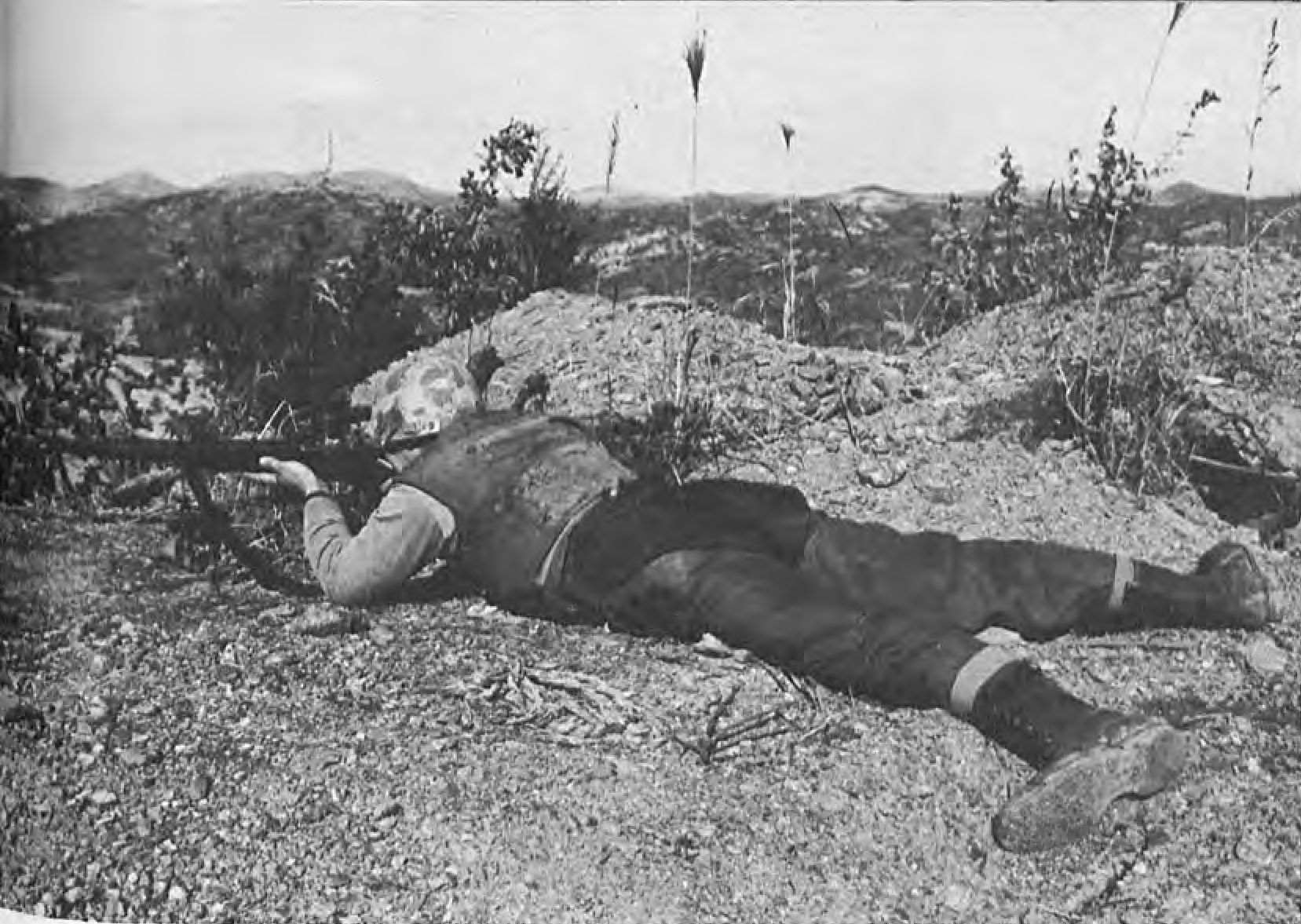
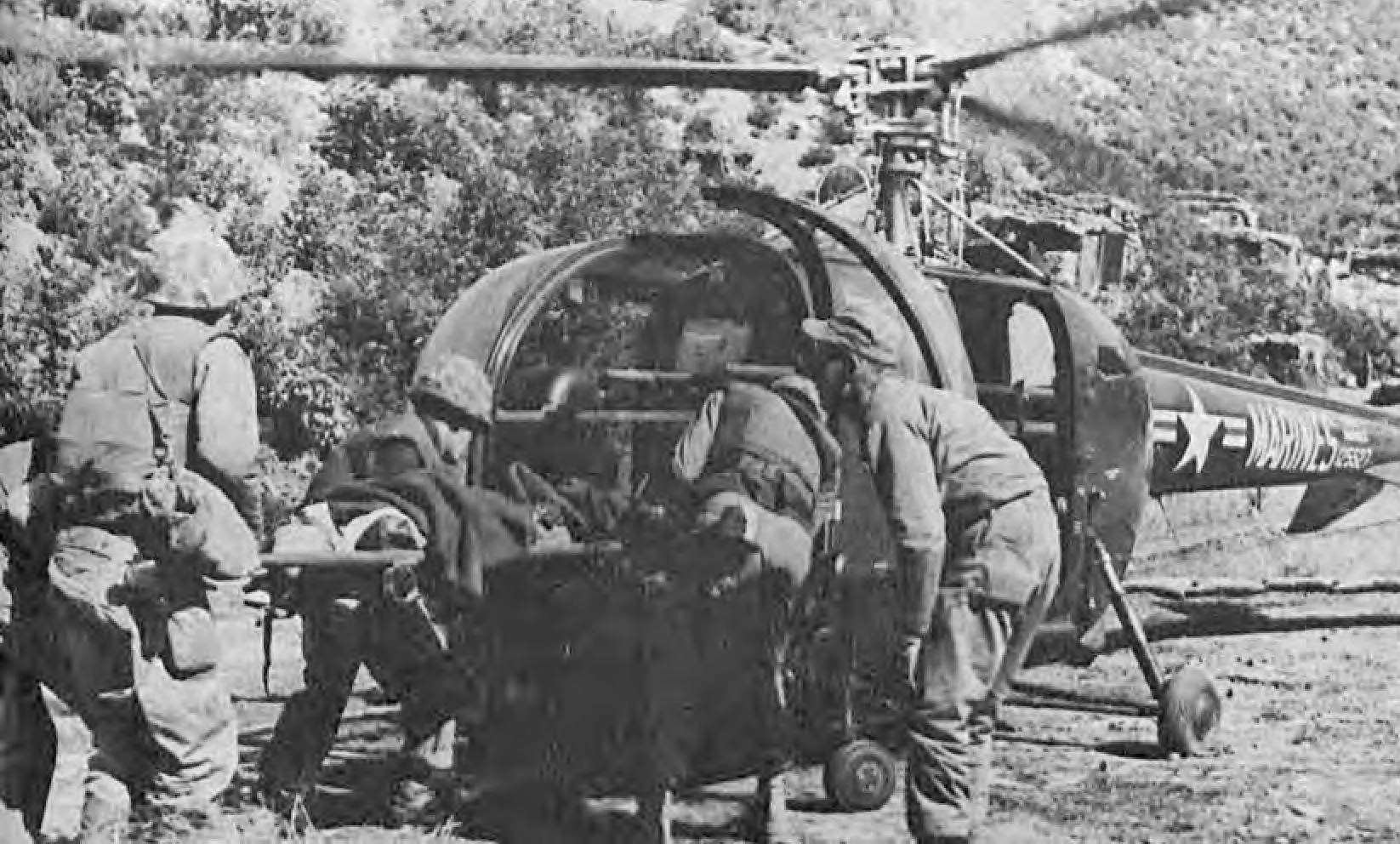
Torso Protection—Above, a Marine rifleman lies prone to exhibit the protective torso armor. Below, a helicopter evacuates a corpsman who was wounded while treating a buddy.
DD MC A 167282
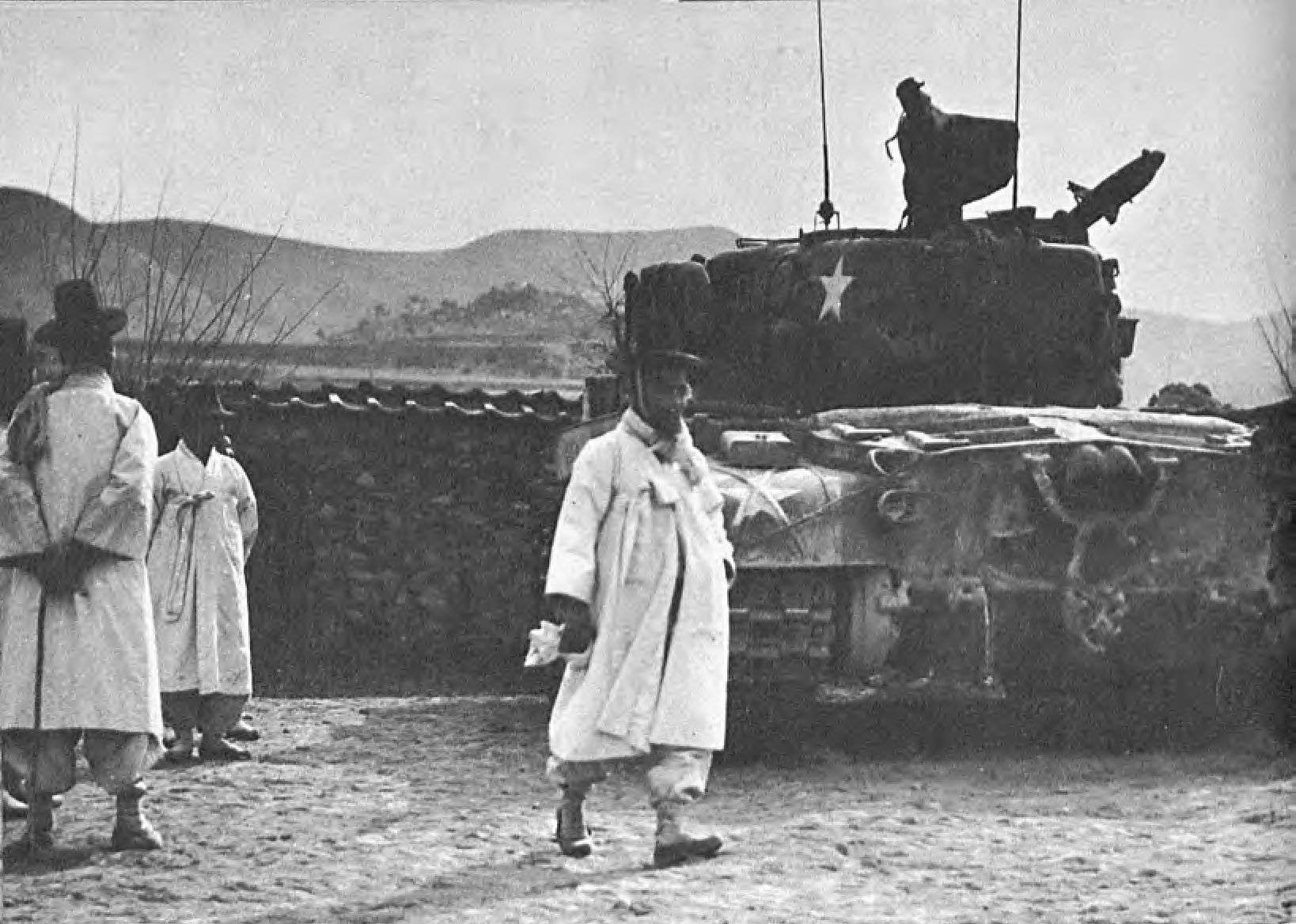
DD MC A 156301
Papa-sans and Pills—Above, a group of Korean patriarchs gaze curiously at a Marine tank. Below, an Army nurse administers medication to a grimacing Marine.
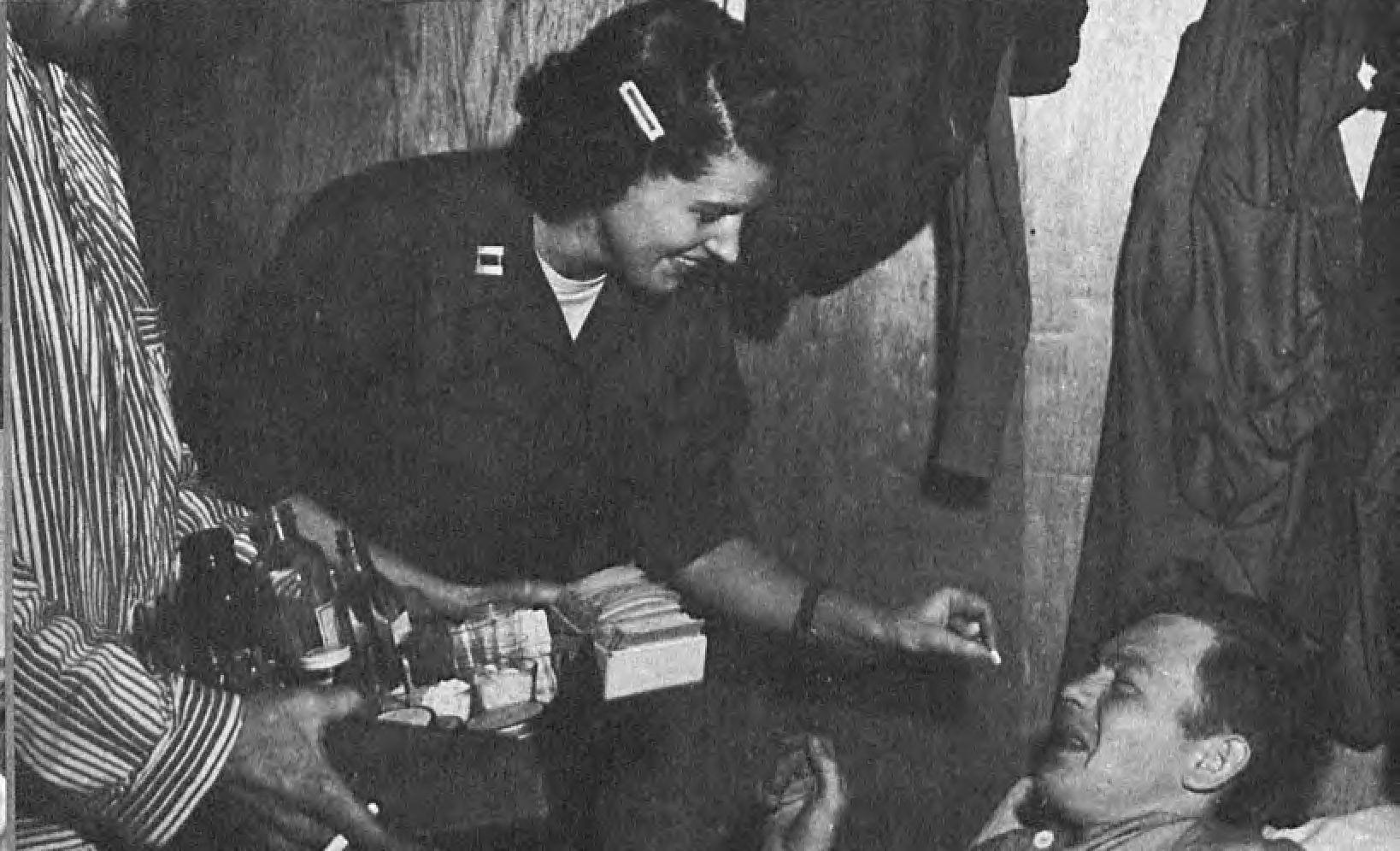
SC 358063
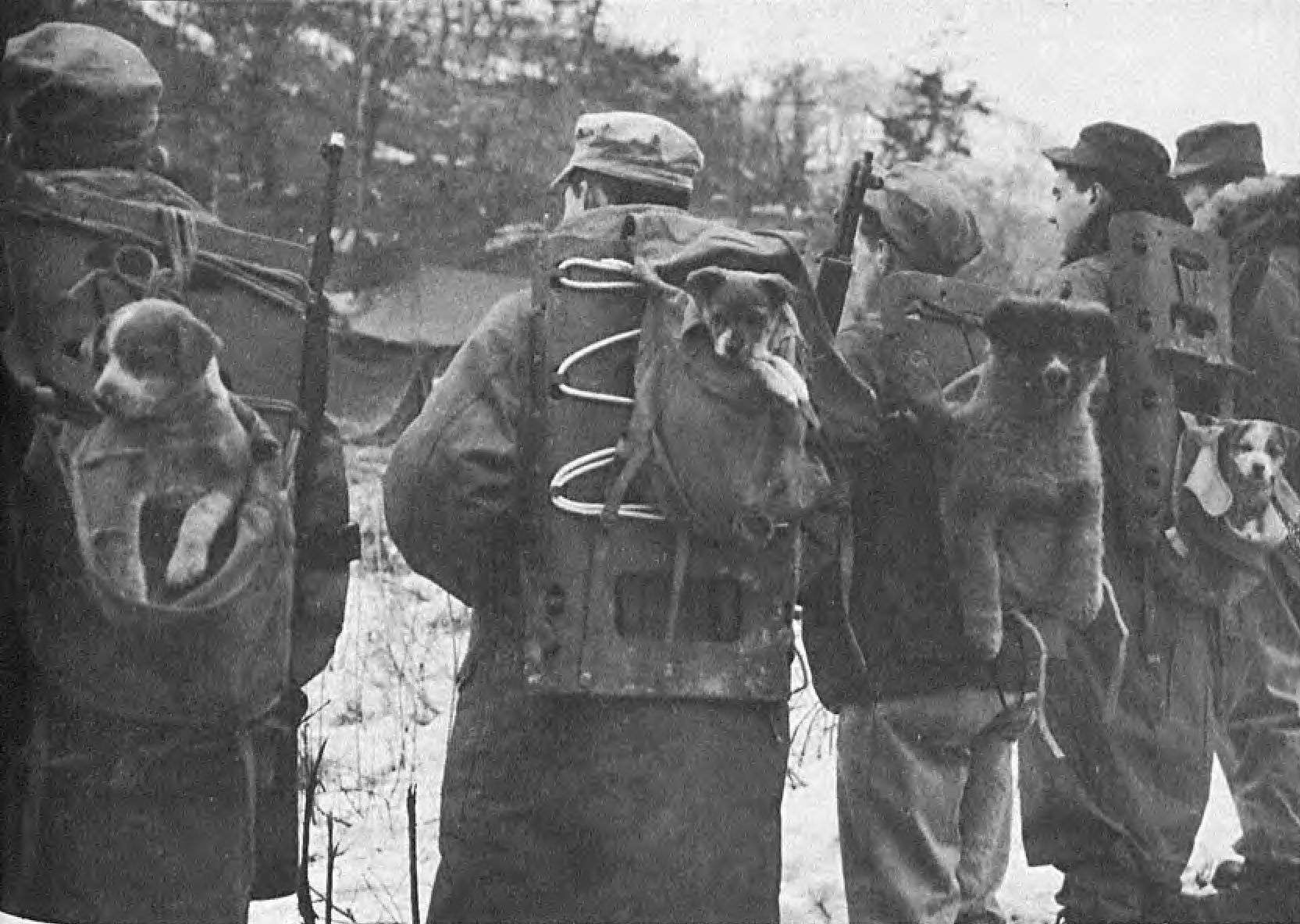
DD MC A 159786
A Dog’s Life—Above, Marines line up with their pets all packed and ready to go. Below, troops gather for the ever-welcome mail call.
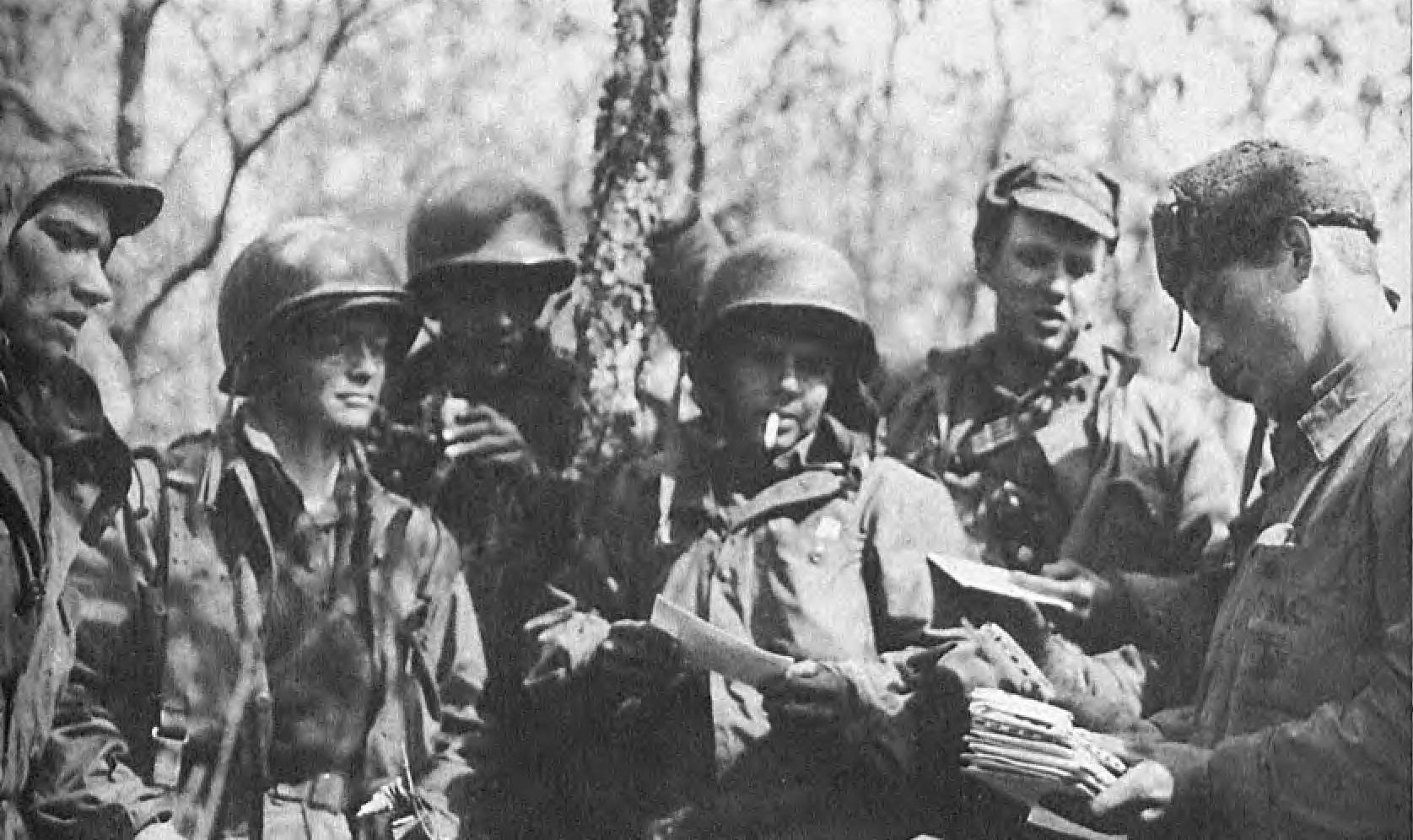
DD MC A 7468
DD MC A 6843
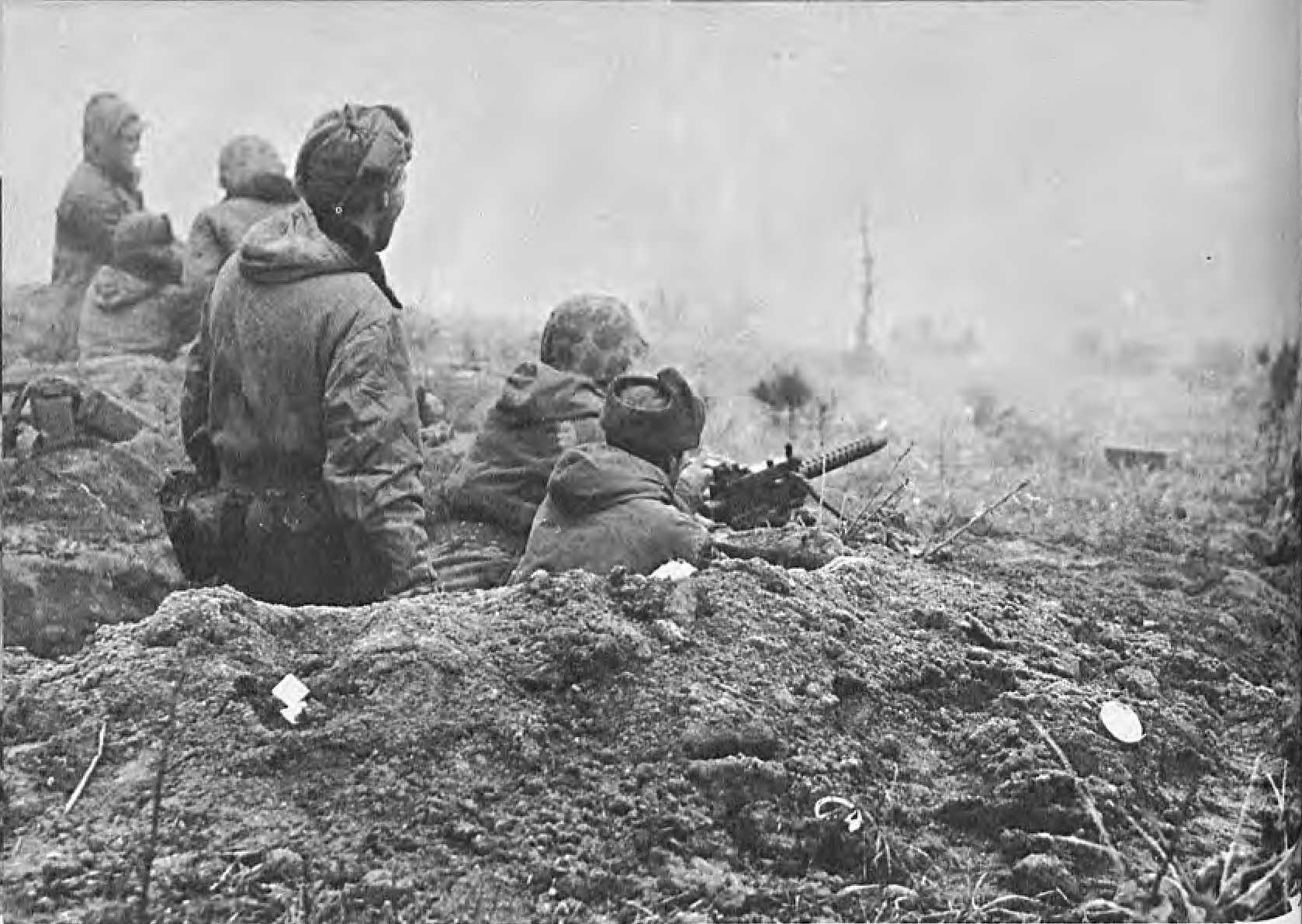
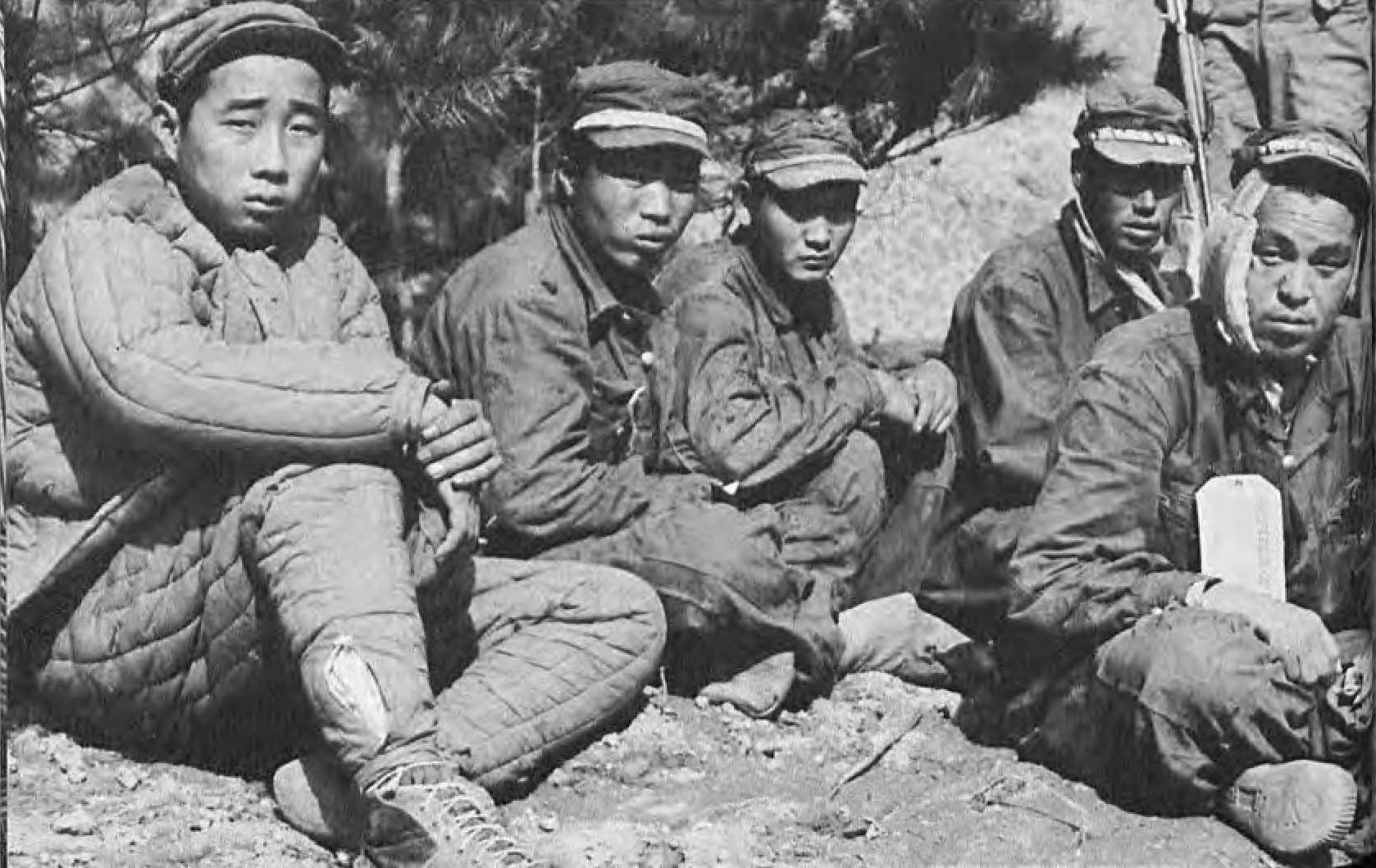
At The Front—Above, Marines advance across a fog-filled valley while supported by machine gun fire. Below, a group of Communist prisoners wait for interrogation by trained experts.
DD MC A 157686
DD MC A 408351
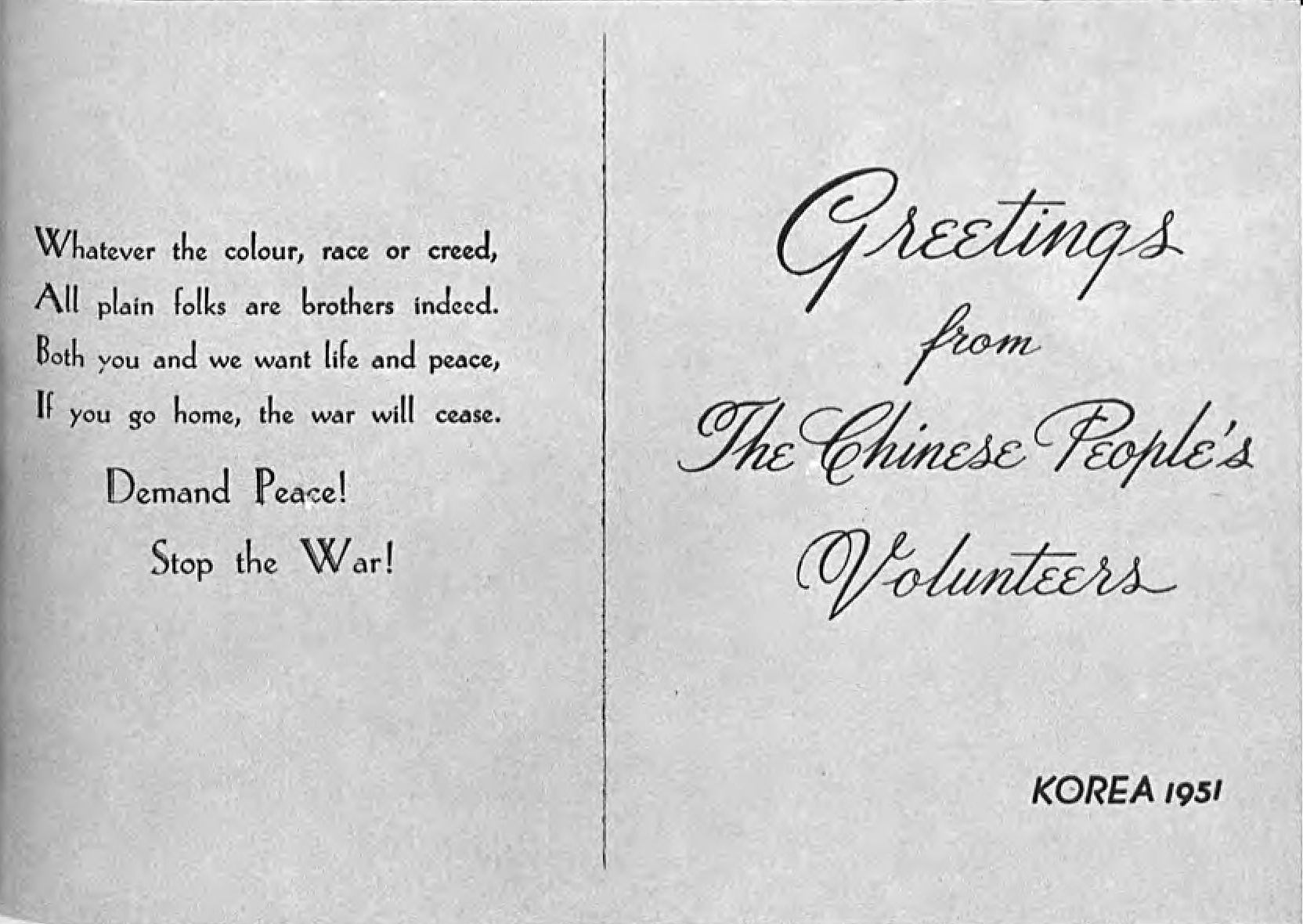
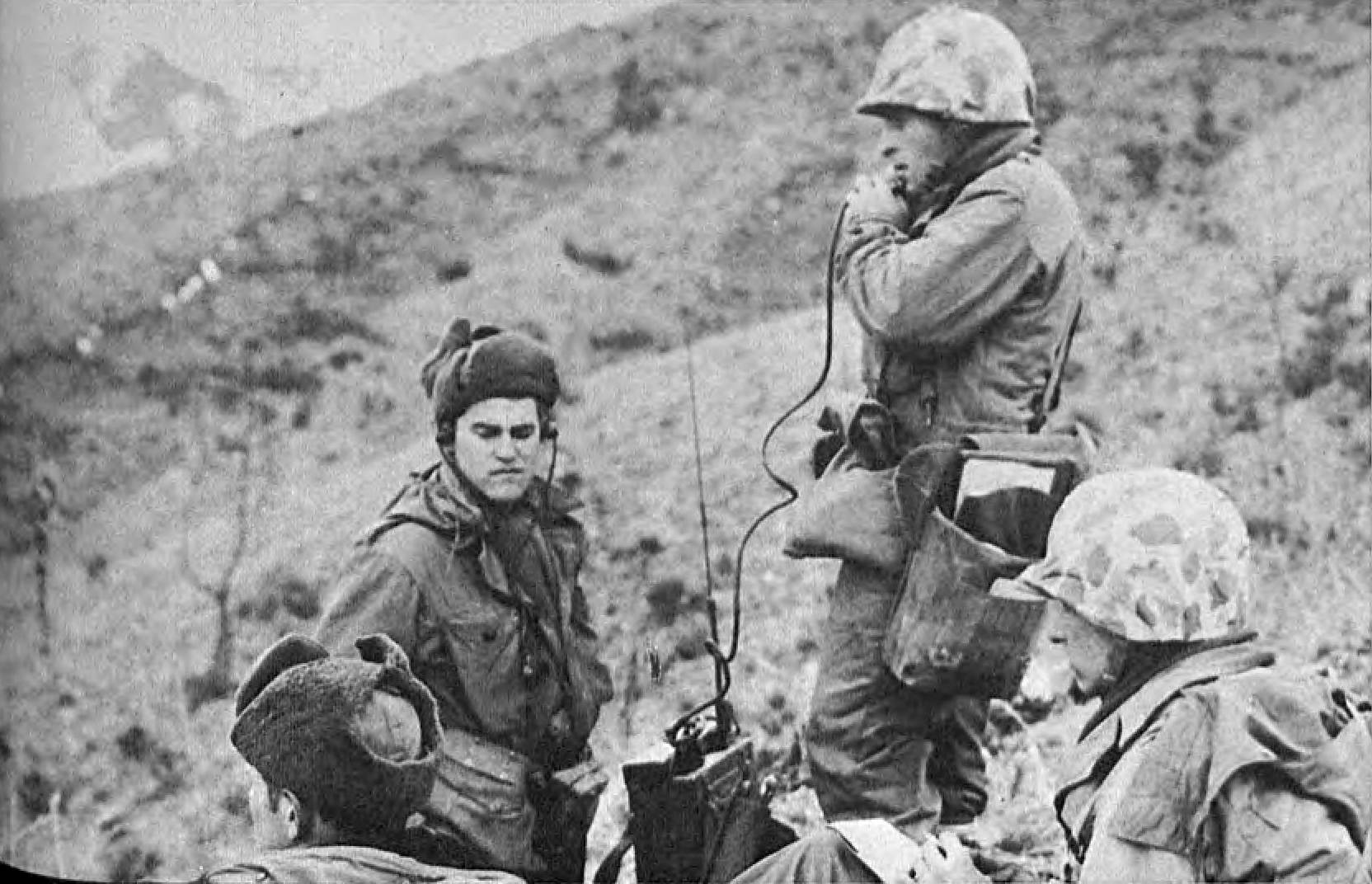
CCF Propaganda—Above, one of the thousands of attractively-colored CCF Christmas cards dropped on the MLR in December, 1951. Below, a mortar observer crew in action.
DD MC A 6627
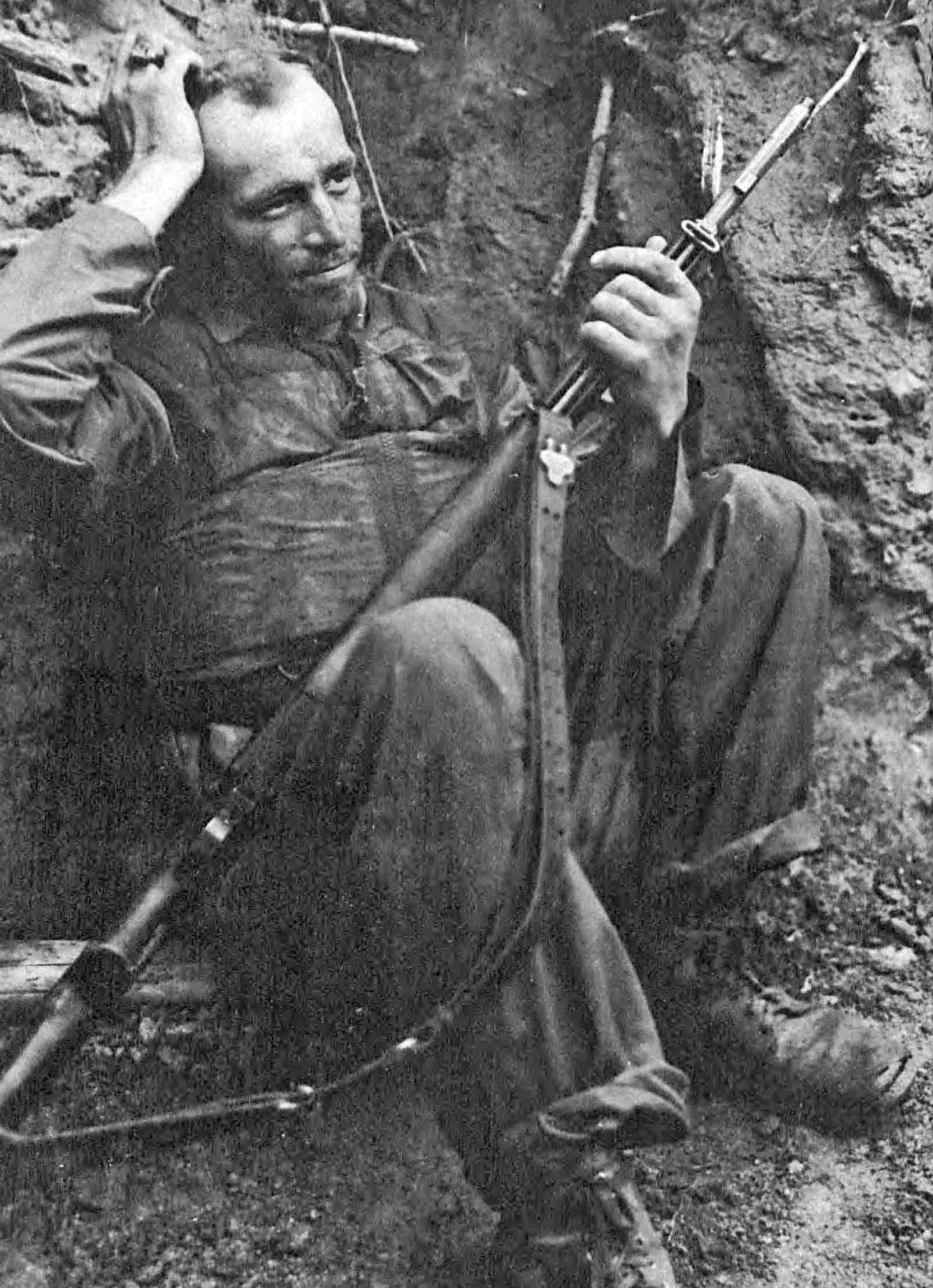
DD MC A 162989
Life’s Little Problems—PFC Henry A. Friday pauses to rest in a trench and reflect upon the progress of his own particular efforts towards fighting the Communists.
These statistics of Operation BUMBLEBEE made it certain that Stateside headlines would proclaim another Marine “first.” Only four days later HMR-161 demonstrated its ability to carry out on short notice an emergency resupply and evacuation operation in a combat zone. Help was requested in the IX Corps sector to the west for a completely surrounded ROK unit in need of ammunition and of casualty evacuation. Lieutenant Colonel Mitchell led six HRS-1 aircraft which flew in 19,000 pounds of ammunition. Lieutenant Donald L. Hilian (MC), USN, surgeon of HMR-161, landed to supervise the evacuation of 24 wounded ROKs, several of whom would otherwise have died. Captains James T. Cotton and Albert A. Black made four flights each into the beleaguered area, and all Marine pilots of Operation WEDGE were congratulated in person by Major General Claude F. Ferenbaugh, commanding general of IX Corps.314
Seven infantry battalions, with 2/1 in immediate reserve, manned the MLR from 1 to 13 October—three KMC battalions on the left of the Division sector; two 5th Marines battalions (relieved by the 7th Marines on the 11th) in the center; and two 1st Marines battalions on the right. Scout and sniper teams were employed throughout the period, with contacts few and far between. More destruction was inflicted on the enemy by observed artillery, tank, and mortar fire.315
A new emphasis was placed on psychological warfare during these defensive operations. Eighty-seven NKPA soldiers surrendered from 1 to 13 October, but whether they responded to leaflets fired by the 11th Marines could not be determined.
Early in October the 1st Marine Division was granted permission by EUSAK to use Sokcho-ri (Map 19) as a port of embarkation and debarkation instead of Pusan. The change proved satisfactory even though troops had to be lightered from ship to shore. A 68-mile truck movement through the I ROK Corps zone replaced the airlift of 200 miles from Pusan to Chunchon, followed by a motor march of 70 miles. It was estimated that the new routing would add from 8,000 to 10,000 man-days a month to the combat potential of the Division.
An improvement in logistics resulted when the Division asked and received permission from EUSAK to use field K-50 near Sokcho-ri for an airhead instead of K-51 at Inje. Although the Marines were limited to five or six sorties a day while sharing K-50 with I ROK Corps, they were able to transfer many airhead activities to the new field.
The mission of the Division remained essentially unchanged from 14 to 31 October. Foot patrols ranged farther into enemy territory, and tank-infantry raids in company strength, supported by air and artillery, were launched at every opportunity.
Typical of these operations was the raid staged on 16 October by elements of the 1st Battalion, 7th Marines, (Lieutenant Colonel James G. Kelly) supported by tanks, air, artillery, and engineers. Captain John R. McMahon’s Charlie Company was the principal unit involved. The Marine column had as its objective an NKPA strong point overlooking the village of Changhang (Map 2) on the east and the flats on both sides of the Soyang-gang to the south and southwest. Captain McMahon’s mission was “to reduce all fortifications and installations ...” [and] “... to seize, occupy and hold ground until the area was thoroughly mined, booby-trapped and infested with trip flares.”316
A small-scale battle flared up for a few minutes as the enemy put up a stiff resistance with artillery, mortar, and automatic weapons fire. Superior Marine firepower soon prevailed, and at 1540 the attackers reached their objective. During the next hour and 20 minutes enemy installations were destroyed and the strong point rendered untenable by mines and booby traps. The Marines withdrew at 1700 after sustaining casualties of 3 KIA and 18 WIA. Enemy losses were 35 counted KIA.
The next day a reinforced KMC company, supported by tanks, air, artillery, and engineers made a similar raid on enemy positions about 875 yards northwest of Hill 751 and 1,500 yards south of Hill 1052 (Map 20). Twenty-five NKPA bunkers were destroyed with losses to the enemy of 15 counted KIA, 3 prisoners, and 5 captured machine guns.317
On 21 October the front of the 1st Marine Division was reduced a mile when elements of the 3d ROK Division relieved the 2d KMC Battalion on the Marine left flank in accordance with instructions of X Corps. Six infantry battalions now manned an MLR of 12¼ miles.
A strong enemy position, menacing the forward elements, had developed to the north of the 1st Battalion, 1st Marines’ sector. Three days of reconnaissance and detailed preparation preceded the destructive raid carried out on 30 October. Captain George E. Lawrence’s Charlie Company, reinforced with heavy machine guns, was held up by NKPA resistance in estimated company strength. The Marines fought their way up a ridgeline, throwing white phosphorus grenades into enemy bunkers. Pinned down momentarily by NKPA mortar and small-arms fire, they reached a defiladed position and withdrew under cover of Marine artillery, air, mortars, and heavy machine guns. At a cost of only one WIA, the raiders inflicted 65 counted KIA casualties on the enemy and destroyed an estimated 40 NKPA bunkers.318
All three Marine regiments on Line MINNESOTA were directed by General Thomas to fight the enemy whenever possible with his own weapons in the form of ruses and night ambushes. On 31 October the 3d Battalion of the 1st Marines feigned preparations for an attack even to the extent of a brief artillery barrage. When the firing let up, the Marines sounded an NKPA bugle call as a signal for enemy troops to rush out of bunkers and man open trenches. Thus exposed, they became the victims of intense Marine mortar and artillery fire which inflicted an estimated 47 KIA and 48 WIA casualties.
During the last 2 weeks of October, 11 missions were fired by the battleship USS New Jersey and 41 missions by the heavy cruiser USS Toledo. Appreciation was expressed in a message to the Toledo by General Thomas: “Your accurate and effective fire during period 24–29 October made an important contribution to operations of this division. Many thanks and come again.”319
Antiguerrilla raids behind the MLR were carried out by Marine ground forces relying upon HMR-161 helicopters for transportation. In Operation BUSHBEATER teams from 1/1 were landed on the Division’s east flank to sweep westward toward the Soyang-gang on 22 October while teams from Recon Company patrolled from the opposite direction.
Operations HOUSEBURNER I and II were planned to deprive guerrillas of shelter during the coming winter. As the name implies, helicopter-borne teams set Korean huts afire with flame throwers and incendiary grenades.320
Enemy forces facing the Marines at various times in October were believed to comprise the 2d Division, II NKPA Corps, the 1st and 15th Divisions of III Corps, and the 19th Division of VI Corps. Nkpa casualties during the month were announced by the 1st Marine Division as 709 counted and 2,377 estimated KIA, 4,927 estimated WIA, and 571 prisoners. The Marines (including the 1st KMC Regiment) suffered losses of 50 KIA, 2 MIA, and 323 WIA.321
Marine Operations of November 1951
On 1 November 1951 the front line strength of the opposing forces was nearly equal—195,000 for the UN, and 208,000 for the enemy. In reserves the Communists held their usual numerical advantage with nine CCF armies totaling 235,000 men plus 138,600 in four NKPA corps. All were readily available either as reinforcements or as assault troops for a great offensive.322
Even though the Eighth Army was committed to a warfare of position, General Van Fleet meant to keep the initiative. “If we had stagnated on any one of our many positions since the tide turned in April,” he said in a recorded statement of 3 November, “the hydra-headed Communists—who seem to grow two soldiers for each one cut down—would soon have been at our throats. With the enemy’s prolific capacity posing an ever-present threat, we had no choice but to destroy the menace before it matured.”323
Throughout November the 1st Marine Division continued to occupy the eastern portion of the X Corps defense sector in east-central Korea. From left to right the 1st KMC Regiment, 7th Marines, and 1st Marines held the 12¼-mile MLR with two battalions each. The 5th Marines remained in reserve until the 11th, when it relieved the 1st Marines. That regiment went into the new reserve area at Mago-ri (Map 19).324
Elements of the 1st, 15th, and 19th Divisions, III NKPA Corps, manned the opposing lines. The Marines continued to organize artillery- and air-supported tank-infantry-engineer task forces in company strength for raids. Squad-size patrols were sent out nightly to ambush the enemy, employing ruses whenever possible.
The howitzers of the 11th Marines and the 90mm rifles of the 1st Tank Battalion were kept busy throughout the month. On 7–8 November, for instance, Marine artillery fired 257 observed missions in 24 hours—including 34 on enemy artillery positions, 32 on mortar positions, 25 on bunkers, 22 on machine gun positions, 4 in support of friendly patrols, 3 on supply dumps, 2 on trucks, and 1 each on a bridge, a CP, and a 57mm recoilless rifle position.
In spite of such daily pounding, aerial photographs proved that NKPA defenses in depth had become more intricate and formidable in November 1951 than during any previous month.
On the 7th the 14th Replacement Draft added 2,756 officers and men to the 1st Marine Division. Within a few hours 2,066 officers and men of the 10th Rotation Draft were detached. And on the 27th the 11th Rotation Draft represented a further loss of 2,468 Marines whose departure was hastened so that they could be home by Christmas.
A note of grim humor crept into proceedings on 9 November. Division OpnO 50-51 directed that all supporting arms and weapons commemorate the Marine Corps Birthday the next day by firing a TOT on Hill 1052, the key enemy observation point overlooking the friendly sector.325 While the cruiser USS Los Angeles contributed naval gunfire, the Commanding General of 1st MAW, Major General Christian F. Schilt, led an air strike of 83 Marine planes to blast this enemy strong point.
The performance was embellished on the 10th when Marine tanks, mortars, and machine guns added their fire to the grand crescendo of exploding shells and bombs. The Communists were also bombarded with 50,000 leaflets inviting them to the Marine birthday dinner that evening. Twenty Korean Reds actually did surrender, though some doubt remained whether they had responded to the invitation or the TOT. General Van Fleet sent a message to all Marines in his command, congratulating them on “a job well done” in Korea.326
On 11 November the 5th Marines carried out its relief of the 1st Marines on Line MINNESOTA. This was the occasion for the largest helicopter troop lift so far, involving the transportation of nearly 2,000 combat-equipped men.
Operation SWITCH began at 0635 on D-Day when three helicopters took off from Field X-83 with Shore Party specialists to signal aircraft into landing sites and supervise the unloading and reloading of troops. Twelve helicopters were employed, each carrying five men and supplies from the 1st Battalion, 5th Marines (Lieutenant Colonel Kirt W. Norton), and returning to Field X-83 with a like load from Lieutenant Colonel Clifford E. Quilici’s 2d Battalion, 1st Marines.327
Naval gunfire from the USS New Jersey helped to keep the enemy quiet during the relief. All told, 950 men were flown to Hill 884—soon to be known unofficially as “Mount Helicopter”—and 952 lifted to Field X-83 in return flights. Total flight time was 95.6 hours and over-all time 10 hours. Once again the Marine Corps had made tactical history.
Ground forces operations throughout November seldom varied from the familiar pattern of squad-size patrols nightly and an occasional daytime raid by a company-size task force with the support of artillery and air. Supporting arms kept enemy strongholds under almost constant fire, and North Korean activity in the construction or improvement of bunkers provided frequent targets of opportunity.
Contacts seemed to be avoided by enemy troops. On the night of 29 November, for instance, 11 Marine ambush patrols ranged from 1,500 to 2,500 yards ahead of the MLR with only a single contact before returning at daybreak. One enemy KIA was inflicted and one prisoner taken at a cost of four Marine WIA casualties.
Total Marine casualties (including the KMCs) during November were 34 KIA and 250 WIA. Enemy losses amounted to 408 counted and 1,728 estimated KIA, 2,235 estimated WIA, and 104 prisoners.
The Second Marine Christmas in Korea
Marine operations in December were shaped in advance by the resumption of armistice negotiations. This time Panmunjom was agreed upon as a conference site instead of Kaesong. Literally a wide place in the road, the tiny hamlet was located just north of the 38th Parallel between Munsan and Kaesong (Map 19). In the lack of houses, tents provided shelter for the UN and Communist delegates who renewed their meetings on 25 October 1951 for the first time since the Reds walked out at Kaesong on 23 August.
Discussions during November were largely devoted to the question of a cease fire based upon a line of demarcation. On the 23d it was agreed to accept a line linking up the farthest points of repeated contacts up to 2,000 yards forward of the United Nations MLR. Three days later, representatives of both sides initialed maps to indicate acceptances.328
The effect of the so-called cease fire on EUSAK operations was immediate. General Van Fleet sent his corps commanders a letter of instructions warning that active defensive operations were to continue until a full armistice had been concluded. If such an event took place within 30 days after 27 November 1951, the demarcation line would not be altered. But if an agreement had not been reached by that time, the line would be revised in accordance with actual changes.329
EUSAK instructions to corps commanders were relayed in a X Corps message of 27 November to the 1st Marine Division:
Part 1. The conference at Panmunjom has fixed a military demarcation line as a preliminary step to ending hostilities within a 30-day period.
Part II. Every US, UN, and ROK soldier will be informed that hostilities will continue until armistice agreement is signed.
Part III. While negotiations continue, X Corps will: (1) Demonstrate its willingness to reach an agreement by reducing operations to those which are essential to insure maintenance of present positions. Counterattacks to regain key terrain lost to enemy assault are authorized, but other clearly offensive actions will be taken only by direction of this Headquarters; patrolling only to that line beyond which contact has been repeatedly established; limiting supporting fires, including air strikes, to destruction of those targets which appear to constitute a major threat, or to improve the enemy’s offensive capability. (2) Prepare for offensive action by: Conserving ammunition; maintaining combat effectiveness through intensified training; preparation for and rehearsal of limited-objective attacks, to be launched near the end of the 30-day period in order to improve the MLR.
Part IV. Every effort will be made to prevent unnecessary casualties.330
In view of these instructions, it is understandable that a lull set in along the X Corps front in December 1951. Most of the cold weather clothing had been issued during the preceding month, and work was largely completed for the “winterizing” of bunkers. It remained only to improve defensive installations as front line elements continued to send out patrols to maintain pressure against the enemy. And since the Communists were putting similar military policies into effect, both sides kept in contact with relatively small units.331
The enemy also busied himself with extending already formidable defenses in depth. And though he did not seek a fight, he showed no hesitation about accepting one.
From 5 to 20 Marine patrols went out nightly during December, some of them manning night outposts called “duck blinds;”332 occasional raids continued with relatively few contacts. In the rear of the Division area, helicopter patrols continued against guerrillas.
The 13 aircraft of HMR-161 had a busy month with 390 missions and 621 flights. Six thousand pounds of rations, 9,000 pounds of fuel oil in drums, 15,000 pounds of fortification material, and 15,000 pounds of cold weather clothing were among the supplies flown to the front. Personnel to the number of 2,022 were lifted, and cargo to the amount of 149,477 pounds.
The first breakthrough in truce negotiations, at Kaesong, occurred on 18 December, when lists of prisoners held by both sides were exchanged. Prior to this exchange of lists the UN Command could only speculate on the number carried as missing in action who were in reality held as prisoners of war. The Communists had previously reported only a few dozen names, and then only if it suited their propaganda purposes. Radio Peking, in releasing names piecemeal, had broadcast recordings made by UN prisoners under duress. Far Eastern monitors reported these broadcasts were slanted to give the Communist viewpoint.
The 18 December list of 3,198 American POWs revealed only 61 Marines including 2 Navy hospital corpsmen. (Information received from 18 Marines who gained their freedom in May 1951 was sketchy concerning others held at the time and was never accredited as official or authoritative.)333 Interestingly enough when the Communist negotiators saw the list given them by the UN representative they became irate and tried to withdraw their list. The names of the Chinese and Korean prisoners had been Anglicized and caused considerable difficulty in retranslating the names into oriental characters.
Negotiations hit a snag at this point, and no other list was offered by the Red officials until the first prisoner exchange (Operation LITTLE SWITCH in April 1953). Notwithstanding the protracted and exasperating tactics of the Reds at the truce table, the exchange of prisoner of war lists presaged infinitely better treatment to the UN prisoners than had been accorded them prior to that time. The so-called lenient treatment policy by the Chinese, promulgated in July 1951, was initiated after the exchange of lists.334
The lists given by the Communists did not include several Marines captured during the months of October, November, or December of 1951. The families of these men were to sit in anguish waiting for these names until April of 1953. These and other instances of perfidy and treachery at the truce table by the Communist negotiators were to become legion.335
On 19 December the 2d Battalion, 5th Marines (Major William E. Baugh) was relieved just behind the MLR by Lieutenant Colonel Norton’s 1/5 in helicopter Operation FAREWELL. It was the last flight in Korea for Lieutenant Colonel Herring, who returned to Quantico as commanding officer of Marine Helicopter Experimental Squadron (HMX)-1. His relief as commander of HMR-1 was Colonel Keith B. McCutcheon, and Lieutenant Colonel Mitchell remained as executive officer.336
The Marine helicopters of VMO-6 had also been setting records during the last half of 1951 under four commanding officers, Major David W. McFarland (5 April-5 October), Major Allan H. Ringblom (6 October-31 October), Major Edward R. Polgrean (1 November-25 November), and Major Kenneth C. Smedley (26 November-31 January 1952). A total of 1,096 Marine wounded had been flown out during this period, many of whom would otherwise have lost their lives.337
The supposed vulnerability of the helicopter was whittled down to a myth by VMO-6 experience. Returning from a front line mission with bullet holes was too commonplace for mention, yet the year 1951 passed without a single helicopter pilot being lost to enemy action, even though several aircraft were shot down. The experience of these 12 months also proved anew the wisdom of combining rotary-wing and fixed-wing aircraft in an observation squadron in fairly equal numbers. When it came to reconnaissance and artillery spotting, the nimble little OYs and OEs (both types are light observation planes) were much better suited than the “choppers.”
As for close air support, increased Air Force emphasis on an interdiction campaign beyond artillery ranges added to the limitations imposed on Marine requests. Of the 22 strikes requested in December 1951, only five were approved.
From the 1st to the 10th, units of the Division along the MLR consisted from left to right of the 1st KMC Regiment, 7th Marines, and 5th Marines. The only major change took place on the 11th, when the 1st Marines relieved the 7th and the latter went into Division reserve. Enemy units were believed to be the 1st, 15th, and 19th (soon relieved by the 47th) NKPA Divisions with an estimated strength of 25,750.
Permission was rarely granted by X Corps for Marine raids to cross the EUSAK military limiting line known as Line DUCK, which generally coincided with the line of demarcation. Christmas passed like any other day except for the holiday feast. Nineteen patrols went out on Christmas Eve, two of which had brief fire fights with enemy patrols before returning at dawn. During the day 40 rounds of naval gunfire from the heavy cruiser USS St. Paul were credited with destroying seven enemy bunkers.
More than a third of the Marines partaking of Christmas turkey were comparative newcomers who had reached Korea since the warfare of movement ended on 20 September. The 15th Replacement Draft brought 38 officers and 2,278 men early in December, and 127 officers and 1,805 men departed with the 12th Rotation Draft. No Marines who had arrived prior to 1 January 1951 were left among the 1,495 officers and 23,040 men in Korea at the close of the year.
Heavy snow on 26 December impeded foot-patrol activity and increased the danger of mines. Next day, when the 30-day cease-fire agreement ended, it was announced at Panmunjom that the terms had been renewed and that operational restrictions would be extended indefinitely.
Thus December came to an end on a note of troubled uncertainty. Not a single large-scale combat had been reported, yet 24 Marines were killed (including KMCs) and 139 wounded in patrol actions. That the enemy had sometimes succeeded in the grim quest of both sides for prisoners is shown by the unwonted entry of eight Marines missing in action. NKPA losses for the month consisted of 246 counted KIA, and 56 prisoners.
The year 1951 passed into history at 2400 on 31 December as the 11th Marines saluted 1952 by firing a “toast” at enemy strongholds. The thud of the snow-muffled howitzers was also a fitting farewell to the past year of a war that was not officially a war. Indications were that it would doubtless be concluded by a peace that was not a peace, judging from the attitude of the Communist delegates at Panmunjom. And meanwhile the Marines and other Eighth Army troops would keep on fighting in accordance with the terms of a cease fire was not a cease fire.