Volume 1 — CHAPTER IV The Advance Party
Reading edition
Conference With CINCFE—The Washington Scene—The Advance Party in Japan—Voyage of the Brigade—The Advance Party in Korea—Crisis of the Eighth Army
As the ships of the Brigade vanished over the horizon, Generals Craig and Cushman rushed to complete final administrative details at their respective West Coast bases. Then, in the early morning of 16 July, the advance party, consisting of the two commanders and parts of their staffs, boarded a transport plane at the Marine Corps Air Station, El Toro, and began the long journey westward.
The first stop was Pearl Harbor, T. H., island “Pentagon” of America’s vast defensive network in the Pacific. On arrival, Craig and Cushman immediately reported to General Shepherd. In company with him, the two visitors called briefly on Admiral Radford. Later, Shepherd, his staff, and the advance party met at Fleet Marine Force Headquarters for a conference on the problems incident to the Marine commitment in combat.75
The Brigade commander painted a vivid picture of his provisional fighting force, stressing both its potential and its handicaps. He repeatedly emphasized the necessity for the addition of a third rifle company to each infantry battalion. With equal fervor he spoke of the need for two more 105-mm. howitzers in each battery of his artillery battalion. He told how the Brigade had been forced to leave behind much of its motor transport because of limited shipping space, and he requested that replacement vehicles be provided as soon as possible.
His presentation was not falling on deaf ears; for combat-wise officers knew only too well how such shortages would restrict the maneuverability, firepower, and mobility of the Brigade. Finally, Craig repeated his earlier request that steps be taken immediately to provide for monthly replacement drafts of 800 men. If the peace-strength Marine unit were committed to combat in the near future, he said, it could ill afford to watch its already thin ranks dwindle indefinitely.76
Leaving behind a maze of support and reinforcement problems for FMFPac Headquarters, the Brigade advance party boarded its plane and set out for Japan. On 19 July the big aircraft discharged its passengers at the Haneda Airport, near Tokyo. General Craig immediately reported to his naval superior, Admiral Joy. Later the Brigade commander, General Cushman, and the other officers of the advance party, assembled at General Headquarters, Far East, where they would get their first glimpse of the war through the eyes of the United States Army.
They conferred first with Major General Edward A. Almond, USA, and Brigadier General Edwin K. Wright, USA. The former was Chief of Staff to General MacArthur, while the latter served as G-3 on the staff. After Almond and Wright had received a report on the organization and capabilities of the Brigade air-ground team, they ushered the two Marine generals into the office of MacArthur.77
Conference With CINCFE
The commander in chief greeted his visitors cordially and expressed his pleasure at having Marines in his command again. He commented briefly on the excellence of the 1st Marine Division and certain Marine air units which had served under him during World War II. The general smiled as he mentioned a rumor to the effect that he had been prejudiced against Marines during the Pacific War. Sweeping aside this tale as being unfounded, he said that he had always held the greatest admiration for the Corps and would welcome its units to his command any time.78
Following this reception, MacArthur meticulously briefed Craig and Cushman on the critical situation in Korea, where the war was already entering its fourth week. The commander in chief disclosed his tentative plans for commitment of the Marines: he would hold the Brigade in Japan as a force in readiness until an entire Marine division could be assembled. If he could have this division by September, he intended to launch an amphibious assault against the port of Inchon on the west coast. Striking deep in the Communist rear, he would sever the long lines of communications linking North Korean bases to the Communist invaders at the front. Thus isolated, the latter would quickly wither, and Walker’s Eighth Army could smash out of the Pusan Perimeter.79
When MacArthur concluded, he and Craig discussed the organization of the Brigade. The Marine general emphasized that his command was an air-ground team; and though few in numbers, the Brigade had a powerful potential if its air arm remained integral. MacArthur assured him that the Marine combination would remain intact, unless some emergency dictated otherwise.
Craig next mentioned that the infantry and artillery units of the Brigade were at peace strength. MacArthur was surprised to learn that each battalion had just 2 rifle companies, and each battery only 4 guns instead of 6. He was even more surprised to find that each of the 6 infantry companies had 50 men less than the number called for in Marine war tables. The Army leader had been aware of certain shortages when he sent a message to the Pentagon on 10 July, requesting the Joint Chiefs of Staff to authorize expansion of the Brigade to a full war-strength division.80 He believed at the time, however, that the Brigade itself would be formed on a wartime basis. Now, confronted with reality, he ordered his chief of staff to prepare another dispatch to the Joint Chiefs, asking that the Brigade be expanded to full war strength and reiterating his request for an entire division.81
MacArthur concluded the conference by informing Craig that the Marine fighting team would remain in Japan under operational control of Joy’s headquarters. This was good news to the Brigade commander. Being attached to the Naval command meant that his Marines would be free to train and otherwise prepare for their future amphibious mission; whereas an assignment to the Eighth Army’s rear echelon might have entailed time-consuming occupational and administrative duties.82
The Washington Scene
Although the solution to Marine Corps problems had seemed simple enough in MacArthur’s office, it was quite another story on the other side of the world in Washington. The Joint Chiefs of Staff had rendered no decision on the general’s 10 July request for a Marine division. Nevertheless, General Cates ordered his staff to draw up detailed plans for expansion so that immediate action could be taken if authorization were forthcoming. As a result, Plans Able and Baker were prepared, the one designed to augment the Brigade to war strength, the other to explore the requirements for creating a full division. To cover these possibilities together with the Corps’ other irrevocable commitments throughout the world, Marine planners were drawn more and more toward a single basic conclusion—if President Truman and the Joint Chiefs of Staff granted MacArthur’s request, the Marine Corps Reserve would have to be mobilized at once.
When the Joint Chiefs received the message which MacArthur had dictated in General Craig’s presence, they requested an estimate from the Marine Corps on how long it would take to form a war-strength division. General Cates summed up his case: the Marine Corps, numbering only 74,279 officers and men,83 was committed on a global basis. There was a brigade on its way to Korea, a peace-strength division on the Atlantic Coast,84 and a battalion landing team permanently assigned to the Mediterranean Fleet. There were detachments of Marines assigned for domestic security, shipboard duty, and overseas security. Moreover, in order to carry out any expansion program on a sound basis, it would be necessary to maintain cadres of experienced personnel in various training centers. The Commandant’s presentation made it clear that any immediate expansion would, as proved by simple arithmetic, be dependent upon mobilization of the Reserve.
Accordingly, the Joint Chiefs of Staff recommended to President Truman that the Organized Marine Corps Reserve be called to active duty. That same morning, 19 July, Admiral Sherman notified General Cates of this decision. The Commandant lost no time at ordering his staff to alert all Reserve units. His grounds for haste were well founded; for in the afternoon a presidential proclamation announced that the “citizen-Marines” would be mobilized. The following day Cates called CNO and submitted Plans Able and Baker, the proposed procedures for building both the Brigade and 1st Marine Division to war strength.
In the meantime JCS had notified MacArthur that his request could not be granted until late fall “without unacceptable weakening [of] the Fleet Marine Force Atlantic.”85 When the U. N. commander received this message, he countered immediately with the reply:
“... Most urgently request reconsideration of decision with reference to First Marine Division. It is an absolutely vital development to accomplish a decisive stroke and if not made available will necessitate a much more costly and longer operational effort both in blood and expense.
“It is essential the Marine Division arrive by 10 September 1950 as requested. While it would be unwise for me to attempt in this message to give in detail the planned use of this unit I cannot emphasize too strongly my belief of the complete urgency of my request. There can be no demand for its potential use elsewhere that can equal the urgency of the immediate battle mission contemplated for it.86
“Signed MacArthur”
On 22 July the gears of mobilization were already enmeshed. Taking this into account along with the urgency of MacArthur’s last communication, the Joint Chiefs showed the first signs of relenting in their reply to Tokyo. This time they informed the Army general that they were reconsidering his problem, but added that he must advise them of the proposed employment of the Brigade up to 10 September and the possibility of adjusting that deadline. The same message carried the encouraging news that a directive had already been issued to bring both the Brigade and its air group to full war strength.87
In answer, MacArthur stated his intention to retain the Brigade in Japan, unless a more critical situation developed in Korea prior to 10 September. He described his operation planned for mid-September as an amphibious landing in the rear of the enemy’s lines. This seaborne attack, he added, would be designed to envelop and destroy the Communist invader in conjunction with an offensive from the south by the Eighth Army. The General concluded his message on notes of conditional optimism and grave warning:
“Although exact date of D-day is partially dependent upon enemy reaction during month of August, I am convinced that an early and strong effort behind his front will sever his main lines of communications and enable us to deliver a decisive and crushing blow. Any material delay in such an operation may lose this opportunity. The alternative is a frontal attack which can only result in a protracted and expensive campaign to slowly drive the enemy north of the 38th parallel.”88
On 25 July these exchanges came to a climax when the Pentagon directed the Marine Corps to build its 1st Division to full war strength.
At this point the change of heart among the joint Chiefs of Staff is pertinent because of its direct effects on the 1st Provisional Marine Brigade. As previously noted, the Pentagon on 22 July approved the Marine Corps’ plan Able which provided for the expansion of the Brigade to war strength. General Cates immediately set machinery in motion to bolster the ranks of that unit. With the approval of Admiral Sherman, he cut into the rosters of Marine security detachments throughout the United States and arranged for the personnel thus released to be channelled to Craig’s command. It was also possible now to implement an earlier plan relating to casualty replacements for the Brigade. As far back as 14 July, the Commandant had ordered activation of the First Replacement Draft, fixing its departure for Korea at 10 August.89 Thus Craig could be assured of early reinforcement by more than 800 officers and men if the course of the war necessitated a premature commitment of his Brigade.
The Advance Party in Japan
Generals Craig and Cushman were meanwhile assigned a large office in General Headquarters, Tokyo. There they cleared away much administrative detail which accumulates in the path of every military operation.
On 20 July the two commanders called on General Stratemeyer. Marine Air was the focal point of discussion as they again explained the organization of their fighting team. When they informed Stratemeyer of MacArthur’s decision to keep the Brigade intact, the air officer gave them further assurance that MAG-33 would always be available to support the Marine ground force.90
Originally, the Army planned to base the Marine ground elements at Sasebo, Japan, and the air group 400 miles away at Itami Field, near Kobe. Craig and Cushman realized that the resulting large gap would give rise to problems in liaison, training, and supply. Hoping to change such an undesirable arrangement, the Brigade staff carefully studied the layout of available land and facilities. Armed with the results of this research, Craig proposed to General Headquarters that all Marines be based in the Kobe-Osaka-Kyoto area. After he outlined the advantages of keeping the Brigade and its supporting aviation close together, Wright responded encouragingly to the recommendation.91
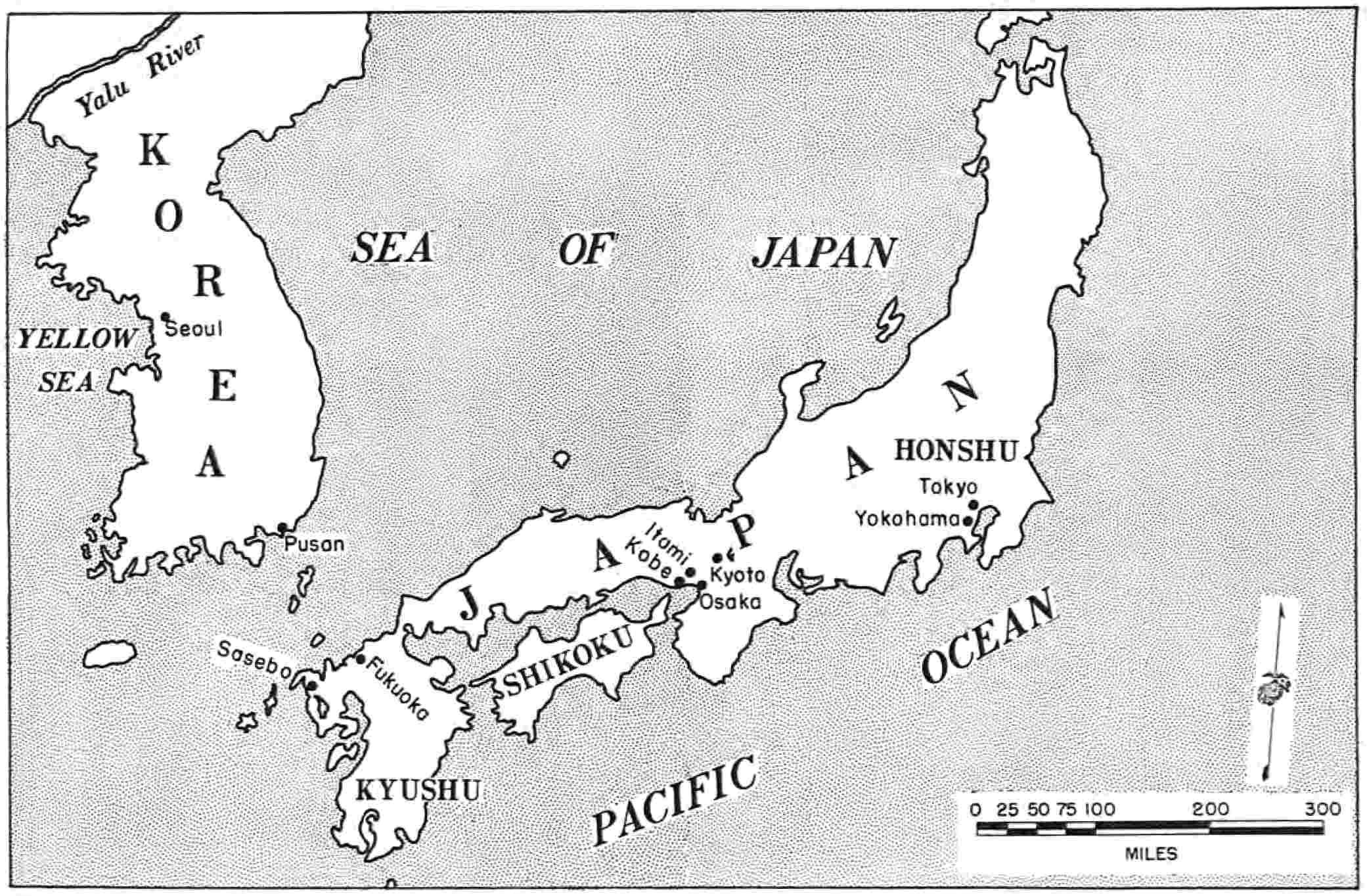
Confident that the suggestion would be favorably considered, the advance party flew to Itami on 21 July and made a detailed reconnaissance of debarkation, billeting, and training sites. While Craig inspected the area and prepared a report, Cushman examined the air base facilities and established his headquarters according to the initial plan. The Marine officers then returned to Tokyo 2 days later to push the request for getting both air and ground forces located in the same area. To support his proposal, Craig submitted a complete “floor plan” not only for the Brigade but also for the entire 1st Marine Division. MacArthur’s staff promptly approved.92
On the 25th the advance party again set out for Itami, this time to prepare for the arrival of the Brigade. Their plane was a scant 20 minutes out of Tokyo when an urgent message from General Headquarters directed their return to that city at once. The big aircraft roared back to the field, and a few minutes later the Marines were driving through the Japanese capital.
At headquarters, Wright summed up the most recent reports from the front. The American forward wall was crumbling under continuous hammering. A wide envelopment had just netted the whole southwestern tip of the peninsula for the Communists, who were now pressing in on Pusan from the west as well as north. Lacking sufficient troops to defend its broad frontage, the Eighth Army was falling back. If the Red tide continued unabated, there was imminent danger of losing Pusan, the one remaining major port in American hands. Should this coastal city fall, South Korea would be lost.
Wright told Craig that all available troops had to be thrown into the line to meet this threat. Therefore, General MacArthur had diverted the seaborne Brigade from Japan to Korea, where it would join General Walker’s beleaguered forces.93
Obviously, the Marines were not far from a fight.
Voyage of the Brigade
At sea the 1st Provisional Marine Brigade was unaware of the decisions and difficulties developing on higher levels. Nevertheless, that tactical organization was having enough trouble of its own. On 12 July, Company A, 1st Tank Battalion, and the 1st Amphibious Tractor Company departed San Diego on board the LSD’s Fort Marion and Gunston Hall. Designated Task Unit 53.7.3, the twin amphibious ships sailed 2 days before the rest of the Brigade and were scheduled to join the main convoy, Task Group 53.7, before crossing 160° east longitude.94
At noon on 13 July, the well deck of the Fort Marion accidentally flooded, the water rising to a height of 5 feet among the Brigade’s M-26 tanks. An hour passed before the ship’s pumps could drain the compartment, and briny water damaged 14 of the new armored vehicles, 300 90-mm. projectiles (then in critical supply), and 5,000 rounds of .30-caliber ammunition.
When news of the flood damage reached Brigade headquarters, then still at San Diego, the message was rushed to Craig. He immediately sent a dispatch to Captain English, authorizing him to jettison the ruined ammunition. He added that replacement armor would be requisitioned from the Barstow depot without delay. Craig then contacted the supply base and was promised that 14 M-26’s would be commissioned and on their way to San Diego within 24 hours. The Brigade commander was preparing to request additional shipping for the vehicles when messages from the Fort Marion reported that 12 tanks could be restored to operating condition at sea. The remaining two would require new parts and 72 hours of repair work upon debarkation.95
As already noted, the Marines were placing heavy reliance on their armor, confident that it was a match for the enemy’s Russian-built T-34 tank in Korea. Consequently, Craig’s staff reacted to the flood reports with concern. Headquarters FMFPac was asked to include four M-26’s in its first resupply shipment to the Brigade; arrangements were made for new parts to be flown to the port of debarkation, and ammunition to replace that damaged in the flood was loaded on board the larger convoy.
Misfortune struck again a few hours after Task Group 53.7 steamed from San Diego on 14 July. The transport Henrico developed a serious mechanical failure and was declared temporarily unseaworthy. This ship was carrying Lieutenant Colonel Murray, his regimental staff, and the entire 1st Battalion Landing Team.96 After Murray and his headquarters transferred to the APA Pickaway off San Clemente island, the Henrico limped back toward California with about one-third of the Brigade’s fighting force. The vessel docked at the United States Naval Supply Depot, Oakland, on the 16th. Repairs were started in urgent haste, since there was no other ship available. For security reasons, the Marines were forbidden to leave ship except for training on the dock. On the nights of the 16th and 17th, they sat on deck and gazed longingly at the beckoning lights of San Francisco. Twice during this time the Henrico weighed anchor and passed westward under the Golden Gate bridge; twice it was forced to return for additional repairs. Finally, on the evening of the 18th, the vessel steamed under the great bridge for its third attempt. This time it kept going, but it would not overtake the convoy until the morning of the very day the ships reached their destination.
During the voyage, strict wartime security measures, including radio silence, were enforced on all ships. While the North Koreans were believed to have no warships left afloat, their naval capabilities remained hidden from the outside world by a blur of question marks. No one realized more than the commander of Task Group 53.797 that it was much too early to take Soviet Russia for granted.
The Henrico, now travelling independently, had a spine-chilling experience during her second night out of Oakland. The ship’s radar picked up two “unidentified submarines” which appeared to be converging on the stern of the lone vessel. General Quarters was sounded. While sailors peered into the darkness from their battle stations, several hundred Marines joked weakly in the troop compartments below the waterline. After an anxious hour, the persistent spots on the electronic screen vanished.
Shipboard life for the Brigade was otherwise uneventful. The troops took part in physical drills as vigorously as the limited confines of vessels would allow. Daily classes and conferences emphasized those subjects most relevant to the news reports trickling back from the front. Success of North Korean armor stimulated keen interest in land mines and the new rocket launchers. Press commentaries on the battleground’s primitive environment made even field sanitation a serious matter. Since there was no military intelligence available on the North Korean forces, officers and NCO’s turned to publications on Russian tactics and weapons.
As previously noted, Sasebo, Japan, was the original destination of the ships transporting the Brigade’s ground elements. The Achernar, Anderson, and Badoeng Strait were bound for Kobe with MAG-33. When Craig’s proposal for consolidation was approved by General Headquarters, the entire convoy was ordered to Kobe. Then, on 25 July, Colonel Edward W. Snedeker, Chief of Staff, received the dispatch sending the ground force directly to Pusan.
This announcement came as no surprise to the majority of officers and men. Day by day, news reports had been outlining the course of the war. The shrinking perimeter of Walker’s army was traced on maps and sketches throughout every ship. After the Communist “end run” in southwest Korea, Marines began to wonder if there would be any front at all by the time they arrived. In the captain’s mess of the Pickaway, senior Marine and naval officers were giving odds that the Brigade would reach the South Korean port only in time to cover a general evacuation of the peninsula.98
The Advance Party in Korea
With the Brigade well beyond the halfway point in its Pacific voyage, Craig and his staff could not afford to waste a minute. At 1700 on 25 July they left Tokyo by plane for Korea. En route they landed at Itami, where the Brigade commander and Cushman made hurried adjustments to meet the new situation.99
Leaving Itami on the 26th, they flew to Fukuoka, Japan. There they transferred from their 4-engine Marine aircraft to a smaller Air Force plane which could be accommodated on the primitive landing fields of Korea. On the last lap of their journey, they reached Taegu at 1400.
Taegu was a dismal place during this crucial phase of the UN delaying action. Hastily chosen as a headquarters by General Walker, the ancient town gave the appearance of a remote outpost. Its airstrip was crude. The fewness of the airmen and soldiers among the handful of transport and fighter planes served only to emphasize the critical situation of the UN forces.100
General Craig reported to General Walker immediately, while the Brigade G-3, Lieutenant Colonel Joseph L. Stewart, met with his Eighth Army opposite, Colonel William E. Bartlett. Later, Walker’s chief of staff, Colonel Eugene M. Landrum, assembled all the Marine officers for an official briefing. He explained that the Brigade had not been earmarked for any specific mission. The battle situation was too fluid for firm plans. Information from the field was sketchy and unreliable, as outnumbered Army forces slowly retreated. From the time of first contact by American units, the front had been more of a blur than a distinct line. Landrum concluded by saying that the Brigade must be prepared to move anywhere after debarkation—and on a moment’s notice.101
After he and his officers had been assigned rooms in a temporary barracks, Craig requested permission to reconnoiter the combat zone.102 Walker assented, providing his own plane and pilot for the trip. Accompanied by Stewart and Lieutenant Colonel Arthur A. Chidester, his G-4, Craig flew first to Pusan, where he checked harbor facilities, roads, and railways. There he conferred with Brigadier General Crump Garvin, USA, to initiate preparations for the Brigade’s arrival.103
Leaving Pusan, the Marine officers flew over Chinhae, which they discovered to be a suitable base, if necessary, for VMO-6 and the Brigade’s air support control unit. Cruising westward, they passed over Masan, then continued toward Chinju. From the latter vicinity, the enemy’s envelopment was then threatening the western approaches to Pusan. Veering northward, the reconnaissance party paralleled the Naktong River. The pilot, who was familiar with the ground, briefed his passengers along the way. By the time the plane returned to Taegu, the Marines had a broad picture of the critical areas most likely to become Brigade battlefields.104
General Craig and his ground officers remained at Taegu 4 days. Attending daily briefings of the Eighth Army staff, they acquired a sound knowledge of the tactical situation. At a conference with Major General Earle E. Partridge and his Fifth Air Force staff,105 the Marines were brought up to date on the disposition of aviation and its policy for supporting UN ground forces.106
In the fight for time, ground force units in line were frequently withdrawn and shuttled to plug gaps in the sagging front. Reports from the battlefield more often were food for the imagination rather than fact for the planning room. All of this created confusion among Eighth Army staff officers.107
In the Taejon area the 24th Infantry Division had lost 770 officers and men during the single week of 15–22 July. Of these casualties, 61 were known dead, 203 wounded, and 506 missing in action.108 Among the missing was General Dean, and the wounded included a regimental commanding officer, a regimental executive officer, and a battalion commander.109
Following this ordeal, the 24th had been relieved by the recently arrived 1st Cavalry Division, which went into line alongside the 25th Division in the Kumchon area. ROK divisions held to the north and east, where NKPA forces were driving toward Pohang-dong.
The shape of strategic things to come was indicated late in July when two NKPA divisions completed a much publicized “end run” past the open UN left flank to the southwest tip of the peninsula, then wheeled eastward for a drive on Pusan.
General Walker reacted promptly to the danger by recalling the 24th Division from Eighth Army reserve and moving it southward from Kumchon to block the enemy near Hadong. With the recently landed 29th Infantry attached, the division totalled only 13,351 officers and men.110 Its front extended from the southern coast near Hadong to the town of Kochang, 40 miles north.111 In addition to manning this mountainous line, the 24th had troops in action at Pohang-dong, more than 100 miles away on the east coast. There some of its units fought as Task Force Perry, under direct control of Eighth Army headquarters.112
The 24th Division and 29th Infantry had no more than deployed when they found themselves plunged into a confused 5-day fight. Although they sold ground as dearly as possible, the Army units were compelled to give up Hadong and fall back toward Chinju.113
As the threat to Pusan grew more serious, the Eighth Army commander shifted units. In order to protect the approaches from Chinju to Pusan, he pulled the 25th Infantry Division back across the river Naktong near Waegwan and moved it from the northern to the southern front in 48 hours. The next day saw the 1st Cavalry withdrawing across the Naktong in the Waegwan area and blowing the bridges.
After being relieved in the south by the 25th Division, the 24th joined the 1st Cavalry withdrawal to hastily organized defensive positions east of the Naktong. ROK divisions continued to defend the northeast approaches, while the 25th Division stood guard to block any enemy move toward Chinju.114
At this juncture General Craig became increasingly concerned about prospects of maintaining the Brigade’s integrity as a Marine air-ground team. He and his staff were aware that elements of the 29th Infantry had been rushed from their ships directly into combat in the Chinju area, and some units were badly mauled. Craig took occasion, therefore, to remind Army leaders once more of the Marine tactical concept of the indivisible air-ground team.115
MAG-33, said Craig, would have to unload its planes and prepare them for action; and the control squadron would need an interval to set up co-ordinated tactical air support.116
Crisis of Eighth Army
As July drew to an end, the situation both on the northern and southwestern fronts was developing into a crisis. Hourly it grew apparent that the Eighth Army’s perimeter would have to shrink even more, so that defenses could assume some depth in sensitive areas. Landrum indicated for the first time that the Brigade was being considered primarily for a mission on the left flank.117 Guided by this possibility, Craig and his staff officers devoted a day to drawing up a flexible operation plan. The purpose of this directive was to advise the Brigade’s subordinate commanders of possible commitment in the Chinju, Kochang, or Kumchon areas, in that order of probability. Also included were detailed instructions for movement to forward assembly areas, broad missions for supporting units, security measures to be taken, and a general outline of the situation ashore.118
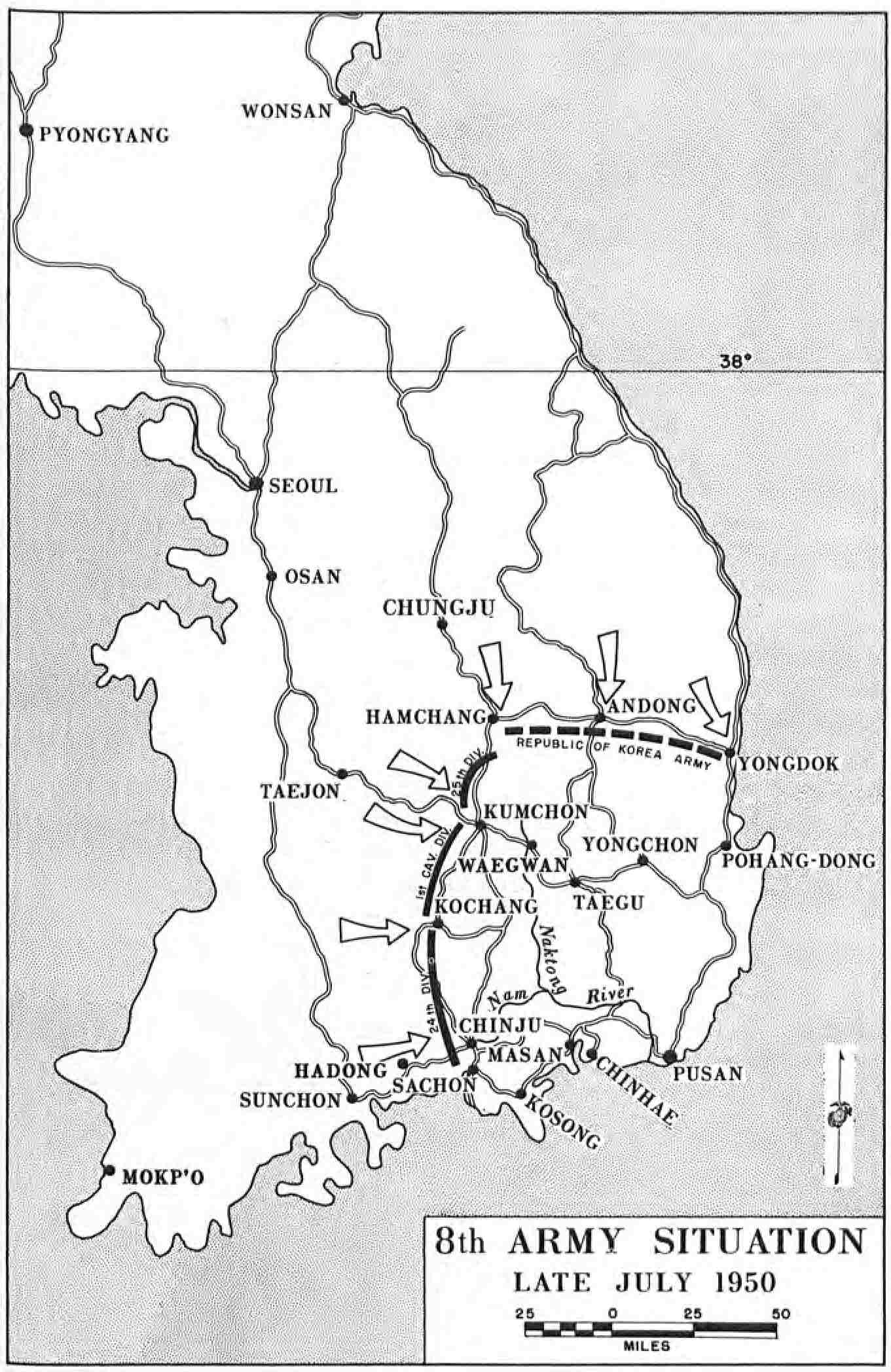
8th ARMY SITUATION
LATE JULY 1950
The advance party extracted from the plan a fragmentary warning order suitable for radio transmission. This message was delivered to Eighth Army headquarters with a request that it be sent immediately to the Brigade at sea.119 Now Craig assumed that Snedeker and Murray would have a reasonable impression of the situation awaiting them.120
At an Army briefing on the 29th, the Marines learned that the UN left flank was collapsing. An air of uneasiness pervaded Taegu, and Eighth Army headquarters began preparations for displacement to Pusan. Craig was told that the Brigade definitely would be committed in the southwest, unless a more critical situation suddenly sprang up elsewhere. Again the Army officers added that the Marine unit actually must be prepared to move in any direction on short notice.121
With the approval of the Eighth Army, the Brigade commander immediately sent a message to COMNAVFE requesting that the Marine air group be made available to support the ground force by 2 August, and that VMO-6 be transported to Korea as quickly as possible.122 Time was drawing short.
On 30 July, General Craig had a final conference with Generals Walker and Partridge. This time, Walker himself told the Marine leader that the Brigade would be sent to the southwest; and that the unit, once committed, would be free to push forward without interference from Eighth Army.123 Partridge interjected that his planes would be available to support Craig’s ground troops if Marine air did not arrive in time.124
Immediately after the conference, the Marine officers set out for Pusan by jeep. While their vehicles bounced southward on the ancient road, army headquarters in Taegu was sinking to new depths of dejection. Chinju had just fallen, and the Red column was pounding on toward Masan.125
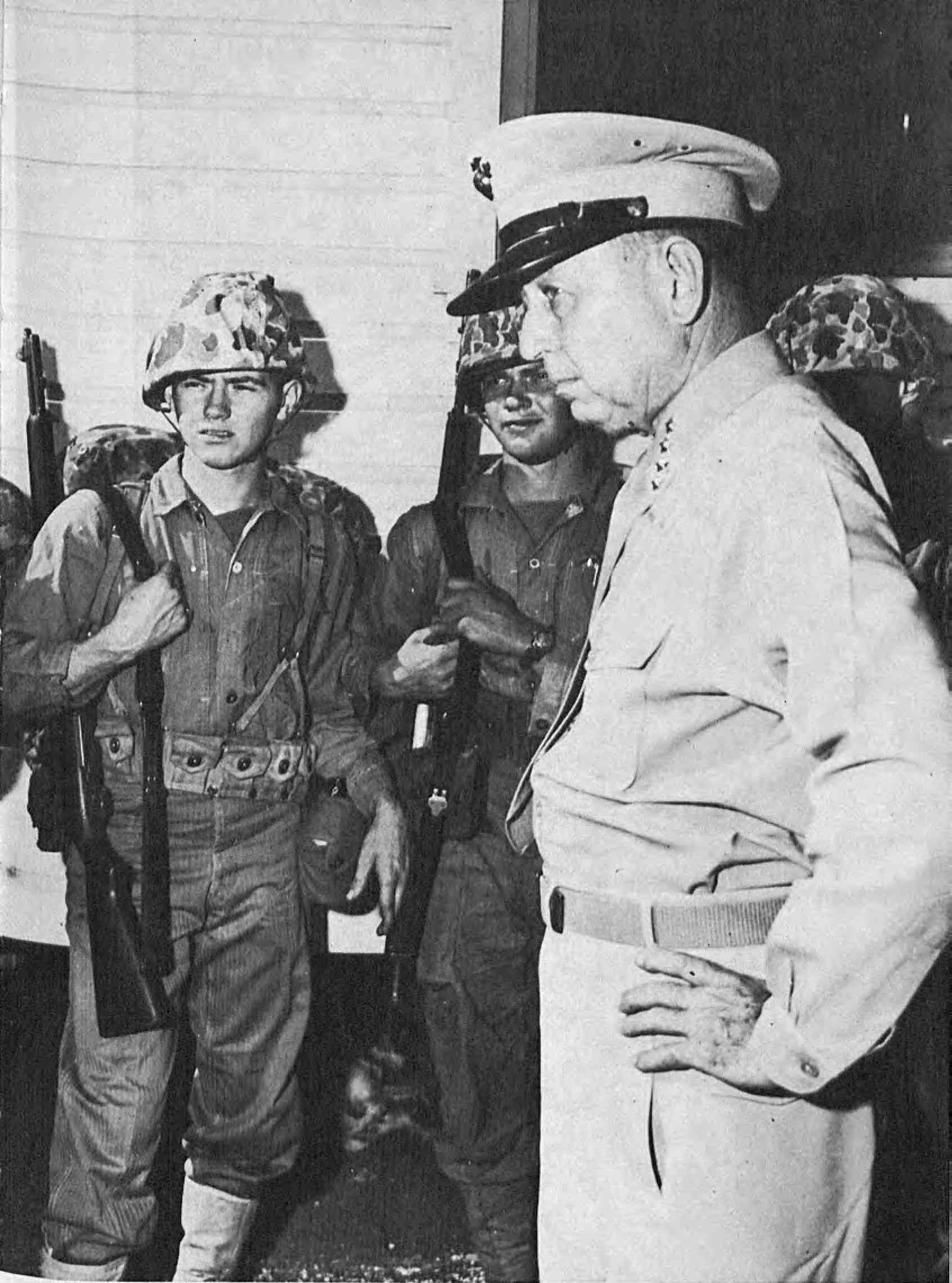
Commandant Says Farewell—General Clifton B. Cates visits San Diego for embarkation of 1st Provisional Marine Brigade (Marine Corps Photo).
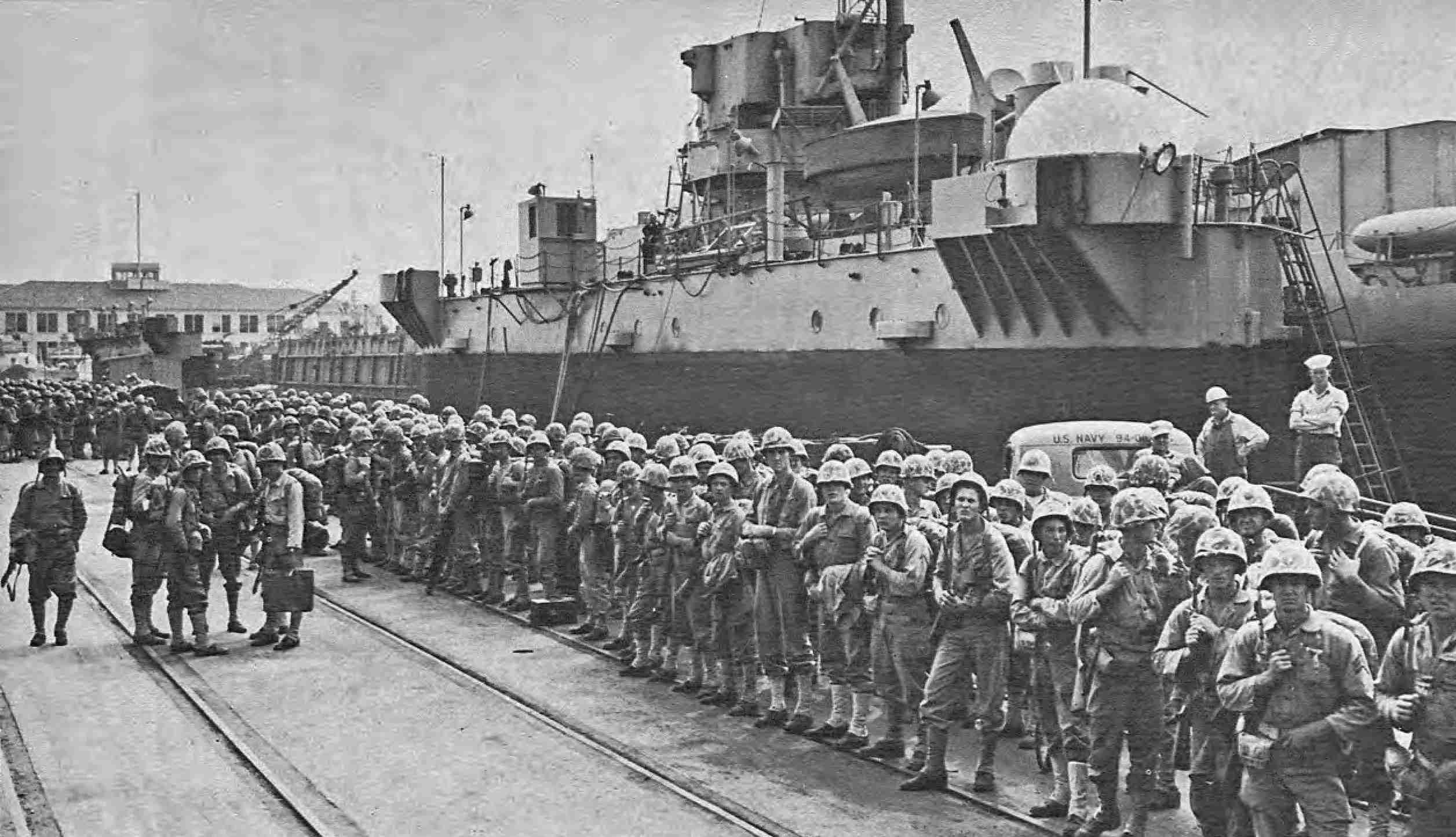
All Aboard—Marines of the Brigade waiting to embark at San Diego for the Far East (Marine Corps Photo).
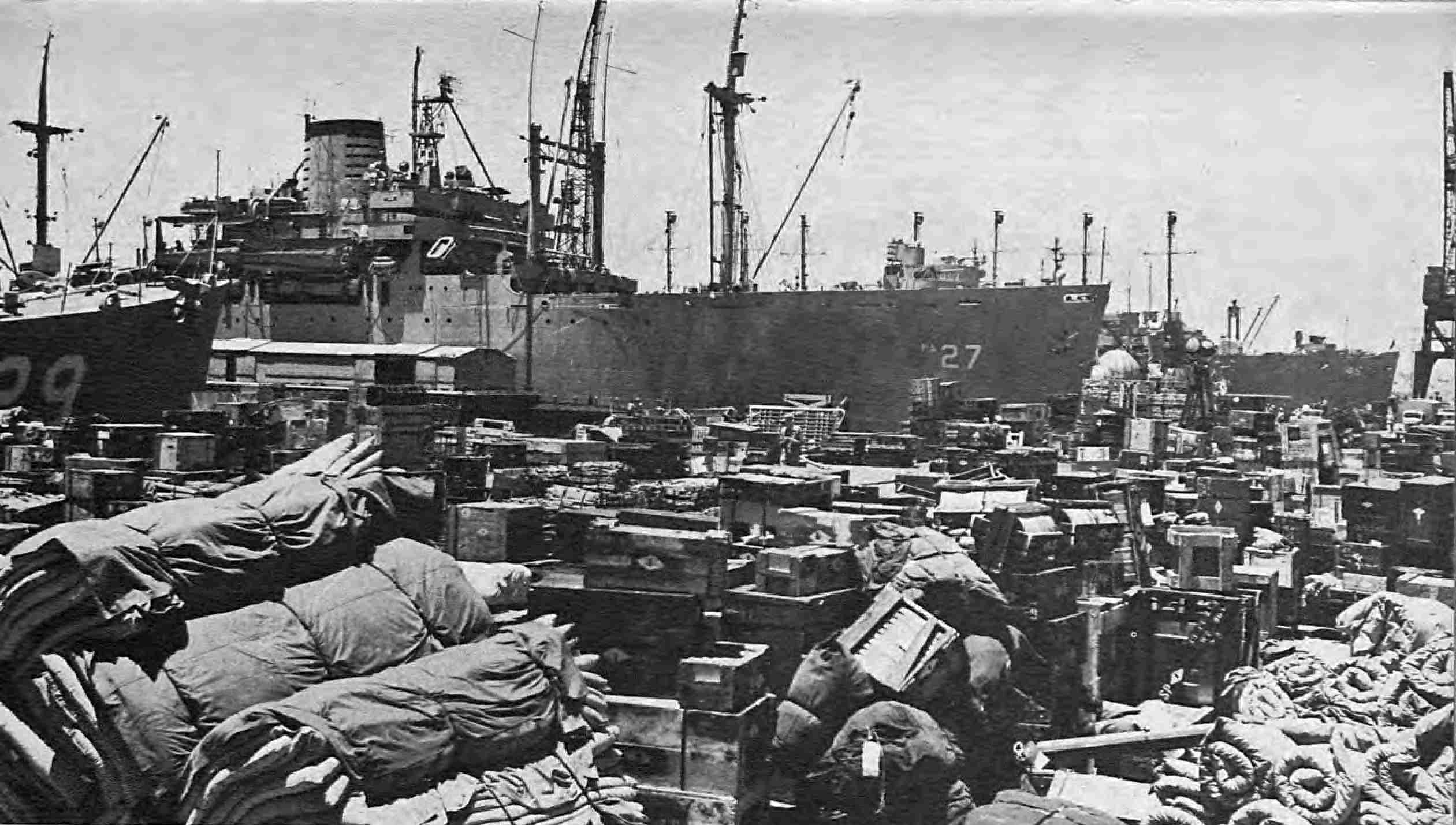
Mountains of Supplies—Hundreds of tons of equipment ready for loading aboard ships taking Marines to the Far East (Marine Corps Photo).
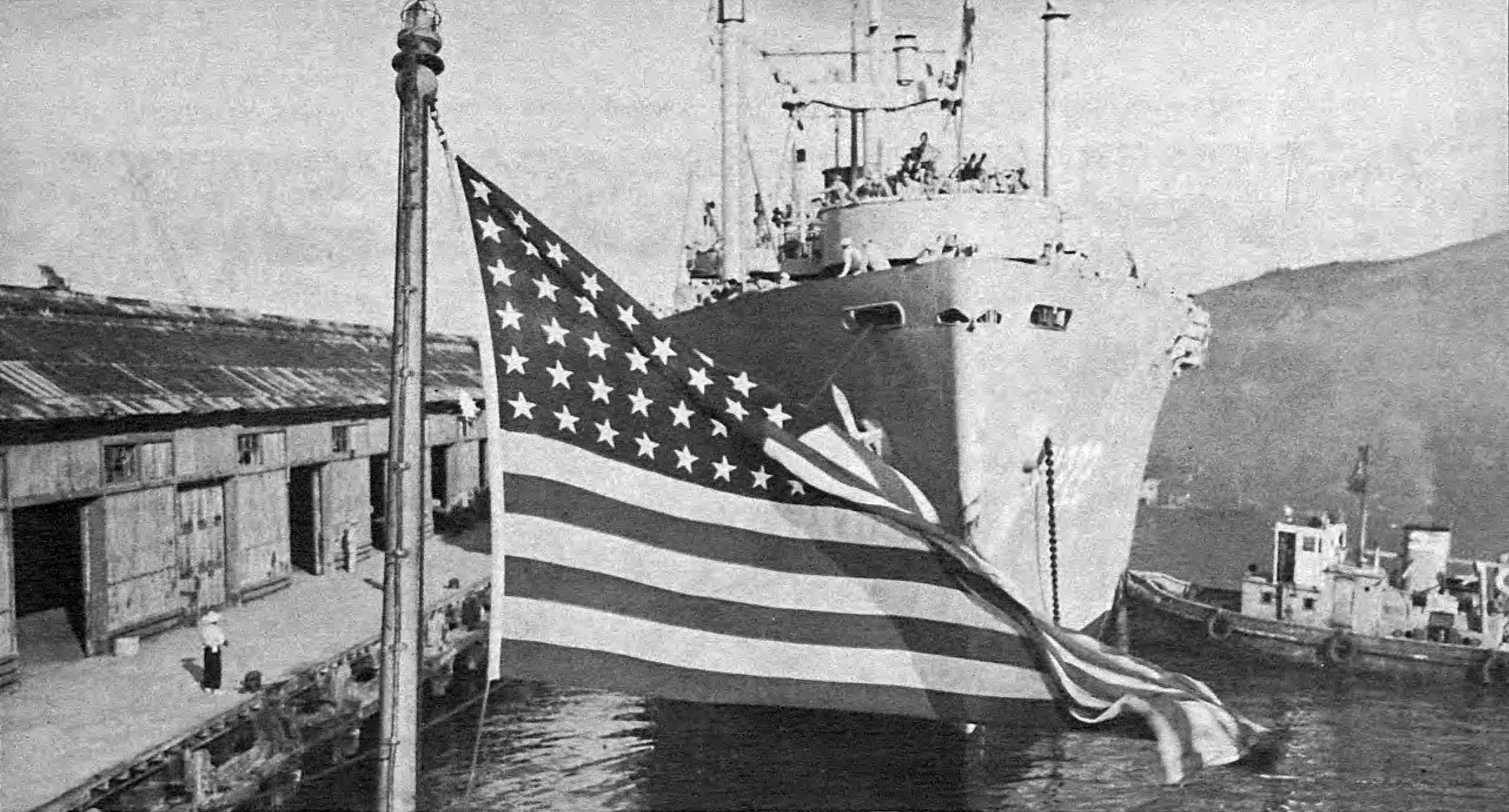
Arrival at Pusan—Marines catch their first glimpse of Korea as the U. S. S. Pickaway docks (Marine Corps Photo).
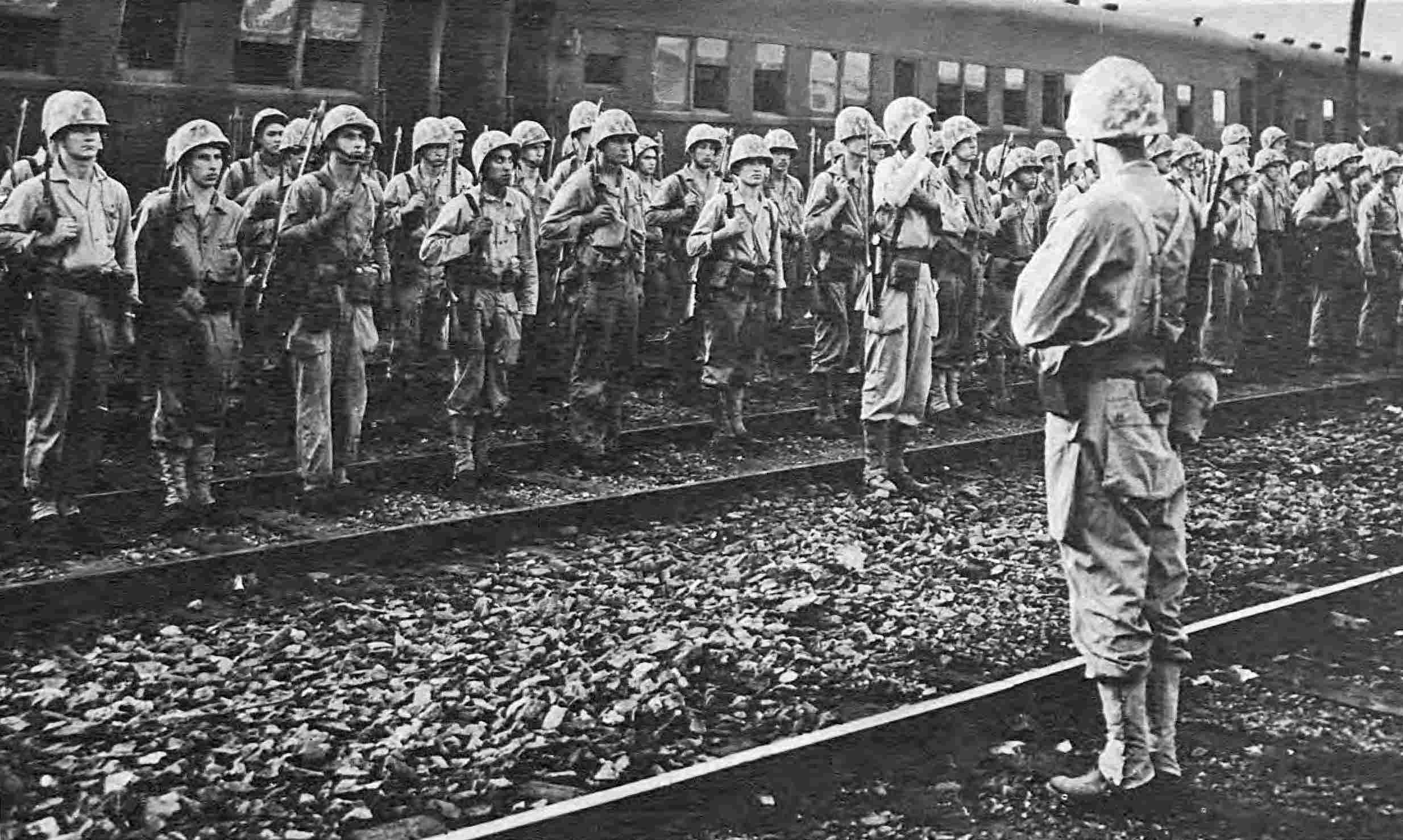
Movement to the Front—Brigade troops preparing to entrain at Pusan for the Changwon bivouac area (Marine Corps Photo).
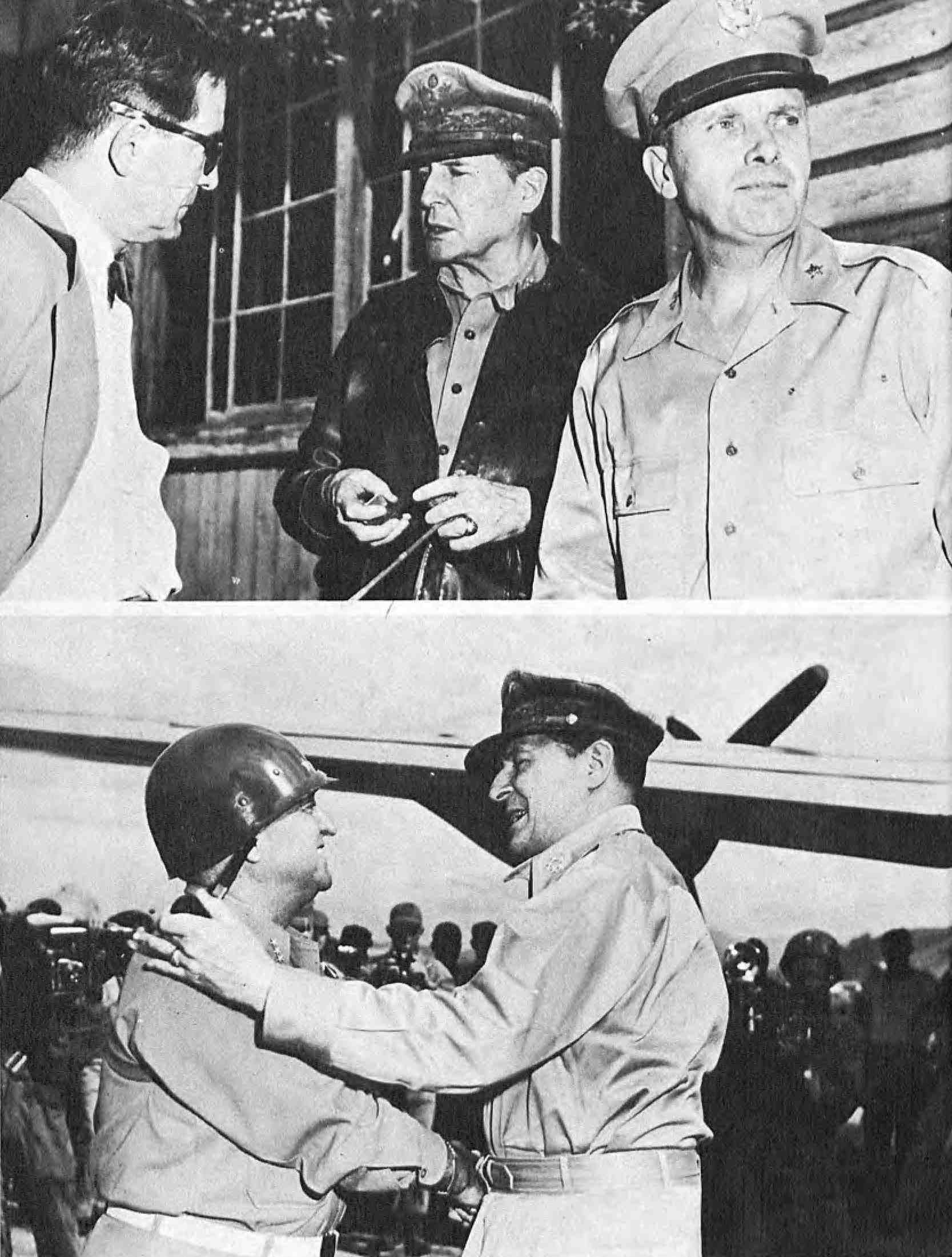
Visit to the Front—Above, General of the Army Douglas MacArthur with Ambassador John J. Muccio and Major General Edward M. Almond, Chief of Staff, GHQ, FEC; and, below, with Lieutenant General Walton H. Walker, commanding the Eighth U. S. Army in Korea (U. S. Army Photo).
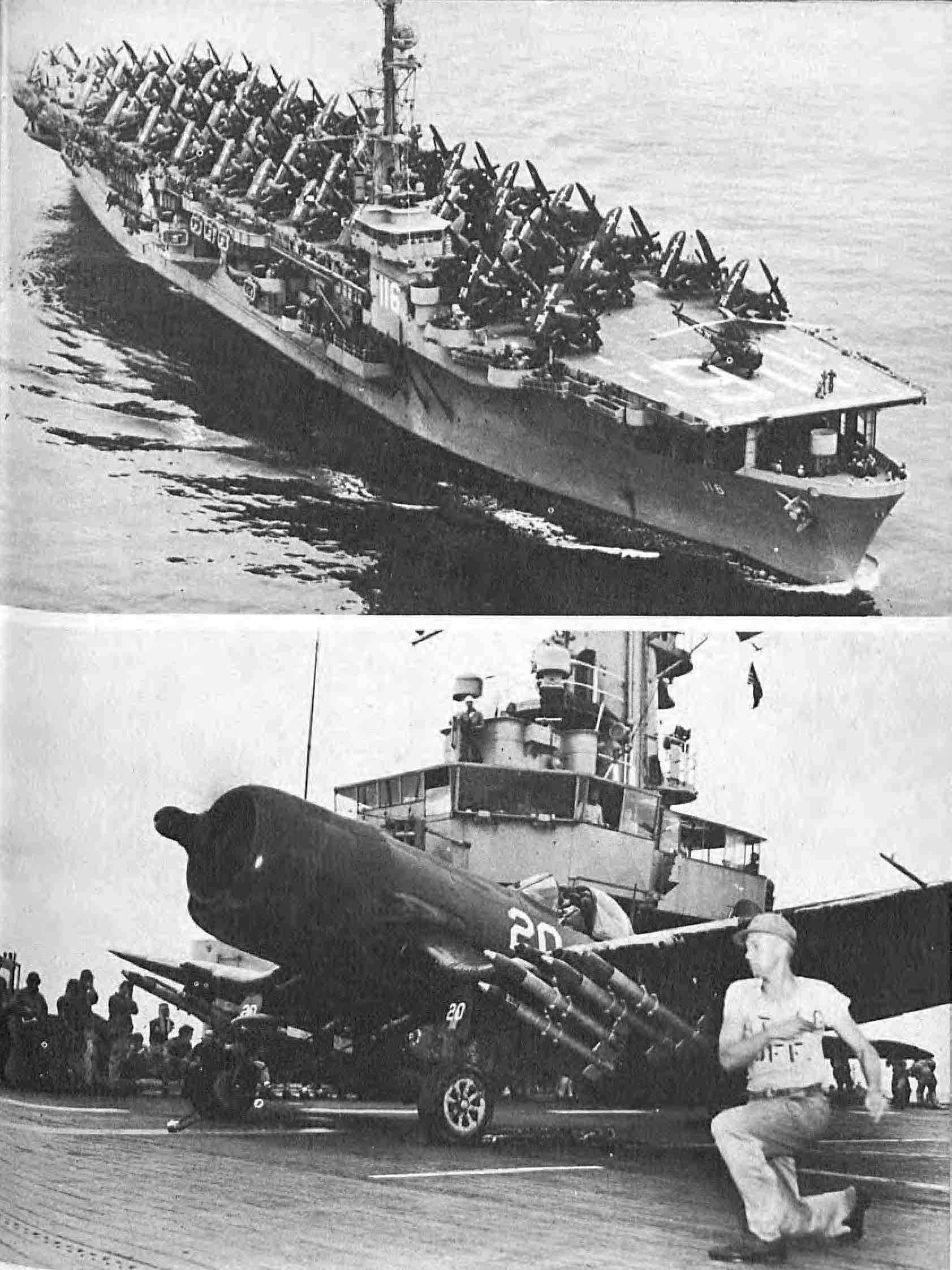
Marine Air Strikes First—Above, the U. S. S. Badoeng Strait (CVE 116) nearing Japan with Corsairs on deck; and, below, an F4U armed with eight rockets and a 500-lb. bomb takes off from the U. S. S. Sicily (CVE 118) (U. S. Navy Photo).
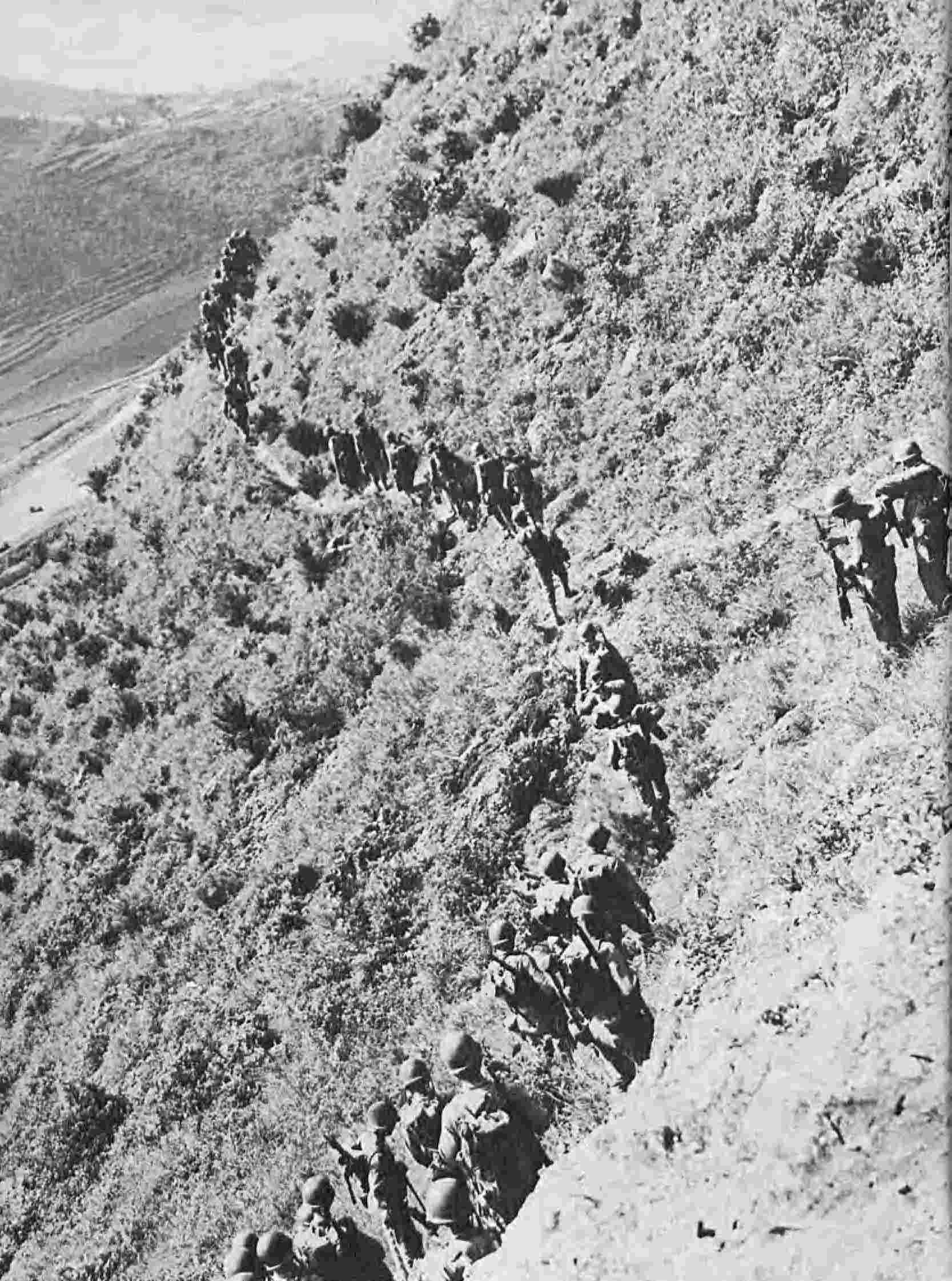
Korea the Vertical—Marines of the Brigade literally climb into battle during their first fights in the Chindong-ni area (Marine Corps Photo).
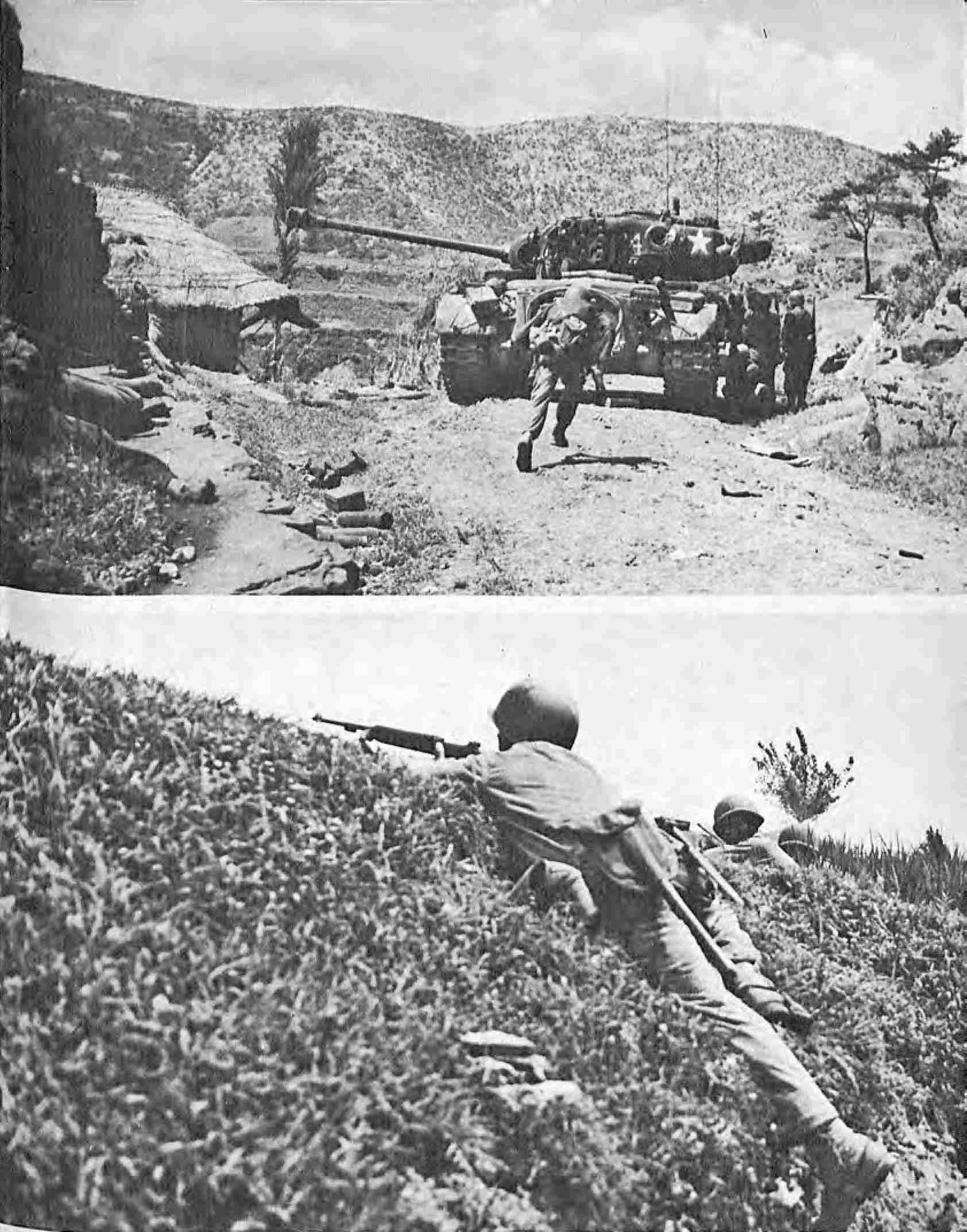
Marines in Action—Above, Brigade infantry and M-26 tank, advancing under fire, pass body of dead United States soldier on left; and, below, ambushed Marines are pinned down temporarily by enemy machinegun fire at Naktong Bulge (Marine Corps Photo).
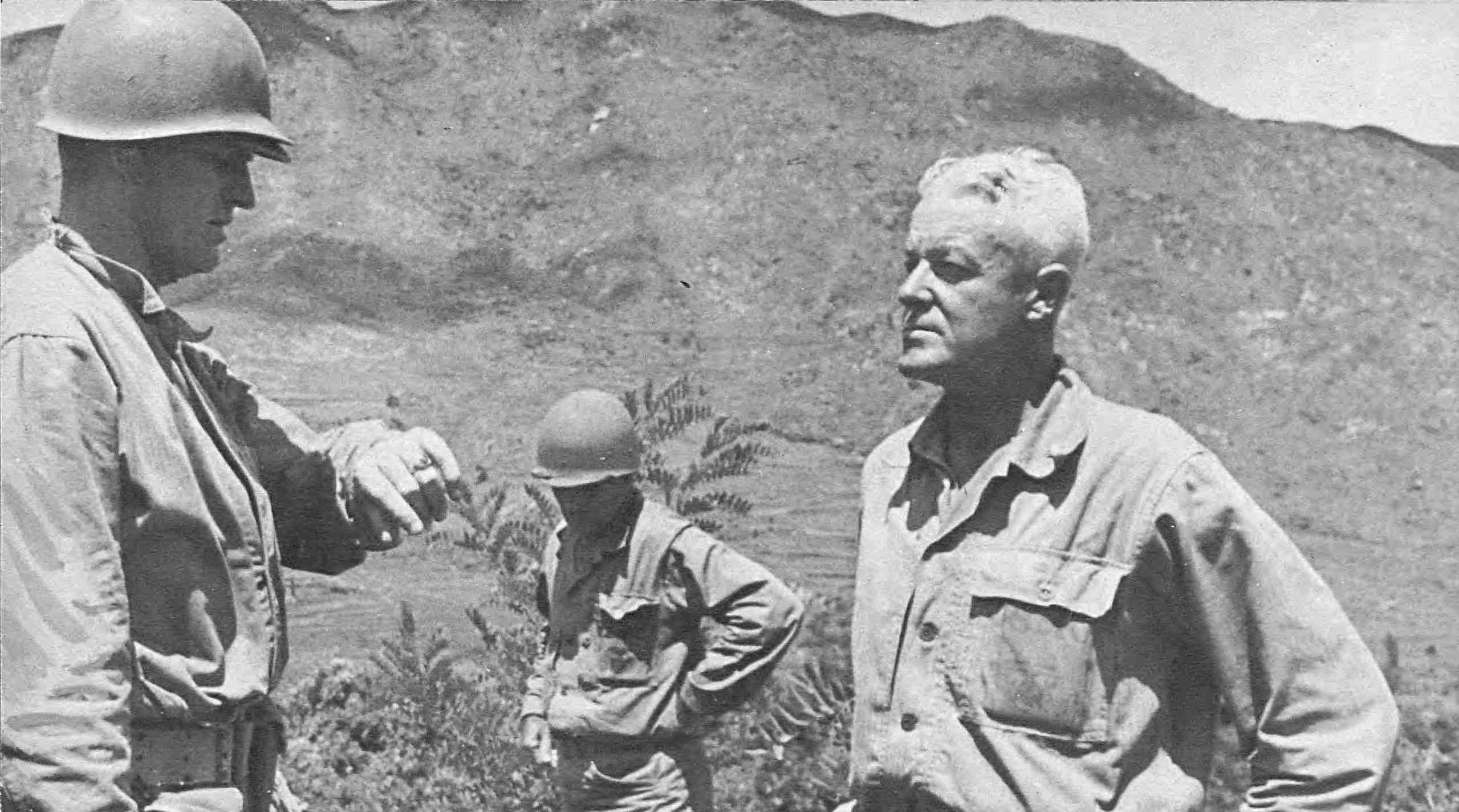
At the Brigade CP—Lieutenant Colonel Joseph L. Stewart, Brigade G-3 and Brigadier General Edward A. Craig, with Colonel Edward W. Snedeker, Brigade chief-of-staff, in background (Life Magazine Photo).
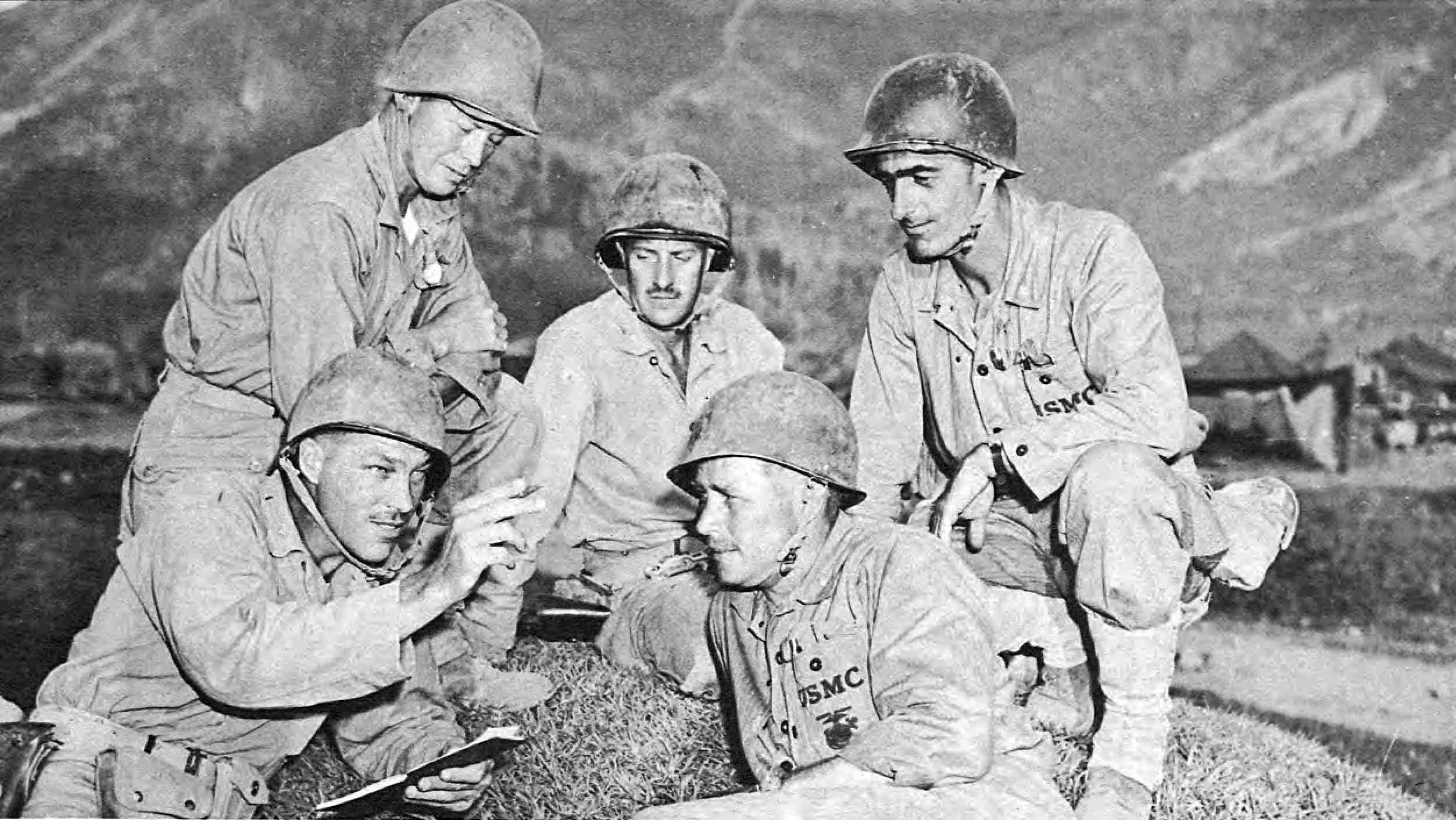
Combat Leaders of 5th Marines—Front row, Lieutenant Colonel Raymond L. Murray, regimental commander, and Lieutenant Colonel L. C. Hays, Jr., Executive Officer; rear, Lieutenant Colonel H. R. Roise, CO 2d Battalion. Lieutenant Colonel G. R. Newton, CO 1st Battalion, and Lieutenant Colonel R. D. Taplett, CO 3d Battalion (Marine Corps Photo).
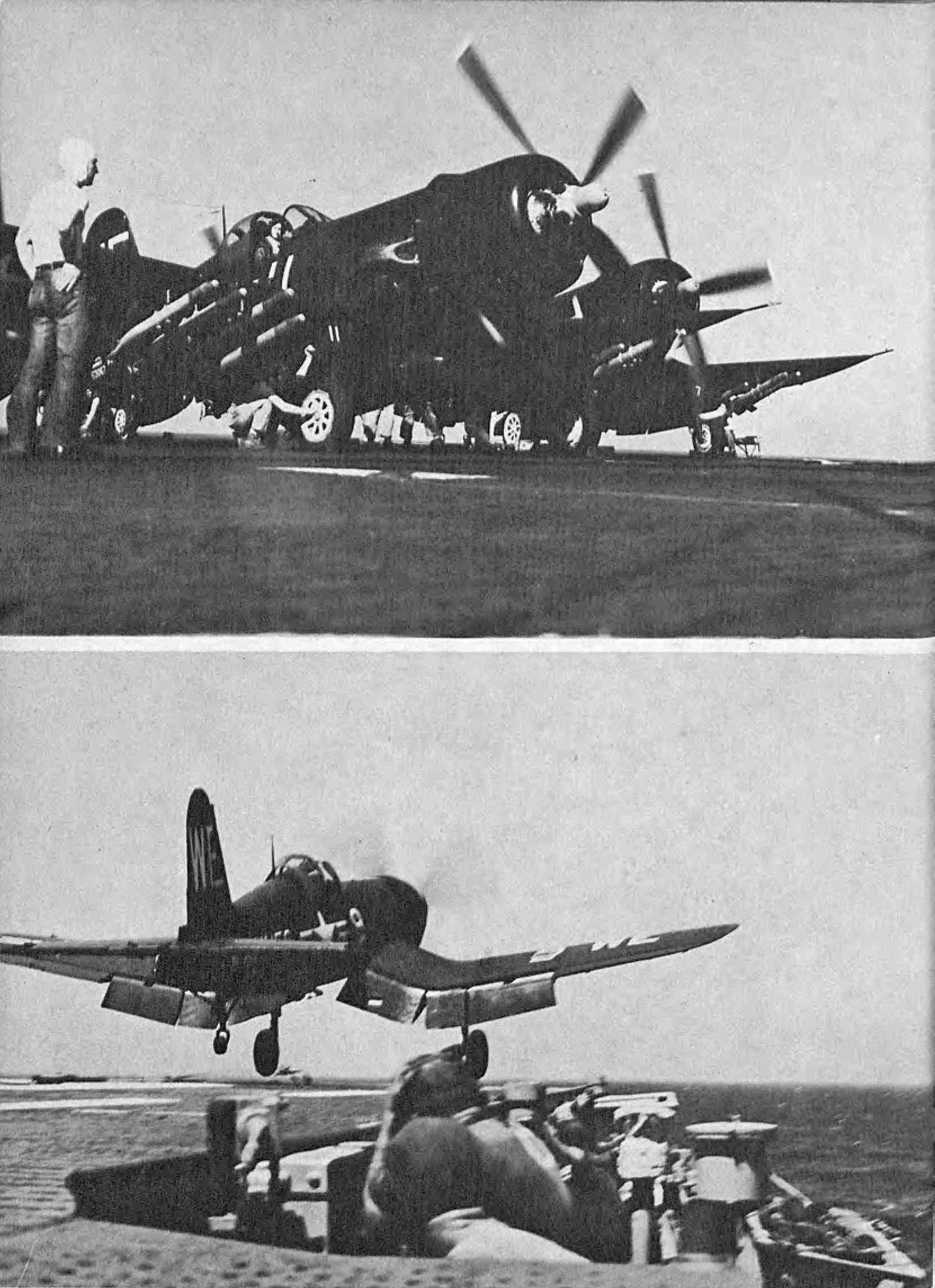
Marine Air in Action—Above, rocket-laden planes of VMF-214 warming up on the flight deck of the Sicily; and, below, a Corsair takes off for the front in Korea (U. S. Navy Photo).
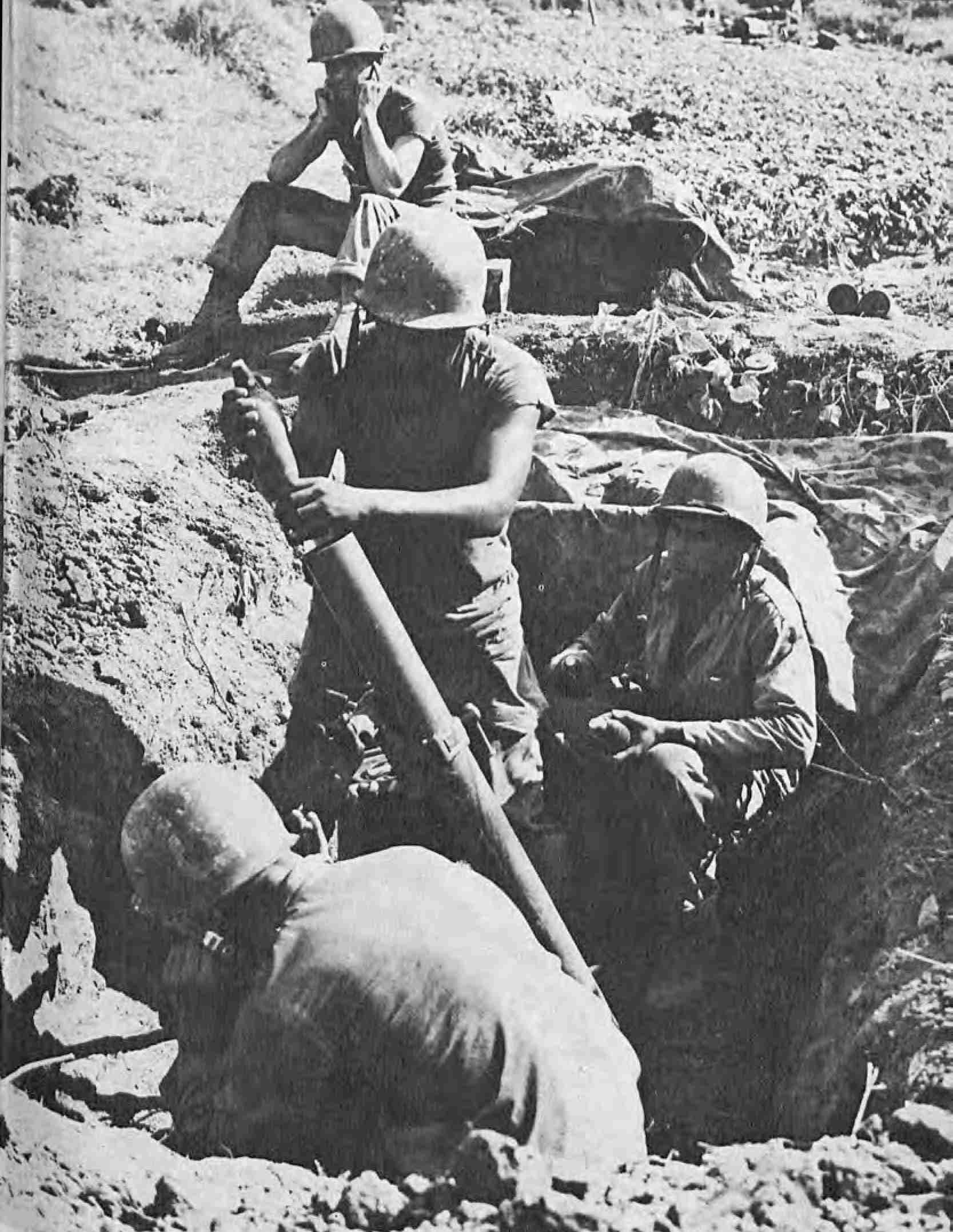
Marine Mortar Crew—Supporting the infantry advance with 81-mm. shells are, left to right, Private First Class Jesse W. Haney, Jr., Bakersfield, Calif.; Private First Class Bennie M. John, Ardmore, Okla.; Private First Class Richard A. Robey, Houston, Tex.; and an unidentified Marine in background (Marine Corps Photo).
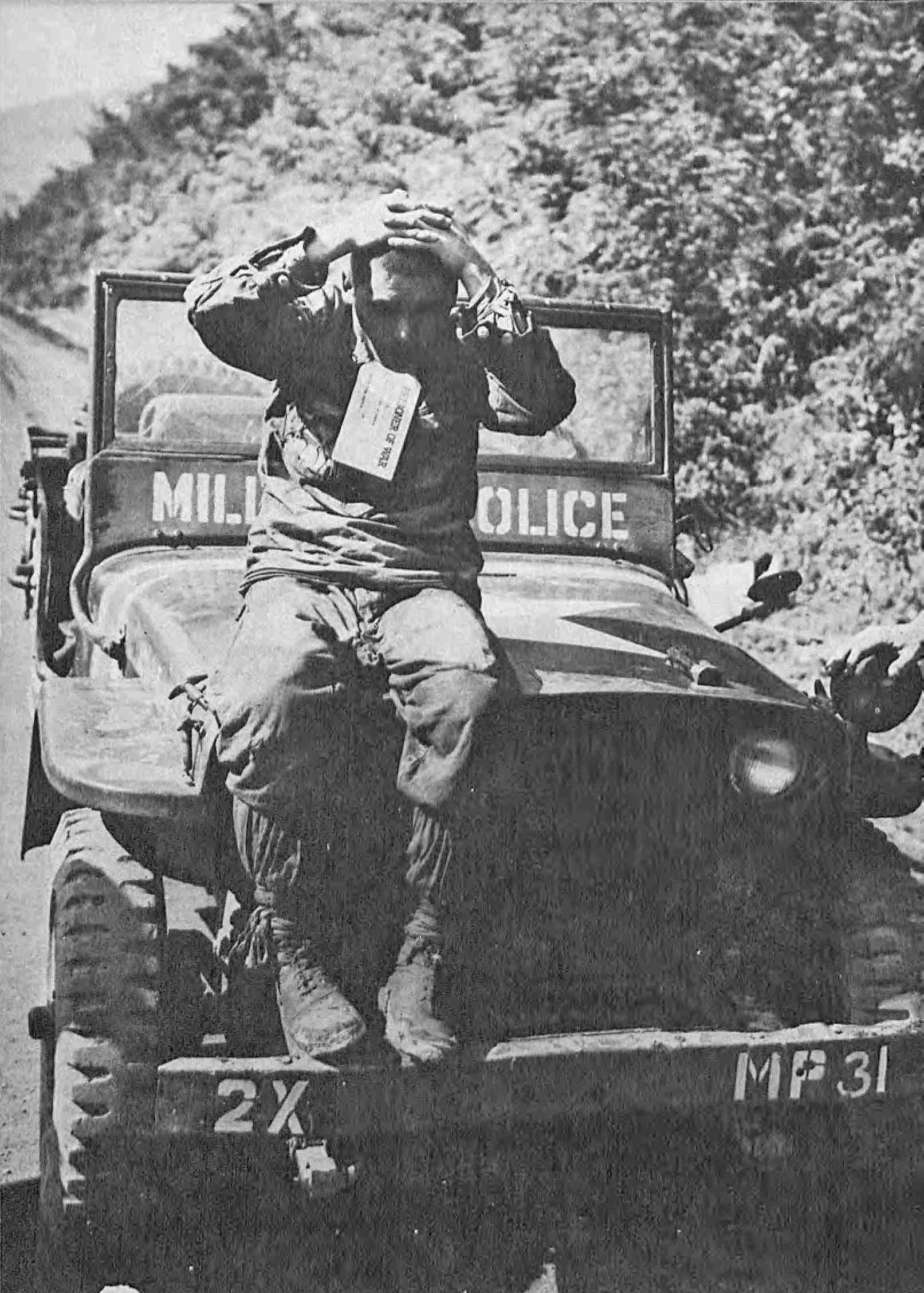
Introducing the Enemy—No prisoner of war appears at his best, but Marine veterans of the Brigade can attest that some of the tough well-trained NKPA soldiers put up a good fight in Pusan Perimeter operations (Marine Corps Photo).
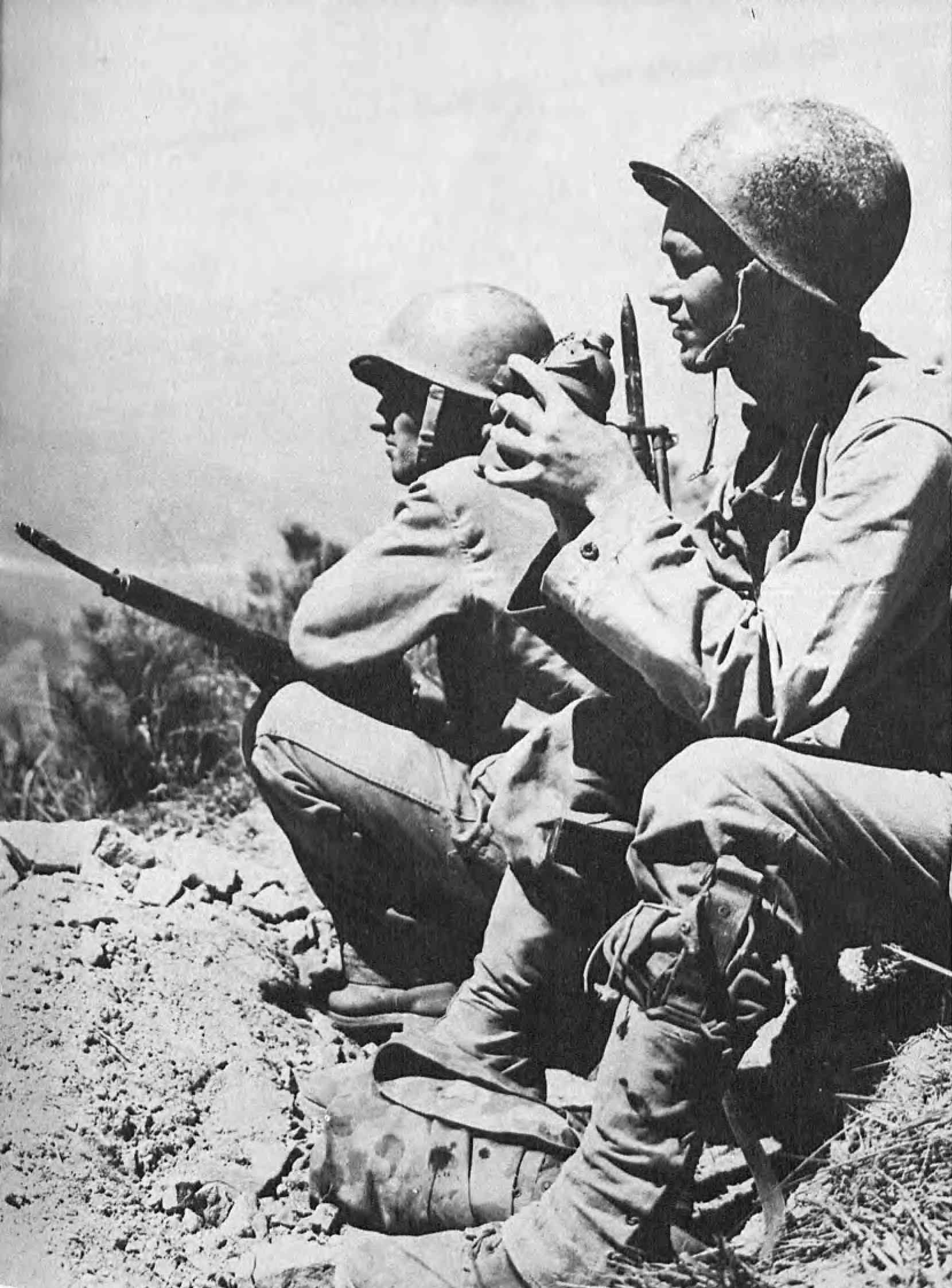
Crest of the Ridge—Two Marine PFC’s, Harold R. Bates (left) of Los Angeles, and Richard N. Martin, of Elk River, Minn., take a break after fighting their way to the top of a ridge in the Naktong Bulge (Marine Corps Photo).
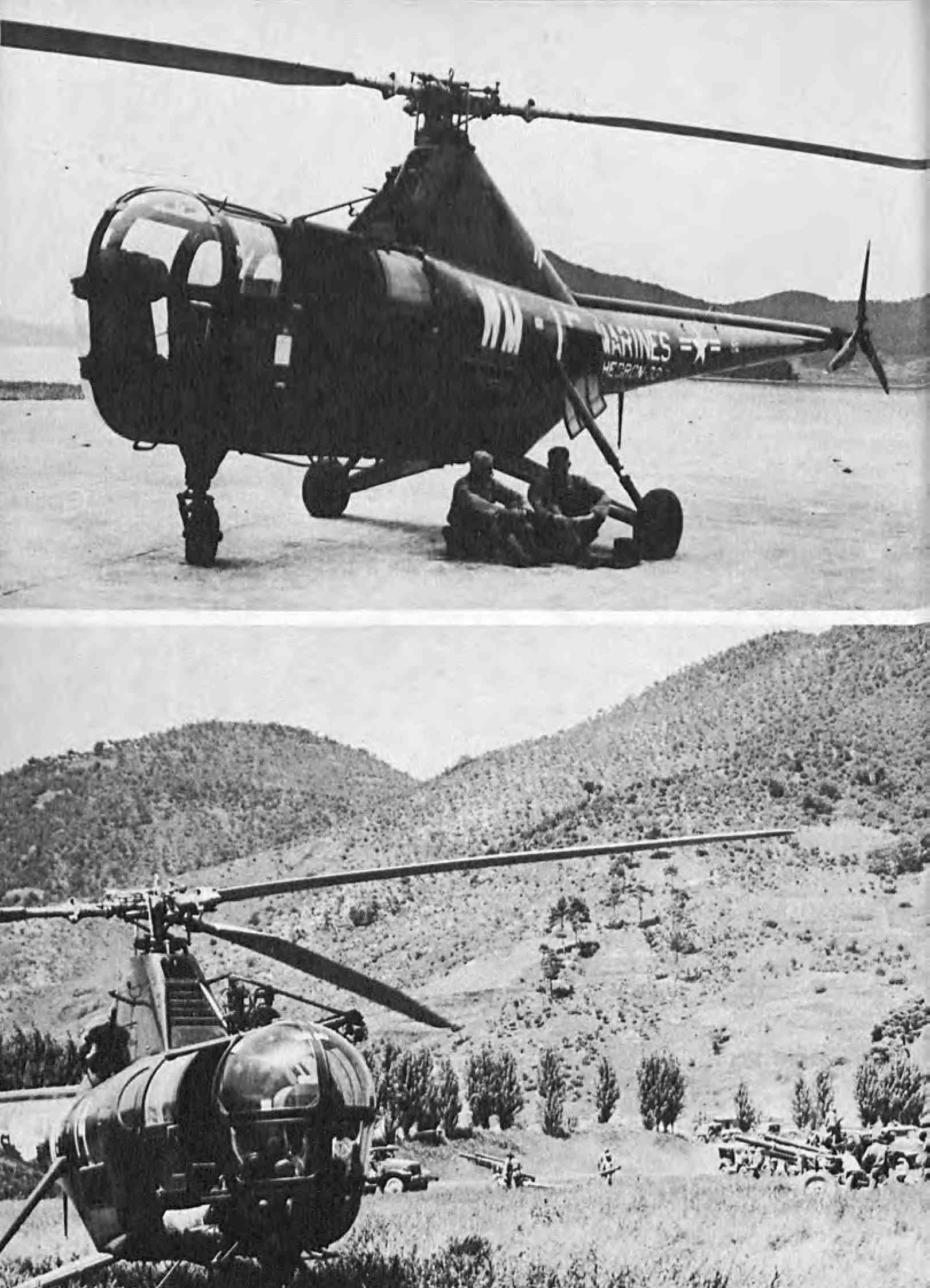
The Flying Windmills—Above, Generals Craig (left) and Cushman waiting for the pilot to take them aloft in an HO3S-1 helicopter; and, below, a VMO-6 helicopter lands near the artillery positions of the 1st Battalion, 11th Marines (Marine Corps Photo).