Front matter (continued 2)
Reading edition
"Laniq," he had murmured. "Laniq, I—"
"Shh!" And they were kissing again.
"Laniq—it's crazy, wild, impossible. We hardly know each other, we.... I came into time looking for you wanting to kill you!"
"We have been through all of civilization together. I know you for five thousand years. Umm-mm, don't stop, Tedor."
And he hadn't, not for a long time. She burned like fire and she cooled like a clear mountain lake on a hot summer day and Tedor had whispered in the dark, "I love you, Laniq."
"Tedor! I love you. Tell me again."
"I love you."
And afterwards, he had prepared drinks and they toasted the future and discussed plans and then Laniq had gone to the telephone and called Chenkov.
"I have to see you, Vladimir. I missed you every minute." Tedor stood nearby; she kissed the tip of his nose.
Tedor was so close he heard the voice faintly over the receiver. "I'm busy, but I'll put it aside. Dinner and then my dacha for the night, darling Anna."
That was Laniq's name here in Russia, Anna Myinkov. As Anna Myinkov she had on previous visits captivated the hearts of Chenkov and others. Only fat Georgi Malenkov, she had told Tedor, had been impossibly aloof. Of course, the extent of her captivation was information. She could learn what was happening, but Tedor somehow would have to put it to use.
"I'll pick you up in an hour, Anna."
"An hour, then," and Laniq cut the connection, turning into Tedor's arms.
Tedor scowled. "Just what—happens at his dacha?"
Laniq laughed softly. "Silly Tedor, we're not married yet." But her eyes were twinkling.
"What happens?"
"You leave that to me, but I can tell you this: if I gave Chenkov what he could get, and gladly, from any Russian beauty, he'd tire of me."
"Just what do you do?"
Laniq practiced some exaggerated bumps and grinds like those Tedor had often seen in the Eradrome. "Enough, but not too much. Listen, Tedor—you'd better be on your way in a few minutes. What happens if Chenkov finds you here?"
Grumbling, Tedor picked up his fur-lined coat and Russian pile-cap. "There's a man at the Spasso House," he told her. "Someone who decided he liked the twentieth century better than our own, counterfeited a birth certificate, deposited it in an American department of health some thirty years ago and took up citizenship there. He went into state department work and is here in Moscow now.
"You get what information you can from Chenkov. I'll see my friend. We'll compare notes and decide what to do. Laniq—I want you to—well, be careful, that's all."
"Well ..." Laniq smiled at him.
"I'm not joking. Maybe that gown kind of hurried what I felt all along, but it was coming, Laniq. I loved you from the beginning but didn't know it. Laniq, be careful."
"You can come back and sleep here tonight if you want. I'll see you in the morning. And you know I'll be careful, Tedor. Now that I've found you I want to keep you—and I want to stay healthy enough to appreciate what I've got."
The phone rang.
"Hello, this is Anna Myinkov. Yes? Oh, yes, Vladimir. My, but that was fast. Of course." Laniq hung up, shoved Tedor toward the door. "Get out of here, quick! Chenkov's suite of rooms when he's not in the Kremlin or his dacha is in a hotel down the street. He's early. He's on his way up right now. Scram!"
Tedor kissed her quickly, stalked out into the hall and waited for the elevator. A middle-aged man got off—wearing the uniform of a Red Army marshal, carrying a large bouquet of flowers.
"You should have doffed your hat," the female elevator operator admonished Tedor as they started down. "That was Marshal Chenkov."
"Don't I know it," said Tedor.
"Barwan! This is a surprise. Come in, come in."
The Spasso House, the American Embassy adjacent to Red Square, was a gaunt, grim structure. Frawdin Chlon—Harry Marsden now—was a man of about Tedor's age, but shorter, fair of skin and hair and quite calm and self-possessed in an American business suit.
"We were about to close for the day, Barwan. But this is a surprise."
"How are you, Frawdin—no, I guess it had better be Harry."
"You're telling me! Fine, thank you. It's quite a coincidence, because I had another visitor earlier today. He says he knows you and wanted to see you, but I had no idea you were in Moscow."
"Who was that?"
"A solidio writer, name of Dorlup."
"Dorlup?" Tedor frowned.
"He claims to be in some kind of trouble and says he has a story to tell which would make your hair stand on end."
"He has a habit of doing that. Do you have his address?"
Marsden nodded, then asked: "What brings you here?"
"It's a long story, and since you are working for the American government now, I don't think I'd better tell you. Not that anything I plan doing will hurt America—far from it. But you know about time-travel and the way we have to do everything in secret. All I want is some information, anyway. What's the current international state of affairs?"
"I wish I knew, Tedor. Frankly, I'm worried. The Russians have massed three million troops on their European border, another million to the east, north of the Yellow Sea. Their big planes, capable of delivering anything including atomic weapons a third of the way around the world, are lined up on a 'round-the-clock stand-by basis at half a dozen airfields; there's talk they'll be used soon. Everything seems to hinge on something happening in the Kremlin right now. There's talk, wild rumors, but nothing official."
"What are the rumors about?"
"You'll think this is silly, but they're from usually reliable sources. They claim Stalin has come back to life."
"What!"
"That's right. Stalin has come back, sort of like a totalitarian Communist Messiah. All people have a culture-hero who's supposed to come back in times of trouble and lead his nation to glory. Even though Stalin's been gone only a year and a half, he's the Russian culture-hero. If somehow they can rig up a setup—the men in the Kremlin, I mean—which convinces the people he has come back and wants war, there's no telling what Russia might do."
"But does the Kremlin want war?"
Marsden shrugged. "It might be necessary to keep power. The people don't like their government, although they tolerated it under Stalin because he managed to convince them he was something of a deity. But if the government can turn the people to an exterior trouble, namely a world war, the government would stay in power. It depends on what these rumors are all about."
"And don't you know?"
"No."
"Okay, Harry. Thanks. Listen, don't tell Dorlup I was here if he should call you. I'll get in touch with him when I have a chance."
Marsden gave Tedor an address where Dorlup could be reached, told him they'd have to have lunch together some time, then led him to the door.
Vladimir Chenkov's dacha—his big estate at the far end of the private highway some thirty-odd miles south of Moscow—almost had the proportions of a palace. It was big all over, with huge rooms, high ceilings, half a dozen fireplaces, two grand pianos, ponderous, overstuffed furniture and eight private bedrooms, each easily large enough to accommodate four people although each contained only one oversized bed.
"You're a strange girl, Anna," said Chenkov, sitting with her on bearskins near the fireplace and trying to maneuver in such a way that when she grew tired her head would naturally fall into his lap.
"Oh, I like you—yes. Don't misunderstand. But at times you are so—cold."
"You're married, Vladimir, and sometimes I think of your wife and think of how I would feel under similar circumstances."
"That is all?"
"Well—"
"Then listen to me, Anna. What is a wife? A man has a wife because it is conventional, like a country says it is striving for peace when often it must have war to keep from flying apart. I can get you anything, anything. I could treat you like no wife ever was treated. Here, you like this dacha? Say the word and it is yours."
Servants came with vodka, champagne, paper-thin slices of sturgeon, caviar. Chenkov nibbled at the sturgeon while Laniq had some caviar and champagne. Chenkov began drinking vodka and hardly paused until, Laniq realized, he was high enough to be uninhibited, yet not sufficiently high to be a boor. It was the gentlemanly thing in Russian nobility, Laniq knew.
"Do you not even feel inclined to kiss me tonight, my Anna?"
Laniq offered her lips without heat, got them bruised by Chenkov's teeth.
"Then at least dance for me, Anna."
She had danced for him before, here in this very dacha, at the same fireplace. But now it was different, now she could not feel the same emotional indifference and so whet Chenkov's appetite sufficiently for him to start talking.
Laniq got up and did a tentative pirouette.
"Come now."
Laniq danced slowly, spinning and dipping and feeling terribly sorry for herself. But the firelight was warm and the champagne, and the whole room seemed to go out of focus except for Chenkov's hungry eyes, which became enormous—and in Laniq's own time the dance was something to be done because you loved doing it, and except for Chenkov's eyes she might dance with abandon and enjoy herself.
Tedor, she thought. Tedor....
If she closed her own eyes she thought, almost, she was dancing for him and not for Chenkov. The slit skirt swirled around her flashing thighs; the bodice, slashed from throat to waist, clung and fell away, clung and fell away.
She danced not for Chenkov but for Tedor—and then not for Tedor but for all the people in the world who might live in freedom if Chenkov's tongue loosened. But the hands which reached up for her legs and pulled her down were Chenkov's.
"Tell me," she said breathlessly while Chenkov tried to paw her and she scampered away to fill a large glass with vodka for him and a small one with champagne for herself. "Tell me, are you as important a man as I hear?"
"My dear Anna! You're jesting."
"No I mean it. I'm only a country girl, really I am, and I'd—"
"You? A country bumpkin. That's good, that's splendid. Well, then I will tell you. I am number two man in all the realm, and...."
Laniq pouted.
"Don't cry. Don't. I will, one day be number one man, I know it. You may rest assured of that. I could show you things, so many things which would make your beautiful hair stand on end."
"Then show me!"
"Very well—I shall, my Anna."
"Show me how you can do anything, anything you want in all of Moscow."
"And in the Kremlin, too," Chenkov said thickly. "Yes, in the Kremlin. Tomorrow morning I will take you to see something you never dreamed of. Tomorrow morning...." He kissed her wetly, too far gone with vodka.
"Tomorrow morning then. I'm sleepy." And Laniq stood up, brushed his fumbling hands away from her, climbed the stairs to the second floor, retreated to a bedroom and bolted the door behind her. Chenkov was soon stomping up the stairs and banging insistently at the door.
"Tomorrow," Laniq whispered, and repeated it when Chenkov protested. "I said tomorrow."
"But Anna—"
"You show me what you can do. After all, I don't want to be a fly-by-night mistress of this dacha. Good night, Vladimir."
"Good night, then. Tomorrow morning—and tomorrow night."
They always tried to bring Chenkov in on everything. They actually had more power than people on the outside could imagine, Malenkov thought petulantly. They numbered only two-score but they were his cabinet of ministers and sub-ministers and it seemed—ridiculously—that he had to answer to them for everything. "But why don't we forget about Vladimir?" Malenkov pleaded, "who must certainly be kept busy with his Army work?"
"Vladimir will come. Stalin would have wanted it that way."
Stalin, in truth, had asked for Chenkov as well as Malenkov. Stalin. Malenkov trembled when he thought of it. That was not Stalin—that was nobody. A thing, not a person. It spoke even with a mechanical voice. Stalin—the Old Stalin—never answered to a cabinet of ministers and sub-ministers. As for the new Stalin, the strange horrible thing which the bio-chemist, Zhubin, insisted was Stalin, there was no telling what he would want or demand. Malenkov wished passionately he could get his hands around Zhubin's scrawny neck and choke the life from him. This was all Zhubin's fault.
Not really, for Mulid Ruscar couldn't be discounted. Why did everything happen this way? Why did men from the future even insist on poking their noses into his, Malenkov's business? But why was any of this Ruscar's affair, anyway? Ruscar seemed to hold the whip-hand. Ruscar told them what to do, and they did it. Ruscar knew political intrigue as well as a Chenkov, bio-chemistry as well as a Zhubin—for was it not Ruscar who had helped, paved the way, in fact, for Zhubin to construct the monster masquerading as a resurrected Stalin? As if a hideous, naked thing in a glass cage could be a man of flesh and blood and think like a man.
"Hurry, Comrade Premier. Ruscar is waiting and Stalin with him."
Ruscar—and Stalin. But Ruscar had not been born yet, and would not be, for thousands of years. Stalin? Stalin was dead.
"I do not feel well," said Malenkov. "Summon the Comrade Doctor."
"I am here, Comrade Premier. I will go with you to the meeting. A slight sedative will perhaps—"
"No! Get that thing away from me!" Malenkov recoiled in terror from the needle which the Comrade Doctor had extended. "I am all right."
Was the Comrade Doctor in the employ of Chenkov to poison him? Was he in the employ of Ruscar for some nameless purpose? Or of Zhubin, the bio-chemist, to transform Malenkov also into a pink thing floating in ghastly fluid in a little glass container?
Almost blubbering as he walked toward the laboratory, Malenkov could feel the weight of Communist Empire, crushing him like a worm to the floor.
"I've never been in the Kremlin," Laniq told Chenkov as they hurried along the silent hallways within the walled fortress. She had seen the towers, the minarets, the gaunt walls only briefly from the outside, and then Chenkov had spirited her within the place, although clearly a Red Army guard would have protested had he been anyone but the Chief of Staff.
"I can take you anywhere you want." Chenkov promised, walking beside her, his arm tucked in hers, resembling neither the whip-lash leader of the Army, which he was, nor the romantic lover, which he hoped to be—but rather the obscure military figure who had climbed to glory over the purge-slain bodies of his comrades. He would one day look the part of the field marshal, Laniq thought; at the moment he was trying to convince himself as well as Anna Myinkov of the brightness of his star in the communist firmament.
They reached a heavy metal door flanked by two guards. "Marshal Chenkov!" cried one, and they both saluted with their rifles. The door opened, they went inside.
Laniq saw a huge room, a laboratory it seemed—all white porcelain and gleaming chrome. At the far end a group of men clustered about an object which seemed suspended in air and bathed in radiance of gold and amber. The object was cylindrical and rather small, transparent with a pinkish mass floating inside.
Laniq almost screamed. The thing in the glass container was a human brain.
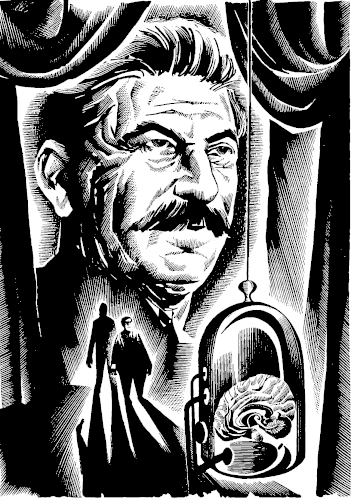
Chenkov grasped her arm more tightly. "They won't like it when they find I brought you here." He smiled. "They'll probably insist you remain within the Kremlin—with me."
A big, nervous man with flabby jowls and the palest face Laniq had ever seen turned to face them.
"Vladimir," he said, "you're late."
It was Georgi Malenkov.
Chenkov shrugged. "I am here."
"And your friend?"
"She is that, a friend."
"You shouldn't have brought her. What do you think this is, a circus?"
"It's a private affair. She's harmless."
"I'll summon the guards and have her removed."
"Yes? To whom do you think the guards owe their first allegiance?"
A white-smocked figure turned to look at the newcomers. "Please, Comrades. Let's have none of this squabbling. Stalin wants to talk with us."
"We'll settle this later," grumbled Malenkov.
"There is nothing to settle," said Chenkov, standing his ground.
Malenkov growled, but looked again at the brain floating in its case. The white-smocked figure adjusted some dials on a table nearby. On the wall behind the glass enclosed brain, a microphone-speaker blared metallically:
"Are they both here? Malenkov and Chenkov, both of them?"
"Yes," said Zhubin. "Yes, Comrade Stalin. They are here."
"You now know that I live," said the brain. "It is a strange new life I have, but I can think—perhaps more clearly than would otherwise be possible, for I have no body to encumber me. Before I go on, do you have any questions?"
Malenkov blinked his fat-enveloped eyes. Chenkov stared.
"Very well. The day my body died, a quick operation removed the brain and preserved it. Comrade Zhubin—working under the direction of a man you've only seen once or twice—transferred the brain, my brain exactly as it was in life so that when I speak you will know it is Stalin, the Man of Iron, talking, into this case. I have since conferred with the man who made the operation possible, the man who can do great things for Mother Russia, and because talking tires me in some strange way and he knows the situation more completely at this time than I do, I want you to listen to him as if it were I, Stalin, talking."
There was a silence. The half dozen figures still stood around the brain case, but one of them turned slowly around to look at all the earnest faces. His eyes raked Laniq. "A woman?" he said, incredulously, and his eyes wandered, then darted back. "Laniq Hadrien!" he cried. "Who brought this woman here? Fools! Speak!"
"It was Chenkov," fat Malenkov said spitefully.
"Is that true?" the man demanded.
Chenkov nodded defiantly. "So what?"
"So what? So this, you idiot! That girl is a representative of our most dangerous enemy."
"The United States?" wailed Malenkov.
"Far worse than the United States."
Laniq sprinted for the doorway at the other end of the room, heard the voice call from behind her: "Guards! Stop that woman!"
The speaker was Mulid Ruscar.
When Laniq failed to return Tedor began to worry. It suddenly occurred to him that he might be able to reach Mulid Ruscar for help. True, Ruscar had sent out an order for his arrest, but directives could be mis-read, transferred incorrectly. Perhaps Ruscar merely needed him urgently. Perhaps Ruscar had realized he would be flitting through the ages and nothing short of arrest would detain him long enough for them to get together. Tedor used his tongue to flick on the tiny transmitter embedded in his palate, then said:
"This is Tedor Barwan calling Mulid Ruscar. Barwan calling Ruscar."
He waited not more than half a minute when the answering voice whispered in his ear. "Tedor, where are you?"
"In Moscow, Chief. I'm sorry I couldn't wait in New York. I have news for you. It's about Laniq Hadrien."
"Laniq? Oh, of course. Laniq Hadrien eh? Where are you?"
Tedor gave Ruscar his address.
"Fine, Tedor. I'll send someone over to fetch you. Stay right there."
"All right, chief." And Tedor cut the connection. Ruscar had a way about him for getting to the bottom of intrigue. Tedor felt better already.
A moment later, the doorbell rang. Ruscar's man? Impossible.
Tedor opened the door and admitted a nervous Dorlup.
"Barwan, thank heaven I found you. Harry Marsden gave me your address."
Tedor watched guardedly as Dorlup entered the room, sat down on a big chair. "Have you people got any closer to finding the time-tyrant?"
Tedor shook his head.
"Let me ask you another question. At the very beginning of all this you were going to write a report. What was it about?"
"The 20th century, of course. I was going to say it seemed that the most aggressive, war-like state here, Russia, was receiving aid from our own time. Fornswitthe started to write it."
"That's what I thought." Dorlup mopped his forehead, although it was comfortably warm in the apartment. "And someone killed him and stole it. You thought I was the only one who could have known where Fornswitthe was living. But someone else knew. Mulid Ruscar knew."
"Of course Ruscar knew," Tedor declared irritably. "That doesn't mean anything. Ruscar is fighting everything the monopolist stands for."
"We'll get back to that. It might interest you to know I'm a fugitive. I escaped from Ruscar in the United States when Ruscar accused me of being the time-tyrant."
"I've wondered the same thing myself. But somehow you don't fill the role."
"He has enough phony evidence to make it stick, Barwan. You see, certain people were creating too much of a fuss about the monopolist. It was crimping Ruscar's plans. He figured if he could convict a scapegoat the furor would die down, at least for a while. I was his scapegoat."
Tedor frowned while he poured them both drinks. "It just doesn't make sense. Ruscar all his life has stood for everything the monopolist was trying to tear down.
"Which is exactly why no one ever suspected him."
"I think you're crazy, or lying, or wrong—but we'll find out soon enough. Ruscar knows I'm in Moscow. He's sending someone over, as a matter of fact."
"If Ruscar is sending someone to find you we've got to get out of here!" Dorlup gasped.
"Calm down. We'll do no such thing. We'll wait for Ruscar's man and see what this is all about."
"You'll wait, you mean—if you are stupid enough to aid in your own execution. I'm getting out of here." Dorlup climbed to his feet, but Tedor pushed him back into his chair.
"You're waiting with me, Dorlup. I'd like to find out once and for all just where you fit into all this."
"Barwan, I came to you in good faith! Give me a chance! Ruscar has enough rigged evidence to have me gassed."
"Sit still and wait."
Dorlup emptied his glass of vodka, reached over to the table and tremblingly poured another.
Seconds later the doorbell rang.
He was tall, broad of shoulder, wore a snap-brim hat and a concealed weapon which nevertheless bulged on his hip. He showed his credentials. "I am from Army Intelligence," he announced. "The Chief of Staff's Office instructed me personally to escort you to a meeting with a Comrade Ruscar."
"Chief of Staff," said Dorlup. "That would be Chenkov himself. You're a big fish, Barwan."
Tedor wondered if there could be any truth in all that Dorlup had said. Looking at Dorlup now, he realized the man bordered on hysteria, and even if he were indeed well-meaning, he could still have misinterpreted everything. Unlikely—but no less likely than the accusations Dorlup had made against Mulid Ruscar. Perhaps the Intelligence Agent could inadvertently shed light on the entire situation.
Tedor yawned. "I am tired. I think I have changed my mind. Yes, I'd rather sleep. You tell the Chief of Staff to tell Ruscar I won't see him today, after all."
"But Comrade, I was sent to get you."
"Fine, you're a good man. I'm sending you back without me. Care for a drink before you leave?"
"Thank you, no. I never drink on duty. Comrade, listen; the Chief of Staff would hate to tell Comrade Ruscar that you have changed your mind. I know this for a fact, Comrade."
"Are you trying to say I haven't much choice? I go with you voluntarily or get taken?"
The Intelligence Agent shrugged. "I never said it and you are putting it crudely, even coarsely. But the general assumption is correct."
Still smiling, Tedor reached for the bottle of vodka which stood on a table near the door. The Intelligence Agent stood with one foot inside the apartment, one outside, waiting.
"Go to hell," said Tedor.
The Intelligence Agent reached quickly for his gun. Tedor swung the vodka bottle in a short, savage arc at the right side of the man's face while he fumbled in his pocket for the weapon. The bottle struck his jawbone, shattered. He screamed and fell, his face a red smear.
Tedor dragged him inside the apartment and shut the door. "Maybe you know what you're talking about, Dorlup. Are you willing to help me prove it?"
"I guess so. Yes, of course!"
Tedor reached into the fallen Intelligence Agent's pocket, found his wallet, his identification card with a picture and his gun. "We'll need this," he said. "Come on."
Laniq's commandeered auto was still parked at the curb downstairs, a crowd of urchins admiring it. "Climb in," Tedor told Dorlup, then walked to a display board down the street, found a poster with Malenkov's picture, quickly removed it and ran for the car. "We're dead ducks if my time-conveyor isn't where I left it," he said. "If it's there, we may have a chance."
And half an hour later:
"So we're in your conveyor. Now what?"
"Sit down," said Tedor. "We've got to hurry."
"But this is the matter duplicator."
Tedor nodded. Each conveyor was equipped with one of the devices—which could print perfect counterfeit money, create clothing, artificial hair, skin tissue, anything to render a visit to past ages as foolproof as possible.
"Whatever you want to copy is ordinarily stored on microfilm," Tedor explained. "But this thing can copy anything."
"I know, but what do you want me—"
Tedor thrust the picture of Malenkov into the receiver. "Easy, Dorlup. You're about the right size. Just sit still. You're going to be Georgi Malenkov, Premier of all the Russians."
Five minutes later, Tedor looked at Malenkov rising from the chair. "It's perfect," he said.
"I don't understand."
"You can write solidios, Dorlup; you'd better be able to act as well. You're going to be Malenkov."
Tedor sat down himself, placed the Intelligence Agent's ID picture into the duplicator. "I'll be your personal bodyguard," he said—and he was, moments later.
"They've got a friend of mine somewhere," said Tedor. "If Chenkov takes orders from Malenkov, we're going to find out where. We're also going to find out what Ruscar has up his sleeve, provided you're right about him."
"I'm right."
"We'll see. But if you were lying, Dorlup—if you were, I'll kill you myself."
Dorlup blanched. "We don't have to worry about that."
"All right. According to his ID card, this man was Fyodor Archevski. I'm Fyodor Archevski, your guard."
And then they were speeding in Laniq's auto back to Moscow—and the Kremlin.
"Where do you think you are going? Oh, Comrade Premier. Comrade Malenkov—I am sorry."
Dorlup nodded brusquely at the guard. They drove through the Kremlin gates and up a ramp.
"Do you know your way around this place?" Dorlup demanded.
"No."
Tedor stopped the car. They climbed out, watched as a uniformed figure darted out from a doorway, leaped into the auto, drove it away after saluting them.
Another figure came forward. "May I be of help, Comrade Premier?"
"The Premier wishes an immediate audience with Comrade Chenkov," Tedor told the soldier. "Not in his private quarters but in the nearest available study. Lead us to it and have someone fetch Chenkov. Quickly."
The guard took them up another ramp, through a doorway, down a hall. He led them into a spacious sitting room, soon had the fireplace burning brightly. "I'll get the Marshal myself," he said, and departed.
Tedor looked around, discovered a draped alcove at one end of the room. Peering inside he saw a dressing table and a mirror. "I'll be in here," he said. "Remember, the first thing you want to find out from Chenkov is this: where's Laniq? Her name's Anna Myinkov, and Chenkov knows her, probably saw her yesterday and possibly more recently than that. Afterwards, if Chenkov wants to tell you anything in addition, that'll be fine."
A few moments later, Chenkov stalked angrily into the study. "See here, Georgi! I saw you not half an hour ago in your quarters and now you bring me here. What is it?"
Dorlup cleared his throat. "I wanted some information."
"You sound strange."
"Cold coming on, I think. Vladimir, tell me—what happened to the girl? You know, Anna Myinkov?"
"Why should you be interested in her? Anyway, you know what happened. Don't tell me the living brain of Stalin frightened you so much you didn't even see what was going on?"
"Y-yes. That was it, Vladimir."
Chenkov snorted. "And the mantle of powers is yours. Well, Ruscar said Anna was from some enemy force and since she was his enemy she was also ours. I had a hard time explaining my way out of that one, but Ruscar must have realized I hold enough power here to give him trouble if he tries to give me some. He probably has Anna in the Lubianka Prison and I intend to do something about it, although why you should be interested, I don't know."
Dorlup was a doleful-looking Malenkov, but the features were identical—the tiny eyes, high forehead, thick jowls, petulant lips. Hiding in the dressing alcove, Tedor wondered how long the ruse would hold.
"I was just curious, that's all."
"It seems to me other things should be on your mind. I'm the Chief of Staff, so it's not my problem. But with Ruscar and Stalin—"
"Stalin? I—"
"Stalin's brain, Georgi. His brain. Ruscar resurrected it, not I. If the war goes badly—it shouldn't, but if it does—the people will have a resurrected Stalin to turn to for faith, and hope. It was a stroke of genius, I think. But right now you and Molotov should be conferring with the military leaders, getting things ready, planning...."
"It's arranged," Dorlup said evasively. "It's all arranged."
"So quickly? That's preposterous. You don't start a vast war-machine functioning in mere hours. We're planning on quick victory with a sudden, devastating atomic attack on the United States."
"I—know."
"I know you know, Georgi. You hardly seem concerned. Even Comrade Zhubin pointed out how nervous you seemed today, and Zhubin usually minds his own business. You seem even worse now."
Dorlup nodded, clearly struggling for words and a way to prolong the conversation. "I—I'm not myself," he said, mopping his brow.
"Well," said Chenkov, irritably, "is that all you wanted me for?"
Dorlup stood there, fidgeting. Chenkov snorted, began to leave the room.
"Just one moment, Comrade Marshal." It was Tedor, who had emerged from behind the drapery.
"Eh? By Lenin, what are you doing here Archevski? Am I going crazy? I thought I sent you to find this, uh—Barwan."
"You did, Comrade Marshal, but—"
"But I told him not to," said Dorlup.
"You? What for? Ruscar wanted him brought at once."
"I know that," said Dorlup.
"But the Comrade Premier told me not to go, anyway. Then Comrade Premier further told me that Ruscar had concluded his usefulness after we had Stalin's resurrected brain. The Comrade Premier—"
"Let him talk for himself, Archevski! And I'll see you later for disobeying my orders."
"No you won't."
"He's in my employ now," Dorlup told Chenkov. "What he was saying is this: why do we need Ruscar? Let Ruscar go back where he came from. We can handle everything ourselves."
"Georgi, you don't mean it."
"I mean it."
"Then you are not yourself! You had better see a doctor. Why, only the day before yesterday we spoke with Ruscar about what all this could mean. Defeating the United States we could conquer the earth, of course. But what is the Earth here and now, this year, when with Ruscar's help we can have all Earth, through all the centuries, for all time?"
"What makes you think we can trust this Ruscar?"
"That's fantastic. Everything is arranged. Perhaps later, much later—after we have consolidated our position in time, then we can think of doing without Ruscar's help. But not now."
"Well—" said Dorlup, at a loss for words.
The door opened. It was Georgi Malenkov who stood there.
"Vladimir, I was told I could find you here in conference with someone, they didn't know who. They—Vladimir!" Malenkov looked at Dorlup. His small eyes bulged.
Chenkov's mouth dropped open. "This is impossible!"
"Vladimir, please. Please. I see it now. I see it all—" Malenkov had grown pale staring at his duplicate. "You have this double. You and Ruscar. You plan to do away with me and keep a figurehead instead. Vladimir, please, I can listen to reason. I can make my rule a partnership, a triumvirate if you wish." Malenkov was blubbering. "I could smell it in the air, this plot, this intrigue, this—I knew something was afoot. Something I didn't know what. All hands were turned against me, all—"
Tedor ran to the door, closed it, locked it.
"Vladimir, I beg of you—"
"Oh, shut up! I don't know any more about this than you do. You are Malenkov, I know that now. The other man looks like you but doesn't talk like you."
Tedor took Archevski's gun from his own pocket. "You try to figure it out," he said. He gave the gun to Dorlup, who stood watch over Russia's two top leaders.
Tedor ran to the drapes which hid the dressing alcove, tore them down, ripped them into strips. He bound Chenkov first, hand and foot.
"You realize you haven't a chance, whatever game you're playing," Chenkov said.
Tedor bound Malenkov, then fastened them together, sitting on the floor, back to back. If one of them struggled with his bonds he would strangle the other, for Tedor had tied their necks together.
"Give me the gun, Dorlup," he said, taking the pistol. "I haven't time. I can't play with you. I want you to answer one question and I'm going to give you ten seconds to start talking. If you don't, I'll kill you."
Chenkov squirmed, making Malenkov gasp and choke. Chenkov subsided. "What's your question?"
"I want to know the location of your storage areas for atomic weapons."
"N-never!" Malenkov gasped, his voice breaking.
Tedor started counting. "One, two, three, four, five—"
"Wait!" This was Chenkov. "There's no need making a martyr of yourself, Georgi. You tell me, what good would the information do them? They'll never get a chance to use it."
"Y-yes. Don't move, Vladimir. You're choking me. I see what you mean. Very well, this is the information. We have three atomic storehouses, one in the Urals at—"
The information memorized, Tedor forced a gag of drapery material into Chenkov's mouth and one into Malenkov's. With Dorlup he left the study.
"But why did they give us the information so readily?" the solidio writer demanded.
"That's simple. Evidently, they've already removed their atomic weapons from the storage areas, possibly to airfields. They aren't familiar enough with time-travel, though. We'll simply go back a dozen hours and blast those three locations. If Russia doesn't have atomic power for a sneak attack, she won't be able to attack at all. First stop is the Lubianka prison, however."
They found Lubianka Street after getting a vehicle from the Kremlin motor pool, the motor officer's eyes bulged when Malenkov and his personal body guard came down for the car themselves. They rushed inside the prison, where the warden demanded, stuttering:
"Is—is this an inspection, C-comrades? We are r-ready at any t-time, of course, and honored, even, but sometimes, once in a while, you see—"
"Forget it," Tedor cut him short. "You have a woman prisoner, Anna Myinkov? Bring her to us, quickly."
"At once."
The warden was gone less than ten minutes, returning with a muscular, sexless female jailor who prodded Laniq ahead of her. Laniq stared at them dully, without hope.
"Thank you," said Tedor to the warden. "We'll take her."
Dorlup-Malenkov smiled and the warden bowed out. In the street, Laniq's spirit had returned. "Don't tell me Malenkov himself is going to be around for the execution?"
They didn't say anything. Tedor wanted to be in the car before they revealed themselves to her.
"You'll have to catch me first!" cried Laniq. Tedor had been holding her loosely by the arm and she suddenly tried to pull away. When his grip tightened, she turned on him furiously, raking his face with her nails, kicking, biting butting with her head.
Tedor pinned her arms to her sides while she cried in rage. "Cut it out, Laniq. I'm Tedor. Tedor!"
"Te-dor? Tedor? Oh, Tedor...." Laniq fainted in his arms.
They drove south with her to the time-conveyor.
They were twelve hours into the past, materializing abruptly on the field of the first atomic area.
Soldiers rushed the conveyor, but when the door opened and Malenkov stood revealed in the entrance, they saluted smartly. "Bring your commanding officer," said Dorlup, and when the man came—a full Marshal—Dorlup ordered three of the most powerful atomic bombs for the conveyor.
They were brought on flatcars, jerry-rigged to the conveyor's bottom at Tedor's direction, with a crude releasing device.
"This is—is somewhat irregular," said the Marshal.
Dorlup said nothing, looked at him scornfully.
"I am sorry, Comrade Premier."
"You should be."
They closed themselves within the conveyor, set the first of their atomic bombs for ten seconds, retreated thirty seconds into the past and took off.
In forty seconds they had climbed to thirty thousand feet. Intense light engulfed the conveyor as it sped away, followed almost at once by a shock wave which buffetted them helplessly about the cabin of the conveyor. Below them and now far to their left, a great atomic mushroom billowed into the sky, then slowed, rising serenely on a brown and violet pillar.
"Let's hit the next one," said Tedor and they did so.
The third storage area was far out beyond the Ural Mountains and to the North, in the remote Siberian wilderness of the great Eurasian land-mass. They retreated back into time far enough to account for the two hours it took them to rocket from the Urals to Siberia, then circled over the storage areas while searchlights probed the sky for them like groping fingers.
"That way," Tedor explained, "all the plants will blow up simultaneously, with no chance for one to warn another."
They circled, and Dorlup said, "I'm bringing her down."
"Just a minute." It was Laniq, sitting near the telio. "Someone's calling." A face flashed into view on the screen—Ruscar.
"Let me speak to Barwan," he said. "You have a few seconds to decide whether you want to live or die."
"Take the conveyor back up," Tedor told Dorlup, and went to the telio. Ruscar looked far from happy.
"Tedor, you still have a chance. I've been following you in time, ever since we found out what happened to Malenkov and Chenkov. You can't stop me now, Tedor. Everything is ready and there are enough atom and hydrogen bombs here at this one base to do the job."
Tedor was looking at Ruscar for the first time since his dual life had been revealed. Enemy of time-tyrants on the one hand, tyrant who wanted all the world and all of time under his control on the other.
"Throw in with me, Tedor! I'll forget what you've done. We need men like you."
Tedor shook his head. "It would take me years to tell you what I think of you, so I won't even try. The answer is no."
"My conveyor is five miles to the south, Tedor. We're going to blow you out of the sky unless you—"
Tedor snapped the telio off, went to the controls and replaced Dorlup at them.
"Can he do it?" Laniq wanted to know.
Through the port, they watched the other conveyor streak into view. Suddenly there was a rattling noise and a furious hissing as Ruscar opened up with rockets and machine guns. Cursing, Tedor clutched at the controls and their conveyor plummeted towards the earth.
"We're not armed," Dorlup wailed. "He can destroy us at his leisure."
"Maybe." Tedor brought them down to within a few hundred feet of the ground, Ruscar right behind them. The lack of anti-aircraft fire meant Ruscar had ordered the ground batteries out of action, since they might just as easily have hit him.
Ruscar's craft opened up again. A rocket ripped into the hull of their conveyor and exploded, flipping it in a quick 360 degree turn and flinging Tedor from the controls.
He climbed groggily to hands and knees, dragged himself back to the pilot chair. Laniq was stretched out on the floor, moaning. Dorlup sat dazed in a corner. But by the time Tedor sat at the instrument panel again, Laniq was on her feet groggily at his side.
"Bad?" she said.
"We're helpless, unless we can out-maneuver him."
They dived again. Tedor brought them out of it at the last moment, plunging them half a minute into the past. Ruscar had stayed with them all the way.
"All I need is time to release the bomb and get away, but he's sticking."
Machine gun bullets ripped in through their hull, unarmed since the conveyor was not intended for aerial battle. Tedor forced the craft into a steep climb, then brought it down again in the same maneuver. But Ruscar fled into the past with him and he could not destroy the storage area and Ruscar's conveyor without also killing himself, Laniq and Dorlup in the process.
Ruscar was fast converting their conveyor into a sieve and Tedor realized it would be only moments before he damaged their engine and forced them to crash. They climbed once more, dove again. Laniq looked at Tedor, tears in her eyes. They had come so close to victory....
Tedor punched the controls rapidly. The conveyor rocked, absorbed another rocket hit, shuddered. Then for an instant, it was floating calmly in undisturbed air.
Tedor released the bomb and sent the ship skyward.
"What did you do?" Laniq cried.
"Ruscar figured I'd leap into the past again. I didn't. I tried the future, because it was our only chance. Just fifty seconds, but by the time Ruscar realizes his mistake, I hope...."
They looked down below them, saw a tiny dot which was Ruscar's ship materialize. Then it was blotted out, along with the storage area, by a flash of light, a roar, a seething, rocking, thundering tempest—
Ruscar's conveyor, the storage area, the barren tundra below them—all were replaced by a huge, mushroom-topped pillar of kaleidoscoping destruction....
Much later, in southwestern United States:
"My father is going to be all right, Tedor. And have you seen the headlines?"
"Yes." He smiled at her. "There were three mysterious atomic explosions, almost simultaneous, in the USSR. Malenkov and Chenkov have become extremely conciliatory."
"The people of the world will never know what happened."
"Neither will Ruscar. He'd closed the year 1955, intending to move into it in the normal time-stream, sure it would be the crucial year. He died in 1954."
"Then, everything is fine—except for all those trophies I have, Tedor. We could set up a museum, I suppose."
"What for? Those trophies are more valuable where they came from. I can't think of a better way to spend the first few weeks of our married life than to return them. Sort of a honeymoon in time." And Tedor took her in his arms.
She pulled away from him. "Just a minute, Tedor Barwan! I'm not going to kiss anyone until he removes that disguise."
Tedor smiled at her, turned to Dorlup. "You'd better do the same thing, Comrade Malenkov, unless you want the people around here to lynch you."
"I sure will," Dorlup said. "Wait till you see the solidio I'm going to write, though. We'll call it 1954. What a story!"
"Oh, no," groaned Tedor.
But Laniq kissed him and Tedor forgot everything else....