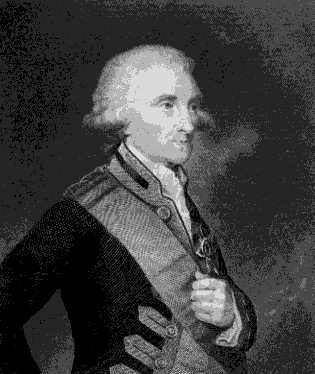
HAWKE (continued 2)
Reading edition
Hawke remained nearly two months longer, returning to England January 17, 1760. He had then been thirty-five weeks on board, without setting foot on shore. At the age of fifty-four, and amid such manifold cares, it is not to be wondered at that he should need relief. Rather must he be considered fortunate that his health, never robust in middle life, held firm till his great triumph was achieved. Boscawen succeeded him temporarily in the command.
He was received in England with acclamations and with honors; yet the most conspicuous mark of approval conferred on admirals before and after, the grant of the peerage, was not given to him, who had wrought one of the very greatest services ever done for the country. Recent precedent—that of Anson—demanded such recognition; and popular enthusiasm would have applauded, although the full military merit of the man could scarcely be appreciated by the standards of his generation. That no such reward was bestowed is most probably attributable to Hawke's own indifference to self-advancement. If demanded by him, it could scarcely have been refused; but he never pushed his own interests. His masculine independence in professional conduct, towards superiors and inferiors, found its root and its reflection in personal unconcern—as well antecedent as subsequent—about the results from his actions to his fortunes. To do his own part to the utmost, within the lines of the profession he knew, was his conception of duty. As he would not meddle with the land officers' decision as to what they should or should not do, so he left to the politicians, in whose hands the gifts lay, to decide what they would, or should, accord to a successful admiral. Pitt, the Great Commoner, left Hawke a commoner. Possibly he recognized that only by stretch of imagination could Hawke be reckoned one of the creations of a great Minister's genius.
Little remains to tell. On September 3, 1762, the admiral's flag was hauled down for the last time. He never went to sea again. In 1766, when Pitt came back to power as Lord Chatham, Hawke became First Lord of the Admiralty, and so remained till 1771. It was a time of unbroken peace, succeeding a period of continuous wars extending over a quarter of a century; consequently there was in naval and military matters the lassitude usual to such a period. Hawke is credited with formulating the principle that "the British fleet could only be termed considerable in the proportion it bore to that of the House of Bourbon;" that is, to the combined navies of France and Spain, over which that House then reigned. The maxim proves that he had some claim to statesmanship in his view of affairs outside his service; and his manifested freedom from self-seeking is the warrant that no secondary political motives would divert his efforts from this aim. That he succeeded in the main, that he was not responsible for the fallen condition of the fleet when war again arose in 1778, is evidenced by a statement, uncontradicted, in the House of Lords in 1779, that when he left office the navy had 139 ships-of-the-line, of which 81 were ready for sea.
In 1765 Hawke, who was then already a full admiral, wearing his flag at the mainmast head, was made Vice-Admiral of Great Britain; an honorary position, but the highest in point of naval distinction that the nation had to give. As one who held it three-quarters of a century later wrote, "It has ever been regarded as the most distinguished compliment belonging to our profession." The coincidence is significant that upon Hawke's death Rodney succeeded him in it; affirming, as it were, the consecutiveness of paramount influence exercised by the two on the development of the Navy. In 1776 the peerage was at last conferred; seventeen years after his great victory, and when, having passed three score and ten, a man who had ever disdained to ask must have felt the honor barren to himself, though acceptable for his son.
His last recorded professional utterances are in private letters addressed in the summer of 1780 to the commander-in-chief of the Channel Fleet—Francis Geary—who had served with him in the Bay of Biscay, though he missed Quiberon. He recommends the maintenance of his old station off Brest, and says, "For God's sake, if you should be so lucky as to get sight of the enemy, get as close to them as possible. Do not let them shuffle with you by engaging at a distance, but get within musket shot if you can. This will be the means to make the action decisive." In these words we find an unbroken chain of tradition between Hawke and Nelson. One of Hawke's pupils was William Locker; and Locker in turn, just before Hawke's death, had Nelson for a lieutenant. To him Nelson in after years, in the height of his glory, wrote, "To you, my dear friend, I owe much of my success. It was you who taught me,—'Lay a Frenchman close and you will beat him.'"
Hawke died October 16, 1781. On his tomb appear these words, "Wherever he sailed, victory attended him." It is much to say, but it is not all. Victory does not always follow desert. "It is not in mortals to command success,"—a favorite quotation with the successful admirals St. Vincent and Nelson. Hawke's great and distinctive glory is this,—that he, more than any one man, was the source and origin of the new life, the new spirit, of his service. There were many brave men before him, as there were after; but it fell to him in a time of great professional prostration not only to lift up and hand on a fallen torch, but in himself to embody an ideal and an inspiration from which others drew, thus rekindling a light which it is scarcely an exaggeration to say had been momentarily extinguished.
FOOTNOTES:
George Brydges, Lord Rodney