WALLIS NASH,
Reading edition
AUTHOR OF "OREGON, THERE AND BACK IN 1877."
Straight mine eye hath caught new pleasures,
While the landscape round it measures,
Russet lawns, and fallows gray,
Where the nibbling flocks do stray;
Mountains on whose barren breast
The lab'ring clouds do often rest;
Meadows trim with daisies pied;
Shallow brooks, and rivers wide.
L'Allegro.
Turn, Fortune, turn thy wheel with smile or frown;
With that wild wheel we go not up or down;
Our hoard is little, but our hearts are great;
Smile and we smile, the lords of many lands;
Frown and we smile, the lords of our own hands;
For man is man and master of his fate.
Tennyson.
NEW YORK: D. APPLETON AND COMPANY 1, 3, and 5 BOND STREET. 1882.
COPYRIGHT BY D. APPLETON AND COMPANY 1881.
I DEDICATE THIS BOOK
TO
MY FATHER,
WHO, THOUGH SEVERED FROM US BY LAND AND OCEAN, YET LIVES WITH US IN SPIRIT.
PREFACE TO THE SECOND EDITION.
It is my grateful task to recognize the marked kindness with which my modest volume has been received by the public and the press. It is rare that a second edition of a work of the kind should be called for within three months of the first issue, and still more rare that, out of a vast number of reviews by the leading journals all over the country, but one newspaper, and that the one I deemed it my duty to the State of Oregon to denounce (on page 216), has found aught but words of commendation.
I desire also to tender my apologies to the esteemed Roman Catholic Archbishop, and to the Sisters of Charity of Portland, for the error on my part in ascribing to Bishop Morris, of the Episcopal Church, the credit of St. Vincent's Hospital.
I ought not to have forgotten to notice the Good Samaritan Hospital and Orphanage founded by Bishop Morris.
A single remark should be added about the price or value given, on page 70, for seed-wheat as an element of the cost of the crop raised from it.
The wheat reserved by the farmer for this purpose, being exempt from the charges and waste incident to hauling, storage, insurance, and sacking, necessary in marketing, is fairly estimated at seventy cents, though the marketed portion of the crop averages eighty-five to ninety cents; the difference being composed, in part, of profit.
W. N.
PREFACE.
I send forth this book, as sequel to the sketch published three years ago, with many misgivings—rather as if one who, as a lover, had written poems in praise of his mistress, should, as a two years' husband, give to the world his experience of the fireside charms and household excellences of his wife. Perhaps the latter might more faithfully picture her than when she was seen through the glamour of a first love.
Be that as it may, it is true that the questions put from many lands, as to how we fare in this Western country, demand fuller answers than mere letter-writing can convey. I trust that those correspondents who are yet unanswered personally will find herein the knowledge they are seeking, and will accept the assurance that they are themselves to blame for some of the more solid and tedious chapters; as, if I had not known that such information were needed, I would not have ventured to put in print again that which previous and better authors have given to the world.
While I have striven to write what is really a guide-book to Oregon for the intending emigrant, others may be interested in the picture of a young community shaping the details of their common life, and claiming and taking possession of a heritage in the wilderness.
No one can go farther West than we have done: it is fair, then, to suppose that the purposes of the Western movement will be seen here in their fullest operation.
Since 1877 a vast change has taken place in this, that Oregon now shares with older States the benefits of becoming the theatre for large railroad operations.
No apology to American readers is needed for the endeavor to show things in a fairer light and different color from those chosen by persons interested in causing all men to see with their eyes. Transatlantic readers may not have the same concern; but even from them I bespeak a hearing in matters which may indirectly, if not directly, touch their interests.
But I do not wish to suggest that I write as having only a general feeling that certain things would be the better for a more open discussion than they have hitherto received. My own affairs, and those of many friends, both in Oregon and elsewhere, and, indeed, the successful development of this great Willamette Valley, largely depend on our convincing an unprejudiced public that Nature is on our side in the effort we are making to secure a direct and near outlet to the great world.
I only claim in these particulars to be an advocate, but I add to this a full and honest conviction of the justice of the views for which I contend.
To turn again to more general matters, I have the pleasant duty of thanking several friends who have contributed to the information here collected.
To our shame be it said that there was not, among our English immigrants, one naturalist who could rightly name the birds, beasts, fishes, and insects in our Western home. But I was fortunate in finding an American friend, Mr. O. B. Johnson, of Salem, whose complete and accurate knowledge of these subjects only rendered more easy his kindly endeavors to give me the benefit of all his stores.
I wish to acknowledge also the care with which, ever since our visit in 1877, the professors at the Corvallis Agricultural College have kept the records of climate and rainfall, the results of which are now published.
I trust that, if any sketches in these pages are recognized as portraits, not one grain of offense will be taken by those who have unwittingly served as models in the life-studio.
Or that, if any effect is produced, it may be as good and lasting as that which followed on a fancy picture in the former book, in which many stray touches were collected. Whether the cap fitted, or was pressed on his head by too officious neighbors, I know not; but this I know, that cleared fields, neat fences, new barn, clean house, and fitting furniture, rendered it impossible for me to recognize a tumbledown place which then served to point a warning. These improvements, I am told, the owner lays at my unconscious door.
Wallis Nash.
Corvallis, Oregon, April 14, 1881.
CONTENTS.
PAGE
CHAPTER I.
Personal reasons for coming to Oregon—Plans of colonizing—Who came—Who have returned—Who remain—Bowie-knives and revolvers—A sheriff in danger—No tragedy—Our landing at Corvallis—Frail houses—Pleasant welcome—The barber's shop—Its customers—Given names—New acquaintances—Bright dresses—Religious denominations. 17
CHAPTER II.
Where we live—Snow-peaks and distant prospects—Forest-fires—The Coast Mountains and Mary's Peak—Sunset in Oregon—Farmhouses: the log-cabin, the box-house, the frame-house—Dinner at the farm—Slay and eat—A rash chicken—Bread-making by amateurs—Thrift and unthrift—Butter and cheese—Products of the "range," farm, and garden—Wheat-growing. 26
CHAPTER III.
The land-office; its object and functionaries—How to find your land—Section 33—The great conflagration—The survivors of the fire—The burnt timber and the brush—The clearing-party—Chopping by beginners—Cooking, amateur and professional—The wild-cat—Deer and hunting—Piling brush—Dear and cheap clearing—The skillful axeman—Clearing by Chinamen—Dragging out stumps—What profits the farmer may expect on a valley farm—On a foot-hills farm. 36
CHAPTER IV.
A spring ride in Oregon—The start—The equipment—Horses and saddlery—Packs—The roadside—Bird fellow-travelers—Snakes—The nearest farm—Bees—The great pasture—The poisonous larkspur— Market-gardening—The Cardwell Hill—The hill-top—The water-shed —Mary River—Crain's—The Yaquina Valley—Brush, grass, and fern —The young Englishmen's new home—A rustic bridge—"Chuck-holes"— The road supervisor—Trapp's—The mill-dam—Salmon-pass law—Minnows and crawfish—The Pacific at rest—Yaquina—Newport. 48
CHAPTER V.
Hay-harvest—Timothy-grass—Permanent pasture—Hay-making by express—The mower and reaper—Hay-stacks as novelties— Wheat-harvest—Thrashing—The "thrashing crowd"—"Headers" and "self-binders"—Twine-binders and home-grown flax—Green food for cows—Indian corn, vetches—Wild-oats in wheat—Tar-weed the new enemy—Cost of harvesting—By hired machines—By purchased machines—Cost of wheat-growing in the Willamette Valley. 62
CHAPTER VI.
The farmer's sports and pastimes—Deer-hunting tales—A roadside yarn—Still-hunting—Hunting with hounds—An early morning's sport—Elk—The pursuit—The kill—Camp on Beaver Creek— Flounder-spearing by torchlight—Flounder-fishing by day—In the bay—Rock oysters—The evening view—The general store—Skins— Sea-otters—Their habits—The sea-otter hunters—Common otter—The mink and his prey. 72
CHAPTER VII.
Birds in Oregon—Lark—Quail—Grouse—Ruffed grouse—Wild-geese— Manœuvres in the air—Wild-ducks—Mallard—Teal—Pintail— Wheat-duck—Black-duck—Wood-duck—Snipe—Flight-shooting— Stewart's Slough—Bitterns—Eagles—Hawks—Horned owls—Woodpeckers —Blue-jays—Canaries—The canary that had seen the world—Blue-birds —Bullfinches—Snow-bunting—Humming-birds at home. 91
CHAPTER VIII.
Up to the Cascades—Farming by happy-go-lucky—The foot-hills—Sweet Home Valley—Its name, and how deserved and proved—The road by the Santiam—Eastward and upward—Timber—Lower Soda Springs—Different vegetation—Upper Soda Springs—Mr. Keith—Our reception—His home and surroundings—Emigrants on the road—The emigrant's dog—Off to the Spokane—Whence they came—Where they were bound—Still eastward— Fish Lake—Clear Lake—Fly-fishing in still water—The down slope east—Lava-beds—Bunch-grass—The valleys in Eastern Oregon—Their products—Wheat-growing there—Cattle-ranchers—Their home—Their life—In the saddle and away—Branding-time—Hay for the winter—The Malheur reservation—The Indians' outbreak—The building of the road—When, how, and by whom built—The opening of the pass—The history of the road—Squatters—The special agent from Washington—A sham survey. 100
CHAPTER IX.
Indian fair at Brownsville—Ponies—The lasso—Breaking-in—The purchase—"Bucking" extraordinary—Sheep-farming in Eastern Oregon— Merinos—The sheep-herder—Muttons for company—A good offer refused—Exports of wool from Oregon-Price and value of Oregon wool—Grading wool—Price of sheep—Their food—Coyotes—The wolf-hunt—Shearing—Increase of flocks—"Corraling" the sheep— Sheep as brush-clearers. 118
CHAPTER X.
The trail to the Siletz Reserve—Rock Creek—Isolation—Getting a road—The surveying-party—Entrance at last—Road-making—Hut-building in the wilds—What will he do with it?—Choice of homestead—Fencing wild land—Its method and cost—Splitting cedar boards and shingles— House-building—The China boy and the mules—Picnicking in earnest—Log-burning—Berrying-parties—Salting cattle—An active cow—A year's work—Mesquit-grass on the hills. 127
CHAPTER XI.
The Indians at home—The reservation—The Upper Farm—Log-cabins— Women must work while men will play—The agency—The boarding-house —Sunday on the reservation—Indian Sun day-school—Galeese Creek Jem—The store-Indian farmers—As to the settlement of the Indians —Suggestions—A crime—Its origin—Its history—The criminals— What became of them—Indian teamsters—Numbers on the reservation —The powers and duties of the agent—Special application. 136
CHAPTER XII.
The Legislative Assembly—The Governor—His duties—Payment of the members—Aspect of the city; the Legislature in session—The lobbyist—How bills pass—How bills do not pass—Questions of the day—Common carriers—Woman's suffrage—Some of the acts of 1878—Judicial system of the State—Taxes—Assessments—County officers—The justice of the peace—Quick work. 145
CHAPTER XIII.
Land laws—Homesteads and preëmption—How to choose and obtain Government land—University land—School land—Swamp land—Railroad and wagon-road grants—Lieu lands—Acreages owned by the various companies. 157
CHAPTER XIV.
The "Web-foot State"—Average rainfall in various parts—The rainy days in 1879 and 1880—Temperature—Seasons—Accounts and figures from three points—Afternoon sea-breezes—A "cold snap"—Winter— Floods—Damage to the river-side country—Rare thunder—Rarer wind-storms—The storm of January, 1880. 164
CHAPTER XV.
The State Fair of 1880—Salem—The ladies' pavilion—Knock-em-downs à l'Américaine—Self-binders—Thrashing-machines—Rates of speed—Cost—Workmanship—Prize sheep—Fleeces—Pure versus graded sheep—California short-horns—Horses—American breed or Percheron—Comparative measurements—The races—Runners—Trotters— Cricket in public—Unruly spectators. 174
CHAPTER XVI.
History of Oregon—First discoverers—Changes of government— Recognition as a Territory—Entrance as a State—Individual histories—"Jottings"—"Sitting around"—A pioneer in Benton County—How to serve Indian thieves—The white squaw and the chief—Immigration in company—Rafting on the Columbia—The first winter—Early settlement—Indian friends—Indian houses and customs—The Presbyterian colony—The start—Across the plains— Arrival in Oregon—The "whaler" settler—A rough journey—"Ho for the Umpqua!"—A backwoodsman—Compliments—School-teacher provided for—Uncle Lazarus—Rogue River Cañon—Valley of Death—Pleasant homes—Changed circumstances. 183
CHAPTER XVII.
State and county elections—The Chinese question—Chinese house-servants—Washermen—Laborers—A large camp—Supper—Chinese trading—The scissors—Cost of Chinese labor—Its results—Chinese treaties—Household servants—Chee and his mistress—"Heap debble-y in there"—The photo album—Temptation—A sin and its reward—Good advice on whipping—Chung and the crockery—Chinese New Year—Gifts— "Hoodlums"—Town police—Opium. 201
CHAPTER XVIII.
Life in the town—Sociables—Religious sects—Sabbath-schools— Christmas festivities—Education, how far compulsory—Colleges— Student-life and education—Common schools—Teachers' institutes— Newspapers—Patent outsides-"The Oregonian"—Other journals—Charities —Paupers—Secret societies. 209
CHAPTER XIX.
Industries other than farming—Iron-ores—Coal—Coos Bay mines— Seattle mines—Other deposits—Lead and copper—Limestone—Marbles— Gold, where found and worked—Silver, where found and worked—Gold in sea-sand—Timber—Its area and distribution—Spars—Lumber—Size of trees—Hard woods—Cost of production and sale of lumber—Tanneries —Woolen-mills—Flax-works—Invitation to Irish—Salmon—Statistics of the trade—Methods—Varieties of salmon—When and where caught— Salmon-poisoning of dogs—Indians fishing—Traps—Salmon-smoking. 219
CHAPTER XX.
Eastern Oregon—Going "east of the mountains"—Its attractions— Encroaching sheep—First experiments in agriculture and planting— General description of Eastern Oregon—Boundaries—Alkaline plains— Their productions—The valleys—Powder River Valley—Description— The Snake River and its tributaries—The Malheur Valley—Harney Lake Valley—Its size—Productions—Wild grasses—Hay-making—The winters in Eastern Oregon—Wagon-roads—Prineville—Silver Creek—Grindstone Creek Valley—Crooked River—Settlers' descriptions and experiences— Ascent of the Cascades going west—Eastern Oregon towns—Baker City—Prineville—Warnings to settlers—Growing wheat for the railroads to carry. 231
CHAPTER XXI.
Southern Oregon—Its boundaries—The western counties—Population— Ports—Rogue River—Coos Bay—Coal—Lumber—Practicable railroad routes—The harbor—Shifting and blowing sands—A quoted description —Cost of transportation—Harbor improvements—Their progress and results—The Umpqua—Douglas County—Jackson County—The lake-country —Linkville—Water-powers—Indian reservations—The great mountains— Southeastern Oregon—General description—Industries. 243
CHAPTER XXII.
The towns—Approach to Oregon—The steamers—The Columbia entrance— Astoria—Its situation, industries, development—Salmon—Shipping— Loading and discharging cargo—Up the Columbia and Willamette to Portland—Portland, West and East—Population—Public buildings— United States District Court—The judge—Public Library—The Bishop schools—Hospital—Churches—Stores—Chinese quarter—Banks—Industries —The city's prosperity—Its causes—Its probable future—The Oregon Railway and Navigation Company—Shipping abuses and exactions— Railroad termini—Up the Columbia—The Dalles—Up the Willamette— Oregon City, its history—The falls—Salem—Its position and development—Capitol buildings—Flour-mills—Oil-mills—Buena Vista potteries—Albany—Its water-power—Flour-mills—Values of land— Corvallis—The line of the Oregon Pacific Railroad—Eugene, its university and professors—Roseburg—The West-side Railroad to Portland—Development of the country—Prosperity—Counties of Oregon —Their population—Taxable property—Average possessions—In the Willamette Valley—In Eastern Oregon—In Eastern Oregon tributary to Columbia and Snake Rivers. 252
CHAPTER XXIII.
The transportation question—Its importance—Present legal position —Oregon Railway and Navigation Committee's general report—That company—Its ocean-going steamers—Their traffic and earnings—Its river-boats—Their traffic and earnings—Its railroads in existence —Their traffic and earnings—Its new railroads in construction and in prospect—Their probable influence—The Northern Pacific— Terminus on Puget Sound—Its prospects—The East and West Side Railroads—"Bearing" traffic and earnings—How to get "control"— Lands owned by the Oregon Railway and Navigation Company—Monopoly —How threatened—The narrow-gauge railroads—Their terminus and working—Efforts to consolidate monopoly—The "blind pool"—Resistance —The Oregon Pacific—Its causes, possessions, and prospects—Land grant and its enemies—The traffic of the valley—Yaquina Bay—Its improvement—The farmers take it in hand—Contrast and comparisons —The two presidents—Probable effects of competition—Tactics in opposition—The Yaquina improvements—Description of works—The prospects for competition and the farmers' gains. 271
CHAPTER XXIV.
Emigration to Oregon—Who should not come—Free advice and no fees—English emigrants—Farmers—Haste to be rich—Quoted experiences—Cost and ways of coming—Sea-routes—Railroads— Baggage—What not to bring—What not to forget—Heavy property— The Custom-house—San Francisco hotels—Conclusion. 293
Appendix. 305
TWO YEARS IN OREGON.
CHAPTER I.
Personal reasons for coming to Oregon—Plans of colonizing—Who came—Who have returned—Who remain—Bowie-knives and revolvers—A sheriff in danger—No tragedy—Our landing at Corvallis—Frail houses—Pleasant welcome—The barber's shop—Its customers—Given names—New acquaintances—Bright dresses—Religious denominations.
After visiting Oregon in the year 1877, and traveling with three or four companions through its length and breadth, I ventured to publish in England on my return a short account of our seeings and doings.
While the reception of this book by the reviews generally was only too kind and flattering, one paper, the "Athenæum," distinguished me by a long notice, the whole point of which lay in the observation that it would be interesting to know if I, who had been recommending Oregon to others, were prepared to take my own prescription, and emigrate there myself.
Now, although it would not perhaps be fair to make all physicians swallow their own medicines, regardless whether or not they were sick, and although I certainly was not in any position rendering emigration necessary, or in the opinion of any of my friends and acquaintances even desirable, yet I did not like it to be possible to be accused rightly of recommending a course so serious as a change of dwelling-place and even of nationality, without being willing to prove by my own acts the genuineness of the advice I had given.
And this, among other motives and inducements, had a strong influence in overcoming the crowd of hesitations and difficulties which spring up when so great a change begins to be contemplated as possible.
And it is no more than natural that now, having had two years' experience in Oregon, I should desire to have it known if it be necessary to recall the general advice given in the former book, advocating, as undoubtedly I then did advocate, Oregon as a desirable residence.
But, as this involves my putting into some kind of literary shape our experiences for the past two years in this far Western land, it is better to begin by some general relation of our plans.
When I undertook to come out with my wife and children and see to the settlement and disposal of the tract of land we had purchased, as one result of my visit in 1877, I was applied to by a good many fathers to take some superintendence of their sons, who desired to emigrate to Oregon. Next, one or two married couples expressed a wish to join us. Then several acquaintances, who were practical mechanics, had heard a good report of Oregon, and desired to accompany us. And I was busy in answering letters about the place and people to the very moment of sailing.
I was not at all willing to have the company indefinitely numerous, not having graduated in Mr. Cook's school for tourists, and knowing something of the embarrassments likely to attend a crowd of travelers. We found our party of twenty-six fully large enough for comfort. We were kindly and liberally treated by the Allan Steamship Company, the Grand Trunk Railway of Canada, and the Chicago and Northwestern Railway; but our lines did not fall to us in pleasant places when we experienced the tender mercies of the Union and Central Pacific. Our party was broken up into different cars, and our strongest portmanteaus were shattered by the most atrocious handling.
PLANS OF COLONIZING. It was a serious question if we should try to found an English colony here, in the usual sense of the word. That would have involved a separate life from the American residents; it would have fostered jealousy here, and we should have committed numberless mistakes and absurdities. We should have had to buy all our experience, amid the covert ridicule of our neighbors. And I was confident that many members of our party would have played at emigrating, and treated the whole business as picnicking on a large scale. Moreover, I was not sure that, even if we succeeded in transplanting English manners, customs, and institutions, they would take hold in this new soil. The fact was always before my eyes that the country was only thirty years old, in a civilized sense, and I doubted the wisdom of trying to transport thither a little piece of the old country.
I believed the wiser course to be to plant ourselves quietly among the Oregonians with as little parade and fuss as possible, and to let our own experience dictate to others whether to join us or not.
It has been our practice throughout to answer freely, and as fully as possible, the many letters of inquiry as to place and people that we have had, but to offer no advice; leaving those who were thinking of coming out to take the responsibility on themselves of deciding to come or to stay away.
Under this system our numbers have grown to upward of a hundred, and now rarely a month passes without additions. Of course, a process of natural selection goes on all the time. Not every one who comes remains; but we have every reason to be satisfied with the representatives of the mother-country who are making Oregon their permanent home, and the same feeling is shared, as I am confident, by the original residents.
Shall I try to describe what sort of people we live among here, a hundred miles from Portland, the chief city in the State?
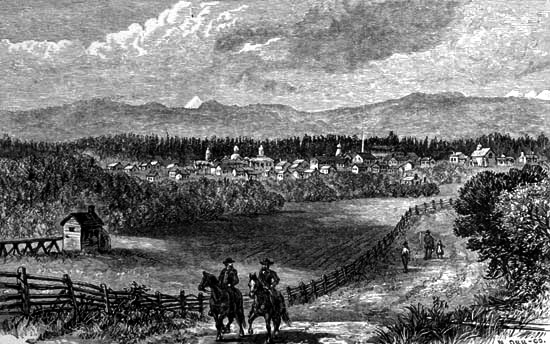
Corvallis, 1880.
What the notions of some of our party were you will understand when I mention that all I could say could not prevent the young men of the party from arming themselves, as for a campaign in the hostile Indian country, so that each man stepped ashore from the boat that brought us up the Willamette with a revolver in each pocket, and the hugest and most uncompromising knives that either London, New York, or San Francisco could furnish.
OUR LANDING AT CORVALLIS. As ill luck would have it, just as we arrived, the sheriff had returned to town with an escaped prisoner, and had been set upon by the brother, and a pistol had been actually presented at him. I should say in a whisper that the sheriff, worthy man, had proposed to return the assault in kind, but had failed to get his six-shooter out in time from the depths of a capacious pocket, where the deadly weapon lay in harmless neighborhood, with a long piece of string, a handful or so of seed-wheat, a large chunk of tobacco, a leather strap and buckle, and a big red pocket-handkerchief. So I fancy he had not much idea of shooting when he started out.
But the incident was enough to give a blood-color to all our first letters home, and I dare say caused a good many shiverings and shudders at the thought of the wild men of the woods we had come to neighbor with.
The worst of it was, that it was the only approach to a tragedy, and that we have had no adventures worth speaking of. "Story, God bless you! I have none to tell, sir." Still we did know ourselves to be in a new world when we stepped ashore from the large, white-painted, three-storied structure on the water that they called a stern-wheel river-boat, and in which we had spent two days coming up the great river from Portland. It was the 17th of May, just a month from leaving Liverpool, that we landed. The white houses of the little city of Corvallis were nestled cozily in the bright spring green of the alders and willows and oaks that fringed the river, and the morning sun flashed on the metal cupola of the court-house, and lighted up the deep-blue clear-cut mountains that rose on the right of us but a few miles off.
When we got into the main street the long, low, broken line of booth-like, wooden, one-storied stores and houses, all looking as if one strong man could push them down, and one strong team carry them off, grated a little, I could see, on the feelings of some of the party. The redeeming feature was the trees, lining the street at long intervals, darkening the houses a little, but clothing the town, and giving it an air of age and respectability that was lacking in many of the bare rows of shanties, dignified with the title of town, that we had passed in coming here across the continent.
The New England Hotel invited us in. A pretty plane-tree in front overshadowed the door; and a bright, cheery hostess stood in the doorway to welcome us, shaking hands, and greeting our large party of twenty-six in a fashion of freedom to which we had not been used, but which sounded pleasantly in our travel-worn ears. The house was tumble-down and shabby, and needed the new coat of paint it received soon after—but in the corner of the sitting-room stood a good parlor-organ. The dining-room adjoining had red cloths on the tables, and gave a full view into the kitchen; but the "beefsteak, mutton-chop, pork-chop, and hash" were good and well cooked, and contrasted with, rather than reminded us of, the fare described by Charles Dickens as offered him in the Eastern States when he visited America thirty-nine years ago.
The bedrooms, opening all on to the long passage upstairs, with meager furniture and patchwork quilts, the whole wooden house shaking as we trotted from room to room, were not so interesting, and tempted no long delay in bed after the early breakfast-gong had been sounded soon after six. Breakfast at half-past six, dinner at noon, and supper at half-past five, only set the clock of our lives a couple of hours faster than we had been used to; and bed at nine was soon no novelty to us.
The street in front was a wide sea of slushy mud when we arrived, with an occasional planked crossing, needing a sober head and a good conscience to navigate safely after dark; for, when evening had closed in, the only street-lighting came from the open doors, and through the filled and dressed windows of the stores.
THE BARBER'S SHOP.Saloons were forbidden by solemn agreement to all of us, but the barber's shop was the very pleasant substitute. Two or three big easy-chairs in a row, with a stool in front of each. Generally filled they were by the grave and reverend seigniors of the city—each man reposing calmly, draped in white, while he enjoyed the luxury, under the skillful hands of the barber or his man, of a clean shave. At the far end of the shop stood the round iron stove, with a circle of wooden chairs and an old sofa. And here we enjoyed the parliament of free talk. The circle was a frequently changing one, but the types were constant.
The door opened and in came a man from the country: such a hat on his head! a brim wide enough for an umbrella, the color a dirty white; a scarlet, collarless flannel shirt, the only bit of positive color about him; a coat and trousers of well-worn brown, canvas overall (or, as sometimes spelled, "overhaul"), the trousers tucked into knee-high boots, worn six months and never blacked. His hands were always in his pockets, except when used to feed his mouth with the constant "chaw."—"Hello, Tom," he says slowly, as he makes his way to the back, by the stove. "Hello, Jerry," is the instant response. "How's your health?" "Well; and how do you make it?" "So-so." "Any news out with you?" "Wall, no; things pretty quiet." And he finds a seat and sinks into it as if he intended growing there till next harvest.
We all know each other by our "given" names. I asked one of our politicians how he prepared himself for a canvass in a county where I knew he was a stranger this last summer. "Well, I just learned up all the boys' given names, so I could call them when I met them," was the answer. "I guess knowing 'em was as good as a hundred votes to me in the end." It was a little startling at first to see a rough Oregonian ride up to our house, dismount, hitch his horse to the paling, and stroll casually in, with "Where's Herbert?" as his first and only greeting. But we soon got used to it.
But the barber's shop was, and is, useful to us, as well as amusing. The values and productiveness of farms for sale, the worth and characters of horses, the prices of cattle, the best and most likely and accessible places for fishing, and deer-shooting, and duck-hunting—all such matters, and a hundred other things useful for us to know, we picked up here, or "sitting around" the stoves in one or other of the stores in the town.
Another good gained was, that thus our new neighbors and we got acquainted: they found we were not all the "lords" they set us down for at first, with the exclusiveness and pride they attributed to that maligned race in advance; while we on our side found a vast amount of self-respect, of native and acquired shrewdness, of legitimate pride in country, State, and county, and a fund of kindly wishes to see us prosper, among our roughly dressed but really courteous neighbors.
There was a good deal of feminine curiosity displayed on either side, by the natives and the new-comers. When we went to church the first Sunday after our arrival, there were a good many curious worshipers, more intent on the hats and bonnets of the strangers than on the service in which we united. We heard afterward how disappointed they were that the stranger ladies were so quietly and cheaply dressed. We could not say the same when callers came, which they speedily did after we were settled in our new home—such tight kid gloves, and bright bonnets, and silk mantles! It was a constant wonder to our women-folk how their friends managed to show as such gay butterflies, two thousand miles on the western side of everywhere.
RELIGIOUS DENOMINATIONS.We found here, in a little town of eleven hundred inhabitants, all kinds of religious denominations represented—Episcopalians, Presbyterians, Roman Catholics, Methodists North, and Methodists South, Evangelicals, and Baptists—but very little rivalry and no rancor. I shall have something more to say about the religious life later on, but I think I will reserve the description of our home, and of those of some of our neighbors, for a fresh chapter.
CHAPTER II.
Where we live—Snow-peaks and distant prospects—Forest-fires—The Coast Mountains and Mary's Peak—Sunset in Oregon—Farmhouses: the log-cabin, the box-house, the frame-house—Dinner at the farm—Slay and eat—A rash chicken—Bread-making by amateurs—Thrift and unthrift—Butter and cheese—Products of the "range," farm, and garden—Wheat-growing.
You might look the world over for a prettier spot than that on which this house stands. Just a mile from Corvallis, on a gently rounded knoll, we look eastward across the town, and the river, and the broad valley beyond, to the Cascade Mountains.
Their lowest range is about thirty miles off, and the rich flat valley between is hidden by the thick line of timber, generally fir, that fringes the farther side of the Willamette. Against the dark line of timber the spires of the churches and the cupola of the court-house stand out clear, and the gray and red shingled roofs of the houses in the town catch early rays of the rising sun.
The first to be lighted up are the great snow-peaks, ninety, seventy, and fifty miles off—a ghostly, pearly gray in the dim morning, while the lower ranges lie in shadow; but, as the sun rises in the heavens, these same lower ranges grow distinct in their broken outlines. The air is so clear that you see plainly the colors of the bare red rocks, and the heavy dark, fir-timber clothing their rugged sides. Ere the sun mounts high the valley often lies covered with a low-lying thin white mist, beyond and over which the mountains stand out clear.
For some weeks in the late summer heavy smoke-clouds from the many forest and clearing fires obscure all distant view. This last summer fires burned for at least fifty miles in length at close intervals of distance, and the dark gray pall overlay the mountains throughout. Behind the house, and in easy view from the windows on either side, are the Coast Mountains, or rather hills.
Mary's Peak rises over four thousand feet, and is snow-crowned for nine months in the year. The outlines of this range are far more gently rounded than the Cascades, and timber-covered to the top. Save for the solid line of the heavy timber, the outlines of the Coast Range constantly remind us of our own Dartmoor; and the illusion is strengthened by the dark-red soil where the plow has invaded the hills, yearly stealing nearer to their crowns. Mary's Peak itself is bare at the top for about a thousand acres, but the firs clothe its sides, and the air is so clear that, in spite of the seventeen miles' distance, their serrated shapes are plainly and individually visible as the sun sinks to rest behind the mountain.
SUNSET IN OREGON.Such sunsets as we have! Last night I was a mile or two on the other side of the river as night fell. Mount Hood was the first to blush, and then Mount Jefferson and the Three Sisters in turn grew rosy red. From the valley I could not see the lower Cascades, but these snowy pyramids towered high into the sky. One little fleecy cloud here and there overhead caught the tinge, but the whole air on the eastern side was luminously pink. Turning westward, the pale-blue sky faded through the rainbow-green into the rich orange surrounding the departing sun; and the westward mountains stood solidly and clearly blue in massive lines.
One great peculiarity of the Oregon landscape, as distinguished from an English rather than a New England scene, is in the number of white farmhouses that catch the eye. We see many from our windows. I suppose it is that the roads are so bad in winter that the farmers must live on the farms, instead of in the English-village fashion. So it is that you may travel by railroad up and down this valley for two hundred miles between farmhouses every quarter or half mile all the way. Nearly every farmhouse has its orchard close by; but one big barn is all the out-buildings they boast, and farm-yard, in the English sense, one never sees.
Our own house is not a fair specimen, because of our large family and its corresponding habitation; but the regular farmhouse is by no means an uncomfortable abode.
There are three kinds: log-cabin, box-house, frame-house.
FARMHOUSES.The first, by far the most picturesque type, is fast becoming obsolete, and on most of the good farms, if not pulled down, is degraded into woodhouse or piggery. But to my eye there is something rarely comfortable in the low, solid, rugged walls of gray logs, with overhanging shingled roof; the open hearth, too, with its great smoldering back-log and wide chimney, invites you to sit down before it and rest. By the side of the fireplace, from two deers' horns fastened to the wall, hangs the owner's rifle—generally an old brown veteran—with bullet-pouch and powder-horn. Over the high mantel-shelf stands the ticking clock, suggesting "Sam Slick, the clock-maker." Curtained off from the main room, with its earthen or roughly-boarded floor, are the low bedsteads of the family, each covered with its patchwork quilt. A corner cupboard or two hold the family stock of cups and plates, and the smell of apples, from the adjoining apple-chamber, pervades the house.
Round the house is the home-field, generally the orchard, sown with timothy-grass, where range four or five young calves, and a sow or two, with their hungry, rooting youngsters. The barn, log-built also, stands near by, with two or three colts, or yearling cattle, grouped around. The spring of cold, clear water runs freely through the orchard, but ten yards from the house-door, hastening to the "creek," whose murmur is never absent, save in the few driest weeks of summertime.
Snake-fences, seven logs high, with top-rail and crossed binders to keep all steady, divide the farm from the road, and a litter of chips from the axe-hewed pile of firewood strew the ground between wood-pile and house. Here and there, even in the home-field, and nearly always in the more distant land, a big black stump disfigures the surface, and betrays the poverty or possibly the carelessness of the owner, who has carved his homestead from the brush.
But as the farmer prospers, be it ever so little, he hastens to pull down his log-cabin and to build his "box" or more expensive "frame" house. In each case the material is "lumber." By this is signified, be it known to the uninitiated, fir boards, one foot wide, sixteen feet long, and one inch thick.
The "box" house is built of boards set upright, and the cracks covered with strips of similar board, three inches wide.
The "frame" house is double throughout, the boards run lengthwise, and there is a covering outside of an outer skin of planking.
With the box or frame house comes the inevitable stove. The cooking and eating of the family go on in a lean-to room, and the living-room is furnished with some pretensions, always with a sewing-machine, and often with a parlor-organ or piano. Muslin curtains drape the windows; a bureau is generally present, and chromos, or very rough engravings, hang on the walls. The political tendencies of the owner betray themselves. General Grant, with tight-buttoned coat and close-cut beard, or President Lincoln and his family, show the Republican. Strangely enough, General Lee, with a genial smile on his attractive face, is affected by the Democrats. The followers of the greenback heresy delight in Brick Pomeroy, with clean-shaven, smug, and satisfied look.
DINNER AT THE FARM.It is not the fashion to carry provisions with you on journeys in Oregon. When meal-time draws near, and hotels are many miles away, you ride boldly up to the nearest farm, dismount, throw your horse's rein over the paling, and walk in. The lady of the house appears, from the cooking department at the rear, and you say: "Good-morning, madam; can I get dinner with you?" Unless there is grave reason to the contrary, she considers a moment, and then answers, "I guess so," with a hospitable smile. The next question is as to your horse, which one of the children leads into the barn, and then fills out a goodly measure of oats, and crams the rack with hay from the pile filling the middle of the barn. While your hostess adds a little to the family meal, you turn over the newspapers in the sitting-room, generally finding a "Detroit Free Press," or a "Toledo Blade," or a New York "World" or "Tribune," or a San Francisco "Bulletin" or "Chronicle," besides the local weekly. If you want books, you must take to the "Pacific Coast Reader," the last school-book, which you are sure to find on the shelf; unless you chance on a "Universal History," or the "History of the Civil War," or the "Life of General Jackson," or the "Life of General Custer," or a collection of poetry in an expensive binding, all of which signify that the book-peddler has been paying a recent visit.
Then your hostess returns, saying, "Will you come and eat?" If you go into the back room—where, generally, the master of the house and you, the visitor, and perhaps a grown-up son, or a farming hand, sit down and dine, while the mistress and her daughter serve—you will not starve.
In front of you is a smoking dish of meat, either pork or mutton, salted, cut into square bits and fried; rarely beef, more often venison, or deer-meat, as it is called here. By it is piled up a dish of mashed potatoes, and a tureen of white, thick sauce. A glass dish of stewed apples, or apple-sauce, and one of preserved pears or peaches, and a smaller dish of blackberry or plum jam, complete the meal, with the constant coffee, and generally a big jug of milk. The bread is brought you in sets of hot, square rolls, fresh from the stove. It is not always that you can get cold bread, and a look of surprise always follows the request for it.
Generally, a good supply of white beans, boiled soft, and with a slice or two of bacon, is an important item. Apples, and the best of them, too, you can have for the asking—too common to be offered to you.
This régime applies to breakfast, dinner, and supper, with but slight variations. I forgot, though, the saucer of green, sharp, vinegary gherkins, which the Oregonians seem not to know how to do without, and also the honey, and trout, which are the frequent and welcome additions to the meal among the hills.
My wife and I dropped in once to a dinner of this kind. We were sitting, cooling ourselves on the veranda, watching some pretty, black Spanish chickens scratching among the scanty rose-bushes in front. The farmer's wife came quickly out and addressed me: "Have you got your revolver?" I stared for a moment, thinking of tramps, and bears, and I know not what. "I never carry one on horseback," I answered. "Oh," said she, "I would have had you shoot the head off one of them chickens, for I've got no fresh meat." Inwardly I congratulated ourselves that our dinner did not altogether depend on my skill with that common, but, to my mind, very unsatisfactory weapon.
One of my friends bought out an Oregonian farmer, and paid him for stock and lot, including some fine fowls. Dropping in to dinner two days afterward, he found a smoking chicken on the board. I suppose he eyed it askance, for the farmer observed: "That's one of your chickens I killed by accident. I saw some wild-geese feeding on the wheat, and fetched the rifle, and that there foolish rooster got right in the way of the bullet."
BREAD-MAKING BY AMATEURS.If any friends of yours think of coming out, send them to the school of cookery, I implore you. It is the greatest possible quandary to be in, to be set down with flour, water, and a tin of saleratus or baking-powder, and to have to make the bread or go without. Then, to convert chickens running about your house into food for man is not so easy as it looks; nor is cooking beans or potatoes a matter of pure instinct, I assure you. Shall I ever forget riding up at nearly three in the afternoon, to one of our Englishmen's farms, to find the proprietor standing, coat off and sleeves turned up, before a huge, round tin of white slush? When he saw me come in, he lifted out his hands and rubbed off the white dripping mess, saying: "I'll be hanged if I'll try any longer; since eleven o'clock have I been after this beastly bread! Can you make it? Is this stuff too thin or too thick, or what?" It is true that he makes fine bread now; but if you could but know the stages of slackness, heaviness, soddenness, flintiness, that he and his friends passed through, you would see that I was giving a useful hint, and one that applies to the feminine emigrant quite as much as to the masculine. Another thing strikes us out here, namely, the waste that pervades an average Oregon farmer's household. Does he kill a deer? He leaves the fore half of the creature, and all the internals, in the wood where he killed it, taking home only the hind-quarters and the hide. If he kills a hog, the head is thrown out, to be rolled round and gnawed at by the dogs; the same with a sheep or a calf.
Half of them will not even take the trouble to have butter, letting the calves get all the milk, but just a little for the meals. You rarely see eggs on the table, though there may be scores of hens about.
You will hardly believe that large quantities of butter and cheese are imported into this valley, both from California and from Washington Territory, and cheese even from the East, though there can not be a finer dairy country than this, if they would but look a little ahead and provide some green food for the cows for the interval between the hay-crop off the timothy-grass and the fresh growth of the same from the autumn rains.
It is still more inexcusable among the hills, where the grass keeps green all the year round. The exclusive devotion to wheat is what will very shortly and most surely impoverish the country; and therefore it is that, in the interests of Oregon, I am so anxious that many farmers should come here who are familiar with mixed farming, and will apply it to our deep, rich, stoneless soil, and will thus avert the inevitable consequences of wheat, wheat, wheat, continuously for fifteen, twenty, ay, and thirty years.
It is not that other crops and other pursuits do not answer here. Sheep, cattle, and horses thrive and multiply. Oregon valley wool ranks among the very best. The Angora goat takes to Western Oregon as if it were his native home, and produces yearly from three to four pounds of hair, worth from sixty to eighty cents a pound. Beans, peas, carrots, parsnips grow as I have never seen them elsewhere. Swedish turnips have succeeded well in this valley, and nearer the coast the white turnips I have seen nearly as big as your head, and good all through. I saw a large heap of potatoes the other day that averaged six inches long, and perfectly clean and free from all taint. Carrots we grew ourselves that weighed from one and a half to two pounds all round. Barley thrives splendidly, with a full, round, clear-skinned berry. Oats I need hardly mention, as the export of this cereal is very large, and the quality is undeniable.
The common red clover grows in a half-acre patch in my neighbor's field waist-high, and he cut it three times last year. We have the humble-bee (or, at any rate, a big fellow just like the English humble-bee—for I never handled one to examine it closely) to fertilize the clover. The white Dutch clover spreads wherever it gets a chance.
WHEAT-GROWING.But the temptation to grow wheat is very strong. It is the staple product of the State, and hardly ever fails in quality. The farmers understand it; their system of life is organized with a view to it. A thousand bushels of wheat in the warehouse is as good as money in the bank, and is in reality a substitute for it. There is a clear understanding of what it costs to plant, harvest, and warehouse, and it involves the lowest amount of trouble and anxiety.
Therefore, Oregon grows wheat, and will grow it; and men will grow nothing else until the consequences are brought home to them.
CHAPTER III.
The land-office; its object and functionaries—How to find your land—Section 33—The great conflagration—The survivors of the fire—The burnt timber and the brush—The clearing-party—Chopping by beginners—Cooking, amateur and professional—The wild-cat—Deer and hunting—Piling brush—Dear and cheap clearing—The skillful axeman—Clearing by Chinamen—Dragging out stumps—What profits the farmer may expect on a valley farm—On a foot-hills farm.
By the time we had been here about a month and had settled down a little, we set about clearing a tract of wild land called section 33, situated nearly twenty miles away. You will ask, What does section 33 mean? Oregon is divided into several districts. For the Willamette Valley the land-office is at Oregon City, one of the most ancient towns in the State, having a history of forty years, dating from the rule of the Hudson's Bay Company. The chief officer is called the "register." He is supplied with maps of the surveys from the central office at Washington. Each map is of one township, consisting of a square block of thirty-six sections of a square mile or six hundred and forty acres each. Each township is numbered with reference to a baseline and a meridian, fixed by the original survey of the State, thus giving a position of latitude and longitude. From the land-office duplicates of the maps for each county are furnished to the county-seat and are deposited in the county clerk's office for general inspection. Each year a certain sum is set aside for new surveys, and contracts are given by the Surveyor-General of the State to local surveyors for the work.
The corners of each square-mile section are denoted by posts or large stones, and the neighboring trees are blazed or marked so as to direct attention to the corner post or stone.
Thus for years after the surveying-party have passed through wild land, there is but little difficulty in finding the corner-posts, and thence by compass ascertaining the boundary-lines of any section or fraction of a section in question. Surveys being officially made, boundary disputes are avoided, or easily solved and set at rest by reference to the county surveyor, who for a few dollars' fee comes out and "runs the lines" afresh of any particular plot.
Section 33, then, is the section thus numbered in township 10, south of range 7, west of the Willamette meridian. It lay just on the edge of the burned woods country.
THE GREAT CONFLAGRATION.Although forest-fires in Oregon are still of yearly occurrence, since settlement by the white men the range of the devastation has been by degrees narrowed and confined. Formerly the Indians started fires every year to burn the withered grass in the valleys and on the hillsides, and thence fire spread into the woods and ravaged many miles of timber. The "great fire" is said to have occurred about forty years ago, when many Indians perished in the flames, and others had to take refuge in the streams and rivers, till the destroying element had passed them in its resistless fury.
Standing on the top of one of these Coast Mountains, the eye ranges for many miles over hill and dale, dotted everywhere with the huge black trunks, the relics of the great conflagration. Many standing yet, some towering high into the sky, testify of their former gracefulness by the symmetrical tapering of the tall trunk, and the regular positions of the broken limbs and branches. But Nature is busily at work repairing damages; each winter's rains penetrate more deeply into the fabric of the trunk; each winter's gales loosen yet more the roots in which the living sap was long ago destroyed; each spring the wind brings down additions to the graveyard of trees, rotting away into mold; while a few young successors to the former race of firs are showing themselves clothed in living green, and a dense growth of copse-wood, hazel, cherry, vine-maple, arrow-wood, and crab-apple is crowding the hollows of the cañons on the hill-sides.
The brake-fern covers the hills, attaining a growth of five, six, or eight feet, and sheltering an undergrowth of wild-pea and native grass. Section 33 lies between the burned timber and the living forest, but its chief value is in the valley of some three hundred acres of alluvial land forming its center, through which winds here and there the Mary River, at this distance from its mouth scarcely more than a clear and rapid brook.
Eight of us started on the clearing-party with two light wagons, and a good supply of food, blankets, and axes and saws. A squatter had settled on one corner and built himself a hut and a little barn, and had got four or five acres of land cleared and plowed. But he had abandoned his improvements and gone some ten miles off, to clear another homestead among the thick woods.
The first night we camped out in a grassy corner by the wood-side, while the horses were tethered near.
CHOPPING BY BEGINNERS.The next day we began. Two or three of us had some little knowledge of the virtue of an axe, but the rest were new to the art. It was amusing to watch their eager efforts to hit straight and firm. One or two of our Oregonian neighbors came and looked on with rather scoffing faces, but advised us how to lay the brush we cut in windrows, with a view to the future burning.
We cut young firs, up to a foot thick, cherry poles from fifteen to thirty feet high, vine-maple as thick as the cherry but only half as tall, and here and there a tough piece of crab-apple. The brush was so thick that what was cut could only fall one way, so that the patch each man had cut by dinner-time was ridiculously small. Of course, the whole valley was not brush-covered—very far from it; there were great open spaces of clear grass, with here and there a tuft of blue lupin and rose-bushes. The firs once cut off were done with, and the stump would rot out of the ground in a year or two. The cherry-brush was no bad enemy, either; the young shoots would sprout from the root next year, but sheep would bite them off and kill the cherry out in a couple of seasons. But by all accounts the vine-maple was as tough in life as in texture, and that it was tough in texture our poor arms testified when night came.
For a few days we tried to be our own cooks, one of the party in turn being detailed for the purpose; but much good victuals was spoiled. So I sent into town for a Chinaman cook. That too much Chinaman is bad, I am prepared to support my neighbors in believing; but enough Chinaman to have one at call whenever you think fit to send for him is a comfort indeed. So Jem, as he called himself, came out to us. He wore a smile all day long on his broad face; and he was caught reading earnestly in a poetry-book he must have found left out of one of our bags; so I conclude he was a learned Chinaman. But he had strange fancies for his own eating. He cooked a wild-cat that was shot, and we laughed; but he proceeded next to skin and eat a skunk that had fallen a victim to its curiosity to see how white men lived, and had trespassed inside the hut; and that was too much. We tasted, or thought we tasted, skunk in the bread for a day or two, so we sent Jem back.
Turn out at five, breakfast over by soon after six, work till noon; then from one till six; then supper, and camp-fire, and pipes and talk till nine, and then to bed. Such was our regular life, certainly a healthy and not an unpleasant one.
DEER AND HUNTING.We had an excitement one night. The hut stood at the corner of the clearing, with a couple of good-sized firs in front of the door. A wood-covered hill came close to it on the right and rear. We were going to bed, when there was a howl outside, followed by a chorus from our three hounds. Out rushed a couple of us into the starlight with rifles in hand. The dogs had sent whatever creature it was up into one of the fir-trees and bayed fiercely round. Nothing could be seen among the thick branches. One of the party, an enthusiast, though a novice in woodland sport, got right close to the tree-trunk and managed to make out a form against the sky some twenty feet above his head. At once he fired, and down came the creature almost on his head; fortunately for him, the hounds attacked it at once, and a royal fight and scrimmage went on in the dark. Presently the intruder fought its way through the dogs to the rail-fence, but mounting it showed for an instant against the sky, and a second rifle-shot brought it down. Dragged to the light, some called it a catamount, but others more correctly a wild-cat (Lynx fasciatus). A right handsome beast it was, with short tail, and tufted ears, and spotted skin. It was and remains the only one that has been seen. It was attracted, no doubt, by some mutton we had hung up in the fir to be out of the way of the dogs. Fortunate, indeed, was our friend to escape its claws and teeth, as it has the reputation of being the fiercest and hardest to kill of all the cats found in Oregon.
The woods in front of the hut across the valley were a sure find for deer, and we could kill one almost any day by planting a gun or two at points in the valley which the deer would make for, and then turning the hounds into the woods above. It is a poor kind of hunting at the best, this hiding behind a bush and watching, it may be for hours, for the deer. You hear the cry of the hound far away, gradually growing nearer, and presently the deer breaks cover, and either swims or runs and wades down the river toward your stand; occupied solely with the trailing hound, and ignorant of the ambushed danger in front, the shot is generally a sure and easy one at a few paces' distance, often within buck-shot range from an ordinary gun.
THE SKILLFUL AXEMAN.Before the summer had passed, enough brush had been cut to clear some fifty acres of the valley, and we left the cut stuff piled in long rows to dry till next summer, that the burning might be a complete one when we did put fire to it. The fires would need tending for a day or two, and feeding with the butt-ends of the long poles, to finish the work; grass-seed sown on the ashes with the first autumn rains would speedily make excellent pasture in that deep and fertile soil. The fencing of the cleared acreage, and the plowing up and sowing with oats and wheat of some eight or ten acres of land from which the roots and stumps had been carefully grubbed out, would complete a "ranch," according to the Oregon fashion, and section 33 would lose that name and assume that of its first owner. The transformation from wild land to tame would be complete, and my work in connection with it would be done. So much for one way, and that the simplest, of making a home in Oregon. Longer experience taught us cheaper methods. For the large clearing-party with its attendant expense and need of oversight may be substituted clearing by contract; when some one or two of the poorer and more industrious homesteaders will contract to cut and clear at so much the acre or the piece, boarding themselves, and taking their own time and methods of doing the work. Some of the Indians are masters of the axe, and will both make a clearing bargain and stick to it, provided you are careful to keep always a good percentage of their pay in hand till the work is finished: fail to do this, and some rainy day you will find no ringing of the axe amid the trees, and their rough camp will be deserted, its inhabitants gone for good. I like to watch a skillful axeman. Set him to one of the big black trunks, six feet through. Watch how he strolls round it, axe on shoulder, determining which way it shall fall. He fetches or cuts out a plank, six or eight inches wide, and four feet long, and you wonder what he will do with it. A few quick blows of his keen weapon, and a deep notch is cut into the tree four feet from the ground; the plank is driven into it, and he climbs lightly on it. Standing there, another notch is cut four feet still higher from the ground, and a second plank inserted. Then watch him. Standing there on the elastic plank, which seems to give more life and vigor to his blows, it springs to the swing of the axe and the chips fly fast. As you look, he seems to be inspired with eager hurry, and the chips fly in a constant shower. Soon a deep, wedge-like cut is seen eating its way into the heart of the trunk. In an hour or so he has finished on that side, and leaves it. Taking the opposite side of the tree, he is at it again, and a big wound speedily appears. Long before the heart is reached, a loud cracking and rending is heard. The axeman redoubles his efforts. The tree shakes and quivers through all its mass, and then the top moves, slowly at first, then faster, and down it comes, with a crash that wakes the echoes in the hills for miles and shakes the ground. Then send him into the thick brush, where the stems are so crowded that they have shot high up into the sky. Two cuts on one side, and one on the other, an inch or two from the earth, and he drops his axe, and leans all his weight against the stem. It cracks and snaps; he shakes it, and gently it sways, bending its elastic top till it touches the ground before the stem has left its hold on Mother Earth. Before it has had time to fall its neighbor is attacked, and a broad strip of sunlight is soon let into the wood. Hard work? Of course it is: a day's chopping will earn you sore wrists and aching arms, but a fine appetite and the soundest of sleep. Unless a new-comer has had experience in the art and practice of wood-cutting, he will find it too slow work to undertake with his own hands the clearing of wild land to make his homestead. Let him buy a place where some of the rough early work has been already done, and there are plenty to be had, and by all means let him by degrees, and as time serves, enlarge his clearing and extend his fields. Or, let him contract for the clearing at so much the acre. Some of the very best wheat-land in this valley is covered with oak-grubs which have sprung up within the last twenty years to a height of from ten to twenty feet. Chinamen are generally used to clear this land, being engaged at the rate of from eighty to ninety cents a day; that is, from three shillings fourpence to three shillings tenpence English. They want looking after closely to get full value from their work. They come in gangs of any size wanted, and have to be provided with a rough hut to sleep in; they furnish their own food and cooking. The oak-wood is not only cut, but the roots are grubbed out, and the land left ready for the plow. The wood is cut into four-feet lengths and stacked ready for carting away. It is worth almost anywhere in the valley not less than three dollars a cord; that is, a pile eight feet long, four feet wide, and four feet high. Thus the farmer who has a little capital and so can afford the first outlay, need not hesitate to clear this oak-grub land, as the value of the cord-wood and the first year's crop should more than defray the expense of the grubbing.
In England it is usual to bring into farming course gradually woodland that has been cleared, sowing oats first. Here, on the contrary, the farmer may expect a good wheat crop from his cleared woodland the first year.
Yet another method of clearing is very effective and economical, especially at a distance from the haunts of Chinamen. A strong wooden windlass is made and fitted with a long lever for one horse. The windlass is anchored down near the oak-grub or cherry-brush to be got rid of. A strong iron chain is caught round the bush and attached to the windlass. The horse marches round and round, and winds up the windlass-rope; the roots soon crack and tear. The farmer stands by, axe in hand, and one or two strokes sever the toughest roots, and the bush is torn up by main force, root and branch. One man and a horse can thus do the work of six men, and do it effectually too.
PROFITS ON A VALLEY FARM. Before we turn to other subjects let me give some idea of what a newly arrived farmer may expect to get, if he settles on a valley farm.
Suppose the farm to consist of 400 acres, of which 150 acres are plowed land, the remainder being rough pasture, and 30 acres brush. Of the 150 acres, 90 acres would be in wheat and 60 in oats and timothy-grass. The wheat-land would produce 26 bushels to the acre, or 2,340 bushels in all. The value may be taken to be 90 cents the bushel, on an average of years, or $2,106 in all. The farmer would have a flock of 250 sheep, the produce from which in wool and lambs would not be less than $300 a year. He would breed and sell two colts a year, yielding him certainly $125, probably half as much more. He would have ten tons of timothy-hay to sell, producing $75. He should fat not less than a dozen hogs, worth $10 each, or $120. We will say nothing of milk, butter, eggs, fruit, and garden produce; but, from the sources of profit we have enumerated, you will find the return to be $2,726.
The necessary expenses would be the wages of one hired hand, say $300 a year; harvesting, $150, and other expenses, such as repairs to implements, horse-shoeing, and wheat-bags for the grain, $276, leaving a net return of $2,000. Supposing that the cost of the farm was $25 an acre, or $10,000 in all, I think the return is a pretty good one on such a figure, even if another $1,000 or $1,500 has to be added for implements, farm-horses, and sheep, to start with.
The figures I have given are from the actual working of a thoroughly reliable man, but relate to a year slightly above the general average of profit. You will see a large possibility of improvement in bringing more of the unbroken land into cultivation, either in grain or in tame grasses, and better sheep and cattle feed. So much for a valley farm at present prices. Naturally, the figures will alter as time goes on, as I do not imagine that the present prices of land will continue stationary, in the face of new railroads, improved communications, and growing population.
Let us look at the opportunities of an emigrant with less capital and greater willingness to dispense with some of the valley advantages.
PROFITS ON A FOOT-HILLS FARM.His 400 acres would probably give him only 50 acres of farming, cleared land; but adjoining, or at any rate near by, he would find land belonging still to the Government, or untilled and unfenced, for his cattle to range over. He would have, say, 20 acres of wheat, giving him 500 bushels, and 30 acres of oats and timothy-hay, yielding 600 bushels of oats, of which 200 would be for sale, and the rest for use and seed, and 30 tons of hay. He would have, say, 40 cattle, of which 15 would come into market each year. The average value of these would be $18, or $270 in all. Add 20 hogs at $10, or $200 in all. He must also raise and sell three colts a year, giving him $150. Looking to smaller items of profit, the farmer's wife should have ten pounds of butter a week to sell, at any rate, through the summer months, which at 20 cents a pound would give her $2 a week for 25 weeks, or $50 in all. Eggs should yield also not less than $40 in the year. This all totals to $1,240, against an original outlay of $10 an acre, or $4,000 in all for the farm, and $1,500 for implements and stock.
If the farmer is a sportsman, he may add a good many deer in the course of the year to the family larder, and also pheasants and partridges and quail, from August to November. I use the local names, the ruffed grouse and the common grouse being in question.
CHAPTER IV.
A spring ride in Oregon—The start—The equipment—Horses and saddlery—Packs—The roadside—Bird fellow-travelers—Snakes—The nearest farm—Bees—The great pasture—The poisonous larkspur— Market-gardening—The Cardwell Hill—The hill-top—The water-shed—Mary River—Crain's—The Yaquina Valley—Brush, grass, and fern—The young Englishmen's new home—A rustic bridge—"Chuck-holes"—The road supervisor—Trapp's—The mill-dam—Salmon-pass law—Minnows and crawfish—The Pacific at rest—Yaquina—Newport.
Some months ago I noticed an observation in the "Spectator," in a critique of a book of the Duke of Argyll's on Canadian homes, to the effect that what was wanted was such a description of roadside, farm, and woodland as should cause far-away readers to see them in their ordinary, every-day guise.
I have often felt the same need in books of travels, when I little thought it would ever fall to my lot to try to bring a land thousands of miles away before untraveled eyes.
So, take a ride with me, in May, from our town to Yaquina Bay, just sixty-six miles off.
I have already said enough of the valley lying here, in the early morning, calm and quiet, with the light mist tracing out the course of the great river for miles into the soft distance, and the Cascade Range standing out clear above. But we turn our backs on the town and face toward the west.
HORSES AND SADDLERY.One word on mount and equipment. The horse is a light chestnut—sorrel we call it here—about fifteen hands high, compact and active, with flowing mane and tail. He cost a hundred dollars six months back; in England, for a park hack, he would be worth three fourths as many pounds. He has four paces—a walk of about four miles an hour, a jog-trot of five, a lope or canter of six or seven, and a regular gallop. He passes from one pace to another by a mere pressure of the leg against his sides, and the gentlest movement of the reins. To turn him, be it ever so short, carry the bridle-hand toward the side you want to go, but put away all notion of pulling one rein or the other. He will walk unconcernedly through the deepest mud or the quickest flowing brook, and climb a steep hill with hardly quickened breath; if he meets a big log in the trail, he will just lift his fore-legs over it and follow with his hind-legs without touching it, and hardly moving you in the saddle. And he will carry a twelve-stone man, with a saddle weighing nearly twenty pounds, and a pack of fifteen pounds behind the saddle, from eight in the morning till six in the evening, with an hour's rest in the middle of the day, and be ready to do it again to-morrow, and the next day, and the day after that.
The saddle is in the Mexican shape, with a high pommel in front, handy for a rope or gun-sling, and a high cantle behind; it has a deep, smooth seat, and a leather flap behind and attached to the cantle on which the pack rests; huge wooden stirrups, broad enough to give full support to the foot, and wide enough for the foot to slip easily in and out. A horse-hair belt, six inches wide, with an iron ring at each end, through which runs a buckskin strap to attach it to the saddle, and by which it is drawn tight, forms a "sinch," the substitute for girths. The word "sinch" is a good one, and has passed into slang. If your enemy has injured you and you propose to return the compliment in the reverse of Christian fashion, "I'll sinch him," say you. If a poor player has won the first trick by accident, "I guess he'll get sinched soon," says the looker-on.
I advise no Englishman to bring saddlery to Oregon. He will save no money by doing so, and will not be fitted out so well for the hours-long rides he will have. I have only heard one Englishman out of fifty say that he prefers the English saddle, after getting used to the Mexican, and he had brought one out with him and used it out of pride.
Behind the saddle is the pack. Just a clean flannel shirt and a pair of socks, a hair-brush, a comb and tooth-brush, fit us out for a week or two; baggage becomes truly "impedimenta" when you have to carry it on your horse. You need not carry blankets now, for there are good stopping-houses at fit distances apart. But you may, if you wish, bring your Martini carbine, or Winchester rifle, for we may meet a deer by the way. So we start.
The first mile or two is along the open road. A brown, rather dusty track in the center, beaten hard by the travel; on either side a broad band of short grass; and snake-fences, built of logs ten feet long, piled seven high, and interlaced at the ends. In the angles of nearly every panel of the fence grows a rose-bush, now covered with young buds, just showing crimson tips. As we canter by, a meadow-lark gives us a stave of half-finished song from the top of the fence, and flits off to pitch some fifty yards away, in the young green wheat, and try again at his song. The bird is nearly as large as an English thrush, with speckled breast, and a bright-yellow patch under the tail. Just in front of us, on the fence, sits a little hawk, so tame that he moves not till we pass him, and then by turns follows and precedes us along the road, settling again and again upon the tallest rails. He is gayly dressed indeed, with a russet-brown back and head, and a yellow and brown barred and speckled chest, and all the keenness of eye one looks for in his tribe.
SNAKES.Early as it is, here and there in the road is one of the little brown snakes that abound in the valley; seduced from his hole by the warm sun, he is enjoying himself in the dust, and only just has time to glide hastily away as the horse-hoofs threaten his life. Their harmlessness and use in waging war on beetles, worms, and frogs, ought to save their lives; but they are snakes, and that suffices to cause every passer-by to strike at them with his staff.
The face of the country is vivid green, the autumn-sown wheat nearly knee-high, and the oats running the wheat a race in height and thickness. The orchard-trees close to the farmhouse we are approaching stand clothed from head to foot in flower; the pear-trees, whose branches are not now curved and bent with fruit, tower as white pyramids above the heads of the blushing apples.
Close by the orchard-fence the ewes and lambs feed, the little ones leaping high and throwing themselves away with the mere joy of warm sun and young life.
The farmer sees us coming, and scolds back the rough sheep-dog noisily barking at the strangers as he comes to his gate to shake hands. "Won't you hitch your horse and come in?" he says; "I want you to look at these bees—I have got six swarms already." And under the garden-fence stands a long, low-boarded roof, and under it a whole row of boxes and barrels, of all ages and sizes, with a noisy multitude coming and going. Straw hives are unknown, and any old tea-chest is used. Not much refinement about bee-keeping in Oregon; but honey fetches from thirty to fifty cents a pound.
We mount again, and, passing through a couple of loosely made and carelessly hung gates, we enter the big pasture. Not very much grass in it; it is wet, low-lying, undrained land. The wild-rose bushes are scattered here, there, and everywhere in clumps, and the face of the field is strewed with the dull, light-green, thick and hairy leaves of a wild sunflower, whose bright-yellow flowers with a brown center, all hanging as if too heavy for the stalk, have not yet matured. The cattle are very fond of this plant, and do well on it. An enemy of theirs is the lupin, here called the larkspur, one of the earliest of spring plants. Its handsome, dark-blue flowers do not redeem it, for the cattle are deceived by it, eat, and are seized with staggers, and will sink down and die if not seen to and treated. One of our friends tells us that he cures his larkspur-poisoned cattle with fat pork, lumps of which he stuffs down their throats. This information we submit to an unprejudiced public, but we do not guarantee that this remedy will cure. It is generally two-year-old cattle which partake and sicken—perhaps the calves have not enterprise enough, and the older cattle too much sense.
The plant is not so very common, but it has to be watched for and extirpated when found. Between the pasture and the wheat-fields stands another snake-fence and a gate. Alas! by the gate, and to be crossed before we reach it, is the Slough of Despond—a big, deep, uncompromising pool of black, sticky mud. The horses eye it doubtfully, and put down their noses to try if it smells better than it looks, and then step gravely in, girth-high almost, till we open and force back the heavy gate.
Skirting the wheat-field, between it and the creek, hardly seen for the undergrowth of rose-bushes and hazel, with here and there a big oak-tree, the road brings us out into a patch of garden-ground, filled with vegetables for the town housekeepers. Just now there is little to be seen but some rows of early peas and spring cabbage. Later on, the long beds of onions, French beans, cauliflowers, and all the rest, with the melons, squashes, or vegetable marrows, pumpkins, cucumbers, and tomatoes (which were the glory of the gardener), showed the full advantages of the irrigating ditches, fed by the higher spring, which are led here, there, and everywhere through the patch. For, remember, we had almost continuous fine weather, with hot sun and few showers, from the middle of May till the middle of October.
THE CARDWELL HILL.But here is the main road again, which we left to turn across the fields, and we are at the foot of the Cardwell Hill. The wood lies on both sides of us, and we mount rapidly upward. The wild-strawberry creeps everywhere along the ground, its white flower and yellow eye hiding modestly under the leaves. The catkins on the hazel-bushes dangle from each little bough. The purple iris grows thickly in the frequent mossy spots, and the scarlet columbine peers over the heads of the bunches of white flowers we knew not whether to call lilies-of-the-valley or Solomon's seal, for they bear the features of both. The purple crocuses have not yet all gone out of bloom, though their April glory has departed, and the tall spear-grass gives elegance all round to Dame Nature's bouquets.
We have ample time to take in all these homely beauties, for the road is too thickly shaded by the wood for the sun to dry the mud, and our horses painfully plod upward, with a noisy "suck, suck," as each foot in turn is dragged from the sticky mass.
But the undergrowth is thinner as we mount; first oak-scrub and then oak-trees growing here and there, with grass all round, take the place of the copse, and the mountain air blows fresh in our faces as we near the summit. Halting for a moment to let the horses regain their breath, we turn and see the whole broad valley lying bright in sunshine far below. So clear is the air that the firs on the Cascades, forty miles away, are hardly blended into a mass of dark, greenish gray; and the glorious snow-peaks shining away there twenty miles behind those firs, look to be on speaking terms with the Coast Range on which we stand.
But we pursue our westward course along a narrow track following the hill-side near the top, leaving the road to take its way down below, to round the base of the hill which we strike across. This hill is bare of trees, and is covered now with bright, young, green grass, soon to be dried and shriveled into a dusty brown by the summer sun. We wind round the heads of rocky clefts or cañons, down each of which hastens a murmuring stream. There the oaks and alders grow tall, but we look over their heads, so rapid is the descent to the vale below.
The mountains on the distant left of us are Mary's Peak and the Alsea Mountain; the former with smooth white crown of snow above the dark fir timber; and away to the right, among lower, wooded hills, we catch one glimpse of the burned timber, the thick black stems standing out clear on the horizon-line.
Passing down the hill and by the farmhouse at the foot, with its great barn and blooming orchard, we strike the road once more, passing for a mile or two between wheat-fields, with the Mary River on the left closed from our sight by the screen of firs that follow it all the way along; then by a bridge and by other farms, and between fir-woods of thickly standing trees, and up and down hill, with here and there a level valley in between, we strike the Mary River again for the last time, and climb the Summit Hill.
We are twenty-two miles from our starting-point, and claim a meal and rest. We are among old friends as we ride up to Crain's to dine, and the noonday sun is hot enough for us to enjoy the cool breeze among the young firs behind the house, as we stand to wash hands and face by the bench on the side of the dairy built over the stream close by. The horses know their way to the barn, to stand with slackened sinches, and nuzzle into the sweet timothy-hay with which the racks are filled.
THE YAQUINA VALLEY.On our way once more, in half an hour we stand on the edge of the water-shed, and look down far into the Yaquina Valley, lying deep between rugged and broken hills below. As we dip below the crest, the character of the vegetation changes at once.
We have left the thick woods behind. The last of the tall green firs clothes the crest we have passed, and the black burned timber is dotted along the hill-sides.
Last year's brake-fern clothes the hills in dull yellow and brown, except where patches of thimble-berry and salmon-berry bushes have usurped its place. The wild-strawberry has been almost entirely left behind, and instead there is the blackberry-vine trailing everywhere along the rough ground, and casting its purple-tinged tracery over the fallen logs. There is plenty of grass among the fern, and the wild-pea grows erect as yet, not having length enough to bend and creep. The river Yaquina comes down from a wild, rough valley to the right, to be crossed by a wooden bridge close to a farmhouse on rising ground. Two of our recently arrived Englishmen have bought this place, and are well satisfied with their position. About eight hundred acres of their own land, of which quite three hundred are cultivable in grain, though not nearly all now in crop, and really unlimited free range on the hills all round for stock; some valley-land which produces everything it is asked; a garden-patch where potatoes grew this year, one of which was six pounds in weight; a comfortable house and substantial barn; a trout-stream by their doors; a railroad in near prospect to bring them within two hours of a market at either end; and, meanwhile, a demand at home for all the oats and hay they can raise for sale—it would be strange, indeed, I think, if they who had supposed they were coming into a wilderness with everything to make, were not well pleased.
The only things they complain of are the scarcity of neighbors and bad roads—both, we hope, in a fair way to be overcome. They look contented enough, as they stand by their house-door to bid us good-day as we ride by. The valley widens out and narrows again in turn. In each open space stands a farmhouse, or else the site demands one.
As we get nearer to the coast, the river forces its way through quite a narrow gorge, following round the point of a projecting fern-covered slope, and under the shadow of the high hill on the northern side. The great blechnum ferns, with fronds three or four feet long, are interspersed with the thimble-berry bushes, and border the road. Syringa and deutzia plants and two varieties of elder, which bear black and red berries, but are now bright with abundant flowers, clothe the steep bank overhanging the river, which here widens out into calm pools, divided by ripples, and runs over rocks. And see, here is a natural bridge; a huge fir has fallen right across, and the farmer has leveled the ground up to the top of the trunk, some six feet high, and has set up a slender rail on each side of his bridge, and over it he drives his sheep into the less matted and tangled ground on the far side.
"CHUCK-HOLES."The road, cut into the steep hill-side, never gets the sunshine; the mud clogs the horse's feet and fills the "chuck-holes"—traps for the unwary driver. Be it known that oftentimes a great log comes shooting down the hill in winter, and brings up in its downward course on the ledge formed by the road. Notice is sent to the road supervisor by the first passer-by, and this functionary, generally one of the better class of farmers, who has charge of the road district, calls out his neighbors to assist in the clearing of the road. He has legal power to enforce his summons, but it is never disregarded, and the "crowd" fall on with saws, axes, and levers. They soon cut a big "chunk" out of the log, some ten feet long, wide enough to clear the center of the road, and roll it unceremoniously away down the hill, or lodge it lengthwise by the roadside. There they leave matters, deeming spade-and-shovel work beneath them. Next winter's rain lodges and stands in the dint made by the trunk when it fell, and in the depression left by the men who rolled the middle of the log away. Never filled up, or any channel cut to run the water off, a "chuck-hole" is formed, which each wagon enlarges as it is driven round the edge to escape the center. Woe betide the stranger who does not altogether avoid, or boldly "straddle," the "chuck-hole" with his wheels! The side of the wagon whose fore and hind wheels have sunk into the hole dips rapidly down, and he is fortunate who escapes without an upset, and with only showers of liquid mud covering horses, driver, and load, as the team struggles to drag the wagon through. But, pressing through the gorge, we emerge into a more open stretch. On the right of us rises a smooth, round hill, fern-covered to the top; and on the opposite side, next the river, planted on a pretty knoll just where the valley turns sharply to the north, thereby getting a double view, is Mr. Trapp's farmhouse, our resting-place for the night. We have made our forty-four miles in spite of the muddy road and steep grades, and there is yet time before supper to borrow our host's rod and slip down to the river for a salmon-trout. Excellent fare and comfortable beds prepare us for the eighteen miles we have yet before us on the morrow, and we get an early start. Two miles below Trapp's is Eddy's grist-mill, with its rough mill-dam, made on the model of a beaver-dam, and of the same sticks and stones, but not so neatly; the ends of the sticks project over the mill-pool below, and prove the death of numberless salmon, which strike madly against them in their upward leaps, and fall back bruised and beaten into the pool again.
An effort was made to pass a law, this last session of the Legislature, compelling the construction of fish-passes through the mill-dams; but it was too useful and simple a measure to provoke a party fight, and therefore was quietly shelved. Better luck next time.
MINNOWS AND CRAWFISH.Presently we leave the Yaquina River, which, for over twenty miles, we have followed down its course; for never a mile without taking in some little brook, where the minnows are playing in busy schools over the clean gravel, and the crawfish are edging along, and staggering back, as if walking were an unknown art practiced for the first time. The river has grown from the burn we first crossed to a tidal watercourse, with a channel fifteen feet in depth, and, having left its youthful vivacity behind, flows gravely on, bearing now a timber-raft, then a wide-floored scow, and here the steam-launch carrying the mail. But we climb the highest hill we have yet passed, where the aneroid shows us eleven hundred feet above the sea-level, and from its narrow crest catch our first sight of the bay, glittering between the fir-woods in the morning sun.
We leave the copse-woods behind, and canter for miles along a gently sloping, sandy road; the hills are thick in fern and thimble-berry bush, with the polished leaves and waxy-white flowers of the sallal frequently pushing through. We have got used by this time to the black, burned trunks, and somehow they seem appropriate to the view. But the sound of the Pacific waves beating on the rocky coast has been growing louder, and as we get to the top of a long ascent the whole scene lies before us.
That dim blue haze in the distance is the morning fog, which has retreated from the coast and left its outlines clear.
On the right is the rounded massive cape, on the lowest ledge of which stands Foulweather Lighthouse. The bare slopes and steep sea-face tell of its basaltic formation, which gives perpendicular outlines to the jutting rocks against which, some six miles off, the waves are dashing heavily.
Between that distant cape and the Yaquina Lighthouse Point the coast-line is invisible from the height on which we stand, but the ceaseless roar tells of rocky headlands and pebble-strewed beach.
Below us lies the bay, a calm haven, with its narrow entrance right before us, and away off, a mile at sea, a protecting line of reef, with its whole course and its north and south ends distinctly marked by the white breakers spouting up with each long swell of the Pacific waves.
Under the shelter of the lighthouse hill, on the northern side, stands the little town of Newport, its twenty or thirty white houses and boat-frequented beach giving the suggestion of human life and interest to the scene.
Away across the entrance, the broad streak of blue water marking the deep channel is veined with white, betraying the reef below—soon, we trust, to be got rid of in part by the engineers whose scows and barges are strewed along the south beach there in the sun.
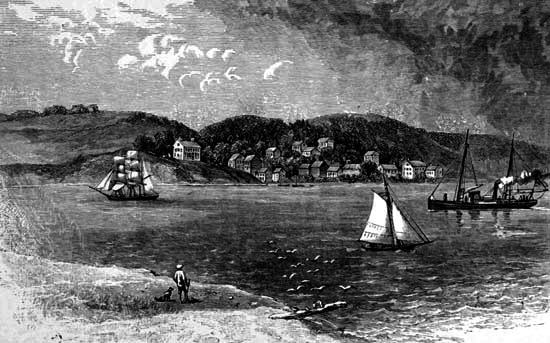
Yaquina Bay, Newport, 1880.
NEWPORT.On that south side a broad strip of cool, gray sand borders the harbor, and there stand the ferry-house, and its flag-staff and boats.
Looking to the left, the fir-crowned and fern-covered hills slope down to Ford's Point, jutting out into deep water, which flows up for miles till the turn above the mill shuts in the view.
But we must not wait, if we mean to catch any flounders before the tide turns, and so we hurry down to the beach and along the hard sand bordering the bay under the broken cliffs, and are soon shaking hands with the cheery landlord of the Sea-View Hotel, who has been watching us from his veranda ever since we descended the hill from Diamond Point.
CHAPTER V.
Hay-harvest—Timothy-grass—Permanent pasture—Hay-making by express— The mower and reaper—Hay-stacks as novelties—Wheat-harvest—Thrashing —The "thrashing crowd"—"Headers" and "self-binders"—Twine-binders and home-grown flax—Green food for cows—Indian corn, vetches—Wild-oats in wheat—Tar-weed the new enemy—Cost of harvesting—By hired machines —By purchased machines—Cost of wheat-growing in the Willamette Valley.
Neither the first nor the second year did hay-harvest begin with us till after the first week in July. We did not shut the cattle off the hay-fields till the end of February, so that there was a great growth of grass to be made in four months and a half.
How different our hay-fields are from those in the old country! I should dearly like to show to some of these farmers a good old-fashioned Devonshire or Worcestershire field, with its thick, solid undergrowth and waving heads. I should like them to see how much feed there was after the crop was cut.
Here timothy-grass is everything to the farmer. Certainly, the old-country man would open his eyes to see a crop waist-high, the heavy heads four to seven inches long, and giving two tons to the acre. And he would revel in laying aside for good and all that anxiety as to weather which has burdened his life ever since he took scythe and pitchfork in hand. We expect nothing else but dewy nights and brilliant sunshine, so that the habit is to cut one day, pile the grass into huge cocks the same day, and carry it to the barn the next. Hay-stacks are unknown; the whole crop is stored away in the barn; and you may see sixty, eighty, or a hundred tons under the one great roof, and no fear of heating or burning before the farmer's eyes.
THE MOWER AND REAPER.The glory of the scythe has departed. Every little farmer has his mower, or mower and reaper combined; or else, if he can not afford to pay two hundred dollars or thereabout for his machine, he hires one from his more fortunate neighbor, and pays him "six bits"—that is, seventy-five cents—per acre for cutting his crop. Wood's, McCormick's, or the Buckeye, are the favorites here.
Our own machine, with one pair of stout horses, cuts from nine to twelve acres a day, according to the thickness of the crop and the level or hilly nature of the ground. It looks easy—just riding up and down the field all day—but try it, and you will find you have to give close attention all the time, to be ready to lift your knives over a lumpy bit of ground or round a stump, and to cut your turns and corners clean; and there are no springs to your seat, and a mower is not the easiest carriage in the world.
Nor is it light work to follow the horse hay-rake all day, lifting the teeth at every swath. Pitching hay is about the same work all the world over, I think; but at home one does not expect to make acquaintance with quite so many snakes, which come slipping down and twisting and writhing about as the hay is pitched into the wagon. It is true they are harmless, but I don't like them, all the same.
We put up a big hay-stack each year, in spite of the most dismal prophecies from our neighbors that the rain would mold the hay, that it would not be fit to use, and that even a "town-cow" would despise it (and they will eat anything from deal boards to sulphur-matches, I declare). But the event justified us, and the whole stack of 1879 was duly eaten to the last mouthful.
Wheat and oats follow close on the heels of the hay. We finished our stack on the 17th of July, and began cutting wheat on the 27th.
There is one harvest, and only one, on record in Oregon, where rain fell on the cut grain and injured it. The rule is to feel absolutely secure of cutting your grain, thrashing it in the field as soon as cut, and carrying it from the thrashing-machine straight to the warehouse.
There is lively competition to get the thrasher as soon as the grain is cut. The "thrashing crowd," of some seven or eight hands, which accompany the thrasher, have a busy time. They get good wages—from the $2.50 for the experienced "feeder" of the machine, to the $1.50 for the man who drives and loads the wagon, or pitches the sheaves. They travel from farm to farm, setting up the thrasher in a central spot, and "hauling" the sheaves to it. The quantity passed through the machine in one long day varies from one thousand to fifteen hundred bushels with horse-power; driven by steam, the quantity will run up to upward of two thousand bushels. These quantities seem very large by the side of those yielded by English machines, but they are too well authenticated to be open to doubt.