Note 1 — A ROMAN SCHOOL
Reading edition
“Four or five of these (walnuts) are piled pyramidally together, when the players, withdrawing to a short distance, pitch another walnut at them, and he who succeeds in striking and dispersing the heap wins.” Story, “Roba di Roma,” p. 128.
2 See Johnston, “Private Life of the Romans,” p. 81; or Miller, “The Story of a Roman Boy.”
3 Here, as well as elsewhere, remember that Gāius and Gāia are each three syllables.
4 Tune of “Onward, Christian Soldiers.” Slightly altered from Education, Vol. IX, p. 187. The author hopes that this most obvious anachronism will be pardoned on the ground that this hymn appeals to young pupils more than most Latin songs, and is therefore enjoyed by them and more easily learned.
5 Anonymous.
The magister, iudices, and discipuli should all wear white togas with a purple6 border. A white gauze shirt with short sleeves may be used as a tunic, while white duck trousers and tennis slippers serve to complete the costume.
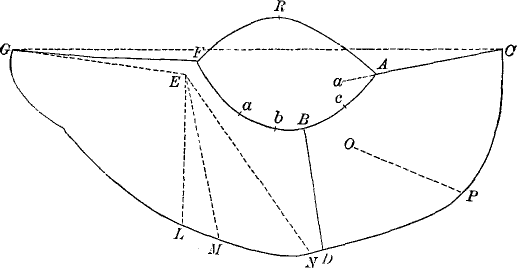
The togas can be made of white muslin according to the measurements and cut given by Professor Johnston,7 which he has kindly permitted me to use. “Those who attempt the reconstruction of the toga wholly or chiefly from works of art find it impossible to reproduce on the living form the drapery seen on the statues, with a toga of one piece of goods or of a semicircular pattern. An experimental form is shown in the figure, and resembles that of a lamp shade cut in two and stretched out to its full extent. The dotted line GC is the straight edge of the goods; the heavy lines show the shape of the toga after it had been cut out, and had had sewed upon it the ellipse-like piece marked FRAcba. The dotted line GE is of a length equivalent to the height of a man at the shoulder, and the other measurements are to be calculated proportionately. When the toga is placed on the figure, the point E must be on the left shoulder, with the point G touching the ground in front. The point F comes at the back of the neck, and as the larger part of the garment is allowed to fall behind the figure the points L and M will fall on the calves of the legs behind, the point a under the right elbow, and the point b on the stomach. The material is carried behind the back and under the right arm and then thrown over the left shoulder again. The point c will fall on E, and the portion OPCa will hang down the back to the ground. The part FRA is then pulled over the right shoulder to cover the right side of the chest and form the sinus, and the part running from the left shoulder to the ground in front is pulled up out of the way of the feet, worked under the diagonal folds, and allowed to fall out a little to the front.”
The servi and paedagogus should wear tunics of some coarse, dark-colored material.
In small schools, where there is not a sufficiently large number of boys in the Latin classes for discipuli, the parts may be taken by girls. Their hair should fall nearly to their shoulders, as in the case of the Roman boy. They may wear unstarched white skirts under the toga.
The tabellae may be made of little book-shaped slates with wooden borders (paint them light-colored), and the rolls of paper.