CONTENTS (continued 2)
Reading edition
Though the civill Reception my last Book found were sufficient invitation, for which I gladly here offer my Thanks, especially to those worthy and grateful Strangers, who are far more candid and equall in their Censures than some new Judges of our own Country, who (in spite of their starrs) will sit and pronounce upon things they understand not.
But this is the Fate of all mankind, to be render'd less at home than abroad. For my part I can say (and there are will believe me) that if any man have low thoughts of mee, hee is of my opinion. Yet the way of Composition I chiefly possess (which is to shape Notes to the Words and Sense) is not hit by too many: and I have been often sad to observe some (otherwise able Musicians) guilty of such Lapses and mistakes this way. And possibly this is it makes many of us hear so ill abroad; which works a Beleefe amongst ourselves, that English words will not run well in Musick: This I have said, and must ever avow, is one of the Errors of this Generation.
I confess I could wish that some of our words could spare a Consonant (which must not be slur'd, for fear of removing those Landmarks in spelling which tell their Originall); but those are very few, and seldom occur; and when they do, are manageable enough by giving each syllable its particular humour; provided the breath of the sense be observed. And (I speak it freely once for all) that if English words which are fitted for song do not run smooth enough 'tis the fault either of the Composer or Singer.
Our English is so stor'd with plenty of Monosyllables (which, like small stones, fill up the chinks) that it hath great priviledge over divers of its neighbours, and in some particulars (with reverence be it spoken) above the very Latin, which Language we find overcharg'd with the letter (S) especially in (bus) and such hissing Terminations. But our new Criticks lodge not the fault in our words only; 'tis the Artist they tax as a man unspirited for forraign delights: which vanity so spreads, that those our productions they please to like must be born beyond the Alpes, and father'd upon Strangers. And this is so notorious, that not long since some young Gentlemen, who were not untravell'd, hearing some Songs I had set to Italian words (publickly sung by excellent voyces) concluded those songs were begotten in Italy, and said (too loud) "they would faine heare such songs to be made by an Englishman." Had they layd their sceane a little nearer home, there had been more colour; for, a short Ayre of mine (neare 20 years old) was lately reviv'd in our neighbour Nation, and publickly sung to words of their own as a new borne piece, without alteration of any one Note: Tis the Ayre to those words, "Old Poets Hippocrene admire etc." a sorry trifle (a man would think) to be rais'd from the dead after 18 years burial. But (to meet with this humour of lusting after Novelties) a friend of mine told some of that company, that a rare new Book was come from Italy, which taught the reason why an Eighth was the sweetest of all notes in Musick; because (said he) Jubal who was Founder of Musick was the eighth man from Adam; and this went down as current as my songs came from Italy. I beg your pardon for instancing such particulars. But there are knowing persons, who have been long bred in those worthily admired parts of Europe, who ascribe more to us than we to ourselves; and able Musicians returning from Travaill doe wonder to see us so thirsty after Forraigners.
For they can tell us (if we knew it not) that Musick is the same in England as in Italy; the Concords and Discords, the Passions, Spirits, Majesty and Humours, are all the same they are in England; their manner of composing is sufficiently known to us, their best Compositions being brought over hither by those who are able enough to choose.
But we must not here expect to find Music at the highest, when all Arts and Sciences are at so low an ebbe. As for myself, although I have lost my Fortunes with my Master (of ever blessed Memory) I am not so low to bow for a subsistence to the follies of this Age; and to humour such as wil seem to understand our Art, better than we that have spent our lives in it.
If anything here bring you benefit or delight, I have my design. I have printed the Greek in a Roman Character for the ease of Musicians of both sexes.
Farewell, H. L.
This is in the Second Book of Ayres and Dialogues. Dedicated to the Hon. the Lady Dering, wife to Sir Edward Dering, Bart.
During the Civil War he appears to have lived in London, composing and teaching. His compositions for the Church in the way of Anthems were but few. As we have seen in his early days, he preferred the stage, and during the Commonwealth there was no inducement to write Cathedral music. But the words of several of his Anthems are to be found in Clifford's Divine Services and Anthems, published in 1666.
In 1656 he joined Captain Cooke and others in writing music for Davenant's First Day's Entertainment at Rutland House, e.g., declamation and music. A little later he assisted in the production of The Siege of Rhodes, which Roger North calls a semi-opera.
This was produced during the Commonwealth, and is of particular interest from the fact that Purcell's father, Henry Purcell the elder, took part in the performance. This is the first notice we get of the Purcell family, about whom I hope to say more in a later Lecture. It is an interesting fact that the composer of the music to the last important Masque (Milton's Comus) should have helped also in what was apparently the first English Opera.[4]
Lawes at the Restoration was re-appointed to his Chapel Royal post, and composed the Anthem Zadok the Priest for the Coronation of Charles II. He did not long survive the revival of his fortunes. He lived in the little Almonry at Westminster, the block of ancient buildings in which the Purcell family lived. He probably knew the young Henry Purcell, then a child of tender years, and one wonders if he detected the musical genius of the little boy.
We get a glimpse of him in his last days from the Diary of Samuel Pepys, who, on December 30th, 1660, makes the following entry:
Mr. Child and I spent some time at the Lute, and so promising to prick me some lessons to my theorbo he went away to see Henry Lawes who lies very sick.... I to the Abbey, and walked there, seeing the great companies of people that come there to hear the organs.
The Coronation was in April, 1661, so Lawes recovered from his illness, though he died the following year. He was buried in the Cloisters of Westminster Abbey though unfortunately there is nothing to mark the spot of his interment. I think it is probably in the "Little Cloister" as Dr Wilson, a brother musician, was interred there a few years later.
In Henry and William Lawes we have "two noble brothers" who deserve to be remembered with affectionate respect. The portraits of both are preserved at Oxford.
IX. MATTHEW LOCKE
1630 (?)—1677
A prominent personage in the seventeenth-century musical world was Matthew Locke. The exact date of his birth is not known, but it was approximately 1630. Matthew Locke laid the foundation of his art as a chorister in an English Cathedral, and at Exeter there is evidence that he occupied that position in 1638. The evidence cannot be disputed, as it is graven in the very fabric of the old Cathedral. The embryo musician took the trouble, upon two occasions, to inscribe his name upon the walls of the Cathedral, together with the dates. Upon the inner side of the old organ screen runs the legend "Matthew Lock, 1638," and in a more abbreviated form at a later date "M. L., 1641." As a boy he seems to have been content with a name of four letters Lock; in his later years he always attached a final "e" to his patronymic. At Exeter he had the advantage of being trained by Edward Gibbons, brother of the great Orlando, and, in addition to Gibbons' share in his training, he owed much to William Wake, Organist, for whom he wrote one of his first published works.
The period following Locke's later inscription—1641—was one not calculated to encourage or foster the art of music; the country was in a state of civil war, the soldiers of Cromwell wrought sad havoc in the Cathedrals, and the musical portions of those establishments came in for no small share of their destroying wrath.
At Westminster Abbey we are told "the soldiers brake down the organs for pots of ale," and the Cathedral at which Locke served his pupilage fared very badly at the hands of the Roundheads.
It is natural, then, that during the stormy times which marked that period we have little intelligence concerning the doings of Locke. We have the dates of some of his compositions, one as early as 1651. The chief interest, however, which attaches to his work between 1650 and 1660 is that it is so much connected with the stage, and in that way marks the progress towards the Opera, of the English form of which Locke is sometimes credited with being the originator. As instances of this kind of work we might, perhaps, draw attention to his association with Christopher Gibbons in Shirley's Masque Cupid and Death (1653), and the music he wrote in 1656 for Davenant's Siege of Rhodes, in the production of which he himself shared—playing the part of the Admiral. Henry Lawes wrote some of the music of this Opera, and Purcell's father was one of the actors.
The next item of importance that we have concerning him is in the Diary of Samuel Pepys; there, under date February 21st, 1659/60, we read:
"After dinner I back to Westminster Hall. Here met with Mr. Lock and Pursell, Master of Musique, and with them to the Coffee House, into a room next the Water by ourselves. Here we had a variety of brave Italian and Spanish Songs, and a Canon of eight voices which Mr. Locke had lately made on these words 'Domine Salvum fac Regem,' an admirable thing."
This is a very interesting entry. It shows Locke associated with Purcell's father; it gives another instance of Mr Pepys never missing the opportunity of cultivating the friendship of good musicians, and, apart from the musical side, as an historical matter of interest the words of the Canon Domine Salvum fac Regem show the feeling of loyalty towards the Crown which ended in the Restoration; words which ten years before it would have been a heresy to utter. It may be pointed out that the entry February, 1659, by the old way of reckoning, was really February, 1660, and therefore the year of the Restoration. In the Ceremonies connected with that great event Locke played an important part; it was to his music for Sagbutts and Cornets that the Royal Progress was made, from the Tower to Whitehall, the day before the Coronation 1661. As a reward he was made "Composer in ordinary to His Majesty," and "One of the Gentlemen of His Majesty's Private Musick."
For the next year or two he appears to have been engaged in composition, both for Church and stage; amongst the former may be mentioned some Anthems, whilst his music for Stapylton's Stepmother presents another instance of his association with dramatic music. This dramatic side of his nature may have been the cause of Roger North's complaint that "he sacrificed the 'old Style' for the modes of his time" and of "his theatrical way."
The year 1666, the year of the Fire of London, is rather an important one in the consideration of Locke's life. It introduces us to him in another character, and that of a literary type. As will be seen later, he was a scathing and bitter critic of his detractors, and first gave evidence of this quality in the year now under notice. The cause of this outpouring of his wrath was the treatment a Kyrie of his composition had received at the hands of the Chapel Royal choir. It would appear that he had set the Kyrie in an original way, giving different music to each response; such an innovation did not meet with the approval of the Choir, and they seem to have given it rather a rough time. The result was that Locke published it, and supplied a Preface entitled "Modern Church Music; Pre-Accused, Censured, and obstructed in its performance before His Majesty, 1st of April, 1666. Vindicated by its Author, Matthew Locke." Some of his observations are very severe and abusive. I give a small portion of the somewhat long and windy preface.
"He is a slender observer of human actions who finds not pride generally accompanied with ignorance and malice, in what habit soever it wears. In my case zeal was its vizor and innovation the crime. The fact, changing the custom of the Church by varying that which was ever sung in one tune, and occasioning confusion in the Service by its ill performance. That such defects should take their rise from the difficulty or novelty of the composition I utterly deny, the whole being a kind of counterpoint, and no one change from the beginning to the end but what naturally flows from, and returns to the proper centre, the key".
With regard to the Vindication, however convincing it might be, I believe the Kyrie was not performed again at the Royal Chapel.
Pepys refers to the incident in his Diary of September 2nd, 1667, in which he says: "Spent all the afternoon, Pelling, Howe and I and my boy, singing of Locke's response to the ten commandments, which he hath set very finely, and was a good while since sung before the King, and spoiled in the performance which occasioned the printing them, and are excellent good." Mr Pepys evidently sympathized with the lacerated feelings of the injured author.
I may say that some little time ago I edited these Kyries and the Creed, and they have been sung in the Abbey and in various Cathedrals. The Kyries are, many of them, very tuneful, and the whole setting of Kyrie and Creed does Locke great credit.
I have not space to dwell longer upon his Church music, of which we have some excellent specimens in the way of Anthems.
Somewhat later he was appointed Organist of the Chapel at Somerset House; this Chapel was part of the establishment of Queen Catherine, the Queen of Charles II, who throughout her life remained a Roman Catholic. It would appear from Roger North that Locke was not altogether a success in this position. He says: "Locke was organist of Somerset House Chapel as long as he lived, but the Italian Masters that served there did not approve of his manner of play; but must be attended by more polite hands, and one while, one Signor Baptista Sabancino, and afterwards Signor Baptista Draghi used the Great Organ, and Locke (who must not be turned out of his place, nor the execution) had a small Chamber Organ by, on which he performed with them the same Services." This seems a somewhat humbling position for such a man—and one wonders what he said about it!
Another sharp controversy he took part in was in answer to Mr Thomas Salmon, M.A., of Trinity College, Oxford, who had written and published An Essay to the Advancement of Music by casting away the perplexity of different cliffs and writing all sorts of music in one universal character.
The desire to simplify musical signs seems to have been an old theme and one that gave rise to a fierce controversy between Matthew Locke and Mr Salmon. It is only fair to say that Mr Salmon was not over judicious in his method of recommending his scheme. He seems to have purposely hit out at music masters (of whom Locke was one of the most eminent), and suggested that their opposition to his ideas sprang from the sordid desire to make as much as they could out of their pupils, by keeping them as long as possible under tuition.
Matthew Locke replied to this in a treatise entitled The Present Practice of Musick vindicated against the exceptions and new way of attaining music lately published by Thomas Salmon, M.A. The controversy was very warm. You shall hear a short address "To the Reader" which will give some idea of the style of discussion Locke adopted.
Though I may without scruple aver that nothing has done Mr. Salmon more kindness than that his books have had the honour to be answered, yet I have been forced to afford him this favour rather to chastise the Reproaches which he hath thrown upon the most eminent Professors of Musick than for anything of learning that I found in him. Those gentlemen he accused of ignorance for not embracing his illiterate absurdities for which it was necessary to bring him to the "Bar of Reason" to do him that justice which his follies merited. Though for the fame he gets by this, I shall not much envy him, with whom it will fare as with common criminals, who are seldom talked of above two or three days after execution.
A little farther on he gets angry and says:
Had I been "purblind," "copper-nosed," "sparrow-mouthed," "goggle-eyed," "hunch-backed" or the like (ornaments which the best of my antagonists are adorned with) what work would there have been with me?
Attention has already been directed to Locke's association with dramatic music, and so it would be well to glance briefly at the claim he possesses to be considered the "Father of English Opera." The work which entitles him to be ranked as the writer of the first English Opera is Shadwell's Psyche; this, with the music to The Tempest, was produced in 1673, with the title of The English Opera. It contained a Preface, setting forth Locke's opinions on real Opera. North calls his works in this branch of Art "semi-Operas," but from the title just quoted it may be inferred that Locke, at any rate, considered them full-grown specimens. It should be added that the Act tunes in Psyche were written by Draghi. The writer on Opera in Grove's Dictionary marks Purcell as the originator of English Opera. "Henry Purcell (he says) transformed the Masque into the Opera, or rather annihilated the one and introduced the other." Perhaps Roger North's term "semi-Opera" is the best expression for Locke's essays in this connection.
With regard to Locke's other dramatic music, reference must be made to the Macbeth music, which has for so many years been associated with his name. For long the matter has been the subject of conjecture as to whether he was really the author of it or not.
The music of Psyche is so good that there is no ground for saying he could not have written the Macbeth music. He was exceedingly dramatic and also melodious. There is a beautiful Dialogue on the death of Lord Sandwich, the great patron of Samuel Pepys, which is to be found in the Pepys Library of Magdalene College, Cambridge. No doubt this was written at the suggestion of Pepys. And there is a remarkable setting of Hamlet's soliloquy, also in MS., in Pepys' book, which I firmly believe is by Locke.
As usual Locke wrote an aggressive Preface to Psyche. It begins:
That Poetry and Musick, the chief manifestives of Harmonical Phancy, should provoke such discordant effects in many is more to be pityed than wondered at: it having become a fashionable art to peck and carp at other men's conceptions, how mean soever their own are. Expecting, therefore, to fall under the lash of some soft-headed or hard-hearted composers (for there are too many better at finding of faults than mending them) I shall endeavour to remove these few blocks which perhaps they may take occasion to stumble at.
He goes on to say the title Opera is of the Italian, and claims that as far as his ability could reach, he had written agreeably to the design of the author, and that the variety of his setting was never in Court or Theatre till now presented to the nation, "though I must confess there has been something done, and more by me than any other of this kind."
Locke evidently considered Psyche as a real Opera and a novelty in this country. The work was dedicated to James, Duke of Monmouth, who (the composer says) "gave this life by your often hearing this practised and encouraged and heartened the almost heartless undertakers and performers."
Amongst his other works was one called Melothesia, or Certain general Rules for playing upon a continued Bass. This is said to be the first book of its kind, and he contributed to many other works. Roger North tells us "Locke set most of the Psalms to music in parts for the use of some vertuoso ladyes in the City, and he composed a magnifick Consort of four parts after the old style which is the last that hath been made."
His life was not long, but it was important, and perhaps the greatest tribute to his memory was that Henry Purcell wrote an ode commemorative of his decease "On the death of his worthy friend Mr Matthew Locke, Music Composer in Ordinary to His Majesty, and Organist of Her Majesty's Chappell, who dyed in August, 1677."
X. PELHAM HUMFREY
1647—1674
We have all heard of "Single-speech Hamilton," a Member of Parliament, who, it is said, made a "single speech," and by it achieved lasting fame. As a matter of history, Hamilton made other speeches, but it was by the first that he earned his well-known cognomen. And we have a somewhat similar example in connection with a celebrated musician, John Jenkins. Born in 1592, he lived until 1678, and wrote, as North expresses it, "horse-loads of music." He was most prolific and most celebrated, and yet until a few years ago, when I revived many of his compositions—Dialogues, Fancies for Strings, and Latin Motets—not a note of his music was heard anywhere, save one little piece. But this was sung in every school where vocal music was taught—it is the charming little round A boat, a boat, haste to the ferry.
The subject of our present consideration is another example of the same fate. "Pelham Humfrey, Composer of the Grand Chant" is about all people know of him. This so-called Grand Chant is known and sung in every Protestant Church in the world. Humfrey is, however, a worthy member of the band of musicians whose work I am following, and we will see what else he did besides writing the Grand Chant.
Born in 1647, he is said to have been a nephew of Colonel John Humphrey, Bradshaw's sword-bearer.
From the arms which were on his tomb we can learn a little of his family and forbears—these arms, I regret to say, have long since been obliterated, in fact they had gone in Sir John Hawkins' time, together with the epitaph; and at the present time the exact position of the grave can be only a matter of conjecture.[1] But what was on it has been preserved to us in a valuable old work, Keepe's Monumenta Westmonasteriensia, 1682. In this work a description is given of the armorial bearings, and by them we can trace him to an old Northamptonshire stock. The family is mentioned as being settled in the County in The Visitation of Northampton of 1564, but had disappeared from it before the next Visitation some years later.
We know nothing of Pelham Humfrey's life until 1660, the year of the Restoration, when we find him, at the age of thirteen, entered as one of the first set of children of the reconstructed Chapel Royal Choir, under Henry Cooke, generally known as Captain Cooke, who having fought in the Civil War, obtained his Captain's Commission as early in the struggle as 1642; and retained his military title for the rest of his life.
While at the Chapel Royal, Humfrey displayed signs of that precocity which so often shows itself in the musical genius. He began composition while yet a boy, and in 1664 we find the words of no fewer than five of his Anthems published in Clifford's Divine Services and Anthems.
A reference to one of these Anthems is in the Diary of Samuel Pepys, which contains, by the way, several interesting references to Humfrey's career. Under date November 22nd, 1663, we find:
At Chapel: I had room in the Privy Seale pew with other gentlemen, and there heard Dr. Lilligrew preach. The Anthem was good after Sermon, being the 51st Psalm made for five voices by one of Captain Cooke's boys, a pretty boy. And they say there are four or five of them that can do as much. And here I first perceived that the King is a little Musical and kept good time with his hand all along the Anthem.
Now that Anthem was written by a Choir-boy in the Royal Chapel, but it is a remarkable fact, as Pepys says, that he was not the only boy-composer in the same choir and at the same time. Captain Cooke appears to have been rarely fortunate in having in his newly-formed choral body a set of phenomenally gifted boys, and doubtless no small credit is due to the loyal and gallant musician for the skill and care he must have devoted to their training.
Captain Cooke must have been a clever teacher and a still cleverer selector of boys for his choir; and this brilliant little school he gathered round him (including such names as Humfrey, Blow, and Purcell) shines out like a beacon light in our musical world. A curious and interesting fact bearing upon this came to my knowledge quite lately. A Thesis for a Doctor's degree in the University of Paris (in 1912) was on the subject of Captain Cooke's Choir Boys, and it was a clever yet concise account of the work done by these three pupils of Cooke—Humfrey, Blow, and Purcell. English music seems to be looking up when we find a period of our musical history and three of our past great musicians taken as the subject for a thesis in a foreign University!
The same year that witnessed the production of this Anthem was an all-important one, not only for Humfrey but also for English art. On leaving the Royal Choir, Charles II sent him abroad to continue his musical studies; the cost of the trip was paid out of the Secret Service Fund, and was expended in the following way:
1664. "To defray the charge of his journey into France and Italy £200." In the two following years also he was granted £100 and £150 respectively.
Most of the time Humfrey spent abroad was passed in Paris with J. B. Lully, an Italian by birth but a Frenchman by adoption, the most celebrated dramatic musical composer of his day. He wrote many Operas in the most varied styles, both grave and gay, was the composer of a good deal of sacred music, and was also a reformer in Opera-writing; he introduced the accompanied recitative in place of the Italian Recitative secco, making many changes in the ballets. Of still more importance was his development of the Overture, for which service he cannot be too highly valued.
It is very probable that the instruction given by Lully to Humfrey was less by precept than by example. The pupil listened with eager ears to his master's music and doubtless often took part in the performance of it. Under this influence—the influence of the greatest master of dramatic music of his time—it is not surprising that the already precocious genius of the young Englishman quickened, and that he returned to his native country with a different conception of his art. Another world had been opened up to him whose earliest instruction had, necessarily, been chiefly confined to the ecclesiastical side of it.
Before his return to England he had been appointed a Gentleman of the Chapel Royal, in the place of one Thomas Hazard, January, 1667, and he was duly sworn in the October following. A glance at Pepys' Diary under dates November 1st and 15th, 1667, gives us that shrewd observer's opinion of our hero as he appears fresh from his Continental trip.
November 1st, 1667. To Chapel, and heard a fine Anthem made by Pelham, who is come over.
The entry, however, of a fortnight later is of more interest, as apparently being Mr Pepys' first personal encounter with him since his return.
November 15th, 1667. Home, and there I find, as I expected, Mr. Caesar and little Pelham Humfrey lately returned from France, and is an absolute Monsieur as full of form and confidence and vanity, and disparages everything and everybody's skill but his own. But to hear how he laughs at all the King's Musick here, as Blagrave and others, that they cannot keep time nor tune nor understand anything; and that Grebus, the Frenchman, the King's Master of the Music, how he understands nothing nor can play on any instrument and so cannot compose; and that he will give him a lift out of his place; and that he and the King are mighty great. I had a good dinner for them, a venison pasty and some fowl, and after dinner we did play, he on the Theorbo, Mr. Caesar on his French lute, and I on the viol, but made but mean Musique, nor do I see that this Frenchman do so much wonders on the Theorbo, but without question, he is a good musician, but his vanity do offend me.
Grebus (or rather Grabu) was the King's Master of the Music. He displaced Bannister, who was dismissed, according to the historians, because he championed English violinists and said he preferred them to Frenchmen. He may have said this, but the real cause of his dismissal was that he kept back the money which he ought to have paid to the Private Band! King Charles has often been blamed for dismissing Bannister on account of his patriotic sentiments and defence of English players, but this charge is not true.
Returning to Mr Pepys for a record of his next day's doings, November 16, 1667, we find a very interesting reference to Humfrey and a somewhat scathing criticism from the Diarist:
1667, November 16th. To White Hall, where there is to be a performance of Music of Pelham's before the King. The company not come; but I did go into the Music Room where Captain Cooke and many others, and here I did hear the best and the smallest Organ go that ever I saw in my life and such a one as by the grace of God I will have the next year, if I continue in this Condition, whatever it cost me.
Mr Pepys then records a short walk and talk with Mr Gregory, returning to Whitehall:
And there got into the theatre room and there heard both the vocall and instrumentall Music, where the little fellow (Pelham Humfrey) stood keeping time, but for my part I see no great matter, but quite the contrary, in both sorts of Music. The composition, I believe, is very good, but no more of delightfulness to the eare or understanding, but what is very ordinary.
In addition to being a composer, Humfrey was an accomplished lutenist, and in the State Papers for the year 1668, under date January 20th, we find a promotion of his in the Royal Service; the record runs as follows:
January 20th, 1668. Warrant to pay Pelham Humfreys, Musician in Ordinary on the Lute, in place of Nich. Sawyer deceased £40 yearly, and £16 2s. 6d. for Livery.
On May 29th of this same year Mr Pepys again refers to him:
May 29th, 1668. Home, whither by agreement by and by comes Mercer and Gayet and two gentlemen with them, Mr. Monteith and Pelham, the former a swaggering young handsome gentleman, the latter a sober citizen merchant.[2] Both sing, and the latter with great skill, the other no skill, but a good voice and a good basse, but used only to tavern tunes; and so I spent all this evening till eleven at night, singing with them till I was tired of them, because of the swaggering fellow, tho' the girl Mercer did mightily commend him before me.
Later in the year (July) another reference is made in the Diary:
July 11th, 1668. So home, it being almost night (Mr. Pepys had been after an espinette at Deptford), and there find in the garden Pelling, who hath brought Tempest, Wallington, and Pelham to sing, and there had most excellent Musick late, in the dark with great pleasure.
Humfrey's Sacred music is a clear evidence of his French experience. He puts symphonies for strings and is dramatic at times and often somewhat light. An Anthem O Praise the Lord is a good example of the latter tendency. There are two short Bass solos, one to the words Sing praises lustily, which is almost like the song of a jovial sailor! It is in triple time, and is the sort of thing King Charles would certainly have beaten time to with his hand "all along the Anthem," in Pepys' words. The Bass solo in the Anthem he wrote when a boy and before his French training is in a quite different style, and might have been written by any of our good Cathedral writers, such as Locke, or Blow, or even Purcell.
In addition to his Sacred works Humfrey wrote three Odes and many songs. These latter fall under the critical notice of Dr Burney, who refers to them, I think, rather unfairly and harshly. Speaking of a collection called Choice Songs and Aires, Burney says: "Among these songs, to the number of near fifty, there is not one air that is either ingenious, graceful, cheerful or solemn: an insipid languor or vulgar pertness pervades the whole. From Pelham Humphry, whose Church Music is so excellent, I own I expected to find originality, or merit of some kind or other; but his songs are quite on a level with the rest."
Burney's remarks are not only spiteful, but untrue. To mention only one song, Humfrey's setting of Where the Bee Sucks, which he wrote for Dryden and Davenant's altered version of The Tempest (the oldest setting but one which we possess), is charming, both as regards melody and harmony. The first part is in the minor key, for which Humfrey seems—like Purcell—to have a weakness. There is an effective change to the Tonic Major at Merrily, merrily shall I live now, with a most striking and delicious drop of a 7th (I expect Burney regarded this as a crudity), To me the song seems one of the best of the time.
Humfrey went on adding rapidly to his honours. On January 24th, 1672, he was elected one of the wardens of "the Corporation for regulating the Art and Science of Musick," and in July of the same year his old master, Captain Cooke, died; his death being accelerated—so Antony Wood tells us—by chagrin at finding himself getting supplanted by his old pupil. This I do not believe: Cooke would have had a soul above such foibles, and had too many successful pupils to be jealous of poor little Humfrey.
However this may be, Humfrey succeeded him as Master of the Children of the Chapel Royal, and later, jointly with Thomas Purcell, he was appointed Composer in Ordinary for the Violins to His Majesty.
It was in this year, 1672, that he wrote a charming little song called Wherever I am and Whatever I do. It was written for Dryden's Conquest of Granada, produced in that year.
Nothing of any importance is chronicled of him for the last two years of his all too short life. He died at Windsor on July 13th, 1674, and was buried in the Cloisters of Westminster Abbey, near the south east door. His last will and testament, witnessed by his old schoolfellow, Dr Blow, is interesting:
Aprill ye 23rd, 74.
Bee itt knowne to all people whomsoever itt may Concerne that I leave my deare wife my sole executrix and Mrs. of all I have in the world after those few debts I owe are payd:
I only desire that 3 Legacyes may bee given that is to say to my cousin Betty Jelfe: to Mr. Blow ad to Besse Gill each of them twenty shillings to buy them Rings.
Pell. Humfrey.
30 July, 1674.
Which day appeared personally John Blow of Westminster and made oath that he was present when Mr. Pelham Humfrey wrote the above written writing containing his last will and testament and he the sd Mr. Pelham Humfrey being of perfect mind and sound memory published and declared the same for his last will and testament.
John Blow.
30 July, 74.
(Proved 30 July 1674 by Catherine Humfrey Relict and sole executrix).
Humfrey's life, brief though it was, must be regarded as a turning point in our art's history—not alone by his own compositions, but by the infusion of his influence into the greater Purcell. He was not only Purcell's master at the Chapel Royal, but actually composed an Anthem jointly with Purcell, called By the Waters of Babylon. In Boyce's opinion "he was the first of our ecclesiastical composers who had the least idea of musical pathos and expression of the words," but this is an exaggeration.
This great advance in our music was carried on by the immortal Purcell, who, as a choir-boy under Humfrey, was, no doubt, an eager listener to the "new effects" which his master introduced. The pupil is so great, one is in danger of forgetting the master. At least here we have endeavoured to do some justice to the short-lived genius Pelham Humfrey.
XI. DR JOHN BLOW
1648—1708
If there is one name among the Twelve Musicians with whom I am dealing in this course of Lectures to which I desire specially to do justice, it is that of Dr. John Blow. As a child I sang his Anthems in Rochester Cathedral, and I well remember the delight with which I listened to, and took part in, his beautiful and expressive I beheld, and lo a great multitude, and I was in the Spirit on the Lord's day. In those days the great masterpieces of the English Cathedral School were constantly done, and very well done, at Rochester, and none of the Anthems except I may say, perhaps, Purcell's great Anthem O Sing unto the Lord, touched me and thrilled me as did that of Blow. And as long as I played in Manchester Cathedral and Westminster Abbey, so long did I feel the power and religious impressions of these splendid specimens of Blow's genius. Of course there are many Anthems and Services by this master, but none, to me at least, ever spoke so eloquently as did the two I have mentioned. This is one reason why I approach the subject of Blow's career with such a desire to do him justice. Another is the strange neglect of most of his secular music, and lastly the absurd and ignorant criticism of Dr Burney, as displayed in his History, when he talks of "Blow's crudities."
Without further delay let us proceed to trace his musical life. I refrain, on account of time, from dwelling much on biographical details in these Lectures. So I will merely state that it seems pretty certain that Blow was born at North Collingham, in Nottinghamshire, and baptised in the Parish Church of Newark in February 1648-9. Let us begin with recording his admission as a Chorister to the Chapel Royal—one of the "clever boys" whom Captain Cooke got together and taught. Of his school-fellow, Pelham Humfrey, I have already spoken, and, like Humfrey, Blow composed Anthems while in the choir. It is possible—or rather, I think, probable—that an entry in Pepys' Diary refers to him. Under the head of August 21, 1667, we read:
This morning come two of Captain Cooke's boys, whose voices are broke, and are gone from the Chappell, but have extraordinary skill, and they and my boy, with his broken voice, did sing three parts: their names were Blaew and Loggings, but notwithstanding their skill, yet to hear them sing with their broken voices, which they could not command to keep in tune, would make a man mad, so bad it was.
If this refers to Blow he would be about nineteen years old, and could have had but a very broken voice. But it is not impossible, as many boys retain their voices until a good age, and continue singing "alto" in a moderate sort of style. It is hardly likely there would be a boy named Blaew and one named Blow. And there was some arrangement whereby boys who had left the Choir continued to reside with the Masters, possibly to study.[1]
At the early age of twenty-one, in 1669, he became Organist of Westminster Abbey, and the appointment, apparently, was not enough for his ambition (or, more probably, for his needs!), for in 1674 he succeeded Humfrey as Master of the Children of the Chapel Royal, becoming Organist also (while still holding Westminster Abbey) in 1676. As regards his degree of Mus. Doc. I have (on the authority of the late Dr Southgate) to make a little correction of former statements. It has generally been said the degree was conferred upon Blow by Archbishop Sancroft, but Dr Southgate told me in a note, when I was about to lecture on Blow, some years ago, that the degree was granted by Bancroft's representative the Dean of Canterbury—the Archbishop being dead. It is marked in the Lambeth Register "Sede vacante": it was thus bestowed when the "See was vacant." It is a curious fact that Blow gave up his Abbey post in 1680, being succeeded by Purcell; and on Purcell's death, in 1695, he was again appointed organist of the Abbey, and held that post until his death.
But I have to record yet another important Cathedral appointment which our indefatigable musician held. He was Almoner and Master of the Choristers in St Paul's Cathedral, holding those offices for six years, from 1687 to 1693. Again he seems to have resigned in favour of a pupil, Mr Jeremiah Clarke. It is a remarkable testimony to the esteem in which he was held that he should have filled posts at the Chapel Royal, St Paul's Cathedral, and Westminster Abbey, all at the same time. Bishops, in the old days, often presided over a Diocese, filled a Canonry or directed a College and occupied a "Living" or two, simultaneously; but Blow seems to me to have been the greatest Organist pluralist on record!
But this is a testimony to his worth, and in following up our investigation of his contributions to music I will not dwell longer upon his Church music, except to mention that he wrote an Anthem I was glad, for the opening of St Paul's Cathedral in 1697, and to tell the story of the composition of the Anthem which I mentioned in the early part of my lecture, I beheld and Lo! When it was performed in the Chapel Royal, the King (who had asked him to compose it) sent Father Petre to say he was greatly pleased with it; "but (added Petre) I myself think it too long!" "That (answered Blow) is the opinion of but one fool—I heed it not." The Priest was greatly incensed at this remark, and it is said that, had not James II lost his place by his sudden flight to France, Dr Blow would have lost his!
Among the Anthems of this composer may be mentioned two which he wrote for the Coronation of James II, and he also took part in the funeral of William III in the Abbey, receiving, according to an Abbey record, the very large fee of 7s. 10d. for the latter. He does not seem to have directed the music at the Coronation, but took part in the choir. On the death of his pupil, Purcell, he wrote an ode, the words by Dryden, beginning Mark how the lark and linnet sing.
I must not omit to mention that he and Purcell were the Organists selected by Father Smith to display the organ of the Temple Church at the memorable competition between Smith and Harris, the two rival organ-builders. Smith won the day, and showed his wisdom in getting the best men to preside at his instrument. It was the custom for many years to have an Ode for St Cecilia's Day composed for and performed in Stationers Hall on the Saint's Day. Blow wrote the second of these Odes in 1684—the year of the Temple Church competition. He published, in 1700, a great collection of his secular vocal music, under the title of Amphion Anglicus, and in his dedication to the Princess Anne of Denmark he announces that he is preparing "as fast as I can a second musical Present, my Church Services and Divine composition." He gives his sentiments with regard to Sacred composition in the same dedication, which are worth repeating:
To those in truth I have ever more especially consecrated the thoughts of my whole life. All the rest I consider but the blossoms or rather the leaves those I only esteem as the Fruits of all my labours in this kind. With them I began my first Raptures in this Art, with them I hope calmly and comfortably to finish my days.
The composer did not carry out his design, though he lived about eight years after this.
A very interesting work, which has only of late years been made known, is a Masque entitled Venus and Adonis. Some years ago I noticed it among the music in the Chapter Library at Westminster. It has since been edited by Mr Arkwright, and, quite lately, produced upon the stage at Glastonbury. It is very interesting, as it shows that Blow, like Purcell, had a leaning to dramatic music and this Masque is specially noticeable as it consists of musical dialogue—not spoken—thus coming very near to a little Opera.
Blow also contributed to some Choice Lessons for the Harpsichord, a collection published by Playford, to which also Henry Purcell contributed. There are also interesting specimens of organ music, among which is a curious arrangement of the Hundredth Psalm Tune "as they are played in Churches and Chapels." I have also a copy of a MS. Lesson on the Hundredth Psalm. It would now be called a Choral Prelude for the Organ. After a short introduction, the whole tune appears at intervals in the Bass, with very florid upper counterpoint. It is evidence of Blow's knowledge of organ effects and of his ability as a player.
A writer in 1711, three years after Blow's death, tells us "he was reckoned the greatest Master in the world for playing most gravely and serenely in his Voluntaries", and we have Purcell's testimony to him as "one of the greatest masters in the world". With this testimony before him it seems incredible that Dr Burney should have made such a fierce onslaught upon this really excellent man and versatile musician, on account of what he calls his "crudities." He has actually given four pages of music type in his History, full of quotations of Blow's misdeeds. I have examined these carefully, and in many cases the examples are really a remarkable testimony to Blow's advanced ideas, and his feeling for pathetic and expressive harmony. In some specimens there are obvious mis-prints, accidentals omitted, etc., which Burney, had he not been prejudiced, would certainly have perceived. But it is not worth while to follow up this matter, although I am sorry to say Sir Frederick Ouseley took rather the same line when commenting on Blow's music. He really pays Blow a compliment when he says that "he always appears to have been trying experiments in harmony or introducing new combinations and discords". This was what was said of another great musician, Monteverde, to whom we owe so much, and such criticisms only bring discredit upon the writers who failed to see the value behind the novelty. Sir Hubert Parry, in speaking of these "crudities" says "they do Blow, for the most part, great credit, for they show that he adventured beyond the range of the mere conventional, and often with the success that betokens genuine musical insight."
I have already commented upon his greatest Anthems I beheld and lo! and I was in the Spirit. They are full of examples of Blow's melodious power, and this also comes out in some of his secular airs. Perhaps one of the best is his beautiful song which is to be found in Amphion Anglicus entitled The Self Banished beginning "It is not that I love you less"; the words are by Waller, and the music is worthy of them.
Blow, as described by Sir John Hawkins, was "a very handsome man in his person, and remarkable for a gravity and decency in his deportment, suited to his station".
This worthy musician died in 1708, aged 60, and is buried in Westminster Abbey, near the old entrance to the organ-loft and in close proximity to Purcell. A fine monument is erected near the spot, and a specimen of his composition, in the form of a Gloria from one of his services is engraved thereupon. This Gloria is said to have been sung at St Peter's at Rome. I remember an interesting matter in connection with this monument. In my early days at the Abbey (during Dean Stanley's time) the Emperor of Brazil paid a visit and was shown round the Abbey by the Dean. The only thing he specially asked to be shown was "Dr. Blow's monument"! The Dean told me His Majesty inspected it very closely and seemed to be reading the music. He probably knew more about Blow's music than Burney's History!
XII. HENRY PURCELL
1658—1695
In Henry Purcell I reach the last and the greatest of my Twelve Good Musicians. And to attempt to consider and discuss completely his life and work in the short space of a University Lecture, would be an absurd effort. But, as I have before pointed out, my object has been to endeavour to interest the musical student—amateur and professional—in certain prominent masters of music, and in the remarkable progress made in our own country by their aid in the seventeenth century. I can do little more than arouse interest, and I cannot pretend to write a complete history, but I trust the Lectures will have helped to fill up the "blank" which Sir Hubert Parry declared existed in many minds as regards the music of this period.
Henry Purcell
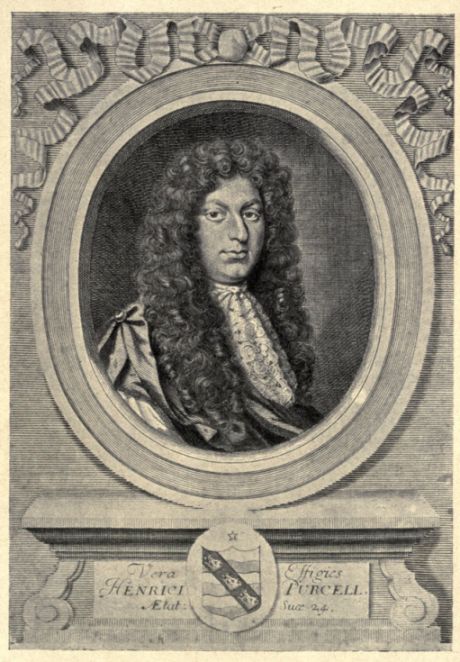
In the consideration of the various musicians of whom I have already treated I have avoided biographical detail. As a rule information in these matters may be gleaned from the well-known books of reference. But in the case of Purcell I am obliged to enlarge a little on his life, in the hope that I may be able to contribute a few interesting facts with regard to his family that are not generally known.
Let me begin, then, with Purcell's father. It is an extraordinary thing that we know nothing whatever of him until we find his name among distinguished musicians, such as Captain Cooke, Locke, and Lawes, as one of the performers in the Siege of Rhodes, in 1656. In the Preface to this publication it is claimed that "The Musick was composed and both the Vocal and Instrumental is exercised by the most transcendent of England in that Art."
What did the elder Purcell do before he attained to such a position? We know absolutely nothing as regards his origin, his training, or his career up to this. I have made diligent search in the archives of Westminster to see if there were anything to be learned there, and have gleaned a few small facts.
The name of Roger Pursell occurs in a bill for bringing timber to the College—in August 1628. The items of the bill include Carriage by land 1s. 6d., for watching 6d., for helping to land ye timber 6d. This would seem to apply to a load of timber brought from a distance for the use of the carpenters of the College. Roger Pursell may have come up with the timber or he may have been one of the carpenters. He was paid 3s. for two days' work. The name appears again in 1659 when we find in a page of accounts "Expended by George Blackborn and Joseph Hobbes for the travelling charges about the Colledge affaires at Offord, in the County of Huntingdon" the following note: "In the Bonds taken from Mr Throgmorton and Roger Pursell there is included £4 towards travelling charges." Then Roger Pursell is spoken of as "the 'Bayliffe' of Mr Giles." It is rather curious that the name of Roger Pursell should occur at such a wide interval, 1628 and again in 1659. One wonders if Roger's connection with the Abbey and its property was the beginning of the musical members of the family coming to Westminster.
There was a Shropshire Purcell family of some standing, and in the Herald's Visitation of Shropshire in 1623 it was given as of Onslow, and Shrewsbury; and there were many distinguished Purcells in Ireland.
We know and hear nothing more of the elder Purcell after the production of the Siege of Rhodes in 1656 until his name appears in a book in the Library at Westminster. This book records the admission of one or two Petty Canons in 1660, and the payment by them of 5s. for the entry. Mr Henry Purcell's name is also entered with the note "instead of 5s. this book."
Here, then, we have the great musician's father installed in the Abbey as Master of the Choristers (not organist also) and Copyist. He was also a Gentleman of the Chapel Royal and a Singing Man of Westminster. Later on we find him a member of the Royal Band (1663). All these important appointments testify to his leading musical position.
We have a glimpse of him in Pepys' Diary, under date February 21st, 1660.
"After dinner I back to Westminster Hall. Here I met with Mr. Lock and Pursell, Master of Music, and with them to the Coffee House into a room next the Water by ourselves. Here we had variety of brave Italian and Spanish songs and a Canon for eight voices which Mr. Locke had lately made on these words 'Domine Salvum fac Regem.'"
Another small fact of interest in connection with the elder Purcell is furnished me by my brother of Chester. He finds in the Chirk Castle accounts, by the steward of Sir Thomas Myddelton, an allusion to Mr Purcell, who is, no doubt, our elder Purcell. Dr. Bridge writes as follows:
"In 1661 the family had gone up to London and we find the Steward there and recording
Dec. 24, Paid for a quart of Purle with Mr. Purcell .... 2d.
As a rule only the names of important personages are put in the accounts. As the Steward did not live in London, it looks as if Mr. Purcell was a former acquaintance from somewhere near Chirk. This place is on the borders of three Counties of which Shropshire is one, and as the Purcells probably came from Salop, their birth-place or place of residence, may have been at the Chirk end of the County. Possibly Mr. Purcell was an old friend of the Steward's."
There is no doubt the elder Purcell lived in the place called the Almonry, where the "Singing Men" had houses. These stood where the well-known Westminster Palace Hotel now stands. And here his distinguished son was born.[1]
It is generally stated that he was born in 1658. It seems, however, just as likely—or even more likely—the date should be 1659. Unfortunately it has been impossible to find the record of his baptism. The Register at St Margaret's Church, Westminster, for this period (which was then very carefully kept) does not show Henry Purcell's name. The approximate date is fixed fairly well for us by the fact that in June, 1683, Purcell published some Sonatas to which his portrait was prefixed. On this portrait he is said to be "aetat: suae 24," i.e. in the twenty-fourth year of his age. Again on his monument in the Abbey we find "Anno Aetatis suae 37," i.e., in the thirty-seventh year of his age. Therefore, if he was in his thirty-seventh year on November 21, 1695 (the date of his death), he must have been born between November 21st, 1658, and November 20th, 1659.
Not only is his baptism during these years not recorded at St Margaret's, but the Rate Books of St Margaret's for 1658 and 1659 do not contain the name of Purcell, as they certainly would have had his father had a house in the parish.
A friend has made most careful enquiries for me on this point. I expect the Almonry was in the precincts of Westminster Abbey, and so would not be "in the parish," and it is quite reasonable to suppose the child born in the Almonry was christened in the Abbey: but I have never yet found any record of this. Purcell's own son, Edward, was christened in the Abbey in 1689.
It is interesting to know that Henry Lawes lived also in the Almonry, and so must have known the little boy Purcell; but, as Lawes died in 1662, the child could not have given any great proof of his future genius. The elder Purcell died in 1664, and the young boy was placed in the Chapel Royal Choir at the early age of six years.
Thomas Purcell, brother of the elder Purcell, was a distinguished musician also and a member of the Chapel Royal, besides holding other important posts. He looked after his clever little nephew, and was a real father to him. As in the case of Henry Purcell, Senior, we know nothing of the previous history of Thomas Purcell until we find him in his high position. Who trained him and his brother Henry we know not.
Henry Purcell was thus one of the remarkable set of boys to which I have often alluded in these Lectures, among his fellow choristers being Pelham Humfrey and Blow. Like the other boys, he began to compose, and the first reliable composition we have was the Address of the Children of the Chapel Royal to the King and their Master, Captain Cooke, on His Majestie's Birthday A.D. 1670, composed by MASTER PURCELL, one of the Children of the said Chapel.
Purcell, no doubt, owed much to Captain Cooke, but it is also certain that the influence of Pelham Humfrey, with the experience he gained by his studies with Lully, must have made a deep impression. As we know, Humfrey died at the early age of twenty-seven, and Purcell continued his studies with Blow, whose monument in the Abbey records he was "Master to the famous Henry Purcell."
The first appointment Purcell held was that of copyist to Westminster Abbey (1676), a post which his father had held before him. We know little for certain as to his compositions for the Church in his early days. As a matter of fact, he seems to have been drawn (like Henry Lawes) more to the secular side, writing for the theatre. It has been suggested that he was introduced to this kind of work by Locke, who we know was a prominent composer for the stage. We must also remember that Humfrey would, very likely, have helped to influence the mind of the young Purcell in that direction. On Locke's death in 1677 Purcell wrote an ode On the death of his worthy friend, Matthew Locke.
In 1680 Dr Blow resigned his position as Organist of Westminster Abbey, and Purcell succeeded him. There is no record of Blow resigning or the cause of it in the Chapter Books; one simply finds in the Treasurer's accounts that Purcell drew the salary as Organist instead of Blow. Probably his appointment to Westminster turned his mind more towards Church than stage.
The composition of the Opera Dido and Æneas is, I think, proved by Mr Barclay Squire's clever article on Purcell's dramatic music not to be a composition of his early years. It is not possible for me to go minutely into the subject of Purcell's many compositions, but I will for a few moments call attention to what I consider almost his master-piece. I allude to the splendid and original set of Sonatas which he issued in 1683.[2] This was Purcell's first publication, and it was issued from St Ann's Lane, beyond Westminster Abbey, where the composer resided—having been married in 1681. (It should be added that he was made Organist of the Chapel Royal in 1682, holding that post at the same time as the Abbey.)
These Sonatas are a very interesting study in Purcell's career. Like many of the composers mentioned in these Lectures, Purcell wrote Fancies; but the Sonatas are a very different thing. Written for Two Violins 'Cello and Basso Continuo, and consisting of three or four movements of differing character, they are a wonderful advance on anything previously done in this direction, either in England or abroad.
Corelli issued his Sonatas in the same year that Purcell's appeared. But Corelli's—although beautiful—have not the depth or originality of Purcell's, which are admirably written for the strings and abound in clever devices, but are in no way dull or suggestive of vocal writing. The three strings are often complete without the Continuo, but occasionally there is an extra part for this. My own experience of them in performance is that the least possible accompaniment is best, and it should be remembered that the Continuo is not written for a modern pianoforte with its powerful tone, but for the Harpsichord or Organ.
Purcell in his Preface says: "for its Author he has faithfully endeavoured a just imitation of the most favour'd Italian Masters". He goes on to explain the meaning of certain Italian "terms of Art perhaps unusual," such as Adagio, Grave, Presto, Largo, etc., and concludes with a wish that his book may fall into no other hands but those who carry musical souls about them; for he is willing to flatter himself into a belief that with such his labours will seem neither unpleasant nor unprofitable."
The question of the models that Purcell had in writing these fine Sonatas and what famous Italian Masters he imitated has been often debated. For myself I cannot but believe that Purcell owed much to a remarkable Neapolitan violinist, Nicola Matteis.
This Italian violinist and composer came to London about 1672, and resided there till after Purcell's death. The date of Matteis's birth is not known, but the accounts of his playing given from personal observation by such authorities as John Evelyn in his contemporary Diary, and Roger North in his Memoirs of Musick, show that he came here as a mature artist. Purcell was then fifteen years old, and during the eleven years which elapsed till the publication of the 1683 Purcell Sonatas, Matteis was much the most prominent foreign musician, and the only Italian musician of any rank resident in London. The propagation of musical styles from one country to another was carried out in those days very little by the dissemination of copies, whether manuscript or printed, and much more by the activity of persons who went here and there giving performances and concerts. And Roger North says specifically: "But as yet wee have given no account of the decadence of the French musick, and the Italian coming in its room. This happened by degrees, and the overture was by accident, for the coming over of Sig. Nicolai Matteis gave the first start. He was an excellent musician, &c., &c., &c." Purcell, the Organist of Westminster Abbey, must of course have known Matteis, as he directed the concerts of Chief Justice Francis North (Roger North's brother) in Queen Street, and it is evident from the writings of Roger that the Norths were supporters of Matteis. In the Bodleian Library I have found Chief Justice North's name inscribed as the owner on one of the volumes of Matteis's Aires for the Violin. Then as to the explanation of Italian terms in Purcell's Preface, it is a little singular that much the same sort of information is found prefixed to Matteis's second volume of Violin Pieces. Again I have discovered in MS. parts in the Bodleian Library, and had performed at a Lecture at the Royal Institution, a Sonata in A by Matteis, in the exact Sonata form used by Purcell in 1683; and, though the date of this MS. composition cannot be traced, it is at least as likely to have been composed before 1683 as after. However, I am not asserting that a composer like Purcell copied Matteis's works. I am only saying that it was Matteis who made the Italian chamber-music prevalent in London, and that but for him Purcell would possibly never have thought or written in that style. And I cannot better conclude than by quoting from one of North's voluminous manuscripts, Essay of Musical Ayre (Brit. Museum, Addit. MSS., 32, 536, folio 78):
The poor man (Matteis) as a grateful legacy to the English nation, left with them a generall savour for the Itallian manner of Harmony, and after him the French was wholly layd aside, and nothing in towne had a relish without a spice of Itally, and the masters here began to imitate them, wittness Mr. H. Purcell, in his noble set of Sonnatas.
Purcell composed another set of Sonatas, which was published after his death. One of them, generally called The Golden Sonata, is, perhaps, the best known of any in either of the issues. But it is inferior to others, particularly No. 4 of the first set, and altogether I do not think the second is at all on a level with the first. I may add that I have in my library the parts of the original publication of the first set. The Continuo contains an immense number of additional figures, and there are a few corrections in the other parts, which I have never found in any other copy. It would appear almost as if Purcell had himself made the corrections, and, indeed, Sir Hubert Parry was of opinion this was so. I hope I may be able shortly to print these Sonatas in separate parts so that they may be accessible to lovers of Purcell.
I cannot linger now over these interesting Sonatas, but must glance at Purcell's further activities. He wrote an Ode for St Cecilia's Day in this year (1683) and many Anthems about this time. In 1686 he took part in the competition of Organ-Builders at the Temple Church, already spoken of in my Lecture on Dr Blow.
In 1685 he produced music for the Coronation of James II, himself singing in the choir with Blow, Child, and others. Who directed the music, i.e., played the organ, as was customary, we are not told. I possess a very rare engraving of this great ceremony, and one of the Choir seems certainly to hold a baton in his hand, but it was not usual to have a Conductor.
A second Coronation in which Purcell took part had a rather serious turn. It was that of William and Mary, and Purcell admitted persons to the organ-loft to see the Ceremony, for which they evidently paid pretty well. Purcell thought it was a "perquisite" (I do not suppose he was paid for his extra work on the occasion); but the Dean and Chapter claimed the money and passed the following Chapter Order:
April 18, 1689. It is ordered that Mr. Purcell, organist to ye Dean and Chapter of Westminster, do pay to the hand of Mr. John Needham, Receiver of the College, all such moneys as was received by him for places in the Organ Loft at ye Coronation of King William and Queen Mary, by or before Saturday next, being ye 20th day of this instant Aprill. And in default thereof his place is ordered to be null and void. And it is further ordered that his stipend or salary due at our Lady Day past be detayned in the hands of the Treasurer until further order.
(Entry in Chapter Book)
Poor Purcell paid up, as an entry in the Treasurer's book states:
"Received of Mr. Purcell (his poundage and charges being deducted) £78 4s. 6d."
The visitors to the organ-loft could not have been many, as it was but small, so they paid pretty well for their seats, and Purcell seems to have had some sort of commission in the way of "poundage and other charges."
The Opera of Dido and Æneas has often been quoted as a marvellous effort of Purcell's early days. Being a complete Opera without spoken Dialogue, it is a most interesting example of Purcell's advanced views, and, had he written it in 1675 (when only seventeen years of age), it would indeed have been a marvel. But I feel sure Mr Barclay Squire is right in putting it much later—in 1689. Although a splendid piece of work it is that of a man of experience and not of a youth.
One of the composer's best Operas is Dioclesian, an adaption from Beaumont and Fletcher by Betterton. It is scored for strings, flutes, hautboys (3), bassoons and trumpets. It is very interesting music, and there is a "Masque" included in it, containing some of the host of Purcell's operatic work. Purcell corrected the copies of the first issue by his own hand.
I possess one of these scarce books. He tells us a little of his troubles with the printer in an advertisement at the end of the book. "In order to the speedier publication of the Book I employed two several printers, but one of them falling into some trouble and the volume swelling to a bulk beyond my expectations have been the occasion of this delay." The music to Dioclesian and to Amphitryon (a play by Dryden), added greatly to Purcell's fame; and Dryden who at one time thought Grabu, the French master of the King's Music, to be far superior to any English composer, now mentions Purcell as one "in whose Person we have at length found an Englishman equal with the best abroad. At least my opinion of him has been such since his happy and judicious performances in the last Opera." (Dryden's.)
Dryden wrote another Opera in 1691, King Arthur, which Purcell set to music. This is, I think, the best (excepting Dido and Æneas) of Purcell's dramatic works, containing as it does the celebrated Air Come if you dare and the Frost Scene.
I cannot dwell longer on Purcell's dramatic music, but will turn for a moment to the music for St Cecilia's Day in 1692. This was performed, as usual, in Stationers Hall (the Hall still stands at the bottom of Paternoster Row), and The Gentleman's Magazine of the time mentions the performance and tells us the interesting fact that the second stanza was sung with incredible graces by Mr. Purcell himself. So it seems that Purcell had an alto voice; and it is pleasant to go into the very Hall, with the Musicians Company of the present day, and think of the old building echoing, years ago, to the strains of Purcell's voice.
And now I must turn to one of the finest of Purcell's contributions to the Services of the Church. In 1694 he wrote an elaborate Te Deum and Jubilate with orchestral accompaniment: this is the first of its kind by an English composer. It was written for the festival of St Cecilia's Day, 1694, but was not published until after the composer's death. The Te Deum was performed in St Paul's at the Annual Festival Service of the Sons of the Clergy until 1713, when Handel's Te Deum, composed for the Peace of Utrecht, took its place. From that time for some years the two rival Te Deums were performed alternately. There are some points of resemblance. Handel must have heard Purcell's setting, but the version of it which, until lately, was known—and sometimes performed—was a sad corruption of the original. Boyce, with the intention no doubt of helping Purcell's Te Deum to compete with Handel's, broke it up into various movements, made some alterations in the harmony, and added many dull symphonies. The original Purcell score consisted of 325 bars and Boyce added 149 more! The result was disastrous and practically killed the Purcell setting. A performance of it was given in 1829, again at the Festival of the Sons of the Clergy. A very interesting letter from M. Fétis, the great French writer, is preserved in a musical paper of June 1829, which I will quote:
I must confess that my curiosity was considerable to hear the music of Purcell, whom the English proudly cite as being worthy of being placed in the same rank with the greatest composers of Germany and Italy. I was in a perfectly admiring disposition of mind when the Te Deum of this giant began; but what was my disappointment upon hearing, instead of the masterpiece which they had promised me, a long succession of insignificant phrases, ill-connected modulations and incorrect, albeit pretending harmonies. At first I imagined myself deceived, and that I ought to doubt my judgment on a style of music to which I was unaccustomed but M. Felix Mendelssohn, a young and highly distinguished German composer, who stood beside me, received precisely the same impressions. Such indeed was the inconvenience felt by him that he would not prolong it, but escaped, leaving me to encounter Purcell alone during the performance of the Jubilate[3], which appeared to me no way superior.
It was a great anxiety to me to know what to do about introducing this Te Deum in the music of the Abbey Purcell Celebration. I consulted Sir Hubert Parry, who said it was "long-winded and dull"! And so I had always found it, and the result was I gave up the idea. But—most providentially—the MS. score of this work was brought to me one day in the Cloisters of the Abbey; the announcement of the coming celebration had called the owner's attention to it. He sold it to me—and when I looked it over I found out what was the real reason of its failure. It was Boyce's edition and not Purcell's music. A new edition was prepared and the Te Deum again restored to life!
In another direction Purcell showed his remarkable versatility. He corrected and amended Playford's Introduction to the Skill of Musick, a book of great interest. Purcell's observations on Canon are particularly good and valuable.
In 1695 the funeral of Queen Mary took place in the Abbey, Purcell contributing an Anthem and other music. The solemn March for "flat mournful trumpets" has lately been recovered and published; this is a beautiful specimen of Purcell's art, and, it is said, was played at his own funeral.
Purcell died on November 21st, 1695, and Dr Cummings, in his Life of Purcell, draws a moving picture of the death of the composer "in a house on the west side of Dean's Yard." But—Purcell never lived in Dean's Yard. Rate Books are not romantic, but generally trustworthy. The Rate Books of Westminster show that in 1682 Purcell paid rates for a house in Great St Ann's Lane, in 1686 for a house in Bowling Alley East, and in 1693, 1694, and 1695 (the year of his death) for a house in Marsham Street. All these houses are now demolished, but the one in Bowling Alley existed until lately, and I possess cupboards made from the mantelpieces and balusters of the staircase of Purcell's house.
Further proof that he rented houses lies in the fact that he was allowed £8 a year in lieu of a house, and this same payment continued up to the time of my predecessor, who had no house for the early years of his organistship.
The death of this great man was a grievous loss to English music. Although he had worthy pupils in Dr Croft and others, yet he had no real successor; and the arrival of Handel and the musical domination which he exercised did much to cause Purcell's name to sink somewhat into oblivion. But it was only for a time—and now there is no English musician whose name and fame is more assured. A Purcell Society is gradually publishing all his works and making them more accessible. His Operas of Dido and Æneas and The Fairy Queen have been performed with great success, and his Church music is still constantly on the lists of our Cathedrals.
It has not been possible for me to notice all his work as I would wish to have done, but we must all feel that, not only was he the last of my Twelve Good Musicians, but by far the greatest.
A translation of the lines upon his gravestone in Westminster Abbey may fitly close this chapter.
Applaud so great a guest, celestial powers, Who now resides with you but once was ours, Yet let invidious earth no more reclaim Her short-lived fav'rite and her chiefest fame, Complaining that so prematurely died Good-natured pleasure and devotion's pride. Died? no, he lives while yonder Organs sound And sacred echoes to the Choir rebound.
NOTE
Since the preceding pages were written I have been in correspondence with Dr W. H. Grattan-Flood, of Enniscorthy, with reference to the Irish Purcells mentioned on p. 120. Dr Grattan-Flood claims to have proved Henry Purcell to be descended from a distinguished Irish family. Before quoting from his kind communication, I may say it seems to me very probable the Purcells were of good family. Both the elder Henry and his brother Thomas, were musicians of note when we first hear of them, and at the Restoration were members of the King's Band, Henry being also "Master of the Choristers" of Westminster Abbey. Edward Purcell, an elder brother of the composer, was a distinguished officer, who took part in the Siege of Gibraltar, and ended his days in honourable retirement at the seat of the Earl of Abingdon, at Wytham, near Oxford, in the chancel of which Church he is interred. Another small point is the fact that Purcell's first published work, the Sonatas, was issued with a portrait of the composer and with a coat-of-arms. All this looks as if "Roger Purcell, the 'Bayliffe' of Mr. Giles," (see p. 120) is not so likely to have been an ancestor of the musician as one of the Irish Purcells.
I am not able to give all the matter kindly sent to me—which I hope Dr Grattan-Flood will make public—but append his observations on the most important points:—
"Henry Purcell, the composer, was the younger son of Henry Purcell the Elder; and was adopted at the age of six by his uncle Thomas. The puzzle, then, is: Who was the father of Henry Purcell the Elder and of Thomas Purcell?
"In order to answer this, I have made a systematic search in the Fiants of Elizabeth and James I, in the Calendars of State Papers, Ireland, 1623-1670, in the Inquisitions, Funeral Entries in the Office of Arms, etc., and have succeeded in tracing the father and grandfather of Henry Purcell the Elder. I had unusual opportunities of making this investigation inasmuch as I assisted Capt R. P. Mahaffy, B.L., in the editing of the Irish State Papers of Charles I and Charles II.
"Henry Purcell the Elder was the son of Thomas Purcell of Gortanny and Ballycross, Co. Tipperary, the son of Thomas Fitz Piers Purcell, cousin of the Baron of Loughmoe, and cousin of the Purcells of Croagh, Co. Limerick. Both Henry and Thomas Purcell were brought when quite young to England by their aunt, and placed in the Chapel Royal. Their aunt was a blood-relation of the Marquis of Ormonde, who was on intimate terms with King Charles I. Mrs James Purcell, their aunt, took for her second husband Colonel John Fitzpatrick, who was also a personal friend of Charles I and of Charles II. This lady was Elizabeth Butler, 4th daughter of Thomas, Viscount Thurles; her marriage jointure is dated 11 February, 1639. She returned from London in 1643.
At the Restoration, through the influence of the Marquis of Ormonde, who was created Duke of Ormonde on March 30, 1661, both Henry Purcell the Elder and his brother Thomas were given posts as Gentlemen in the Chapel Royal, and were in the immediate entourage of the Court, and not unregarded by the observant Pepys. Henry married circa 1651, and his eldest son, Edward, called after an uncle of the same name, was born in 1653."
"W. H. GRATTAN-FLOOD."
It will be seen Dr Grattan-Flood gives interesting particulars of the Irish family. On one point the suggestion that the elder Purcell and his brother Thomas were "placed in the Chapel Royal," I wish he could give some real proof, for it would, I think, explain all the ensuing musical success of Purcell's father, his Uncle Thomas, and himself. But I can only hope that Dr Grattan-Flood's further researches may end in completely clearing up the mystery of the ancestry of Henry Purcell.
J.F.B.
INDEX
Abbey Amen, The, 42 Allnutt (Mr), 67 Amphion Anglicus, 113 Anne of Denmark (Princess), 113 Bach Choir, 51 Bannister, 101 Beaumont and Fletcher, 132 Bleaw, 110 Blow (Dr John), 108-117 Bodleian Library, 26 Boethius, 56 Boyce's Cathedral Music, 10 Brackly (Viscount), 74 Brazil (Emperor of), Visit to Westminster Abbey, 117 Bridgewater (Lord), 76 Bull (Dr John), 1-10 Burlesque Madrigal, 36 Byrd (Wm.), 11-20 Camden History Professorship, 42 Campion, 31 Canterbury Cathedral, 48 Cantiones (Byrd), 13 Casaubon, 47 Clarke (Hyde), 68 Clarke (Jeremiah), 111 Coleman (Mrs), 82 (note) Collier (J. P.), Catalogues of Early English Literature, 78 Comic Song, The First Real, 77 Comus (Milton), 72 Coperario (Giovanni), 71, 72 Corelli, 126 Coszyn's (Ben), Virginal Book, 36 Crews (Mr), 49 Cromwell (Oliver), 53 Cryes of London, 31, 36, 60 Davenant's First Day's Entertainment, 82 Deering (Richard), 50-62 Deering (Henry), 54 Deering (William), 54 Dido and Æneas, 125, 132 Dioclesian, 132 Drayton (Michael), 28 Dyke (Eleanor), 54 Earle's Microcosmographie, 45-47 Egerton (Lady Alice), 76 English Country Songs, 70 Fairy Queen (The), 138 Fancies (Byrd), 20 Fawkes (Guy), 59 Fellowes (Rev Dr), 33 Ferabosco, 37 Fétis (M), 135 Fitzwilliam Virginal Book, 9, 16, 25 Forster's Virginal Book, 25 Gibbons (Christopher), 85 Gibbons (Edward), 34-35 Gibbons (Orlando), 34-49 Gloria Tibi Trinitas, 37 Grabu (Grebus), 101 Gresham Lectures, 1 Grey (Lady Elizabeth), 54 Hamilton ("Single-speech"), 95 Hamlet's Soliloquy, 93 "Hatten's" Galliard, 36 Hatton (Sir Christopher), 36 Hawkins (Sir John), 116 Heyther (Dr), Doctor's Exercise, 42 Humorous Fancy, 31, 33, 37, 60 Humfrey (Pelham), 95-107 Humfrey (Col. John), 96 In Nomines (Byrd), 20, 37 It was a Lover and His Lass (Morley), 23 James II, Coronation of, 131 Jenkins (John), 95 Jerusalem Chamber, 44 Jonson (Ben), 6 Keepe's Monumenta Westmonasteriensia, 96 Lady Nevill's Booke, 16 Lambeth Register, 111 Lawes (Henry), 71-83 Lawes (William), 83 Life of Archbishop Williams, 44 Locke (Matthew), 84-94 Locke's Response to the Ten Commandments, 89 London University, 1 Ludlow Castle, 74 Lully (J. B.), 99 Macbeth, 92 Mace's Musick's Monument, 54 Madrigals and Mottets, 36 Matteis (Nicola), 127-130 Medulla Musicke, 16 Merchant Taylors' Company, 5 Milton (John), 63-70 Morley (Thomas), 21-28 Musica Transalpina, 14 Musical Antiquarian Soc., 39 Musicians, Worshipful Company of, 26 Myriell (Thomas), 38 Non nobis Domine (Byrd), 20 North (Francis), 129 North (Roger), 82, 89, 92, 129 Notes and Queries, 67 O Mistress Mine (Byrd), 19 Ouseley (Sir Frederick), 53, 115 Overture, Development of, 99 Oxford University, 10, 48, 83 Paris University, 98 Parry (Sir Hubert), 115, 136 Parthenia, 10, 35 Peacham's Compleat Gentleman, 19, 53 Pepys (Samuel), Diary, 83 Petre (Father), 112 Playford, 75 Purcell (Henry, the Elder), 82 Purcell (Henry), 118-141 Purcell (Roger), 119, 120 Purcell (Thomas), 105, 124, 139, 140, 141 Purcell Family, 120 Purcell Society, 138 Ravenscroft, 31 Ripon, Bishop of, 66 Robinson (Dr Armitage), 51 Rochester Cathedral, 108 Sagbutts and Cornets, 87 St Paul's Choir, 6 Salmon (Thomas), 90 Sancroft (Archbishop), 110 Sandwich (Lord), 93 Sandys (George), 73 Scott (Dr), 56 Scrivener's Company, 65 "Semi-operas," 92 Shakespeare (W.), 25 (note) Siege of Rhodes, 82, 119 Smith (Dr Cooper), 75 Somerset House Chapel, 89 Southgate (Dr), in Stanley (Dean), 117 Stanley (Sir William), 58 Stondon, 18 Sweelinck, 9 Tallis (Thomas), 11 Tavola (Lawes), 77 Teares and Lamentations (Leighton), 10 Tewkesbury, 3 Three Ladies of London, 32 Triumphs of Oriana, 11, 23 Twincledowne Tavye, 32 Venus and Adonis, 114 Waelrant, 9 Weelkes (Thomas), 28-33 Westminster Abbey, Gibbons' Festival (1907), 48 Westminster Abbey, Chapter Library, 50 Where the Bee Sucks, 104 Wilbye, 33 Wilson (Dr), 83 Wither's Hymns and Songs of the Church, 43 Wood (Anthony), 11, 54 York, 69
PRINTED AT THE DEVONSHIRE PRESS, TORQUAY, ENGLAND.