COMPARATIVE STUDY OF KATCINA DANCES IN CIBOLA AND TUSAYAN
Reading edition
The published material which can be used as a basis of comparison in the study of Katcinas in other villages is meager and insufficient. Even of the nearest pueblo, Zuñi, which has been more studied than many of the others, and in which Katcina observances closely akin to those of Tusayan are performed, the published accounts are very limited. In a general way it seems to me that the Tusayan ceremonials are more showy and elaborate than those at Zuñi. There is, however, one marked exception;[117] the powerful war society, called the Priesthood of the Bow, has more elaborate ceremonials in Zuñi than in Walpi, where this organization is weak. It is not possible from my limited knowledge of Zuñi ceremonials to declare that it is less complicated than that of Tusayan, but I believe that the powerful organization mentioned has had much to do with many of the differences between the two.
One source of information in regard to the differences and likenesses between the Zuñi and Hopi ceremonials is the testimony of the chiefs themselves. This does not hold in regard to modified ceremonials primarily the same or derived from a common source, and is only hearsay, not science.
All the Hopi priests say that the Siotü (Zuñis) have no knowledge of the Tcütcübwimi (Snake-Antelope mysteries). The same chiefs likewise claim that the Zuñis have no Mamzraúti, Lálakoñti,[118] Wüwütcímti, and no societies corresponding to the Tátaukyamû, Áaltû, or Kwákwantû.
Although they may not reproduce some of these ceremonials in the form celebrated by the Hopi, it is not clear to me that some of those which they observe may not be differentiations of the same ceremony, as I have shown in my accounts of the women’s dances.[119] There is a marked similarity in many of the myths, which would seem to imply resemblances in ritualistic dramatizations of the same.
It is possible to verify historical data and legendary history by a study of the same ceremony. For instance, the five oldest Tusayan pueblos of which we have accounts in the earliest records are Awatobi, Walpi, Micoñinovi, Cuñopavi, and Oraibi.[120] Awatobi was destroyed in 1700, so that but four original communities of the time of Vargas still remain. It is in these four and at Cipaulovi that the Snake ceremony is still celebrated, and Sitcomovi and Hano are ascribed by Hopi legends to a much later time than the first appearance of the Spaniards; their names do not appear in the early descriptions of the province.
It is a mistaken idea, and one which has led to many misconceptions, to suppose that what is true of one group of pueblos is true of all. While in a general way the mythology and ritual of all may be said to have general resemblances, there is far from an identity between the ceremonials, for instance, of the Hopi and the Zuñi, or those of the Rio Grande pueblos and Tusayan. It is not a question of knowing all by an intimate knowledge of one; but each branch, even individual pueblos, must be investigated separately before by comparative knowledge we can obtain an adequate conception of the character of the pueblo type of mythology and ritual. Moreover, there is evidence that this difference existed in ancient times, and while the differentiation of the manners and customs of different pueblos may have been less rapid in the past than today they were far from being identical. It does not follow, except in certain limits, that the most primitive pueblos today show in their survivals a better picture of the character of life in another pueblo than the existing state of things in the latter. To reconstruct the probable character of the ancient culture we must trace similarities by comparative studies.
In a comparative study of the ceremonials of different pueblos, it is important to decide which are most primitive or nearest the aboriginal condition and which are least affected by foreign influences. The purer the present aboriginal culture, the greater worth will it have in our approximation to a true conception of the primitive pueblo culture. Many of the Pueblos practice a religious system which may be rightly called aboriginal, but in some it has been modified by outside influences. I think no one, for instance, would say that the present Zuñi custom of burial in a churchyard was not due in part to the influence of Catholic priests, for Spanish narratives of three and a half centuries ago are quite explicit in their statement that the Zuñi burned their dead. If one custom has been changed, how are we to distinguish the modified from the primitive? It can be shown that strong influences have been used for the direct purpose of destroying the Katcina worship. Take, for instance, Zuñi, the least changed of all the pueblos except those of Tusayan. It is pagan today, and probably never was profoundly modified by Christianity, but Roman Catholic fathers, with the avowed determination to Christianize it, could not have lived there continuously for over a century and caused the great missions to be built without modifying the religious customs of the Zuñians. It is said that after the priests were driven out the Pueblos returned to their ancient practices, but it must be admitted that no one has yet shown how the pure Katcina practices were preserved over three generations. They returned to an old worship, but who has evidence to say that it was the same as that of their great-great-grandfathers?
In some instances the natives have very willingly adopted Christian teachings and the Christian God, believing that by so doing their own religion would necessarily become strengthened by an addition to their pantheon. Such adoption, however, no matter how regarded by them, made a permanent impression on their primitive condition by changing their mode of thought and life.
They apparently may have abandoned all that the church taught; but what means could have been used to restore the pure worship of pre-Columbian times? The culture which was revived was aboriginal, but could never be identical[121] with that of the times before Coronado.
The question then resolves itself into a historical one—which pueblos were the home of Catholic priests for the shortest time, and in which were their influences least powerful? The historian will of course answer the Tusayan pueblos, and ethnology contributes her quota of facts to indicate that the purest form of Pueblo ceremonials are now practiced by these villagers.
Although there are several ceremonials which the Hopi claim are not performed at Zuñi, and conversely others performed at Zuñi which are not observed in Tusayan, there is a similarity, differing in details, between the Kóko and Katcina dances close enough to show their identity. The Hopi recognize this fact, and to prove it I need only mention that the Áñakatcina in 1891 was danced at Zuñi by some of the Hopi as a Kóko. I have already pointed out the identity of the masks, paraphernalia, and songs of the Kókokshi, performed by the Zuñians, and the Áñakatcina at Walpi. There is no doubt in my mind that they are the same, but I can not accept the dictum that what is observed in one is identical with what exists in the other. There are slight modifications which exist likewise in different Hopi villages, as will be seen by a comparison of my descriptions of the two. One marked difference is that several Kókokshi dances were performed in the summer I spent at Zuñi, and that this identical Katcina (the Áña) is performed but once each summer in any one Hopi village.
BUREAU OF ETHNOLOGY.
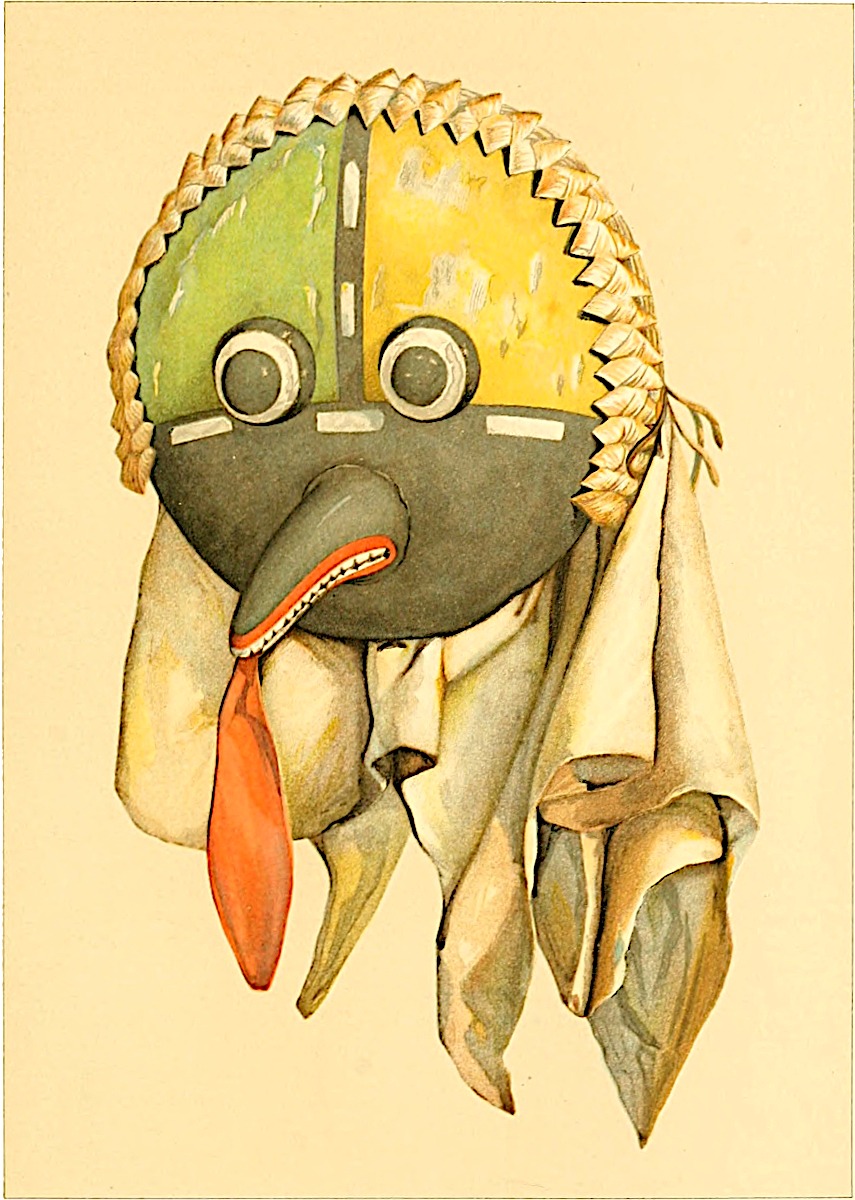
FIFTEENTH ANNUAL REPORT. PL. CXI.
A. HOEN & CO., LITH.
A POWAMU MASK.
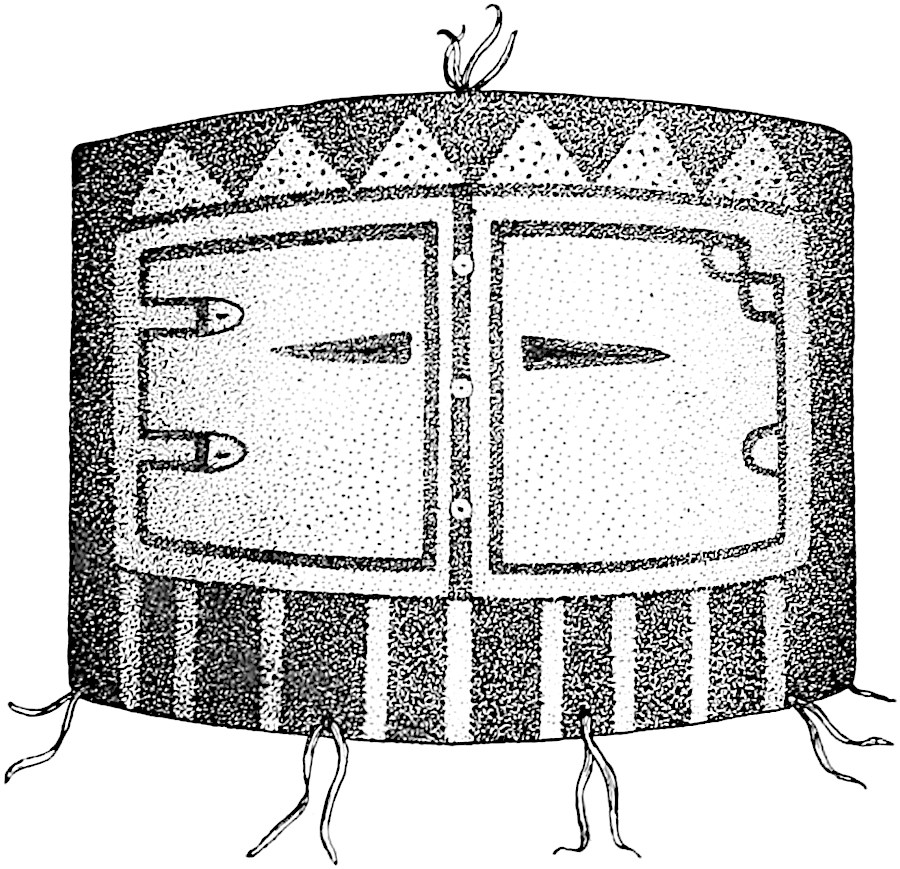
Fig. 48
—Symbolism of the helmet of Húmiskatcina (tablet removed).
The only other Kóko[122] dance which I know of from personal observation is the tablet dance, which is in many respects homologous with the Húmiskatcina. The symbolism of the mask and tablet, however, differs from the Húmis, and while in a speculative way I regard them the same we must await more research to prove them identical. The subject is still more complicated by the fact that the Hopi have a tablet mask with still a third symbolic character, which they call the Zuñi or Síohúmiskatcina.
I think we need have no hesitation in supposing that the so-called Sío (Zuñi) Katcina, which I have elsewhere described, is a Zuñi celebration derived from that pueblo. I do not know whether it is ever performed there in the same way as at Walpi, since it has not been described by any of the students of the Zuñians.
We have, however, as before mentioned, a partial description by Cushing of the Zuñi Shálako, and from his account we can gather a few of the main points of difference between it and the Síocálako performed at Walpi and described in the preceding pages. The Hopi, however, have a Cálako of their own. They distinguish it from the Síocálako, which they not only recognize as of Zuñi origin, but are also able to designate the family which brought it from the Zuñians. The name of the celebration and the use of Zuñi words in it both point to this conclusion.
The correspondence between the Héemashikwi, or last[123] dance—the tablet dance described by me elsewhere as occurring at the close of the series of Kókos—is probably the same as the Nimánkatcina. There are many similarities to indicate this fact, and, although as yet we know nothing of the secret observances connected with it, I suspect that a similarity between them and those described in the Móñkiva will later be made known.
Dolls in imitation of the Héemashikwi are reported in the catalogue of Colonel James Stevenson’s collection from Zuñi in 1881, and I have no doubt it will be found that there formerly was, and possibly still survives, at the celebration of this dance at Zuñi the characteristic habit in Tusayan of distributing dolls as presents at the departure of the Katcinas.
Mrs Stevenson has given short descriptions of some of the Zuñi Kókos and figures of the masks of the same. While it is not possible for me to use them in a comparison with Katcina celebrations, they are interesting in studies of symbolism. The “flogging Kókos,” for instance, seem to function the same as Túñwup among the Hopi, but as the symbolism of the mask of the floggers, Saiāhlias, is not given by Mrs Stevenson I am not able to express an opinion whether the same personage is intended or not. The time of year when the flagellation is inflicted by the Saiāhlia of Zuñi would be an interesting observation, and the accompanying ceremonials would also be of great interest for comparison with the Powámû.
I have not been able to find the equivalents of the Sälämobias among the Hopi, but the symbolism of Pooatíwa agrees almost exactly with that of the Hopi Paútiwa.
The Sälämobias of the different world-quarters agree in color with those assigned by the Hopi to the same points, with the exception of those for the above and below. In Zuñi, according to Cushing and Mrs Stevenson, the above is all colors, the below black. Among the Hopi the above was found to be black and the below all colors. This discrepancy in observations is recommended as a good subject for future students, both in Tusayan and Zuñi.
In reviewing the Hopi ceremonial personages I have been unable to find any homology with the Sälämobias. The views of the masks[124] given by Mrs Stevenson afford little information on this subject, but in her sand picture, surrounded by the Plumed Snake, I find some of the figures of Sälämobias with indication of a connecting band between the eyes, which recalls Paútiwa’s[125] symbolism. There does not seem to be a wide difference between the profile views of the masks of Paútiwa and Sälämobia of the different world-quarters.
The environment of the pueblos of Tusayan and of Cibola is so similar and the rain-cloud worship so imperative in both that, a priori, we should expect the rain-cloud symbol to be as frequent in Zuñi as in Walpi. I am much surprised therefore in studying the description of Zuñi ceremonials to find nothing said of the characteristic Hopi symbols of the rain clouds, the semicircles and the parallel lines of falling rain (plate CVIII). If the rain clouds at Zuñi are limited to the terraced[126] figures found on the prayer-meal bowls and the same made in sacred meal we certainly have a significant difference between the symbolism of these two peoples. In Tusayan there is not one of the great religious festivals where the semicircular clouds and falling rain do not appear as symbols. Thus far students of the Zuñi ceremonials have not figured one instance in which they are used.[127]
The short account of the effigy of the Plumed Snake (Kólowisi) with attendant ceremonials at Zuñi, by Mrs Stevenson, shows the existence of archaic rites with the Plumed Serpent which have been observed in a different form (Pálülükoñti) at Tusayan. The time of the year when the Zuñi effigy is brought to the kivas on a rude altar is not given; nor is the special name of the ceremony. The conch shell is similarly used to imitate the voice of the Plumed Serpent at Zuñi, as at Walpi, in the Soyáluña and the Pálülükoñti. In neither of these ceremonials, however, have the effigies been observed to be carried ceremonially about the pueblos of the Tusayan mesas. The symbolism of Pálülükoñti and Kólowisi seems to differ, judging from published accounts and symbolism on Zuñi and Hopi pottery. I find no intimation of the horn on the head of Zuñi pictures of the Plumed Snake, and the arrowhead decoration fails on the body. The two crescents which are common on the body of the Zuñi figures have not been observed in Hopi pictographs or effigies.
It would seem both from legendary and other reasons that there has not been the warmest friendship between the inhabitants of Tusayan and Cibola. This is not to be wondered at, for only on rare occasions has there been good feeling between two pueblos even of the same speech. The massacre of Awatobi at the hands of the other Hopi has been told elsewhere, and even at the present day Oraibi is not on the best of terms with the other Hopi towns. The legends of the Hopi are full of quarrels of one pueblo with another, and bitter hatred sometimes developing into bloody wars in which their own kindred were attacked and pueblos destroyed.
In her article, “A chapter of Zuñi mythology,”[128] Mrs Stevenson says: “The Ahshiwanni,[129] a priesthood of fourteen men who fast and pray for rain; the Kokko, an organization bearing the name of anthropomorphic beings (principally ancestral) whom they personate, and thirteen esoteric societies are the three fundamental religious bodies of Zuñi.... The society of the Kokko personate anthropomorphic gods by wearing masks and other paraphernalia. There are six estufas or chambers of the Kokko for the six regions, the north, west, south, east, zenith, and nadir, and these rooms present fantastic scenes when the primitive drama is enacted by the personators of these anthropomorphic gods.... The esoteric societies, with but one or two exceptions, have nothing to do with anthropomorphic beings, this category of gods being zoomorphic.”
Accepting these statements as a correct idea of the “three fundamental religious bodies of Zuñi” I find great difficulty in tracing an intimate relation between them and those of the Hopi system. A large number of the Katcinas are anthropomorphic and likewise ancestral. They bear the names of animals, and in that sense may be called in some instances zoomorphic. Walpi, however, has but five kivas, the members of each of which in the Powámû personify different Katcinas. I have not yet discovered that each of these kivas is associated with a different cardinal world-quarter, as Mrs Stevenson finds to be the case in Zuñi. The esoteric societies of the Zuñi, according to Mrs Stevenson, “with but one or two exceptions have nothing to do with anthropomorphic beings.” I am not able to harmonize my observations of the secret societies in Tusayan with the definition given of the esoteric societies in Zuñi, and must await some clearer insight into the character of the latter before offering any discussion of several resemblances which can be detected. From an examination of Cushing’s article in the Century Magazine, in which the esoteric societies of Zuñi are briefly defined, I am led to believe that the so-called esoteric societies in that pueblo differ a good deal from those in Walpi. The Hopi testify that while some of their secret fraternities are represented in Zuñi several of them are not identical.[130]
Mrs Stevenson does not make it clear who these fourteen (six) so-called Ahshiwanni are, but calls them “rain priests.” She intimates that they appeal directly to the Sun father, their supreme deity, and to the rain makers, while the “societies” address “the beast gods of their worship to intercede with the Sun father and rain makers.” There is apparently no parallelism between these conditions and those at Tusayan, but I can readily find truth in the statement when applied to the Hopi that “no society convenes without giving much time to invocations for rain.” I am sure that some of the societies at Tusayan do not appeal to the beast gods to intercede with the Sun father and rain makers, but address the latter directly in their prayers. In this particular there is certainly a marked difference between the conceptions back of the rites in Tusayan and those ascribed to the Cibolans.[131]
The custom of the Yókimoñwi, or rain chief, retiring alone to a cell to pray for rain was practiced in Tusayan. One of these retreats is to be seen at the Middle mesa. Among the foothills there is a block of sandstone, 15 feet long, 5 feet wide, and 4 feet thick. Its flat face is about horizontal or slightly tilted toward the northeast. Portions of a rough wall are still in place under the block, confirming the story that there was here formerly a chamber of which the block was the roof. An aperture on the northeastern corner, about 20 inches square, is usually closed with loose stones, but the chamber is now filled in with sand to within about 2 feet of the roof or lower surface of the slab. The interior of the chamber was about 8 feet long and 4 feet wide. On the roof, which was painted white, are figures of yellow, green, red, and white rain clouds with parallel lines of falling rain and zigzag lightning symbols in conventional patterns. To this chamber, it is said, the Rain chief of the Water people retired at planting time and lived there sixteen days, his food being brought to him by a girl during his vigils. He was able by his prayers to bring the rain. These visits were made long ago, but even now there are páhos strewn about the chamber, and devout persons visit the place at the present day with a nakwákwoci and pray for rain. Although the Rain chief no longer passes the sixteen days there, it is a holy place for the purposes mentioned.
“The earth,” says Mrs Stevenson,[132] “is watered by the deceased Zuñi of both sexes, who are controlled and directed by a council composed of ancestral gods. These shadow people collect water in vases and gourd jugs from the six great waters of the world, and pass to and fro over the middle plane, protected from view of the people below by cloud masks.”
I find a different conception from this of the rain-making powers of the dead among the Hopi. Among other ceremonials, when certain persons die, after the chin has been blackened, the body washed, and prescribed feathers placed on different parts of it, a thin wad of raw cotton in which is punched holes for the eyes is laid upon the face. This is a mask and is called a rain-cloud or “prayer to the dead to bring the rain.” In general, as many writers have said, the use of the mask transforms the wearer into a deity designated by the symbolism of the same,[133] and as a consequence the dead, we may theoretically suppose, are thereby endowed with supernatural powers to bring rain. The Ómowûhs, however, are the Rain gods, and so far as I can explain the significance of the symbolic rain-cloud mask on the face of the dead and the black color on the chin, it is simply a method of prayer through the divinized dead to the Rain-cloud deities. Among the Hopi the earth is watered by the Rain-gods, but the dead are ceremonially made intercessors to affect them. In this view of the case the Hopi may be said to believe that the earth is “watered by the deceased of both sexes.”
The Hopi believe that the breath body of the Zuñi goes to a sacred place near Saint Johns, called Wénima. There the dead are supposed to be changed into Katcinas, and the place is reputed to be one of the homes of these personages. It is likewise specially spoken of as the house of Cálako, and it is believed that the Zuñi hold the same views of this mysterious place. In lagoons near it turtles are abundant, and not far away Mr Hubbell and others discovered sacrificial caverns in which were large collections of pottery. Tótci, a Hopi resident of Zuñi, is the authority for the statement that the Cibolans do not use the raw cotton mortuary mask, although they blacken the face of the dead chiefs. He says the same idea of divinization of the breath body into a Katcina seems to be current among the Zuñi as among the Hopi.
According to Mrs Stevenson the father of the Kokko is Kaklo (Kyäklu), whose servants are the Sälämobiyas. The name of their mother is not known to me. The Katcinas are said to be the offspring of an Earth goddess,[134] who figures under many names. Their father’s name on comparative grounds is supposed to be Táwa, the sun, or Túñwup, their elder brother.
A study of the group of Katcina ceremonials as compared with the Kóko brings out in prominence the conclusion that while some of them may be identical, as a rule there is considerable difference in the ritual of the Tusayan people and their nearest neighbor, the Zuñi. If variations exist between these neighbors we are justified in the suspicion, which observation as far as it has thus far gone supports, that there are even wider differences between pueblos more distant from each other. The ethnologist fully cognizant with the ritual in one pueblo has a general conception of the character of all, but changes due to suppression of ceremonials, survivals, dying out of societies, and many other causes have modified the pueblos in different ways. The character of the ancient system is adulterated in all. We can form an idea of this modification in no better way than by a minute study of the existing ritual in every pueblo. Upon such comprehensive study science is at the very threshold.
The foregoing pages open many considerations of a theoretical nature which I have not attempted to develop. My greatest solicitude has been to sketch the outline of the Katcina ceremonials as performed at the Hopi village of Walpi in Tusayan.
FOOTNOTES: