GIOTTO’S CAMPANILE. MRS. OLIPHANT.
Reading edition
Of all the beautiful things with which Giotto adorned his city, not one speaks so powerfully to the foreign visitor—the forestiere whom he and his fellows never took into account, though we occupy so large a space among the admirers of his genius nowadays—as the lovely Campanile which stands by the great Cathedral like the white royal lily beside the Mary of the Annunciation, slender and strong and everlasting in its delicate grace. It is not often that a man takes up a new trade when he is approaching sixty, or even goes into a new path out of his familiar routine. But Giotto seems to have turned without a moment’s hesitation from his paints and panels to the less easily-wrought materials of the builder and sculptor, without either faltering from the great enterprise or doubting his own power to do it. His frescoes and altar-pieces and crucifixes, the work he had been so long accustomed to, and which he could execute pleasantly in his own workshop, or on the cool new walls of church or convent, with his trained school of younger artists round to aid him, were as different as possible from the elaborate calculations and measurements by which alone the lofty tower, straight and lightsome as a lily, could have sprung so high and stood so lightly against that Italian sky. No longer mere pencil or brush, but compasses and quaint mathematical tools, figures not of art by arithmetic, elaborate weighing of proportions and calculations of quantity and balance, must have changed the character of those preliminary studies in which every artist must engage before he begins a great work. Like the poet or the romancist when he turns from the flowery ways of fiction and invention, where he is unincumbered by any restrictions save those of artistic keeping and personal will, to the grave and beaten path of history—the painter must have felt when he too turned from the freedom and poetry of art to this first scientific undertaking. The Cathedral was so far finished by this time, its front not scarred and bare as at present, but adorned with statues according to old Arnolfo’s plan, who was dead more than thirty years before; but there was no belfry, no companion peal of peace and sweetness to balance the hoarse old vacca with its voice of iron. Giotto seems to have thrown himself into the work not only without reluctance but with enthusiasm. The foundation-stone of the building was laid in July of that year, with all the greatness of Florence looking on; and the painter entered upon his work at once, working out the most poetic effort of his life in marble and stone, among masons’ chippings and the dust and blaze of the public street. At the same time he designed, though it does not seem sure whether he lived long enough to execute, a new façade for the Cathedral, replacing Arnolfo’s old statues by something better, and raising over the doorway the delicate tabernacle work which we see in Pocetti’s picture of St. Antonino’s consecration as bishop of St. Mark’s. It would be pleasant to believe that while the foundations of the Campanile were being laid and the ruder mason-work progressing, the painter began immediately upon the more congenial labour, and made the face of the Duomo fair with carvings, with soft shades of those toned marbles which fit so tenderly into each other, and elaborate canopies as delicate as foam; but of this there seems no certainty. Of the Campanile itself it is difficult to speak in ordinary words. The enrichments of the surface, which is covered by beautiful groups set in a graceful framework of marble, with scarcely a flat or unadorned spot from top to bottom, has been ever since the admiration of artists and of the world. But we confess, for our own part, that it is the structure itself that affords us that soft ecstasy of contemplation, sense of a perfection before which the mind stops short, silenced and filled with the completeness of beauty unbroken, which Art so seldom gives, though Nature often attains it by the simplest means, through the exquisite perfection of a flower or a stretch of summer sky. Just as we have looked at a sunset, we look at Giotto’s tower, poised far above in the blue air, in all the wonderful dawns and moonlights of Italy, swift darkness shadowing its white glory at the tinkle of the Ave Mary, and a golden glow of sunbeams accompanying the midday Angelus. Between the solemn antiquity of the old Baptistery and the historical gloom of the great Cathedral, it stands like the lily—if not, rather, like the great Angel himself hailing her who was blessed among women, and keeping up that lovely salutation, musical and sweet as its own beauty, for century after century, day after day.
The Makers of Florence (London, 1876).
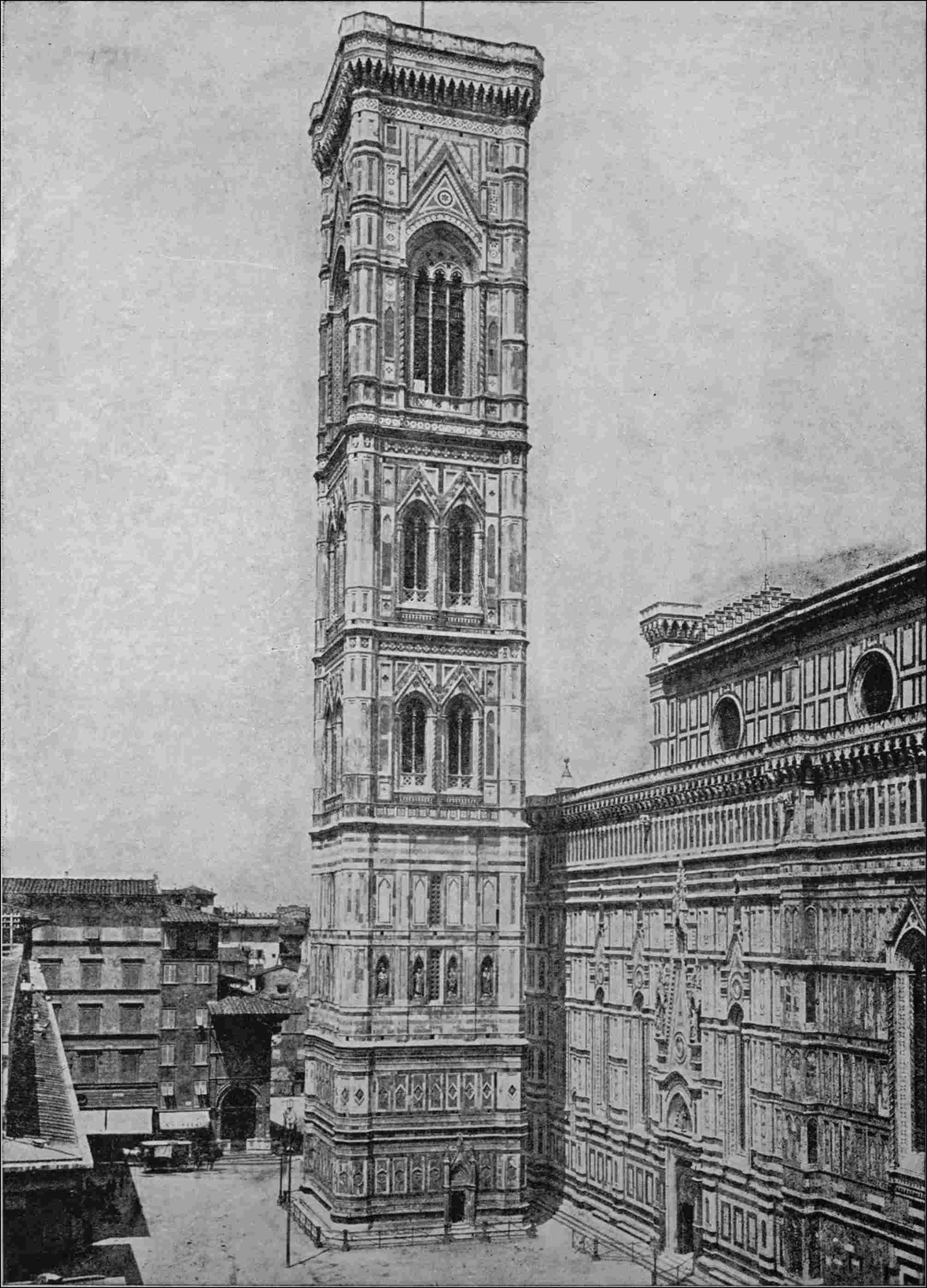
THE CAMPANILE OF FLORENCE