Harry Collingwood (continued 4)
Reading edition
A low murmur of comprehension arose from the scanty crew ranged at wide intervals along the schooner’s port rail, that being the side which the natives were approaching. But before anything more could be said, a loud shout—in a voice the tones of which seemed somehow familiar to me—arose from one of the canoes, and was instantly answered by a yell that, from its volume of sound, must have emanated from the throats of nearly or quite two hundred savages; and then, without further attempt at concealment, a whole host of paddles suddenly dashed into the water, lashing it into long, swirling lines of luminous foam, and, with loud cries of mutual encouragement from the occupants, the eight big canoes surged forward and came rushing through the water at the schooner.
“Keep cool, men,” I shouted above the din: “pick your mark; aim into the thick of them; and load and fire as many times as you can before they can get alongside.” And forthwith I led off with a shot aimed straight at the centre of the dark mass which represented the nearest canoe, at that moment distant about two hundred and fifty yards. My aim was true, and my bullet must have found a double mark, for two distinct shrieks responded a bare moment before a ragged volley of seven shots rang out from the rest of the defenders. More shrieks followed this discharge, but it did not stop the rush of the canoes, which now came sweeping toward us like so many steamers. Meanwhile I was busily engaged in slipping another cartridge into the breach of my piece, calculating upon being able to get in two more shots before the savages arrived alongside. And so, as a matter of fact, I did, as also did some of the others, with disastrous results for the savages, if the shrieks that followed upon each discharge were to be accepted as any criterion; and, apart from that, there was a noticeable wavering and hesitation on the part of the crews of two or three of the canoes after that third discharge. But the hesitation was only momentary; then the rascals gripped their courage afresh and drove their canoes alongside, four dashing up on our port side, and the remaining four essaying to board us to starboard. And when the canoes were within about four or five fathoms of the schooner’s side, with good way upon them, the savages suddenly laid in their paddles and, rising to their feet, hurled a heavy shower of spears at us, every one of which flew harmlessly over our heads, luckily for us.
Then the heavy night air suddenly became vibrant with a medley of harsh, discordant sounds, compounded of the yells and shrieks of the savages, the fierce ejaculations of our own people, the quick, snapping explosions of revolvers, and the gasping groans of the wounded, as the natives swarmed up our low sides and suddenly found themselves confronted by the barrier of our improvised boarding net, through the meshes of which our lads pointed their revolvers and thrust furiously with their cutlasses, while the savages unavailingly strove to tear the stout strands apart and make an opening through which to pass, or thrust at us in their turn with their spears. Suddenly, in the dim starlight, as I was busily reloading my revolver, I saw the cook emerge from the galley with what looked like a bucket in his hand. With a quick twirl he seemed to throw the contents of this bucket through the net just where the savages were crowding thickest on the other side of it, and the next instant there arose a more than usually piercing chorus of shrieks, while the great bulk of the savages at that particular point appeared to melt away suddenly, and I heard the heavy impact of a number of bodies falling headlong into the canoes alongside.
The “Doctor” paused a moment, apparently to note the effect of his experiment, and then he hastily returned to the galley, presently emerging again and repeating his former tactics with similar results. I subsequently learned that, when it became known that an attack of the savages might be certainly looked for, the cook had lighted a rousing fire in his galley, filled his coppers with a mixture of slush and salt water, and brought the whole to the boil, so arranging the matter that the mixture was in a state of furious ebullition by the time the savages arrived alongside. And wherever the blacks pressed thickest and most determinedly, there Cooky intervened with a bucketful of his scalding stuff, which he very effectively distributed over the naked bodies of a round dozen or so of our assailants by giving the bucket a neat twirl at the instant of discharge.
But despite the effective aid thus rendered, matters were, on the whole, going rather badly for us, for two American forecastle hands were by this time down, transfixed by spears which pinned them to the deck, while the sailmaker and I were each punctured and bleeding freely, Sails having received a bad prick in his left shoulder, while a spear had passed completely through the fleshy part of my right thigh; in addition to which a party of savages, by concentrating their efforts upon one particular spot, had contrived to make a hole in the net, which they were rapidly enlarging. Of this last fact I was happily unaware, as indeed I was of the critical character of our situation generally, for it was forward, where Murdock, the ex-boatswain of the Zenobia, was in charge, that matters were going so badly, while aft, where I was, we were doing pretty well.
But Murdock was not the sort of man to be discouraged because for the moment he happened to be getting the worst of it; on the contrary, it was just that state of things that stirred him to extra effort, and it did so now. Perceiving that, unless something were done to prevent them effectively, the savages would soon force their way through the net—and thereafter make short work of all hands of us—Murdock sets his wits going, and presently thought out a plan which he immediately proceeded to put into operation. Seizing a half-empty case of revolver ammunition, he broke open about a dozen cartridges and arranged the powder in a little heap at the bottom of the case, burying one end of a length of extemporised fuse in the heap. Then he piled the cartridges on the top of the heap, placed the case on the windlass bitts, ignited the free end of the fuse, and rushed aft, yelling to us to throw ourselves flat upon our faces as he did so.
So urgent was his call that we all instinctively obeyed it; and there we lay for perhaps ten or fifteen seconds, while the savages, seeing the weak point suddenly deserted, swarmed about it in greatly augmented numbers, finally enlarging the hole in the net to such an extent that at length it was big enough to permit the passage of a man, when one after another they began to force their way through. It was at this precise moment that the spark of the burning fuse reached the powder, which of course instantly blew up, igniting the hundred or so of cartridges that remained in the case, and scattering the bullets in them in all directions. There was a quick flash of the ignited powder, immediately followed by the cracker-like reports of the exploding cartridges, a horrible chorus of yells and shrieks of wounded men, and then—sudden, complete silence, for the space of perhaps half a dozen breaths. Then came renewed groans and outcries, as the injured men felt the first smart of their wounds, followed by a sudden wailing cry, and with one accord the panic-stricken savages flung themselves back into their canoes, seized their paddles, and headed for the shore in frantic haste, being presently sped upon their way by the bullets which we poured into their midst as long as they remained in sight.
Then, and not until then, we laid aside our weapons, mopped the perspiration and powder grime from our streaming brows, bound up each other’s wounds, and went forward to inspect the results of Murdock’s little experiment. It had been exceedingly effective, for scattered round the spot where the explosion had occurred we found no less than nineteen savages, of whom eleven were dead, five were more or less severely wounded, and three appeared to be only stunned. These three we promptly proceeded to bind hand and foot, during which operation we discovered that one of the trio was none other than friend Oahika, our “bumboat man in or’nary”, as the skipper had styled him. I was especially glad that this particular rascal had fallen into our hands, for during the progress of the fight I had frequently caught sight of him, by the light afforded by the flash of our revolvers, and had noticed that he was taking an exceptionally prominent part in the proceedings; while one or two circumstances which I had also noticed led me to suspect that he might possibly be a person of some importance among the natives of Roua Poua.
And now, as with the assistance of three lanterns we proceeded with our investigations, the really desperate character of the struggle in which we had so recently been engaged began to be borne in upon us; for, in addition to the nineteen who had fallen victims to the boatswain’s contrivance, we found scattered about the ship twenty-six dead, and thirty-three more or less wounded natives; while others—with whom the sharks were already busy—were floating in the water near the ship. As for ourselves, we had lost two foremast hands, both of them Americans, while the remainder of us, with the solitary exception of the cook, had each his scratch to show, my own and the sailmaker’s being, fortunately, the only wounds that could be reasonably termed serious, while even they were of comparatively little moment, provided that gangrene did not supervene.
And now, the natives having been beaten off, our next task was to straighten up after the fight, and a beginning was made by throwing all the dead—except our own two—overboard, where the sharks might be safely trusted to see to their speedy disposal. Then we overhauled the wounded savages: and such of them as had received only trifling hurts, and might therefore perhaps yet give us trouble if we were not careful, we bound securely; while the others we laid out on deck, and then proceeded to doctor up as well as our means and our very limited surgical knowledge permitted.
It was while we were all thus busily engaged that the boatswain, happening to straighten his back for a moment and cast an alert glance across the water toward the shore, suddenly stood rigid and staring, and then remarked to me, in a low tone of voice:
“Just look over there for a minute, Mr Temple. Ain’t that a canoe or somethin’ headin’ this way?”
I looked in the direction indicated, and at once sighted a small, shapeless blot of deeper blackness in the shadow that enshrouded the whole of the west side of the island. But if it was a canoe it was certainly a very small craft; moreover, it was not coming from the direction of the beach, but from a point apparently about a mile to the north of it. We stood watching it for a full minute, or more, and then I caught the now familiar phosphorescent gleam of water which indicated the presence of a moving object.
“Yes,” I said, “it certainly is a canoe, Murdock; but she seems to be only a very small affair, such as need give us no very serious amount of anxiety. We will keep an eye upon her for a minute or two and see what she is after. Perhaps it is a messenger from the natives coming off to treat with us for the surrender of the wounded. I hope it may be, because then we shall perhaps learn what has become of the skipper and the rest of the missing men.”
As the canoe continued to approach, we observed a certain eccentricity in her behaviour, for instead of progressing in a straight line her course was a decided zigzag, now heading one way and now another, to the extent of about four points of the compass; still it looked as though she was aiming for the schooner, for her general direction of approach was toward us. I procured the night glass and brought it to bear upon her, and was then able to distinguish that she was indeed an exceedingly diminutive craft, containing only one figure, who seemed to be sitting in her stern, and was paddling somewhat awkwardly, first on one side of her and then on the other, which probably accounted for her eccentricity of movement. Furthermore, as I continued to watch, a certain suggestion of familiarity grew upon me in connection with the appearance and actions of the paddling figure; and finally, when the canoe had approached to within about a hundred fathoms of the schooner, I put down the glass and hailed:
“Canoe ahoy! what canoe is that?”
“Hillo! is that you, Temple?” came the reply in Cunningham’s well-known voice.
“Ay, ay,” I replied, “it is I, right enough. And glad I am to see that you are all right. Do you happen to know anything about the skipper?”
“Got him here, in the bottom of the canoe,” was the reply. “The poor old chap is rather badly hurt, I’m afraid. Con-found this canoe! Why won’t the wretched thing go straight?”
“It is because you don’t understand how to handle her, I expect,” replied I. “Do you know anything about the three men who took you ashore yesterday?”
“No,” answered Cunningham. “Didn’t they return to the ship?”
“They did not; and I am very much afraid that we shall never set eyes upon them again.”
“Phew!” whistled Cunningham; “that’s bad news, although I’m not very greatly surprised to hear it after the way that the beggars ashore behaved—Hillo! what’s this? Why—I say, Temple, there’s a dead native floating about out here. What’s the meaning of that?”
“It means that a determined attempt to capture the schooner was made, about two hours ago, and was very near being successful,” said I. “Do you mean to say that you did not hear the rumpus?”
“Not a sound of it,” answered Cunningham. “But of course that may be accounted for by—but one can talk about that later. Just heave me a rope’s end, there’s a good chap, and— I say, how are we going to get the skipper up on deck? He’s rather badly hurt, and can’t manage without assistance, I’m afraid.”
The canoe was by this time close aboard of us, and a few seconds later she was brought alongside with the aid of the line which I hove to Cunningham. Then I dropped lightly over the side into her, to see what could be done to help Brown, who all this time had remained perfectly silent. I found him propped up in the eyes of the little craft, and when I stooped over him I saw that his eyes were closed, as though he slept. But according to Cunningham it was not sleep, it was insensibility, resulting from a blow on the head with a heavy club. In any case the poor old fellow was obviously quite unable to help himself. I therefore took the rope’s end which I had thrown to Cunningham, made a standing bowline in the end of it, passed it under the skipper’s arms, and then sang out to those on deck to hoist away gently, while Cunningham and I helped by lifting. Thus presently we managed to get Brown first on deck and then down into his own stateroom, where Cunningham, who claimed to possess a certain amateurish skill and knowledge in medicine and surgery, at once took him in hand, while I returned to the deck and assisted the others in the task of straightening up generally.
By the time we had finished the young dawn was paling the eastern sky, and the island, from being a mere shapeless black shadow, had changed to a deep neutral-tinted—almost black—silhouette, as clear and sharp of outline as though it had been cut out of paper, its equally dark reflection trembling on the surface of the water, and coming and going almost as far out as where the schooner lay at anchor. Then, even as I stood watching, the pallor brightened to a clear, pale tint of purest primrose, which presently flushed into a warm, delicate orange hue; a long shaft of white light shot straight up toward the zenith, and an instant later the topmast branches of the trees that crowned the island became edged with a thin hair-line of burning gold, which spread with marvellous rapidity north and south until every limb and trunk glowed with it. Finally a level beam of golden light flashed through a dense clump of foliage that crowned the highest point of the island, and the next instant that same clump became swallowed up and lost in a great, dazzling, palpitating blaze of golden light, which was the body of the rising sun; the colour of the island changed from neutral tint to deep sepia, and from that to innumerable subtle tones of olive and green, as the light grew stronger, and the masses of foliage separated themselves from each other and became distinct, until the shape of each became perfectly defined and took its proper place in the picture. And while these magical colour changes were in progress the deep shadow which marked the junction of land and water dissolved until the beach once more emerged into view, with the jollyboat still hauled up on it where she had been left on the previous day, and round about her, to left and right, eight big canoes, undoubtedly those which had been used in the attack upon the schooner a few hours earlier.
While I still stood gazing, entranced, at the beauty of the new day, Cunningham emerged from the companion way and joined me.
“Well,” he said, “you will be glad to hear that I think we shall pull the poor old skipper through, after all. I started to give him a thorough overhaul as soon as you left me; and I found that those murdering thieves of natives had literally cracked the poor old chap’s skull for him. I also found that a tiny splinter of bone had been driven inward upon the brain by the force of the blow; and this splinter I succeeded in extracting, with the result that he emerged from his state of coma, and, after I had properly dressed his wound, went to sleep.”
Chapter Ten.
We lose the Skipper.
“I am delighted to hear it,” I said, “for we have paid dearly enough already for our folly in coming to this island, without being called upon to pay the additional penalty of that poor old chap’s life. We have lost two of our number in the attack upon the ship, while the three hands who took you ashore yesterday are missing—and, by the by, where is Maybury?”
“Dead, poor chap, I am sorry to say—murdered by those treacherous scoundrels of natives,” answered Cunningham. “The way of it was this. When we landed we were immediately surrounded by a mob of blacks; and just for a moment I had a shadowy suspicion that things were not quite all that they ought to be. But as I looked round I saw that the natives were all unarmed; and, moreover, they were all smiling and apparently in the best of tempers—indeed, one of them, a girl, flung a garland of flowers round my neck, either as a joke or a sign of goodwill, I didn’t quite know which—so I took it for granted that they were friendly disposed, and we all got laughing and joking together. Then the skipper, Maybury, and I gradually worked our way through the crowd, and, accompanied by the men who had wood to sell, walked up through the village, which seemed to be inhabited chiefly by naked little piccaninnies, playing in the sand with the dogs, and women.
“The village is about a quarter of a mile in length, and beyond it there are about twenty acres of cleared ground, planted with manioc, cassava, corn, and fruit trees—principally bananas, beyond which is the virgin forest. Toward this we made our way, and, entering it, followed a bush path for about a quarter of a mile, until we reached a small open space. We had scarcely entered this when the three pretended sandalwood merchants simultaneously turned upon us, and, uttering a terrific yell, seized each of us by the arms, which they tried to confine behind our backs. Taken unawares though I was, I struggled fiercely to throw off my particular assailant, but the beggar was a big sinewy chap, with muscles like steel, and ere I could wrench myself clear about a dozen other blacks sprang into the enclosure, evidently in response to the shout raised by our captors; and before I well knew what was happening I found myself upon the ground, with three or four savages sitting upon me, while others were binding me hand and foot. While I was still struggling I heard the pop of a revolver twice, the reports being so close together that I knew at once they must have come from different weapons; and the next instant I heard a dull crack, a groan, and the fall of two heavy bodies upon the dry leaves and twigs which carpeted the floor of the open space where the struggle had taken place. Then, when my captors had effectually secured my limbs, they raised me to my feet, and I saw the skipper lying, face downward, about a yard away, with his head bare, a small stream of blood trickling from it and clotting among his grey hair; while close to him lay Maybury on his back, quite dead, with a long spear driven right through his heart.
“The blacks turned the skipper over, examined him closely, and then, finding that he was not dead, held some sort of consultation in their own language, the purport of which of course I could not gather; but the end of it was that they hoisted both of us upon their shoulders, carried us back to the village, and thrust us into one of the huts, where we lay untended for the remainder of the day and practically the whole of last night. Then some time—about the small hours I think it must have been—a girl, who proved to be the same who had flung the garland of flowers round my neck, stole into the hut as silently as a ghost, laid her finger upon my lips—to indicate, I suppose, that I was not to talk—and deftly proceeded to cast adrift my bonds; after which she proceeded vigorously to chafe my ankles and wrists, in order to restore the circulation, which had been practically suspended by the tightness with which the ligatures had been bound. And look here, Temple, if you should ever chance to have an enemy, and have a fancy to torture him, just bind his wrists and ankles tightly together and leave him for a few hours—that’s all!
“Well, when the feeling had come back into my limbs a bit, and I could move them without screaming, the girl produced some food and drink, and, although I don’t in the least know what they were, I ate and drank freely. Then, in the curious ‘pidgin’ lingo that these people use when conversing with white men, the girl gave me to understand that my life and that of the skipper was in the greatest jeopardy, and that if I did not want particularly to die I must buck up and save myself and the skipper. Then, taking command, she bade me lift the old man by the shoulders while she took his feet; and in this fashion we slipped out of the hut, seeing nobody, and made our way slowly through the wood until we emerged upon a little beach just on the other side of that headland. Then she drew out from among the bushes a small canoe, in the bottom of which she helped me to place the skipper; after which, with a warning to me to be exceedingly careful and to make no noise, she handed me a paddle, thrust the canoe afloat, and vanished. And—and—well, that’s all! And now you may as well pitch me the yarn of your share of the night’s doings. If one may venture to judge by appearances you seem to have had a fairly lively time out here.”
“We have, I can assure you,” said I; and then I proceeded to give Cunningham a detailed account of all that had happened during the absence of himself and the skipper. I had scarcely finished when the cabin boy came up with the intimation that breakfast was ready in the cabin, and we accordingly went below, seated ourselves, and fell to. We did not dally long over the meal, for there was still plenty to be done and thought about; but before returning to the deck I remarked to Cunningham that I should like to look in and see how the skipper was getting on, and we both entered the stateroom together. To my surprise we found that the old chap was awake and seemingly feeling not very much the worse for the hard knock on the head which he had received; indeed, he wanted to turn out and dress and go on deck. But Cunningham, who had assumed the rôle of surgeon, would not hear of such a thing—would not even permit Brown to leave his bunk; so, as a compromise, I just had to sit down and spin the whole yarn of our adventure over again to him. The poor old fellow seemed very much cut up when he learned that we had lost six men—all of them compatriots of his, too—and bitterly reproached himself for having come to the island at all. Of course we comforted him as well as we could by pointing out to him that the happening was due not so much to want of precaution on his part as to the exceeding guile of the natives; and then I led the conversation round to the prisoners, and asked what he proposed to do with them. Cunningham was for taking the law into our own hands and inflicting upon them a salutary lesson by hanging one of them at the yardarm for each of our people who had been murdered; but Brown would not hear of this, and we were all three still discussing the matter when the cabin boy came down with a message from Murdock to say that a large canoe had just been launched from the beach and was heading for the schooner, and would I be pleased to go on deck.
Of course I instantly obeyed the call, for my first idea was that another attack was possibly impending; but when I got on deck I found that the canoe, although a large one, was manned by only four natives, who were approaching us very slowly, and apparently with a considerable amount of trepidation, and that a large palm-leaf was conspicuously displayed in the bows of the craft, the latter being, as I interpreted it, intended to serve the purpose of a flag of truce. Naturally we at once assumed our weapons, and saw that our firearms were fully loaded and placed handy for use, lest further treachery should be contemplated; and then I hailed the canoe and informed her occupants that if they had anything to say to us they might approach within easy speaking distance, but that they were not to attempt to come alongside without permission, and that if any such attempt were made they would at once be fired upon. And that there might be no misunderstanding upon this point I flourished a loaded gun in their sight, to show that we were quite prepared to carry out our threat.
Slowly and hesitatingly the canoe continued to approach the schooner until she had arrived within about twenty fathoms of us, and then her crew backed water and brought their craft to a standstill. A short consultation among them next followed, and then one of their number rose to his feet and hailed.
“Master,” he shouted, “we got it three mans ashore belong you. You any mans got it belong we?”
“Yes,” replied I. “We have eight of your people on board here. Are the white men unhurt?”
“No,” was the answer. “They all get it hurt leettle bit, not much. Black mans along you not hurt, eh?”
“Three of them are unhurt; the others are wounded so they no can walk. What for you not bring it off those white mans with you?” I demanded, adopting their peculiar mode of speech under the mistaken impression that I could thus make myself the better understood.
“Those white mans no can walk too,” answered my interlocutor. “Suppose you want it them, we bring them off, and you give it us those eight black fellows belong we, eh?”
So it was an exchange of prisoners that they had come off to negotiate, it appeared. Well, I was more than willing to make the exchange, but I did not care to appear too eager; so I temporised by enquiring as to the nature and extent of the white men’s hurts. But they either could not or would not reply in a manner that was perfectly intelligible to me, and matters seemed to be approaching a deadlock when one of the canoe men started to his feet, and in an eager, impatient manner, asked:
“Master, suppose you no got it Oahika aboard, eh?” which enquiry went a good way toward confirming my opinion that the rascal was a person of some importance.
“Yes,” I replied, “we got it Oahika, all right, not hurt one little bit.” Then, with some vague idea of trying the effect of a “bluff”, I continued: “He great blackguard scoundrel! He attack schooner last night, kill it two white mans! By and by we hang Oahika up there until he go dead!” and I pointed to the schooner’s lower yardarm.
A yell of anguish immediately followed this announcement of mine, fully confirming me in the belief that Oahika was likely to prove a valuable asset if properly manipulated. The next moment, however, one of the men jumped up and shouted:
“Mine no believe you got it Oahika. Suppose yes, you show it him, eh?”
“Murdock, Simpson,” I shouted, “just hoist that swab Oahika up on his feet and take him to the rail, so that those fellows in the canoe may see him.”
This was done; and the moment that the fellow’s head and shoulders appeared above the top of the schooner’s low bulwark another loud howl arose from the crew of the canoe, who incontinently flung themselves down on their knees and began to kow-tow energetically. But they were quickly interrupted by Oahika, who shouted angrily at them, and then, as soon as he had secured their attention, proceeded to gabble to them a long string of what seemed to be instructions, in a language quite unintelligible to me. When he had finished, the occupants of the canoe waved their hands, as if to indicate that they understood, then seized their paddles and began to sweep the canoe’s head round toward the shore. This sudden change of front rather puzzled me. I did not quite know what to make of it; it might mean anything, I thought, and among other things it might mean that Oahika had given instructions to muster every available fighting man in the village—or the island—and renew the attack upon the schooner. So I hailed the hastily departing canoe:
“Hillo, there, canoe ahoy! Where are you going, and what are you about to do?”
The men ceased paddling for a moment, and one of them flourished his hand toward the island.
“We get it back along ashore plenty quick and bring it them three mans belong you. Then you give it us Oahika, eh?” he announced.
“You bring the three white mans, and then we’ll see,” I retorted. “And—listen you—if you bring any more of your own men with you I shall shoot Oahika dead! Sabby?”
This threat, uttered upon the spur of the moment, seemed to disconcert them very decidedly, for they remained inactive, staring each other in the face. It also seemed to disconcert Oahika; for no sooner had I finished speaking than he began to shout a long string of further directions, to which the canoe men replied from time to time by waving their hands. Finally Oahika brought his communication to an end with a few words which, from the intonation of his voice, might have been an injunction to the men to hurry up; and away the canoe sped toward the shore.
As soon as it had gone I went down below and reported to the skipper, who now seemed to be not quite so well as he had been half an hour earlier. He was, naturally, very pleased to learn that the three men whom we had all believed to be dead were still alive; and he instructed me to make the best terms I could for their ransom, and, as soon as I had secured possession of them and the boat, to get the schooner under way and proceed to sea without further delay.
The canoe had been gone about three-quarters of an hour when, watching the shore through the ship’s telescope, I perceived a slight stir upon the beach, and presently became aware that a small party of natives had gathered about the jollyboat, which they pushed off from the beach, making fast her painter to the stern of the canoe. Then other natives appeared, bearing in grass hammocks the three missing seamen, who were laid in the sternsheets of the jollyboat; and finally the canoe was manned, apparently by the same four natives who had previously come off in her, and headed for the schooner, whereupon I gave orders for the windlass to be manned and the cable to be hove short, all ready for tripping the anchor at a moment’s notice. This was done; and by the time the canoe was once more within hailing distance the cable was so taut up and down that a single additional revolution of the windlass barrel would break out the anchor and free us from the ground.
And now came the really difficult part of my negotiation with the savages; for, being themselves superlatively unscrupulous and deceitful, they naturally suspected us of being the same, and would not come alongside, or render up possession of the jollyboat and the three wounded seamen whom she carried, until we on our part had released Oahika. And this I flatly refused to do, feeling that, as likely as not, they would play us some scurvy trick as soon as they had recovered possession of the man who, I now very strongly suspected, was the paramount chief of the island, or, if not that, at least a chief of very considerable importance. We argued, stipulated, and made counter stipulations, all to no purpose, and finally once more arrived at a deadlock. Of course I might very easily have settled the matter by shooting the four natives in the canoe; but that would have been an act of the very blackest treachery, and I was strongly of opinion that it was just such treacherous conduct on the part of certain unscrupulous white men that had made the natives of some of the Polynesian islands the cruel, treacherous wretches that they had become.
I therefore once more resorted to “bluff”, by hailing them and saying that unless they came alongside at once and surrendered possession of the boat and those in her, I would get the schooner under way and proceed to sea, taking Oahika and the rest of our prisoners with me; and to make my threat the more effective I turned away and gave the order to man the windlass. This was enough; with the first clank of the windlass pawls, Oahika, who had thus far taken no part in our second palaver, let out a yell at the men in the canoe which caused them to surrender instantly at discretion and rush their craft up alongside the schooner.
And now I determined upon a bold thing. These Roua Poua savages had caused us a vast amount of trouble and loss; through them we were short-handed to the extent of no less than six men; and I felt that for the sake of my own satisfaction and self-respect I must get something, though it were ever so little, back out of them. Therefore, since we white men were all armed, and therefore in a position to take good care of ourselves, as soon as the tackles were hooked into the jollyboat’s ringbolts I ordered the four savages in the canoe to leave her and come on deck to help to hoist in the boat; and this they did in a state of the most abject fear and trembling. Then I sent them for’ard to the windlass to assist in breaking out the anchor; and it was not until the schooner was actually adrift that I permitted them to begin the transfer of their wounded from the Martha’s deck to the canoe. They displayed remarkably little consideration for the comfort and wellbeing of their comrades in the performance of this duty; and indeed I have always been of opinion that had I been foolish enough to liberate Oahika before the others had been transhipped, he and his canoemen would have incontinently made off at top speed for the shore, leaving the others, sound and wounded alike, upon our hands and at our mercy. But I was careful to keep Oahika until the last, and it was not until the schooner was fairly under way and heading out to sea that I cast him adrift and permitted him to go over the side, which he did in a splutter of mingled wrath and fear, pouring out a long string of what were probably native curses as he seized the steering paddle and violently thrust the canoe off the schooner’s side.
By midday we were bowling merrily away to the westward under every rag that we could set, and Roua Poua had sunk out of sight beneath the eastern horizon. Long before this, however—in fact, the moment that they were safely aboard and comfortably bestowed in their bunks—Cunningham had taken the three wounded seamen in hand; and when he had done all that he could for them he came up on deck and reported to me.
“I am afraid,” he said, “that there is not much hope for those three,” with a jerk of his thumb in the direction of the forecastle. “Sullivan and Halpin have had their skulls cracked by blows inflicted with a war club, and their cases are very similar to that of the skipper, but worse; while poor Glenn has no less than eleven spear wounds in his body, and though none of them is very serious in itself this heat makes me terribly afraid of gangrene. However, I have done all that I can for them at present, and we must just hope for the best. Glenn tells me that after the skipper and I had left them the natives came swarming round them, exciting their curiosity by exhibiting curios of various kinds for sale, or barter, rather, at ridiculously cheap prices, and so enticing them away from the beach toward the village, where, they were informed, some really valuable articles might be seen. And then, when they arrived at the village, they were suddenly set upon before they had time to draw their weapons, overpowered, and confined in a hut, where they were left all day yesterday and all last night without food or water, and with their injuries untended. I am afraid there is not much hope for them, poor fellows!”
This was bad news—so very bad, indeed, that I felt it my duty to go forthwith to the skipper, report the matter to him, and ask for instructions; my own idea being that we ought to head for the Samoa or Tonga group, and procure properly qualified medical assistance with as little delay as possible.
But when I got down below and began to talk to the Old Man I soon found that he was, for some inscrutable reason, utterly opposed to any such idea. He would not give his reasons, but he positively forbade me to do as I had suggested, instructing me instead to work out a Great Circle track to Canton, and to get the ship upon her proper course at once. And as he seemed to be in full possession of all his faculties, and to know quite well what he was talking about, I had no alternative but to obey. And indeed, so far as saving the three men in the forecastle was concerned, we might as well have been heading for Canton as anywhere else; for Halpin and Glenn died within a couple of hours of each other that same night, while Sullivan lingered only some twenty-six hours longer.
I looked forward to a speedy and pleasant run to Canton, for I reckoned upon carrying the Trades with us practically all the way. But we were unfortunate; for after a fine run of nine days to the northward and westward we ran into the belt of equatorial calms in latitude 4 degrees South, and for fully three weeks thereafter encountered such extraordinary weather that we dared not ship our fins, from fear of having them carried away, or of badly straining the schooner. For instead of the long spell of calms which one usually expects in those latitudes the quiet weather generally lasted but an hour or two, and then was succeeded by such furious squalls that, for the most part, we could do nothing but run before them under bare poles; and perhaps the most exasperating part of it all was that these squalls blew mostly from the westward, or nearly dead in our teeth, so that it was only toward the tail end of them, just when they were dying out, that we were able to bring the little hooker to the wind for half an hour or so, and make a few miles of northing. And when it was not blowing with hurricane strength it was usually just the opposite: a flat calm, with a black, lowering, overcast sky, moist, steamy, overpowering heat, heavy storms of thunder and lightning, torrential downpours of tepid rain—which, by the way, enabled us to re-fill all our water tanks and casks—and waterspouts ad libitum constantly threatening us with destruction.
It was a month, to a day, from the date of our departure from Roua Poua when we at length cleared the calm belt and got the first breath of the north-east Trades in latitude 3 degrees 47 minutes North, and longitude 158 degrees 55 minutes West, having been driven back almost as far east as Christmas Island by the baffling winds and furious squalls with which we had been obliged to contend; and this brought the dangerous Marshall group right athwart our track. Therefore, the poor old skipper being still unwell, and quite unfit for duty, I decided to make a good stretch to the northward—say as far as latitude 10 degrees North—before bearing up for Canton; by doing which I should have a clear sea before me for the remainder of the trip.
I have spoken of the skipper as being unwell and quite unfit for duty; but that scarcely conveys a correct impression of his condition. The fact was that he was well enough to be up and about on deck, but he was constantly worried with headache of the most distracting kind, and, what was still worse, his intellect seemed to be failing him: he suffered from frequent total lapses of memory, stopping short in the midst of a conversation simply because he forgot in a moment what he was talking about; and he was subject, from time to time, to hallucinations, when he would assure us, with the utmost gravity, that he was the King of England taking a holiday “incognito”, the re-incarnation of Morgan the pirate, or something else equally ridiculous, while at other times he would be perfectly rational. For the first two or three weeks, while these symptoms were in process of development, he caused Cunningham and me a very considerable amount of anxiety, for we were constantly dreading some new departure which would render him dangerous either to himself or to others; but at length, as we were unable to detect any such tendency, we grew easier in our minds, just allowing him to wander about the ship at his own sweet will, and amuse himself by giving the most extraordinary orders, which nobody ever even pretended to carry out. We came to the conclusion that he was suffering from some obscure form of concussion of the brain, from which we hoped he might be relieved upon our arrival at Hong-Kong, where we expected to obtain efficient surgical assistance; but that, meanwhile, he was in no very serious danger. As the event proved, however, we were all woefully mistaken. We had made as much northing as I deemed necessary, and were bowling along upon a west-nor’-west course, reeling off our ten knots per hour, with all our flying kites abroad and a fine north-east breeze over our starboard quarter, when, about four bells in the first; watch, the skipper came up on deck complaining that he found it impossible to sleep in consequence of the extreme heat of his cabin. The night was brilliantly starlit, and the air so clear that we could have easily distinguished a sail at a distance of two miles, had there been owe to see; but the light was not strong enough to enable me clearly to distinguish Brown’s features, even when he was standing beside me, while the cabin lamp was turned low, so that there was not much light coming through the skylight. But when the old fellow fell into step by my side, and began to talk quite rationally about the heat below, the impossibility of sleeping, and his gratification at the fine breeze which we had fallen in with, and so on, I was completely thrown off my guard; for he appeared to be in precisely the condition that I had often previously seen him in, when he had talked rationally enough for a time, taken a little walk—as he was doing at that moment—and then, suddenly forgetting what he was conversing about, gone below and slept for several hours.
All at once, as we were walking to and fro between the main rigging and the wheel grating, the old fellow halted, pulled off his cap, extracted a big bandana handkerchief from it, and proceeded to mop his head and face, from which—as in my own case—the perspiration was freely pouring.
“Great snakes,” he ejaculated, “but it is hot, and no mistake! The sweat’s pourin’ out o’ me like water outen a sponge. I guess that’s what’s makin’ me so all-fired thirsty. Where’s the water cask? I’m boun’ to have a drink. My tongue’s so dry it’s rattlin’ agin my teeth! Can’t ye hear it? Where’s that there scuttle butt, I say?”
“Better not drink direct from the cask, sir,” I said, for Cunningham had strongly urged us all to drink nothing but filtered water, and even that with a dash of lime juice in it, during the extreme heat. “The filter stands on the sideboard, and there is an opened bottle of lime juice in the rack above it; you will find that very much cooler and more refreshing than the water from the scuttle butt. That stuff is really not fit to drink.”
“But I’m so tarnation thirsty that I must have a drink,” he insisted, “and I’d rather drink outer the cask than go below. Why, man alive, that there cabin is like a oven!”
“Oh,” said I, glancing hastily round and noting that the weather seemed fine and settled, “if that is all I’ll very soon slip down and fetch you up a drink! Bring yourself to an anchor here on the wheel grating, sir, while I go below. I’ll be back in a brace of shakes. Just keep your eye on him, Chips,” I whispered to the carpenter, who was at the wheel. “I’ll not be gone more than half a minute.”
“Right you are, sir,” responded the carpenter, turning his quid in his mouth as the skipper obediently seated himself on the wheel grating, while I made a rush for the companion. I turned up the cabin lamp, procured a tumbler, and was in the act of measuring out a liberal dose of lime juice when I heard the carpenter’s voice suddenly upraised in accents of panic.
“Man overboard! Man overboard!!” he shouted. “Mr Temple, come on deck, sir; the skipper’s been and throwed hisself over the lee rail!”
Flinging down the tumbler and bottle of lime juice, I mounted the companion ladder in two jumps, nearly dashing my brains out against the slide in my haste, and stared stupidly about me for a moment, being more than half-stunned. Then, as I pulled myself together, I heard Chips repeating, parrot-wise:
“He just laid his han’s upon the rail and swung hisself clean overboard, like a boy jumpin’ a gate.”
“Down helm, man; down helm and round her to!” I roared. And rushing to the main rigging I let go the lee braces and began to drag frantically upon the weather ones in an ineffectual effort to back the topsail. Then I remembered that the weather studdingsails were set, being reminded thereof, in fact, by the snapping of the topmast studdingsail-boom, as the schooner, with her helm hard a-lee, rushed furiously up into the wind, and her topgallantsail, topsail, and squaresail flew aback, and the broken spar began to thresh spitefully against the fore rigging in the fresh breeze. I saw at once that I had made a mess of things to no purpose, and also stood to make a far worse mess of them if I was not careful; for the amount of sail which the schooner could carry while running off the wind was altogether too much for her when brought to, and she was now lying over with her lee rail buried, with the possibility that her masts might go over the side at any moment if she were not relieved in one way or another. As for saving the skipper, that was impossible: for—as I had forgotten for the moment—we were now, owing to the loss of six of our foremast men, short-handed, and we could not possibly launch a boat until the schooner was snugged down; and by the time we had done that we should be miles away from the spot where the skipper had gone overboard, without any certain, definite knowledge as to the precise direction in which to look for him. Therefore, all these circumstances coming to my mind in a flash, I jumped to the wheel and helped Chips to put it hard up again, luckily managing to get the little hooker before the wind once more with no further damage than the loss of a studdingsail-boom and the splitting of the lower studdingsail.
Chapter Eleven.
The Wreck of the “Martha Brown”.
This last fatality had the rather curious result that of the entire crew who left Baltimore in the Martha Brown only the cook and the cabin boy now survived, the remainder of the existing crew consisting of Cunningham, myself, and the boatswain, carpenter, and sailmaker of the Zenobia; it also resulted in the destinies of the ship and those aboard her, and the interests of poor old Ephraim Brown’s widow, suddenly falling into my inexperienced hands. This being the case, I decided to consult with Cunningham at once as to the proper steps to be taken under the circumstances, although my own view of the matter was perfectly clear and decided. And that view, stated briefly, amounted to this: that my obvious duty was to do the very best I possibly could for Mrs Brown, and that, knowing quite clearly what the skipper’s intentions were, I could not do better than carry them out in their entirety. It was in this form that I laid the matter before Cunningham, asking him to give me his opinion upon it, and requesting him to suggest a better course if he could think of one; but he fully agreed with me that, the schooner being practically full of sandalwood, and being also within three weeks’ sail of Canton, we could not do better than proceed to our destination, dispose of our cargo, invest the proceeds in tea, and then be guided by circumstances—or, rather, the state of the market—as to whether we should take the tea to Europe or America, ultimately returning to Baltimore, and there rendering an account of our stewardship. And upon this understanding being arrived at, the voyage to Canton was continued.
It was on the afternoon of the third day following the suicide of the skipper that the Trade wind, which up to then had been blowing with its usual steadiness, began to weaken, and upon consulting the barometer I found that the mercury was falling rather rapidly. At the same time I became aware that the aspect of the firmament was undergoing a subtle change, the clear, brilliant blue of the sky gradually fading to a colourless pallor, as though a succession of veils of white gauze was being drawn across it, while the clouds, sailing up out of the north-east, paused in their flight and began to bank up in the south-west quarter. These changes continued throughout the afternoon, the result being that the sun gradually became blotted out, and was entirely obscured about an hour and a half before the time of sunset. And with the disappearance of the sun the wind sank until it died away altogether and the schooner lost steerage way, while the heavens assumed a dark, lowering appearance, and the atmosphere became close, suffocating, and so oppressively hot that even the thinnest and lightest of clothing was an almost unendurable burden, and every article was dispensed with that could be discarded without outraging decency. But although the wind had completely died away, the swell did not diminish; on the contrary, it seemed if anything to increase, for the schooner rolled and plunged most outrageously, shipping water over her rails, her bows, and even her taffrail, the water seeming to heap itself up suddenly and fall aboard her in the most extraordinary and unexpected manner. It was evident that a change of weather was impending, and, as the mercury clearly indicated that the change would be for the worse, I caused the schooner to be stripped just before darkness set in, leaving only the reefed foresail and fore staysail set, under which short canvas I believed she could not come to much harm, let the impending weather be what it might.
A quarter of an hour after the time of sunset the darkness was so intense that for all practical purposes we might as well have been blind, for at a distance of ten or twelve feet from the illuminated cabin skylight it was literally impossible to see one’s hand when held close before one’s eyes; while between the darkness and the violently uneasy motions of the little hooker it was positively dangerous to attempt to move about the decks. As for staying below, it was out of the question, for the cabins were like so many ovens; therefore, after supper was over, Cunningham and I both returned to the deck, and, seating ourselves on the wheel grating beside the lashed wheel, chatted together while the engineer smoked pipe after pipe.
It happened to be my eight hours in, that night; therefore, since it was hopeless to think of sleeping in my bunk on such a hot, breathless night, I stretched myself out on the wheel grating, shortly after eight bells of the second dog-watch, and was soon fast asleep, despite the hardness of my bed, while Cunningham sat near me, keeping such a lookout as was possible under the circumstances.
It was seven bells, or within half an hour of midnight, when Cunningham awoke me.
“Sorry to disturb you before your time, old chap,” he apologised. “I have been hoping that it might not be necessary to awake you until eight bells, but—just look at that sky! What on earth does it mean; and what is going to happen?”
I had started up, broad awake, the instant that Cunningham’s hand touched my shoulder, and had at once become conscious of the very extraordinary and portentous aspect of the sky; it was therefore quite unnecessary for me to ask what he meant. When, soon after the expiration of the second dog-watch, I had stretched myself out and fallen asleep on the wheel grating, the darkness had been as opaque as that of Egypt when Moses stretched forth his hand and there was a thick darkness in all the land for the space of three days, during which the Egyptians saw not one another, neither rose any from his place; but now, the moment that I opened my eyes, I saw that the plunging schooner, the restless, heaving surface of the ocean, and the overarching dome of the sky, packed with enormous masses of slowly working cloud, were all suffused with ruddy light, such as might be emitted by a volcano in furious eruption. Yet no flaming crater was anywhere visible, nor did the light flicker or wax and wane, as it would have done had it issued from such a source; it was perfectly steady, and after I had gazed upon it for a time I could come to no other conclusion than that it emanated from the clouds themselves, which glowed with the colour of iron heated to a low red-heat. I had never before beheld such a weird, awe-inspiring spectacle, but as I gazed upon it the memory came to me that I had somewhere read of something similar, and I also remembered that it had been described as the precursor of a hurricane, or some similar atmospheric convulsion.
“I am afraid it means a heavy blow, a hurricane—or typhoon as they call it in these seas,” said I: “and I am very glad that you called me, for I will take the hint and have the schooner battened down forthwith; also this is the first time I have ever witnessed such a phenomenon, and I would not have missed it on any account. You might as well turn in now, if you care to do so,” I added, “for I see it is not far off eight bells, and I shall not attempt to sleep again.”
“Thanks, no—not if I know it!” answered Cunningham. “Like yourself, I have never seen anything of this kind before, and I intend to see all that I can of it now that I have the opportunity. It began more than half an hour ago, the ruddy glare growing out of the inky blackness so subtly and imperceptibly that it is difficult to say precisely when it began, but I became conscious of it when I got up to strike six bells. Then it brightened so rapidly, and seemed so altogether unnatural, that at length I began to feel jumpy about it, and decided that the time had arrived when you ought to be called.”
“Quite right,” I agreed. “Well, if you won’t turn in, perhaps you will be good enough to keep a lookout here while I go for’ard and see to the battening down. There is not much to be done, but the little that needs doing might as well be done at once.” And therewith I left him and staggered along the squirming deck to the forecastle head, where Chips and Sails were perched upon the windlass bitts, out of the way of the water that was constantly slopping in over one bow or the other, talking together in a low-pitched murmur, and staring awestruck at the incandescent sky.
“Well, Chips,” said I, “have you ever seen anything like this before?”
“Ay, sir, I seen the same thing once before, when I was in the Tenedos, one of the China tea clippers,” answered the carpenter. “We was in the Injin Hocean at the time, homeward-bound. The skipper—Cap’n Bowers, his name was—was down with dysentery at the time, and the mate was one o’ these here chaps that thinks they knows everything. He ’lowed that the weather signs didn’t mean nothin’ partic’lar, and wouldn’t so much as take in the skysails—because, d’ye see, we was racin’ home with another ship, and Mister Mate reckoned he wasn’t goin’ to be scared into shortenin’ down just because the weather looked a bit unusual. Consequence was that we was on our beam-ends about a hour a’terwards, with all three masts over the side and the ship threatenin’ to go down under us. A nice busy twenty-four hours we had of it a’ter that, I can tell ye, Mr Temple, and it ended up in our crawlin’ into Table Bay under jury-masts, and lyin’ there five solid months before the new spars comed out to us and we re-rigged the old barkie!”
“How did it come down upon you then—in the shape of a sudden squall?” I demanded.
“Well, no, not exactly that,” answered the carpenter. “It began wi’ little whifflin’ gusts that comed up from nowhere partic’lar, and was gone again afore you could say Jack Robinson. They comed moanin’ along, filled the canvas with a smack, and—there was an end o’ that one. Then another’d come along same way, do the same thing, and go floatin’ away down to loo’ard. It happened ’bout half a dozen times, and then, afore we knowed where we was, away come the hurricane, screamin’ and yellin’ like Billy-oh. ‘Halyards and sheets let go, fore an’ aft!’ yells my noble Mr Mate—Bryce his name was; but, Lor’ bless you, sir, afore we could cast off the turns from the belayin’ pins the gale had hit us, and there we was, on our beam-ends, wi! the deck standin’ up like the side of a ’ouse.”
“Well,” said I, “that can scarcely happen to us, I think, with the small spread of canvas that we are showing. But it will be bad enough when it comes, I doubt not; so go below and call Murdock, the cook, and the cabin boy, and say I want them to come on deck, as I am about to batten down the fore scuttle. And when eight bells comes, you will have to go aft and stretch yourselves out on the cabin lockers, for the forecastle will be closed until this breeze is over.”
It took us but a few minutes to batten down the forecastle hatch securely, for there was a good tarpaulin cover that had been specially made to fit it; and when that was done I set our scanty crew to work—myself lending a hand—to secure the galley and the boats with extra lashings, so that they might not be washed away: and when we had finished, the cook entered his galley and shut himself in, to finish the night there.
As it happened, we were none too soon in the completion of our preparations; for scarcely had we finished when the ruddy glow in the sky began to die out again, and as it did so the first of those scuffling puffs of which Chips had spoken came whining and moaning across the surface of the ocean from the south-west, filling our scanty spread of canvas with a resounding clap and then passing away toward the north-east, its track across the glistening surface of the ocean being marked by a dimming blur like a catspaw, which swept down toward us, touched us for an instant, and was gone again. This occurred some seven or eight times at decreasing intervals, each succeeding rush of air being of a few seconds’ longer duration than the preceding one, and coming with greater strength and spite, thus enabling us at last to get steerage way upon the schooner and partially turn her stern toward the point from which we expected the outfly to come. And when presently it came roaring and howling and screaming down upon us, with such a medley of sound as might be expected from a legion of unchained furies, our port quarter was turned towards it, with the schooner in motion and paying off before it. Yet, even so, it swooped down upon us with such appalling violence that the little vessel careened until her lee sheer-poles were buried and the water was up to the coaming of the main hatch. But with way on her, her helm hard up, no after canvas set, and the hurricane dragging at her stout foresail, she could not help paying off, and after a long minute of heart-racking suspense, during which we momentarily expected her to keel-up with us, she suddenly righted and went flying away dead before the wind, with the water boiling under her bows up to the level of her head-boards.
One of the Martha Brown’s good points was that she steered as handily as a little boat. I therefore had no difficulty in keeping her dead before the wind without assistance, although Cunningham stood by to lend me a hand should I chance to need any help. Also the water, apart from the boiling foam into which its surface was scourged by the hurricane, was perfectly smooth, the smallest suggestion of a wave crest being instantly seized by the wind and swept away to leeward in the form of fine, salt rain; indeed, the air was so full of spindrift and scudwater that I believed, even had it been daylight, we could not have seen farther than about two, or at most three, lengths from the ship. As it was, with the outfly of the hurricane that weird, unnatural, ruddy light of which I have spoken almost immediately died out from the sky, leaving the night as pitch-dark as before, save for the ghostly gleam of phosphorescent light which arose from the storm-swept ocean, and which gave the water, as far as it could be seen, the appearance as if moonlight were shining up through it.
When we had been scudding for a full quarter of an hour before that raving, screaming, howling fury of wind I began momentarily to expect and look for some indication that the worst was over, and to hope that the wind would moderate sufficiently to allow us to heave the schooner to before the sea should acquire height and weight enough to render the operation dangerous, for now every mile that we ran was carrying us just so much farther from our destination. But as time went on the gale, instead of moderating, seemed to increase in strength, until I began to wonder how much longer hemp and pine and canvas could endure the terrific strain to which our foremast, its rigging, and the reefed foresail were exposed. Still, although the mast was bowed forward in a curve that seemed to have approached perilously near to breaking-point, and although the shrouds and backstays were strained until they were hard as iron bars, everything was, so far, holding splendidly, and the schooner was rushing along at a speed which I was firmly persuaded she had never before approached.
At length, after I had been at the wheel nearly three hours, Cunningham insisted on relieving me: and, to speak truth, I was more than glad to accept his offer, for notwithstanding that it was by that time blowing harder than ever, and that the wind continued to scoop up the water in such vast quantities that the air was thick with salt rain, a high and unpleasantly steep sea had gradually risen, chasing the schooner and constantly threatening to poop her, or broach her to, so that at length, in order to escape the one fate or the other, it became necessary to keep the wheel perpetually in motion, now to port and anon to starboard; and a couple of hours of that kind of work, combined with the heavy strain upon one’s nerves, is enough pretty well to tire out the strongest—moreover, I was drenched to the skin. Therefore I gladly made way for Cunningham, and, having first gone forward and directed Murdock to go aft and stand by the wheel, so that he might be at hand in the event of Cunningham needing any assistance, I returned aft—finding it necessary, by the way, to go down on my hands and knees and literally crawl along the deck, in order to make headway against the buffeting of the wind—and went below to my cabin, where I proceeded to strip off my wet clothes and subject myself to a vigorous towelling preparatory to donning a dry rig and my mackintosh.
Taking my time over the operation, I had proceeded so far as to have donned a dry undervest and a pair of thin duck trousers; and, having rolled the legs of these up to my knees, was in the act of unhooking my long mackintosh coat from its peg, when a terrific shock hurled me violently against the cabin bulkhead, and the next instant a deafening medley of sounds, compounded chiefly of the crash of breaking spars, the wild yells of Cunningham and Murdock, the seething smash of a perfect mountain of water on the deck, the splintering of the glass in the cabin skylight and the pouring of a deluge of water down into the cabin, smote upon my ears.
Partially stunned by the violence with which I had been dashed against the bulkhead, I made no immediate effort to rise, but remained passively where I had fallen, stupidly striving to realise what had happened, until a tremendous upheaval of the schooner’s hull, by which she was hove completely over on her beam-ends, and a rush of water that half-filled my cabin awoke me to the consciousness that a catastrophe of some sort had overtaken us, and I scrambled awkwardly and with difficulty to my feet, pulling myself up by means of the knobs of the drawers under my standing bedplace, when another furious shock again upset me, and I fell squatting into the water violently surging to and fro athwart my cabin. By this time, however, full consciousness of the serious character of the situation had come to me, and as the schooner was again hove up and almost on to her opposite beam-ends, I let go my hold of the drawer-knobs and went swirling out through my stateroom door, lifted fairly off my feet by the rush of water, and found myself swimming for my life in the main cabin, in the midst of a squadron of cushions that had floated or been flung off the top of the cabin lockers. Then another mountainous sea swooped down upon and overwhelmed the hapless schooner, another deluge poured into her cabin through the smashed skylight and the companion, and had not a backwash of water just then swept me into the companion way and stranded me on the ladder, so that I could grasp the handrail, I should certainly have been drowned, for that second downpour filled the cabin to the level of the beams.
As I pulled myself up and secured a footing on the companion ladder I felt the hull of schooner again soaring aloft, up, up, until it seemed to my excited imagination as though the little craft was being hove right up among the clouds and at the same time being capsized. Then came the thundering crash of another mountain of water upon her deck, accompanied by the sound of rending woodwork as the companion cover parted company and was swept away; a whole Niagara of water poured down through the opening upon my devoted head, and as I clung to the handrail with the grip of a drowning man the schooner struck a third time, with such terrific violence that I fully expected the hull to go to pieces about my ears. But no, the stanchly built little hooker still held together, although I knew that her bottom must be stove in like a cracked egg-shell; and presently, when I felt that I could not hold my breath for another second, I found my head once more above water, and saw dimly, close above me, the hole in the deck where the companion cover had once been. Another moment and I had again found footing on the ladder, and, bruised all over and aching in every joint of my body, I crawled out on deck.
Whether it was that my eyes had at last adjusted themselves to the darkness, or that the darkness was less profound than it had been, I know not, but as I emerged from the companion way and secured a footing on deck I became aware that I could dimly perceive my immediate surroundings. The first object to catch my eye was the stump of the mainmast within a few feet of the spot where I was standing, and the instinct of self-preservation at once prompted me to make a dash at it and fling my arms round it, in order that I might not be swept away by the next sea which should break aboard. And as I stood there gasping for breath and staring about me I discovered that I could not only dimly perceive my immediate surroundings, but that the entire hull of the schooner was visible as an all but shapeless black patch in the midst of a madly leaping chaos of swirling foam, which gleamed ghostly white in the light of its own phosphorescence. It was still blowing as furiously as ever, and the air was thick with spindrift and scudwater, which blotted out everything outside the radius of some thirty fathoms on every side; but the schooner now seemed to be in comparatively smooth water, and I was not long in guessing at the reason, for, glancing to windward, I could dimly see, a few fathoms away, a great wall of spouting, leaping white breakers, evidently marking the position of the reef upon which we had struck so violently, and over which we now seemed to have beaten, for there were no further shocks. But imperfectly as I could distinguish objects in the darkness, I could still see enough to convince me that the schooner was a complete wreck and full of water, for both masts were over the starboard side, still attached to the hull by the rigging, while every scrap of bulwark, boats, galley, in fact everything above the level of the deck, was swept away.
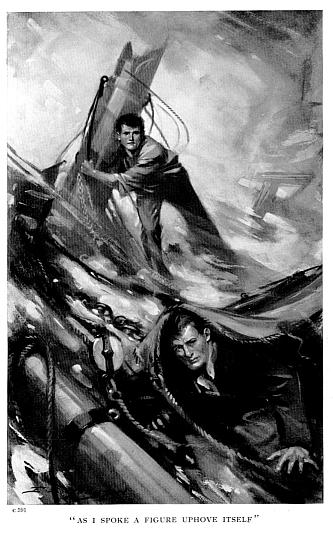
A single glance sufficed me to grasp these details, and then I turned my gaze inboard again, wondering whether any of the others had survived that awful passage across the reef. And as I did so the sound of someone vomiting close at hand reached my ears.
“Who is that?” I demanded, looking in the direction from which the sound proceeded, and as I spoke a figure uphove itself from among the raffle of the port main rigging, which lay athwart the deck, and a voice which I recognised as Cunningham’s responded.
“That you, Temple?” it asked. “Ugh! Ouch! Ow! By the Piper, this is awful! I seem to have swallowed half the Pacific Ocean! Ow! Ugh! I—Aw! I say, old chap—auch!—where the dickens are we, and what has happened, eh?”
“Where we are I’ll be hanged if I know,” I responded, “for all about here should be open water, according to the chart. But it isn’t, for we’ve just beaten over a reef and in all probability smashed the bottom of the poor little hooker to matchwood in the process. And now the best we can hope is that there is land of some sort close under our lee, for if there isn’t we are in a very pretty pickle. Have you seen anything of the others?”
“Yes,” answered Cunningham, “Murdock is here; but I’m afraid he is badly hurt, poor chap, if not killed outright. When the schooner struck, he and I were swept for’ard by the first sea that broke aboard, and the next thing I knew, when the water had gone, was that I was clinging to this rigging here with one hand, and that I had hold of somebody’s leg with the other, that somebody being Murdock. But he was—and still is—insensible, and I am afraid he must have been violently dashed against some of the wreckage, so I lost no time in making him fast to the first loose rope’s end I could find. But I say, if the schooner’s bottom is stove, as you say, I suppose she’ll sink in a few minutes, won’t she?”
“Sink! With her hold full of sandalwood? Not much!” I retorted. “Still, I hope there is land not far away, for I have no fancy for washing about the Pacific on a crazy, waterlogged hulk, and that is the condition of the Martha Brown at this moment. But where are Chips and Sails and the boy? I’m afraid we shall never again set eyes upon poor cooky, for he was in the galley, and that, I see, is gone, together with everything else that was on deck.”
“Yes,” said Cunningham, “it went, I think, with the first sea that broke aboard us when we struck the reef. And I don’t know what has become of the others. I seem to remember having seen two figures emerge from the companion way while I was busy with Murdock here, but I don’t know what became of them. I wonder whether we could do anything for the boatswain—the sea is no longer breaking aboard, and—”
“Yes, of course,” said I. “Where is he? We can at least discover whether or not he is alive.”
“Here he is, among all this raffle,” answered Cunningham. “The first thing, I suppose, will be to get him clear of it, and then—”
“Well, I am afraid that is about all that we can do for him at present,” said I, as I moved across the sluggishly rolling deck toward Cunningham. I stooped beside him, and at his direction lifted the tangle of rigging beneath which the boatswain was lying, while he proceeded to cast off the lashings that had saved the inert body from being washed overboard. Then between us we dragged the man out to a clear spot on the deck, where Cunningham knelt, supporting the head and shoulders, while I tore open the front of the thin vest and laid my hand upon the broad, hairy chest. The heart was beating, although but feebly; yet as Cunningham continued to support the man in a sitting position the beats gradually became stronger, and presently, with a groan, consciousness returned, and, heaving himself over on his side, with an ejaculation, poor Murdock began to vomit violently, as Cunningham had done, having evidently, like him, swallowed a great quantity of salt water. For perhaps five minutes the paroxysm continued with severity; then, having rid himself of most of the salt water, the man, between groans, began to ask where he was, and then, as memory returned, informed us that he had received a violent blow on the top of the head which had knocked the senses out of him. Fortunately there was no wound; and after a while the boatswain was able to sit up unassisted, with his back against the stump of the mainmast. And then, having placed him in a tolerably comfortable position, we were free again to take cognisance of things in general, when we became aware of the fact that the schooner, although still rolling heavily with the movement of the water about her, had taken the ground; and upon looking away to leeward I thought I could perceive, through the flying spindrift and against the darkness of the sky, a darker shadow which could scarcely be anything else than land.
When next we turned to Murdock, to enquire whether there was anything more that we could do for him, we found that he had fallen asleep, which was perhaps the best thing that could have happened to him. We therefore left him to finish his nap and fell to pacing the weather side of the deck, between the main rigging and the taffrail, comparing notes as to our experiences; and while we were still thus engaged we became aware of two things. The first of these was that the gale was breaking, while the second was that the dawn was at hand, for far away to leeward of us the sky was paling, down to a certain point, beneath which the shadow lay as dark as ever, but was assuming, even as we stood, a certain definiteness of shape, ultimately resolving itself into the outline of what seemed a distant hill, with deeper shadows between ourselves and it, which, in turn, developed into a low, bush-crowned cliff, out of the base of which a sandy beach presently grew as the light gathered strength.
Then, quite suddenly, the clouds to windward and overhead broke up into detached masses, between which a few stars twinkled transiently before they vanished in the fast-growing light of the new day; and the cloud masses drove away to leeward and disappeared, revealing a sky of the deepest, richest ultramarine, softening away down in the eastern quarter to a tone of the palest and most delicate primrose, against which the outline of the distant hill stood out, sharp as though cut out of paper, so deeply purple as to be almost black. Then, the light coming so swiftly that the eye scarcely found time to note the multitudinous changes of tint accompanying it, the sky behind the hill flushed from palest primrose to rich, glowing amber; a few evanescent shreds of cloud midway between horizon and zenith blushed rosy red at being caught unawares by the sun’s first rays, then vanished; a pencil dipped in burning gold outlined the crest of the distant hill for a few seconds, and then the upper edge of the sun’s disk, palpitating with living light, floated up into view beyond the ridge of the hill, and in an instant the whole scene, save the beach, which still lay in the shadow of the cliff, became a picture of brilliant, dazzling light and colour. To seaward, about two miles distant, was the creaming surf, sparkling diamond-like as it plunged down upon the reef over which we had driven and then leaped and spouted thirty feet high into the clear air before the wind caught it and tore it into mist; while shoreward there stretched a line of curving sandy beach, about a mile in length, forming part of the shore of a shallow bay into which we had driven and wherein the schooner now lay stranded. The beach was distant about half a cable’s length from us, and was backed by a rocky cliff averaging about fifty feet in height, crowned by a growth of low scrub, over the top of which appeared what now seemed to be a low, flat-topped hill, distant perhaps three miles inland.
The beach immediately to leeward of the schooner was strewed with fragments of wreckage, among which we recognised the galley and some fragments of the boats; but what gave us the greatest satisfaction of all was to see two apparently inanimate figures—those of the carpenter and the sailmaker—rise slowly to their feet, walk down to the water’s edge, stare intently in our direction under the sharp of their hands, and then wave their hands frantically in response to our waving, as they recognised the fact that we were aboard the wreck, and for the present, at all events, safe. Then they put their hands trumpet-wise to their mouths and evidently hailed us; but the roar and the crash of the surf on the reef were so deafening that it was impossible for us to catch a word of what they said, and, recognising this, they presently turned and walked up the sand until they came to a dry spot, where they sat down, with the obvious intention of awaiting events. As for Cunningham and myself, we could do nothing but abide in patience where we were until the surf upon the beach should moderate sufficiently to render it safe for us to swim ashore, the wreck being swept so clean that, without breaking up the deck, there was not a fragment of timber left out of which to construct a raft.
Chapter Twelve.
The Island.
By the time the sun had been risen about an hour, Cunningham and I became aware that it needed something more than a mere shipwreck to rob us of our appetite, for we found ourselves rapidly developing a good, wholesome hunger; but, alas! there were no means of appeasing it, for the schooner was full of water and everything in the nature of provisions was quite un-get-at-able: we should therefore be obliged to wait for a meal until we could get ashore, which, we decided, could scarcely be until the afternoon, if even then. And we soon came to the conclusion that our companions ashore were in like case with ourselves, so far at least as hunger was concerned, for about half an hour later we saw them rise to their feet, point first to their mouths and then to the top of the cliff, and presently proceed to the cliff foot, evidently in search of a spot at which it might be climbed. And although, viewed from the wreck, the cliff appeared to be quite vertical, they soon found such a spot; for, as we watched, they began to ascend the cliff, zigzagging to right and left and apparently following something that by courtesy might be called a path, for they walked rather than climbed it, reaching the top in about five minutes. Then, with a wave of the hand to us, they turned into the bushes and disappeared, returning about an hour afterwards with what, as they held it up for us to see, looked like a small bunch of bananas.
Meanwhile, the gale having broken, the wind rapidly dropped, until about midday it fell stark calm. But it was not until nearly sunset that the surf on the beach had abated sufficiently to render it at all safe for us to attempt the swim from the wreck to the shore, by which time we were both so ravenously hungry that we were prepared to take quite an appreciable amount of risk, if by doing so we could procure the wherewithal to appease our craving for food. And while waiting for the sea to go down we employed our time usefully in cutting adrift the rigging by which the broken masts remained attached to the wreck, thus giving the wreckage a chance to drive ashore upon the beach, where we should eventually want it.
At length, however, when the sun had dropped to within some fifteen degrees of the western horizon, and was shining full into the bay where the wreck lay, the sea had so far gone down and the surf on the beach had so far abated as to render it possible for us to land without incurring much risk of injury to our limbs; we therefore awoke Murdock—who had passed most of the day in sleep—and, finding him in pretty good form after his long rest, forthwith proceeded to make the attempt. The distance which we had to traverse was a mere trifle of about fifty fathoms or thereabouts, and we did perfectly well until we reached the inner line of breakers; but there, as luck would have it, something went wrong with the boatswain, and without saying a word to either of us he suddenly flung up his hands and disappeared, at the precise moment when the comber had us in its grip and was about to fling us up on the beach, and when, consequently, it was most necessary that each of us should be perfectly free to look after himself. Fortunately, however, we were all swimming close together, and as Murdock disappeared, Cunningham and I with one accord dived and made a grab at him, catching him just as the breaker curled over and broke, hurling us all forward in a smothering swirl of foam; and the next instant we were all being rolled over and over upon the sand. Then, as we came to rest, I dug my toes and the fingers of my disengaged hand deep into the sand, ready for the backwash, while, as it afterward appeared, Cunningham did the same; and after a severe struggle of a few seconds’ duration the water receded, leaving us stranded and gasping for breath, when Chips and Sails, who had been on the watch, rushed down into the water, and, in obedience to a gasped request from me, seized the boatswain’s insensible body and dragged it up out of reach of the next breaker, while Cunningham and I scrambled to our feet and staggered after them.
Once ashore the boatswain soon recovered from his fainting fit, or whatever it had been, whereupon we all seated ourselves in a circle upon the sand and feasted upon bananas, afterwards slaking our thirst at a little runnel of deliciously cool, sweet water that the carpenter had discovered, earlier in the day, trickling out of the cliff at no great distance from the point at which the wreck had come ashore. And while we were eating, the carpenter informed us that he and the sailmaker had been stretched out upon the schooner’s cabin lockers, fast asleep, when she struck upon the reef for the first time; and that, awakened by the violence of the shock and the crash of the falling masts, they had leaped to their feet, and, scarcely knowing what they did, rushed up on deck, only to be swept overboard the next instant by a heavy sea which broke over the ship. Neither of them knew, at the moment, what had befallen the other; but from what they told us it was evident that the same sea which washed them overboard swept the schooner’s deck of everything and carried away her bulwarks: for when, fighting for breath, they rose to the surface, each of them found himself close to a mass of floating wreckage, to which he clung desperately, and so was eventually flung up on the beach, with the life so nearly battered out of him that it was just as much as either of them could do to crawl far enough up the beach to get beyond the reach of the deadly backwash, when they both collapsed, and so lay senseless until they were revived by the rays of the morning sun.
There were, however, two still missing, namely, the cook and the cabin boy. The former of these we found, quite dead, shut up in the stranded galley; but exactly what became of the cabin boy we never knew, for we never found a trace of him, alive or dead. We buried the body of the cook that same evening in the sand, using fragments of splintered planking wherewith to dig the grave, after which we flung ourselves down upon the dry sand above high-water mark, and, completely worn out, slept soundly until the following morning.
We awoke shortly after sunrise, to find the weather gloriously fine, the Trade wind again blowing briskly, and, to our very great surprise, the wreck but a few yards from the shore, in very little over two feet of water. But a single glance around us at the greatly altered appearance of the beach, as compared with what we had seen of it on the previous day, sufficed to explain the apparent mystery. The tide had something to do with it, of course, for it chanced that the schooner had come ashore on the very top of the highest spring tide: but it was perfectly evident that, apart from this, the water in the bay had been piled up to quite an unusual height by the gale; hence when the storm had subsided and the ocean had once more found its normal level the wreck was left little short of high and dry. This was quite a stroke of good luck for us; for we subsequently discovered that the range of tide in that particular part of the ocean was so exceedingly small that, even at high-water, we were able to wade right out to the wreck, while the wreckage which had been cast ashore on the previous day was now lying high and dry far up the beach, and quite beyond the reach of the ordinary tides. We were thus saved a vast amount of trouble, for although, when we began salvage operations, it was still necessary to do a certain amount of rafting in order to convey heavy articles ashore, light articles, such as we could carry, could be taken thither by the simple process of lowering them over the side to one of our companions, who then carried them ashore in his arms or on his shoulders.
But there were one or two matters demanding our immediate attention, the first being breakfast, while the next was the settlement of the very important question whether or not the island happened to possess other inhabitants than ourselves, and, incidentally, if so, what would be their attitude toward us. And this last was a matter of the most vital importance to us; for our experience, gained during the collection of our cargo of sandalwood, was that while the natives of certain of the islands were gentle, kindly disposed toward strangers, and perfectly harmless, those of others were exceedingly jealous and suspicious, fierce, treacherous, bloodthirsty, and in some cases actually cannibals. Of course if it should so chance that we had been cast away upon an island inhabited by natives possessing the last-named characteristics, our prospects of ultimate escape with our lives were what poor old Skipper Brown would have designated as “purty slim”, and until the point could be determined it behoved us to be exceedingly careful. Therefore, after discussing the matter at a sort of council of war, it was decided that, important as it might be to explore the island and ascertain its capabilities and limitations without delay, it was still more important and urgent to provide ourselves with the means of self-defence. Accordingly, while Chips and Sails again undertook to climb the cliff and procure some bananas for breakfast, Cunningham and I, accompanied by the boatswain—who seemed, after a good night’s rest, to be little the worse for the happenings of the previous day—agreed to wade off and board the wreck, with the view of securing such weapons and ammunition as were come-at-able, and had not been spoiled by sea water.