Front matter (continued 2)
Reading edition
"Look up, sergeant! Look up, old man! Here's Fred himself. Didn't I tell you he was no deserter?" It was Cross' voice, and it is Cross' strong arm that lifts the wondering, trembling veteran to his feet. The young fellow has leaped from his horse and is springing toward them. With wondrous look of relief, of inexpressible joy, of gratitude beyond all words, of almost Heaven-born rapture mingling with the sunshine in his old face, the sergeant stretches forth his trembling arms and cries aloud, "My boy! my boy!"
CHAPTER XIV.
INNOCENT OR GUILTY.

THE provost sergeant at Fort Robinson is a man who has seen and heard a great deal in the course of his army life, and who has the enviable faculty of knowing everything that is going on around him, without appearing to know anything at all. It had been his duty, a day or two previous, to expel from the limits of the reservation a rascally pack of gamblers—a species of two-legged prairie wolf that in the rough old days on the frontier followed every movement of the Army paymasters, and lured and trapped the soldiers until every cent of their money was gone. In point of number the gamblers were strong enough to take care of themselves in case of Indian attack, yet rarely did they venture far from the protection of the nearest troops. Driven out of post and forbidden to return, they had simply camped with their whole "outfit" at the lower edge of the military reservation, where the laws of the State of Nebraska and not the orders of Uncle Sam took precedence. And here they "set up shop" again, and had a game going in full blast this very sunshiny Sunday morning, and the provost sergeant knew all about it. He also knew by ten o'clock that Sergeant Dawson and Private Patsy Donovan of Charlton's troop, with some adventurous spirits from the garrison, were down there, "bucking their luck" against the tricks of these skilled practitioners; and it was not hard to predict what the result would be.
"Shall I take a file of the guard and fetch them back, sir?" he asked the colonel commanding, and that gentleman glanced inquiringly at his cavalry friend.
"How say you, captain?" Charlton reflected a moment and then replied:
"No, colonel. I should say let them have all the rope they choose to take. I can get them when they are needed. You are sure about their whereabouts on Tuesday and Wednesday nights?" he asked, turning to the sergeant.
"Perfectly, sir; and just what they lost and how much they owed the quartermaster's gang when they left."
"Just see where they are at noon then, and let me know," and the provost sergeant went his way, leaving the officers in consultation.
At noon the soldier telegrapher came hurrying to the colonel and handed him a dispatch.
"I feared as much," said the old soldier as he handed the paper to Captain Charlton. "This means work for you at once. Let us go to the office; there will be dispatches from Omaha presently. Isn't it strange that no one at Sidney should have heard of the Indians getting over the Platte?"
At two o'clock Charlton's troop was in saddle, with only three familiar faces missing from the line. In the new excitement the men had ceased to speak of Trumpeter Fred. What puzzled them now was the absence of Dawson and Donovan. A sergeant sent into the garrison, to warn them that the troop was to march at once, came back to say that he had searched every stable and corral; the horses were nowhere about the post or the Agency stores, and men on guard said that they had seen the two troopers riding away down White River soon after one o'clock, and they had not come back. And when Graham reported them absent to Captain Charlton, as the latter in his familiar scouting costume rode out to take command, the whole troop was amazed that their leader seemed to treat it as a matter of no consequence whatever. He returned the sergeant's salute and inquired:
"Every horse fed and watered?"
"Yes, sir."
"Every man got two days' hard bread and bacon?"
"Yes, sir."
"How much ammunition?"
"Eighty rounds carbine per man—twenty revolver, sir."
"Very good, sergeant;" and this brief colloquy ended, the sergeant reined about and rode to the right flank. "Prepare to mount—mount!" ordered the captain. "Form ranks!" and without further delay, "Fours right—march!" and away they went up the lonely valley, along the winding water, breaking into columns of twos and riding "at ease" the moment they had passed the point where the post commander and a little knot of officers had assembled to bid them God-speed. Captain Charlton bent down from his saddle to grasp the colonel's extended hand and whisper a few words in his ear. The colonel nodded appreciatively. "They can't escape," he answered low, and then, watched by friendly eyes in that little group until out of sight, and by fierce and lurking spies until darkness shrouded them from view, the troop rode jauntily on its mission; Charlton and Blunt in murmured consultation in the lead, and forty-eight stalwart troopers confidently and unquestioningly following in their tracks. Who cared that an all-night ride through Indian-haunted wilds was before them? It was an old, old story to every man.
Were there "ghost lights" on the Niobrara that night? The Indian spies could swear by the deeds of their ancestors that the troop soon climbed out of the valley of the White River and rode briskly southward by the Sidney trail, and that every man was in his place in column when they wound down in the "Running Water" flats at twilight. Yet hours afterward, far to the west, miles away at the Laramie crossing, there were twinkling, dancing, "firefly" gleams—like will-o'-the-wisps—through the chinks and loop-holes of that old log hut, and when morning came the ground was stamped with a fresh impress of half a dozen set of hoof tracks—shod horses, not Indian ponies this time.
It must have meant "bad medicine" for the Sioux, for when morning came all the bands that had been so confidently raiding the trails through the settlements found themselves compelled to seek the shelter of their reservations. From Laramie to Sidney the stalwart infantry came marching to the scene, and from east, north, and west the cavalry came trotting, troop after troop, to hem in and head them off. The very band that ventured south of the Platte and killed in cold blood those helpless teamsters, and then sought the destruction of Gaines and his men, fleeing now before Wallace's troops, were met and soundly thrashed by our friends of Company B, with Captain Charlton and Lieutenant Blunt in the lead, and by Monday night the broad valley was clear of savage foes, the cavalry were resting by their bivouac fires, and then, from the lips of Captain Wallace, Charlton heard the story of Fred Waller's exploit, and of the long gallop that brought about the rescue of Colonel Gaines. Our captain could hardly wait for morning to come, but in two days more he was standing by the bedside of his old sergeant at Sidney barracks, and Trumpeter Fred was there too.
One week later, in the big, sunshiny assembly room of the old barrack, an impressive scene took place, and a long remembered though very brief trial was brought to an abrupt close. A court-martial was in session at Sidney; the general who commanded the department had himself arrived to look into the condition of affairs about the Indian reservation, and with Captain Charlton had had a long consultation, at the close of which the bearded, kindly-faced brigadier had gone to the hospital with the troop commander, and bending over old Waller as he lay upon the narrow cot, took his hand and talked with him about Five Forks and Appomattox, and then promised him that his wish should be respected. It was a singular wish—a strange thing for a father to ask. Old Sergeant Waller had insisted that his boy should be brought to trial before the court-martial then in session, and convicted or acquitted of the double charge of theft and desertion that had been lodged against him. In vain Charlton represented to him that it was not necessary, nobody believed the stories now; the veteran was firm and positive in the stand he made.
"Everywhere in this department, sir, my boy's name has been held up to shame as a thief and a deserter. There is only one way to clear him; let him stand trial, prove his innocence, and let us fix the guilt where it belongs." And Waller was right.
Who that was in the court room that hot August morning, when the south wind blew the dust-cloud into the post and burned the very skin from the bronzed faces around the whitewashed wall, will ever forget the closing incidents of that trial? At the long wooden table sat the nine officers who composed the court with their gray-haired president at the head, all dressed in their full uniforms, all grave and silent. At the lower end of the table was the keen, shrewd face of the young judge advocate who conducted the entire proceedings. On one side of him, quiet, self-possessed, and patient, sat little Fred, neat and trim as a new pin in his faultless fatigue dress. A little behind the boy was his captain, Charlton, and along the wall, at the end of the room, Colonel Gaines, with his arm still in a sling, and Captain Cross, with his piercing restless eyes and "fighting face." On the other side of the judge advocate stood the chair in which witness after witness had taken his seat and given his testimony, and now at high noon it was empty, and the crowd of spectators, sitting in respectful silence around the room, craned their necks and gazed at the doorway in hushed, yet eager curiosity to see the man whose name had just been passed to the orderly. It was understood that the case for the prosecution depended mainly upon his evidence.
CHAPTER XV.
COURT-MARTIAL.

FIRST SERGEANT GRAHAM had sworn to the disappearance of the money at the Niobrara and the fact that at daybreak the trumpeter had gone with his horse, arms, and equipments. He also told of his belief that he and the men who slept near him that night had been stupefied by chloroform. Two other troopers told of the loss of their money at the same time; the hospital steward from Fort Robinson testified to Fred's coming to him and getting a little vial of chloroform on a forged request from Sergeant Graham. Corporal Watts had positively identified a ten-dollar bill, which was in the trumpeter's possession when he was searched (at his own request) when first accused of the crime, as one stolen from him at the Niobrara. He had had some experience, he said, and had made a record of the numbers; and this record, in a little notebook, was exhibited to the court.
Not once had the defense interposed or asked a question. It was evidently the policy of Fred's advisers to let the prosecution go as far as it chose. And now came the announcement of the name that was most intimately connected with the case, and Sergeant Dawson in his complete uniform strolled into court, removed the gauntlet from his right hand, and holding it aloft, looked the judge advocate squarely in the face and swore to tell the truth, the whole truth, and nothing but the truth. Then he sat down and glanced quickly around him, but his eyes did not seem to see Fred Waller, nor did they rest for an instant on Captain Charlton, who, tugging at his mustache, looked steadily at the face of his left guide. Then began the slow, painful, cumbrous method by which the law of the land requires military courts to extract their evidence, every question and answer being reduced to writing. Sergeant Dawson gave, as required, his full rank, troop, regiment, and station, but hesitated as to the latter point. "I was left behind at Red Cloud when the troop came away Sunday a week ago, sir, along with Private Donovan, and we were kept there until I got orders to come here with the hospital steward. I just got in this morning, and I'm told the troop is back at the Platte crossing." But the matter of station was of no particular consequence, and the examination proceeded. Yes, he knew the prisoner, Trumpeter Fred Waller, Troop B, and had known him several years before he had enlisted. Told to tell in his own way what he knew of the circumstances that led to the charges against Waller, the witness cleared his throat and began.
It was the night they camped at the Niobrara, giving the date, that the prisoner seemed restless. All the men expected the Indians to make an attempt to run off the horses, and all were wakeful, but he had most occasion to notice Waller, who didn't seem able to sleep. That night passed without alarm of any kind, but the next night it was very dark, the moon went down at eleven, and the horses got to stamping and snorting. Witness was sergeant of the guard, and all night long had to be moving about among his sentries and the herd. About midnight he had come in to the fire, where Sergeant Graham was sleeping, to clean out his pipe, that had clogged. His leather wallet, with his money and some papers, was inside the canvas scouting jacket that the captain allowed him and others of the men to wear, and he took the jacket off a few minutes while he walked over to the stream and soused his head and face in the cold water, a thing he always tried to do when he felt sleepy. While there he thought he heard a call from the sentry up the stream and he ran thither, and it was just then that the horses began making such a fuss. He kept around among the sentries, trying to find out the cause, and did not go back to the fire until it was all quiet after two o'clock, and then he slipped into his jacket and overcoat and hurried back to where Donovan was on post below the bivouac. There was some noise they could not understand, far out on the prairie in that direction. He never missed his money and the wallet until daybreak, when it was discovered that Waller had gone. He never heard him steal away during the night, and was simply amazed when told of his desertion. The lieutenant had been disposed to blame him at first for letting the trumpeter get away with his horse, but no man could have been more vigilant than he was. "The captain had never blamed him," he was sure from the captain's manner when he spoke to him about it at Red Cloud. And Dawson looked confidently now at his commander, but that gentleman never changed a muscle of his face.
As was customary, the judge advocate inquired if the prisoner had any questions to ask, and the spectators were amazed when he calmly answered, "No." Big beads of sweat were trickling down the sergeant's face by this time, but he could not control the look of wonderment that flashed for one instant into his eyes at this refusal of a valued privilege.
"Has the court any questions?" asked the judge advocate, and to the still greater wonderment of spectators and witness no member of the court appeared to care to inquire further. When Sergeant Dawson left the court room and walked away toward the barracks he knew that all eyes were upon him, and just as soon as he could throw aside his saber, helmet, and full dress he lost no time in getting to the trader's store and swallowing half a tumbler of raw whisky. He thought the ordeal over and that he was free. It was with a sensation of something like premonition that, as he came forth, he saw at the barracks the orderly of the court-martial, who had been sent to warn him that he would be called by the defense at two o'clock.
CHAPTER XVI.
PRISON AND PROMOTION.
THAT afternoon the court room was crowded when Sergeant Dawson retook his seat and glanced for the first time at the prisoner before him. In front of the boy was a little table, on which was a number of slips of paper. One of these was quietly passed to the judge advocate, who took it, wheeled in his chair, and read aloud:
"What answer did you give Lieutenant Blunt when he asked if you had been outside the sentry-line the night the prisoner disappeared?"
"I told him that I had not, sir," was the prompt reply.
The judge advocate posted the reply on his record sheet, and wrote the answer below. Then came another slip.
"What answer did you give the captain when asked if any man had ridden back toward the Niobrara the morning the troop left there for Red Cloud?"
The sergeant's throat seemed to clog a little, but he gulped down the obstruction. "I said no man went back, sir."
"What buildings, if any, were there near the spot where the troop was in bivouac on the Niobrara?"
Dawson's face was losing its ruddy hue, but the beads of sweat were starting afresh.
"An old empty log hut, sir. I didn't take much notice of it, sir."
"How far from the sentries was it?"
"I don't just know, sir. Two or three hundred yards perhaps." His lips were beginning to twitch, and his eyes to wander nervously from face to face.
"How much money did you lose with your wallet that night?"
"Over sixty dollars, sir; every cent I had."
"What answer did you give Captain Charlton at Red Cloud when he asked you if you had seen anything of it since that night?"
"I told him no, sir."
"With whose money were you playing cards then, below Red Cloud, on the Sunday the troop marched away, leaving you behind?"
Dawson's face was ghastly. He choked for a moment, then seemed to make a desperate effort to pull himself together. "It wasn't so, sir," he muttered; then more loudly, "It was just a few dollars I borrowed," he began, but looking furtively around he caught one glimpse of his captain's stern face, and just beyond him, through the open window, the sight of a tall, straight form in the uniform of the infantry. It was the provost sergeant from Fort Robinson.
"It wasn't mine," he weakly murmured.
Another slip, and in the same cool, relentless tone the judge advocate read:
"What reason had you for taking your horse to the post blacksmith, instead of the cavalry farrier, to be shod the evening you reached Fort Robinson?"
Again the pallor of his face was almost ghastly, a hunted and desperate look came into his flitting eyes. One could have heard a pin drop anywhere in the court room, so intense was the silence. For the first time Dawson began to realize that his every movement had been watched, traced, and reported—and still he strove to rally.
"He was a better horse-shoer, that's all."
"You have testified that you did not go outside of the line on the night of the camp on the Niobrara, and did not allow anyone to go back after the troop marched away. For what purpose did you, yourself, ride back and enter the log hut you described?"
"I—I never did," gasped Dawson, with glaring eyes and ashen face, "I——" but his tongue seemed to cleave to the roof of his mouth, for Captain Charlton quietly arose, stepped forward, and placed upon the table a large, flat wallet, at sight of which the sergeant's nerves gave way entirely. He made one or two efforts to speak, he struggled as if to rise, his eyes rolled in his head, and in another instant he was slipping helplessly to the floor. A young surgeon sprang to his side as the bystanders strove to lift him, and with one brief glance turned to the court: "Mr. President, this man is in a spasm, and should be taken to the hospital."
"Very good, sir," was the calm reply. "Major Edwards, will you see to it that a sentry is posted over him. That man must not be allowed to escape."
Two more witnesses were examined that afternoon—the provost sergeant and Captain Charlton. The former testified that Dawson had been gambling and had lost heavily in the post before pay day; that on that fateful Sunday, bill after bill he had seen him pay—over one hundred dollars at the table in the gamblers' tent down below the reservation—before he interfered, warned him of the departure of his troop, and ordered him to report in garrison with his horse at once. Donovan had merely been a looker-on at the mad game in which the sergeant had sought to recover his losses.
Charlton stated that, after his investigation at Red Cloud, he was confident that Dawson was the trooper who rode back to the old ranch, and that something must be concealed there. Searching it late, Sunday night, he found in the dugout a spot where the earth had been recently scooped away, and there in Dawson's old rubber poncho was the wallet with his papers and about two hundred dollars of the missing money, or what his men believed to be such.
And then, amid the sympathetic glances of all the court, young Fred told his strange but soldierly story. It was Dawson who asked him to get the chloroform for him at Red Cloud and gave him the folded pencil note; it was Dawson who suggested to him the idea of sleeping down below the bivouac that evening near where Donovan was posted, and it was Dawson who roused him suddenly and startlingly in the dead of the night. "Up with you, Fred, boy!" he had said. "Up with you, but make no noise. There's the devil's own news! The Indians are out everywhere! The lieutenant's just got a courier from Robinson, and he and Sergeant Graham have to write dispatches to go right to the captain at Laramie. You know the whole Platte valley, and how to get across and reach the Sidney road below?" Of course he did. "Then the lieutenant says, for God's sake lose not a minute; go for all you're worth; keep well to the west until you cross the Platte, and then make for the southeast, and warn back everybody who is coming north. He says Mrs. Charlton and the children were to come that way, Saturday or Sunday, to join the captain at Red Cloud. You can save them, if you're in time."
Suddenly roused from sleep, Fred was bewildered for an instant; could only realize that his loved benefactors and friends were in deadly peril and that he was chosen to haste and rescue them, Dawson lifted him into the saddle; pressed some money into his hand to buy food when he reached the settlement or Sidney, in case he met no travelers this side; led him to the water's edge, and bade him lose not an instant. He never dreamed of harm or wrong or plot until his wounded father told him the foul charge against him, after his long and gallant ride that blazing Sunday.
Then for a moment the little man broke down and sobbed; and old war-worn soldiers in the court turned away with glistening eyes, and the president, rapping on the table, huskily ordered the room to be cleared. Charlton's arms were around his trumpeter's shoulders as he led him to the open air, and to his father's bedside. "Cleared!" he said, in answer to the longing look in the sergeant's eyes. "Cleared! There isn't a man, woman, or child in all the post that doesn't know the verdict, and that Dawson is doomed to four years in prison." And then he left them together and alone.
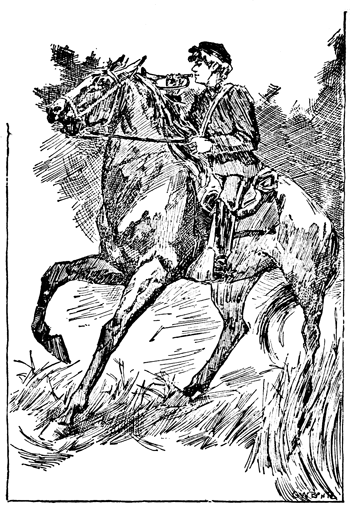
HE SOUNDED THE RETREAT.
Dawson's trial and confession settled it all. He himself was the thief, who sought in this way to replace the money lost in gambling and to throw upon Fred Waller, should he escape, the burden of the crime. But a merciful God had watched over the boy in his brave and loyal effort; had guided him in safety through a host of savage foes, and led him on to honor and vindication in the end. For months there was no happier boy on all the wide frontier than the little hero of the Sidney route; no happier father than brave old Sergeant Waller.
Long years afterward, riding one evening into a cavalry camp on the Southern plains, Captain Cross and the writer noted a tall, blue-eyed, bronzed-cheeked trooper, whose twirling mustache was almost the color of the faded yellow of the chevrons on his sleeve. Despite dust and the rough prairie dress, no finer soldier had met their eyes in the long column that went flitting by.
"Who is that young first sergeant?"
"That?" answered Cross in surprise. "Don't you know who that is? Why, man, that's Charlton's old Trumpeter Fred."
THE END.
TRANSCRIBER'S NOTES:
Inconsistencies in spelling and hyphenation have been retained from the original. Punctuation has been corrected without note. Obvious typographical errors have been corrected as follows: Page 22: fellowed changed to followed Page 70: aint changed to ain't