"True to his Colours" (continued 3)
Reading edition
“Well, Thomas,” said Barnes, on the return of his friend, “I hope there’s nothing very bad come of my losing the bag?”
“James,” replied the other, gravely, “I can’t say that; I wish I could. The loss of the bag is a serious business to us; but we must do our best to try and find it, and you must help us.”
James looked very sad and crestfallen. “Thomas,” he said, “I wish I’d only knowed as that bag were of so much consequence. But then that’s nothing to do with it; I ought to have brought it to you at once—I know that. I’ll do my very best, however, to find it; and, come what will, I’ve had a lesson as I shan’t easily forget. The inside of the public has seen the last of me.”
“Stick to that, Jim,” said the other, “and put a prayer to it to the Lord to keep you; and that’ll do more to make up for the loss of the bag than anything you can possibly do for us. Good-night, Jim. Keep firm to your pledge, and you’ll not want friends here and above.”
“Good-night, Thomas; and the Lord bless you for your kindness!”
And now, what was to be done? It was quite clear that the bag contained the means of a triumphant establishment of Jane’s innocence with Lady Morville, and consequent freedom from all stain or slur on her character. But was it possible to find the bag? The circumstances connected with the bag’s loss were communicated to the vicar, who helped Bradly to institute every possible inquiry after it in a quiet way, for they did not wish, especially on Jane’s account, to make the matter a nine days’ wonder in Crossbourne by advertising. But all was in vain; not the faintest clue could be got by which to trace it. Of course, it might have been possible for Jane to ascertain through her brother whether John Hollands had really left Monksworthy Hall, and whether or no any of his evil practices had come to light since his departure. And, supposing such discoveries to have been made, she might have produced the letter signed “JH,” and have shown its contents to Lady Morville. But then Jane would naturally be expected to produce the bag alluded to in the letter, or, at any rate, the companion bracelet which was said to be in it; and the having to tell what would look like a roundabout story concerning its loss would not be likely to leave a thoroughly favourable impression on the mind of her late mistress.
Poor Jane! She felt that without the bracelet she could not hope to claim a full and frank acknowledgment from her ladyship that her innocence was completely vindicated. She must therefore wait, trust, and be patient.
“Light has begun to dawn on your trouble, Jane,” said the vicar; “and be sure brighter light will follow. We must do our best, and leave it to the Lord to carry out his own purposes in his own wise and gracious way. Sure I am of this, that you will find the fuller light come in due time; and, more than that, that you will see that good has all the while been working out, through this trial, to others as well as to yourself.”
“I’m sure you’re right, sir,” said Bradly; “she’ll have cause in the end even to bless the Lord for this affliction. And, after all, I don’t see why we shouldn’t try and find out Hollands’ whereabouts through some of his old companions, when he’s been a little while in foreign parts; and if we write and tell him about the loss of the bag, I don’t doubt, if he’s truly sorry for what he’s done to Jane,—and it seems likely as he is,—he’ll write her back such a letter as will clear up all with Lady Morville. But the next step is just to leave all in the Lord’s hands for the present.”
And so it was left.
Chapter Nine.
Crossbourne Annual Temperance Meeting.
Week after week rolled by, and James Barnes continued firm to the pledge which he had signed in Thomas Bradly’s “Surgery.” And now the usual time for holding the annual meeting of the “Crossbourne Temperance Society” had come round, and a meeting was accordingly advertised to be held in the Town Hall. But mischief was apparently brewing; for all the bills announcing the meeting which were posted on the walls were either torn down or defaced the same night that they were put up,—a thing which had never happened before. So it would seem that the enemies of the temperance cause were prepared to offer more than ordinary opposition, and that very possibly they might try to spoil or interrupt the meeting itself.
And the friends of the temperance movement in Crossbourne had not to look far to find the cause. There had been mutterings of a coming storm for some time past. The lovers of strong drink, supported by those who made capital out of their unnatural and ruinous thirst, had been laying plans and concocting schemes for thwarting the steady advance which temperance was making in the town. And now the sudden and shocking death of poor Joseph Wright, so far from teaching any of his old associates the lesson which God, who can bring good even out of man’s evil, would have had them learn from that frightful disaster, had only made them plunge more deeply into the slough of drunkenness; and so total abstainers and their principles got more abuse and hatred from them than ever. Conscience would be heard for a little while, roused into utterance as it was by the death of their miserable companion; but they hated that inward voice—it exasperated them. Drink they would have, and cordially would they hate more and more all who would try, however gently and lovingly, to draw them away from the intoxicating cup. And now the desertion of James Barnes, as they considered it, to the enemy, made the fire of their wrath and indignation burn with a tenfold intensity.
“We’re like to have hot work to-night, sir,” said Bradly to the vicar, as he sat in the vicarage study on the morning of the meeting talking over the arrangements for the evening.
“I fear so,” said Mr Maltby; “so we must take proper precautions. I hear that the friends of poor Joseph Wright intend to muster in full force and spoil the meeting if they can. However, I have spoken to the police sergeant, and he will be there with one or two of his men to prevent any serious disturbance. You must see that they don’t turn off the gas, and get us into trouble that way.”
“All right, sir,” replied Bradly, “we’ll take care about that; but I ain’t much afraid. There’s a deal of bluster among those chaps, but it don’t take much to empty it out of ’em. Somehow or other I think we’re going to have a good meeting after all.”
Nevertheless, it was not without some considerable feeling of anxiety that the vicar entered the committee room of the Town Hall about a quarter of an hour before the time of commencement. He was accompanied by a brother clergyman from a distant county, who had brought a plain working-man with him from his parish. These were to be the chief speakers of the evening. Thomas Bradly was to bring James Barnes with him, and both were to take their places among the audience, but near the platform, so as not to attract more observation than necessary, at the first.
The hall, which was a spacious and well-lighted building, began to fill as soon as the doors were opened. There was manifestly an unusual interest taken, not necessarily nor probably in the cause itself, but, at any rate, in the present meeting. The friends of Joseph Wright and their companions had made it publicly known, and a matter of open boasting, that they intended to be there; and this announcement was the inducement to a number of idle men and boys to attend the meeting in the hopes of having some diversion. But Thomas Bradly and his friends were quite equal to the occasion; they were fully alive to the intention of their adversaries, and acted accordingly. As the opponents of temperance entered the hall, members of the Temperance Society contrived to slip in with them, and so to distribute themselves over the seats that no large number of the other side could be gathered in a compact body together.
By the time the minute-hand of the clock over the chairman’s seat had reached twenty-five minutes past seven—the meeting being advertised to begin at half-past seven—the hall was densely packed from one end to the other, the only unoccupied places being one or two seats close under the platform. Punctually at the half-hour the party from the committee room walked on to the platform, headed by the vicar; while at the same moment Thomas Bradly, followed by James Barnes, emerged from a side door near the platform, and the two friends placed themselves on two of the vacant foremost chairs. The entrance of these two parties was greeted by a roar of mingled cheers, laughter, and a few groans and hisses.
Mr Maltby advanced to the front of the platform, and there was instantly silence. “Just one word, dear friends, before we commence our meeting,” he said. “I have such confidence in your manly English honesty and common fairness, that I am persuaded that, whether you agree with us or no, you will give myself and my friends a quiet and uninterrupted hearing. We are come here to try and do some good. Bear with us, then, and listen to us.”
This short speech had the desired effect. There was indeed a grand effort made to obstruct and disturb on the part of the drinking faction; but it became apparent at once that the great bulk of the working-men present—though most had come chiefly with a view to be amused—were not at all disposed to allow the vicar and his friends to be hissed or shouted down. The few straightforward words just spoken aroused their better feelings, and the intended rioters felt that they must wait a little before attempting any further demonstration.
Thankful for the success of his brief speech, Mr Maltby proceeded to open the meeting with Scripture and prayer as usual. All were very still; but as he rose from his knees his eyes fell upon a man who sat at the extreme end of the front bench to his right. That man was William Foster. Never had the vicar seen him before at any meeting where he himself was present; and as he took his seat in the chair, he whispered to his clerical friend, “Do you see that man at the extreme end of the front bench? I am afraid his being here to-night bodes us no good, for he is the leading infidel and mischief-maker in the place.”—“Indeed!” replied his friend; “well, let us hope the best. Perhaps the Lord will give us a word even for him to-night. At any rate, we have a noble and intelligent audience before us; and let us do our best for them, and leave the issue in higher hands.”—“Thank you,” whispered the vicar; “I feel ashamed of my want of faith. Doubtless all will be overruled for good.”
He then proceeded to give a short address, in which, avoiding all harshness and bitterness of expression, he strove to leave on his hearers’ hearts the impression that love and nothing else constrained him and his fellow-workers in the efforts they were using to promote the spread of temperance in the parish and neighbourhood. The other speakers followed in the same strain; the working-man being able, in his rough-and-ready way, to carry with him the great majority of the meeting, so that a feeble attempt at disturbance from the opponents proved a decided failure.
But now a strange stir and excitement rustled through the vast assembly as James Barnes, at the invitation of the vicar, mounted the platform, and stood unabashed before his fellow-townsmen. But scarcely had he begun to open his lips when a torrent of yells and shouts burst from a score or two of drunken throats; others cheered, many laughed, some shouted; then followed a thunder of clapping and stamping, whistling and shrieking, and it seemed for a few moments as though the triumph were to be on the side of disorder and intemperance. But, as a second whirlwind of uproar was beginning, the vicar again stepped forward, and, raising his right-hand as begging silence, smiled pleasantly on the excited crowd, while he placed his left hand on the shoulder of James Barnes, who stood his ground manfully. Then followed shouts of “Shame, shame!”—“Sit down!”—“Hold your noise!”—“Hearken Jim!” and the storm gradually subsided into a calm.
“I’m one of yourselves,” began Jim bluntly, as soon as order was restored, and not in the slightest degree discomposed by this rough reception; “you shouldn’t make such a din. How’s a fellow to make himself heard? Why, it’s worse than half a dozen engines all whistling at once.” There was a buzz of amused satisfaction at this professional illustration, and James Barnes had got the ear of the meeting. “I’ll tell you what it is, friends,” he went on; “it’s true I ain’t much of a speaker, but I can tell you a thing or two about myself as may be useful. I’ve got my Sunday coat on to-night, and it’s my own, and it’s never been to the popshop. I couldn’t have said that a month ago, for I’d never a Sunday coat then. Another thing, I’m spending my own wages; that’s more nor I’ve done for many years past, for the devil’s been used to spend the best part of them for me and put ’em into the landlord’s till. Now I takes ’em to buy bread and clothes for the wife and children. Another thing, and better still, I’ve got one or two good friends as pulled me out of the mire, and won’t let me go. Tommy Tracks there, as you call him, he’s one of them; and your good friend the vicar,—for he is your friend, think as you please,—he’s another. And, best of all, I’ve got a clear head and a clear conscience, and a hope of a better home by-and-by, and a Saviour above all to look to; and I shouldn’t have had none of these if I’d been going on in my old ways. So you may laugh if you please when you say, ‘Jim Barnes has turned teetotaler;’ but I mean to sing when I says it, for it’s true, and he means to stick to it, with God’s help, all the days of his life.”
Having delivered himself of this brief address, James Barnes hurried down from the platform, followed by a roar of hearty applause, which completely drowned the efforts of a few dissentient voices.
The vicar was now just rising to call on another speaker to address the meeting, when his attention, as well as that of the whole audience, was turned to William Foster as he got up deliberately from his seat. Mr Maltby had watched him narrowly during the evening, and not without considerable anxiety and interest. Up to the close of Barnes’s speech Foster had apparently taken little or no interest in the proceedings; certainly he had not joined either in the applause or in the dissent. What was he now about to do? Turning to the vicar, amidst a breathless silence throughout the hall, he said, in a firm and clear voice, “Mr Chairman, may I say a few words to this meeting?” The vicar hesitated. Was this man going to spoil all? His eye at that moment caught Thomas Bradly’s. Thomas nodded to him, and then turned to Foster and said, “Get you on to the platform, William; the vicar and all the rest of us will give you a patient hearing, I’m sure.” Foster then mounted the platform, and stood for a moment facing the audience without speaking. He was very pale, and his voice trembled at first, but soon recovered its firmness as he spoke as follows:—
“Mr Chairman and fellow-townsmen, I have not come here to-night to oppose the temperance movement, but quite the contrary. I am quite sure that movement has been doing good in this town, and is doing good still. You have only to look at Jim Barnes to see that. Everybody knows what he was, and everybody knows what he now is; there is no sham nor deceit in the matter. Now, whatever our creeds may be, whether we think alike in other things or not, there can be no two opinions about this matter with honest and reasoning men. The temperance movement is doing good, and we have before us a plain proof of it. Now, I am not here to-night merely to talk. I should not have come if that were all. I have come to act. I have professed to be a reasoning man, and to belong to a party that prides itself upon being governed by reason, and yet I have allowed myself to come more or less under the dominion of that strong drink which just turns a reasoning man into something far lower than an irrational brute. ‘Well, then,’ some of you might say, ‘can’t you exert your own will and give it up without coming to a temperance meeting to talk about it?’ Yes, I could; but that would be just merely doing good to myself. Now, I can’t help being aware that your chairman, the vicar of this parish, and his right-hand man, Thomas Bradly, are not content with being total abstainers for their own benefit, but are doing their best, spite of ridicule, opposition, and persecution, to get others to become abstainers also. They can have nothing to gain by this except the happiness of making others happy. I see this plainly; and my reason (they would call it conscience, I suppose) tells me that, if I am a really honest and unprejudiced man, I ought to follow their example. I am here to-night to do it. I have other reasons besides for taking this course, but I do not think it necessary to mention them on the present occasion. I know what it will cost me to take this step, but I have well weighed the consequences and am prepared to accept them. Mr Chairman, I will sign the pledge to-night in your book, and join your society, if you will allow me.” Having spoken thus, William Foster quietly resumed his seat.
The effect of this speech on the meeting was most overwhelming. Every word had been heard all over the hall, for Foster had a clear and powerful voice, and had spoken calmly and deliberately, as one who weighed every word and sentence carefully; and the silence while he addressed his audience had been almost oppressive. Was it possible that Foster could be in earnest? There was no mistake about it—every man was at once convinced of this from the vicar down to the most sottish of the anti-temperance gathering. Such a man as Foster would never have come forward in this way had he not had powerful and all-constraining motives to lead him to take such a step. When he sat down there was neither shouting nor laughter: the great body of working-men, including the obstructionists, seemed stupified; they looked at one another with open-eyed and open-mouthed wonder, and whispered their amazement and perplexity. Then the vicar, struck dumb for the moment by sheer astonishment, after exchanging with his brother clergyman on the platform a glance of deep thankfulness, rose, and addressing William Foster, said, “I cannot tell you, my friend, how truly glad I am to find that you have been guided to take such a step as you now contemplate; most cordially shall I receive your signature in our pledge-book, and welcome you to our society.” Then the crowd of hearers rose to their feet, and gave vent to their feelings in three hearty cheers; while the opponents of the cause made their way to the door as quickly as they could.
The next minute Thomas Bradly stood by the vicar’s side, and all sat hushed in attention as he addressed the meeting. Tears were in his eyes, and half-choked was his voice as he began:—
“Friends, I’ve been at many a temperance meeting in my day, but never at one that I shall remember like this. Some of us abstainers came here to-night with doubting hearts; it seemed as if the evil one was a-going to put a big stone or two in the way of the temperance cause, but instead of that he’s been and trod upon his own tail, as he often does. O bless the Lord for his goodness! We’ve had a mighty large stone took out of the way, instead of any new ’uns laid in our path. Ah! Why should we ever be fainthearted? The cause is a good cause, and it will prosper, depend upon it. And now, friends, there’s many of you here to-night as came, I know, just for a bit of fun; you didn’t mean no harm, but you wouldn’t have minded a little bit of a laugh against us. But it’s turned out just the other way: you’ve given us a help, and stopped the mouths of them as would have upset our meeting; so let them laugh as wins. And now, friends, I want to say a word to you about our friend William here. We’re all thinking about him; he has come forward like an honest man to-night, and a right brave man too. I know he can’t have done it without having to pay for it. I know, and you know too, as it’ll not be all smooth work between him and his mates. Now, whether you like or don’t like what he has done to-night, you can’t help respecting him for it; so just keep your tongues off him when you meet him, and do him a kind turn if you can. He and I ain’t of one mind, you well know—at least we haven’t been; but he knows this, that in anything that’s good I’ll back him up through thick and thin if he’ll let me. And now, here’s a grand opportunity; just some of you chaps as have been cheering him like anything come up to the table and sign the pledge with him, and keep it by God’s help, and you’ll bless this night every day of your lives, and so will the wives and children.”
There was a cheery response to this speech in many a hearty word of assent; and then the vicar closed the meeting, inviting any who were willing to come and sign. The crowded room was soon emptied of all but a very few, among whom were William Foster and about a dozen more of the working-men, who expressed their intention to sign with him. Foster himself signed his name with an unflinching hand, but said nothing. The vicar thought it wisest not to endeavour to draw him into conversation at this time, but with a kindly shake of the hand, and an expression of thankfulness at his joining the Temperance Society, bade him good-night.
As the committee and the speakers were leaving the hall, the vicar kept Thomas Bradly back, and said to him: “This is wonderful indeed; it is the Lord’s doing, and is marvellous in our eyes. Now you must keep your eye, Thomas, on Foster; I think you will get at him at first better than I should be likely to do. You will be able to see just how the land lies, and I shall be ready to come in at any time; only with such a man we must use discretion, knowing what his antecedents have been.”
“Ay, surely,” replied the other; “I’ll not let him go, sir, now that we’ve got hold of him—you may depend upon it. Oh! This is indeed what I never could have dreamt of. Well, we’ve had a grand night; and it’s a sign, I believe, as we’re going to have some rare bright sunshine on our temperance work.”
“I trust and believe so, indeed,” rejoined Mr Maltby, and they parted.
That meeting was never forgotten in Crossbourne, but was always spoken of as emphatically the great Crossbourne Temperance Meeting.
Chapter Ten.
Light in the Dark Dwelling.
The day that followed the great temperance meeting was one full of excitement to the operatives of Crossbourne. Every mill and workshop resounded with the eager hum of conversation and conjecture touching the marvellous occurrence of the previous evening—the speech and conduct of William Foster. Of course a variety of distorted versions of the matter flew abroad, and were caught and carried home into the country by some who lived at a distance from the town. Among these versions was a strongly affirmed and as strongly believed account of the last night’s occurrences, which set forth how William Foster, with a picked party of his friends, had forced their way to the top of the hall, and were in the act of mounting the platform for the purpose of turning the vicar out of the chair, when a voice of unearthly loudness was heard to shout, “Forbear!”—upon which the meeting broke up in wild confusion, leaving Foster prostrated on the ground by some invisible and mysterious power, where he lay till brought back to consciousness by the joint efforts of Mr Maltby and Thomas Bradly; after which, at their earnest suggestion, he there and then signed the pledge.
Foster’s own companions, however, had not been altogether taken by surprise. For some weeks past he had been absent from his club, and from the public-house, and when questioned on the subject had given short and evasive answers. A change had been coming over him—that was clear enough; but whence it originated even those who had been the most intimate with him were at a loss to conjecture. And now on the morning after the meeting, when he walked into the mill-yard, while some looked on him with the sort of wonder with which a crowd would gape at some strange animal, the like of which they had neither seen nor heard of before, others began to assail him with gibes and taunts and coarse would-be witticisms. But Foster bore it all unmoved, never uttering a word in reply, but going on steadily with his work. As the men, however, were about to leave for their homes, after the mill had loosed, a sneering, sour-looking fellow, one Enos Wilkinson, who had gathered a little crowd about him, and was watching for Foster, whose work detained him a little later than the ordinary hands, stepped across his path, and raising his voice, cried, “Come now, Saint Foster, you’ll be bringing out a nice little book about your conversion, to edify us poor sinners who are still in heathen darkness. When do you mean to favour us with the first edition?”—“The day after you become sober and sensible, Enos,” was Foster’s reply, and he walked on, leaving his persecutors unprepared with an answer.
Two hours later, and Thomas Bradly might be seen standing outside Foster’s house, with a happy smile on his face, and a short whispered conversation going on between two parts of himself. “Now, then, Thomas, you’re in for it.” “Ay, to be sure; and in for a good thing too.” “What’ll Will Foster say? And what’ll you say, Thomas?” “Ah! Well, all that’s best left in the Lord’s hands.”
After this a loud, decided knock on Thomas’s part, and then the cautious tread of a woman inside.
“All right, missus; it’s only me, Thomas Bradly.”
No answer for a minute, and then the heavier tread of a man. Foster himself opened the door, and holding out his hand, said,—
“Come in, Thomas. You’re just the man I’ve been wanting to see.”
“And you’re just the man I’m right glad to hear say so,” was the other’s reply.
The two men walked into the inner room together. All was very neat, and the whole place wore an air of comfort far different from what had been its appearance in days past. But the greatest change was in Foster’s wife. Bradly, who had met her often in the street or in the shops, could hardly believe her to be the same. “Ha, ha!” said he inwardly to himself; “the Lord’s been at work here, I can see.” Yes! There was that marked change on the features which can come only from a changed heart. There was peace on that face—a peace whose tranquil light had never shone there before. There was not joy yet, but there was peace. Not, indeed, peace unmixed, for there was a shade of earth’s sadness there still; but God’s peace was there, like a lunar rainbow, beautiful in its heavenly colouring cast upon the clouds of sorrow, but not intensely bright. As she held out her hand to Bradly to give him a friendly welcome, he could see that her eyes were full of tears. “All right,” he said to himself; “the work’s begun.”
As he was seating himself on one side of the fire, his eye fell on a little, stout, shabbily-bound volume lying in a corner near some showily-ornamented books. Could it really be a Bible? “Right again,” thought Thomas; “I ain’t often mistaken about that book. The secret’s out; I see what has worked the change.”
“I’m truly glad, but almost ashamed, to see you, Thomas,” began Foster, seating himself opposite his guest. “However, I’m glad now of this opportunity of expressing my regret for the many hard and undeserved things I’ve spoken against you, both to your face and behind your back.”
“Never give it another thought, William,” cried the other. “You’ve never done me the least harm; but quite the other way. It’s as good as physic, and a deal better than some physic, to hear what other people think of us, even if it ain’t all of it quite true to the life.”
“Ah! But I did you injustice, Thomas.”
“Never mind if you did. You never said half as much evil of me as I knew of myself. But let by-gones be by-gones. You’ve made me happier than I can tell you; for I can see plainly enough as the Lord has been laying his loving hands on you and your missus.”
“You are right, Thomas; and I know it will give you real pleasure to hear how it has all come about.—So sit down, Kate, and help me out with my story.”
Ah, what a different scene was this from that sorrowful time when the poor, broken-hearted young mother leant hopelessly over the cradle of her little one thirsting for that which she knew not where to find! Now the same wife and mother sat with a smile of sweet contentment, busily plying her knitting, while her husband told the simple story of how the God of the Bible had “brought the blind by a way that they knew not.”
“You know what I have been, Thomas,” began Foster. “Well, I am not ashamed now to confess that I never was really happy, nor satisfied with my own creed. Spite of my conviction of my own superior knowledge, I could not help acknowledging to my inward self that you were right and I was wrong; at least, I saw that your creed did for you what my creed could not do for me. It was very pleasant and flattering, of course, to be looked up to as an oracle by the other members of my club, and to get their applause when I said sharp things against religion and men whose views differed from our own. But all the while I despised those very companions of mine, and their praises; and, what’s more, I despised myself.
“And another thing—I had no real happiness at home, nor poor Kate neither. I was disappointed in her—she won’t mind my saying so now—and she was disappointed in me. We had nothing to bind our hearts together but a love which wanted a stronger cement than mere similarity of tastes. Besides which—for I may as well speak out plainly now while I’m about it—it was poor satisfaction to come home and find books lying about, and scarce a spark of fire in the grate; no tea getting ready, but, instead of it, twenty good reasons why things were not all straight and comfortable. And these reasons were but a poor substitute for the comforts that were not forthcoming, and only made matters worse. And if there was neglect on her part, there was plenty of fault-finding on mine. I was sharp and unreasonable; and then we both of us lost our temper, and I was glad to seek other company, and began to care less and less for my home, and more for the public-house and for the drink which gives the inspiration to the conversation you meet with in such places.
“Sometimes things would go on a little better, but not for long. And when we got to angry words with one another, we had no higher authority than ourselves to appeal to when we would set one another right. Thomas, I see this more plainly every day now. Freethinkers—would-be atheists, like my former self—are at an immense disadvantage compared with Christians in this respect. A Christian has a recognised, infallible authority to which he can appeal—the will of his God, as set forth in the Word of his God. When he differs from a fellow-Christian, both can go to that authority, and abide by its decision. Christians will do this if they are honest men, and really love one another. We freethinkers have no such court of appeal. However, let that pass.
“Things went on as I’ve been telling you, and were getting worse. Our two hearts were getting further apart every day, and colder and colder towards each other. This went on, and the breach kept widening, till a few weeks ago. You’ll not have forgotten, I know, poor Joe Wright’s sad end. Well, it was a few days after the accident that I came home much the worse for liquor, I’m ashamed to say, and in a particularly bad temper. Things had not been pleasant at the club. One of the members had been breaking the rules; and when I pointed this out, I was met with opposition, and the determined display of an intention on the part of several others to side with the offender. Words ran high, and I spoke my mind pretty freely, and received in return such a shower of abuse as fairly staggered me. So I betook myself to the public-house, and drank glass after glass to drown my uncomfortable reflections, and then went home.
“The drink, instead of driving away my mortification, only made me more irritable; and when I got into my own house, I was ready to find fault with everything, and to vent the bitterness of my spirit on my poor little wife. But, to my surprise, she did not answer me back, far less repay my disparaging remarks with usury, which she might very well have done, and would have done a few days before. I could not help seeing, too, that she had been taking pains to make the room look tidier than usual. My supper was ready for me, my slippers set by the fender, and the arm-chair drawn up near the fire. I did not choose to make any remark on this at the time; indeed, I got all the more cross, because I was annoyed by the sense of my own injustice in being angry with her. So poor Kate had but a sad time of it that night.
“However, I had made a note in my mind of what I had seen, and I was curious to mark if this change in domestic matters would continue. To my surprise, and, I am ashamed to say, not altogether to my gratification, I found that it did continue. I was suspicious as to the motive and reason for this change, and therefore not satisfied. So I took the improvement in my poor wife’s temper and conduct very surlily; the real fact being, I now believe, that I was inwardly vexed by being forced to feel that she was showing by her behaviour to me her superiority to myself. But the change still continued, and I could detect no unworthy motive for it; so at last Kate’s loving ways and patient forbearance got the victory, and then I began to look around for the cause of this transformation. What could it have been that had made my wife so different, and my home so different?
“While I now freely confessed to her my pleasure at the improvement, and endeavoured to repay her loving attentions by coming home regularly in good time and sober, I forbore to question her as to what had made such a difference in her, and she was evidently anxious to avoid the subject. But I was resolved to find out how this new state of things had come about, and an opportunity for doing so soon presented itself. One evening there was a break-down at the mill, and I returned home earlier than usual. I was getting near the house, when I heard my wife singing, and the tune was clearly a hymn tune. The secret was discovered now. I took off my boots, and crept slowly up to the door. The singing had stopped, and all was quiet. Then I heard Kate’s voice gently reading out loud to herself, and the words she read, though I could not catch them distinctly, were manifestly not those of any book of science or amusement: I could tell that by the seriousness of the tone of her voice. The conviction then came strongly upon me that she was reading the Bible, and that this book was the cause of the great change in her. A thousand thoughts stirred in my heart. I durst not venture to look in at the window, lest she should see me, for I had not at all made up my mind what to do. So I went back a little distance, put on my boots again, and came into the house as if nothing had happened.
“I was unusually silent that night, and I saw Kate looking aside at me now and then with a half-frightened glance, as if she was afraid that I was going to change back to my old unkind ways. I watched her very narrowly, and she saw it, and was uneasy. The fact was, I wanted to get at her Bible, if she really had one, and I had not yet the courage to speak to her about it. She knew how I had talked to her against it, and made a mock at it, and I couldn’t yet humble myself enough to ask for a sight of it. I noticed, however, that she looked a little anxiously at me when I turned down the baby’s bed-clothes in the cradle to have a look at him; and as I could see no Bible anywhere about the room, it darted into my mind that she had hidden it under the clothes. So when she was gone up into the bedroom, to set things to rights upstairs, I found the book I was looking for stowed snugly away, and began to read it as eagerly as if it had been a rich man’s will leaving me all his property.”
“You weren’t far wrong there, William,” broke in Thomas Bradly; “for the gospel is our heavenly Father’s will and testament, making us his heirs; and it’s written with his own hand, and sealed with the blood of his dear Son. But go on, William.”
“I don’t doubt but you’re right,” resumed Foster. “Well, as I read the little Bible, I was quite astonished, for I saw how utterly ignorant I had been of its contents and teaching. Ah, yes; it’s one thing to know a few texts, just enough to furnish matter for censure and ridicule, and quite a different thing to read the very same book with a sincere desire to learn and understand what it has to tell us. I found it so, I can assure you. So I learnt from that humble little Bible of Kate’s what all my philosophy and all the philosophy in the world could never teach me.
“It isn’t to the point now, but I’ll tell you another time how this Bible came into Kate’s hands; for of course we had not one of our own in the house. A singular chance I should have called it a short time ago; but I’m coming more and more to your mind, Thomas, that chance is only a wrong and misleading term for the guiding hand of One whom I now hope to trust in, love, and obey, however unworthily.”
“The Lord be praised, his blessed name be praised!” cried Thomas Bradly, while the tears ran fast down his cheeks.
“Yes,” said Foster reverently, “he may well be praised, for I have indeed good reason to praise him.—So you see I had got to the bottom of the mystery at last, and that little book has become to me now worth a thousand times its own weight in gold.
“Day after day I went on reading it by stealth, and every day I wondered more and more at its marvellous suitableness to my own case. And then I began to do that which a few weeks back I should have looked upon as simply an evidence of insanity in a man of my views. I began to pray. I hardly dared make the attempt at first. It seemed to me that were I to venture to address the great Being whose existence I had denied, and whose name I had constantly blasphemed, a flash of lightning or some other sudden exertion of his power would strike me dumb. But I did venture at last to offer up an earnest cry for mercy and pardon in the name of that Saviour who invites us to offer our prayers in his name; and then it seemed as though a mountain were lifted from my heart, and blindness were removed from my eyes.
“Next day, after tea, I quietly asked Kate for the Bible. I shall never forget her look as long as I live. Fear, hope, joy followed one another like sunshine breaking through the clouds. Could I be in earnest? She did not hesitate long, for she saw that in my face which told her that she might trust me with her treasure. Then she brought out the book from its hiding-place, put it on the table by me, and throwing her arms round my neck, wept away the sorrows of years. And it may be that at that time angels looked down upon us, and shed tears of joy to see two poor penitent sinners thus ‘sitting at the feet of their Saviour, clothed, and in their right mind.’”
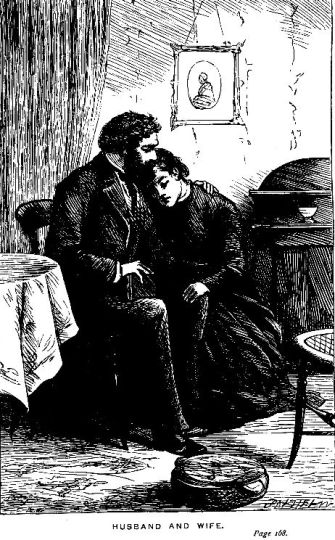
For a while no one spoke, for all were too deeply moved. At last Foster continued: “I knew I should have to come out on the right side openly sooner or later, but you may be sure it would be no easy matter. However, I had made up my mind: it would have to be done some time or other, so, as the Annual Temperance Meeting was soon to come off—I knew that, for Joe Wright’s party were boasting of what they meant to do—I determined to show my colours by joining your society, and you have seen the result.”
“Yes, William,” said Bradly, cheerily, “I see it, and I bless the Lord for it; and if he has made me in any way an unworthy instrument in helping to bring about this change, I can truly say that he has paid me back interest a thousandfold for any little I’ve ever done or suffered for him.”
“Then, Thomas,” said the other earnestly, “you may be pleased to know that it was your hand that gave the first blows to the nail, though, it was my dear wife that was the means of driving it home. I often thought I could easily knock down your arguments, and, though I knew you had the best of it—for you had honesty and truth on your side—yet when I went home after one of our talks, I’ve vexed myself many a time by thinking, ‘Well, now, if I’d only thought of this or that thing, I might have floored him.’ But there was one thing that always floored me, and that was ‘the logic of the life;’ I couldn’t find an answer to that. And not only so, but, as I said a little while ago, I saw that the religion of Jesus Christ made you truly happy, and I knew that my free-thinking never did that for me nor for any of my like-minded companions; so that deep down in my heart a voice was constantly saying, ‘Tommy Tracks is right.’ And now I’m sure that he is so. Thomas, I now ask your friendship and your help, as I have already asked your forgiveness.”
Bradly wrung the other’s hand with a hearty grip, and then said, “You shall have them, William. I know you’ll be all the better for an earthly friend or two, for there’ll want a deal of backing up just at first. But oh, I’m so truly thankful that you and your missus have got the best Friend of all on your side, who will never leave you nor forsake you. Yes, come what will, you can go to One now who will keep peace in your conscience, peace in your heart and peace and love in your home.”
By Foster’s request, before they parted, Thomas Bradly knelt with them and offered a prayer. Ah, what a sight! Glorious even for angels to look down upon! Those three uniting in prayer—the old disciple; the blasphemer, persecutor, and injurious; and the till late Christless wife—all now one in Jesus, bowed at his footstool, while the humble servant of the Lord poured out his heart in simple, fervent supplication and praise, as all bent head and knee in the felt presence of the unseen God.
Next Sunday Foster was at church in the morning, and was there with his wife in the evening, Mrs Bradly having undertaken to look after the baby. As for Bradly himself, his face was a sight worth seeing on that Sunday. It was always brighter than usual on the Lord’s-day; but on this particular Sabbath every line of his features shone with a glow of gladness, as though, like Moses, he had just come down from the mount. It need hardly be said that the vicar’s heart also deeply rejoiced. As for the inhabitants of Crossbourne generally, some were glad, with a spice of caution in their gladness; some shook their heads and smiled, meaning thereby to let all men know that, in case Foster should not persevere in his new career, they, at any rate, had never been over-sanguine as to the genuineness of his reformation; some simply looked grave; while the profligate and the profane gnashed their teeth with envy hatred, and malice, and exchanged vehement asseverations of “how they’d pay off the sneaking humbug of a deserter, and no mistake.”
Chapter Eleven.
A Blighted Life.
Spring had come, but the cloud still rested on poor Jane Bradly. True, her heart was lighter, for she now believed with her brother that there was deliverance at hand for her, and that the mists were beginning to melt away. She was firmly persuaded that her character would be entirely cleared. But when? How soon would the waiting-time come to an end? And what good could come out of such a trouble? Here was the trial of her faith; but she bore it patiently, and the chastening was producing in her, even now, “the peaceable fruit of righteousness.” She began to improve in health and strength, and had lost much of the look of abiding care; for the habitual peace of a mind stayed on God, and the consciousness of innocence as regarded the wrong-doing of which she had been suspected, kept her calm in the blessedness of a childlike trust.
But there was one who lived not far from her, a sister in affliction, about whose sad heart the clouds were gathering thicker and thicker. Spring, with its opening buds and rejoicing birds, brought no gladness to the spirit of Clara Maltby. She was gradually wasting away. Change of air and scene had been recommended, but she would not hear of leaving home, and clung with a distressing tenacity to her round of daily studies, shortening her brief time of exercise, and seeming anxious to goad herself into the attainment of the utmost amount of knowledge which it was possible for her to acquire, grudging every minute as lost and wasted time that was not given to study. To shine had become with her the one absorbing object; to shine, not, alas! for Christ, but for self, for the world, that she might gain the prize of human applause. So she was using the gifts with which God had endowed her, not to his glory, by laying them at the foot of the cross, and employing them as talents with which she was to occupy till the Master came, but as means whereby she might win for herself distinction, and outstrip others in the race for earthly fame. But such a strain on mind and body could not last; the overtaxed faculties would assert their claim for the much-needed rest; and so, in the early spring-time, Clara Maltby was suddenly stricken down and lay for days in a state of half-unconsciousness.
At last she rallied, in a measure; and when she was sufficiently recovered to bear conversation, she earnestly begged that she might be allowed to see Thomas Bradly, and have an opportunity of saying a few words to him in the presence of her parents, previously to her being taken from home by her mother to the seaside, to which she had been ordered by her medical man, as soon as she could bear the removal. So one evening, after his work, Bradly, with a sorrowful heart, made his way up to the vicarage, and was introduced by Mr Maltby into the inner room, where his daughter had gathered together her own special library.
The patient lay on a low couch near the fire, which burned cheerfully, and lighted up, though not with gladness, the care-smitten features of the vicar’s daughter. Close to her was a little table, on which lay a small Bible, a pile of photographs, and a few printed papers. Her writing materials occupied part of a larger table, and were flanked on either side by heaps of volumes—scientific, historical, and poetical; while beyond the books was a small but exquisitely-modelled group of wax flowers, most life-like in appearance, under a glass shade. Over the fire-place was a large water-colour drawing of Crossbourne Church, with miniatures of her father and mother, one on each side of it. On the mantelpiece was an ivory statuette, beautifully carved, the gift of a travelled friend; and other articles of taste and refinement were scattered up and down the room. But now the gentle mistress of this quiet retreat lay languid and weary, incapable of enjoying these articles of grace and beauty which surrounded her. There was a flush indeed on her cheek, but no light in the heavy eyes. She looked like a gathered flower,—fair, but drooping, because it can strike no root and find no moisture. Thomas Bradly was shocked at the change a few days had made in the poor girl since he last saw her, and could hardly restrain his tears. At the head of the couch sat Mrs Maltby, with a face sadly worn and troubled; and between her and the fire was her husband, on whose features there rested a more chastened and peaceful sorrow.
“Come, sit down, Thomas,” said Mr Maltby; “my dear child cannot rest till she has seen you, and told you something that lies on her mind. I think she will be happier when she has had this little talk; and it may be that God will bless her visit to the sea, and send her back to us in improved health. I know we shall have your prayers, and the prayers of many others, that it may be so.”
“You shall, you do have our prayers,” cried Bradly, earnestly; “the Lord’ll order it all for the best. He’s been doing wonderful things for us lately, and he means to give you and dear Miss Clara a share of his blessings.”
“Well,” replied the vicar, “we will hope and trust so, Thomas. The clouds have not gathered without a cause; but still, I believe that, as the hymn says, they will yet ‘break with blessings on our head.’—Clara, my child, it will not be wise to make this interview too long; so we will leave the talking now to yourself and Thomas Bradly.”
“Dear, kind friend,” began Miss Maltby, raising herself from her couch, and leaning herself on her mother, who came and sat by her, “I could not be satisfied to leave Crossbourne without seeing you first, as I want you to do something for me in the parish which I cannot ask my dear father to do. And I want to make a confession also to you, as it may be the means of doing some little good in the place where I have left so much undone, and as perhaps it may not please God that I should come back again to my earthly home.”
She was unable to proceed for a few moments, and Bradly dared not trust himself to speak, while the vicar and his wife found it hard to control their feelings.
“Thomas,” she at length continued, her voice gaining strength and her mind clearness under the excitement of the subject which now filled her heart and thoughts, “I want you to say something for me to my class—at least to those girls who belonged to it when I used to teach it. Say it to them in your own plain and simple way, and I trust that it may do them good.
“I want you to tell them from me that I have tried what the world and its idols are, and I have found them ‘vanity of vanities.’ Not that I have been leading what is called a wicked life; not that I have loved gay company or worldly amusements; not that I have lost sight of Christ and heaven altogether, though they have been getting further off from my sight every day; but I have been fashioning for myself an idol with my own hands, which has been shutting out heavenly things from me more and more. And now God has in mercy shattered my idol, and I trust that I can see Jesus once more as I have not seen him, oh, for so long!
“I am startled when I look back and see how far I have gone astray, and how I have let the devil cheat me with a thousand plausible falsehoods. Oh, what a useless life I have been leading! What a selfish life I have been leading! And yet I have been persuading myself that I was only cultivating the powers which God gave me. But it has not been so; it is as though I had been set to draw a picture of our Saviour, and had ability and the best of materials given me for making a beautiful likeness, and I had all the while gone on just drawing an image of myself, and had then fallen down and worshipped it.
“Tell my girls, then,—for I may never have the opportunity of telling them myself,—that there is no real happiness in such a life as mine has lately been. It is really purely for self is this struggle after distinction; God put us into this world for something far different. I know, of course, that my scholars are not any of them likely to be snared exactly in the same way that I have been. Still, they might be tempted to think what a grand thing it would be to have the advantages for getting knowledge and distinction that I have had. Ah, but what has been my life, after all? Why, like that group of wax flowers under the glass shade. Don’t they look beautiful? But you see they are not real; they have no life and no sweetness in them, and they can never make the sick and the suffering happy as real flowers do. My life, with all its advantages, and what people call accomplishments, has been as unreal, as lifeless, as scentless as those wax flowers. It has not pleased God; it has not made others happy; there has been nothing to envy in it, but oh, quite the other way: it should rather be a warning. Tell my girls so, for they have their temptations even in this direction; there is so much attention paid now to head knowledge in all ranks and classes, and such a danger of neglecting heart knowledge and Christ knowledge. Show them how it has been with me. Tell them how I feel now on looking back.
“What have I really gained by this eager pursuit after earthly fame? Nothing. I have strained body and mind in seeking it—strained them, probably, past recovery. And what have I lost in the pursuit? I have lost peace; I have lost a thousand opportunities of doing good which can never be recalled; I have lost the happy sense of Jesus’ love and presence.—Dear father, would you give me that open book?—These words just suit my life, Thomas:—
“‘Nothing but leaves! The Spirit grieves Over a wasted life; O’er sins indulged while conscience slept, O’er vows and promises unkept; And reaps from years of strife— Nothing but leaves! Nothing but leaves!’”
She paused, and hiding her face in her mother’s breast, wept long and bitterly.
Thomas Bradly had listened with deep emotion to every word, but had not yet been able to command himself sufficiently to speak. But now he stretched his hand forward, and took up the little hymn-book from which Clara Maltby had been reading, and, as he turned over its pages, said—“I don’t doubt, dear Miss Clara, but you’ve just said the plain truth about yourself; I’ve grieved over it all, and prayed about it. But that’s all past and gone now, and the Lord means to bring good out of the evil, I can see that, and you’ll let me read you these lines out of your book, as I’m sure it ain’t going to be ‘nothing but leaves’ after all. Listen, miss, to these blessed words, for they belong to you:—
“There were ninety and nine that safely lay In the shelter of the fold; But one was out on the hills away, Far-off from the gates of gold,— Away on the mountains wild and bare, Away from the tender Shepherd’s care. “‘Lord, thou hast here thy ninety and nine: Are they not enough for thee?’ But the Shepherd made answer: ‘This of mine Has wandered away from me; And although the road be rough and steep, I go to the desert to find my sheep.’ “And all through the mountains, thunder-riven, And up from the rocky steep, There rose a cry to the gate of heaven, ‘Rejoice! I have found my sheep!’ And the angels echoed around the throne, ‘Rejoice, for the Lord brings back his own!’”
“Thank you, Thomas, thank you most sincerely,” cried the sick girl, raising herself again. “Yes, I trust that these beautiful words do apply to me. Jesus has gone after me, a poor wandering and rebellious sheep, and brought me back again. Do then, kind friend, tell my dear class for me that I have found all out of Christ to be emptiness, and that there can be no true happiness here unless we are working for him.
“Of course, I might have pursued my studies innocently had I given to them leisure hours when other duties had been done, and then they would have been a delight to me, and a source of real improvement. But instead of that I made an idol of them, and they became a snare to me. I lived for them, and in them, and all else was as good as forgotten. Yes, even my Bible, that was once so precious,—it might as well have lain on the shelf, and indeed, latterly, it has seldom been anywhere else. I had no time for reading it; earthly studies absorbed every moment. But now it has become to me again truly my Bible; it has shown me, and shows me more and more plainly every day, my sin and my neglect. Ah! It is an awful thing when the struggle after this world’s honours and prizes makes us thrust aside thoughts of God and of the crown of glory. It has been so with me. I have been chasing an illuminated shadow until it has suddenly vanished, and left me in a darkness that might be felt.
“Tell my girls, then, dear friend, to take warning from me. Tell them how I mourn over my wasted life; but tell them also that I have a good hope that God, for Christ’s sake, has forgiven me, and ask them to pray for me. The great lesson I want you to impress upon them from my case is just this, that no knowledge can be worth having that interferes with our following our Saviour; that no pursuit, though it may not be outwardly sinful or manifestly worldly, which unfits us in body or mind for doing our duty in that state of life to which it has pleased God to call us, can be innocent, for it robs Jesus of that service which we all owe to him.
“And now I am going to ask you to give these photographs, one a piece, to my girls: they will value them, I know, as the likeness of one who was once happy in being their teacher, and who hopes, should God spare her, to be their teacher again; a better instructed teacher far, I hope, because taught in the school of bitter but wholesome experience to know herself.”
These last few words, uttered with deep feeling, made it necessary for Clara to pause once more. So Thomas Bradly, seeing that her strength was well-nigh exhausted, simply expressed his hearty readiness to comply with her requests, and was rising to take his leave, when she signed him to remain.
“Just one thing more, dear friend,” she added, as soon as she was sufficiently recovered.—“Nay, dearest mother, you must let me finish what I have to say. I shall be happier and calmer when I have told all.—O Thomas! I have been on the very edge of a dreadful precipice; nay, I almost fear that I have scarcely avoided beginning the terrible fall. Finding myself unequal to the full strain which my studies imposed upon me, I began to have recourse to intoxicating stimulants, first a little, and then a little more, till at last I got to crave them, oh, how terribly! And, alas! alas! worse still. As I was ashamed to bring such things openly into my father’s house, I have employed a servant once or twice to fetch them for me, but simply as a medicine, and I have found myself scheming how I might do this to a still greater extent without detection. Oh, to what a depth have I fallen! But I see it all now; the Lord has opened my eyes. What I wanted was rest, not stimulants. And surely nothing could justify me in putting such a strain upon my mind as to make it needful to fly to such a restorative.
“I don’t ask you to mention this to my girls, nor to any one else, for it might not do good, and might be a hindrance, in a measure, to my dear father in his work; but I tell it you to ease my own heart, and that you may pray for me, and that you may hear me now, in the presence of my beloved father and mother, declare that from this time forward I renounce all such study, if God spare me, as shall unfit me for a loving service of Jesus, in my home and out of it, and that I have done with all intoxicating stimulants, the Lord helping me, now and for ever.”
“Bless the Lord!” said Bradly to himself, as, after a silent pressure of Clara Maltby’s hand, he stole out of the room. “All’s working for good, I’m sure,” he added, as he walked homewards. “We shall do grandly now. One great stone has just been struck out of our good vicar’s path. Satan’s a queer, knowing customer, but he often outwits himself; and there’s One wiser and stronger than him.”
Chapter Twelve.
A Mysterious Discovery.
A few days after Thomas Bradly’s visit to the vicarage, Mrs Maltby and her daughter left home for the seaside. In the evening of the day of their departure, something different from the ordinary routine was evidently going on at Thomas Bradly’s. As it drew near to half-past six o’clock, four young women, neatly dressed, might be seen making their way towards his house. These were shortly joined by three others; and then followed some more young women and elderly girls, till at length thirteen were gathered together in the road, whispering and laughing to one another, and evidently somewhat in a state of perplexity.
“What’s it all about, Mary Anne?” asked a bright-looking girl of fifteen of one of the oldest of the group.
“I’m sure I don’t know,” was the reply; “all I know for certain is, that I’ve been invited to tea at Thomas’s, at half-past six this evening.”
“So have I”—“So have I,” said the rest.
“There’s no mistake or hoax about it, I hope?” asked one of the younger girls anxiously.
“Nay,” said the one addressed as Mary Anne, “Thomas asked us himself, and he’s not the man to hoax anybody.”
Just at this moment the front door opened, and Bradly himself, full of smiling welcome, called upon his guests to come in.
A comfortable meal had been prepared for them in the spacious kitchen, and all were soon busily engaged in partaking of the tea and its accompaniments, and in brisk and cheerful conversation; but not a word was said to explain why they had been invited at this particular time. Their host joined heartily in the various little discussions which were being carried on in a lively way by his guests, but never, during the tea, dropped a hint as to, why he had asked them.
At last, when teapots and cups had disappeared, leaving a clear table, and the young women, after grace had been duly sung, sat opposite to one another with a look of amused expectation as to what might be coming next, Thomas rose deliberately from his arm-chair, which he had drawn to the head of the table, and looking round on the young people with a half-serious, half-humorous expression, said: “Well, I suppose, girls, it may be as well if I tell you what I’ve asked you here for this evening.”
No answer, but a murmur of amused assent being given, he proceeded:—
“Now, my dear young friends, I’ll just tell you all about it; and I’m sure you’ll listen to me seriously, for it’s a serious matter after all. You know that poor Miss Clara Maltby is gone from home to-day very ill, so ill that it mayn’t be the Lord’s will she should ever come back to us again. Now she has asked me to give you all and each a message from her—perhaps it may be a dying message. She sends it to every one as belonged to her class when she taught it. I’m going to tell you what she said, not quite in her own words, but just what I took to be her meaning.
“You know as she’s not taken her class for a good long time. We was all very sorry when she gave over, but it seemed as it couldn’t be helped, for she was getting weak and worn, and felt that coming to church twice on the Lord’s-day was as much as her poor mind and body would bear. But she wants me to tell you how she feels now she’s been letting earthly learning get too much hold of her thoughts. Not as there’s any harm in getting any sort of good learning, so long as you don’t get it in the wrong way. But it seems as this earthly learning had been getting too big a share of Miss Clara’s heart. I daresay you all know as she’s wonderful clever at her books. Eh, what a sight of prizes she’s got! Well, but she’d come to be too fond of her studies; they was becoming a snare to her; she’d made a regular idol of them, and could scarce think of anything else. She’d given them all the time she could spare, and more. And so it kept creeping on. These studies of hers, they’d scarce let her eat or drink, or take any exercise, or read her Bible and pray as she used to do. Ah, how crafty the evil one is in leading us astray! He don’t make us jump down into the dark valley at one or two big leaps, but it’s just down an incline, like the path as leads from Bill Western’s house to the smithy: when you’ve got to the bottom and look back, you can hardly believe at first as you’ve come down so low.
“Now, you’re not to run away with the idea that Miss Clara has forsaken her Saviour, and given up her Bible and prayer. Nothing of the sort! She’s a dear child of God, and always has been since I’ve knowed her; only this learning and these studies have so blocked up her heart, that they’ve scarce left room for her gracious Saviour. But yet he’d never let her go, and she hadn’t altogether forsaken him; only she’s been on a wrong course of late, and she sees it now.
“Friends have flattered her, and told her what grand things she might do with such a head-piece as hers, and she’s been willing to listen to them for a bit. But now the Lord has brought her to see different, and she wants me to tell you what a snare she has found this learning to be. She wants me to tell you from her that she’s found it out in her own experience as there’s no happiness out of Christ; as head knowledge can never make us happy without heart knowledge of Jesus.
“It’s all very well wishing to shine in the world and be thought clever, but that’s just pleasing self, and can never give us real peace. She’s tried it, and she says it’s ‘vanity of vanities.’ It’s led her away from her duty, and made her neglect helping her dear father and mother in many ways where she might have been useful, just because her head and her heart were full of her books.
“Now, perhaps some of you may be thinking, while I’ve been talking, ‘Well, this don’t concern us much; we ain’t in danger of going astray after too much learning.’ Don’t you be too sure of that. There’s traps of the same kind being laid before you by the old enemy, though they mayn’t be got up so fine as them by which he catches clever young ladies. Ah, perhaps he’ll be whispering to some of you as it’ll be a grand thing to get up a peg or two higher by learning all sorts of things with queer and long names to ’em. Won’t you just make folks open their eyes when you can rattle off a lot about this science and that science? But what good will it do you? How much will you remember of it ten years hence? What’ll be the use of it, when you’ve got homes of your own, if you’ve your heads cram full of hard names, but don’t know how to mend your clothes or make a pudding? Depend upon it, there’s need to listen to Miss Clara’s message when she bids me tell you from her as there’s no real happiness to be got in making an idol of learning or anything else, and that there’s no happiness out of Christ; and that the chief thing is just to do one’s duty, by grace, in ‘the state of life to which it has pleased God to call us;’ and then, if he means us to do something out of the way, he’ll chalk out a line for us so broad and plain that we shan’t be able to mistake it.
“So now I’ve given you the message; but there’s something else for you besides.—Here, missus, just hand me that little brown paper parcel.”—So saying, he opened the packet which his wife gave him, and taking out the photographs, handed one to each of the girls, saying, “It’s a keepsake to each of you from Miss Clara.”
As the little gifts were received, tears and sobs burst from the whole company; and when time had been given for the first vehemence of their feelings to subside, Thomas continued,—
“I’ve just one or two more things to say; and the first is this: will you all promise me to pray for our dear young lady, that she may be restored to us in health and strength again, and take her place once more as your teacher?”
“Ay, that we will with all our hearts,” was the cry, which was uttered with tearful earnestness by all.
“And will you pray, for yourselves, for grace to remember and profit by the lesson which she has sent you?”
“We will, Thomas, we will,” was again the cry.
“Well, thank God for that,” said Bradly. “He’s bringing good out of evil already, as he always does,—bless his holy name for it! And now, I’ve just to tell you, girls, why I’ve asked you to tea, and given you the messages and the photographs in this fashion—I daresay some of you can guess.”
“I think we can, Thomas,” said one of the elder ones.
“Well, it were just in this way,” he continued: “I’m jealous about our dear vicar’s character, and about dear Miss Clara’s, and I’m sure we all ought to be. Now, if I’d given you her message in the Sunday-school, even if I’d had your class by yourselves, ten to one some of the other scholars would have got hold of things by the wrong end, and it would have been made out as Miss Clara had been doing something very wicked, and her mother had been taking her away in consequence. Now, you see how it is: Miss Clara’s done nothing to disgrace herself or her family; she’s been following a lawful thing, only she’s been following it too closely; but she’s found it to be only like chasing a shadow after all. And now that the Lord has humbled her, he’ll raise her up again; she’ll come out of the furnace pure gold; she’ll be such a teacher when she comes back as she never was afore, if the Lord spares her. So now that I’ve got you here in this quiet way, I want you all to promise me you’ll not go talking about what Miss Clara sent me to tell you, but you’ll keep it as snug as possible; it ain’t meant for the public, it’s meant only for yourselves. The world wouldn’t understand it; they’d think as there was something behind. And the devil, he’d be only too glad to make a bad use of it. So promise me to keep our dear young lady’s lesson to yourselves in your own hearts and memories. You can show the photographs to the other scholars, and tell them as they was Miss Clara’s parting gifts to her class, and that’s all as they need to know.”
The promise was cheerfully given by all; and then, before they left, all knelt, and in their hearts joined in the fervent prayer which Thomas Bradly offered for the vicar and his family, and specially for the invalid, that she might be spared to return to them in renewed health, and be kept meanwhile in perfect peace.
The evening after this little happy tea-party, Thomas Bradly called in at William Foster’s. He found the young man and his wife studying the Bible together; but there was a look of trouble and anxiety on the husband’s face which made him fear that there was something amiss. He was well aware that his former foe but now firm friend was but a weak and ignorant disciple; and he expected, therefore, that he would find it anything but smooth sailing at first in his Christian course. Still, what a marvellous change, to see one so lately a sceptic and a scoffer now humbly studying the Word of Life!
“Anything amiss?” asked Bradly. “Can I be of any service to you, William?” he added, as he took his seat.
“Well, Thomas,” replied the other, “I can only say this—I had no idea how little I knew of the Bible till I began to study it in earnest. I see it does indeed need to be approached in a teachable spirit. But I have my difficulties and perplexities about it still. Only there’s this difference now,—I’ve seen in my own home, and I see daily more and more in my own heart, abundance to convince me that the Bible is God’s truth. So now, when I meet with a difficulty, I see that the obscurity is not in the Bible but in myself; in fact, I want more light.”
“Yes; and you’ll get it now, William; for the Bible itself says, ‘The entrance of thy word giveth light; it giveth understanding unto the simple.’”
“I heartily believe it, Thomas; still there is much that is very deep to me—out of my depth, in fact. But there is one thing just now which is a special trouble to me. They don’t chaff me so often at the mill now, but this evening Ben Thompson came up to me, and said, ‘Do you think it’s any good your turning Christian?’—‘Yes, Ben, I hope so,’ I said.—‘Well,’ he went on, ‘just you look in the Bible, and you’ll find that there’s what they call the unpardonable sin—there’s no forgiveness for those who’ve been guilty of it; and if there’s truth in that Bible, there’s no forgiveness for you, for you’ve been the biggest blasphemer against the Bible in Crossbourne.’ Thomas, I hadn’t a word to answer him with; his words cut me to the heart, and he saw it, and went off with a grin full of malice. And now, since I came home, Kate and I have been looking through the Gospels, and we’ve come to this passage, in our Saviour’s own words,—‘Verily, I say unto you, All sins shall be forgiven unto the sons of men, and blasphemies wherewith soever they shall blaspheme: but he that shall blaspheme against the Holy Ghost hath never forgiveness, but is in danger of eternal damnation: because they said, He hath an unclean spirit.’ Now, I’m afraid I’ve committed that sin many times; and what then? Is it true that there is no forgiveness for me?”
He gazed earnestly into Bradly’s face, as one would look on a man on whose decision hung life or death. But the other’s reply brought relief at once to both Foster and his wife.
“Ha! ha!” he exclaimed; “is that the old enemy’s device? I’m not surprised—he’s a crafty old fox; but the Lord’s wiser than him. I see what he’s been up to: he couldn’t keep the sword of the Spirit out of your hand any longer, so he’s been trying to make you turn the point away from him, and commit suicide with it. Set your mind at rest, William, about these verses, and about the unpardonable sin; those who are guilty of it never seek forgiveness, and so they never get it. These words ain’t meant for such a case as yours. This is the sort of text for you: ‘God so loved the world, that he gave his only begotten Son, that whosoever believeth in him should not perish, but have everlasting life.’ Jesus said it, and he’ll never go back from it. ‘Whosoever’ means you and me; he said, ‘Whosoever,’ and he’ll never unsay it. If you’d committed the unpardonable sin, you wouldn’t be caring now about the Bible and about your soul. If you’d committed it, God would never have given you the light he has done, for it has come from him; it can’t have come from nowhere else. He don’t open to you the door with one hand, and then shut it in your face with the other; that ain’t his way at all He has let you in at the gate, and you may be sure as he’ll never turn you off the road with his own hand, now that you’re on it.”
“Thank God for that!” said Foster, reverently. “What you say, Thomas, carries conviction with it, for I am sure that my present views, and the change that has so far been made in me, must be the Lord’s own work; and, if so, it is certainly only consistent that, as he has taken in hand such a wretched blasphemer as I have been, he should not undo his own work by casting me off again.”
“Hold fast to that, William,” said Bradly, “and you can’t go wrong. Just hand me your Bible; I’ll show you where to find another text or two as’ll suit you well.—Eh! What’s this?” he cried, as having taken the little book into his hand, he noticed the red-ink lines which were drawn under many of the verses. Then he turned hastily to the inside of the cover, and uttered an exclamation of astonishment, then turned very pale, and then very red, and gazed at the book as if fascinated by it. There were the words on the cover,—
Steal not this book for fear of shame, For here you see the owner’s name. June 10, 1793. Mary Williams.
“Where did you get this book?” he asked at length, in a hoarse, broken voice. “It’s my mother’s Bible; it’s Jane’s long-lost Bible.” Then he restrained himself, and turning quietly to Foster and his wife, who were staring at him in bewilderment and distress, said, “Dear friends, don’t you trouble yourselves about me; there’s nothing really amiss; it’s all right, and more than right, only I was taken by surprise, as you’ll easily understand when I explain matters to you. We are all friends now, so I know I may depend upon your keeping my secret when I’ve told you all about it.” He then proceeded to lay the story of Jane’s troubles before his deeply interested and sympathising hearers. When he had brought his account to an end, he said, “Now, you can understand why I was so taken aback at seeing my mother’s name in this Bible, and why I’m so anxious to know how you came by it. Why, this is the very Bible which was restored, or, at any rate, meant to be restored to Jane by John Hollands three or four months ago. But, then, how did it get here? And what’s become of the bag and the bracelet?”
“I’m sure you will believe me when I tell you,” said Foster, “that I am as much surprised about the Bible as you are; and as for the bag and the bracelet, I have neither seen nor heard anything of either. Kate, however, can tell you best how we came by the Bible.”
Mrs Foster then related how the volume, now so precious to herself and her husband as having been the means of bringing light and peace into their hearts and home, had been dropped in at her window by a female hand. Of the bag and bracelet she of course knew nothing.
“There’s something very strange and mysterious about it all,” said Thomas thoughtfully; “the bag and the bracelet are somewhere about, but who can tell where? If we could only find them, all could be set straight, and poor Jane’s character completely cleared; but then it ain’t the Lord’s will, so far, that it should be so. One thing’s clear, however; the tangle’s being undone for us bit by bit, and what we’ve to do is just to be patient and to keep our eyes and ears open; but, please, not a word to anybody. And now, William, I must ask you to let me have this Bible to take to poor Jane; it was her mother’s, and is full of her own marks under her favourite verses. You shall have another instead of it, with a better print.”
“Of course,” replied Foster; “this book is your sister’s and not ours, and I would not keep it back from her for a moment. Still, I shall part with it with great regret, as if I were parting with an old friend. Little did I think a few weeks ago that I should ever care so much about a Bible; but I thank God that this little book has done Kate and myself so much good already, and I shall be much pleased to have another copy as a gift from yourself.”
Thomas Bradly rose to go; but Mrs Foster said, “I ought to have told you that there was something else dropped into the room at the same time with the Bible, but it wasn’t the bracelet, I’m sorry to say.”
“Stay, dear friend,” cried Bradly; “let me run home to my dear sister with her Bible; I’ll be back again in half an hour.”
So saying he hurried home, and seating himself by Jane, who was knitting as usual in her snug retreat by the fireside, said, “Jane dear, the Lord’s been bringing us just one little step nearer to the light—only one step, mind, only one little step, but it’s a step in the right direction.”
“Thomas, what is it?” she exclaimed anxiously.
“Your Bible’s turned up.”
“My Bible, Thomas!”
“Yes, Jane.” He then placed it in her hand. Yes, she could see that it was indeed her own dearly-prized Bible.
“And the bracelet, Thomas?” she asked eagerly.—He shook his head sadly. A shadow came over the face and tears into the eyes of his poor sister.
“The Lord’s will be done,” she said patiently; “but tell me, dear Thomas, all about it.”—He then related what he had heard from Kate Foster.
“And you feel sure, Thomas, that the Fosters know nothing about the bag or bracelet?”
“Quite sure, Jane. I’m certain that neither Foster nor his wife would or could deceive me about this matter. But take heart, my poor sister. See, the Lord’s opening the way for you ‘one step at a time.’ We should like it to be a little faster, but he says No. And see, too, how this blessed book of yours has been made of use to Foster and his wife. Oh, there’s been a mighty work done there! But mark, Jane, ’twouldn’t have been so if this Bible had come straight to you. There’s wonderful good, you see, coming out of this trial already. So wait patiently on the Lord, the bag and the bracelet will turn up too afore so long; they are on the road, only we don’t see them yet; you may be sure of that.”
Jane smiled at him through her tears, and pressed her recovered Bible to her lips. Then she opened it, and, as she turned over leaf after leaf, her eye fell on many a well-known underlined text, and the cloud had given place to sunshine on her gentle features as her brother left the house and returned to William Foster’s.
Chapter Thirteen.
Who Owns the Ring?
“You are satisfied that we know nothing about the bag or the bracelet, I hope?” asked Foster anxiously on Bradly’s return.
“Perfectly,” was the reply; “I haven’t a doubt about it; but there’s something behind as none of us has got at yet, but it’ll come in the Lord’s own time. Wherever the bag and bracelet are, they’ll turn up some day, I’m certain of that; and it’ll be just at the right moment. And so we must be patient and look about us.—But what was it, Kate, you said was dropped along with the Bible?”
“It was this ring,” replied Mrs Foster, at the same time placing a small gold ring with a ruby in the centre on the table. The three examined it by turns. There were no letters or marks engraved anywhere on it.
“And this was dropped by the same hand which dropped the Bible?” asked Bradly.
“Yes; it rolled along the floor, and may have fallen either off the finger of the person who put her hand in at the window, or from between the leaves of the Bible.”
“And have you mentioned about this ring to any one?”
“No, not even to my husband. I’m sure William will forgive me. It was just this way: I put it into my pocket at the time, and afterwards into a secret drawer in my desk, fearing it might bring one or both of us into trouble. When this happy change came, and both William and I began to care about the Bible, I told him how I came by the book, but thought I would wait before I said anything about the ring; perhaps something would come to clear up the mystery, and it would be time enough to produce the ring when some one came forward to claim it; but no one has done so yet.”
“And you have no suspicion at all who it belongs to, or who dropped it?”
“No, none whatever.”
“Well,” continued Bradly, “I don’t think it fell out of the leaves of the Bible, as not a word is said about it in John Hollands’ letter. I’m of opinion as it slipped off accidentally from the hand of the woman as she was dropping the Bible; and since it’s clear she didn’t want it to be known who she was, if she knows where she lost her ring she won’t want to come and claim it.”
“And do you think,” asked Foster, “that she is some one living in Crossbourne or the neighbourhood?”
“Pretty certain,” replied Thomas. “There’s been some roguery or trickery about it altogether. The bag was in Crossbourne on the 23rd of last December, and your wife got the Bible that same evening. I’m firmly persuaded there’s been some hoax about it all, and I believe bag and bracelet and all’s in the town, if we only knew how to find ’em without making the matter public. If we could only get at the owner of the ring without making a noise, we might find a clue as would lead us to where the bag is.”
“I’m much of your mind,” said Foster. “I fancy that some one of poor Jim Barnes’s drunken mates has been playing a trick off on him by watching him into the Railway Inn, and running off with the bag just to vex him; and then, when he found what was in the bag, he would hide all away except the Bible, for fear of getting into a scrape. But can anything be done about the ring?”
“I’ll tell you what we’ll do if you’ll let me have it for a while,” said Bradly, with a twinkle in his eye. “I’ll get our Betsy to wear it in the mill to-morrow. You’ll see there’ll something come out of it, as sure as my name’s Thomas Bradly.”
Accordingly, next morning Betsy Bradly appeared at the mill with the ring on her little finger—a circumstance which soon drew attention, which was expressed first in looks and then in whispers, much to the quiet amusement and satisfaction of the wearer. No questions, however, were asked till the dinner hour, and then a small knot of the hands, principally of the females, gathered round her. These were some of her personal friends and acquaintances; for her character stood too high in the place for any of the less respectable sort to venture to intrude themselves upon her.
“Well, Betsy,” cried one, “you’ve got a pretty keepsake there; let’s have a look at it.”
The other’s only reply was to take off the ring and offer it for inspection. As it was passed from hand to hand, various exclamations were uttered: “Eh, it’s a bonny stone!”—“I never seed the like in all my born days!”—“It’s fit for the Queen’s crown!”—“Where did you get it, Betsy?”—“Her young man gave it her, of course!”—“Nay, you’re wrong there,” said another; “he’s got more sense than to spend his brass on such things as that,—he’s saving it up for a new clock and a dresser!”—“Come, Betsy, where did you get it?”
“You’ll never guess, so it’s no use axing,” said Betsy, laughing. “It ain’t mine; but it’ll be mine till its proper owner comes and claims it.”
“Oh, you picked it up as you was coming to the mill!”
“Ah yes!” cried another; “like enough it’s been dropped by the vicar’s lady, or by some one as has been staying at the vicarage!”
“You’re wrong there,” replied Betsy; “I didn’t find it, and nobody’s lost it exactly.”
“Well, I never!” cried several, and then there was a general move towards their different homes.
Betsy continued wearing the ring for the next day or two, and always dexterously parried any attempt to find out how she came by it. Odd stories began to fly about on the subject, and work-people from other mills came to have a look at the ring, Betsy being always ready to gratify any respectable person with a sight of it. But still she persisted in refusing to tell how it had come into her possession. At last, one afternoon, just as the mills were loosing, one of the railway clerks came up to her, and said,—
“Are you looking out for an owner to that ring you’re wearing? I’ve been told something of the sort.”
“I ain’t been exactly looking out,” was the reply; “but I shall be quite ready to give it up when I’m sure it’s the right owner as wants it.”
“Well, I’ve a shrewd guess I know whose it is,” said the young man.
“Indeed! And who may that be?”