APPENDIX. ON THE INSCRIPTIONS FOUND AT HISSARLIK. By The Editor.
L. Dora Schmitz translation
AS soon as Dr. Schliemann’s wonderful discoveries at Hissarlik were made known, one of the most important questions that arose in the mind of all scholars was:—Has he found any Inscriptions, to throw the certain light of written testimony on the language and ethnic affinities, the history and social condition, the religion, science, and literature, of the old inhabitants of the hill, whose records form as yet no part of ancient history?
Dr. Schliemann’s private communications during the progress of his work had called forth the efforts of eminent Orientalists—such as Martin Haug, Émile Burnouf, and Max Müller—to attempt the discovery of true writing among the vast variety of strange and novel patterns impressed upon the terra-cotta whorls, balls, seals, vases, and other objects in his collection; for some of these bore a likeness to written characters which could hardly be deceptive.[314] It mattered not for this enquiry, by what name the habitations, whose successive strata were revealed, had been called of old. No one whose opinion was worth regarding disputed their very high antiquity, which implied the great age of the objects found. Apart even from its traditional claim to be the Ilium of Homer, the site lay in the track of the primitive migrations of the Indo-European race from their cradle in the East to their settlements in the West; and not of one migration only, but of their passage to and fro between the shores of Asia and of Europe; as well as upon the path of their commerce and military expeditions, after they were settled in their homes. For, lest we be misled by the arbitrary distinction between the continents, which is stereotyped in the names of Asia and Europe—that is, East and West—it must be borne in mind that the Hellespont and Bosporus (as the latter name expresses) were ferries rather than sundering seas, and the islands of the Ægean were stepping-stones. The close affinities of the early settlers on both shores had long since been proved; and, in particular, the presence of the great Pelasgo-Hellenic or Græco-Italic family had been traced on both. The very ancient habitation of the north-western parts of Asia Minor by the Ionians—the oriental name of the whole Hellenic race—long before their traditional colonization from the peninsula of Hellas—had been maintained by Ernst Curtius twenty years ago,[315] and more fully established by recent Egyptologers[316]—thus confirming the most ancient ethnic record, that the Isles of the Gentiles were divided among the families of the Sons of Javan.[317] Thus, before the first trench was dug at Hissarlik, a clue was already supplied to the race of the primitive inhabitants, if any such had dwelt there, and to the nature of their language, if they had left any written records.
Among the patterns engraved upon the whorls and other terra-cottas, many were soon found, as Dr. Schliemann has fully shown, to be the most ancient sacred emblems of the Aryan race; and the discovery of these at all depths, below the ruins of Greek Ilium, attested the common Aryan descent of all the nations that had dwelt successively on the hill before the historic Grecian colony. The absence of any trace of Egyptian influence, and almost equally of Assyrian, seemed to attest an independent and very ancient Aryan civilization; while the general character of the works in terra-cotta, resembling those found in Cyprus and some of the islands of the Ægean, appeared to belong to the style which Professor Conze, of Vienna, had defined as the earliest Greek or European Indo-Germanic. The characters, which looked so exactly like writing, were certainly not hieroglyphs in any of their varieties; nor—though there were some cuneiform marks—was there any true cuneiform writing; while the few semblances of Phœnician characters were soon found to be deceptive. This last fact, again, helped to carry back the time of the settlement of Hissarlik beyond the age when Greeks and Phœnicians had entered into close relations of civilization on the shores of the Ægean, that is, before the date of the Homeric poems, which are full of allusions to Phœnician influence.
It has often been observed how remarkably new discoveries coincide in point of time, just when they are needed to throw light upon one another. At the very moment when Dr. Schliemann was bringing to light the remains buried in the Hill of Hissarlik, Orientalists were engaged in deciphering the inscriptions found among the antiquities of Cyprus, and upon the rock tablets in the island, by the aid of the still recent results of cuneiform interpretation. The Cyprian characters were proved to belong to a syllabic alphabet, which is a varied form of the cuneiform writing of Babylonia and Assyria, and of an origin older than the Phœnician. The leaders in this work were Mr. George Smith and Dr. Samuel Birch, who assigned a phonetic value to 33 characters of the Cypriote syllabary; and it was followed up with especial zeal by the lamented young scholar, Dr. Johannes Brandis, who determined (as was thought) the remainder of the 60 signs. His unfinished posthumous Essay on the Decipherment of the Cyprian Inscriptions forms the landmark of the state of enquiry in the year in which Dr. Schliemann finished his excavations.[318]
To Dr. Martin Haug belongs the honour of first applying this key to the decipherment of the Hissarlik inscriptions. He traced such striking resemblances in some of the characters to those of the Cyprian alphabet, as to make out a good primâ facie case for their identity, and he seemed to have succeeded in deciphering three words. Two of these were formed by the six characters on a whorl from the Trojan stratum, which were afterwards seen to be identical with those on another from the same depth (7 meters), a repetition which seems to show the importance of the inscription. Both had been specially noticed and discussed by Dr. Schliemann on their discovery;[319] and they will be always memorable in the history of this investigation. Haug read these characters ta. i. o. si. i. go., which he interpreted as a dedication, θείῳ Σιγῷ, “to the divine Sigo,” a deity whose name was found in Sigeum, the Scamander, and even Sicyon; and he thought he traced the same name on two of Schliemann’s small funnels (Nos. 145, 146, p. 191).[320] But the deity was otherwise as unknown as the transmutation of ta. i. o. into θείῳ was forced; and, while Haug was doubtless right in his method, his results must be pronounced at best:—
“Fragments of broken words and thoughts, Yet glimpses of the true.”
Nos. 292, 293. Two Trojan Whorls from the same depth (7 M.) with an identical inscription.[321]


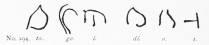
It was with such a conviction that the enquiry was taken up by Professor Theodore Gomperz, of Vienna,[322] whose words are well worth quoting as a lesson in the method of investigation: “One circumstance alone appeared to me consoling, namely, that I did not find myself obliged to add a new hypothesis to the numerous ones already existing, and that I felt it still possible to abide by Haug’s discovery, were it only as a starting-point for further efforts. For the beginning of continuity in enquiry is always the surest harbinger of approaching success.” After making one correction in Haug’s reading of the above inscription, he still found it quite unintelligible, till the thought struck him of reading it from right to left round the whorl, instead of from left to right, and the confused syllables flashed, as by a sudden crystallization, into the pure Greek ta. go. i. di. o. i., that is Ταγῷ δίῳ. “To the divine General or Prince,” an interpretation which Professor Max Müller pronounced to be “almost beyond reasonable doubt.”[323] We deem this solution worthy of special record, both as a landmark in the history of the investigation, and still more as a striking example of the power of mere coincidence to produce combinations that seem to bear the stamp of truth.
No. 294. ta. go. i. di. o. i. No. 294. The above Inscription developed (7 M.).
No. 295. Inscription on a Trojan Seal (7 M.).

No. 296. Inscription on a Trojan Whetstone (7 M.).
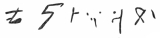
The other inscriptions, of which Professor Gomperz proposed solutions, were the following: First, three letters on the terra-cotta seal, also from the Trojan stratum, mentioned in the ‘Introduction’ (No. 4, p. 24; Pl. 19, No. 555 in Schliemann’s Atlas), which Professor Max Müller was at one time tempted to read as the very name of Ilion (See the ‘Academy’ for May 16, 1874, p. 546). The second was the “splendidly engraved inscription” round the base of the whetstone of red slate (No. 5, p. 24, Pl. 190, No. 3474, Atlas). The third is round the shoulder of a vase from the Palace of Priam (No. 3, p. 23; Pl. 168, Nos. 3273 and 3278, Atlas), where, however, about one-third of the inscription is wanting. The fourth is on a whorl from the lower limit of the Trojan stratum.
No. 297. Inscription on a Trojan Vase from the Palace (8 M.).

No. 298. Trojan Whorl, with an Inscription (10 M.). No. 299. The Inscription developed (10 M.). Comp. Pl. XXVII., No. 369. This also is of very coarse work.

The above record of the process of the investigation will still possess great historical interest, long after the results shall have emerged (as we trust) from the cloud which, for the moment, has come over our hopes; and we believe that its interest will be increased by stating the present position of the case in the words of Professor Gomperz himself[324]:—
“There is not, and there cannot be, the slightest doubt that Professor Haug at Munich was perfectly right, when he first identified the symbols found on several of the Hissarlik vases, &c., with Cypriote characters. I was right too in following up the track, and I think still that I have scarcely once been wrong in identifying those symbols with these characters. Furthermore, my general inferences drawn from the fact, that the Cypriote syllabic writing occurs out of Cyprus, and associated with what I rightly have called pre-Homeric objects of art, I still think unassailable. But—I cannot go further than this! My attempt at deciphering those inscriptions I now look upon as abortive! I hasten to add, that I do not think I deserve any reproach in the matter. I utilized to the best of my abilities the progress which till then had been made in the decipherment of the Cypriote inscriptions found in Cyprus. I used as a key for my decipherment of the Hissarlik inscriptions the phonetic values which Mr. George Smith and Dr. Johannes Brandis had ascertained for those characters. But both these investigators had been only partially right! Wonderful indeed it is, that, applying as I did a key partially right and partially wrong, good and intelligible Greek words emerged. It was a most marvellous coincidence—but nothing else, a mere fortuitous coincidence.
“The labour of ascertaining the phonetic value of the Cypriote characters has since been taken up by several German scholars, Dr. Moritz Schmidt, Professor at Jena, and Messrs. De[.e]ck[.e] and Siegismund at Strasburg, and to a candid critic there cannot remain a doubt that they are right, and that I (together with Smith and Brandis) was wrong.”[325]
Such a frank, truth-loving spirit in the enquirer is as sure a guarantee of ultimate success as that “continuity in the enquiry,” which Gomperz still holds to be established. In a word, the right track is known, but the sign-posts have to be rectified; the key is found, but its wards need some fresh adjustment; and we may soon hope for results far more fruitful than those of which, for a moment only, we have been disappointed.
Meanwhile it is well to put on record Professor Gomperz’s reply to the objections that may be brought forward against the probable conclusion that, even before the Homeric times, there existed Greeks acquainted with a written language.
“For this supposition is not only opposed by ancient, though possibly unhistoric traditions, such as the denial of the settlement of Asia Minor by European Greeks, but by really historical facts—for instance, the total absence of any mention of the art of writing in these very Homeric poems.
“However this objection—let it count for as much or as little as it may—affects not only our decipherings, but also a firmly established and quite undeniable fact, the existence of a Cyprian syllabic writing. For that a nation which knew of a written language, simple and handy as the Phœnician with its facility of supplying the vowels, should prefer one like the Cyprian, full of the most troublesome characters and yet subject to the worst ambiguity, is surely as unlikely as that a nation in possession of the needle-gun should return to the use of the battle-axe. However, in the ninth and at latest in the eighth-century (and very probably much earlier) the Greeks must already have been acquainted with the so-called Phoenician writing, which at that time was employed with equal readiness both in Moab and in Nineveh. Hence the Cyprian writing must have found its way among the Greeks before this epoch (and we may almost safely say a considerable time before this epoch, for otherwise how could it have taken firm root in Cyprus only?) My opinion is that we shall soon find the definite outlines of an epoch of Greek culture, or semi-culture, which I should be inclined to name the pre-Cadmean, the decline of which may probably be dated from the mighty impulse which the conquest of Canaan by the Israelites (about 1300) gave to the migration and the colonization of the Phœnicians.”[326]
We are enabled, by a communication from Dr. Schliemann, to present a list of all the objects in his collection, which Professor Gomperz has recognised as bearing Inscriptions, all of which are figured in our work. We also append the depth at which each object was found, inasmuch as this determines to which of the nations, that dwelt successively on the site of Ilium, each inscription is to be referred; and this is by no means the least interesting point in the investigation.
It will be understood, of course, that this is, in the strongest sense, a “first provisional list” of the results of an enquiry only just begun. We believe that we could make no inconsiderable additions to it; but we await the verdict of the more competent enquirers who are now engaged in the research. Their labours may show that the lowest stratum of remains is not destitute of traces of a written language, as would appear at first sight from the List. Meanwhile the great preponderance of known inscriptions from the “Trojan stratum” (7-10 M.) of Dr. Schliemann is very striking: 11 out of the 18 belong to it. But the ethnic affinity between the Trojans and their successors, already attested by many proofs, is now confirmed by five inscriptions in the Cyprian character from the depths of 4, 5, and 6 meters (Nos. 5, 6, 7, 12 and 16 in the List). The two funnels (Nos. 17, 18) are furnished by the uppermost stratum: each bears only a single letter, which appears also to be Cyprian; but there would seem to be still some doubt whether it may not be Phœnician.
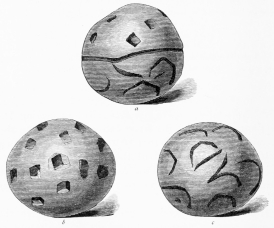
No. 300. Terra-cotta Ball (4 M.). a. Side View. b. Upper Hemisphere. c. Lower Hemisphere, with the Inscription.