Testing and Redeeming Soils
Reading edition
By H. Alison Webster.
With the population of the world ever increasing, and the acreage of fertile lands ever decreasing, with the consequent increasing demand for, and decreasing supply of all products of the soil, is not the duty of redeeming worn-out lands, enriching naturally poor lands and preserving the fertility of fertile lands a duty that every land owner owes to posterity? If the results of robbing the soil of its plant foods has already been felt by the farmer, and if such a practice be continued, what will be the condition of the same soil by the time it descends to his great-grandchildren? If the vast majority of the inhabitants of the globe are poor, and scarcely able to provide food and raiment at the present prices, what will be the fate of such a people when prices rise higher and higher, as will be the inevitable result of an inadequate supply? Is confidence the cause of such shameful neglect, or does the farmer lack confidence in the practicability of the results of scientific research? It is true that the great variety of objects in nature are extremely bewildering, and if every farmer were forced to comprehend God’s creations in order to equip himself to cultivate his land intelligently, the soil would continue to get poorer and poorer, as the useful years of a long life would pass in study; but men of science, in the past and present generations, by faithful and noble work, have reduced all to simple facts to be made practicable by the farmer, and there is no longer any excuse for ignorance and neglect. Study the results of the work of these men of science. Put them into practice. Experiment and work with the soil. Study it and find out what it needs, and having found out, supply the right thing in the right way at the right time. It is work, hard work; but the reward is generous. In the words of Mr. Charles Barnard, “Try things and learn, and having learned, do what is right by your soil, and it will return all your labor in full measure, running over, and your children will inherit the land as a well-kept trust and blessing.”
As stated, things have been greatly simplified. Chemists, by thousands of experiments, have found in all sixty-five single separate things they call elements. Seventeen of these elements are in the soil. Out of these seventeen the farmer is obliged to provide only four, as the remaining thirteen, with favorable weather and proper tillage of the soil, will take care of themselves. The four to be provided are nitrogen, potassium, phosphorus and calcium. The first three elements are the most important, as they are plant foods or fertilizers. The last, calcium, or lime, is a stimulant, and serves in the capacity of neutralizing the acids of the soil. Lime is abundant in many soils and in such soils is not needed; but where it is needed it is needed badly and should be supplied. Nitrogen, potassium and phosphorus are the plant foods that are yearly consumed in various quantities by various crops, which are taken away and sold or otherwise disposed of. They are foods absolutely necessary to plant life, and if taken away and never returned, the soil is as certain to become poor and exhausted as the sun is to set in the west. This is the sum and substance of the whole matter. What you take from the soil, you have to replace or suffer loss. Your soil may need one, two, three or all four of the elements. What it requires can be found out by experiment, as will be shown further on. These elements as everyone must know, can be easily obtained at costs varying with, and depending upon, the form in which they are bought, or methods by which they are secured. The all-important thing is to study the soil and prepare it to accept and properly appropriate whatever foods are applied. No fertilizer is insurance against laziness and ignorance. It takes work and intelligence to accomplish any task. Study your soil, and you will appreciate the fact that it has a constitution like yourself, and will get worn out, and sick, and need physic just as you do. After knowing its constitution, you can prescribe and administer the physic it requires. No doctor can prescribe medicine intelligently without knowing the constitution of his patient.
Naturally, though unfortunately, men of science, so far as the farmer is concerned, are quite as intricate in their explanations of the objects of nature, as are the objects themselves. Mr. Charles Bernard in his “Talks About Soils,” published by Funk & Wagnalls, New York, is the first to reduce matters to a practical plane. His explanations and experiments I therefore adopt to simplify and make clear many things which are of unquestionable importance.
The soil having been formed, in the main, by the weathering away of the rocks, its foundation is either sand or clay or both combined. On account of different quantities of sand and clay being found in different soils, and to distinguish one from another, soils have been divided into six classes. These are as follows:
A Light Sand.—This is a soil containing ninety per cent of sand. If it had more sand and less of clay and other matter it would hardly produce any useful plants, and could not fairly be called a soil.
2. A Pure Clay.—This would be a soil in which no sand could be found. A pure clay soil would be wet and cold, and would not be good for our common plants. Such soils are rare: and what is commonly called a pure clay soil is one containing a great excess of clay, and only a little sand or other matter.
3. A Loam.—This is one of the best of all soils. Such a soil contains both sand and clay as well as other matter.
4. A Sandy Loam.—This is a mixture of sand and clay, with more sand than clay.
5. A Clay Loam.—This is a mixture in which there is more clay than sand.
6. A Strong Clay.—This is a clay containing from five to twenty per cent of sand and other matter.
Experiments with Sand and Clay.—Procure a quart of pure sand and spread it out in the sun to dry, and when dry place a small quantity on a spoon, and hold over a hot fire. The heat has no effect upon it. Remove the spoonful of sand from the fire, and it will be found that the sand keeps its heat for a long time. Place a small quantity of sand in a small sieve and pour water over it. The water at first flows away more or less discolored, and presently runs quickly through the sand pure and clean. While wet the sand sticks together slightly. Place it in the air, and it soon dries, and the grains are as loose as before. Place a little of the washed sand in a bottle filled with water. Cork the bottle and shake it up. The sand will move about as long as the water is in motion, but the instant the bottle is at rest, it falls to the bottom, and forms a layer under the clear water. Place some of the sand in an oven or in the sun till perfectly dry. Place three tablespoonfuls of water in a saucer, and then pour carefully into the saucer a cupful of dry sand. It becomes wet around the little heap while still dry at the top; soon the water will begin to creep up the sand and in a short time it is all wet, and remains wet as long as there is water in the saucer.
These experiments show us that sand is not affected by heat, and that it keeps its heat for some time; that water passes through it readily and, if clean, the water passes through pure and clean. When wet it is very slightly sticky, when dry this stickiness disappears completely. In water it sinks the moment the water is at rest. Water rises through it easily by capillary attraction.
Another experiment, taking more time, is to place some clean sand in a flower pot, wet it, and sprinkle fine grass-seeds over it. Place in a warm room and the seeds will soon sprout and send small roots down into the sand.
These experiments show some of the characteristics of all soils composed largely of sand. We observed that sand when heated retains its heat for some time. Any soil having a large proportion of sand, when warmed by the sun will keep the heat after the sun has set or is hid by the clouds. We proved that water would flow quickly through it. A sandy soil is therefore a dry soil, and for this reason favorable to nearly all our useful plants. We saw that water would rise through sand by capillary attraction, which makes sand useful in soil in dry weather to bring water up from a damp subsoil to feed the roots of plants growing in the soil.
However, there are objections to sand. As we saw, it is loose and easily moved about by water. A sandy soil is therefore easily washed away by rains, and, if too sandy, may suffer great injury by washing in heavy storms. Water flows through sand quickly, and if there is no damp subsoil immediately beneath, the soil may get so dry that plants will burn up. The water may also wash down all the light organic matter out of reach of the plants.
We observed that sand is easily moved about. This is important in that all soils where plants are growing must be frequently stirred, to let air come into the soil, and to kill the weeds. A sandy soil is easy to hoe or plow, because the sand is loose. This saves time and money, or work in caring for plants, and is a business advantage.
If you carry out the experiment with seeds planted on sand you will observe that the roots of the young plants easily find their way through the sand in search of food and water. This shows that a soil containing sand is favorable to the growth of plants, because in it their roots spread in every direction.
Procure a small quantity of clay from some clay bank. Place in a warm place to dry, and in a day or two you can crush it into a soft, impalpable powder. Pinch a little between the fingers and it appears to stick together slightly. Place some in a bottle of water, cork it tight and shake the bottle. The powder floats in the water in clouds, till the water appears completely filled with it. Let the bottle stand and it will be many hours before the clay settles and the water becomes clear. Wet some of the dry clay, and it forms a sticky, pasty mass, that has a soft, greasy feeling between the fingers. Spread some of the soft, pasty mass over a sieve, and pour water on it and the water will hardly pass through the sieve at all. Spread some wet clay over a rough board, and pour water over it, and the clay will cling to the board a long time before it is swept away. Place a lump of wet clay in the sun and it will be many hours before it is entirely dry. Spread some of the wet clay over a dish and place it in the sun, and when it slowly dries it will be found full of cracks. Place a lump of wet clay in an oven and it will dry hard like stone.
Place some of the wet clay in a pot and scatter fine seeds over it. The seeds may sprout and try to grow, but they will probably perish as tender roots are unable to push their way through the sticky clay.
After all these experiments have been performed with the clay and sand, another experiment can be made by drying both the clay and sand and then mixing them together in equal parts. When well mixed place in a pot and scatter fine seeds upon the mixture. Water well, and place in a sunny window; and the plants will sprout and grow longer and better than in either the pure sand or pure clay.
These experiments with the lump of clay show that if soil consists wholly of clay, it must be a poor place for plants. In every hard rain the water, instead of sinking into the soil to supply the plants, would run away over the surface and be wasted. After slow soaking rains the soil would remain wet and cold for a long time. When the sun dries the soil it splits and cracks and tears the roots of plants growing in it. This sticky, pasty soil sticks to spade and plows and we find it hard, slow work to cultivate it. A pure clay from these would appear to be a poor soil for plants. We must not, however, be led astray by our experiments, as it is not easy to find a soil composed wholly of clay. It is usually mixed with other things and then forms a valuable part of the best soils. Sand alone would be a poor soil. Clay alone would be a poorer soil. Mixed together and mixed with other things, they make a part of all good soils.
Organic and Inorganic Matter.—Organic matter is something that has life, or has had life at some time. The organic matter in the soil has been supplied by animals and plants, in one way or another. All else is inorganic. Both organic and inorganic matters are necessary to the existence of plants. Peaty soils wholly organic will not grow plants, neither will sandy soils wholly sand. Inorganic matter forms the foundation of soils and generally forms from eighty to ninety per cent of the whole soil.
Testing Soils for Clay, Sand and Organic Matter.—Take from the ground you wish to test, a peck of soil and place on a board in a round heap, and with a trowel stir it until completely mixed. Then pile into a heap and divide into four equal parts. Next weigh out eight ounces, and spread it out to dry. When dry weigh it and note the loss by air-drying. Next put the soil in a pan and place it in an oven for three hours. Then take the soil out of the pan and weigh it, noting the loss by fire-drying. It is now dry soil and to estimate the organic and inorganic matter, place an iron shovel over the fire, and when red hot put the dry soil on it, let it burn, stirring it occasionally as it burns. It will smoke and smoulder away to ashes and dust. When it ceases to smoke, carefully weigh the ashes. This ash represents the inorganic sand and clay parts of the soil. All the organic matter disappeared in the smoke.
Now take this ash and pour it in a bottle of water. Shake the bottle well and then set on a table, and just so soon as the water becomes still the sand will immediately settle at the bottom, while the clay will remain for some time making the water muddy. As soon as the sand has settled, pour the muddy or clay water off, being careful not to pour any of the sand with it. Then pour some clear water in the bottle on the sand, shake it and pour sand water and all on a cloth fine enough to catch the sand. Dry the sand and weigh it. If it weighs two ounces, then out of the four ounces of dry soil you have tested you have two ounces of sand, one ounce of clay and one ounce of organic matter. Or your soil is twenty-five per cent organic matter and twenty-five per cent clay, and fifty per cent sand. You have a loam soil.
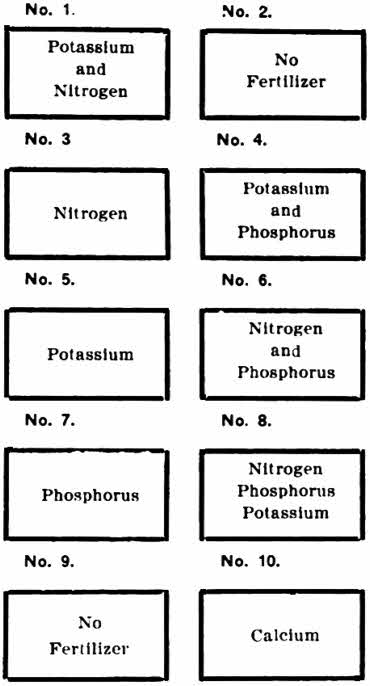
Testing Soils with Plant Foods and Lime.—In the field to be tested, select as level a place as possible and mark out ten squares, each measuring one rod on each side. Place these in two rows leaving spaces three feet wide between the squares. These empty spaces are to be kept clear of weeds and used as walks. Each square should be marked by stakes at the corners, and properly numbered as in the accompanying diagram.
The squares are to be planted with the same crop and well cultivated through the season. Two of these squares, Nos. 2 and 9, are to have no fertilizers, that they may serve as a check or guide in testing the other squares. Square No. 1 is to have a fertilizer containing nitrogen only. No. 4 potassium and phosphorous combined; No. 5 potassium alone; No. 6 nitrogen and phosphorus; No. 7 phosphorus alone; No. 8 all three plant foods combined, and No. 10 is to have calcium only.
No. 1.
Potassium and Nitrogen
No. 2.
No Fertilizer
No. 3.
Nitrogen
No. 4.
Potassium and Phosphorus
No. 5.
Potassium
No. 6.
Nitrogen and Phosphorus
No. 7.
Phosphorus
No. 8.
Nitrogen Phosphorus Potassium
No. 9.
No Fertilizer
No. 10.
Calcium
Apply the fertilizers and work them in the soil about four inches deep before the crop is planted. Plant the same variety of seed on all the squares at the same time, and carefully cultivate through the entire season, treating all exactly alike. Suppose that potatoes have been used. During the growing season, carefully watch the different plats and notice if any one or more seems more or less thrifty than others. Notice which plat appears to mature first, which blooms first and keep a record of all observations. At the end of the season, carefully dig the crop on each square, gathering all the tubers large and small, and weigh each lot. First weigh the crops on squares 2 and 9. This will serve as a standard of comparison, as it will show the natural condition of the soil. Record the weights in each lot and just for illustration we may say that they run something like this: Average of 2 and 9, 80 pounds; No. 1, 380 pounds; No. 3, 250 pounds; No. 4, 360 pounds; No. 5, 350 pounds; No. 6, 300 pounds; No. 7, 220 pounds; No. 8, 400 pounds; No. 10, 120 pounds.
On the particular soil we are supposed to be testing, we can clearly see that the land is benefited in some degree by every element used. Calcium helps, and that means that it should be used on that soil in addition to all of the others. This land plainly needs all four elements and needs potassium especially.
What to Do.—After having gone through with Mr. Barnard’s experiments, you will have a practical idea of what your soil is, and what it needs. The only remaining questions then are those of preparing the soil, and obtaining and applying the plant foods and the lime.
A cold, wet, clay soil needs to be made warmer and lighter, and a light, sandy soil, being too dry, needs some moisture-retaining substance. If conditions are favorable, it would be well at odd time to put sand on the clay soil and clay on the sandy soil; but in most cases this is too expensive, and therefore not practical. To redeem poor lands then, you will have to depend almost entirely upon green manure and lime. Barnyard manures are, of course, at all times, with all soils, the best of all fertilizers, as they return to the soil by the laws of nature, what has been taken from them, or what it should have. Besides the plant foods, it furnishes additional organic matter or humus, which makes the soil lighter and facilitates plant growth by furnishing food to bacteria essential to plant life. The trouble about barn-yard manure is its scarcity. Every farm needs more plant food and humus than can be supplied with common manure.
In the fall, apply 500 pounds of lime per acre to the poor land to be redeemed, break it and prepare it thoroughly, and seed it to rye. In the spring when the rye heads out, turn it under and sow cow peas. When the peas mature, scatter lime, 500 pounds to the acre, over them and turn them under. The lime will prevent the green stuff from souring the soil, will decompose it and fit it for plant food, and will prepare the soil to accept any other foods that may be applied. Follow the peas with wheat, or wheat and clover.
The land once redeemed, do not wear it out again, but preserve its fertility by the use of high-grade commercial fertilizers and barn-yard manure, always rotating the crops so as to get back to some leguminous crop and lime at least once every four years.
Do not retard agricultural education by making warfare on commercial fertilizers, for they are indispensable to every farmer in preserving the fertility of the soil. The world employs the use of just about one-tenth of the artificial fertilizers it should use, and about one-half of what is used is used intelligently. Make war on low grade fertilizers that have the attractive but deceiving feature of cheapness, and buy grade fertilizers by the unit under the guidance of the requirements of your soil.
Phosphatic Limestone.
The use of lime has been and is being sadly neglected, especially in the Southern States and, when it is absolutely necessary to all soils in which it does not exist or exists only in small or insufficient quantities, it does look like the move to provide it is one of imperative moment. Look at the Bluegrass Region of Tennessee and Kentucky, the fairest and most fertile of God’s country. What made it? The dissolution and weathering away of the original phosphatic limestone rock. It is strictly a limestone country and teaches one of nature’s great lessons that the agricultural world should accept and be profited thereby.
All the limestone of this region contains more or less bone phosphate of lime, and in this fact lies the whole secret. In the past ages the foliage from the thick mass of trees and other vegetable growth fell to the ground, soured, and formed an acid which immediately attacked the bone phosphate of lime and converted it into phosphoric acid, while the calcium carbonate or lime decomposed all vegetable matter and conditioned it for plant food, neutralizing all acids and stood ready itself to enter into all future and standing vegetable growth. Now the forests have given place to the cleared fields and we no longer have the dropping from the trees to enrich our soils, neither have we in our fields in sections devoid of limestone any vegetation with roots that extend deep enough in the earth to bring up the carbonate of lime sufficient to support our crops. Therefore the vegetable matter the cheapest of all manures, we provide by turning under green leguminous or nitrogen-gathering plants. These plants sour and finally decompose, but without carbonate of lime to perform its important duties of creating plant food out of this decayed matter, all the fertilizer you get from your crop is the nitrogen it has gathered from the air. Then why not use powdered Tennessee phosphatic-limestone containing enough calcium carbonate (not quick lime) to furnish desired results and no more bone phosphate of lime than will be entirely and immediately converted into plant food. If this phosphatic-limestone product is used with leguminous crops, potash is the only plant food that you will have to provide during the two crop seasons following; however, every soil that has a clay subsoil is a safe bank that will retain all you place on deposit, and if you have the money to spare, deposit it in the soil by investing in high-grade fertilizers and draw a high rate of interest on it instead of letting it stand idle. The calcium in the phosphatic limestone will absolutely correct all free acids in the commercial fertilizers, the burning, deleterious effects of which you may have experienced, and it will rectify the sourness of any and all soils.
An object lesson in favor of this phosphatic limestone is taught by riding along any turnpike macadamized with it and observing the rankness of the crops about fifty yards on either side of the pike, especially where the fields are worn and poor. This demonstrates that it is the dust blown from the roads over into the fields that makes the rank growth alongside the roads. It may be argued that the manure dropped on the pike produced the results; but if so small an amount of manure produced such wonderful results when mixed with the dust from the pike, what would be the result if you would mix all of your barn-yard manure with the powdered limestone?
Recently the writer made twelve tests or experiments with litmus paper. The first ten of these experiments were made with blue litmus paper and samples drawn from ten different fields, all of which have been under cultivation for many years and have had liberal yearly applications of acid fertilizers. The soils so tested are Alabama soils, and are decidedly acid, as shown by the bits of blue litmus turning red on coming in contact with them.
Everyone must know that it takes lime to neutralize the acids of acid soils; but comparatively few farmers ever take the trouble to find out whether or not their soils are acid, even after failing to get a catch of clover three or four years in succession. All clovers positively refuse to grow in acid soils. Inoculation will not do any good for bacteria cannot exist and operate in such soils. Sweeten the soil and nature will in most cases supply the bacteria.
Carbonate of lime enters into the frame of every plant and a lack of it will cause soft stems and flabby leaves. It improves the chemical, mechanical and biological condition of the soil. It flocculates very light, sandy soils, making them compact and capable of retaining moisture, while it prevents clayey soils from becoming pasty hard and full of cracks by causing them to crumble when dry.
Lime is the great carrier into plants of other elements which go there to form their organic compounds, during the elaboration of which, organic acids are created, any and all of which would poison and kill the plants were it not for the action of lime; so lime, in addition to its all-importance as a salifiable base, becomes the great carrier of all foods into plants where it is again of paramount importance as a fixer of oxalic fermentation, thus having the natural and distinct power to act where all other elements are useless.
It will correct sourness in any soil regardless of its origin, it will neutralize all acids that come into the soil through cultivation, through commercial fertilizers or green manurial crops. It will facilitate cultivation and produce a greater porosity and granulation of all soils and thereby lessen the bad effects of drought by reducing surface evaporation, will obviate excessive capillary rise of moisture which elevates the water-soluble foods above the zone of roots, provide better circulation of air in the soil and will cause rapid percolation of rain and thus reduce surface washing. It stimulates and increases nitrification and decomposes vegetable matter, extracting from it all plant foods and leaving humus to lighten the soil and retain its moisture. It enters into the composition of all plant life and therefore into all animal life, giving to animals its carbon combined with the carbon of the air to furnish them fat, and its lime to furnish them bone. It is the phosphatic-limestone that has made Tennessee and Kentucky horses the strength to excel in work and racing, and it is this same soil constituent that has given to the Jersey cow sufficient butter fat to lead the world in butter tests. It enables the clovers and grasses to grow, and without such crops what would the brothers of the hoe do toward profitable farming and meeting the responsibilities of life? It perpetuates and permits the use of commercial fertilizers which are becoming so absolutely essential to husbandry, as it obviates the evil effects of the acids these products contain, and makes all plant food available to the plant. Finally, it is a property designed by the Creator to act for and enter into all vegetable and animal life, and evil will be the reward to him who rejects it.