Front matter (continued 2)
Reading edition
All this British capital, all the capital of the Missions, all these various and not inconsiderable agencies, have been tempted into Africa largely in the hope that the old policy of England would not only be continued but extended. England has never in theory departed from the position she assumed in the days of the Zambesi Expedition. On the contrary, she has distinctly recognized the relation between her Government and Africa. She has continued to send out British Consuls to be the successors of Livingstone in the Nyassa region. When the first of these, Captain Foote, R.N., died in the Shiré Highlands in 1884, the English Government immediately sent another to take his place. But this is the last thing that has been done. The Consul is there as a protest that England has still her eye on Africa. But Africa needs more than an eye. And when, as happened the other day, one of Her Majesty's representatives was under Arab fire for five days and nights on the shores of Lake Nyassa, this was brought home to us in such practical fashion as to lead to the hope that some practical measures will now be taken.
I do not presume to bring forward a formal proposal; but two things occur to one as feasible, and I shall simply name them. The first is for England, or Germany, or France, or some one with power and earnestness, to take a firm and uncompromising stand at Zanzibar. Zanzibar, as the Arab capital, is one of the keys of the situation, and any lesson taught here would be learned presently by the whole Mohammedan following in the country.
The other key to the situation is the vast and splendid water-way in the heart of Africa—the Upper Shiré, Lake Nyassa, Lake Tanganyika, and the Great Lakes generally. As a base for military or patrol operations nothing better could be desired than these great inland seas. A small steamer upon each of them—or, to begin with, upon Nyassa and Tanganyika—with an associated depôt or two of armed men on the higher and healthier plateaux which surround them, would keep the whole country quiet. Only a trifling force of well-drilled men would be needed for this purpose. They might be whites, or blacks and whites; they might be Sikhs or Pathans from India; and the expense is not to be named considering the magnitude of the results—the pacification of the entire equatorial region—that would be achieved. That expense could be borne by the Missions, but it is not their province to employ the use of force; it could be borne by the Lakes Company, only they deserve protection from others rather than that this should be added to the large debt civilization already owes them; it could be done by the Free Congo State,—and if no one else is shamed into doing it, this further labor of love may fall into its hands. But whether alone, or in co-operation with the few and overburdened capitalists of the country, or in conjunction with foreign powers, England will be looked to to take the initiative with this or a similar scheme.
The barriers in the way of Government action are only two, and neither is insurmountable. The one is Portugal, which owns the approaches to the country; the other is Germany, which has inland interests of her own. Whether England could proceed in the face of these two powers would simply depend on how it was done. As a mere political move such an occupation of the interior might at once excite alarm and jealousy. But wearing the aspect of a serious mission for the good of Africa, instigated not by the Foreign Office but by the people of England, it is impossible to believe that the step could either be misunderstood or opposed. It is time the nations looked upon Africa as something more than a chess-board. And even if it were but a chess-board, the players on every hand are wise enough to know that whatever is honestly done to relieve this suffering continent will react in a hundred ways upon the interests of all who hold territorial rights within it.
A beginning once made, one might not be unduly sanguine in anticipating that the meshes of a pacific and civilizing influence would rapidly spread throughout the country. Already the missionaries are pioneering everywhere, prepared to slay and do their part; and asking no more from the rest of the world than a reasonable guarantee that they should be allowed to live. Already the trading companies are there, from every nationality, and in every direction ready to open up the country, but unable to go on with any confidence or enthusiasm till their isolated interests are linked together and secured in the presence of a common foe. The territories of the various colonies are slowly converging upon the heart of Africa, and to unite them in an informal defensive alliance would not be impossible. With Emin Pasha occupying the field in the north; with the African Lakes Company, the British East African Association, and the German Association, in the east; with the Congo Free State in the west, and British Bechuanaland in the south, a cordon is already thrown around the Great Lakes region, which requires only to have its several parts connected with one another and with central forces on the Lakes, to secure the peace of Africa.
V. WANDERINGS ON THE NYASSA-TANGANYIKA PLATEAU.
A TRAVELLER'S DIARY.
With a glade in the forest for a study, a bale of calico for a table, and the sun vertical and something under a billion centigrade, diary-writing in the tropics is more picturesque than inspiring. To keep a journal, however, next to keeping his scalp, is the one thing for which the consistent traveller will go through fire and water; and the dusky native who carries the faded note-books on the march is taught to regard the sacredness of his office more than if he drove the car of Juggernaut. The contents of these mysterious note-books, nevertheless, however precious to those who write them, are, like the photographs of one's relations, of pallid interest to others, and I have therefore conscientiously denied myself the joy of exhibiting such offspring of the wilderness as I possess to my confiding reader.
But as the diary form has advantages of its own, I make no apology at this stage for transcribing and editing a few rough pages. Better, perhaps, than by a more ordered narrative, they may help others to enter into the traveller's life, and to illustrate what the African traveller sees and hears and does. I shall disregard names, and consecutive dates, and routes. My object is simply to convey some impression of how the world wags in a land unstirred by civilization, and all but untouched by time.
29th September.—Left Karongas, at the north end of Lake Nyassa, at 10.30, with a mongrel retinue of seven Mandalla natives, twelve Bandawé Atongas, six Chingus, and my three faithfuls—Jingo, Moolu, and Seyid. Total twenty-eight. Not one of my men could speak a word of English. They belonged to three different tribes and spoke as many languages; the majority, however, knew something of Chinanja, the lake language, of which I had also learned a little, so we soon understood one another. It is always a wise arrangement to have different tribes in a caravan, for in the event of a strike, and there are always strikes, there is less chance of concerted action. Each man carried on his head a portion of my purse—which in this region consists solely of cloth and beads; while one or two of the more dependable were honored with the transportation of the tent, collecting-boxes, provisions, and guns.
The road struck into a banana grove, then through a flat country fairly well wooded with a variety of trees, including many palms and a few baobabs. The native huts dotted over this rich flat are the best I have seen in Africa. The roofs are trimly thatched, and a rude carving adorns door-post and lintel. After seven miles the Rukuru is crossed—a fine stream rippling over the sand, with large flakes of mica tumbling about in the current, and sampling the rocks of the distant hills. The men laid down their loads, and sprawled about like crocodiles in the water as I waded across. A few yards off is a village, where a fire was quickly lit, and the entire population turned out to watch the white man nibble his lunch. The consumption at this meal being somewhat slight, and the menu strange to my audience, I saw that they regarded the white man's effort at nutrition with feelings of contempt. "The M'sungu eats nothing," whispered one, "he must die." The head man presently came asking beads; but, as I had none unpacked, two stray trinkets and a spoonful of salt more than satisfied him. On getting the salt he deftly twisted a leaf into a little bag, and after pouring all the salt into it, graciously held out his hand to a troop of small boys who crowded round, and received one lick each of his empty palm. Salt is perhaps the greatest luxury and the greatest rarity the north-end African can have, and the avidity with which these young rascals received their homœopathic allowance proved the instinctiveness of the want. I have often offered native boys the choice between a pinch of salt and a knot of sugar, and they never failed to choose the first. For return-present the chief made over to me two large gourds filled with curds, of which, of course, I pretended to drink deeply before passing it on to the men.
Three miles of the same country, with tall bean-plants about, castor oil, and maize, but no villages in sight. Bananas unusually fine, and Borassus everywhere. At the tenth or eleventh mile we reached the fringe of hills bordering the higher lands, and, taking advantage of a passage about half a mile wide which has been cut by the river, penetrated the first barrier—a low rounded hill of conglomerate, fine in texture, and of a dark-red-color. Flanking this for two miles, we entered a broad oval expansion among the hills, the site apparently of a former lake. Winding along with the river for a mile or two more, and passing through a narrow and romantic glen, we emerged in a second valley, and camped for the night on the banks of the stream. On the opposite side stood a few native huts, and the occupants, after much reconnoitring, were induced to exchange some ufa and sweet potatoes for a little cloth.
1st October.—Moolu peered into my tent with the streak of dawn to announce a catastrophe. Four of the men had run away during the night. All was going so well yesterday that I flattered myself I was to be spared this traditional experience—the most exasperating of all the traveller's woes, for the whole march must be delayed until fresh recruits are enlisted to carry the deserters' loads. The delinquents were all Bandawé men. They had no complaint. They stole nothing. It was a simple case of want of pluck. They were going into a strange land. The rainy season was coming on. Their loads were full-weight. So they got homesick and ran. I had three more Bandawé men in the caravan, and, knowing well that the moment they heard the news they would go and do likewise, I ordered them to be told what had happened and then sent to my tent. In a few moments they appeared; but what to say to them? Their dialect was quite strange to me, and yet I felt I must impress them somehow. Like the judge putting on the black cap, I drew my revolver from under my pillow, and, laying it before me, proceeded to address them. Beginning with a few general remarks on the weather, I first briefly sketched the geology of Africa, and then broke into an impassioned defence of the British Constitution. The three miserable sinners—they had done nothing in the world—quaked like aspens. I then followed up my advantage by intoning in a voice of awful solemnity, the enunciation of the Forty-Seventh Proposition of Euclid, and then threw my all into a blood-curdling Quod erat demonstrandum. Scene two followed when I was alone; I turned on my pillow and wept for shame. It was a prodigious piece of rascality, but I cannot imagine anything else that would have done, and it succeeded perfectly. These men were to the end the most faithful I had. They felt thenceforth they owed me their lives; for, according to African custom, the sins of their fellow-tribesmen should have been visited upon them with the penalty of death.
Seyid and Moolu scoured the country at once for more carriers, but met with blank refusals on every side. Many natives passed the camp, but they seemed in unusual haste, and something of local importance was evidently going on. We were not long in doubt as to its nature. It was war. The Angoni were in force behind a neighboring hill, and had already killed one man. This might have been startling, but I treated it as a piece of gossip, until suddenly a long string of armed and painted men appeared in sight and rushed past me at the double. They kept perfect step, running in single file, their feet adorned with anklets of rude bells which jingled in time and formed quite a martial accompaniment. The center man held aloft a small red and white flag, and each warrior carried a large shield and several light barbed spears. The regiment was led by a fantastic looking creature, who played a hideous slogan on a short pan-pipe. This main body was followed at intervals by groups of twos and threes who had been hastily summoned from their work, and I must say the whole turnout looked very like business. The last of the warriors had scarcely disappeared before another procession of a different sort set in from the opposite direction. It consisted of the women and children from the threatened villages farther up the valley. It was a melting sight. The poor creatures were of all ages and sizes, from the tottering grandmother to the week old infant. On their heads they carried a miscellaneous collection of household gods, and even the little children were burdened with a calabash, a grass-mat, a couple of fowls, or a handful of sweet-potatoes. Probably the entire effects of the villages were represented in these loads. Amongst the fugitives were a few goats and one or two calves, and a troop of boys brought up the rear driving before them a herd of cows. The poor creatures quickened their pace as they passed my tent, and eyed me as furtively as if I and my men had been a detachment from the Angoni executing a flank movement. The hamlet opposite our camp, across the river, which had gladdened us the night before with its twinkling fires, its inhabitants sitting peacefully at their doors or fishing in the stream, was already deserted—the men to fight, the woman to flee for their lives they knew not whither. This is a common chapter in African history. Except among the very largest tribes no man can call his home his own for a month.
I was amazed at the way my men treated the affair. They lounged about camp with the most perfect indifference. This was accounted for by my presence. The mere presence of a white man is considered an absolute guarantee of safety in remoter Africa. It is not his gun or his imposing retinue; it is simply himself. He is not mortal, he is a spirit. Had I not been there, or had I shown the white feather, my men would have stampeded for Nyassa in a body. I had learned to understand the feeling so thoroughly that the events of the morning gave me no concern whatever, and I spent the day collecting in the usual way.
It was impossible to go on and leave the loads; it was equally impossible to get carriers at hand. So I despatched Seyid with a letter to the station on the Lake requesting six or eight natives to be sent from there. This meant a delay of two or three days at least, which, with the rains so near, was serious for me.
Made a "fly" for the tent, collected, and read. One only feels the heat when doing nothing. As the sun climbed to its zenith my men put up for themselves the most enticing bowers. They were ingeniously made with interlacing grasses and canes, and densely thatched with banana leaves.
Tried twice to bake bread, with Jingo and Moolu as assistant cooks. Both attempts dismal failures, so I had to draw on the biscuit-tins. I have plenty of fowls, bought yesterday for beads. Maraya down with fever. One of the carriers, Siamuka, who had been left behind sick, straggled into camp, looking very ill indeed. Physicked him and gave him four yards of cloth to wrap himself in. Towards sunset I began to get anxious for news of battle. The arrival of the armed band which had passed in the morning soon gratified me. There had been no battle. There had been no Angoni. It was simply a scare—one of those false alarms which people in these unsettled circumstances are constantly liable to. All evening the women and children were trooping back to their homes; and next morning our friends opposite were smoking their pipes at the doors again, as if nothing had happened.
Tuesday, 2d October—After morning cocoa had a walk with my hammer to examine the sections in the valley. Back to a good breakfast, cooked with all the art of Jingo, the real cook being at Karongas with the flag of distress. Moolu ill. This is the third man down with fever since we left the Lake. Bought some ufa and beans. Dispensed needles, and bent pins for fish-hooks, among the men. Held a great washing with Jingo. Towards the afternoon the reinforcements arrived from Karongas. The chief was drunk, it appeared, when my messenger reached him; but Mr. Munro at the Lake kindly sent me a number of his own men.
Another of my carriers begged leave to dissolve our partnership, and produced two youths whom he had beguiled into taking his load. His plea was that he was in bad odor at Mweni-wanda, and was afraid to go on. My own impression is that he found the load which he carried—on his head, like all Africans—was spoiling the cut of his hair. Even Africa has its exquisites, and this man was the swell all over. By "all over," I mean, of course, all over his head, for as his hair is his only clothing, except the bark loin cloth of which the cut cannot well be varied, he had poured out the whole of his great soul upon his coiffure. At the best the African's hair is about the length of a toy-shop poodle's; but vanity can make even a fool creative, and out of this scanty material and with extraordinary labor he had compiled a masterpiece. First, heavily greased with ground-nut oil, it was made up into small-sized balls like black-currants, and then divided into symmetrical patterns, diamonds, circles, and parterres, designed with the skill of a landscape-gardener. To protect this work of art from nightly destruction, this gentleman always carried with him a pillow of special make. It was constructed of wood, and dangled conspicuously from his spear-head on the march. He sold it to me ultimately for a yard of calico—and he certainly would not sleep after the transaction till he had laid the foundations of another.
12th October.—Got under weigh at early dawn. Much shirking and dodging among the men for light loads. Formerly sudden and suspicious fevers used to develop at this critical juncture—by a not unaccountable coincidence among the men with the heaviest loads; but my now well-known mixture, compounded of pepper, mustard, cold tea, citrate of magnesia, Epsom salts, anything else that might be handy, and a flavoring pinch of cinchona, has miraculously stayed the epidemic. But I forgive these merry fellows everything for wasting none of the morning coolness over toilet or breakfast. I need not say the African never washes in the morning; but, what is of more importance, he never eats, he rises suddenly from the ground where he has lain like a log all night, gives himself a shake, shoulders his load, and is off. Even at the mid-day halt he eats little; but, if he can get it, will regale himself with a draught of water and a smoke. This last is a perfunctory performance, and one pipe usually serves for a dozen men. Each takes a whiff or two from the great wooden bowl, then passes it to his neighbor, and the pipe seldom makes a second round.
I often wondered how the natives produced a light when camping by themselves, and at last resolved to test it. So when the usual appeal was made to me for "motu," I handed them my vesta-box with a single match in it. I generally struck the match for them, this being considered a very daring experiment, and I felt pretty sure they would make a mess of their one chance. It turned out as I anticipated, and when they handed back the empty box, I looked as abstracted and unapproachable as possible. After a little suspense, one of them slowly drew from the sewn-up monkey skin, which served for his courier-bag, a small piece of wood about three inches long. With a spear-head he cut in it a round hole the size of a threepenny-piece. Placing his spear-blade flat on the ground to serve as a base, he stretched over it a scrap of bark-cloth torn from his girdle, and then pinned both down with the perforated piece of wood, which a second native held firmly in position. Next he selected from among his arrows a slender stick of very hard wood, inserted it vertically in the hole, and proceeded to twirl it round with great velocity between his open palms. In less than half a minute the tinder was smoking sulkily, and after a few more twirls it was ready for further treatment by vigorous blowing, when it broke into active flame. The fire originates, of course, in the small soft piece of wood, from which sparks fall upon the more inflammable bark-cloth at the bottom of the hole.
Our daily programme, on the march, was something like this. At the first streak of dawn my tent was struck. There is no time for a meal, for the cool early hour is too precious in the tropics to waste over eating; but a hasty coffee while the loads were packing kept up the tradition of breakfast. In twenty minutes the men were marshalled, quarrels about an extra pound weight adjusted, and the procession started. At the head of the column I usually walked myself, partly to see the country better, partly to look out for game, and partly, I suppose, because there was no one else to do it. Close behind me came my own special valet—a Makololo—carrying my geological hammer, water-bottle, and loaded rifle. The white man, as a rule, carries nothing except himself and a revolver, and possibly a double-awned umbrella, which, with a thick pith helmet, makes sunstrokes impossible. Next Jingo marched the cook, a plausible Mananja, who could cook little, except the version of where the missing victuals went to. After the cook came another gentleman's gentleman carrying a gun and the medicine chest, and after him the rank and file, with another gun-bearer looking out for deserters at the rear. From half-past five I usually trudged on till the sun made moving torture, about ten or eleven. When I was fortunate enough to find shade and water there was a long rest till three in the afternoon, and an anomalous meal, followed by a second march till sunset. The dreadful part of the day was the interval. Then observations were made, and specimens collected and arranged, each man having to fill a collecting-box before sunset. When this was over there was nothing else to do that it was not too hot to do. It was too hot to sleep, there was nothing to read, and no one to speak to; the nearest post-office was a thousand miles off, and the only amusement was to entertain the native chiefs, who used occasionally to come with their followers to stare at the white man. These interviews at first entertained one vastly, but the humbling performances I had to go through became most intolerable. Think of having to stand up before a gaping crowd of savages and gravely button your coat—they had never seen a coat; or, wonder of wonders, strike a match, or snap a revolver, or set fire to somebody's bark clothes with a burning-glass. Three or four times a day often I had to go through these miserable performances, and I have come home with a new sympathy for sword-swallowers, fire-eaters, the man with the iron jaw, and all that ilk.
The interview commenced usually with the approach of two or three terror-stricken slaves, sent by the chief as a preliminary to test whether or not the white man would eat them. Their presents, native grains of some kind, being accepted, they concluded I was at least partly vegetarian, and the great man with his courtiers, armed with long spears, would advance and kneel down in a circle. A little speechifying followed, and then my return presents were produced—two or three yards of twopence-halfpenny calico; and if he was a very great chief an empty Liebig pot or an old jam tin was also presented with great ceremony. None of my instruments, I found, at all interested these people—they were quite beyond them; and I soon found that in my whole outfit there were not half a dozen things which conveyed any meaning to them whatever. They did not know enough even to be amazed. The greatest wonder of all perhaps was the burning-glass. They had never seen glass before, and thought it was mazi or water, but why the mazi did not run over when I put it in my pocket passed all understanding. When the light focused on the dry grass and set it ablaze their terror knew no bounds. "He is a mighty spirit!" they cried, "and brings down fire from the sun." This single remark contains the key to the whole secret of a white man's influence and power over all uncivilized tribes. Why a white man, alone and unprotected, can wander among these savage people without any risk from murder or robbery is a mystery at home. But it is his moral power, his education, his civilization. To the African the white man is a supreme being. His commonest acts are miracles; his clothes, his guns, his cooking utensils are supernatural. Everywhere his word is law. He can prevent death and war if he but speak the word. And let a single European settle, with fifty square miles of heathen round him, and in a short time he will be their king, their lawgiver, and their judge. I asked my men one day the question point blank—"Why do you not kill me and take my guns and clothes and beads?" "Oh," they replied, "we would never kill a spirit." Their veneration for the white man indeed is sometimes most affecting. When war is brewing, or pestilence, they kneel before him and pray to him to avert it; and so much do they believe in his omnipotence that an unprincipled man by trading on it, by simply offering pins, or buttons or tacks, or pieces of paper, or anything English, as charms against death, could almost drain a country of its ivory—the only native wealth.
The real dangers to a traveller are of a simpler kind. Central Africa is the finest hunting country in the world. Here are the elephant, the buffalo, the lion, the leopard, the rhinoceros, the hippopotamus, the giraffe, the hyæna, the eland, the zebra, and endless species of small deer and antelope. Then the whole country is covered with traps to catch these animals—deep pits with a jagged stake rising up in the middle, the whole roofed over with turf and grass, so exactly like the forest bed that only the trained eye can detect their presence. I have found myself walking unconsciously on a narrow neck between two of these pits, when a couple of steps to either side would almost certainly have meant death. Snakes too, and especially the hideous and deadly puff adder, may turn up at any moment; and in bathing, which one eagerly does at every pool, the sharpest lookout is scarcely a match for the diabolical craft of the crocodile.
13th October.—Walking through the forest to-day some distance ahead of my men, I suddenly came upon a rhinoceros. The creature—the rhino is solitary in his habits—was poking about the bush with its head down and did not see me, though not ten yards separated us. My only arms were a geological hammer and a revolver, so I had simply to lie down and watch him. Presently my gun-bearer crawled up, but unfortunately by this time the pachyderm had vanished, and was nowhere to be found. I broke my heart over it at the moment, though why in the world I should have killed him I do not in the least know now. In cold blood one resents Mr. Punch's typical Englishman—"What a heavenly morning! let's go and kill something!" but in the presence of temptation one feels the veritable savage.
We are now at an elevation of about four thousand feet, and steadily nearing the equator, although the climate gives little sign of it. It is a popular mistake that the nearer one goes to the equator the temperature must necessarily increase. Were this so, Africa, which is the most tropical continent in the world, would also be the hottest; while the torrid zone, which occupies so large a portion of it, would be almost insupportable to the European. On the contrary, the nearer one goes to the equator in Africa it becomes the cooler. The reasons for this are twofold—the gradual elevation of the continent towards the interior, and the increased amount of aqueous vapor in the air. Central Africa is from three to five thousand feet above the level of the sea. Now for every three hundred feet of ascent the thermometer falls one degree. It is immensely cooler, therefore, in the interior than at the coast; and the equatorial zone all over the world possesses a climate in every way superior to that of the borders of the temperate region. At night, in Equatorial Africa, it is really cold, and one seldom lies down in his tent with less than a couple of blankets and a warm quilt. The heat of New York is often greater than that of Central Africa; for while in America a summer rarely passes without the thermometer reaching three figures, in the hottest month in Africa my thermometer never registered more than two on a single occasion—the highest actual point reached being 96°. Nowhere, indeed, in Africa have I experienced anything like the heat of a summer in Malta, or even of a stifling August in Southern Germany or Italy. On the other hand, the direct rays of the sun are necessarily more powerful in Africa; but so long as one keeps in the shade—and even a good umbrella suffices for this—there is nothing in the climate to disturb one's peace of mind or body. When one really feels the high temperature is when down with fever; or when fever, unknown to one, is coming on. Then, indeed, the heat becomes maddening and insupportable; nor has the victim words to express his feelings towards the glittering ball, whose daily march across the burnished and veilless zenith brings him untold agony.
15th to 22d October.—This camp is so well situated that I have spent the week in it. The programme is the same every day. At dawn Jingo came to my tent with early coffee. Went out with my gun for a morning stroll, and returned in an hour for breakfast. Thereafter I sorted the specimens captured the day before, and hung up the fatter insects to dry in the sun. Routing the ants from the boxes and provision stores was also an important and vexatious item. Some ants are so clever that they can break into every thing, and others so small that they will crawl into anything; and between the clever ones, and the small ones, and the jam-loving ones, and the flour-eating ones and the specimen-devouring ones, subsistence, not to say science, is a serious problem. The only things that have hitherto baffled them are the geological specimens; but I overhaul these regularly every morning along with the rest, in terror of one day finding some precocious creature browsing off my granites. After these labors I repaired to a natural bower in the dry bed of a shaded streamlet, where I spent the entire day. Here, even at high noon, was perfect coolness, and rest, and solitude unutterable. I lay among birds and beasts and flowers and insects, watching their ways, and trying to enter into their unknown lives. To watch uninterruptedly the same few yards of universe unfold its complex history; to behold the hourly resurrection of new living things, and miss no change or circumstance, even of its minuter parts; to look at all, especially the things you have seen before, a hundred times, to do all with patience and reverence—this is the only way to study nature.
Towards the afternoon the men began to drop in with their boxes of insects, each man having to collect a certain number every camp-day. If sufficient were not brought in the delinquent had to go back to the bush for more. At five or six I went back to my tent for dinner, and after an hour over the camp-fire turned in for the night. The chattering of the men all round the tent usually kept me awake for an hour or two. Their merriest time is just after sunset, when the great ufa-feast of the day takes place. The banter between the fires is kept up till the small hours, and the chief theme of conversation is always the white man himself—what the whit man did, and what the white man said, and how the white man held his gun, and everything else the white man thought, looked, willed, wore, ate, or drank. My object in being there was an insoluble riddle to them, and for what witchcraft I collected all the stones and insects was an unending source of speculation.
That they entered to some extent into one at least of these interests was proved that very night. I was roused rather late by a deputation, who informed me that they had just discovered a very uncommon object crawling on a stick among the firewood. Going out to the fire and stirring the embers into a blaze, I was shown one of the most extraordinary insects it has been my lot to look upon. Rather over two inches in length, the creature lay prone upon a branch, adroitly shamming death, after the manner of the Mantidæ, to which it obviously belonged. The striking feature was a glittering coal-black spiral, with a large central spot of the same color, painted on the middle of the back; the whole resembling a gigantic eye, staring out from the body, and presenting the most vivid contrast to the lemon yellows and greens of the rest of the insect. One naturally sought a mimetic explanation of the singular marking, and I at once recalled a large fringed lichen which covered many of the surrounding trees, and of which this whole insect was a most apt copy. That it was as rare as it was eccentric was evident from the astonishment of the natives, who declared that they had never seen it before.
22d October.—Water has been scarce for some days, and this morning our one pool was quite dried up, so I struck camp. Marching northwest, over an undulating forest country, we came to a small village, near which was a running stream. The chief, an amiable old gentleman, after an hour spent in suspicious prospecting, came to see the show, and propitiated its leading actor with a present of flour. In return I gave him some cloth and an empty magnesia bottle to hold his snuff. The native snuff-mull is a cylinder of wood profusely carved, and, in the absence of a pocket, hangs tied round the neck with a thong. Snuffing is universal hereabouts.
This is a hotter camp than the last, though the elevation (4500 feet) is nearly the same. Paid the men their fortnight's wage in cloth, and as I threw in an extra fathom they held high revelry till far on in the night.
24th October.—Buffalo fever still on. Sallied forth early with Moolu, a large herd being reported at hand. We struck the trail after a few miles, but the buffaloes had moved away, passing up a steep valley to the north and clearing a hill. I followed, but saw no sign, and after one or two unsuccessful starts gave it up, as the heat had become terrific. Breakfasted off wild honey, which one of the natives managed to lay hands on, and sent for the camp to come up. Moolu went on with one native, T'Shaula—he of the great spear and the black feathers. They returned about two o'clock announcing that they had dropped two bull buffaloes, but not being mortally wounded the quarry had made off. Late in the afternoon two of my men rushed in saying that one of the wounded buffaloes had attacked two of their number, one severely, and that assistance was wanted to carry them back. It seems that five of the men, on hearing Moolu's report about the wounded buffaloes, and tempted by the thought of fresh meat, set off without permission to try to secure them. It was a foolhardy freak, as they had only a spear with them, and a wounded buffalo bull is the most dangerous animal in Africa. It charges blindly at anything, and even after receiving its mortal wound has been known to kill its assailant. The would-be hunters soon overtook one of the creatures, a huge bull, lying in a hollow, and apparently in articulo mortis. They calmly walked up to it—the maddest thing in the world—when the brute suddenly roused itself and charged headlong. They ran for their lives; one was overtaken and trampled down in a moment; the second was caught up a few yards farther on and literally impaled on the animal's horns. The first hobbled into camp little the worse, but the latter was brought in half dead. He had two frightful wounds, the less serious on the back behind the shoulder-blade, the other a yawning gash just under the ribs. I fortunately had a little lint and dressed his wounds as well as I could, but I thought he would die in my hands. He was quite delirious, and I ordered a watch all night in case the bleeding should break out afresh. His nurses unhappily could not take in the philosophy of this, and I had to turn out every hour to see that they were not asleep. The native's conception of pain is that it is the work of an evil spirit, and the approved treatment consists in blowing upon the wound and suspending a wooden charm from the patient's neck to exorcise it. All this was duly done now, and the blowing was repeated at frequent intervals through the night.
25th October.—Kacquia conscious, and suffering much. It is impossible to go on, so the men have rigged up a bower for me on the banks of a stream near the camp. Read, wrote, physicked right and left, and received the Chief of Something-or-other. Bribed some of his retinue to search the district for indiarubber, and bring specimens of the trees. After many hours' absence they brought me back two freshly-made balls, but neglected to bring a branch, which was what I promised to pay them for. From their description I gather the tree is the Landolphia vine. The method of securing the rubber is to make incisions in the stem and smear the exuding milky juice over their arms and necks. After it has dried a little they scrape it off and roll it up into balls.
An instance of what the native will do for a scrap of meat. Near camp this morning Moolu pointed out to me a gray lump on the top of a very high tree, which he assured me was an animal. It was a kind of lemur, and very good to eat. I had only my Winchester with me, and the ball ripped up the animal, which fell at once, but leaving an ounce or two of viscera on the branch. One of the men, Makata, coming up at the sound of the shot, perceived that the animal was not all there—it had been literally "cleaned"—immediately started to climb the tree for the remainder. It was a naked stem for a considerable height and thicker than himself, but he attacked it at once native fashion, i.e., by walking up the trunk, his clasped hands grasping the trunk on the opposite side from his doubled-up body, and literally walking upward on his soles. He soon came down with the precious mess, and in a few minutes it was cooked and eaten.
To-night I thought my hour was come. Our camp was right in the forest; it was pitch dark; and I was sitting late over the smouldering fire with the wounded man. Suddenly a terrific yell rang out from the forest, and a native rushed straight at me brandishing his spear and whooping at the pitch of his voice. Sure that it was an attack, I darted towards the tent for my rifle, and in a second every man in the camp was huddling in it likewise. Some dashed in headlong by the door, others under the canvas, until there was not room to crawl among their bodies. Then followed—nothing. First an awful silence, then a whispering, then a mighty laughter, and then the whole party sneaked out of the fort and yelled with merriment. One of my own men had crept out a few yards for firewood; he had seen a leopard, and lost control of himself—that was all. It was hard to say who was most chaffed about it; but I confess I did not realize before how simple a business it would have been for any one who did not approve of the white man to exterminate him and his caravan.
Sunday, 28th October.—My patient holding on; will now probably pull through. As he has to be fed on liquids, my own fowls have all gone in chicken soup. Fowls are now very scarce, and my men, taking advantage of the high premium and urgent demand, have gone long distances to get them. They will not supply them to the invalid, but sell them to me to give him. Wishing to teach them a lesson in philanthropy, I declined to buy any more on these terms; and after seeing me go three days dinnerless to give Kacquia his chance of life they became ashamed of themselves, and handed me all the fowls they had in a present. This was a prodigious effort for a native, and proves him capable of better things. The whole camp had been watching this byplay for a day or two, and the finish did good all round—more especially as I gave a return present, after a judicious interval, worth five times what had been given me.
Held the usual service in the evening—a piece of very primitive Christianity. Moolu, who had learned much from Dr. Laws, undertook the sermon, and discoursed with great eloquence on the Tower of Babel. The preceding Sunday he had waxed equally warm over the Rich Man and Lazarus; and his description of the Rich Man in terms of native ideas of wealth—"plenty of calico and plenty of beads"—was a thing to remember. "Mission-blacks," in Natal and at the Cape, are a byword among the unsympathetic; but I never saw Moolu do an inconsistent thing. He could neither read nor write; he knew only some dozen words of English; until seven years ago he had never seen a white man; but I could trust him with everything I had. He was not "pious"; he was neither bright nor clever; he was a commonplace black; but he did his duty and never told a lie. The first night of our camp, after all had gone to rest, I remember being roused by a low talking. I looked out of my tent; a flood of moonlight lit up the forest; and there, kneeling upon the ground, was a little group of natives, and Moolu in the centre conducting evening prayers. Every night afterwards this service was repeated, no matter how long the march was nor how tired the men. I make no comment. But this I will say—Moolu's life gave him the right to do it. Mission reports are often said to be valueless; they are less so than anti-mission reports. I believe in missions, for one thing, because I believe in Moolu.
But I need not go on with this itinerary. It is very much the same thing over again. For some time yet you must imagine the curious procession I have described wandering hither and thither among the wooded mountains and valleys of the table-land, and going through the same general programme. You might have seen its chief getting browner and browner in the tropical sun, his clothes getting raggeder and raggeder, his collecting-boxes becoming fuller and fuller, and his desire to get home again growing stronger and stronger. Then you might have seen the summer end and the tropical rains begin, and the whole country suddenly clothe itself with living green. And then, as the season advanced, you might have seen him plodding back to the Lake, between the attacks of fever working his way down the Shiré and Zambesi, and so, after many days, greeting the new spring in England.
VI. THE WHITE ANT.
A THEORY.
A few years ago, under the distinguished patronage of Mr. Darwin, the animal in vogue with scientific society was the worm. At present the fashionable animal is the ant. I am sorry, therefore, to have to begin by confessing that the insect whose praises I propose to sing, although bearing the honored name, is not entitled to consideration on account of its fashionable connections, since the white ant, as an ant, is an impostor. It is, in fact, not an ant at all, but belongs to a much humbler family—that of the Termitidæ—and so far from ever having been the vogue, this clever but artful creature is hated and despised by all civilized peoples. Nevertheless, if I mistake not, there is neither among the true ants, nor among the worms, an insect which plays a more wonderful or important part in nature.
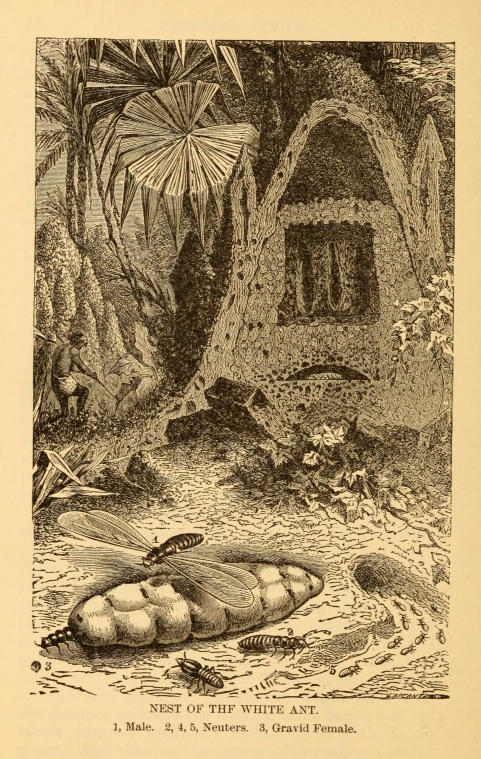
NEST OF THE WHITE ANT. 1, Male. 2, 4, 5, Neuters. 3, Gravid Female.
Fully to appreciate the beauty of this function, a glance at an apparently distant aspect of nature will be necessary as a preliminary.
When we watch the farmer at work, and think how he has to plough, harrow, manure, and humor the soil before even one good crop can be coaxed out of it, we are apt to wonder how nature manages to secure her crops and yet dispense with all these accessories. The world is one vast garden, bringing forth crops of the most luxuriant and varied kind century after century, and millennium after millennium. Yet the face of nature is nowhere furrowed by the plough, no harrow disintegrates the clods, no lime and phosphates are strewn upon its fields, no visible tillage of the soil improves the work on the great world's farm.
Now, in reality, there cannot be crops, or successions of crops, without the most thorough agriculture; and when we look more closely into nature we discover a system of husbandry of the most surprising kind. Nature does all things unobtrusively; and it is only now that we are beginning to see the magnitude of these secret agricultural operations by which she does already all that man would wish to imitate, and to which his most scientific methods are but clumsy approximations.
In this great system of natural husbandry nature uses agencies, implements, and tools of many kinds. There is the disintegrating frost, that great natural harrow, which bursts asunder the clods by the expansion during freezing of the moisture imprisoned in their pores. There is the communistic wind which scatters broadcast over the fields the finer soil in clouds of summer dust. There is the rain which washes the humus into the hollows, and scrapes bare the rocks for further denudation. There is the air which, with its carbonic acid and oxygen, dissolves and decomposes the stubborn hills, and manufactures out of them the softest soils of the valley. And there are the humic acids, generated through decay, which filter through the ground and manure and enrich the new-made soils.
But this is not all, nor is this enough; to prepare a surface film, however rich, and to manure the soil beneath, will secure one crop, but not a succession of crops. There must be a mixture and transference of these layers, and a continued mixture and transference, kept up from age to age. The lower layer of soil, exhausted with bringing forth, must be transferred to the top for change of air, and there it must lie for a long time, increasing its substance, and recruiting its strength among the invigorating elements. The upper film, restored, disintegrated, saturated with fertility and strength, must next be slowly lowered down again to where the rootlets are lying in wait for it, deep in the under soil.
Now how is this last change brought about? Man turns up the crust with the plough, throwing up the exhausted earth, down the refreshed soil, with infinite toil and patience. And nature does it by natural ploughmen who, with equal industry, are busy all over the world reversing the earth's crust, turning it over and over from year to year, only much more slowly and much more thoroughly, spadeful by spadeful, foot by foot, and even grain by grain. Before Adam delved the Garden of Eden these natural agriculturists were at work, millions and millions of them in every part of the globe, at different seasons and in different ways, tilling the world's fields.
According to Mr. Darwin, the animal which performs this most important function in nature is the earthworm. The marvellous series of observations by which the great naturalist substantiated his conclusion are too well known for repetition. Mr. Darwin calculates that on every acre of land in England more than ten tons of dry earth are passed through the bodies of worms and brought to the surface every year; and he assures us that the whole soil of the country must pass and repass through their bodies every few years. Some of this earth is brought up from a considerable depth beneath the soil, for, in order to make its subterranean burrow, the animal is compelled to swallow a certain quantity of earth. It eats its way, in fact, to the surface, and there voids the material in a little heap. Although the proper diet of worms is decaying vegetable matter, dragged down from the surface in the form of leaves and tissues of plants, there are many occasions on which this source of aliment fails, and the animal has then to nourish itself by swallowing quantities of earth, for the sake of the organic substances it contains. In this way the worm has a twofold inducement to throw up earth. First, to dispose of the material excavated from its burrow; and, second, to obtain adequate nourishment in times of famine. "When we behold a wide, turf-covered expanse," says Mr. Darwin, "we should remember that its smoothness, on which so much of its beauty depends, is mainly due to all the inequalities having been slowly levelled by worms. It is a marvellous reflection that the whole of the superficial mould over any such expanse has passed, and will again pass, every few years, through the bodies of worms. The plough is one of the most ancient and most valuable of man's inventions; but long before he existed the land was, in fact, regularly ploughed by earthworms. It may be doubted whether there are many other animals which have played so important a part in the history of the world as have these lowly organized creatures."*
Now, without denying the very important contribution of the earthworm in this respect, a truth sufficiently endorsed by the fact that the most circumstantial of naturalists has devoted a whole book to this one animal, I would humbly bring forward another claimant to the honor of being, along with the worm, the agriculturist of nature. While admitting to the fullest extent the influence of worms in countries which enjoy a temperate and humid climate, it can scarcely be allowed that the same influence is exerted, or can possibly be exerted, in tropical lands. No man was less in danger of taking a provincial view of nature than Mr. Darwin, and in discussing the earthworm he has certainly collected evidence from different parts of the globe. He refers, although sparingly, and with less than his usual wealth of authorities, to worms being found in Iceland, in Madagascar, in the United States, Brazil, New South Wales, India, and Ceylon. But his facts, with regard especially to the influence, on the large scale, of the worm in warm countries, are few or wholly wanting. Africa, for instance, the most tropical country in the world, is not referred to at all; and where the activities of worms in the tropics are described, the force of the fact is modified by the statement that these are only exerted during the limited number of weeks of the rainy season.
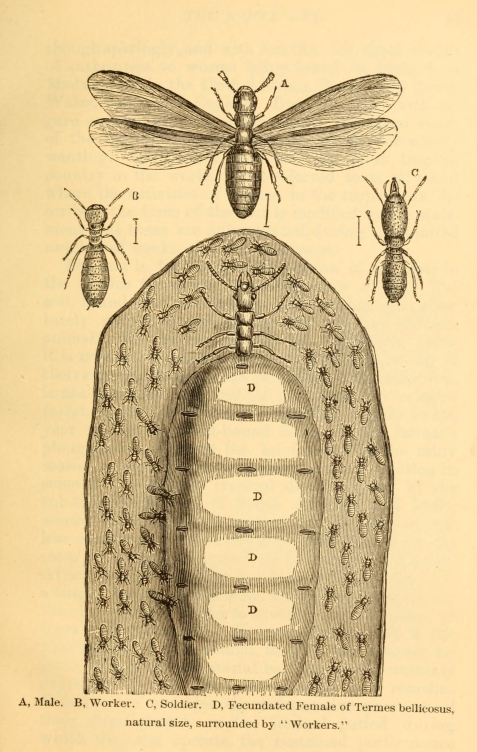
A, Male. B, Worker. C, Soldier. D, Fecundated Female of Termes bellicosus, natural size, surrounded by "Workers."
The fact is, for the greater portion of the year in the tropics the worm cannot operate at all. The soil, baked into a brick by the burning sun, absolutely refuses a passage to this soft and delicate animal. All the members of the earthworm tribe, it is true, are natural skewers, and though boring is their supreme function, the substance of these skewers is not hardened iron, and the pavement of a tropical forest is quite as intractable for nine months in the year as are the frost-bound fields to the farmer's ploughshare. During the brief period of the rainy season worms undoubtedly carry on their function in some of the moister tropical districts; and in the sub-tropical regions of South America and India, worms, small and large, appear with the rains in endless numbers. But on the whole the tropics proper seem to be poorly supplied with worms. In Central Africa, though I looked for them often, I never saw a single worm. Even when the rainy season set in, the closest search failed to reveal any trace either of them or of their casts. Nevertheless, so wide is the distribution of this animal, that in the moister regions even of the equatorial belt one should certainly expect to find it. But the general fact remains. Whether we consider the comparative poorness of their development, or the limited period during which they can operate, the sustained performance of the agricultural function by worms, over large areas in tropical countries, is impossible.
Now as this agricultural function can never be dispensed with, it is more than probable that nature will have there commissioned some other animal to undertake the task. And there are several other animals to whom this difficult and laborious duty might be entrusted. There is the mole, for instance, with its wonderful spade-like feet, that natural navvy, who shovels the soil about so vigorously, at home; but against the burnt crust of the tropics even this most determined of burrowers would surely turn the edge of his nails. The same remark applies to those curious little geologists the marmots and skipmunks, which one sees throwing up their tiny heaps of sand and gravel on the American prairies. And though the torrid zone boasts of a strong-limbed and almost steel-shod creature, the ant-bear, his ravages are limited to the destruction of the nests of ants; and however much this somewhat scarce animal contributes to the result, we must look in another direction for the true tropical analogue of the worm.
The animal we are in search of, and which I venture to think equal to all the necessities of the case, is the termite or white ant. It is a small insect, with a bloated, yellowish-white body, and a somewhat large thorax, oblong-shaped, and colored a disagreeable oily brown. The flabby, tallow-like body makes this insect sufficiently repulsive, but it is for quite another reason that the white ant is the worst abused of all living vermin in warm countries. The termite lives almost exclusively upon wood; and the moment a tree is cut or a log sawn for any economical purpose, this insect is upon its track. One may never see the insect, possibly, in the flesh, for it lives underground; but its ravages confront one at every turn. You build your house, perhaps, and for a few months fancy you have pitched upon the one solitary site in the country where there are no white ants. But one day suddenly the door-post totters, and lintel and rafters come down together with a crash. You look at a section of the wrecked limbers, and discover that the whole inside is eaten clean away. The apparently solid logs of which the rest of the house is built are now mere cylinders of bark, and through the thickest of them you could push your little finger. Furniture, tables, chairs, chests of drawers, everything made of wood, is inevitably attacked, and in a single night a strong trunk is often riddled through and through, and turned into matchwood. There is no limit, in fact, to the depredation by these insects, and they will eat books, or leather, or cloth, or anything; and in many parts of Africa I believe if a man lay down to sleep with a wooden leg it would be a heap of sawdust in the morning. So much feared is this insect now, that no one in certain parts of India and Africa ever attempts to travel with such a thing as a wooden trunk. On the Tanganyika plateau I have camped on ground which was as hard as adamant, and as innocent of white ants apparently as the pavement of St. Paul's, and wakened next morning to find a stout wooden box almost gnawed to pieces. Leather portmanteaus share the same fate, and the only substances which seem to defy the marauders are iron and tin.
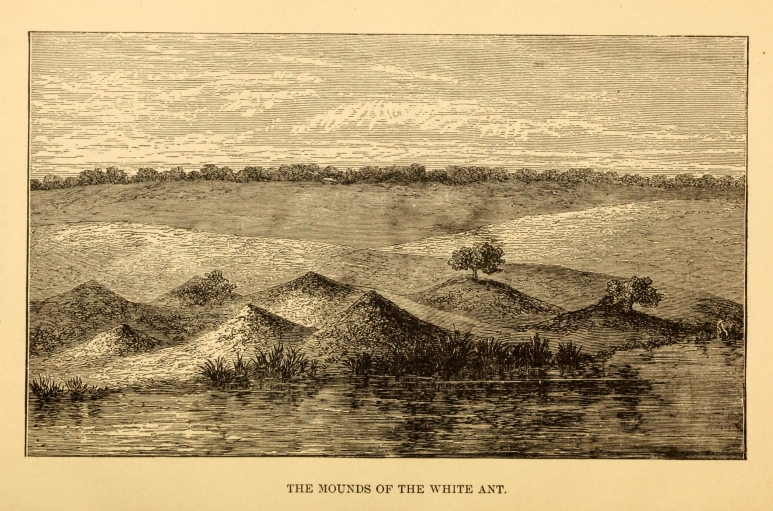
THE MOUNDS OF THE WHITE ANT.
But what has this to do with earth or with agriculture? The most important point in the work of the white ant remains to be noted. I have already said that the white ant is never seen. Why he should have such a repugnance to being looked at is at first sight a mystery, seeing that he himself is stone blind. But his coyness is really due to the desire for self-protection, for the moment his juicy body shows itself above ground there are a dozen enemies waiting to devour it. And yet the white ant can never procure any food until it comes above ground. Nor will it meet the case for the insect to come to the surface under the shadow of night. Night in the tropics, so far as animal life is concerned, is as the day. It is the great feeding time, the great fighting time, the carnival of the carnivores, and of all beasts, birds, and insects of prey from the least to the greatest. It is clear then that darkness is no protection to the white ant; and yet without coming out of the ground it cannot live. How does it solve the difficulty? It takes the ground out along with it. I have seen white ants working on the top of a high tree, and yet they were underground. They took up some of the ground with them to the tree-top; just as the Esquimaux heap up snow, building it into the low tunnel-huts in which they live, so the white ant collects earth, only in this case not from the surface but from some depth underneath the ground, and plaster it into tunnelled ways. Occasionally these run along the ground, but more often mount in endless ramifications to the top of trees, meandering along every branch and twig, and here and there debouching into large covered chambers which occupy half the girth of the trunk. Millions of trees in some districts are thus fantastically plastered over with tubes, galleries, and chambers of earth, and many pounds weight of subsoil must be brought up for the mining of even a single tree. The building material is conveyed by the insects up a central pipe with which all the galleries communicate, and which at the downward end connects with a series of subterranean passages leading deep into the earth. The method of building the tunnels and covered ways is as follows:—At the foot of a tree the tiniest hole cautiously opens in the ground close to the bark. A small head appears with a grain of earth clasped in its jaws. Against the tree-trunk this earth-grain is deposited, and the head is withdrawn. Presently it reappears with another grain of earth, this is laid beside the first, rammed tight against it, and again the builder descends underground for more. The third grain is not placed against the tree, but against the former grain; a fourth, a fifth, and a sixth follow, and the plan of the foundation begins to suggest itself as soon as these are in position. The stones or grains or pellets of earth are arranged in a semicircular wall, the termite, now assisted by three or four others, standing in the middle between the sheltering wall and the tree, and working briskly with head and mandible to strengthen the position. The wall in fact forms a small moon-rampart, and as it grows higher and higher it soon becomes evident that it is going to grow from a low battlement into a long perpendicular tunnel running up the side of the tree. The workers, safely ensconced inside, are now carrying up the structure with great rapidity, disappearing in turn as soon as they have laid their stone and rushing off to bring up another. The way in which the building is done is extremely curious, and one could watch the movement of these wonderful little masons by the hour. Each stone as it is brought to the top is first of all covered with mortar. Of course, without this the whole tunnel would crumble into dust before reaching the height of half an inch; but the termite pours over the stone a moist sticky secretion, turning the grain round and round with its mandibles until the whole is covered with slime. Then it places the stone with great care upon the top of the wall, works it about vigorously for a moment or two till it is well jammed into its place, and then starts off instantly for another load.
Peering over the growing wall, one soon discovers one, two, or more termites of a somewhat larger build, considerably longer and with a very different arrangement of the parts of the head, and especially of the mandibles. These important-looking individuals saunter about the rampart in the most leisurely way, but yet with a certain air of business, as if perhaps the one was the master of works and the other the architect. But closer observation suggests that they are in no wise superintending operations, nor in any immediate way contributing to the structure, for they take not the slightest notice either of the workers or the works. They are posted there in fact as sentries, and there they stand, or promenade about, at the mouth of every tunnel, like sister Ann, to see if anybody is coming. Sometimes somebody does come in the shape of another ant—the real ant this time, not the defenceless Neuropteron, but some valiant and belted knight from the warlike Formicidæ. Singly, or in troops, this rapacious little insect, fearless in its chitinous coat of mail, charges down the tree-trunk, its antennæ waving defiance to the enemy, and its cruel mandibles thirsting for termite blood. The worker white ant is a poor defenceless creature, and blind and unarmed, would fall an immediate prey to these well-drilled banditti, who forage about in every tropical forest in unnumbered legion. But at the critical moment, like Goliath from the Philistines, the soldier termite advances to the fight. With a few sweeps of its scythe-like jaws it clears the ground, and while the attacking party is carrying off its dead, the builders, unconscious of the fray, quietly continue their work. To every hundred workers in a white ant colony, which numbers many thousands of individuals, there are perhaps two of these fighting men. The division of labor here is very wonderful, and the fact that besides these two specialized forms there are in every nest two other kinds of the same insect, the kings and queens, shows the remarkable height to which civilization in these communities has attained.
But where is this tunnel going to, and what object have the insects in view in ascending this lofty tree? Thirty feet from the ground, across innumerable forks, at the end of a long branch, are a few feet of dead wood. How the ants know it is there, how they know its sap has dried up, and that it is now fit for the termites' food, is a mystery. Possibly they do not know, and are only prospecting on the chance. The fact that they sometimes make straight for the decaying limb argues in these instances a kind of definite instinct; but, on the other hand, the fact that in most cases the whole tree, in every branch and limb, is covered with termite tunnels, would show perhaps that they work most commonly on speculation, while the number of abandoned tunnels, ending on a sound branch in a cul de sac, proves how often they must suffer the usual disappointments of all such adventurers. The extent to which these insects carry on their tunnelling is quite incredible until one has seen it in nature with his own eyes. The tunnels are, perhaps, about the thickness of a small-sized gas-pipe, but there are junctions here and there of large dimensions, and occasionally patches of earthwork are found embracing nearly the whole trunk for some feet. The outside of these tunnels, which are never quite straight, but wander irregularly along stem and branch, resembles in texture a coarse sandpaper; and the color, although this naturally varies with the soil, is usually a reddish brown. The quantity of earth and mud plastered over a single tree is often enormous; and when one thinks that it is not only an isolated specimen here and there that is frescoed in this way, but often the whole of the trees of a forest, some idea will be formed of the magnitude of the operations of these insects and the extent of their influence upon the soil which they are thus ceaselessly transporting from underneath the ground.
In travelling through the great forest of the Rocky Mountains or of the Western States, the broken branches and fallen trunks strewing the ground breast-high with all sorts of decaying litter frequently make locomotion impossible. To attempt to ride through these western forests, with their meshwork of interlocked branches and decaying trunks, is often out of the question, and one has to dismount and drag his horse after him as if he were clambering through a woodyard. But in an African forest not a fallen branch is seen. One is struck at first at a certain clean look about the great forests of the interior, a novel and unaccountable cleanness, as if the forest-bed was carefully swept and dusted daily by unseen elves. And so, indeed, it is. Scavengers of a hundred kinds remove decaying animal matter—from the carcase of a fallen elephant to the broken wing of a gnat—eating it, or carrying it out of sight, and burying it on the deodorizing earth. And these countless millions of termites perform a similar function for the vegetable world, making away with all plants and trees, all stems, twigs, and tissues, the moment the finger of decay strikes the signal. Constantly in these woods one comes across what appear to be sticks and branches and bundles of faggots, but when closely examined they are seen to be mere casts in mud. From these hollow tubes, which preserve the original form of the branch down to the minutest knot or fork, the ligneous tissue is often entirely removed, while others are met with in all stages of demolition. Examine the section of an actual specimen, which is not yet completely destroyed, and from which the mode of attack may be easily seen. The insects start apparently from two centres. One company attacks the inner bark, which is the favorite morsel, leaving the coarse outer bark untouched, or more usually replacing it with grains of earth, atom by atom, as they eat it away. The inner bark is gnawed off likewise as they go along, but the woody tissue beneath is allowed to remain to form a protective sheath for the second company who begin work at the centre. This second contingent eats its way outward and onward, leaving a thin tube of the outer wood to the last, as props to the mine, till they have finished the main excavation. When a fallen trunk lying upon the ground is the object of attack, the outer cylinder is frequently left quite intact, and it is only when one tries to drag it off to his camp-fire that he finds to his disgust that he is dealing with a mere hollow tube a few lines in thickness filled up with mud.
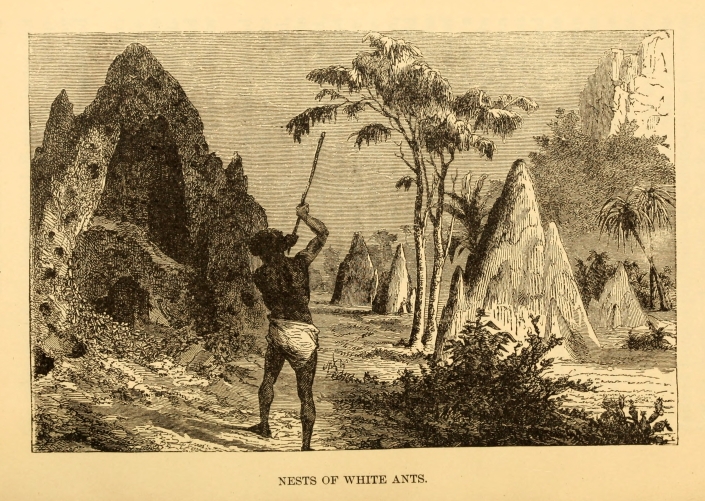
NESTS OF WHITE ANTS
But the works above ground represent only a part of the labors of these slow-moving but most industrious of creatures. The arboreal tubes are only the prolongation of a much more elaborate system of subterranean tunnels, which extend over large areas and mine the earth sometimes to a depth of many feet or even yards.
The material excavated from these underground galleries and from the succession of domed chambers—used as nurseries or granaries—to which they lead, has to be thrown out upon the surface. And it is from these materials that the huge ant-hills are reared, which form so distinctive a feature of the African landscape. These heaps and mounds are so conspicuous that they may be seen for miles, and so numerous are they and so useful as cover to the sportsman, that without them in certain districts hunting would be impossible. The first things, indeed, to strike the traveller in entering the interior are the mounds of the white ant, now dotting the plain in groups like a small cemetery, now rising into mounds, singly or in clusters, each thirty or forty feet in diameter and ten or fifteen in height; or, again, standing out against the sky like obelisks, their bare sides carved and fluted into all sorts of fantastic shapes. In India these ant-heaps seldom attain a height of more than a couple of feet, but in Central Africa they form veritable hills, and contain many tons of earth. The brick houses of the Scotch mission-station on Lake Nyassa have all been built out of a single ants' nest, and the quarry from which the material has been derived forms a pit beside the settlement some dozen feet in depth. A supply of bricks, as large again, could probably still be taken from this convenient depôt; and the missionaries on Lake Tanganyika and onwards to Victoria Nyanza have been similarly indebted to the labors of the termites. In South Africa the Zulus and Kaffirs pave all their huts with white-ant earth; and during the Boer war our troops in Praetoria, by scooping out the interior from the smaller beehive-shaped ant-heaps, and covering the top with clay, constantly used them as ovens. These ant-heaps may be said to abound over the whole interior of Africa, and there are several distinct species. The most peculiar as well as the most ornate, is a small variety from one to two feet in height, which occurs in myriads along the shores of Lake Tanganyika. It is built in symmetrical tiers, and resembles a pile of small rounded hats, one above another, the rims depending like eaves, and sheltering the body of the hill from rain. To estimate the amount of earth per acre raised from the water-line of the subsoil by white ants would not in some districts be an impossible task; and it would be found, probably, that the quantity at least equalled that manipulated annually in temperate regions by the earthworm.
These mounds, however, are more than mere waste-heaps. Like the corresponding region underground, they are built into a meshwork of tunnels, galleries, and chambers, where the social interests of the community are attended to. The most spacious of these chambers, usually far underground, is very properly allocated to the head of the society, the queen. The queen-termite is a very rare insect, and as there are seldom more than one, or at most two, to a colony, and as the royal apartments are hidden far in the earth, few persons have ever seen a queen, and indeed most, if they did happen to come across it, from its very singular appearance, would refuse to believe that it had any connection with white ants. It possesses, indeed, the true termite head, but there the resemblance to the other members of the family stops, for the size of the head bears about the same proportion to the rest of the body as does the tuft on his Glengarry bonnet to a six-foot Highlander. The phenomenal corpulence of the royal body in the case of the queen-termite is possibly due in part to want of exercise, for once seated upon her throne she never stirs to the end of her days. She lies there, a large, loathsome, cylindrical package, two or three inches long, in shape like a sausage, and as white as a bolster. Her one duty in life is to lay eggs, and it must be confessed she discharges her function with complete success, for in a single day her progeny often amounts to many thousands, and for months this enormous fecundity never slackens. The body increases slowly in size, and through the transparent skin the long folded ovary may be seen, with the eggs, impelled by a peristaltic motion, passing onward for delivery to the workers who are waiting to carry them to the nurseries where they are hatched. Assiduous attention, meantime, is paid to the queen by other workers, who feed her diligently, with much self-denial stuffing her with morsel after morsel from their own jaws. A guard of honor in the shape of a few of the larger soldier-ants is also in attendance as a last and almost unnecessary precaution. In addition, finally, to the soldiers, workers, and queen, the royal chamber has also one other inmate—the king. He is a very ordinary-looking insect, about the same size as the soldiers, but the arrangement of the parts of the head and body is widely different, and like the queen he is furnished with eyes.
Let me now attempt to show the way in which the work of the termites bears upon the natural agriculture and geology of the tropics. Looking at the question from the large point of view, the general fact to be noted is, that the soil of the tropics is in a state of perpetual motion. Instead of an upper crust, moistened to a paste by the autumn rains, and then baked hard as adamant in the sun; and an under soil hermetically sealed from the air and light, and inaccessible to all the natural manures derived from the decomposition of organic matters—these two layers being eternally fixed in their relations to one another—we have a slow and continued transference of the layers always taking place. Not only to cover their depredations, but to dispose of the earth excavated from the underground galleries, the termites are constantly transporting the deeper and exhausted soils to the surface. Thus there is, so to speak, a constant circulation of earth in the tropics, a ploughing and harrowing, not furrow by furrow and clod by clod, but pellet by pellet and grain by grain.
Some idea of the extent to which the underlying earth of the tropical forests is thus brought to the surface will have been gathered from the facts already described; but no one who has not seen it with his own eyes can appreciate the gigantic magnitude of the process. Occasionally one sees a whole trunk or branch, and sometimes almost an entire tree, so swathed in red mud that the bark is almost completely concealed, the tree looking as if it had been taken out bodily and dipped in some crystallizing solution. It is not only one tree here and there that exhibits the work of the white ant, but in many places the whole forest is so colored with dull red tunnels and patches as to give a distinct tone to the landscape—an effect which, at a little distance, reminds one of the abend-roth in a pine forest among the Alps. Some regions are naturally more favorable than others to the operations of the termites; and to those who have only seen them at work in India or in the lower districts of Africa this statement may seem an exaggeration. But on one range of forest-clad hills on the great plateau between Lake Nyassa and Tanganyika I have walked for miles through trees, every one of which, without exception, was ramified, more or less, with tunnels. The elevation of this locality was about 5000 feet above the sea and the distance from the equator some 9°; but nowhere else have I seen a spot where the termites were so completely masters of the situation as here. If it is the case that in these, the most elevated regions of Central Africa, the termite colonies attain their maximum development, the fact is of much interest in connection with the geological and agricultural function which they seem to serve; for it is here precisely, before the rivers have gathered volume, that alluvium is most wanting; it is here that the tiny headwaters of these same rivers collect the earth for subsequent distribution over the distant plains and coasts; and though the white ant may itself have no power, in the first instance, of creating soil, as a denuding and transporting agent, its ministry can scarcely be exaggerated. If this is its function in the economy of nature, it is certainly clear that the insect to which this task is assigned is planted where, of all places, it can most effectively fulfil the end.
The direct relation of the termites' work to denudation will still further appear if we try to imagine the effect upon the accumulations of earth pellets and grains of an ordinary rainy season. For two or three months in the tropics, though intermittently, the rains lash the forests and soils with a fury such as we, fortunately, have little idea of. And though the earthworks, and especially the larger ant-hills, have marvellous resisting properties, they are not invulnerable, and must ultimately succumb to denuding agents. The tunnels, being only required for a temporary purpose, are made substantial enough only to last the occasion. And in spite of the natural glue which cements the pellets of earth together, the structure, as a whole, after a little exposure, becomes extremely friable, and crumbles to pieces at a touch. When the earth-tubes crumble into dust in the summer season the debris is scattered over the country by the wind, and this way tends to increase and refresh the soil. During the rains, again, it is washed into the rivulets and borne away to fertilize with new alluvium the distant valleys, or carried downward to the ocean, where, along the coast line, it "sows the dust of continents to be." Herodotus, with equal poetic and scientific truth, describes Egypt as "the gift of the Nile." Possibly had he lived to-day he might have carried his vision farther back still, and referred some of it to the labors of the humble termites in the forest slopes about Victoria Nyanza.
VII. MIMICRY.
THE WAYS OF AFRICAN INSECTS.
Mimicry is imposture in nature. Carlyle in his blackest visions of "shams and humbugs" among human kind never saw anything so finished in hypocrisy as the naturalist now finds in every tropical forest. There are to be seen creatures, not singly, but in tens of thousands, whose very appearance, down to the minutest spot and wrinkle, is an affront to truth, whose every attitude is a pose for a purpose, and whose whole life is a sustained lie. Before these masterpieces of deception the most ingenious of human impositions are vulgar and transparent. Fraud is not only the great rule of life in a tropical forest, but the one condition of it.
Although the extraordinary phenomena of mimicry are now pretty generally known to science, few workers have yet had the opportunity of studying them in nature. But no study in natural history depends more upon observation in the field; for while in the case of a few mimetic forms—the Heliconidæ, for example—the imitated form is also an insect, and the two specimens may be laid side by side in the cabinet at home, the great majority of mimetic insects are imitations of objects in the environment which cannot be brought into comparison with them in the drawers of a museum. Besides this, it is not only the form but the behavior of the mimetic insect, its whole habit and habitat, that have to be considered; so that mere museum contributions to mimicry are almost useless without the amplest supplement from the field naturalist. I make no further apology, therefore, for transcribing here a few notes bearing upon this subject from journals written during a recent survey of a region in the heart of Africa—the Nyassa-Tanganyika plateau—which has not yet been described or visited by any naturalist.
The preliminaries of the subject can be mastered in a moment even by the uninitiated, and I may therefore begin with a short preface on animal coloring in general. Mimicry depends on resemblances between an animal and some other object in its environment of which it is a practical gain to the creature to be a more or less accurate copy. The resemblance may be to any object, animate or inanimate. It may be restricted to color, or it may extend to form, and even to habit; but of these the first is by far the most important.
Apart from sexual selection, color in animals mainly serves two functions. It is either "protective" or "warning." The object of the first is to render the animal inconspicuous, the object of the second is the opposite—to make it conspicuous. Why it should be an object with some animals to be palpably exposed will be apparent from the following familiar instance of "warning" coloration. There are two great families of butterflies, the Danaidæ and Acraiedæ, which are inedible owing to the presence in their bodies of acrid and unwholesome juices. Now to swallow one of these creatures—and birds, monkeys, lizards, and spiders are very fond of butterflies—would be gratuitous. It would be disappointing to the eater, who would have to disgorge his prey immediately, and it would be an unnecessary sacrifice of the subject of the experiment. These butterflies, therefore, must have their disagreeableness in some way advertised, and so they dress up with exceptional eccentricity, distinguishing themselves by loud patterns and brilliant colorings, so that the bird, the monkey, and the rest can take in the situation at a glance. These animated danger-signals float serenely about the forests with the utmost coolness in the broadest daylight, leisureliness, defiance and self-complacency marking their every movement, while their duskier brethren have to hurry through the glades in terror of their lives. For the same reason, well-armed or stinging insects are always conspicuously ornamented with warning colors. The expense of eating a wasp, for instance, is too great to lead to a second investment in the same insect, and wasps therefore have been rendered as showy as possible so that they may be at once seen and as carefully avoided. The same law applies to bees, dragonflies, and other gaudy forms; and it may be taken as a rule that all gayly-colored insects belong to one or other of these two classes: that is, that they are either bad eating or bad-stingers. Now the remarkable fact is that all these brilliant and unwholesome creatures are closely imitated in outward apparel by other creatures not themselves protected by acrid juices, but which thus share the same immunity. That these are cases of mimicry is certain from many considerations, not the least striking of which is that frequently one of the sexes is protectively colored and not the other.
The brilliant coloring of poisonous snakes is sometimes set down by naturalists to "warning," but the details of coloring among reptiles have never been thoroughly worked out. The difficulty suggests itself that if the vivid yellows and oranges of some snakes are meant to warn off dangerous animals, the same conspicuousness would warn off the animals on which the venomous forms prey. Thus, while being hunted, a showy skin might be of advantage to the snake; in hunting it would be an equal disadvantage. But when one watches on the spot the manner in which snakes really do their hunting, it becomes probable that the coloring, vivid and peculiar as it is, in most cases is designed simply to aid concealment. One of the most beautiful and ornate of all the tropical reptiles is the puff-adder. This animal, the bite of which is certain death, is from three to five feet long, and disproportionately thick, being in some parts almost as thick as the lower part of the thigh. The whole body is ornamented with strange devices in green, yellow, and black, and lying in a museum its glittering coils certainly form a most striking object. But in nature the puff-adder has a very different background. It is essentially a forest animal, its true habitat being among the fallen leaves in the deep shade of the trees by the banks of streams. Now in such a position, at the distance of a foot or two, its appearance so exactly resembles the forest bed as to be almost indistinguishable from it. I was once just throwing myself down under a tree to rest when, stooping to clear the spot, I noticed a peculiar pattern among the leaves. I started back in horror to find a puff-adder of the largest size, its thick back only visible, and its fangs within a few inches of my face as I stooped. It was lying concealed among fallen leaves so like itself that, but for the exceptional caution which in African travel becomes a habit, I should certainly have sat down upon it, and to sit down upon a puff-adder is to sit down for the last time. I think this coloration in the puff-adder is more than that of warning, and that this semi-somnolent attitude is not always the mere attitude of repose. This reptile lay lengthwise, concealed all but a few inches, among the withered leaves. Now the peculiarity of the puff-adder is that it strikes backward. Lying on the ground, therefore, it commands as it were its whole rear, and the moment any part is touched, the head doubles backward with inconceivable swiftness, and the poison-fangs close upon their victim. The puff-adder in this way forms a sort of horrid trap set in the woods which may be altogether unperceived till it shuts with a sudden spring upon its prey.
But that the main function of coloring is protection may be decided from the simplest observation of animal life in any part of the world. Even among the larger animals, which one might suppose independent of subterfuge and whose appearance anywhere but in their native haunts suggests a very opposite theory, the harmony of color with environment is always more or less striking. When we look, for instance, at the coat of a zebra with its thunder-and-lightning pattern of black and white stripes, we should think such a conspicuous object designed to court rather than to elude attention. But the effect in nature is just the opposite. The black and white somehow take away the sense of a solid body altogether; the two colors seem to blend into the most inconspicuous gray, and at close quarters the effect is as of bars of light seen through the branches of shrubs. I have found myself in the forest gazing at what I supposed to be a solitary zebra, its presence betrayed by some motion due to my approach, and suddenly realized that I was surrounded by an entire herd which were all invisible until they moved. The motionlessness of wild game in the field when danger is near is well known; and every hunter is aware of the difficulty of seeing even the largest animals though they are just standing in front of him. The tiger, whose stripes are obviously meant to imitate the reeds of the jungle in which he lurks, is nowhere found in Africa: but its beautiful cousin, the leopard, abounds in these forests, and its spotted pelt probably conveys the same sense of indistinctness as in the case of the zebra. The hippopotamus seems to find the deep water of the rivers—where it spends the greater portion of its time—a sufficient protection; but the crocodile is marvellously concealed by its knotted mud-colored hide, and it is often quite impossible to tell at a distance whether the objects lying along the river banks are alligators or fallen logs.
But by far the most wonderful examples of protective adjustments are found where the further disguise of form is added to that of color, and to this only is the term mimicry strictly applicable. The pitch of intricate perfection to which mimicry has attained in an undisturbed and unglaciated country like Central Africa is so marvellous and incredible, that one almost hesitates to utter what his eyes have seen. Before going to Africa I was of course familiar with the accounts of mimetic insects to be found in the works of Bates, Belt, Wallace, and other naturalists; but no description prepares one in the least for the surprise which awaits him when first he encounters these species in nature. My introduction to them occurred on the borders of Lake Shirwa—one of the smaller and less known of the great African lakes—and I shall record the incident exactly as I find it in my notes. I had stopped one day among some tall dry grass to mark a reading of the aneroid, when one of my men suddenly shouted "Chirombo!" "Chirombo" means an inedible beast of any kind, and I turned round to see where the animal was. The native pointed straight at myself. I could see nothing, but he approached, and pointing close to a wisp of hay which had fallen upon my coat, repeated "Chirombo!" Believing that it must be some insect among the hay, I took it in my fingers, looked over it, and told him pointedly there was no "Chirombo" there. He smiled, and pointing again to the hay, exclaimed "Moio!"—"It's alive!" The hay itself was the Chirombo. I do not exaggerate when I say that that wisp of hay was no more like an insect than my aneroid barometer. I had mentally resolved never to be taken in by any of these mimetic frauds; I was incredulous enough to suspect that the descriptions of Wallace and the others were somewhat highly colored; but I confess to have been completely stultified and beaten by the very first mimetic form I met. It was one of that very remarkable family the Phasmidæ, but surely nowhere else in nature could there be such another creature. Take two inches of dried yellow grass-stalk, such as one might pluck to run through the stem of a pipe; then take six other pieces nearly as long and a quarter as thick; bend each in the middle at any angle you like, stick them in three opposite pairs, and again at any angle you like, upon the first grass stalk, and you have my Chirombo. When you catch him, his limbs are twisted about at every angle, as if the whole were made of one long stalk of the most delicate grass, hinged in a dozen places, and then gently crushed up into a dishevelled heap. Having once assumed a position, by a wonderful instinct he never moves or varies one of his many angles by half a degree. The way this insect keeps up the delusion is indeed almost as wonderful as the mimicry itself; you may turn him about and over and over, but he is mere dried grass, and nothing will induce him to acknowledge the animal kingdom by the faintest suspicion of spontaneous movement. All the members of this family have this power of shamming death; but how such emaciated and juiceless skeletons should ever presume to be alive is the real mystery. These Phasmidæ look more like ghosts than living creatures, and so slim are they that, in trying to kill them for the collecting-box, the strongest squeeze between finger and thumb makes no more impression upon them than it would upon fine steel wire, and one has to half-guillotine them against some hard substance before any little life they have is sacrificed to science.
I examined after this many thousands of Phasmidæ, Mantidæ, and other mimetic forms, and there is certainly in nature no more curious or interesting study. These grass-stalk insects live exclusively among the long grass which occurs in patches all over the forests, and often reaches a height of eight or ten feet. During three-fourths of the year it is dried by the sun into a straw-yellow color, and all the insects are painted to match. Although yellow is the ground tone of these grasses, they are variegated, and especially towards the latter half of the year, in two ways. They are either tinged here and there with red and brown, like the autumn colors at home, or they are streaked and spotted with black mould or other markings, painted by the finger of decay. All these appearances are closely imitated by insects. To complete the deception, some have the antennæ developed to represent blades of grass, which are often from one to two inches in length, and stick out from the end of the body, one on either side, like blades of grass at the end of a stalk. The favorite attitude of these insects is to clasp a grass-stalk, as if they were climbing a pole; then the body is compressed against the stem and held in position by the two fore-limbs, which are extended in front so as to form one long line with the body, and so mixed up with the stalk as to be practically part of it. The four other legs stand out anyhow in rigid spikes, like forks from the grass, while the antennæ are erected at the top, like blades coming off from a node, which the button-like head so well resembles. When one of these insects springs to a new stalk of grass it will at once all but vanish before your eyes. It remains there perfectly rigid, a component part of the grass itself, its long legs crooked and branched exactly like dried hay, the same in color, the same in fineness, and quite defying detection. These blades, alike with limbs and body, are variously colored according to season and habitat. When the grasses are tinged with autumn tints they are the same; and the colors run through many shades, from the pure bright red, such as tips the fins of a perch, to the deeper claret colors or the tawny gold of port. But an even more singular fact remains to be noted. After the rainy season, when the new grasses spring up with their vivid color, these withered-grass insects seem all to disappear. Their color now would be no protection to them, and their places are taken by others colored as green as the new grass. Whether these are new insects or only the same in spring toilets I do not know; but I should think they are a different population altogether, the cycle of the former generation being, probably, complete with the end of summer.