Front matter (continued 3)
Reading edition
I have often thought, that many persons do not travel in a right spirit. They start on their journey with a full belief that all the customs and modes of life they find, differing from those they have been accustomed to, are all wrong, and proper subjects of censure and dislike. They see nothing in its true light, enjoy nothing, find fault with everything; and are continually running their heads against a post. They are always on the rack; and probably punish themselves as much as they do every one around them. But such a course betrays a gross ignorance. Who can read the outpourings of madame Trollope's brain, without being convinced that she had too gross conceptions, and too strong prejudices, to write the history of any people, whose manners were different from her own. She saw nothing, only through a jaundiced eye; and she had too narrow and contracted a mind, ever to make the important discovery, that the fault might be in herself, and not in the objects with which she was surrounded.
Some prefer to be mere scavengers; and when they find anything gross or impure, delight to exhibit it to the gaze of the world. I have often thought of the severe reply of Dr. Johnson to a lady, who told him she liked his dictionary, because he had no indelicate words in it. O, says the doctor, I did not trouble my head about them, but I see you have been looking for them.
Other travellers think, the more fault they find, the more they will be noticed; and they will be treated with the more deference and respect. I once happened to ride in the stage with the venerable Chief Justice Marshall. He was affable and polite, at peace with himself, and displeased at nothing. In the same stage, as if nature intended to exhibit two beings, in bold relief, and make the contrast the more striking, was a testy young man, who found fault with every thing, and was pleased with nothing. He cursed the driver, the stage and the road; and the country through which we travelled was too execrable to live in. At the hotel, where we stopped to dine, he keeps the house in a continual uproar. The dinner bell rang, and we set down at the table. For some reason, he did not come in immediately; and when he made his appearance, the table was entirely full. This was too much for him to bear. He cursed the waiter for not saving a place for him. The waiter, as quick as possible, provided him a place at a side table. But he was determined not to be thrown into the shade in this manner. The Judge ate his dinner in silence; but this side table gentleman kept a continual cry for something. "I say, waiter"—bring me this, and bring me that.—His vociferations became quite annoying. At length, he cried out with rather increased vehemence, "I say, waiter, bring me a fresh potatoe." The moment this was uttered, one of the gentleman at our table said, "Waiter, give that gentleman a fresh chair, I am sure he has set in that one long enough." This was a damper. It caused quite a laugh at the young man's expense. He became silent, and after dinner, we saw no more of him.
CHAPTER XV.
"Behold us mounted once again,"—and immediately after leaving this gentleman's plantation, we again passed into a dense forest and found a muddy path. In about six miles we found some sandy land and pine timber, and here we left what is called the Mississippi swamp. We soon came to the outlet of the lake, which we had to ford. The water was deep, and the shore deep mud. It was a difficult job to make a horse wallow through. We were told that a horse got swamped and died in the mud, a few feet from the spot where we crossed.
We came to the banks of Washita river, followed it down three miles, and crossed over to Harrisonburg. The town is built on a level plain on the west bank of the river; but it contains not more than twenty houses. This river empties into Red River, and is navigable for steamboats a long distance above the village. It is forty-two miles west of Natchez. On this river are the lands where the famous Aaron Burr talked of establishing a colony; but unless the land above and below is better than in this region, it might not have been very flourishing. The soil is too sandy and poor.
We rode twenty-five miles over a rolling sandy country, generally covered with pine woods; and stopped at night with a gentleman who had been one of Burr's party. He did not seem inclined to say much of that ill-fated expedition. Here we were kindly treated, and fared well. He had been there nineteen years; had cleared a large plantation; raised cotton, corn and cattle; had eight or ten negroes, and possessed the necessaries of life in abundance. But he still lived in a log house, without a glass window in it. I asked him, why he did not have windows. He said, the house was well enough; if the hole cut for a window did not make it light enough, he opened the door. It was not just such a house as I should be contented in, for nineteen years, and possessing the wealth he had.—It, however, was to his taste; and for aught I could see, he was as happy as those who live in much better houses.
To-day we travelled thirty-three miles to Alexandria, just one hundred miles from Natchez. The first forty was Mississippi swamp, excellent land, but a good deal of it too low for cultivation; the last sixty miles was, with few exceptions, hilly, sandy, pitch pine woods. We passed only a few good plantations. Occasionally, we found a small prairie of poor soil, and a deserted log house. It was indeed the most dreary road I ever travelled. In the last day's travel, we passed two small rivers; one we crossed in a ferry boat; and to our special wonder, we found quite a decent bridge over the other.
Red River is rightly named; it is almost as red as blood, caused by the red soil through which it passes. It is quite a large stream; but the water is too brackish to drink, or for culinary purposes. The only resource of the inhabitants of Alexandria is to catch rain water for which they have enormous large cisterns. We crossed the river opposite the town in a ferry boat, and found the current about as strong as that of the Mississippi. It is navigable for steamboats, in a moderate stage of water, as high up as "the raft," and when the removal of that is completed, for a long distance into the country. About a mile above the town, there is a short rapid which boats cannot pass when the water is low.
The mouth of Red River has probably undergone some changes. It is almost certain, that in by-gone years, Red River had its own separate channel to the Gulf of Mexico; but in process of time, the ever changing Mississippi river took a long turn that way; struck into its channel, and after appropriating its waters and three miles of its bed to its own use, wheeled round to the left, and pursued its own course to the ocean. In this state of the case, the upper part of Red River became a tributary of the Mississippi, and the lower part a mere waste-way to pass off its superfluous waters. But the inconstant Mississippi, a short time ago, cut out for itself a new, strait channel across the bend, and left Red River to itself. This cut-off, however, proved of incalculable advantage to that section of country. It let off the Mississippi waters so freely, that a large tract of most excellent land does not now overflow; and this is sought for with avidity, and settling fast.
Alexandria is pleasantly situated on a level plain, the south side of Red River, one hundred and four miles from its mouth, and three hundred and twenty-nine from New-Orleans. It is regularly laid out in squares; has a court house, three hotels, eight or ten stores, two or three groceries, and a number of good dwelling houses. Its chief export is cotton, and that of the first quality. Red River cotton commands the highest price in market. I saw a large number of bales piled on the river bank, and wagon loads coming in.
Gentlemen and ladies, in pleasure carriages and on horseback, were riding through the streets; and the hotels were full of guests. It appears to be a place of business and of pleasure; of much wealth, and in a rich neighborhood. This place and Natchitoches, seventy-five miles above it, are the only towns of any size in this section of the country.
At the upper end of the town, there is a regular laid out race-course, of a circular form, and a mile in extent. Here, the speed of horses is frequently put to the test, and extensive bets made on the result. This seems to be the favorite sport of this country—of more absorbing interest than any other; and about which the people talk more than on any other one subject. Good race-horses are of great value, and almost any price will be given for them. Although the race-course may have its great attractions—it may exhilarate the feelings, to see that noble animal, the horse, with mettle high, and lofty bearing, spurn the dust beneath his feet, and skim along the plain with the swiftness of the wind; and although it may have a tendency to improve the breed of horses; yet upon the whole, may it not be said, that it is purchasing improvement and pleasure, at a great expense of time and money; and, independent of its moral effect upon society, productive of more evil than good.
Gambling is too much the order of the day. A large billiard room faces the main street in this village, and seems never to lack for customers. In this room one man killed another by striking him on the head with the cue, and his trial was just finished as I arrived. He was convicted of manslaughter, and sentenced to ten years confinement in the State Prison. The result of the trial gave general dissatisfaction among the people. They thought he ought to have been convicted of murder and suffered its penalty.
Not much attention is paid to the cultivation of vegetables or fruit. The peach and fig-tree were the only fruit trees I saw, and but few of them.—The fig-tree much resembles our northern quince tree, but grows some larger in size. The only vegetables we had at table, were turnips and sweet potatoes. The northern potatoe will not produce a crop unless new seed is obtained every year.
All the beds in this region are surrounded with thin curtains, or as they are termed here, moscheto-bars, to protect the inmate from that pestiferous, anti-sleeping insect, the moscheto. Of all insects this world produces, the moscheto is the most troublesome and annoying. To lie down without a bar, as I sometimes did, and fight the moschetoes all night long is dreadful. Too tired and sleepy to keep awake, I would fall into a drowse, only to be aroused in a moment by half a dozen dabbing into my face, and singing in my ears. They are indeed, too familiar by half; and the only chance to cut their acquaintance is to flee. I would not spend my days in the region of moschetoes for the sake of wealth, for I should only possess splendid misery.
CHAPTER XVI.
About a mile above this place, we left Red River, and travelled the road on the bank of Bayou Rapide for twenty-five miles, to the mansion house of a Mr. Henderson, where we stayed over night. In this day's ride, we passed over as rich land as I ever saw, covered with extensive cotton plantations. It is all river-bottom land of a red clayey soil; and all along the road, as we passed, we saw clouds of negroes with bags and baskets at their sides, picking cotton. The land produces an abundant and a profitable crop, and the planters appear to have grown rich. But it seems not exactly to be a paradise, if there be indeed, any such a place on earth. It is excessively annoyed by moschetoes, and is very unhealthy. During the warm, sickly summer months, the planters with their families flee to the pine woods, where the air is fine and salubrious; and leave their overseers and negroes to battle with disease and moschetoes, the best way they can. They are very companionable, hospitable and kind, and their style of living is much the same as that of the southern planters generally.
About half way up, we crossed the stream over a bridge to the right hand side; and just before we arrived at Mr. Henderson's, we crossed it again. Soon after we crossed it the first time, I happened to cast my eyes towards the stream, and found it running the other way! We had certainly been travelling all along up the stream; and now, without any apparent cause, either in the "lay of the land," or direction of the channel, it was just as certain its current was with us. I enquired of our host the meaning of all this. He pleasantly observed, that the streams in this part of the country, were very accommodating; they could go almost any way. He, however, explained the phenomenon. He said, the channel of the stream, by the side of which we had travelled, was, undoubtedly, once the bed of Red River. Ten miles above him, the river had taken a straight course to Alexandria, and left its former circuitous route. The water, which we now saw running, is supplied by a stream from the lake, enters the old channel on the opposite side from where we were travelling, then divides itself, one half running down and entering the river near Alexandria, and the other running up the old bed, and entering the river ten miles above. When the river is high, a portion of it flows round in its old bed, and drives the upper current along with it. So that by this house the stream runs about half of the year one way, and the other half in the opposite direction! A rather difficult stream I should think, to build a mill upon. This is indeed quite a curiosity; but to the explanation one objection may be urged. If this be in fact the old bed of Red River, and from examination I am satisfied it is, one might naturally suppose it would be all along descending one way; and, therefore, the stream which enters it would not divide itself, but the whole of it run in the same direction that the river formerly did. The answer to this is, the stream coming in, carried sand with it, and for a considerable distance somewhat filled up the old channel, so as to make a descent each way; but not so much as to prevent Red River when high, from sweeping round, in its former course.
A curiosity, in some respects similar to this, is found in Arkansas territory. White river and Arkansas river enter the Mississippi ten miles apart; and about twenty miles above, there is a direct water communication between them; which is a large navigable stream; the water of which runs, sometimes one way and sometimes the other, according to the comparative height of each river; so that a person living on its bank, could make no sort of calculation which way the stream might run, from day to day.
Mr. Henderson has a large house pleasantly situated on a sandy hill near the pine woods, and commands an extensive view in front of the river flatland, and cotton plantations. We here fared well; and as Mr. Henderson has ample accommodations, his house may be safely recommended as a stopping place for the traveller. Our route now lay through the pine woods. Our object was to strike the road from Natchitoches to Mexico, at the nearest point practicable; and this spot, we were told, was at the garrison, fort Jessup. This fort is situated half way between Natchitoches and the Sabine river, the line between the United States and Texas; being twenty-five miles from each. Natchitoches being twenty-five miles north of our route, we concluded not to pass through it; but when Red River is high, travellers to Texas often take a passage on board a steamboat from Natchez to that place, and from thence, take the Mexican road.
From Mr. Henderson's an intelligent gentleman, well acquainted with the country, travelled with us three or four days on our route; and from whom we obtained much information. This day, we travelled forty miles through an unbroken forest of pitch pine. The land is sandy, gently undulating, but seldom rocky. The trees were of good size, but not so thick together as to prevent the grass from growing beneath them; or the traveller from seeing a great distance as he passes along. About half way, we found a small log house, in which a white man lived with a black wife. With some people, I suppose this would be commendable; but I confess it gave me unpleasant feelings to see half a dozen of half-bloods running about the house. He professed to keep a sort of tavern, but all the refreshment we obtained was bread and meat.
At night, we came to the house of a planter, near a small river. He had a hundred acres cleared of river bottom land, which had been planted with cotton and corn; a large stock of cattle and hogs, which ranged in the woods. He had lived here twelve years, was worth twenty thousand dollars; yet still lived in a log house with only two rooms, and without a window in it. Our supper was fried beef, fried greens, sweet potatoes, corn bread and a cup of coffee, without milk or sugar; which we ate by the light of the fire, as he had neither a candle or a lamp. Our fellow traveller told us that we had now got out of the region of what we should call comfortable fare; and we might expect to find it worse, rather than better, all the way through Texas. Our lodging was on a comfortable bed made of Spanish moss; and our breakfast exactly like our supper, which we ate with the doors open to give us light. Our bill was a dollar each, for supper, breakfast, lodging and horsekeeping; and this, I found to be the general price, in all country places throughout Texas.
After passing the river and about a mile of bottom land, we came to the pine woods again. I could always tell when we approached a stream, by the trees being covered with Spanish moss. The first I saw, was on the Mississippi, about a hundred miles above Natchez; and in all the region south of that, it is found hanging to the limbs of the trees near streams of water. It is of a silver-grey color, hanging straight down from the limbs three or four feet, like a horse's mane. It looks, perhaps, more like dressed flax than any thing else; and some of the trees were so completely covered with it that we could scarcely discover any thing but the moss. It does not strongly attach itself to the limb I used to pull off handfulls of it, as we passed along, to examine. It is but the work of a few minutes to gather enough for a bed. The only preparation necessary is to scald it in hot water, or to let it remain awhile in cold water, to rot like hemp. It then looks like fine long hair, and a dark brown color. When dry, it is whipped, and put into the tick. It makes a very good, cheap bed, and lasts a long time. Of this material most of the beds in this country are made, and sometimes a mattress of the kind is found at the north.
All the river bottom lands at the south, are covered with a dense, heavy growth of trees, among which are many kinds not found at the north. The cotton-wood grows very large, somewhat resembling the whitewood of the western States. The magnolia, celebrated for its large, splendid blossom, is an evergreen, having a dark, green leaf an inch and a half wide, and two and a half long, and of the size of the maple—the peccan, a tree resembling the walnut, and bearing a round nut an inch long, equal to the hickory-nut—the hackberry, about the size and much resembling the beach—the holly, a small evergreen, having a small thick leaf—the chinquopin, a mere shrub, resembling the chestnut tree, and bearing a similar but smaller nut. We frequently found the grape vine of large size running high up the trees; and occasionally, a spot of cane-brake.
This day's travel was through the pine woods, except at some few places where we found a small clearing and a log house, near some small stream. We did not go by fort Jessup. Our companion knew of a nearer route, and we took it. About the middle of the afternoon, we came out on the Mexican road, three miles south of the garrison. It appeared to be a road a good deal travelled by wagons, as well as on horseback; some places running through swamps and muddy; occasionally, a bridge over the most miry streams; but generally in a state of Nature. The land became some better, and we passed more settlements.
At night we stopped at a log house kept by a widow. She had, living with her, two sons and one daughter. The house had no windows, and but one room in it. Near it, was a small kitchen where a negro woman did the cooking. Our fare was very similar to that of the night before, except the old lady had a candle on the table at supper. There were four beds in the room where we all slept—the old lady and her daughter in one bed—her two sons in another—and we three travellers in the other two. I hope the delicate nerves of my fair readers may not greatly be disturbed at this; if they are, they must close the book, and read no further; for If I must tell "the whole truth," I shall be obliged to state, that during the thirty following nights, I often slept in the same room with one or more ladies!
The old lady had about twenty acres cleared and cultivated with corn; but the land is not the first rate. The fact is, all along Missouri, Arkansas and Louisiana, after you get sixty or seventy miles west of the Mississippi river, you come to light, sandy, hilly land; generally covered with pitch pine; excepting a narrow strip on the margin of the streams; so that half of Missouri, three-fourths of Arkansas, and half of Louisiana, are poor land, hardly fit for cultivation. This is not what I had supposed; but from my own observations, and the information of travellers, I believe this to be the fact.
We took an early start, and travelled on. The northern people have been accused of being very inquisitive; but I am sure I would turn out the people here against them on a wager. As a general rule, we were inquired of, "where from"—"where going," &c. &c. To-day, a man, twenty rods distant from the road, came running up, and asked us, where we were from. I thought this was carrying inquisitiveness too far; and so I took the yankee privilege of answering his question by asking another, viz:—If it was out of mere curiosity, or for the sake of obtaining information beneficial to himself, that induced him to enquire. He said he was from Kentucky himself, and did not know but we might be from there also; and in that case, he wished to inquire the news. I told him we were none of us from Kentucky. But this did not satisfy him; he insisted upon knowing where we were from; and appeared quite vexed that he could not obtain the information from any of us.
We passed a number of covered waggons, generally with four horses, loaded with goods and families bound to Texas. They invariably lodge out doors over night. They carry their own provisions with them, and select some spot where there is plenty of wood and water, build up a fire, cook their meals, turn their horses or oxen loose to feed on the prairie, or in the woods, and camp down on the grass by the side of the fire. I saw some who had been thirty and forty and sixty days on the road; from Missouri, Illinois, Indiana, &c. and said they had not put up at a house for a single night. Some of them looked quite "wearied and worn;" and if they do indeed find rest at last, it must be confessed, that "through great tribulation," they enter the promised land.
About noon to-day, we came to the Sabine river, the dividing line between the United States and Texas. We had now travelled from Natchez two hundred and twenty-five miles on horseback; and this, the seventh day since we started. I had now become used to the saddle; and saving the muddy roads and miry streams which we sometimes found, I enjoyed the trip very well. I was surprised to find the Sabine so small a river. I should think it was not more than one third as large as Red River. It is a deep muddy stream, and gentle current. We were paddled across the river by a woman, who was a "right smart" one, and landed at last on the shore of
TEXAS.
CHAPTER XVII.
I had read and heard so many fine descriptions of Texas—its pleasant streams, beautiful prairies, mild climate, and extensive herds of buffalo, wild horses and cattle, that it was with no small degree of enthusiasm, I set foot, for the first time, on its territory. I cast my eyes back for a moment on the United States; then turned to the "fairy land," with high hopes and bright anticipations.
The Sabine has two or three miles of good bottom land on each side, heavily timbered; but it is too much subject to inundation to be cultivated.—After we passed the river bottom, we came to gentle swells, of red clayey soil, covered with oak, hickory, &c. called oak openings. Sometimes we passed a small prairie; and occasionally, a log house and a small field. Thus we passed ten miles; and here, our fellow traveller, having arrived to the end of his journey, left us. He had travelled a hundred miles with us; was an intelligent man, well acquainted with the country, and we became too much interested in him, not to feel serious regret at parting. This is one of the disagreeable things in travelling; we form acquaintances only to leave them.
We now found cotton fields, as well as corn; more extensive plantations, and better houses. We passed two race-courses by the road side, and stopped for the night, at a very decent looking double log house, having a wide portico in front, and a wide avenue through the centre. Here, we found good accommodations. The house contained three or four rooms, and had about the same number of glass windows in it. We had for supper, venison, sweet potatoes, corn bread, coffee, butter and milk. Back of the house, I observed a small orchard of apple trees, the only one I found in all Texas. The trees looked thrifty, and had just begun to bear fruit. In front, near the road, was as fine a spring of good, clear, soft water, as I ever saw; but it was hardly cold enough for a northern man. Here were extensive fields of cotton and corn. This planter had a cotton gin and press. The cotton was sent by land to Natchitoches; to be transported from thence to New-Orleans by water.
Six miles from this, we came to an entirely new village, called St. Augustine, near a stream called the Ayish Bayou. About two years ago, it was laid out; and now it contains two large taverns, three stores, a court house, and ten or a dozen dwelling houses. There is a good school kept here, to which scholars are sent from some distance. It would be tedious, however, to relate the particulars of this, and the two succeeding days—it would only be the same story over again. Our fare was rather poor—the meals, better than the lodging.
One night, we slept in a new framed house, one side all open to the weather; and the other, we slept in a log house, the interstices between the logs not filled up, so that you might thrust your arm out almost any where. This night we had a smart shower, accompanied by a strong wind, and the rain beat in so liberally, I was obliged to haul my bed eight or ten feet to leeward. We passed quite a number of log houses, small plantations, through oak openings and pine plains, and, at length, came to the ancient town of Nacogdoches.
I could not but smile at the odd and grotesque appearance of Nacogdoches, as I entered the principal street of the town. In by-gone days, the Spaniards built a town of log houses; generally having the logs standing perpendicular at the sides and ends, and the space between them filled with mud; with chimneys made of the same materials. These look old and woe-begone. In modern times, the Americans have erected a number of elegant, framed houses, well finished and painted white; and these are scattered along among these ancient hovels. The contrast is very striking, and somewhat ludicrous. Before me, stood an ancient Roman Catholic church, built in true Spanish style, with perpendicular logs and mud; now falling to decay, and presenting to the eye a hideous mass of ruins.
The town stands on a beautiful plain; having a small stream of water on each side; is very healthy; and when American industry shall have removed these dark spots from its surface, will be a most desirable place in which to reside. It has two public houses; and the one we put up at, had very respectable accommodations. There are a number of stores, which carry on a brisk trade with the country people and Indians. The chief article the Indians have to sell is deer pelts; and in the course of the year, they bring in a large number. These are done up in bales, and sent by land to the United States.—These skins are bought of the Indians by weight, and, I was told, the average amount was about fifty cents apiece. I observed a number of Indians in town on horseback; and this is the general mode of travelling for all the western and southern Indians.
Nacogdoches is the head quarters of the "Galveston Bay and Texas Land Company." The lands of this Company embrace three grants; that of Xavala, Burnet and Vehlein, and are bounded on the northeast by the Sabine River; on the northwest by a small river called the St. Jacinta; on the south by the gulf of Mexico—about one hundred and seventy miles in width, and running northwest nearly three hundred; equal to fifty-one thousand square miles. I shall now continue my journal, and give hereafter a description of this Company's lands in my general view of Texas.
While at this place, I frequently saw Maj. Nixon, the agent of the Company for giving titles to the grants. He is quite an agreeable and intelligent man, and very readily gave me all the information respecting the country that I requested. No more than a league of land is granted to foreigners; but to the Spaniards, a number of leagues are frequently given. The Spaniards, however, place but little value upon land. They sometimes have large flocks of cattle and horses; but are too indolent to cultivate the soil. Quite a number of them reside at Nacogdoches; some very respectable families; but a good many are poor and indolent. They are of a darker complexion than the Americans, and are readily designated at first sight.
An instance of the little value placed upon land was stated to me while here. An American had a fine looking dog that a Spaniard took a fancy to; he asked the price and was told a hundred dollars. The Spaniard replied, he had no money, but would give him a scrip for four leagues of land! The bargain was immediately closed; and the land could now be sold for $10,000. Truly, the old adage, "dog cheap," ought to be reversed.
Immediately after leaving the town, we came into pine woods again; to all appearance, the same we had already passed over—rolling, sandy soil; the trees straight and tall, but standing so far apart, that a carriage might go almost anywhere among them. The grass grew beneath them, and we could see a great distance as we passed along. And thus it continued, for about twenty miles, with hardly a house on the way. I thought, we never should have done with pine woods. We had travelled about three hundred miles from Natchez; and two-thirds of the way had been pine woods; and here, they made their appearance again. To ride a short distance in them, is not unpleasant; but to continue on, day after day, is too monotonous—there is no change of scenery.
In twenty miles, we came to an elegant house, painted white, a large portico in front; a neat paling round the yard, and large fields beside the road. A saw and grist mill were building on a small stream, about a mile from the house. We passed a small river over a bridge, having split rails for a covering, instead of plank, and through pine woods, oak woods and small prairies, and put up at a house near the bank of the river Neches, forty miles from Nacogdoches.
By the side of the road near his house, I saw a race-course, and the gentleman told me there were frequent races on it. He had himself won twelve hundred dollars on a bet, a short time before. His house was made of hewn logs and clapboarded, having three rooms in it, but as usual in this country, no windows. We had our common fare, beef, corn bread and coffee.
On a large prairie in front of his house, I saw two Indian mounds, and as I had a little leisure before breakfast, I went out to examine them. I had seen many of the Indian mounds in the western States and Louisiana; and these were similar to them. The largest one was about twenty feet high and ten in diameter. I was puzzled to find where the dirt was taken from to make them, as the ground was a perfect level a long distance around; but my host showed me the spot about half a mile distant, and from the size of the excavation, I thought he was right. No reason can be given, however, why the dirt was carried to such a distance.
Throughout the western and southern country, are found mounds of earth of different sizes, shapes and heights—some, of a conical form; others, of an oblong shape; and occasionally, much resembling fortifications. They are first seen along the southern shore of Lake Erie; they increase in number and size in Ohio, Indiana and Illinois; are scattered over the Mississippi Valley; and are often found on the plains of Texas, and along the Gulf of Mexico. They are generally found on level prairies, or on rich and level woodland, and near lakes, ponds, or streams of navigable water. A very interesting essay might be written upon these Indian Mounds; but I shall notice only some of the most remarkable.
The largest mound in the state of Ohio, is on the level bottom land of Grave Creek, near its entrance into the Ohio river, and fourteen miles below Wheeling. It is 350 feet in diameter at the base, sixty feet across at the top, and seventy-five feet in height. The area at the top is slightly concave, and from its centre, arises a stately oak, in a straight shaft, like a flag-staff. One of these mounds has been entirely demolished, and upon its site, is built the town of Chillicothe. The town of Circleville is principally laid out within the limits of two contiguous mounds—the one of a circular form; the other, of an oblong square. The circular mound is much the largest, and from which, the name of the town is derived.
In the state of Missouri, a little north of St. Louis, are gigantic and interesting mounds. These enormous stacks of earth lift their tall heads high in the air, and show to advantage on approaching St. Louis from the upper country.
But the most numerous group of Indian mounds, is found in the state of Illinois. They are situated on the American Bottom, and are said to exceed two hundred in number. The largest and most remarkable of these, stands near the bank of Cahokia creek. It is in the shape of an oblong square, is eight hundred yards in circumference, and ninety feet in height. On its south side, is an extensive and beautiful terrace, which was formerly cultivated by the monks of La Trappe as a garden. These monks had a monastery near the base of this mound; and probably the earth could not afford a spot more in keeping with the doctrines they professed. Near them, a stately monument of by-gone ages, reared its tall head far above their rude dwelling—around them, a solitary prairie, bounded in the distance, either by stately trees of the forest, or perpendicular cliffs of solid limestone. No human habitations were within the bounds of vision; and it was indeed a spot, sufficiently lonely and retired for those who chose to abstract themselves from the busy scenes of active life, enjoy undisturbed the solitude of the wilderness, and hold communion only with the God of Nature.
It has often been asked, who built these mounds, and for what purpose were they erected? These are questions of difficult solution, and, perhaps, at this late stage of the world, of useless discussion. Some have supposed them to be places of interment; others believe them to be sentry stations, upon which guards were placed to watch the movements of the enemy. Although decayed bones have been found in some of them, yet it is not probable that they were all erected simply as monuments for the dead. Who built them? Their origin and use may never be certainly known; but I am fully persuaded, the ancestors of the present race of Indians did not erect them. The Indians, now upon the stage, know nothing about them—make no use of them—and build none like them. Now, if their ancestors built these stately mounds all over the country, it is utterly impossible to believe that all tradition would have been lost of such prominent monuments, that passed in review before the eyes of their nation, from day to day, and year to year. In addition to this, many of these mounds are of gigantic dimensions, and show much more labor in their erection, than the present race of Indians have ever been known to perform. The earth, of which they are composed, is generally brought from a distance, and some of them must have taken a thousand men a number of months to complete them.
We found the Neches to be quite a river; clayey banks and muddy water. We saw a boat on the other side; and a house half a mile distant, through the woods. We could not tell whether it was fordable or not; but after calling a few times for the ferryman, my companion concluded to plunge in. I thought in that case, discretion was the better part of valor; so I waited to see what became of him, before starting myself. He had a good horse, and although the stream was deep, and quite a current, he came safely out on the other bank; sustaining no other damage than being decently wet. He was good enough, however, to loose the boat, come over and take me across; remarking that there was no great pleasure in fording streams like that. We now passed through ten miles of pine woods; then prairies of a mile or so in extent, and post-oak openings.
This was the thirtieth day of November. The day was warm and mild, although somewhat cloudy. As we were passing through the woods, it became quite dark. On casting my eyes on the sun, I found it was under an eclipse. It was here almost total. I thought it hardly lacked a digit of being entirely covered.
We stopped at night at a small log house on the side of an extensive prairie. We found only a young woman at home. She said, she was from the east part of Texas, had been married only a week, and moved there a few days previous. Her husband soon returned. He had been to spend the day, it appeared, at a neighbor's, seven miles distant, and left the new made bride at home alone. All we obtained here to eat, was meat and corn bread, and water to drink; and that not very good. He had sixty or seventy head of cattle, twenty cows; but no milk, butter, or cheese. He had quite a large field under cultivation, in which he raised corn only. He had a hired man to help him take care of the flocks and the field, and to accompany him in his hunting excursions. A number of skins were stretched out on the sides of his buildings, as the trophies of his prowess and success; among which, I noticed the skin of a large panther. In the morning, his wife went a quarter of a mile for water, picked up wood and built a fire; and the two men looked on and did nothing. What young lady would not marry, if she could pass such a honey-moon as this!
CHAPTER XVIII.
The next day, we passed three houses, a number of prairies and post-oak openings; but found no more pine woods. Immediately on this side of the Trinity, we passed over a low, wet prairie, four miles in extent; where a horse would sink in to the fetlock joint; and then, half a mile of heavy timber. The Trinity is a large stream; but not quite as large as Red River—deep, navigable, and muddy water. We stopped at the house of an intelligent farmer on the other bank of the river. Here, our accommodations were very good. He had a house of hewn logs, three rooms, no windows, a portico in front and rear, and an avenue through the middle. The front yard was fenced in; and a kitchen and smoke house were in the back yard. He had a large field cultivated with corn, and perhaps, half a dozen negroes.
I here found a young man who deserved commiseration. He was from Missouri. With his young wife and two small children, the youngest not quite a year old, he started in a wagon for Texas. He had been two months on the road; encamped out in the woods every night, although they had some wet and chilly weather. The fatigues of such a long journey, and the many attentions such small children required at the hands of the wife while on the route, were more than her constitution could endure. She became worn down almost to a skeleton; and grew daily more enfeebled; but as they were approaching the end of the journey, she kept up a good heart, and exerted herself to the utmost. But "tired nature" could do no more. She sickened and died—and left her husband in a distant land, with two infant children. Those who have endured the agony of a parting scene like this, although surrounded by relatives and friends, may form some estimate of the measure of pity due to him!
There are many hardships, perplexities and sufferings, necessarily attendant upon a removal to a new and distant country; and any accident or misfortune is more severely felt, because a person has no chance of remedying the evil. I do think, a single family ought not to go to a new country alone; but a number in company; and then they can assist each other in all their hardships and trials.
At the mouth of Red River, a gentleman, moving on to Texas with his family, lost his pocket-book, containing about four hundred dollars. He carried it in the breast pocket of his coat; and in unlading some of his goods from the steamboat, he stepped forward to assist, pulled off his coat, threw it across the railing, and the pocket-book dropped out into the water and sunk. It would have swam on the water, had it not contained three or four dollars in specie. Search was made for it; but the stream was so deep and muddy, they were foiled in all their attempts to find it. This was, at such a time and in his situation, a severe misfortune. On the road, two thousand miles from the place he started from, and five hundred more to travel; his family with him, and all his money gone. A family of his acquaintance happened to be in company with him, and through their assistance, he was enabled to proceed.
Another case was stated to me, more aggravating than this, because it was not the effect of accident but of knavery. A gentleman, moving from Michigan to Texas, brought down in the boat a valuable horse worth three hundred dollars. On board, he became acquainted with a young man, who wished employment, and he hired him. When they arrived at the mouth of Red River, he concluded to send his horse by the young man across the country by land, and he and his family would go round by water. He, accordingly, equipped the horse with a new, elegant saddle, bridle, martingale and saddle bags; and supplied the young man with a good greatcoat, and twenty dollars in money, and started him off. And that was the last time he saw man, horse or equippage! He incidentally heard, that a man answering his description, gambled away a horse and equippage at Alexandria.
For ten miles after leaving Trinity river, we passed over some most beautiful rolling prairies. Although it was December, yet the air was mild and serene, and the grass as green as in June. These prairies much resemble those of Illinois; and on some of them, we saw large herds of cattle feeding. We passed some miry swamps and deep muddy streams. The most disagreeable part of the whole trip, was the fording of streams. The banks were generally steep down into the water; and so slippery, we had sometimes to dismount, hold on to a tree, and let the horse slide down; then pull the horse beside us, mount him in the water, and ride across. I would sometimes take my saddle bags off, send my horse over by himself, and find a tree or a log on which to pass myself. The water was very muddy, so that we could not see the bottom, or form hardly any idea how deep it might be, until we forded. One stream was a very bad one. There were logs in the bottom, embedded in the mud about the middle of the river; and when our horses passed them, they struck into a channel where the water was about two feet deeper; their heads were suddenly plunged under water, and we came very near being thrown into the stream. Among the trees in the swamps, I noticed the red cedar, to-day, for the first time. It grows to quite a large tree, and is very good timber for building, boards, posts, &c.
To-day, we found by the side of the path a number of petrified limbs of trees; and in one place, there was a log about a foot in diameter, turned into stone. We broke off some pieces which plainly showed the grains of wood; and on one side the bark remained and was petrified also. It might probably be manufactured into good hones, although it was coarser grained, and of a lighter shade, than those usually found at our stores.
We passed only two houses this day, and put up for the night at a miserable log house occupied by a widow woman. She had a large stock of fine looking cattle, but no milk. Our fare was not of the best kind, although the old lady tried to accommodate us as well as she could.
There are few mills of any kind in the whole country. The corn is ground in a steel mill, like a coffee mill, although much larger, and having a crank on each side. This is commonly nailed to a tree before the door. The corn is often left standing in the field, and gathered only as fast as they wish to use it. It used to amuse me, when we rode up to a house at night, and called for a meal, to hear the woman sing out to a boy, "Run to the field and bring two or three ears of corn—I want to make some bread for the gentlemen's supper." So we had to wait until the corn was gathered, ground, kneaded and baked, before we could have bread to eat. I suppose this is the true method of "living from hand to mouth."
We took an early start next morning, and after passing swamps, streams and woods, came out into a fine prairie country. Our path led over the top of one, somewhat elevated above the general level of the country, and from which we could see many miles all around. It was a prospect too grand and imposing to be adequately described.
As we passed along by the side of an extensive prairie, we saw two Indians horseback, on an elevated spot, about half a mile distant, with guns in their hands, and looking at the country beyond them. On seeing us, they wheeled their horses and came at full speed down upon us. We were a little startled at first; but they halted within a few rods of us, stared a moment, and then civilly passed the time of day, and enquired in broken English, the distance to a house on the road we had come. I never was an enthusiastic admirer of the Indian character. They may have done some noble deeds of daring, and performed some generous acts of disinterested friendship; but they possess and practice the art of deception so well, that no one can know, with any degree of certainty, when these acts may occur. When I see Indians approaching, I hardly know whether it is for good or for evil; and therefore, never feel entirely at ease in their society.
The Romans, in the days of their prosperity, prided themselves in being called a Roman citizen; and this was generally, a sufficient protection from depredation and insult, when travelling among the more barbarous nations around them. Like the Romans, I felt not a little pleasure in the thought, that I was an American citizen, and that this was a protection from outrage and insult in the presence of the savage Indian. Since my return, I have seen an account of twenty Polanders, while on their way from New-Orleans to Mexico, who were attacked by the Indians in Texas, and all killed except one, who was fortunate enough to escape and tell the story. Had not the Indians readily discovered by our personal appearance, that we were American citizens, we might have shared the same fate.
We passed a muddy swamp, in many places the water standing in the road a foot or two in depth; densely covered with timber, and four miles in extent. As we emerged from this, we came upon the bank of the Brazos river, at Hall's ferry. This is a stream of the size and complexion of Red River. In crossing in a boat, we found a strong current. On the other side there is a high bank on which a town has been laid out; but now contains only three dwelling houses and one store. Here we stayed over night. Late in the afternoon, a Spanish trader arrived and put up for the night. He had two men, five mules and one horse and wagon with him. His goods were bought at Natchitoches, and he was transporting them to St. Antonio in the interior of Texas. They were made up into convenient bundles, hung across the mules' backs and stowed in the wagon. They were all armed with guns; and the trader himself had a pistol at each side. He could not well talk English and we conversed but little with him. He had a strong dislike to the Indians, and was afraid of being robbed by them. Of this ill-will, the Indians have their full share. In hunting parties composed of both Americans and Spaniards, when attacked by the Indians in their excursions along the Rocky Mountains, they have been known to spare the Americans, when they have killed all the Spaniards.
The next day's ride was through a most beautiful open prairie country. We crossed some small streams, skirted with timber and small groves on the highland; but generally, we found high, rolling prairie. The live-oak made its appearance to-day. This is an evergreen and a beautiful tree. We saw them growing in an open prairie, sometimes, one standing by itself, about the size, and at a distance, of the appearance of the northern apple tree.
On a fine high prairie, we observed quite a number of elegant houses, a store, a tavern, &c. and some fine farms. This is called Cole's Settlement; and from the beautiful scenery around, and the respectable appearance of the inhabitants, I inferred that it is a desirable neighborhood.
We stopped for the night at a house half way between the Brazos and Colorado rivers; being thirty-five miles from each. A few years ago, a town was lotted out in this place, but still it shows only one decent farm house. Here is a gristmill turned by horses, and does a good deal of business; and profitable too, for the rule is to take one sixth part for toll. In the neighborhood, I saw a very good looking house, built of limestone.
From this place to the Colorado river, we passed only two houses; a distance of thirty-five miles; and the complexion of the country was similar in all respects to that of the day before. At a very decent farm house on an extensive prairie, by the side of the river, we put up for the night; and remained here and in the neighborhood, a number of the succeeding days.
And now from this central position, I propose to take a more general view of the country. I stayed more than a month in Texas, traversed the country in various directions, conversed with the inhabitants, and gained what information I could within that time. I feel therefore, somewhat qualified to speak of the country. And this I shall do fearlessly; yet I hope, in sincerity and in truth. I am aware that many articles have been written concerning this country, of various import and meaning; but I shall speak for myself only, without reference to others. I do not propose to write its geography or history. Had I the means and ability accurately to do this, the limits of this work would not allow of it. I only propose to give the information I obtained from inspection, examination and enquiry, in a concise form and tangible shape.
CHAPTER XIX.
GENERAL VIEW OF TEXAS.
From whatever point you approach Texas, its aspect is unfavorable. If it be by sea, you are met by a low, sandy beach and a marshy, flat country, as far as the eye can reach. If by land, through Louisiana and Red River, its first appearance is that of a poor country of hilly land, chiefly covered with wood, and presenting to the eye a weak soil, alternately of sand and of clay. But when you pass the border towards the interior, the scene becomes entirely changed. You behold a beautiful country of rich soil, rounded by the hand of nature into the most fanciful forms, covered with eternal verdure, and begirt with forests of stately trees. Earth may not afford a more beautiful prospect than is obtained from the summit of an elevated prairie. On such a spot I have stood, and gazed with admiration. The scene extends all around as far as the eye can reach, and presents the varied aspect of wood land and lawn, like sunshine and shade. Its appearance is so much that of a country nicely cultivated by the hand of man, that one can hardly believe himself to be in an uninhabited region; but he looks in vain, to catch a glimpse of the husbandman's cottage, and his herds of cattle feeding on the green fields. The din of human industry and civilized life strikes not his ear, and the unwelcome truth is forced upon him at last, that he is only in the solitude of the wilderness; and the scene before him, with all its beauties, is left "to waste its sweetness on the desert air!"
The scenes of Texas have so much of fascination about them, that one is disinclined to come down to the details of a common-place description of the country. But the whole truth must be told. The public have a right, and in fairness ought to know, the true state of the case. The emigrant cannot live on air, or by admiring the beauties of the country. It is of importance to him to know, what facilities the country offers, for obtaining the necessaries and conveniences of life; and what the prospect may be of enjoying them, when obtained.
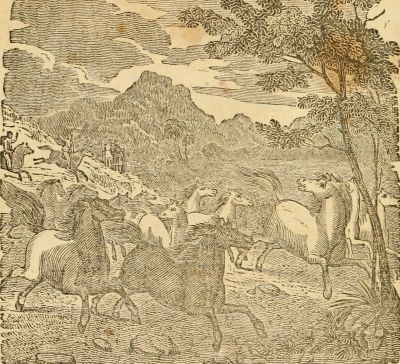
In the first place, I shall strike off from the list of the resources of the country, "the immense herds of buffalo and wild horses." They are often paraded in the many published descriptions of Texas, as a most prominent feature in the bright picture exhibited; and as one of the many inducements to the emigrants to remove thither. But they are no sort of benefit to the settler at all. They generally keep ahead of population, some small herds only are ever seen near the settlements; and there is not inducement enough for the husbandman to leave his farm, and go far into the interior, to catch the wild horse and kill the buffalo, among tribes of hostile Indians; as the prospect of gain would not equal the hardship, risk and expense. The wild horse is an animal hard to catch; and when caught, it is difficult and troublesome to tame him, and render him gentle and kind in harness and under the saddle. It would be as well for the farmer if the fact of their existence were not known; as it is easier to raise the animal in this country of evergreen pasture, than to catch and tame the wild one. There is one point of view, in which a knowledge of the existence of these animals may be of some importance to the emigrant; it is proof positive of the natural luxuriance of the soil, and of the mildness of the climate.
The wild horses are called by the Spaniards, mustangs. I saw some small herds of them prancing at random over the plains. They are quite wild, you can seldom approach very near them. They are of various colors and of rather smaller size than the American horse. The Spaniards are fond of good horses, and are good horsemen. Some of them make a business of catching and breaking the mustangs. This is done by building a fence in the shape of a harrow, with a strong pen at the small end, and driving them into it; or mounting a fleet horse, get as near as they can unperceived, then start after them at full speed, throw a rope with a slip-noose at one end, and the other fastened to the saddle, around the neck, haul out at right angles with their course, and choke them down. When caught, they put the bridle on, take them into a large, soft prairie, mount them at once, flog them with the greenhide, and let them plunge and rear until they become fatigued and subdued. After undergoing a few more operations of this kind, they are deemed "fit for use." They are sold at various prices, from six to twelve dollars; but unless they are caught when young, they never become gentle as other horses.
Texas appears like the State of Illinois. To the southward and westward of Trinity river, it is generally an open prairie country. All the streams have more or less bottom land, covered with a dense forest of timber; and occasionally, a grove of post oak openings will be found on the moist high land. The soil in these bottoms is very rich, but some of them are too wet, or too subject to be overflowed to admit of cultivation.
A strip of land, bordering on the bays and sea coast, and sixty or seventy miles in width, is flat, generally approaching to a dead level, in the spring and fall very wet, and sometimes impassable. Beyond this, comes the high, dry, rolling country, having no swamps except immediately on the borders of the rivers. "The Galveston Bay and Texas Land Company" have a good deal of good land, in pleasant and healthy situations; and much of it, not yet settled; but they have also a good deal of poor land. In their grant, are large tracts of pine woods and post-oak plains; among which, are found some spots of good land, but generally, it is of a weak and sandy soil. The pine woods are not without their use. Their resinous qualities give a salubrity to the air about them, and thereby render a situation in their neighborhood healthy; and the trees themselves furnish an inexhaustible supply of the first rate of timber. On the Sabine and Galveston Bays, there are large prairies of good land, but low and flat; in the region of Nacogdoches, are small prairies, large tracts of wood, good soil of red clay, black marle, sandy land, and all the varieties of soil imaginable. Higher up in the country, there are alternately prairies and woodland, and an excellent soil. This Company's grant lies contiguous to the United States, and except on the bay, is as healthy as any part of the country; but it cannot be called the most pleasant and beautiful portion of Texas.
The prairies are all burnt over twice a year—in midsummer, and about the first of winter. Immediately after the burning, the grass springs up again; so that there is an abundant supply all the year round. No country in the world can be compared to this, in the ease and facility of raising stock. All the herdsman has to do, is to look after them, so they may not stray away, and some portion of the year, yard them to prevent their growing wild. The prairie grass is of a peculiar species, unlike any thing we have at the north; but it is of so nutricious a quality, that it keeps the cattle fat, all the year round. They grow large and handsome. I never saw better looking herds in my life. The horse does equally as well on grass, but if worked hard, requires some grain. Hogs keep in good flesh all the year; and in autumn, when the nuts fall from the trees, grow fat. Horses, cattle and hogs can, therefore, be kept in this country without any more trouble than merely looking after them to prevent their straying away.
And then, there is plenty of game. First in the list, is the deer. I hardly supposed there were as many deer on the continent, as I saw in Texas.—They were continually crossing my path, or were seen in flocks feeding on the prairies. I recollect that from an elevated spot, I counted five flocks of deer in sight at the same time! In some parts of the country, a man may about as certainly kill a deer if he choose, as a northern farmer can kill a sheep from his flock. Their meat is excellent, and their skins valuable.
Deer-hunting is not very systematically practiced here, as it is in some parts of the world. Indeed, they are so plenty, that it does not require much method, or concert of action among a number of individuals to kill them. The deer is a gregarious animal. You never find one alone, unless it be accidentally strayed away from the flock. Sometimes a number of hunters resort to a favorite haunt of the deer, and while a part arouse them with the dogs in their retreat, and cause them to flee, others will remain in ambush, near their usual crossing places at the streams and swamps, and shoot them as they pass. In the night they are decoyed by fire and killed. A hunter fixes a blazing torch in his hat, or has another person to carry one just before him; the deer will stand gazing at the light while he approaches, and by the brilliancy of their eyes and space between them, calculates his distance and takes his deadly aim. He must take especial care, however, that the shadow of a tree or of any thing else does not fall upon the deer; for in that event, he starts and is off in a moment.
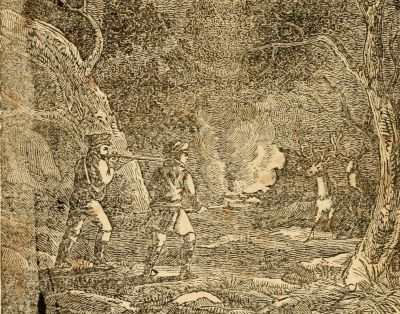
Then there are the bear, Mexican hog, wild geese, rabbits, and a great variety of ducks. The prairie hen is not so plenty here as in Illinois. An emigrant, may, therefore, easily supply himself with meat. All he has to do is "to kill and eat."
Let us now glance at the soil, and see what that will produce. This subject I attended to, somewhat critically. It will produce cotton, sugar cane, Indian corn, rye, barley, oats, rice, buckwheat, peas, beans, sweet potatoes and all common garden vegetables. The cabbage does not form a compact head as it does at the north. Wheat will not grow in this country. The stalk will run up rank, but the ear will not fill with plump kernels. Last December, while I was there, flour sold on the river Brazos, for ten dollars a barrel; and in the interior, it sold for fourteen. Corn grows well, and is quite a sure crop when planted early—about the first of February. I saw a very good crop which had been planted in June.
I found one man, who, with the aid of a boy ten years old, raised and gathered fifteen hundred bushels of corn. Perhaps I am severely taxing the credulity of my readers; but if there be any reliance on human testimony, the fact is as I have stated. And when it is considered that the ground is only ploughed, a small portion, if any, hoed at all, and then it gets ripe early, and he can gather it at his leisure—the statement may not appear at all incredible. Tobacco will grow, but it has too thin a leaf to be valuable.
But it is emphatically a cotton country. It produces a larger quantity to the acre, and of a better quality than any portion of the United States—not excepting the bottom lands on Red River. This is my belief from an examination of the growing crop and gathered cotton. And I found this to be an admitted fact by the most experienced cotton growers.
The following is as perfect a list of the forest trees, shrubs, vines, &c., as I can make—to wit:—Red, black, white, willow, post and live oaks; pine, cedar, cotton-wood, mulberry, hickory, ash, elm, cypress, box-wood, elder, dog-wood, walnut, pecan, moscheto—a species of locust, holly, haws, hackberry, magnolia, chincopin, wild peach, suple jack, cane-brake, palmetto, various kinds of grape vines, creeper, rushes, Spanish-moss, prairie grass, and a great variety of flowers. The live oak, magnolia, holly, pine and cedar are evergreens.
The Spanish-moss, so profusely hanging on all the trees near streams of water, gives them an antique and venerable appearance. It is of a silver grey color; and, if trees may be compared with men, they appear like the long grey bearded sages of the antedeluvian world. When the tree dies, the moss soon withers, and becomes dry. I used to amuse myself by setting fire to the dry moss in the night. It burnt like tinder, and would sometimes throw a grand column of flame a hundred and fifty feet into the air, and brilliantly illuminate the scene, a great distance around.
Of fruit trees, I saw only the peach, the fig and the orange trees; excepting one small cluster of apple trees. I think it is too warm throughout the year for the apple tree to produce much fruit; but the others will become abundant.
As to the health of the country, the fact seems to be, that in all the low country, and on the streams of water, the inhabitants are more or less afflicted with the fever and ague. It much resembles Illinois in this particular, as well as in many others. In other situations, I believe it is as healthy as any portion of the United States.
The climate is fine; the air, generally clear and salubrious. It is neither so hot in the summer, or so cold in the winter, as it is in New-England. The country lies between the Gulf of Mexico and the snow-capped Cordillera mountains, so that it is fanned by a refreshing breeze, which ever way the wind may blow. Sometimes, in winter, the northwest wind sweeps over the plain, strong and keen; and the thin-clad southerner sensibly feels its effects upon his system; and I was informed, instances had been known of their being chilled to death, when obliged to encamp out in the open air without a fire. It is sometimes cold enough to make thin ice; but, generally, it is mild and pleasant all winter. The hottest days of summer, are not as warm and oppressive, as we find them at the North. Individuals originally from Maine and New-Hampshire, said they had found no night so warm, that it was disagreeable to sleep under a woollen blanket.
CHAPTER XX.
The rivers are navigable to some extent, whether great or small. The following are the names of the principal, to wit:—Sabine, Ayish Bayou, Atoyac, Angelina, Neches, Trinity, St. Jacinta, Buffalo Bayou, Navasota, Brazos, Bernard, Canebrake, Colorado, Navedad, La Baca, Guadalupe, San Antonio, Aransaso, Neuces and Rio Grande or Rio del Norte. The streams are all muddy and unpleasant, until you reach the Colorado; this, and those to the south are, generally, clear and beautiful. About ten miles from the mouth of the Colorado, a raft two miles in extent, obstructs the navigation; when that is removed, boats may go some distance into the country. The Brazos is navigable at high water, to the falls, about two hundred and fifty miles from its mouth. A steamboat is now running upon it, as high up as St. Felipe, over a hundred miles.
The Sabine, Neches and Trinity are respectively three hundred and fifty, three hundred, and four hundred and ten miles in length, and are navigable some distance into the country for a considerable portion of the year. The San Bernard is navigable sixty miles. It has about four feet of water on the bar at its mouth. The Colorado rises in the high prairies near the mountains, pursues quite a direct course six hundred miles and falls into Metagorda Bay. Above the raft, which is situated ten or twelve miles above its mouth, it is navigable three hundred miles. It has as strong a current as that of the Mississippi.
But the Rio del Norte is much the largest and longest river in this region. It rises high up among the mountains, and is estimated to be seventeen hundred miles in length. For two thirds of its course it runs nearly south; it then changes to the southeast, and empties into the Gulf of Mexico, near the southern boundary of Texas. It has been ascended by a steamboat two hundred miles to Loredo; and it is stated by those acquainted with the stream, that it is navigable five hundred miles further.
Texas has a seacoast of three hundred and fifty miles; and in a commercial point of view is favorably situated. Its many navigable streams afford great facilities for transporting the rich products of its luxuriant soil to the United States and the rest of the world. It will shortly be settled, its rich lands will become valuable, and it will soon be a great and powerful state.
Mill seats are not plenty. Although the streams run with a lively current, yet there are not many falls suitable for mills; especially in the lower part of the territory. On the sides of the streams, are occasionally found ledges of limestone; but none of any kind are seen scattered over the country.—The prairies are free from rocks, brambles, bushes, and every thing except grass. They look like a finely cultivated old field, well set in grass; sometimes flat, sometimes rolling, but invariably having a surface entirely smooth and unbroken. A carriage can run any where over them. Clay is found all over the country, of an excellent quality for brick. In some places, coal and iron ore are said to have been discovered.
Such are the situation and resources of the country. Let us now look, for a moment, at the inhabitants, and see how they are improved. The Spaniards are not an agricultural people. They are more fond of raising stock, than cultivating the land. They are also a very social people, and fond of society. They are seldom found on farms alone, and at a distance from neighbors. They formed some small villages in Texas, and left the remainder of the country entirely unsettled. Some ten years ago, the system of grants commenced; allowing an individual, under certain regulations, to introduce and colonize foreigners. There are now thirteen of these Grants, including a large portion of Texas, to wit: Zavala, Burnet and Vehlein—now formed into the Galveston Bay company—Austin's, Milam's, Robertson's, Cameron's, Dewitt's, De Leon's, Felisola's, McMullen's and McGloin's, Powers' and Beal's. On all these Grants, more or less settlements have been made, and therefore, the population is scattered over an extent of country out of all proportion to their numbers. The large tract granted to each individual, tends to the same result. In riding through regions called settled, a person may not find a house in thirty or forty miles; but generally from ten to twenty. I believe there are from forty to fifty thousand inhabitants in Texas; and a large proportion of them are Americans. A person may travel all day; and day after day, and find Americans only. He can hardly make himself believe that he is not still in the United States.
The exports of Texas are cotton, live-stock and peltries. The cotton and peltries are sent either by Natchitoches, or by shipping through the Gulf of Mexico, to New-Orleans. The live-stock—cattle, horses and mules, are driven by land across the country to Natchez or New-Orleans. The cost of driving is trifling. Plenty of grass is found all the way for the stock; and the drivers carry their provisions, shoot game, &c. and camp down near wood and water by the side of a fire, and cook their meals.
In this manner, a fellow traveller and myself camped out two or three nights. It was quite a novelty to me to sleep in the open air; but the people here think nothing of it. The wolves made rather too much noise, for me to sleep quietly. One night, they awaked me out of a sound sleep, by their discordant yells; I jumped up, dashed a club or two at them, and off they went over the prairies. Our provisions were what they sought, I presume, and not us.
The inhabitants are, many of them, what our northern people would call rather indolent. Occasionally, I found a good farm, large plantation and fine herds of cattle, and all the comforts of life within their dwellings; but more generally, the traveller only finds the log house, built in an open, rude manner, with only one room, where he and the family lodge together; and perhaps only corn-bread, meat and sweet potatoes to eat. I called at some places where they had twenty or thirty cows, and could get neither butter, cheese, or milk. They let the calves run with the cows, and seldom milk them at all. I did not find butter at half of the places where I called; and obtained cheese only once in Texas. At only three places I found wheat bread.
Although the climate is suitable to the production of Indian corn, yet it is not cultivated to any extent. The reason is, stock is raised with less trouble, and cotton is thought to be a more profitable crop. There is hardly enough corn raised for the consumption of the inhabitants; it, therefore, bears a high price. At St. Felipe, it was a dollar a bushel; and at Velasco on the mouth of the Brazos river, I saw a bushel of shelled corn sold for two dollars!
Thus it is; man seems disinclined to "till the ground," and by "the sweat of his face," to obtain his bread. It often happens, where the earth produces in abundance with little labor, that little is indifferently performed, so that all the comforts and conveniences of life are less enjoyed, than in more sterile soils, and unpropitious climes. Man will "'mid flowing vineyards die of thirst." Where nature has done almost all, and scattered her favors without stint, man will not stretch forth his hand, and gather her rich bounties. It is not universally so. There are many exceptions to this in Texas. In many instances, the comforts of life are enjoyed there to perfection. Man may not be censured, for not performing severe bodily labor, if he can well provide for himself and those dependent upon him, without it; but life could not have been given, to be spent in listless idleness. A vast field of usefulness is open to the active man; and he may do much good in his day and generation, other than toil for gain.
But another inducement is held out to the emigrant to settle in Texas, besides the beauty of the country and productiveness of the soil. It is the cheapness of the land. This is no small consideration. A man with a family obtains a Spanish league of land, amounting to four thousand four hundred and twenty-eight English acres, by paying the expense of surveying it, office fees, &c. These expenses amount to one hundred and eleven dollars, with the addition of thirty dollars to the government. So that a man with a family has four thousand four hundred and twenty-eight acres of land for the small sum of one hundred and forty-one dollars. He must make application to an officer, called an empressario, and obtain his consent; which is given in the form of a certificate, stating the name of the family and the quantity of land allowed. This certificate is presented to another officer, called a commissioner, who orders a survey; and when completed, makes a deed from the government to the emigrant. The only condition is, that the land shall be settled upon, within a limited time. The emigrant may make his own selection out of any lands, not previously granted. A single man obtains one quarter of that quantity, with the privilege of having three quarters more, when he is married. And provision is made, that a foreigner, marrying a Mexican woman, may have a league and one third. These terms are, certainly, very liberal. A man here obtains good land, at a cheaper rate, than in any other part of the world.
But the government have lately adopted another method of disposing of their land. A regular land law has been enacted, and various offices have been established for the sale of all the vacant land in the province. A person desirous of purchasing public land, goes to the land office in the district where the land is situated, files a petition for a sale, and obtains an order for a survey. This land is laid off into what is called labors of one hundred and seventy-seven acres each, and an individual may purchase as many labors as he pleases, up to two hundred and seventy-five, which is about equal to fifty thousand English acres. The minimum price is fixed at ten dollars per labor, the purchaser paying the expense of surveying in addition. One third of the purchase money is payable at the time of sale; the remainder in two equal annual instalments; and the new settlers are exempt from the payment of taxes for the term of ten years.
But Texas has some evils, which will be deemed greater or less, according to the particular section of the country the emigrant may happen to come from. But still, they ought in fairness to be stated, that all may judge for themselves. And in the first place there are three kinds of venomous snakes—the great rattlesnake, the moccason snake, and the prairie rattlesnake. The large rattlesnake is not very plenty, and is seldom seen far out in the open prairie. A gentleman who had lived in the country ten years told me he had killed only two in the time. The moccason snake, deemed as poisonous as the rattlesnake, seems to be more plenty; but they are not found except in or near wet, marshy land. A gentleman told me, he had a small marsh near his house which seemed to be a haunt for them, as occasionally he found some near it, and in his door yard. He set half a dozen of his servants to cut down the weeds, and dig a ditch to drain off the water; and in one day they killed forty-three moccason snakes; and he pleasantly added, it was not a very good snake day neither. Perhaps this will be set down as another "snake story;" but my authority is Mr. Elisha Roberts, living on the main road, five miles north of St. Augustine; a very respectable man as I was informed. The prairie rattlesnake is a small one, about a foot in length, similar to that of Illinois. I saw only one in all my wanderings through the country. There are other snakes, not venomous, such as the coach-whip snake, the large black snake, which is here called the "chicken snake," because it sometimes robs hen's nests; the glass snake, which if you strike it, will break in a number of places, and some others. Then, there is the tarantula, a large spider; and the stinging lizard, a species of the scorpion, of a reddish color, and about two inches long. The bite of the tarantula and stinging lizard is, in pain and effect, similar to the sting of a bee. There is a weed here, growing all over the country, which is a certain cure for the bite of all these venomous reptiles.
The alligator is found in the rivers of Texas. I saw three, one large one; the other two, small ones. They sometimes catch hogs, as they go down to the water to drink. They will attack a man in the water. A man was seized by one on Little river, while I was in the country, who was swimming across; but he was beaten off by a person near him, on a raft.
Of the animals, there are many—the panther, wolf, wildcat, tiger cat, bear, Mexican hog, antelope, &c. The wolves are the most numerous, and are quite bold and mischievous. I frequently saw them in the day time, and often heard their discordant howl in the night.
One day, as I was riding along alone in the open woods, a panther came out of a small thicket, into the path before me! I knew that retreat would be dangerous; and, therefore, I boldly sung out and pushed forward towards him. He was not disposed to give battle, but leaped off at once into the woods. I was a good deal startled at this sudden appearance of such a powerful, uncaged beast of the forest; but as he appeared to be the most frightened of the two, I ought to be content. The panther is an animal of the size and color of a full grown lioness, but too cowardly to attack his prey in the open field. Like the Indian, he lies in ambush, or sits perched on the branch of a tree, and seizes his victim unawares. Even a small dog has been known to chase him into his favorite retreat on a tree. The bears, generally, take to the dense forest of trees and cane-brake. They catch the full grown hogs, and the wolves take the pigs.
Flies, of various kinds, are found here; and are more troublesome to animals in the warm summer months, than at the north. I saw large sores, caused by them, on cattle, dogs and hogs. An application of mercury is sometimes found necessary to cure them. There is also a wood tick, resembling that on sheep, which fastens itself on animals, but does not appear to do any essential injury.
But last, although not least, in the list of evils, is the ever active moscheto. In the flat country, bordering on the sea and bays, they are indeed dreadful to a northern man. When I was at the mouth of the Brazos, towards the last of December, whether on the beach, in the house, on board the vessel, day and night without cessation, the moschetoes were excessively annoying. Give me a general assortment of alligators, snakes and lizards, rather than subject me to the eternal buzz, and stinging bite of the ever busy moscheto. Other animals may be successfully combatted and subdued; but to fight the moscheto is like "beating the air;" give a blow in front and he is in the rear; brush the rear, and he is in front—and so on all day long. And when you have done, you have only excessively fatigued and perplexed yourself, and left him the uninjured master of the field. The only chance to get rid of such a keen tormentor as this, is to hang yourself, or run away. In the high rolling country, there are less flies and no moschetoes.
There are few remnants of tribes of Indians in the settled region of Texas. They are generally said to be harmless and inoffensive; doing nothing worse than stealing a hog or so, in a neighborly way; so that they may not be entirely forgotten. A woman where I stopped one night, told me that about twenty Indians encamped at the spring near her house; came to the house for meal, and she gave them all she could spare. In the morning, after they were gone, she found they had robbed the yard of all the melons, and taken the fattest shoat she had.
While I was in the country a man was shot at and wounded by an Indian, near Jones' ferry on the Colorado river. As he was riding along alone over the prairie, he saw a number of Indians by the side of a wood, who beckoned for him to approach. When he had come quite near, happening to cast his eyes towards the wood, he saw an Indian, partly concealed behind a tree, with a gun drawn up in the act of firing. He had only time to throw himself back on his horse, and the ball made a slight flesh wound on his breast. He wheeled, put spurs to his horse and escaped. Whether these were Indians belonging to the settled or unsettled regions of Texas, could not be ascertained.
Between the settlements and the Rocky Mountains, are large tribes of Indians; and detached parties from them, sometimes come down to the border plantations, and steal a few horses. They consider the Spaniards lawful game; but do not care about fighting the Americans. They say, the Americans are a brave people and fight most desperately; and from them, they obtain their chief supplies.
Perhaps my readers may think this rather a formidable array of animals and reptiles. It may appear more so on paper, and at a distance, than in the region where they are found. People of Mississippi, Alabama and Florida, would find themselves at home among them; but to a northern man they might be found somewhat disagreeable at first.—They would, however, soon become so much accustomed to them, that in a short time they would hardly regard them at all. The inhabitants here, from whatever quarter they may have come, do not think they form any serious objection to settling in the country.
While I remained in Texas, I found no serious trouble from the animals, reptiles or insects, except that general enemy to repose, the moscheto, and that only in the lowlands. On the open prairies, there are but few noxious animals, except the wolves. This is owing a good deal, undoubtedly, to the fire running over them twice a year. As the country becomes more settled, they will be less numerous; and some of them will become entirely extinct.
The water, generally, is very good for a southern country. I found many fine springs of pure soft water in various parts of Texas; and in the rolling prairies, good water is obtained by digging. The only objection to it is in its temperature. To me, it was universally too warm to be agreeable. "A cup of cold water" is nowhere to be found in the territory; and to a northern man, in a warm day, it is so refreshing, reviving, invigorating—so readily slakes the thirst, and cools the body, it is almost indispensable to his comfort and enjoyment. Warm water is the common drink of the inhabitants. In the towns, I found the various kinds of spirits and wine; but in the country, I found no spirits, (except very seldom, whiskey) wine, beer, or cider; but only water—warm water. It must be admitted, that the people are very temperate, if not to drink the ardent be a sure indication of temperance.
CHAPTER XXI.
There are no large towns in Texas. Bexar, or as it is commonly called, St. Antonio, is the capital, and contains about thirty-five hundred inhabitants—the other villages are small, varying from one hundred to one thousand souls. St. Antonio, like all the Spanish towns, is composed of houses built of logs and mud, and makes a squalid appearance. It is situated about twenty miles east of San Antonio river. The principal towns are, Nacogdoches, St. Augustine; and on Galveston Bay, Harrisburg and Lynchburg: on the Brazos—Velasco, Brazoria, Columbia, St. Felipe, and a new town in Robinson's colony at the falls: Cole's Settlement, fifteen miles west of the Brazos: on the Colorado—Metagorda, Montezuma, Electra, Bastrap, or Mina: on the Gaudalupe—Gonsales: on the San Antonio—Goliad, (formerly Bahia,) and Bexar: in Powell's Grant—St. Patrick: on the Rio Grande, or Rio del Norte—Refugio, Metamoras, Reinosa, Camargo, Mier, Revilla, Laredo, Presidio and the city of Doloros.
A new town is laid out at the falls on the Brazos river in Robinson's colony, about two hundred and fifty miles from its mouth. This is the place where the land office is kept for this colony, and will become quite a village. But the country is not now settled enough to make or support large towns. It must be the work of time. Although men may lay out a town, and commence building it, yet it cannot prematurely be forced into existence. It must have a back settlement to support it. The merchant and mechanic cannot sell, unless there are some inhabitants to buy.
The Spaniards, more than one hundred and fifty years ago, built some small towns in Texas, the principal of which are St. Antonio, Nacogdoches and La Bahia. These became something of villages; but for twenty years their population has continually diminished; and the country at large does not contain half the Spanish inhabitants that it did at that time. They, like the Indians, dwindle away, or flee before the settlements of the Americans.
The Mexican government had three garrisons of soldiers stationed in Texas—one at Nacogdoches, one on Galveston Bay, and one at Velasco, at the mouth of the Brazos. Some of the commanders of these garrisons, attempted to exercise despotic powers, in seizing Americans who had become obnoxious to them, and putting them in prison. About two years ago, their conduct became so oppressive, that the citizens rose en masse, killed some of the soldiers, and took the remainder prisoners. The Mexican government then recalled all the officers and soldiers, and there has not been a Mexican garrison in Texas since.
The inhabitants of the country pay no taxes at all. It is said that the lands are exempt from taxation for ten years to come. All articles imported for the private use of the emigrant, are free of duty; and in fact, a great portion of the merchandize pays none. When I left the Brazos river, there was no custom house officer upon it; and a number of vessel loads of goods were landed, without being required to pay any duty.
Almost all kinds of goods afford a good profit and a ready sale in Texas; especially domestic cottons, boots, shoes, hats and ready made clothing. Coffee is used in large quantities, but I did not find hardly a cup of tea in the whole country. It is not a good place for mechanics. Manufactured articles of all kinds are brought from the north, and sold cheaper than they can be made here; and the country is too thinly settled, and the raw material is too scarce, to give much employment to artisans of what is called custom work, such as shoemakers, tailors, &c. Blacksmiths, however, are an exception to this. They are indispensable, although there are now but few of them. The price charged for shoeing a horse is from three to four dollars.
Texas is connected with Cohahuila, and both form one province of the Mexican Confederacy. But lately, they have been made into separate judicial districts; each having its own courts and officers. In Texas their proceedings in court and the records, are in the English language; but land titles are still written in the Spanish. The laws are liberal; they guarantee the freedom of religious opinion and a trial by jury. Courts are held in St. Felipe, Nacogdoches, St. Augustine, Bastrap, &c. The government is elective and republican. I attended an election of sheriff and other county officers. They vote viva voce, as the practice is in many of our southern States. To be an inhabitant of the country, is all the qualification necessary to become a voter.