IV. GENERAL DEVELOPMENT OF GERMAN LAW DURING THE NAZI PERIOD
Reading edition
A. Introduction
Throughout the trial and in the judgment of the Tribunal, references were frequently made to various laws and decrees issued during Hitler’s Third Reich. Some of these laws and decrees were introduced by the prosecution, some by the defense, and some by both the prosecution and the defense. Most of these laws and decrees are relevant in connection with more than one of the principal issues of the case. Hence, with respect to laws and decrees selected for publication herein, it has often been difficult to decide where a particular law or decree should appear within the sections of this volume. To reduce the complexity of this matter, more than 30 laws and decrees have been reproduced together in the chronological order of their promulgation. (Section B, “Selected Laws and Decrees, 1933–1944.”) A number of other laws and decrees appear in the later sections of the volume. In a further effort to reduce the difficulties inherent in this situation, cross-references by way of footnotes have often been made to laws or decrees mentioned in the documents and in the testimony.
Since the main issues of the case involved the organization and administration of justice in the Third Reich, it was also thought appropriate to include early in the volume some general materials on the organization of the Reich Ministry of Justice and the German judicial system (sec. C). First appears a brief excerpt from the testimony of the defendant Mettgenberg concerning the position and responsibility of leading officials in the Reich Ministry of Justice (sec. C1). This is followed by parts of a “Basic Information” of justice (sec. C2). This “Basic Information” was submitted by the prosecution at the beginning of the trial not as evidence, but rather as an aid to the understanding of the evidence later submitted. The parts reproduced herein include a “Summary of the organization of the administration of justice in Germany” and two charts purporting to show graphically the structure of the regular and extraordinary courts and the main positions held by the defendants in the over-all administration of justice. The next following materials are all contemporaneous documents, principally laws and decrees, concerning the establishment and functioning of the Special Courts (sec. C3), the People’s Court (sec. C4), the hereditary health courts (sec. C5), and civilian courts martial (sec. C6).
These materials on the general structure and organization of the administration of justice are followed by extracts from the testimony of the defense expert witness, Professor Jahrreiss, whose testimony dealt comprehensively with the development of German law and justice from a period far antedating the Nazi regime (sec. D). This section concludes with extracts from the testimony of the defendant Schlegelberger, under secretary (Staatssekretaer) in the Reich Ministry of Justice (sec. E). In addition to giving a leading defense point of view concerning general legal developments during the Hitler regime, this testimony introduces a number of the leading figures who played a role in the administration of justice and whose names frequently arise in the later appearing documents and testimony.
B. Selected Laws and Decrees, 1933–1944
PARTIAL TRANSLATION OF DOCUMENT NG-715
PROSECUTION EXHIBIT 112[82]
[Also Schlegelberger Document 91
Schlegelberger Defense Exhibit 84][83]
DECREE, 28 FEBRUARY 1933,
BY REICH PRESIDENT VON HINDENBURG, COSIGNED BY REICH CHANCELLOR HITLER AND REICH MINISTERS FRICK AND GUERTNER, SUSPENDING CONSTITUTIONAL RIGHTS AND INSTITUTING OTHER MEASURES[84]
1933 REICHSGESETZBLATT, PART 1, PAGE 83
Decree of the Reich President for the Protection of People and State of 28 February 1933.
Pursuant to article 48, paragraph 2 of the German constitution, the following is decreed as a defensive measure against Communist acts of violence endangering the State:
Article 1
Articles 114, 115, 117, 118, 123, 124, and 153 of the constitution of the German Reich are suspended until further notice.[85] Thus, restrictions on personal liberty, on the right of free expression of opinion, including freedom of the press, on the right of assembly and the right of association and interferences with the secrecy of postal, telegraphic, and telephonic communications, and warrants for house searches, orders for confiscations as well as restrictions on property, are also permissible beyond the legal limits otherwise prescribed.
[All footnote quotations from the Weimar constitution used in this volume have been taken from the translation in Select Constitutions of the World, edited by B. Shiva Rao (Mylapore, Madras, The Madras Law Journal Press, 1934), page 208 and following pages.]
Article 2
If in a state [Land] the measures necessary for the restoration of public security and order are not taken, the Reich government may temporarily take over the powers of the highest State authority.
Article 3
The authorities of the states [Laender] and local communities have to comply, within their competency, with the orders of the Reich government issued on the basis of article 2.
Article 4
Whoever disobeys the orders issued by the supreme State authorities or by the authorities subordinate to them for the implementation of this decree, or the orders issued by the Reich government in pursuance of article 2, or whoever solicits or incites others to disobey such orders, will be punished with imprisonment of not less than 1 month or a fine from 150 up to 15,000 Reichsmarks, unless other regulations make his act liable to a more severe punishment.
Whoever, by a violation of paragraph 1, induces a common danger for human life, will be punished with hard labor, or, in case of extenuating circumstances, with imprisonment of not less than 6 months, and, if the violation causes the death of a person, with death, or, in case of extenuating circumstances, with penal servitude of no less than 2 years. In addition, his property may be confiscated.
Whoever solicits or incites to commit a violation under the qualifications of paragraph 2, will be punished with hard labor or, in case of extenuating circumstances, with imprisonment of not less than 3 months.
Article 5
The crimes, which under the penal code are punishable with hard labor for life, are to be punished with death; i.e., in articles 81 (high treason), 229 (poisoning), 307 (arson), 311 (use of explosives), 312 ([intentional] flooding), 315 paragraph 2 (damaging of railroad installations), and 324 (poisoning causing public danger).
Insofar as a more severe Punishment has not been previously provided for, the following are punishable with death or with hard labor for life or with hard labor not to exceed 15 years—
1. Whoever undertakes to kill the Reich president or a member or a commissioner of the Reich government or of a state government, or solicits such a killing, or volunteers to commit it, or accepts such an offer, or conspires with another for such a killing.
2. Whoever under article 115(2) of the penal code (serious rioting) or of article 125(2) of the penal code (serious disturbance of the peace) commits the act with arms or cooperates consciously and intentionally with an armed person.
3. Anyone who deprives a person of his liberty under article 239 of the penal code with the intention of making use of the person deprived of his liberty as a hostage in the political struggle.
Article 6
This decree comes into force on the day of its promulgation.
Berlin, 28 February 1933
The Reich President
von Hindenburg
The Reich Chancellor
Adolf Hitler
The Reich Minister of the Interior
Frick
The Reich Minister of Justice
Dr. Guertner
PARTIAL TRANSLATION OF DOCUMENT NG-715
PROSECUTION EXHIBIT 112
[Also Klemm Document 1.
Klemm Defense Exhibit 1.]
THE “ENABLING ACT”[86]
1933 REICHSGESETZBLATT, PART 1, PAGE 141
Law for the Solution of the Emergency of People and Reich of 24 March 1933
The Reichstag has decreed the following law, which is hereby promulgated in agreement with the Reich Council [Reichsrat], after it has been duly established that the prerequisites of legislation changing the constitution have been fulfilled.
Article 1
Laws of the Reich can be decreed, apart from the procedure provided by the constitution of the Reich, also by the government of the Reich. This also applies to the laws mentioned in articles 85, paragraphs 2, and 87 of the constitution of the Reich.
Article 2
The laws decreed by the government of the Reich may deviate from the constitution of the Reich as far as they do not concern the institution of the Reichstag and the Reich Council [Reichsrat] as such. The rights of the Reich President remain untouched.
Article 3
The laws decreed by the government of the Reich are certified by the Reich Chancellor and promulgated in the Reichsgesetzblatt. Unless they dispose otherwise, they will come into force on the day following the promulgation. Articles 68 through 77 of the constitution of the Reich do not apply to laws decreed by the government of the Reich.
Article 4
Treaties of the Reich with foreign countries concerning subjects under Reich legislation do not require the approval of the authorities taking part in the legislation. The government of the Reich issues the ordinances which are necessary to carry into effect these treaties.
Article 5
This law comes into force on the day of its promulgation. It will become invalid on 1 April 1937; it will further become invalid if the present government of the Reich will be replaced by another one.
Berlin, 24 March 1933.
The Reich President
von Hindenburg
The Reich Chancellor
Adolf Hitler
The Reich Minister of the Interior
Frick
The Reich Foreign Minister
Baron von Neurath
The Reich Finance Minister
Count Schwerin von Krosigk
PARTIAL TRANSLATION OF DOCUMENT NG-715
PROSECUTION EXHIBIT 112
LAW, 7 APRIL 1933, CONCERNING ADMISSION TO THE BAR
1933 REICHSGESETZBLATT, PART 1, PAGE 188
The Reich government has enacted the following law which is promulgated herewith:
Article 1
The admission [to the bar] of attorneys who, according to the Law for the Restoration of the Professional Civil Service of 7 April 1933 (Reichsgesetzblatt, Part 1, page 175), are of non-Aryan descent, may be revoked before 30 September 1933.
The provision of paragraph 1 does not apply to attorneys who were already admitted on 1 August 1914 or who, during World War I, fought for the German Reich or her allies, or whose fathers or sons were killed in action in World War I.
Article 2
The admission to the bar can be refused to persons, who, according to the Law for the Restoration of the Professional Civil Service of 7 April 1933 (Reichsgesetzblatt, Part 1, page 175) are of non-Aryan descent, even though the reasons for this measure provided by the Attorneys’ Ordinance do not apply. The same applies to the admission, at another court, of attorneys designated in article 1, paragraph 2.
Article 3
Persons who have undertaken Communist activities are excluded from admission to the bar. Admissions already granted will be revoked.
Article 4
The administration of justice can suspend the admission of an attorney until it has been decided whether the right to revoke his admission according to article 1, paragraph 1, or article 3 will be used or not. The provisions of article 91b, paragraphs 2 through 4 of the Attorneys’ Ordinance (1933 Reichsgesetzblatt, Part 1, page 120) apply in case of a suspension.
Attorneys of the kind described in article 2, paragraph 2, can only be suspended in those cases where article 3 is applicable.
*******
Berlin, 7 April 1933.
The Reich Chancellor
Adolf Hitler
The Reich Minister of Justice
Dr. Guertner
TRANSLATION OF DOCUMENT NG-1070
PROSECUTION EXHIBIT 439
LAW OF 1 DECEMBER 1933 CONCERNING SPECIAL NAZI PARTY AND STORM TROOPS’ (SA) JURISDICTION OVER MEMBERS OF THE NAZI PARTY, THE SA, AND THEIR SUBORDINATE ORGANIZATIONS[87]
Law for the Safeguarding of Unity of Party and State decreed on 1 December 1933
The Reich government has passed the following law, which herewith is promulgated.
Article 1
(1) Since the victory of the National Socialist revolution the National Socialist German Workers’ Party is the bearer of the German State ideology and merged with the State inseparably.
(2) It is a corporate body under public law. Its statutes are determined by the Fuehrer.
Article 2
In order to guarantee closest cooperation between Party and SA offices on the one hand and public authorities on the other hand, the deputy of the Fuehrer [Hess] and the chief of staff of the SA [Roehm] become members of the Reich government.
Article 3
(1) Because they are the leading and moving power of the National Socialist State, the members of the National Socialist German Workers’ Party and of the SA (including their subordinated organizations) have an enhanced duty toward the Fuehrer, the Nation, and the State.
(2) For violation of these duties they come under a special Party and SA jurisdiction.
(3) The Fuehrer can rule that these regulations be extended to members of other organizations.
Article 4
A violation of duty is represented by any action or omission, which affects or endangers the existence, the organization, the activities, or the reputation of the National Socialist German Workers’ Party; for members of the SA (including all organizations subordinated to it) especially every offense against discipline and order.
Article 5
In addition to the usual disciplinary penalties, terms of imprisonment and arrest can be imposed.
Article 6
Within the limits of their competence, the public authorities must render official and judicial assistance to Party and SA—offices which have been entrusted with the execution of the Party and SA jurisdiction.
Article 7
The law, concerning the right of imposing disciplinary penalties on members of the SA and SS, decreed on 28 April 1933 (Reich Law Gazette I, page 230) is repealed.
Article 8
In his capacity as leader of the National Socialist German Workers’ Party and supreme commander of the SA, the Reich Chancellor issues the necessary regulations for the carrying-out and completion of this law, especially those regarding the structure and the procedure of Party and SA jurisdiction. He determines the date on which the regulations pertaining to this jurisdiction will take effect.
Berlin, 1 December 1933
The Reich Chancellor
Adolf Hitler
The Reich Minister of the Interior
Frick
PARTIAL TRANSLATION OF DOCUMENT NG-715
PROSECUTION EXHIBIT 112
EXTRACTS FROM THE FIRST LAW FOR THE TRANSFER OF THE ADMINISTRATION OF JUSTICE TO THE REICH, 16 FEBRUARY 1934[88]
1934 REICHSGESETZBLATT, PART 1, PAGE 91
The Reich government has enacted the following law, which is promulgated herewith:
Article 1
All courts shall pronounce sentence in the name of the German people.
Article 2
The Reich President exercises the right to quash pending proceedings, apart from his clemency prerogative.
Amnesties can only be issued by Reich law.
Article 3
Whoever has obtained the qualification to act as a judge, must be admitted to the bar in each State in pursuance of the existing Reich regulations.
*******
Article 5
The Reich Minister of Justice is authorized to issue all regulations which the transfer of the administration of justice to the Reich requires.
Berlin, 16 February 1934
The Reich Chancellor
Adolf Hitler
The Reich Minister of Justice, at the same time for the Reich Minister of Food and Agriculture
Dr. Guertner
The Reich Minister of the Interior
Frick
The Reich Minister of Finance
Count Schwerin von Krosigk
The Reich Minister of Economics
Dr. Schmitt
The Reich Minister of Labor
Franz Seldte
The Reich Minister of War
von Blomberg
PARTIAL TRANSLATION OF DOCUMENT NG-715
PROSECUTION EXHIBIT 112
EXTRACTS FROM THE LAW, 24 APRIL 1934, AMENDING PROVISIONS OF CRIMINAL LAW AND CRIMINAL PROCEDURE
1934 REICHSGESETZBLATT, PART 1, PAGE 341
The Reich government has enacted the following law, which is promulgated herewith:
Part I
In the second part of the criminal code, the first section (articles 80 to 93) is amended as follows):
Section 1
High treason[89] [Hochverrat].
Article 80
Whoever undertakes to incorporate, by violence or by threat of violence, the German territory [Reichsgebiet] in its entirety or in part into a foreign state, or to detach from the Reich any territory belonging to the Reich, will be punished by death.
*******
Article 81
Whoever undertakes to deprive the Reich President, the Reich Chancellor or any other member of the Reich government of his constitutional power, or to force or prevent such a person by violence or threat of violence or perpetration of a crime or offense, from exercising his constitutional rights altogether or in a certain sense, will be punished by death or hard labor for life or hard labor of not less than 5 years.
Article 82
Whoever conspires with another person in a treasonable act (articles 80, 81) is subject to punishment by death, hard labor for life or hard labor of not less than 5 years.
Whoever contacts a foreign power for the purpose of the preparation of a treasonable act or misuses his official authority or recruits men or trains them in the use of arms will be liable to the same penalty. If the perpetrator contacts a foreign government in a written declaration, the crime is considered accomplished once this declaration has been sent off.
*******
Article 83
Whoever publicly solicits, and incites to, an undertaking of high treason shall be punished by hard labor up to 10 years.
Whoever prepares an undertaking in any other way shall be liable to the same penalty.
The death penalty or hard labor for life or hard labor for not less than 2 years will be inflicted—
1. If the act aimed at establishing or maintaining an organized structure for the preparation of high treason; or
2. If the act was directed toward making the armed forces or police unfit for the execution of their duty to protect the stability of the German Reich from internal or external attack; or
3. If the act was directed toward influencing the masses by composing or distributing writings, recordings and pictures, or by the installation of radio, telegraph, or telephone; or
4. If the act was committed abroad or in such a manner that the perpetrator undertook to import writings, recordings or pictures from abroad for the purpose of distribution within the country.
*******
Article 87
Undertakings, within the meaning of the criminal code, embrace both completion and attempt.
Section 1 a
Article 88
Treason [Landesverrat]
State secrets in the meaning of the provisions of this section are documents, drawings, other objects, facts or reports thereof, which the welfare of the Reich, especially in the interest of national defense, requires to be held secret from a foreign government.
Whoever passes on or publicizes such a state secret to another person, especially to a foreign government or to a person acting for a foreign government, with the intent of endangering the welfare of the Reich, commits an act of treason in the meaning of the provisions of the section.
Article 89
Whoever undertakes to give away a state secret will be punished by death.
If the perpetrator is a foreigner he may be sentenced to hard labor for life.
If the act could not have constituted a danger for the welfare of the Reich, the verdict may be hard labor for life or for not less than 5 years.
Article 90
Whoever undertakes to procure a state secret in order to give it away will be punished by death or hard labor for life.
If the crime could not have brought about a danger for the welfare of the Reich the verdict may be a term of hard labor.
*******
Article 91
Whoever establishes contact with a foreign government or a person acting for a foreign government with the intention of causing a war or forcible measures against the Reich or other serious disadvantages to the Reich, will be punished by death.
Whoever establishes contact of the kind described in paragraph 1 with the intention of causing serious disadvantages for a national of the Reich, will be punished with hard labor for life or for not less than 5 years.
Article 82, paragraph 2, second sentence shall apply.
Article 91 a
A German who, during a war against the Reich, serves in the armed forces of the enemy or carries arms against the Reich or its allies shall be punished by death or hard labor for life or not less than 5 years.
Article 91 b
Whoever, during a war against the Reich, or with regard to an impending war, undertakes within the Reich, or being a German abroad, to either aid and abet the enemy power, or to cause a detriment to the armed forces of the Reich or its allies shall be punished by death or by hard labor for life.
*******
Article 92
Whoever conspires with another in a crime of treason under articles 89 through 90a, or 90f through 91b shall be punished by hard labor.
Whoever solicits or volunteers to commit a crime as described in paragraph 1, or accepts such a solicitation or offer will be liable to the same punishment. If the perpetrator declares his solicitation, offer, or acceptance in writing, the crime is accomplished when the declaration is sent off.
*******
Part III. People’s Court[90]
*******
Berlin, 24 April 1934
The Reich Chancellor
Adolph Hitler
The Reich Minister of Justice at the same time for the Reich Minister of the Interior
Dr. Guertner
The Reich Defense Minister
von Blomberg
PARTIAL TRANSLATION OF DOCUMENT NG-715
PROSECUTION EXHIBIT 112
EXTRACTS FROM THE SECOND LAW CONCERNING THE TRANSFER OF THE ADMINISTRATION OF JUSTICE TO THE REICH, 5 DECEMBER 1934[91]
1934 REICHSGESETZBLATT, PART 1, PAGE 1214
The Reich government has enacted the following law, which is promulgated herewith:
In the National-Socialist State, the administration of justice is uniform. It is under the jurisdiction of the Reich and requires uniform administration by the Reich. After the Ministries of Justice of the Reich and of Prussia have been combined, the Reich takes over the immediate direction of the administration of justice in the other states [Laender] in accordance with the following provisions:
Article 1
The competencies of the Supreme Justice Authorities of the States [Laender] are transferred to the Reich Minister of Justice; he is authorized to delegate them to agencies subordinate to him.
*******
Berlin, 5 December 1934
The Fuehrer and Reich Chancellor
Adolf Hitler
The Reich Minister of Justice
Dr. Guertner
The Reich Minister of the Interior
Frick
TRANSLATION OF 1393-PS
PROSECUTION EXHIBIT 508
LAW, 20 DECEMBER 1934, ON INSIDIOUS ACTS AGAINST STATE AND PARTY FOR THE PROTECTION OF PARTY UNIFORMS HEIMTUECKEGESETZ
1934 REICHSGESETZBLATT, PART 1, PAGE 1269
The Reich government has enacted the following law, which is promulgated herewith:
Section I
Article 1
1. Unless heavier punishment is provided for in other provisions, imprisonment up to 2 years shall be imposed upon anybody deliberately making false or grossly distorted statements, which are apt to debase the welfare of the Reich or the prestige of the Reich government, the NSDAP or its affiliated agencies. Whoever makes or disseminates such statements in public, will be imprisoned for not less than 3 months.
2. Anyone committing the offense with gross neglect shall be punished with imprisonment up to 3 months, or with a fine.
3. If the offense is directed solely against the prestige of the NSDAP or its affiliated agencies, the offender shall be prosecuted only with the consent of the Fuehrer’s Deputy or of agencies authorized by him.
Article 2
1. Whoever makes statements showing a malicious, inciting or low-minded attitude toward leading personalities of the State or the NSDAP, or about orders issued by them or about institutions created by them, which are apt to undermine the confidence of the people in its political leadership—shall be punished with imprisonment.
2. Statements of this kind which are not made in public shall be punished equally if the offender reckons or has to reckon that his statements will eventually circulate in public.
3. The offender shall be prosecuted only by order of the Reich Minister of Justice; in case the offense was committed against a leading personality of the NSDAP, the Reich Minister of Justice will issue the order in agreement with the Fuehrer’s Deputy.
4. The Reich Minister of Justice in agreement with the Fuehrer’s Deputy shall determine who is to be regarded as a leading personality according to paragraph 1.
Article 3
1. Anyone who, when committing or threatening to commit a punishable act, is wearing or is carrying on his person the uniform or an insignia of the NSDAP, without being entitled to do so as a member of the NSDAP or its affiliated agencies, will be punished with hard labor or in minor instances with imprisonment for at least 6 months.
2. Anyone who commits the offense with the intention to bring about disorder or to sow fear or terror among the population, or to create difficulties for the German Reich with a foreign power, shall be punished with hard labor for at least 3 years or with hard labor for life; in particularly grave cases the death penalty may be imposed.
3. According to this law, a German national may be punished also if he committed the offense in a foreign country.
Article 4
1. Anyone who for his material advantage or for political ends poses as a member of the NSDAP or its agencies, shall be punished with imprisonment up to 1 year, plus a fine or both.
2. The offender shall be prosecuted only with the consent of the Fuehrer’s deputy or of agencies authorized by him.
Article 5
1. Anyone who manufactures, holds in stock, sells or otherwise brings on the market official Party uniforms, parts of Party uniforms, uniform cloth, or insignia of the NSDAP, its affiliated agencies or organization, without the permission of the Reich Treasurer of the NSDAP, shall be punished with imprisonment up to 2 years. By a directive to be published in the Reichsgesetzblatt the Reich Treasurer of the NSDAP in agreement with the Reich Minister of Economics will determine for what parts of uniform and uniform cloth a permission is required.
2. Anyone who has in his possession official Party uniforms and insignia without being a member of the NSDAP or its affiliated agencies or organizations, or without being entitled to possess them for any other reason, shall be punished with imprisonment of up to 1 year. Anyone who wears any of the above-mentioned items, shall be punished with imprisonment for at least 1 month.
3. To be put on a par with Party uniforms, parts of uniforms and insignia, are those uniforms, parts of uniforms, and insignia which can easily be taken for them.
4. In addition to the penalty those uniforms, parts of uniforms, uniform cloth, flags, or insignia which are involved in the punishable act shall be confiscated. In case no particular person can be prosecuted or condemned, the confiscation shall take place automatically, provided conditions justify it.
5. The confiscated items shall be turned over to the Reich Treasurer of the NSDAP or to those agencies appointed by him, for future use.
6. The prosecution of the offense and the confiscation (article 4, paragraph 2) can be carried through only in agreement with the Fuehrer’s deputy or agencies authorized by him.
Article 6
According to this law, anyone who has obtained membership of the Party through false pretenses, is not a member of the NSDAP, its affiliated agencies or organizations.
Article 7
The Fuehrer’s deputy, in agreement with the Reich Minister of Justice and the Reich Minister of the Interior, shall issue the regulations necessary for the application and supplementation of articles 1 to 6.
Section II
Article 8
1. The regulations set forth in this law, with the exception of article 5, paragraph 1, apply accordingly to the Reich League for Air Defense [Reichsluftschutzbund], the League of German Sports Fliers [Deutscher Luftsportverband], the Voluntary Labor Service [Freiwilliger Arbeitsdienst], and the Technical Emergency Corps [Technische Nothilfe—TeNo].
*******
Section III
Article 9
Article 5, paragraph 1, will come into force on 1 February 1935. The other rules set forth in this law will come into force one day after their promulgation; the decree on malicious acts against the Government of the National Revolution, of 21 March 1933 (Reichsgesetzblatt I, page 135) as well as article 4 of the law on the Reich Aviation Administration of 15 December 1933 (Reichsgesetzblatt I, page 1077) are declared invalid.
Berlin, 20 December 1934
The Fuehrer and Reich Chancellor
Adolf Hitler
The Reich Minister of Justice
Dr. Guertner
The Fuehrer’s Deputy, Reich Minister without Portfolio
R. Hess
The Reich Minister of the Interior also for the Reich Minister of Aviation
Frick
PARTIAL TRANSLATION OF DOCUMENT NG-715
PROSECUTION EXHIBIT 112
EXTRACTS FROM LAW OF 28 JUNE 1935 AMENDING THE CRIMINAL (PENAL) CODE
1935 REICHSGESETZBLATT, PART 1, PAGE 839
The Reich government has enacted the following law, which is promulgated herewith:
Section I
Creation of law by analogous application of penal laws. Articles 2 and 2a of the penal code are amended as follows:
Section I
Article 2[92]
Whoever commits an act which the law declares as punishable or which deserves punishment according to the fundamental idea of a penal law or the sound sentiment of the people, shall be punished. If no specific penal law can be directly applied to the act, it shall be punished according to the law whose underlying principle can be most readily applied to the act.
Section I
Article 2a
*******
A law issued for a limited time only is to be applied to those criminal acts which were committed during its validity, even after its validity has expired.
*******
Berlin, 28 June 1935
The Fuehrer and Reich Chancellor
Adolf Hitler
The Reich Minister of Justice
Dr. Guertner
PARTIAL TRANSLATION OF DOCUMENT NG-715
PROSECUTION EXHIBIT 112
EXTRACTS FROM THE LAW, 28 JUNE 1935, THE CODE OF CRIMINAL PROCEDURE AND THE JUDICATURE ACT
1935 REICHSGESETZBLATT, PART 1, PAGE 844
The Reich government has enacted the following law, which is promulgated herewith:
Section I
Freer Position of the Judge
1. Creation of law by analogous application of the penal laws.
(a) As articles 170a and 267a, the following stipulations will be inserted in the Code of Criminal Procedure:
Article 170a
If an act deserves punishment according to the sound sentiment of the people, but is not declared punishable in the law, the prosecution will examine whether the underlying principle of a penal law can be applied to the act and whether justice can be helped to triumph by analogous application of that penal law. (Article 2 of the Penal Code).
Article 267a
If the trial shows that the defendant has committed an act which deserves punishment according to the sound sentiment of the people, but is not declared punishable by the law, the court will examine whether the underlying principle of a penal law applies to the act and whether justice can be helped to triumph by analogous application of that penal law (Article 2 of the Penal Code).
Article 265, paragraph 1, applies accordingly.
*******
4. Removal of one-sided limitations of the courts deciding on legal appeals. The code of criminal procedure is amended as follows:
(a) Article 331 is amended as follows:
Article 331
Even if the judgment has been contested only by the defendant or his legal representative or by the prosecution in his favor, it can be changed against the interests of the defendant.
(b) Article 358, paragraph 2, is amended as follows:
Even if the judgment has been contested only by the defendant or his legal representative or by the prosecution in his favor, it can be changed against the interests of the defendant.
(c) Article 373, paragraph 2, is amended as follows:
Even if resumption of the proceedings has been applied for only by the defendant or his legal representative or by the prosecution in his favor, the sentence can be changed against the interest of the defendant.
*******
Section II
Exemption of the Reich Supreme Court from being bound by precedents.
The Reich Supreme Court as the highest German tribunal must consider it its duty to effect an interpretation of the law which takes into account the change of ideology and of legal concepts which the new state has brought about. In order to enable it to accomplish this task without having to show consideration for the jurisdiction of the past brought about by other ideologies and other legal concepts, it is ruled as follows:
When a decision is made on a legal question, the Reich Supreme Court can deviate from a decision laid down before this law came into force.
*******
Section IV
Freer Position of the Prosecution
1. Removal of the necessity of proceedings before the investigating judge; Introduction of assistant judges.
The investigating code of criminal procedure is amended as follows:
(a) Article 178 is amended as follows:
Article 178
In those penal cases, which belong to the competency of the People’s Court, the courts of appeal or the courts of assize, a preliminary court investigation is to be held at the request of the prosecution, if the prosecution, according to its own discretion, deems this necessary.
Also, in other penal cases a preliminary court investigation will be held, if the prosecution so requests. The prosecution should make such a request only if extraordinary circumstances require a preliminary court investigation by a judge.
*******
2. Discretion with regard to victims of blackmail:
As article 154b, the following stipulation is inserted:
Article 154b
If duress has been applied, or blackmail has been committed, by threatening to reveal a criminal act, the prosecution can refrain from prosecuting the act whose revelation has been threatened, if it is required as expiation and for protection of the community of the people.
*******
Berlin, 28 June 1935
The Fuehrer and Reich Chancellor
Adolf Hitler
The Reich Minister of Justice
Dr. Guertner
PARTIAL TRANSLATION OF DOCUMENT NG-715
PROSECUTION EXHIBIT 112
LAW, 15 SEPTEMBER 1935, FOR THE PROTECTION OF GERMAN BLOOD AND HONOR[93]
1935 REICHSGESETZBLATT, PART 1, PAGE 1146
Imbued with the conviction that the purity of the German blood is the prerequisite for the permanence of the German people, and animated by the inflexible will to safeguard the German nation for all future, the Reichstag has unanimously enacted the following law, which is promulgated herewith:
Article 1
(1) Marriages between Jews and German nationals of German or related blood are prohibited. Marriages concluded despite of this are void, even if concluded abroad in order to circumvent this law.
(2) Only the public prosecutor can file an action for nullification.
Article 2
Sexual intercourse (except in marriage) between Jews and German nationals of German or related blood is forbidden.
Article 3
Jews may not employ female German nationals of German or related blood below 45 years of age in their households.
Article 4
(1) Jews are forbidden to show the Reich and national flag or the colors of the Reich.
(2) They are, however, allowed to show the Jewish colors. The exercise of this right will be protected by the State.
Article 5
(1) Whoever violates the prohibition of article 1 will be punished with hard labor.
(2) Any man violating the prohibition of article 2 will be punished with imprisonment or hard labor.
(3) Whoever violates the regulations under articles 3 or 4, will be punished with imprisonment up to 1 year or with a fine, or with both of these penalties.
Article 6
The Reich Minister of the Interior, in agreement with the deputy of the Fuehrer and the Reich Minister of Justice, will issue the legal and administrative regulations required for carrying out and supplementing this law.
Article 7
This law comes into force on the day following its promulgation; article 3, however, not until 1 January 1936.
Nuernberg, 15 September 1935, at the Reich Party Congress for Freedom.[94]
The Fuehrer and Reich Chancellor
Adolf Hitler
The Reich Minister of the Interior
Frick
The Reich Minister of Justice
Dr. Guertner
The Deputy of the Fuehrer Reich Minister without Portfolio
R. Hess
PARTIAL TRANSLATION OF DOCUMENT NG-715
PROSECUTION EXHIBIT 112
EXTRACTS FROM THE LAW AGAINST ECONOMIC SABOTAGE, 1 DECEMBER 1936
1936 REICHSGESETZBLATT, PART 1, PAGE 999
The Reich government has enacted the following law, which is promulgated herewith:
Article 1
(1) A German citizen who deliberately and unscrupulously, for his own gain or for other low motives, contrary to legal provisions smuggles property abroad or leaves property abroad and thus inflicts serious damage to German economy is to be punished by death. His property will be confiscated. The perpetrator is also punishable, if he commits the act abroad.
(2) This crime is subject to the jurisdiction of the People’s Court.
Article 2
The law becomes effective on the day of its promulgation.
Berlin, 1 December 1936
The Fuehrer and Reich Chancellor
Adolf Hitler
The Plenipotentiary for the Four Year Plan
Goering
Minister President
The Reich Minister of Economics as Deputy
Posse
The Reich Minister of Justice
Dr. Guertner
TRANSLATION OF ALTSTOETTER DOCUMENT 10
ALTSTOETTER DEFENSE EXHIBIT 1 (1)
EXTRACT FROM THE GERMAN CIVIL SERVICE LAW (DEUTSCHES BEAMTENGESETZ, OR “DBG”), 26 JANUARY 1937[95]
4. Obligation to render obedience
Article 7
(1) The civil servant is responsible for the lawfulness of his official acts.
(2) Insofar as nothing else has been legally provided, he has to comply with the official directives given by his superiors or by persons authorized to give him directives by virtue of a special order; the responsibility then rests with him who gave the directive. The civil servant must not comply with an order the execution of which would obviously contravene the criminal laws.
(3) The civil servant may accept directives for his official acts only from his superior or from persons authorized by virtue of a special order to give him directives; his obligation to comply with the law and with such regulations has the precedence of any other obligations to render obedience.
(4) The Fuehrer and Reich Chancellor decides whether and to what extent it is admissible to call a civil servant who is a member of the National Socialist German Workers’ Party to account before a Party court.
TRANSLATION OF SCHLEGELBERGER DOCUMENT 127
SCHLEGELBERGER DEFENSE EXHIBIT 123
DECREE, 10 JULY 1937, OF THE FUEHRER AND REICH CHANCELLOR CONCERNING APPOINTMENT OF CIVIL SERVANTS AND TERMINATION OF CIVIL SERVICE STATUS
1937 REICHSGESETZBLATT, PART 1, PAGE 769
On the basis of Articles 24, 31, 66, and 78 of the German Civil Service Law of 26 January 1937 (Reichsgesetzblatt I, page 39) I hereby order under concurrent suspension of my decree on the appointment and termination of Reich and Land [State] civil servants of 1 February 1935 (Reichsgesetzblatt I, pages 74, 73) and on the participation of the deputy of the Fuehrer in the appointment of civil servants of 24 September 1935 (Reichsgesetzblatt I, page 1203) as follows:
I
(1) I reserve to myself the power to appoint and retire civil servants of permanent status [Planstellen] of the civil service pay groups A 2 c 2 and upward and in the equivalent Land civil service pay groups, if not otherwise directed by special regulations. These civil servants will be dismissed by me in accordance with articles 60, 61, 63 of the German Civil Service Law, but according to article 61 only in as far as they can be placed in inactive status [Wartestand]. Civil servants whom I have placed in inactive status, and who are to be returned to active duty in permanent positions which do not require a formal appointment on my part can only be returned to active duty with my concurrence. I reserve to myself the power to retire the following civil servants in inactive status: under secretaries, ambassadors, ministerial directors, ministers first class, and Oberreichsanwaelte.
(2) Suggestions will be submitted by the appropriate Reich Minister, for Prussia by the Minister President.
(3) Before suggestions for appointment of civil servants and the employment in accordance with sentence 3, Article I, is made, the advice from the deputy of the Fuehrer [Hess] is to be sought, except in cases where they are civil servants of the armed forces.
II
(1) I delegate the implementation of the powers reserved to myself on appointment, retirement, and dismissal of the other civil servants, in as far as I have not made reservations in article I, to the Reich Ministers, for Prussia to the Minister President, who can further delegate their authority with concurrence of the Reich Minister of Interior and the Reich Minister of Finance.
(2) In special cases I reserve to myself the right of personal decision also in cases of these civil servants.
III
The necessary regulations for the implementation of this decree will be published by the Reich Minister of the Interior and the Reich Finance Minister.
Berchtesgaden, 10 July 1937
The Fuehrer and Reich Chancellor
Adolf Hitler
The Reich Minister of Interior
Frick
PARTIAL TRANSLATION OF DOCUMENT NG-715
PROSECUTION EXHIBIT 112
EXTRACTS FROM DECREE, 17 AUGUST 1938, FOR SPECIAL CRIMINAL LAW IN TIME OF WAR AND SPECIAL EMERGENCY[96]
1939 REICHSGESETZBLATT, PART 1, PAGE 1455
*******
Article 5. Undermining of Military Efficiency[97]
(1) The following shall be guilty of undermining German defensive strength, and shall be punished by death:
1. Whoever publicly solicits or incites others to evade the fulfillment of compulsory military service in the German or an allied armed force, or publicly otherwise seeks to paralyze or undermine the will of the German or allied people to assert itself by force of arms.
2. Whoever undertakes to induce a soldier or conscript in the reserves to disobedience, opposition, or violence against a superior, or to desertion or illegal absence, or otherwise to undermine the discipline of the German or an allied armed force.
3. Whoever undertakes to avoid or cause another person to avoid the fulfillment of military service entirely, partly, or temporarily by means of self-mutilation, by means designated to deceive, or by other methods.
*******
Berlin, 17 August 1938
The Fuehrer and Reich Chancellor
Adolf Hitler
The Chief of the High Command of the Armed Forces
Keitel
PARTIAL TRANSLATION OF DOCUMENT NG-715
PROSECUTION EXHIBIT 112
DECREE, 1 SEPTEMBER 1939, CONCERNING EXTRAORDINARY MEASURES WITH REGARD TO FOREIGN RADIO BROADCASTS
1939 REICHSGESETZBLATT, PART 1, PAGE 1683
*******
Article 1
Deliberate listening to foreign radio stations is prohibited. Violations are punishable by hard labor. In less severe cases a sentence of imprisonment may be passed. The radio receivers used will be confiscated.
Article 2
Whoever deliberately spreads news from foreign radio stations which is apt to undermine the defensive strength of the German people will be punished by hard labor, in particularly severe cases by death.
Article 3
The provisions of this decree do not apply to actions taken in execution of official duty.
Article 4
The Special Courts have jurisdiction to try and decide on violations of this decree.
Article 5
Criminal prosecution under articles 1 and 2 takes place only on request of the State Police authorities.
*******
Berlin, 1 September 1939
The Chairman of the Ministerial Council for the Defense of the Reich
Field Marshal Goering
The Deputy of the Fuehrer
R. Hess
The Plenipotentiary for the Administration of the Reich
Frick
The Reich Minister and Chief of the Reich Chancellery
Dr. Lammers
PARTIAL TRANSLATION OF DOCUMENT NG-700
PROSECUTION EXHIBIT 625
Copy
DECREE, 3 SEPTEMBER 1939, OF THE FUEHRER AND REICH CHANCELLOR CONCERNING EXECUTION OF THE RIGHT OF PARDON[98]
During my absence from Berlin I delegate to the Reich Minister of Justice the execution of the right of cancellation [Niederschlagungsrecht] as well as the power to grant pardon and to dismiss petitions for pardon, in cases which come under the jurisdiction of the ordinary courts insofar as I have reserved these decisions to myself in the decree of 1 February 1935 (Reichsgesetzblatt I, page 74).
The same applies to revocation of decisions based on the decree of 23 November 1938 (Reichsgesetzblatt I, page 729).
I reserve to myself the right to decide personally in individual cases.
Berlin, 3 September 1939
The Fuehrer and Reich Chancellor
[Signed] Adolf Hitler
[Great Reich Seal]
The Reich Minister of Justice
[Signed] Dr. Guertner
Minister of State and Chief of the Presidential Chancellery
[Signed] Dr. Meissner
PARTIAL TRANSLATION OF DOCUMENT NG-715
PROSECUTION EXHIBIT 112
EXTRACTS FROM THE WAR ECONOMY DECREE OF 4 SEPTEMBER 1939
1939 REICHSGESETZBLATT, PART I, PAGE 1609
To protect the borders of our Fatherland, supreme sacrifices are demanded from each of the members of the people’s community [Volksgenossen]. The soldier protects the Fatherland with a weapon, risking his life. In view of the greatness of this commitment, it is the obvious duty of every member of the people’s community in the Fatherland to put all their strength and wealth at the disposal of the people and the Reich, in order to guarantee the continuation of an orderly economic life. This also means that every member of the people’s community restricts himself in his way of living and his standards.
*******
Section 1
Conduct Detrimental to War
Article 1
(1) Whoever destroys, removes, or conceals raw materials or products belonging to the vital requirements of the population and thereby malevolently endangers the supply of such requirements will be punished with hard labor or imprisonment, and in particularly serious cases by death.
(2) Whoever conceals payment certificates without any justified reason, will be punished with imprisonment and, in particularly serious cases, with hard labor.
*******
Berlin, 4 September 1939
The Chairman of the Ministerial Council for Defense of the Reich
Field Marshal Goering
The Deputy of the Fuehrer
R. Hess
The General Plenipotentiary for the Administration of the Reich
Frick
The General Plenipotentiary for the Economy
Walther Funk
The Reich Minister and Chief of the Reich Chancellery
Dr. Lammers
The Chief of the High Command of the Armed Forces
Keitel
PARTIAL TRANSLATION OF DOCUMENT NG-715
PROSECUTION EXHIBIT 112
DECREE, 5 SEPTEMBER 1939, AGAINST PUBLIC ENEMIES[99]
1939 REICHSGESETZBLATT, PART I, PAGE 1679
The Ministerial Council for the Defense of the Reich decrees with the force of Law:
Article 1
Looting in Liberated Territory
(1) Whoever is found looting in liberated territory or in buildings or rooms voluntarily vacated will be punished by death.
(2) This crime is subject to the jurisdiction of the Special Courts,[100] insofar as field military courts have no jurisdiction.
(3) The death penalty may be executed by hanging.
Article 2
Crimes During Air Raids
Whoever commits a crime or offense against the body, life, property, taking advantage of air raid protection measures, is punishable by hard labor of up to 15 years or for life, and in particularly severe cases by death.
Article 3
Crimes of Public Danger
Whoever commits arson or any other crime of public danger, thereby undermining German defensive strength, will be punished by death.
Article 4
Exploitation of the State of War as a Reason for more severe Punishment
Whoever commits any other criminal act by exploiting the extraordinary conditions caused by war is punishable beyond the regular punishment limits with hard labor of up to 15 years or for life, or by death if the sound sentiment of the people requires it because of the particular wickedness of the act.
Article 5
Speeding up of Special Court Proceedings
In all trials by Special Courts the verdict must be pronounced at once without observation of time limits if the perpetrator is caught redhanded or if his guilt is otherwise obvious.
Article 6
Sphere of Jurisdiction
The provisions of this Law are also applicable in the Protectorate of Bohemia and Moravia, also for those persons who are not German nationals.
Article 7
Final Regulations
The Reich Minister of Justice will issue the legal and administrative regulations required to carry out and supplement this decree.
Berlin, 5 September 1939
The Chairman of the Ministerial Council for the Defense of the Reich
Field Marshal Goering
The Plenipotentiary for the Administration of the Reich
Frick
The Reich Minister and Chief of the Reich Chancellery
Dr. Lammers
TRANSLATION OF DOCUMENT KLEMM 29
KLEMM DEFENSE EXHIBIT 29
DECREE OF 17 OCTOBER 1939, ESTABLISHING SPECIAL JURISDICTION AND PROVIDING FOR JUDGES APPOINTED BY HIMMLER, FOR CRIMINAL PROCEEDINGS AGAINST MEMBERS OF THE SS AND POLICE FORMATIONS ON SPECIAL TASKS
1939 REICHSGESETZBLATT, PART I, PAGE 2107
Decree on special jurisdiction in criminal proceedings against members of the SS and members of police formations on special tasks, dated 17 October 1939.
The council of ministers for the defense of the Reich decrees that the following become law in the territory of the Greater German Reich:
Article 1[101]
Special jurisdiction is established for the prosecution of—
1. Professional members of the Reich leadership of the SS,
2. Professional members of the staffs of those Higher SS and Police Leaders who command organizations listed under numbers 3 to 6,
3. Members of the SS Special Duty Troops,
4. Members of the SS Death Head units[102] including their replacement units,
5. Members of the SS Junkers’ Schools,
6. Members of the police formations on special tasks.
Article 2
(1) The persons specified under article 1, numbers 1 to 5, come under special jurisdiction in all cases of unlawful actions for which army courts are competent. The persons specified under article 1, number 6, come under special jurisdiction only if these unlawful actions have been committed while on special duty.
(2) The competence of the army courts remains unchanged.
Article 3
(1) If not ordered otherwise, the regulations of the military penal code, the regulations of the criminal procedure of courts martial as well as their introductory laws will be applied correspondingly under this special jurisdiction. As far as nonmilitary offenses are concerned, general criminal law applicable to members of the armed forces will be applied.
(2) The place of the Reich Minister for War or of the Chief of the High Command of the Wehrmacht is taken by the Reich Leader of the SS and Chief of the German Police. He appoints the judges and specifies the regional sphere of their jurisdiction.
Article 4
(1) Courts martial will be replaced by SS courts and, wherever cases against members of police units are concerned, by SS and police courts. The army appeal courts will be replaced by an SS and police appeal court.
(2) A special decree will be issued as to which court will take over the tasks of the Supreme Army Court in Wehrmacht affairs.
Article 5
(1) Civilian army judges will be replaced by SS judicial officers [Justizfuehrer] who are qualified to be judges. They will be appointed by the Fuehrer and Reich Chancellor, and in disciplinary matters, are directly subordinate to the Reich Leader SS.
(2) If the proceedings involve a member of the SS, SS members will be appointed as associate judges, otherwise the associate judge will be appointed from the ranks of the police.
(3) The registrars of the office will be replaced by SS Beurkundungsfuehrer [SS officers having registrar’s functions].
(4) Further regulations as to the legal status of SS judicial officers and SS Beurkundungsbeamte [SS officials having registrar’s functions] remain reserved.
Article 6
The regulations of the military penal code concerning special honor penalties [Ehrenstrafen] against soldiers are not to be applied. They are superseded by regulations concerning the penalties of dishonorable discharge and dismissal from the SS.
Article 7
The Reich Minister for the Interior and the Reich Leader SS, in agreement with the Reich Ministers of Justice and of Finance, are authorized to decree in their own field of activities the regulations necessary for articles 4 and 5 as well as the regulations for the carrying out of this ordinance.
Article 8
This ordinance becomes effective on the day of its proclamation.
Berlin, 17 October 1939
The Chairman of the Council of Ministers for the Defense of the Reich
Field Marshal Goering
The Plenipotentiary General for the Administration of the Reich
Frick
The Reich Minister and Chief of the Reich Chancellery
Dr. Lammers
PARTIAL TRANSLATION OF DOCUMENT NG-715
PROSECUTION EXHIBIT 112
EXTRACTS FROM DECREE, 25 NOVEMBER 1939, SUPPLEMENTING PENAL PROVISIONS FOR PROTECTION OF THE MILITARY STRENGTH OF THE GERMAN PEOPLE[103]
1939 REICHSGESETZBLATT, PART I, PAGE 2319
The Ministerial Council for the Defense of the Reich decrees with the force of law:
Article 1
Damage to Military Equipment
(1) Whoever intentionally destroys, renders unserviceable, damages, abandons or removes military equipment of an installation intended for the German defense, and thereby intentionally, or through negligence, endangers the fighting power of the German armed forces, will be punished with imprisonment of not less than 6 months. In serious cases the death penalty, or hard labor for life, or a term of hard labor will be imposed.
(2) The same punishment will be inflicted upon a person who intentionally builds, manufactures or delivers in a defective manner military equipment or installations of the kind described above, and thereby intentionally or through negligence endangers the fighting power of the German armed forces.
(3) The attempt is also punishable.
(4) Whoever acts carelessly and thereby negligently endangers the fighting power of the German armed forces will be punished with imprisonment.
(5) This regulation replaces article 143 a of the penal code.
Article 2
Disturbance of an Essential Enterprise
(1) Whoever disturbs or endangers the orderly function of an enterprise essential to the defense of the Reich or to the supply of the population by making any object serving the enterprise completely or partially unusable or by putting it out of commission will be punished with hard labor or in especially serious cases with death.
(2) In less serious cases the penalty will be imprisonment.
*******
Article 5
Endangering of the Armed Forces of Friendly States
(1) Whoever in Germany gathers or forwards information concerning military matters for a foreign military intelligence service to the prejudice of another state, or forms, maintains, or supports an information service concerning such matters will be punished with hard labor or in less serious cases with imprisonment.
(2) The act shall be prosecuted only upon order of the Reich Minister of Justice.
Article 6
In the Protectorate of Bohemia and Moravia the provisions of articles 1, 2, 4, and 5 of this decree apply also to persons who are not German nationals.
Berlin, 25 November 1939
The Chairman of the Ministerial Council for the Defense of the Reich
Field Marshal Goering
The Plenipotentiary for the Administration of the Reich
As Deputy, Himmler
The Chief of the Reich Chancellery
Dr. Lammers
PARTIAL TRANSLATION OF DOCUMENT NG-715
PROSECUTION EXHIBIT 112
DECREE OF 5 DECEMBER 1939 AGAINST VIOLENT CRIMINALS
1939 REICHSGESETZBLATT, PART I, PAGE 2378
The Ministerial Council for the Defense of the Reich decrees the following with the force of law for the area of the Greater German Reich:
Article 1
Armed Violence
(1) Whoever uses a firearm, a cutting or stabbing weapon, or any other equally dangerous object while committing rape, street robbery, bank robbery or any other serious act of violence, or whoever threatens another person’s body or life with such a weapon will be punished by death.
(2) The criminal who attacks his pursuers or defends himself against them with the use of arms will be subject to the same penalty.
Article 2
Protection for People Assisting in the Pursuit of the Criminals
Whoever takes part personally in the pursuit of a criminal for the purpose of his apprehension has the same privileges under criminal law as policemen and officers of the law.
Article 3
Competence of the Special Court
In cases of crimes which fall under the provisions of articles 1 or 2 of this decree, the indictment will be filed with the Special Court.
Article 4
More Severe Punishment for Attempted Crimes and Aiding and Abetting
Where an attempted crime or offense or the aiding and abetting in such a crime or offense are punishable, the same punishment is generally admissible as is provided for the accomplished crime.
Article 5
Retroactive Force
This decree is also applicable to punishable acts committed before it came into force.
Article 6
Final Regulations
The Reich Minister of Justice will issue the legal and administrative provisions required to carry out and supplement this decree, and the special provisions concerning the application of this decree in the Protectorate of Bohemia and Moravia.
Berlin, 5 December 1939
The Chairman of the Ministerial Council for the Defense of the Reich
Field Marshal Goering
The Plenipotentiary for the Administration of the Reich
Frick
The Reich Minister and Chief of the Reich Chancellery
Dr. Lammers
PARTIAL TRANSLATION OF DOCUMENT NG-715
PROSECUTION EXHIBIT 112
DECREE OF 6 MAY 1940 ON THE EXTENSION OF THE APPLICATION OF GERMAN CRIMINAL LAW
1940 REICHSGESETZBLATT, PART I, PAGE 754
The Ministerial Council for the Defense of the Reich decrees, for the territory of the greater German Reich, with the force of law:
Section I
Extent of the Application of Criminal Law
Articles 3 through 5, 8 and 37 of the Reich Penal Code will be replaced by the following regulations:
Article 3
German criminal law will be applied to the crime of a German national, no matter whether it is committed in Germany or abroad.
For a crime committed abroad, which according to the laws of the place of commitment is not punishable, German criminal law will not be applied, if such an act according to the sound sentiment of the German people—on account of the particular conditions prevailing at the place of commitment—is not considered to be deserving punishment.
An act shall be deemed to have been committed in any place where the perpetrator has acted, or, in case the act consists in an omission, where he ought to have acted, or where the results of the act came about or were intended to come about.
Article 4
German criminal law will be applied also in case of acts committed by a foreigner in Germany.
German criminal law will be applied to a crime committed by a foreigner abroad, if it is punishable according to the penal code of the territory where it is committed, or if such territory is not subject to any punitive authority [Strafgewalt] and if—
1. The perpetrator obtained German nationality after the act, or
2. The act is directed against the German people or a German national, or
3. The perpetrator is apprehended in Germany and is not extradited, although the nature of his act would permit extradition.
German criminal law will be applied to the following acts committed by a foreigner abroad, independently of the laws of the place of commitment:
1. Acts committed while holding a German government office, as a German soldier, or as member of the Reich Labor Service, or committed against a holder of an office of the German State or the Party, against a German soldier, or a member of the Reich Labor Service, while on duty, or relating to his duty;
2. Acts constituting treason or high treason against the German Reich;
3. Crimes committed with explosives;
4. Traffic in children and women;
5. Disclosure of a manufacturing or commercial secret of a German enterprise;
6. Perjury committed in the course of proceedings of a German court or some other German agency authorized to take oaths;
7. Crimes and offenses of counterfeiting;
8. Unauthorized sale of narcotics;
9. Trade with pornographic publications.
Article 5
German criminal law will be applied, independently of the laws of the place of commitment, to crimes committed on a German vessel or a German airplane.
Section II
Regulations Amending the Rules of Criminal Procedure:
1. As article 8 a of the Code of Criminal Procedure the following regulation is being inserted:
Article 8 a
Jurisdiction shall also be established at the court in the district of which the defendant is being detained by order of an authority at the time the indictment is filed.
2. As article 153 a of the Code of Criminal Procedure, the following regulation is being inserted:
Article 153 a
*******
An act committed by a foreigner abroad will be prosecuted by the public prosecutor only if so demanded by the Reich Minister of Justice.
The public prosecutor may abstain from the prosecution of a punishable act if for the same act punishment has already been carried out abroad and the sentence to be expected in Germany, after deducting the time served abroad, would not be heavy.
*******
Berlin, 6 May 1940
The Chairman of the Ministerial Council for National Defense
Field Marshal Goering
The Plenipotentiary General for the Administration of the Reich
Frick
The Reich Minister and Chief of the Reich Chancellery
Dr. Lammers
TRANSLATION OF DOCUMENT NG-1807
PROSECUTION EXHIBIT 626
DECREE OF 11 JUNE 1940 CONCERNING EXECUTION OF PRISON SENTENCES FOR CRIMES COMMITTED IN TIME OF WAR
1940 REICHSGESETZBLATT, PART I, PAGE 877
The Ministerial Council for National Defense decrees the following with legal force for the territory of Greater Germany:
Article 1
(1) If a court martial or an SS and police court sentences a person to hard labor for crimes committed in time of war, or, sentences him, in addition to imprisonment, to loss of the right to bear arms, or loss of civil rights, and if the sentence is to be carried out within the scope of the Reich Administration of Justice, the period spent in prison during the war will not be included in the time of imprisonment. In special cases the judiciary can decide differently.
(2) If a person has within the scope of the Reich Administration of Justice been sentenced to hard labor for a crime committed in time of war, the executing authority should give an order which complies with the legal consequence of article 1, paragraph 1.
(3) The provisions of articles 1 and 2 apply also to prison sentences which have been passed before the effective date of this decree.
(4) Prison sentences which are covered by the provisions of article 1, paragraph 1, or for the execution of which an order according to article 2 is given, will be executed under more strict conditions.
Article 2
The Reich Minister of Justice is authorized to issue the necessary legal and administrative provisions for the carrying out or supplementation of this decree. He may determine that article 1, paragraph 2, should be applied accordingly if imprisonment is to be imposed.
Article 3
This decree applies also in the Incorporated Eastern Territories.
Berlin, 11 June 1940
The Chairman of the Ministerial Council for National Defense
Field Marshal Goering
The Plenipotentiary for the Administration of the Reich
Frick
The Chief of the High Command of the Armed Forces
Keitel
The Reich Minister and Chief of the Reich Chancellery
Dr. Lammers
PARTIAL TRANSLATION OF DOCUMENT NG-715
PROSECUTION EXHIBIT 112
EXTRACTS FROM LAW OF 4 SEPTEMBER 1941 AMENDING THE CRIMINAL (PENAL) CODE
1941 REICHSGESETZBLATT, PART I, PAGE 549
The Reich government has enacted the following law, which is promulgated herewith:
Article 1
The dangerous habitual criminal (article 20a of the penal code) and the sex criminal (articles 176 through 178 of the penal code) are subject to the death penalty if the protection of the national community or the need of just expiation require it.
*******
Article 3
The usurer (articles 302d and 302e of the penal code) will be punished with hard labor in especially serious cases. Moreover, a fine of an unlimited amount can be imposed.
*******
Fuehrer Headquarters, 4 September 1941
The Fuehrer and Reich Chancellor
Adolf Hitler
The President of the Ministerial Council for the Defense of the Reich
Reich Marshal Goering
The Acting Reich Minister of Justice
Dr. Schlegelberger
The Reich Minister of the Interior
Frick
The Reich Minister and Chief of the Reich Chancellery
Dr. Lammers
PARTIAL TRANSLATION OF DOCUMENT NG-715
PROSECUTION EXHIBIT 112
EXTRACTS FROM THE ELEVENTH REGULATION ON THE REICH CITIZENSHIP LAW, 25 NOVEMBER 1941[104]
1941 REICHSGESETZBLATT, PART I, PAGE 722
The Reich government has enacted the following law, which is promulgated herewith:
Article 1
A Jew, having his regular abode abroad, cannot be a German national. Regular abode abroad shall be presumed if a Jew is abiding abroad under circumstances indicating that he abides there not only temporarily.
Article 2
A Jew loses German nationality—
a. If at the date this amendment becomes effective, he has his regular residence abroad, with that same date.
b. If he takes up his regular residence abroad later on, at the same time replacing his regular domestic residence by a residence abroad.
Article 3
(1) The property of the Jew who is losing his German nationality under this amendment shall be forfeited for the benefit of the Reich at the moment he loses his nationality. For the benefit of the Reich shall further be forfeited the property of Jews who are stateless at the moment this amendment becomes effective, and who were of German nationality, prior to this amendment coming into effect, if they have taken up or take up their regular residence abroad.
(2) The property thus forfeited shall serve the furthering of all purposes in connection with the solution of the Jewish question.
Article 4
(1) Persons whose property is forfeited for the benefit of the Reich under article 3, shall not be able to inherit anything from a German national.
*******
Article 8
(1) It is for the chief of the Security Police and the SD to decide whether the conditions for a forfeiture of property are given.
(2) The administration and liquidation of the forfeited property is up to the chief of the Regional Finance Office, Berlin.
*******
Article 10
(1) Claims for pensions of Jews who lose German nationality under article 2 expire with the end of the month during which the loss of nationality occurs.
*******
Article 12
This amendment is also valid for the Protectorate of Bohemia and Moravia and the Incorporated Eastern Territories.
Berlin, 25 November 1941
The Reich Minister of the Interior
Frick
The Chief of the Party Chancellery
M. Bormann
The Reich Minister of Finance
As Deputy, Reinhardt
The Acting Reich Minister of Justice
Dr. Schlegelberger
TRANSLATION OF SCHLEGELBERGER DOCUMENT 23
SCHLEGELBERGER DEFENSE EXHIBIT 63
ORDER OF 16 JANUARY 1942 FOR EXECUTION OF THE FUEHRER DECREE CONCERNING THE POSITION OF CHIEF OF THE PARTY CHANCELLERY
1942 REICHSGESETZBLATT, PART I, PAGE 35
Pursuant to the Fuehrer decree of 29 May 1941 (Reichsgesetzblatt I, p. 295) defining the position of the chief of the Party Chancellery, the following is hereby directed:
Article 1
(1) Any Party contribution toward national legislation is the exclusive responsibility of the chief of the Party Chancellery unless otherwise directed by the Fuehrer. Legislative proposals or suggestions emanating from the Party, its formations or affiliated organizations are to be submitted exclusively by the chief of the Party Chancellery to the top-level Reich authorities concerned.
(2) Likewise, all assistance of the Party in dealings with personnel matters of civil servants is the exclusive responsibility of the chief of the Party Chancellery.
Article 2
In all matters of national legislation the chief of the Party Chancellery occupies the same position as that of any Reich minister concerned. Therefore he is to be consulted by the highest Reich authorities with regard to the drafting of Reich laws, decrees, and directives of the Fuehrer, directives of the Ministerial Council for National Defense, as well as directives issued by the highest Reich authorities, and regulations and provisions for the execution of these directives. The same applies to the endorsement of laws and directives issued within the jurisdiction of the German States [Laender] or of directives of Reich governors.
Article 3
In all matters of general principle and national policy, particularly in matters pertaining to the drafting, amendment, or execution of laws, decrees, or directives, all communications between the highest Reich authorities and the highest authority of the German States including several political districts on one hand, and the agencies of the Party, its formations and affiliated organizations on the other hand, are to be channeled exclusively through the chief of the Party Chancellery. In such cases there shall exist no direct correspondence between either the highest Reich authorities or the highest authorities of the German States, and any agencies of the Party other than the chief of the Party Chancellery. The same applies to personnel matters of civil servants, unless such matters are otherwise regulated by special provisions.
Fuehrer Headquarters, 16 January 1942
The Reich Minister and Chief of the Reich Chancellery
Dr. Lammers
The Chief of the Party Chancellery
M. Bormann
PARTIAL TRANSLATION OF DOCUMENT NG-715
PROSECUTION EXHIBIT 112
FUEHRER DECREE, 21 MARCH 1942, CONCERNING SIMPLIFICATION OF THE ADMINISTRATION OF JUSTICE
1942 REICHSGESETZBLATT, PART I, PAGE 139
The defense of people and Reich necessitates smooth and quick work in the administration of justice. In order to enable the courts and the public prosecutors to continue the fulfilling of their tasks under the extraordinary conditions, I decree the following:
I
The procedure in penal cases including the administration of punishment, in civil cases and in matters of voluntary jurisdiction, is to be simplified and expedited, by eliminating all dispensable measures and by utilizing all available manpower, as far as it is compatible with the purpose of the procedure. In particular, in penal cases the enforcement of the indictment by the offended party, and the formal decree of the court opening, the trial will be eliminated; the authority of the local court in penal matters is to be enlarged, and the admissibility of writs of punishment to be extended.
II
Indictments and judicial decisions will be written in concise style and cut down to the absolutely necessary.
III
The participation of professional associate judges in judicial decisions is to be restricted.
IV
Appeals against judicial decisions will be adapted to war conditions; they can be made subject to special admission. In civil cases of appeal the introduction of new factual material is to be further restricted.
V
(1) The term of office of the members of the Special Senates of the Reich Supreme Court and of the People’s Court, as well as the honorary members of the People’s Court, is extended to the termination of the war.
(2) The units and members of units of the Reich chamber of attorneys, the Reich chamber of notaries public and the notaries’ finance office will remain in office until the termination of the war; their appointment can be revoked at any time.
VI
I commission the Reich Minister of Justice, in agreement with the Reich Minister and chief of the Reich Chancellery, and the chief of the Party Chancellery, to issue the legal provisions necessary for the execution of this decree. I empower the Reich Minister of Justice to make the necessary administrative provisions and to decide any doubtful questions by administrative means under due observation of article 2 of the decree of 16 January 1942 (Reichsgesetzblatt Part I, page 35).
Fuehrer Headquarters, 21 March 1942
The Fuehrer
Adolf Hitler
The Reich Minister and Chief of the Reich Chancellery
Dr. Lammers
PARTIAL TRANSLATION OF DOCUMENT NG-715
PROSECUTION EXHIBIT 112
UNANIMOUS DECISION OF THE GREATER GERMAN REICHSTAG, 26 APRIL 1942, CONCERNING UNRESTRICTED POWERS OF ADOLF HITLER
1942 REICHSGESETZBLATT, PART I, PAGE 247
Decision of the Greater German Reichstag, 26 April 1942
At the proposal of the president of the Reichstag, in its session of 26 April 1942, the greater German Reichstag has unanimously approved of the rights which the Fuehrer has postulated in his speech[105], with the following decision:
“There can be no doubt that in the present war, in which the German people is faced with a struggle for its existence or annihilation, the Fuehrer must have all the rights postulated by him which serve to further or achieve victory. Therefore—without being bound by existing legal regulations—the Fuehrer in his capacity as leader of the nation, supreme commander of the armed forces, chief of the government, and supreme holder of executive power, as holder of the supreme judicial power [Oberster Gerichtsherr] and leader of the Party must be in a position to force with all means at his disposal every German, if necessary, whether he be common soldier or officer, low or high official or judge, leading or subordinate official of the Party, worker or employee, to fulfill his duties. In case of violation of these duties, the Fuehrer is entitled, after conscientious examination, regardless of so-called well established rights, to impose due punishment, and to remove the offender from his post, rank and position, without using prescribed procedures.”
At the order of the Fuehrer this decision is hereby promulgated.
Berlin, 26 April 1942
The Reich Minister and Chief of the Reich Chancellery
Dr. Lammers
PARTIAL TRANSLATION OF DOCUMENT NG-715
PROSECUTION EXHIBIT 112
DECREE, 15 JULY 1942, SIGNED BY KEITEL, STUCKART AND DEFENDANT SCHLEGELBERGER, EXTENDING SPECIAL JURISDICTION OF SS AND POLICE OR MILITARY COURTS TO THE PROTECTORATE OF BOHEMIA AND MORAVIA
1942 REICHSGESETZBLATT I, PAGE 475
Order Concerning the Jurisdiction of SS Courts and Police Courts in the Protectorate Bohemia and Moravia, 15 July 1942
In pursuance of the decree of the Fuehrer and Reich Chancellor concerning the Protectorate Bohemia and Moravia, dated 16 March, 1939 (RGB1.I, p. 485) and in agreement with the Reich Protector of Bohemia and Moravia, the following order is issued:
Article 1
In case of direct attack by a non-German citizen against the SS or the German police or against any of their members, the Reich Leader of the SS and chief of the German police in the Reich Ministry of the Interior may establish the jurisdiction of a combined SS court and police court, by declaring that special interests of parts of the SS or of the police require that judgment be given by an SS and police court.[106]
This declaration shall be sent to the Reich Protector of Bohemia and Moravia. The SS and police court, which shall have jurisdiction in individual cases, shall be specified by the Reich leader of the SS and chief of the German police in the Reich Ministry of the Interior.
Article 2
If the offense directly injures the interests of the armed forces the Reich Leader of the SS and chief of the German police in the Reich Ministry of the Interior, and the chief of the High Command of the Armed Forces shall reach an agreement as to whether the case shall be prosecuted by an SS and police court or by a military court.
Article 3
This order shall become effective 1 week after its publication.
Berlin, 15 July 1942
The Reich Minister of the Interior
As deputy, Dr. Stuckart
The Chief of the High Command of the Armed Forces
Keitel
The Acting Reich Minister of Justice
Dr. Schlegelberger
PARTIAL TRANSLATION OF DOCUMENT NG-715
PROSECUTION EXHIBIT 112
EXTRACTS FROM DECREE OF 13 AUGUST 1942 FOR THE FURTHER SIMPLIFICATION OF THE ADMINISTRATION OF JUSTICE IN CRIMINAL CASES
1942 REICHSGESETZBLATT, PART I, PAGE 508
*******
Article II
Extended penal authority of the Local Court
The local court may pass sentence of hard labor up to 5 years.
Article III
Extension of the Admissibility of the Writ of Punishment
A writ of punishment of up to 6 months’ imprisonment is admissible for crimes, too.
Article IV
Economizing on Manpower in the Composition of Penal Court
Decisions by the penal chamber of the district court, the Special Court and the penal senate of the courts of appeal may be made by the president or his regular deputy alone, if he considers the cooperation of his associates dispensable in view of the factual and legal simplicity of the case, and if the public prosecutor agrees.
Article V
Trial without Public Prosecutor
In proceedings before the local court the public prosecutor may abstain from participation in the trial.
*******
Article VII
Reorganization of the System of Legal Remedies
Article 1
Restriction of Legal Remedies
Appeal and complaint by the defendant or the plaintiff in penal cases, prosecuting on his own or beside the public prosecutor, against a decision issued after this decree comes into force, are subject to special admission. This will be granted in cases where a refusal would be unfair.
Berlin, 13 August 1942
The Acting Reich Minister of Justice
Dr. Schlegelberger
PARTIAL TRANSLATION OF DOCUMENT NG-715
PROSECUTION EXHIBIT 112
HITLER DECREE, 20 AUGUST 1942, CONCERNING SPECIAL POWERS AUTHORIZING THE REICH MINISTER OF JUSTICE TO DEVIATE FROM ANY EXISTING LAW IN ESTABLISHING A NATIONAL SOCIALIST ADMINISTRATION OF JUSTICE
1942 REICHSGESETZBLATT, PART I, PAGE 535
Decree of the Fuehrer concerning Special Powers of the Reich Minister of Justice
To fulfill the tasks of the Greater German Reich, a strong administration of justice is necessary. Therefore, I commission and empower the Reich Minister of Justice[107] to establish a national socialist administration of justice and to take all necessary measures in accordance with my directives and instructions and in agreement with the Reich Minister and chief of the Reich Chancellery and the chief of the Party Chancellery.[108] In doing so, he can deviate from any existing law.
Fuehrer Headquarters, 20 August 1942
The Fuehrer
Adolf Hitler
The Reich Minister and Chief of the Reich Chancellery
Dr. Lammers
PARTIAL TRANSLATION OF DOCUMENT NG-715
PROSECUTION EXHIBIT 112
EXTRACTS FROM THE REICH JUVENILE COURT LAW OF 10 NOVEMBER 1943
1943 REICHSGESETZBLATT, PART I, PAGE 639
First Part
Juvenile Delinquencies and their Consequences
First Section
General Rules
Article 1
Sphere of Application
(1) This law applies whenever a juvenile commits a delinquency subject to punishment. A juvenile is one who, at the time of the deed, is 14 but not yet 18 years old.
(2) This law applies to Germans. It shall be applied accordingly to members of other nationalities, as far as not otherwise provided.
*******
Seventh Section
Application of the General Criminal Law
Article 20
Juvenile Major Criminals
(1) If at the time of the deed the juvenile was morally and mentally developed to such an extent that he can be considered like a perpetrator over 18 years old, the judge will apply the general criminal law, if the sound sentiment of the people requires it because of the particularly wicked character of the perpetrator and because of the seriousness of his deed.
(2) The same applies, if the juvenile at the time of the deed, according to his moral and mental development, cannot be considered like an adult, but if the over-all appreciation of his personality and his deed shows that he is a major criminal of a degenerate character and the protection of the people demands such treatment.
*******
PARTIAL TRANSLATION OF DOCUMENT NG-715
PROSECUTION EXHIBIT 112
FIFTH DECREE, 5 MAY 1944, AMENDING THE DECREE CONCERNING SPECIAL CRIMINAL LAW IN TIME OF WAR AND SPECIAL EMERGENCY
1944 REICHSGESETZBLATT, PART I, PAGE 115
Pursuant to Article 10 of the Decree concerning Special Criminal Law in Time of War and Special Emergency[109] (Special Penal Decree for Wartime) of 17 August 1938 (Reichsgesetzblatt 1939, I, p. 1455) the following is ordered:
Article I
Article 5a of the Special Penal Decree for Wartime is amended as follows:
Article 5a
Excess of the Regular Penalty Limits
(1) With regard to all offenders who through an intentional, punishable act have become guilty of causing a serious detriment or danger to the conduct of the war or the security of the Reich, the penalty can be increased in excess of the regular penalty limits, up to the statutory maximum of a given type of penalty, or to a term of hard labor, or to hard labor for life, or to death, if the regular penalty limits are an insufficient expiation according to the sound sentiment of the people. The same applies to all punishable acts committed by negligence, if they have caused a particularly serious detriment or danger to the conduct of the war or the security of the Reich.
(2) In the case of punishable acts committed against the discipline and courage required of a soldier, the regular penalty limits may be likewise exceeded, if the maintenance of discipline and the security of the military unit require it.
Article II
Article I applies also to acts committed before this decree becomes effective.
Fuehrer Headquarters, 5 May 1944
The Chief of the High Command of the Armed Forces
Keitel
TRANSLATION OF DOCUMENT NG-1918
PROSECUTION EXHIBIT 531
DECREE OF 25 AUGUST 1944, FOR THE PROTECTION OF THE TOTAL WAR EFFORT
1944 REICHSGESETZBLATT, PART I, PAGE 184
Pursuant to the decree of the Fuehrer concerning special powers of the Reich Minister of Justice,[110] of 20 August 1942 (Reichsgesetzblatt I, p. 535), in connection with the decree of the Fuehrer concerning total war effort of 25 July 1944 (Reichsgesetzblatt I, p. 161) the following is ordered in agreement with the Reich Minister and chief of the Reich Chancellery, the chief of the Party Chancellery, and the Plenipotentiary for the Administration of the Reich.
Article I
(1) He who willfully or negligently violates an order or prohibition contained in a legal decree or a duly promulgated administrative order of the Reich government, any Supreme Reich Authority or any other authority on the same level with it concerning measures for implementing total war effort, will be punished with imprisonment and/or a fine.
(2) If the perpetrator is guilty of causing, by a willful violation, a serious disadvantage or a serious danger or, by a negligent violation, a specially serious advantage or a specially serious danger to the war effort or the security of the Reich, he may be punished with hard labor for a limited period, or for life, or with death.
Article II
This decree is also applicable if the legal decree or administrative order has been promulgated before this decree comes into force, but after 25 July 1944.
Berlin, 25 August 1944
The Reich Minister of Justice
As deputy, Klemm[111]
TRANSLATION OF KLEMM DOCUMENT 57
KLEMM DEFENSE EXHIBIT 57
EXTRACTS FROM DECREE, 13 DECEMBER 1944, FOR THE FURTHER ADAPTATION OF CRIMINAL PROCEDURE TO THE REQUIREMENTS OF TOTAL WAR (FOURTH DECREE FOR THE SIMPLIFICATION OF CRIMINAL PROCEDURE)
1944 REICHSGESETZBLATT, PART I, PAGE 339
In pursuance of the decree of the Fuehrer concerning special powers of the Reich Minister of Justice, dated 20 August 1942,[112] (Reichsgesetzblatt I, p. 535), in connection with the decree of the Fuehrer concerning total war, dated 25 July 1944 (Reichsgesetzblatt I, p. 161), and in agreement with the Reich Minister and chief of the Reich Chancellery, the chief of the Party Chancellery, and the Plenipotentiary for the Administration of the Reich, the following is ordered:
*******
Part II
*******
Article 12
Limited Admittance of Defense Counsel
(1) In one criminal case, several lawyers or professional representatives may not act side by side as chosen counsel for one defendant.
(2) The rules about obligatory representation by defense counsel do not apply. The presiding judge appoints a defense counsel for the whole or part of the proceedings if the difficulty of the factual or legal problems makes assistance by a defense counsel necessary, or if the defendant, in due consideration of his personality, is unable to defend himself personally.
*******
Berlin, 13 December 1944
The Reich Minister of Justice
Dr. Thierack
C. Organization and Structure of the German Judicial System and the Reich Ministry of Justice
I. THE POSITION AND RESPONSIBILITY OF LEADING OFFICIALS IN THE REICH MINISTRY OF JUSTICE
EXTRACT FROM THE TESTIMONY OF DEFENDANT METTGENBERG[113]
DIRECT EXAMINATION
*******
Dr. Schilf (counsel for defendant Mettgenberg): Dr. Mettgenberg, at the Reich Ministry of Justice you last held the position of a subdepartment chief. In the course of this trial a great many things have been said about that subdepartment chief,[114] but you are the only defendant who last held that position. Therefore, would you please give the court an outline of that last position you held?
Defendant Mettgenberg: Perhaps I may somewhat exceed the scope of the question and say a few words about the structure of the Reich Ministry of Justice as a whole, of which so far nothing has been said here. The entire personnel of the Reich Ministry of Justice amounted to approximately 800. Those 800 people composed three groups, the workers, the employees, and the officials. As an example for the workmen may I perhaps mention the cleaning women and the boilermen. As an example for the employees, the majority of the secretaries and typists. Officials were those who held the posts of civil servants. Conditions to fulfill the status of a civil servant were mainly of a formal nature. Within the body of civil servants there were three groups which must be distinguished—the lower grade, the intermediate grade, and the higher grade. Lower officials were, for example, those who carried the files, the chief messengers, etc. Officials of the intermediate grade were the men whose task it was to keep the registers and to draft documents which were made by the dozen. The higher grade of officials were those beginning with assessor [junior judge or prosecutor] up to the Minister himself. The scope of work for the higher grade civil servants was distributed in such a way that the younger of these civil servants were employed as so-called co-workers [Mitarbeiter] or assistants. Above the co-workers there were the Referents.[115] They were older officials who held the rank of Oberregierungsrat or ministerial counsellor [Ministerialrat].[115] Above them the next category was the subdepartment chiefs [Unterabteilungsleiter]. These subdepartment chiefs were either senior ministerial counsellors [Ministerialraete] or Ministerialdirigenten.[115] Above them there were the department chiefs [Abteilungsleiter], as a rule a ministerial director.[115] Sometimes it was a Ministerialdirigent. Above them, but only temporarily, there was an assistant under secretary [Unterstaatssekretaer]. Above him there was one or several under secretaries [Staatssekretaeren].[115] At the very top there was the Reich Minister.[115] When one keeps that survey in mind, the answer to the question which counsel put to me becomes fairly clear. The subdepartment chief was between the Referent and the department chief. His task was to take reports from the Referent on matters which were of a somewhat supernormal importance; matters which were altogether normal and clear and unambiguous, where there were no misgivings, no doubts, there the Referent made the decision. But as soon as a matter, from any point of view, assumed somewhat greater significance, he had to report on it to the chief who, in turn, had to consider as to whether he himself was competent to decide on the question. If it was of real significance, a report had to be made to a higher authority, to the department chief, to the State Secretary, and possibly to the Minister. In the absence of the department chief, the subdepartment chief had to deputize for him in his business as department chief. And the organization with us was such that every subdepartment chief for his sphere of work had to undertake that work as a deputy. In the big department IV, which has been discussed here such a great deal, there were in the end six subdepartment chiefs, each of whom had his own sphere of work. When the department chief was absent, each one of the six subdepartment chiefs had to deputize for the department chief within and for his own sphere of work. In the main, my defense counsel has already explained the matter in his opening statement, and I may therefore refer to it. As concerns myself as a subdepartment chief, I too had to deputize for the department chief when matters were concerned which belonged within my sphere of work as a subdepartment chief.
2. EXTRACTS FROM THE “BASIC INFORMATION”
A BRIEF SUMMARY OF THE COURT SYSTEM[116]
Following the practice of most continental nations, German law (based primarily on Roman law principles) is largely enacted into codes. The criminal code dates from 1871, and the code of criminal procedure from 1877.
Before Hitler’s seizure of power, the individual German states (Laender) retained their sovereignty in the administration of justice and the establishment of courts. There was, however, a Supreme Court of the entire German Reich (Reichsgericht), which sat at Leipzig.
Under the Supreme Court, there were 34 district courts of appeal (Oberlandesgerichte), established in the several states and provinces. Under the district courts of appeal were some 180 district courts (Landgerichte) and about 2,200 local courts (Amtsgerichte).
Both the Judicature Act of 1877 and the Weimar constitution (article 102) provided that the courts and judges should be independent. The general administration of the courts, however, was controlled by the Justice Ministries—the Reich Supreme Court by the Reich Ministry of Justice and the intermediate and lower courts by the Justice Ministries of the individual states. The Reich and state prosecutors were appointed and controlled by the respective Reich and state ministries.
*******
The regular courts. Original jurisdiction, both in civil and criminal matters, was divided between the local courts and the district courts. The local courts served for civil cases where the claim did not exceed 1500 reichsmarks, and criminal cases where the crime was punishable with penal servitude up to 5 years. Cases where these limits were exceeded were brought originally in the district courts.
The appellate procedure was much simplified as a war measure in 1939. Criminal cases heard in the local courts could thereafter be appealed to the district courts, and criminal cases heard originally in the district courts could be appealed directly to the Reich Supreme Court. Civil cases from the local courts could be taken on appeal directly to the district courts of appeal; civil cases from the district courts could be appealed to the district courts of appeal and thereafter to the Reich Supreme Court.
Under the impact of the war and the resulting shortage of judges and judicial personnel, a decree in September 1944 further curtailed the right of appeal and entirely eliminated the judicial functions of the district courts of appeal.
The Reich Supreme Court was the court of first and last instance for cases of treason against the Reich but, as set forth below, in 1934 this function was absorbed by the People’s Court.
Extraordinary courts. Immediately after the seizure of power, by a decree of 21 March 1933,[117] Special Courts (Sondergerichte) were established in order to combat the activities of opponents of the new regime. One Special Court was established within the area of each district court of appeal. Each court was composed of a president and two associates, drawn from the professional judges of the district. The Special Courts were given jurisdiction over various crimes, including inciting to disobedience of governmental orders, crimes in the nature of sabotage, and acts “contrary to the public welfare.” There was no appeal from decisions of the Special Courts.
The following year, the People’s Court (Volksgerichtshof) was established by the law of 24 April 1934.[118] The People’s Court tried cases of treason, which were withdrawn from the jurisdiction of the Reich Supreme Court. During the following years, the jurisdiction of the People’s Court was vastly increased by the expanded concept of treason.
The People’s Court sat in six divisions, or “senates”; later on, a “special senate” was created to retry cases where, in the judgment of the Chief Public Prosecutor of the Reich, an insufficient punishment had been imposed. Ordinarily a senate of the People’s Court was composed of five judges, of whom two were professional judges and the other three were laymen specially appointed from the SS, the armed forces, and the Nazi Party hierarchy. There was no appeal from decisions of the People’s Court.
*******
Other special tribunals established under the third Reich included the “hereditary health courts”[119] (Erbgesundheitsgerichte) and in 1945, emergency civilian “courts martial”[120] (Standgerichte) in those parts of Germany which were near the front lines.
*******
REGULAR AND EXTRAORDINARY COURTS OF THE THIRD REICH
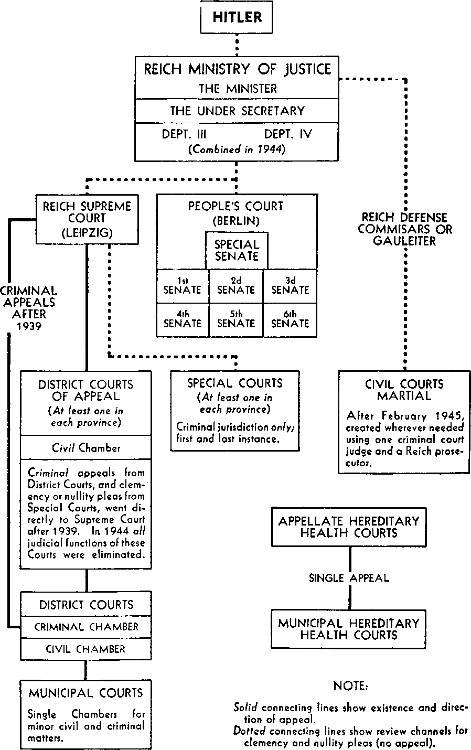
+------+ |HITLER| +------+ . +---------------------------+ | REICH MINISTRY OF JUSTICE |............ | THE MINISTER | . +---------------------------+ . | THE UNDER SECRETARY | . +---------------------------+ . | DEPT. III DEPT. IV | . | (_Combined in 1944_) | . +---------------------------+ . . . ......................... . . . . +-------------+ +---+----------------+---+ . |REICH SUPREME| | | PEOPLE’S COURT | | . +--| COURT | | | (BERLIN) | | REICH DEFENSE | | (LEIPZIG) | | +---+--------+---+ | COMMISSARS OR | +-------------+ | | SPECIAL| | GAULEITER | | . | | SENATE | | . | | . +-------+--------+-------+ . CRIMINAL | . | 1st | 2d | 3d | . APPEALS | . |SENATE | SENATE | SENATE| . AFTER | . +-------+--------+-------+ . 1939 | . | 4th | 5th | 6th | . | | . |SENATE | SENATE | SENATE| . | | . +-------+--------+-------+ . | | . . | | ..................... . | | . . | +------------------+ +------------------+ +-----------------+ | | DISTRICT COURTS | | SPECIAL COURTS | | CIVIL COURTS | | | OF APPEAL | |(_At least one in_| | MARTIAL | | |(_At least one in_| | _each province_) | |After February | | |_each province_) | | | |1945, created | | +------------------+ |Criminal | |wherever needed | | | Civil Chamber | |jurisdiction | |using one | | +------------------+ |_only_; first | |criminal court | | |_Criminal_ appeals| |and last instance.| |judge and a Reich| | |from District | +------------------+ |prosecutor. | | |Courts, and | +-----------------+ | |clemency or | | |nullity pleas | | |from Special | | |Courts, went | +--------------------+ | |directly to | |APPELLATE HEREDITARY| | |Supreme Court | | HEALTH COURTS | | |after 1939. In | +--------------------+ | |1944 _all_ | | | |judicial | | | |functions of | SINGLE APPEAL | |these Courts | | |were eliminated. | | | +------------------+ | | | | | | | | +------------------+ +--------------------+ | | DISTRICT COURTS | |MUNICIPAL HEREDITARY| | +------------------+ | HEALTH COURTS | +-| CRIMINAL CHAMBER | +--------------------+ +------------------+ | CIVIL CHAMBER | +------------------+ | | +------------------+ | MUNICIPAL COURTS | | | NOTE: | Single Chambers | _Solid_ connecting lines show existence | for minor civil | and direction of appeal. | and criminal | _Dotted_ connecting lines show review | matters. | channels for clemency and nullity +------------------+ pleas (no appeal).
CHART SHOWING POSITIONS OF THE DEFENDANTS AND OTHERS IN THE REICH MINISTRY OF JUSTICE AND THE GERMAN JUDICIAL SYSTEM UNDER HITLER[121]
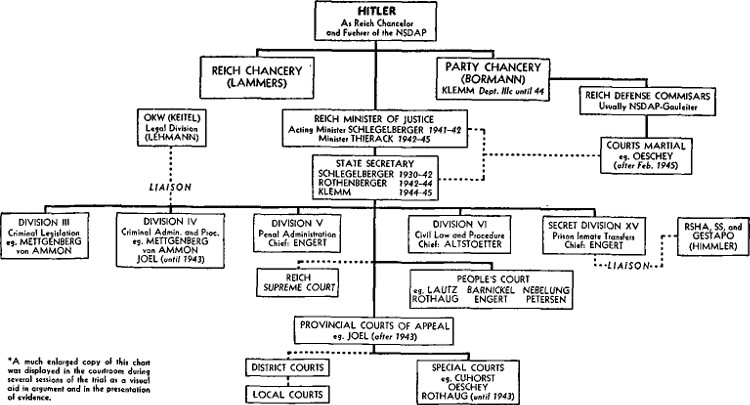
+------------------------+ | HITLER | | As Reich Chancellor | |and Fuehrer of the NSDAP| +-----------+------------+ | +---------------------------+-----------------------------+ | | | +--------------+ | +---------------------------+ |REICH CHANCERY| | | PARTY CHANCERY |-------------------+ | (LAMMERS) | | | (BORMANN) | | +--------------+ | |KLEMM _Dept. IIIc until 44_| +-----------------------+ | +---------------------------+ |REICH DEFENSE COMMISSARS| | |Usually NSDAP-Gauleiter | | +------------------------+ | | +--------------+ +--------------------------------------+ | | OKW (KEITEL) | | REICH MINISTER OF JUSTICE | | |Legal Division| |Acting Minister SCHLEGELBERGER 1941–42|... | | (LEHMANN) | | Minister THIERACK 1942–45 | . | +--------------+ +--------------------------------------+ . | | | . | | +----------------------+ . +-------------------+ | | STATE SECRETARY | ...............................| COURTS MARTIAL | | |SCHLEGELBERGER 1930–42| . | eg. OESCHEY | | |ROTHENBERGER 1942–44|............. |(_after Feb. 1945_)| | |KLEMM 1944–45| +-------------------+ _LIAISON_ +----------------------+ | | +--------------------------+----------------------------+-----------+------------+------------------------------+ | | | | | | +--------------------+ +-------------------------+ +--------------------+ | +-----------------------+ +-----------------------+ +-------------+ | DIVISION III | | DIVISION IV | | DIVISION V | | | DIVISION VI | | SECRET DIVISION XV | |RSHA, SS, and| |Criminal Legislation| |Criminal Admin. and Proc.| |Penal Administration| | |Civil Law and Procedure| |Prison Inmate Transfers| | GESTAPO | | eg. METTGENBERG | | eg. METTGENBERG | | Chief: ENGERT | | | Chief: ALTSTOETTER | | Chief: ENGERT | | (HIMMLER) | | von AMMON | | von AMMON | +--------------------+ | +-----------------------+ +-----------------------+ +-------------+ +--------------------+ | JOEL (_until 1943_) | | . . +-------------------------+ | ......._LIAISON_....... .....................+-------------------------+ . | | . | | +-------------+ | +----------------------------+ | REICH | | | PEOPLE’S COURT | |SUPREME COURT| | |eg. LAUTZ BARNICKEL NEBELUNG| +-------------+ | | ROTHAUG ENGERT PETERSEN| | +----------------------------+ | +---------------------------+ |PROVINCIAL COURTS OF APPEAL| | eg. JOEL (_after 1943_) | +---------------------------+ | ....................+---------------------+ . | +---------------+ +----------------------+ |DISTRICT COURTS| | SPECIAL COURTS | +---------------+ | eg. CUHORST | . | OESCHEY | +---------------+ |ROTHAUG (_until 1943_)| | LOCAL COURTS | +----------------------+ +---------------+
3. SPECIAL COURTS[122]
PARTIAL TRANSLATION OF DOCUMENT NG-715
PROSECUTION EXHIBIT 112
DECREE OF THE REICH GOVERNMENT, 21 MARCH 1933, ON THE FORMATION OF SPECIAL COURTS
1933 REICHSGESETZBLATT, PART I, PAGE 136
Pursuant to chapter II of part six of the third decree of the Reich President to safeguard economy and finances and to combat political excesses, of 6 October 1931, (Reichsgesetzblatt I, pp. 537, 565) the following is decreed:
Article 1
(1) A Special Court will be created for the district of each court of appeal.