Part 2 — DESCRIPTION OF THE PLATE.
Reading edition
1. Small funnel-shaped tube for testing minute portions of liquids.
2. Apparatus for the distillation of fluids suspected to contain acids, one-seventh the natural size.
3. Tube for reducing very small portions of arsenic or mercury. The figure is of half the natural size. The ball may be blown larger, if the material to be reduced is bulky.
4. A small glass funnel for introducing the material into the tube Fig. 1, without soiling its inside.
5. The ordinary apparatus for disengaging sulphuretted-hydrogen. The funnel must be a little longer than the emerging tube. The fluid should not be at any time much higher than in the figure, in order to secure the operator against its effervescing up into the emerging tube. The figure is a fourth of the natural size.
6. Instrument for washing down scanty precipitates on filters. It is a thin bottle capable of standing heat—half-filled with water, which may be boiled on occasion,—and having its cork pierced with a small tube drawn at its outer end to a very fine bore. The breath is impelled into the bottle, and, the bottle being then reversed, a very fine stream issues with great force.
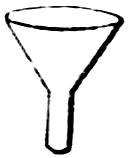
Fig. 1.
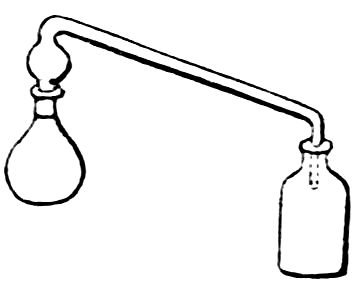
Fig. 2.

Fig. 3.

Fig. 4.
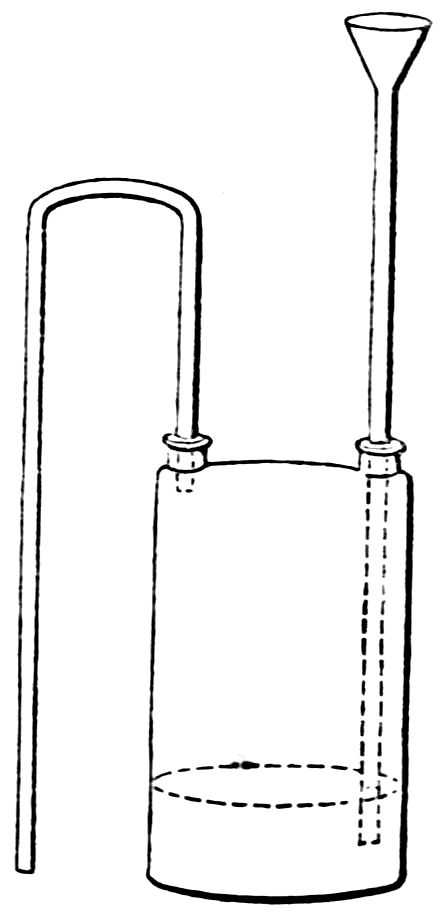
Fig. 5.
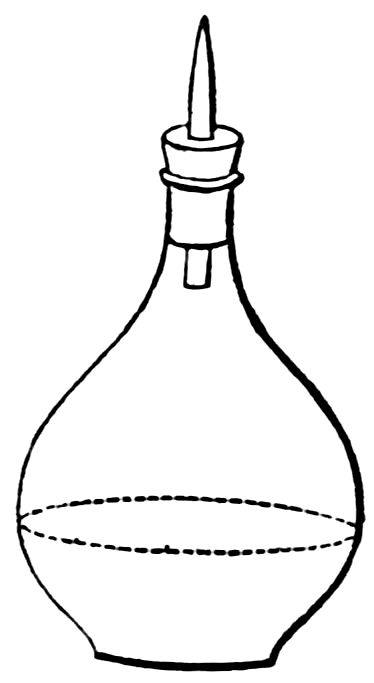
Fig. 6.
7567. Tubes of natural size for collecting small portions of mercury by the process, p. 300.
8. Pipette, one-fourth the natural size, for removing by suction fluids lying over precipitates. Some have a rectangular bend in the upper part, by means of which the operator sees better the point of the instrument when in action; but such pipettes are difficult to clean. That represented in the figure is easily cleaned with a feather.
9. Apparatus for reducing the sulphurets of some metals by a stream of hydrogen. A, the vessel with zinc and diluted sulphuric acid, the latter of which may be renewed by the funnel B. C, a ball on the emerging tube to prevent the liquid thrown up by the effervescence from passing forward. D, E, corks by which C and G are fitted into F, the tube which contains the sulphuret at F. G, the exit-tube for the sulphuretted-hydrogen, plying into a vessel containing acetate of lead. When the hydrogen has passed long enough to expel all the air, the spirit-lamp flame is applied at F; and when sulphuretted-hydrogen is formed, the lead solution is blackened. The figure is one-third the size of the apparatus.
For Description of Figures 10 and 11, see p. 212.
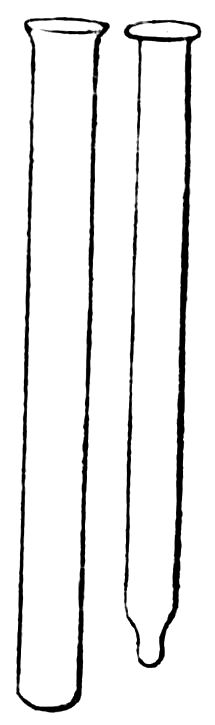
Fig. 7.
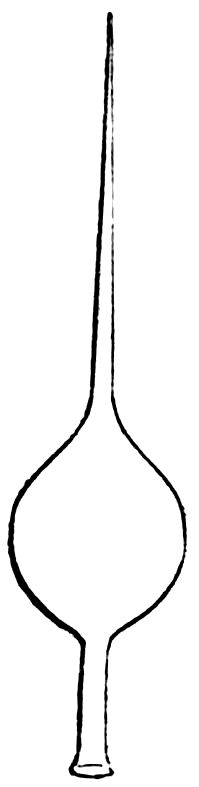
Fig. 8.
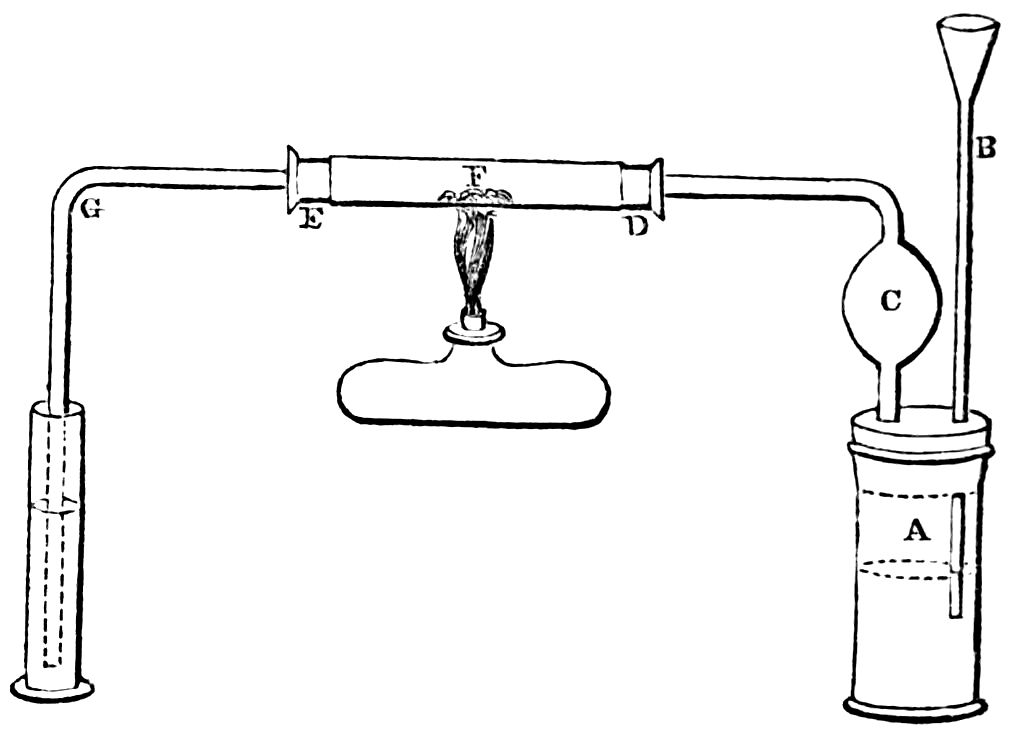
Fig. 9.
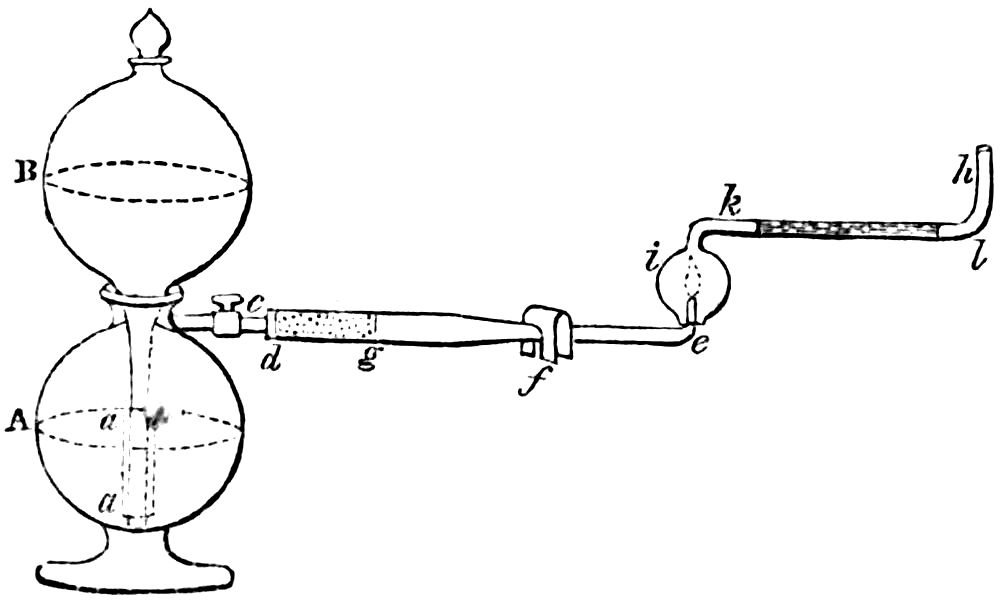
Fig. 10.
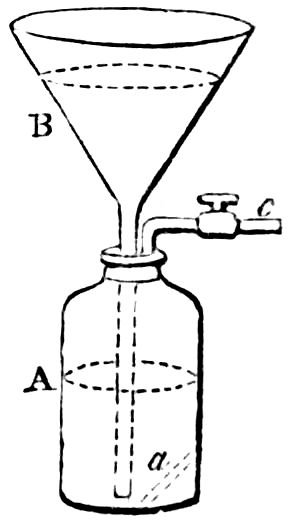
Fig. 11.
THE END.
TRANSCRIBER’S NOTES
P. 476, changed “exasperated by the use of oil” to “exacerbated by the use of oil”.
P. 513, changed “I may here add a very opposite instance of hemorrhagic apoplexy” to “I may here add a very apposite instance of hemorrhagic apoplexy”.
P. 712, added missing anchor for the last footnote.
Silently corrected typographical errors and variations in spelling.
Archaic, non-standard, and uncertain spellings retained as printed.