A JOURNAL OF THE TRAVELS, WITH A DESCRIPTION OF THE COUNTRY, LAKES, &c.
Reading edition
IN June 1766, I set out from Boston, and proceeded by way of Albany and Niagara, to Michillimackinac; a Fort situated between the Lakes Huron and Michigan, and distant from Boston 1300 miles. This being the uttermost of our factories towards the north-west, I considered it as the most convenient place from whence I could begin my intended progress, and enter at once into the Regions I designed to explore.
Referring my Readers to the publications already extant for an Account of those Parts of North America, that, from lying adjacent to the Back-Settlements, have been frequently described, I shall confine myself to a Description of the more interior parts of it, which having been but seldom visited, are consequently but little known. In doing this, I shall in no instance exceed the bounds of truth, or have recourse to those useless and extravagant exaggerations too often made use of by travellers, to excite the curiosity of the public, or to increase their own importance. Nor shall I insert any observations, but such as I have made myself, or, from the credibility of those by whom they were related, am enabled to vouch for their authenticity.
Michillimackinac, from whence I began my travels, is a Fort composed of a strong stockade, and is usually defended by a garrison of one hundred men. It contains about thirty houses, one of which belongs to the governor, and another to the commissary. Several traders also dwell within its fortifications, who find it a convenient situation to traffic with the neighbouring nations. Michillimackinac, in the language of the Chipéway Indians, signifies a Tortoise; and the place is supposed to receive its name from an Island, lying about six or seven miles to the north-east, within light of the Fort, which has the appearance of that animal.
During the Indian war that followed soon after the Conquest of Canada in the year 1763, and which was carried on by an army of confederate nations composed of the Hurons, Miamies, Chipéways, Ottowaws, Pontowattimies, Mississauges, and some other tribes, under the direction of Pontiac, a celebrated Indian warrior, who had always been in the French interest, it was taken by surprize in the following manner: The Indians having settled their plan, drew near the Fort, and began a game at Ball, a pastime much used among them, and not unlike tennis. In the height of their game, at which some of the English officers, not suspecting any deceit, stood looking on, they struck the ball, as if by accident, over the stockade; this they repeated two or three times, to make the deception more complete; till at length, having by this means lulled every suspicion of the centry at the south gate, a party rushed by him; and the rest soon following, they took possession of the Fort, without meeting with any opposition. Having accomplished their design, the Indians had the humanity to spare the lives of the greatest part of the garrison and traders, but they made them all prisoners, and carried them off. However some time after they took them to Montreal, where they were redeemed at a good price. The Fort also was given up again to the English at the peace made with Pontiac by the commander of Detroit the year following.
Having here made the necessary dispositions for pursuing my travels, and obtained a credit from Mr. Rogers, the governor, on some English and Canadian traders who were going to trade on the Mississippi, and received also from him a promise of a fresh supply of goods when I reached the Falls of Saint Anthony, I left the Fort on the 3d of September, in company with these traders. It was agreed, that they should furnish me with such goods as I might want, for presents to the Indian chiefs, during my continuance with them, agreeable to the governor’s order. But when I arrived at the extent of their route, I was to find other guides, and to depend on the goods the governor had promised to supply me with.
We accordingly set out together, and on the 18th arrived at Fort La Bay. This Fort is situated on the southern extremity of a Bay in Lake Michigan, termed by the French the Bay of Puants; but which, since the English have gained possession of all the settlements on this part of the Continent, is called by them the Green Bay. The reason of its being thus denominated, is from its appearance; for on leaving Michillimackinac in the spring season, though the trees there have not even put forth their buds, yet you find the country around La Bay, notwithstanding the passage has not exceeded fourteen days, covered with the finest verdure, and vegetation as forward as it could be were it summer.
This Fort, also, is only surrounded by a stockade, and being much decayed is scarcely defensible against small arms. It was built by the French for the protection of their trade, some time before they were forced to relinquish it; and when Canada and its dependencies were surrendered to the English, it was immediately garrisoned with an officer and thirty men. These were made prisoners by the Menomonies soon after the surprise of Michillimackinac, and the Fort has neither been garrisoned or kept in repair since.
The Bay is about ninety miles long, but differs much in its breadth; being in some places only fifteen miles, in others from twenty to thirty. It lies nearly from north-east to south-west. At the entrance of it from the Lake are a string of islands, extending from north to south, called the Grand Traverse. These are about thirty miles in length, and serve to facilitate the passage of canoes, as they shelter them from the winds, which sometimes come with violence across the Lake. On the side that lies to the south-east is the nearest and best navigation.
The islands of the Grand Traverse are mostly small and rocky. Many of the rocks are of an amazing size, and appear as if they had been fashioned by the hands of artists. On the largest and best of these islands stands a town of the Ottowaws, at which I found one of the most considerable chiefs of that nation, who received me with every honour he could possibly show to a stranger. But what appeared extremely singular to me at the time, and must do so to every person unacquainted with the customs of the Indians, was the reception I met with on landing. As our canoes approached the shore, and had reached within about threescore rods of it, the Indians began a feu-de-joy; in which they fired their pieces loaded with balls; but at the same time they took care to discharge them in such a manner, as to fly a few yards above our heads: during this they ran from one tree or stump to another, shouting and behaving as if they were in the heat of battle. At first I was greatly surprised, and was on the point of ordering my attendants to return their fire, concluding that their intentions were hostile; but being undeceived by some of the traders, who informed me that this was their usual method of receiving the chiefs of other nations, I considered it in its true light, and was pleased with the respect thus paid me.
I remained here one night. Among the presents I made the chiefs, were some spirituous liquors; with which they made themselves merry, and all joined in a dance, that lasted the greatest part of the night. In the morning when I departed, the chief attended me to the shore, and, as soon as I had embarked, offered up, in an audible voice, and with great solemnity, a fervent prayer in my behalf. He prayed “that the Great Spirit would favour me with a prosperous voyage; that he would give me an unclouded sky, and smooth waters, by day, and that I might lie down, by night, on a beaver blanket, enjoying uninterrupted sleep, and pleasant dreams; and also that I might find continual protection under the great pipe of peace.” In this manner he continued his petitions till I could no longer hear them.
I must here observe, that notwithstanding the inhabitants of Europe are apt to entertain horrid ideas of the ferocity of these savages, as they are termed, I received from every tribe of them in the interior parts, the most hospitable and courteous treatment; and am convinced, that till they are contaminated by the example and spirituous liquors of their more refined neighbours, they retain this friendly and inoffensive conduct towards strangers. Their inveteracy and cruelty to their enemies I acknowledge to be a great abatement of the favourable opinion I would wish to entertain of them; but this failing is hereditary, and having received the sanction of immemorial custom, has taken too deep root in their minds to be ever extirpated.
Among this people I eat of a very uncommon kind of bread. The Indians, in general, use but little of this nutritious food: whilst their corn is in the milk, as they term it, that is, just before it begins to ripen, they slice off the kernels from the cob to which they grow, and knead them into a paste. This they are enabled to do without the addition of any liquid, by the milk that flows from them; and when it is effected, they parcel it out into cakes, and inclosing them in leaves of the basswood tree, place them in hot embers, where they are soon baked. And better flavoured bread I never eat in any country.
This place is only a small village containing about twenty-five houses and sixty or seventy warriors. I found nothing there worthy of further remark.
The land on the south-east side of the Green Bay is but very indifferent, being overspread with a heavy growth of hemlock, pine, spruce and fir trees. The communication between Lake Michigan and the Green Bay has been reported by some to be impracticable for the passage of any vessels larger than canoes or boats, on account of the shoals that lie between the islands in the Grand Traverse; but on sounding it I found sufficient depth for a vessel of sixty tons, and the breadth proportionable.
The land adjoining to the bottom of this Bay is very fertile, the country in general level, and the perspective view of it pleasing and extensive.
A few families live in the Fort, which lies on the west-side of the Fox River, and opposite to it, on the east side of its entrance, are some French settlers who cultivate the land, and appear to live very comfortably.
The Green Bay or Bay of Puants is one of those places to which the French, as I have mentioned in the Introduction, have given nicknames. It is termed by the inhabitants of its coasts, the Menomonie Bay; but why the French have denominated it the Puant or Stinking Bay I know not. The reason they themselves give for it is, that it was not with a view to mislead strangers, but that by adopting this method they could converse with each other, concerning the Indians, in their presence, without being understood by them. For it was remarked by the persons who first traded among them, that when they were speaking to each other about them, and mentioned their proper name, they instantly grew suspicious, and concluded that their visiters were either speaking ill of them, or plotting their destruction. To remedy this they gave them some other name. The only bad consequence arising from the practice then introduced is, that English and French geographers, in their plans of the interior parts of America, give different names to the same people, and thereby perplex those who have occasion to refer to them.
Lake Michigan, of which the Green Bay is a part, is divided on the north-east from Lake Huron by the Straits of Michillimackinac; and is situated between forty-two and forty-six degrees of latitude, and between eighty-four and eighty-seven degrees of west longitude. Its greatest length is two hundred and eighty miles, its breadth about forty, and its circumference nearly six hundred. There is a remarkable string of small islands beginning over against Atkin’s Farm, and running about thirty miles south-west into the Lake. These are called the Beaver Islands. Their situation is very pleasant, but the soil is bare. However they afford a beautiful prospect.
On the north-west parts of this Lake the waters branch out into two bays. That which lies towards the north is the Bay of Noquets, and the other the Green Bay just described.
The waters of this as well as the other great Lakes are clear and wholesome, and of sufficient depth for the navigation of large ships. Half the space of the country that lies to the east, and extends to Lake Huron, belongs to the Ottowaw Indians. The line that divides their territories from the Chipéways, runs nearly north and south, and reaches almost from the southern extremity of this Lake, across the high lands, to Michillimackinac, through the center of which it passes. So that when these two tribes happen to meet at the factory, they each encamp on their own dominions, at a few yards distance from the stockade.
The country adjacent either to the east or west side of this lake is composed but of an indifferent soil, except where small brooks or rivers empty themselves into it; on the banks of these it is extremely fertile. Near the borders of the Lake grow a great number of sand cherries, which are not less remarkable for their manner of growth, than for their exquisite flavour. They grow upon a small shrub not more than four feet high, the boughs of which are so loaded that they lie in clusters on the sand. As they grow only on the sand, the warmth of which probably contributes to bring them to such perfection, they are called by the French, cherries de sable, or sand cherries. The size of them does not exceed that of a small musket ball, but they are reckoned superior to any other sort for the purpose of steeping in spirits. There also grow around the Lake gooseberries, black currants, and an abundance of juniper, bearing great quantities of berries of the finest sort.
Sumack likewise grows here in great plenty; the leaf of which, gathered at Michaelmas when it turns red, is much esteemed by the natives. They mix about an equal quantity of it with their tobacco, which causes it to smoke pleasantly. Near this Lake, and indeed about all the great lakes, is found a kind of willow, termed by the French, bois rouge, in English red wood. Its bark, when only of one year’s growth, is of a fine scarlet colour, and appears very beautiful; but as it grows older, it changes into a mixture of grey and red. The stalks of this shrub grow many of them together, and rise to the height of six or eight feet, the largest not exceeding an inch diameter. The bark being scraped from the sticks, and dried and powdered, is also mixed by the Indians with their tobacco, and is held by them in the highest estimation for their winter smoaking. A weed that grows near the great lakes, in rocky places, they use in the summer season. It is called by the Indians, Segockimac, and creeps like a vine on the ground, sometimes extending to eight or ten feet, and bearing a leaf about the size of a silver penny, nearly round; it is of the substance and colour of the laurel, and is, like the tree it resembles, an evergreen. These leaves, dried and powdered, they likewise mix with their tobacco; and, as said before, smoak it only during the summer. By these three succedaneums the pipes of the Indians are well supplied through every season of the year; and as they are great smoakers, they are very careful in properly gathering and preparing them.
On the 20th of September I left the Green Bay, and proceeded up Fox River, still in company with the traders and some Indians. On the 25th I arrived at the great town of the Winnebagoes, situated on a small island just as you enter the east end of Lake Winnebago. Here the queen who presided over this tribe instead of a Sachem, received me with great civility, and entertained me in a very distinguished manner, during the four days I continued with her.
The day after my arrival I held a council with the chiefs, of whom I asked permission to pass through their country, in my way to more remote nations on business of importance. This was readily granted me, the request being esteemed by them as a great compliment paid to their tribe. The Queen sat in the council, but only asked a few questions, or gave some trifling directions in matters relative to the state; for women are never allowed to sit in their councils, except they happen to be invested with the supreme authority, and then it is not customary for them to make any formal speeches as the chiefs do. She was a very ancient woman, small in stature, and not much distinguished by her dress from several young women that attended her. These her attendants seemed greatly pleased whenever I showed any tokens of respect to their queen, particularly when I saluted her, which I frequently did to acquire her favour. On these occasions the good old lady endeavoured to assume a juvenile gaiety, and by her smiles showed she was equally pleased with the attention I paid her.
The time I tarried here, I employed in making the best observations possible on the country, and in collecting the most certain intelligence I could of the origin, language, and customs of this people. From these enquiries I have reason to conclude, that the Winnebagoes originally resided in some of the provinces belonging to New Mexico; and being driven from their native country, either by intestine divisions, or by the extension of the Spanish conquests, they took refuge in these more northern parts about a century ago.
My reasons for adopting this supposition, are, first from their unalienable attachment to the Naudowessie Indians (who, they say, gave them the earliest succour during their emigration) notwithstanding their present residence is more than six hundred miles distant from that people.
Secondly, that their dialect totally differs from every other Indian nation yet discovered; it being a very uncouth guttural jargon, which none of their neighbours will attempt to learn. They converse with other nations in the Chipéway tongue, which is the prevailing language throughout all the tribes, from the Mohawks of Canada to those who inhabit the borders of the Mississippi, and from the Hurons and Illinois to such as dwell near Hudson’s Bay.
Thirdly, from their inveterate hatred to the Spaniards. Some of them informed me that they had made many excursions to the south-west, which took up several moons. An elderly chief more particularly acquainted me, that about forty-six winters ago, he marched, at the head of fifty warriors, towards the south-west, for three moons. That during this expedition, whilst they were crossing a plain, they discovered a body of men on horseback, who belonged to the Black People; for so they call the Spaniards. As soon as they perceived them, they proceeded with caution, and concealed themselves till night came on; when they drew so near as to be able to discern the number and situation of their enemies. Finding they were not able to cope with so great a superiority by day-light, they waited till they had retired to rest; when they rushed upon them, and, after having killed the greatest part of the men, took eighty horses loaded with what they termed white stone. This I suppose to have been silver, as he told me the horses were shod with it, and that their bridles were ornamented with the same. When they had satiated their revenge, they carried off their spoil, and being got so far as to be out of the reach of the Spaniards that had escaped their fury, they left the useless and ponderous burthen, with which the horses were loaded, in the woods, and mounting themselves, in this manner returned to their friends. The party they had thus defeated, I conclude to be the caravan that annually conveys to Mexico, the silver which the Spaniards find in great quantities on the mountains lying near the heads of the Coloredo River: and the plains where the attack was made, probably, some they were obliged to pass over in their way to the heads of the River St. Fee, or Rio del Nord, which falls into the Gulph of Mexico to the west of the Mississippi.
The Winnebagoes can raise about two hundred warriors. Their town contains about fifty houses, which are strongly built with palisades, and the island on which it is situated nearly fifty acres. It lies thirty-five miles, reckoning according to the course of the river, from the Green Bay.
The River, for about four or five miles from the Bay, has a gentle current; after that space, till you arrive at the Winnebago Lake, it is full of rocks and very rapid. At many places we were obliged to land our canoes, and carry them a considerable way. Its breadth, in general, from the Green Bay to the Winnebago Lake, is between seventy and a hundred yards: the land on its borders very good, and thinly wooded with hickery, oak, and hazel.
The Winnebago Lake is about fifteen miles long from east to west, and six miles wide. At its south-east corner, a river falls into it that takes its rise near some of the northern branches of the Illinois River. This I called the Crocodile River, in consequence of a story that prevails among the Indians, of their having destroyed, in some part of it, an animal, which from their description must be a crocodile or an alligator.
The land adjacent to the Lake is very fertile, abounding with grapes, plums, and other fruits, which grow spontaneously. The Winnebagoes raise on it a great quantity of Indian corn, beans, pumpkins, squash, and water melons, with some tobacco. The Lake itself abounds with fish, and in the fall of the year, with geese, ducks, and teal. The latter, which resort to it in great numbers, are remarkably good and extremely fat, and are much better flavoured than those that are found near the sea, as they acquire their excessive fatness by feeding on the wild rice, which grow so plentifully in these parts.
Having made some acceptable presents to the good old queen, and received her blessing, I left the town of the Winnebagoes on the 29th of September, and about twelve miles from it arrived at the place where the Fox River enters the Lake on the north side of it. We proceeded up this river, and on the 7th of October reached the great Carrying Place, which divides it from the Ouisconsin.
The Fox River, from the Green Bay to the Carrying Place, is about one hundred and eighty miles. From the Winnebago Lake to the Carrying Place the current is gentle, and the depth of it considerable; notwithstanding which, in some places it is with difficulty that canoes can pass, through the obstructions they meet with from the rice stalks, which are very large and thick, and grow here in great abundance. The country around it is very fertile and proper in the highest degree for cultivation, excepting in some places near the River, where it is rather too low. It is in no part very woody, and yet can supply sufficient to answer the demands of any number of inhabitants. This river is the greatest resort for wild fowl of every kind that I met with in the whole course of my travels; frequently the sun would be obscured by them for some minutes together.
About forty miles up this river, from the great town of the Winnebagoes, stands a smaller town belonging to that nation.
Deer and bears are very numerous in these parts, and a great many beavers and other furs are taken on the streams that empty themselves into this river.
The River I am treating of, is remarkable for having been, about eighty years ago, the residence of the united bands of the Ottigaumies and the Saukies, whom the French had nicknamed, according to their wonted custom, Des Sacs and Des Reynards, the Sacks and the Foxes, of whom the following anecdote was related to me by an Indian.
About sixty years ago, the French missionaries and traders having received many insults from these people, a party of French and Indians under the command of Captain Morand marched to revenge their wrongs. The captain set out from the Green Bay in the winter, when they were unsuspicious of a visit of this kind, and pursuing his route over the snow to their villages, which lay about fifty miles up the Fox River, came upon them by surprize. Unprepared as they were, he found them an easy conquest, and consequently killed or took prisoners the greatest part of them. On the return of the French to the Green Bay, one of the Indian chiefs in alliance with them, who had a considerable band of the prisoners under his care, stopped to drink at a brook; in the mean time his companions went on: which being observed by one of the women whom they had made captive, she suddenly seized him with both her hands, whilst he stooped to drink, by an exquisitely susceptible part, and held him fast till he expired on the spot. As the chief, from the extreme torture he suffered, was unable to call out to his friends, or to give any alarm, they passed on without knowing what had happened; and the woman having cut the bands of those of her fellow prisoners who were in the rear, with them made her escape. This heroine was ever after treated by her nation as their deliverer, and made a chiefess in her own right, with liberty to entail the same honour on her descendants: an unusual distinction, and permitted only on extraordinary occasions.
About twelve miles before I reached the Carrying Place, I observed several small mountains which extended quite to it. These indeed would only be esteemed as molehills when compared with those on the back of the colonies, but as they were the first I had seen since my leaving Niagara, a track of nearly eleven hundred miles, I could not leave them unnoticed.
The Fox River, where it enters the Winnebago Lake, is about fifty yards wide, but it gradually decreases to the Carrying Place, where it is no more than five yards over, except in a few places where it widens into small lakes, though still of a considerable depth. I cannot recollect any thing else that is remarkable in this River, except that it so serpentines for five miles, as only to gain in that place one quarter of a mile.
The Carrying Place between the Fox and Ouisconsin Rivers is in breadth not more than a mile and three quarters, though in some maps it is so delineated as to appear to be ten miles. And here I cannot help remarking, that all the maps of these parts, I have ever seen, are very erroneous. The rivers in general are described as running in different directions from what they really do; and many branches of them, particularly of the Mississippi, omitted. The distances of places, likewise, are greatly misrepresented. Whether this is done by the French geographers (for the English maps are all copied from theirs) through design, or for want of a just knowledge of the country, I cannot say; but I am satisfied that travellers who depend upon them in the parts I visited, will find themselves much at a loss. Having surveyed with the greatest care, every country through which I passed, I can assert that the plan prefixed to this work is drawn with much greater precision than any extant.
Near one half of the way, between the rivers, is a morass overgrown with a kind of long grass, the rest of it a plain, with some few oak and pine trees growing thereon. I observed here a great number of rattle-snakes. Mons. Pinnisance, a French trader, told me a remarkable story concerning one of these reptiles, of which he said he was an eye-witness. An Indian, belonging to the Menomonie nation, having taken one of them, found means to tame it; and when he had done this, treated it as a Deity; calling it his Great Father, and carrying it with him in a box wherever he went. This the Indian had done for several summers, when Mons. Pinnisance accidentally met with him at this Carrying Place, just as he was setting off for a winter’s hunt. The French gentleman was surprized, one day, to see the Indian place the box which contained his god on the ground, and opening the door give him his liberty; telling him, whilst he did it, to be sure and return by the time he himself should come back, which was to be in the month of May following. As this was but October, Monsieur told the Indian, whose simplicity astonished him, that he fancied he might wait long enough when May arrived, for the arrival of his great father. The Indian was so confident of his creature’s obedience, that he offered to lay the Frenchman a wager of two gallons of rum, that at the time appointed he would come and crawl into his box. This was agreed on, and the second week in May following fixed for the determination of the wager. At that period they both met there again; when the Indian set down his box, and called for his great father. The snake heard him not; and the time being now expired, he acknowledged that he had lost. However, without seeming to be discouraged, he offered to double the bett if his great father came not within two days more. This was further agreed on; when behold on the second day, about one o’clock, the snake arrived, and, of his own accord, crawled into the box, which was placed ready for him. The French gentleman vouched for the truth of this story, and from the accounts I have often received of the docility of those creatures, I see no reason to doubt his veracity.
I observed that the main body of the Fox River came from the south-west, that of the Ouisconsin from the north-east; and also that some of the small branches of these two rivers, in descending into them, doubled, within a few feet of each other, a little to the south of the Carrying Place. That two such Rivers should take their rise so near each other, and after running such different courses, empty themselves into the sea at a distance so amazing (for the former having passed through several great lakes, and run upwards of two thousand miles, falls into the Gulf of St. Lawrence, and the other, after joining the Mississippi, and having run an equal number of miles, disembogues itself into the Gulph of Mexico) is an instance scarcely to be met in the extensive continent of North America. I had an opportunity the year following, of making the same observations on the affinity of various head branches of the waters of the St. Lawrence and the Mississippi to each other; and now bring them as a proof, that the opinion of those geographers, who assert, that rivers taking their rise so near each other, must spring from the same source, is erroneous. For I perceived a visibly distinct separation in all of them, notwithstanding, in some places, they approached so near, that I could have stepped from one to the other.
On the 8th of October we got our canoes into the Ouisconsin River, which at this place is more than a hundred yards wide; and the next day arrived at the Great Town of the Saukies. This is the largest and best built Indian town I ever saw. It contains about ninety houses, each large enough for several families. These are built of hewn plank neatly jointed, and covered with bark so compactly as to keep out the most penetrating rains. Before the doors are placed comfortable sheds, in which the inhabitants sit, when the weather will permit, and smoak their pipes. The streets are regular and spacious; so that it appears more like a civilized town than the abode of savages. The land near the town is very good. In their plantations, which lie adjacent to their houses, and which are neatly laid out, they raise great quantities of Indian corn, beans, melons, &c. so that this place is esteemed the best market for traders to furnish themselves with provisions, of any within eight hundred miles of it.
The Saukies can raise about three hundred warriors, who are generally employed every summer in making incursions into the territories of the Illinois and Pawnee nations, from whence they return with a great number of slaves. But those people frequently retaliate, and, in their turn, destroy many of the Saukies, which I judge to be the reason that they increase no faster.
Whilst I staid here, I took a view of some mountains that lie about fifteen miles to the southward, and abound in lead ore. I ascended one of the highest of these, and had an extensive view of the country. For many miles nothing was to be seen but lesser mountains, which appeared at a distance like haycocks, they being free from trees. Only a few groves of hickery, and stunted oaks, covered some of the vallies. So plentiful is lead here, that I saw large quantities of it lying about the streets in the town belonging to the Saukies, and it seemed to be as good as the produce of other countries.
On the 10th of October we proceeded down the river, and the next day reached the first town of the Ottigaumies. This town contained about fifty houses, but we found most of them deserted, on account of an epidemical disorder that had lately raged among them, and carried off more than one half of the inhabitants. The greater part of those who survived had retired into the woods, to avoid the contagion.
On the 15th we entered that extensive river the Mississippi. The Ouisconsin, from the Carrying Place to the part where it falls into the Mississippi, flows with a smooth but a strong current; the water of it is exceedingly clear, and through it you may perceive a fine and sandy bottom, tolerably free from rocks. In it are a few islands, the soil of which appeared to be good, though somewhat woody. The land near the river also seemed to be, in general, excellent; but that at a distance is very full of mountains, where it is said there are many lead mines.
About five miles from the junction of the rivers, I observed the ruins of a large town in a very pleasing situation. On enquiring of the neighbouring Indians why it was thus deserted, I was informed, that about thirty years ago, the Great Spirit had appeared on the top of a pyramid of rocks, which lay at a little distance from it, towards the west, and warned them to quit their habitations; for the land on which they were built belonged to him, and he had occasion for it. As a proof that he, who gave them these orders, was really the Great Spirit, he further told them, that the grass should immediately spring up on those very rocks from whence he now addressed them, which they knew to be bare and barren. The Indians obeyed, and soon after discovered that this miraculous alteration had taken place. They shewed me the spot, but the growth of the grass appeared to be no ways supernatural. I apprehend this to have been a stratagem of the French or Spaniards to answer some selfish view; but in what manner they effected their purposes I know not.
This people, soon after their removal, built a town on the bank of the Mississippi, near the mouth of the Ouisconsin, at a place called by the French La Prairies les Chiens, which signifies the Dog Plains; it is a large town, and contains about three hundred families; the houses are well built after the Indian manner, and pleasantly situated on a very rich soil, from which they raise every necessary of life in great abundance. I saw here many horses of a good size and shape. This town is the great mart, where all the adjacent tribes, and even those who inhabit the most remote branches of the Mississippi, annually assemble about the latter end of May, bringing with them their furs to dispose of to the traders. But it is not always that they conclude their sale here; this is determined by a general council of the chiefs, who consult whether it would be more conducive to their interest, to sell their goods at this place, or carry them on to Louisiana, or Michillimackinac. According to the decision of this council they either proceed further, or return to their different homes.
The Mississippi, at the entrance of the Ouisconsin, near which stands a mountain of considerable height, is about half a mile over; but opposite to the last mentioned town it appears to be more than a mile wide, and full of islands, the soil of which is extraordinary rich, and but thinly wooded.
A little farther to the west, on the contrary side, a small river falls into the Mississippi, which the French call Le Jaun Riviere, or the Yellow River. Here the traders who had accompanied me hitherto, took up their residence for the winter. I then bought a canoe, and with two servants, one a French Canadian and the other a Mohawk of Canada, on the 19th proceeded up the Mississippi.
About ten days after I had parted from the traders, I landed as I usually did every evening, and having pitched my tent, I ordered my men, when night came on, to lay themselves down to sleep. By a light that I kept burning I then sat down to copy the minutes I had taken in the course of the preceding day. About ten o’clock, having just finished my memorandums, I stepped out of my tent to see what weather it was. As I cast my eyes towards the bank of the river, I thought I saw by the light of the stars which shone bright, something that had the appearance of a herd of beasts coming down a descent at some distance; whilst I was wondering what they could be, one of the number suddenly sprung up and discovered to me the form of a man. In an instant they were all on their legs, and I could count about ten or twelve of them running towards me. I immediately re-entered the tent, and awaking my men, ordered them to take their arms, and follow me. As my first apprehensions were for my canoe, I ran to the water’s side, and found a party of Indians (for such I now discovered them to be) on the point of plundering it. Before I reached them I commanded my men not to fire till I had given the word, being unwilling to begin hostilities unless occasion absolutely required. I accordingly advanced with resolution, close to the points of their spears, they had no other weapons, and brandishing my hanger, asked them with a stern voice, what they wanted. They were staggered at this, and perceiving they were like to meet with a warm reception, turned about and precipitately retreated. We pursued them to an adjacent wood, which they entered, and we saw no more of them. However, for fear of their return, we watched alternately during the remainder of the night. The next day my servants were under great apprehensions, and earnestly entreated me to return to the traders we had lately left. But I told them, that if they would not be esteemed old women (a term of the greatest reproach among the Indians) they must follow me; for I was determined to pursue my intended route, as an Englishman, when once engaged in an adventure, never retreated. On this they got into the canoe, and I walked on the shore to guard them from any further attack. The party of Indians who had thus intended to plunder me, I afterwards found to be some of those straggling bands, that having been driven from among the different tribes to which they belonged for various crimes, now associated themselves together, and, living by plunder, prove very troublesome to travellers who pass this way; nor are even Indians of every tribe spared by them. The traders had before cautioned me to be upon my guard against them, and I would repeat the same caution to those whose business might call them into these parts.
On the first of November I arrived at Lake Pepin, which is rather an extended part of the River Mississippi, that the French have thus denominated, about two hundred miles from the Ouisconsin. The Mississippi below this Lake flows with a gentle current, but the breadth of it is very uncertain, in some places it being upwards of a mile, in others not more than a quarter. This River has a range of mountains on each side throughout the whole of the way; which in particular parts approach near to it, in others lie at a greater distance. The land betwixt the mountains, and on their sides, is generally covered with grass with a few groves of trees interspersed, near which large droves of deer and elk are frequently seen feeding. In many places pyramids of rocks appeared, resembling old ruinous towers; at others amazing precipices; and what is very remarkable, whilst this scene presented itself on one side, the opposite side of the same mountain was covered with the finest herbage, which gradually ascended to its summit. From thence the most beautiful and extensive prospect that imagination can form opens to your view. Verdant plains, fruitful meadows, numerous islands, and all these abounding with a variety of trees that yield amazing quantities of fruit, without care or cultivation, such as the nut-tree, the maple which produces sugar, vines loaded with rich grapes, and plum-trees bending under their blooming burdens, but above all, the fine River flowing gently beneath, and reaching as far as the eye can extend, by turns attract your admiration and excite your wonder.
The Lake is about twenty miles long and near six in breadth; in some places it is very deep, and abounds with various kinds of fish. Great numbers of fowl frequent also this Lake and rivers adjacent, such as storks, swans, geese, brants, and ducks: and in the groves are found great plenty of turkeys and partridges. On the plains are the largest buffaloes of any in America. Here I observed the ruins of a French factory, where it is said Captain St. Pierre resided, and carried on a very great trade with the Naudowessies, before the reduction of Canada.
About sixty miles below this Lake is a mountain remarkably situated; for it stands by itself exactly in the middle of the River, and looks as if it had slidden from the adjacent shore into the stream. It cannot be termed an island, as it rises immediately from the brink of the water to a considerable height. Both the Indians and the French call it the Mountain in the River.
One day having landed on the shore of the Mississippi, some miles below Lake Pepin, whilst my attendants were preparing my dinner, I walked out to take a view of the adjacent country. I had not proceeded far, before I came to a fine, level, open plain, on which I perceived at a little distance, a partial elevation that had the appearance of an intrenchment. On a nearer inspection I had greater reason to suppose that it had really been intended for this many centuries ago. Notwithstanding it was now covered with grass, I could plainly discern that it had once been a breast-work of about four feet in height, extending the best part of a mile, and sufficiently capacious to cover five thousand men. Its form was somewhat circular, and its flanks reached to the River. Though much defaced by time, every angle was distinguishable, and appeared as regular, and fashioned with as much military skill, as if planned by Vauban himself. The ditch was not visible, but I thought on examining more curiously, that I could perceive there certainly had been one. From its situation also, I am convinced that it must have been designed for this purpose. It fronted the country, and the rear was covered by the River; nor was there any rising ground for a considerable way that commanded it; a few straggling oaks were alone to be seen near it. In many places small tracks were worn across it by the feet of the elks and deer, and from the depth of the bed of earth by which it was covered, I was able to draw certain conclusions of its great antiquity. I examined all the angles and every part with great attention, and have often blamed myself since, for not encamping on the spot, and drawing an exact plan of it. To shew that this description is not the offspring of a heated imagination, or the chimerical tale of a mistaken traveller, I find on enquiry since my return, that Mons. St. Pierre and several traders have, at different times, taken notice of similar appearances, on which they have formed the same conjectures, but without examining them so minutely as I did. How a work of this kind could exist in a country that has hitherto (according to the general received opinion) been the seat of war to untutored Indians alone, whose whole stock of military knowledge has only, till within two centuries, amounted to drawing the bow, and whose only breast-work even at present is the thicket, I know not. I have given as exact an account as possible of this singular appearance, and leave to future explorers of these distant regions to discover whether it is a production of nature or art. Perhaps the hints I have here given might lead to a more perfect investigation of it, and give us very different ideas of the ancient state of realms that we at present believe to have been from the earliest period only the habitations of savages.
The Mississippi, as far as the entrance of the River St. Croix, thirty miles above Lake Pepin, is very full of islands; some of which are of a considerable length. On these, also, grow great numbers of the maple or sugar tree, and around them vines loaded with grapes creeping to their very tops. From the Lake upwards few mountains are to be seen, and those but small. Near the River St. Croix reside three bands of the Nawdowessie Indians, called the River Bands.
This nation is composed, at present, of eleven bands. They were originally twelve; but the Assinipoils some years ago revolting, and separating themselves from the others, there remain only at this time eleven. Those I met here are termed the River Bands; because they chiefly dwell near the banks of this River: the other eight are generally distinguished by the title of the Naudowessies of the Plains, and inhabit a country that lies more to the westward. The names of the former are the Nehogatawonahs, the Mawtawbauntowahs, and the Shahsweentowahs, and consist of about four hundred warriors.
A little before I met with these three bands I fell in with a party of the Mawtawbauntowahs, amounting to forty warriors and their families. With these I resided a day or two, during which time five or six of their number, who had been out on an excursion, returned in great haste, and acquainted their companions that a large party of the Chipéway warriors, “enough,” as they expressed themselves, “to swallow them all up,” were close at their heels, and on the point of attacking their little camp. The chiefs applied to me, and desired I would put myself at their head, and lead them out to oppose their enemies. As I was a stranger, and unwilling to excite the anger of either nation, I knew not how to act; and never found myself in a greater dilemma. Had I refused to assist the Naudowessies I should have drawn on myself their displeasure, or had I met the Chipéways with hostile intentions, I should have made that people my foes, and had I been fortunate enough to have escaped their arrows at this time, on some future occasion should probably have experienced the severity of their revenge. In this extremity I chose the middle course, and desired that the Naudowessies would suffer me to meet them, that I might endeavour to avert their fury. To this they reluctantly assented, being persuaded, from the inveteracy which had long prevailed between them, that my remonstrances would be in vain.
Taking my Frenchman with me, who could speak their language, I hastened towards the place where the Chipéways were supposed to be. The Naudowessies during this kept at a distance behind. As I approached them with the pipe of peace, a small party of their chiefs, consisting of about eight or ten, came in a friendly manner towards me; with whom, by means of my interpreter, I held a long conversation; the result of which was, that their rancour being by my persuasions in some measure mollified, they agreed to return back without accomplishing their savage purposes. During our discourse I could perceive, as they lay scattered about, that the party was very numerous, and many of them armed with muskets.
Having happily succeeded in my undertaking, I returned without delay to the Naudowessies, and desired they would instantly remove their camp to some other part of the country, lest their enemies should repent of the promise they had given, and put their intentions in execution. They accordingly followed my advice, and immediately prepared to strike their tents. Whilst they were doing this they loaded me with thanks; and when I had seen them on board their canoes I pursued my route.
To this adventure I was chiefly indebted for the friendly reception I afterwards met with from the Naudowessies of the Plains, and for the respect and honours I received during my abode among them. And when I arrived many months after at the Chipéway village, near the Ottowaw lakes, I found that my fame had reached that place before me. The chiefs received me with great cordiality, and the elder part of them thanked me for the mischief I had prevented. They informed me, that the war between their nation and the Naudowessies had continued without interruption for more than forty winters. That they had long wished to put an end to it, but this was generally prevented by the young warriors of either nation, who could not restrain their ardour when they met. They said, they should be happy if some chief of the same pacific disposition as myself, and who possessed an equal degree of resolution and coolness, would settle in the country between the two nations; for by the interference of such a person an accommodation, which on their parts they sincerely desired, might be brought about. As I did not meet any of the Naudowessies afterwards, I had not an opportunity of forwarding so good a work.
About thirty miles below the Falls of St. Anthony, at which I arrived the tenth day after I left Lake Pepin, is a remarkable cave of an amazing depth. The Indians term it Wakon-teebe, that is, the Dwelling of the Great Spirit. The entrance into it is about ten feet wide, the height of it five feet. The arch within is near fifteen feet high and about thirty feet broad. The bottom of it consists of fine clear sand. About twenty feet from the entrance begins a lake, the water of which is transparent, and extends to an unsearchable distance; for the darkness of the cave prevents all attempts to acquire a knowledge of it. I threw a small pebble towards the interior parts of it with my utmost strength: I could hear that it fell into the water, and notwithstanding it was of so small a size, it caused an astonishing and horrible noise that reverberated through all those gloomy regions. I found in this cave many Indian hieroglyphicks, which appeared very ancient, for time had nearly covered them with moss, so that it was with difficulty I could trace them. They were cut in a rude manner upon the inside of the walls, which were composed of a stone so extremely soft that it might be easily penetrated with a knife: a stone every where to be found near the Mississippi. The cave is only accessible by ascending a narrow, steep passage that lies near the brink of the river.
At a little distance from this dreary cavern is the burying-place of several bands of the Naudowessie Indians: though these people have no fixed residence, living in tents, and abiding but a few months on one spot, yet they always bring the bones of their dead to this place; which they take the opportunity of doing when the chiefs meet to hold their councils, and to settle all public affairs for the ensuing summer.
Ten miles below the Falls of St. Anthony the River St. Pierre, called by the natives the Waddapawmenesotor, falls into the Mississippi from the west. It is not mentioned by Father Hennipin, although a large fair river: this omission, I conclude, must have proceeded from a small island that is situated exactly at its entrance, by which the sight of it is intercepted. I should not have discovered this river myself, had I not taken a view, when I was searching for it, from the high lands opposite, which rise to a great height.
Nearly over against this river I was obliged to leave my canoe, on account of the ice, and travel by land to the Falls of St. Anthony, where I arrived on the 17th of November. The Mississippi from the St. Pierre to this place is rather more rapid than I had hitherto found it, and without islands of any consideration.
Before I left my canoe I overtook a young prince of the Winnebago Indians, who was going on an embassy to some of the bands of the Naudowessies. Finding that I intended to take a view of the Falls, he agreed to accompany me, his curiosity having been often excited by the accounts he had received from some of his chiefs: he accordingly left his family (for the Indians never travel without their households) at this place, under the care of my Mohawk servant, and we proceeded together by land, attended only by my Frenchman, to this celebrated place.
We could distinctly hear the noise of the water full fifteen miles before we reached the Falls; and I was greatly pleased and surprized, when I approached this astonishing work of nature: but I was not long at liberty to indulge these emotions, my attention being called off by the behaviour of my companion.
The prince had no sooner gained the point that overlooks this wonderful cascade, than he began with an audible voice to address the Great Spirit, one of whose places of residence he imagined this to be. He told him that he had come a long way to pay his adorations to him, and now would make him the best offerings in his power. He accordingly first threw his pipe into the stream; then the roll that contained his tobacco; after these, the bracelets he wore on his arms and wrists; next an ornament that encircled his neck, composed of beads and wires; and at last the ear-rings from his ears; in short, he presented to his god every part of his dress that was valuable: during this he frequently smote his breast with great violence, threw his arms about, and appeared to be much agitated.
All this while he continued his adorations, and at length concluded them with fervent petitions that the Great Spirit would constantly afford us his protection on our travels, giving us a bright sun, a blue sky, and clear untroubled waters: nor would he leave the place till we had smoaked together with my pipe in honour of the Great Spirit.
I was greatly surprized at beholding an instance of such elevated devotion in so young an Indian, and instead of ridiculing the ceremonies attending it, as I observed my catholic servant tacitly did, I looked on the prince with a greater degree of respect for these sincere proofs he gave of his piety; and I doubt not but that his offerings and prayers were as acceptable to the universal Parent of mankind, as if they had been made with greater pomp, or in a consecrated place.
Indeed, the whole conduct of this young prince at once amazed and charmed me. During the few days we were together his attention seemed totally to be employed in yielding me every assistance in his power; and even in so short a time he gave me innumerable proofs of the most generous and disinterested friendship; so that on our return I parted from him with great reluctance. Whilst I beheld the artless, yet engaging manners of this unpolished savage, I could not help drawing a comparison between him and some of the more refined inhabitants of civilized countries, not much, I own, in favour of the latter.
The Falls of St. Anthony received their name from Father Louis Hennipin, a French missionary, who travelled into these parts about the year 1680, and was the first European ever seen by the natives. This amazing body of waters, which are above 250 yards over, form a most pleasing cataract; they fall perpendicularly about thirty feet, and the rapids below, in the space of 300 yards more, render the descent considerably greater; so that when viewed at a distance they appear to be much higher than they really are. The above-mentioned traveller has laid them down at above sixty feet; but he has made a greater error in calculating the height of the Falls of Niagara; which he asserts to be 600 feet; whereas from latter observations accurately made, it is well known that it does not exceed 140 feet. But the good father I fear too often had no other foundation for his accounts than report, or, at best, a slight inspection.
In the middle of the Falls stands a small island, about forty feet broad and somewhat longer, on which grow a few cragged hemlock and spruce trees; and about half way between this island and the eastern shore is a rock, lying at the very edge of the Fall, in an oblique position, that appeared to be about five or six feet broad, and thirty or forty long. These Falls vary much from all the others I have seen, as you may approach close to them without finding the least obstruction from any intervening hill or precipice.
The country around them is extremely beautiful. It is not an uninterrupted plain where the eye finds no relief, but composed of many gentle ascents, which in the summer are covered with the finest verdure, and interspersed with little groves, that give a pleasing variety to the prospect. On the whole, when the Falls are included, which may be seen at the distance of four miles, a more pleasing and picturesque view cannot, I believe, be found throughout the universe. I could have wished that I had happened to enjoy this glorious sight at a more seasonable time of the year, whilst the trees and hillocks were clad in nature’s gayest livery, as this must have greatly added to the pleasure I received; however, even then it exceeded my warmest expectations. I have endeavoured to give the Reader as just an idea of this enchanting spot as possible, in the plan annexed; but all description, whether of the pencil or the pen, must fall infinitely short of the original.
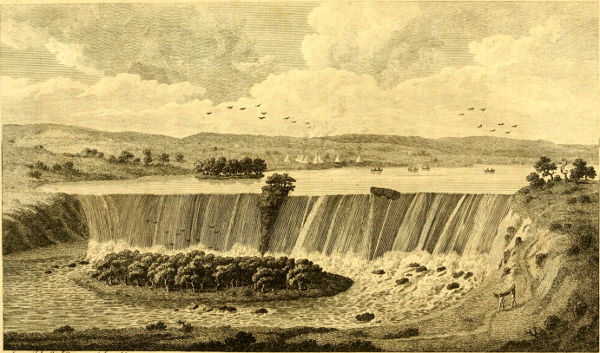
Survey’d by Capt. Carver, Novr. 17, 1766. M. A. Rooker Sculpt. Height of the Fall 30 feet Perpendr. The falls of St. Anthony in the River Mississippi, near 2400 Miles from its entrance into the Gulf of Mexico. Breadth, near 600 feet.
At a little distance below the Falls stands a small island, of about an acre and half, on which grow a great number of oak trees, every branch of which, able to support the weight, was full of eagles nests. The reason that this kind of birds resort in such numbers to this spot, is that they are here secure from the attacks either of man or beast, their retreat being guarded by the Rapids, which the Indians never attempt to pass. Another reason is, that they find a constant supply of food for themselves and their young, from the animals and fish which are dashed to pieces by the Falls, and driven on the adjacent shore.
Having satisfied my curiosity, as far as the eye of man can be satisfied, I proceeded on, still accompanied by my young friend, till I had reached the River St. Francis, near sixty miles above the Falls. To this river Father Hennipin gave the name of St. Francis, and this was the extent of his travels, as well as mine, towards the north-west. As the season was so advanced, and the weather extremely cold, I was not able to make so many observations on these parts as I otherwise should have done.
It might however, perhaps, be necessary to observe, that in the little tour I made about the Falls, after travelling fourteen miles, by the side of the Mississippi, I came to a river nearly twenty yards wide, which ran from the north-east, called Rum River. And on the 20th of November came to another termed Goose River, about twelve yards wide. On the 21st I arrived at the St. Francis, which is about thirty yards wide. Here the Mississippi itself grows narrow, being not more than ninety yards over; and appears to be chiefly composed of small branches. The ice prevented me from noticing the depth of any of these three rivers.
The country in some places is hilly, but without large mountains; and the land is tolerably good. I observed here many deer and carribboos, some elk, with abundance of beavers, otters, and other furs. A little above this, to the north-east, are a number of small lakes called the Thousand Lakes; the parts about which, though but little frequented, are the best within many miles for hunting, as the hunter never fails of returning loaded beyond his expectations.
The Mississippi has never been explored higher up than the River St. Francis, and only by Father Hennipin and myself thus far. So that we are obliged solely to the Indians, for all the intelligence we are able to give relative to the more northern parts. As this River is not navigable from the sea for vessels of any considerable burthen, much higher up than the Forks of the Ohio, and even that is accomplished with great difficulty, owing to the rapidity of the current, and the windings of the river, those settlements that may be made on the interior branches of it, must be indisputably secure from the attacks of any maritime power. But at the same time the settlers will have the advantage of being able to convey their produce to the sea-ports with great facility, the current of the river from its source to its entrance into the Gulph of Mexico, being extremely favourable for doing this in small craft. This might also in time be facilitated by canals or shorter cuts; and a communication opened by water with New York, Canada, &c. by way of the lakes. The Forks of the Ohio are about nine hundred miles from the mouth of the Mississippi, following the course of the river; and the Messorie two hundred miles above these. From the latter it is about twenty miles to the Illinois River, and from that to the Ouisconsin, which I have given an account of, about eight hundred more.
On the 25th I returned to my canoe, which I had left at the mouth of the River St. Pierre; and here I parted with regret from my young friend the prince of the Winnebagoes. This river being clear of ice by reason of its southern situation, I found nothing to obstruct my passage. On the 28th, being advanced about forty miles, I arrived at a small branch that fell into it from the north; to which, as it had no name that I could distinguish it by, I gave my own; and the Reader will find it in the plan of my travels denominated Carver’s River. About forty miles higher up I came to the Forks of Verd and Red Marble Rivers, which join at some little distance before they enter the St. Pierre.
The River St. Pierre, at its junction with the Mississippi, is about a hundred yards broad, and continues that breadth nearly all the way I sailed upon it. It has a great depth of water, and in some places runs very briskly. About fifty miles from its mouth are some rapids, and much higher up there are many others.
I proceeded up this river about two hundred miles to the country of the Naudowessies of the Plains, which lies a little above the Forks formed by the Verd and Red Marble Rivers, just mentioned, where a branch from the south nearly joins the Messorie River. By the accounts I received from the Indians, I have reason to believe that the River St. Pierre and the Messorie, though they enter the Mississippi twelve hundred miles from each other, take their rise in the same neighbourhood; and this within the space of a mile. The River St. Pierre’s northern branch rises from a number of lakes near the shining mountains; and it is from some of these, also, that a capital branch of the River Bourbon, which runs into Hudson’s Bay, has its sources.
From the intelligence I gained from the Naudowessie Indians, among whom I arrived the 7th of December, and whose language I perfectly acquired during a residence of five months; and also from the accounts I afterwards obtained from the Assinipoils, who speak the same tongue, being a revolted band of the Naudowessies; and from the Killistinoes, neighbours of the Assinipoils, who speak the Chipéway language, and inhabit the heads of the River Bourbon; I say from these nations, together with my own observations, I have learned that the four most capital rivers on the Continent of North America, viz. the St. Lawrence, the Mississippi, the River Bourbon, and the Oregon or the River of the West (as I hinted in my Introduction) have their sources in the same neighbourhood. The waters of the three former are within thirty miles of each other; the latter, however, is rather farther west.
This shews that these parts are the highest lands in North America; and it is an instance not to be paralleled on the other three quarters of the globe, that four rivers of such magnitude should take their rise together, and each, after running separate courses, discharge their waters into different oceans at the distance of two thousand miles from their sources. For in their passage from this spot to the bay of St. Lawrence, east, to the bay of Mexico, south, to Hudson’s Bay, north, and to the bay at the Straights of Annian, west, each of these traverse upwards of two thousand miles.
I shall here give my Readers such reflections as occurred to me, when I had received this interesting information, and had, by numberless inquiries, ascertained the truth of it; that is, as far as it was possible to arrive at a certainty without a personal investigation.
It is well known that the Colonies, particularly those of New England and Canada, are greatly affected, about the time their winter sets in, by a north-west wind, which continues for several months, and renders the cold much more intense there than it is in the interior parts of America. This I can, from my own knowledge, assert, as I found the winter, that I passed to the westward of the Mississippi, far from severe; and the north-west wind blowing on those countries considerably more temperate than I have often experienced it to be nearer the coast. And that this did not arise from an uncertainty of the seasons, but was annually the case, I conclude, both from the small quantity of snow that then fell, and a total disuse of snow shoes by these Indians, without which none of the more eastern nations can possibly travel during the winter.
As naturalists observe, that air resembles water in many respects, particularly by often flowing in a compact body; and that this is generally remarked to be with the current of large streams, and seldom across them, may not the winds that set violently into the Bay of Mexico about the latter end of the year, take their course over the continent in the same direction as the Mississippi does; till meeting with the north winds (that from a similar cause blow up the Bourbon from Hudson’s Bay) they are forced across the great lakes, down the current of the waters of the St. Lawrence, and united, commit those ravages, and occasion those severe winters, experienced in the before-mentioned countries? During their progress over the lakes they become expanded, and consequently affect a greater tract of land than they otherwise would do.
According to my scanty knowledge of natural philosophy this does not appear improbable. Whether it is agreeable to the laws established by naturalists to account for the operations of that element, I know not. However, the description here given of the situation of these vast bodies of water, and their near approach to each other, with my own undigested suppositions of their effect on the winds, may prove perhaps, in abler hands, the means of leading to many useful discoveries.
On the 7th of December, I arrived (as I said before) at the utmost extent of my travels towards the west; where I met with a large party of the Naudowessie Indians, among whom I resided seven months. These constituted a part of the eight bands of the Naudowessies of the Plains; and are termed the Wawpeentowahs, the Tintons, the Asrahcootans, the Mawhaws, and the Schians. The other three bands, whose names are the Schianese, the Chongousceton, and the Waddapawjestin, dwell higher up, to the west of the River St. Pierre, on plains that, according to their account, are unbounded; and probably terminate on the coast of the Pacific Ocean. The Naudowessie nation, when united, consists of more than two thousand warriors. The Assinipoils, who revolted from them, amount to about three hundred; and leagued with the Killistinoes, live in a continual state of enmity with the other eleven bands.
As I proceeded up the River St. Pierre, and had nearly reached the place where these people were encamped, I observed two or three canoes coming down the stream; but no sooner had the Indians that were on board them discovered us, than they rowed toward the land, and leaping ashore with precipitation, left their canoes to float as the current drove them. In a few minutes I perceived some others; who, as soon as they came in sight, followed, with equal speed, the example of their countrymen.
I now thought it necessary to proceed with caution; and therefore kept on the side of the river opposite to that on which the Indians had landed. However, I still continued my course, satisfied that the pipe of Peace which was fixed at the head of my canoe, and the English colours that were flying at the stern, would prove my security. After rowing about half a mile farther, in turning a point, I discovered a great number of tents, and more than a thousand Indians, at a little distance from the shore. Being now nearly opposite to them, I ordered my men to pull directly over, as I was willing to convince the Indians by such a step, that I placed some confidence in them.
As soon as I had reached the land, two of the chiefs presented their hands to me, and led me, amidst the astonished multitude, who had most of them never seen a white man before, to a tent. Into this we entered, and according to the custom that universally prevails among every Indian nation, began to smoke the pipe of Peace. We had not sat long before the crowd became so great, both around, and upon the tent, that we were in danger of being crushed by its fall. On this we returned to the plain, where, having gratified the curiosity of the common people, their wonder abated, and ever after they treated me with great respect.
From the chiefs I met with the most friendly and hospitable reception; which induced me, as the season was so far advanced, to take up my residence among them during the winter. To render my stay as comfortable as possible, I first endeavoured to learn their language. This I soon did, so as to make myself perfectly intelligible, having before acquired some slight knowledge of the language of those Indians that live on the back of the settlements; and in consequence met with every accommodation their manner of living would afford. Nor did I want for such amusements as tended to make so long a period pass cheerfully away. I frequently hunted with them; and at other times beheld with pleasure their recreations and pastimes, which I shall describe hereafter.
Sometimes I sat with the chiefs, and whilst we smoked the friendly pipe, entertained them, in return for the accounts they gave me of their wars and excursions, with a narrative of my own adventures and a description of all the battles fought between the English and the French in America, in many of which I had a personal share. They always paid great attention to my details, and asked many pertinent questions relative to the European methods of making war.
I held these conversations with them in a great measure to procure from them some information relative to the chief point I had constantly in view, that of gaining a knowledge of the situation and produce, both of their own country, and those that lay to the westward of them. Nor was I disappointed in my designs; for I procured from them much useful intelligence. They likewise drew for me plans of all the countries with which they were acquainted; but as I entertained no great opinion of their geographical knowledge, I placed not much dependence on them, and therefore think it unnecessary to give them to the public. Such as I afterwards found confirmed, by other accounts, or by my own observations, make a part of the map prefixed to this work. They draw with a piece of burnt coal, taken from the hearth, upon the inside bark of the birch tree; which is as smooth as paper, and answers the same purposes, notwithstanding it is of a yellow cast. Their sketches are made in a rude manner, but they seem to give as just an idea of a country, although the plan is not so exact, as more experienced draughtsmen could do.
I left the habitations of these hospitable Indians the latter end of April 1767; but did not part from them for several days, as I was accompanied on my journey by near three hundred of them, among whom were many chiefs, to the mouth of the River St. Pierre. At this season, these bands annually go to the Great Cave, before mentioned, to hold a grand council with all the other bands; wherein they settle their operations for the ensuing year. At the same time they carry with them their dead for interment bound up in buffaloes skins. Besides those that accompanied me, others were gone before, and the rest were to follow.
Never did I travel with so cheerful and happy a company. But their mirth met with a hidden and temporary allay from a violent storm that overtook us one day on our passage. We had just landed, and were preparing to set up our tents for the night, when a heavy cloud overspread the heavens, and the most dreadful thunder, lightning, and rain issued from it, that ever I beheld.
The Indians were greatly terrified, and ran to such shelter as they could find; for only a few tents were as yet erected. Apprehensive of the danger that might ensue from standing near any thing which could serve for a conductor, as the cloud appeared to contain such an uncommon quantity of the electrical fluid, I took my stand as far as possible from any covering; chusing rather to be exposed to the peltings of the storm than to receive a fatal stroke. At this the Indians were greatly surprized, and drew conclusions from it not unfavourable to the opinion they already entertained of my resolution. Yet I acknowledge that I was never more affected in my life; for nothing scarcely could exceed the terrific scene. The peals of thunder were so loud that they shook the earth; and the lightning flashed along the ground in streams of sulphur; so that the Indian chiefs themselves, although their courage in war is usually invincible, could not help trembling at the horrid combustion. As soon as the storm was over, they flocked around me, and informed me, that it was a proof of the anger of the evil spirits, whom they were apprehensive that they had highly offended.
When we arrived at the Great Cave, and the Indians had deposited the remains of their deceased friends in the burial-place that stands adjacent to it, they held their great council, into which I was admitted, and at the same time had the honour to be installed or adopted a chief of their bands. On this occasion I made the following speech, which I insert to give my Readers a specimen of the language and manner in which it is necessary to address the Indians, so as to engage their attention, and to render the speaker’s expressions consonant to their ideas. It was delivered on the first day of May 1767.
“My brothers, chiefs of the numerous and powerful Naudowessies! I rejoice that through my long abode with you, I can now speak to you (though after an imperfect manner) in your own tongue, like one of your own children. I rejoice also that I have had an opportunity so frequently to inform you of the glory and power of the Great King that reigns over the English and other nations; who is descended from a very ancient race of sovereigns, as old as the earth and waters; whose feet stand on two great islands, larger than any you have ever seen, amidst the greatest waters in the world; whose head reaches to the sun, and whose arms encircle the whole earth. The number of whose warriors are equal to the trees in the vallies, the stalks of rice in yonder marshes, or the blades of grass on your great plains. Who has hundreds of canoes of his own, of such amazing bigness, that all the waters in your country would not suffice for one of them to swim in; each of which have guns, not small like mine which you see before you, but of such magnitude, that a hundred of your stoutest young men would with difficulty be able to carry one. And these are equally surprizing in their operation against the great king’s enemies when engaged in battle; the terror they carry with them your language wants words to express. You may remember the other day when we were encamping at Wadawpawmenesoter, the black clouds, the wind, the fire, the stupendous noise, the horrible cracks, and the trembling of the earth which then alarmed you, and gave you reason to think your gods were angry with you; not unlike these are the warlike implements of the English when they are fighting the battles of their great King.
“Several of the chiefs of your bands have often told me, in times past, when I dwelt with you in your tents, that they much wished to be counted among the children and allies of the great King my master. You may remember how often you have desired me, when I return again to my own country, to acquaint the great King of your good disposition towards him and his subjects, and that you wished for traders from the English to come among you. Being now about to take my leave of you, and to return to my own country, a long way towards the rising sun, I again ask you to tell me whether you continue of the same mind as when I spoke to you in council last winter; and as there are now several of your chiefs here, who came from the great plains towards the setting of the sun, whom I have never spoke with in council before, I ask you to let me know if you are all willing to acknowledge yourselves the children of my great master the King of the English and other nations, as I shall take the first opportunity to acquaint him of your desires and good intentions. I charge you not to give heed to bad reports; for there are wicked birds flying about among the neighbouring nations, who may whisper evil things in your ears against the English, contrary to what I have told you; you must not believe them, for I have told you the truth.
“And as for the chiefs that are about to go to Michillimackinac, I shall take care to make for them and their suite, a straight road, smooth waters, and a clear sky; that they may go there, and smoke the pipe of Peace, and rest secure on a beaver blanket under the shade of the great tree of peace. Farewell!”
To this speech I received the following answer, from the mouth of the principal chief:
“Good brother! I am now about to speak to you with the mouths of these my brothers, chiefs of the eight bands of the powerful nation of the Naudowessies. We believe and are well satisfied in the truth of every thing you have told us about your great nation, and the Great King our greatest father; for whom we spread this beaver blanket, that his fatherly protection may ever rest easy and safe amongst us his children: your colours and your arms agree with the accounts you have given us about your great nation. We desire that when you return, you will acquaint the Great King how much the Naudowessies wish to be counted among his good children. You may believe us when we tell you that we will not open our ears to any who may dare to speak evil of our Great Father the King of the English and other nations.
“We thank you for what you have done for us in making peace between the Naudowessies and the Chipéways, and hope when you return to us again, that you will complete this good work; and quite dispelling the clouds that intervene, open the blue sky of peace, and cause the bloody hatchet to be deep buried under the roots of the great tree of peace.
“We wish you to remember to represent to our Great Father, how much we desire that traders may be sent to abide among us, with such things as we need, that the hearts of our young men, our wives, and children may be made glad. And may peace subsist between us, so long as the sun, the moon, the earth, and the waters shall endure. Farewell.”
I thought it necessary to caution the Indians against giving heed to any bad reports that may reach them from the neighbouring nations to the disadvantage of the English, as I had heard, at different places through which I passed, that emissaries were still employed by the French to detach those who were friendly to the English from their interest. And I saw, myself, several belts of Wampum that had been delivered for this purpose to some of the tribes I was among. On the delivery of each of these a Talk was held, wherein the Indians were told that the English, who were but a petty people, had stolen that country from their Great Father the king of France whilst he was asleep; but that he would soon awake, and take them again under his protection. These I found were sent from Canada by persons who appeared to be well affected towards the government under which they lived.
Whilst I tarried at the mouth of the River St. Pierre with these friendly Indians, I endeavoured to gain intelligence whether any goods had been sent towards the Falls of St. Anthony for my use, agreeable to the promise I had received from the governor when I left Michillimackinac. But finding from some Indians, who passed by in their return from those parts, that this agreement had not been fulfilled, I was obliged to give up all thoughts of proceeding farther to the north-west by this route, according to my original plan. I therefore returned to La Prairie le Chien, where I procured as many goods from the traders I left there the preceding year as they could spare.
As these however were not sufficient to enable me to renew my first design, I determined to endeavour to make my way across the country of the Chipéways to Lake Superior; in hopes of meeting at the Grand Portage on the north side of it, the traders that annually go from Michillimackinac to the north-west; of whom I doubted not but that I should be able to procure goods enough to answer my purpose, and also to penetrate through those more northern parts to the Straights of Annian.
And I the more readily returned to La Prairie le Chien, as I could by that means the better fulfil the engagement I had made to the party of Naudowessies mentioned at the conclusion of my speech. During my abode with this people, wishing to secure them entirely in the interest of the English, I had advised some of the chiefs to go to Michillimackinac, where they would have an opportunity of trading, and of hearing the accounts that I had entertained them with of my countrymen confirmed. At the same time I had furnished them with a recommendation to the governor, and given them every direction necessary for their voyage.
In consequence of this one of the principal chiefs, and twenty-five of an inferior rank, agreed to go the ensuing summer. This they took an opportunity of doing when they came with the rest of their band to attend the grand council at the mouth of the River St. Pierre. Being obliged, on account of the disappointment I had just been informed of, to return so far down the Mississippi, I could from thence the more easily set them on their journey.
As the intermediate parts of this river are much frequented by the Chipéways, with whom the Naudowessies are continually at war, they thought it more prudent, being but a small party, to take the advantage of the night, than to travel with me by day; accordingly no sooner was the grand council broke up, than I took a friendly leave of these people, from whom I had received innumerable civilities, and pursued once more my voyage.
I reached the eastern side of Lake Pepin the same night, where I went ashore and encamped as usual. The next morning, when I had proceeded some miles farther, I perceived at a distance before me a smoke, which denoted that some Indians were near; and in a short time discovered ten or twelve tents not far from the bank of the river. As I was apprehensive that this was a party of the Rovers I had before met with, I knew not what course to pursue. My attendants persuaded me to endeavour to pass by them on the opposite side of the river; but as I had hitherto found that the best way to ensure a friendly reception from the Indians is to meet them boldly, and without shewing any tokens of fear, I would by no means consent to their proposal. Instead of this I crossed directly over, and landed in the midst of them, for by this time the greatest part of them were standing on the shore.
The first I accosted were Chipéways inhabiting near the Ottowaw lakes; who received me with great cordiality, and shook me by the hand in token of friendship. At some little distance behind these stood a chief remarkably tall and well made, but of so stern an aspect that the most undaunted person could not behold him without feeling some degree of terror. He seemed to have passed the meridian of life, and by the mode in which he was painted and tatowed, I discovered that he was of high rank. However, I approached him in a courteous manner, and expected to have met with the same reception I had done from the others: but to my great surprize he with-held his hand, and looking fiercely at me, said in the Chipéway tongue, “Cawin nishishin saganosh,” that is, “The English are no good.” As he had his tomahawk in his hand, I expected that this laconick sentence would have been followed by a blow; to prevent which I drew a pistol from my belt, and, holding it in a careless position, passed close by him, to let him see I was not afraid of him.
I learned soon after from the other Indians, that this was a chief, called by the French the Grand Sautor, or the Great Chipéway Chief, for they denominate the Chipéways Sautors. They likewise told me that he had been always a steady friend to that people, and when they delivered up Michillimackinac to the English on their evacuation of Canada, the Grand Sautor had sworn that he would ever remain the avowed enemy of its new possessors, as the territories on which the fort is built belonged to him.
Finding him thus disposed, I took care to be constantly upon my guard whilst I staid; but that he might not suppose I was driven away by his frowns, I took up my abode there for the night. I pitched my tent at some distance from the Indians, and had no sooner laid myself down to rest, than I was awakened by my French servant. Having been alarmed by the sound of Indian music, he had run to the outside of the tent, where he beheld a party of the young savages dancing towards us in an extraordinary manner, each carrying in his hand a torch fixed on the top of a long pole. But I shall defer any further account of this uncommon entertainment, which at once surprized and alarmed me, till I treat of the Indian dances.
The next morning I continued my voyage, and before night reached La Prairie le Chien; at which place the party of Naudowessies soon overtook me. Not long after the Grand Sautor also arrived, and before the Naudowessies left that place to continue their journey to Michillimackinac, he found means, in conjunction with some French traders from Louisiana, to draw from me about ten of the Naudowessie chiefs, whom he prevailed upon to go towards those parts.
The remainder proceeded, according to my directions, to the English fort; from whence I afterwards heard that they returned to their own country without any unfortunate accident befalling them, and greatly pleased with the reception they had met with. Whilst not more than half of those who went to the southward, through the difference of that southern climate from their own, lived to reach their abode. And since I came to England I have been informed, that the Grand Sautor having rendered himself more and more disgustful to the English by his inveterate enmity towards them, was at length stabbed in his tent, as he encamped near Michillimackinac, by a trader to whom I had related the foregoing story.
I should have remarked, that whatever Indians happen to meet at La Prairie le Chien, the great mart to which all who inhabit the adjacent countries resort, though the nations to which they belong are at war with each other, yet they are obliged to restrain their enmity, and to forbear all hostile acts during their stay there. This regulation has been long established among them for their mutual convenience, as without it no trade could be carried on. The same rule is observed also at the Red Mountain (afterwards described) from whence they get the stone of which they make their pipes: these being indispensable to the accommodation of every neighbouring tribe, a similar restriction becomes needful, and is of public utility.
The River St. Pierre, which runs through the territories of the Naudowessies, flows through a most delightful country, abounding with all the necessaries of life, that grow spontaneously; and with a little cultivation it might be made to produce even the luxuries of life. Wild rice grows here in great abundance; and every part is filled with trees bending under their loads of fruits, such as plums, grapes, and apples; the meadows are covered with hops, and many sorts of vegetables; whilst the ground is stored with useful roots, with angelica, spikenard, and ground-nuts as large as hens eggs. At a little distance from the sides of the river are eminences, from which you have views that cannot be exceeded even by the most beautiful of those I have already described; amidst these are delightful groves, and such amazing quantities of maples, that they would produce sugar sufficient for any number of inhabitants.
A little way from the mouth of this river, on the north side of it, stands a hill, one part of which, that towards the Mississippi, is composed entirely of white stone, of the same soft nature as that I have before described; for such, indeed, is all the stone in this country. But what appears remarkable is, that the colour of it is as white as the driven snow. The outward part of it was crumbled by the wind and weather into heaps of sand, of which a beautiful composition might be made; or, I am of opinion that, when properly treated, the stone itself would grow harder by time, and have a very noble effect in architecture.