Volume 2 — CHAPTER IV. (continued 2)
William Hazlitt translation
The road which leads from Na-Ptchu to Lha-Ssa is, in general, rocky and very laborious, and when it attains the chain of the Koïran mountains it becomes fatiguing in the highest degree. Yet, as you advance, your heart grows lighter and lighter, at finding yourself in a more and more populous country. The black tents that speckle the background of the landscape, the numerous parties of pilgrims repairing to Lha-Ssa, the infinite inscriptions engraved on the stones erected on each side of the way, the small caravans of long-tailed oxen that you meet at intervals—all this contributes to alleviate the fatigues of the journey.
When you come within a few days’ march of Lha-Ssa, the exclusively nomadic character of the Thibetians gradually disappears. Already, a few cultivated fields adorn the desert; houses insensibly take the place of black tents. At length, the shepherds vanish altogether, and you find yourself amidst an agricultural people.
On the fifteenth day after our departure from Na-Ptchu, we arrived at Pampou, which, on account of its proximity to Lha-Ssa is regarded by the pilgrims as the vestibule of the holy city. Pampou, erroneously designated Panctou on the map, is a fine plain watered by a broad river, a portion of whose stream, distributed in canals, diffuses fertility all around. There is no village, properly so called; but you see, in all directions, large farm houses with handsome terraces in front, and beautifully white with lime-wash. Each is surrounded with tall trees, and surmounted with a little tower, in the form of a pigeon-house, whence float banners of various colours, covered with Thibetian inscriptions. After travelling for more than three months through hideous deserts, where the only living creatures you meet are brigands and wild beasts, the plain of Pampou seemed to us the most delicious spot in the world. Our long and painful journeying had so nearly reduced us to the savage state, that any thing in the shape of civilization struck us as absolutely marvellous. We were in ecstasies with everything: a house, a tree, a plough, a furrow in the ploughed field, the slightest object seemed to us worthy of attention. That, however, which most forcibly impressed us, was the prodigious elevation of the temperature which we remarked in this cultivated plain. Although it was now the end of January, the river and its canals were merely edged with a thin coat of ice, and scarcely any of the people wore furs.
At Pampou, our caravan had to undergo another transformation. Generally speaking, the long-haired oxen are here replaced by donkeys, small in size, but very robust, and accustomed to carry baggage. The difficulty of procuring a sufficient number of these donkeys to convey the baggage of the Khartchin-Lamas, rendered it necessary for us to remain two days at Pampou. We availed ourselves of the opportunity to arrange our toilet, as well as we could. Our hair and beards were so thick, our faces so blackened with the smoke of the tent, so ploughed up with the cold, so worn, so deplorable, that, when we had here the means of looking at ourselves in a glass, we were ready to weep with compassion at our melancholy appearance. Our costume was perfectly in unison with our persons.
The people of Pampou are for the most part in very easy circumstances, and they are always gay and frolicsome accordingly. Every evening they assemble, in front of the different farms, where men, women, and children dance to the accompaniment of their own voices. On the termination of the bal champétre, the farmer regales the company with a sort of sharp drink, made with fermented barley, and which, with the addition of hops, would be very like our beer.
After a two days’ hunt through all the farms of the neighbourhood, the donkey-caravan was organized, and we went on our way. Between us and Lha-Ssa there was only a mountain, but this mountain was, past contradiction, the most rugged and toilsome that we had as yet encountered. The Thibetians and Mongols ascend it with great unction, for it is understood amongst them that whoever attains its summit, attains, ipso facto, a remission of all his or her sins. This is certain, at all events, that whoever attains the summit has undergone on his way a most severe penance: whether that penance is adequate to the remission of sins, is another question altogether. We had departed at one o’clock in the morning, yet it was not till ten in the forenoon that we reached this so beneficial summit. We were fain to walk nearly the whole distance, so impracticable is it to retain one’s seat on horseback along the rugged and rocky path.
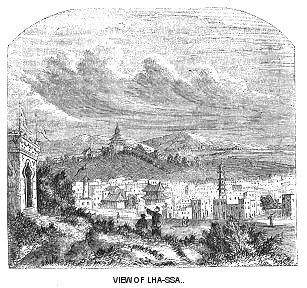
The sun was nearly setting when, issuing from the last of the infinite sinuosities of the mountain, we found ourselves in a vast plain, and saw on our right Lha-Ssa, the famous metropolis of the Buddhic world. The multitude of aged trees which surround the city with a verdant wall; the tall white houses, with their flat roofs and their towers; the numerous temples with their gilt roofs, the Buddha-La, above which rises the palace of the Talé-Lama—all these features communicate to Lha-Ssa a majestic and imposing aspect.
At the entrance of the town, some Mongols with whom we had formed an acquaintance on the road, and who had preceded us by several days, met us, and invited us to accompany them to lodgings which they had been friendly enough to prepare for us. It was now the 29th January, 1846; and it was eighteen months since we had parted from the Valley of Black Waters.