Chapter XXII
Reading edition
ON THE ARTS OF MEROE.
AFFLUENCE WOULD INTRODUCE A TASTE FOR THE ARTS. — THE HEAT OF THE CLIMATE FAVOURABLE TO SEDENTARY PURSUITS. — PRIVATE EMULATION WOULD AFFORD FURTHER ENCOURAGEMENT. — DESIRE OF DISTINGUISHING THEMSELVES BY INTELLECTUAL PURSUITS. — TESTIMONY OF DIODORUS THAT KNOWLEDGE WAS VERY GENERALLY DIFFUSED IN ETHIOPIA. — THE PYRAMIDS OF MEROE THE OLDEST SPECIMENS OF ETHIOPIAN ART. — CIVILISATION OF THE ETHIOPIANS PROVED BY THEIR MONUMENTAL EDIFICES. — THE ETHIOPIANS INVENTORS OF THE ARCH. — EGYPTIAN ARCHES. — ETHIOPIAN SCULPTURE. — PROBABLE CAUSE OF THEIR PECULIAR STYLE. — REASONS FOR PRESERVING IT. — DEFERENCE OF THE PTOLEMIES AND ROMANS FOR THE SUPERSTITIONS OF THE EGYPTIANS. — PLEASING EFFECT OF THE EGYPTIAN AND ETHIOPIAN SCULPTURE. — ADMIRABLE MANNER OF DRAWING ANIMALS, HIEROGLYPHICS, AND THEIR TASTE IN ORNAMENTS. — COLOURING ON ETHIOPIAN SCULPTURE. — THE KNOWLEDGE OF THE ARTS DESCENDED FROM ETHIOPIA. — COMPLEXION OF THE ANCIENT AND PRESENT INHABITANTS. — ACCURACY OF DIODORUS’ ACCOUNT PROVED BY THE MONUMENTS. — TASTE FOR THE ARTS IN A NATION INSEPARABLE FROM OTHER INTELLECTUAL PURSUITS. — WORKS OF THE ETHIOPIAN KING TIRHAKA. — REVIEW OF THE ANTIQUITIES IN ETHIOPIA. — FOLLY OF COMPARING THE PRESENT WITH THE ANCIENT INHABITANTS OF THE VALLEY OF THE NILE.
It has appeared in the preceding chapters, that the kingdom of Meroe was the emporium of the interior of Africa, and from her rich productions, and the abundance of her precious metals, was resorted to by the inhabitants of the regions in her vicinity. This influx of population would naturally oblige many to employ their capital and talent in other pursuits besides commerce. Every branch of industry would gradually improve; a rich and luxurious people would constantly desire new objects to please the fancy, and contribute to the enjoyment of life. The son of the merchant, who had earned great wealth, would, as in our days, be able to reap the fruits of that industry. Some might indulge in foolish extravagance; but others would place their enjoyment in the encouragement of the arts, or in those studies which gratify and enrich the mind, and, at the same time, tend to improve and civilise society.
In so fertile a country, a great proportion of the principal landed proprietors, besides those who had realised large fortunes by commerce, must have been able to pass their lives in literary leisure, and employ their fortune in the encouragement of the arts, and the propagation of science. Even the heat of the climate would contribute to the advancement of civilisation. In Europe, particularly in its northern districts, how many consume a great portion of their time and fortune in the healthy, but rough, amusement of the chase; but in the tropics, the greatest luxury is repose. I have remarked repeatedly, that the rich natives of the climates of the East rarely expose themselves to the heat of the sun, except when necessity absolutely requires it, as on a journey; and even then as little as possible. It is considered one of the greatest advantages of rank and fortune, that its possessors can enjoy the luxury of shade during the whole day, while their less fortunate brethren are obliged to toil under a burning sun.
The same natural causes, operating equally in ancient times, would give to the Ethiopians an inclination for sedentary pursuits, which would be advantageous to their advancement in the different branches of science, as soon as their taste for them had been unfolded. That rivalry which always arises among bodies of men, would urge to the improvement of the arts. The great and wealthy would endeavour to surpass each other in the beauty and magnificence of their palaces, and they would emulously display their piety to the gods, by contributing to the building and decorating the temples, and their munificence and generosity, by the construction of edifices of public utility.
This is not an imaginary picture. Let the reader look at the drawings of Meroe, and candidly say whether, in a country containing architects able to construct such chaste and beautiful monuments, men could have spent the superfluity of wealth, derived from commerce, in mere sensual indulgence? Was the knowledge of architecture, sculpture, and painting, exclusively employed in the construction of the sepulchres of her monarchs and the temples of the gods? Can it be supposed that those who must have had the means, would content themselves with wretched huts, when their wealth enabled them to employ their skilful architects in erecting commodious and elegant habitations, suitable to their rank? Can we imagine that the gentry of a kingdom, famous in antiquity for its civilisation, would spend their time, like the Turks, in listless indolence, and would not seek to distinguish themselves by studies and learning? But Diodorus, speaking of the language of hieroglyphics, says, that, in Egypt, the priests only were acquainted with them, whilst, in Ethiopia, they were generally understood. This shows that civilisation was widely diffused among the people, who apparently were not content, like their neighbours, to view without understanding the tablets of writing and sculpture which ornamented the walls of their temples.
Unfortunately, the remains of pure Ethiopian art, at all events, those of the earliest period, are but few. The pyramids of Nouri, but particularly those of Meroe, must have been built many ages before the temples of Gibel el Birkel, especially the one finished by Tirhaka: the style of the sculpture differs so widely, that a slight examination only is necessary to prove that a long period must have intervened before, in a country like this, the style could have so materially changed. I place, then, the pyramids of Meroe among the earliest specimens now existing of the skill of the Ethiopians. In my description of those ruins, I have extolled the beautiful simplicity of the architecture, imposing, and, at the same time, elegant, in a superior degree to the immense pyramids of Geezah. The sepulchres of Meroe delight us by evincing the greatest purity of taste, while they are not, like the Egyptian pyramids, monuments of the tyranny and oppression of their kings.
The different plates I have given of the sculpture in the porticoes of Meroe, at Gibel el Birkel (see Plates X., XI., and XII., and particularly Plate XI., which contains a number of vases,) display a great degree of elegance, and, perhaps, a refined simplicity, equal to what we find in Egyptian sculpture.
The offerings (see Plate XXIX.) are the animals of the country and surrounding deserts. The group with branches of the palm tree, is quite Ethiopian, and very beautiful; but the splendid procession alluded to, in treating of the commerce, as existing in a tomb at Thebes, is particularly instructive: the Ethiopians are there represented carrying presents to a great man at the time of Thothmes. Besides the ivory, ebony, gold, silver, skins, and animals, enumerated in my last chapter, they are also represented bearing different kinds of vases. These evince a degree of elegance and refinement which has never been surpassed. They are not ornamented with figures like the Phœnician, Etruscan, Greek, and Roman vases, but in taste and elegant simplicity of form they are not surpassed by those of any nation. Such discoveries as these afford the strongest evidence of the civilisation of a people. No learning or profound knowledge of the arts is required to understand, that a nation, among whom have been wrought such rich and magnificent vases as are now to be found in London, could be barbarians.
When a people have attained a certain degree of taste, such knowledge is never confined to one branch. The cultivated minds, which could appreciate such works of art as the pyramids of Meroe, and were accustomed to such a degree of elegance in their domestic ornaments, could not, I conceive, have been uncivilised, generally speaking. These vases, like the chairs and furniture represented on the walls of Thebes, admit us at once to a knowledge of the private life of the people. We cannot doubt the luxury and refinement of the private life of the Egyptians, when we find represented, in one of the tombs of the kings at Thebes, more beautiful patterns of chairs, cushions, &c. than are now to be found in Europe. As little can we imagine, that apartments, ornamented with such elegant vases as the Ethiopians are represented offering to the Egyptians, would not in every other respect be furnished with equal taste. I think, then, that I am not too bold in asserting, that the people who had skill to devise, and ability to execute, such beautiful works of art, are entitled to a very high rank in the scale of civilisation. To the other proofs that they are Ethiopian, I should add, their long curly hair, their peculiar dress, differing from the Egyptian, the similarity with the few vases which I found sculptured on the walls at Meroe, (see Plate XI.) and, most of all, the hieroglyphics written over the procession, which state them to be from the land of Ethiopia.
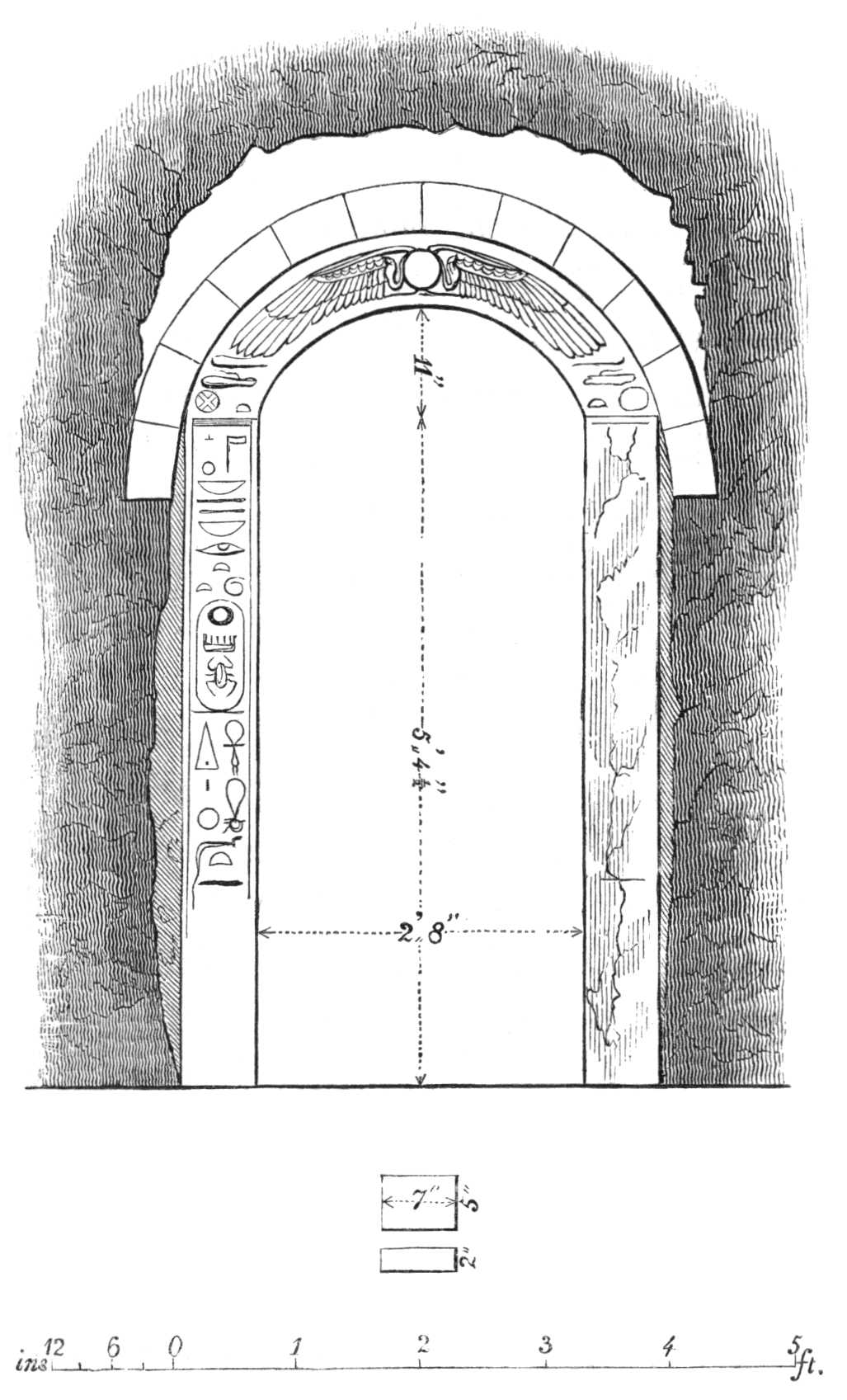
Another important proof of the extensive architectural skill of the Ethiopians is their knowledge and employment of the arch. In my narrative, I have described that which exists in one of the porticoes of Meroe, having the form of the segment of a circle, and have mentioned also the pointed arch in a pyramid at Gibel el Berkel. Both are constructed on the true principle of being supported only by lateral pressure. The pyramids of Meroe being the oldest, we may say that the earliest specimen of the arch now existing is on the site of the capital of Ethiopia. I conceive it very likely, that the necessity of finding some method of resisting the tropical rains led the Ethiopians to the invention of the arch; as of course, slight even as they are here, they would be obliged to pay more attention to their roofs than in Egypt, where, with few exceptions, sometimes, especially in Upper Egypt, not exceeding once in the year, it may almost be said never to rain. The rains which fall at Shendy are, however, rarely heavy. As I have noticed in my topographical description (page 156.), the only specimens of the arch in Egypt belong to that period when wars existed between the two countries, and the Egyptians would have the opportunity of learning that invention from the Ethiopians. It is also singular, that there is not a stone arch in Egypt regularly constructed, except one, before mentioned, of the time of Psammitichus, who reigned after the Ethiopian dynasty. The only specimens which show the Egyptians to have been acquainted with the true mode of forming one, is a brick arch, erected at the time of Amunoph, and another of the time of Thothmes III. They are formed of crude bricks; the size of which is seven inches by five. (See Vignettes.) Is it not singular, that although these and other brick arches at Thebes are regularly constructed, the specimens there and elsewhere in stone, lead us to infer, that they were acquainted with the beauty of the arch as an architectural ornament, but not with its great utility? I refer to that arch near to the temple excavated out of the rock, in the valley of Hassaseef, at Thebes, of the time of Amunoph, which is formed by approaching stones (see Vignette), and numerous excavations in the valley of the Nile, where the roofs are hollowed slightly into the arched form. As, therefore, no specimen of even a brick arch exists before the reign of those kings who carried their arms into Ethiopia; and as the pyramids of Ethiopia are evidently so very ancient, it seems highly probable that this important discovery had there its origin.
STONE ARCH AT THEBES.
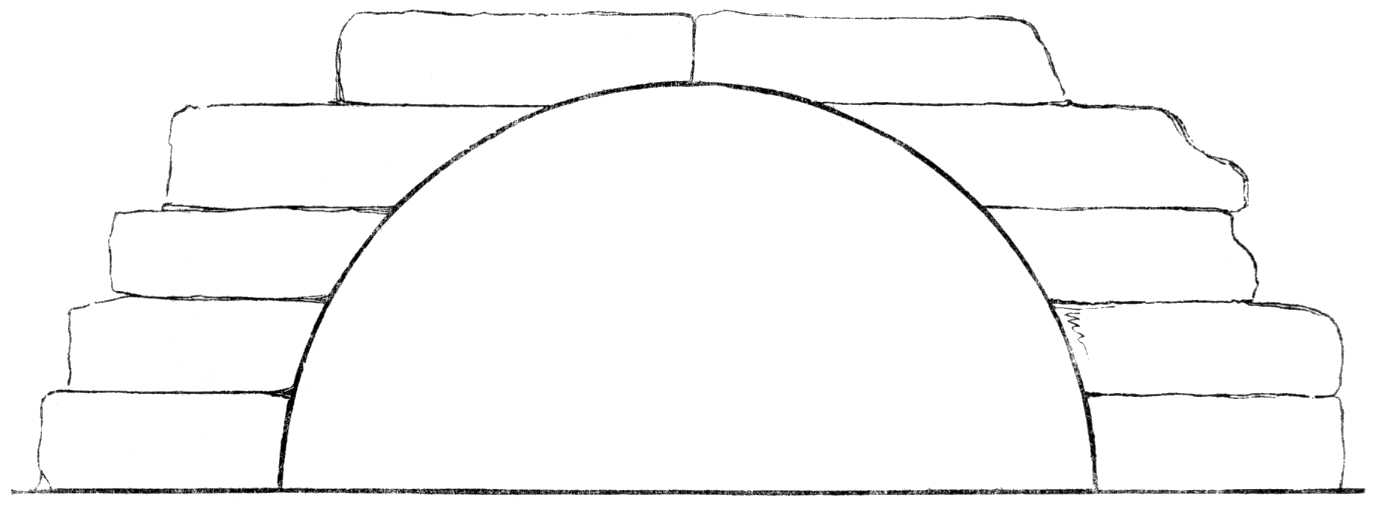
The tomb in which the elliptical arch (see Vignette) exists, is near the valley of the Sepulchre of the Queens, at Thebes. It is almost filled up to the ceiling with mummies, which occasioned great difficulty to get at the spring of the arch. It is a painted tomb, and the roof is plastered; and over the plaster, along the centre, is a line of hieroglyphics, containing the name of Amunoph I.; proving the existence of the knowledge of the arch in Egypt, about fifteen centuries and a half before the Christian era. It is also very remarkable, that this arch is not a segment of a circle, but elliptical. A part of the ceiling being broken, discovered the space between the ceiling and the rock.
BRICK ARCH IN A TOMB AT THEBES.
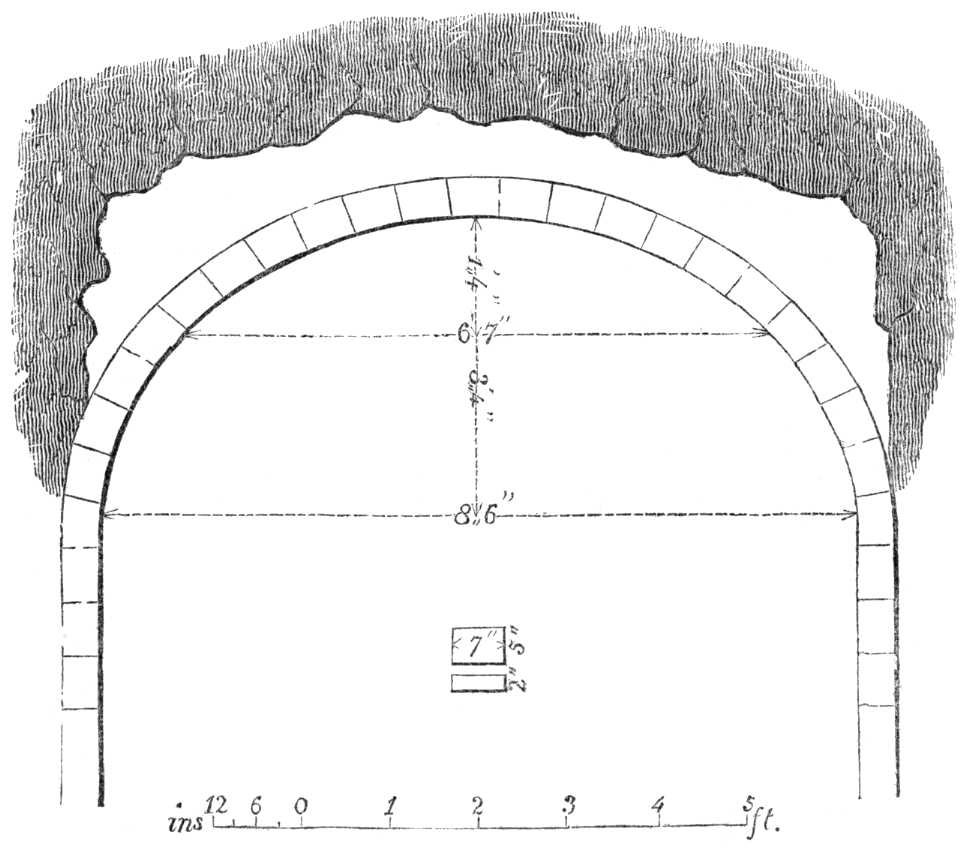
On the road from the Memnonium to the valley of the Hassaseef, a little elevated on a rock, is a very small painted tomb, which is also vaulted. The vignette represents the arch of the roof resting on the rock, and the inner arch of a recess at the end. This recess, as likewise the whole tomb, is covered with a coating of plaster; and on one of the jambs of the recess are the titles and prænomen of Thothmes III., “Sun, Establisher of the World,” fifth king of the eighteenth dynasty, who reigned about fifteen centuries before the Christian era. The present access to this tomb is through a hole in the ceiling, from the floor of another tomb. This fracture discovers satisfactorily the construction of the arch. The sections, therefore, of the pointed arch at Gibel el Birkel (see Plate XXVIII.), of the circular one at the site of the metropolis of Ethiopia (see Plate VII.), and this elliptical and circular arch at Thebes, will, I think, satisfy the most sceptical, that the Romans were not the first who were acquainted with the power and principle of the arch. We have here, undoubtedly, the geometrical forms; and in answer to the cui bono of the learned author of the able article in the last Quarterly Review[92], I must state that the Ethiopian arches were obviously invented to resist the rains; as the peasants of Sennaar have conical roofs to their cottages for the same purpose. The brick arches at Thebes, I conceive to have been erected not merely as ornaments, but, as regards the one of the time of Amunoph III., for the purpose of protecting it from the partial decomposition of the calcareous rock, which happens to be there less solid, while the tomb of the time of Thothmes III., being immediately beneath another, suggested the utility, if not necessity, of strengthening the roof with an arch.
BRICK ARCH IN A TOMB AT THEBES.
The Ethiopian sculpture has the same defects as the Egyptian, as to the manner of representing the profile of the face, but the bodies have a roundness which distinguishes them entirely from the Egyptian. The latter is more graceful and pleasing to the eye, when the traveller is accustomed to that peculiarity of style, but I do conceive the Ethiopian to be, in some respects, more true to nature.
It may be asked why, advanced as the Ethiopians were in the arts, they did not draw the human figure better, and more in accordance with nature. It is difficult, and, I must confess, almost impossible, to explain quite satisfactorily this circumstance. The Egyptians, as I have said, had a style still more unnatural, yet few can doubt their high degree of civilisation. The general form of the figures gives one the idea of their being very early efforts of art. It seems to me very possible, that the invention of the sculptor and painter may have been first exercised on the walls of some celebrated temple; and this defective representation may, from the sacredness of the place, have become the conventional style of the country. The bigotted veneration which the people would naturally feel for those forms under which their divinities were first represented, may have made them consider it lawful, indeed, to improve the delineation, but criminal to attempt to change it entirely.
The Egyptians and the Ethiopians were equally ignorant of perspective. When Egypt was under the dominion of the Greeks and Romans, we perceive that policy and respect for the prejudices of the people prevented those nations from making any innovations in the national style. The differences between the sculpture, at those periods, and during the eighteenth dynasty, cannot be called so much changes, as marks of the great decline of the pure Egyptian art. No figures, on the walls of the temples, are sculptured or painted in the pure Greek or Roman style. Those rulers of Egypt, though of course acquainted with the latter, continued to follow the Egyptian style in all the edifices that they erected. The only instances in which they seem to have deviated at all from this rule, are in some few portraits found on Greek mummies. This renders it probable that there existed a strong religious prejudice on the subject, and that the Ethiopians and Egyptians were as tenacious of the forms and costumes of their divinities, as religious sects, in more recent times, have shown themselves about the dress and appearance of their ministers.
There is, therefore, no reason to suppose, that the Ethiopians were unable to draw figures correctly, because, from reverence to the antiquity of their religion, and the superstition of the people, they did not improve the forms of their divinities. Faulty, however, as that style is, both in design and colour, it has still its attractions, though, in saying so, I may be accused of being an admirer of deformity. Their formality is not inappropriate to sacred edifices. Travellers daily become reconciled to its defects, and at last admire what at first appeared to them so strange. No one can have visited the Tombs of the Kings at Thebes, without an enthusiastic admiration of the beautiful and rich harmony of the colouring, the taste displayed in the ornaments, the spirited execution of the animals and hieroglyphics, and the magical effect of the decorations. We see, in the fragments which still exist, that the Ethiopians drew animals, and also ornaments, very beautifully. We may therefore consider it almost certain, that they could have drawn the human figure better had they been permitted.
There are few traces of colour remaining on any Ethiopian edifice, yet I found sufficient in one of the porticoes of the pyramids of Gibel el Birkel, to enable me to ascertain the important fact, that the colouring was similar to the Egyptian. That of the human body is of the same red tint; and is it not singular that man is represented of the same complexion in Ethiopia as in every part of Egypt? Such a coincidence could only arise from the circumstance of the one people having derived their knowledge of the arts from the other. The colouring of the Ethiopians and Egyptians was of course, like the form of the figure, conventional. Now, I ask the reader, Where is it most probable that this colour was first established? Was it in a country where the inhabitants must have been nearly of that dark tint represented in these sculptures, or was it in one, 1700 miles farther north, where the people must have been, as they are now, yellow, or, comparatively speaking, white. The first colonies which introduced the arts into Egypt would naturally represent their divinities under the same appearance as in the mother country, and the first kings, and other persons making offerings, would of course be the colonists. Impressed with reverence for the first models presented to them, the Egyptians would continue to use this colour, tacitly acknowledging, by this circumstance, that they derived the knowledge of the arts from Ethiopia. There are several representations in Egypt of black men and black queens, but these almost invariably bear the negro features. Even if they were intended to represent Ethiopians, that colour could only be a mark of distinction, afterwards introduced, as of a blacker nation than themselves; for we find the Ethiopians, on their own edifices, represented as exactly of the same tint as the Egyptians of Thebes and Memphis.
If the artist were to paint them of one of the six colours with which they were acquainted,—white, red, green, blue, yellow, or black, the one approaching nearest to what was probably the real Ethiopian complexion, would certainly be the red. We shall be confirmed in this conclusion, if we consider the latitude and the colour of the present cultivators of the soil. Though they speak the Arabic language, they are most probably (and the tradition I heard at Dongolah confirms the supposition) descended from the race of the true Ethiopians, obliged, by force, to adopt the language and religion of their conquerors. That people, from their climate, could not have been white, and, had they been black, they would have so represented themselves. The Copts, the descendants of the Egyptians, are fairer than the Fellaheen, yet the latter look white in Ethiopia, contrasted with the present inhabitants of that country. It must also be considered that the Arab conquerors, being from the southern part of their country, and therefore darkened by the climate and the desert life they led, would, to a certain extent, give a darker tint to the Ethiopians; nevertheless, I have given views of some Berbers whose complexions are decidedly lighter than they are represented on the walls. (See Plate XVI.) We must recollect also that it has ever been a custom of the Orientals to represent themselves and their mistresses as beautifully fair. The present Ethiopians esteem nothing more than a light complexion. Before they were accustomed to Europeans, they looked with horror on what they considered their unnatural whiteness; but if an Ethiopian is celebrating in a song the charms of his mistress, he dwells with the greatest rapture on her fair skin. The petty kings seek wives of equal rank with themselves, chiefly on account of their fair complexion, which the daughters of the meleks acquire by being generally confined to the house; particularly as all mixture with the negro blood is carefully shunned. The colour most approaching to nature, if this conventional one had originated in Egypt, would certainly have been the white, or rather light yellow. Such must have been the colour of the Egyptians; and we cannot suppose that they would pay themselves so bad a compliment as to represent their complexion so many shades darker than it must really have been. Here then we have another great proof that civilisation and art descended the river. I have mentioned, in my topographical description, the passages of Diodorus which state shortly, but explicitly, that the Ethiopians stated the Egyptians to have derived all their knowledge from them. The inquiries of that intelligent traveller penetrated through the veil which the pride of the Egyptians, jealous, and anxious to magnify their antiquity, had thrown over the origin of their institutions; and when to this national propensity we add the obstinate wars, which would naturally eradicate every attachment to their parent land, and induce them to conceal their obligations to Ethiopia, it appears surprising how that intelligent traveller should have been able to ascertain the fact, that civilisation descended from Meroe. Diodorus had no object in inventing that account; and if the Ethiopians gave it to him in Egypt, he had there the means of ascertaining the truth from the priests and other learned men, who, no doubt, were acquainted with the fact; and would have contradicted it if he had not believed it. Herodotus apparently heard a similar account. He visited Egypt during the time of the Persian dynasty, while Diodorus was in that country little more than half a century (sixty years) before Christ, when the philosophy of the Greeks may have penetrated through the pride and false pretensions of the Egyptian priests. Herodotus states that the Egyptians believed themselves to be from where the race of man first existed (ἐξ οὗ ἄνθρωπον γένος ἐγένετο). He mentions that the Thebaid was Egypt before the formation of the Delta[93]: the increase of population forced them to spread themselves down the valleys, emigrating from the Thebaid to the Delta, in the same way, no doubt, as they originally emigrated from Meroe. There is one question connected with this subject, which, I must confess, is an important one; namely, by what language the hieroglyphics of both countries are to be interpreted. Is it by a common one, as emanating from the same origin, or by a different one in the two countries? I shall not now commit myself by a discussion and hasty opinion on a subject which I hope to be better able to treat, as I extend my acquaintance with hieroglyphics, and with the Coptic and the Ethiopian languages. It seems to me, however, that if the Egyptians derived their knowledge of hieroglyphics from Ethiopia, they would, of course, receive from the same source the language by which they were explained.
With regard to the early literature and science of the Ethiopians, we know them only by the monuments; but we may rest satisfied, that they could not have been neglected in a country where, as Diodorus says, the language of hieroglyphics was generally understood. The existence of these on the walls of the porticoes of the pyramids, is a proof that some at least were acquainted with them. It is a very remarkable circumstance, which, even at the hazard of repetition, I must impress upon the reader, that notwithstanding the little sculpture and the few monuments that remain, there is sufficient to corroborate the very words of Diodorus. The reader who has examined my drawings will agree with him, that the Ethiopians buried their dead with as much pomp as the Egyptians; the processions were the same; and although there is some little difference in the style of the sculpture and hieroglyphics, it certainly is my conviction, that the Egyptian style had, as he very correctly expresses himself, its origin in Ethiopia.[94]
History affords no example, at least that I know, of a people being so advanced in the fine arts, without at the same time having applied themselves to the cultivation of the sciences, of history and philosophy. Their religion, as I may show on another occasion, evinces their acquaintance with metaphysics, not being a gross mythology, but the worship, under different forms, of the one great Divinity, whose attributes are manifested in the wonders of the creation. A people who had evidently so much taste for the arts, must have been sensible to the charms of study. Those who had the means would naturally wish to distinguish themselves, or at least their children, by various literary acquirements. Individuals seeking to elevate themselves above the common level would rise together, and what was at first an extraordinary attainment would become necessary to secure admittance into society.
The remarks which I have hitherto made on the arts of Ethiopia are chiefly applicable to their earliest period. In my narrative I have mentioned, that there are still the remains and traces of 80 pyramids at Meroe, 42 at Nouri, and 17 at Gibel el Birkel. In the few which are now nearly entire, the porticoes are decorated with figures sculptured in the round and bulky Ethiopian style. It is impossible now to determine positively whether these are representations of private individuals, of kings, or of members of different royal families. They represent in several instances, two persons,—a king and his wife, and there is one instance of a queen only. The tombs which we can ascertain, from the hieroglyphics, to be those of kings and queens, being not of superior, or even equal magnitude with many of the others, I think it not unreasonable to conclude, that every one of them was erected for a sovereign or some members of a royal family. If they were each of a king or queen who had reigned alone, the immense number which can even now be traced, independent of the many which the desert has swallowed up, would carry us back to an earlier era than can be admitted, for it is evident, from the style of the sculpture, and other appearances of the monuments, that they were erected long previous to the time of Tirhaka, (730 years B.C.)
That Ethiopian king, who reigned over Egypt, constructed a magnificent temple at Gibel el Birkel, which city, if not the place of his birth, and at one time the seat of his empire, was at all events peculiarly favoured by him; for we do not see his name on any Ethiopian edifice, except on an altar in the great temple, and on the walls and columns of the temple of Athor at Birkel.
Part of the temple of Tirhaka is excavated out of the rock, either in imitation of those he had seen in Egypt, or it may perhaps be a more ancient temple, added to and decorated by that king. The style of sculpture at that time was tolerably good, very like the Egyptian, but by no means equal to the best at Thebes. The architecture, however, seems to have then very much declined. The columns of Athor and the deformed Pthah in the temple built by Tirhaka, are very inferior to the fragment we have at Abou Naga, and the great temple at Gibel el Birkel, built, perhaps, by Pionchei, probably a much more ancient king. That edifice, for magnificence, may be compared to any in the valley of the Nile. I may here also remark, that, notwithstanding the great pecuniary resources which Tirhaka must have possessed, as king of two such rich and powerful countries as Egypt and Ethiopia, still the temple erected by him is not to be compared to the splendid edifice of his predecessor.
It is singular, that, with the exception of the remains of this large temple, and some other less important vestiges of smaller edifices there, the colossal statues of Argo, the Ethiopian temple of Amarah, the fragment of an Ethiopian ruin at Naga, on the Nile, and the Ethiopian temples at Mecaurat or Naga, in the desert (see Cailliaud), there are no remains of any sacred edifice of an earlier period than Tirhaka, or indeed of a later, except the ruins at Wady el Owataib. The sepulchres of the kings only are standing. The temples which remain in the best state of preservation above the second cataract are those of Semneh, built by Thothmes III., an Egyptian king, and the magnificent temple of Solib, built by Amunoph III., also an Egyptian monarch. Petronius, in his hatred for every thing that was Ethiopian, probably destroyed all the edifices which had escaped from the ravages of previous wars.
If Gibel el Birkel was Napata (as it is considered by many), the temples might have been destroyed by Petronius, but I have before stated, that I cannot conceive it to be that town. We must therefore attribute its destruction to an earlier era, or to the Christians or Arabs. The great temple of Gibel el Birkel must have required great labour to demolish it so utterly. The immense and massive columns and thick walls would have lasted for ages, had they not been destroyed by violence. As no attempts have apparently been made to restore these edifices, the place was perhaps deserted, and the name erased from among the list of cities. My drawings, plans, &c. of the temples of Semneh, Solib, and the small temple at Gibel el Birkel, will show that they are exceedingly ruined, yet not with the same dreadful destruction as the large temple at the latter place, and others, of which scarcely a vestige remains.
Some of the pyramids of Gibel el Birkel and Meroe bear evidence of the greatest violence having been employed to destroy them, whereas others seem injured only by time. The demolition of the former, may, I conceive, be entirely attributed to the avarice of the Mahometans. The very nature of the construction of the pyramids would certainly present greater difficulties in destroying them, but this could not have been the motive in forbearing from the attempt; for all events it would have been easy for the levellers of whole rows of immense and lofty columns to demolish entirely every portico. That respect for the sepulchres of the dead, which has existed in every age, among civilised and uncivilised nations, prevented probably the devastators from violating the pyramids of Meroe and Nouri, whilst, at both those places, every trace of the temples has been obliterated. Religious bigotry must have been the cause of this violence. The invaders, while they respected the habitations of the dead, the sepulchres of ancient kings, might consider the destruction of the sanctuaries to be the surest mode of eradicating every trace of the idolatrous worship of Ammon.
The monuments of Ethiopia present unfortunately no regular series of edifices by which we might trace the progressive rise and subsequent decline of the arts. There is as wide a difference between the most ancient sculpture and architecture of Meroe and that of the time of Tirhaka, as between the latter and the far more modern edifice, the ruins of which are now called Wady el Owataib. In my description of the latter, (see narrative, Chapter VIII.) I have stated my belief that it was erected during the last stage of the arts. The confused and extremely defective plan, and the wretched style of the sculpture, are proofs that it must have been built very long after the reign of Tirhaka. I have mentioned also that, from the design, and from a certain affectation of Greek ornaments, particularly in the fluting of the columns, I conceive it not improbable, that this, and also, perhaps, the Greek edifice at Mecaurat, were erected by the Ethiopian king Ergamenes, who had a Greek education, and was contemporary with Ptolemy Philadelphus.
It will be remarked, that there is a vast difference between these monuments in Ethiopia, and the magnificent architectural edifices erected at that period in Egypt; but we must recollect, that the dynasty of the Ptolemies infused fresh vigour into every pursuit connected with the prosperity of the country. The first kings of that dynasty occupied themselves almost exclusively in promoting the commerce and encouraging the literature and arts of the country. The sculpture indeed was then very inferior to the pure Egyptian; but their temples, notwithstanding this inferiority, may rank among the most splendid edifices which ornament the banks of the Nile, or even any part of the world. But Meroe did not enjoy the same advantage. The extended commerce of her rival would of course diminish more and more her own prosperity. Her territory declining continually in richness and affluence, and her commerce impaired, her kings, instead of occupying themselves in encouraging the arts, would require all the resources of the state to save them from becoming the prey of their more powerful neighbour.
The next and only additional edifice which I have now to notice, as marking the last epoch in the history of the arts of Meroe, is the Christian church opposite Gibel el Birkel. As we have no certain ground to suppose that Christianity was much spread in Ethiopia before the year 330[95], a later date cannot be assigned to that structure. I conceive it to be one of the earliest Christian edifices erected in that country, as I have remarked, in my description of it, that it is ornamented with the Ethiopian cornice and beading. This is the most modern architectural construction that now remains in Ethiopia.
The Arabs at their invasion do not seem to have brought with them the talent and means to erect any of those splendid mosques which they have reared in honour of their prophet in other climes. I have elsewhere described the dwellings of the present inhabitants. They are miserable mud and straw huts, some of the latter having conical roofs, a remnant of the knowledge of the arch. The fortified castles of the chiefs are superior to these, but necessity only has taught them to build towers and thick walls for their protection: nothing can be more barbarous and rude than their internal structure. For the man who has made himself independent, or is ignorant, of the luxuries, elegancies, and comforts of life, they are perhaps sufficient, since they afford shelter against the summer heat, the occasional showers of rain, and the winter cold; but it is impossible to have a more striking evidence of the effects of civilisation, than the contrast between the wretched abodes of the present inhabitants of Ethiopia, and the magnificent sepulchres of her departed kings.
Some writers even of ability affect to doubt the civilisation and great power of the Ethiopians and Egyptians, particularly the latter. They reason on the present condition of the country, without reflecting on the great changes it has undergone. I may add, that they display little knowledge of Egyptian subjects, and even of the history of the arts in general. They would otherwise be aware of the time necessary for a nation to acquire the degree of taste, knowledge, and affluence, necessary for the construction of such edifices as those still existing in the valley of the Nile. Setting aside altogether the authority of historians, let us only compare the present inhabitants, who are almost destitute of any ideas or information, incapable even of rearing for themselves a suitable abode, with a nation whose architectural proficiency has never been surpassed, and whose advancement in so many branches of science and civilisation is established by the indisputable evidence of lapidary inscriptions. It were vain to expect to find at the present day in this part of Ethiopia, an individual capable of constructing such edifices as we have seen existing at Meroe. I do not hesitate to say, that were it possible to transport one of the pyramids of Meroe entire to London, it would be considered one of the most chaste and beautiful ornaments of our metropolis. Though constructed more perhaps than three thousand years ago, it might, even now, be studied with advantage by our artists and architects.
When such observations are applied to Egypt, the answer is still more easily made. Where in Europe is there an edifice like the great temple at Karnak, one hall of which contains 140 columns, 36 feet in circumference, dimensions rarely to be found in Europe, and every portion of that splendid court covered with carefully finished and painted sculptures? Having, however, trespassed so long on the reader’s patience, I must not now allow myself to enter on the subject of Egyptian art. I will only say, in conclusion, that the materials used in the pyramids of Memphis are sufficient to construct a city, and that no palaces of Europe are comparable in splendour to the Tombs of the Kings at Thebes.
THE END.
London: Printed by A. Spottiswoode. New-Street-Square.