APPENDIX. (continued 2)
Reading edition
While all these tribes roam about to the north of Wára, I now class together those settled, at least part of the year, in the valley of the Bat-há. These are the Missiríye, the third tribe amongst the Wádáy Arabs, in respect to numbers, and divided into two sections, viz. the Missiríye Zorúk, or the black (dark) ones, and the Missiríye Homr, or the red ones—Dómboli is the chief place of residence of the Missiríye; then the Khozám, the next in point of numbers; the Zóyúd, the Jʿaátena, the Zábbadé, and the ʿAbidíye; to whom may be added the Nuwʿaíbe, who keep more to the north of the Bat-há. Next in order may be named the Sábalát, a rather indigent tribe, who breed cattle for the king, and supply his household with milk. South of the Sungóri are the settlements of the Kórobát, whose chief place is Ténjing, east of Týnjung, which is two days from Sheníni. On the rich pasture-grounds, fed by a shallow water called the bahr e’ Tíni, four days S.E. from Birket Fátima, there are the wandering tribes of the Kólomát and the Térjem; while towards the S.W. extremity of the empire, on the borders of another shallow water, probably without any current, and called after the tribe which I am just about to mention, there are the settlements of the Welád Ráshid, close to the eastern borders of the pagan dependencies of Bagírmi, and part of them settled even in the midst of those pagan tribes, principally amongst the Búwa Kúli, with whom they are said even to intermarry; they are particularly rich in horses of small breed, and possess considerable property.
Finally, there is another group of Arab tribes, who pasture their cattle near another shallow water, which seems to me to have likewise very little inclination, and is generally called Óm e’ Timán, but very often named after the tribes who are settled on its borders. There are towards the east, not far from the Bándalá, the Sálamát, a rather numerous tribe; to the west of them the Hémád; and, finally, the Shárafa, who occasionally also visit the bahr e’ Tíni. Besides these, in the western extremity of the empire there are the Dúggana or Dághana, who were in former times dependent on Bórnu.
With regard to their colour, all these Arab tribes may be distributed into two groups, namely, the “Zorúk,” and the “Homr.” To the first group—the dark-coloured tribes—belong principally, the Missiríye, the Zorúk, and the ʿAbidíye; while the Máhamíd, the Ráshid, the Khozám, the Hamíde, and the others mentioned above, constitute the far more numerous group of the Homr.
APPENDIX VIII.
GOVERNMENT OF WÁDÁY.
It appears, from the above exposition of the various elements of which the population of the country of Wádáy consists, that its government cannot but be of a varied composition, and that it has not as yet assumed an harmoniously concentrated character. If we investigate the manner in which the government of this number of various nationalities is in general managed, we have first to observe that, no doubt in imitation of Dár-Fúr, the whole of the empire of Wádáy is divided into four great sections: viz. the inhabitants of the western districts, or “Lulúl-endí;” those of the southern provinces, or “Motáy-endí;” those of the eastern districts, or “Talúnt-endí;” and, lastly, those of the northern ones, or “Túrtalú.” Over these four large departments or provinces a like number of Kemákel or Kamkoláks have been placed, the Kamkolák of the west, at present K. Nehéd, having his residence in Gosbéda, a village belonging to Máshek, three days W.S.W. from Wára; the Kamkolák of the southern districts, at present Mohammed, having his residence in Kúrkutí, two days south from Wára, on the Betéhá; the Kamkolák of the East, at present Abákr (Abú Bakr) Weled Méram, residing near the frontier of Dár-Fúr; and, finally, that of the north, at present Sheikh-el-ʿArab, son of Tondó, residing in Mégeren, about twenty miles north from Wára.
Besides these four principal governors or Kamkoláks, there are four smaller ones, called Kamkolák-endikrék, who appear to be the substitutes of the former, but seem besides to have some particular duties to perform. Their names at present are Kamkolák Násr, belonging to K. Nehéd; K. Hejáb, stationed in the south; K. Kélingen, and Kamkolák Rákeb.
These Kamkoláks in general have the management of all public affairs in the provinces, and have the power of life and death, and wherever they go they levy the “dhiyáfa,” properly the present of hospitality, a sort of tribute regulated according to the size of each respective place. However, they seem to have nothing to do with the Arab population, and even with regard to the indigenous tribes there are many exemptions from their authority, several of those clans, especially the Táma, the Kodoyí, the Bulála, the Míddogó, and some of the Ábú Sháribs, having powerful chiefs of their own, and some of the pagan tribes having retained their former princes. Moreover, a great many of the places inhabited by indigenous tribes have been allotted to the Ágade or Agíds, who were originally appointed as governors over the Arab tribes, so that on military expeditions the Kemákel have not nearly so large a force under their command as the Ágade.
Besides, as far as regards the eastern districts, a particular Agíd e’ sybba (sábah) has been appointed, who exercises a distinct function from that of the Kamkolák of the east, and has his residence in Bír-Tawíl, a place near the frontier of Dár-Fúr, though originally his authority extended only over the Kórobát.
The following is a list of the present agíds or ágade, together with the tribes over which they rule, and the chiefs each tribe has of its own.
Name of the Agíd. Name of the Chief. Name of the Tribe over which they rule.
Jérma, nephew of Mohammed Sáleh ʿAbd e’ Salám Hagar Máhamíd.
Tamóki Shíggerát.
Goddúm Séf e’ Dín.
Bení Hassan.
Músa Khabásh Welád Jenúb.
Sherf e’ dín Maharíye Welád ʿAlí.
Mágené Yaríma Missiríye Zorúk.
Dágga Magáddam Missiríye Homr.
(Kamkolák Nehéd) Allajád Zoyúd.
Mámmedí Riyát Nuwaíbe.
Fadalállah (Fadhl-Allah) Sheikh Sáleh Jʿaátena.
Al Bahér Dúggana.
Jérma Shógoma (Not known to me) Khozám.
Hanno Dilla Hamíde.
Rádama
Barka Méser Sindur ʿAbidíye.
Jérma ʿAbd el Azíz Sáleh Kólomát.
Gádi Fákih Yakúb Térjem.
Bakhéd, Agíd e’ sybba (Chief not known) Kórobát.
Sʿaíd Diyáb, with the surname “sídí jénún” Sálamát.
Rekék, whose daughter is married to the king Shárafa.
Jedd el Móla Hemád.
Horr Sheikh Anje Sábbada.
Danna Halíb, a woman Ráshid.
(Not known) Máfer Sábalát.
ʿAbd-el-Wáhed Diyáb Debába, a section of the tribe of this name.
Fákih ʿAlí, or ʿAlío, called Agíd-el-bahr; his father Beshára died at Kúsuri Ádim, next to whom in authority is Kharith Asále’.
Tebu Tribes.
Áb Kashélle Kréda.
Bírre Ábú Nakór Shinnakóra,
Sákerdá.
Sákeré.
Madamée.
Fámálle.
These agíds, the most powerful of whom is Jérma, to whom the half of Wádáy is said to belong, exercise a very great authority in times of peace, as well as in case of war; for they have not only to inspect the state of their respective districts, and to collect the tribute, but they have also to assemble the troops, and lead them into battle; and they are continually undertaking great expeditions on their own account. After Jérma, the agíd el bahr, to whom Moíto, the north-easternmost town of Bagírmi, has still to pay a special tribute, besides the general one which Bagírmi pays to Wádáy, is the most powerful on account of his numerous cavalry; then follows, it seems, the Agíd of the Jʿaátena, and Dúggana. The Agíd-e’-sybba, is very unpopular on account of the extortions and vexations to which he is continually subjecting travellers and pilgrims, who on that account shun his territory as they would the haunt of a wild beast.
Each of these agíds has a khalífa, or substitute, called agíd-el-birsh, whom he sends into his province if he does not wish to go himself, and some of whom exercise considerable authority by themselves; and besides this person an Emín is also added, on the part of the sultan, in order to inspect and control the collection of the tribute, and to see that the due proportion, viz. half of the dhiyáfa, is sent to the sultan.
Tribute.—The tribute or tax, called here “diván,” varies greatly according to the wealth and character of the productions of the several districts. But as a general rule, an inhabitant of any town in Wádáy Proper, besides occasional contributions or presents, has to pay for himself two mudd—a measure containing twenty-two handfuls of corn, or rather dukhn; and, together with the other inhabitants of his town, a certain number of camels; while with regard to the Arabs, every chief of a family has to give a káffala of two heads of cattle every third year, and if he be a fákih, but one. But besides this general tax, there are some smaller ones for the black natives; as, for example, on each of the great Mohammedan holidays, every village has to present to its Ajuwádi, that is to say, to the person upon whom it has been settled as an estate, one makhaláye—a measure containing three mudd or medád—of dukhn, and has also to make the same present to an officer in the palace called “Sídi-e’-derb,” as well as to the “Sídi-el-alboye;” the larger villages or towns have to give more in proportion, as much as ten mekháli; and besides this, on bringing their tribute to the king, the smaller villages have to present their Ajuwádi with one camel-load of dukhn, and the larger ones with more. The native negro population of Wádáy Proper have not to pay any cattle or tokáki (strips of cotton), except at the special request of the king; but certainly with them also the various character of the productions of their district, and the wealth they possess, are taken into account; the Sungóri, for instance, whose excellent race of horses I have mentioned above, are said to pay every year a tribute of one hundred horses; and the tribute of the Gémir and the Týnjur is entirely confined to rice—wild rice—with which they have to supply the household of the king.
As for the Arabs, besides the general tribute or káffala mentioned above, they have to give to the king himself the “nóba,” that is to say, once in three years, every four men, one cow; and on each holiday, every encampment has to furnish a young cow; and besides this, they are greatly annoyed by the expensive dhiyáfa, which, as I have stated above, they have to present to the agíd-el-birsh on his annual visit, while on the whole it is well known that the Wádáy people keep the Arabs settled in their country in very strict subjection, and do not allow them to collect any considerable property for themselves. As for the Máhamíd, they pay their tribute entirely in camels, and are said to make up every third year the number of one thousand camels, while the ʿAbidíye, who have very little cattle for themselves, but breed cattle for the king, they have to pay their tribute in butter.
With respect to the indigenous tribes in the outlying provinces of Wádáy Proper, the tribute or diván imposed upon them varies greatly. For example, the Dájo have to give 1000 tokáki, besides honey, wherein consists the whole regular tribute paid by the provinces of Dággel, Kebáit, and of the Bándalá; while Sílla, besides honey, has to furnish a certain number of handsome female slaves; and Rúnga, in addition to a certain quantity of this favourite article (viz. honey), 100 large elephants’ teeth every year, or half of the value in slaves. The tribute of Gúlla, and of the adjacent pagan states, consists solely of slaves. As for the Tebu tribes, the Zogháwa have to furnish a certain number of horses, while the tribute raised on the Gurʿaán, as far as they are dependent on Wádáy, consists of camels.
Here, finally, I have to mention the diván paid by the king of Bagírmi, down from the period when ʿOthmán, father of the present ruler of that country, solicited the assistance of Sabún, in order to reconquer his country from the facha, as I have stated in my account of Bagírmi. This tribute, which was levied the very year of my residence in Más-eñá, consists of 100 horses of indifferent description, 100 slaves, 30 serári or handsome female slaves, and 1000 shirts, or gumsán. This tribute, the whole value of which, in Bagírmi, is from 2500 to 3000 dollars, is paid every third year, besides a present of 10 serári, 4 horses, and 4 gumsán to Jérma, Weled el Méram, who has the superintendence of this dependency. For there is a superintendent, or as the Wádáwy call it a “Kursí,” for every province without the borders of Wádáy Proper; and Jérma, besides having all those Arab tribes above mentioned under him, is the Kursí, not only of Bagírmi, but likewise of the whole Fittrí, of the Dájó, and of Míddogó. The present Kursí of Runga, whose name is Sheríf, has his residence in Sheníni, which, together with the neighbouring villages, has to furnish him with necessaries, and he visits that province annually, in order to levy the tribute. The Welád Ráshid also, partly owing to their considerable distance from the capital, and partly, as it would seem, on account of their being deeply sunk in paganism, although they have a special agíd, have likewise, together with the Sálamát, had a kursí established over them.
The Fásher and Members of the Fásher.—After having given this short account of the external government of the country, if I may so call it, I now proceed to the interior; but, as there is naturally no civil government, I content myself with naming the persons composing the Fásher, or Royal Council, where the present sultan Mohammed Sheríf however never appears. This council is held in an open place, which is likewise called Fásher, where all public business is transacted. The president of the Fásher, and the first of the “Fásher-melé” or members of the Fásher in authority, is the Sing-melék, or, properly speaking, the master of the gate, but whose character and authority evidently approach those of a vizier, all business, as far as regards the internal operations of government, being principally transacted by him. The present Sing-melék is said to be a person of intelligence, of the name of Ashén, the younger brother of the powerful Jérma, Weled el Méram, who surpasses him in material power and wealth. But with regard to the composition of the Fásher this Jérma is to be ranked next to Sing-melék. Then comes Kamkolák Rákeb, who appears to have the authority of a major-domo, then Emín ʿAbd-Alláhi, a brother of Sing-melék, who is the inspector of the shirts, that is to say, the private treasurer of the monarch; next in order is Kursí Ábú Bakr, son of Ábú Horra, the person mentioned above, at present stationed in the territory of the Kodoyí; Kursí ʿAbd-Alláhi, who has the inspection of the Welád Ráshid; the Agíd el Máhamíd; the Agíd of the Welád Ráshid; the Agíd el Jʿaátena; Agíd e’ Sálamát; Agíd el Khozám; Agíd el Birsh; Agíd el Édderí; Maigenék, a person whose duty it is to proceed with his troop in advance of the sultan, in case of an expedition, like the Jérma in the Bórnu army; Kamkolák Mohammed Wókilík, K. Nehéd, K. Tandó, K. Ábú Bakr, Agíd el ʿAbidíye, Kursí Rúnga, Agíd e’ sybba; K. ʿAtamán (ʿOthmán), Agíd Ammárga, an officer of the household, Agíd Sálem, inspector of the corn supplied to the palace, Agíd Yúngo, likewise for the interior, Milleng-díme, khalífa of the Kamkolák of the southern provinces, Milleng-túri, Khalífa of the governor of the eastern districts, Mohammed Jégeles, khalífa of the agíd of the Máhamíd, Mohammed Dahába Bódda, substitute of Kamkolák Mohammed, khalífa Fód, whose station is towards the S.; Kubár, an Ajuwádi, who has his residence in Ábgudám, eleven days S. from Wára, and others of minor authority.
The order in which I have enumerated the members of the Council, is nearly that of their rank. As for the Mómó, or queen mother, she is sometimes asked to give her opinion, but she never appears in the assembly.
Army.—I shall add but a few words concerning the military department. After various minute inquiries, I think I shall not be wrong in stating the cavalry of Wádáy, in which, as in almost all these countries, the strength of the army consists, at seven thousand horse. Of these about one thousand appear to be clad in coats of mail or “derret,” while, on account of the communication with Ben-Gházi, the number of these coats of mail are annually increasing, every caravan bringing several camel-loads of them, which sell for one or two female slaves apiece. The horses are said to be excellent; and exposed as they are to storm and heat, never enjoying the protection of a roof or shade, they are able to support the greatest fatigue, while at the same time those of the great men at least are said to be fed sumptuously with rice and milk. All the horses of the sultan, which bear the special title of “aruwáil” (sing. rawáil) have each of them a particular name. The number of muskets in the army is very small, the Wádáwy themselves having assured me that there are not more than about 300; for the strength of the people of Wádáy consists in their spears, while the Fúráwy trust almost entirely to their swords.
As for the commanders on an expedition, their rank, according to the number of the troops which they lead into the field, is as follows. After the sultan and the Sing-melék, certainly nobody can emulate Jérma, the agíd of the Máhamíd, after whom follows Jérma ʿAbd el Azíz, and then Kamkolák Rákeb; these are free men; then follow the slaves, viz. the powerful agíd el Bahr; then Fadalálle, the agíd of the Jʿaátena, Sʿaíd, agíd of the Sálamát; then Dánna; Dágga, who is the Édderí of the army, that is to say, he has the command of the rear; then Mágené; El Horr; Hánno, the Agíd of the Hamíde, who is not a slave, but a native of Wádáy; Jérma Shógoma; Káffa, and others.
There are several captains of the sultan’s own cavalry with the title of Jérma: as Jérma Angarútú, Jérma Dhohob, J. Rebek, J. Kaukob, J. Hassan, J. Siyáde, J. Dháhab, J. Fudhl, who has his station generally in Kánem, J. Mongó, and J. Benáy.
Household of the Sultan.—The principal persons composing the household of the sultan of Wádáy are the kolótus and the mérams, the former title being given to every son of the monarch, and the latter to all his daughters. Of kolótus there were during my stay in Bagírmi five. Mohammed, the heir apparent, who already at that time was said not to be on good terms with his father, was born of a Púllo or Fellatníye woman, whom Mohammed Sáleh married in Kordofán, and for this reason the greater part of the people of Wádáy did not wish him to succeed to the sovereign power. ʿAlí and Ádim were born of one and the same mother, Mádem Shékoma. Khodr, the third son, and Makhmúdi, are by another mother. After the kolótus and mérams follow the hábbabát, or, as the Wádáwy call them in their own tongue, elísi (sing. elík), the wives or concubines of the sultan, of whom Shékoma and Sokáy were said to be the favourites.
The officers who have the management of the household of the monarch, or part of it, under their inspection, are as follows: the barákena-kolí, meaning royal servants in general; the daláli-kolí, or “siyáde el alboye,” who have to make and repair the tents; the tuwerát, or messengers; the motór-melé, or bearers of the spears; the tangna-kolí, or pages and chamberlains; the ayál-legedábe, or messengers waiting in the shed or hall, “legedábe,” for the occasional orders of their master; then the kórayát, or siyád el khél, the masters of the horses, the gárrafín, or “siyád el kholgán,” the masters of the shirts and “tokáki,” and, finally, the ártu (sing. arak), or, as they are called here, shiúkh, the eunuchs, or the masters of the female department.
Character of the Towns and Villages.—The dwelling-places throughout the whole extent of Wádáy are in general small; and I have been assured by the natives themselves that there is no town containing one thousand separate dwellings. Indeed Wára, till recently the capital and residence of the monarch, which in 1852, on account of the seat of government having been transferred to Abéshr, was every day becoming more and more deserted, scarcely contains above four hundred houses, while Nimró, the famous seat of the Jellába, is stated not to exceed two hundred. In general the towns or villages of the Kodoyí are said to be the largest, some of them containing as many as six hundred houses, while those of the Mímay are said to be the smallest. But the largest place in the whole of Wádáy is said to be Kódogus, two days west from Sheníni.
The houses or huts consist, like those of all the rest of Negroland, of groups of round, bell-shaped huts, made of reed, and called “máharéb,” or “samavi,” in the Wádáy language, enclosed by a wall or fence, “sherágena-dalí,” and but very rarely, as is the case with the houses of the king and those of the persons of rank on one side and the Jellába on the other, built of clay. But the Arabs live in portable huts, made of mats which they themselves manufacture of the leaves of the deléb-palm, and which are called “réri” by the Wádáwy.
Commerce and Market-places.—Almost all the commerce, on a large scale, which is carried on in Wádáy, is in the hands of the Jellába; a considerable number of this peculiar stock, whom I have not classed above among the various tribes inhabiting that country, having migrated into Wádáy about a hundred years ago, from the valley of the Nile, and principally, though not exclusively, settled at present in Nimró, a place about eight miles S.W. from the former capital. Separated into several bodies, these merchants by birth have each of them his own route of commerce; thus, there is one body of Jellába who go annually to Runga; another body frequents the copper-mines south of Dár-Fúr; others take their merchandise only to the distant provinces towards the S.W., viz. the territory of the Welád Ráshid and the neighbouring pagan countries on the borders of Bagírmi, namely, Bedánga, Gógomi, Ándi; while others again visit the markets of Bagírmi, Logón, and Bórnu; some of them visiting Más-eñá during my residence in such numbers that they built a considerable village for themselves outside of the town, on the road to Ábú-Gher; while another band visits annually the markets of Dár-Fúr and Kordofán, others, and especially the wealthier individuals, frequently follow the recently-opened caravan-road to Ben-Gházi, of whose history M. Fresnel has given such an elaborate account. Each of these bodies when en route has its chief or agíd appointed over them by the sultan, to whom he is responsible for a handsome tax raised on the profit obtained.
The principal objects of this commerce in general are the following articles: salt, brought by the Máhamíd and the Tebu to Nimró and Wára, and bought by the Jellába in large quantities, in order to be sold by them in detail to the most distant provinces—even as far as Logón; copper, brought chiefly from the famous copper-mine “el Hófrah,” and from Runga, and exported, principally to Bórnu, where it fetches a high price; European articles, brought by the caravans from Ben-Ghází, or imported also from Egypt by way of Dár-Fúr, such as fine clothes, bernúses, coats of mail, beads, and other ornaments, calico, paper, needles, &c., ivory, principally taken in exchange from the Rungáwy, the Welád Ráshid, and in Bagírmi, in order to be exported, with very great profit from Wára to Ben-Gházi; asses, of the Eastern breed, very much in request in the western part of Sudán; túrkedí; tobacco; kóhol; and sundry other articles brought by the retail merchants of Háusa to Bagírmi, where they are taken in exchange by the Jellába. Slaves, as in the whole of Sudán, are certainly the most important article of commerce.
With regard to the market-places, I have to observe that there is no considerable market-place in the whole of Wádáy where a person might find the productions of the different parts of the country collected together, neither at Wára nor at Nimró, nor in any other place, and one has to go some distance in order to supply himself with the necessaries of life. Thus the people of Wára, as well as the Máhamíd, when they wish to lay in a provision of dukhn, which is their principal food, have to go to Gírre, a place a little to the west of Nimró, or to the villages of the Kodoyí; or else they go to the settlements of the Kashémeré, such as Kúldi, Bútir, Kúndungó, Kornayé, Héjir and others, while in the southern districts dukhn is bought at the cheapest rate in Abker, Gnamúniya and Mistakhéde, and in the valley of the Bat-há; principally in Dumbóli, Rás el fíl, Summúkedúr, Agílba, in a village called Kósi-wáhed (“one hut”) and in Asáige.
The standard price of every article is the tokíya (pl. tokáki), a term signifying two long strips of cotton, measuring eighteen drʿa in length, and three wide, made of smaller strips, which however far surpass those used in Bagírmi, Bórnu, and all the western parts of Sudán in width, though they are much coarser. This is the currency of Wádáy, and with it all the smaller bargains are made, while the larger ones are made in cattle, in which consists the chief wealth of the Wádáy people in general, or in slaves; dollars have only lately been introduced by the Ben-Ghází merchants. One tokíya will fetch, it is said, three or four sheep, with the Máhamíd, who, as has been stated above, are very rich in small cattle, and where consequently they are the cheapest; and about thirty ewes will fetch a cow, while from twelve to fifteen cows are said to buy a good horse. As for the price of corn, one tokíya is said to buy from four to five wéba—a measure, eight of which constitute a bullock-load of dukhn, at the time when it is dearest, and six after the time of the harvest; while a cow is said to fetch from thirty to thirty-six wéba, but the bullock only from sixteen to twenty.
Manufactures and Productions.—It is clear that in a newly-founded kingdom, such as that of Wádáy, composed of a mere agglomeration of almost entirely barbarous tribes, there can only be very few manufactures, or rather none at all, except the roughest productions of industry, such as weapons and rural implements, made from the iron found in the country, while besides iron, copper alone is found, namely, in Runga, and in small proportion in the wádí called Jélingák. Indeed the Wádáwy themselves do not even know how to make use of the fine indigo found in their country, in order to dye their clothes, or rather their shirts, as there are very few persons who are able to afford anything better than this most essential article of dress. It is even stated that before the time when the considerable spoil was carried away from Bagírmi by ʿAbd el Kerím Sabún, the great majority of the people of Wádáy were clad in nothing but the well-known fáruwá. As for the business carried on with indigo, it is entirely in the hands of Bagírmi, or Bórnu people, established in Wádáy; but the Bórnu people are the most famous and numerous, and their settlements in the country, to which great importance is attached on this account, are the following:—The greatest fame for giving the finest tint of indigo to the clothes has been obtained by the inhabitants of Jemíl e’ Síd, a place situated two short days S.W. from Wára, and second to it is Bírbashón, another settlement of Bórnu people, situated between Jemíl e’ Síd and Wára; west from Jemíl e’ Síd, there is another dyeing settlement called Shálla, and close to it Léyin, and likewise Birén, a somewhat larger place, situated on the Betéhá, two days S.W. from Wára. Other Bórnu dyers are established in Karríngalá (two days south of Wára), and in Dérdigí (one day south from the former), while others again have settled in Kélingen Méser, a place situated in the district of the Kélingen. But nevertheless a black or blue shirt is a great luxury in Wádáy, and a mark of distinction for persons of rank; indeed, when on their expedition against Bórnu, as related above, the Wadáwy satisfied themselves by tearing the black shirts from the backs of all the Bagírmi or Bórnu people they could lay hold of, instead of leading the persons themselves into captivity.
Learning.—Certainly no one will look for any great amount of learning in such a country as Wádáy; but the Wádáwy fákihs and ʿUlama are the most famous of all the nations in Sudán for their knowledge of the Kurán, the Fúlbe or Féllani not excepted. But besides, they possess several small books or tracts which are generally read as well as the Kurán, partly for grammatical partly for religious instruction, namely, Nóh, Elfíye, Khalíl, Resála, Ákhdar-Mandhúm, Ákhdar-Mansúr, Bakádi, Taʿalík, Abú-el-Hassan, Thamán al jénne, ʿÁjeli or Áujeli el kúbbara, Áujeli-el-ustha, and others. As for the Sheríya, it is exercised with ability by these fákihs or doctors; but the Siyása, or the usage of the country, has greater authority than the book.
The greatest doctor in Wádáy, at the present time, is stated unanimously to be a man belonging to the Ábú-Shárib, and generally known merely under the name of Fákih-el-bahr, who spent many years with Mohammed Sáleh, when he was wandering homeless about; and probably on this account was not put to death by the fierce king who has executed a considerable number of learned men, and among others, the Sheikh-el-Herán, a great doctor, belonging also to the more spirited tribe of the Ábú-Shárib, on the pretext that he had betrayed him to his enemies the Kodoyí; he likewise executed the great and learned Imám Mohammed Gírga.
Food.—I shall conclude this notice of Wádáy with a few observations on the food of its inhabitants. As in most parts of Sudán, it consists principally of dukhn or pennisetum typhoïdeum; but they have also some wheat and rice. The people of Wádáy have a plentiful supply of meat, and are tolerably well provided with milk and butter, and are therefore not obliged to have recourse every day to that insipid broth made of dried and powdered fish, formed into a sort of loaf, and in this form called “méndichék,” the dried fish, preserved in its natural form, being called “fértené.” On the contrary, they have a tolerably good variety of dishes, of which I shall give a short list, without, however, being able to explain the exact preparation of each. But first I must observe, that the people of Wádáy do not make any use of the funduk or kárru, the large wooden mortar so exclusively used over other parts of Negroland, but grind their dukhn on stones, their country being rather of a stony character, while in many parts of Bórnu and Bagírmi not a single stone is seen. As far as the dishes are prepared of dukhn, the following are the principal ones: first the damírge, the common daily dish; then masáffa, a very favourite dish in Wádáy; reshéfa, another dish of dukhn, prepared with milk; takárin, prepared with the fat of oxen, instead of milk; kíssere, denási, amkóshu, súri, kókor, ʿajíne amráfa, rotóto, and subáy; another dish made of sesamum and called amkeleño. Then their various sweetmeats, as the kíllikáb, prepared with corn and honey; the matábba, made of rice and honey; the kák, made of corn, or rice, with butter, honey, and dates; the ʿajíne zérka; and, finally, the fáworó, made of dates boiled in milk and then left to cool. Of the dishes of meat, the wéka, and the shaham el kebél are the most celebrated. As for drinking, it is well known that almost all the people of Wádáy indulge in an intoxicating beverage called merísa by the Arabs, of which there are three species,—the bilbil or red, the ákebésh or white, and the “hal.”
I cannot conclude this account of Wádáy without stating that the whole of it was drawn up in Bagírmi in the year 1852. I did not see Le Voyage au Ouadáy, published in 1851, by Jomard et Perron, till 1855, and have not changed a word in it. The account of the Sheikh el Túnsí is extremely valuable with regard to the private life of the people, but full of exaggerations with regard to public affairs; for example, the strength of the army, the tribute paid by Bagírmi, and so on.
APPENDIX IX.
COLLECTION OF ITINERARIES FOR FIXING THE TOPOGRAPHY OF WÁDÁY, AND THOSE PARTS OF BAGÍRMI WHICH I DID NOT VISIT MYSELF.
1. Roads from Más-eñá to Wára, E.N.E.
(a.) Route of Háj Bú-bakr Sadík of Bákadá, who performed this journey three times. March, about six hours per diem.
1st day. Baláwu, a large Bagírmi place with a sheikh of its own; pass Bídderi on the road,—the place mentioned repeatedly in my journey.
2nd. Dílfin, a Bagírmi place. The wells all about here are deep.
3rd. Kínji, the last place of Bagírmi Proper, already mixed with Shúwa.[111]
4th. Wenése, a Shúwa place with cultivated fields.
5th. Bírka, a place of the Welád Músa, represented as the most warlike tribe of Shúwa hereabouts.
6th. Túmsa, a place inhabited by Kúka, but belonging to Bagírmi.
7th. No village. Having arrived about noon, you start again in the evening, and, after a short repose, reach in the morning
8th. Géla, the first place of Fittrí.
9th. Mélme, a considerable place with a great market held every Tuesday. The direction, having hitherto been nearly north, now turns east.
10th. Yʿawó, the capital of Fittrí, on the north side of the Bat-há, and not far from its junction with the (lake) Fittrí, a large but open place (built by the Bulála, before whose arrival and settlement in the country, Kúdu was the capital of Fittrí), the residence of Juráb ben Ábú Sekín, the present ruler of the Bulála. The country abounds in rich pasture-grounds. The road from Mélme to Yʿawó forms an angle, first east, further on south.
11th. Séta, a place of the Bulála.
12th. Hafír, encampment without a village, still within the territory of the Fittrí.
13th. Jeddáda, no inhabited place; encampment in the sandy valley of the meandering Bat-há, which in the dry season forms only stagnant pools of water.
14th. Surra, a locality only temporarily inhabited by the Arab tribe of the Jʿaátena, who frequent it during the rainy season. The territory belongs to Wádáy.
15th. Dífda, a place of the Arab tribe of the Khozám.
16th. Néjme, a place of the Arab tribe of the Hémedát.
17th. Kunjur, a village of the tribe of the Kúka.
18th. Dermáma, a place of the tribe of the Kúka. From Dermáma to Ábú Telfán, a great mountain inhabited by pagans of the tribe of the Dájo, one day, a little south from east.
19th. Birket Fátima, an extensive basin filled by the water of the Bat-há beyond the north limit of the wádí, with a place of the Arab tribe of the Masmája, frequented likewise by the Erzegát.
20th. Ráhet el Khalla, another large pond of water, with a hamlet inhabited by the Dájó, a tribe of negroes under the rule of Wádáy, with a language of their own.
21st. Ojób, a place of the Másalít, negroes with a peculiar speech (ertána).
22nd. Foróli, a place of the Siyáda, a division of the Másalít.
23rd. ʿAín Hajar, a place of the Másalít.
24th. Jemést (Juméz) el bédha, a place of the Másalít, on a bend of the Bat-há, which here comes from the south, and which you now leave behind.
25th. Bórorít, a large village in Wádáy Proper. You turn now from east to N.E.
26th. Ám-sháraríb, a large village, Wádáy.
27th. Máshek, a large place.
28th. Nimró, a place of the Jellába, with clay houses. The well is three fathoms deep. South of Nimró lies Tolfú, a place situated on a mountain.
29th. Wára, the capital of Wádáy, inclosed on all sides by sandhills, leaving only, both on the south and the north sides, a single passage for access to the town. By the south entrance (the Lingak Embélkena), you enter the town, leaving the hamlet Búrtay on one side. With the exception of the palace, all the dwellings consist of reed. The Fásher, or council-place, is nothing but a spacious open square, planted with trees (of the kind called here sayál). The wells within the town are nine fathoms deep; those outside are of less depth. The palace lies on a range of hills on the east side. The western range of hills is called Tiré, contains several huts, and has a military guard. W.N.W. from Wára lies Toná, and at a short distance south lies Gándigin. Nimró from Wára is about eight miles.
(b.) Route of Fáki Íbrahím, from the Ábú Shárib Ménagón, from Bórorít to Más-eñá. West somewhat south.
1st day. Hillet e’ Sheikh, a large village inhabited by the slaves of the sultan, by the Zoyúd Arabs, and by the Bulála. You pass in the morning several small hamlets, and stop during the heat of the day (from ten to three or four o’clock) at Angúrma Táwemát, a place of the Dár-Zoyúd, at some distance north of the Bat-há, which has received the Betéhá at Malám.
2nd. Ám-debáng, a large place inhabited by Kúka, situated in sandy soil (góz), about one day and a half north of the Bat-há. The heat of the day is passed at the village of Módu on the ráhet Sáribé, a pond with a clayey soil, fed by the water coming from the north.
3rd. A large place of the Zoyúd, name not known. Stop during the heat at Dókeát, a place of the same tribe of the Zoyúd. Within Dár Wádáy the villages of the Arabs consist of huts of reed; beyond the boundaries of the country, of portable huts of matting, called “véri” by the Wádáy people.
4th. Sheg el hájilíj, a place of the Kúka and Bulála, under Agíd Fadalallah, at some distance from the Bat-há. Stop during the heat of the day at another village, whose name my informant has forgotten.
5th. Encamp in the open air on néga, sterile land, without an inhabited place and without water, talha being the only vegetation. Stop during the heat at Ám-birke, a small place.
6th. Ám-jumézi, a place adorned by sycamores, “juméz”; stop during the heat at a place of the Bulála.
7th. Khatít, a village of the Bulála. Íbrahím, remaining the whole morning at Ám-jumézi, started at ʿaser; consequently Khatít is only distant from the former a few miles.
8th. A small hamlet. Stop during the heat of the day at a place inhabited by Bórnu people.
9th. Ngarruwendi, a considerable place of the Missiríye; stop during the heat at Ám-Sheráy, a Pullo or Felláta place, with numerous cattle.
10th. Árda, a village of the Kúka and Bulála on the Bat-há; stop during the heat at Shebína, a considerable place of the Kúka, who formerly possessed there much power, situated on the Bat-há. On the banks of the Bat-há the deléb-palm at present has entirely disappeared, all the trees having been cut down during the great famine which prevailed seventeen years ago, in order to feed on the nourishing pith or core.
11th. Ám-aláwi, a considerable place, inhabited by Wádáy and the Jʿaátena Arabs, at some distance from the Bat-há, which here turns southward. As far as Ám-aláwi, where Íbrahím stopped two days, the whole district belongs to Dár Mába, or Wádáy Proper. Stop in the morning at a small hamlet. From Árda you turn a little N. by W.
12th. Encamp in the sandy bed of the Bat-há without an inhabited place. Surra is left to the right in the north bend of the wádí. My informant did not stop for the heat during these days, but travelled on from morning till noon.
13th. Kharúb, in the bed of the Bat-há, no inhabited place.
14th. Jeddáda, open encampment in the Bat-há.
15th. Séta, a village of the Bulála in their district of Fittrí.
16th. Gámsa, a place of the Bulála on the south bank.
17th. Yʿawa or Yʿawó, capital of the Bulála, close to the north bank of the Bat-há. Míddogó is from here about twelve hours E.S.E.
18th. Mélme, a considerable market-place, consisting of three hamlets, close to the north bank of the (lake) Fittrí. Between Yʿawó and Mélme, the road describes an angle.
19th. Encamp in a forest at midnight, having stopped during the heat at a well, and started thence at dhohor. Up to this well the road follows a westerly direction; from here to Más-eñá it keeps south.[112]
20th. Moító, the first place in Bagírmi, which, however, has to pay a separate tribute of 400 shirts to the agíd el bahr. Moító comprises five villages, three of which lie in a line on the southern foot of a rocky eminence, and two at the eastern foot of another. The road to Fittrí runs between the two rocky ridges, which are of considerable elevation, and the eastern one of which extends to a great length. At the easternmost village of the western group, a market is held twice a week, every Tuesday and Thursday, but is much less important than that of Mélme. Moító is the residence of a khalífa of the sultan of Bagírmi.[113] Stop during the heat in the morning in hillelát (small villages) of the Kúka, and start at dhohor; arrive late in Moító.
21st. Hillet ʿArab, which you reach in the morning, having started in the evening and slept on the “néga.”
22nd. Garra, in the morning, having started in the evening, and slept at a place belonging to some Arabs.
23rd. Jilás, having started in the morning, and passed the heat at a place of the Kúka.
24th. Ábú-Gher, a place of some importance on account of its Saturday market, and comprising two villages separated from each other by the market-place. The place is of Púllo or Felláta origin; and the southern village is entirely inhabited by Fúlbe, whilst the northern one is occupied by small tradespeople. The name, as far as I know, has nothing to do with the ábú kern or rhinoceros.
25th. Sobiyó, a village of the mʿallem Sáleh Tynjuráwi, a very learned fáki. Arrive early in the morning, having started in the evening and slept on the road.
26th. Más-eñá, the capital of Bagírmi, after a short march. From Ábú Gher, direction S.S.E.
(c.) Route of the Fáki ʿAlí Malánga from Más-eñá to Wára.
1st day. Ábú-Gher.
2nd. Yelás, the Bagírmi place above-mentioned.
3rd. Ábú Gérra.
4th. Moító, a group of villages skirting some rocky eminences. Seven hours north from Moító lies the village of Aúni, likewise on a rocky eminence[114]; one day N.W. Gosús, also on a hill; Ángora, a place of the Kúka, two days N.E.
5th. Kalkálle, a Bagírmi place. A long march.
6th. Mélme, a large place, with small hamlets lying in the neighbourhood.
7th. Séta, a large place north of the Bat-há. Yʿawó is left on the right.
8th. Surra, encampment without any inhabited place.
9th. Jeddáda, encampment only.
10th. Geltsa, encampment.
11th. Difdé, a village of the Sálamát and Kúka, who use the water of the Bat-há, which here makes a bend towards the north.
12th. Ám-aláwi, a place of the Malánga, distant from the Bat-há. A short march. The Menázel Sultán extends from Wára as far as this place.
13th. Ngaruwendi, a place of the Welád Hasén, distant from the Bat-há, which has turned towards the south.
14th. Esheráya, a hamlet of the Fúlbe or Felláta.
15th. Tawíle, a place of the Jellába, with clay dwellings and reed huts, distant from the Bat-há.
16th. Bírre, a place of the mʿallem Mohájar, the agíd of the Sébbadé. Birket Fátima, the great place of the Siyáde Masmáje and residence of their agíd, with clay and reed huts, is six hours south from here.
17th. Abú Gérra, a large place of the Welád Bú Sʿaíd.
18th. Beréga, a place of the Malánga. A good march.
19th. Mégerá, a place of the Týnjur and Jellába on the wádí Elmá, which extends towards the north into the gizán.
20th. Dókeát, a considerable place of the nás (people of) Gírri, on a wádí abounding with lions and rhinoceroses.
21st. Dúggulí, a place of the Ráshid Arabs, Fókara zuwáye, close to Ám-debáng.
22nd. Ám-batéta, a place of the Missiríye Arabs in the néga, no wádí.
23rd. Támmedál Húmmelán with Missiríye Arabs.
24th. Bír Sunta, an opulent place of Bórnu tradesmen.
25th. Bíri Yóyo, a place of the Mágena Makhmúdi.
26th. Ám-Zét, a place of the Fókara of the Missiríye, with a small zaraf.
27th. Ám-shéreríb, a place of the Térjem, near three eminences consisting of a red-coloured rock.
28th. Ám-dekík, a place of the nás Gírri, founded by Sabún, and called by the people Karnak Wádáy.
29th. Fírsha, a place of the nás Mánga.
30th. Káltegge, a place of the Mánga.
31st. Nimró, a Jellába place, with the great fáki Góni Merés.
32nd. Wára.
2. Routes in the Interior of Wádáy.
(a.) Fáki Íbrahím’s Route from Wára to Sheníni. South.
1st day. Abéshr, formerly a small place of the Kélingen, but, three years ago having become the residence of Sultán Sheríf, more densely inhabited, and containing also some clay huts. Arrive about dhohor, having in the morning passed Tára, Menzel Sultán (where Yúsuf Kharifáyín died, and which was formerly a large place); further on, Kay-wána, a considerable village; then Gañánga, Nyaláng (a place of the Jellába), Jikúb, and finally Útuló. From Abéshr to Nimró is a long march.
2nd. Kélingen Kíri, a hilly place belonging to the sultan (whose mother is a native of it), and the residence of the kamkolák Rákeb. Dílebát has been passed on the way.
3rd. Kínji Mínrak, a place of the Kajánga, who inhabit about forty villages in this hilly region, on the north bank of the Betéhá. Stop during the heat in Errin-manga in a level tract of country.
4th. Deñam, a village of the Ábú Shárib, having passed in the morning Ám-dírdi, a place of the Kajánga, Fárrel and Gándigin situated at the western foot of a rocky eminence. Stop during the heat at Bedíne, pass Gúngerúm,—all places of the Kajánga,—then Kórdufál, and finally Gélebé, the native place of my informant Fáki Íbrahím.
5th. Sheníni, a place of the Ábú Shárib Ménagón and Márarít, who are, however, mixed with the Bíli, the Kodoyí, the Mími, the Gañánga, the Bulála, and the Khozám Arabs. Pass in the morning Ám-búrtunú, a place of the Dájó at the northern foot of a rocky eminence, at the western foot of which lies a place of the Jellába, and to the east of which lies a place of the Missiríye. Having turned west round the hill, you pass the wádí el Hamra, a wide valley which, in its upper course near the villages Kóriyó, Gúndur, &c., is overgrown with deléb-palms, date-palms, and ʿardéb—here, however, producing corn. The valley towards the S.W., near Sunkútu Malám, joins that of the Bat-há. Further on you traverse a “néga,” or “élan,” a plain overgrown with talha, and reach, ultimately, Habíle, a place of the Ábú Shárib, with Mʿallem Zakharíye, where you stop during the heat. Then you pass Áblubán, where the wádí Habíle joins the wádí el Hamra, and reach Sheníni, having passed the deep and expansive wádí Dirrengék, which runs towards the wádí el Hamra.
(b.) From Sheníni to Bórorít, by way of Ógrogó, according to the Fáki Íbrahím.
1st day. Abkar ʿAbd el Khálik, a village of the district of Abkar, which, besides this, comprises the following villages: Abkar Jembóng, one of the largest villages in Wádáy, with about 600 huts, A. Mótotóng, A. Béndaláng, A. Táwalibé, A. Ámjedáge, A. Hejéllijóng, A. Hejérbasán (called by the Arabs “Hajar Ábú Hassan”), A. Gógnotáng, A. Dillit, A. Jemíl e’ Síd. Having in the morning first turned west, you cross the w. el Hamra, and pass the village of Mustakhéde, then turn N.W., and cross the w. Wárringék, which is close on the right, and pass the village Rógrogó; stop, during the heat, at Méri, a place of the Ogodóngde and Gámara; having then crossed the w. Wárringék, which, between Rógrogó towards the west, and Áblubán east, joins the w. el Hamra, you pass Seríra, Magállemék, all on the west bank of the w. Wárringék, and, lastly, A. Hejéllijóng, close before you reach A. ʿAbd el Khálik.
2nd. Namwúrren, a place of the Kajánga, passing in the morning Hámiyen, the only place in Wádáy possessing warm springs of fresh water, in a district distinguished by some small rocky hills, and close to the wádí Wárringék. The water is so warm that you cannot put your hand into it; but it soon cools in the air. In Hámiyen resides Fáki Jʿabúr, of the Ábú Shárib. Passing then Sakháli, a place of the Bándalá, you halt, during the heat, at Karángalák. In the afternoon you cross once more the w. Wárringék, which, in its upper course, comes from N.W. from Morró, a place of the Kajánga, from whence it proceeds to the néga Ajáje, thence to Marfa, and thence east to Kulbú, distant three hours W.N.W. from Hámiyen. From Karángalák you come to Kiréngel, a place of the Bándalá, situated on the west and north side of the wádí Karéngelnák, which, by way of Nyára, where it is joined by the w. Kórkotó, runs south towards the wádí Wárringék. The country, “góz” (sand) and “tín” (clay), stretches to Himéda, and thence to Namwúrren.
3rd. Jómbo Fókarán, on the w. Ngónjobók, a large wádí, where onions are extensively grown, and which, coming from the north, joins the Betéhá, which is not far from this place. Having in the morning passed Fáringáng a place of the Kajánga, Kúñigi, and further on Fútela nyammúk gwána (“pour in the butter,” butter being here very plentiful), then Fírti,—all places of the Kajánga,—you cross the Betéhá, which supplies the inhabitants of Fírti with water, and stop, during the heat, at Nyemér Hejilíje, a place of the Kajánga, but under the authority of the agíd of the Jʿaátena, N.W. of the Betéhá, which here comes from the north. Proceeding then to Nyemér Tergeménge, still on the Betéhá, which now is left on the east side, you reach Jombó.
4th. Ógrogó was reached by Íbrahím about káíla, he having passed Jómbo Lársherí on the Betéhá, J. Swébe and J. Dángal, all places inhabited by Wádáy people. From Ógrogó he intended to proceed to the Máhamíd in the wádí ʿOrádha, for the purpose of pursuing his studies among this most opulent Arab tribe. The Kodoyí being, however, at that time at war with the sultan, and the road running between the Kélingen and the Kodoyí being unsafe, he resolved to go to Bagírmi, and consequently changed his direction west, and then N.W., towards Bórorít. He started the same day, and slept at Kinji-Mínrak, a large village of the Kajánga, consisting of 500 huts, and the native place of Sáleh Dérret, having passed Jómbo Sárkalé and Gúndogín, a village of the Kajánga, consisting of three hamlets. West a little south.
5th. Óshena, a place of the Kashémeré, south of the Betéhá. Having passed in the morning Gósmin, in a sandy tract, then Tongóng, a small hamlet of Shékoma, the mother of Mohammed the eldest son of the sheríf, inhabited by Kajánga, then Jerád, also a Kajánga place, on the Betéhá, and Ofúlek, a village inhabited by Moslemín of the tribe of the Dájó, he stayed, during the heat, at Birén, a considerable place with a mixed population consisting of nás Koróngo, Gardáy, Kólotáng, and Júngoráng, south of the Betéhá, and sixteen to seventeen hours south of Wára. Passing then Birén Kénga, a place of the Wádáy, and Kashémeré on the Betéhá, he arrived at Óshena.
6th. Ám-kharúba, a large place of the Kashémeré, formerly belonging to Ábú Horra, the brother of the sheríf, who fell in the battle of Tórbigen. Of all the inhabitants of Wádáy, the Kashémeré prepare their meals in the richest and most palatable manner. Pass in the morning Kélti, a considerable place of the Kashémeré, and the village Bútere, both south of the Betéhá, and stay, during the heat, in Fúnduk, another place of the Kashémeré, quite close to Ám-kharúba.
7th. Káure, a place north of the Betéhá, where you stop for the night, on account of the good edibles, the Káure people being, next to the Kashémeré, the most excellent cooks in Wáday, while next to them in this respect rank the Ábú Godám and the Marfa. Crossing in the morning the Betéhá, leaving Nyángalá, a place of the Jellába north of the Betéhá, on your right hand, and bending a little north from west, you pass Híjjerát, a place of the people of the shiúkh (eunuchs) of the hábbabát (concubines of the sultan), at some distance from the Betéhá, and stay during the heat in Hijjér, not very far from the Betéhá, formerly a place of Fátima, the sheríf’s favourite daughter, who died at Tórbigen; at present the village is transferred to a daughter of Shékoma. From this place, Káure is a little south from west.
The Betéhá bends from Káure S.W. to Malám, so called on account of this watercourse joining here the Bat-há (“the confluence”), a place inhabited by a clan of the Táma, ten or twelve hours south a little west from Káure.
8th. Bórorít, a large place, “Menzel Sultán,” inhabited by Kashémeré, Wádáy, Arabs, and Welád Hushta (domestics of the former sultans), consisting of about twenty hamlets, the largest of which is called Bórorít Hajar. Pass in the morning several small hamlets, in one of which you stop during the heat of the day.
(c.) From Wára to Dumta, the first Place in Dár Fúr, according to Háj Sadík. [About 10 miles per diem.]
1st day. Gáttakarák, a place of the Wádáy.
2nd. Gáttakarák, a place of the Kélingen.
3rd. Wáweledá, a place of the Wádáy.
4th. Kélmedí, a large place of the Sungóri with a considerable market-place (“tarf e’ dár”), the last place in Wádáy. East from this place are some rocky hills which occasionally serve as hiding-places to the Táma highway robbers.
5th. Tumtubáya, a well in the khalla or wilderness.
6th. Asúnga, a wádí overgrown with deléb-palms, and with running water in the rainy season. (Wádí Asúnga, according to all appearance, is identical with W. Kíya.)
7th. Dumta, the first place in Dár-Fúr.
Dumta, according to Háj Sadík, is eight days’ journey from Kebkabíye:—
1st day. Bír Degíg, a place with a separate ertána (jargon).
2nd. Óra, ⎫ ⎬ ⎭ villages.
3rd. Ám-dúkhen,
4th. Kulkuláya,
5th. Kónge, with a great mosque.
6th. Wádí Báre, a densely inhabited valley, stretching S.S.E.
7th. Sultán ʿOmár, a large place on the Báre, at the foot of a rocky eminence.
8th. Kebkabíye, a large place of the Jellába, with clay houses, and a much-frequented market, held every Tuesday and Thursday. Warm springs.
From Kebkabíye to Tendélti, eight days:—
1st day. Bír Nabék, a well in the wilderness, in the Márra mountains.
2nd. Káura, a well, with some slight cultivation in the mountains.
3rd. Kúru, a place in the mountains, with mosque.
4th. Shebéna, a place of the Jellába, in the wádí.
5th. Jéllo, a place, with clay huts, of the Jellába.
6th. Mowéle, a place with clay houses and reed huts; wells deep.
7th. Maddúb, a small place.
8th. Tendélti, the capital of Dár Fúr.
(d.) From Sheníni to Dumta, according to Fáki Íbrahím.
1st day. Derjíli, a place of the ʿAlí, blacks, with a separate ertána or jargon. Pass in the morning Bárekálla, and stop for the heat at Míchirí, also villages of the ʿAlí.
2nd. Búrtay, a group of two villages, of the ʿAlí. Stop for the heat at Aláshi.
3rd. Harrúnek, a considerable place in the mountains, inhabited by Másalít and ʿAlí; arrive before dhohor, at about two o’clock. Pass in the morning Sáñigó, likewise a place of the ʿAlí, in the mountains, where the wádí Bat-há commences, two days E.N.E. from Ám-gontúra, a place of the Kúbu.
4th. Dulla, a place of the Másalít, in a plain.
5th. Kíya, a wádí with clayey soil and with deléb-palms and another tree called jákh-jakh; in its upper course called Asúnga. Stop during the heat at Mʿamúr, a pond of water at the base of a rocky eminence.
6th. Murlí, a place of the Másalít, but already belonging to Fúr. Pass in the morning Wádí Kája; halt there during the heat.
7th. Dumta, a small place with a few date-palms, “mukdám Hánafí” (the residence of Hánafí).
(e.) From Sheníni to Jurlú, according to Fáki Íbrahím.
1st day. Óguma, a village of the Ábú Shárib, passing Áblubán and Habíle.
2nd. Adékke, a place in the hills, inhabited by the Kúka, passing Glégis, Wére, Shakh-hén, all occupied by the Ábú Shárib, then Tará, a village in the mountains; Tará Gorórgorá, a place of the Táma; and Gáskunji, a place of the Kúka.
3rd. Betéhá, the valley, without an inhabited place, passing Tynjúng and Kúltumó, both inhabited by nás Wádáy, and Tammám, all situated in the plain. Tammám is occupied by the Sungóri.
4th. Jurlú, a place in the mountains, inhabited by the Sungóri, who, along with the Másalít, occupy all this tract down from the Betéhá. Jurlú is the residence of the higher classes of the Sungóri. The mountain is very considerable in comparison with the other mountainous eminences in Wádáy, but nevertheless not an entire day’s journey in breadth. According to Íbrahím, the Betéhá rises in this mountain, whilst the Bat-há rises in the Soñyó.
(f.) The Principal Villages along the Betéhá from Birén upwards. According to Fáki Íbrahím.
West of Birén lies Aúshena, or Óshena, on the opposite or northern side of the wádí Múrshudú; then east, further up, Ofúla, a place of the Dájó, then Jemér Hejilíje, a place of the Kajánga and Koróriyang, likewise belonging to the Kajánga and the Fírti, all on the south side of the wádí, while on the north lies Gosmínni, further on Ámmárga, then Shokán—consisting of six or seven villages, viz., Sh. Kórdofán, Sh. Bátarán, Sh. Abérbi, Sh. Miñi, &c., all inhabited by the Bíli; then east of the latter Shimé, a place of the Mími and Kóromboy; then Agúrbo, a place of the Mími; Kunó, a place of the Kodoyí and Kawák; then follow the villages of the Sungóri.
All these villages are remarkable for their cultivation of onions. About Etím, west of Birén, near an eminence, corn is cultivated by slaves of the sultan.
(g.) From Sheníni to Nyéseré. S.E.
1st day. Ám-gontúra, a place of the Ábú Shárib on the south bank of the Bat-há, which is here joined by the wádí Iséra, which comes from Dirjéli, four days N.W. of Birén, by way of Marfa-Ógumó— Dóbbur—Dirjéli. Passing in the morning Bárekalla of the Ábú Shárib and Gumtúj, a place of the Gnórga, you stop during the heat in Dalíñe, a hamlet of the Gnórga.
2nd. Kétteké, a place of the Másalít. Passing in the morning Urúlla, situated close to Ám-gontúra towards the east, and Nebbegága, both villages of the Ábú Shárib, you enter the district of the Másalít, and pass their villages of Óla Sábbalát and Óla Dábangát.
3rd. Khalla; stop during the heat in Wádí Kíya.
4th. Nyéseré, a place of the Másalít, or, more strictly speaking, of the Ambús, a division of the Másalít, who are accused of cannibalism. This place belongs already to Fúr.
(h.) From Sheníni to the Móku, or iron mines. West.
The Móku are situated near Shákkayak, a place consisting of two hamlets, and inhabited by the Barúwala, one mine being close to the place, the other south of it, on two separate hills, whilst close to Shákkayak on the west there is another mine, in a hill close to the village of Lágiya, where 100 jerári, or hoes of this shape , may be bought for one ox. The iron from these Móku, which is only broken in small stones on the surface, is manufactured by the blacksmiths in the neighbouring villages of Fáhem, south of Shákkayak, Áblubán, south of Fáhem, Múruske, south of Shákkayak, and in Gosmán.
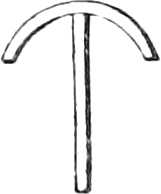
On the short march from Sheníni to Shákkayak, you pass Mistakhéde, Rógrogó, Mánga Dírdigé and Mánga Abákrnak, these two hamlets forming part of the large place of Mánga, inhabited by Mími, Gélma, Ábú Shárib and Kanúri. The other hamlets belonging to the place are called Mánga Kordále, Mánga Mérendé, which lies north of Shákkayak, Mánga Múttong, Mánga Ábeyáng, inhabited by Ábú Shárib, and Mánga Míri, from whence it is not far to Abkar Hájilíj, the village above mentioned, by way of Serír and Magállem.
There is besides another considerable iron mine at Kájam, four hours W.S.W. of Tókhilí, in the district Jéji, the iron of which is brought by the Áblebay to Átarek between Abkar and Mánga Mérendé, where this iron, as well as the copper brought by the Jellába from the celebrated hofra in the south of Dár-Fúr, is manufactured by the “haddád Mónnu.”
(i.) From Sheníni to Sillá by way of Ándelá, according to Fáki Íbrahím. Direction S.S.W., then south.
1st day. Ándelá, a place inhabited by Wádáy and Bándalá. Passing in the morning Shokhúlke, a place consisting of two hamlets, and inhabited by the Ogodóngde, close to Sheníni, Tordóna, likewise of the Ogodóngde, you cross the wádí Hamra, and stop during the heat in Súnkutú, whereupon, passing Súnkutú Jídnak or Nyílik, you cross the Bat-há, which somewhat higher up, near Súnkutú Malám, receives the wádí Hamra, and finally pass Agílbe, a village comprising three hamlets inhabited by Wádáy people, and close to Ándelá, Agílbe Angneréda.
2nd. Shakák, a village of the Bándalá, in a sandy tract, with rocky hills. A good march; stop during the heat at the well of Kadáda, a place not inhabited, but containing numerous trees, particularly dúm-palms.
3rd. Chilímna, a village of the Bándalá and the Áblebay, near to which towards the west dwell the Sálamát, Míssiríye, and Jéji. Here are seen the mountains of Sillá, the inhabitants of which supply the market of Chilímna with honey, and fish, fresh and dried. Stop during the heat at noon in the wádí Bokhás, said to run south into the large wádí Diwé, which skirts the district Jéji, and by some is considered identical with the bahr Sálamát, which passes Mangára, and then, one day from Mangára, is called Gedé, or bahr el Hémád, and further down Óm e’ Tímán or bahr Sálamát. Íbrahím considers it as a tributary of the river of Runga. Besides the Hémád and Sálamát, the Shárafa also pasture on its banks.
4th. Sillá, which was not visited by Íbrahím himself, is reached after crossing in the morning the wádí Diwé, which spreads out to a great extent on clayey ground, and swarms with fish. The Sillá are handsome people, without incisions. Yúsuf Kharifáín made a ghazzia to this place.
(k.) Direct way to Sillá.
1st day. Dumbóli, a place of the Míssiríye, close to Rás el Fíl or Tánjaknák on the west. Passing in the morning Shokhúlke and Abjefíli, a place of the Ogodóngde, with the small wádí Ábú Ghánem (pronounced Ábú Khánem) in the south, which joins the wádí el Hamra, near Súnkutú; stop during the heat at Sórumó, on the north bank of the Bat-há, which flows close, on the east, to the Wádáy hamlet of Maráy.
2nd. Khalla, passing the large mountain of Kajéske.
3rd. Sillá, in the morning.
(l.) From Wára to Rúnga, according to Háj Sadík. South, afterwards west.
1st day. A place of the Kóndongó, with a large mountain stretching out to a great length.
2nd. Andísha, a place of the Wádáy.
3rd. Hawára, a place of the Wádáy in a level country.
4th. Betéhá, a wádí, occupied by Wádáy people.
5th. Áfi, a place of the Wádáy, at the base of a ridge of mountains.
6th. Kémerí, a place of the Wádáy, in a plain with mountains in the distance; south.
7th. A place of the Chaíma, slaves of the Bándalá, who prepare honey.
8th. Kódogus, one of the largest places of Wádáy, inhabited by Talba Arabs. According to Íbrahím, Kódogus is rather a place of the Ábú Shárib, Kajágasé, and Dermúdi, and is three days and a half from Sheníni. Sleep at Úrka, a place of the Wádáy and Bándalá, on the Bat-há, then at Ám-búrtunú, a village of the Wádáy and Bándalá, the latter being the more numerous, and the third night at a place the name of which he had forgotten. W.S.W.
9th. Íd el Gadém.
10th. Kájam, a village at the western foot of a mountain.
11th. Mangára (according to this informant erroneously called the chief place of Kebét or Kajágasé). From Mangára to Sillá, one day’s journey east.
12th. Gurára, encampment in the wilderness.
13th. Metérbe.
14th. Donás, the name of the ruler of the province of Runga, the successor of Sebír, who pays tribute both to Fúr and Wádáy.
According to Háj Sadík, the position of Runga with regard to Wára is like that of Mándará and Kúkawa, and its geographical relation to Tendélti as that of the Púllo place of Bógo, on the east side of Mándará, to Más-eñá.
(m.) From Sheníni to Runga. From the account of Fáki Íbrahím.
1st day. Ándalá.
2nd. Shakáki.
3rd. Jéji, a district comprising about twenty hamlets.
4th. Kerére, a place of the Másmajé.
5th. Khalla.
6th. Kebét, an outlying province of Wádáy, not, as my other informant thought, identical with Kajágasé, which belongs to Wádáy Proper.
7th. Khalla.
8th. Mangára, the capital of Dággel, situated on a rocky eminence (“Mangára,” in the Dággel language, signifies a rock), and close by a large pool of standing water, called by the Arabs, “Bahr e’ Tíni.”
9th. An expansive marsh, inundated to a large extent during the rains, with a clayey soil.
10th. Runga in the morning. South from Runga, according to Fáki Sámbo, lies Dár Meng.
(n.) From Tendélti to Runga, according to the information of Háj Sadík.
1st. day. Kórigó, a considerable market-town. A long march till ʿaser. If you travel but slowly, you stop during the heat at the pond called Ráhet Birbídi, sleep at Ám-habíle, and reach Kórigó only on the following morning. The market of Kórigó is held only on Tuesdays and Thursdays. Some of the pilgrims turn from the territory of the Sungóri by way of Jebel Herés, straight upon Kórigó.
2nd. Jurtóba, a place of the Bulála and Kúka.
3rd. Abéshr, a village of the Furáwy.
4th. Wágif, a place occupied by Bagírmi people.
5th. Ám-kordás, another village inhabited by Bagírmi people. The entire tract consists of sandy soil.
6th. Selálo, a large place inhabited by Bórnu people.
7th. Ám-majúra, a considerable place, important on account of its traffic with the Kirdi country, here called Firtít, and the residence of the governor of Birket, inhabited by Másalít, Dájó, Bagírmi, and Furáwy.
From Tendélti to Ám-majúra, according to Háj Mohammed.
1st day. Difán Haggeróna, a place of the Dájó, beyond Kórigó, which you pass. A long march.
2nd. Ám-harrás, a place only recently built by a man from Bú Harrás in Kordofán, and inhabited by Fúr and Bagírmi people.
3rd. Ám-kardús, a place belonging to Shetéta, and inhabited by Fúr. Identical with Ám-kordés.
4th. Hillet el Makdúm Khalíl.
5th. Ám-majúra, two days and a half from Tebeldíye, three days from the hofra, and about three days from Bahr el Erzegát. Ám-majúra is very rich in deléb-palms, and has an important Sunday market supplied with butter by the Erzegát. The inhabitants of the place are said to trade particularly in slaves, which they buy with wodʿa and tobacco.
8th. Gíja, a place inhabited by Fúr and Gullá, governed (at that time) by Mohammed Setéba. Direction from hence a little south from west.
9th. Májam, a place of the Taʿasha Arabs, but inhabited besides by some Másalít.
10th. Ráhet Kháli in the Khalla, without an inhabited place.
11th. Báli.
12th. Dúm Asehéba.
13th. Dúm ʿArdéba.
14th. Khalla.
15th. Débe, a village of the Runga; pagans, besides a few ʿUrbán or Arabs.
16th. Tarkámu, a district occupied by Bórnu people.
17th. The place of residence of Donás the Prince of Runga, after whom it is generally called; the original name is not known to me.
(o.) List of the more considerable places in Fittrí, and the divisions of the Bulála, according to the Buláli Íbrahím.
In the district called Defn Meláda: Témsa (identical with Dumsa), Késhegá, Tíggedí, where a fugitive son of the last sultan of Bórnu resides, Góla, Dúbunór, Géla, Kábberá, Móyo, Dógo, Gálo. In the district El Góza: Mélme, Kúdu, Amána, Gúgu, Sége, Ágené, Bayálla, Bógo, Shegé, Búrrigó, Befárkamá, Dénni, Góllo, Yʿawó, Gámsa, Wágalá, Séta. Kabáíl or families of the Bulála: Lóffewá the Sóltana or ruling family, Gíjo, Battáwa, Argumuwá, Chélmuwá, Wádewá, Kásewá, Jilluwá, and many others, at least twenty; according to tradition, ninety-nine. The ancestor of the Bulála is Jíli (Jíl Shikomémi), who came from Kánem.
(p.) Some account of Fittrí and Bat-há, according to ʿOthmán, who had been carried off as captive from Bagírmi by Sabún, with additions by Háj Sadík.
The lake (Fittrí means nothing but valley, basin of water, and coincides in sense with Tsád) is two days’ journey in circumference, contains fresh water, is very shallow, has a clayey bottom, and is surrounded on all sides by a rich marsh almost destitute of trees, whilst the valley of the Bat-há is densely and beautifully wooded—at least it was so till lately. No wádí joins the lake except the Bat-há; and none issues from it. In the centre of the shallow lake lies an island called Módo, the pagan, or at least half pagan inhabitants of which belong to a tribe generally called Ábú Simmin, long since reduced to subjection by the Kúka, and navigate the lake in small canoes, made from trunks hollowed out, and holding two or three persons. Among the fish found in the lake are the angóla, which strikes the water, and the bolbút; but there is no sémmak. The principal places lying about the lake are (beginning from Yʿawó) Debunóro, Tamsa or Temsa, Géla, Gólo, Dágo, Gámsa, which is about twelve miles from Yʿawó (but these places are at a considerable distance from the shores of the lake, though varying, of course, greatly according to the season). Five tribes pasture in the Fittrí—the Bení Málekí, who possess numerous camels, the Jʿaátena, the Hamíde, and a part of the Kréda; and it is visited even by other Tebu tribes during the summer. In the kharíf, or rainy season, when the Arab tribes are removing, and the whole country is inundated and infested by swarms of mosquitoes, the camels of the Fittrí are, like those of the sultan, stall-fed in sheds, or at least are sheltered with mats.
The principal places along the lower course of the Bat-há are: Séta, Dífde, Henéwu Júrundú, Ám-kharúba, Durmámi, Sigó, Mugdára; Birket Fátima, a place of the Másmajé on the west side of the ráhet and north of the wádí; Ám-siddre, Al Áfanín, then the district called Dár-Zoyúd.
From Míddogó, which is one day from Yʿawó, to Birket Fátima, is four days by way of Áb Zeráfa, a place of the Kúka, with small rocky ridges; Hejél, a place of the Kúka, and finally Bóyo.
(q.) From Fittrí to Mʿawó, N.W., according to the Buláli Íbrahím.
1st day. Fáli or Fári (Fághi?), a hamlet inhabited by Bagírmi people, in a wádí-like hollow encompassed by rocks.
2nd. Aúni, a hamlet of Bagírmi people, with some rocky ridges.
3rd. Búkko, another hamlet of the Bagírmáye.
4th. Shégeráye, a wádí where the Gurʿaán pasture their camels.
5th. Bahr el ghazál, an expansive and richly-timbered wádí.
6th. Kedáda, a place of the Týnjur. Kedáda is one day from ʿAlímarí, where the waters of the eastern extremity of the Tsád are said to have been formerly discharged into the Bahr el ghazál, the communication with which is now interrupted by sandy downs.
7th. Mondó, another place of the Týnjur, under the chief Abákr.
8th. Yagúbberí, a hamlet of the Týnjur.
9th. Mʿawó, the residence of the khalífa of Wádáy, and the general head-quarters of Jérma Móngo. The inhabitants of Mʿawó are called Beránemá in the Gurʿaán language.
(r.) From Fittrí to Mʿawó, according to a Wádáwy.
1st day. Khabíni, a Gurʿaán settlement, with abundance of water.
2nd. El Khazálát, a wádi, said to be a tributary of the Bahr el ghazál, occupied by Dághana.
3rd. Shegeráye, a wádí, occupied by the Gurʿaán.
4th. Délebát, a wádí.
5th. El Grét, a wádí.
6th. Mʿawó.
My informant declares that he left the wádí Fári on his right, and never passed the Bahr el ghazál at all.
Another informant went from Mʿawó to Fittrí by way of Kálkalá, Gújer, the well of Toróro in the Bahr el ghazál, the wádí Shegeráye with abundance of water, and the rocks of Hajjiját in the wádí Fári.
(s.) Wára to Wádí ʿOrádha, according to Fáki Íbrahím and ʿAlí Malánga.
1st day. Bóbok, a place of the Kajígají, a Wádáy tribe. Leaving Wára by the N.W. gate on the road called Lingak Bátemelek from the village of Báteme, which is passed soon after starting, further on you pass the village of Índing, and afterwards Korummúdi, a village inhabited by Fezzáni people.
2nd. Tátsere, a place inhabited by Wádáy. Stop during the heat at Tákhsha.
3rd. ʿOrádha, a wádí or zaraf, very rich in pasture-grounds, where the Máhamíd pasture in the summer, whilst in the kharíf they proceed to Túrru and Súbbu. East of the wádí ʿOrádha is the wádí Subb, two days from the mountainous country of the Táma. The road from Fezzán by the Búrgu country to Wára touches at ʿOrádha.
ʿAlí made the following détour in going to the wádí ʿOrádha, which is much resorted to by the Wádáy Fákí, as, by their reading and writing, they may easily earn from the wealthy Arabs of that locality a cow or a good number of sheep:—
1st day. Bóbok.
2nd. Kursó, a considerable place of the Mími.
3rd. Tátsere. All this country has a sandy soil.
4th. Armán, a place of the fokará of the Máhamíd, inhabited by their chiefs Mahmúd ʿAbd e’ Salám Weled Chócho and Hagar Weled Bélle.
5th. Rehédo, another place of the Máhamíd.
6th. Subb, a zaraf running west, whither the Máhamíd likewise resort.
7th. ʿOrádha.
3. Routes in the Interior of Bagírmi.
(a.) Large and small Places on the Shári, from Búgomán upwards.
Márja, a small place; Mískin, a considerable walled town; Mébi, a small place at the confluence of the Báchikám with the Shárí; Mainpa, or Mankhfa; Anja; Mólan; Gélendé; Mákelíl; Óngo, or Óñoko; Búnjul; Baleñére, a walled place; Mondó, with a rampart; Moró; Madélamá; Baingané; Laffiyáta; Gedó; Músgu; Bowáy; Miyán; Mógoló; Kába; Jílim; Mábbelé, a town surrounded by a strong wall; Láffaná, with a rampart in ruins; Busó, a large place; Móngalá; Bá-Ngórgolong; Bíri; Korómafé; Tábe; Májim; Bubúr; Dére; Gófna; Chíromadí; Miltú.
(b.) From Más-eñá to Láffaná and Busó.
1st day. Mogál, beyond the ford of Báchikám, on the upper part of the river of the same name, which at Tápe, a village near Miltú, branches off from the upper Shárí, and rejoins it at Mébi, a small village near Mískin.
2nd. Mangagúllafé.
3rd. Gáram, a place inhabited by Kanúri.
4th. Sleep in the wilderness.
5th. Bedá-kúrchi, a Bagírmi place under Busó.
6th. Dendám, a Bagírmi place.
7th. Láffaná. Bedá-kúrchi is nearer to Mábbelé and Láffaná than to Busó.
(Busó, according to Agíd Músa, is about as far from Más-eñá as Logón bírni or Moító, Busó being reached in three long marches: viz.
1st day. Gáwin Háji.
2nd. Bedá-kúrchi.
3rd. Busó.)
(c.) From Más-eñá to Busó, according to Háj Sádík.
1st day. Báchikám, a village on the southern side of the small branch of the Shárí which, from this village, is generally called Báchikám, at least by the inhabitants of the capital, although from the larger town of Ír, which is situated on its northern bank, and was formerly governed by a sultan of its own, it is also called Bá-Ír. Its size varies extremely, according to the season, from a small rivulet scarcely twenty yards across, to a large sheet of water more than a mile in width.
2nd. Búlturí, a large village, inhabited by Kanúri.
3rd. Bedá-kúrchi, with a large swamp (bedá), whence its name. You stop during the heat in Dílfin, a Kanúri place.
4th. Dendám, a Bagírmi place.
5th. Busó, a large town inhabited by a mixed population of pagans, who are however clothed, and of Moslemín. It contains many of those so-called mʿallems, that is to say, people who know how to write a few phrases from the Kurán.
(d.) From Busó to Miltú, S.E.
1st day. Kiyár, at some distance from the river, the inhabitants drawing their supply of water only from wells. Crossing the river in the morning, you keep close along it a little south from east.
2nd. Tápe, a large place on the southern side of the river, S.S.E. N.B. Agíd Músa appears here to have made a mistake by transposing Kiyár and Tápe.
3rd. Miltú, a pagan place of considerable extent, at present governed by Bá, the son of ʿAlí Fenjár, who died two years ago in Más-eñá. The inhabitants possess large numbers of horses, and prepare, from the ashes of the reeds in the river, a sort of salt, which, in the form of sugar loaves, has a sale extending over a very large region. At Bólo, close to Miltú on the east, the Báchikám branches off from the Shárí.
(e.) Places along the Báchikám upwards, S.S.E.
Báchikám, the fording place; Ír, a large town; Mogál; Mábberat or Mábbelat, formerly the capital of an independent principality; Más-eñawu, the place of the bowága or trumpeters of the sultan; Bélamédi, a Bagírmi place; Mámsa; Chíkorigá; Bugolóbe; Kúttutú; Díggeli; Máseré; Gáyoko; Mírre or Méré, seat of a man of influence called Damre, formerly the capital of an independent principality; Dol; Mégelé, or Mégedé; Yelál; Dímkir; Mariñé; Mub Béti; Ngírbing; Ságemáta, the last Bagírmi place beyond which the pagan country of Sáruwa begins.
(f.) From Más-eñá to Kírbe the capital of Sáruwa.
1st day. Báchikám.
2nd. Naíromá, a place with a considerable market held on a Friday, and situated on a rivulet, which joins the Báchikám at Ír.
3rd. Ngáttara, about 10 A.M.
4th. Jíl, a village, about 10 A.M.
5th. Ságemáta, a Bagírmi place on the Báchikám. A long march.
6th. Négi, a village; about 10 A.M.
7th. Móngolá, a place on the Shárí, already belonging to Sáruwa.
8th. Kírbe, the residence of the chief of Sáruwa, of the name of Ábú, as he is called in Bagírmi. One day from each of the three places Kírbe, Tápe, and Miltú, but a little nearer to Kiyár.
The road from Kírbe to Míddobó, another important town in Sáruwa, passes by Dañ or Daña. Other places in Sáruwa are, Tógilá, Dángwa, both on the Báchikám; Dañ, Mírti, Jílang, Mírkin, Móngolá, Jímmir, Jó, Bélay, Mut, Bilé, all of which are on the Shárí. From Daña to Lairy is one long march, about 30 miles.
(g.) From Miltú to Gógomi, according to Agíd Músa, with additions by Ramadhán. Direction, N.E.
1st day. Attar, another place in Sáruwa, having passed in the morning, close to Miltú, the Shárí, which here comes from the south, and is called bá-Busó. A long march.
2nd. Komé, a place inhabited by pagans, in a mountainous district, surrounded by four mountains, two of which are called Tábe and Boño. A long march. Komé is one day from Míddobó, north.
3rd. Belél Kolé, a place inhabited by the Sókoró, fortified by nature in an extraordinary way, encompassed as it is said to be by several rocky ridges which inclose each other in a circular form, so as to leave only a single approach, whilst the interior is supplied with water. The prince resides on a rocky eminence in the centre of this peculiar mountain-basin. The other inhabitants dwell between the rocky ridges. In the vicinity is a place inhabited by Shúwa. Between Komé and Belél Kolé lies Jótol, at some distance to the south.
4th. Gógomi, a place situated in a deep basin in the mountains, accessible only by a narrow defile, and inhabited by a division of the Sókoró, whose formerly powerful chief was conquered and made prisoner by the sultan of Bagírmi during my stay in the country. The Jellába of Wádáy travel as far as Gógomi, where they import European commodities. From Gógomi to Kénga it is five or six short days’ journey, by way of Búdir, a place situated a short distance from Gógomi, on a steep mountain, said to be about as high as that of Tibésti, with a spring at its base and on its summit; Sim, a place in the mountains; Báddegé, a place on the top of a mountain; all these places being inhabited by Sókoró, who are armed with bows and arrows; Gal, a place in the mountains, surrounded by a moat; Tumki, a place situated on an eminence; Kénga Matáya.
(h.) From Más-eñá to Gógomi.
1st day. Bídderi, a considerable place, renowned on account of a family of shiúkh, who, as I have mentioned above, have exercised a most remarkable influence in the extension of Islám in these regions, and important on account of its Friday market, where, however, the usual money of Más-eñá, viz. fardas and kholgán, has no currency, but only the finest gábagá, twenty of which are deemed equivalent to one khálag or shirt. About dhohor.
2nd. Múdda, a Bagírmi place.
3rd. Dekháruwe, a large place of the Arab tribe of the Dekhákhera or Deghághera.
4th. Kúrí, a Shúwa place on a pond of stagnant water.
5th. Maskáwu, a Shúwa place.
6th. Gató, a Shúwa place with a pond in the wilderness.
8th. Jená, a large walled town of the Sókoró, in a hilly district. The inhabitants, like almost all of the Sókoró, are said to eat a kind of beetle, called “dernána” by the Bagírmi. Jená lies between Gógomi and Komé.
9th. Gógomi, two days from Míddobó, a little north from east.
The road from Gógomi to Ábú Telfán passes by Bánem, Bálli, Sim, Kóndolá, Kéngetá, Ábú Telfán.
(i.) Divisions of the Búwa.
The following divisions of this numerous tribe are subject to the Sultan of Bagírmi: the Búwa Nyéldang, the most powerful of all; the Búwa Gamkúl; Gamkúl[115] is from Míddobó, the frontier-place of Sáruwa, twelve miles east, and two days south from Gógomi, through a mountainous wilderness; Búwa Ír; Búwa Wagé, and Búwa Shok.
The following are independent: the Búwa Lá, who are very numerous, and are divided into several families, occupying distinct places; the Búwa Kúnne; Búwa Gángli; Búwa Móke; Búwa Dámla; and east and S.E. from Gamkúl, at the distance of from twelve to fifteen miles, are the two places Kormále and Sarakélle, both situated on the top of a hill, and the latter said to be governed by a queen; Búwa Kurmán (?); Búwa Goy, with a high mountain, having water on its top; Búwa Dókeró; Búwa Gúm; Búwa Ladón; Búwa Túniya; Búwa Kúrbul; Búwa Kullúnga or Kelánge, on a mountain, two days from Komé; Búwa Malbón; Búwa Bulúl, and finally the Búwa Mubb and the Búwa Kúli, who occupy a mountainous district close to the territories of the Welád Ráshid.
Another tribe, the Nyílem, to whom, according to Agíd Músa, belong the Dasár, whilst others consider these to belong to the Búwa, dwell close to the N.E. bank of the river. Beyond the Dasár you reach the Kólum, the Nyú, and at no great distance the Furá with Gambay.
(k.) From Más-eñá to Kénga Matáya. East.
1st day. Naíromá, the market-place abovementioned.
2nd. Mílle, a place with a Sunday market.
3rd. Kírsuwa, a considerable place on a small marshy watercourse or sél on a clayey soil, which, in the Kharíf, flows to Barkadaña, Sidígiyá, Bulúlu, and to Gámmara, a considerable place under an independent chief. (Is this watercourse identical with the Msél of Debbába?)
4th. Hírla, a place of a tribe related to the Bágrimma.
5th. Bedánga, a considerable place in a hilly district belonging to a section of the tribe of the Sókoró, under a powerful chieftain, converted, at least in outward appearances, to Islám. These people wear clothes and do not disfigure themselves by incisions on their faces; the women, however, have a bead in the nose and beads in the ears, as worn almost universally in these regions. The Wádáy Jellába import their commodities even into these districts. The natives are armed neither with bows nor arrows, but only with spears and hand-bills. According to Mohammed Búme, who has been living here several years, the waters of this mountainous region are drained by the Nile through the territory of the Welád Ráshid,—a piece of information which is, however, very doubtful.
From Bedánga to Ábú Telfán is three days’ journey E.N.E. by way of Bámmaná and Míggedi.
6th. Kénga Matáya, the chief place of a tribe closely related to the Bagrimma nation, under a powerful chief, to whose extensive territory also Jon, Gal, and Dámbar belong. The principal produce of this region is sesamum. My new informant, the aforesaid Moh. Búme, confirmed fully the statements communicated to me previously by Agíd Búrku with regard to the strange religious observances of these pagans. According to the same, the waters of the district round Gógomi are discharged by way of Lim, Gal, Bánam, and Kénga, into the “gezán,” the sandy wilderness south of Fittrí. Kénga, according to the same, is four days from Yʿawó, by way of Ngar-sára, the residence of a powerful chieftain, distant about two days from both places and also from Míddogó. According to the Buláli Íbrahím, Kénga is reached in three long day’s marches from Yʿawó, by way of Gáriya, Mórbo, and Býllum. From Bedánga to Kénga is a long and unsafe journey, made during the night, in about sixteen hours, from evening to the heat of the day.
(k.) From Más-eñá, by way of Laíry to Busó.
1st day. Gógo. Stop during the heat in Malá.
2nd. Ngóg;
3rd. Duwíng;
4th. Múro. All short marches.
5th. Laíry, a large Bagírmi place, E. (S.E.) from Kírsuwa, on the same watercourse, and one good day’s journey from Tógilá, and from thence to Attar in two days, having slept on the Báchikám.
6th. Gapkóng. A short march.
7th. Busó, having crossed the Báchikám about halfway.
(l.) From Más-eñá, by way of Kólle to Laíry, and from Kólle to Moíto.
1st day. Séta, passing Bídderi, Mandélu, Dabíñen, and Gadáwu.
2nd. Ámjerí, passing Mábbelá, Dérrejá, Meléde, Bindébiyó, and Tawyín.
3rd. Kólle, a considerable Bagírmi place, one day from Kírsuwa, towards which place a sél or shallow and marshy water takes its course hence by way of Dóldegí and Fór.
4th. Laíry. A long march.
From Kólle to Moíto by way of Debába.
1st day. Kírsuwa Jibílgi, with an independent chief, situated on a watercourse.
2nd. Hírla, a place situated on a hill.
3rd. Jókko, a place of the Kúka.
4th. Debába, a large place, consisting of various hamlets of the Shúwa, with rich pasture-grounds, and several watercourses. Debába is two days from Baláwu, having slept in Kósi, a Kanúri place, and crossed another “sél” between Kósi and Baláwu.
5th. Moító. A good day’s march.
(m.) From Láffaná to Bang-Bay. Expeditious march, such as is usual on a ghazzia. Direction south as far as Lay.
1st day. Állowa, a pagan place, subject to Bagírmi; crossing in the morning the Shárí, or rather, as it is called here, the Bá-Busó.
2nd. Gúrgará, a large place belonging to a considerable tribe, whence all the iron consumed in Bagírmi is exported. It is obtained from siderites, and is not near so good as the iron of Wándalá or Búbanjídda.
3rd. Cháken, a large place, with an independent chief; about noon.
4th. Jogdó, a large place, consisting in part of clay huts, belonging to the extensive principality of Gábberí.
5th. Lóji, a place under the independent chieftain Kíki the son of Belát.
6th. Gun, a place on the Bá-Gun, as the river of Logón is here called. Almost every place has its separate ertána (jargon). The country yields sorghum, beans, “kolche” or ground-nuts, and melons.
7th. Lay, on the same bank of the river, the residence of Súgulum son of Nóba. The river abounds with fish, and is navigated by numerous boats. South of Lay, according to this informant, an arm, coming from the Fúlbe territory (from Bubanjídda, it seems), appears to join the river. This informant considers the river of Logón and the river of Day, Miltú, Busó, and Ásu to be only arms of the same river, which is bifurcated, as he says, above Day. It may be so; but I doubt whether this account be true, the rate of the current in these two rivers being very different. The direction now becomes almost south.
8th. Myl, having crossed the river at Lay, and then taken a course a little south from west.
9th. Kóyo, a place with an independent chieftain, on a dry clay soil.
10th. Kíyagór, at a short distance, with an independent chieftain. About six hours from Kíyagór, a little north from east lies Bári, in a mountainous region.
11th. Nong, another place belonging to Bagírmi.
12th. Dógo, the furthest place in Bagírmi which was reached by the ghazzia. The country produces abundance of honey, contains large numbers of goats and sheep, but no cattle. Dukhn (Pennisetum typhoïdeum) constitutes the principal food. Among the trees the tábur, or butter-tree, and the deléb-palm, are the most remarkable and predominant. The soil is dark red (being loam). From Dógo to Búbanjídda, according to informant, two days.
(n.) From Mábbelé to Lay and Kim, according to Agíd Músa.
1st day. Gúrgará; a long march till ʿaser.
2nd. Cháken, a considerable place, with an independent chief; important as the point of junction of several roads leading south to Lay, S.W. to Kim, and W.S.W. to Dam.
3rd. Jogdó, an important place; short march.
4th. Cholól, a place four hours east from Gun.
5th. Nyinga, a short journey.
6th. Lay, a large place on the eastern bank of the river of Logón. If you go from Lay W.S.W., after having crossed the river you reach, after ten or twelve miles, Mung-chiré, and thence Chúwa, with three independent chiefs, Málo, Dúkko, and Baíbotó.
From Cháken to Kim.
1st day. Gunógunó; about twenty miles.
2nd. Kim, a large place on the river of Logón. Kim is three days’ journey from Démmo, in Wúliya, our furthest point on the Músgu expedition. This, therefore, is a very important piece of information for joining these routes:
1st day. Jimán, on the river; about ten miles.
2nd. Kar, twenty miles.
3rd. Démmo in Wúliya.
Kim from Lay is two good days’ journey S.S.E., stopping for the night at Bisme, on the river. This track has a dry clayey soil, almost without trees, so that you may see from Kim the trees of Éré, a place in the N.W., on the west bank of the river, and probably called from its situation on a ford, “éré” meaning river in the Músgu language. Márraba, a large place of the Mógom, is ten or twelve miles from Kim, beyond and at some distance from the river.
From Lay to Sálin. Direction a little north from east.
1st day. Chíre, a large place, residence of the chief Kassarák, who is not the only chieftain in this region, but there are two petty chiefs besides him. This place has a separate ertána. It is distinguished by an extensive plantation of fruit-bearing date-trees, which is well irrigated and kept in order,—a very remarkable circumstance, so that I have taken pains to ascertain that the informant has not confounded the date-palm with the deléb-palm. There are no asses in Chíre, nor any cats; and the horses are imported from Bagírmi. A long march of twenty-five miles.
2nd. Masró, about thirty miles.
3rd. Sálin, the residence of the chief, and the principal market-place of Dam.
From Sálin to Dámmuk, the capital of Somray, one day S.E.
From Más-eñá to Sálin.
1st day. Mogál.
2nd. Jeljélli, a Kanúri place.
3rd. Bana-kúrchi.
4th. Busó.
5th. Túnjurkú, a Kerdi place.
6th. Gúrgará.
7th. Límmi.
8th. Sálin, the capital of Dam or Ndam, which latter may be the right form.
(o.) Más-eñá to Báng-Bay.
1st day. Kagá.
2nd. Garám.
3rd. Mábbelé.
4th. Gúrgará, or rather one of the three villages which constitute the district of that name; the southern village lying in the direction of Cháken, and the western one in that of Chejiráki.
5th. Mátelé.
6th. Kim, a large place, where a kashélla (inspector of the river) of the sultan of Bagírmi resides.
7th. Márraba, about ʿaser (there having been probably a difficulty in crossing the river).
8th. Dómaná. A whole day.
9th. Bísay; about noon.
10th. Bay Kurí.
11th. Bay Toy, one of the four large principalities of the Bay.
12th. Kóman.
13th. Kaktíya.
14th. Múdumbím, one of the four largest principalities or places of Bang-Bay.
15th. Kéni, another of the four principalities.
16th. Debjógemé.
17th. Gómbay.
18th. Tápoló, the principality of the most powerful chief in Bang-Bay.
19th. Másentá.
(p.) From Busó to Bang-Day. Expeditious march, a ghazzia.
1st day. Tábe, a large place on the south side of the river, which you cross in the morning.
2nd. Kiyár, a smaller place, at some distance from the river.
3rd. Miltú, a large straggling place close to the S.W. bank of the river.
4th. Báki, at some distance from the river.
5th. Shéggi.
6th. Myl, a large place.
7th. Sará-Gulé, with the chief Koína, son of the renowned Gósdegá, after whom the country and the place is usually named. The inhabitants take their supply of water from wells only.
8th. Dígti, with an independent chief.
9th. Gár-Kúmra, or Sará-Ngár-Kúmra, another principality with a powerful chief.
10th. Bang-Day, another principality on a considerable river, called by my informant—the same from whom I wrote down the itinerary marked (m.)—the river of the Fellán, or Fúlbe. Day and Fong are the most important principalities in Sará.
(q.) From Miltú to Day, and from Lay to Day, according to Agíd Músa. South.
1st day. Myl, a large place. A long march, till sunset; about thirty-five miles.
2nd. Sará-Gósdegá; dhohor (two o’clock P.M.); twenty-five miles. A little east from south.
3rd. Kumra. Till ʿaser; thirty miles. South.
4th. Day, a large place in a densely-populated country on the Upper Shárí, which here flows from south to north, and at Miltú bends to N.W. Dhohor; twenty-five miles. S.S.E.
Lay to Day. S.S.E.
1st day. Bay Fir, an independent principality on the river of Logón.
2nd. Bay Kagá, another principality belonging to Bay, distant from the river, surrounded by woods, close to Masró.
3rd. Day, after having crossed the river Shárí. According to the express statement of another informant, Day lies on the western bank of the river, in the same way as Kárnak Lógone does.