Front matter
Reading edition
Author of “Flames of the Storm,” “The Ranch of the Tombstones,” etc.
The first faint flush of dawn was creeping over the Mission River hills, as the Overland train drew to a stop at the little town of Moon Flats. It was only a moment’s pause, but in that length of time a man had dropped off the rods of the baggage-car, crept between the trucks and walked slowly down the main street.
The town was deserted at this time in the morning, and the man seemed to study the dimly outlined, false-fronted buildings as if he had been there before.
Moon Flats was a cow town—nothing more nor less. It was a shipping-point for the Mission River ranges, which also made it an outfitting point. Like the majority of the old cow towns it had one street, narrow wooden sidewalks, the tops of which were never securely nailed down, long hitch-racks and a pavement of deep, yellow dust in the Summer and a quagmire of mud and slush in the Winter.
As the light grew stronger it illuminated the faded and battered signs of the Moon Flats Gambling House, Buck Franey’s Place, Bill Eagle’s General Merchandise, Jakie Dick’s Élite Café and Restaurant, Trail End Gambling House, Mission River Stage-Office and General Post-Office.
The stronger light also illuminated the features of the man who studied them—a young face, although deeply lined and with a slight pallor, as if from sickness.
His eyes were dark, and his black hair showed slightly silvered at the temple, as if lightly brushed with a white powder. His nose was slightly hooked, and his lips seemed molded into a thin line above a strong chin.
He was slightly above the average in height, but just a trifle stooped. His garb was nondescript, dirty and greasy from travel. As he studied the signs a half-smile passed across his face and he sat down on the sidewalk in front of the Moon Flats Gambling House. By turning a pocket inside out, he managed to collect enough tobacco to roll a thin cigaret, which burned with the unmistakable odor of lint, but the man did not seem to mind.
Across the street, in the two-story, ramshackle Cattlemen’s Hotel, an alarm-clock started its tin-panny whirr, and in a moment a man’s voice was raised in sleepy profanity. The man on the sidewalk smiled.
There was silence for a few minutes, and again the clock shattered the silence. A moment later the cheap curtains were flung aside, an arm described an outward arc and the faithful despoiler of slumber splintered on the sidewalk.
This time the man on the sidewalk laughed softly. It was all so human—and he was unused to human things. And as if the splintering of the clock was a signal, Moon Flats began to wake up. From behind the Élite Café came the sounds of some one splitting kindling, and over at the livery stable the sliding doors creaked as the stable man came out and looked around. Doors slammed in the hotel.
A sleepy-eyed, uncombed cowboy came around a corner from a corral, leading two horses which he watered at the livery stable watering trough. He paid no attention to the man on the sidewalk as he went past, but on his return trip he stared hard and rubbed his ear with a rope end, as if wondering or thinking. The man on the sidewalk spat dryly.
The door behind him opened and a man came out, carrying two wooden buckets, while another lounged in the doorway, holding a broom in both hands. They were swampers, getting ready to clean out the place. The man with the buckets crossed to the pump beside the stable, where he filled the buckets, accompanied by much creaking protest from the old pump.
In a few minutes the two cowboys came out of the hotel, yawned widely and started across the street, arguing.
“I never done no such a —— thing!” declared one of them. “All I done was wind it.”
“Whatcha want to wind it fer?” queried the other. “It wasn’t your clock, Newt. My gosh! What did you care ’f it run down? Wakin’ us up at five o’clock! I s’pose you thought it was scientific, didn’t yuh? Knowed that clocks would wind up; so yuh wanted to do the right thing by it, eh?”
“Tha’s it, Monte,” agreed the other. “Let her go at that, can’t cha? You’d holler if yuh was goin’ to be sent to the——”
He stopped abruptly as he looked at the man on the sidewalk and squinted sharply, as if not believing his own eyes.
The man on the sidewalk looked them over coldly—a half-amused expression about his thin lips.
“Shell Romaine!” blurted the one called Newt.
“Yeah,” nodded the man on the sidewalk. “Shelby Romaine.”
“Well, I’m ——!”
Newt Bowie rubbed his chin and looked at Monte Barnes, who was pursing his lips as if trying to whistle, though no sound came forth.
“Moon Flats ain’t changed much in a year,” observed Romaine dryly.
“No-o-o, she ain’t—for sure,” agreed Newt, looking around as if considering the unprogressiveness of Moon Flats. “She ain’t growed much, Shell.”
“When didja come back?” queried Monte.
“Just before yore alarm went off.”
“Oh, that —— thing!”
Monte glanced back at the hotel.
“Newt, the danged fool, went and ——”
“Aw, let up on the poor old clock,” interrupted Newt. “Anybody’d think you’d been abused, cowboy. You ain’t seen a sunrise f’r so long that you don’t know it ever comes up.”
Newt and Monte sat down on the steps and relaxed. It was not difficult for either of them to relax, and their shoulder-blades were calloused from half-reclining against corral posts or tree-trunks.
“Goin’ t’ be here f’r a while, Shell?” asked Newt.
“Mebbe.”
“Uh-huh.”
Newt wanted information, but did not feel like asking pointblank for it.
Slightly over a year before, Shelby Romaine had been sent to the penitentiary for five years. Two men had held up the Mission County Bank at Sula, stolen thirty thousand dollars and shot the cashier. The cashier was crippled for life.
Jim Searles, a cowboy, who was an eyewitness of the robbers’ getaway, swore that he recognized one of them as being Shell Romaine. The Romaines, father and son, were of rather bad reputation, and it was not difficult to secure a conviction.
Old “Rim-Fire” Romaine, the father, battled mightily for his son. He was an old, lean-faced, white-mustached range man; quick-tempered, bitter of tongue, and reputed to be fast with a gun. The defense was weak, but there still remained—circumstantial evidence.
Shell Romaine refused to tell where the money was hidden, nor would he implicate any one else. The prosecution was also weak, but the jury brought in a verdict of guilty, and the judge sentenced Shelby Romaine to serve five years in Deer Park prison.
Old Rim-Fire Romaine cursed the judge and jury bitterly, and only through the intervention of the defense attorney was Rim-Fire prevented from filling the courtroom with powder smoke. Old Rim-Fire had gone back to his little ranch-house, fairly sizzling with anger, while Shelby, linked to Undersheriff “Splinter” See, had gone to prison.
Many folk were of the opinion that Shell Romaine should have received a heavier sentence, but the State was satisfied. He was reputed to be a hard-riding, wild sort of a ——, who respected no one; and the Mission range-folks breathed easier after he was gone.
But now he was back, looking like a tramp; a little leaner, slightly more white about the temples, but still keen of eye. The prison pallor still showed in his face, but a few days of sun would wipe that away.
“Seen anythin’ of my old dad?”
Shell’s voice was low.
“Yeah, I seen him the other day,” replied Newt. “Same old feller. Know yo’re out, Shell?”
“No. Is he still runnin’ the ranch?”
“Yeah.”
Shell watched Newt roll and light a cigaret before he said—
“Anythin’ new goin’ on around here?”
Newt inhaled deeply and blew the ash off his cigaret.
“No-o-o, nothin’ much, except the feller they calls the ‘Black Rider.’”
“He’s a-plenty,” grunted Monte seriously.
“Black Rider?”
“Uh-huh.”
Newt nodded and puffed slowly.
“Some jasper is liftin’ treasure-boxes, robbin’ banks, et cetery, and he dresses all in black. He’s sure a dinger, that feller; and he’s got the sheriff pawin’ his head.”
Shell stared at the toes of his worn shoes for a moment, and a bitter smile twisted his lips as he looked at Newt.
“It’s a wonder they don’t say it’s the man who helped me do that Mission Bank job.”
“That’s what they’re sayin’,” nodded Newt.
Shell laughed shortly.
“He must be smarter than I am.”
“He’s smart as ——,” agreed Monte quickly. “He’s about ten thousand dollars ahead of the game now.”
“Includin’ his half of the thirty thousand we stole, makes him kinda rich,” mused Shell.
“Yeah, that’s a fact,” grinned Newt. “’F he’s real cute, he’ll quit while the quittin’ is good.”
“Takes brains, I reckon,” sighed Shell. “A —— fool never knows when to quit. Pat Haley’s still sheriff, ain’t he?”
“Yeah, Pat is still lookin’ for suspects.”
“Pat’s all right—good sheriff,” nodded Shell. “Just ’cause he shipped me to the pen, don’t make me sore at him. He treated me right. No—” Shell shook his head—“I ain’t sore at none of them judges, lawyers nor jury. They done their dangdest, I reckon.”
“Jim Searles is still around here,” volunteered Monte.
“Thasso?”
Shell was too indifferent to this.
“Yeah, he’s still around here.”
“Lemme have yore Durham,” said Shell, holding out his hand to Newt. “I ain’t had nothin’ but pocket-scrapin’s for quite a while.”
“He’p yoreself, pardner, and then we’ll have a little mornin’ snifter.”
“Much obliged for the smoke, but I ain’t drinkin’—thank yuh kindly, Newt. I’ve been away from it a year, and I’m kinda sanitary and antiseptic, I reckon. I kinda get a kick outa settin’ here and lookin’ at the old town.”
“She ain’t much t’ look upon,” grinned Monte.
“It’s home,” said Shell softly as he lowered his head to lick the edge of his cigaret paper, “and I’ve been away for a good many lifetimes.”
That same morning Cal Severn stood on the spacious veranda of the Diamond-S ranch-house, leaning against the railing as he moodily smoked a cigaret, his somber eyes taking in the wide vista of rolling hills and the sun-tinted Mission range beyond.
Just beyond the huddle of barns and shelter-sheds a long line of cottonwoods and willows marked the twisting course of Whispering Creek. To the south lay mile upon mile of broken, rolling hills, an ideal cattle range.
The Diamond-S was the largest, and reputed to be the richest, cattle outfit in the Mission River range; owned for years by the Severn family, of which Cal Severn was the last of his line. Square-shooting, upstanding folks were the old Severns, proud, perhaps arrogant.
Cal Severn was barely thirty years of age, well-built, bronzed as an Indian. His face was lean but well proportioned, and his dusky-gray eyes remained indifferent, dreaming, even when his lips laughed. Like all of the Severns, he was quick of temper, slow to forgive; and Cal Severn was a fighter—a hard-riding fighter of the old rangeland.
Two men rode in at the big gate and halted at the corral, where they talked with two of the Diamond-S cowboys, who were saddling their horses. Cal Severn watched these two men turn their horses and ride toward him. They were strangers in the Mission River range; cowboys, by their garb.
One of them was tall, swarthy, with a heavy mustache and a hawk-like face; the other shorter, wiry of build, and with a face filled with grin-wrinkles. The tall one, in spite of his serious mien, appeared ready to laugh at any time.
They drew rein and nodded to Cal Severn.
“Lookin’ for work,” announced the tall one. “Me ’n’ him,” indicating his companion.
Severn shook his head.
“Not taking in any hands now.”
He shifted his position and tossed away his cigaret.
“Fact of the matter is, I’m laying off all, but one, of my boys today.”
“Thasso?”
The tall one seemed sympathetic. For a moment he considered Severn, and then his eyes swept around the confines of the Diamond-S as he reached to an inside pocket of his vest and took out a folded paper.
“Mind readin’ this?” he asked, handing the paper out to Severn, who took it and unfolded it slowly.
His eyes grew even more sober, and his lips settled into a harsh line as he scanned the typewritten page.
His eyes came up from the letter, and he stared off across the hills, thinking deeply.
“Yuh sabe the idea, don’t yuh?” queried the tall one.
Cal Severn seemed to jerk back to the present, and after a few moments he nodded slowly and handed the letter back to its owner.
“Yeah, I reckon I understand,” he said. “You’ll find bunks down there—” pointing toward the bunk-house—“and just make yourselves to home. Henry Horsecollar’ll fix yuh up.”
“I’m Hartley,” said the tall one. “Folks calls me ‘Hashknife.’ This wide-awake pardner of mine was christened Geor-gh, but answers to ‘Sleepy.’ How far is it to town?”
“Six miles,” shortly.
Cal Severn turned and walked back into the house, while Hashknife Hartley and Sleepy Stevens rode down to the bunk-house and dismounted. A tired-looking individual came around the corner and looked them over.
“Want t’ see somebody?” he asked.
Hashknife shook his head.
“No-o-o, I reckon not. We’ve just hired out to the Diamond-S.”
“Thasso? Huh!”
The man rubbed his ear violently.
“Kinda funny, seems like. Boss said he was cuttin’ down the crew, and he let Newt Bowie and Monte Barnes go yesterday.”
“He hired us,” grinned Sleepy. “Mebbe he knows two danged good men when he sees ’em, pardner.”
“Mebbe,” dryly. “M’name’s Dryden; first name’s Henry and m’ middle name’s Harrison. H. H. Dryden.”
“They sure branded yuh,” grinned Hashknife. “I’m Hartley, and my pardner’s name is Stevens. Hashknife Hartley and Sleepy Stevens.”
“T’ meetcha,” bowed Dryden. “Howsa folks?”
“That,” said Hashknife seriously, “would be pryin’ into our private lives.”
“Ex-cuse me plumb to ——!” exclaimed Dryden, very apologetic and also very serious. “I’ll kinda he’p yuh git settled in the bunk-house.”
He led them inside the spacious bunk-house and allotted each of them a bunk. The room was large enough to accommodate twelve men, and as the Diamond-S force had been cut down they were able to select their own sleeping-places.
“Strangers around here?” queried Dryden.
“Uh-huh,” admitted Hashknife. “Tee-to-tally.”
“I sure know her from stem t’ gudgeon.”
Dryden smiled over his superior knowledge. It was not often that Dryden, known as “Henry Horsecollar,” was able to get any one to listen.
“I know this here country jist like a book,” he went on. “I know everything about her. There ain’t a cañon nor a wash-out that I ain’t fa-mil-yer with. By cripes, I sure know it well.”
“That’s sure fine,” applauded Hashknife, looking up from his bed-roll. “Anythin’ startling ever happen here?”
“Now yo’re talkin’,” said Henry. “There sure is. Ain’tcha never heard of the Black Rider?”
“Go ahead,” grinned Sleepy. “We’ll bite, Henry.”
“Aw-w-w-w, it ain’t no joke. Nossir.” Henry shook his head violently.
“That there Black Rider sure ain’t no joke. He’s a lone rider, that feller is, and he’s sure he’pin’ himself t’things around this neck of the timber.”
“Rustler?”
“No-o-o, I don’t reckon he’s rustlin’ any; but he’s sure makin’ money off the stages and banks. Rides a black horse and dresses in black. Aw-w-w, yuh don’t have t’ believe me; yuh can ask anybody around here.”
“Henry Horsecollar, we believe yuh,” grinned Hashknife. “Who do yuh reckon it is?”
“’F I knowed I’d sure go after him—mebbe.”
Henry was not committing himself.
“Outlawin’ must be a good business around here,” observed Sleepy.
“While she lasts,” agreed Henry; “but she don’t always last long. Look at Shell Romaine. He sure grabbed off a lot of money from the bank at Sula; but they put the deadwood on him, and he’s bustin’ rocks at Deer Park for five years. His old man owns a little outfit between here and Moon Flats—off to the right-hand side as yuh go from here. They calls him ‘Rim-Fire’ Romaine.
“Bitter? Beside him quinine would taste kinda sickish-sweet. Hates everybody. Got a few dogey cows and some horses.”
“What’s he sore about?” asked Hashknife.
“Eve’ything.”
Henry spread his hands to indicate the entire universe.
“Hates eve’ything.”
“Did they ever get the money back?” asked Sleepy.
“Git it? ——, no! Shell wouldn’t tell ’em nothin’. It was thirty thousand dollars. There was three weeks that not a danged cowboy on this range would work. Nossir; they was all treasure-hunters; but nobody ever found it.”
“Did you hunt for it?”
“Yuh danged well right I did! I was workin’ for the X Bar X outfit at the time and when I got back I found out I didn’t have no job; so I beat the Diamond-S outfit over here and got a job from Cal Severn. Cal was sore as —— at his own crew.”
“Good feller to work for?” asked Hashknife.
“Fine and dandy. He don’t pay much attention; but say—” Henry lowered his voice—“this ranch ain’t no money-maker. They tell me that old man Severn was a humdinger, but Cal sure ain’t. ——, he’s a dreamin’ son-of-a-gun, and yuh can’t run a cow-ranch thataway. He’s hot-headed sometimes, and he’d fight a circle-saw, but he ain’t got no idea of business.”
“He ought to make you the foreman,” said Hashknife.
“Yeah.”
Henry shifted his tobacco and spat accurately at a sawdust-filled box beside the stove.
“Yeah, that’s what I been thinkin’. I could sure make this a reg’lar ranch, y’betcha. Mebbe Cal Severn don’t think it takes brains t’ run a ranch like this, but ’f I had a chance I’d sure show him what a li’l head-work would do.”
“What’s yore job around here now?” queried Hashknife.
“Aw, I kinda work around—keepin’ things tidy-like.”
Just at that moment, Cal Severn came to the door and looked inside.
“Henry fix yuh up?” he asked.
“Yeah,” grinned Hashknife. “We’re all set.”
“Yuh spoke about goin’ to town,” remarked Severn. “I’m ridin’ down right away.”
“And we’ll ride right along with yuh,” nodded Hashknife.
Cal Severn saddled a horse and the three men rode away, while Henry Horsecollar stood in the doorway, chewing rapidly. He heartily approved of the new men. Since they were strangers, he would be able to talk about many things that the natives would not listen to nor believe.
“Quite a character,” observed Hashknife, jerking his head in the direction of the bunk-house.
“Henry Horsecollar?” grinned Severn. “Yeah, he sure is. Did he retail all the range gossip?”
“Well, he got a runnin’ start,” laughed Hashknife. “Told us about the Black Rider.”
Severn laughed.
“That’s a pet piece of gossip for Henry, and if he talks long enough about it he’ll tell you who the Black Rider is and where to find him.”
“Is it Henry’s imagination, or is there a Black Rider?”
“There is,” declared Severn, “and he’s makin’ things bad for the money interests. Somebody named him the Black Rider because he wore black clothes, I reckon.”
“Got any idea who it might be?”
Severn shook his head.
“No, but I wish I did. There’s an aggregate of ten thousand dollars reward for him—and I could sure use ten thousand dollars right now.”
“You ain’t got nothin’ on me, pardner,” assured Hashknife. “I never could count that much, but they could short-change me and never make me sore.”
Shell Romaine stirred the curiosity of Moon Flats, and many were the conjectures over his appearance; but he made no explanation of why he was out four years ahead of his sentence. Pat Haley got word of it and lost no time in meeting Romaine.
Pat was hard-faced, prone to hew to the line of duty, but with a soft heart inside his deep chest; and it was with a smile that he approached Shell Romaine.
“Shell, me lad, I heard ye was in town.”
“Hyah, Pat,” grinned Shell. “Howsa jail since I left?”
They shook hands earnestly, like two old friends meeting after a long separation.
“The jail is still intact,” stated Pat, “and little used.”
“She’s a good strong jail,” admitted Shell, “or I’d ’a’ bored out, y’betcha. How’s the good wife?”
“She’s fine, Shell. Did they treat ye right at the big corral?”
Shell smiled grimly.
“Did any one ever go there expectin’ good treatment, Pat?”
“’Tis not the primary object of the thing,” agreed Pat slowly, “and I suppose that even Moon Flats looks good to ye now, Shell.”
“Uh-huh,” slowly.
“Will ye be stayin’ hereabouts?”
Pat Haley wanted some information, but did not want to come right out and ask for it.
“I dunno.”
Shell shook his head.
“It all depends, Pat.”
“I suppose so.”
Pat fidgeted with his belt-buckle.
“Have ye been out long, Shell?”
“Not very long.”
“Uh-huh. Well, have ye seen the old man yet?”
“No.”
“Uh-huh,” thoughtfully.
Evidently Shell Romaine was not going to explain anything. They stood together on the edge of the board sidewalk in front of the Élite Café and considered the street while Cal Severn, Hashknife Hartley and Sleepy Stevens rode in and tied their horses at the hitch-rack in front of Buck Franey’s place.
Haley noticed that there were two new punchers with Severn and also noted that their horses were branded with the Hashknife brand, which was a big outfit many miles to the South. Shell Romaine watched Severn until he disappeared inside Franey’s Place, and then he turned to Haley.
“How’s Cal Severn gettin’ along these days, Pat?”
“Fine.”
Some one called out from across the way, and they turned to see a man riding swiftly down the street. He jerked his mount to a stop at the door of the Moon Flats saloon and sprang to the ground. Several men gathered around him as he talked excitedly, and one of them pointed across the street in the direction of the sheriff and Romaine.
“Somethin’ must ’a’ happened,” observed Haley. “There’s Mort Lee. C’m on.”
They crossed the street, where the crowd was gathering, and the excited rider turned to the sheriff. The man was a stranger to Romaine.
“They got the Black Rider!” he exclaimed. “He tried to stop the Mission River stage at Medicine Creek, and Jim Searles got him cold.”
“What do ye know about that?” grunted the sheriff. “Do ye know who he was, Mort?”
“Old man Romaine!”
The sheriff shot a quick glance at Shell Romaine, whose body had stiffened under the shock of his father’s death. Some one in the crowd who knew Shell tried to interrupt the speaker, who continued:
“Doc Maldeen was with Searles when the old man tried to stick ’em up; but Searles was lookin’ for somethin’ like that, and he started shootin’. They’ll be here in a little while.”
The man laughed nervously as he added:
“I come dang near gettin’ shot m’self. I was ridin’ down the creek trail and busted right into it after it was all over. Thought I heard a shot just before that, but the creek makes so much noise and the twisted cañon kinda cuts off sounds. Searles lined up on me before he recognized who I was.”
Nearly all the men in the crowd knew Shell Romaine, and they watched him curiously as he turned away and went into the Moon Flats saloon.
“You —— fool!”
One of the cowboys grasped the excited informer by the arm. “That feller is Shell Romaine, the old man’s son!”
“Well, how’d I know?” he whined. “I never seen him before.”
Cal Severn, Hashknife and Sleepy had joined the group in time to hear it all. There were no expressions of satisfaction over the passing of the Black Rider, although he had been a menace to the country. Both father and son bore bad reputations, but these grave-faced men around the sheriff did not comment upon the passing of one nor the appearance of the other.
One of the crowd moved over to the doorway of the saloon and peered inside, coming back in a moment to state softly that Shell Romaine was at the bar, drinking whisky.
“I don’t blame him,” stated the sheriff. “I dunno what I’d do in a case like that, so I don’t.”
A man came up the sidewalk, surveyed the group for a moment and called to the sheriff. The man was dressed in “store clothes,” bareheaded and in his shirt sleeves. He handed a folded yellow paper to the sheriff and watched him as he read:
EXPRESS MESSENGER OF OVERLAND FOUND BOUND AND GAGGED WHEN TRAIN REACHED WHEELOCK THIS MORNING. SAFE BLOWN AND BIG AMOUNT REPORTED STOLEN. MESSENGER SAYS ROBBER LEFT TRAIN BETWEEN CLEVIS CREEK AND MOON FLATS.
(Signed) CLAVERING.
Sheriff Haley squinted closely at the message as some of the more inquisitive moved in close to see what it was about. Haley folded up the message and turned to the crowd.
“A lone bandit blew the Overland safe this mornin’ and got off between here and Clevis Creek, accordin’ to this telegram from Clavering, the marshal at Wheelock.”
“By ——, this is gittin’ to be a reg’lar country!” exclaimed an old grizzled cowman. “If it ain’t one thing, it’s two.”
Haley nodded, and his eyes squinted thoughtfully as he remembered that Shell Romaine had just reached town. It was only three miles to Clevis Creek by the road, although it was much farther by rail and over a heavy grade, where a train barely crawled.
“If the Black Rider hadn’t been killed they’d blame it on to him,” declared another.
“The Overland hits there before daylight,” said another, “and the stage don’t hit Medicine Creek before eleven o’clock or later—and it’s only seven miles from Medicine Creek crossin’ to Clevis Creek railroad bridge.”
Haley glanced around the crowd, and his eyes stopped at Hashknife, who was looking at him. Both Hashknife and Sleepy were strangers—and this was not exactly a nice day for strangers in Moon Flats; not unless they could furnish a good alibi.
Several others took notice of Hashknife and Sleepy, but the coming of the stage precluded any questions. It drew up at the stage-office, and thither went the crowd.
Jim Searles, the driver, was a lanky, raw-boned, long-mustached person with pouchy eyes and red-veined cheeks. Doc Maldeen, the other occupant of the driver’s seat, was a man of about forty years of age, black-haired, keen of features and with a long, flowing black mustache. He was slightly overdressed, and one might expect him momentarily to produce a stock of cure-alls, made by some famous Indian medicine-man, and which would cure any and all ills of mankind.
But Jim Searles was no less the showman in spite of his appearance. Without visible emotion but feeling that his prowess had been well advertised by Mort Lee, Searles looked the crowd over coldly, triumphantly. Then he handed the lines to Maldeen, got slowly down over the wheel and with a quick motion of his arm jerked the stage door open.
Lying on the floor of the stage, half-reclining against a seat, was the body of old Rim-Fire Romaine.
“There,” said Searles dramatically, “is yore Black Rider!”
As Searles’ eyes came back to the crowd he looked straight into the face of Shell Romaine, the man he had helped send to the penitentiary. Searles’ eyes widened and he swayed back against the wheel as if trying to get farther away.
Shell’s eyes were half-closed as he leaned forward and looked inside the stage. He had drunk considerable whisky, but was far from being drunk. The sheriff stepped in beside Searles and motioned for two of the men to help him remove the body, but Shell shoved one of them aside and took his place.
They carried the body into the stage-office and placed it on the floor. The old man was dressed in an old suit of rusty, badly fitting black clothes, nondescript shirt, black slouch hat and well-worn, high-heeled boots. The sheriff, after a cursory examination, stepped back. The old man had been killed with a buckshot load from a sawed-off shotgun—the upper part of his body being riddled.
Shell Romaine still stood beside the body, his shoulders hunched as he stared down at what had been his father, while the crowd watched him in silence. Then he lifted his eyes and looked straight at Jim Searles. It was not a look of anger; rather it appeared that Shell was trying to read Searles’ innermost thoughts—and Searles turned away.
“Mind tellin’ us about it, doc?” asked the sheriff of Maldeen. “Mort Lee told us some of it, but he was kinda excited.”
“There’s not much to tell,” stated Maldeen. “We came to Medicine Creek, and Romaine stepped out of the brush just in front of us. He threw up his hand, trying to stop us, I think—and Searles shot him.
“He fell back into the brush. I held the team while Jim went over there and found out that he had killed old man Romaine. As he came back Mort Lee rode out of the brush and Jim almost shot him. Mort found out what had happened and then came on in ahead to tell about it.”
“Had a gun, did he?” queried the sheriff.
Searles stepped forward and handed him a long-barreled .44 Colt pistol.
“This here’s his gun, sheriff.”
The sheriff looked at the gun and dropped it into his pocket as he said—
“It kinda looks like Searles was right; so there won’t be no inquest.”
“How about that reward, Pat?” asked Searles.
He had moved in closer to Shell Romaine as he spoke to the sheriff, and the words had barely left his lips when Shell whirled, stepped across the body of his father and smashed Searles flush in the mouth with a terrific right-hand swing.
Searles went backward almost out of the doorway, where he collapsed, half-knocked out and spitting broken teeth through his cut lips. Shell tried to follow up his blow, but Hashknife Hartley blocked him.
“Take her easy, pardner,” begged Hashknife. “You can’t hurt him any more until he gets partly over that punch.”
Shell’s face was white, and his eyes were a mere, dark-colored line, so tightly were they drawn, but he did not try to force his way past the tall cowpuncher. Searles crawled to his hands and knees and managed to get to his feet.
“I’d druther be kicked by a mule,” observed one of the crowd seriously. “Jim Searles’ll be eatin’ his meals through Doc Hansen’s stummick-pump, I’ll betcha.”
But Searles made no comment. He clapped one hand over his mouth and staggered outside, without asking further about the reward. That punch had driven all monetary considerations from his mind.
Shell Romaine turned to the sheriff.
“If there ain’t goin’ to be no inquest, can’t I take him home, sheriff?”
His voice was pitched low, and his sudden flash of resentment had passed now.
“There ain’t nothin’ yuh want of him—now, is there?”
Pat Haley did not know just what to say. He looked at Shell and around at the crowd as if seeking guidance in this matter. Then he said:
“Well, I dunno, Shell. Why don’t ye let us bury him all regular-like and——”
“Knowin’ that he was an outlaw, Pat? What does Moon Flats care about old man Romaine? My God, he was the only person on earth who cared for me! Me and him were a lot alike, sheriff; carin’ for each other—kinda; and if it ain’t against the law I’d like to take him—home.”
Shell turned his head and looked down at the body, while Pat Haley bit his lower lip and had trouble adjusting his cartridge-belt. It was annoying him greatly; and several moments elapsed before he looked at Shell Romaine.
“Shell—ahem-m-m—it may be irregular as ——, but there ain’t any of us too regular. You go right ahead, will ye?”
“Thanks, Pat. I suppose I can hire a team and a wagon.”
“Yuh can borry mine,” stated the man who had declared that Searles was due to take nourishment through a stomach-pump. “It’s over in front of the store.”
“Thanks,” nodded Shell, and walked out past the crowd.
Severn, Hashknife and Sleepy walked outside to the edge of the sidewalk, where they were joined in a moment by the sheriff, who looked curiously at Hashknife and Sleepy.
“Do yuh think that Romaine was the Black Rider, Pat?” asked Severn.
The sheriff spat dryly and looked at Hashknife.
“We’re strangers,” explained Hashknife, “and I know how yuh feel, sheriff. I’m Hashknife Hartley and my pardner’s name is Stevens.”
Names meant nothing to Pat Haley, and he merely nodded.
Hashknife produced the same paper he had shown to Cal Severn and handed it to the sheriff, who perused it slowly, pursing his lips over the words. Finally he folded it carefully and handed it back to Hashknife.
“Ah-ha-a-a!” he grunted. “So that’s it, eh?”
“Kinda looks thataway,” smiled Hashknife.
“Well, I wish ye luck.”
Shell Romaine drove up and crowded the team close to the edge of the sidewalk, while four men brought out the body and placed it in the wagon-box. And without a word to any one Shell Romaine kicked off the brake and drove slowly down the street—going home.
“May the —— fly away wid me!” muttered Pat Haley. “I may be violatin’ the law and me own duty in doin’ this thing, but I’ve somethin’ inside of me besides liver and lights, so I have.”
“Do yuh think that Shell Romaine had anythin’ to do with the Overland robbery?” asked Severn.
Pat Haley bit off a generous chew of tobacco and hitched up his cartridge-belt.
“Ye’ll never find out by askin’ me today, and if ye asked Shell—he’d likely lie about it.”
Hashknife grinned in appreciation of the answer, but Cal Severn turned on his heel and walked away.
“The Spanish cavalee-e-e-er stood in his retreat and on his guit-ar-r-r-r played a tune, de-e-e-ear.”
Henry Horsecollar’s voice, if it might be called a voice, wailed dismally as he stood, razor in hand, and surveyed his half-shaven features in the dingy bunk-house mirror.
Hashknife Hartley sat up in his blankets and blinked sleepily at Henry, after which he reached down and picked up one of his boots. Henry twisted his face sidewise so as to afford a medium smooth surface for the dull razor, and from that cramped facial angle continued—
“The mu-u-u-usic so-o-o-o swee-e-e-t——”
Blam! The boot crashed into the wall beside the mirror and drove all the music from Henry’s soul. He turned and glared at Hashknife.
“Ex-cuse me,” apologized Hashknife seriously.
“Why for did yuh throw the boot at me?” demanded Henry.
“Honest to gosh, I thought yuh was sufferin’,” declared Hashknife, “and I can’t bear to see sufferin’.”
Sleepy kicked himself loose from his blankets and sat up.
“This is Sunday, don’tcha know it?” queried Henry.
“And you woke us up this early!” growled Sleepy. “What kind of a ranch is this anyway? Does everybody get up early and go to church?”
“I betcha Henry Horsecollar has got a sweetheart,” grinned Hashknife, and Henry’s ears got very red.
He turned and washed his face violently in cold water, while Hashknife and Sleepy winked at each other and began dressing.
“What does the boss do on Sunday?” queried Hashknife.
“Goes to see his girl,” replied Henry.
“This must be a reg’lar Romeo ranch,” laughed Sleepy. “We’ll have to fall in love with somebody, Hashknife.”
Henry wiped his face and sat down on the edge of his bunk. His face was badly cross-hatched from the dull razor, but shone from much scrubbing with soap—that is, the part which had been scrubbed. Henry was a lot like the average small boy, who never washes farther back than a line drawn from temple to angle of jaw-bone.
“Who is Cal Severn’s girl?” asked Hashknife.
“Mary O’Hara.”
“Swede?” queried Sleepy.
“I dunno. She’s Pat Haley’s niece, that’s all I know.”
“Visitin’ here?”
Hashknife seemed anxious for information.
“No, I don’t reckon you’d call it that. She’s been with Pat and his wife for a couple of years!”
“Pretty girl?”
Henry Horsecollar scratched his chin and seemed to take the question under advisement.
“Well, she ain’t my idea of beauty. I never did care for yallerish-red hair and blue eyes; and I betcha she powders, ’cause no danged human female has got skin as white as her skin is, and—Well, I ain’t sayin’ she ain’t pretty, but to my way of thinkin’, she ain’t.”
“Young?”
“Yuh can’t tell—with all that powder; but mebbe she ain’t more ’n twenty-one. I reckon she’s a nice girl, but if she wasn’t, Henry H. Dryden would be the last one to hold it ag’in’ her.”
“Yo’re sure broad-minded, Henry,” applauded Hashknife. “Did yuh know Shell Romaine?”
“Dang right!”
Henry grew thoughtful.
“I wonder why they turned him loose and what he’s goin’ to do. I had a hunch that Rim-Fire Romaine was the Black Rider. I kinda git hunches, don’tcha know it?”
“You look like yuh might,” agreed Sleepy meaningly.
“It don’t look right t’ me for a man t’ take his own father home and bury him.”
Henry shook his head.
“Things like that ought t’ be all fixed up by a preacher.”
“Do yuh think that it makes any difference to God Almighty?” asked Hashknife.
“Well, if yo’re goin’ that deep into the matter, I’ll pass. The old man was a tough old pelican; hated —— out of everybody, ’specially after Shell got sent to the pen.”
“Shell is a hard man to whip, ain’t he?” asked Sleepy.
“Yo’re danged well right he is!”
Henry laughed and caressed his scratched chin.
“He licked Cal Severn, and when yuh lick Cal yo’re some scrapper.”
“What did they fight over?”
Hashknife grew serious.
“I dunno. That was over a year ago, and I don’t reckon I ever knowed what started it. Anyway they curried each other right on the main street of Moon Flats, and Shell jist knocked —— out of Cal. They both had guns on ’em, but neither one offered to do any shootin’.”
“Probably just a friendly fight,” observed Hashknife. “Let’s see if the cook’s got anythin’ to eat.”
A middle-aged half-breed woman was doing the cooking. Henry Horsecollar called her “Mrs. Wicks,” and then talked to her in the Nez Percé tongue, which they both spoke fluently. Henry scowled over some information and shot questions at the woman, who only repeated her statement.
“I’m goin’ to git me a new job!” declared Henry heatedly. “By gosh, I’m tired of bein’ bossed allatime. Sunday is supposed t’ be a day of rest, and here the boss goes an’ passes me an order t’ stay here at the ranch.”
“Can’t yuh rest here?” asked Sleepy.
“Rest, ——!” exploded Henry. “There ain’t no reason for it, by gosh!”
He turned and spoke to Mrs. Wicks, who repeated her former statement. Henry sighed—
“I don’t reckon she’s mistaken, ’cause she’s told me the same darned thing three times hand-runnin’.”
After breakfast Hashknife and Sleepy saddled their horses, while Henry Horsecollar looked on disconsolate. He wanted to go and see his girl, but a job meant a lot to Henry and he did not want to displease Cal Severn.
Hashknife and Sleepy rode toward Moon Flats, twisting in and out of the low hills to a rickety old bridge which spanned the swift-running Mission River. Beyond this the road skirted the hills. There were a few cattle in evidence, but the better feed was farther back in the range.
“What do yuh think of this layout?” queried Sleepy.
“I dunno,” grunted Hashknife. “’Pears like we’ve run into somethin’, Sleepy.”
Hashknife drew rein near the mouth of a gulch, up which was an old road, showing little travel.
“I wonder if this is the road that leads to Romaine’s ranch.”
“Kinda looks like she might be,” agreed Sleepy, and they turned and rode up the side of the hill, ignoring the road, which angled up the gentle slope of the dry cañon.
A mile farther on they cut back to the rim of the cañon and stopped in a clump of jackpines. Below them in the bottom of the gulch was a tumble-down shanty and barn. Behind this was a rickety old corral. An old roan horse browsed around the corral, and a few chickens roamed around the dusty yard.
There did not seem to be any sign of life about the place. Suddenly their attention was arrested by a flash of color farther up the cañon, where a large clump of cottonwoods grew around a spring. A man and a woman were standing there close together, but at that distance it was impossible to identify them. There was a saddle-horse tied to a tree, but the shadows hid its color.
“I reckon this ain’t the place we’re lookin’ for,” observed Hashknife, “but we’ll ride down and kinda find out whose place she is, Sleepy.”
“Might as well,” agreed Sleepy, and they rode straight down the side of the hill to the flat below.
Half a dozen mongrel dogs came out of the house at their approach, and each one tried to outdo the other in dog language.
As they rode up to the door a disheveled-looking character came on to the porch and stared at them. The man was a half-breed, bleary of eye and slovenly dressed. He was without boots, and his socks were half off his feet.
Several loose rocks were on the porch, and one of these he hurled at the barking dogs, sending them ki-yiing away. Then he drew himself up in mock dignity and said—
“What in —— you want here?”
“What yuh got?” asked Hashknife seriously.
“Ugh!”
The man leaned against a post and put one foot on top of the other, while he wiped his lips with a none too clean hand.
“This yore ranch?” asked Hashknife.
“Yeah—my ranch; yo’ —— right!”
“What’s yore name?”
“Me Joe Wicks, by ——!”
“Must be the lovin’ husband of the cook,” grinned Sleepy. “No wonder she hires out.”
Joe Wicks bobbed his head drunkenly and reached for another rock; but the dogs knew what was coming and fled down toward the barn, where they proceeded to pull off a free-for-all fight.
“How far is it to the Romaine ranch?” asked Hashknife.
Joe Wicks considered this a while, slobbering just a trifle and keeping one eye on a spotted dog, which was coming toward the porch, but on an angle which would take it just beyond the corner.
A moment later came the slither of gravel, and Joe hurled his rock at the corner just in time to hit a girl who was turning toward the porch. Without a sound she crumpled up, while the dog, which had gone up to meet her, went yapping back toward the fighting crew at the barn.
“My Gawd!” gasped Hashknife, sliding out of his saddle and almost colliding with Sleepy.
They picked the girl up and placed her on the porch. The rock had hit her on the head, but too high up to do her any permanent injury.
Joe Wicks looked drunkenly on as Hashknife parted her hair and examined the bruise. She was dressed in a plain calico dress, badly made, and was undeniably part Indian, but her features were pretty. She was not over eighteen and had not begun to acquire the shapeless figure which her kind are heir to after the bloom of youth has faded.
After a minute her eyes opened and she looked around.
“Got eyes like a young doe,” grunted Sleepy, and blushed to think that he had spoken his thoughts.
“What was it?” she asked softly.
“You got hit with a rock,” explained Hashknife. “Better lay still for a few minutes.”
Her hand went up to her head, and she felt tenderly of the bruise. Hashknife pointed at Joe Wicks and said—
“He throwed a rock at the dog and you walked into it.”
“—— dogs!” grunted Joe. “Too —— much dogs!”
She sat up, blinked her eyes dizzily for a moment and got to her feet with Hashknife’s assistance.
“Thank you,” she said with that peculiar, half-hiss of an Indian speaking a strange tongue, and went into the house without speaking to Joe Wicks.
“My girl,” said Joe. “Marie Wicks, by ——!”
“Your daughter?” asked Sleepy.
“Yeah—my papoose; yo’ —— right!”
Hashknife considered Joe, and his mind flashed back to the squat figure of Mrs. Wicks. Marie was pretty, graceful; but still she was the offspring of these two. Joe’s socks bothered him considerably; so he yanked them off and threw them aside.
“Yo’ have drink whisky?” he grunted.
“Where did you get whisky?” demanded Hashknife quickly.
Joe licked his lips and his eyes narrowed, but he did not say. Hashknife knew it was of no use to ask an Indian where he got liquor; so he did not repeat his question.
“Let’s go,” suggested Hashknife, getting back into his saddle. “We’ll cut across the hills toward town, and we’ll likely find the Romaine ranch.”
Sleepy mounted, and they started toward the opposite side of the cañon. Joe Wicks watched them through narrowed eyes, and called after them—
“Yo’ go to ——!”
Hashknife nodded as if accepting good advice, while Joe Wicks spat dryly and went into the house.
“Can yuh ’magine that girl bein’ a daughter of them two? Can yuh?”
Sleepy’s questions were explosive.
“Well,” laughed Hashknife, “she sure don’t take after her folks, Sleepy.”
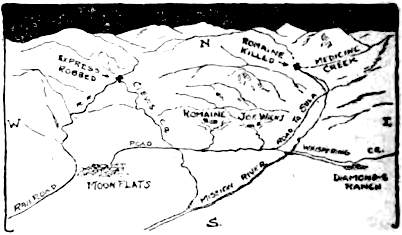
They rode on across the sage-covered hills, angling back toward the road, riding silently; both men thinking deeply. Their course led down the sharp side of a hill and on to a flat, where they passed a heavy growth of timber and drew up at an old rail fence which enclosed a ranch-house, little better kept than that belonging to Joe Wicks.
There was no human being in sight, and an air of lonesomeness seemed to pervade the old place. The roofs of the house and barn were sway-backed from age and neglect, and everything seemed neglected, forgotten.
Hashknife opened a broken-hinged gate, and they rode up to the house. The door was closed and locked with a heavy padlock. Just out in the yard was a fresh mound of dirt; mute evidence that Shell Romaine had buried his own father.
Hashknife shook his head sadly.
“Dang it all, yuh got to feel sorry for Romaine. Mebbe he ain’t no good—I dunno.”
“He’s got guts anyway,” declared Sleepy. “He didn’t lay down and wail about it, Hashknife.”
“No,” agreed Hashknife; “he sure didn’t; and I like the way he pasted the stage-driver. Man, he sure can hit. Well, I don’t reckon there’s any use foolin’ around here.”
They turned and rode out of the yard, heading down the road, which would connect with the main highway to Moon Flats. Just at the edge of the clearing, where the road twisted between a tall outcropping of granite and a big clump of brush, Hashknife suddenly jerked sidewise in his saddle, almost falling across his horse’s neck; while from back somewhere near the house came the sharp snap of a high-power rifle.
With a sharp slash of his spurs Sleepy whirled his horse sidewise, throwing Hashknife’s mount off the road and into the brush, where both horses raced ahead several jumps before Sleepy stopped them. Hashknife was humped in the saddle, apparently badly jarred. Sleepy slid to the ground and went to Hashknife’s assistance, but the tall cowboy had already dismounted and was fumbling with his holster.
“Where did it git yuh?” asked Sleepy anxiously.
“Take a look,” grunted Hashknife, turning his back to Sleepy.
The bullet had torn Hashknife’s shirt from the center of his back to a point high up on the shoulder, cutting an ugly gash but not going deep enough for any permanent injury.
Sleepy started to examine it more closely; but another bullet struck a sapling just behind them, and they both dropped low in the brush.
“Kinda jagged me, didn’t it?” asked Hashknife.
“Cultivated yore shoulder,” grunted Sleepy. “If that danged fool don’t quit he’ll hit a horse.”
“Yeah—if he don’t quit he’ll grab a harp,” gritted Hashknife, flexing his right arm.
Another bullet flipped above them, sending a shower of leaves down upon their sombrero hats, but they were so low that the shooter could not see them now, and he was evidently shooting by guess.
“Wish we had a Winchester,” grumbled Hashknife. “Can’t do much with a six-shooter at this range, but I can sure make one awful stab at it.”
“Aw-w-w, look at them —— horses!” wailed Sleepy.
The two horses had left the brush and were working out into the open. One of them had the reins looped around its foot and was moving along head down, when the rifle cracked again, and the horse pitched headlong, kicked wildly and lay still.
Sleepy sprang to his feet, but Hashknife yanked him down.
“Stay down, yuh danged fool! Don’tcha know he was tryin’ to hoodle yuh into starting somethin’?”
The rifle cracked again, and the other horse floundered back into the brush, ran a few jumps and crashed down.
“Well,” said Hashknife slowly, “we’re due to walk now.”
“I reckon we better be glad that we’re able to walk,” observed Sleepy. “That jasper is a good shot, and you just happened to turn far enough to miss bein’ hit plumb center. Hurtin’ yuh much?”
“Not half as much as my feet will before we get to town, Sleepy. My boots are kinda tight.”
“Danged dude,” sarcastically. “Tryin’ to pinch a pair of number tens into nines. Next thing I know you’ll be usin’ cornstarch on yore nose to take off the shine.”
“Well,” mournfully, “I’ll still be yore little friend. No matter what happens, I won’t turn yuh down because yuh ain’t got no sense, Sleepy.”
Sleepy grunted explosively and peered through the brush. There was no sign of the shooter. A magpie, dipping and sailing across the clearing, twisted sharply and came to rest on the apex of the ranch-house roof. A minute later another of the same species came in from the opposite direction and perched near the first one, where they both chattered volubly, arguing in almost human voices.
“Either that bushwhacker is danged well hid or he’s pulled out,” declared Hashknife. “Them magpies ain’t even cautious, and yuh can’t hardly fool a magpie.”
Cautiously they crawled toward the edge of the clearing, taking plenty of time and watching closely. An exposed sombrero failed to draw a shot. Hashknife snaked himself in behind a cottonwood bole and assumed an upright position. The sharp eyes of the magpies discovered him, and they flitted swiftly away, calling a warning to all of their kind.
Hashknife gripped his gun, flung himself away from the tree and ran to the dead horse, where he dropped flat on the ground. Still there was no shot to break the stillness. He sat up, taking a long chance, but no shot came.
Sleepy walked over, and they examined the horses, both of which had been almost instantly killed. They stripped off the saddles and bridles and hung them up in a tree. Neither of the men complained nor swore dire revenge upon the man who had deprived them of their mounts.
“That there roan was a danged good horse,” declared Sleepy.
“Such as he was,” admitted Hashknife; “but he didn’t noways compare with my gray hawse.”
“Both of ’em bein’ dead, it sure makes a fifty-fifty argument,” grinned Sleepy. “That little roan bronc was all horse. Fifty miles a day——”
“Yuh mean, a week,” interrupted Hashknife.
“Lemme finish, won’t yuh? Jumpin’ at conclusions thataway, Hashknife, makes me weary of yore company. I was goin’ to say that fifty miles a day would kill that roan—dead. Want me to doctor that shoulder?”
“Naw. It kinda burns a little, and it’s sore as ——; but yore kind of doctorin’ wouldn’t help it none. Let’s go to Moon Flats. Can’t be more than a couple of miles.”
Sleepy nodded.
“All right, cowboy. I hope they don’t cuss us nor shoot at us down there. I never did see such a —— uncivilized country in my life. Who do yuh reckon shot at us?”
Hashknife shook his head.
“I dunno. Likely mistook us for some one else and pulled out as soon as they found out their mistake.”
Sleepy shook his head and squinted at Hashknife.
“Now, you don’t even start to think thataway. They’d ’a’ found that out before they shot our horses, wouldn’t they? They never got a look at us after that.”
“Mebbe they got scared and shot the horses to keep us from followin’ ’em, Sleepy.”
“All right, all right. Mebbe this and mebby that, and all the time——”
“We’re delayin’ the blisters on our heels,” finished Hashknife. “C’mon, old pessimist.”
And they started off down the road, walking with the stiff-legged gait of a cowboy whose boots are high-heeled and altogether too tight; walking with elbows bent and hardly swaying from the head to the waist.
Just before they reached the forks of the road a rider swung on to Romaine’s road and eyed them curiously. It was Mort Lee, the cowboy who had brought news of the Romaine killing to Moon Flats. Hashknife grinned at him, and after a moment Mort Lee grinned widely.
“Takin’ our daily exercise,” stated Hashknife seriously.
“Yeah?”
Mort Lee did not seem convinced.
“Keeps a feller in good shape,” added Sleepy, shaking the perspiration off his nose.
“I betcha,” agreed Mort, and added, “’Specially in ridin’-boots.”
“That fit tight,” added Hashknife painfully.
Mort Lee nodded, and his eyes invited explanations which did not come. Finally he said—
“Been up to Romaine’s place?”
“Uh-huh.”
“Shell at home?”
“I dunno,” said Hashknife. “We didn’t see him.”
“Oh.”
Mort Lee pursed his lips and squinted at the sun.
“We-e-ell, I reckon I’ll be moseyin’ on, gents. Yuh won’t find the main road much better walkin’ than this.”
He spurred his horse and went away in a whirl of dust.
“If they don’t cuss yuh or shoot at yuh, they hang crape,” complained Sleepy. “—— such a country!”
“Country’s all right,” argued Hashknife. “It’s the folks in it that make it bad. These people need purifyin’—that’s all it needs, Sleepy.”
“That’s all —— needs,” retorted Sleepy sadly.
About the time that Hashknife and Sleepy reached the main road, a crowd of men gathered around a poker table in the Moon Flats gambling house. Cal Severn had challenged Doc Maldeen to a single-handed game of stud poker. Severn seldom played poker, but when he did it was for big money, and the men around the table grinned in anticipation of large stakes.
There was no money in sight, Severn merely requesting five thousand dollars worth of chips. The cowboys around the table gasped audibly. Five thousand dollars! But Maldeen did not even blink as he slid five stacks of white chips across the table to Severn.
“Hundred dollar chips big enough?” he asked casually, and Severn nodded as he stacked them up in two piles of twenty-five chips each.
They cut for deal, and Maldeen won. Both men shoved in an ante of two hundred dollars after getting their hole-card. Then Severn drew an ace and Maldeen a seven spot. Severn bet two hundred and Maldeen stayed. The third card around showed another ace for Severn and a king for Maldeen.
This time Severn bet two hundred, and, after calm consideration, Maldeen tossed in seven chips.
“Tiltin’ it five hundred, eh?” Severn half-smiled, as he called the raise.
The fourth card showed a jack for Severn and another king for Maldeen. Severn studied Maldeen’s cards. He had Maldeen beaten in sight, but the five hundred dollar raise made it appear that Maldeen had a king buried. Severn passed the bet and Maldeen shoved in five chips. Severn fingered his chips for quite a while, but finally tossed five into the pot.
Maldeen dealt slowly, placing the next card carefully beside Severn’s hand. It was another jack. This gave Severn aces and jacks in sight. Maldeen flipped over his own card—another king. Three kings against two pair—in sight. It was Maldeen’s first “say” in the pot, and he quickly estimated Severn’s chips before shoving ten chips into the center.
Severn seemed to hesitate. He was beaten in sight, and Maldeen held a hard hand to bluff. Severn was already in eleven hundred dollars. Then he slowly picked up the rest of his chips and slid them to the center. Maldeen smiled and shook his head.
“Cal, that’s cold-blooded poker, but I feel that yo’re out on a limb.”
He swiftly counted out his chips and slid them to the center, and his pile totaled one more chip than what Cal Severn had bet.
“Raisin’ a hundred?” queried Severn softly.
“Thassall,” smiled Maldeen.
Severn hesitated for a moment and cleared his throat.
“Give me five thousand more, doc.”
Maldeen seemed about to refuse, but counted out the required amount. Severn was good for that amount, just on the strength of the Diamond-S ranch. He did not stack his chips this time, but shoved them all to the center.
“Boostin’ it forty-nine hundred,” he stated.
A gasp went up from dry throats around the table. It was the largest bet they had ever seen made. Maldeen studied Severn’s cards as if seeking to discover whether Severn was bluffing or had filled his hand. He squinted at Severn’s face, but the young cattleman was slowly puffing on his cigaret and looking at the fortune in the center of the table.
“I call,” said Maldeen, tossing in his chips. Severn flipped over his hole-card—an ace. “Ace full!” gasped a cowboy, almost overcome from the suspense.
Maldeen smiled grimly and turned his card. It was another seven.
“King full!” exploded another cowboy. “Two full houses!”
For a few moments Cal Severn did not say anything. He shoved the chips across to Maldeen and leaned back in his chair.
“The god of luck was with me, doc; I’m through.”
Maldeen got slowly to his feet and went back to his private room, where he kept a small safe. In a few moments he came back with ten thousand dollars in gold and currency. After he had counted it out he turned to the crowd and said—
“The house buys a drink, gents.”
And the “gents” took their drink, gulping it down wolfishly, as if seeking solace from the reaction of that big bet.
“Never saw nothin’ like it before,” declared a cowboy earnestly. “That’s goin’ to spoil me for any of this four-bits-a-stack game. I used to git a thrill out of a five-dollar bet, but—Forty-nine hundred—whoo-o-ee!”
Severn laughed softly and leaned on the bar.
“That ten thousand will kinda help to pay up some of my debts, doc.”
Maldeen grimaced.
“It won’t help mine, Cal. That’s a hard jolt for the old Moon Flats, if anybody asks yuh.”
Severn shrugged his shoulders.
“You dealt ’em to me, doc.”
“I’m a —— of a dealer,” admitted Maldeen, and the crowd laughed boisterously.
They appreciated a good loser, and Maldeen was not kicking.
And that same morning Mary O’Hara met Shell Romaine in the hills; but the meeting was not planned. Mary rode the hills nearly every day astride a wiry little sorrel horse, riding as recklessly as any cowboy; but today she was not in the mood for a wild gallop, and was poking slowly along a narrow trail when her horse suddenly stopped, and she looked up at Shell Romaine, whose horse blocked the trail.
For several moments they looked at each other, and then Shell swung his horse on to the down-hill side, giving her plenty of room to pass. He had removed his hat, but did not speak. He had changed from the dilapidated suit of the day before, and was now wearing a black sombrero, faded blue shirt and bat-winged, silver-trimmed chaps. Around his neck was a scarlet silk muffler, while around his waist was a wide, silver-trimmed cartridge-belt, and swinging low on his thigh was a holstered pistol.
“Why don’t you speak to me?” asked Mary O’Hara.
Shell looked closely at her and dropped his eyes to the pommel of his saddle, where the palm of his right hand was tightly clenched.
“I didn’t reckon you’d care to have me,” he replied.
“Did you make that up out of your own head, Shell?”
“Well—” Shell lifted his head defiantly—“I don’t know why yuh should want to speak to me.”
Mary sighed and examined her well-worn gauntlets.
“Nobody wants to speak to a horse-thief, bank-robber, killer,” he continued; but there was no bitterness in his voice. “I reckon everybody knows that my old man was the Black Rider.”
“Shell, I’m sorry—for—you. It is hard luck, but——”
“I don’t want sympathy,” interrupted Shell, “and I’m not blamin’ luck for what happened. I reckon I’ll try to sell out the old place and leave the Mission country. It was hard to make a livin’—before; it’ll be impossible now.”
Mary nodded slowly. Shell twisted in his saddle and wiped his forehead with his sleeve.
“Mary, I want to tell yuh somethin’ and ask yuh to forgive me for doin’ it—if yuh can.”
“If I can?”
“Yeah. Before that bank robbery—” Shell paused a moment—“mebbe it was a week or so before that, I got drunk in Moon Flats, and I got to braggin’ to some of the boys. You was crossin’ the street and I told them that me and you was engaged to marry.”
Mary looked curiously at him and shook her head.
“No one ever told me that, Shell.”
“Well, I said it, Mary. I dunno why I lied like that, but I did, and I’m glad it never came to you.”
Suddenly Mary smiled.
“Shell, it did, too; but not that you had said it. Quite a while after you went away Cal Severn asked me if I was engaged to you. I told him I was not, and he laughed it off. I did not ask him where he got the idea.”
“I reckon some of the boys told him,” said Shell slowly; and then, “Are you goin’ to marry Cal Severn, Mary O’Hara?”
Mary flushed and reached down to pat the shoulder of her horse, but did not reply.
“I wish yuh a lot of luck,” said Shell. “A lot of luck.”
Mary lifted her head, her eyes filled with tears.
“Shell, I must tell you something. You heard that the Overland was robbed yesterday morning between Moon Flats and Clevis Creek bridge, didn’t you?”
Shell nodded his head.
“Uncle Pat was notified yesterday morning. It was done by a lone robber, who tied up the messenger and blew the safe. There was a lot of money taken. The messenger was discovered at Wheelock, and he was unable to give a good description of the robber, but said he was dressed in dark-colored clothes.”
Shell turned his head and stared off across the purple sage, his mind working fast. He had been on that train.
“Did Pat find any clews, Mary?” he asked.
“No. But, Shell, they want to know where you were at that time, don’t you see? Some say it was done by the Black Rider, but others point out the fact that you came into town early. Newt Bowie and Monte Barnes say that you were in Moon Flats at daylight.”
Shell smiled bitterly.
“Is there a warrant out for me?”
“Uncle Pat did not say, but I know he has worried a lot about it, Shell.”
“Has he? I suppose I ought to go to town and prove that I had nothin’ to do with it, or give myself up to the law; but one I can’t do and the other—I’ve had a taste of, Mary. Oh, I know what the Mission range thinks of me, and I know how much chance I’d have in their courts. I’m already convicted, in their minds.”
Mary nodded. She knew that Shell’s past reputation was all against him, and she knew that many folks in Moon Flats had already declared that Shell Romaine had robbed the train. Hadn’t he been convicted of robbery before? Hadn’t his own father been the Black Rider and got killed in the act of holding up a stage?
“Couldn’t you prove your innocence, Shell?” asked Mary.
“Prove nothin’!” bitterly. “What proof could a paroled convict bring to a court of law?”
“Paroled?”
“Yeah—paroled, Mary. I’m not free—not in the right way. I’ve got to report to the sheriff every so often, and any old time I even look cross-eyed—back I go to the pen.”
“Will you report to Uncle Pat?”
“No!”
Shell gathered up his reins and settled himself in his saddle.
“I’m an outlaw. I haven’t got a chance in the world to prove anythin’, and I’m not goin’ back to the penitentiary. If they got me for this robbery I’d go in for twenty years, don’tcha know it?
“They’re all primed to get me, I reckon. I ain’t got a friend left—if I ever did have any; and from now on I’m goin’ to get the game as well as the fame. You tell Pat Haley, will yuh, Mary? Tell him he can declare open season on the last of the Romaines. I like Old Pat, and the Lord never made a better woman than ‘Ma’ Haley. I don’t want to harm them, but you tell Pat that I’m not comin’ in—not on my own feet.”
Shell turned his horse down the hill, riding straight down the steep slope to the bottom, where he swung around on to a hog-backed ridge and disappeared in the timber.
For several minutes after Shell had disappeared, Mary continued to watch after him. He had wished her lots of luck in her marriage to Cal Severn. She had liked Shell Romaine, but had never thought seriously about him. He was a wild sort of person, willing to fight at the drop of a hat—and drop it himself—while Cal Severn was more settled, substantial.
She turned her horse and rode slowly back toward town, secretly glad that Shell Romaine was not going to give himself up to the law. She knew that it would be Pat Haley’s duty either to arrest or kill him; knew that the men of the Mission River ranges would comb the hills for him. Turning outlaw would be proof conclusive that he was guilty, but for some reason Mary was glad that Shell Romaine was no quitter.
Hashknife and Sleepy came into Moon Flats tired, dusty and limping from sore feet. They headed for the horse-trough beside the livery stable, where they took off their boots and immersed their aching feet in the water.
“—— hath no fury like a busted blister,” declared Sleepy, wiggling his cramped toes. “I wish I had the power to bring a curse upon the man who slew our chargers.”
“Go ahead,” groaned Hashknife, “and I’ll do my dangdest to make it come true. The man that made my boots never knowed that a human bein’ had more’n one toe.”
“You will be a dude,” observed Sleepy. “Bend yore feet all out of shape to make ’em look dainty.”
Sleepy looked up and shoved his bare foot against Hashknife’s ankle. Cal Severn was coming down toward them, leading his horse.
“What’s the idea of the foot-bath?” he asked as he came up to them.
“Gettin’ sanitary,” grinned Hashknife, reaching for his cigaret-makings. “Washin’ feet helps clear yore mind.”
“Thasso?”
Cal Severn seemed amused.
“And what is the real reason?”
“Hot feet,” grunted Hashknife, and then proceeded to tell Severn what had happened to them.
“You ain’t kiddin’ me, are yuh?” he asked when Hashknife finished.
“Go and look in Romaine’s front yard and you’ll find two perfectly good dead horses,” declared Hashknife.
Severn shook his head.
“No, I’ll take yore word for it and keep away from Romaine’s place.”
“Scared of him?” queried Hashknife, lighting his smoke.
Severn grinned.
“If yuh want to look at it that way. I don’t care to be shot at, Hartley. But—” Severn grew more serious—“why should Shell Romaine shoot at you two?”
“Who in —— said he shot at us?” demanded Hashknife.
“Well, you—uh— Didn’t you just tell me——”
“I said we was shot at,” corrected Hashknife.
“I getcha. But who would shoot at you? You are strangers around here. Maybe it was a mistake.”
“I dunno about that.”
Hashknife proceeded to pull on his socks carefully.
“Anyway—” looking up with a grin—“we know —— well that we wasn’t welcome around there.”
“Kinda looks that way,” admitted Severn seriously, and then, “Get a couple of horses from the stable to ride out to the ranch today.”
Severn started to lead his horse into the stable, but turned.
“I reckon I can fix up some saddles for yuh out at the ranch.”
“Ne’ mind,” said Hashknife. “We’ll go out tomorrow and get our own rigs.”
“Out to Romaine’s?”
“Perzactly!” grunted Hashknife, kicking a boot-heel against the trough, trying to drive his swollen foot into close quarters.
Severn nodded and led his horse inside.
“I wonder what kinda whippoorwills he thought we are?” queried Sleepy. “Think we’d give up them there good saddles?”
“Didn’t know he had hired two brave men,” grinned Hashknife, but grimaced with pain as he took a step. “—— it! I thought my shoulder was sore, but these two feet of mine ain’t feet a-tall; they’re —— in a pinch.”
Hobbling along, they headed for the Moon Flats saloon, where several cowboys, including Monte Barnes, were standing on the porch. The cowboys looked curiously at them, but said nothing.
“I’ll buy a drink,” announced Hashknife. “I bet my pardner the drinks that I could beat him to town from the Diamond-S, but I calculated wrong; so I’ll buy a drink for everybody.”
“Walk?” gasped Monte.
“Not all the way,” said Hashknife, standing on one foot. “Part of the way we ran. C’m on in.”
They all went inside and lined up at the bar. Maldeen was not there, and the conversation turned to the poker game, which had been played a short time before.
“Severn won ten thousand dollars in one hand,” explained Barnes. “Game of stud. Both men filled. Never seen anythin’ like it in my life.”
“Prob’ly won’t never ag’in,” declared another.
Hashknife squinted at his drink and looked around the room. Finally he turned to Barnes.
“Ten thousand is a lot of money.”
“More ’n I ever seen before,” declared Barnes. “It’s plumb easy to speak about it, but when yuh see it all on the table—whoo-o-o-ee!”
“And Maldeen done the dealin’,” added another. “He sure deals a straight game.”
“Severn must be a plunger,” observed Sleepy.
“I never seen him play big before,” stated Barnes. “He plays poker once in a while, but I think that most of his gamblin’ is done in the East.”
“Goes East to gamble?”
Hashknife squinted at Barnes.
“Naw—the stock markets. Yuh know what I mean—gamblin’ in wheat and oats and that kinda gamblin’. We took a train of beef back there two years ago and Cal studied market stuff. Ever since then he’s gambled thataway, and I reckon he didn’t get as square a deal as he got today.”
“They kinda hook yuh, I reckon,” observed Hashknife.
“Dang right! They sure hookum-cow. Man ain’t got no chance to bluff; don’t even get time to study his cards. I’ll takem mine over the poker table, y’betcha.”
“What happened to yore back and shoulder?” asked one of the cowboys, pointing at Hashknife’s back, where the bullet had ripped the shirt.
The wound had bled considerably, discoloring his shirt.
“Oh, that?”
Hashknife tried to twist his head and look over his own shoulder.
“Well, sir, I was kinda hurryin’ along and snagged m’self on a barb-wire fence.”
The cowboys glanced at each other, but did not dispute the explanation. That it was not done by a barbed wire was very certain, but they knew better than to inquire too deeply into something that was really none of their business.
After the round of drinks Hashknife and Sleepy left the saloon, leaving a bunch of cowboys trying to figure out why two sore-footed cowboys had walked into town and why one of them had a bullet-scrape across his shoulder.
Jim Searles was standing in front of Bill Eagle’s general merchandise store, and from him Hashknife found out where Pat Haley lived. Searles scowled at them and hitched up his belt. Searles was an evil-looking gentleman, short of body, but long of face.
“Whatcha want him fer?” he asked after directing them.
“Want him to say a prayer,” said Hashknife seriously.
“Who fer?” quickly.
“I dunno—yet,” grinned Hashknife and turned away.
Pat Haley lived in a home-like frame cottage just at the edge of town. Two great cottonwoods almost concealed the house, and the front yard was a mass of rosebushes. A sorrel horse, saddled, was tied to the rear gate, and voices were audible through the open front door.
The two cowboys went up to the door and were about to knock, when Pat Haley came into the short hall. He glanced quickly at them and grinned with his pipe clenched between his big teeth.
“Come in and rest your feet,” he greeted them. “Sure, it’s cooler in the house, and me wife has just made a gallon of limminade wit’ ice. Come on in.”
They followed him into the living-room, where he introduced them to Ma Haley and Mary O’Hara.
“Me niece,” explained Haley. “She’s one-half of the Haley family, and me and Ma are the other half.”
Hashknife and Sleepy sat down awkwardly on the sofa and fondled their hats. Hashknife winced from the jerk of his shirt as he sat down, and Ma Haley divined that something was wrong.
“Did ye get hurt?” she asked abruptly, getting out of her chair.
“Now, it ain’t nothin’,” declared Hashknife. “I just got scratched with a bullet, thassall.”
“All?”
Ma Haley came straight to him and made him bend his back.
“Heavens above!” she exclaimed. “Why, the poor boy has been badly hurt! Mary, get some hot water and car-r-bolic-acid bottle—quick!”
“Aw-w-w-w!” begged Hashknife. “It ain’t nothin’.”
“You’re in a —— of a fix,” laughed Pat Haley. “When Ma finds a cut or a bruise she niver lets up until she doctors it. But who shot ye, Har-r-tley?”
“I dunno. You tell him, Sleepy—I’m in the hospital.”
“You’ve got to take off that shirt,” declared Mrs. Haley, “I never do things by halves, me boy.”
“Come out on the porch and I’ll tell yuh,” laughed Sleepy. “I’d get to laughin’ if I ever seen Hashknife Hartley in the rough.”
They went outside, leaving Hashknife groaning mentally.
Mary came in with the water and bottle of acid, and Hashknife prayed that she would go out again; but Ma Haley spoiled his prayer by saying:
“I want you to help me, Mary. Every girl should know how to doctor a cut, bruise or a gun-shot wound, and this is a bad one to star-r-rt on,” and then to Hashknife, “Shall I cut the shirt off, or can ye stand to have it pulled off?”
Hashknife hesitated.
“Bring me the shears, Mary.”
“——!” breathed Hashknife. “I suppose there ain’t no way out of it; so I might as well save the shirt,” and he began to take it off.
He glanced at Mary O’Hara, who was trying to suppress a laugh, and at Ma Haley’s serious face. It was too much for Hashknife. He bared his back and prayed that it might not take long.
From out on the porch came the droning of Sleepy’s voice as he explained things to Pat Haley, while Ma Haley bathed the wound tenderly and explained the dangers of infection to Mary O’Hara.
For lack of adhesive Ma Haley was compelled to wind the bandages around Hashknife’s chest and over his shoulder, which forced him to sit up and face them, bared to the waist. He was bronzed from the sun, and the long muscles rippled like those of an athlete.
“Ye are no weakling,” declared Ma Haley, and Hashknife blushed like a girl.
“Would ye tell me where ye were when ye got shot?”
“In Romaine’s front yard,” replied Hashknife.
Crash! Mary dropped the pan of water upside down on the carpet, and it flooded Ma Haley’s shoes. She sprang aside and stared at Mary, who was staring at Hashknife.
“In Romaine’s front yard?” breathed Mary. “At the Romaine ranch?”
Hashknife nodded and looked down at the wet carpet. Just at that moment Pat Haley and Sleepy came in from the porch and stared at the tableau.
“What went wrong?” asked Pat.
“Mary fumbled the pan,” said Mrs. Haley gently. “Sure, the antiseptic water should be good for the carpet.”
Sleepy laughed and leaned against the wall.
“Hashknife, yo’re all packed up and ready for shipment.”
Hashknife merely glanced at Sleepy, but turned his eyes back to Mary O’Hara, wondering why she dropped the pan of water. Why was she startled when he mentioned the place where the horses were killed? Pat Haley was talking now, and so was Ma Haley; one about the shooting, the other about supplying Hashknife with a clean shirt while she washed the torn one.
Hashknife agreed with both sides and Ma Haley bustled away to get one of Pat’s shirts, while Pat sat down on the sofa beside Hashknife. Mary picked up the pan and went to the kitchen just as some one knocked on the front door and Cal Severn’s voice called a greeting from the porch.
Without waiting for any one to answer his hail, he came down the hall and into the doorway, where he stopped and stared at the three men.
“Excuse me,” he grinned. “I didn’t know yuh had company, Pat. Where’s Mary?”
“Out in the kitchen.”
Severn walked through the kitchen door, and a moment later he and Mary were in conversation.
“She goin’ to marry Severn?” asked Hashknife.
“Uh-huh,” grunted Pat. “That’s the idea, I reckon.”
“Severn just won ten thousand dollars from Maldeen.”
Pat took his pipe from his mouth and looked closely at it for a moment. He squinted at Hashknife curiously.
“Would ye say that ag’in?”
Hashknife repeated the statement and added that it was won on a single hand in which both men held full houses.
“Well, well!”
Pat blinked rapidly.
“I’ve an idea that ten thousand is a lot of money. And ye say it was a single hand? Ten thousand dollars! I’m thinkin’ that Doc Maldeen will face a lean year.”
Mrs. Haley came in with one of Pat’s shirts and gave it to Hashknife.
“I’ll wash and mend the other one,” she stated, “and I’ll also go out while ye put this one on.”
“Yo’re a wonder, Mrs. Haley,” declared Hashknife. “My shoulder feels better than it did before it was hurt.”
“A little lyin’ directly from the heart hurts no one,” grinned Ma Haley.
Hashknife put on the shirt and rolled a cigaret, while Pat Haley puffed slowly, thoughtfully.
“Sleepy told yuh all about what happened, didn’t he?” asked Hashknife, and Pat nodded.
“He did. I can’t for the life of me de-duct why ye were shot at, though. If it was Shell Romaine, why would he wish to kill either of you?”
“If he knowed why we are here he might,” said Hashknife softly.
“Aye, but he don’t know. Cal Severn and meself are the only ones who know. I have not told him, and I’m sure that Cal has not.”
Hashknife studied the tip of his cigaret for a moment, and then—
“What do yuh know about Joe Wicks?”
“The half-breed? He’s just Injun—no good. Got a shack in a gulch over beyond the Romaine place. His woman cooks for Severn.”
“Yeah, I know she does,” nodded Hashknife. “We rode up to his place today. Joe was half-drunk—more than half, ’cause he asked us to have a drink with him. His girl was there.”
“Marie,” nodded Pat.—“Pretty Injun girl. She’s been to the Injun school, and they tell me that she’s smart. Mary has taken a likin’ to her.”
Pat laughed and shook his head as he added—
“Henry Horsecollar Dryden is stuck on Marie and wants to marry her, so Mary says.”
“Thasso?”
Hashknife grew interested; but just then Cal Severn came in from the kitchen, barely nodded to them and went out the front door.
“Well, that’s leavin’ in a hurry,” observed Pat.
From the kitchen came the sounds of argument between Mrs. Haley and Mary, and Pat grinned widely.
“Sure, there’s been a battle,” he whispered. “Ma’s out there tryin’ to pour water on the powder.”
A moment later Ma Haley came into the room, her eyes serious as she went to the front window and looked out. Then she turned to Pat.
“Mary’s cryin’ her heart out, and Cal’s headin’ back toward the ranch.”
“Well, now, isn’t that the usual thing to do, Ma?”
Pat seemed surprised at her distress.
“I mind the time that you bawled——”
“I never bawled, Pat Haley! If you’d ’a’ hurt my feelin’s before we were married—we wouldn’t ’a’ married.”
“Ma, ye’re startin’ an argument with me,” warned Pat. “I have never won an argument with ye yet, but I’m givin’ ye fair warnin’. I’ll win some day, so I will.”
“Ye will, will ye? Well, if it wasn’t for our guests I’d make ye wish ye’d never made the statement.”
Pat Haley grinned delightedly and was about to continue when Mary came in. She had been crying, but her mind seemed to have been made up and she spoke directly to Pat Haley.
“I did not want to tell you this, but I think I must. I met Shell Romaine this morning—in the hills. It was an accidental meeting. We talked for a while about things, and he told me that everything and every one was against him and for me to tell you that he was not going to come in and report to you. He said that he was turning outlaw and that he was going to get the game along with the fame.”
Pat took his pipe from between his teeth and polished the bowl on his palm while the others waited for him to speak. Finally he laid the pipe aside and smiled softly.
“I believe I’m not surprised. What time was it, Mary, and where did ye meet him?”
“It was about ten o’clock, and I met him on that narrow trail around the head of Broken Gulch.”
Pat turned to Hashknife.
“About what time was it that you were shot at, Hartley?”
“It must have been later than that. Mebbe it was ten-thirty or a little later.”
Pat nodded and rubbed his knees.
“From that spot it is about two miles to the Romaine ranch.”
He frowned for a moment and looked at Mary.
“I’m sorry, but it looks like Shell Romaine had started real quickly to make good his threat.”
Mary’s eyes blinked back the tears, and she turned and went back into the kitchen. Pat squinted after her and turned to Ma Haley, speaking softly,
“And what was the row about—between her and Cal?”
“She would not say, Pat. Does a girl blab about the troubles between her and her sweetheart?”
Pat grinned at Ma Haley’s serious expression and turned to Hashknife.
“It appears that Shell Romaine has challenged the law, does it not? I hate like the —— to accept, but me sworn duty says for me to bring him to task.”
“If he’s the one what shot at us, yo’re welcome,” said Sleepy. “That jasper sure can shoot.”
“Aye, he can that, and it will be a grand battle.”
Hashknife got to his feet and shook hands with Ma Haley, thanking her for dressing his wounds.
“Come and see us,” she urged. “Ye have not been well entertained because things are kinda upset; but drop in any time.”
Hashknife turned and walked to the kitchen door. Mary was standing at a rear window, looking out, but turned as Hashknife came up to her, holding out his hand.
“I—I am pleased to meet you,” she faltered.
“Yes’m, I suppose yuh are, but yuh ain’t had much pleasure since I’ve been here. I hope to see yuh again—smilin’.”
He turned and walked on to the porch, where Pat and Sleepy were waiting for him, and with a hearty handshake they left the warm-hearted sheriff of Moon Flats.
Severn had spoken to the livery stable keeper, and two horses were saddled for them. The man volunteered the information that Severn had gone back to the ranch. He dilated on the fact that Severn had won ten thousand dollars from Maldeen, and was still marveling over it as they rode out of earshot.
Hashknife was very thoughtful, shaking his head as he debated things with himself. Finally he said—
“Mary O’Hara is a danged pretty girl.”
“Yeah?”
Sleepy grinned.
“Think she is, do yuh? Henry Horsecollar didn’t think so.”
“He likes ’em dark.”
Hashknife turned sidewise in his saddle and squinted at Sleepy.
“I’ve got a hunch that Mary likes Shell Romaine.”
“Yo’re dense as —— if it took yuh that long to find it out,” grinned Sleepy. “Didja notice that her and Cal Severn had a quarrel?”
“Yeah, and I’d give a lot to know what it was about, Sleepy.”
“What good would that do yuh?”
“I dunno—no good, mebbe.”
They rode in at the ranch and stabled their horses. Henry Horsecollar squinted at their mounts and rubbed his chin.
“Didja trade with the livery stable?” he asked.
“Rented ’em,” said Hashknife. “Somebody shot both of our horses.”
“M’ ——! Shot ’em? Where?”
Sleepy sketched out their experience, and Henry listened in open-mouthed amazement.
“Well, sir,” he declared, “it’s a caution what folks will do. Cal Severn came home a while ago, swore at me and almost jarred the winders out of the house when he slammed the door.”
“He won ten thousand dollars from Maldeen today,” stated Hashknife.
Henry half-opened his mouth and leaned weakly against the corral.
“Ten— Aw-w-w, yo’re kiddin’ me, ain’tcha?”
“In one hand of stud poker,” said Sleepy.
Henry rubbed his chin slowly.
“Well, sir, I reckon he wasn’t mad a-tall—he was crazy. The shock of winnin’ that money kinda insaned him, don’tcha s’pose?”
“It would me,” grinned Hashknife, and then sobered suddenly, as he said, “I seen yore girl today, Henry.”
“My girl—Marie?”
Hashknife explained their mistake in thinking it was Romaine’s place, and then he told of how Joe Wicks had hit Marie with a rock. Henry listened calmly enough, but his lips tightened over the recital.
“Drunk, was he?”
“Drunk enough to ask us to drink with him.”
“That’s pretty drunk,” admitted Henry.
“I dunno where he gets his whisky—wish I did.”
He sighed and leaned against the fence.
“I never had no girl before. Mebbe folks will look down on me for carin’ for an Indian girl, but it’s my own business. I’m shootin’ square with her.”
“Then we’re with yuh, Henry,” said Hashknife softly.
“We’re with anybody that shoots square. Me and Sleepy ain’t no plaster saints, but we sure do admire folks that shoot straight.”
“I ain’t no saint either.”
Henry shook his head.
“I’ve mavericked cows and been two jumps ahead of the sheriff; I’ve done a lot of wrong things, but I’m square with Marie.”
“Kinda wipes out the rest of the charges,” nodded Sleepy, and added, “We met Mary O’Hara today.”
“Yeah? She’s goin’ to marry Cal Severn, I reckon. Anyway folks say she is. Didja hear anythin’ more about the train-robbery?”
“Not much,” said Hashknife. “They’re thinkin’ that Shell Romaine pulled that job.”
Henry grinned and shook his head.
“I don’t believe that. I betcha Shell Romaine came back here to dig up his half of that thirty thousand dollars he stole a year ago, and he ain’t takin’ no chances till he gets it.”
“There may be a hunk of truth in that,” admitted Hashknife.
“Yo’re danged well right there is truth in it. I’ve felt that all along. His old man has got a cache somewhere that’s a dinger. Mebbe Shell will find that, too. Mort Lee came past here today and asked me if I’d seen Shell. I wonder what Mort wants him for.”
“Mort’s the cowpuncher that brought in the news of old Romaine’s killin’,” said Hashknife thoughtfully.
“We met him, too. What kind of a feller is he, Henry?”
“Mort Lee? Well, I’ll tell yuh about me: If I can’t say somethin’ good about a man, I won’t say anythin’. Mort Lee is jist so-so, if yuh know what I mean.”
“What about Jim Searles?”
“That or’nary pup? Sa-a-ay——”
Henry shook his head.
“Words fails me when I even think of Jim Searles.”
“That’s good,” said Hashknife. “Let’s see if Minnehaha has got any food for the stummick.”
Cal Severn was not friendly the following morning, but the boys put that down to the fact that the quarrel between him and Mary O’Hara still ruffled him. He came down to the bunk-house after breakfast, leading a saddled horse.
“Goin’ after your saddles today?” he asked.
“Pretty quick,” said Hashknife. “We’ll lead a couple of your horses so we can return the livery stock.”
“All right. Henry’ll show yuh the ridin’ stock.”
“Reckon I’ll ride in, too,” said Henry; but Severn shook his head.
“No; I want you to ride that upper fence today,” he said.
Severn swung into his saddle and turned.
“I’m goin’ up the east side of the river if anybody wants to know.”
He rode away while Henry Horsecollar swore under his breath.
“I dunno who in —— cares!” he snorted. “Make me stay here all day Sunday and then send me out to fix a —— old fence!”
“When yo’re foreman, yuh can do as yuh please,” grinned Hashknife.
“Yeah, and when ——’s froze over I can skate, too!” retorted Henry heatedly.
Hashknife and Sleepy led two of the Diamond-S horses and rode the livery horses across the hills toward the Romaine ranch. They did not follow the road beyond Mission River, but swung back into the hills, circled Joe Wicks’ place and swung around the heads of the gulches which led down to the Romaine place.
Just above the Romaine ranch-house the gulch forked like the letter Y, and Hashknife and Sleepy circled both forks, which brought them out on to the side-hill on the west side of the ranch. It gave them a clear view of the place. The ranch-house was about four hundred yards away and below them, as they rode into a thicket of jackpines and stopped.
There was no one in sight about the place, but both men studied it closely. They were going to be very sure that no one was there to ambush them again. Hashknife slowly rolled a cigaret, never taking his eyes off the clearing below them.
“She’s plumb deserted,” declared Sleepy.
Hashknife nodded in agreement, but his eyes continued to search the tangle of timber and brush north of the buildings.
“Look down the road!” grunted Sleepy, lifting himself in his stirrups.
Two riders were coming up the narrow, winding road, heading toward the ranch. They were plainly visible to Hashknife and Sleepy, who were far above them, but they were still concealed from the ranch-house.
“Who do yuh reckon it is?” queried Sleepy.
“I dunno,” admitted Hashknife. “I ain’t familiar enough with folks around here to tell who it is.”
The riders came on, their horses kicking up a cloud of dust, swung into the clearing and headed for the house. Then one of the riders seemed to jerk sidewise and fell off his horse, which whirled and ran back toward the brush, while the clear air was shattered by the whip-like pop! of a rifle.
The other rider sprang from his horse and dropped flat on the ground, while the horse whirled and followed the other one back toward the brush. There was silence for several moments, and then the rifle cracked again. A splatter of gravel lifted in front of the man on the ground, who rolled rapidly aside as if trying to get the ranch-house between himself and the shooter.
Hashknife and Sleepy were watching closely, and now Hashknife drew his six-shooter.
“I think I see him, Sleepy. He’s shootin’ smokeless powder, but—watch that heavy clump of willers.”
As Hashknife spoke he lifted his gun and fired—once—twice. It was long range for a .45 pistol, but Hashknife guessed the elevation perfectly, and a man got up from among the willows and began running up the gulch. He was partly screened by the brush, which made it impossible for either Hashknife or Sleepy to tell how he was dressed or even to estimate his physical proportions.
It was only about fifty yards from the heavy willow clump to the forks of the gulch, and both Hashknife and Sleepy emptied their guns at him, but at that range it was impossible to tell where the bullets were striking.
At the forks of the gulch the man stopped in a screen of cottonwoods, and a moment later a bullet splatted into the dirt under Hashknife’s horse. Quickly they swung their horses back into the heavier thicket, but another bullet hummed past their heads, cutting the plume off the top of a jack-pine.
“Dang the luck!” swore Hashknife. “If we only had a rifle!”
He was shoving cartridges into his revolver as he spoke, and after filling the chambers he dropped it back into its holster and turned to Sleepy.
“You go down and help with that wounded man. I’m goin’ to try and snag that smart jasper.”
Sleepy nodded quickly, and Hashknife spurred out of the thicket and galloped off along the slope of the hill. His only chance was to circle the heads of both gulches and try to head off the man’s escape; but if the other had a horse close at hand he would have a decided advantage. Hashknife could have ridden straight down the hill to the bottom of the gulch and followed the man, but it would mean that he would have to ride in the open in the face of rifle-fire; and this man had demonstrated his ability with a rifle.
Sleepy took the two lead-ropes and poked off down the hill, while Hashknife circled the west fork of the gulch, riding recklessly but watching the country. Between the two gulches was a wide stretch of open country, where a rider would be plainly visible; but on the east side of the main gulch were miles of broken hills, where a man might hide away for months.
Hashknife circled around the head of the west fork and galloped straight across this wide flat, heading swiftly for the rim of the main gulch, over a mile away. Instead of going toward the junction of the two forks he swung to the left, cutting across to the main fork, with the intention of striking it about half a mile from the forks. He felt sure that the shooter, realizing that he had more than one person to contend with, would retreat; and there was a bare possibility that he would follow the gulch.