The Life of Paul
Reading edition
New Testament Division—Third Period (Concluded)
PRINCIPAL EVENTS
His Early Life.—Born (as Saul) at Tarsus, in Cilicia (Acts 22:3), the date of his birth not being known. His trade was that of tentmaking (Acts 18:3), and this he found useful later (1 Cor. 4:12). He was educated under Gamaliel, a noted Rabbi (Acts 22:3; 5:34).
His First Appearance in the gospel story is at the stoning of Stephen (Acts 8:3) and he became an active persecutor of Christians (Acts 9:1; 26:10, 11; 9:13).
His Conversion took place on the road to Damascus (Acts 9:1-22; 22:3-13; 26:9-18). He went to Arabia (Gal. 1:15-17) and worked in Syria and Cilicia (Gal. 1:21). He was brought by Barnabas to Antioch (Acts 11:25, 26) and remained there a year.
His First Missionary Journey began at Antioch (Acts 13:1-3) and is described in Acts 13 to Acts 15:35, when a return to Antioch was made. He was stoned at Lystra (Acts 14:8-19) and made a number of disciples (Acts 14:20-24).
His Second Missionary Journey began at Antioch, where he and Barnabas disagreed (Acts 15:36-40) and is recorded in Acts 15 to 18:22. Timothy joined him (Acts 16:1-3), he heard the call of need from Macedonia; crossing to Europe (Acts 16:8-10) he planted churches (Acts 17:1-9; 18:1-17) and again returned to Antioch.
His Third Missionary Journey began at Antioch, and is recorded in Acts 18:23 to Acts 21:26. It included a stay of three months in Greece, and ended at Jerusalem, where he made a report of his Gentile ministry (Acts 21:15-26).
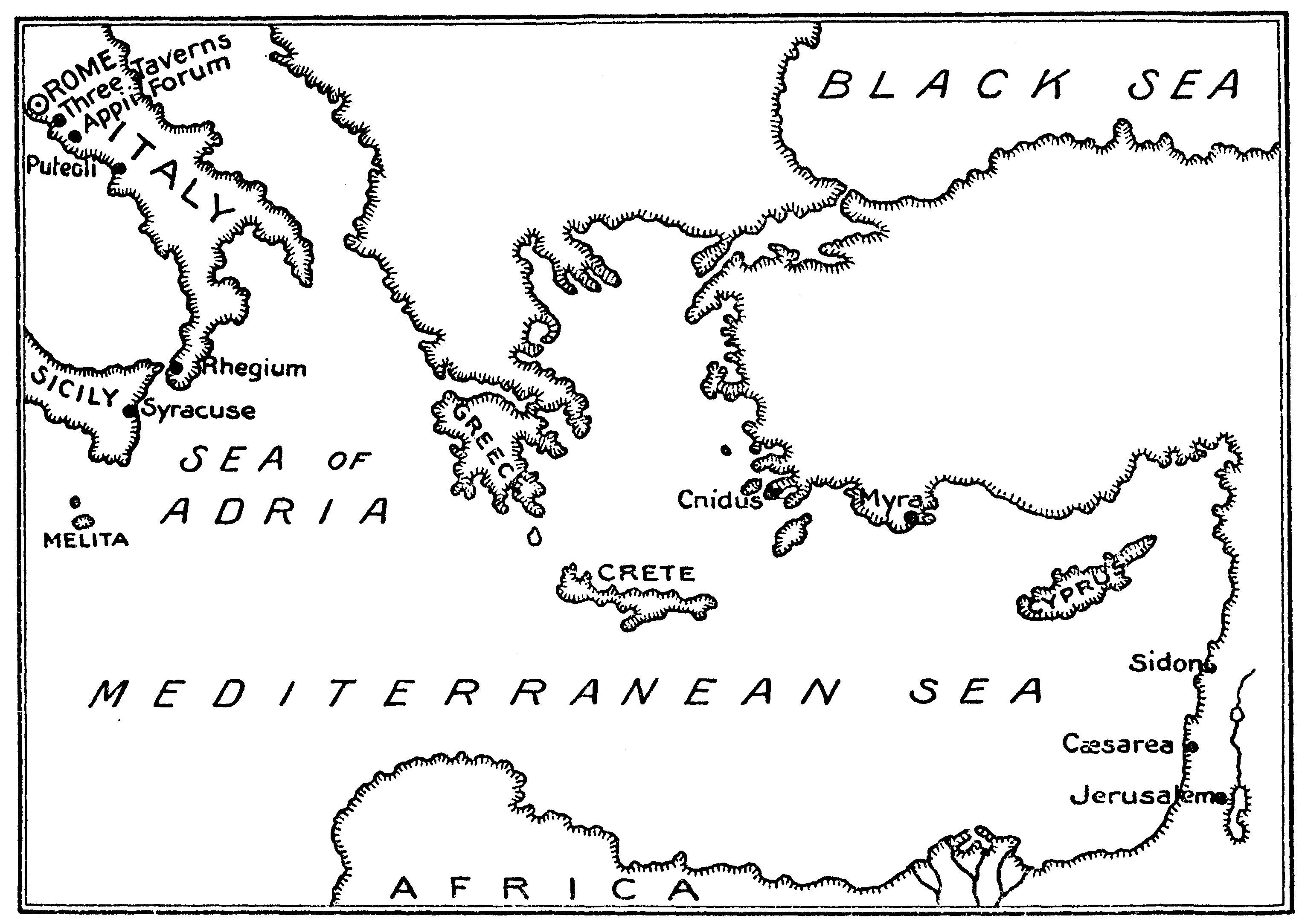
His Voyage to Rome began with arrest in Jerusalem (Acts 21:27-36). A plot to kill Paul failed (Acts 23:12-14). He was sent to Cæsarea and appeared before the Roman rulers (Acts 24, 25, 26), remaining there over two years (Acts 24:27). He suffered shipwreck (Acts 27:1-44), but reached Rome at last (Acts 28:1-31).
His Sufferings are outlined in 2 Corinthians 11:25-28.
TIME.—About A. D. 2 to A. D. 63.
PLACES.—Tarsus, Jerusalem, Arabia, Damascus, Antioch, Cyprus, Perga, Antioch in Pisidia, Iconium, Lystra, Derbe, Malta, Galatia, Troas, Corinth, Athens, Caesarea, Rome. (Details of Paul's journeys are given in the Appendix.)
SIGNIFICANCE OF EVENTS.—Paul bequeathed to his Christian posterity the record of a life unreservedly consecrated to service and a series of letters which set forth the philosophy of Christian belief in a manner that for simplicity and depth has never been surpassed.
Paul—Persecutor and Preacher
159. His Birthplace.—Saul was born in Tarsus in Cilicia, which was one of the university cities of that day. Unlike John the Baptist, therefore, Saul was a city-bred man, and this urban influence is seen in the illustrations of truth that he loves to use. They deal largely with city life. The influence, too, of a city is apparent in his mental make-up, for no one like Saul could be brought up in a university town without feeling the influence of his environment.
160. His Age.—Exactly when he was born is not known. But all seem to agree that it was about the same time as our Lord, so that when Jesus was playing in the streets of Nazareth, Saul may have been playing in the streets of Tarsus. His parents evidently intended that he should be a rabbi, but before he went to Jerusalem, there to continue his studies, they had him learn the trade of a tentmaker (Acts 18:3). This trade was most useful to him in later days (1 Cor. 4:12). In Jerusalem he was under the instruction of a noted teacher named Gamaliel, (Acts 5:34), and Saul names him as his teacher in Acts 22:3.
161. He comes before us first in the stoning of Stephen, where he cares for the garments of those who did the actual stoning of the first martyr. Then for a while he stands to the forefront in the bitter persecution of the new and hated sect of the Nazarene. For the fearful work that he did in Jerusalem read Acts 8:3, and Acts 9:1; for similar work done elsewhere also Acts 26:10, 11. How widely he was soon known as a ruthless persecutor we learn from Acts 9:13. On account of all this he was the most feared man in the world by all believers.
162. His miraculous conversion took place on the way to Damascus on an errand of persecution. Of this we have one narrative given by Luke, and two given by the Apostle himself. (Acts 9:1-22; Acts 22:3-13; Acts 26:9-18). From the moment of his conversion, Saul was a changed man. That which he hated before he now loved, and for the sake of his newly found Master he was willing to suffer all the persecutions that he himself had up to that time meted out to others. As a consequence of his preaching in Damascus he was obliged to flee, and he went at once to Arabia (Gal. 1:15-17), where many think that he spent three years in the vicinity of Mount Sinai, where Moses and Elijah had learned so much. It may be also that before he comes to the front in the story told by Luke, he was in Syria and Cilicia, as mentioned in Galatians 1:21.
163. In connection with the revival in Antioch, he is introduced by Barnabas, who went to Tarsus and got him to aid him in his work (Acts 11:25, 26). Here the Apostle remained for about one year, doing grand work for the church in that place. As we have seen in our lesson on the Acts, this was the church which organized the first missionary work, and sent Paul and Barnabas as their missionaries to other cities. Here begins Paul's first missionary journey (Acts 13:2). In all his work Paul aimed at cities, for he knew that there he could find men, and these were what he sought. This first journey took him to Cyprus, Perga, Antioch in Pisidia, Iconium, Lystra, Derbe, and back through Lystra, Iconium, Antioch, to Attalia, and back to Antioch in Syria. Let the scholar read the story as told in Acts 13 and 14. In Lystra it was that he and Barnabas were first deified—thought to be gods,—and not long after nearly killed by the inhabitants of that city. In Malta later on he was first taken for a murderer, and then later on deified. Paul is the only man in all the Bible history who had such varied experiences.
164. In his second missionary journey he started once more from Antioch, and together with Silas made a tour of the cities touched in his first journey. Then they went into Galatia, and so on to Troas. Here it was that the vision of the man of Macedonia came to Paul, and the result was that they crossed over to Europe. In our last lesson we saw this army of four start on their journey across the Hellespont, they being destined to bring to Europe the gospel of the grace of God. For the narrative of this journey let the scholar look up carefully Acts 15:36 to 18:22. In this tour he remained for a year and a half at Corinth. The place where he found the least persecution was Athens, and there too he found the least real seriousness. The Athenians seem to have cared too little about religion to take the trouble to persecute.
165. The third missionary journey begins in Acts 18:23, and the chief episode of this journey is that which took place in Ephesus (Acts 19, 20). In this city Paul remained for two years (Acts 19:10). Here was kindled the most remarkable bonfire that the world had ever seen, it being made up of books of incantation, that the idolaters were now willing to consign to the flames.
166. Paul's journey to Rome really begins at Jerusalem, whither he had gone to take alms to his fellow-countrymen who were in distress. Here he was set upon and arrested, and then taken to Cæsarea, where he appeared before Festus, Felix, and Agrippa. Here he was delayed for more than two years. Then he was sent to Rome on trial for his life. In this voyage the great shipwreck occurred. (For further details of this wonderful life, the scholar is referred to Dr. Stalker's Life of Paul, a most wonderful and brief setting forth of the main incidents of the life of the Apostle.)
167. In all this story of Paul's labors and sufferings there are great gaps. This is seen as soon as we compare his life, as given in the Acts, with one statement of his to the Corinthians, as given in 2 Corinthians 11:25-28. Put in parallel columns, so as to bring them out, the record is as follows:
Paul's Story Luke's Story
Five times whipped by Jews. Not one mentioned.
Thrice scourged by Romans. Only one mentioned.
Thrice shipwrecked. Not mentioned, for the shipwreck given in Acts was subsequent to those named.
A night and a day in the deep. Not mentioned.
168. A Triumphant Life.—Therefore, Paul was bound to the whipping-post eight times, and suffered shipwreck four times, while once he clung to wreckage for twenty-four hours before he could get to land. Yet in spite of all this he could exclaim, "Wherefore I take pleasure in weaknesses, in injuries, in necessities, in persecutions, in distresses, for Christ's sake: for when I am weak, then am I strong" (2 Cor. 12:10). And in spite of all that he suffered he could also cry out: "I have learned, in whatsoever state I am, therein to be content" (Phil. 4:11). It seems to us that if the Apostle had been asked, "Where did you learn this truly wonderful lesson?" he might have replied, "The whipping-post was my academy, and mobs with clenched fists and paving-stones were my professors. Fastings and perils in the deep were my college, and my midnight vigils were kept in the inner prison. Weariness and pain were my text-books, and kings and rulers my lecturers. Chained soldiers were my room-mates, a thorn in the flesh was my monitor, and Christ the crucified was Head-master."
169. All agree that at last Paul suffered martyrdom in Rome, by being beheaded. So ended the life of the most useful man of that day, and the great leader in work among the Gentiles.
Test Questions
Where was Saul born?
What distinguished Tarsus at that day?
What trade did Saul learn, and how was it useful to him in after-life?
When does he first come before us as a historical character?
What kind of a life did he live after the martyrdom of Stephen?
Give an account of his conversion.
Where did he go from Damascus at once on his conversion?
Give the outline of his first missionary journey.
What remarkable experience did he have at Lystra?
Give the tour of his second missionary journey.
What was the principal city in which he wrought on his third journey?
Give an account of his sufferings as given in his letter to the Corinthians compared with Luke's narrative.
Where did Paul suffer martyrdom, and in what way?
Test Questions for Review
Lessons 6 to 9
1. What were the charges in the ecclesiastical trial of Jesus?
2. What in the political trial?
3. Name the persons who were present at the crucifixion.
4. Give the six truths concerning the resurrection.
5. Mention in their order the various appearances of Jesus to his disciples.
6. What other appearances may be added to these?
7. Describe the Ascension.
8. What are the six pivotal events recorded in Acts?
9. What fact in Saul's conversion is of the utmost importance?
10. What victory did Paul and Silas gain in prison?
11. Give the outline of Paul's first missionary journey.
12. Of his second.
13. Where did Paul suffer martyrdom and how?