Chapter VIII · A PLEA FOR PROTECTION
Reading edition
A Delightful Place
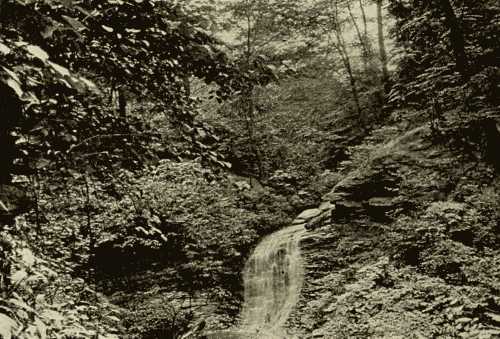
As I loiter along the banks of a sylvan stream about the first of April, looking for the return of some of the feathery tribe, there falls upon my ears a sound, hoarse and grating as described by ornithologists, but to my ears most pleasant, for it tells me that a fine bird, the belted kingfisher (Ceryle alcyon), has arrived for the season. With his crest plainly visible, in strong flight he is following the course of the winding creek. This highly original character is the only member of the kingfisher family in our part of the country. Yet there is little or no protection extended to him by law. It would be a calamity indeed if he were eliminated from the scenery of the wooded banks, the tossing rapids, and the still pool at the foot of the falls. Here the silvery spray contributes a weird touch to the scene as the “lone fisherman” hovers for an instant, then with a spiral sweep makes a plunge, disappears for a second, comes up with his finny prey, and takes his rapid flight to some old limb, where he consumes the fish at leisure. I have never heard a word against this striking bird, except on one occasion when a friend, who is the proud owner of a lily pond, complained about one of them making visits to poach on his goldfish. The legislation permitting their slaughter was passed, I presume, in the sole interest of the fisherman. Surely this stately bird should not be exterminated; its chief diet is minnows and small fry, fish rejected by the angler except for use as bait. To my mind the species is at present in serious danger of becoming extinct and should be protected.
Caught (Note the minnow in his beak.)
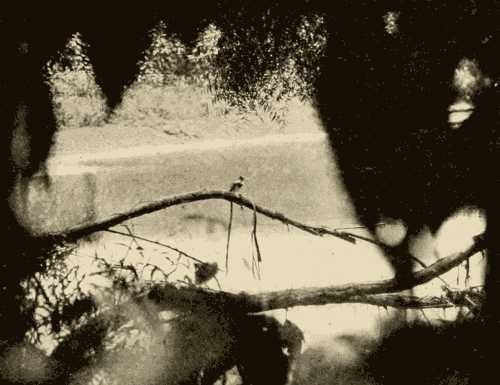
I was quite anxious to get a few pictures before he passed into history. So one bright summer day, selecting a pool previously observed to be much frequented, I constructed a blind out of boughs and weeds on the bank three or four feet away from an old root where I had seen the birds alight as they patrolled up and down the stream. Truly “the watched pot never boils.” After waiting three or four hours I heard a rattling call, a splash, and through my peephole saw his lordship perched, dripping wet, on the very spot on which I had trained the camera. The shutter clicked, but it might as well have “clacked” for he was instantly alert; I was discovered, and away went the kingfisher, rattling as though in defiance. In the short instant of his sojourn, however, my purpose was accomplished. Only the person who has had this or a similar hobby can appreciate my delight when I developed the film and found it had caught the fisherman with the small fry in his beak.
In building their nest Mr. and Mrs. Ceryle select some high embankment where they excavate a small tunnel from three to six feet long, widened at the far end into a chamber perhaps fourteen inches in diameter. Here the silvery-white eggs are deposited usually on the bare floor. They frequently build their nest in a bank whose base is washed by the waters of a stream. On one occasion we opened a hole about half its length and could see eggs in the chamber. Bridging over the excavation with sticks and leaves, we returned in about a week, opened it up, and found the old bird on the eggs incubating. We replaced the sticks and leaves without disturbing the bird, and the following week the young were hatched. We thought our opportunity to photograph a kingfisher family had arrived. As the birds were too small to remove from the nest, we left them until the next week, when they were still too young to pose well. Upon our visit a week later, the nest was to all appearances undisturbed as we had left it, but an examination disclosed that it was empty save for the partly decomposed body of a half-fledged young bird. Whether the rest of the brood had fared forth into the world and this one, a weakling or cripple perhaps, had been put to death or deserted, or whether some dire fate had fallen upon the entire household, remains to us an unsolved mystery.
Another bird that is unprotected by our law makers is the green heron (Butorides virescens). For weeks we had been studying the habits of one of these birds and had about decided on the location of a blind or ambush for photographing. One day we saw our little friend rise from the pool where we had so often found him, and take to wing with neck stretched forward and legs backward, in one continuous line. He disappeared around a bend in the stream and presently we heard the report of a shotgun. I thought, perhaps audibly, “Good-bye, little heron, good-bye!” Sure enough, in a few minutes we met a party of three or four coming towards us with their guns, and a little later came to the place where the shots had been fired. There was the object of our study floating lifeless on the surface of the water, with wings spread out, not in flight, but in death. I deplored the untimely end of the little bird. While looking at his lifeless form I was startled by the appearance of a stranger, who seemed more than casually interested. As I talked with him about the death of the heron we heard the report of a gun several times, and I have no doubt each report rang out the death knell of one of our feathered friends. The stranger proved to be an officer of the law. I was anxious to have him prosecute the person who killed the heron, but he pulled out a copy of the statute that specifically permitted the deed. I was sorry to learn that such an act had been passed. As with the kingfisher so with the heron; it is of economic value in that it devours a great number of destructive insects, as well as crayfish, small water fry, and frogs.
Of the game birds, the ruffed grouse (Bonasa umbellus) is far superior to all others and well able to take care of itself against its most deadly foe—the breech-loading shotgun in the hands of a crack shot. He is more than a match for all comers. He outwits the most carefully trained setters, and only the old dogs after years of experience can take him unawares. At times, when flushed, grouse will alight on a limb of a tall tree, squatting near the trunk, where they remain unobserved, and this ruse frequently accounts for the dogs being unable to find the bird again. An “educated” bird will ofttimes “jump” from cover, make a bee-line for a tree, pass around it and continue its flight, thus hidden from sight until beyond gun reach. I have had a staunch point along a stake and rider fence—a flush, a whirr, leaves flying in every direction, and lo! the bird in flight passes between two rails of the fence and continues on the wing up the other side until out of sight. At times I have been fairly successful, occasionally making a “double,” then again, obliged to return home after a hard day’s hunt without a single bird. Hunting grouse in western Pennsylvania is a noble sport, one that requires strong endurance, a good dog, and skillful shooting to out-general the cunning, crafty fowl, who is a problem for most hunters. How it stirs one’s admiration to see the old dog, after “rhoding” backward and forward, take a trail, follow carefully, head erect, nostrils expanded, and every nerve at its highest tension in anticipation of a point! But the bird is running and ere the point is made, a whirr at the crest of the hill draws the eye, and behold! he is a-wing, sailing over the ravine to the other ridge.
Nest and Eggs of Ruffed Grouse
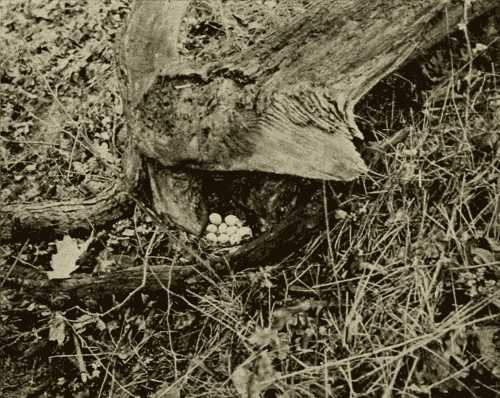
In the month of April the drumming of an old cock-bird can be heard a long way off, like the muffled beating of a bass drum, beginning soft and slow, then louder and faster until it reaches the highest pitch, and, receding, gradually dies away in the distance. He continues his love call, as some think it, for a considerable time, and if you approach carefully you may see him on an old log, strutting about like a pea-fowl, his tail expanded, erect, and in a semicircle, his head thrown back and his glossy black ruffs spread to their full extent, like the crimped and fluted adornment of the days of “Queen Bess.” About the middle of May he does not drum so much, for the courtship is over and his lady is “sitting” on the nest beside some old log, where she lays as many as fifteen creamy-white eggs in a little depression lined with a few dried leaves and grass. Their color harmonizes so nicely with the surroundings that it is almost impossible to see them. Grouse seem to understand the law of protective coloration, and will not flush from the nest until they are sure they have been discovered. Whether deliberately, I do not pretend to say, but frequently, as she rises from the nest, the hen grouse with her wings stirs the leaves so that they fall upon and partly conceal the eggs. When once disturbed she will not let you get so close again. As soon as the young are hatched they will run to hide, while the mother bird is feigning all kinds of decrepitude to attract your attention from the cute little brownish fluffs of feather scampering here and there for cover. I once knew a farmer boy who found a nest, took the eggs home, and put them under a hen. In due time they hatched out. How pretty, cute, and interesting were the little birds, and how the foster-mother strutted about, undoubtedly proud of her chicks! But ere long the little creatures, wild by nature, died for want of proper food and the maternal care required by their kind.
Quite different from the grouse in many respects is the other member of the same family, the bobwhite (Colinus virginianus), the first a woodland bird, the other a dweller in the fields. It is fascinating to follow a well trained dog as he jumps the rail fence, and if the wind is not favorable, slowly and carefully follows the fence line for fear of flushing the covey. When he gets to windward he increases his gait and “rhodes” backward and forward through the stubble until he gets a whiff of the odor so familiar to the experienced dog; then according to the strength of the scent he puts on the brakes. I have seen old Fan stop so suddenly that she turned a somersault, then recover herself sheepishly, if that term may be applied by way of accommodation to as brave a hunter as she.
Not Certain
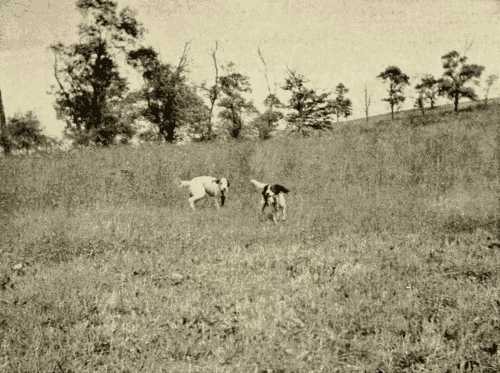
Quail are easy marks for the hunter. Usually they “roost” in a stubble field in a circle, heads outward, and thus they keep warmer during the cold weather. I have known pot-hunters to shoot into a covey in the early morning before they began to feed, killing almost every one.
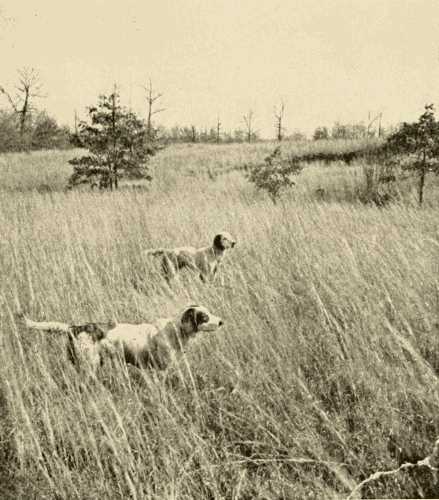
A Sure Point
Photo by W. S. Bell
It is rare sport to start out with the dogs on a November morning after a fall of snow, light, but sufficient to show the footprints—three toes in front, one behind. By this time the birds are strong of flight and at their best. After “heeling” the dogs, the trail is followed. The birds will separate and run hither and thither, always, however, coming together again so that their tracks cross and recross each other over the field. Snow always makes the birds wild, and invariably when feeding they will take to flight long before the dogs are near enough to make a point. A good dog takes the stubble field with the wind in his favor. Getting a fresh scent as the birds are feeding he throws his head and tail in the air and “rhodes” on. Occasionally the bird will run a short distance before taking to wing; then the dog shows his lack of training by running helter-skelter as the hunter shouts, “Steady, steady, old girl!” or “old boy”; or if well trained, the noble fellow returns with his tail between his legs, as much as to say to his master: “It was not my fault they wouldn’t lie to cover; it wasn’t my fault; give me another chance!” The humane master cautions his dog to be careful; the brute probably kicks his dog unmercifully, and all because of lack of knowledge on his part. If he had understood his dog he would have known from its actions that the birds were feeding in the cornfield where there was not much shelter, and that if time had been given them they would have found cover and the old dog would have made a beautiful point. The birds in the beginning of the open season will not make a long flight, but pitch abruptly over handy cover, such as an old fence grown with briars, elder, and grass. The dogs follow the windward side with nostrils dilated and the delicate membrane of their olfactory nerves detects the whereabouts of the little feathered creature concealed in a tuft of grass or a bunch of leaves. When the briars are real thick occasionally the little bird does not take to wing easily, but in great alarm runs about, neck extended, tail expanded, and crest erect, calling “peep, peep,” as though loath to leave cover.
Orchard Nest of Mourning Dove
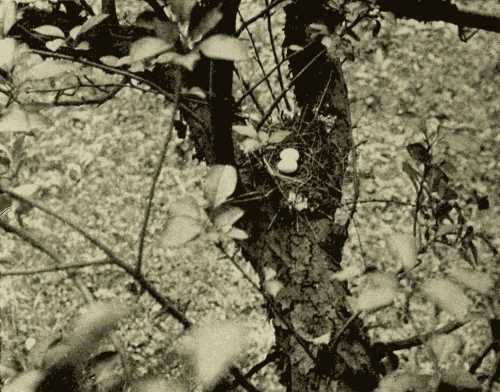
Frequently when the dogs are working a stubble field they put to flight small flocks of turtle doves (Zenaidura macroura). Although these are scarcely gregarious, they like to mingle together in the fall. They visit the fields to glean a few grains of corn or wheat left after the harvest. On taking to wing they make a whistling noise similar to that of a flight of American golden-eye ducks, and beat a hurried course to the top limb of some old dead tree, where they spread their fan-like tails just before lighting, then meekly turn their heads to take in the situation. Many of the birds are shot over the dogs in this way. Their flesh is considered a great delicacy by some would-be sportsmen. In the nesting time they separate in pairs through the woods, fields, and orchards, building in every conceivable place according to fancy. Measured by the usual standards, their flimsy nests are several sizes too small for the owner. When you approach their home the bird drops to the ground and feigns a crippled condition to entice you away, always careful, however, to keep just beyond your reach.
Two Little Turtle-Doves
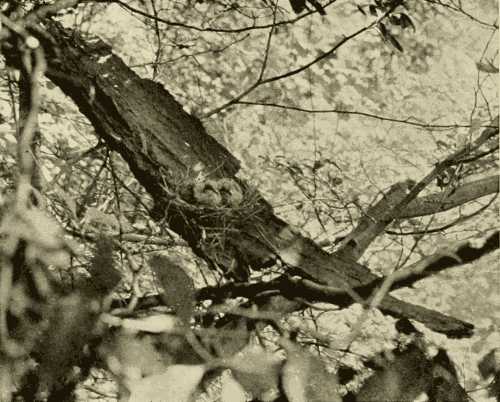
The nest shown in the accompanying photograph was happily located upon a broad slab of bark that had fallen from a locust tree and was curiously lodged some feet off the ground among the branches of undergrowth. Here a few straggling pieces of dried grass, sufficient merely to prevent the eggs from rolling off, formed the nest. To one coming up the hill after inspection of a beautifully constructed vireo’s nest in the woods below, the first impression would be that this crude affair could not be the handiwork of so neat and orderly-looking a bird as the dove on the tree nearby; but alas! fine feathers do not make fine birds, nor do good clothes make good housekeepers. No better illustration of this is needed than the sight of a dove’s nest with the eggs or young in it.
Thus in our rambles from the opening of spring until the winter snows, we come upon a great variety of feathered friends—some esteemed for their beauty, some for their flesh, some esteemed little or not at all, and yet each one has its place in the general system of creation, each one has its individuality and its own peculiar characteristics so well adapted to the sphere in which it moves. The question often comes to us: Is it for man to say that any of these birds shall be deprived of the law’s protection merely because their habits of life do not appeal to him? A brief study of the question from an economic point of view, aside from the æsthetic, leads us to hope that the time is not far distant when the several States will afford a uniform protection to all of the native fowls of the air, regardless of whether they be game birds, song birds, or “other” birds, at least until such time as a long-continued investigation will prove beyond a doubt that the restriction of the numbers of any species is of substantive value from an economic standpoint.